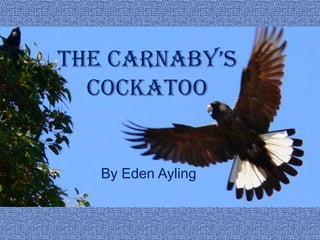
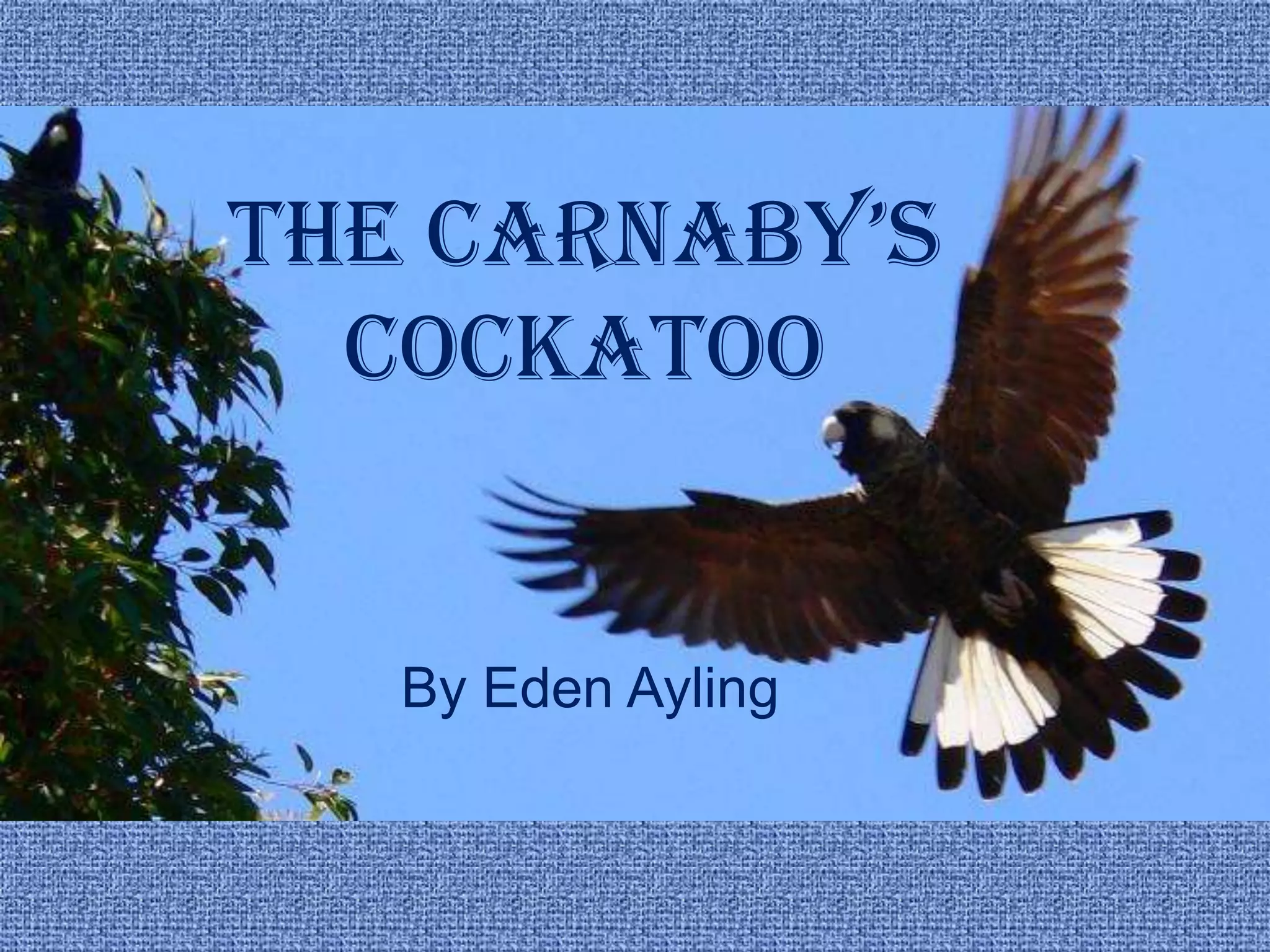
the carnaby’s
  Cockatoo


   By Eden Ayling
Introduction

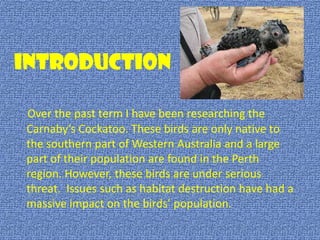
Over the past term I have been researching the
Carnaby’s Cockatoo. These birds are only native to
the southern part of Western Australia and a large
part of their population are found in the Perth
region. However, these birds are under serious
threat. Issues such as habitat destruction have had a
massive impact on the birds’ population.
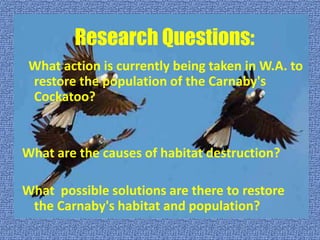
Research Questions:
 What action is currently being taken in W.A. to
 restore the population of the Carnaby's
 Cockatoo?


What are the causes of habitat destruction?

What possible solutions are there to restore
 the Carnaby's habitat and population?
The Carnaby’s Cockatoo
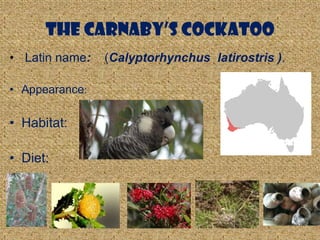
• Latin name:   (Calyptorhynchus latirostris ).

• Appearance:

• Habitat:

• Diet:
Issues and threats
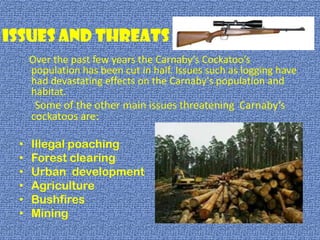
     Over the past few years the Carnaby’s Cockatoo’s
     population has been cut in half. Issues such as logging have
     had devastating effects on the Carnaby's population and
     habitat.
      Some of the other main issues threatening Carnaby’s
     cockatoos are:

 •   Illegal poaching
 •   Forest clearing
 •   Urban development
 •   Agriculture
 •   Bushfires
 •   Mining
Action being taken
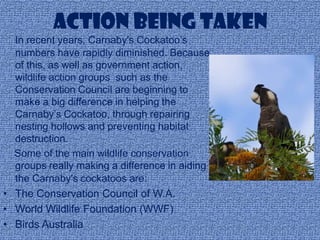
  In recent years, Carnaby's Cockatoo’s
  numbers have rapidly diminished. Because
  of this, as well as government action,
  wildlife action groups such as the
  Conservation Council are beginning to
  make a big difference in helping the
  Carnaby’s Cockatoo, through repairing
  nesting hollows and preventing habitat
  destruction.
  Some of the main wildlife conservation
  groups really making a difference in aiding
  the Carnaby's cockatoos are:
• The Conservation Council of W.A.
• World Wildlife Foundation (WWF)
• Birds Australia
Nesting hollows
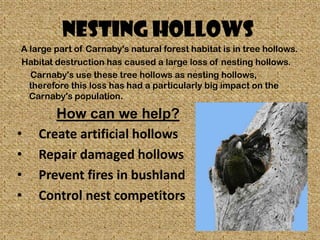
A large part of Carnaby's natural forest habitat is in tree hollows.
Habitat destruction has caused a large loss of nesting hollows.
  Carnaby's use these tree hollows as nesting hollows,
  therefore this loss has had a particularly big impact on the
  Carnaby's population.

       How can we help?
•   Create artificial hollows
•   Repair damaged hollows
•   Prevent fires in bushland
•   Control nest competitors
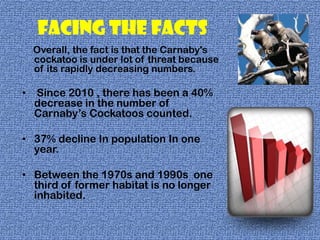
Facing the facts
    Overall, the fact is that the Carnaby's
    cockatoo is under lot of threat because
    of its rapidly decreasing numbers.

•   Since 2010 , there has been a 40%
    decrease in the number of
    Carnaby’s Cockatoos counted.

• 37% decline In population In one
  year.

• Between the 1970s and 1990s one
  third of former habitat is no longer
  inhabited.
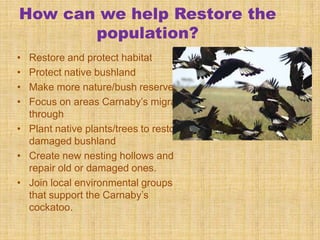
How can we help Restore the
       population?
• Restore and protect habitat
• Protect native bushland
• Make more nature/bush reserves
• Focus on areas Carnaby’s migrate
  through
• Plant native plants/trees to restore
  damaged bushland
• Create new nesting hollows and
  repair old or damaged ones.
• Join local environmental groups
  that support the Carnaby’s
  cockatoo.
References:
• http://cockatoosneedyou.org.au

• http://www.wwf.org.au

• http://www.birdsaustralia.com.au

• http://ccwa.org.au/

• http://www.dec.wa.gov.au

The carnaby’s cockatoo - Eden

  • 1.
    the carnaby’s Cockatoo By Eden Ayling
  • 2.
    Introduction Over the pastterm I have been researching the Carnaby’s Cockatoo. These birds are only native to the southern part of Western Australia and a large part of their population are found in the Perth region. However, these birds are under serious threat. Issues such as habitat destruction have had a massive impact on the birds’ population.
  • 3.
    Research Questions: Whataction is currently being taken in W.A. to restore the population of the Carnaby's Cockatoo? What are the causes of habitat destruction? What possible solutions are there to restore the Carnaby's habitat and population?
  • 4.
    The Carnaby’s Cockatoo •Latin name: (Calyptorhynchus latirostris ). • Appearance: • Habitat: • Diet:
  • 5.
    Issues and threats Over the past few years the Carnaby’s Cockatoo’s population has been cut in half. Issues such as logging have had devastating effects on the Carnaby's population and habitat. Some of the other main issues threatening Carnaby’s cockatoos are: • Illegal poaching • Forest clearing • Urban development • Agriculture • Bushfires • Mining
  • 6.
    Action being taken In recent years, Carnaby's Cockatoo’s numbers have rapidly diminished. Because of this, as well as government action, wildlife action groups such as the Conservation Council are beginning to make a big difference in helping the Carnaby’s Cockatoo, through repairing nesting hollows and preventing habitat destruction. Some of the main wildlife conservation groups really making a difference in aiding the Carnaby's cockatoos are: • The Conservation Council of W.A. • World Wildlife Foundation (WWF) • Birds Australia
  • 7.
    Nesting hollows A largepart of Carnaby's natural forest habitat is in tree hollows. Habitat destruction has caused a large loss of nesting hollows. Carnaby's use these tree hollows as nesting hollows, therefore this loss has had a particularly big impact on the Carnaby's population. How can we help? • Create artificial hollows • Repair damaged hollows • Prevent fires in bushland • Control nest competitors
  • 8.
    Facing the facts Overall, the fact is that the Carnaby's cockatoo is under lot of threat because of its rapidly decreasing numbers. • Since 2010 , there has been a 40% decrease in the number of Carnaby’s Cockatoos counted. • 37% decline In population In one year. • Between the 1970s and 1990s one third of former habitat is no longer inhabited.
  • 9.
    How can wehelp Restore the population? • Restore and protect habitat • Protect native bushland • Make more nature/bush reserves • Focus on areas Carnaby’s migrate through • Plant native plants/trees to restore damaged bushland • Create new nesting hollows and repair old or damaged ones. • Join local environmental groups that support the Carnaby’s cockatoo.
  • 11.
    References: • http://cockatoosneedyou.org.au • http://www.wwf.org.au •http://www.birdsaustralia.com.au • http://ccwa.org.au/ • http://www.dec.wa.gov.au

Editor's Notes

  • #3 Over the past term I have been researching the Carnaby’s Cockatoo, or the white-tailed cockatoo. These birds are only native to the southern part of Western Australia and a large part of their population are found in the Perth region. However, these birds are under serious threat. Issues such as habitat destruction have had a massive impact on the birds’ population. These birds are currently classified as threatened but if serious action is nor taken they may be added to the endangered list.
  • #5 Appearance: The Carnaby's cockatoo is a large black cockatoo, with white cheeks and a short bill. It has white markings on its tail feathers and a wing span of approximately 110cm.Habitat: The Carnaby's only habitat is in south-west W.A ,with a large amount of their population situated in the wheat belt and the Perth region.Diet: the Carnaby's diet consists of a variety of native and introduced plant species, as well as insect larvae. Plants include: Banksia, dryandra, grevillea, hakea and marri seeds. Introduced species include pine and cape lilac. They even feed on some weeds such as wild radish and wild geranium.
  • #6  illegal poaching and hunting of the birds commercial and industrial forest clearing Urban development and expansion Agriculture, which includes crop farming and livestock grazing. Bushfires caused by Arson or natural causes. mining including open cut mines and associated industrial developments.
  • #8 A large part of Carnaby's natural forest habitat is in tree hollows. However with logging, forest clearing and other habitat loss, Carnaby's Cockatoos have lost a very large part of that natural habitat. Carnaby's use these tree hollows as nesting hollows, therefore this loss has had a particularly big impact on Carnaby's population.How can we help? We can help by:Creating artificial nesting hollows for Carnaby's Cockatoos to nest inRepairing existing damaged or unused hollowsPreventing further illegal poaching of Carnaby's Cockatoos that may also damage their nesting hollowsPreventing fires in woodlands and forests.Controlling introduced and native nest competitors such as kookaburrasBy creating artificial hollows and repairing damaged hollows we can supply Carnaby’s Cockatoos with their natural nesting areas which, if done well, will make a big difference in aiding the Carnaby’s survival.
  • #9 A survey taken from 2010-2011 shows a 37% decline in population in the swan river region. Between the 1970s and 1990s, Carnaby’s cockatoos no longer inhabit over one-third of their former habitat and they are now extinct in many parts of the central Wheat belt.
  • #10 To help the Carnaby’s cockatoo we need to restore and protect their habitat. This can mean protecting more native bushland and making more nature and bush reserves, both in metropolitan and rural areas. Particularly in areas that the Carnaby’s are known to migrate through. We can also help by planting native plants and trees to help restore damaged bushland that may have been badly affected by bushfires or land clearing. We can create new nesting hollows and repair old or damaged ones. We can also join one of the many local environmental groups that support the Carnaby’s cockatoo.