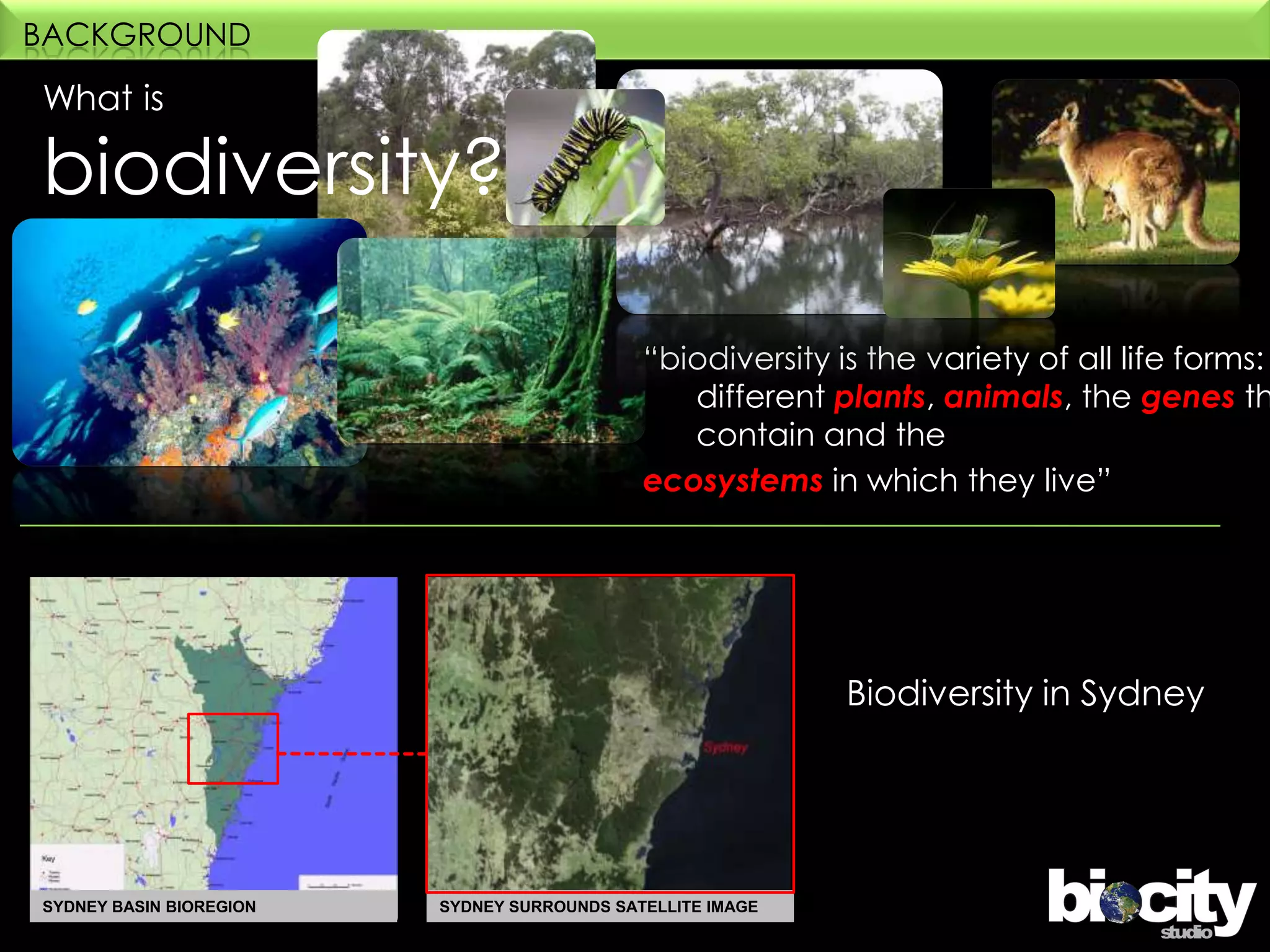
BACKGROUNDWhat isbiodiversity?“biodiversity is the variety of all life forms: different plants, animals, the genes they contain and the ecosystems in which they live”Biodiversity in SydneySYDNEY BASIN BIOREGIONSYDNEY SURROUNDS SATELLITE IMAGE
BACKGROUND=
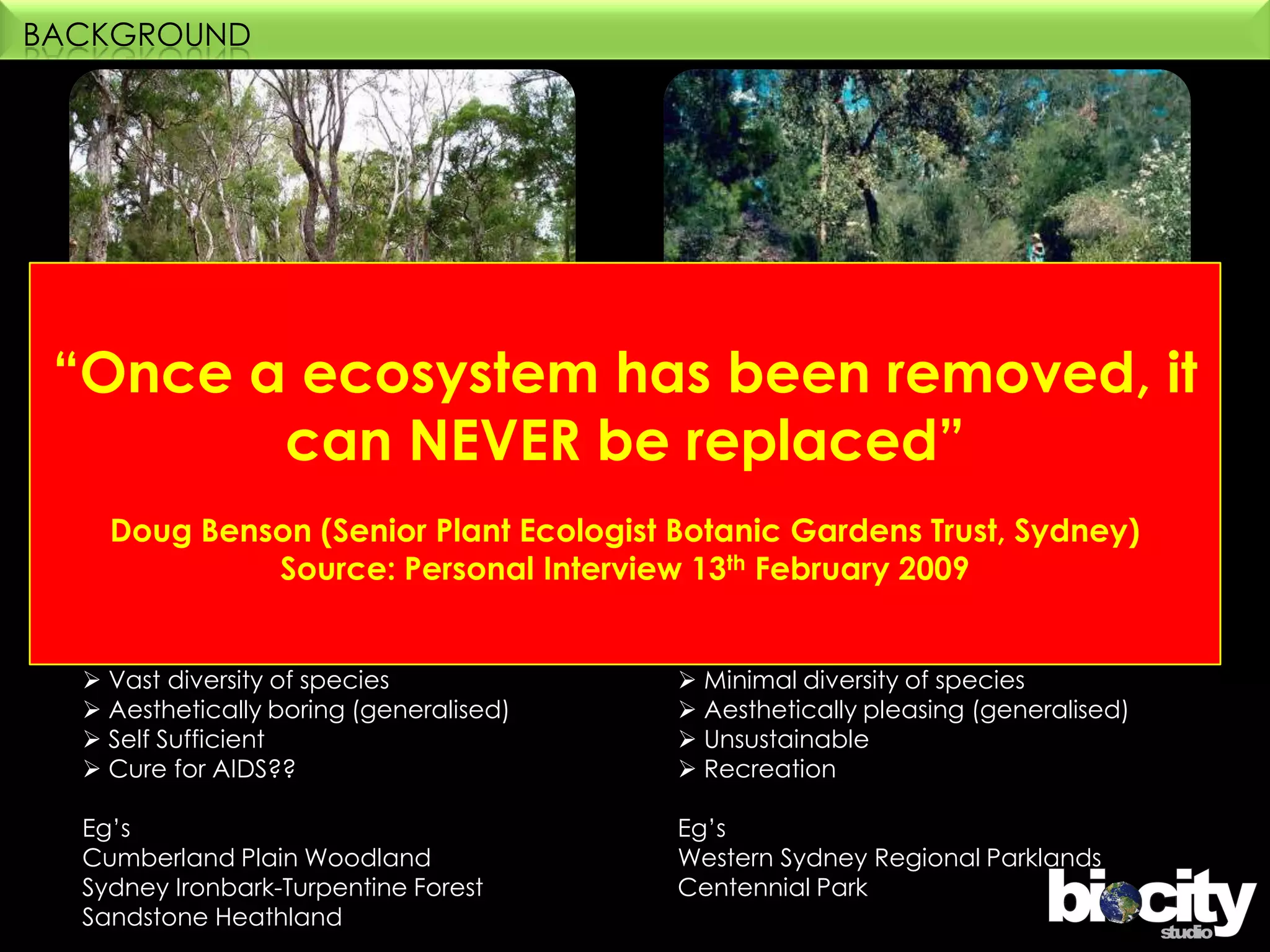
BACKGROUND“Once a ecosystem has been removed, it can NEVER be replaced”Doug Benson (Senior Plant Ecologist Botanic Gardens Trust, Sydney) Source: Personal Interview 13th February 2009Native Garden or ParkMinimal ecological value
 Intense Horticulture
 Minimal diversity of species
 Aesthetically pleasing (generalised)
 Unsustainable
 RecreationEg’s Western Sydney Regional ParklandsCentennial ParkUndisturbed Plant Community Complete ecosystem
 Remnant vegetation
 Vast diversity of species
 Aesthetically boring (generalised)
 Self Sufficient
 Cure for AIDS??Eg’sCumberland Plain WoodlandSydney Ironbark-Turpentine Forest Sandstone HeathlandWhat’s The Difference?
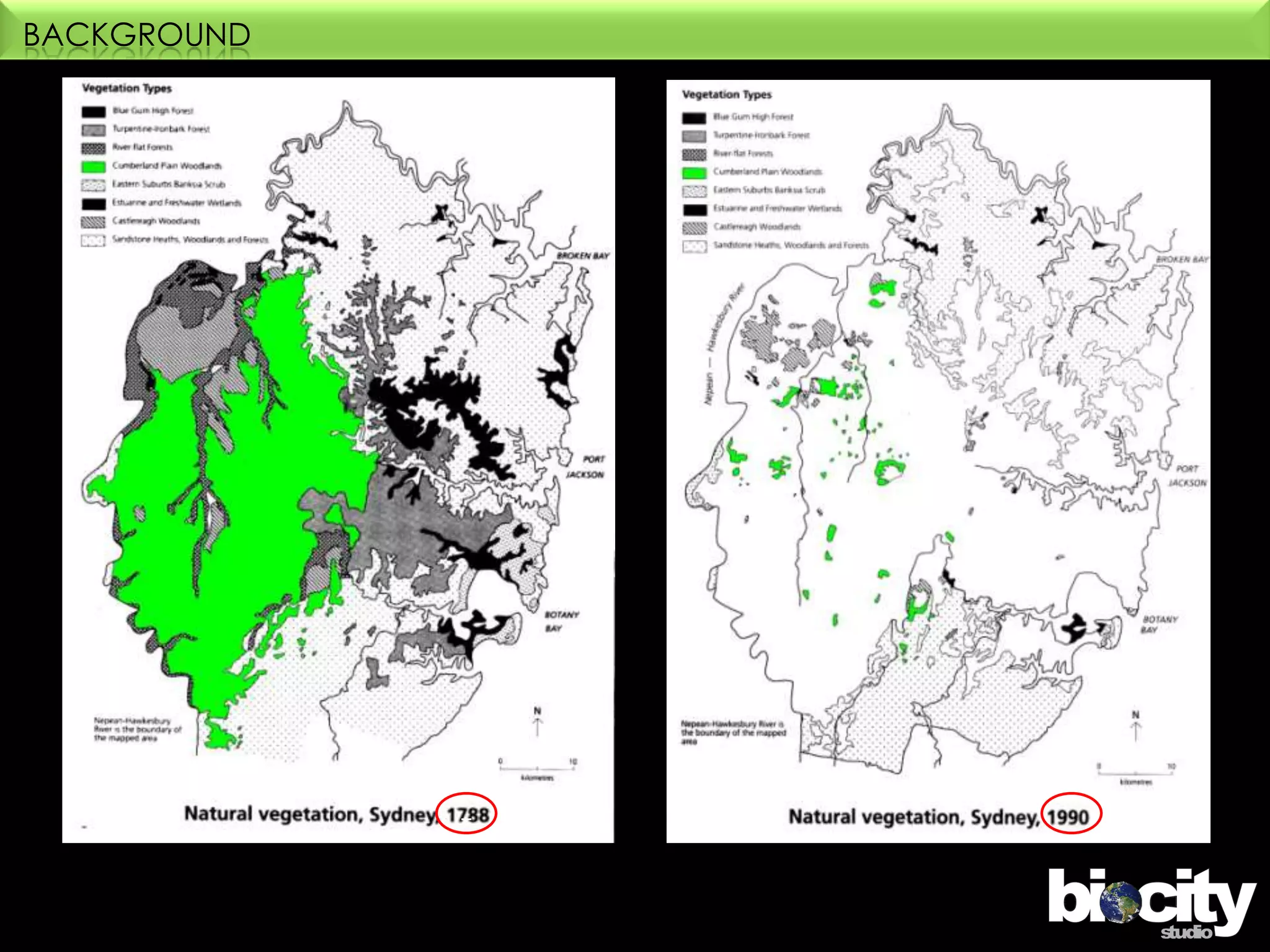
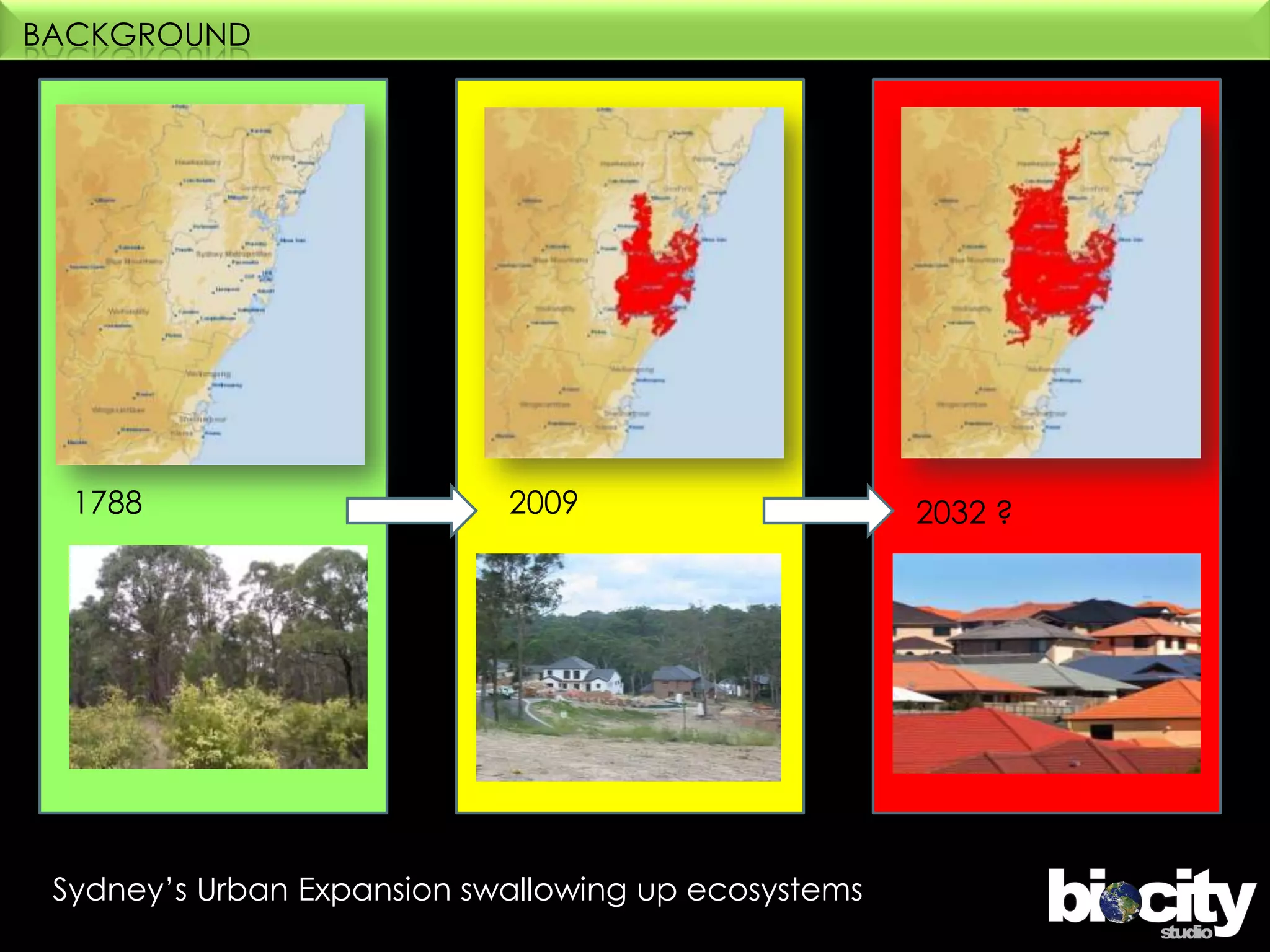
BACKGROUND178820092032 ?Sydney’s Urban Expansion swallowing up ecosystems
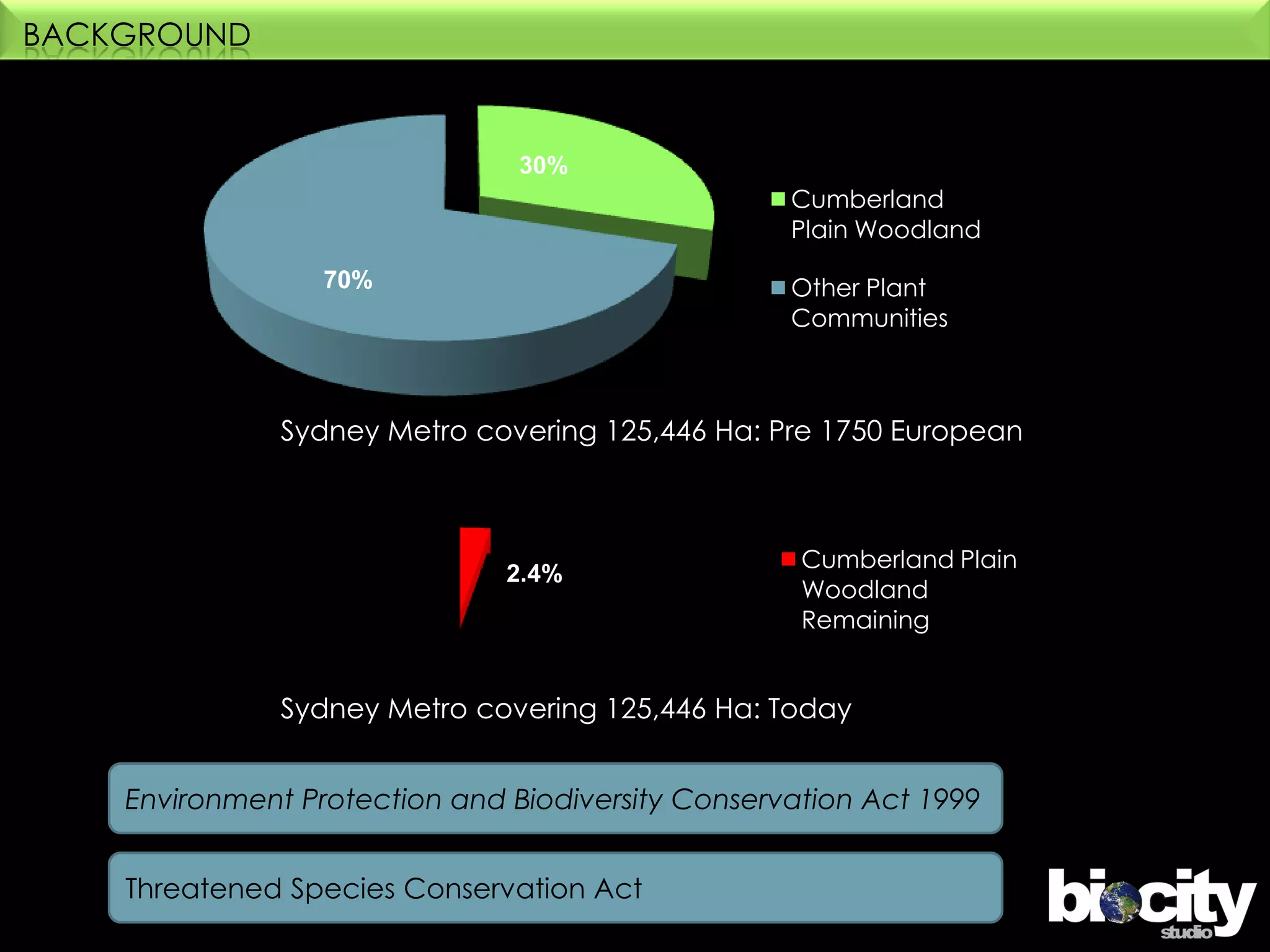
BACKGROUNDSydney Metro covering 125,446 Ha: Pre 1750 European Sydney Metro covering 125,446 Ha: TodayEnvironment Protection and Biodiversity Conservation Act 1999Threatened Species Conservation Act
SOLUTIONS

Biodiversity Gone | Biocity Studio

  • 2.
    BACKGROUNDWhat isbiodiversity?“biodiversity isthe variety of all life forms: different plants, animals, the genes they contain and the ecosystems in which they live”Biodiversity in SydneySYDNEY BASIN BIOREGIONSYDNEY SURROUNDS SATELLITE IMAGE
  • 3.
  • 4.
    BACKGROUND“Once a ecosystemhas been removed, it can NEVER be replaced”Doug Benson (Senior Plant Ecologist Botanic Gardens Trust, Sydney) Source: Personal Interview 13th February 2009Native Garden or ParkMinimal ecological value
  • 5.
  • 6.
  • 7.
  • 8.
  • 9.
    RecreationEg’s WesternSydney Regional ParklandsCentennial ParkUndisturbed Plant Community Complete ecosystem
  • 10.
  • 11.
    Vast diversityof species
  • 12.
  • 13.
  • 14.
    Cure forAIDS??Eg’sCumberland Plain WoodlandSydney Ironbark-Turpentine Forest Sandstone HeathlandWhat’s The Difference?
  • 15.
    BACKGROUND178820092032 ?Sydney’s UrbanExpansion swallowing up ecosystems
  • 16.
    BACKGROUNDSydney Metro covering125,446 Ha: Pre 1750 European Sydney Metro covering 125,446 Ha: TodayEnvironment Protection and Biodiversity Conservation Act 1999Threatened Species Conservation Act
  • 17.
  • 18.
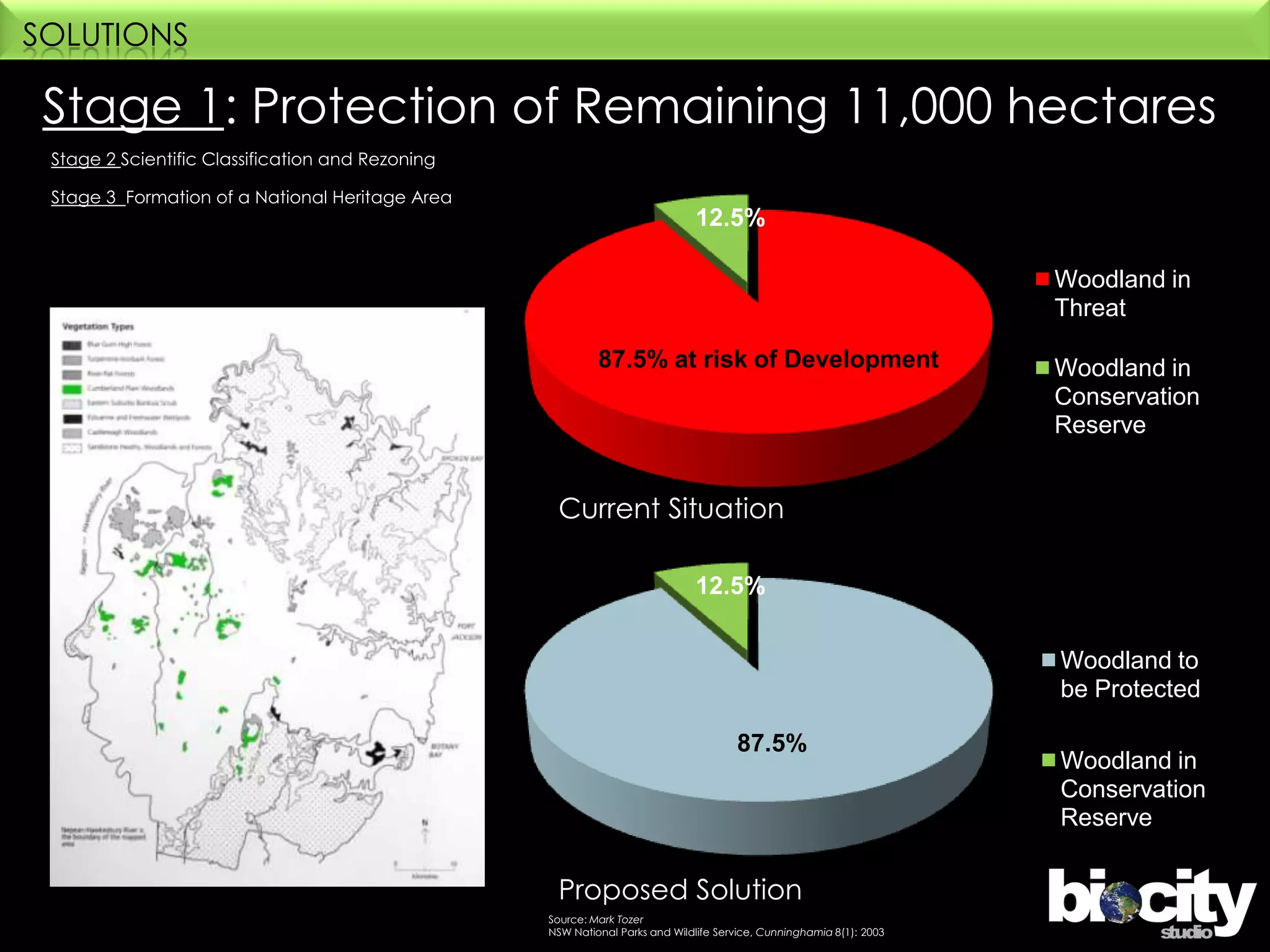
    Stage 1: Protectionof Remaining 11,000 hectares Stage 2 Scientific Classification and Rezoning  Stage 3 Formation of a National Heritage AreaSOLUTIONSCurrent SituationProposed SolutionSource: Mark TozerNSW National Parks and Wildlife Service, Cunninghamia 8(1): 2003
  • 19.
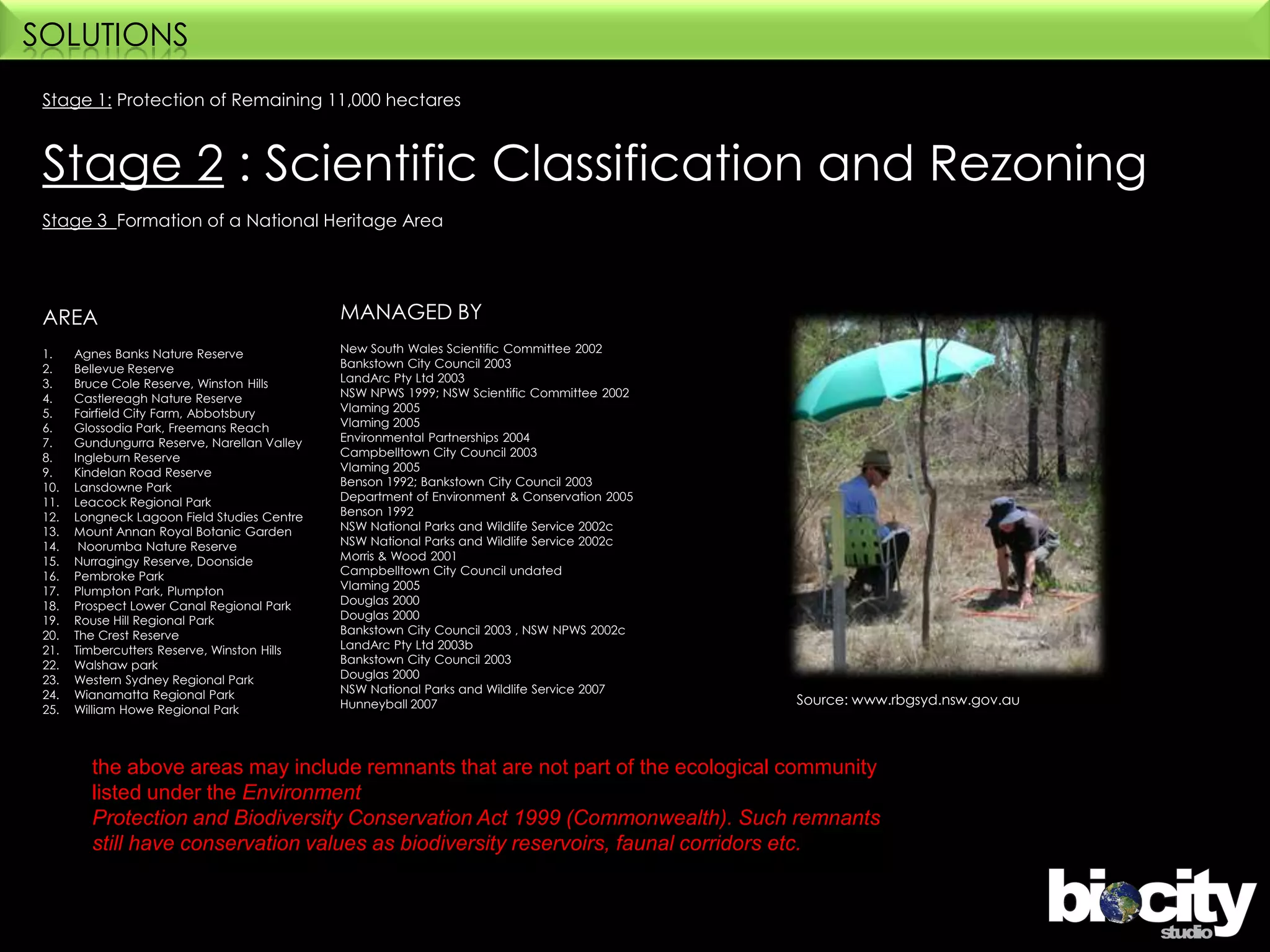
    Stage 1: Protectionof Remaining 11,000 hectaresStage 2 : Scientific Classification and Rezoning Stage 3 Formation of a National Heritage AreaSOLUTIONSMANAGED BYNew South Wales Scientific Committee 2002Bankstown City Council 2003LandArc Pty Ltd 2003NSW NPWS 1999; NSW Scientific Committee 2002Vlaming 2005Vlaming 2005Environmental Partnerships 2004Campbelltown City Council 2003Vlaming 2005Benson 1992; Bankstown City Council 2003Department of Environment & Conservation 2005Benson 1992NSW National Parks and Wildlife Service 2002cNSW National Parks and Wildlife Service 2002cMorris & Wood 2001Campbelltown City Council undatedVlaming 2005Douglas 2000Douglas 2000Bankstown City Council 2003 , NSW NPWS 2002cLandArc Pty Ltd 2003bBankstown City Council 2003Douglas 2000NSW National Parks and Wildlife Service 2007Hunneyball 2007AREAAgnes Banks Nature ReserveBellevue ReserveBruce Cole Reserve, Winston HillsCastlereagh Nature ReserveFairfield City Farm, AbbotsburyGlossodia Park, Freemans ReachGundungurra Reserve, Narellan ValleyIngleburn ReserveKindelan Road ReserveLansdowne ParkLeacock Regional ParkLongneck Lagoon Field Studies CentreMount Annan Royal Botanic Garden Noorumba Nature ReserveNurragingy Reserve, DoonsidePembroke ParkPlumpton Park, PlumptonProspect Lower Canal Regional ParkRouse Hill Regional ParkThe Crest ReserveTimbercutters Reserve, Winston HillsWalshaw parkWestern Sydney Regional ParkWianamatta Regional ParkWilliam Howe Regional ParkSource: www.rbgsyd.nsw.gov.authe above areas may include remnants that are not part of the ecological community listed under the EnvironmentProtection and Biodiversity Conservation Act 1999 (Commonwealth). Such remnants still have conservation values as biodiversity reservoirs, faunal corridors etc.
  • 20.
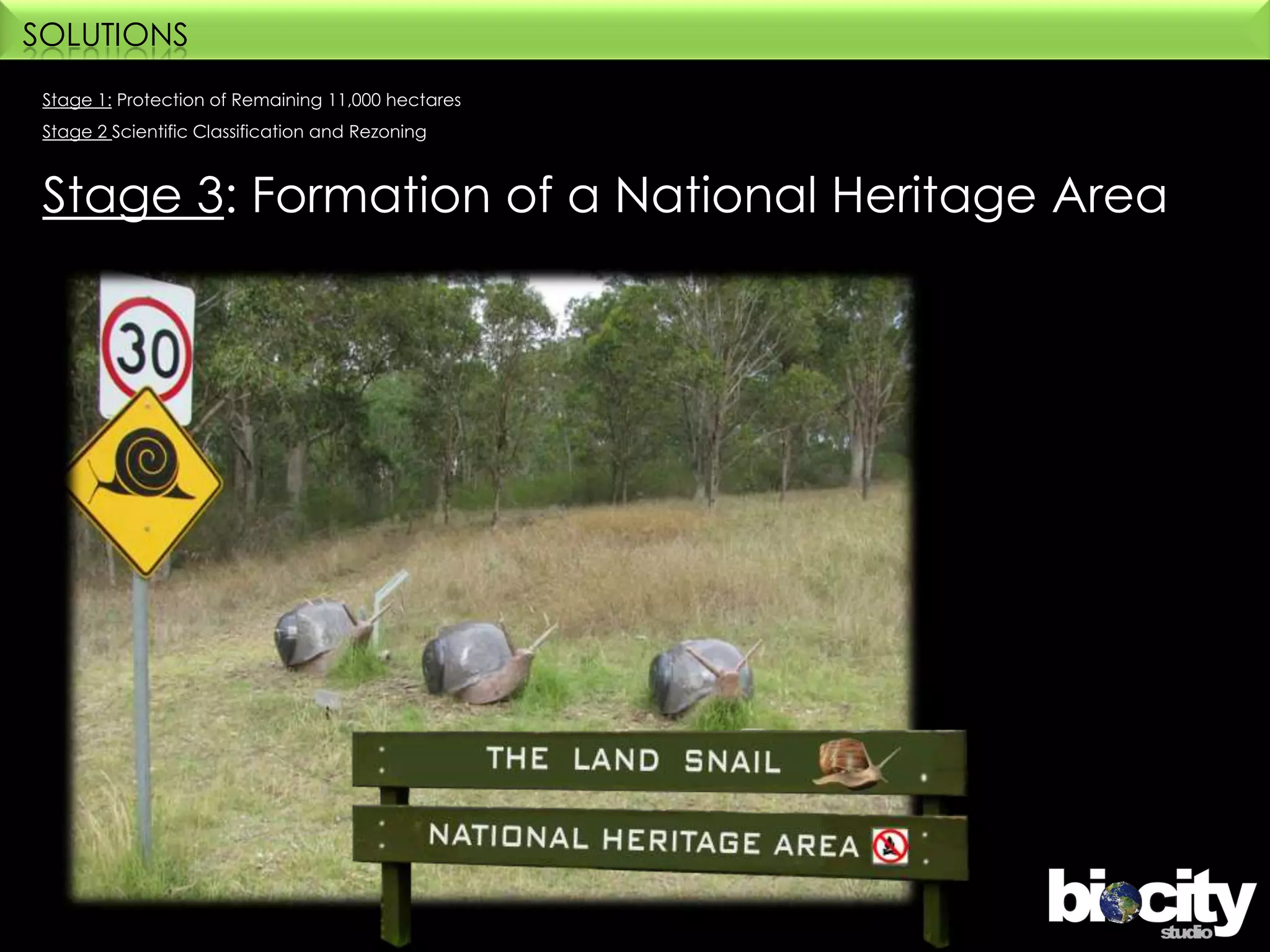
    Stage 1: Protectionof Remaining 11,000 hectaresStage 2 Scientific Classification and Rezoning Stage 3: Formation of a National Heritage AreaSOLUTIONS
  • 21.
  • 22.
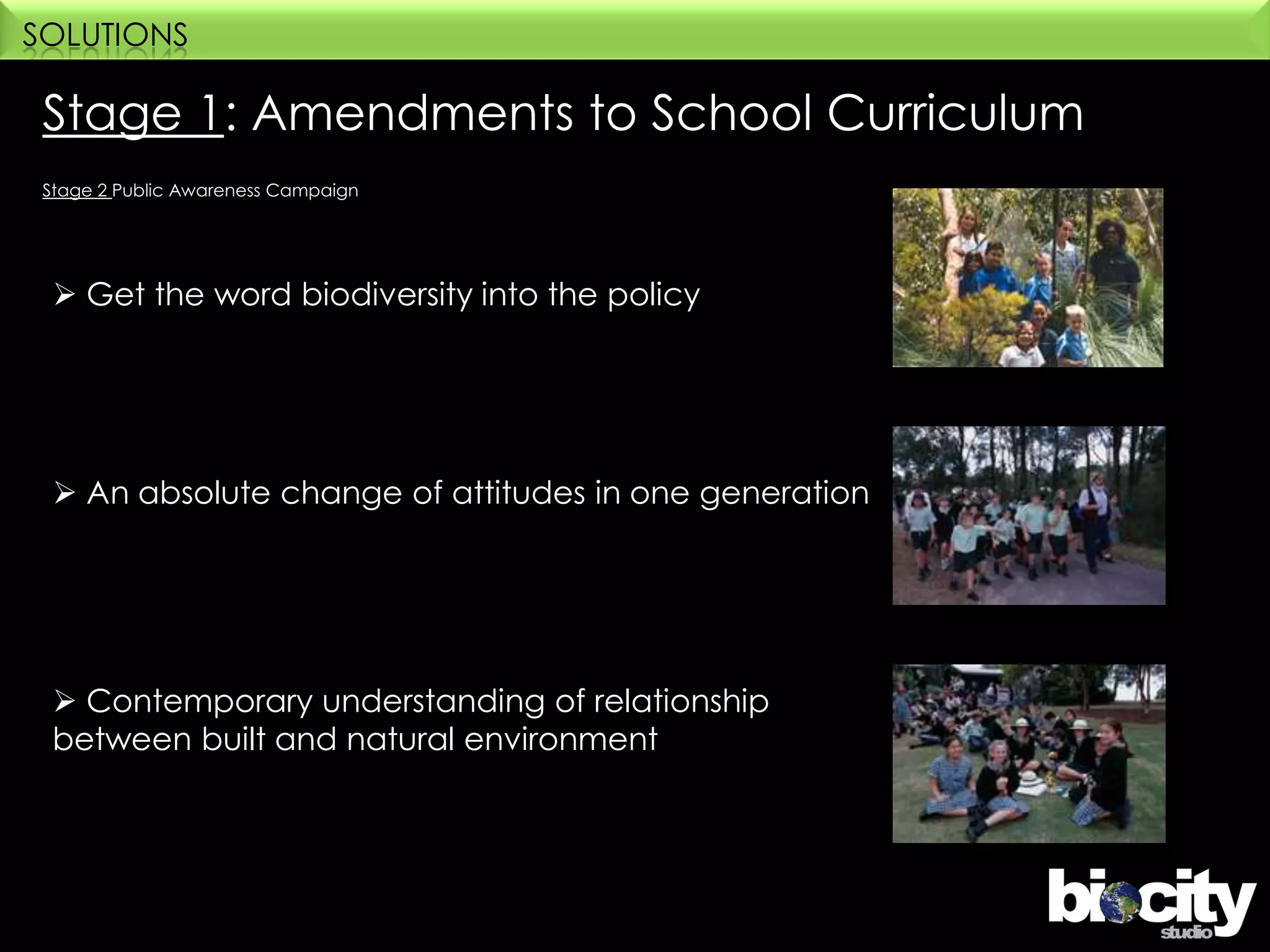
    Stage 1: Amendmentsto School Curriculum  Stage 2 Public Awareness Campaign  SOLUTIONS Get the word biodiversity into the policy
  • 23.
    An absolutechange of attitudes in one generation
  • 24.
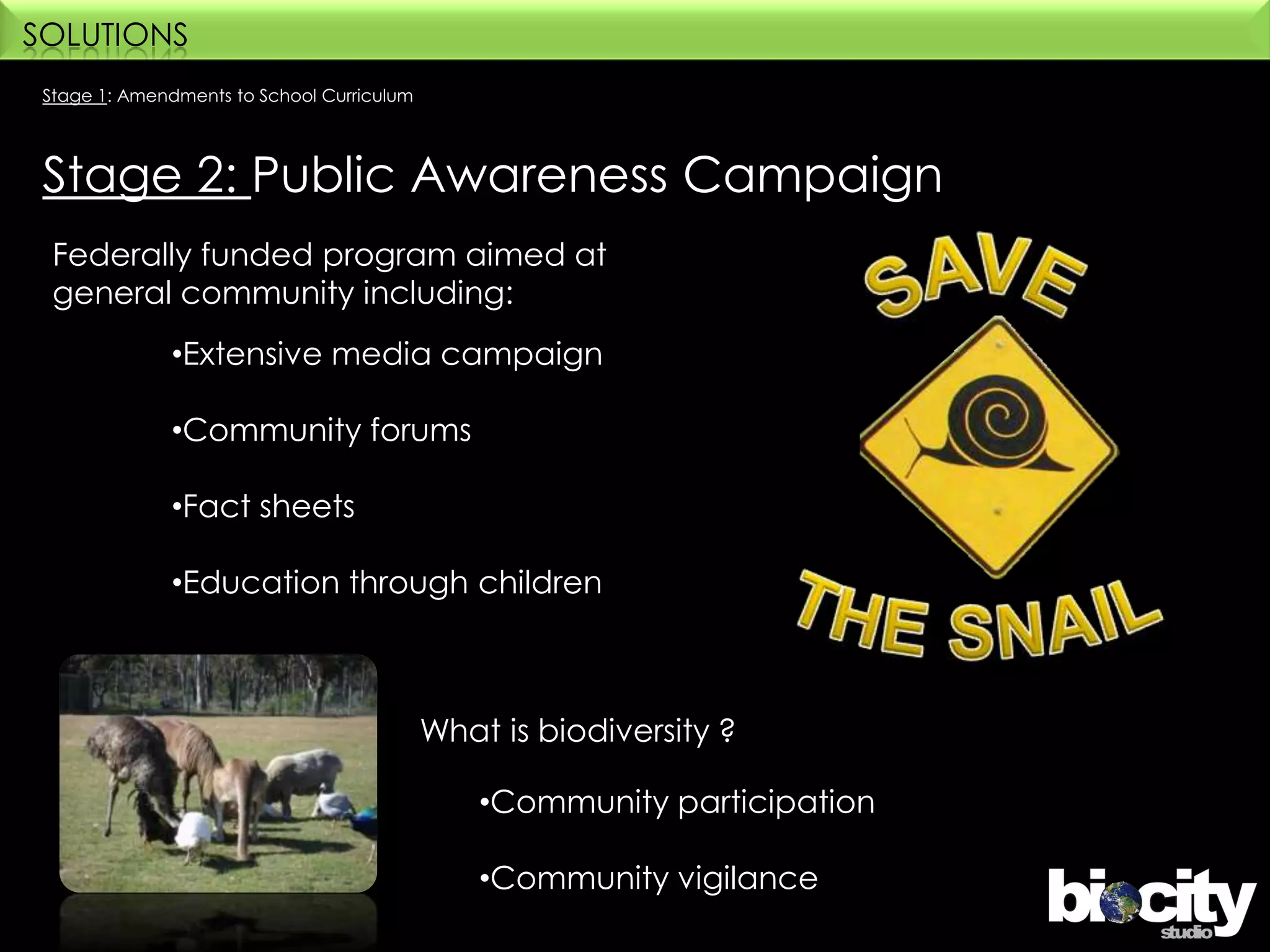
    Contemporary understandingof relationship between built and natural environmentStage 1: Amendments to School Curriculum  Stage 2: Public Awareness Campaign  SOLUTIONSFederally funded program aimed at general community including:SAVEExtensive media campaign
  • 25.
  • 26.
  • 27.
    Education through childrenTHESNAILWhat is biodiversity ? Community participation
  • 28.
    Community vigilanceCONCLUSIONSBiodiversity cannotbe replaced, once it is gone it is gone for goodIt is a design crisis, we are capable of preventing the willing destruction of bio-diverse systems through education, public awareness and community participationWe need to change our value system from one of ignorance and pure economics to one of intrinsic qualities. Our presentation is based on a local issue.. However loss of biodiversity is a regional, state, national and global issue
  • 29.
  • 30.
    Bibliography Benson, D.H. 2009,14th January. Personal Phone Interview. Senior Plant Ecologist of Botanic Gardens Trust, Sydney. Benson, D.H. & Howell, J. 1990, Taken for granted, Kangaroo Press in association with the Royal Botanic Gardens Sydney. Flannery, T. 2003. ‘Beautiful lies - population and environment in Australia’, Quarterly Essay, Black Inc., Melbourne. Flannery, T. 1994, The future eaters, Reed New Holland, Sydney.Nature Conservation Council of NSW, viewed 13th January 2009 http://nccnsw.org.au/index.php<http://www.environment.nsw.gov.au/determinations/cumberlandplainpd.htm>Flannery, T. 1994, The future eaters, Reed New Holland, Sydney.Nature conservation council, viewed 16th January 2009, <http://nccnsw.org.au> NSW Government Sydney Metropolitan Strategy 2005, Crown Copyright 2005 Personal comments, in Interview with Lotte von Richter (Technical Research Scientist, Ecology, Mount Annan Botanic Garden), recorded 16 January 2009.Personal comments, in Interview with Debra Little (Senior Horticulturist Natural Heritage, Mount Annan Botanic Garden), recorded 16 January 2009.Personal comments, in Interview with Doug Benson ( Senior Plant Ecologist Royal Botanic Garden Trust, Sydney), recorded 13 January 2009.School of Earth Sciences, viewed 16th January 2009, <arthsci.unimelb.edu.au/antarctica/plateTectonics.html>Total environment centre, viewed 16th January 2009, http://www.tec.org.auWilkins, S.,Keith, D., Adam, P., 2003 Measuring Success: Evaluating the restoration of a grassy Eucalypt Woodland on the Cumberland Plain, Sydney, Australia, Restoration Ecology Vol.11 No. 4 pp.489-503http://www.environment.nsw.gov.au/bioregions/SydneyBasin-Biodiversity.htmhttps://www.wilderness.org.au/articles/cyclehttp://www.metrostrategy.nsw.gov.au/dev/ViewPage.action?siteNodeId=81&languageId=1&contentId=557http://sydney.cma.nsw.gov.au/http://www.cityofsydney.nsw.gov.au/http://www.anra.gov.au/

Editor's Notes

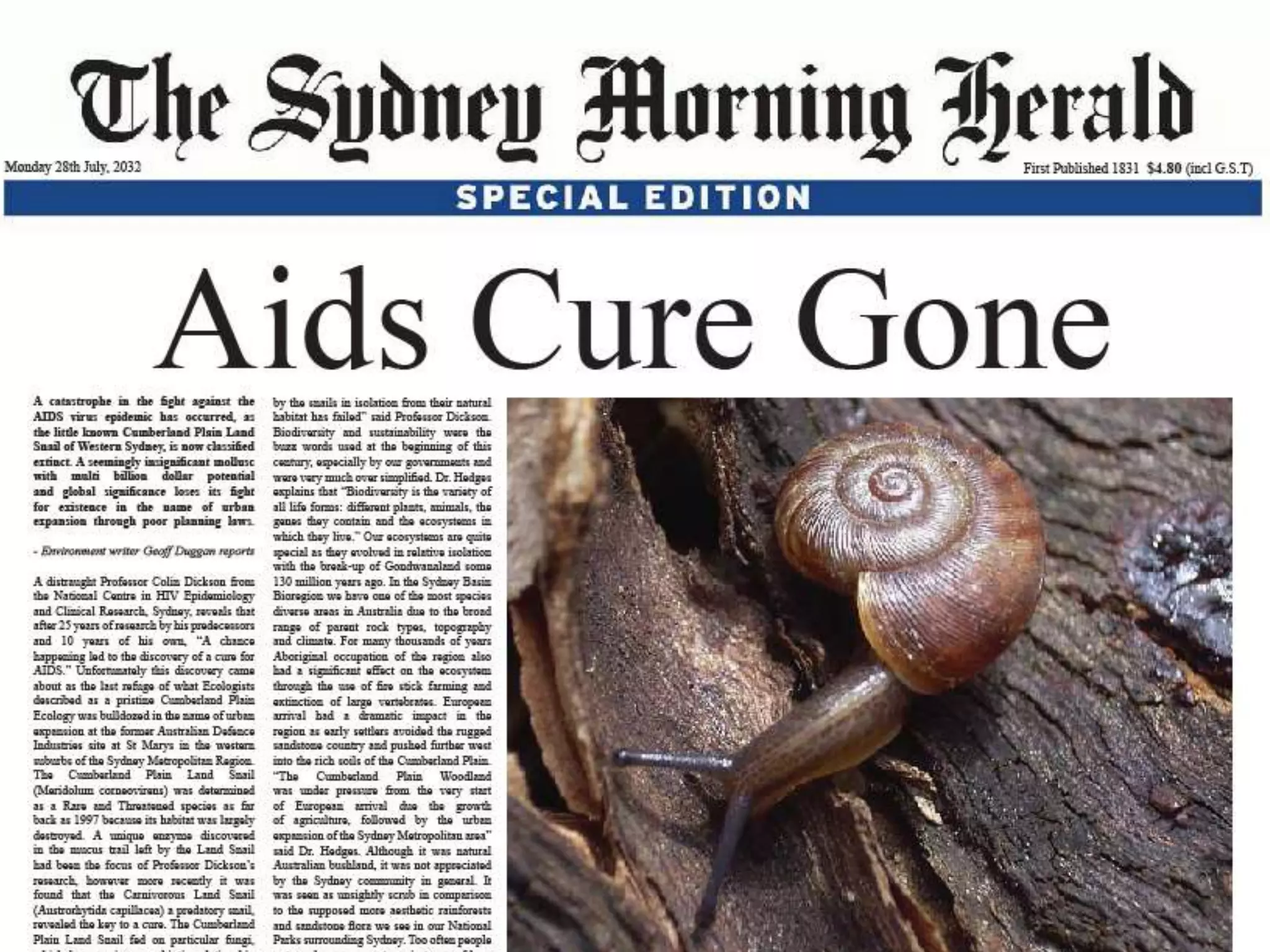
  • #2 “A catastrophe in the fight against the AIDS virus epidemic has occurred today here in Sydney. Scientists have revealed they had found a cure for AIDS only to have their discovery squandered by the extinction of the little known Cumberland Plain Land Snail of Western Sydney. This seemingly insignificant mollusc with multi-billion dollar potential and global significance has slipped from our grasp. The question as to the cause of this lost was announced by the NSW Environment Minister, as he conceded responsibility lied with the failings of planning strategies that resulted in the destruction of the vital ecosystem the snail required for survival. He singled out the old 2005 Sydney Metropolitan Strategy as a driver behind housing policy and continued land releases for development in Sydney from 2007 to 2028. An embarrassing blunder for Sydney and Australia on the world stage”.This the scenario we have foreseen in the year 2032 through loss of biodiversity. Its basis is a demonstration of the intrinsic value of a biodiverse ecosystem and that we don’t know what it is worth until it is too late. It is a story of mucus, symbiosis and predators. The mucus left in the snail trail of the rare Cumberland Plain Land snail contained an enzyme that was the focus of an AIDS cure. The snail feeds on a particular fungus growing on the roots of a tree in the CPW. A carnivorous snail then feeds on the land Snail and its excrement contains a more potent synergised enzyme that is the ultimate cure.  Unfortunately the discovery comes about in tandem as the last pristine ecology of the snails habitat is bulldozed despite assurances that ecologies can be restored by man what nature took millions of years to create. This is called biodiversity.Irony of the story: the indivual snail was only This the scenario we have foreseen in the year 2032 through loss of biodiversity. It about the web of life in a lost ecosystem and how a potential cure for the AIDS epidemic was found to be contained in the mucus of a rare Land snail which became extinct, wiped out by urban expansion.
  • #3 Definition of BIODIVERSITYbiodiversity is the variety of all life forms: different plants, animals, the genes they contain and the ecosystems in which they liveIts a resource and infrastructure for the city that we take for grantedWhat gives Sydney its character - surrounded by Natural bushland preserved in National parks, Wilderness area of the Blue Mountains, the diverse marine environment of the sea, harbour and wetlands
  • #4 Sydney basin one the most biodiverse and densely populated regions in Australia. How do we integrate population growth with biodiversity?fragmentation 
  • #5 When we refer to Biodiversity, we need to make a clear distinction between these two typologies. no consideration for invertebrates or associations between species that make it one sustainable organism.We continue to believe the bush can be re-made once it has been cleared, or we can justify its removal by compensation by making a park or replanting an area. This is far from realityEg. Western Sydney ParklandsInterview with Doug Benson a week ago
  • #6 Sydney’s obsession will suburbia. Not sustainable. Continued government land release to developers. Sydney Metropolitan Strategy: focused on the need to house 1.1million more people by 2030.
  • #7 Only last month, the NSW Scientific Committee made a preliminary decision upgrading Cumberland Plain Woodland’s status from endangered to critically endangeredSource: Nature Conservation Council NSW
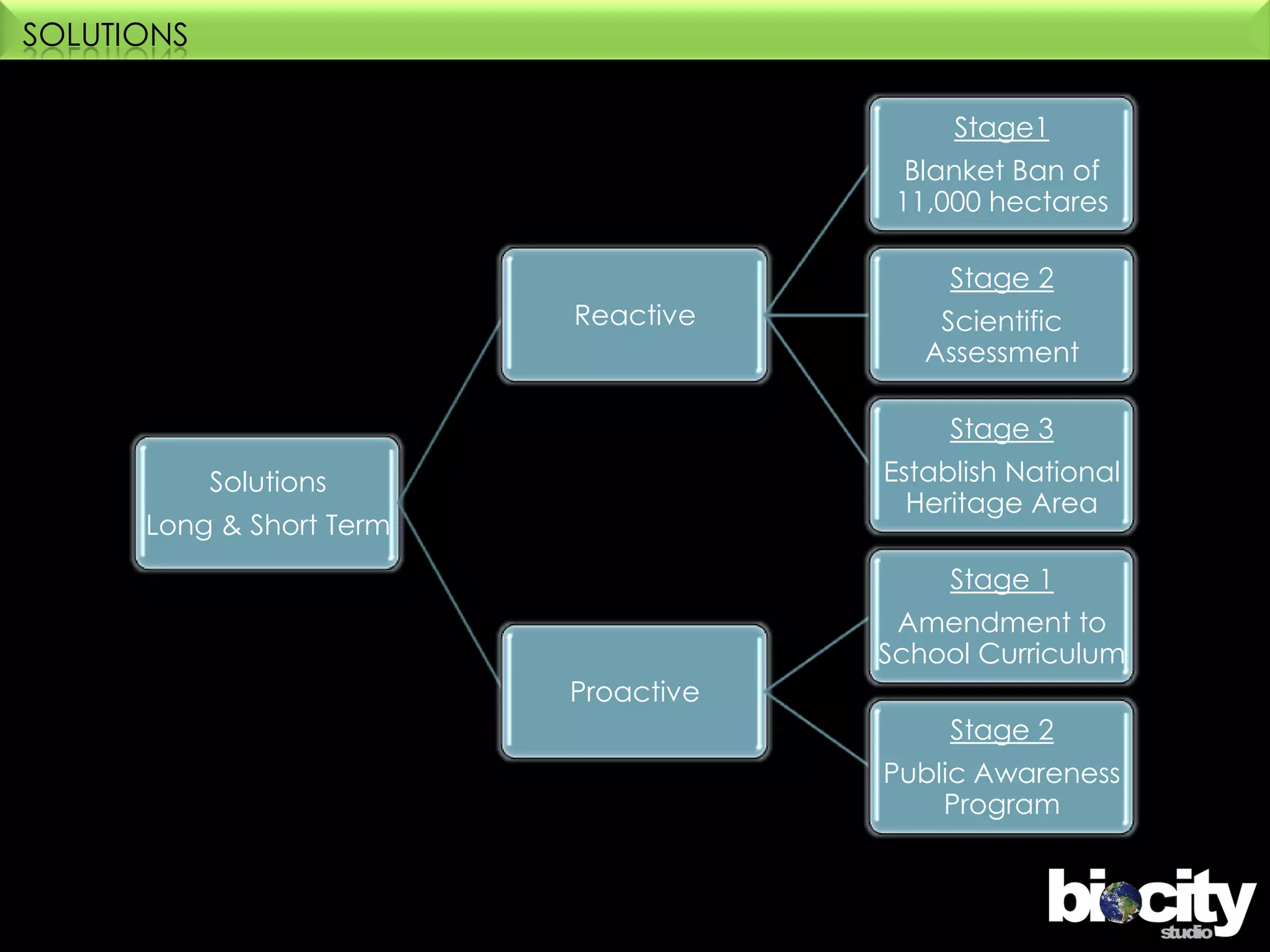
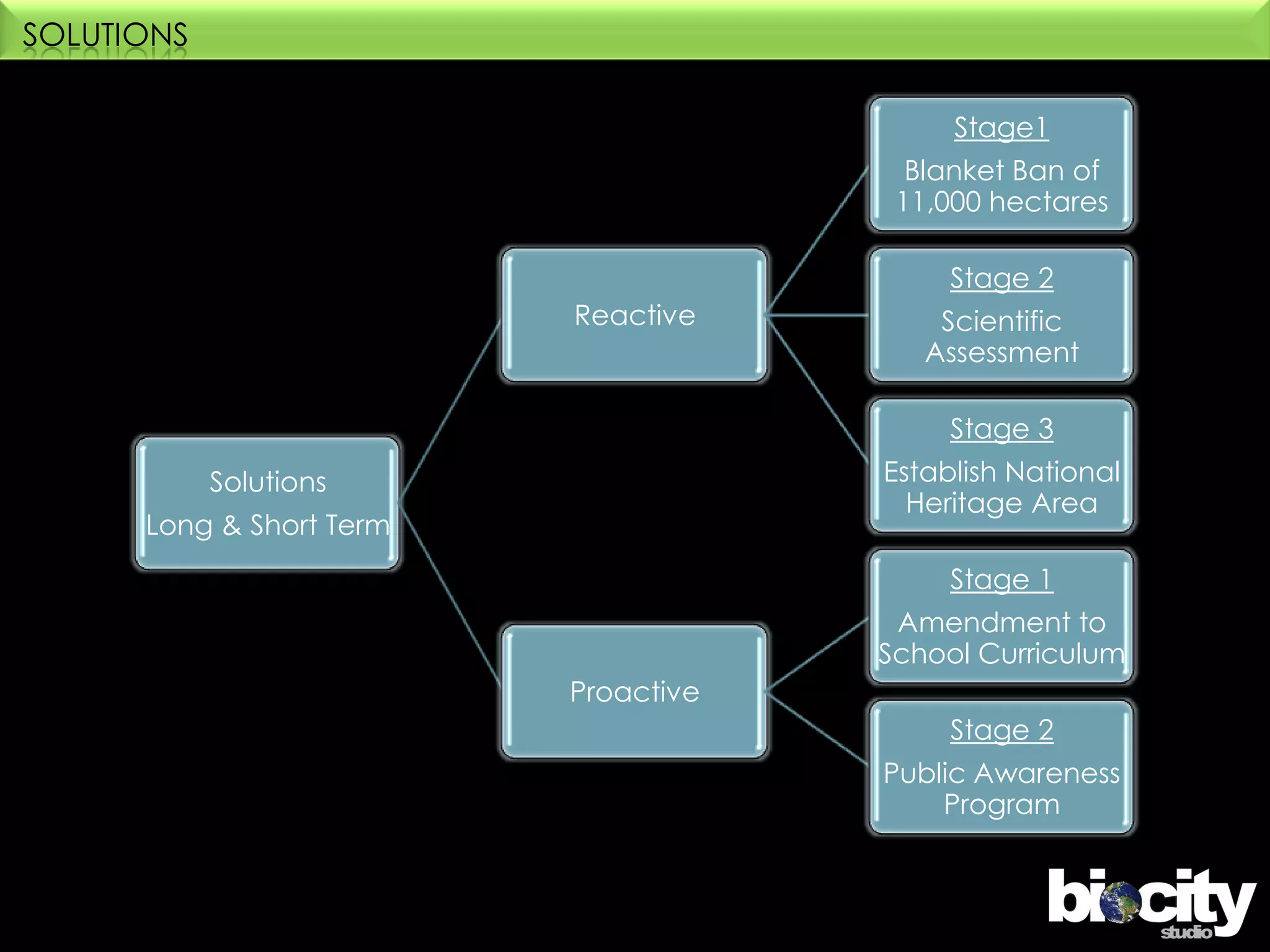
  • #9 Stage 1 Complete Protection of Remaining 11,000 hectares(Legislation will be immediately passed by the NSW Government to place an emergency protection order over all CPW areas classified as such as a precautionary measure. Any privately owned areas will be obtained by compulsory Acquisition by the Commonwealth. The New legislation will enforce stringent laws and severe penalties will be enforced on any breach. A new effective monitoring system will be devised to prosecute offenders ie. Satellite Photography documentation. Eg. Not one infringement ever issued for land clearing in NSW??
  • #10 Stage 2 Scientific Classification and Rezoning Once scientific data is available as to the level, size and integrity through of each remaining pocket of vegetation distinction can be made and each authority will be forced to relinquish all land classified as ‘to be protected’ Scientific assessment to determine exactly what areas should be combined to form a Listed National Heritage Area Scientific data will form the basis of an assessment vetted by t he NSW Scientific Committee. This will be based on scientific data not economics to determine value in terms of biodiversity
  • #11 Stage 3 Formation of a National Heritage AreaFinally the remaining Cumberland Plain Woodland areas are united to form a single National Heritage Area for the People of Australia, and a species insurance policy for never to be compromised for future generations.
  • #13 Stage 1 Amendments to the NSW Department of Education CurriculumWe know that change can be slow so our ultimate goal is to have a complete change in our value system in terms of the importance of biodiversity and its intrinsic value in one generation.Our most optimistic hope, although slow. We acknowledge that there have been great leaps forward in Environmental Education. It has come along way since Mark was at school and was non existent when I was at school. Based on our research of children and school teachers Environment and biodiversity should be pervasive in all subjects so that students will see that they are part of the environment and not separate from it.I have read the NSW government education policy and the word biodiversity is not mentioned. I guess it is the first thing we can change.Currently emphasises local actions in the context of global responsibility.Much mention is made of sustainabilityEcological sustainable developmentManagement of school groundsUse of water tanks etcHowever the word biodiversity is not mentionedMore emphasis should be put on not only the importance of the environment but the relationship between the Built Environment and the natural environment and the conflicts that can arise. Biodiversity is not just about rainforest but about all biological systems.
  • #14 Stage 2 Federally funded public awareness CampaignMore of a short term solution but, humans need to realise that we are sharing this planet. Population increase is feasible although the population will have to be confined in more medium density housing on land that has been previously disturbed through previous human impact.An informed community will realise Biodiversity is more than a rainforest, more than a menagerie of cute and furry animalsThis realisation will encourage community participation in local environmental reparation works and vigilance ensuring the protection of biodiversity in any remaining threatened habitats we have.
  • #15 ExtinctionWe are not in tune with our environment in the way so called primative indigenous communities were. Look at what we have done in the space of just over 200 years.Our presentation is based on a local issue.. However loss of biodiversity is a regional, state, national and global issue