First Nations Pedagogy For Online Learning   -  Sylvia Currie, BEd, MA  [email_address] Nicola Valley Institute of Technology - June Kaminski, RN MSN PhD(c), June.Kaminski@kwantlen.ca  Kwantlen University College ICT SUMMIT 2008
Project Summary BCcampus-funded project led by Nicola Valley Institute of Technology in partnership with Kwantlen University College.    The project proposes to:  1) research best practices in developing and implementing online learning opportunities for Aboriginal learners,  2) develop an accessible, comprehensive resource website that will support these instructors and curriculum designers, and  3) support dialogue and sharing of ideas across institutions and community stakeholders.
Why this project? online delivery of courses specifically targeting Aboriginal learners is relatively new in British Columbia and is on the increase question of what this means in terms of course design, instructional strategies, and building supportive learning communities, remains a challenge to many instructors Campus 2020: Thinking Ahead  report - by 2020 rates of Aboriginal post-secondary participation and attainment will be equal to the rates for the general population
Purpose of this Workshop This workshop will address the first phase of the project:  best practices .  Working with workshop participants we will explore effective instructional strategies and essential elements of an online course that ensure success for Aboriginal learners.
What do we mean when we say  First Nations Pedagogy? Although the notion of Pedagogy is essentially Colonial or Eurocentric in origin, it can be used to draw well-deserved attention to the distinct and noteworthy ways that Pre-Colonial education was offered and engaged in.  Distinct practices used for millennia to teach both “theory” and hands-on practical knowledge were repressed and banned during Colonization, yet the methods have endured and are both unique  and extremely valuable in the 21 st  century
Value of First Nations Pedagogy Online content that is designed using First Nations Pedagogy methods is not only valuable for aboriginal students – it would be very powerful to teach ALL students in this way BUT all aboriginal students have the legal right to be taught using these methods, no matter what educational context they are studying in In fact, the efforts to afford a liberal education for all university students is a mere whisper of the potential that First Nations pedagogy promises: a well rounded, holistic, intelligent professional.
First Nations Pedagogy Teaching in a way that learning includes:  Respectful relations,  Building on experiential learning,  Listening well,  allowing Space,  Story-telling and story-making, supporting Quaternity,  Dialogue,  Positionality, Relevance,  Reciprocity,  Reflectivity,  Elders - informed, Ecologically situated, Creative,  Visual-auditory learning space  Within a self-governance philosophy and  Natural world context.
FIRST NATIONS PEDAGOGY Pre-Colonial educational approaches are profoundly different from those of the current mainstream educational system  Holistic  (physical, mental, spiritual, emotional) growth and development of the person, Experiential learning, Oral tradition, and Student-centeredness are key elements of the First Nations pedagogical approach  Further, and of vital importance, is the  fact that it is grounded in  Spirituality
ELDERS & FORMAL EDUCATION The Aboriginal peoples of North America had their own systems of formal education prior to the arrival of Europeans – systems which were highly successful Elders possess formal knowledge and expertise Through  Orality,  the Elders provide lessons on how to go about living a proper life Elders impart tradition, knowledge, wisdom, and values
ELDERS & FORMAL EDUCATION Elders are the  carriers and emblems of  communally generated and mediated knowledge .  In the western paradigm, such relations and processes of knowledge transmission is "informal". Yet, these same processes are at the heart and soul of what is 'formal" to Indigenous knowledge.  Elders are first and foremost teachers and role models . They are vital in the teaching process, from infanthood to adulthood and beyond.
ELDERS & SOCIAL LEARNING Learning is always socially situated, socially constructed, socially produced and socially validated within social settings which exist as contextual settings.  Elders teach others about culture, tradition and about the vision of life that is contained in First Nations philosophies and handed down in ceremonies and traditional teaching.
ELDERS AND EDUCATION Native thinking processes, bodies of knowledge and structures of knowledge transmission are uniquely different from those underpinning white western institutions.  Non-formal education, informal learning and formal learning are socially organized and socially situated practices.  Obstacles to Elders' participation in formal education must be identified and overcome.  Elders are keepers of tradition, guardians of culture, the wise people, the teachers.
RESPECT Respect stems from the belief that every individual is responsible for themselves, and it is the responsibility of others to teach respect.  In the past, before European influences, First Nations people had their own social systems which addressed issues such as discipline and respect.  Respected  personal space.  Code of silence  was taught from an  early age.
RESPECTFUL RELATIONS Accept and live with other's differentness Resolve conflicts Compassion, empathy, understanding Listening well Allowing space Respecting self Respecting others Respecting nature
Pillars of First Nations Pedagogy Respect  (for self & others, nature, knowledge)  Relevance  (e.g orality)  Reciprocity  (sense-making, skill-building)  Responsibility  (provide appropriate activities)
STORY TELLING & MAKING Stories are used to illustrate, to learn, to highlight, to share traditional nuances, to bring new knowledge, and to understand the world and contexts in which we live.  Teachers need to begin to tell and make stories Learners need to feel comfortable sharing their stories vocally, in writing, in art Online stories can be applied using Journals, forums, blogs, wikis, chats
 
CIRCLE TALKS In its simplest form a circle talk: is done in a complete circle only the person holding the stick talks, all the rest listen the stick is passed around in a clockwise direction a person talks until they are finished, being respectful of time the circle talk is complete when everyone has had a chance to speak a person may pass the stick without speaking, if they so wish if desired, the stick may be passed around again what is said in the circle stays in the circle a circle is used to discuss issues of importance is extremely respectful of everyone as individuals and  what they have to say.
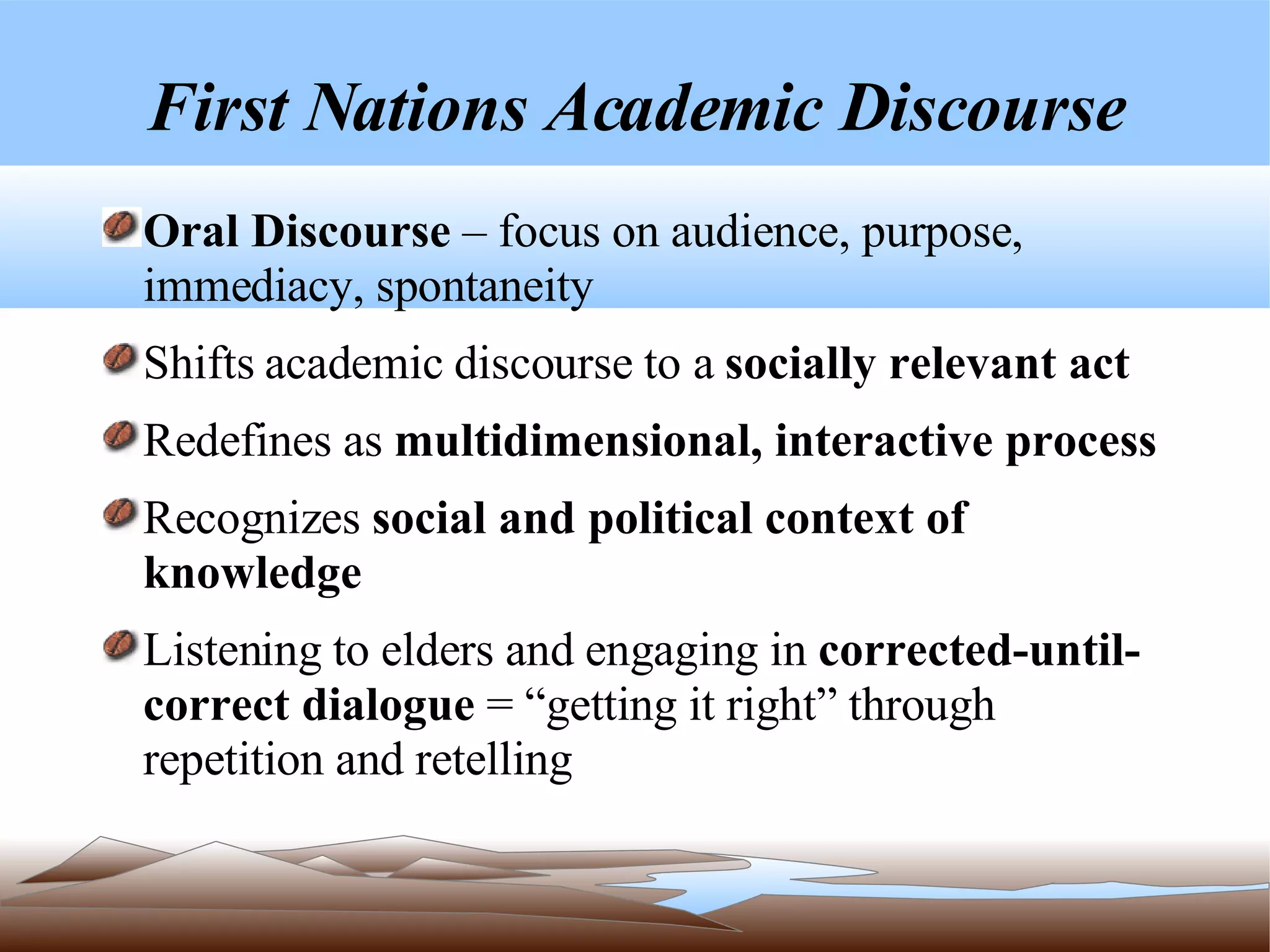
QUATERNITY Cyclically organized, repetitive, and centre-focused discursive pattern of writing that is  intrinsic to First Nations discourse:  does not conform to the classic trinity of introductory, body, and conclusion which is European, that tends to be uni-dimensional, monologic, definite,  linear, text-bound
First Nations Academic Discourse Oral Discourse  – focus on audience, purpose, immediacy, spontaneity Shifts academic discourse to a  socially relevant act Redefines as  multidimensional, interactive process Recognizes  social and political context of knowledge Listening to elders and engaging in  corrected-until-correct dialogue  = “getting it right” through repetition and retelling
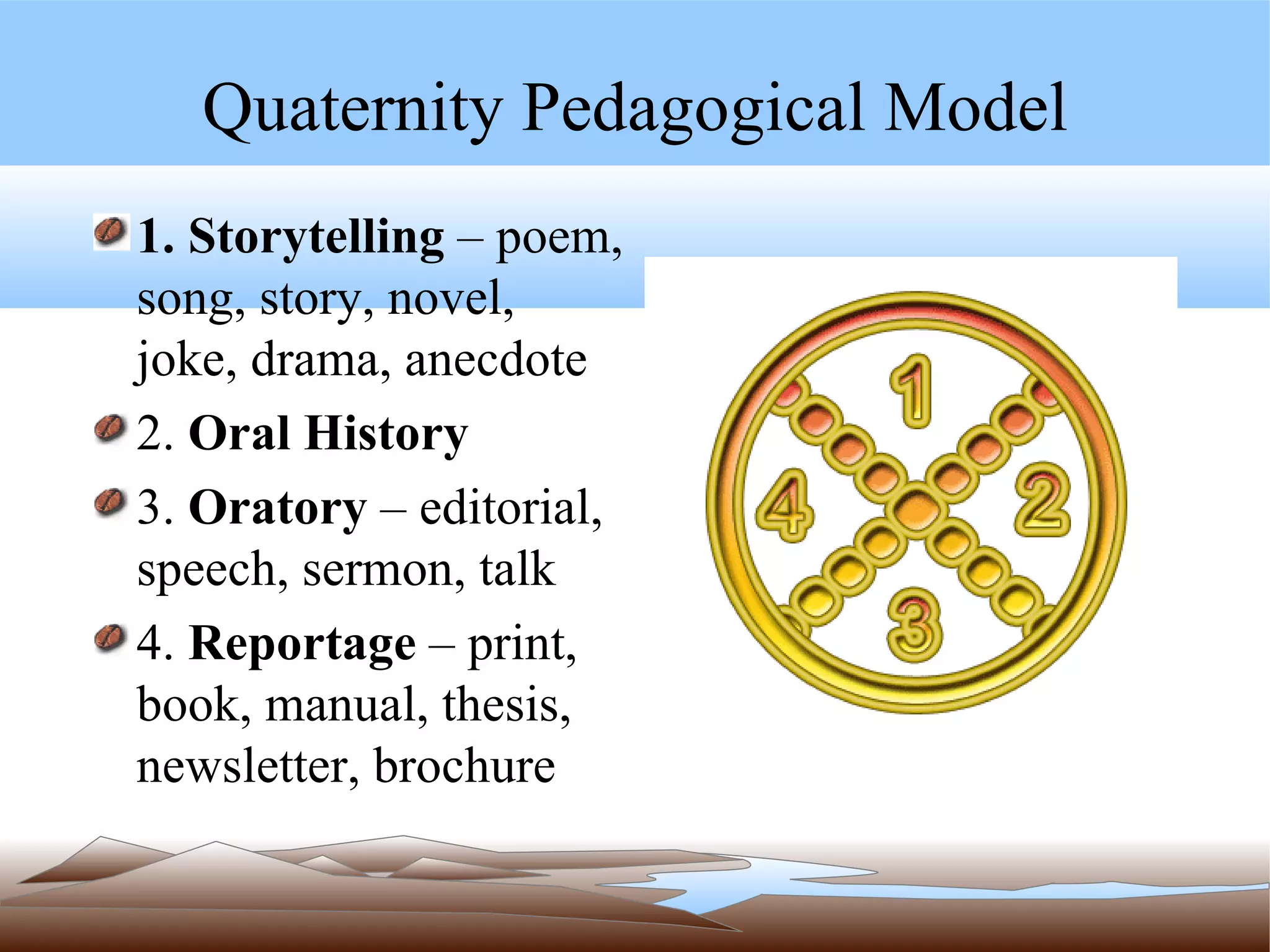
Quaternity Pedagogical Model 1. Storytelling  – poem, song, story, novel, joke, drama, anecdote 2.  Oral History   3.  Oratory  – editorial, speech, sermon, talk 4.  Reportage  – print, book, manual, thesis, newsletter, brochure
First Nations Literacy Narrative Artistic Cultural Language Need to develop culture, identity, avoid assimilation
Sacred Canopy Includes Pre-Colonial First Nations: Ideology Community Culture Land
POSITIONALITY the notion of  one's frame of reference  or positionality is one that is highly supported and advocated by various Elders who challenge the limited vision of modern Canadian education.  Our Elders tell us that we each must know who we are and how we engage and interconnect with our surroundings.
Holistic Perspective Pedagogy must be Holistic in Scope: Body  (physical) Mind  (intellectual) Heart  (relational) Spirit  (soul  centered)  Economically Sound Capacity Building
NURTURANCE OF GIFTS The nurturance of each person’s special gifts, talents and abilities so that s/he would be able to share their gifts with the community is a central tenet of Pre-Colonial teaching and learning.  Spiritual, physical, intellectual, and emotional growth was cultivated Vision Quests, Meditation, Intuition, Dreaming and Rites of Passage are all valid methods of gaining knowledge
FIRST NATIONS KNOWLEDGE is a living process to be absorbed and understood, not a commodity to possess  preference for experiential knowledge  values ability to learn independently by observing, listening, and participating preference for multiple intelligences approach  values introspection, reflection, meditation, prayer,  self directed learning is structured by language and symbolic, verbal, and unconscious order is both empirical (based on experience) and normative  (based on social values)‏
INHERENT ABORIGINAL VALUES Rights and freedoms of the individual Rights and freedoms of the group Respect for elders Respect for land and Community Respect for self Sacredness of life Spirituality Wisdom Honour and Fortitude Generosity Extended family Peace,  Harmony Acceptance Quietness, Patience, Dignity Connectedness of all living things
Seven Sacred Gifts or Teachings Given by the Creator at birth to use as medicine Respect Humility Compassion Honesty Truth Wisdom Love
Culturally Relevant Methods Circles:  full participation develops oral and aural functions: speaking and holistic listening Smudging  and  Medicine Plants/Objects Prayer/Giving Thanks Dreamwork Sweat Lodge  Ceremony Dance and Arts Vision Quests, Fasting, other Ceremonies
Important Goal: Decolonization We must be actively involved in the transformation of knowledge A Postcolonial framework can not be constructed without First Nations peoples renewing and reconstructing the principles underlying their own world-view, environment, language, and how these construct our humanity We know deep inside ourselves, the pattern of life
REFERENCES Battiste, M. (2002) Indigenous knowledge and pedagogy in First Nations education – A literature review with recommendations. Indian and Northern Affairs Canada.  Kirkness, V. J. and R. Barnhardt (2001). First Nations and Higher Education: The Four R's - Respect, Relevance, Reciprocity, Responsibility.  Knowledge Across Cultures: A Contribution to Dialogue Among Civilizations.  R. Hayoe and J. Pan. Hong Kong, Comparative Education Research Centre, The University of Hong Kong.  Pitawanakwat, J.  Informal learning culture through the life course: Initiatives in Native organizations and communities.  New Approaches to Lifelong Learning Working Paper #40-2001. Plant, P. Geoffrey. (2007) Campus2020 : Thinking Ahead : The Report. http://www.aved.gov.bc.ca/campus2020/campus2020-thinkingahead-report.pdf
Workshop Format Purpose : Phase I of the project: best practices. We will explore effective instructional strategies and essential elements of an online course that ensure success for Aboriginal learners.  Form groups Discuss topic (loosely -- tangents good!) Report out We will integrate your ideas into our project website
Discussion Topics  Related to content for the website What are the unique needs of Aboriginal learners? What are the important elements of a supportive environment for Aboriginal learners? What are some effective instructional strategies that build on the culture and values of Aboriginal learners? What are the essential elements of an online course? Related to website design What and how can people contribute to the FNP website? What would you like to take away from the FNP website? Who are the stakeholders/partners? What resources can we build on? What are the design issues and challenges?
Continue to participate More information on First Nations Pedagogy: http://firstnationspedagogy.com Participate in the online  seminar discussion  March 3-31, 2008  :  First Nations Pedagogy for Online Learners   http://scope.lidc.sfu.ca

Fn Pedagogy2008

  • 1.
    First Nations PedagogyFor Online Learning - Sylvia Currie, BEd, MA [email_address] Nicola Valley Institute of Technology - June Kaminski, RN MSN PhD(c), June.Kaminski@kwantlen.ca Kwantlen University College ICT SUMMIT 2008
  • 2.
    Project Summary BCcampus-fundedproject led by Nicola Valley Institute of Technology in partnership with Kwantlen University College.   The project proposes to: 1) research best practices in developing and implementing online learning opportunities for Aboriginal learners, 2) develop an accessible, comprehensive resource website that will support these instructors and curriculum designers, and 3) support dialogue and sharing of ideas across institutions and community stakeholders.
  • 3.
    Why this project?online delivery of courses specifically targeting Aboriginal learners is relatively new in British Columbia and is on the increase question of what this means in terms of course design, instructional strategies, and building supportive learning communities, remains a challenge to many instructors Campus 2020: Thinking Ahead report - by 2020 rates of Aboriginal post-secondary participation and attainment will be equal to the rates for the general population
  • 4.
    Purpose of thisWorkshop This workshop will address the first phase of the project: best practices . Working with workshop participants we will explore effective instructional strategies and essential elements of an online course that ensure success for Aboriginal learners.
  • 5.
    What do wemean when we say First Nations Pedagogy? Although the notion of Pedagogy is essentially Colonial or Eurocentric in origin, it can be used to draw well-deserved attention to the distinct and noteworthy ways that Pre-Colonial education was offered and engaged in. Distinct practices used for millennia to teach both “theory” and hands-on practical knowledge were repressed and banned during Colonization, yet the methods have endured and are both unique and extremely valuable in the 21 st century
  • 6.
    Value of FirstNations Pedagogy Online content that is designed using First Nations Pedagogy methods is not only valuable for aboriginal students – it would be very powerful to teach ALL students in this way BUT all aboriginal students have the legal right to be taught using these methods, no matter what educational context they are studying in In fact, the efforts to afford a liberal education for all university students is a mere whisper of the potential that First Nations pedagogy promises: a well rounded, holistic, intelligent professional.
  • 7.
    First Nations PedagogyTeaching in a way that learning includes: Respectful relations, Building on experiential learning, Listening well, allowing Space, Story-telling and story-making, supporting Quaternity, Dialogue, Positionality, Relevance, Reciprocity, Reflectivity, Elders - informed, Ecologically situated, Creative, Visual-auditory learning space Within a self-governance philosophy and Natural world context.
  • 8.
    FIRST NATIONS PEDAGOGYPre-Colonial educational approaches are profoundly different from those of the current mainstream educational system Holistic (physical, mental, spiritual, emotional) growth and development of the person, Experiential learning, Oral tradition, and Student-centeredness are key elements of the First Nations pedagogical approach Further, and of vital importance, is the fact that it is grounded in Spirituality
  • 9.
    ELDERS & FORMALEDUCATION The Aboriginal peoples of North America had their own systems of formal education prior to the arrival of Europeans – systems which were highly successful Elders possess formal knowledge and expertise Through Orality, the Elders provide lessons on how to go about living a proper life Elders impart tradition, knowledge, wisdom, and values
  • 10.
    ELDERS & FORMALEDUCATION Elders are the carriers and emblems of communally generated and mediated knowledge . In the western paradigm, such relations and processes of knowledge transmission is "informal". Yet, these same processes are at the heart and soul of what is 'formal" to Indigenous knowledge. Elders are first and foremost teachers and role models . They are vital in the teaching process, from infanthood to adulthood and beyond.
  • 11.
    ELDERS & SOCIALLEARNING Learning is always socially situated, socially constructed, socially produced and socially validated within social settings which exist as contextual settings. Elders teach others about culture, tradition and about the vision of life that is contained in First Nations philosophies and handed down in ceremonies and traditional teaching.
  • 12.
    ELDERS AND EDUCATIONNative thinking processes, bodies of knowledge and structures of knowledge transmission are uniquely different from those underpinning white western institutions. Non-formal education, informal learning and formal learning are socially organized and socially situated practices. Obstacles to Elders' participation in formal education must be identified and overcome. Elders are keepers of tradition, guardians of culture, the wise people, the teachers.
  • 13.
    RESPECT Respect stemsfrom the belief that every individual is responsible for themselves, and it is the responsibility of others to teach respect. In the past, before European influences, First Nations people had their own social systems which addressed issues such as discipline and respect. Respected personal space. Code of silence was taught from an early age.
  • 14.
    RESPECTFUL RELATIONS Acceptand live with other's differentness Resolve conflicts Compassion, empathy, understanding Listening well Allowing space Respecting self Respecting others Respecting nature
  • 15.
    Pillars of FirstNations Pedagogy Respect (for self & others, nature, knowledge) Relevance (e.g orality) Reciprocity (sense-making, skill-building) Responsibility (provide appropriate activities)
  • 16.
    STORY TELLING &MAKING Stories are used to illustrate, to learn, to highlight, to share traditional nuances, to bring new knowledge, and to understand the world and contexts in which we live. Teachers need to begin to tell and make stories Learners need to feel comfortable sharing their stories vocally, in writing, in art Online stories can be applied using Journals, forums, blogs, wikis, chats
  • 17.
  • 18.
    CIRCLE TALKS Inits simplest form a circle talk: is done in a complete circle only the person holding the stick talks, all the rest listen the stick is passed around in a clockwise direction a person talks until they are finished, being respectful of time the circle talk is complete when everyone has had a chance to speak a person may pass the stick without speaking, if they so wish if desired, the stick may be passed around again what is said in the circle stays in the circle a circle is used to discuss issues of importance is extremely respectful of everyone as individuals and what they have to say.
  • 19.
    QUATERNITY Cyclically organized,repetitive, and centre-focused discursive pattern of writing that is intrinsic to First Nations discourse: does not conform to the classic trinity of introductory, body, and conclusion which is European, that tends to be uni-dimensional, monologic, definite, linear, text-bound
  • 20.
    First Nations AcademicDiscourse Oral Discourse – focus on audience, purpose, immediacy, spontaneity Shifts academic discourse to a socially relevant act Redefines as multidimensional, interactive process Recognizes social and political context of knowledge Listening to elders and engaging in corrected-until-correct dialogue = “getting it right” through repetition and retelling
  • 21.
    Quaternity Pedagogical Model1. Storytelling – poem, song, story, novel, joke, drama, anecdote 2. Oral History 3. Oratory – editorial, speech, sermon, talk 4. Reportage – print, book, manual, thesis, newsletter, brochure
  • 22.
    First Nations LiteracyNarrative Artistic Cultural Language Need to develop culture, identity, avoid assimilation
  • 23.
    Sacred Canopy IncludesPre-Colonial First Nations: Ideology Community Culture Land
  • 24.
    POSITIONALITY the notionof one's frame of reference or positionality is one that is highly supported and advocated by various Elders who challenge the limited vision of modern Canadian education. Our Elders tell us that we each must know who we are and how we engage and interconnect with our surroundings.
  • 25.
    Holistic Perspective Pedagogymust be Holistic in Scope: Body (physical) Mind (intellectual) Heart (relational) Spirit (soul centered) Economically Sound Capacity Building
  • 26.
    NURTURANCE OF GIFTSThe nurturance of each person’s special gifts, talents and abilities so that s/he would be able to share their gifts with the community is a central tenet of Pre-Colonial teaching and learning. Spiritual, physical, intellectual, and emotional growth was cultivated Vision Quests, Meditation, Intuition, Dreaming and Rites of Passage are all valid methods of gaining knowledge
  • 27.
    FIRST NATIONS KNOWLEDGEis a living process to be absorbed and understood, not a commodity to possess preference for experiential knowledge values ability to learn independently by observing, listening, and participating preference for multiple intelligences approach values introspection, reflection, meditation, prayer, self directed learning is structured by language and symbolic, verbal, and unconscious order is both empirical (based on experience) and normative (based on social values)‏
  • 28.
    INHERENT ABORIGINAL VALUESRights and freedoms of the individual Rights and freedoms of the group Respect for elders Respect for land and Community Respect for self Sacredness of life Spirituality Wisdom Honour and Fortitude Generosity Extended family Peace, Harmony Acceptance Quietness, Patience, Dignity Connectedness of all living things
  • 29.
    Seven Sacred Giftsor Teachings Given by the Creator at birth to use as medicine Respect Humility Compassion Honesty Truth Wisdom Love
  • 30.
    Culturally Relevant MethodsCircles: full participation develops oral and aural functions: speaking and holistic listening Smudging and Medicine Plants/Objects Prayer/Giving Thanks Dreamwork Sweat Lodge Ceremony Dance and Arts Vision Quests, Fasting, other Ceremonies
  • 31.
    Important Goal: DecolonizationWe must be actively involved in the transformation of knowledge A Postcolonial framework can not be constructed without First Nations peoples renewing and reconstructing the principles underlying their own world-view, environment, language, and how these construct our humanity We know deep inside ourselves, the pattern of life
  • 32.
    REFERENCES Battiste, M.(2002) Indigenous knowledge and pedagogy in First Nations education – A literature review with recommendations. Indian and Northern Affairs Canada. Kirkness, V. J. and R. Barnhardt (2001). First Nations and Higher Education: The Four R's - Respect, Relevance, Reciprocity, Responsibility. Knowledge Across Cultures: A Contribution to Dialogue Among Civilizations. R. Hayoe and J. Pan. Hong Kong, Comparative Education Research Centre, The University of Hong Kong. Pitawanakwat, J. Informal learning culture through the life course: Initiatives in Native organizations and communities. New Approaches to Lifelong Learning Working Paper #40-2001. Plant, P. Geoffrey. (2007) Campus2020 : Thinking Ahead : The Report. http://www.aved.gov.bc.ca/campus2020/campus2020-thinkingahead-report.pdf
  • 33.
    Workshop Format Purpose: Phase I of the project: best practices. We will explore effective instructional strategies and essential elements of an online course that ensure success for Aboriginal learners. Form groups Discuss topic (loosely -- tangents good!) Report out We will integrate your ideas into our project website
  • 34.
    Discussion Topics Related to content for the website What are the unique needs of Aboriginal learners? What are the important elements of a supportive environment for Aboriginal learners? What are some effective instructional strategies that build on the culture and values of Aboriginal learners? What are the essential elements of an online course? Related to website design What and how can people contribute to the FNP website? What would you like to take away from the FNP website? Who are the stakeholders/partners? What resources can we build on? What are the design issues and challenges?
  • 35.
    Continue to participateMore information on First Nations Pedagogy: http://firstnationspedagogy.com Participate in the online seminar discussion March 3-31, 2008 : First Nations Pedagogy for Online Learners http://scope.lidc.sfu.ca