1. Suppose you have aeta pupils in your class, what steps will you take to make learning experience
   RELEVANT to his schema. Cite specific example. Your answer should be supported by sound
   theories,principles of learning and research findings pertinent to the topic.

          Many Aboriginal children are being ignored in urban classrooms and the types of behaviour
  found in Malin's (1990) study of Aboriginal children in a South Australian school is by no means the
  exception to the rule. According to Malin the children under study were ignored and invisible when
  they wanted feed-back on the work they produced. However, when they did something wrong they
  were made very visible. One interesting aspect of Malin's study was not only her observation of the
  teacher's responses to the Aboriginal children but the reaction of their non-Aboriginal peers, which
  reflected the teacher's attitudes to the Aboriginal children (Malin, 1990, p.312). The attitude and
  behaviour of the teacher in this case encourages the non-Aboriginal children to copy her and so
  reinforce and perpetuate racial discrimination and stereotypes towards the Aboriginal children, and
  Aboriginal people in general. In this manner racism is becoming entrenched into the Australian
  culture and is being transmitted from one generation to another. The Aboriginal children in this
  classroom are left with the feeling that not only is the teacher against them but whole class is as well.
  These strategies show respect for Aboriginal people and ensure that Aboriginal students feel they are
  part of the school.

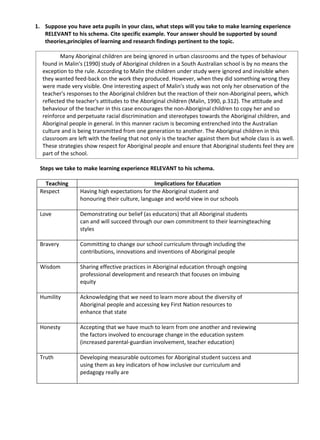
 Steps we take to make learning experience RELEVANT to his schema. for Education

   Teaching                                    Implications for Education
 Respect         Having high expectations for the Aboriginal student and
                 honouring their culture, language and world view in our schools

 Love            Demonstrating our belief (as educators) that all Aboriginal students
                 can and will succeed through our own commitment to their learningteaching
                 styles

 Bravery         Committing to change our school curriculum through including the
                 contributions, innovations and inventions of Aboriginal people

 Wisdom          Sharing effective practices in Aboriginal education through ongoing
                 professional development and research that focuses on imbuing
                 equity

 Humility        Acknowledging that we need to learn more about the diversity of
                 Aboriginal people and accessing key First Nation resources to
                 enhance that state

 Honesty         Accepting that we have much to learn from one another and reviewing
                 the factors involved to encourage change in the education system
                 (increased parental-guardian involvement, teacher education)

 Truth           Developing measurable outcomes for Aboriginal student success and
                 using them as key indicators of how inclusive our curriculum and
                 pedagogy really are
2. What is Indigenous Knowledge? Enumerate different ways how to integrate this to the state
mandated curriculum.

ANSWER:
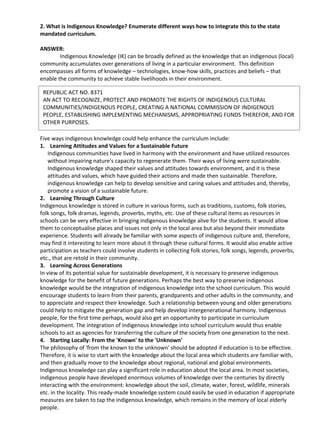
        Indigenous Knowledge (IK) can be broadly defined as the knowledge that an indigenous (local)
community accumulates over generations of living in a particular environment. This definition
encompasses all forms of knowledge – technologies, know-how skills, practices and beliefs – that
enable the community to achieve stable livelihoods in their environment.

 REPUBLIC ACT NO. 8371
 AN ACT TO RECOGNIZE, PROTECT AND PROMOTE THE RIGHTS OF INDIGENOUS CULTURAL
 COMMUNITIES/INDIGENOUS PEOPLE, CREATING A NATIONAL COMMISSION OF INDIGENOUS
 PEOPLE, ESTABLISHING IMPLEMENTING MECHANISMS, APPROPRIATING FUNDS THEREFOR, AND FOR
 OTHER PURPOSES.

Five ways indigenous knowledge could help enhance the curriculum include:
1. Learning Attitudes and Values for a Sustainable Future
   Indigenous communities have lived in harmony with the environment and have utilized resources
   without impairing nature's capacity to regenerate them. Their ways of living were sustainable.
   Indigenous knowledge shaped their values and attitudes towards environment, and it is these
   attitudes and values, which have guided their actions and made then sustainable. Therefore,
   indigenous knowledge can help to develop sensitive and caring values and attitudes and, thereby,
   promote a vision of a sustainable future.
2. Learning Through Culture
Indigenous knowledge is stored in culture in various forms, such as traditions, customs, folk stories,
folk songs, folk dramas, legends, proverbs, myths, etc. Use of these cultural items as resources in
schools can be very effective in bringing indigenous knowledge alive for the students. It would allow
them to conceptualise places and issues not only in the local area but also beyond their immediate
experience. Students will already be familiar with some aspects of indigenous culture and, therefore,
may find it interesting to learn more about it through these cultural forms. It would also enable active
participation as teachers could involve students in collecting folk stories, folk songs, legends, proverbs,
etc., that are retold in their community.
3. Learning Across Generations
In view of its potential value for sustainable development, it is necessary to preserve indigenous
knowledge for the benefit of future generations. Perhaps the best way to preserve indigenous
knowledge would be the integration of indigenous knowledge into the school curriculum. This would
encourage students to learn from their parents, grandparents and other adults in the community, and
to appreciate and respect their knowledge. Such a relationship between young and older generations
could help to mitigate the generation gap and help develop intergenerational harmony. Indigenous
people, for the first time perhaps, would also get an opportunity to participate in curriculum
development. The integration of indigenous knowledge into school curriculum would thus enable
schools to act as agencies for transferring the culture of the society from one generation to the next.
4. Starting Locally: From the 'Known' to the 'Unknown'
The philosophy of 'from the known to the unknown' should be adopted if education is to be effective.
Therefore, it is wise to start with the knowledge about the local area which students are familiar with,
and then gradually move to the knowledge about regional, national and global environments.
Indigenous knowledge can play a significant role in education about the local area. In most societies,
indigenous people have developed enormous volumes of knowledge over the centuries by directly
interacting with the environment: knowledge about the soil, climate, water, forest, wildlife, minerals
etc. in the locality. This ready-made knowledge system could easily be used in education if appropriate
measures are taken to tap the indigenous knowledge, which remains in the memory of local elderly
people.
5. Learning Outside the Classroom
Students can learn much from fieldwork in the local area. This calls for some prior knowledge and
understanding. For instance, to be able to understand the relationship between indigenous people,
soils and plants, students need to identify the plants and soil types in the local area. One way to get a
preliminary knowledge of plants and soil types in the local environment is to consult indigenous
people and invite them to teach your students in the field.
Indigenous people may also be willing to show students collections of artifacts and certain ceremonies
and explain their significance and, where appropriate, share with them particular sites of special
significance.

3. What are the reasons for attrition among indigenous children? Based your answer on research
   findings relative to the topic.

ANSWER:
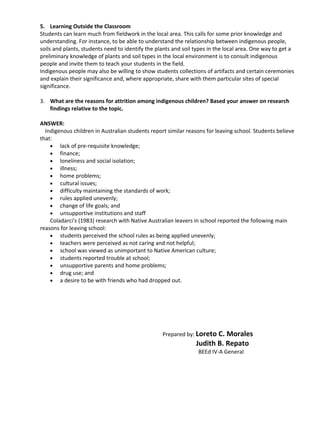
  Indigenous children in Australian students report similar reasons for leaving school. Students believe
that:
    • lack of pre-requisite knowledge;
    • finance;
    • loneliness and social isolation;
    • illness;
    • home problems;
    • cultural issues;
    • difficulty maintaining the standards of work;
    • rules applied unevenly;
    • change of life goals; and
    • unsupportive institutions and staff
    Coladarci's (1983) research with Native Australian leavers in school reported the following main
reasons for leaving school:
    • students perceived the school rules as being applied unevenly;
    • teachers were perceived as not caring and not helpful;
    • school was viewed as unimportant to Native American culture;
    • students reported trouble at school;
    • unsupportive parents and home problems;
    • drug use; and
    • a desire to be with friends who had dropped out.


                                                  Prepared by: Loreto C. Morales
                                                                Judith B. Repato
                                                                 BEEd IV-A General

Assignment in ALS

  • 1.
    1. Suppose youhave aeta pupils in your class, what steps will you take to make learning experience RELEVANT to his schema. Cite specific example. Your answer should be supported by sound theories,principles of learning and research findings pertinent to the topic. Many Aboriginal children are being ignored in urban classrooms and the types of behaviour found in Malin's (1990) study of Aboriginal children in a South Australian school is by no means the exception to the rule. According to Malin the children under study were ignored and invisible when they wanted feed-back on the work they produced. However, when they did something wrong they were made very visible. One interesting aspect of Malin's study was not only her observation of the teacher's responses to the Aboriginal children but the reaction of their non-Aboriginal peers, which reflected the teacher's attitudes to the Aboriginal children (Malin, 1990, p.312). The attitude and behaviour of the teacher in this case encourages the non-Aboriginal children to copy her and so reinforce and perpetuate racial discrimination and stereotypes towards the Aboriginal children, and Aboriginal people in general. In this manner racism is becoming entrenched into the Australian culture and is being transmitted from one generation to another. The Aboriginal children in this classroom are left with the feeling that not only is the teacher against them but whole class is as well. These strategies show respect for Aboriginal people and ensure that Aboriginal students feel they are part of the school. Steps we take to make learning experience RELEVANT to his schema. for Education Teaching Implications for Education Respect Having high expectations for the Aboriginal student and honouring their culture, language and world view in our schools Love Demonstrating our belief (as educators) that all Aboriginal students can and will succeed through our own commitment to their learningteaching styles Bravery Committing to change our school curriculum through including the contributions, innovations and inventions of Aboriginal people Wisdom Sharing effective practices in Aboriginal education through ongoing professional development and research that focuses on imbuing equity Humility Acknowledging that we need to learn more about the diversity of Aboriginal people and accessing key First Nation resources to enhance that state Honesty Accepting that we have much to learn from one another and reviewing the factors involved to encourage change in the education system (increased parental-guardian involvement, teacher education) Truth Developing measurable outcomes for Aboriginal student success and using them as key indicators of how inclusive our curriculum and pedagogy really are
  • 2.
    2. What isIndigenous Knowledge? Enumerate different ways how to integrate this to the state mandated curriculum. ANSWER: Indigenous Knowledge (IK) can be broadly defined as the knowledge that an indigenous (local) community accumulates over generations of living in a particular environment. This definition encompasses all forms of knowledge – technologies, know-how skills, practices and beliefs – that enable the community to achieve stable livelihoods in their environment. REPUBLIC ACT NO. 8371 AN ACT TO RECOGNIZE, PROTECT AND PROMOTE THE RIGHTS OF INDIGENOUS CULTURAL COMMUNITIES/INDIGENOUS PEOPLE, CREATING A NATIONAL COMMISSION OF INDIGENOUS PEOPLE, ESTABLISHING IMPLEMENTING MECHANISMS, APPROPRIATING FUNDS THEREFOR, AND FOR OTHER PURPOSES. Five ways indigenous knowledge could help enhance the curriculum include: 1. Learning Attitudes and Values for a Sustainable Future Indigenous communities have lived in harmony with the environment and have utilized resources without impairing nature's capacity to regenerate them. Their ways of living were sustainable. Indigenous knowledge shaped their values and attitudes towards environment, and it is these attitudes and values, which have guided their actions and made then sustainable. Therefore, indigenous knowledge can help to develop sensitive and caring values and attitudes and, thereby, promote a vision of a sustainable future. 2. Learning Through Culture Indigenous knowledge is stored in culture in various forms, such as traditions, customs, folk stories, folk songs, folk dramas, legends, proverbs, myths, etc. Use of these cultural items as resources in schools can be very effective in bringing indigenous knowledge alive for the students. It would allow them to conceptualise places and issues not only in the local area but also beyond their immediate experience. Students will already be familiar with some aspects of indigenous culture and, therefore, may find it interesting to learn more about it through these cultural forms. It would also enable active participation as teachers could involve students in collecting folk stories, folk songs, legends, proverbs, etc., that are retold in their community. 3. Learning Across Generations In view of its potential value for sustainable development, it is necessary to preserve indigenous knowledge for the benefit of future generations. Perhaps the best way to preserve indigenous knowledge would be the integration of indigenous knowledge into the school curriculum. This would encourage students to learn from their parents, grandparents and other adults in the community, and to appreciate and respect their knowledge. Such a relationship between young and older generations could help to mitigate the generation gap and help develop intergenerational harmony. Indigenous people, for the first time perhaps, would also get an opportunity to participate in curriculum development. The integration of indigenous knowledge into school curriculum would thus enable schools to act as agencies for transferring the culture of the society from one generation to the next. 4. Starting Locally: From the 'Known' to the 'Unknown' The philosophy of 'from the known to the unknown' should be adopted if education is to be effective. Therefore, it is wise to start with the knowledge about the local area which students are familiar with, and then gradually move to the knowledge about regional, national and global environments. Indigenous knowledge can play a significant role in education about the local area. In most societies, indigenous people have developed enormous volumes of knowledge over the centuries by directly interacting with the environment: knowledge about the soil, climate, water, forest, wildlife, minerals etc. in the locality. This ready-made knowledge system could easily be used in education if appropriate measures are taken to tap the indigenous knowledge, which remains in the memory of local elderly people.
  • 3.
    5. Learning Outsidethe Classroom Students can learn much from fieldwork in the local area. This calls for some prior knowledge and understanding. For instance, to be able to understand the relationship between indigenous people, soils and plants, students need to identify the plants and soil types in the local area. One way to get a preliminary knowledge of plants and soil types in the local environment is to consult indigenous people and invite them to teach your students in the field. Indigenous people may also be willing to show students collections of artifacts and certain ceremonies and explain their significance and, where appropriate, share with them particular sites of special significance. 3. What are the reasons for attrition among indigenous children? Based your answer on research findings relative to the topic. ANSWER: Indigenous children in Australian students report similar reasons for leaving school. Students believe that: • lack of pre-requisite knowledge; • finance; • loneliness and social isolation; • illness; • home problems; • cultural issues; • difficulty maintaining the standards of work; • rules applied unevenly; • change of life goals; and • unsupportive institutions and staff Coladarci's (1983) research with Native Australian leavers in school reported the following main reasons for leaving school: • students perceived the school rules as being applied unevenly; • teachers were perceived as not caring and not helpful; • school was viewed as unimportant to Native American culture; • students reported trouble at school; • unsupportive parents and home problems; • drug use; and • a desire to be with friends who had dropped out. Prepared by: Loreto C. Morales Judith B. Repato BEEd IV-A General