Way of the Tireless Runner:
An Aboriginal Pedagogical Guide
- June Kaminski, RN MSN
PhD Student, Curriculum Studies, UBC
Kwantlen BSN Nursing Faculty
Kwantlen
The name Kwantlen is derived from an aboriginal
word meaning “tireless runner” or “tireless
hunter” and refers to the Sto:lo Nation, now
called the Kwantlen First Nation, living along the
historic Fraser River.
The Kwantlen were the largest group on the lower
Fraser, with a traditional territory extending from
Mud Bay in Tsawwassen, through the Serpentine
and Salmon Rivers and along the Fraser River,
east past Mission.
Local First Nations Reserves
Kwantlen First Nation (Fort Langley, McMillan I)
Tsawwassen First Nation (Tsawwassen)
Semiahmoo First Nation (White Rock)
Matsqui First Nation (Langley)
Katzie First Nation (Barnston Island)
Many aboriginal people live off-reserve in the
local areas served by Kwantlen (Surrey, Delta,
Langley, Cloverdale, White Rock, Richmond)
Aboriginal Population in Kwantlen
Catchment Area
Surrey experienced the largest influx of First
Nations people in the GVRD area since 1996
(1,830 people from 1996 - 2001), representing
32% of region's aboriginal popn growth, while
Surrey, Delta, Langley, Burnaby together
accounted for 68.2% of the growth across GVRD.
RESEARCH STEPS
Gather statistics on Kwantlen aboriginal students
Survey for faculty re knowledge in meeting
Aboriginal learning needs, pedagogy
Survey for aboriginal students re experiences in
courses in mainstream environment
Community assessment – Bands, off-reserve
Literature Review on First Nations pedagogy
Plan and develop printed Guide
Design web site
Appreciative Inquiry Design
APPRECIATIVE INQUIRY
DISCOVERS what gives life to the organization,
what is happening when it is at it's best
DREAMS about what might be, what the world is
calling the organization to be
DESIGNS ways to create the ideal as articulated
by the whole organization
DELIVERS through an on-going, dynamic
process of change to achieve ideal and beyond
First Nations Pedagogy
The pedagogical activities include teaching in a
way that learning includes respectful relations,
building on experiential learning, listening well,
allowing space, story-telling and story-making,
supporting quaternity, dialogue, positionality,
relevance, reciprocity, reflectivity, and utilizing a
strong Elders - informed, ecologically situated,
creative, visual-auditory learning space within a
self-governance philosophy and natural world
context.
FIRST NATIONS PEDAGOGY
Traditional educational approaches are profoundly
different from those of the mainstream educational
system. Holistic (physical, mental, spiritual,
emotional) growth and development of the person,
experiential learning, oral tradition, and student-
centeredness are key elements of the traditional
approach.
Further, and of vital importance, is the fact
that it is grounded in spirituality.
STORY TELLING & MAKING
Stories are used to illustrate, to learn, to highlight,
to share traditional nuances, to bring new
knowledge, and to understand the world and
contexts in which we live.
Teachers need to begin to tell and make stories
STORY TELLING
ACTIVITY: Story-telling as a Way of Teaching and Learning
“Story-telling plays a major role in the oral transmission of
knowledge, skills and values needed to live. Stories speak of the
origins of life, proper relationships to various forms of life and life
experiences. Also, the sharing of one's life story and experiences is a
well-established method of teaching. Stories act as mirrors wherein
the learner is allowed to view him/herself and thus gain insights and
understandings to help him/her along the road of life.” (Pitawanakwat,
2001).
Write a brief 2 - 3 paragraph story to illustrate some aspect of
traditional First Nations politics and/or education. Feel free to use
your imagination to choose your main character(s), situation, and
lesson. Post your story on this module's Forum.
ELDERS & FORMAL EDUCATION
Elders are the carriers and emblems of
communally generated and mediated knowledge. In
the western paradigm, such relations and processes
of knowledge transmission is "informal". Yet, these
same processes are at the heart and soul of what is
'formal" to Indigenous knowledge.
Elders are first and foremost teachers and
role models. Elders possess formal knowledge and
expertise. Through orality, the Elders provide
lessons on how to go about living the
right life.
ELDERS & SOCIAL LEARNING
Learning is always socially situated, socially
constructed, socially produced and socially
validated within social settings which exist as
contextual settings.
Elders teach others about culture, tradition and
about the vision of life that is contained in First
Nations philosophies and handed down in
ceremonies and traditional teaching.
RESPECT
Respect stems from the belief that every individual
is responsible for themselves, and it is the
responsibility of others to teach respect.
In the past, before European influences, First
Nations people had their own social systems which
addressed issues such as discipline and respect.
Respected personal space.
Code of silence is taught from an early
age.
RESPECTFUL RELATIONS
Accept and live with other's differentness
Resolve conflicts
Compassion, empathy, understanding
Listening well
Allowing space
Respecting self
Respecting others
Respecting nature
INHERENT ABORIGINAL VALUES
●
Rights and freedoms of the individual
●
Rights and freedoms of the group
●
Respect for elders
●
Respect for land and Community
●
Respect for self
●
Sacredness of life
●
Spirituality
●
Wisdom
●
Honour and Fortitude
●
Generosity
●
Extended family
●
Peace, Harmony
●
Acceptance
●
Quietness, Patience, Dignity
●
Connectedness of all living things
CIRCLE TALKS
In its simplest form a circle talk:
●
is done in a complete circle
●
only the person holding the stick talks, all the rest listen
●
the stick is passed around in a clockwise direction
●
a person talks until they are finished, being respectful of time
●
the circle talk is complete when everyone has had the opportunity to
speak
●
a person may pass the stick without speaking, if they so wish
●
if desired, the stick may be passed around again
●
what is said in the circle stays in the circle
●
a circle is used to discuss issues of importance
●
is extremely respectful of everyone as individuals and
what they have to say.
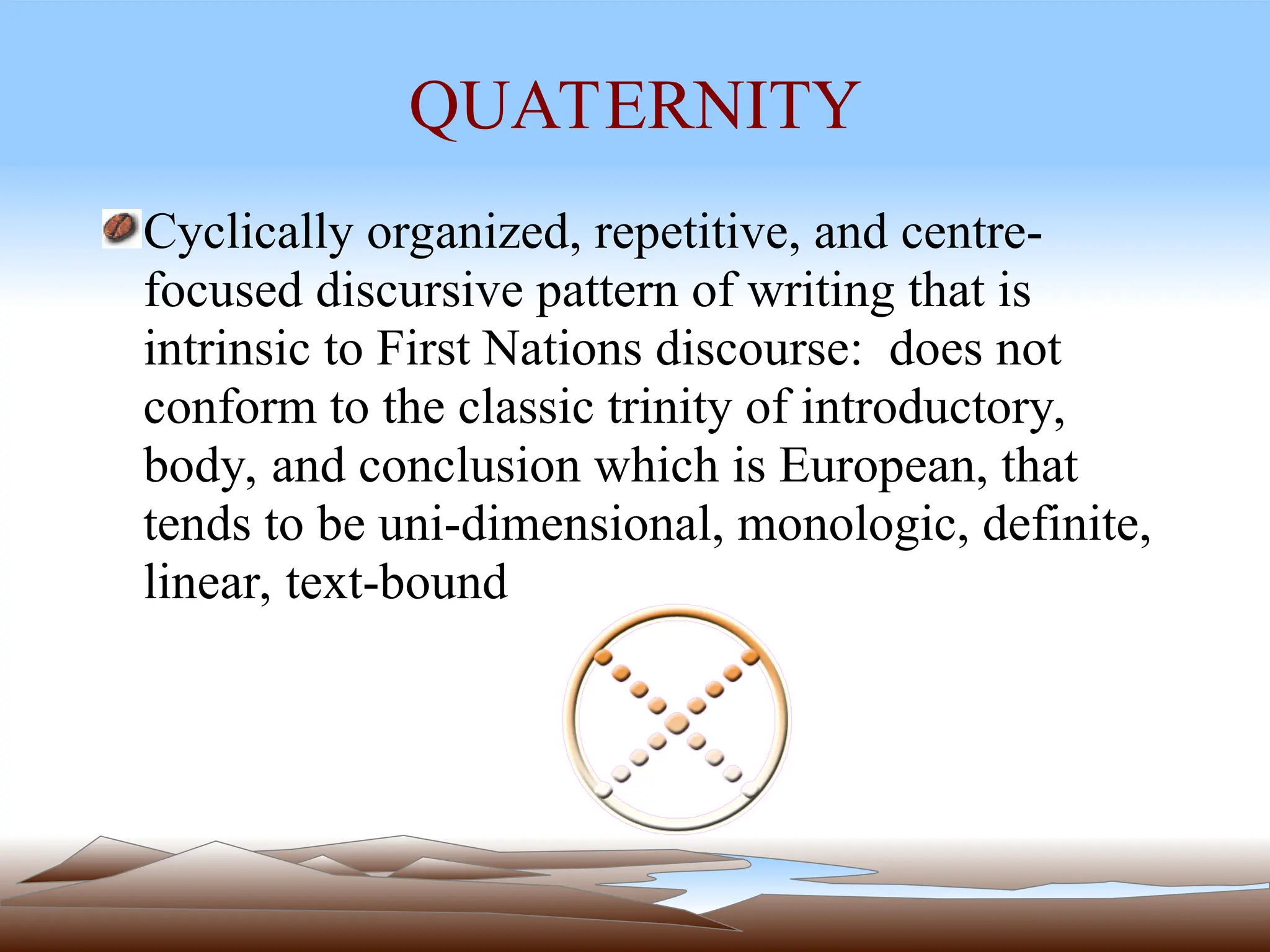
QUATERNITY
Cyclically organized, repetitive, and centre-
focused discursive pattern of writing that is
intrinsic to First Nations discourse: does not
conform to the classic trinity of introductory,
body, and conclusion which is European, that
tends to be uni-dimensional, monologic, definite,
linear, text-bound
POSITIONALITY
the notion of one's frame of reference or
positionality is one that is highly supported and
advocated by various Elders who challenge the
limited vision of modern Canadian education. Our
Elders tell us that we each must know who we are
and how we engage and interconnect with our
surroundings.
FIRST NATIONS KNOWLEDGE
- is a living process to be absorbed and understood, not a
commodity to possess
- preference for experiential knowledge
- values ability to learn independently by observing, listening,
and participating
- preference for multiple intelligences approach
- values introspection, reflection, meditation, prayer, self directed
learning
- is structured by language and symbolic, verbal, and
unconscious order
- is both empirical (based on experience) and normative (based
on social values)
REFERENCES
Battiste, M. (2002) Indigenous knowledge and pedagogy in First Nations
education – A literature review with recommendations. Indian and
Northern Affairs Canada.
Cooperrider, D. & Whitney, D. (2002) A positive revolution in change:
Appreciative Inquiry. Euclid, OH: Lakeshore Publishers.
http://appreciativeinquiry.cwru.edu/uploads/whatisai.pdf
Kirkness, V. J. and R. Barnhardt (2001). First Nations and Higher Education:
The Four R's - Respect, Relevance, Reciprocity, Responsibility. Knowledge
Across Cultures: A Contribution to Dialogue Among
Civilizations. R. Hayoe and J. Pan. Hong Kong, Comparative
Education Research Centre, The University of Hong Kong.
Pitawanakwat, J. Informal learning culture through the life course: Initiatives
in Native organizations and communities. New Approaches to
Lifelong Learning Working Paper #40-2001.

Pedagogy related presentation for training.ppt

  • 1.
    Way of theTireless Runner: An Aboriginal Pedagogical Guide - June Kaminski, RN MSN PhD Student, Curriculum Studies, UBC Kwantlen BSN Nursing Faculty
  • 2.
    Kwantlen The name Kwantlenis derived from an aboriginal word meaning “tireless runner” or “tireless hunter” and refers to the Sto:lo Nation, now called the Kwantlen First Nation, living along the historic Fraser River. The Kwantlen were the largest group on the lower Fraser, with a traditional territory extending from Mud Bay in Tsawwassen, through the Serpentine and Salmon Rivers and along the Fraser River, east past Mission.
  • 3.
    Local First NationsReserves Kwantlen First Nation (Fort Langley, McMillan I) Tsawwassen First Nation (Tsawwassen) Semiahmoo First Nation (White Rock) Matsqui First Nation (Langley) Katzie First Nation (Barnston Island) Many aboriginal people live off-reserve in the local areas served by Kwantlen (Surrey, Delta, Langley, Cloverdale, White Rock, Richmond)
  • 4.
    Aboriginal Population inKwantlen Catchment Area Surrey experienced the largest influx of First Nations people in the GVRD area since 1996 (1,830 people from 1996 - 2001), representing 32% of region's aboriginal popn growth, while Surrey, Delta, Langley, Burnaby together accounted for 68.2% of the growth across GVRD.
  • 5.
    RESEARCH STEPS Gather statisticson Kwantlen aboriginal students Survey for faculty re knowledge in meeting Aboriginal learning needs, pedagogy Survey for aboriginal students re experiences in courses in mainstream environment Community assessment – Bands, off-reserve Literature Review on First Nations pedagogy Plan and develop printed Guide Design web site
  • 6.
  • 7.
    APPRECIATIVE INQUIRY DISCOVERS whatgives life to the organization, what is happening when it is at it's best DREAMS about what might be, what the world is calling the organization to be DESIGNS ways to create the ideal as articulated by the whole organization DELIVERS through an on-going, dynamic process of change to achieve ideal and beyond
  • 8.
    First Nations Pedagogy Thepedagogical activities include teaching in a way that learning includes respectful relations, building on experiential learning, listening well, allowing space, story-telling and story-making, supporting quaternity, dialogue, positionality, relevance, reciprocity, reflectivity, and utilizing a strong Elders - informed, ecologically situated, creative, visual-auditory learning space within a self-governance philosophy and natural world context.
  • 9.
    FIRST NATIONS PEDAGOGY Traditionaleducational approaches are profoundly different from those of the mainstream educational system. Holistic (physical, mental, spiritual, emotional) growth and development of the person, experiential learning, oral tradition, and student- centeredness are key elements of the traditional approach. Further, and of vital importance, is the fact that it is grounded in spirituality.
  • 10.
    STORY TELLING &MAKING Stories are used to illustrate, to learn, to highlight, to share traditional nuances, to bring new knowledge, and to understand the world and contexts in which we live. Teachers need to begin to tell and make stories
  • 11.
    STORY TELLING ACTIVITY: Story-tellingas a Way of Teaching and Learning “Story-telling plays a major role in the oral transmission of knowledge, skills and values needed to live. Stories speak of the origins of life, proper relationships to various forms of life and life experiences. Also, the sharing of one's life story and experiences is a well-established method of teaching. Stories act as mirrors wherein the learner is allowed to view him/herself and thus gain insights and understandings to help him/her along the road of life.” (Pitawanakwat, 2001). Write a brief 2 - 3 paragraph story to illustrate some aspect of traditional First Nations politics and/or education. Feel free to use your imagination to choose your main character(s), situation, and lesson. Post your story on this module's Forum.
  • 12.
    ELDERS & FORMALEDUCATION Elders are the carriers and emblems of communally generated and mediated knowledge. In the western paradigm, such relations and processes of knowledge transmission is "informal". Yet, these same processes are at the heart and soul of what is 'formal" to Indigenous knowledge. Elders are first and foremost teachers and role models. Elders possess formal knowledge and expertise. Through orality, the Elders provide lessons on how to go about living the right life.
  • 13.
    ELDERS & SOCIALLEARNING Learning is always socially situated, socially constructed, socially produced and socially validated within social settings which exist as contextual settings. Elders teach others about culture, tradition and about the vision of life that is contained in First Nations philosophies and handed down in ceremonies and traditional teaching.
  • 14.
    RESPECT Respect stems fromthe belief that every individual is responsible for themselves, and it is the responsibility of others to teach respect. In the past, before European influences, First Nations people had their own social systems which addressed issues such as discipline and respect. Respected personal space. Code of silence is taught from an early age.
  • 15.
    RESPECTFUL RELATIONS Accept andlive with other's differentness Resolve conflicts Compassion, empathy, understanding Listening well Allowing space Respecting self Respecting others Respecting nature
  • 17.
    INHERENT ABORIGINAL VALUES ● Rightsand freedoms of the individual ● Rights and freedoms of the group ● Respect for elders ● Respect for land and Community ● Respect for self ● Sacredness of life ● Spirituality ● Wisdom ● Honour and Fortitude ● Generosity ● Extended family ● Peace, Harmony ● Acceptance ● Quietness, Patience, Dignity ● Connectedness of all living things
  • 18.
    CIRCLE TALKS In itssimplest form a circle talk: ● is done in a complete circle ● only the person holding the stick talks, all the rest listen ● the stick is passed around in a clockwise direction ● a person talks until they are finished, being respectful of time ● the circle talk is complete when everyone has had the opportunity to speak ● a person may pass the stick without speaking, if they so wish ● if desired, the stick may be passed around again ● what is said in the circle stays in the circle ● a circle is used to discuss issues of importance ● is extremely respectful of everyone as individuals and what they have to say.
  • 19.
    QUATERNITY Cyclically organized, repetitive,and centre- focused discursive pattern of writing that is intrinsic to First Nations discourse: does not conform to the classic trinity of introductory, body, and conclusion which is European, that tends to be uni-dimensional, monologic, definite, linear, text-bound
  • 20.
    POSITIONALITY the notion ofone's frame of reference or positionality is one that is highly supported and advocated by various Elders who challenge the limited vision of modern Canadian education. Our Elders tell us that we each must know who we are and how we engage and interconnect with our surroundings.
  • 21.
    FIRST NATIONS KNOWLEDGE -is a living process to be absorbed and understood, not a commodity to possess - preference for experiential knowledge - values ability to learn independently by observing, listening, and participating - preference for multiple intelligences approach - values introspection, reflection, meditation, prayer, self directed learning - is structured by language and symbolic, verbal, and unconscious order - is both empirical (based on experience) and normative (based on social values)
  • 22.
    REFERENCES Battiste, M. (2002)Indigenous knowledge and pedagogy in First Nations education – A literature review with recommendations. Indian and Northern Affairs Canada. Cooperrider, D. & Whitney, D. (2002) A positive revolution in change: Appreciative Inquiry. Euclid, OH: Lakeshore Publishers. http://appreciativeinquiry.cwru.edu/uploads/whatisai.pdf Kirkness, V. J. and R. Barnhardt (2001). First Nations and Higher Education: The Four R's - Respect, Relevance, Reciprocity, Responsibility. Knowledge Across Cultures: A Contribution to Dialogue Among Civilizations. R. Hayoe and J. Pan. Hong Kong, Comparative Education Research Centre, The University of Hong Kong. Pitawanakwat, J. Informal learning culture through the life course: Initiatives in Native organizations and communities. New Approaches to Lifelong Learning Working Paper #40-2001.