Promoting Educational Success of
Aboriginal Learners:
Views of Educational Leaders in
Two Canadian Provinces
By: Jane P. Preston1, Tim R. Claypool2, Jill A.
Martin1, William Rowluck2, & Brenda Green3
(1University of Prince Edward Island, 2University of
Saskatchewan, 3Saskatoon Public School Division)

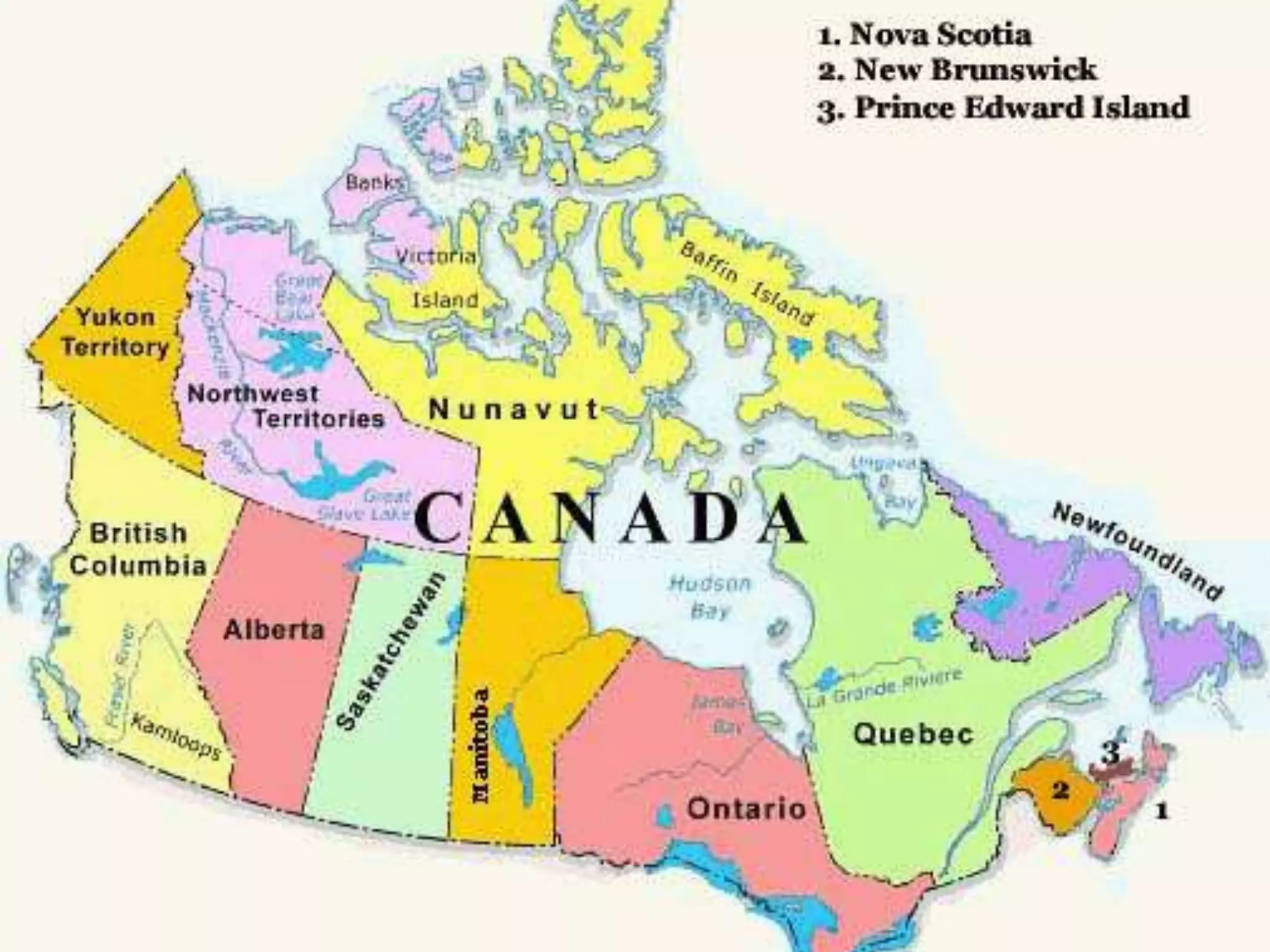
 Introduction to Canada
 Purpose of Research
 Literature Review
 Methodology & Research Design
 Thematic Findings
 Discussion
Overview of Presentation

To describe the leadership perceptions and
practices of principals who promote positive
school experiences for Aboriginal students
Purpose of Research
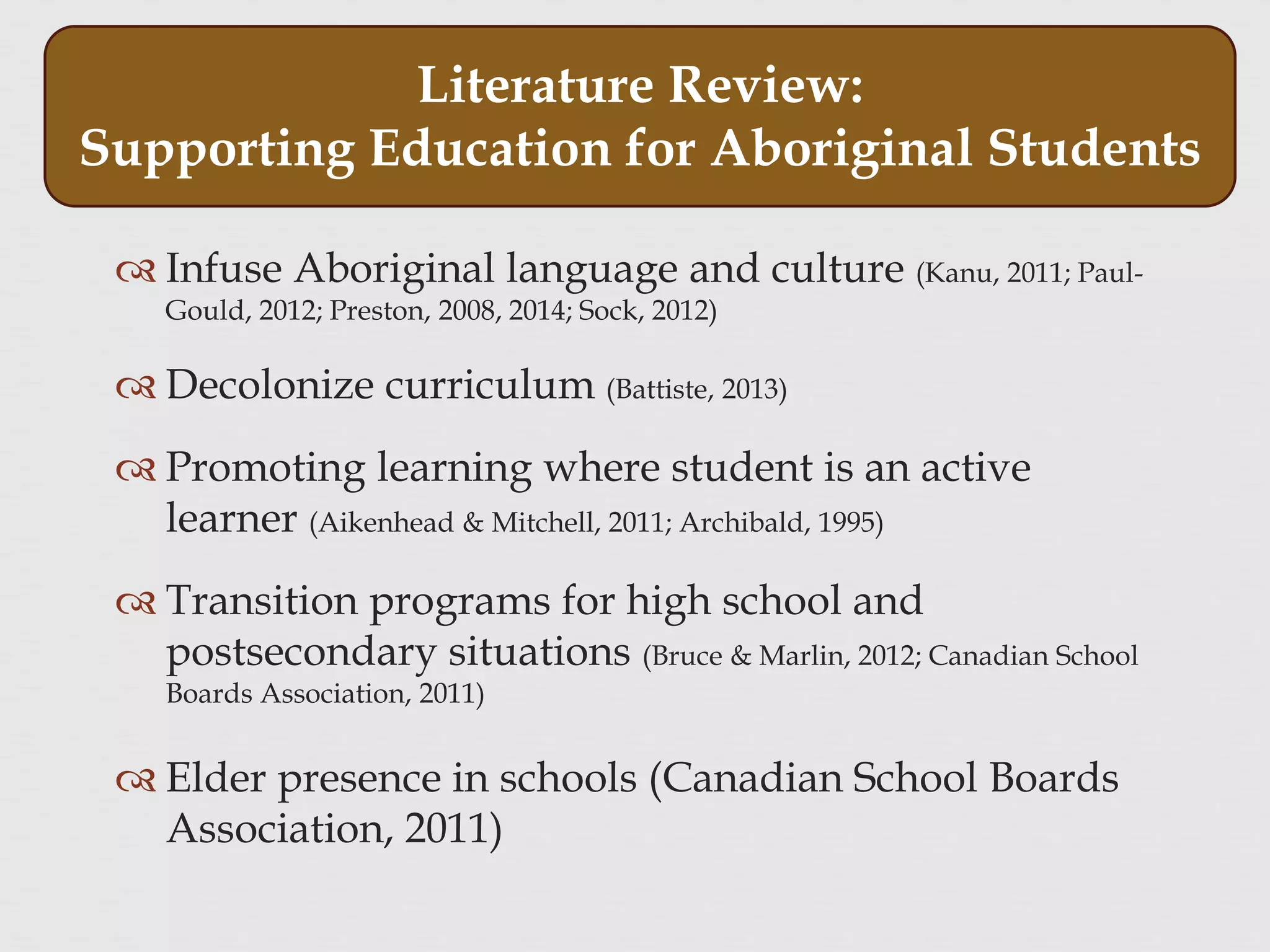
 Infuse Aboriginal language and culture (Kanu, 2011; Paul-
Gould, 2012; Preston, 2008, 2014; Sock, 2012)
 Decolonize curriculum (Battiste, 2013)
 Promoting learning where student is an active
learner (Aikenhead & Mitchell, 2011; Archibald, 1995)
 Transition programs for high school and
postsecondary situations (Bruce & Marlin, 2012; Canadian School
Boards Association, 2011)
 Elder presence in schools (Canadian School Boards
Association, 2011)
Literature Review:
Supporting Education for Aboriginal Students
 Interaction with the land, promotion of language and culture,
promotion of family, and community service (Leon, 2012)
 Rooted in collective values and co-determined outcomes
aimed at social equality and social change (Benham & Murakami,
2013; Gutiérrez, 2012; Leon, 2012; Ottmann, 2005)
 Attending to the community’s needs, above individual needs
(Julien, Wright, & Zinni, 2010)
 Making decision via consensus (Bennet & Rowley, 2004)
 Incorporating spirituality into one’s beliefs and actions (Felicity,
1999)
 Relevancy, responsibility, respect, and reciprocity (Gardner, 2012;
Pidgeon, 2012)
Literature Review: Aboriginal Leadership

Methodology & Research Design
• Qualitative Study: Researcher emphasize the
ontological belief that reality is the co-creation of
interactions between people.
• Multi-Case Design: Used to acquire a better
understanding of the perceptions and practices of
principals in the contexts of Saskatchewan and
Prince Edward Island.

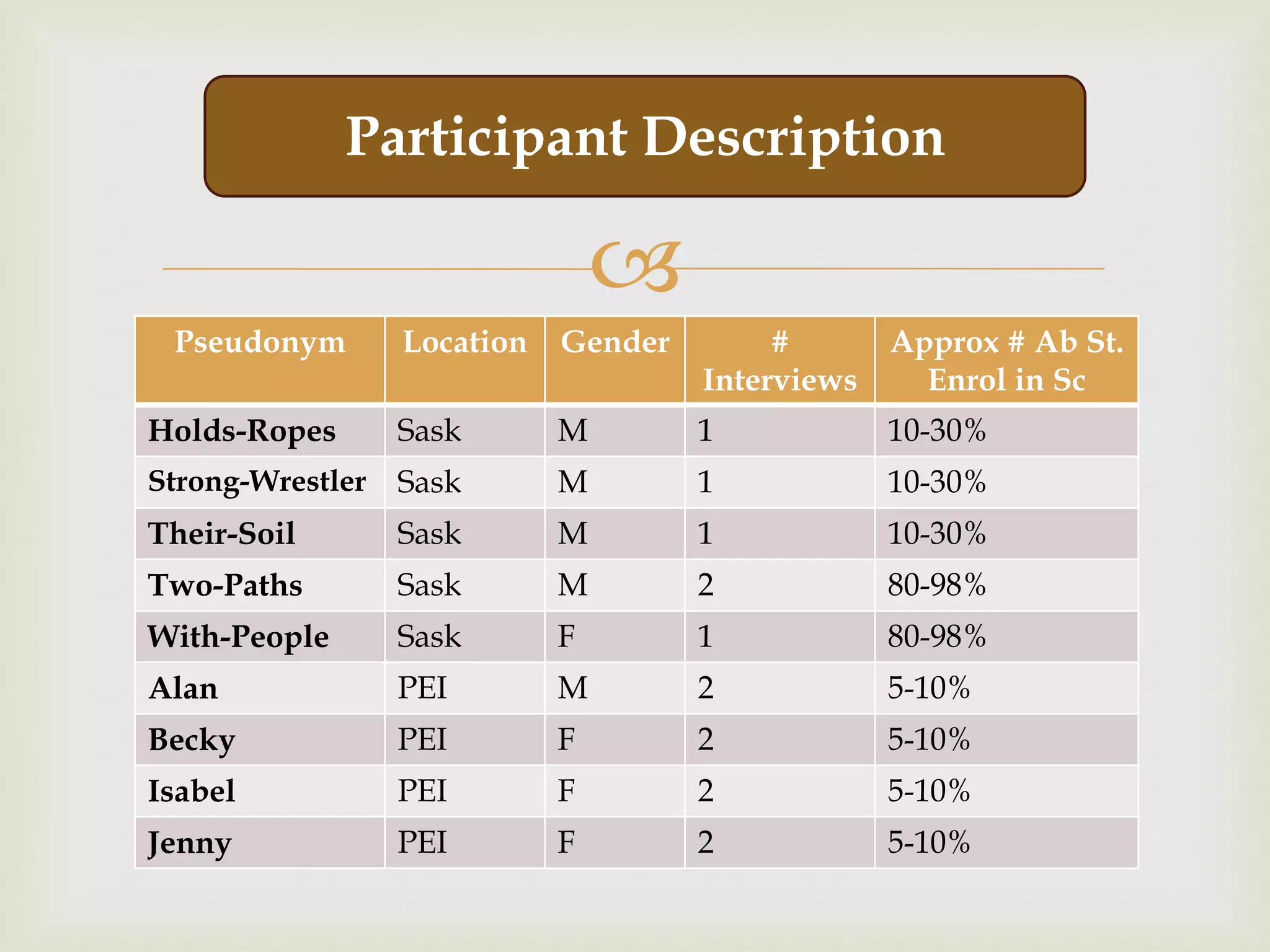
Pseudonym Location Gender #
Interviews
Approx # Ab St.
Enrol in Sc
Holds-Ropes Sask M 1 10-30%
Strong-Wrestler Sask M 1 10-30%
Their-Soil Sask M 1 10-30%
Two-Paths Sask M 2 80-98%
With-People Sask F 1 80-98%
Alan PEI M 2 5-10%
Becky PEI F 2 5-10%
Isabel PEI F 2 5-10%
Jenny PEI F 2 5-10%
Participant Description
 Students can and will learn
 “All kids can learn . . . They learn differently. They
learn at different speeds. They learn in different ways,
but all can learn” (Becky).
 Their-Soil stated, “It comes down to us being
responsive to the learner, relative to who they are as a
person but also relative to who they are as a learner.”
FINDINGS Philosophy of Education
 High Expectations for Aboriginal Students
 “They [Aboriginal students] can achieve just like
everyone else.”(Isabel).
 “Number one, first and foremost when it comes to
educating children is we have to have high
expectations and high expectations academically and
behaviourally” (Their-Soil).
FINDINGS Philosophy of Education
 Physical Safety
 “The number one thing is to make school a safe place.
Make the children know that, when they walk through
the door, they are safe whether it is in the classroom,
hallways, bathroom, or wherever they are in the
school. That means there are anti-bullying campaigns,
lots of supervision, and providing a quality
curriculum all the time” (Jenny)
FINDINGS Physical and Psychological Wellness
 Sense of Belonging
 “When students develop that sense of identity, that
sense of belonging, they’re going to be much more
engaged in the school generally, and much more
committed to being here” (Two-Paths).
 “When I see a kid from [name of First Nation
community], one of the first things I do is introduce
him to the soccer coach and track coach, because
soccer and track are huge [in that community]”
(Holds-Ropes).
FINDINGS Physical and Psychological Wellness
 With Students
 “I know every kid’s name in this school” (Many-
Ropes).
 “We have almost every teacher in this school doing
extracurricular, and that’s how you build
relationships.” (Holds-Ropes).
FINDINGS Relationships, Relationships, Relationships
 With Parents
 “I make time to meet with parents. I just texted some
parents to arrange a time for them to come. Parents
are always surprised that I get to see them in 10 to 15
minutes or even in the same day” (Holds-Ropes).
 “Parents are quite happy if you ask them to come in
and do beadwork with the kids. We have more
success in doing that than say, having them come out
for a meeting” (With-People).
FINDINGS Relationships, Relationships, Relationships
 With Aboriginal Communities
 “If you asked any of our Aboriginal students how they
feel about the school, they would have a positive
outlook on it, because of my relationship with their
community is strong” (Alan)
 “Me showing up once a month [for an education
meeting], going to a Christmas concert or a language
festival, or being called out to help in an interview
process at the band office…” directly and indirectly
shows the Aboriginal student that the principal cares.
(Their-Soil)
FINDINGS Relationships, Relationships, Relationships
 Indigenized teaching
 “If you want to talk about Aboriginal pedagogies and
ways of knowing, … it’s about working together and
collaborating, observing, communicating with each
other, supporting each other. That’s sort of the context
in which curriculum is tackled, and, when you do that,
it kind of opens the door for power sharing in the
classroom … When you do that, you’re sharing the
power of learning with your students, and they
become more authors of their learning. It becomes
more relevant, because they can take an outcome and
they can connect it with who they are in their world
and where they want to take it” (Two-Paths).
FINDINGS School Curriculum

 Many perceptions and practices directly aligned with an
Aboriginal worldview
 relevant, hands-on, and experiential student learning.
 involvement in apprenticeship or mentorship programs.
 the concept of interconnectedness and relationships
between educators, students, parents, and community
members.
 the concept reciprocity when learning from First Nations
communities, in turn, these leaders could use and give their
knowledge to better meet the needs of Aboriginal students
in their school
Discussion

 Principals whose leadership style embodies relationships,
reciprocity, responsibility, and relevancy (trait valued via
Aboriginal leadership) are individuals who work toward
improving the educational experience for all students,
regardless of ethnicity.
Concluding Remark
 Aikenhead, G., & Michell, H. (2011). Bridging cultures: Indigenous and scientific ways of knowing nature. Toronto, ON: Pearson.
 Archibald, J. (1995). Local developed Native Studies curriculum: An historic and philosophical rationale. In M. Battiste & J. Barman (Eds.), First
Nations education in Canada: The circle unfolds (pp. 288–312). Vancouver, BC: UBC Press.
 Battiste, M. (2013). Decolonizing education: Nourishing the learning spirit. Saskatoon, SK: Purich.
 Benham, M., & Murakami, E. T. (2013). Engaging in educational leadership: The generosity of spirit. In M. Grogan (Ed.), The Jossey-Bass reader on
educational leadership (3rd ed., pp. 148–165). San Francisco, CA: John Wiley & Sons.
 Bennett, J., & Rowley, S. (Eds.). (2004). Uqalurait: An oral history of Nunavut. Kingston, ON:McGill-Queen’s University Press.
 Bruce, D., & Marlin, A. (2012). Literature review on factors affecting the transition of Aboriginal youth from school to work. Toronto, ON: Council of
Ministers of Education, Canada.
 Canadian School Boards Association. (2011, December 6). Best practices in public education across Canada: The Urban Aboriginal Education Project—
Lakehead District School Board. Retrieved from http://cdnsba.org/all/education-in-canada/best-practices-in-public-education-across-canada-
the-urban-aboriginal-education-project-lakehead-district-school-board
 Gardner, S. E. B. (2012). The four Rs of leadership in Indigenous language revitalization. In C. Kenny & T. N. Fraser (Eds.), Living Indigenous
leadership: Native narratives on building strong communities (pp. 125–135). Vancouver, BC: UBC Press.
 Gutiérrez, R. D. (2012). Indigenous grandmas and the social justice movement. In C. Kenny & T. N. Fraser (Eds.), Living Indigenous leadership:
Native narratives on building strong communities (pp. 97–133). Vancouver, BC: UBC Press.
 Felicity, J. (1999). Native Indian leadership. Canadian Journal of Native Education, 23(1), 40–57.
 Julien, M., Wright, B., & Zinni, D. M. (2010). Stories from the circle: Leadership lessons learned from Aboriginal leaders. The Leadership
Quarterly, 21(1), 114–126.
 Kanu, Y. (2011). Integrating Aboriginal perspectives into the school curriculum: Purposes, possibilities, and challenges. Toronto, ON: University of
Toronto Press.
 Lear, G. (2012). Leadership lesson from the Medicine Wheel: The seven elements of high performance. Charleston, SC: Advantage.
 Leon, A. Y. (2012). Elder’s teaching on leadership as a gift. In C. Kenny & T. N. Fraser (Eds.), Living Indigenous leadership: Native narratives on
building strong communities (pp. 48–63). Vancouver, BC: UBC Press.
 Ottmann, J. (2005). Aboriginal leadership and management: First Nations leadership development. Banff, AB: The Banff Centre.
 Paul-Gould, S. (2012). Student achievement, fluency, an identity: An in-depth study of the Mi’kmaq Immersion Program in one community. (Unpublished
master’s thesis). St. Francis Xavier University, Antigonish, NS.
 Pidgeon, M. (2012). Transformation and Indigenous interconnections: Indigeneity, leadership, and higher education. In C. Kenny & T. N. Fraser
(Eds.), Living Indigenous leadership: Native narratives on building strong communities (pp. 136–149). Vancouver, BC: UBC Press.
 Preston, J. P. (2008). Overcoming the obstacles: Postsecondary education for Aboriginal peoples. Brock Education: A Journal for Educational
Research and Practice, 18(1), 57–63.
 Preston, J. P. (2014, November). Early childhood education and care for Aboriginal children in Canada. Toronto, ON. Moving Childcare Forward
Project. Preston, J. P., & Claypool, T. R. (2013). Motivators of educational success: Perceptions of Grade 12 Aboriginal students. Canadian Journal
of Education, 36(4), 257–279.
 Sock, S. (2012). An inquiry into the Mi’kmaq immersion program in one community: Student identity, fluency, and achievement. (Unpublished master’s
thesis). St. Francis Xavier University, Antigonish, NS.
References

Hawaii PowerP(Dec23'14) (1)

  • 1.
    Promoting Educational Successof Aboriginal Learners: Views of Educational Leaders in Two Canadian Provinces By: Jane P. Preston1, Tim R. Claypool2, Jill A. Martin1, William Rowluck2, & Brenda Green3 (1University of Prince Edward Island, 2University of Saskatchewan, 3Saskatoon Public School Division)
  • 2.
      Introduction toCanada  Purpose of Research  Literature Review  Methodology & Research Design  Thematic Findings  Discussion Overview of Presentation
  • 4.
     To describe theleadership perceptions and practices of principals who promote positive school experiences for Aboriginal students Purpose of Research
  • 5.
     Infuse Aboriginallanguage and culture (Kanu, 2011; Paul- Gould, 2012; Preston, 2008, 2014; Sock, 2012)  Decolonize curriculum (Battiste, 2013)  Promoting learning where student is an active learner (Aikenhead & Mitchell, 2011; Archibald, 1995)  Transition programs for high school and postsecondary situations (Bruce & Marlin, 2012; Canadian School Boards Association, 2011)  Elder presence in schools (Canadian School Boards Association, 2011) Literature Review: Supporting Education for Aboriginal Students
  • 6.
     Interaction withthe land, promotion of language and culture, promotion of family, and community service (Leon, 2012)  Rooted in collective values and co-determined outcomes aimed at social equality and social change (Benham & Murakami, 2013; Gutiérrez, 2012; Leon, 2012; Ottmann, 2005)  Attending to the community’s needs, above individual needs (Julien, Wright, & Zinni, 2010)  Making decision via consensus (Bennet & Rowley, 2004)  Incorporating spirituality into one’s beliefs and actions (Felicity, 1999)  Relevancy, responsibility, respect, and reciprocity (Gardner, 2012; Pidgeon, 2012) Literature Review: Aboriginal Leadership
  • 7.
     Methodology & ResearchDesign • Qualitative Study: Researcher emphasize the ontological belief that reality is the co-creation of interactions between people. • Multi-Case Design: Used to acquire a better understanding of the perceptions and practices of principals in the contexts of Saskatchewan and Prince Edward Island.
  • 8.
     Pseudonym Location Gender# Interviews Approx # Ab St. Enrol in Sc Holds-Ropes Sask M 1 10-30% Strong-Wrestler Sask M 1 10-30% Their-Soil Sask M 1 10-30% Two-Paths Sask M 2 80-98% With-People Sask F 1 80-98% Alan PEI M 2 5-10% Becky PEI F 2 5-10% Isabel PEI F 2 5-10% Jenny PEI F 2 5-10% Participant Description
  • 9.
     Students canand will learn  “All kids can learn . . . They learn differently. They learn at different speeds. They learn in different ways, but all can learn” (Becky).  Their-Soil stated, “It comes down to us being responsive to the learner, relative to who they are as a person but also relative to who they are as a learner.” FINDINGS Philosophy of Education
  • 10.
     High Expectationsfor Aboriginal Students  “They [Aboriginal students] can achieve just like everyone else.”(Isabel).  “Number one, first and foremost when it comes to educating children is we have to have high expectations and high expectations academically and behaviourally” (Their-Soil). FINDINGS Philosophy of Education
  • 11.
     Physical Safety “The number one thing is to make school a safe place. Make the children know that, when they walk through the door, they are safe whether it is in the classroom, hallways, bathroom, or wherever they are in the school. That means there are anti-bullying campaigns, lots of supervision, and providing a quality curriculum all the time” (Jenny) FINDINGS Physical and Psychological Wellness
  • 12.
     Sense ofBelonging  “When students develop that sense of identity, that sense of belonging, they’re going to be much more engaged in the school generally, and much more committed to being here” (Two-Paths).  “When I see a kid from [name of First Nation community], one of the first things I do is introduce him to the soccer coach and track coach, because soccer and track are huge [in that community]” (Holds-Ropes). FINDINGS Physical and Psychological Wellness
  • 13.
     With Students “I know every kid’s name in this school” (Many- Ropes).  “We have almost every teacher in this school doing extracurricular, and that’s how you build relationships.” (Holds-Ropes). FINDINGS Relationships, Relationships, Relationships
  • 14.
     With Parents “I make time to meet with parents. I just texted some parents to arrange a time for them to come. Parents are always surprised that I get to see them in 10 to 15 minutes or even in the same day” (Holds-Ropes).  “Parents are quite happy if you ask them to come in and do beadwork with the kids. We have more success in doing that than say, having them come out for a meeting” (With-People). FINDINGS Relationships, Relationships, Relationships
  • 15.
     With AboriginalCommunities  “If you asked any of our Aboriginal students how they feel about the school, they would have a positive outlook on it, because of my relationship with their community is strong” (Alan)  “Me showing up once a month [for an education meeting], going to a Christmas concert or a language festival, or being called out to help in an interview process at the band office…” directly and indirectly shows the Aboriginal student that the principal cares. (Their-Soil) FINDINGS Relationships, Relationships, Relationships
  • 16.
     Indigenized teaching “If you want to talk about Aboriginal pedagogies and ways of knowing, … it’s about working together and collaborating, observing, communicating with each other, supporting each other. That’s sort of the context in which curriculum is tackled, and, when you do that, it kind of opens the door for power sharing in the classroom … When you do that, you’re sharing the power of learning with your students, and they become more authors of their learning. It becomes more relevant, because they can take an outcome and they can connect it with who they are in their world and where they want to take it” (Two-Paths). FINDINGS School Curriculum
  • 17.
      Many perceptionsand practices directly aligned with an Aboriginal worldview  relevant, hands-on, and experiential student learning.  involvement in apprenticeship or mentorship programs.  the concept of interconnectedness and relationships between educators, students, parents, and community members.  the concept reciprocity when learning from First Nations communities, in turn, these leaders could use and give their knowledge to better meet the needs of Aboriginal students in their school Discussion
  • 18.
      Principals whoseleadership style embodies relationships, reciprocity, responsibility, and relevancy (trait valued via Aboriginal leadership) are individuals who work toward improving the educational experience for all students, regardless of ethnicity. Concluding Remark
  • 19.
     Aikenhead, G.,& Michell, H. (2011). Bridging cultures: Indigenous and scientific ways of knowing nature. Toronto, ON: Pearson.  Archibald, J. (1995). Local developed Native Studies curriculum: An historic and philosophical rationale. In M. Battiste & J. Barman (Eds.), First Nations education in Canada: The circle unfolds (pp. 288–312). Vancouver, BC: UBC Press.  Battiste, M. (2013). Decolonizing education: Nourishing the learning spirit. Saskatoon, SK: Purich.  Benham, M., & Murakami, E. T. (2013). Engaging in educational leadership: The generosity of spirit. In M. Grogan (Ed.), The Jossey-Bass reader on educational leadership (3rd ed., pp. 148–165). San Francisco, CA: John Wiley & Sons.  Bennett, J., & Rowley, S. (Eds.). (2004). Uqalurait: An oral history of Nunavut. Kingston, ON:McGill-Queen’s University Press.  Bruce, D., & Marlin, A. (2012). Literature review on factors affecting the transition of Aboriginal youth from school to work. Toronto, ON: Council of Ministers of Education, Canada.  Canadian School Boards Association. (2011, December 6). Best practices in public education across Canada: The Urban Aboriginal Education Project— Lakehead District School Board. Retrieved from http://cdnsba.org/all/education-in-canada/best-practices-in-public-education-across-canada- the-urban-aboriginal-education-project-lakehead-district-school-board  Gardner, S. E. B. (2012). The four Rs of leadership in Indigenous language revitalization. In C. Kenny & T. N. Fraser (Eds.), Living Indigenous leadership: Native narratives on building strong communities (pp. 125–135). Vancouver, BC: UBC Press.  Gutiérrez, R. D. (2012). Indigenous grandmas and the social justice movement. In C. Kenny & T. N. Fraser (Eds.), Living Indigenous leadership: Native narratives on building strong communities (pp. 97–133). Vancouver, BC: UBC Press.  Felicity, J. (1999). Native Indian leadership. Canadian Journal of Native Education, 23(1), 40–57.  Julien, M., Wright, B., & Zinni, D. M. (2010). Stories from the circle: Leadership lessons learned from Aboriginal leaders. The Leadership Quarterly, 21(1), 114–126.  Kanu, Y. (2011). Integrating Aboriginal perspectives into the school curriculum: Purposes, possibilities, and challenges. Toronto, ON: University of Toronto Press.  Lear, G. (2012). Leadership lesson from the Medicine Wheel: The seven elements of high performance. Charleston, SC: Advantage.  Leon, A. Y. (2012). Elder’s teaching on leadership as a gift. In C. Kenny & T. N. Fraser (Eds.), Living Indigenous leadership: Native narratives on building strong communities (pp. 48–63). Vancouver, BC: UBC Press.  Ottmann, J. (2005). Aboriginal leadership and management: First Nations leadership development. Banff, AB: The Banff Centre.  Paul-Gould, S. (2012). Student achievement, fluency, an identity: An in-depth study of the Mi’kmaq Immersion Program in one community. (Unpublished master’s thesis). St. Francis Xavier University, Antigonish, NS.  Pidgeon, M. (2012). Transformation and Indigenous interconnections: Indigeneity, leadership, and higher education. In C. Kenny & T. N. Fraser (Eds.), Living Indigenous leadership: Native narratives on building strong communities (pp. 136–149). Vancouver, BC: UBC Press.  Preston, J. P. (2008). Overcoming the obstacles: Postsecondary education for Aboriginal peoples. Brock Education: A Journal for Educational Research and Practice, 18(1), 57–63.  Preston, J. P. (2014, November). Early childhood education and care for Aboriginal children in Canada. Toronto, ON. Moving Childcare Forward Project. Preston, J. P., & Claypool, T. R. (2013). Motivators of educational success: Perceptions of Grade 12 Aboriginal students. Canadian Journal of Education, 36(4), 257–279.  Sock, S. (2012). An inquiry into the Mi’kmaq immersion program in one community: Student identity, fluency, and achievement. (Unpublished master’s thesis). St. Francis Xavier University, Antigonish, NS. References