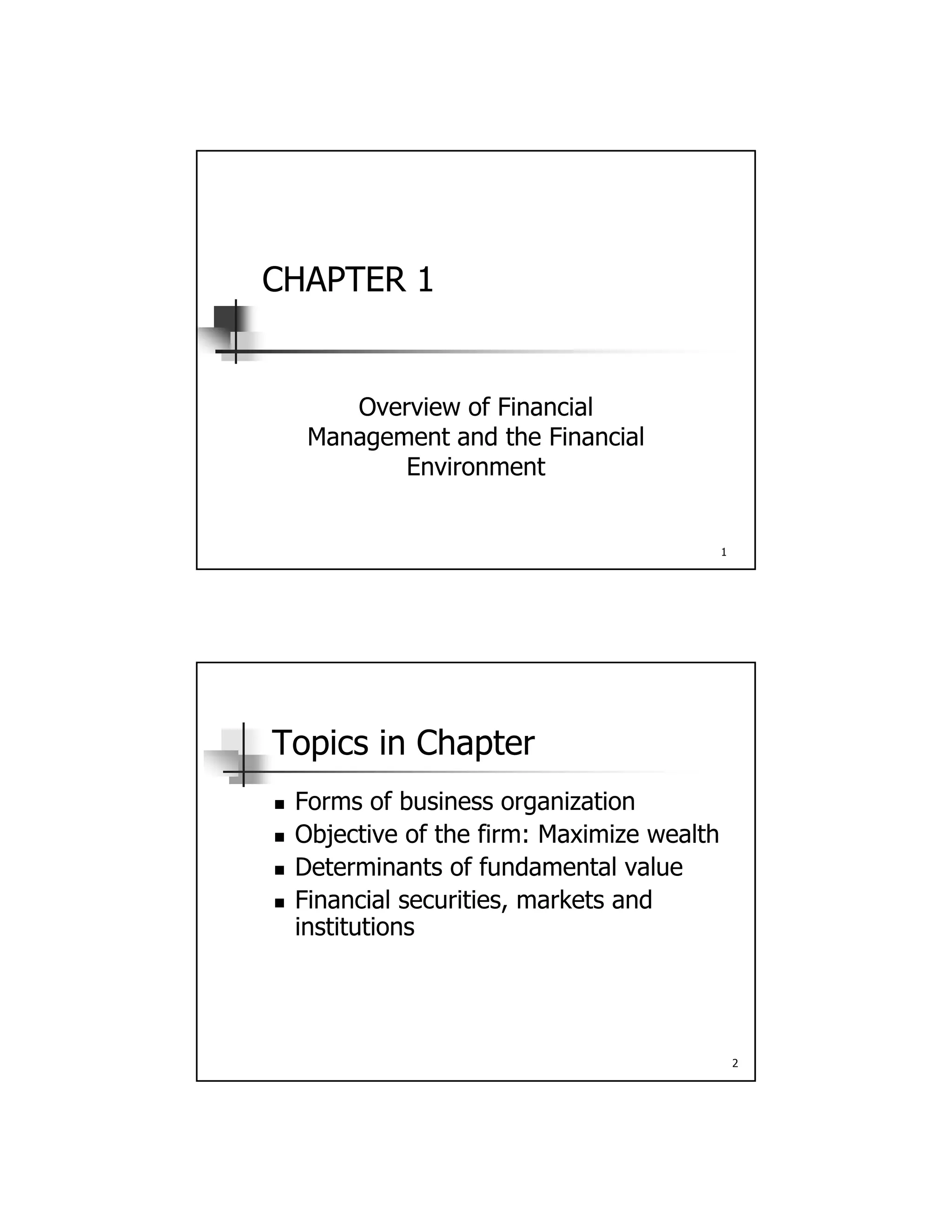
CHAPTER 1CHAPTER 1
Overview of Financial
M t d th Fi i l
1
Management and the Financial
Environment
Topics in Chapter
 Forms of business organization Forms of business organization
 Objective of the firm: Maximize wealth
 Determinants of fundamental value
 Financial securities, markets and
institutions
2
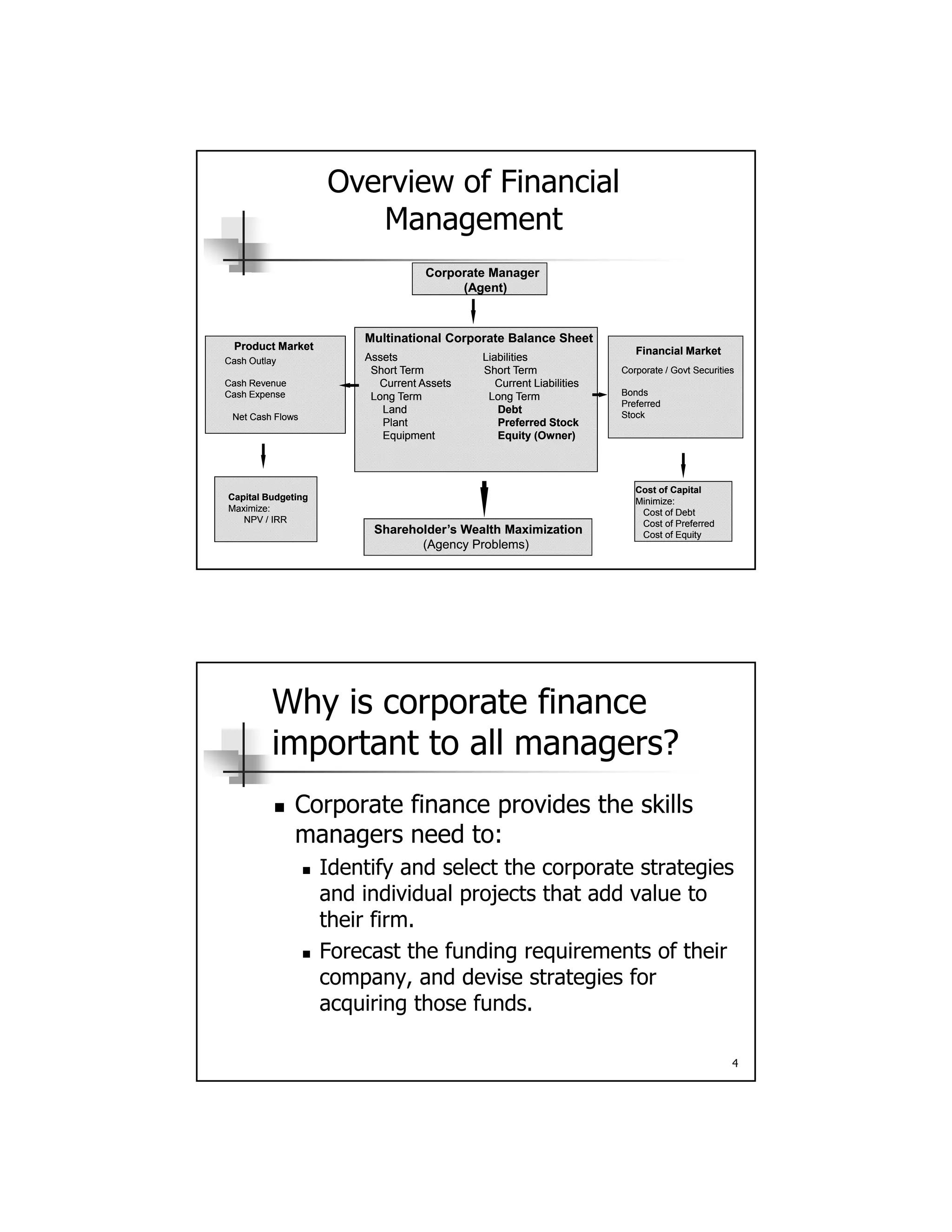
Corporate ManagerCorporate Manager
(Agent)(Agent)
Overview of Financial
Management
Multinational Corporate Balance SheetMultinational Corporate Balance Sheet
AssetsAssets LiabilitiesLiabilities
Short Term Short TermShort Term Short Term
Current AssetsCurrent Assets Current LiabilitiesCurrent Liabilities
Long TermLong Term Long TermLong Term
LandLand DebtDebt
PlantPlant Preferred StockPreferred Stock
Financial MarketFinancial Market
Corporate /Corporate / GovtGovt SecuritiesSecurities
BondsBonds
PreferredPreferred
StockStock
Product MarketProduct Market
Cash OutlayCash Outlay
Cash RevenueCash Revenue
Cash ExpenseCash Expense
Net Cash FlowsNet Cash Flows
(Agent)(Agent)
EquipmentEquipment Equity (Owner)Equity (Owner)
Shareholder’s Wealth MaximizationShareholder’s Wealth Maximization
(Agency Problems)(Agency Problems)
Capital BudgetingCapital Budgeting
Maximize:Maximize:
NPV / IRRNPV / IRR
Cost of CapitalCost of Capital
Minimize:Minimize:
Cost of DebtCost of Debt
Cost of PreferredCost of Preferred
Cost of EquityCost of Equity
Why is corporate finance
important to all managers?
Corporate finance provides the skills Corporate finance provides the skills
managers need to:
 Identify and select the corporate strategies
and individual projects that add value to
their firm.
f f
4
 Forecast the funding requirements of their
company, and devise strategies for
acquiring those funds.
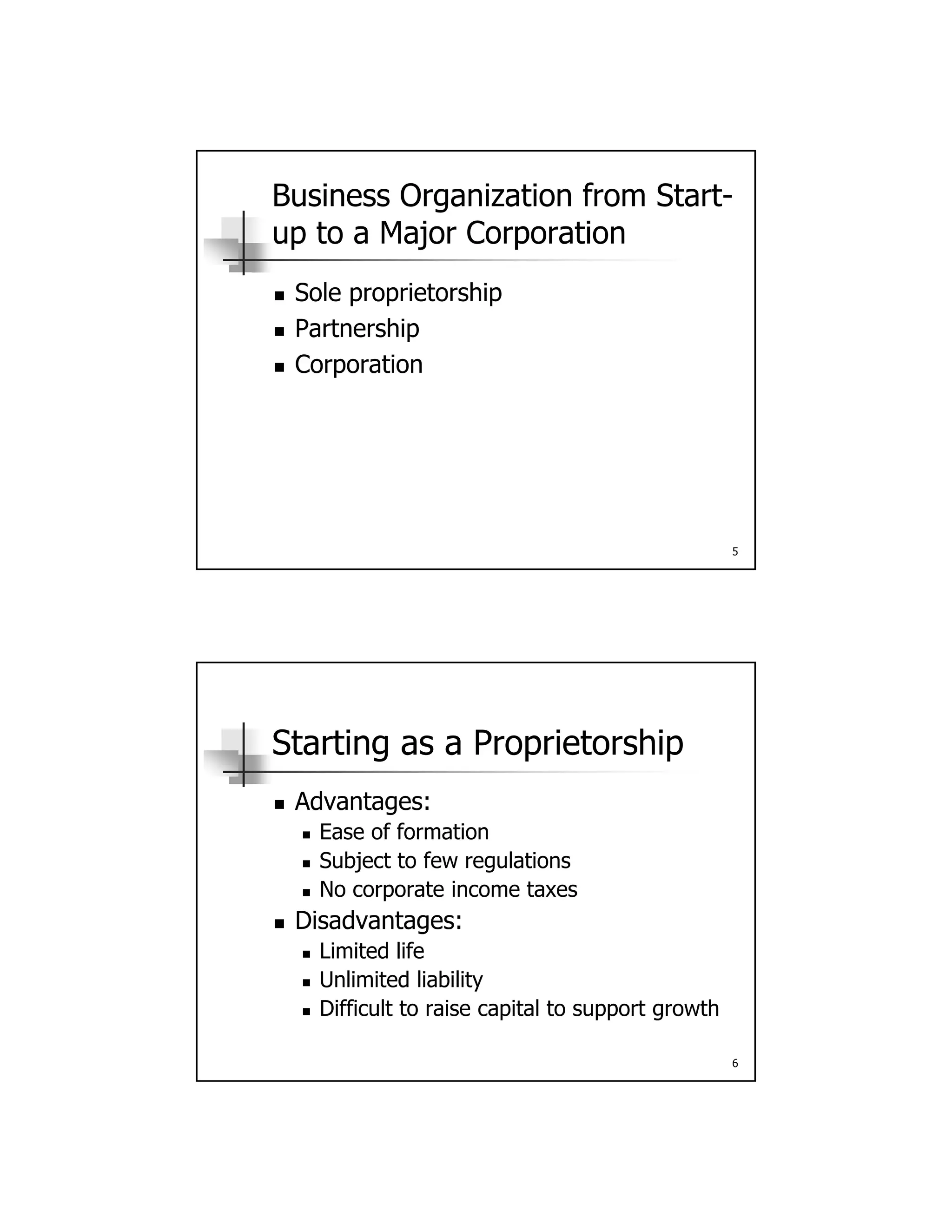
Business Organization from Start-
up to a Major Corporation
Sole proprietorship Sole proprietorship
 Partnership
 Corporation
5
Starting as a Proprietorship
 Advantages: Advantages:
 Ease of formation
 Subject to few regulations
 No corporate income taxes
 Disadvantages:
f
6
 Limited life
 Unlimited liability
 Difficult to raise capital to support growth
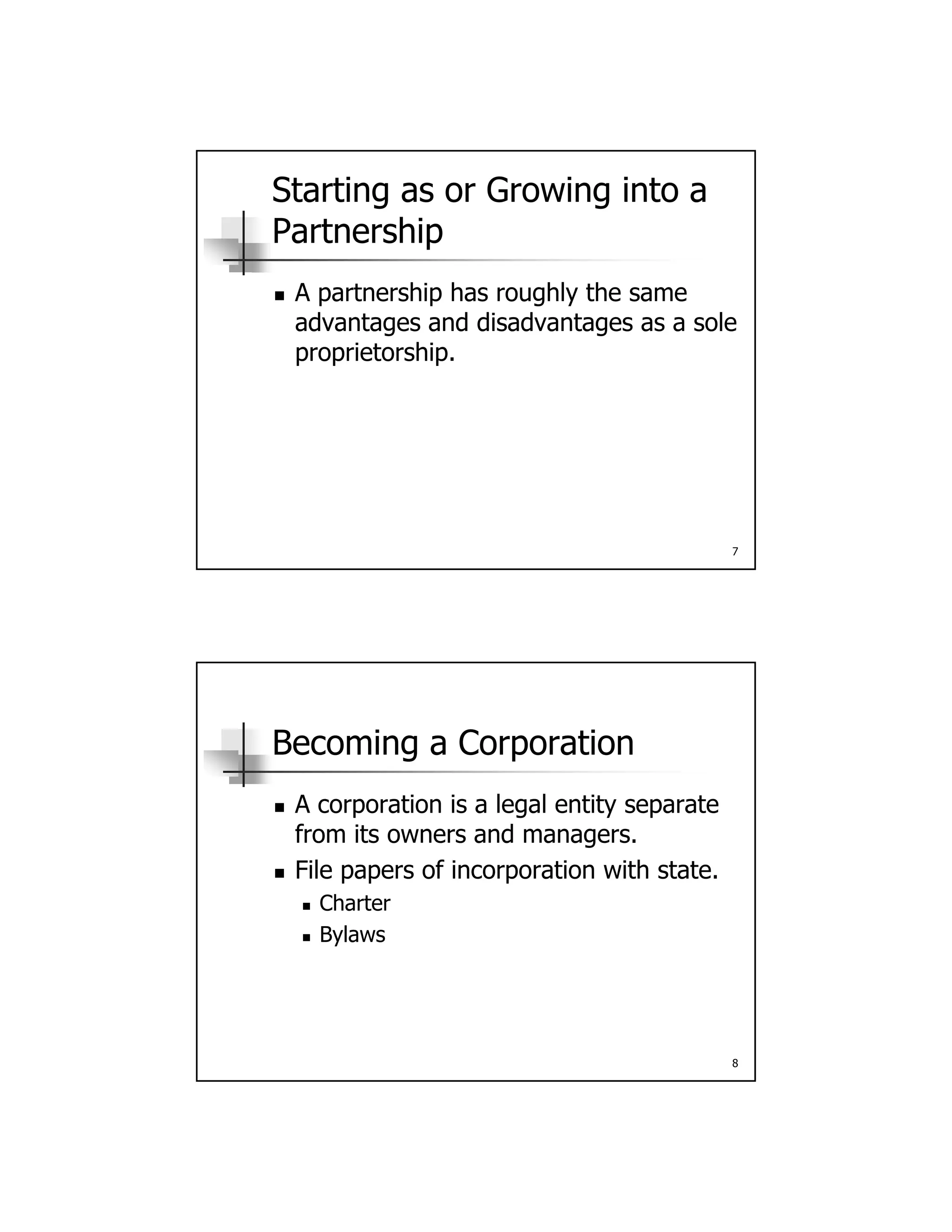
Starting as or Growing into a
Partnership
A partnership has roughly the same A partnership has roughly the same
advantages and disadvantages as a sole
proprietorship.
7
Becoming a Corporation
A corporation is a legal entity separate A corporation is a legal entity separate
from its owners and managers.
 File papers of incorporation with state.
 Charter
 Bylaws
8
Bylaws
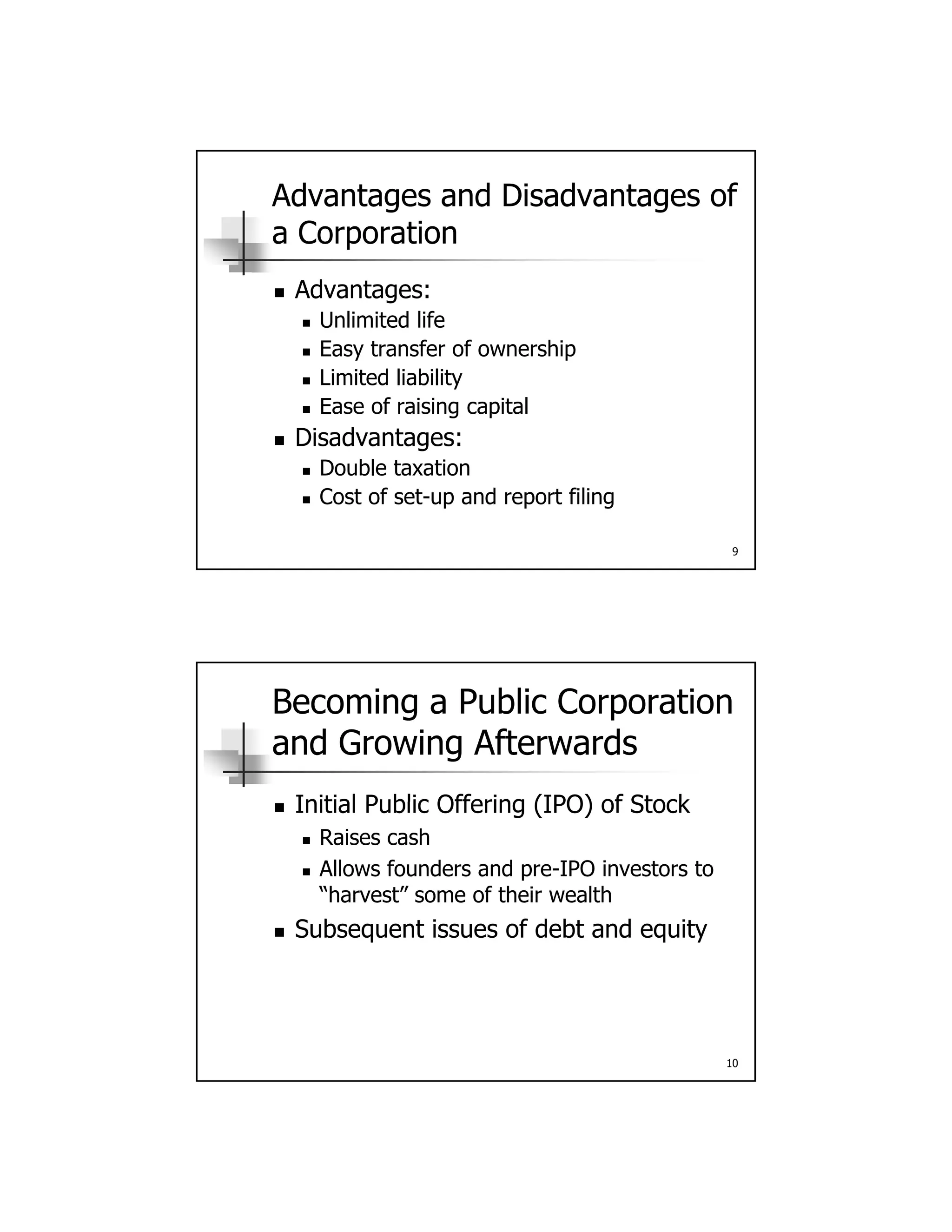
Advantages and Disadvantages of
a Corporation
 Advantages: Advantages:
 Unlimited life
 Easy transfer of ownership
 Limited liability
 Ease of raising capital
Di d t
9
 Disadvantages:
 Double taxation
 Cost of set-up and report filing
Becoming a Public Corporation
and Growing Afterwards
Initial Public Offering (IPO) of Stock Initial Public Offering (IPO) of Stock
 Raises cash
 Allows founders and pre-IPO investors to
“harvest” some of their wealth
 Subsequent issues of debt and equity
10
q q y
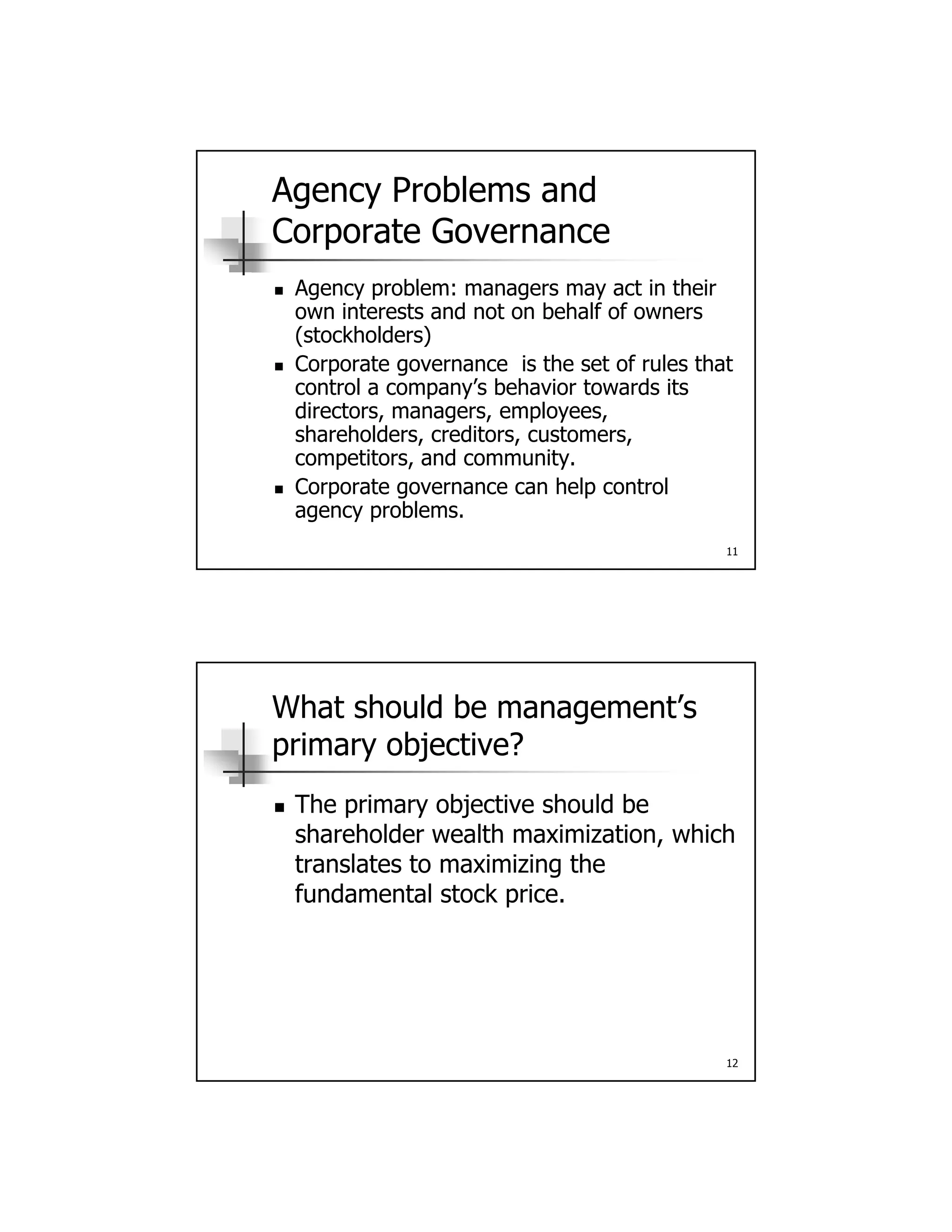
Agency Problems and
Corporate Governance
 Agency problem: managers may act in their Agency problem: managers may act in their
own interests and not on behalf of owners
(stockholders)
 Corporate governance is the set of rules that
control a company’s behavior towards its
directors, managers, employees,
shareholders creditors customers
11
shareholders, creditors, customers,
competitors, and community.
 Corporate governance can help control
agency problems.
What should be management’s
primary objective?
The primary objective should be The primary objective should be
shareholder wealth maximization, which
translates to maximizing the
fundamental stock price.
12
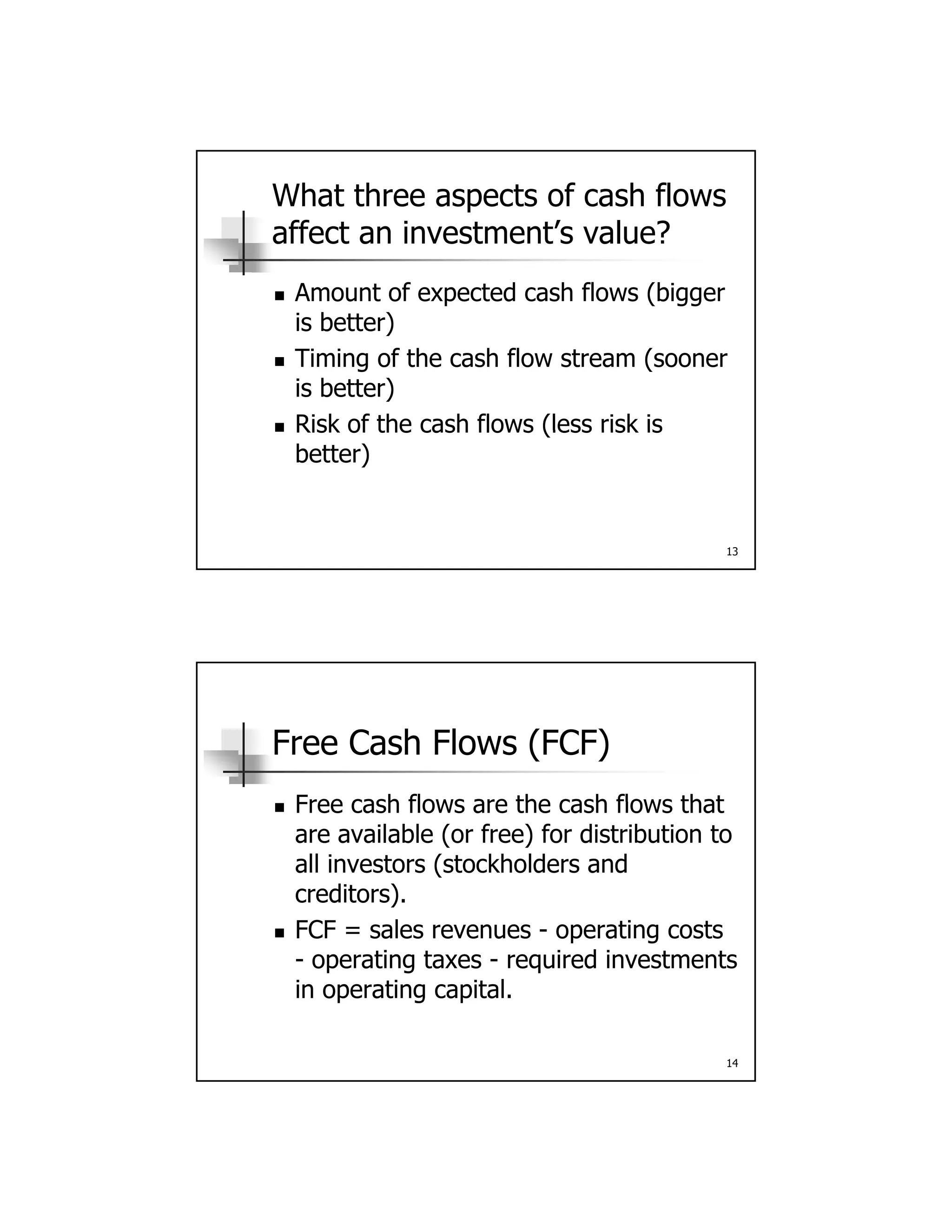
What three aspects of cash flows
affect an investment’s value?
Amount of expected cash flows (bigger Amount of expected cash flows (bigger
is better)
 Timing of the cash flow stream (sooner
is better)
 Risk of the cash flows (less risk is
13
 Risk of the cash flows (less risk is
better)
Free Cash Flows (FCF)
Free cash flows are the cash flows that Free cash flows are the cash flows that
are available (or free) for distribution to
all investors (stockholders and
creditors).
 FCF = sales revenues - operating costs
14
p g
- operating taxes - required investments
in operating capital.
What is the weighted average
cost of capital (WACC)?
 WACC is the average rate of return required WACC is the average rate of return required
by all of the company’s investors.
 WACC is affected by:
 Capital structure (the firm’s relative amounts of
debt and equity)
 Interest rates
15
 Interest rates
 Risk of the firm
 Investors’ overall attitude toward risk
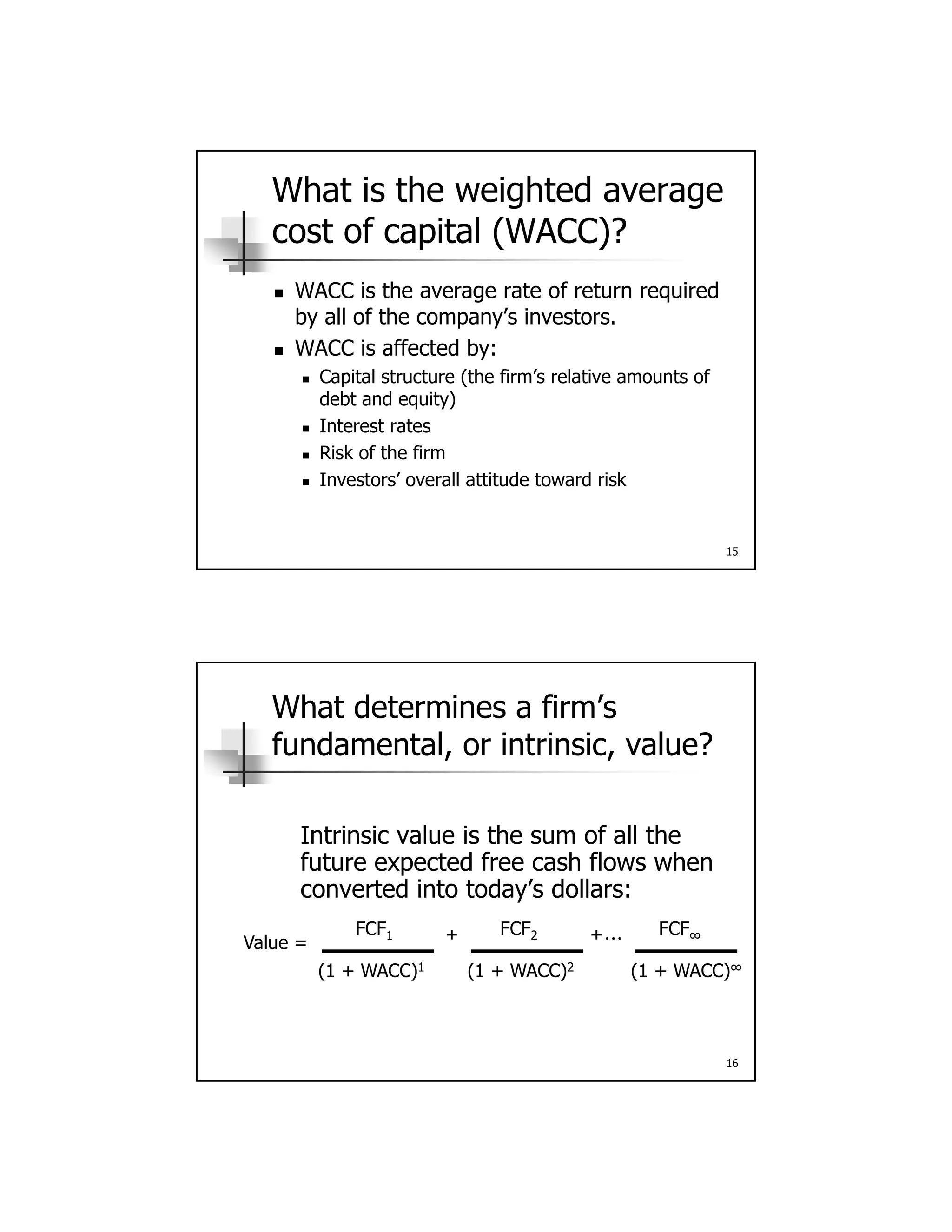
What determines a firm’s
fundamental, or intrinsic, value?
Intrinsic value is the sum of all the
future expected free cash flows when
converted into today’s dollars:
Value =
FCF1 FCF2 FCF∞+ +…
16
Value =
(1 + WACC)1 (1 + WACC)∞(1 + WACC)2
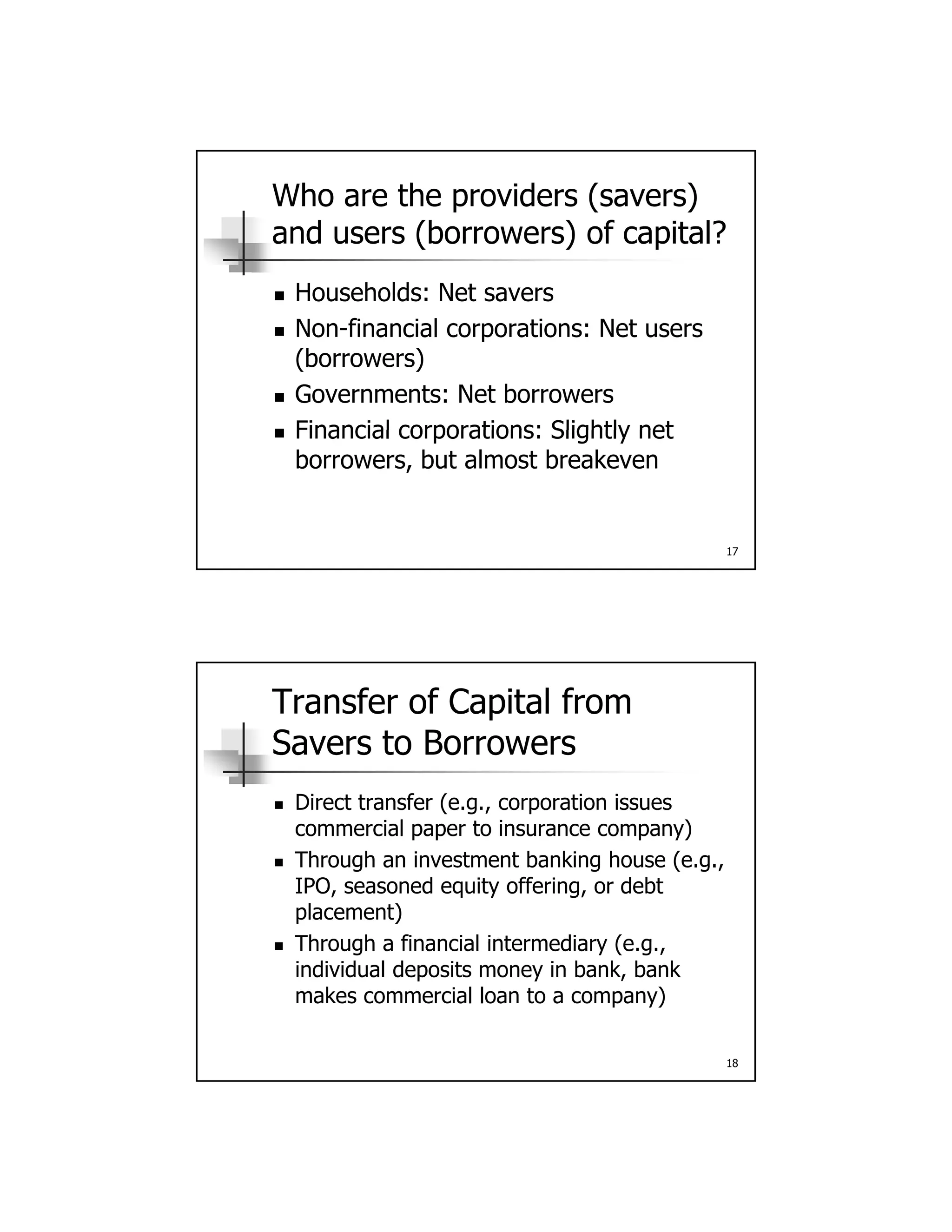
Who are the providers (savers)
and users (borrowers) of capital?
Households: Net savers Households: Net savers
 Non-financial corporations: Net users
(borrowers)
 Governments: Net borrowers
 Financial corporations: Slightly net
17
 Financial corporations: Slightly net
borrowers, but almost breakeven
Transfer of Capital from
Savers to Borrowers
 Direct transfer (e g corporation issues Direct transfer (e.g., corporation issues
commercial paper to insurance company)
 Through an investment banking house (e.g.,
IPO, seasoned equity offering, or debt
placement)
Through a financial intermediary (e g
18
 Through a financial intermediary (e.g.,
individual deposits money in bank, bank
makes commercial loan to a company)
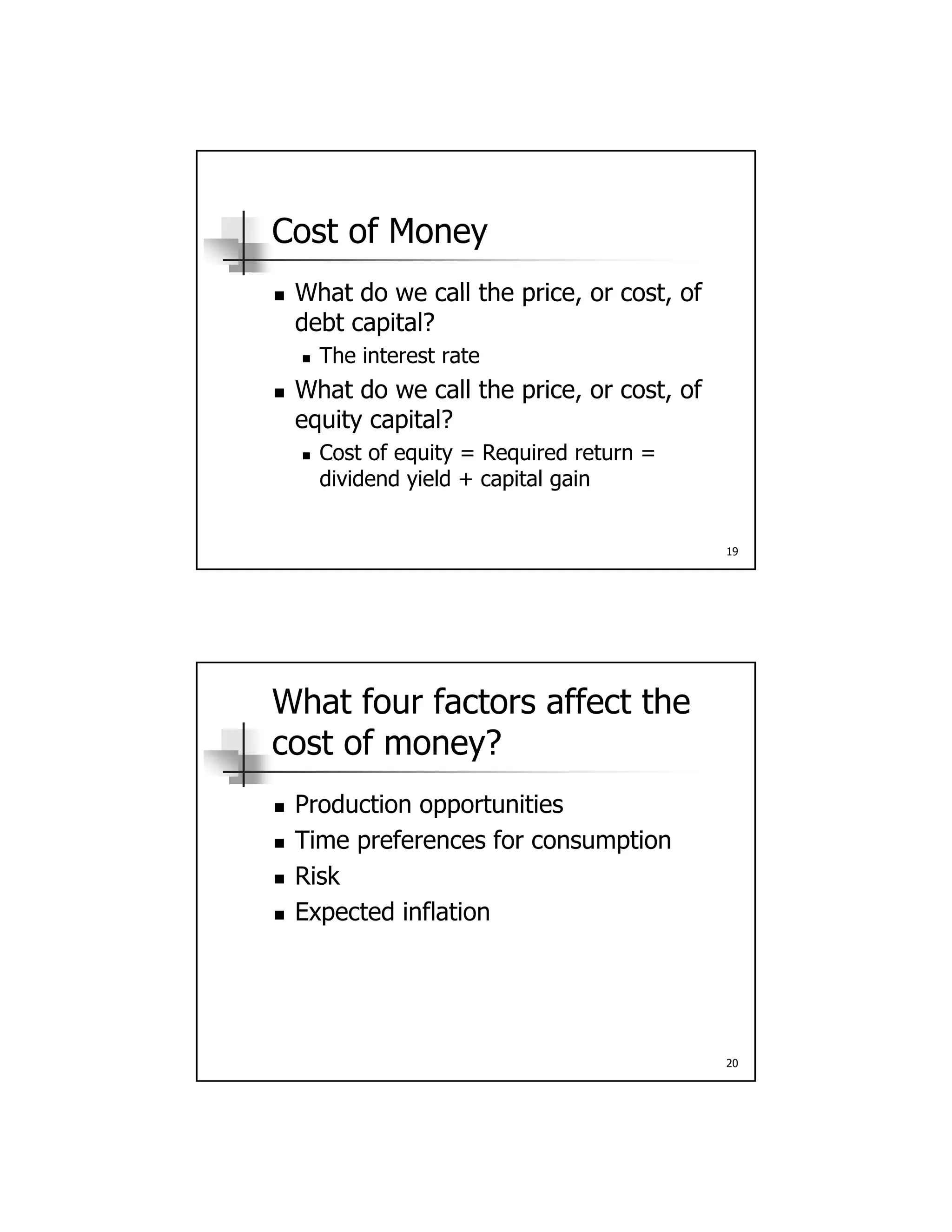
Cost of Money
What do we call the price or cost of What do we call the price, or cost, of
debt capital?
 The interest rate
 What do we call the price, or cost, of
equity capital?
19
q y p
 Cost of equity = Required return =
dividend yield + capital gain
What four factors affect the
cost of money?
Production opportunities Production opportunities
 Time preferences for consumption
 Risk
 Expected inflation
20
What economic conditions
affect the cost of money?
 Federal Reserve policies Federal Reserve policies
 Budget deficits/surpluses
 Level of business activity (recession or boom)
 International trade deficits/surpluses
21
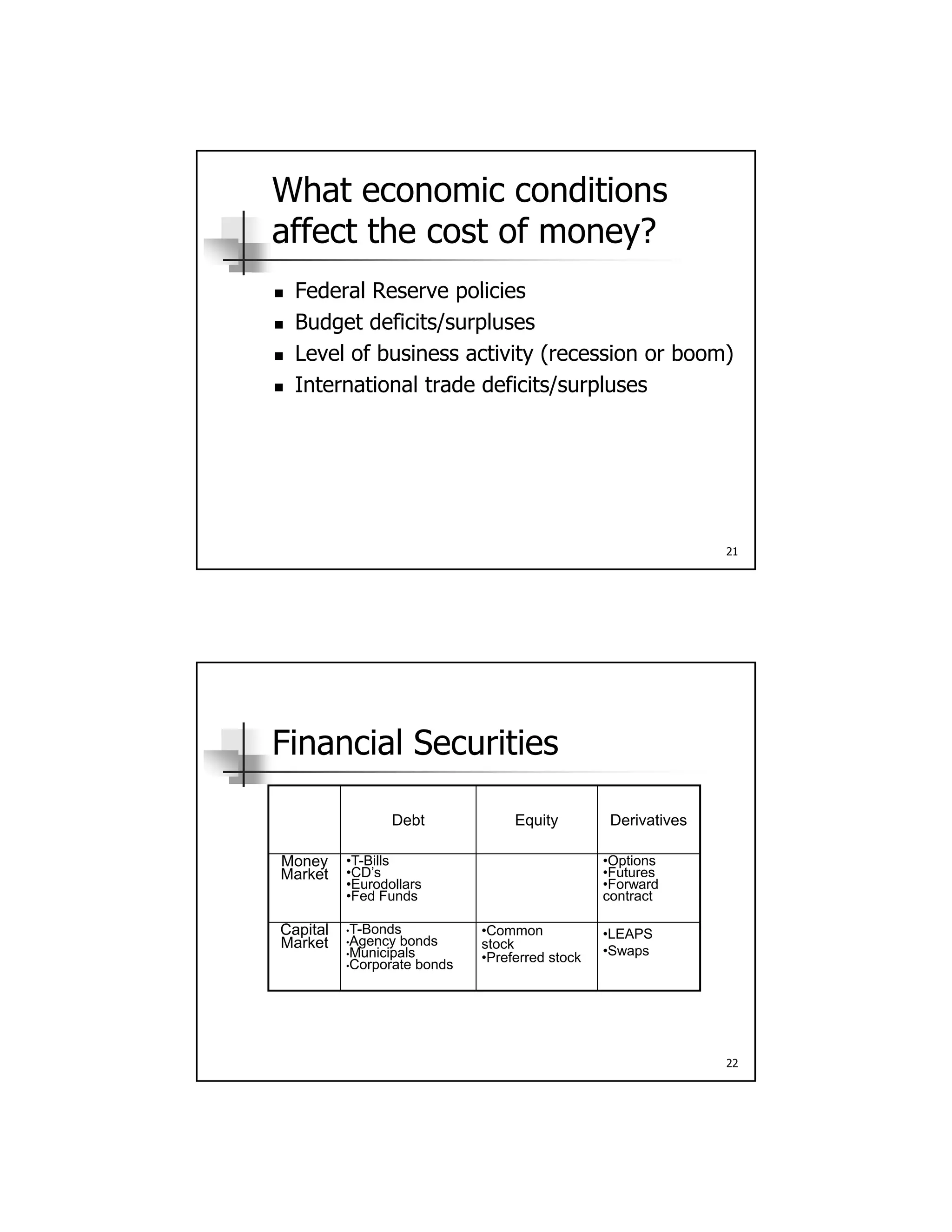
Financial Securities
Debt Equity Derivatives
Money
Market
•T-Bills
•CD’s
•Eurodollars
•Fed Funds
•Options
•Futures
•Forward
contract
Capital
Market
•T-Bonds
•Agency bonds
•Common
stock
•LEAPS
22
Market •Agency bonds
•Municipals
•Corporate bonds
stock
•Preferred stock •Swaps
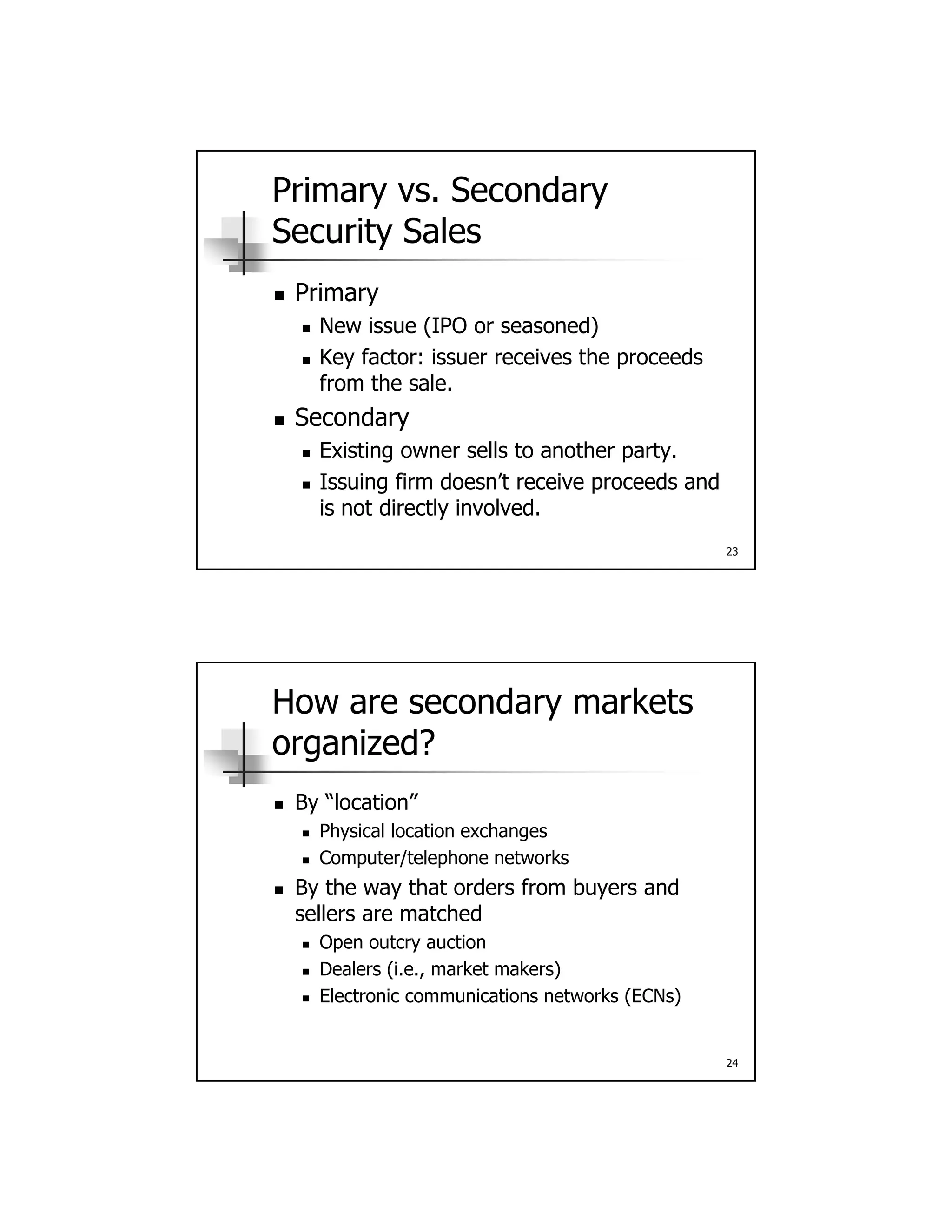
Primary vs. Secondary
Security Sales
Primary Primary
 New issue (IPO or seasoned)
 Key factor: issuer receives the proceeds
from the sale.
 Secondary
23
y
 Existing owner sells to another party.
 Issuing firm doesn’t receive proceeds and
is not directly involved.
How are secondary markets
organized?
 By “location” By location
 Physical location exchanges
 Computer/telephone networks
 By the way that orders from buyers and
sellers are matched
Open outcry auction
24
 Open outcry auction
 Dealers (i.e., market makers)
 Electronic communications networks (ECNs)
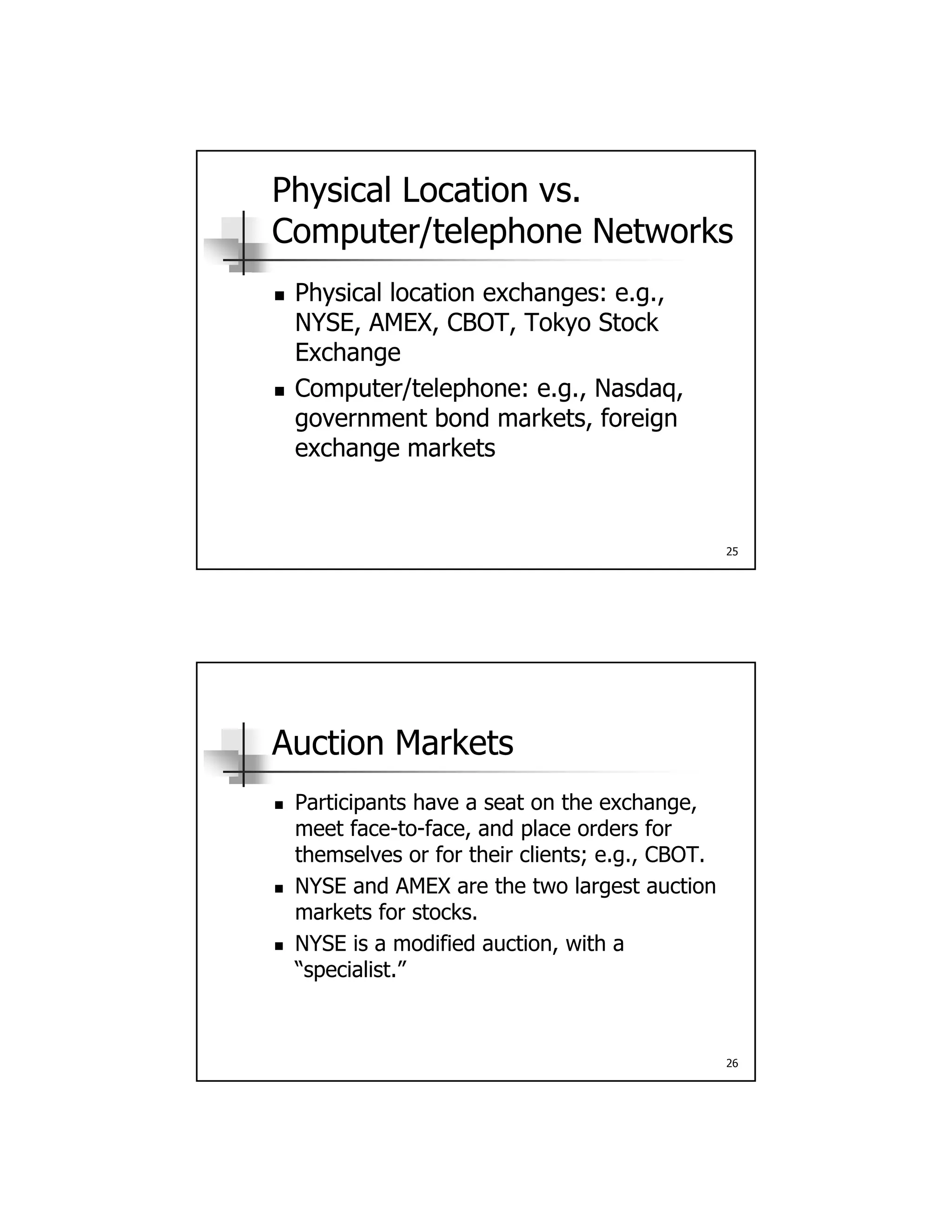
Physical Location vs.
Computer/telephone Networks
Physical location exchanges: e g Physical location exchanges: e.g.,
NYSE, AMEX, CBOT, Tokyo Stock
Exchange
 Computer/telephone: e.g., Nasdaq,
government bond markets, foreign
25
g , g
exchange markets
Auction Markets
 Participants have a seat on the exchange Participants have a seat on the exchange,
meet face-to-face, and place orders for
themselves or for their clients; e.g., CBOT.
 NYSE and AMEX are the two largest auction
markets for stocks.
NYSE is a modified auction with a
26
 NYSE is a modified auction, with a
“specialist.”
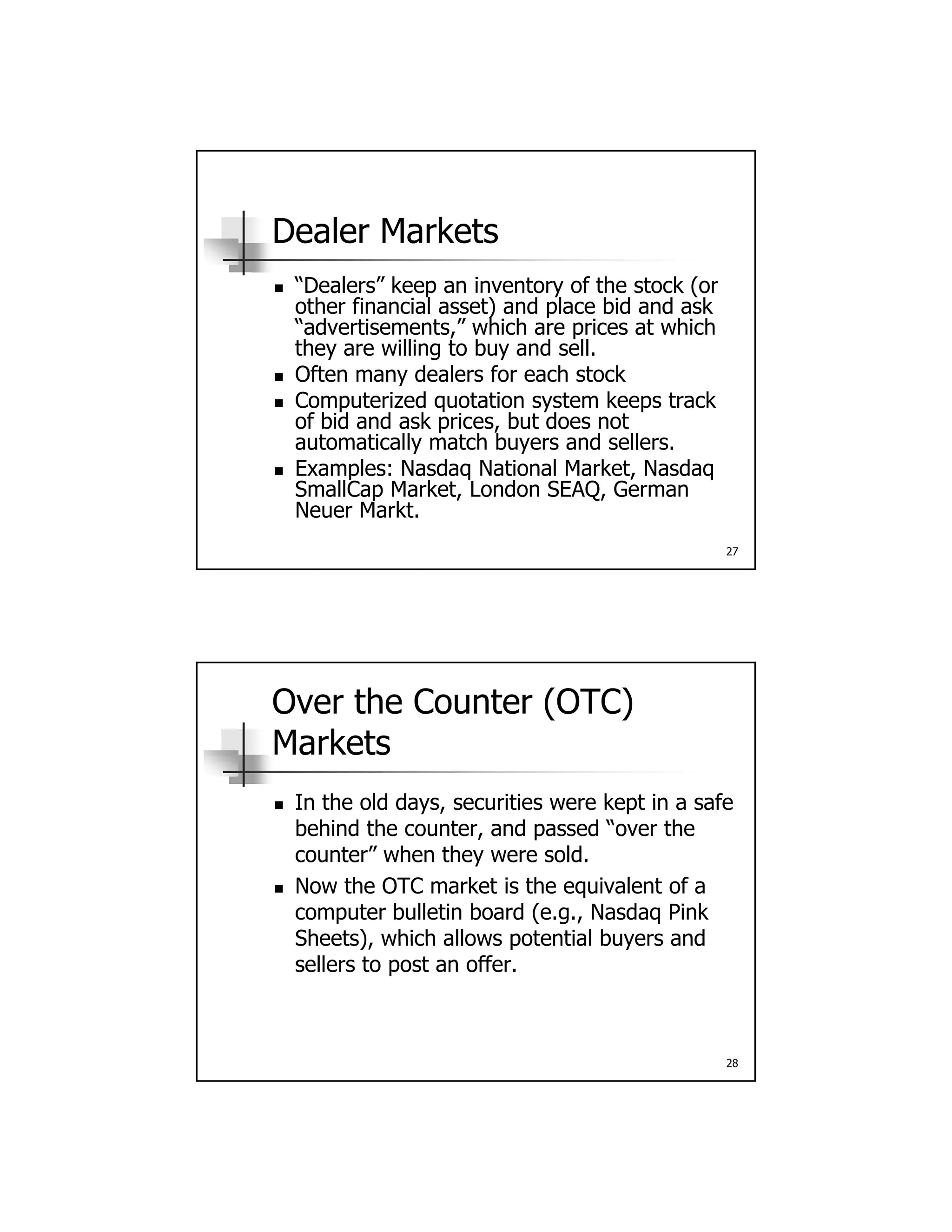
Dealer Markets
 “Dealers” keep an inventory of the stock (or Dealers keep an inventory of the stock (or
other financial asset) and place bid and ask
“advertisements,” which are prices at which
they are willing to buy and sell.
 Often many dealers for each stock
 Computerized quotation system keeps track
of bid and ask prices, but does not
27
p ,
automatically match buyers and sellers.
 Examples: Nasdaq National Market, Nasdaq
SmallCap Market, London SEAQ, German
Neuer Markt.
Over the Counter (OTC)
Markets
 In the old days securities were kept in a safe In the old days, securities were kept in a safe
behind the counter, and passed “over the
counter” when they were sold.
 Now the OTC market is the equivalent of a
computer bulletin board (e.g., Nasdaq Pink
Sheets) which allows potential buyers and
28
Sheets), which allows potential buyers and
sellers to post an offer.

ch 01; overview and fin environment

  • 1.
    CHAPTER 1CHAPTER 1 Overviewof Financial M t d th Fi i l 1 Management and the Financial Environment Topics in Chapter  Forms of business organization Forms of business organization  Objective of the firm: Maximize wealth  Determinants of fundamental value  Financial securities, markets and institutions 2
  • 2.
    Corporate ManagerCorporate Manager (Agent)(Agent) Overviewof Financial Management Multinational Corporate Balance SheetMultinational Corporate Balance Sheet AssetsAssets LiabilitiesLiabilities Short Term Short TermShort Term Short Term Current AssetsCurrent Assets Current LiabilitiesCurrent Liabilities Long TermLong Term Long TermLong Term LandLand DebtDebt PlantPlant Preferred StockPreferred Stock Financial MarketFinancial Market Corporate /Corporate / GovtGovt SecuritiesSecurities BondsBonds PreferredPreferred StockStock Product MarketProduct Market Cash OutlayCash Outlay Cash RevenueCash Revenue Cash ExpenseCash Expense Net Cash FlowsNet Cash Flows (Agent)(Agent) EquipmentEquipment Equity (Owner)Equity (Owner) Shareholder’s Wealth MaximizationShareholder’s Wealth Maximization (Agency Problems)(Agency Problems) Capital BudgetingCapital Budgeting Maximize:Maximize: NPV / IRRNPV / IRR Cost of CapitalCost of Capital Minimize:Minimize: Cost of DebtCost of Debt Cost of PreferredCost of Preferred Cost of EquityCost of Equity Why is corporate finance important to all managers? Corporate finance provides the skills Corporate finance provides the skills managers need to:  Identify and select the corporate strategies and individual projects that add value to their firm. f f 4  Forecast the funding requirements of their company, and devise strategies for acquiring those funds.
  • 3.
    Business Organization fromStart- up to a Major Corporation Sole proprietorship Sole proprietorship  Partnership  Corporation 5 Starting as a Proprietorship  Advantages: Advantages:  Ease of formation  Subject to few regulations  No corporate income taxes  Disadvantages: f 6  Limited life  Unlimited liability  Difficult to raise capital to support growth
  • 4.
    Starting as orGrowing into a Partnership A partnership has roughly the same A partnership has roughly the same advantages and disadvantages as a sole proprietorship. 7 Becoming a Corporation A corporation is a legal entity separate A corporation is a legal entity separate from its owners and managers.  File papers of incorporation with state.  Charter  Bylaws 8 Bylaws
  • 5.
    Advantages and Disadvantagesof a Corporation  Advantages: Advantages:  Unlimited life  Easy transfer of ownership  Limited liability  Ease of raising capital Di d t 9  Disadvantages:  Double taxation  Cost of set-up and report filing Becoming a Public Corporation and Growing Afterwards Initial Public Offering (IPO) of Stock Initial Public Offering (IPO) of Stock  Raises cash  Allows founders and pre-IPO investors to “harvest” some of their wealth  Subsequent issues of debt and equity 10 q q y
  • 6.
    Agency Problems and CorporateGovernance  Agency problem: managers may act in their Agency problem: managers may act in their own interests and not on behalf of owners (stockholders)  Corporate governance is the set of rules that control a company’s behavior towards its directors, managers, employees, shareholders creditors customers 11 shareholders, creditors, customers, competitors, and community.  Corporate governance can help control agency problems. What should be management’s primary objective? The primary objective should be The primary objective should be shareholder wealth maximization, which translates to maximizing the fundamental stock price. 12
  • 7.
    What three aspectsof cash flows affect an investment’s value? Amount of expected cash flows (bigger Amount of expected cash flows (bigger is better)  Timing of the cash flow stream (sooner is better)  Risk of the cash flows (less risk is 13  Risk of the cash flows (less risk is better) Free Cash Flows (FCF) Free cash flows are the cash flows that Free cash flows are the cash flows that are available (or free) for distribution to all investors (stockholders and creditors).  FCF = sales revenues - operating costs 14 p g - operating taxes - required investments in operating capital.
  • 8.
    What is theweighted average cost of capital (WACC)?  WACC is the average rate of return required WACC is the average rate of return required by all of the company’s investors.  WACC is affected by:  Capital structure (the firm’s relative amounts of debt and equity)  Interest rates 15  Interest rates  Risk of the firm  Investors’ overall attitude toward risk What determines a firm’s fundamental, or intrinsic, value? Intrinsic value is the sum of all the future expected free cash flows when converted into today’s dollars: Value = FCF1 FCF2 FCF∞+ +… 16 Value = (1 + WACC)1 (1 + WACC)∞(1 + WACC)2
  • 9.
    Who are theproviders (savers) and users (borrowers) of capital? Households: Net savers Households: Net savers  Non-financial corporations: Net users (borrowers)  Governments: Net borrowers  Financial corporations: Slightly net 17  Financial corporations: Slightly net borrowers, but almost breakeven Transfer of Capital from Savers to Borrowers  Direct transfer (e g corporation issues Direct transfer (e.g., corporation issues commercial paper to insurance company)  Through an investment banking house (e.g., IPO, seasoned equity offering, or debt placement) Through a financial intermediary (e g 18  Through a financial intermediary (e.g., individual deposits money in bank, bank makes commercial loan to a company)
  • 10.
    Cost of Money Whatdo we call the price or cost of What do we call the price, or cost, of debt capital?  The interest rate  What do we call the price, or cost, of equity capital? 19 q y p  Cost of equity = Required return = dividend yield + capital gain What four factors affect the cost of money? Production opportunities Production opportunities  Time preferences for consumption  Risk  Expected inflation 20
  • 11.
    What economic conditions affectthe cost of money?  Federal Reserve policies Federal Reserve policies  Budget deficits/surpluses  Level of business activity (recession or boom)  International trade deficits/surpluses 21 Financial Securities Debt Equity Derivatives Money Market •T-Bills •CD’s •Eurodollars •Fed Funds •Options •Futures •Forward contract Capital Market •T-Bonds •Agency bonds •Common stock •LEAPS 22 Market •Agency bonds •Municipals •Corporate bonds stock •Preferred stock •Swaps
  • 12.
    Primary vs. Secondary SecuritySales Primary Primary  New issue (IPO or seasoned)  Key factor: issuer receives the proceeds from the sale.  Secondary 23 y  Existing owner sells to another party.  Issuing firm doesn’t receive proceeds and is not directly involved. How are secondary markets organized?  By “location” By location  Physical location exchanges  Computer/telephone networks  By the way that orders from buyers and sellers are matched Open outcry auction 24  Open outcry auction  Dealers (i.e., market makers)  Electronic communications networks (ECNs)
  • 13.
    Physical Location vs. Computer/telephoneNetworks Physical location exchanges: e g Physical location exchanges: e.g., NYSE, AMEX, CBOT, Tokyo Stock Exchange  Computer/telephone: e.g., Nasdaq, government bond markets, foreign 25 g , g exchange markets Auction Markets  Participants have a seat on the exchange Participants have a seat on the exchange, meet face-to-face, and place orders for themselves or for their clients; e.g., CBOT.  NYSE and AMEX are the two largest auction markets for stocks. NYSE is a modified auction with a 26  NYSE is a modified auction, with a “specialist.”
  • 14.
    Dealer Markets  “Dealers”keep an inventory of the stock (or Dealers keep an inventory of the stock (or other financial asset) and place bid and ask “advertisements,” which are prices at which they are willing to buy and sell.  Often many dealers for each stock  Computerized quotation system keeps track of bid and ask prices, but does not 27 p , automatically match buyers and sellers.  Examples: Nasdaq National Market, Nasdaq SmallCap Market, London SEAQ, German Neuer Markt. Over the Counter (OTC) Markets  In the old days securities were kept in a safe In the old days, securities were kept in a safe behind the counter, and passed “over the counter” when they were sold.  Now the OTC market is the equivalent of a computer bulletin board (e.g., Nasdaq Pink Sheets) which allows potential buyers and 28 Sheets), which allows potential buyers and sellers to post an offer.