FUNCTION
Total No.of questions in Function are -
Level # 1 ........................................ 109
Level # 2 ........................................ 49
Level # 3 ........................................ 35
Level # 4 ........................................ 45
Total No. of questions......................................................... 238
Questions
based on inequation
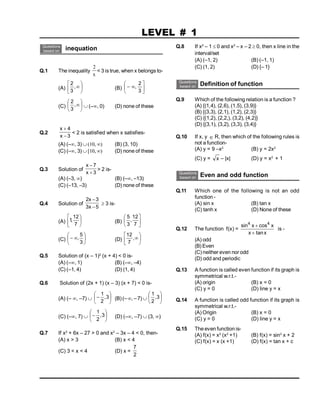
Q.1 The inequality
x
2
< 3 is true, when x belongs to-
(A) 






,
3
2
(B) 







3
2
(C) 






,
3
2
 (–, 0) (D) none of these
Q.2
3
x
4
x


< 2 is satisfied when x satisfies-
(A) (–, 3) (10, ) (B) (3, 10)
(C) (–, 3) [10, ) (D) none of these
Q.3 Solution of
3
x
7
x


> 2 is-
(A) (–3, ) (B) (–, –13)
(C) (–13, –3) (D) none of these
Q.4 Solution of
5
x
3
3
x
2


 3 is-
(A) 





7
12
,
1 (B) 





7
12
,
3
5
(C) 







3
5
, (D) 






,
7
12
Q.5 Solution of (x – 1)2
(x + 4) < 0 is-
(A) (–, 1) (B) (–, –4)
(C) (–1, 4) (D) (1, 4)
Q.6 Solution of (2x + 1) (x – 3) (x + 7) < 0 is-
(A) (– , –7)  





 3
,
2
1
(B)(– , –7)  





3
,
2
1
(C) (–, 7)  





 3
,
2
1
(D) (–, –7)  (3, )
Q.7 If x2
+ 6x – 27 > 0 and x2
– 3x – 4 < 0, then-
(A) x > 3 (B) x < 4
(C) 3 < x < 4 (D) x =
2
7
LEVEL # 1
Q.8 If x2
– 1  0 and x2
– x – 2  0, then x line in the
interval/set
(A) (–1, 2) (B) (–1, 1)
(C) (1, 2) (D) {– 1}
Questions
based on Definition of function
Q.9 Which of the following relation is a function ?
(A) {(1,4), (2,6), (1,5), (3,9)}
(B) {(3,3), (2,1), (1,2), (2,3)}
(C) {(1,2), (2,2,), (3,2), (4,2)}
(D) {(3,1), (3,2), (3,3), (3,4)}
Q.10 If x, y  R, then which of the following rules is
not a function-
(A) y = 9 –x2
(B) y = 2x2
(C) y = x – |x| (D) y = x2
+ 1
Questions
based on Even and odd function
Q.11 Which one of the following is not an odd
function -
(A) sin x (B) tan x
(C) tanh x (D) None of these
Q.12 The function f(x) =
sin cos
tan
4 4
x x
x x


is -
(A) odd
(B) Even
(C) neither even nor odd
(D) odd and periodic
Q.13 A function is called even function if its graph is
symmetrical w.r.t.-
(A) origin (B) x = 0
(C) y = 0 (D) line y = x
Q.14 A function is called odd function if its graph is
symmetrical w.r.t.-
(A) Origin (B) x = 0
(C) y = 0 (D) line y = x
Q.15 The even function is-
(A) f(x) = x2
(x2
+1) (B) f(x) = sin3
x + 2
(C) f(x) = x (x +1) (D) f(x) = tan x + c
Q.16 A function whose graph is symmetrical about
the y-axis is given by-
(A) f(x) = loge (x + 1
x2
 )
(B) f(x + y) = f(x) + f(y) for all x, y  R
(C) f(x) = cos x + sin x
(D) None of these
Q.17 Which of the following is an even function ?
(A) x
a
a
x
x


1
1
(B) tan x
(C)
a a
x x
 
2
(D)
a
a
x
x


1
1
Q.18 In the following, odd function is -
(A) cos x2
(B) (ex
+ 1)/(ex
– 1)
(C) x2
– |x| (D) None of these
Q.19 The function f(x) = x2
– |x| is -
(A) an odd function
(B) a rational function
(C) an even function
(D) None of these
Questions
based on Periodic function
Q.20 The period of sin4
x + cos4
x is -
(A)  (B) /2
(C) 2 (D) None of these
Q.21 The period of function |cos 2x| is -
(A) (B) /2
(C) 4 (D) 2
Q.22 The period of function sin
x
2
F
H
GI
K
J+ cos
x
2
F
H
GI
K
Jis-
(A) 4 (B) 6
(C) 12 (D) 24
Q.23 The period of the function
f(x) = log cos 2x + tan 4x is -
(A) /2 (B) 
(C) 2 (D) 2/5
Q.24 The period of the function f(x) = 2 cos
1
3
(x–)
is -
(A) 6 (B) 4
(C) 2 (D) 
Q.25 In the following which function is not
periodic-
(A) tan 4x (B) cos 2x
(C) cos x2
(D) cos2
x
Domain, Co-domain and range
of function
Q.26 Domain of the function f(x) =
1
2
x 
is-
(A) R (B) (–2, )
(C) [2, ] (D) [0, ]
Q.27 The domain where function f(x) = 2x2
– 1 and
g(x) = 1 – 3x are equal, is-
(A) {1/2} (B) {2}
(C) {1/2,2} (D) {1/2,-2}
Q.28 The domain of the function log
3
2
 x
is-
(A) (3, ) (B) (– ,3)
(C) (0,3) (D) (–3,3)
Q.29 Domain of the function cos–1
(4x –1) is-
(A) (0,1/2) (B) [0,1/2]
(C) [1/2,2] (D) None of these
Q.30 Domain of the function log |x2
– 9| is-
(A) R (B) R– [–3,3]
(C) R – {–3,3} (D) None of these
Q.31 The domain of the function-
f (x) = x 1 + 6  x is-
(A) (1,6) (B) [1,6]
(C) [1, ) (D) (– ,6]
Q.32 The domain of the function f(x) = ( )
2 2 2
 
x x
is -
(A) – 3 x  3
(B) – 1– 3 x –1 + 3
(C) – 2 x 2
(D) –2 + 3 x –2– 3
Q.33 Domain of a function f(x) = sin–1
5x is-
(A) 
F
H
G I
K
J
1
5
1
5
, (B) 
L
N
M O
Q
P
1
5
1
5
,
(C) R (D) 0
1
5
,
F
H
G I
K
J
Q.43 The range of f : R+
 R+
, f(x) = ex
is -
(A) (0,  ) (B) [1,  )
(C) (1,  ) (D) None of these
Q.44 The range of f(x) = cos 2x – sin 2x contains
the set -
(A) [2,4] (B) [–1,1]
(C) [–2,2] (D) [–4,4]
Q.45 If the domain of the function f(x) =
| |
x
x
be
[3,7] then its range is-
(A) [–1,1] (B) {–1,1}
(C) {1} (D) {–1}
Q.46 The domain of the function f(x) =
1
x x
 [ ]
is-
(A) R (B) R–Z
(C) Z (D) None of these
Q.47 The range of the function
f(x) = 2 + x – [x–3] is-
(A) [5,6] (B) [5,6)
(C) R (D) None of these
Questions
based on Value of function
Q.48 If f(x) = log x, then f (x/y) equals-
(A) f(x) + f(y) (B) f(x) – f(y)
(C) f(x) / f(y) (D) f(x) . f(y)
Q.49 If f(x) =
2
1 2
x
x

, then f (tan  ) equals-
(A) cot 2 (B) tan 2 
(C) sec 2 (D) cos 2 
Q.50 If f(x) = ax
, then f(x+ y) equals-
(A) f(x) + f(y) (B) f(x) – f(y)
(C) f(x) f(y) (D) f(x) /f(y)
Q.51 If f(x) = log x, then correct statement is-
(A) f(x + y) = f( x ) + f(y) (B) f(x + y) = f( x) . f(y)
(C) f(xy) = f(x) + f(y) (D) f(xy) = f( x) . f(y)
Q.52 If f (x) =
x
x 1
, then
f a b
f b a
( / )
( / )
=
(A) ab (B) a/b
(C) b/a (D) 1
Q.34 If f : R+
 R, f(x) = log x, then range of f is -
(A) R0
(B) R
(C) R+
(D) None of these
Q.35 The range of thefunction f : R R, f(x) = tan–1
x
is-
(A) 
L
N
M O
Q
P
 
2 2
, (B) 
O
Q
P L
N
M
 
2 2
,
(C) R (D) None of these
Q.36 The range of f(x) = sin

2
[x] is -
(A) {–1,1} (B) {–1,0,1}
(C) {0,1} (D) [–1,1]
Q.37 Domain and range of f(x) =
| |
x
x


3
3
are
respectively-
(A) R, [–1,1] (B) R– {3}, {1,–1}
(C) R+
, R (D) None of these
Q.38 The domain of the function f(x) = sin 1/x is -
(A) R (B) R+
(C) R0
(D) R–
Q.39 Range of the function f(x) = 9 – 7 sin x is-
(A) (2,16) (B) [2,16]
(C) [–1,1] (D) (2,16]
Q.40 For real values of x, range of function
y =
1
2 3
 sin x
is -
(A)
1
3 y 1 (B) –
1
3 y 1
(C) –
1
3
> y > – 1 (D)
1
3
> y > 1
Q.41 If f : R  R, f(x) =
1
1
,
,
when x Q
when x Q

 
R
S
T , then
image set of R under f is -
(A) {1,1} (B) (–1,–1)
(C) {1,–1} (D) None of these
Q.42 If f : R  R, f(x) = x2
, then {x| f (x) = –1} equals-
(A) {–1,1} (B) {1}
(C)  (D) None of these
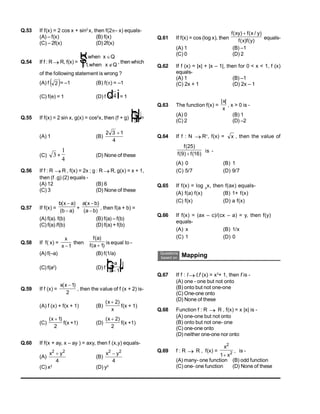
Q.53 If f(x) = 2 cos x + sin2
x, then f(2– x) equals-
(A) – f(x) (B) f(x)
(C) – 2f(x) (D)2f(x)
Q.54 If f : R R, f(x) =
1
1
,
,
when x Q
when x Q

 
R
S
T , then which
of the following statement is wrong ?
(A) f  
2 = –1 (B) f() = –1
(C) f(e) = 1 (D) f 4
d i= 1
Q.55 If f(x) = 2 sin x, g(x) = cos2
x, then (f + g)

3
F
H
GI
K
J=
(A) 1 (B)
2 3 1
4

(C) 3 +
1
4
(D) None of these
Q.56 If f : R  R , f(x) = 2x ; g : R R, g(x) = x + 1,
then (f .g) (2) equals -
(A) 12 (B) 6
(C) 3 (D) None of these
Q.57 If f(x) =
b x a
b a
( )
( )


+
a x b
a b
( )
( )


, then f(a + b) =
(A) f(a). f(b) (B) f(a) – f(b)
(C) f(a) /f(b) (D) f(a) + f(b)
Q.58 If f( x) =
x
x 1
then
f a
f a
( )
( )
1
is equal to -
(A) f(–a) (B) f(1/a)
(C) f(a2
) (D) f


F
H
G I
K
J
a
a 1
Q.59 If f (x) =
x x
( )
1
2
, then the value of f (x + 2) is-
(A) f (x) + f(x + 1) (B)
( )
x
x
 2
f(x + 1)
(C)
( )
x 1
2
f(x +1) (D)
( )
x  2
2
f(x +1)
Q.60 If f(x + ay, x – ay ) = axy, then f (x,y) equals-
(A)
x y
2 2
4

(B)
x y
2 2
4

(C) x2
(D) y2
Q.61 If f(x) = cos (log x), then
f xy f x y
f x f y
( ) ( / )
( ) ( )

equals-
(A) 1 (B) –1
(C) 0 (D) 2
Q.62 If f (x) = |x| + |x – 1|, then for 0 < x < 1, f (x)
equals-
(A) 1 (B) –1
(C) 2x + 1 (D) 2x – 1
Q.63 The function f(x) =
| |
x
x
, x > 0 is -
(A) 0 (B) 1
(C) 2 (D) –2
Q.64 If f : N  R+
, f(x) = x , then the value of
f
f f
( )
( ) ( )
25
9 16

is -
(A) 0 (B) 1
(C) 5/7 (D) 9/7
Q.65 If f(x) = log a
x, then f(ax) equals-
(A) f(a) f(x) (B) 1+ f(x)
(C) f(x) (D) a f(x)
Q.66 If f(x) = (ax – c)/(cx – a) = y, then f(y)
equals-
(A) x (B) 1/x
(C) 1 (D) 0
Questions
based on Mapping
Q.67 If f : I I,f (x) = x3
+ 1, then f is -
(A) one - one but not onto
(B) onto but not one-one
(C) One-one onto
(D) None of these
Q.68 Function f : R  R , f(x) = x |x| is -
(A) one-one but not onto
(B) onto but not one- one
(C) one-one onto
(D) neither one-one nor onto
Q.69 f : R  R , f(x) =
x
x
2
2
1
, is -
(A) many- one function (B) odd function
(C) one- one function (D) None of these
Q.70 If f : R0  R0
, f(x) =
1
x
, then f is -
(A) one-one but not onto
(B) onto but not one-one
(C) neither one-one nor onto
(D) both one-one and onto
Q.71 Function f : R  R, f(x) = x + |x| is
(A) one-one (B) onto
(C) one-one onto (D) None of these
Q.72 Function f :
 
2
3
2
,
O
Q
P L
N
M
 R, f(x) = tan x is
(A) one-one (B) onto
(C) one-one onto (D) None of these
Q.73 Function f :
 
2
3
2
,
L
N
M O
Q
P
 [–1,1], f(x) = sin x is -
(A) one-one (B) onto
(C) one-one onto (D) None of these
Q.74 Function f :
1
2
3
2
 
,
L
N
M O
Q
P
 [–1,1], f(x) = cos x is
(A) many-one onto (B) onto
(C) one-one onto (D) many one into
Q.75 If f : R R, f(x) = ex
+ e–x
, then f is -
(A) one-one but not onto
(B) onto but not one-one
(C) neither one-one nor onto
(D) both one-one and onto
Q.76 If f : R  [–1,1], f(x) = sin x, then f is -
(A) one-one onto (B) one-one into
(C) many-one onto (D) many-one into
Q.77 If f : R R , f(x) = sin2
x + cos2
x , then f is -
(A) one-one but not onto
(B) onto but not one-one
(C) neither one-one nor onto
(D) both one-one onto
Q.78 Which of the following functions from Z to itself
are bijections ?
(A) f(x) = x3
(B) f(x) = x + 2
(C) f(x) = 2x + 1 (D) f(x) = x2
+ x
Q.79 Which of the following functions from
A = {x: –1 x 1} to itself are bijections ?
(A) f(x) =
x
2
(B) g(x) = sin
x
2
F
H
GI
K
J
(C) h(x) = |x| (D) k(x) = x2
Q.80 Which of the following function is onto ?
(A) f : R  R ; f(x) = 3x
(B) f : R R+
; f(x) = e–x
(C) f: [0,  /2]  [–1,1]; f(x) = sin x
(D) f : R R: f(x) = cosh x
Q.81 Which of the following function defined from
R to R is onto ?
(A) f(x) = |x| (B) f(x) = e–x
(C) f(x) = x3 (D) f(x) = sin x.
Q.82 If f :   , f(x) = x2
– x, then f is -
(A) one-one onto (B) one-one into
(C) many-one onto (D) many-one into
Questions
based on Composite function
Q.83 If f(x) = 2x and g is identity function, then-
(A) (fog) (x) = g(x) (B) (g + g) (x) = g(x)
(C) (fog) (x) = (g + g) (x) (D) None of these
Q.84 gof exists, when-
(A) domain of f = domain of g
(B) co-domain of f = domain of g
(C) co-domain of g = domain of g
(D) co-domain of g = co-domain of f
Q.85 If f : R  R, f(x) = x2
+ 2x – 3 and g : R  R,
g(x) = 3x – 4 , then the value of fog (x) is-
(A) 3x2
+ 6x – 13 (B) 9x2
–18x + 5
(C) (3x– 4)2
+ 2x – 3 (D) None of these
Q.86 If f : R  R, f(x) = x2
– 5x + 4 and g : R  R,
g(x) = log x , then the value of (gof) (2) is -
(A) 0 (B) 
(C) –  (D)Undefined
Q.87 If f : R+
 R+
,f(x) = x2
+ 1/x2
and g : R+
 R+
,
g(x) = ex
then (gof) (x) equals-
(A) ex2


ex 2
(B) e
e
x
x
2
2
1
 
(C) e e
x x
2 2
  (D) e e
x x
2 2
.

Q.88 If f : R R, g : R R and f(x) = 3x + 4 and
(gof) (x) = 2x – 1, then the value of g(x) is -
(A) 2x – 1 (B) 2x – 11
(C)
1
3
(2x – 11) (D) None of these
Q.89 If f : R  R, g : R  R and g(x) = x + 3 and
(fog) (x) = (x + 3)2
, then the value of f(–3) is -
(A) –9 (B) 0
(C) 9 (D) None of these
Q.90 If f(x) = ax + b and g(x) = cx + d, then
f(g(x)) = g(f(x)) is equivalent to-
(A) f(a) = g(c) (B) f(b) = g(b)
(C) f(d) = g(b) (D) f(c) = g(a)
Q.91 If f : [0,1]  [0,1], f(x) =
1
1


x
x
. g : [0,1]  [0,1],
g(x) = 4x (1–x), then (fog) (x) equals-
(A)
1 4 4
1 4 4
2
2
 
 
x x
x x
(B)
8 1
1 2
x x
x
( )
( )


(C)
1 4 4
1 4 4
2
2
 
 
x x
x x
(D) None of these
Q.92 If f, g, h are three functions in any set, then
wrong statement is -
(A) (fog)–1
= g–1
of –1
(B) gof  fog
(C) (fog)oh = fo(goh)
(D) (gof)–1
= g–1
of –1
Q.93 If f(x) =
1
1


x
x
, then f [f (sin)] equals -
(A) sin  (B) tan (/2)
(C) cot (/2) (D) cosec 
Q.94 If f(x) = (a – x n
)1/n
, n N, then f [f(x)] is equal to-
(A) 0 (B) x
(C) xn
(D) (an
– x)n
Q.95 If f (x) = log 







x
1
x
1
and g(x) = 









2
3
x
3
1
x
x
3
,
then f[g(x)] is equal to-
(A) –f(x) (B) 3f(x)
(C) [f(x)]3
(D) None of these
Q.96 If  (x) = x2
+ 1 and  (x) = 3x
, then  {  (x)}
and  {  (x)} =
(A) 32x+1
, 3
2
1
x 
(B) 32x+1
, 3
2
1
x 
(C) 32x
+1, 3
2
1
x 
(D) None of these
Q.97 If function f(x) =
1
0
,
,
when x Q
when x Q


R
S
T , (fof) ( 4 )
the value will be -
(A) 0 (B) 2
(C) 1 (D) None of these
Q.98 If f(x) =
1
0
,
,
when x Q
when x Q


R
S
T , then (fof) ( )
 will be-
(A) 2 (B) 0
(C) 1 (D)Undefined
Q.99 If f(y) =
y
y
1 2

, g(y) =
y
y
1 2

, then
(fog)(y) equals-
(A)
y
y
1 2

(B)
y
y
1 2

(C) y (D)
1
1
2
2


y
y
Q.100 If f(x) = [x] and g(x) = cos (x), then the
range of gof is -
(A) {0} (B) {–1,1}
(C) {–1,0,1} (D) [–1,1]
Questions
based on Inverse fucntion
Q.101 If f : R  R, f(x) = x2
+ 3, then pre- image of 2
under f is -
(A) {1,–1} (B) {1}
(C) {–1} (D) 
Q.102 Which of the following functionshas its inverse-
(A) f : R  R , f(x) = ax
(B) f : R R, f(x) = |x| + |x – 1|
(C) f : R0  R+
, f(x) = |x|
(D) f : [, 2]  [–1,1], f(x) = cos x
Q.103 If function f : RR+
, f(x) = 2x
, then f –1
(x) will
be equal to-
(A) logx
2 (B) log2
(1/x)
(C) log2
x (D) None of these
Q.104 The inverse of the function f(x) =
e e
e e
x x
x x



 + 2
is given by -
(A) log
x
x


F
H
G I
K
J
2
1
1 2
/
(B) log
x
x


F
H
G I
K
J
1
1
1 2
/
(C) log
x
x
2
1 2

F
H
G I
K
J
/
(D) log
x
x


F
H
G I
K
J
1
3
1 2
/
Q.105 If f : [1, )  [2, ) is given by ƒ(x) = x +
x
1
then f–1
(x) equals -
(A)
2
4
x
x 2


(B) 2
x
1
x

(C)
2
4
x
x 2


(D) 1 + 4
x2

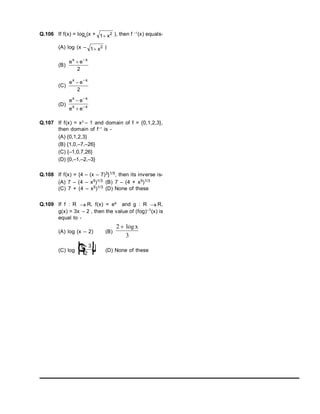
Q.106 If f(x) = loge
(x + 1 2
 x ), then f –1
(x) equals-
(A) log (x – 1 2
 x )
(B)
e e
x x
 
2
(C)
e e
x x
 
2
(D)
e e
e e
x x
x x




Q.107 If f(x) = x3
– 1 and domain of f = {0,1,2,3},
then domain of f–1
is -
(A) {0,1,2,3}
(B) {1,0,–7,–26}
(C) {–1,0,7,26}
(D) {0,–1,–2,–3}
Q.108 If f(x) = {4 – (x – 7)3}1/5, then its inverse is-
(A) 7 – (4 – x5)1/3 (B) 7 – (4 + x5)1/3
(C) 7 + (4 – x5)1/3 (D) None of these
Q.109 If f : R  R, f(x) = ex and g : R  R,
g(x) = 3x – 2 , then the value of (fog)–1(x) is
equal to -
(A) log (x – 2) (B)
2
3
 log x
(C) log
x 
F
H
G I
K
J
3
2
(D) None of these
Q.1 If f(x) = x +
1
x
, then -
(A) f(x2
) = [f(x)]2
(B) f(x + y) = f(x) + f(y)
(C) f(–x) = f(x) (D) f(1/x) = f(x)
Q.2 If x is the radius of a circle and f(x) = x2
, then
domain of f is -
(B) R (B) R+
(C) RÂŻ
(D) R0
Q.3 If f(x) = x2
– 3x + 1 and g(x) =
1
2
x 
, then
domain of (f – g) is -
(A) R (B) R+
(C) R – {2} (D) None of these
Q.4 If f : R  R, f(x) = tan x, then pre-image of
–1 under f is -
(A) n n


 
R
S
T
U
V
W
4
I (B) n n


 
R
S
T
U
V
W
4
I
(C) {n  | n I } (D) None of these
Q.5 f(x) =
x x
x x
2
2
2 1
3 2
 
 
is not defined for-
(A) x = 2 (B) x = 1, 2
(C) x = 2,–1 (D) x = 0
Q.6 If f : R R, f(x) = x3
+ 3, and g : R  R,
g(x) = 2x + 1, then f–1
og–1
(23) equals-
(A) 2 (B) 3
(C) (14)1/3
(D) (15)1/3
Q.7 If f(x) = log x, g(x) = x3
, then f[g(a)] + f [g(b)] is
equal to-
(A) f [g(a) + g(b)] (B) 3 f(ab)
(C) g [f(ab)] (D) g [f(a) + f(b)]
Q.8 Function sin–1 x is defined in the interval-
(A) (–1,1) (B) [0,1]
(C) [–1,0] (D) (–1,2)
Q.9 The interval for which sin–1 x + cos–1
x =

2
holds-
(A) [0, ) (B) [0,3]
(C) [0,1] (D) [0,2]
Q.10 The domain of the function f(x) = x! is -
(A) (0, ) (B) N
(C) W (D) R+
LEVEL # 2
Q.11 Function f : R  R+
, f(x) = x2
+ 2 and
g : R+
 R, g(x) = 1
1
1


F
H
G I
K
J
x
then the value of
gof (2) is -
(A) 5/6 (B) 8/7
(C) 1/6 (D) 6/5
Q.12 The period of function f (x) = |sin3
(x/2)| is
(A) 4  (B) 16 
(C) 2  (D) None of these
Q.13 The inverse of the function y = loge
x is -
(A) 10x
(B) 10–x
(C) ex
(D) e–x
Q.14 If f(x) = log
1
1


x
x
, when – 1 < x1
, x2
< 1, then
f(x1
) + f(x2
) equals-
(A) f
x x
x x
1 2
1 2
1


F
H
G I
K
J (B) f
x x
x x
1 2
1 2
1


F
H
G I
K
J
(C) f
x x
x x
1 2
1 2
1


F
H
G I
K
J (D) f
x x
x x
1 2
1 2
1


F
H
G I
K
J
Q.15 Function f : [–1,1]  R, f(x) = sin (  /2) x is -
(A) one-one (B) onto
(C) one-one onto (D) None of these
Q.16 If the domain of function f(x) = x2
– 6x + 7 is
(–  ,  ), then the range of function is -
(A) (–  ,  ) (B) [–2,  )
(C) (–2,3) (D) (–  ,–2)
Q.17 Function f : R  R, f(x) = [x] is -
(A) one-one onto (B) one-one into
(C) many-one onto (D) many-one into
Q.18 If S be the set of all triangles and f : S  R+
,
f (  ) = Area of  , then f is -
(A) One-one onto (B) one-one into
(C) many-one onto (D) many-one into
Q.19 If f : C R , f(z) = |z|, then f is -
(A) one-one but not onto
(B) onto but not one-one
(C) neither one-one nor onto
(D) both one-one and onto
Q.20 If f : 
L
N
M O
Q
P
1
2
1
2
 
,  [–1,1], f(x) = sin x, then f
is -
(A) one-one (B) one-one onto
(C) onto (D) None of these
Q.21 If f(x) = 1/x then f(a) – f(b) equals-
(A) f
b a
ab

F
H
G I
K
J (B) f
ab
a b

F
H
G I
K
J
(C) f
ab
b a

F
H
G I
K
J (D) f
a b
a b


F
H
G I
K
J
Q.22 f(x) = cos x , correct statement is -
(A) f(x) is periodic and its period = 2
(B) f(x) is periodic and its period = 4  2
(C) f(x) is periodic and its period = 
(D) f(x) is not periodic
Q.23 If f be the greatest integer function and g be the
modulus function, then
(gof) 
F
H
G I
K
J
5
3
– (fog) 
F
H
G I
K
J
5
3
=
(A) 1 (B) –1
(C) 2 (D) 4
Q.24 The domain of function f(x) = log |log x| is-
(A) (0, ) (B) (1, )
(C) (0,1)  (1, ) (D) (–,1)
Q.25 Domain of the function tan–1
x + cos–1
x2
is -
(A) R– [–1,1] (B) R– (–1,1)
(C) (–1,1) (D) [–1,1]
Q.26 Which of the following functions are equal ?
(A) f(x) = x, g(x) = x2
(B) f(x) = log x2
, g(x) = 2 log x
(C) f(x) = 1, g(x) = sin2
x + cos2
x
(D) f(x) = x/x, g(x) = 1
Q.27 If f : Q  Q, f(x)= 2x and g : Q  Q,
g(x) = x + 2, then (fog)–1
(20) equals-
(A) 10 (B) 12
(C) 8 (D) 6
Q.28 f(x) =
2
1
2
2
cosh sin
x x
x


is -
(A) an algebric function
(B) a trigonometrical function
(C) an even function
(D) an implicit function
Q.29 If f(x) = x2
– x–2
, then f(1/x) equals-
(A)
1
f x
( )
(B) –1/f(x)
(C)f(x) (D) – f(x)
Q.30 The domain of function
f(x) =
1
3
10
log ( )
 x + x  2 is -
(A) [–2, 3) (B) [–2, 3) – {2}
(C) [–3, 2] (D) [–2, 3] – {2}
Q.31 Domain of the function f(x) =
x
x x

 
3
1 4
2
( )
is-
(A) (1,2)
(B) (– , –2)  (2, )
(C) (– ,–2)  (1, )
(D) (– , ) – {1,  2}
Q.32 Range of the function f(x) = sin2
(x4
) + cos2
(x4
)
is-
(A) (– , ) (B) {1}
(C) (–1,1) (D) (0,1)
Q.33 Let f : R  R be a function defined by
f(x) = x + 2
x , then f is-
(A) injective (B) surjective
(C) bijective (D) None of these
Q.34 If f (x) = e3x
and g(x) =  n x, x > 0, then (fog) (x)
is equal to-
(A) 3x (B) x3
(C) log 3x (D) 3 log x
Q.35 If f : R  R f(x) = cos (5x + 2) then the value
of f –1
(x) is -
(A)
cos ( )


1
2
5
x
(B) cos ( )


1
2
x
(C)
cos ( )


1
5
2
x
(D) Does not exist
Q.36 Function f(x) = sin log
4
1
2


R
S
|
T
|
U
V
|
W
|
x
x
( ) has domain
(A) [–2,1) (B) [–2,1]
(C) (–2,1) (D) (–,1)
Q.37 The domain of function
f(x) = log (3x –1) + 2 log (x +1) is -
(A) [1/3, ) (B) [–1,1/3]
(C) (–1,1/3) (D) None of these
Q.38 If f(x) =
x
x
1 2

, then (fofof) (x) is equal to-
(A)
3
1 2
x
x

(B)
x
x
1 3 2

(C)
3
1 2
x
x

(D) None of these
Q.39 Which one of the following graphs represents
the function y = 1+ |x| for all x  R ?
(A)
(B)
(C) (D)
Q.40 If f (x) = x3
– x and g(x) = sin 2x, then -
(A) g [f(1)] = 1
(B) f (g (/12)) = – 3/8
(C) g {f(2)} = sin 2
(D) None of these
Q.41 If f(x) =
1
1
x 
and g (x) =
1
1
x 
, then
common domain of function is -
(A) {x | x <1, x  R }
(B) {x | x 0, x  1, x  R}
(C) {1}
(D) {–1}
Q.42 The natural domain of the real valued function
defined by f (x) = x2
1
 + x2
1
 is-
(A) 1 < x <  (B) – < x < 
(C) – < x <–1 (D) (– , ) – (–1,1)
Q.43 If f(x) =
9
3
2
1



x
x
sin ( )
, then domain of f is -
(A) [2,3] (B) [2,3)
(C) (2,3] (D) None of these
Q.44 Let f x
x

F
H
G I
K
J
1
= x2
+
1
2
x
(x  0), then f(x) equals-
(A) x2
– 2 (B) x2
–1
(C) x2
(D) None of these
Q.45 The graph of f(x) = – |x| is -
(A) (B)
(C) (D)
Q.46 If a2
+ b2
+ c2
= 1, then range of ab + bc + ca is-
(A) [–1/2, ) (B) (0, )
(C) [–1/2,1] (D) [1, )
Q.47 If x = loga
bc, y = log b
ca, and z = logc
ab, then
1
1 x
+
1
1 y
+
1
1 z
equals-
(A) 1 (B) x + y + z
(C) abc (D) ab + bc + ca
Q.48 The range of 5 cos x – 12 sin x + 7 is -
(A) [–6,20] (B) [–3,18]
(C) [–6,15] (D) None of these
Q.49 The domain of the function log 2
log 3
log 4
(x)
is -
(A) (1, ) (B) (2, )
(C) (3,) (D) (4,)
Q.1 The domain of definition of
f(x) =
36
x
1
5
x
1
x
log
2
4
.
0










is–
(A) (x : x < 0, x  – 6}
(B) (x : x > 0, x  1, x  6}
(C) (x : x > 1, x  6}
(D) (x : x  1, x  6}
Q.2 The function f : R  R defined by
f (x) = (x – 1) (x – 2) (x – 3) is -
(A) one-one but not onto
(B) onto but not one-one
(C) both one and onto
(D) neither one-one nor onto
Q.3 Set A has 3 elements and set B has 4
elements. The number of injections that can
be defined from A to B is -
(A) 144 (B) 12
(C) 24 (D) 64
Q.4 The number of bijective functions from set A
to itself when a contains 106 elements -
(A) 106 (B) (106)2
(C) 106! (D) 1106
Q.5 Let A be a set containing 10 distinct
elements, then the total number of distinct
functions from A to A is -
(A) 10 ! (B) 1010
(C) 210 (D) 210 – 1
Q.6 Let f : R  R be a function defined by
x
x
x
|
x
|
e
e
e
e
)
x
(
f 



 . Then -
(A) f is a bijection
(B) f is an injection only
(C) f is a surjection only
(D) f is neither an injection nor a surjection
Q.7 The value of nI for which the function
f(x) =






n
x
sin
nx
sin
has 4 as its period is -
(A) 2 (B) 3 (C) 4 (D) 5
Q.8 If f(x) is an odd periodic function with period
2, then f (4) equals to -
(A) 0 (B) 2
(C) 4 (D) –4
Q.9 Domain of the function
f(x) = 








2
5
1
5
x
log
sin is -
(A) [–5, –1]  [1, 5] (B) [–5, 5]
(C) (–5, –1)  (1, 5) (D) None of these
Q.10 Domain of f(x) =
|
x
|
2
|
x
|
1


is -
(A) R – [–2, 2]
(B) R – [–1, 1]
(C) [–1, 1]  (–, –2)  (2, )
(D) None of these
Q.11 Range of




















x
1
x
4
log
sin
2
is -
(A) (–1, 1) (B) [–1, 1]
(C) R (D) None of these
Q.12 If f(x) = 3 2
2
x
16
sin 

, then values of f(x) lie
in -
(A) 




 


4
,
4
(B) [–2, 2]
(C) 





2
3
,
0 (D) None of these
Q.13 The function f (x) = cos (log (x + 1
x2
 )) is-
(A) even (B) odd
(C) constant (D) None of these
LEVEL # 3
Q.14 The function f(x) = max. [1 – x, 1 + x, 2]
x  R is equivalent to -
(A)














1
x
,
x
1
1
x
1
,
2
1
x
,
x
1
)
x
(
f
(B)














1
x
,
x
1
1
x
1
,
2
1
x
,
x
1
)
x
(
f
(C)














1
x
,
x
1
1
x
1
,
1
1
x
,
x
1
)
x
(
f
(D) None of these
Q.15 The domain of the function f(x) = 9–xPx–5 is-
(A) [5, 7] (B) {5, 6, 7}
(C) {3, 4, 5, 6, 7} (D) None of these
Q.16 The range of the function f(x) = 9–xPx–5 is -
(A) {1, 2, 3} (B) [1, 2]
(C) {1, 2, 3, 4, 5} (D) None of these
Q.17 Domain of the function



















 1
x
1
1
log
log
)
x
(
f
4
2
/
1
2 is -
(A) (0, 1) (B) (0, 1]
(C) [1, ) (D) (1, )
Q.18 The period of f(x) = [sin 5x] + |cos 6x| is -
(A)
2

(B)
(C) 2 (D)
5
2
Q.19 Period of f (x) = sin x + tan
2
x
+ sin 2
2
x
+
tan 3
2
x
+ ... + sin 1
n
2
x
 + tan n
2
x
is -
(A)  (B) 2
(C) 2n (D) n
2

Q.20 If [x] denote the greatest integer  x, the
domain of definition of function
f (x) =
2
]
x
[
x
4 2


is -
(A) (–, –2)  [–1, 2] (B) [0, 2]
(C) [–1, 2] (D) (0, 2)
Q.21 The function f : [–1/2, 1/2]  [–/2, /2]
defined by f(x) = sin–1(3x – 4x3) is–
(A) both one-one and onto
(B) neither one-one nor onto
(C) onto but not one-one
(D) one-one but not onto
Q.22 The function f satisfies the functiona equation
3f (x) + 2f 30
x
10
1
x
59
x










for all real x  1.
The value of f (7) is -
(A) 8 (B) 4
(C) –8 (D) 11
Q.23 The domain of the function
f (x) = log3+x(x2 – 1) is -
(A) (–3, –1)  (1, )
(B) [–3, –1)  [1, )
(C) (–3, –2)  (–2, –1)  (1, )
(D) [–3, –2)  (–2, –1)  [1, )
Assertion & Reason Type Question :-
All questions are Assertion & Reason type
questions. Each of these questions contains
two statements : Statement-I (Assertion) and
Statement-2 (Reason). Answer these ques
tions from the following four option.
(A) Statement-1 is false. Statement-2 is true
(B) Statement-1 is true. Statement-2 is true;
Statement-2 is a correct explanation for
Statement-1
(C) Statement-1 is true. Statement-2 is true;
Statement-2 is not a correct explanation
for Statement-1
(D) Statement-1 is true. Statement-2 is false
Q.24 Statement-1 : The period of
f(x) = sin 2x cos [2x] – cos 2x sin [2x] is
2
1
Statement-2 : The period of x – [x] is 1
Q.25 Statement-1 :
If f(x) = |x – 1| + |x – 2| + |x – 3|
Where 2 < x < 3 is an identity function.
Statement-2 : f : A  A defined by
f(x) = x is an identity function.
Q.26 Statement-1 : f : R  R defined by
f(x) = sin x is a bijection
Statement-2 : If f is both one and onto it is
bijection
Q. 27 Statement-1 : f : R  R is a function defined
by f(x) =
3
1
x
2 
.
Then f
–1
(x) =
2
1
x
3 
Statement-2 : f(x) is not a bijection.
Q.28 Statement-1 : If f is even function, g is odd
function then
g
f
, )
0
g
(  is an odd function.
Statement-2 : If f(–x) = –f(x) for every x of its
domain, then f(x) is called an odd function and
if f(–x) = f(x) for every x of its domain, then f(x)
is called an even function.
Q.29 Statement 1 : Function f(x) = sinx + {x} is
periodic with period 2
Statement 2 : sinx and {x} are both periodic
with period 2and 1 respectively.
Q.30 Statement 1 : y = f(x) =
5
x
2
x
4
x
2
x
2
2



 ,
x R Range of f(x) is [3/4, 1)
Statement 2 : (x – 1)2 =
y
1
3
y
4

 .
Passage :-
Let here we define f : R  [–1, 1] and
g : R  [–1, 1]. Now f(x) = 2 cos2 x – 1,
g(x) = cos 2x, h(x) = f(x) + g(x),
I(x) = f(x) – g(x), j (x) = g(x)
f(x)
are 5 functions.
On the basis of above information, answer
the following questions-
Q.31 Which statement is correct-
(A) Period of f(x), g(x) and h(x) are same
and value is
3
2
(B) Period of f(x), g(x) and h(x) makes
the A.P. with common difference
4

(C) Sum of periods of f(x), g(x) and
h(x) is 3
(D) None of these
Q.32 Which statement is correct regarding function
j(x) and I(x)-
(A) The domain of j(x) and I(x) are the
same
(B) Range of j(x) and I(x) are the same
(C) The union of domain of j(x) and I(x) are all
real numbers
(D) None of these
Q.33 If the solution of equation I(x) – g(x) = 0 are
x1, x2, x3, .... xn when x  [0, 10] then which
option is correct-
(A) x1, x2, x3 ... xn makes the A.P. with
common difference 
(B) Total no. of solutions ofI (x) – g(x) = 0 is 20
for x  [0, 10]
(C) Sum of all solutions of the given
equation is 100 in the interval [0, 10]
(D) (B) and (C) are correct
Q.34 If h : R  [–2, 2], then -
(A) h(x) is one-one function
(B) h(x) is one-one and onto function
(C) h(x) is onto function
(D) h(x) is many one and into function
Q.35 Domain and range of j(x) respectively -
(A) R and {1}
(B) R and {0, 1}
(C) R – {(2n + 1) /4}, n I and {1}
(D) R – {(2n + 1) /2}, n  I and {1}
LEVEL # 4
(Questions asked in Previous AIEEE & IIT-JEE)
SECTION - A
Q.1 Which of the following is not a periodic function -
(A) sin 2x + cos x (B) cos x
(C) tan 4x (D) log cos 2x
Q.2 The period of sin2
x is-
(A)/2 (B)
(C)3/2 (D)2
Q.3 The function f : R  R defined by f(x) = sin x is-
(A) into (B) onto
(C)one-one (D)many-one
Q.4 The range of the function f(x) =
x
2
x
2


, x  2 is
-
(A) R (B) R – {–1}
(C) R – {1} (D) R – {2}
Q.5 The function f(x) = log (x + 1
x2
 ), is-
(A) neither an even nor an odd function
(B) an even function
(C) an odd function
(D) a periodic function
Q.6 Domain of definition of the function
f(x) = 2
x
4
3

+ log10
(x3
– x), is-
(A) (– 1, 0)  (1, 2)  (2, )
(B) (1, 2)
(C) ( – 1, 0) (1, 2)
(D) (1, 2)  (2, )
Q.7 If f : R  R satisfies f(x+ y) = f(x) + f(y), for all
x, y  R and f(1) = 7, then 

n
1
r
)
r
(
f is-
(A)
2
)
1
n
(
n
7 
(B)
2
n
7
(C)
2
)
1
n
(
7 
(D) 7n (n+1)
Q.8 A function f from the set of natural numbers to
integers defined by
f(n) =







even
is
n
when
,
2
n
odd
is
n
when
,
2
1
n
is
(A) neither one-one nor onto
(B) one-one but not onto
(C) onto but not one-one
(D) one-one and onto both
Q.9 The range of the function f(x) = 7– x
Px–3
is-
(A) {1, 2, 3} (B) {1, 2, 3, 4, 5, 6}
(C) {1, 2,3,4} (D) {1, 2, 3, 4, 5}
Q.10 If f : R  S, defined byf(x) = sinx – 3 cosx + 1,
is onto, then the interval of S is-
(A) [0, 3] (B) [–1, 1]
(C) [0, 1] (D) [–1, 3]
Q.11 The graph of the function y = f(x) is symmetrical
about the line x = 2, then-
(A) f(x+ 2) = f(x – 2) (B) f(2 + x) = f(2 – x)
(C) f(x) = f(–x) (D) f(x) = – f(–x)
Q.12 The domain of thefunction f(x) = 2
1
x
9
)
3
x
(
sin



is-
(A) [2,3] (B) [2,3)
(C) [1,2] (D) [1, 2)
Q.13 Let f : (–1, 1)  B, be a function defined by
f(x) = tan–1
2
x
1
x
2

, then f is both one-one and
onto when B is the interval -
(A) 




 
2
,
0 (B) 




 
2
,
0
(C) 




 


2
,
2
(D) 




 


2
,
2
Q.14 A real valued function f(x) satisfiesthe functional
equation f(x – y) = f(x) f(y) – f (a – x) f(a + y)
where a is a given constant and f(0) = 1, then
f(2a – x) is equal to -
(A) –f(x) (B) f(x)
(C) f(a) + f(a – x) (D)f(–x)
Q.15 The largest interval lying in







 
2 2
, for which
the function is defined, is-
(A) [0, ] (B)







 
2 2
,
(C) 






 
4 2
, (D) 0
2
,







Q.16 Let f : N  Y be a function defined as
f(x) = 4x + 3 where Y = |y  N : y = 4x + 3 for
some x  N|. Show that f is invertible and its
inverse is
(A) g(y) = 4 +
4
3
y 
(B) g(y) =
4
3
y 
(C) g(y) =
4
3
y 
(D) g(y) =
3
4
y
3 
Q.17 For real x, let f(x) = x3
+ 5x + 1, then -
(A) f is one – one but not onto R
(B) f is onto R but not one – one
(C) f is one – one and onto R
(D) f is neither one – one nor onto R
Q.18 Let f(x) = (x + 1)2
–1, x > –1
Statement – 1 :
The set {x : f(x) = f–1
(x)} = {0, –1}.
Statement – 2 :
f is a bijection.
(A) Statement -1 is true, Statement -2 is true;
Statement -2 is a correct explanation for
Statement -1
(B) Statement -1 is true, Statement -2 is true;
Statement -2 is not a correct explanation
for Statement -1.
(C) Statement -1 is true, Statement -2 is false.
(D) Statement -1 is false, Statement -2 is true.
SECTION - B
Q.1 If function f(x) =
2
1
– tan 




 
2
x
; (–1 < x < 1)
and g(x) = 2
x
4
x
4
3 
 , then the domain of
gof is – (A) (–1,
1) (B) 






2
1
,
2
1
(C) 






2
1
,
1
(D) 






 1
,
2
1
Q.2 If f(x) = cos [2]x + cos [–]x, where [x]
stands for the greatest integer function, then
(A) f 




 
2
= –1 (B) f () = 1
(C) f 




 
4
= 2 (D) None of these
Q.3 The value of b and c for which the identity
f(x + 1) – f(x) = 8x + 3 is satisfied,
where f(x) = bx2 + cx + d, are
(A) b = 2, c = 1 (B) b = 4, c = –1
(C) b = –1, c = 4 (D) None
Q.4 Let f(x) = sin x and g(x) = ln |x|. If the
ranges of the compositie functions fog and
gof are R1 and R2 respectively, then –
(A) R1 = {u : –1 < u < 1},
R2 = {v : – < v < 0}
(B) R1 = {u : – < u < 0},
R2 = {v : –1 < v < 1}
(C) R1 = {u : –1 < u < 1},
R2 = {v : – < v < 0}
(D) R1 = {u : –1 < u < 1},
R2 = {v : – < v < 0}
Q.5 Let 2 sin2 x + 3 sin x – 2 > 0 and x2 – x –
2 < 0 (x is measured in radians). Then x lies
in the interval
(A) 




 

6
5
,
6
(B) 




 

6
5
,
1
(C) (–1, 2) (D) 




 
2
,
6
Q.6 Let f(x) = (x + 1)2 – 1, (x > – 1). Then the
set S = {x : f(x) = f –1(x)} is –
(A) Empty
(B) {0, –1}
(C) {0, 1, –1}
(D)









 




2
3
i
3
,
2
3
i
3
,
1
,
0
Q.7 If f(1) = 1 and f(n + 1) = 2f(n) + 1 if n  1,
then f(n) is-
(A) 2n+1 (B) 2n
(C) 2n – 1 (D) 2n–1 – 1
Q.8 If f is an even function defined on the interval
(– 5, 5), then the real values of x satisfying
the equation f(x) = f 







2
x
1
x
are-
(A)
2
5
1

,
2
5
3 

(B)
2
3
1

,
2
3
3 

(C)
2
5
2 

(D) None of these
Q.9 Let f(x) = [x] sin 









]
1
x
[
, where [.] denotes the
greatest integer function. The domain of f is .......
(A) {x  R| x  [–1, 0)}
(B) {x  R| x  [1, 0)}
(C) {x  R| x  [–1, 0)}
(D) None of these
Q.10 If f(x) = sin2x + sin2 




 

3
x + cos x cos





 

3
x and g 





4
5
= 1, then (gof) (x) =
(A) –2 (B) –1
(C) 2 (D) 1
Q.11 If g(f(x)) = |sin x| and f(g(x)) = (sin x )2,
then
(A) f(x) = sin2 x, g(x) = x
(B) f(x) = sin x, g(x) = |x|
(C) f(x) = x2, g(x) = sin x
(D) f and g cannot be determined
Q.12 If f(x) = 3x – 5, then f–1 (x)
(A) is given by
5
x
3
1

(B) is given by
3
5
x 
(C) does not exist because f is not one - one
(D) does not exist because f is not onto
Q.13 If the function f : [1, )  [1, ) is defined
by f(x) = 2x(x–1) , then f–1 (x) is
(A)
1
2
1







x x
( )
(B)
1
2
 
1 1 4 2
  log x
(C)
1
2
 
1 1 4 2
  log x
(D) not defined
Q.14 The domain of definition of the function y(x)
given by the equation 2x + 2y = 2 is –
(A) 0 < x < 1 (B) 0 < x < 1
(C) – < x < 0 (D) – < x < 1
Q.15 Let f() = sin (sin + sin 3), then f()
(A)  0 only when  0
(B)  0 for all 
(C)  0 for all real 
(D)  0 only when  0
Q.16 The number of solutions of log4 (x – 1) =
log2 (x – 3) is –
(A) 3 (B) 1
(C) 2 (D) 0
Q.17 Let f(x) =
 x
x  1
, x  – 1, then for what value
of  f{f(x)} = x.
(A) 2 (B) – 2
(C) 1 (D) –1
Q.18 The domain of definition of f (x) =
log ( )
2
2
3
3 2
x
x x

 
is –
(A) R / { –2, –2}
(B) (– 2, )
(C) R/ {–1, –2, –3}
(D) (–3, ) / {–1, –2}
Q.19 If f : [1, )  [2, ) is given by f(x) = x +
1
x
then f–1 (x) equals –
(A)
x x
 
2
4
2
(B)
x
x
1 2

(C)
x x
 
2
4
2
(D) 1 + x2
4

Q.20 Let g(x) = 1 + x – [x] and
f(x) =









0
x
;
1
0
x
;
0
0
x
;
1
. Then for all x, f(g(x)) is
equal to :
(where [.] denotes the greatest integer
function):
(A) x (B) 1
(C) f(x) (D) g(x)
Q.21 Suppose f(x) = (x + 1)2 for x  – 1. If g(x) is
the function whose graph is the reflection of
the graph of f(x) with respect to the line
y = x, then g(x) equals–
(A) – x – 1, x  0
(B) 2
)
1
x
(
1

, x > – 1
(C) 1
x  , x  – 1
(D) x – 1, x  0
Q.22 Let function f : R  R be defined by
f(x) = 2x + sin x for x  R. Then f is–
(A) one to one and onto
(B) one to one but NOT onto
(C) onto but NOT one to one
(D) neither one to one nor onto
Q.23 Let f(x) =
x
1
x

defined as [0, )  [ 0, ),
f(x) is–
(A) one one & onto
(B) one- one but not onto
(C) not one-one but onto
(D) neither one-one nor onto
Q.24 Find the range of f(x) =
1
x
x
2
x
x
2
2




is–
(A) (1, ) (B) 





7
11
,
1
(C) 





3
7
,
1 (D) 





5
7
,
1
Q.25 Domain of f(x) = 6
/
)
x
2
(
sin 1



is–
(A) 






2
1
,
4
1
(B) 






2
1
,
2
1
(C) 






4
1
,
4
1
(D) 






4
1
,
2
1
Q.26 Let f(x) = sinx + cos x & g(x) = x2
– 1, then
g(f(x)) will be invertible for the domain-
(A) x   
0,  (B) x  






 
4 4
,
(C) x  0
2
,






 (D) x  







2
0
,
Q.27






Q
x
0
Q
x
x
)
x
(
f ;






Q
x
x
Q
x
0
)
x
(
g
then (f – g) is
(A) one-one , onto
LEVEL # 2
LEVEL # 1
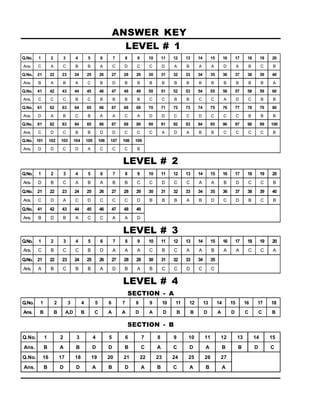
ANSWER KEY
LEVEL # 3
LEVEL # 4
SECTION - A
Q.No. 1 2 3 4 5 6 7 8 9 10 11 12 13 14 15 16 17 18 19 20
Ans. C B C C B D A A A C B C A A B A A C C A
Q.No. 21 22 23 24 25 26 27 28 29 30 31 32 33 34 35
Ans. A B C B B A D B A B C C D C C
Q.No. 1 2 3 4 5 6 7 8 9 10 11 12 13 14 15 16 17 18 19 20
Ans. C A C B B A C D C C D A B A A D A B C B
Q.No. 21 22 23 24 25 26 27 28 29 30 31 32 33 34 35 36 37 38 39 40
Ans. B A B A C B D B B B B B B B B B B B B A
Q.No. 41 42 43 44 45 46 47 48 49 50 51 52 53 54 55 56 57 58 59 60
Ans. C C C B C B B B B C C B B C C A D C B B
Q.No. 61 62 63 64 65 66 67 68 69 70 71 72 73 74 75 76 77 78 79 80
Ans. D A B C B A A C A D D C C D C C C B B B
Q.No. 81 82 83 84 85 86 87 88 89 90 91 92 93 94 95 96 97 98 99 100
Ans. C D C B B D D C C C A D A B B C C C C B
Q.No. 101 102 103 104 105 106 107 108 109
Ans. D D C D A C C C B
Q.No. 1 2 3 4 5 6 7 8 9 10 11 12 13 14 15 16 17 18 19 20
Ans. D B C A B A B B C C D C C A A B D C C B
Q.No. 21 22 23 24 25 26 27 28 29 30 31 32 33 34 35 36 37 38 39 40
Ans. C D A C D C C C D B B B A B D C D B C B
Q.No. 41 42 43 44 45 46 47 48 49
Ans. B D B A C C A A D
SECTION - B
Q.No. 1 2 3 4 5 6 7 8 9 10 11 12 13 14 15
Ans. B A B D D B C A C D A B B D C
Q.No. 16 17 18 19 20 21 22 23 24 25 26 27
Ans. B D D A B D A B C A B A
Q.No. 1 2 3 4 5 6 7 8 9 10 11 12 13 14 15 16 17 18
Ans. B B A,D B C A A D A D B B D A D C C B

01. Functions-Exercise. Module-4 pdf

  • 1.
    FUNCTION Total No.of questionsin Function are - Level # 1 ........................................ 109 Level # 2 ........................................ 49 Level # 3 ........................................ 35 Level # 4 ........................................ 45 Total No. of questions......................................................... 238
  • 2.
    Questions based on inequation Q.1The inequality x 2 < 3 is true, when x belongs to- (A)        , 3 2 (B)         3 2 (C)        , 3 2  (–, 0) (D) none of these Q.2 3 x 4 x   < 2 is satisfied when x satisfies- (A) (–, 3) (10, ) (B) (3, 10) (C) (–, 3) [10, ) (D) none of these Q.3 Solution of 3 x 7 x   > 2 is- (A) (–3, ) (B) (–, –13) (C) (–13, –3) (D) none of these Q.4 Solution of 5 x 3 3 x 2    3 is- (A)       7 12 , 1 (B)       7 12 , 3 5 (C)         3 5 , (D)        , 7 12 Q.5 Solution of (x – 1)2 (x + 4) < 0 is- (A) (–, 1) (B) (–, –4) (C) (–1, 4) (D) (1, 4) Q.6 Solution of (2x + 1) (x – 3) (x + 7) < 0 is- (A) (– , –7)         3 , 2 1 (B)(– , –7)        3 , 2 1 (C) (–, 7)         3 , 2 1 (D) (–, –7)  (3, ) Q.7 If x2 + 6x – 27 > 0 and x2 – 3x – 4 < 0, then- (A) x > 3 (B) x < 4 (C) 3 < x < 4 (D) x = 2 7 LEVEL # 1 Q.8 If x2 – 1  0 and x2 – x – 2  0, then x line in the interval/set (A) (–1, 2) (B) (–1, 1) (C) (1, 2) (D) {– 1} Questions based on Definition of function Q.9 Which of the following relation is a function ? (A) {(1,4), (2,6), (1,5), (3,9)} (B) {(3,3), (2,1), (1,2), (2,3)} (C) {(1,2), (2,2,), (3,2), (4,2)} (D) {(3,1), (3,2), (3,3), (3,4)} Q.10 If x, y  R, then which of the following rules is not a function- (A) y = 9 –x2 (B) y = 2x2 (C) y = x – |x| (D) y = x2 + 1 Questions based on Even and odd function Q.11 Which one of the following is not an odd function - (A) sin x (B) tan x (C) tanh x (D) None of these Q.12 The function f(x) = sin cos tan 4 4 x x x x   is - (A) odd (B) Even (C) neither even nor odd (D) odd and periodic Q.13 A function is called even function if its graph is symmetrical w.r.t.- (A) origin (B) x = 0 (C) y = 0 (D) line y = x Q.14 A function is called odd function if its graph is symmetrical w.r.t.- (A) Origin (B) x = 0 (C) y = 0 (D) line y = x Q.15 The even function is- (A) f(x) = x2 (x2 +1) (B) f(x) = sin3 x + 2 (C) f(x) = x (x +1) (D) f(x) = tan x + c
  • 3.
    Q.16 A functionwhose graph is symmetrical about the y-axis is given by- (A) f(x) = loge (x + 1 x2  ) (B) f(x + y) = f(x) + f(y) for all x, y  R (C) f(x) = cos x + sin x (D) None of these Q.17 Which of the following is an even function ? (A) x a a x x   1 1 (B) tan x (C) a a x x   2 (D) a a x x   1 1 Q.18 In the following, odd function is - (A) cos x2 (B) (ex + 1)/(ex – 1) (C) x2 – |x| (D) None of these Q.19 The function f(x) = x2 – |x| is - (A) an odd function (B) a rational function (C) an even function (D) None of these Questions based on Periodic function Q.20 The period of sin4 x + cos4 x is - (A)  (B) /2 (C) 2 (D) None of these Q.21 The period of function |cos 2x| is - (A) (B) /2 (C) 4 (D) 2 Q.22 The period of function sin x 2 F H GI K J+ cos x 2 F H GI K Jis- (A) 4 (B) 6 (C) 12 (D) 24 Q.23 The period of the function f(x) = log cos 2x + tan 4x is - (A) /2 (B)  (C) 2 (D) 2/5 Q.24 The period of the function f(x) = 2 cos 1 3 (x–) is - (A) 6 (B) 4 (C) 2 (D)  Q.25 In the following which function is not periodic- (A) tan 4x (B) cos 2x (C) cos x2 (D) cos2 x Domain, Co-domain and range of function Q.26 Domain of the function f(x) = 1 2 x  is- (A) R (B) (–2, ) (C) [2, ] (D) [0, ] Q.27 The domain where function f(x) = 2x2 – 1 and g(x) = 1 – 3x are equal, is- (A) {1/2} (B) {2} (C) {1/2,2} (D) {1/2,-2} Q.28 The domain of the function log 3 2  x is- (A) (3, ) (B) (– ,3) (C) (0,3) (D) (–3,3) Q.29 Domain of the function cos–1 (4x –1) is- (A) (0,1/2) (B) [0,1/2] (C) [1/2,2] (D) None of these Q.30 Domain of the function log |x2 – 9| is- (A) R (B) R– [–3,3] (C) R – {–3,3} (D) None of these Q.31 The domain of the function- f (x) = x 1 + 6  x is- (A) (1,6) (B) [1,6] (C) [1, ) (D) (– ,6] Q.32 The domain of the function f(x) = ( ) 2 2 2   x x is - (A) – 3 x  3 (B) – 1– 3 x –1 + 3 (C) – 2 x 2 (D) –2 + 3 x –2– 3 Q.33 Domain of a function f(x) = sin–1 5x is- (A)  F H G I K J 1 5 1 5 , (B)  L N M O Q P 1 5 1 5 , (C) R (D) 0 1 5 , F H G I K J
  • 4.
    Q.43 The rangeof f : R+  R+ , f(x) = ex is - (A) (0,  ) (B) [1,  ) (C) (1,  ) (D) None of these Q.44 The range of f(x) = cos 2x – sin 2x contains the set - (A) [2,4] (B) [–1,1] (C) [–2,2] (D) [–4,4] Q.45 If the domain of the function f(x) = | | x x be [3,7] then its range is- (A) [–1,1] (B) {–1,1} (C) {1} (D) {–1} Q.46 The domain of the function f(x) = 1 x x  [ ] is- (A) R (B) R–Z (C) Z (D) None of these Q.47 The range of the function f(x) = 2 + x – [x–3] is- (A) [5,6] (B) [5,6) (C) R (D) None of these Questions based on Value of function Q.48 If f(x) = log x, then f (x/y) equals- (A) f(x) + f(y) (B) f(x) – f(y) (C) f(x) / f(y) (D) f(x) . f(y) Q.49 If f(x) = 2 1 2 x x  , then f (tan  ) equals- (A) cot 2 (B) tan 2  (C) sec 2 (D) cos 2  Q.50 If f(x) = ax , then f(x+ y) equals- (A) f(x) + f(y) (B) f(x) – f(y) (C) f(x) f(y) (D) f(x) /f(y) Q.51 If f(x) = log x, then correct statement is- (A) f(x + y) = f( x ) + f(y) (B) f(x + y) = f( x) . f(y) (C) f(xy) = f(x) + f(y) (D) f(xy) = f( x) . f(y) Q.52 If f (x) = x x 1 , then f a b f b a ( / ) ( / ) = (A) ab (B) a/b (C) b/a (D) 1 Q.34 If f : R+  R, f(x) = log x, then range of f is - (A) R0 (B) R (C) R+ (D) None of these Q.35 The range of thefunction f : R R, f(x) = tan–1 x is- (A)  L N M O Q P   2 2 , (B)  O Q P L N M   2 2 , (C) R (D) None of these Q.36 The range of f(x) = sin  2 [x] is - (A) {–1,1} (B) {–1,0,1} (C) {0,1} (D) [–1,1] Q.37 Domain and range of f(x) = | | x x   3 3 are respectively- (A) R, [–1,1] (B) R– {3}, {1,–1} (C) R+ , R (D) None of these Q.38 The domain of the function f(x) = sin 1/x is - (A) R (B) R+ (C) R0 (D) R– Q.39 Range of the function f(x) = 9 – 7 sin x is- (A) (2,16) (B) [2,16] (C) [–1,1] (D) (2,16] Q.40 For real values of x, range of function y = 1 2 3  sin x is - (A) 1 3 y 1 (B) – 1 3 y 1 (C) – 1 3 > y > – 1 (D) 1 3 > y > 1 Q.41 If f : R  R, f(x) = 1 1 , , when x Q when x Q    R S T , then image set of R under f is - (A) {1,1} (B) (–1,–1) (C) {1,–1} (D) None of these Q.42 If f : R  R, f(x) = x2 , then {x| f (x) = –1} equals- (A) {–1,1} (B) {1} (C)  (D) None of these
  • 5.
    Q.53 If f(x)= 2 cos x + sin2 x, then f(2– x) equals- (A) – f(x) (B) f(x) (C) – 2f(x) (D)2f(x) Q.54 If f : R R, f(x) = 1 1 , , when x Q when x Q    R S T , then which of the following statement is wrong ? (A) f   2 = –1 (B) f() = –1 (C) f(e) = 1 (D) f 4 d i= 1 Q.55 If f(x) = 2 sin x, g(x) = cos2 x, then (f + g)  3 F H GI K J= (A) 1 (B) 2 3 1 4  (C) 3 + 1 4 (D) None of these Q.56 If f : R  R , f(x) = 2x ; g : R R, g(x) = x + 1, then (f .g) (2) equals - (A) 12 (B) 6 (C) 3 (D) None of these Q.57 If f(x) = b x a b a ( ) ( )   + a x b a b ( ) ( )   , then f(a + b) = (A) f(a). f(b) (B) f(a) – f(b) (C) f(a) /f(b) (D) f(a) + f(b) Q.58 If f( x) = x x 1 then f a f a ( ) ( ) 1 is equal to - (A) f(–a) (B) f(1/a) (C) f(a2 ) (D) f   F H G I K J a a 1 Q.59 If f (x) = x x ( ) 1 2 , then the value of f (x + 2) is- (A) f (x) + f(x + 1) (B) ( ) x x  2 f(x + 1) (C) ( ) x 1 2 f(x +1) (D) ( ) x  2 2 f(x +1) Q.60 If f(x + ay, x – ay ) = axy, then f (x,y) equals- (A) x y 2 2 4  (B) x y 2 2 4  (C) x2 (D) y2 Q.61 If f(x) = cos (log x), then f xy f x y f x f y ( ) ( / ) ( ) ( )  equals- (A) 1 (B) –1 (C) 0 (D) 2 Q.62 If f (x) = |x| + |x – 1|, then for 0 < x < 1, f (x) equals- (A) 1 (B) –1 (C) 2x + 1 (D) 2x – 1 Q.63 The function f(x) = | | x x , x > 0 is - (A) 0 (B) 1 (C) 2 (D) –2 Q.64 If f : N  R+ , f(x) = x , then the value of f f f ( ) ( ) ( ) 25 9 16  is - (A) 0 (B) 1 (C) 5/7 (D) 9/7 Q.65 If f(x) = log a x, then f(ax) equals- (A) f(a) f(x) (B) 1+ f(x) (C) f(x) (D) a f(x) Q.66 If f(x) = (ax – c)/(cx – a) = y, then f(y) equals- (A) x (B) 1/x (C) 1 (D) 0 Questions based on Mapping Q.67 If f : I I,f (x) = x3 + 1, then f is - (A) one - one but not onto (B) onto but not one-one (C) One-one onto (D) None of these Q.68 Function f : R  R , f(x) = x |x| is - (A) one-one but not onto (B) onto but not one- one (C) one-one onto (D) neither one-one nor onto Q.69 f : R  R , f(x) = x x 2 2 1 , is - (A) many- one function (B) odd function (C) one- one function (D) None of these
  • 6.
    Q.70 If f: R0  R0 , f(x) = 1 x , then f is - (A) one-one but not onto (B) onto but not one-one (C) neither one-one nor onto (D) both one-one and onto Q.71 Function f : R  R, f(x) = x + |x| is (A) one-one (B) onto (C) one-one onto (D) None of these Q.72 Function f :   2 3 2 , O Q P L N M  R, f(x) = tan x is (A) one-one (B) onto (C) one-one onto (D) None of these Q.73 Function f :   2 3 2 , L N M O Q P  [–1,1], f(x) = sin x is - (A) one-one (B) onto (C) one-one onto (D) None of these Q.74 Function f : 1 2 3 2   , L N M O Q P  [–1,1], f(x) = cos x is (A) many-one onto (B) onto (C) one-one onto (D) many one into Q.75 If f : R R, f(x) = ex + e–x , then f is - (A) one-one but not onto (B) onto but not one-one (C) neither one-one nor onto (D) both one-one and onto Q.76 If f : R  [–1,1], f(x) = sin x, then f is - (A) one-one onto (B) one-one into (C) many-one onto (D) many-one into Q.77 If f : R R , f(x) = sin2 x + cos2 x , then f is - (A) one-one but not onto (B) onto but not one-one (C) neither one-one nor onto (D) both one-one onto Q.78 Which of the following functions from Z to itself are bijections ? (A) f(x) = x3 (B) f(x) = x + 2 (C) f(x) = 2x + 1 (D) f(x) = x2 + x Q.79 Which of the following functions from A = {x: –1 x 1} to itself are bijections ? (A) f(x) = x 2 (B) g(x) = sin x 2 F H GI K J (C) h(x) = |x| (D) k(x) = x2 Q.80 Which of the following function is onto ? (A) f : R  R ; f(x) = 3x (B) f : R R+ ; f(x) = e–x (C) f: [0,  /2]  [–1,1]; f(x) = sin x (D) f : R R: f(x) = cosh x Q.81 Which of the following function defined from R to R is onto ? (A) f(x) = |x| (B) f(x) = e–x (C) f(x) = x3 (D) f(x) = sin x. Q.82 If f :   , f(x) = x2 – x, then f is - (A) one-one onto (B) one-one into (C) many-one onto (D) many-one into Questions based on Composite function Q.83 If f(x) = 2x and g is identity function, then- (A) (fog) (x) = g(x) (B) (g + g) (x) = g(x) (C) (fog) (x) = (g + g) (x) (D) None of these Q.84 gof exists, when- (A) domain of f = domain of g (B) co-domain of f = domain of g (C) co-domain of g = domain of g (D) co-domain of g = co-domain of f Q.85 If f : R  R, f(x) = x2 + 2x – 3 and g : R  R, g(x) = 3x – 4 , then the value of fog (x) is- (A) 3x2 + 6x – 13 (B) 9x2 –18x + 5 (C) (3x– 4)2 + 2x – 3 (D) None of these Q.86 If f : R  R, f(x) = x2 – 5x + 4 and g : R  R, g(x) = log x , then the value of (gof) (2) is - (A) 0 (B)  (C) –  (D)Undefined Q.87 If f : R+  R+ ,f(x) = x2 + 1/x2 and g : R+  R+ , g(x) = ex then (gof) (x) equals- (A) ex2   ex 2 (B) e e x x 2 2 1   (C) e e x x 2 2   (D) e e x x 2 2 .  Q.88 If f : R R, g : R R and f(x) = 3x + 4 and (gof) (x) = 2x – 1, then the value of g(x) is - (A) 2x – 1 (B) 2x – 11 (C) 1 3 (2x – 11) (D) None of these
  • 7.
    Q.89 If f: R  R, g : R  R and g(x) = x + 3 and (fog) (x) = (x + 3)2 , then the value of f(–3) is - (A) –9 (B) 0 (C) 9 (D) None of these Q.90 If f(x) = ax + b and g(x) = cx + d, then f(g(x)) = g(f(x)) is equivalent to- (A) f(a) = g(c) (B) f(b) = g(b) (C) f(d) = g(b) (D) f(c) = g(a) Q.91 If f : [0,1]  [0,1], f(x) = 1 1   x x . g : [0,1]  [0,1], g(x) = 4x (1–x), then (fog) (x) equals- (A) 1 4 4 1 4 4 2 2     x x x x (B) 8 1 1 2 x x x ( ) ( )   (C) 1 4 4 1 4 4 2 2     x x x x (D) None of these Q.92 If f, g, h are three functions in any set, then wrong statement is - (A) (fog)–1 = g–1 of –1 (B) gof  fog (C) (fog)oh = fo(goh) (D) (gof)–1 = g–1 of –1 Q.93 If f(x) = 1 1   x x , then f [f (sin)] equals - (A) sin  (B) tan (/2) (C) cot (/2) (D) cosec  Q.94 If f(x) = (a – x n )1/n , n N, then f [f(x)] is equal to- (A) 0 (B) x (C) xn (D) (an – x)n Q.95 If f (x) = log         x 1 x 1 and g(x) =           2 3 x 3 1 x x 3 , then f[g(x)] is equal to- (A) –f(x) (B) 3f(x) (C) [f(x)]3 (D) None of these Q.96 If  (x) = x2 + 1 and  (x) = 3x , then  {  (x)} and  {  (x)} = (A) 32x+1 , 3 2 1 x  (B) 32x+1 , 3 2 1 x  (C) 32x +1, 3 2 1 x  (D) None of these Q.97 If function f(x) = 1 0 , , when x Q when x Q   R S T , (fof) ( 4 ) the value will be - (A) 0 (B) 2 (C) 1 (D) None of these Q.98 If f(x) = 1 0 , , when x Q when x Q   R S T , then (fof) ( )  will be- (A) 2 (B) 0 (C) 1 (D)Undefined Q.99 If f(y) = y y 1 2  , g(y) = y y 1 2  , then (fog)(y) equals- (A) y y 1 2  (B) y y 1 2  (C) y (D) 1 1 2 2   y y Q.100 If f(x) = [x] and g(x) = cos (x), then the range of gof is - (A) {0} (B) {–1,1} (C) {–1,0,1} (D) [–1,1] Questions based on Inverse fucntion Q.101 If f : R  R, f(x) = x2 + 3, then pre- image of 2 under f is - (A) {1,–1} (B) {1} (C) {–1} (D)  Q.102 Which of the following functionshas its inverse- (A) f : R  R , f(x) = ax (B) f : R R, f(x) = |x| + |x – 1| (C) f : R0  R+ , f(x) = |x| (D) f : [, 2]  [–1,1], f(x) = cos x Q.103 If function f : RR+ , f(x) = 2x , then f –1 (x) will be equal to- (A) logx 2 (B) log2 (1/x) (C) log2 x (D) None of these Q.104 The inverse of the function f(x) = e e e e x x x x     + 2 is given by - (A) log x x   F H G I K J 2 1 1 2 / (B) log x x   F H G I K J 1 1 1 2 / (C) log x x 2 1 2  F H G I K J / (D) log x x   F H G I K J 1 3 1 2 / Q.105 If f : [1, )  [2, ) is given by ƒ(x) = x + x 1 then f–1 (x) equals - (A) 2 4 x x 2   (B) 2 x 1 x  (C) 2 4 x x 2   (D) 1 + 4 x2 
  • 8.
    Q.106 If f(x)= loge (x + 1 2  x ), then f –1 (x) equals- (A) log (x – 1 2  x ) (B) e e x x   2 (C) e e x x   2 (D) e e e e x x x x     Q.107 If f(x) = x3 – 1 and domain of f = {0,1,2,3}, then domain of f–1 is - (A) {0,1,2,3} (B) {1,0,–7,–26} (C) {–1,0,7,26} (D) {0,–1,–2,–3} Q.108 If f(x) = {4 – (x – 7)3}1/5, then its inverse is- (A) 7 – (4 – x5)1/3 (B) 7 – (4 + x5)1/3 (C) 7 + (4 – x5)1/3 (D) None of these Q.109 If f : R  R, f(x) = ex and g : R  R, g(x) = 3x – 2 , then the value of (fog)–1(x) is equal to - (A) log (x – 2) (B) 2 3  log x (C) log x  F H G I K J 3 2 (D) None of these
  • 9.
    Q.1 If f(x)= x + 1 x , then - (A) f(x2 ) = [f(x)]2 (B) f(x + y) = f(x) + f(y) (C) f(–x) = f(x) (D) f(1/x) = f(x) Q.2 If x is the radius of a circle and f(x) = x2 , then domain of f is - (B) R (B) R+ (C) R¯ (D) R0 Q.3 If f(x) = x2 – 3x + 1 and g(x) = 1 2 x  , then domain of (f – g) is - (A) R (B) R+ (C) R – {2} (D) None of these Q.4 If f : R  R, f(x) = tan x, then pre-image of –1 under f is - (A) n n     R S T U V W 4 I (B) n n     R S T U V W 4 I (C) {n  | n I } (D) None of these Q.5 f(x) = x x x x 2 2 2 1 3 2     is not defined for- (A) x = 2 (B) x = 1, 2 (C) x = 2,–1 (D) x = 0 Q.6 If f : R R, f(x) = x3 + 3, and g : R  R, g(x) = 2x + 1, then f–1 og–1 (23) equals- (A) 2 (B) 3 (C) (14)1/3 (D) (15)1/3 Q.7 If f(x) = log x, g(x) = x3 , then f[g(a)] + f [g(b)] is equal to- (A) f [g(a) + g(b)] (B) 3 f(ab) (C) g [f(ab)] (D) g [f(a) + f(b)] Q.8 Function sin–1 x is defined in the interval- (A) (–1,1) (B) [0,1] (C) [–1,0] (D) (–1,2) Q.9 The interval for which sin–1 x + cos–1 x =  2 holds- (A) [0, ) (B) [0,3] (C) [0,1] (D) [0,2] Q.10 The domain of the function f(x) = x! is - (A) (0, ) (B) N (C) W (D) R+ LEVEL # 2 Q.11 Function f : R  R+ , f(x) = x2 + 2 and g : R+  R, g(x) = 1 1 1   F H G I K J x then the value of gof (2) is - (A) 5/6 (B) 8/7 (C) 1/6 (D) 6/5 Q.12 The period of function f (x) = |sin3 (x/2)| is (A) 4  (B) 16  (C) 2  (D) None of these Q.13 The inverse of the function y = loge x is - (A) 10x (B) 10–x (C) ex (D) e–x Q.14 If f(x) = log 1 1   x x , when – 1 < x1 , x2 < 1, then f(x1 ) + f(x2 ) equals- (A) f x x x x 1 2 1 2 1   F H G I K J (B) f x x x x 1 2 1 2 1   F H G I K J (C) f x x x x 1 2 1 2 1   F H G I K J (D) f x x x x 1 2 1 2 1   F H G I K J Q.15 Function f : [–1,1]  R, f(x) = sin (  /2) x is - (A) one-one (B) onto (C) one-one onto (D) None of these Q.16 If the domain of function f(x) = x2 – 6x + 7 is (–  ,  ), then the range of function is - (A) (–  ,  ) (B) [–2,  ) (C) (–2,3) (D) (–  ,–2) Q.17 Function f : R  R, f(x) = [x] is - (A) one-one onto (B) one-one into (C) many-one onto (D) many-one into Q.18 If S be the set of all triangles and f : S  R+ , f (  ) = Area of  , then f is - (A) One-one onto (B) one-one into (C) many-one onto (D) many-one into Q.19 If f : C R , f(z) = |z|, then f is - (A) one-one but not onto (B) onto but not one-one (C) neither one-one nor onto (D) both one-one and onto
  • 10.
    Q.20 If f:  L N M O Q P 1 2 1 2   ,  [–1,1], f(x) = sin x, then f is - (A) one-one (B) one-one onto (C) onto (D) None of these Q.21 If f(x) = 1/x then f(a) – f(b) equals- (A) f b a ab  F H G I K J (B) f ab a b  F H G I K J (C) f ab b a  F H G I K J (D) f a b a b   F H G I K J Q.22 f(x) = cos x , correct statement is - (A) f(x) is periodic and its period = 2 (B) f(x) is periodic and its period = 4  2 (C) f(x) is periodic and its period =  (D) f(x) is not periodic Q.23 If f be the greatest integer function and g be the modulus function, then (gof)  F H G I K J 5 3 – (fog)  F H G I K J 5 3 = (A) 1 (B) –1 (C) 2 (D) 4 Q.24 The domain of function f(x) = log |log x| is- (A) (0, ) (B) (1, ) (C) (0,1)  (1, ) (D) (–,1) Q.25 Domain of the function tan–1 x + cos–1 x2 is - (A) R– [–1,1] (B) R– (–1,1) (C) (–1,1) (D) [–1,1] Q.26 Which of the following functions are equal ? (A) f(x) = x, g(x) = x2 (B) f(x) = log x2 , g(x) = 2 log x (C) f(x) = 1, g(x) = sin2 x + cos2 x (D) f(x) = x/x, g(x) = 1 Q.27 If f : Q  Q, f(x)= 2x and g : Q  Q, g(x) = x + 2, then (fog)–1 (20) equals- (A) 10 (B) 12 (C) 8 (D) 6 Q.28 f(x) = 2 1 2 2 cosh sin x x x   is - (A) an algebric function (B) a trigonometrical function (C) an even function (D) an implicit function Q.29 If f(x) = x2 – x–2 , then f(1/x) equals- (A) 1 f x ( ) (B) –1/f(x) (C)f(x) (D) – f(x) Q.30 The domain of function f(x) = 1 3 10 log ( )  x + x  2 is - (A) [–2, 3) (B) [–2, 3) – {2} (C) [–3, 2] (D) [–2, 3] – {2} Q.31 Domain of the function f(x) = x x x    3 1 4 2 ( ) is- (A) (1,2) (B) (– , –2)  (2, ) (C) (– ,–2)  (1, ) (D) (– , ) – {1,  2} Q.32 Range of the function f(x) = sin2 (x4 ) + cos2 (x4 ) is- (A) (– , ) (B) {1} (C) (–1,1) (D) (0,1) Q.33 Let f : R  R be a function defined by f(x) = x + 2 x , then f is- (A) injective (B) surjective (C) bijective (D) None of these Q.34 If f (x) = e3x and g(x) =  n x, x > 0, then (fog) (x) is equal to- (A) 3x (B) x3 (C) log 3x (D) 3 log x Q.35 If f : R  R f(x) = cos (5x + 2) then the value of f –1 (x) is - (A) cos ( )   1 2 5 x (B) cos ( )   1 2 x (C) cos ( )   1 5 2 x (D) Does not exist Q.36 Function f(x) = sin log 4 1 2   R S | T | U V | W | x x ( ) has domain (A) [–2,1) (B) [–2,1] (C) (–2,1) (D) (–,1) Q.37 The domain of function f(x) = log (3x –1) + 2 log (x +1) is - (A) [1/3, ) (B) [–1,1/3] (C) (–1,1/3) (D) None of these
  • 11.
    Q.38 If f(x)= x x 1 2  , then (fofof) (x) is equal to- (A) 3 1 2 x x  (B) x x 1 3 2  (C) 3 1 2 x x  (D) None of these Q.39 Which one of the following graphs represents the function y = 1+ |x| for all x  R ? (A) (B) (C) (D) Q.40 If f (x) = x3 – x and g(x) = sin 2x, then - (A) g [f(1)] = 1 (B) f (g (/12)) = – 3/8 (C) g {f(2)} = sin 2 (D) None of these Q.41 If f(x) = 1 1 x  and g (x) = 1 1 x  , then common domain of function is - (A) {x | x <1, x  R } (B) {x | x 0, x  1, x  R} (C) {1} (D) {–1} Q.42 The natural domain of the real valued function defined by f (x) = x2 1  + x2 1  is- (A) 1 < x <  (B) – < x <  (C) – < x <–1 (D) (– , ) – (–1,1) Q.43 If f(x) = 9 3 2 1    x x sin ( ) , then domain of f is - (A) [2,3] (B) [2,3) (C) (2,3] (D) None of these Q.44 Let f x x  F H G I K J 1 = x2 + 1 2 x (x  0), then f(x) equals- (A) x2 – 2 (B) x2 –1 (C) x2 (D) None of these Q.45 The graph of f(x) = – |x| is - (A) (B) (C) (D) Q.46 If a2 + b2 + c2 = 1, then range of ab + bc + ca is- (A) [–1/2, ) (B) (0, ) (C) [–1/2,1] (D) [1, ) Q.47 If x = loga bc, y = log b ca, and z = logc ab, then 1 1 x + 1 1 y + 1 1 z equals- (A) 1 (B) x + y + z (C) abc (D) ab + bc + ca Q.48 The range of 5 cos x – 12 sin x + 7 is - (A) [–6,20] (B) [–3,18] (C) [–6,15] (D) None of these Q.49 The domain of the function log 2 log 3 log 4 (x) is - (A) (1, ) (B) (2, ) (C) (3,) (D) (4,)
  • 12.
    Q.1 The domainof definition of f(x) = 36 x 1 5 x 1 x log 2 4 . 0           is– (A) (x : x < 0, x  – 6} (B) (x : x > 0, x  1, x  6} (C) (x : x > 1, x  6} (D) (x : x  1, x  6} Q.2 The function f : R  R defined by f (x) = (x – 1) (x – 2) (x – 3) is - (A) one-one but not onto (B) onto but not one-one (C) both one and onto (D) neither one-one nor onto Q.3 Set A has 3 elements and set B has 4 elements. The number of injections that can be defined from A to B is - (A) 144 (B) 12 (C) 24 (D) 64 Q.4 The number of bijective functions from set A to itself when a contains 106 elements - (A) 106 (B) (106)2 (C) 106! (D) 1106 Q.5 Let A be a set containing 10 distinct elements, then the total number of distinct functions from A to A is - (A) 10 ! (B) 1010 (C) 210 (D) 210 – 1 Q.6 Let f : R  R be a function defined by x x x | x | e e e e ) x ( f      . Then - (A) f is a bijection (B) f is an injection only (C) f is a surjection only (D) f is neither an injection nor a surjection Q.7 The value of nI for which the function f(x) =       n x sin nx sin has 4 as its period is - (A) 2 (B) 3 (C) 4 (D) 5 Q.8 If f(x) is an odd periodic function with period 2, then f (4) equals to - (A) 0 (B) 2 (C) 4 (D) –4 Q.9 Domain of the function f(x) =          2 5 1 5 x log sin is - (A) [–5, –1]  [1, 5] (B) [–5, 5] (C) (–5, –1)  (1, 5) (D) None of these Q.10 Domain of f(x) = | x | 2 | x | 1   is - (A) R – [–2, 2] (B) R – [–1, 1] (C) [–1, 1]  (–, –2)  (2, ) (D) None of these Q.11 Range of                     x 1 x 4 log sin 2 is - (A) (–1, 1) (B) [–1, 1] (C) R (D) None of these Q.12 If f(x) = 3 2 2 x 16 sin   , then values of f(x) lie in - (A)          4 , 4 (B) [–2, 2] (C)       2 3 , 0 (D) None of these Q.13 The function f (x) = cos (log (x + 1 x2  )) is- (A) even (B) odd (C) constant (D) None of these LEVEL # 3
  • 13.
    Q.14 The functionf(x) = max. [1 – x, 1 + x, 2] x  R is equivalent to - (A)               1 x , x 1 1 x 1 , 2 1 x , x 1 ) x ( f (B)               1 x , x 1 1 x 1 , 2 1 x , x 1 ) x ( f (C)               1 x , x 1 1 x 1 , 1 1 x , x 1 ) x ( f (D) None of these Q.15 The domain of the function f(x) = 9–xPx–5 is- (A) [5, 7] (B) {5, 6, 7} (C) {3, 4, 5, 6, 7} (D) None of these Q.16 The range of the function f(x) = 9–xPx–5 is - (A) {1, 2, 3} (B) [1, 2] (C) {1, 2, 3, 4, 5} (D) None of these Q.17 Domain of the function                     1 x 1 1 log log ) x ( f 4 2 / 1 2 is - (A) (0, 1) (B) (0, 1] (C) [1, ) (D) (1, ) Q.18 The period of f(x) = [sin 5x] + |cos 6x| is - (A) 2  (B) (C) 2 (D) 5 2 Q.19 Period of f (x) = sin x + tan 2 x + sin 2 2 x + tan 3 2 x + ... + sin 1 n 2 x  + tan n 2 x is - (A)  (B) 2 (C) 2n (D) n 2  Q.20 If [x] denote the greatest integer  x, the domain of definition of function f (x) = 2 ] x [ x 4 2   is - (A) (–, –2)  [–1, 2] (B) [0, 2] (C) [–1, 2] (D) (0, 2) Q.21 The function f : [–1/2, 1/2]  [–/2, /2] defined by f(x) = sin–1(3x – 4x3) is– (A) both one-one and onto (B) neither one-one nor onto (C) onto but not one-one (D) one-one but not onto Q.22 The function f satisfies the functiona equation 3f (x) + 2f 30 x 10 1 x 59 x           for all real x  1. The value of f (7) is - (A) 8 (B) 4 (C) –8 (D) 11 Q.23 The domain of the function f (x) = log3+x(x2 – 1) is - (A) (–3, –1)  (1, ) (B) [–3, –1)  [1, ) (C) (–3, –2)  (–2, –1)  (1, ) (D) [–3, –2)  (–2, –1)  [1, ) Assertion & Reason Type Question :- All questions are Assertion & Reason type questions. Each of these questions contains two statements : Statement-I (Assertion) and Statement-2 (Reason). Answer these ques tions from the following four option. (A) Statement-1 is false. Statement-2 is true (B) Statement-1 is true. Statement-2 is true; Statement-2 is a correct explanation for Statement-1 (C) Statement-1 is true. Statement-2 is true; Statement-2 is not a correct explanation for Statement-1 (D) Statement-1 is true. Statement-2 is false
  • 14.
    Q.24 Statement-1 :The period of f(x) = sin 2x cos [2x] – cos 2x sin [2x] is 2 1 Statement-2 : The period of x – [x] is 1 Q.25 Statement-1 : If f(x) = |x – 1| + |x – 2| + |x – 3| Where 2 < x < 3 is an identity function. Statement-2 : f : A  A defined by f(x) = x is an identity function. Q.26 Statement-1 : f : R  R defined by f(x) = sin x is a bijection Statement-2 : If f is both one and onto it is bijection Q. 27 Statement-1 : f : R  R is a function defined by f(x) = 3 1 x 2  . Then f –1 (x) = 2 1 x 3  Statement-2 : f(x) is not a bijection. Q.28 Statement-1 : If f is even function, g is odd function then g f , ) 0 g (  is an odd function. Statement-2 : If f(–x) = –f(x) for every x of its domain, then f(x) is called an odd function and if f(–x) = f(x) for every x of its domain, then f(x) is called an even function. Q.29 Statement 1 : Function f(x) = sinx + {x} is periodic with period 2 Statement 2 : sinx and {x} are both periodic with period 2and 1 respectively. Q.30 Statement 1 : y = f(x) = 5 x 2 x 4 x 2 x 2 2     , x R Range of f(x) is [3/4, 1) Statement 2 : (x – 1)2 = y 1 3 y 4   . Passage :- Let here we define f : R  [–1, 1] and g : R  [–1, 1]. Now f(x) = 2 cos2 x – 1, g(x) = cos 2x, h(x) = f(x) + g(x), I(x) = f(x) – g(x), j (x) = g(x) f(x) are 5 functions. On the basis of above information, answer the following questions- Q.31 Which statement is correct- (A) Period of f(x), g(x) and h(x) are same and value is 3 2 (B) Period of f(x), g(x) and h(x) makes the A.P. with common difference 4  (C) Sum of periods of f(x), g(x) and h(x) is 3 (D) None of these Q.32 Which statement is correct regarding function j(x) and I(x)- (A) The domain of j(x) and I(x) are the same (B) Range of j(x) and I(x) are the same (C) The union of domain of j(x) and I(x) are all real numbers (D) None of these Q.33 If the solution of equation I(x) – g(x) = 0 are x1, x2, x3, .... xn when x  [0, 10] then which option is correct- (A) x1, x2, x3 ... xn makes the A.P. with common difference  (B) Total no. of solutions ofI (x) – g(x) = 0 is 20 for x  [0, 10] (C) Sum of all solutions of the given equation is 100 in the interval [0, 10] (D) (B) and (C) are correct Q.34 If h : R  [–2, 2], then - (A) h(x) is one-one function (B) h(x) is one-one and onto function (C) h(x) is onto function (D) h(x) is many one and into function Q.35 Domain and range of j(x) respectively - (A) R and {1} (B) R and {0, 1} (C) R – {(2n + 1) /4}, n I and {1} (D) R – {(2n + 1) /2}, n  I and {1}
  • 15.
    LEVEL # 4 (Questionsasked in Previous AIEEE & IIT-JEE) SECTION - A Q.1 Which of the following is not a periodic function - (A) sin 2x + cos x (B) cos x (C) tan 4x (D) log cos 2x Q.2 The period of sin2 x is- (A)/2 (B) (C)3/2 (D)2 Q.3 The function f : R  R defined by f(x) = sin x is- (A) into (B) onto (C)one-one (D)many-one Q.4 The range of the function f(x) = x 2 x 2   , x  2 is - (A) R (B) R – {–1} (C) R – {1} (D) R – {2} Q.5 The function f(x) = log (x + 1 x2  ), is- (A) neither an even nor an odd function (B) an even function (C) an odd function (D) a periodic function Q.6 Domain of definition of the function f(x) = 2 x 4 3  + log10 (x3 – x), is- (A) (– 1, 0)  (1, 2)  (2, ) (B) (1, 2) (C) ( – 1, 0) (1, 2) (D) (1, 2)  (2, ) Q.7 If f : R  R satisfies f(x+ y) = f(x) + f(y), for all x, y  R and f(1) = 7, then   n 1 r ) r ( f is- (A) 2 ) 1 n ( n 7  (B) 2 n 7 (C) 2 ) 1 n ( 7  (D) 7n (n+1) Q.8 A function f from the set of natural numbers to integers defined by f(n) =        even is n when , 2 n odd is n when , 2 1 n is (A) neither one-one nor onto (B) one-one but not onto (C) onto but not one-one (D) one-one and onto both Q.9 The range of the function f(x) = 7– x Px–3 is- (A) {1, 2, 3} (B) {1, 2, 3, 4, 5, 6} (C) {1, 2,3,4} (D) {1, 2, 3, 4, 5} Q.10 If f : R  S, defined byf(x) = sinx – 3 cosx + 1, is onto, then the interval of S is- (A) [0, 3] (B) [–1, 1] (C) [0, 1] (D) [–1, 3] Q.11 The graph of the function y = f(x) is symmetrical about the line x = 2, then- (A) f(x+ 2) = f(x – 2) (B) f(2 + x) = f(2 – x) (C) f(x) = f(–x) (D) f(x) = – f(–x) Q.12 The domain of thefunction f(x) = 2 1 x 9 ) 3 x ( sin    is- (A) [2,3] (B) [2,3) (C) [1,2] (D) [1, 2) Q.13 Let f : (–1, 1)  B, be a function defined by f(x) = tan–1 2 x 1 x 2  , then f is both one-one and onto when B is the interval - (A)        2 , 0 (B)        2 , 0
  • 16.
    (C)          2 , 2 (D)         2 , 2 Q.14 A real valued function f(x) satisfiesthe functional equation f(x – y) = f(x) f(y) – f (a – x) f(a + y) where a is a given constant and f(0) = 1, then f(2a – x) is equal to - (A) –f(x) (B) f(x) (C) f(a) + f(a – x) (D)f(–x) Q.15 The largest interval lying in          2 2 , for which the function is defined, is- (A) [0, ] (B)          2 2 , (C)          4 2 , (D) 0 2 ,        Q.16 Let f : N  Y be a function defined as f(x) = 4x + 3 where Y = |y  N : y = 4x + 3 for some x  N|. Show that f is invertible and its inverse is (A) g(y) = 4 + 4 3 y  (B) g(y) = 4 3 y  (C) g(y) = 4 3 y  (D) g(y) = 3 4 y 3  Q.17 For real x, let f(x) = x3 + 5x + 1, then - (A) f is one – one but not onto R (B) f is onto R but not one – one (C) f is one – one and onto R (D) f is neither one – one nor onto R Q.18 Let f(x) = (x + 1)2 –1, x > –1 Statement – 1 : The set {x : f(x) = f–1 (x)} = {0, –1}. Statement – 2 : f is a bijection. (A) Statement -1 is true, Statement -2 is true; Statement -2 is a correct explanation for Statement -1 (B) Statement -1 is true, Statement -2 is true; Statement -2 is not a correct explanation for Statement -1. (C) Statement -1 is true, Statement -2 is false. (D) Statement -1 is false, Statement -2 is true. SECTION - B Q.1 If function f(x) = 2 1 – tan        2 x ; (–1 < x < 1) and g(x) = 2 x 4 x 4 3   , then the domain of gof is – (A) (–1, 1) (B)        2 1 , 2 1 (C)        2 1 , 1 (D)         1 , 2 1 Q.2 If f(x) = cos [2]x + cos [–]x, where [x] stands for the greatest integer function, then (A) f        2 = –1 (B) f () = 1 (C) f        4 = 2 (D) None of these Q.3 The value of b and c for which the identity f(x + 1) – f(x) = 8x + 3 is satisfied, where f(x) = bx2 + cx + d, are (A) b = 2, c = 1 (B) b = 4, c = –1 (C) b = –1, c = 4 (D) None Q.4 Let f(x) = sin x and g(x) = ln |x|. If the ranges of the compositie functions fog and gof are R1 and R2 respectively, then – (A) R1 = {u : –1 < u < 1}, R2 = {v : – < v < 0} (B) R1 = {u : – < u < 0}, R2 = {v : –1 < v < 1} (C) R1 = {u : –1 < u < 1}, R2 = {v : – < v < 0} (D) R1 = {u : –1 < u < 1}, R2 = {v : – < v < 0} Q.5 Let 2 sin2 x + 3 sin x – 2 > 0 and x2 – x – 2 < 0 (x is measured in radians). Then x lies in the interval (A)         6 5 , 6 (B)         6 5 , 1
  • 17.
    (C) (–1, 2)(D)        2 , 6 Q.6 Let f(x) = (x + 1)2 – 1, (x > – 1). Then the set S = {x : f(x) = f –1(x)} is – (A) Empty (B) {0, –1} (C) {0, 1, –1} (D)                2 3 i 3 , 2 3 i 3 , 1 , 0 Q.7 If f(1) = 1 and f(n + 1) = 2f(n) + 1 if n  1, then f(n) is- (A) 2n+1 (B) 2n (C) 2n – 1 (D) 2n–1 – 1 Q.8 If f is an even function defined on the interval (– 5, 5), then the real values of x satisfying the equation f(x) = f         2 x 1 x are- (A) 2 5 1  , 2 5 3   (B) 2 3 1  , 2 3 3   (C) 2 5 2   (D) None of these Q.9 Let f(x) = [x] sin           ] 1 x [ , where [.] denotes the greatest integer function. The domain of f is ....... (A) {x  R| x  [–1, 0)} (B) {x  R| x  [1, 0)} (C) {x  R| x  [–1, 0)} (D) None of these Q.10 If f(x) = sin2x + sin2         3 x + cos x cos         3 x and g       4 5 = 1, then (gof) (x) = (A) –2 (B) –1 (C) 2 (D) 1 Q.11 If g(f(x)) = |sin x| and f(g(x)) = (sin x )2, then (A) f(x) = sin2 x, g(x) = x (B) f(x) = sin x, g(x) = |x| (C) f(x) = x2, g(x) = sin x (D) f and g cannot be determined Q.12 If f(x) = 3x – 5, then f–1 (x) (A) is given by 5 x 3 1  (B) is given by 3 5 x  (C) does not exist because f is not one - one (D) does not exist because f is not onto Q.13 If the function f : [1, )  [1, ) is defined by f(x) = 2x(x–1) , then f–1 (x) is (A) 1 2 1        x x ( ) (B) 1 2   1 1 4 2   log x (C) 1 2   1 1 4 2   log x (D) not defined Q.14 The domain of definition of the function y(x) given by the equation 2x + 2y = 2 is – (A) 0 < x < 1 (B) 0 < x < 1 (C) – < x < 0 (D) – < x < 1 Q.15 Let f() = sin (sin + sin 3), then f() (A)  0 only when  0 (B)  0 for all  (C)  0 for all real  (D)  0 only when  0
  • 18.
    Q.16 The numberof solutions of log4 (x – 1) = log2 (x – 3) is – (A) 3 (B) 1 (C) 2 (D) 0 Q.17 Let f(x) =  x x  1 , x  – 1, then for what value of  f{f(x)} = x. (A) 2 (B) – 2 (C) 1 (D) –1 Q.18 The domain of definition of f (x) = log ( ) 2 2 3 3 2 x x x    is – (A) R / { –2, –2} (B) (– 2, ) (C) R/ {–1, –2, –3} (D) (–3, ) / {–1, –2} Q.19 If f : [1, )  [2, ) is given by f(x) = x + 1 x then f–1 (x) equals – (A) x x   2 4 2 (B) x x 1 2  (C) x x   2 4 2 (D) 1 + x2 4  Q.20 Let g(x) = 1 + x – [x] and f(x) =          0 x ; 1 0 x ; 0 0 x ; 1 . Then for all x, f(g(x)) is equal to : (where [.] denotes the greatest integer function): (A) x (B) 1 (C) f(x) (D) g(x) Q.21 Suppose f(x) = (x + 1)2 for x  – 1. If g(x) is the function whose graph is the reflection of the graph of f(x) with respect to the line y = x, then g(x) equals– (A) – x – 1, x  0 (B) 2 ) 1 x ( 1  , x > – 1 (C) 1 x  , x  – 1 (D) x – 1, x  0 Q.22 Let function f : R  R be defined by f(x) = 2x + sin x for x  R. Then f is– (A) one to one and onto (B) one to one but NOT onto (C) onto but NOT one to one (D) neither one to one nor onto Q.23 Let f(x) = x 1 x  defined as [0, )  [ 0, ), f(x) is– (A) one one & onto (B) one- one but not onto (C) not one-one but onto (D) neither one-one nor onto Q.24 Find the range of f(x) = 1 x x 2 x x 2 2     is– (A) (1, ) (B)       7 11 , 1 (C)       3 7 , 1 (D)       5 7 , 1 Q.25 Domain of f(x) = 6 / ) x 2 ( sin 1    is– (A)        2 1 , 4 1 (B)        2 1 , 2 1 (C)        4 1 , 4 1 (D)        4 1 , 2 1 Q.26 Let f(x) = sinx + cos x & g(x) = x2 – 1, then g(f(x)) will be invertible for the domain- (A) x    0,  (B) x           4 4 , (C) x  0 2 ,        (D) x          2 0 , Q.27       Q x 0 Q x x ) x ( f ;       Q x x Q x 0 ) x ( g then (f – g) is (A) one-one , onto
  • 19.
    LEVEL # 2 LEVEL# 1 ANSWER KEY LEVEL # 3 LEVEL # 4 SECTION - A Q.No. 1 2 3 4 5 6 7 8 9 10 11 12 13 14 15 16 17 18 19 20 Ans. C B C C B D A A A C B C A A B A A C C A Q.No. 21 22 23 24 25 26 27 28 29 30 31 32 33 34 35 Ans. A B C B B A D B A B C C D C C Q.No. 1 2 3 4 5 6 7 8 9 10 11 12 13 14 15 16 17 18 19 20 Ans. C A C B B A C D C C D A B A A D A B C B Q.No. 21 22 23 24 25 26 27 28 29 30 31 32 33 34 35 36 37 38 39 40 Ans. B A B A C B D B B B B B B B B B B B B A Q.No. 41 42 43 44 45 46 47 48 49 50 51 52 53 54 55 56 57 58 59 60 Ans. C C C B C B B B B C C B B C C A D C B B Q.No. 61 62 63 64 65 66 67 68 69 70 71 72 73 74 75 76 77 78 79 80 Ans. D A B C B A A C A D D C C D C C C B B B Q.No. 81 82 83 84 85 86 87 88 89 90 91 92 93 94 95 96 97 98 99 100 Ans. C D C B B D D C C C A D A B B C C C C B Q.No. 101 102 103 104 105 106 107 108 109 Ans. D D C D A C C C B Q.No. 1 2 3 4 5 6 7 8 9 10 11 12 13 14 15 16 17 18 19 20 Ans. D B C A B A B B C C D C C A A B D C C B Q.No. 21 22 23 24 25 26 27 28 29 30 31 32 33 34 35 36 37 38 39 40 Ans. C D A C D C C C D B B B A B D C D B C B Q.No. 41 42 43 44 45 46 47 48 49 Ans. B D B A C C A A D SECTION - B Q.No. 1 2 3 4 5 6 7 8 9 10 11 12 13 14 15 Ans. B A B D D B C A C D A B B D C Q.No. 16 17 18 19 20 21 22 23 24 25 26 27 Ans. B D D A B D A B C A B A Q.No. 1 2 3 4 5 6 7 8 9 10 11 12 13 14 15 16 17 18 Ans. B B A,D B C A A D A D B B D A D C C B