Flow cytometry, ELISA, ELISPOT & cell culture methods Sanjaya Adikari Department of Anatomy
 
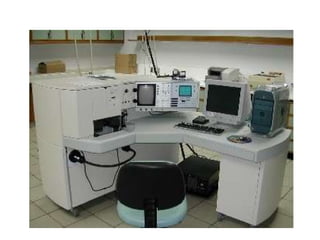
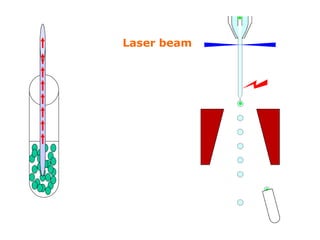
Flow cytometer A nalyze suspended individual cells (or particles) C ells flow through one or more lasers Light scatter provides some information regarding the morphology of the particles fluorescent dyes to label different cellular molecules or structures, such as membrane antigens, DNA, intracellular enzymes, ions, or organelles
Laser beam
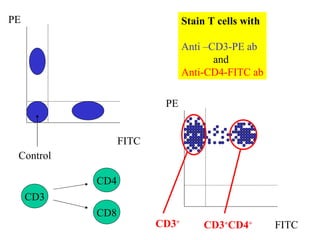
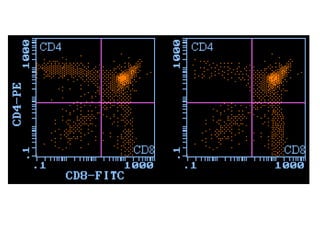
Stain T cells with Anti –CD3-PE ab   and Anti-CD4-FITC ab FITC PE Control FITC PE CD3 CD8 CD4 CD3 + CD3 + CD4 +
 
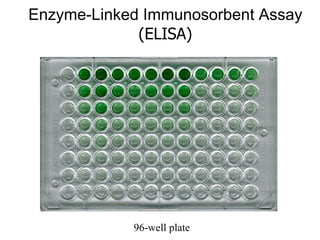
Enzyme-Linked Immunosorbent Assay  (ELISA) 96-well plate
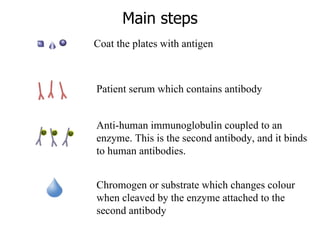
Main steps                                                                         Patient serum which contains antibody Anti-human immunoglobulin coupled to an enzyme. This is the second antibody, and it binds to human antibodies. Chromogen or substrate which changes colour when cleaved by the enzyme attached to the second antibody Coat the plates with  antigen
 
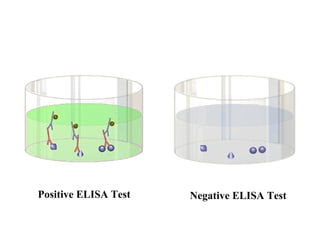
Positive ELISA Test Negative ELISA Test
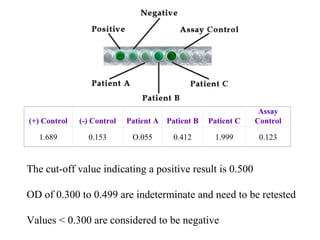
The cut-off value indicating a positive result is 0.500  O D  of 0.300 to 0.499 are indeterminate and need to be retested Values  <  0.300 are considered to be negative (+)  Control (-)  Control Patient A Patient B Patient C Assay Control 1.689 0.153 O.055 0.412 1.999 0.123
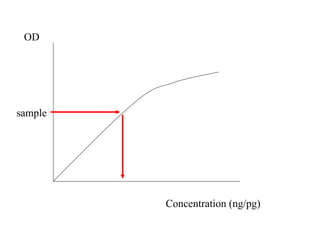
OD Concentration (ng/pg) sample
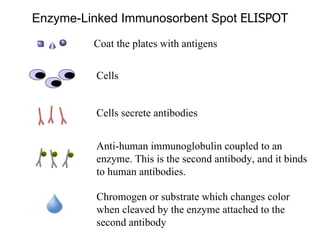
Enzyme-Linked Immunosorbent  Spot   ELISPOT                                                       Coat the plates with  antigens Cells  Anti-human immunoglobulin coupled to an enzyme. This is the second antibody, and it binds to human antibodies. Chromogen or substrate which changes color when cleaved by the enzyme attached to the second antibody Cells secrete antibodies
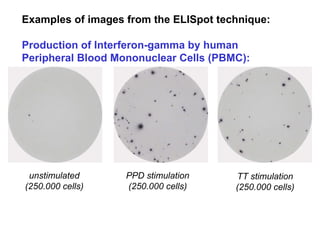
Examples of images from the ELISpot technique: Production of Interferon-gamma by human Peripheral Blood Mononuclear Cells (PBMC):   Interferon-gamma (IFN-  ) Human unstimulated (250.000 cells) PPD stimulation (250.000 cells) TT stimulation (250.000 cells)                                                                                                   
Tissue Culture Methods Tissue culture  organ culture  cell culture  p rimary cell cultures  continuous cell lines
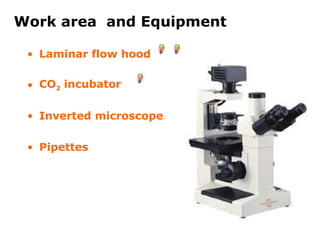
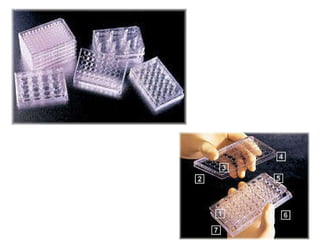
Laminar flow hood CO 2  incubator Inverted microscope Pipettes Work area   and  E quipment
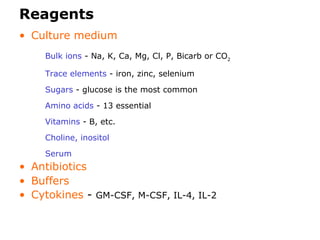
Reagents Culture m edium   Bulk ions  - Na, K, Ca, Mg, Cl, P, Bicarb or CO 2 Trace elements  - iron, zinc, selenium S ugars  - glucose is the most common A mino acids  - 13 essential V itamins  - B, etc. C holine, inositol S erum Antibiotics Buffers Cytokines   -   GM-CSF, M-CSF, IL-4, IL-2
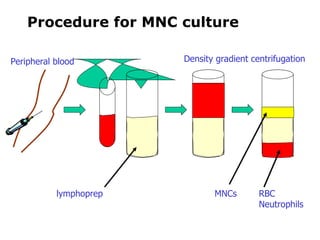
Procedure for MNC culture lymphoprep Peripheral blood MNCs RBC Neutrophils Density gradient centrifugation
 
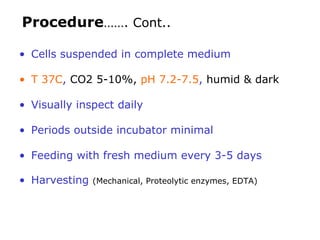
Cells suspended in complete medium T 37C ,  CO2 5-10%,   pH 7.2-7.5 ,  humid & dark Visually inspect daily Periods outside incubator minimal Feeding  with fresh medium   every 3 - 5 days  Harvesting  ( Mechanical ,  Proteolytic enzymes ,  EDTA )  Procedure ……. Cont..
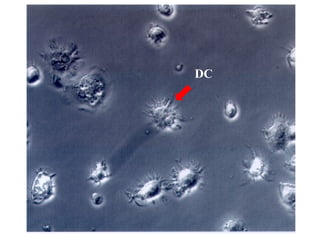
DC

Flowcytometer & elisa

  • 1.
    Flow cytometry, ELISA,ELISPOT & cell culture methods Sanjaya Adikari Department of Anatomy
  • 2.
  • 3.
    Flow cytometer Analyze suspended individual cells (or particles) C ells flow through one or more lasers Light scatter provides some information regarding the morphology of the particles fluorescent dyes to label different cellular molecules or structures, such as membrane antigens, DNA, intracellular enzymes, ions, or organelles
  • 4.
  • 5.
    Stain T cellswith Anti –CD3-PE ab and Anti-CD4-FITC ab FITC PE Control FITC PE CD3 CD8 CD4 CD3 + CD3 + CD4 +
  • 6.
  • 7.
    Enzyme-Linked Immunosorbent Assay (ELISA) 96-well plate
  • 8.
    Main steps                                                                    Patient serum which contains antibody Anti-human immunoglobulin coupled to an enzyme. This is the second antibody, and it binds to human antibodies. Chromogen or substrate which changes colour when cleaved by the enzyme attached to the second antibody Coat the plates with antigen
  • 9.
  • 10.
    Positive ELISA TestNegative ELISA Test
  • 11.
    The cut-off valueindicating a positive result is 0.500 O D of 0.300 to 0.499 are indeterminate and need to be retested Values < 0.300 are considered to be negative (+) Control (-) Control Patient A Patient B Patient C Assay Control 1.689 0.153 O.055 0.412 1.999 0.123
  • 12.
  • 13.
    Enzyme-Linked Immunosorbent Spot ELISPOT                                                    Coat the plates with antigens Cells Anti-human immunoglobulin coupled to an enzyme. This is the second antibody, and it binds to human antibodies. Chromogen or substrate which changes color when cleaved by the enzyme attached to the second antibody Cells secrete antibodies
  • 14.
    Examples of imagesfrom the ELISpot technique: Production of Interferon-gamma by human Peripheral Blood Mononuclear Cells (PBMC): Interferon-gamma (IFN-  ) Human unstimulated (250.000 cells) PPD stimulation (250.000 cells) TT stimulation (250.000 cells)                                                                                                   
  • 15.
    Tissue Culture MethodsTissue culture organ culture cell culture p rimary cell cultures continuous cell lines
  • 16.
    Laminar flow hoodCO 2 incubator Inverted microscope Pipettes Work area and E quipment
  • 17.
    Reagents Culture medium Bulk ions - Na, K, Ca, Mg, Cl, P, Bicarb or CO 2 Trace elements - iron, zinc, selenium S ugars - glucose is the most common A mino acids - 13 essential V itamins - B, etc. C holine, inositol S erum Antibiotics Buffers Cytokines - GM-CSF, M-CSF, IL-4, IL-2
  • 18.
    Procedure for MNCculture lymphoprep Peripheral blood MNCs RBC Neutrophils Density gradient centrifugation
  • 19.
  • 20.
    Cells suspended incomplete medium T 37C , CO2 5-10%, pH 7.2-7.5 , humid & dark Visually inspect daily Periods outside incubator minimal Feeding with fresh medium every 3 - 5 days Harvesting ( Mechanical , Proteolytic enzymes , EDTA ) Procedure ……. Cont..
  • 21.