
“Flow Over Ahmed Body – Experimental and
Computational Studies”
Bluff Body Aerodynamics
( 85-511-01 )
April 5,2018
Instructor:
Dr. Vesselina Roussinova
Presented By:
Devarsh Patel (104861000)
Ajay Vinodkumar Patel (104873609)
Content
 Introduction
 Why Ahmed Body?
 Geometry
 Experiment
 Case study 1
 Case study 2
 Conclusion
 Queries?
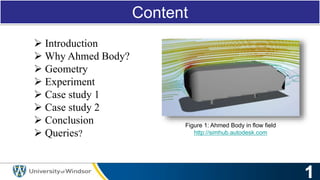
Figure 1: Ahmed Body in flow field
http://simhub.autodesk.com
Introduction
• The Ahmed body was created by S.R Ahmed in his research some Salient feature of
the time averaged ground vehicle wake in 1984, since then it became a benchmark
for aerodynamic simulation tool.
• Ahmed body is simplified car body created to investigate the turbulence behavior
of newly developed car for complex geometry cases. It demonstrated all the flow
features of an actual car involved in a moving car.
• The complexity involved in the automobile design especially due to great number
of accessories and devices that form its geometry makes the validation tasks
unaffordable. The Ahmed body retain the main flow features the vortex wake flow
where most part of the drag is concentrated.
Why Ahmed Body
Observe the flow
behaviour on Generic
Vehicle Body
Effect of various slant
Angle on Total Drag
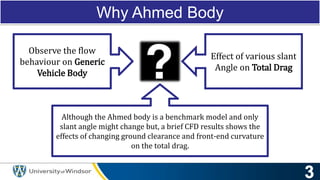
Although the Ahmed body is a benchmark model and only
slant angle might change but, a brief CFD results shows the
effects of changing ground clearance and front-end curvature
on the total drag.
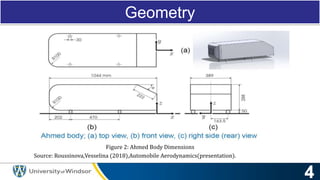
Geometry
Figure 2: Ahmed Body Dimensions
Source: Roussinova,Vesselina (2018),Automobile Aerodynamics(presentation).
Experimental Measures
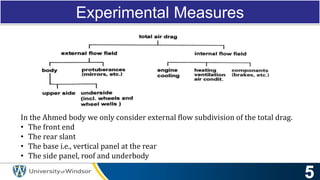
In the Ahmed body we only consider external flow subdivision of the total drag.
• The front end
• The rear slant
• The base i.e., vertical panel at the rear
• The side panel, roof and underbody
Characteristics on total Drag
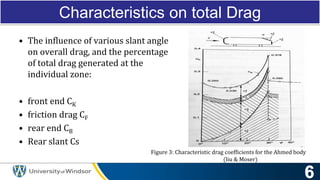
• The influence of various slant angle
on overall drag, and the percentage
of total drag generated at the
individual zone:
• front end CK
• friction drag CF
• rear end CB
• Rear slant Cs
Figure 3: Characteristic drag coefficients for the Ahmed body
(liu & Moser)
Case Study 1
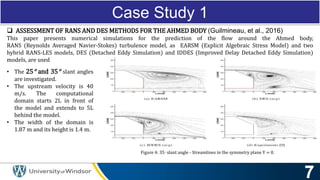
• The 25° and 35° slant angles
are investigated.
• The upstream velocity is 40
m/s. The computational
domain starts 2L in front of
the model and extends to 5L
behind the model.
• The width of the domain is
1.87 m and its height is 1.4 m.
Figure 4: 35◦ slant angle - Streamlines in the symmetry plane Y = 0.
 ASSESSMENT OF RANS AND DES METHODS FOR THE AHMED BODY (Guilmineau, et al., 2016)
This paper presents numerical simulations for the prediction of the flow around the Ahmed body,
RANS (Reynolds Averaged Navier-Stokes) turbulence model, as EARSM (Explicit Algebraic Stress Model) and two
hybrid RANS-LES models, DES (Detached Eddy Simulation) and IDDES (Improved Delay Detached Eddy Simulation)
models, are used
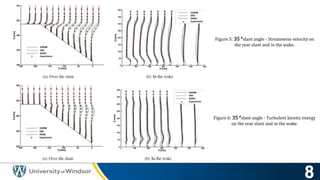
Figure 5: 35° slant angle - Streamwise velocity on
the rear slant and in the wake.
Figure 6: 35° slant angle - Turbulent kinetic energy
on the rear slant and in the wake.
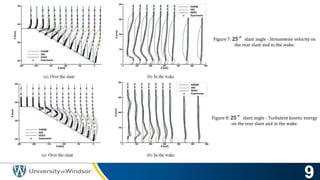
Figure 7: 25° slant angle - Streamwise velocity on
the rear slant and in the wake.
Figure 8: 25° slant angle - Turbulent kinetic energy
on the rear slant and in the wake.
Case Study 1
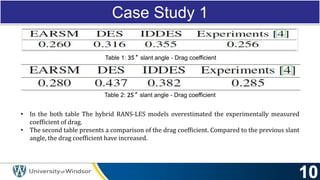
• In the both table The hybrid RANS-LES models overestimated the experimentally measured
coefficient of drag.
• The second table presents a comparison of the drag coefficient. Compared to the previous slant
angle, the drag coefficient have increased.
Table 1: 35°slant angle - Drag coefficient
Table 2: 25°slant angle - Drag coefficient
Case study 2
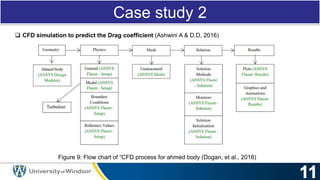
Figure 9: Flow chart of “CFD process for ahmed body (Dogan, et al., 2018)
 CFD simulation to predict the Drag coefficient (Ashwini A & D.D, 2016)
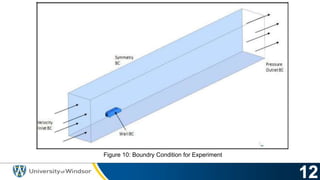
Figure 10: Boundry Condition for Experiment
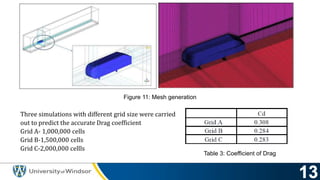
Three simulations with different grid size were carried
out to predict the accurate Drag coefficient
Grid A- 1,000,000 cells
Grid B-1,500,000 cells
Grid C-2,000,000 cellls
Figure 11: Mesh generation
Table 3: Coefficient of Drag
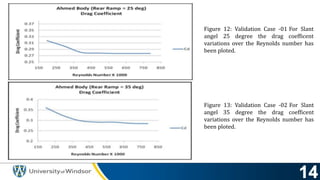
Figure 12: Validation Case -01 For Slant
angel 25 degree the drag coefficent
variations over the Reynolds number has
been ploted.
Figure 13: Validation Case -02 For Slant
angel 35 degree the drag coefficent
variations over the Reynolds number has
been ploted.
Conclusion
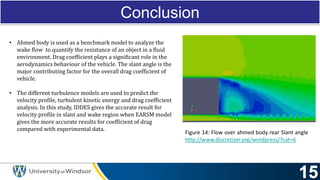
Figure 14: Flow over ahmed body rear Slant angle
http://www.discretizer.org/wordpress/?cat=6
• Ahmed body is used as a benchmark model to analyze the
wake flow to quantify the resistance of an object in a fluid
environment. Drag coefficient plays a significant role in the
aerodynamics behaviour of the vehicle. The slant angle is the
major contributing factor for the overall drag coefficient of
vehicle.
• The different turbulence models are used to predict the
velocity profile, turbulent kinetic energy and drag coefficient
analysis. In this study, IDDES gives the accurate result for
velocity profile in slant and wake region when EARSM model
gives the more accurate results for coefficient of drag
compared with experimental data.
References
Ahmed, S., Ramm, G., & Faltin, G. (1984). Some Salient Features of the Time-Averaged Ground Vehicle Wake. SAE
Transactions,93, 473-503.
Ashwini A, L., & D.D, P. (2016). Aerodynamic study of Automobile Car Ahmed Body using CFD simulation to predict Drag
coefficient and Down Forces. International Engineering Research Journal (IERJ), 1140-1145.
Dogan, T., Conger, M., kim, D.-H., Mousavirad, M., Xing, T., & Stern, F. (2018). Simulation of Turbulent Flow over the Ahmed
Body. Iowa: University of Iowa.
Guilmineau, E., Deng, G., Leroyer, A., Queutey, P., Visonneau, M., & Wackers, a. J. (2016). Assessment of RANS and DES
methods for the Ahmed body. Crete Island: ECCOMAS Congress .
Lienhart, H., Stoots, C., & Becker, S. (2003). Flow and Turbulence Structures in the Wake of a Simplified Car Model(Ahmed
Body). SAE technical Papers.
liu, Y., & Moser, A. (n.d.). Numerical modeling of airflow over the Ahmed body. zurich: Swiss federal institute of technology.
Raffaele, V., Philippe, D., & Azeddine, K. (2014). Unsteady Experimental Characteristics Of the Natural Wake of a Squareback
Ahmed Body. ASME 2014 4th Joint US-European Fluids Engineering Division Summer Meeting. Chicago: ASME.
Queries ?

Flow over ahmed body

  • 1.
    “Flow Over AhmedBody – Experimental and Computational Studies” Bluff Body Aerodynamics ( 85-511-01 ) April 5,2018 Instructor: Dr. Vesselina Roussinova Presented By: Devarsh Patel (104861000) Ajay Vinodkumar Patel (104873609)
  • 2.
    Content  Introduction  WhyAhmed Body?  Geometry  Experiment  Case study 1  Case study 2  Conclusion  Queries? Figure 1: Ahmed Body in flow field http://simhub.autodesk.com
  • 3.
    Introduction • The Ahmedbody was created by S.R Ahmed in his research some Salient feature of the time averaged ground vehicle wake in 1984, since then it became a benchmark for aerodynamic simulation tool. • Ahmed body is simplified car body created to investigate the turbulence behavior of newly developed car for complex geometry cases. It demonstrated all the flow features of an actual car involved in a moving car. • The complexity involved in the automobile design especially due to great number of accessories and devices that form its geometry makes the validation tasks unaffordable. The Ahmed body retain the main flow features the vortex wake flow where most part of the drag is concentrated.
  • 4.
    Why Ahmed Body Observethe flow behaviour on Generic Vehicle Body Effect of various slant Angle on Total Drag Although the Ahmed body is a benchmark model and only slant angle might change but, a brief CFD results shows the effects of changing ground clearance and front-end curvature on the total drag.
  • 5.
    Geometry Figure 2: AhmedBody Dimensions Source: Roussinova,Vesselina (2018),Automobile Aerodynamics(presentation).
  • 6.
    Experimental Measures In theAhmed body we only consider external flow subdivision of the total drag. • The front end • The rear slant • The base i.e., vertical panel at the rear • The side panel, roof and underbody
  • 7.
    Characteristics on totalDrag • The influence of various slant angle on overall drag, and the percentage of total drag generated at the individual zone: • front end CK • friction drag CF • rear end CB • Rear slant Cs Figure 3: Characteristic drag coefficients for the Ahmed body (liu & Moser)
  • 8.
    Case Study 1 •The 25° and 35° slant angles are investigated. • The upstream velocity is 40 m/s. The computational domain starts 2L in front of the model and extends to 5L behind the model. • The width of the domain is 1.87 m and its height is 1.4 m. Figure 4: 35◦ slant angle - Streamlines in the symmetry plane Y = 0.  ASSESSMENT OF RANS AND DES METHODS FOR THE AHMED BODY (Guilmineau, et al., 2016) This paper presents numerical simulations for the prediction of the flow around the Ahmed body, RANS (Reynolds Averaged Navier-Stokes) turbulence model, as EARSM (Explicit Algebraic Stress Model) and two hybrid RANS-LES models, DES (Detached Eddy Simulation) and IDDES (Improved Delay Detached Eddy Simulation) models, are used
  • 9.
    Figure 5: 35°slant angle - Streamwise velocity on the rear slant and in the wake. Figure 6: 35° slant angle - Turbulent kinetic energy on the rear slant and in the wake.
  • 10.
    Figure 7: 25°slant angle - Streamwise velocity on the rear slant and in the wake. Figure 8: 25° slant angle - Turbulent kinetic energy on the rear slant and in the wake.
  • 11.
    Case Study 1 •In the both table The hybrid RANS-LES models overestimated the experimentally measured coefficient of drag. • The second table presents a comparison of the drag coefficient. Compared to the previous slant angle, the drag coefficient have increased. Table 1: 35°slant angle - Drag coefficient Table 2: 25°slant angle - Drag coefficient
  • 12.
    Case study 2 Figure9: Flow chart of “CFD process for ahmed body (Dogan, et al., 2018)  CFD simulation to predict the Drag coefficient (Ashwini A & D.D, 2016)
  • 13.
    Figure 10: BoundryCondition for Experiment
  • 14.
    Three simulations withdifferent grid size were carried out to predict the accurate Drag coefficient Grid A- 1,000,000 cells Grid B-1,500,000 cells Grid C-2,000,000 cellls Figure 11: Mesh generation Table 3: Coefficient of Drag
  • 15.
    Figure 12: ValidationCase -01 For Slant angel 25 degree the drag coefficent variations over the Reynolds number has been ploted. Figure 13: Validation Case -02 For Slant angel 35 degree the drag coefficent variations over the Reynolds number has been ploted.
  • 16.
    Conclusion Figure 14: Flowover ahmed body rear Slant angle http://www.discretizer.org/wordpress/?cat=6 • Ahmed body is used as a benchmark model to analyze the wake flow to quantify the resistance of an object in a fluid environment. Drag coefficient plays a significant role in the aerodynamics behaviour of the vehicle. The slant angle is the major contributing factor for the overall drag coefficient of vehicle. • The different turbulence models are used to predict the velocity profile, turbulent kinetic energy and drag coefficient analysis. In this study, IDDES gives the accurate result for velocity profile in slant and wake region when EARSM model gives the more accurate results for coefficient of drag compared with experimental data.
  • 17.
    References Ahmed, S., Ramm,G., & Faltin, G. (1984). Some Salient Features of the Time-Averaged Ground Vehicle Wake. SAE Transactions,93, 473-503. Ashwini A, L., & D.D, P. (2016). Aerodynamic study of Automobile Car Ahmed Body using CFD simulation to predict Drag coefficient and Down Forces. International Engineering Research Journal (IERJ), 1140-1145. Dogan, T., Conger, M., kim, D.-H., Mousavirad, M., Xing, T., & Stern, F. (2018). Simulation of Turbulent Flow over the Ahmed Body. Iowa: University of Iowa. Guilmineau, E., Deng, G., Leroyer, A., Queutey, P., Visonneau, M., & Wackers, a. J. (2016). Assessment of RANS and DES methods for the Ahmed body. Crete Island: ECCOMAS Congress . Lienhart, H., Stoots, C., & Becker, S. (2003). Flow and Turbulence Structures in the Wake of a Simplified Car Model(Ahmed Body). SAE technical Papers. liu, Y., & Moser, A. (n.d.). Numerical modeling of airflow over the Ahmed body. zurich: Swiss federal institute of technology. Raffaele, V., Philippe, D., & Azeddine, K. (2014). Unsteady Experimental Characteristics Of the Natural Wake of a Squareback Ahmed Body. ASME 2014 4th Joint US-European Fluids Engineering Division Summer Meeting. Chicago: ASME.
  • 18.