SUBJECT : PROCESS CONTROL & AUTOMATION ( 18BT61)
TOPIC : FLOW INJECTION ANALYSIS MEASUREMENT
SAPTHAGIRI COLLEGE OF ENGINEERING
Affiliated to VTU Belagavi & Approved by AICTE, New Delhi)
(Accredited by NAAC “A” Grade & ISO 9001:2015 & ISO14001:2015 certified)
14/5, Chikkasandara, Hesaraghatta Main Road, Bengaluru-57
Department of Biotechnology
Presented By:
TANU KUMAR C
(1SG20BT056)
Submited to:
prof. Kavya. M V
CONTENT:
1. Introduction
2. Principle
3.Instrumentation and working
4. Types of Flow injection analysis (FIA)
5.Single system Injection system
6.Multiple system Injection system
7. Determination of Phosphate by (FIA)
8. Advantages
9.Drawback
10.Applications
INTRODUCTION :
 FLOW INJECTION ANALYSIS : “A simple and
versatile analytical technology for automating wet chemical
analysis, based on the physical and chemical manipulation
of a dispersed sample zone formed from the injection of the
sample into a flowing carrier stream and detection
downstream”.
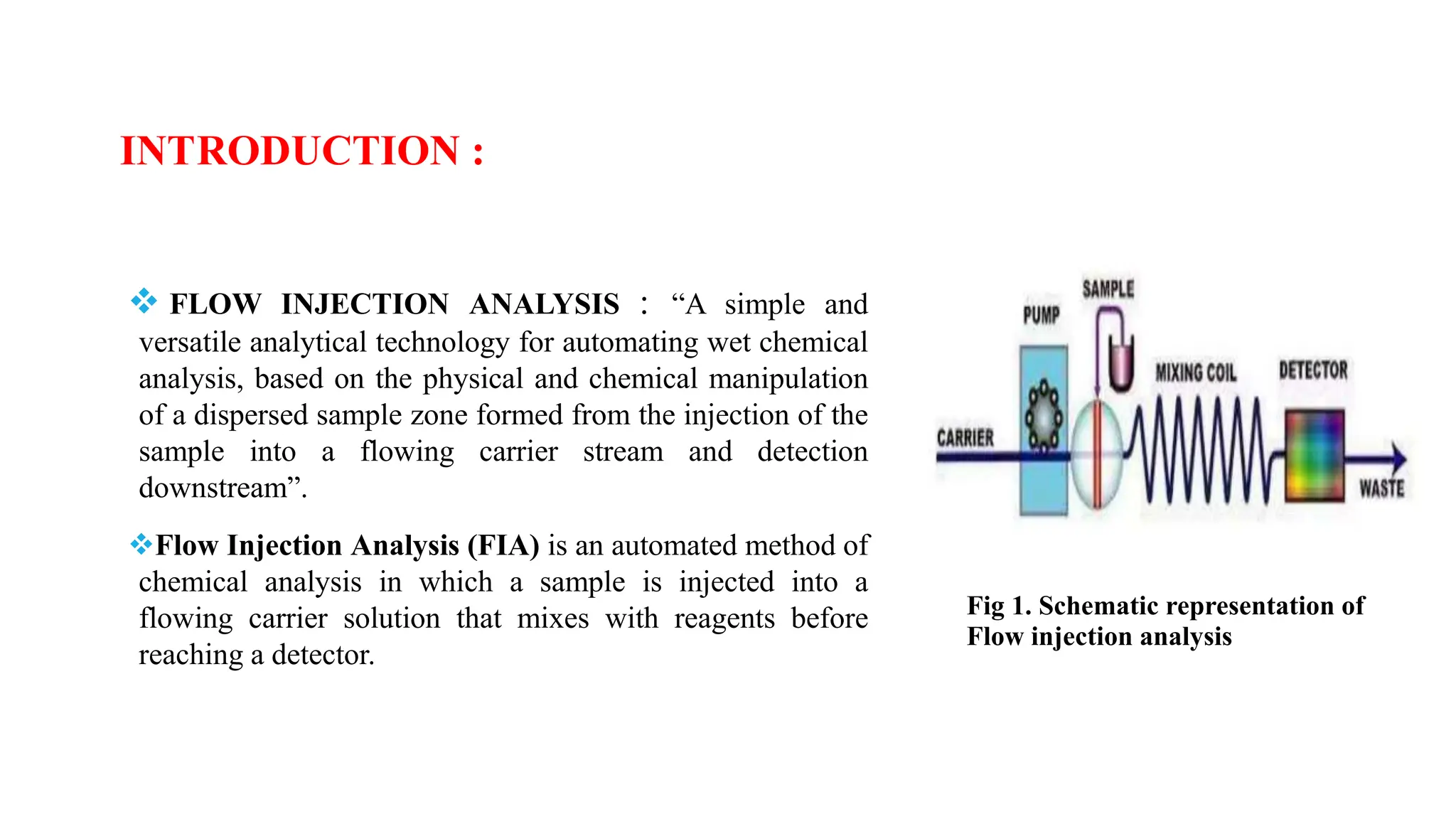
Flow Injection Analysis (FIA) is an automated method of
chemical analysis in which a sample is injected into a
flowing carrier solution that mixes with reagents before
reaching a detector.
Fig 1. Schematic representation of
Flow injection analysis
PRINCIPLES OF FIA :
In a flow injection system, the reagents, along with a carrier
solution, are pumped through tubes in a continuous manner,
mixing coils and the flow center in the detector.
A small sample of the substance to be tested is injected into
the liquid solution where it combines with one or more
reagents.
The ensuing chemical reaction results in a color change that
is measured in the detector.
The reaction time depends on the flow rate and the coil
length and diameter, before the sample passes through a
detector to waste.
FLOW INJECTION ANALYSIS INSTRUMENTATION:
Fig 2. Flow Injection Analysis Instrumentation
INSTRUMENTATION AND WORKING :
The Flow Injection Analysis system usually consists of:
 Injection valve
A high quality multi channel peristaltic pump
 A coiled reactor
A tubing manifold
A detector
An auto sampler.
SAMPLE INTRODUCTION:
INJECTOR :
Important features of valves suitable for FIA :
High precision
Fast switching
Pressure limits of about 100 psi.
Ability to inject sample volumes from a few micro liters to
several hundred micro liters
 In some cases fractions of a micro liters.
Fig 3 : Injector valve
PUMP:
Variable speed of peristaltic pump
 Flow rate (0.0005 to 40 ml/min) controlled by pump speed and
tube id
 The pump is used to propel one or more streams through the
Detector via narrow bore (0.5 -0.8 mm ID) tubing.
These streams may be reagents, solvents, or some other medium
such as a buffer.
This design leads to a flow that is relatively pulse free.
The flow rate is controlled by speed of motor, speed is >30 rpm
and the inside diameter of the tubing. Fig 4: peristaltic pump
DETECTORS:
Commonly used detectors for flow injection analysis are the electrochemical and optical detectors
used in HPLC
A UV - Visible spectroscopy system or HPLC detector is usually used for this purpose.
FIA detectors also have been designed around the use of ion selective electrodes and atomic
absorption spectroscopy.
pump - which is used to propel the carrier stream through a narrow tube;
 Injection port - through which volume of a sample solution is injected into the carrier stream in
a reproducible manner;
 Reaction coil - which the sample and reagents react .
Peristaltic pump- a device in which a fluid (liquid or gas) is squeezed through plastic tubing by
rollers.
Detectors - used in FIA are mainly spectrometric such as uv/vis spectrometer , Fluorimeter
 Recorder -output has the form of a peak,the height, width, or area of which is related to the
concentration of the analyte .
TYPES OF FLOW INJECTION ANALYSIS (FIA) :
 There are 4 types of FIA Techniques :
1. Flow injection (fi):- is based in sample injection into a unidirectional flowing carrier stream to
which reagents are added. So, the concentration gradient is formed by dispersion of the sample
zone alone, signal reflects the gradient of the sample zone as it passes through the detector.
2. Sequential injection (si) :- si and bi are based on sequential injection of sample
3. Bead injection (bi) :-sample and reagents, into carrier stream, followed by flow reversal that
promotes mutual dispersion of injected zones. The flow of the carrier stream is programmed, to
optimize the assay protocol.
4. Sequential injection chromatography (sic):-sic is emerging chromatographic technique that
uses programmable flow to separate components, based on difference in migration velocities, on
short columns
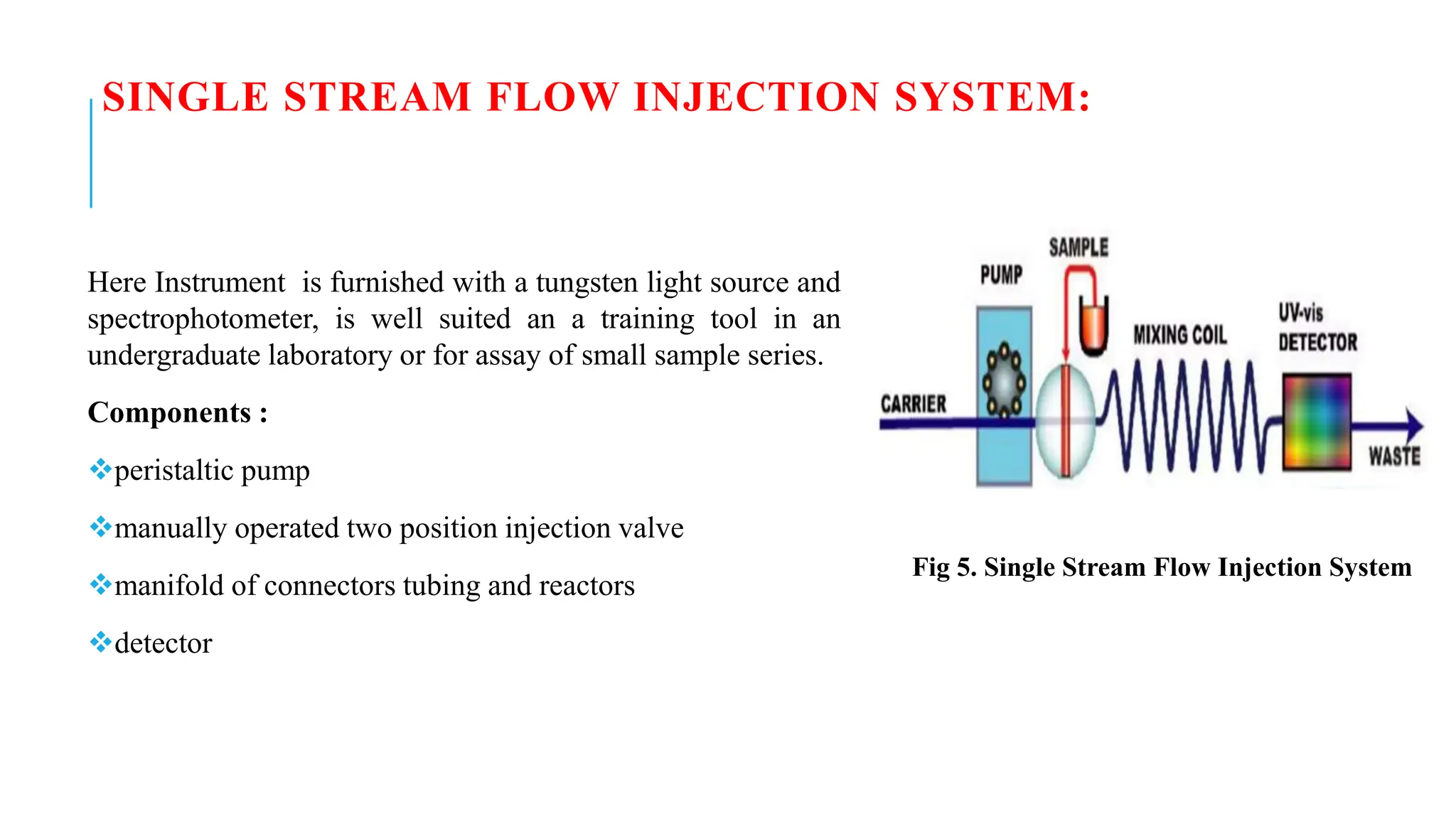
SINGLE STREAM FLOW INJECTION SYSTEM:
Here Instrument is furnished with a tungsten light source and
spectrophotometer, is well suited an a training tool in an
undergraduate laboratory or for assay of small sample series.
Components :
peristaltic pump
manually operated two position injection valve
manifold of connectors tubing and reactors
detector
Fig 5. Single Stream Flow Injection System
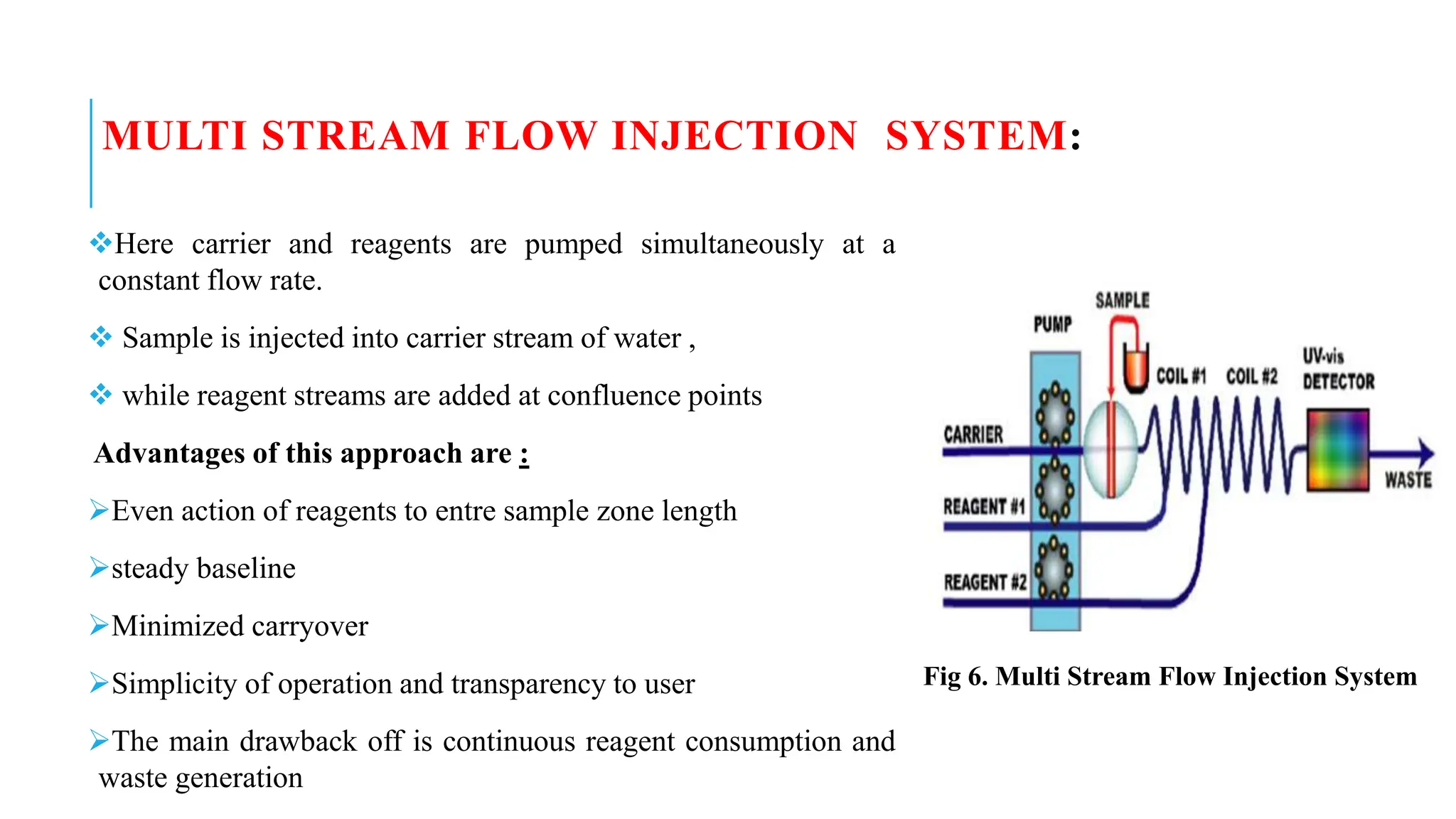
MULTI STREAM FLOW INJECTION SYSTEM:
Here carrier and reagents are pumped simultaneously at a
constant flow rate.
 Sample is injected into carrier stream of water ,
 while reagent streams are added at confluence points
Advantages of this approach are :
Even action of reagents to entre sample zone length
steady baseline
Minimized carryover
Simplicity of operation and transparency to user
The main drawback off is continuous reagent consumption and
waste generation
Fig 6. Multi Stream Flow Injection System
DETERMINATION OF PHOSPHATE BY FIA :
The FIA determination of phosphate is an adaptation of a standard spectrophotometric
analysis for phosphate.
In the presence of acid, phosphate reacts with molybdate to form a yellow-coloured
complex in which molybdenum is present as Mo(VI).
H3PO4(aq) + 12H2MoO4(aq) = H3P(Mo12O40)(aq) + 12H2O(l)
In the presence of a reducing agent, such as ascorbic acid, the yellow-coloured complex is
reduced to a blue - coloured complex of Mo(V)
Procedure:
 prepare reagent solutions of 0.005 M ammonium molybdate in 0.40 M
HNO3, and 0.7% w/v ascorbic acid in 1% v/v glycerine.
Using a stock solution of 100.0-ppm phosphate, prepare a set of external
standards with phosphate concentrations of 10, 20, 30, 40, 50, and 60 ppm.
Use a manifold FIA with a 50-cm mixing coil and a 50 cm reaction coil.
Set the flow rate to 0.5 ml/min.
Prepare calibration curve by injecting 50 mL of each standard, measuring
the absorbance at 650 nm. Samples are analyzed.
ADVANTAGES:
 Their speed, which is frequently significantly greater than that of manual devices.
 A well-designed analyzer can usually produce more reproducible results over a long period of time than
can an operator employing a manual instrument.
It offers an additional level of protection to technicians when handling or testing toxic substances .
 Separations by liquid/liquid extraction, or ion – exchange … etc. are readily carried out automatically with
flow-injection systems.
 The equipment is computer compatible as well, providing quicker analysis while limiting the data entry
errors possible in manual testing
DRAW BACK:
The main drawback is that it leads to increased unemployment because the number
of employees in the laboratory will be reduced because of the lab 's reliance on
automatic analysis .
APPLICATION:
Techniques have proven very useful in marine science for both organic and
inorganic analytes in marine animal samples/seafood.
Flow injection methods applied to the determination of amino acids, dna/rna,
formaldehyde, histamine, hypoxanthine, polycyclic aromatic hydrocarbons.
 Flow injection analysis has been used to analyze a wide variety of samples,
including environmental, clinical, agricultural, industrial, and pharmaceutical
samples.
THANK YOU

FLOW INJECTION ANALYSIS MEASUREMENT.pptx

  • 1.
    SUBJECT : PROCESSCONTROL & AUTOMATION ( 18BT61) TOPIC : FLOW INJECTION ANALYSIS MEASUREMENT SAPTHAGIRI COLLEGE OF ENGINEERING Affiliated to VTU Belagavi & Approved by AICTE, New Delhi) (Accredited by NAAC “A” Grade & ISO 9001:2015 & ISO14001:2015 certified) 14/5, Chikkasandara, Hesaraghatta Main Road, Bengaluru-57 Department of Biotechnology Presented By: TANU KUMAR C (1SG20BT056) Submited to: prof. Kavya. M V
  • 2.
    CONTENT: 1. Introduction 2. Principle 3.Instrumentationand working 4. Types of Flow injection analysis (FIA) 5.Single system Injection system 6.Multiple system Injection system 7. Determination of Phosphate by (FIA) 8. Advantages 9.Drawback 10.Applications
  • 3.
    INTRODUCTION :  FLOWINJECTION ANALYSIS : “A simple and versatile analytical technology for automating wet chemical analysis, based on the physical and chemical manipulation of a dispersed sample zone formed from the injection of the sample into a flowing carrier stream and detection downstream”. Flow Injection Analysis (FIA) is an automated method of chemical analysis in which a sample is injected into a flowing carrier solution that mixes with reagents before reaching a detector. Fig 1. Schematic representation of Flow injection analysis
  • 4.
    PRINCIPLES OF FIA: In a flow injection system, the reagents, along with a carrier solution, are pumped through tubes in a continuous manner, mixing coils and the flow center in the detector. A small sample of the substance to be tested is injected into the liquid solution where it combines with one or more reagents. The ensuing chemical reaction results in a color change that is measured in the detector. The reaction time depends on the flow rate and the coil length and diameter, before the sample passes through a detector to waste.
  • 5.
    FLOW INJECTION ANALYSISINSTRUMENTATION: Fig 2. Flow Injection Analysis Instrumentation
  • 6.
    INSTRUMENTATION AND WORKING: The Flow Injection Analysis system usually consists of:  Injection valve A high quality multi channel peristaltic pump  A coiled reactor A tubing manifold A detector An auto sampler.
  • 7.
    SAMPLE INTRODUCTION: INJECTOR : Importantfeatures of valves suitable for FIA : High precision Fast switching Pressure limits of about 100 psi. Ability to inject sample volumes from a few micro liters to several hundred micro liters  In some cases fractions of a micro liters. Fig 3 : Injector valve
  • 8.
    PUMP: Variable speed ofperistaltic pump  Flow rate (0.0005 to 40 ml/min) controlled by pump speed and tube id  The pump is used to propel one or more streams through the Detector via narrow bore (0.5 -0.8 mm ID) tubing. These streams may be reagents, solvents, or some other medium such as a buffer. This design leads to a flow that is relatively pulse free. The flow rate is controlled by speed of motor, speed is >30 rpm and the inside diameter of the tubing. Fig 4: peristaltic pump
  • 9.
    DETECTORS: Commonly used detectorsfor flow injection analysis are the electrochemical and optical detectors used in HPLC A UV - Visible spectroscopy system or HPLC detector is usually used for this purpose. FIA detectors also have been designed around the use of ion selective electrodes and atomic absorption spectroscopy.
  • 10.
    pump - whichis used to propel the carrier stream through a narrow tube;  Injection port - through which volume of a sample solution is injected into the carrier stream in a reproducible manner;  Reaction coil - which the sample and reagents react . Peristaltic pump- a device in which a fluid (liquid or gas) is squeezed through plastic tubing by rollers. Detectors - used in FIA are mainly spectrometric such as uv/vis spectrometer , Fluorimeter  Recorder -output has the form of a peak,the height, width, or area of which is related to the concentration of the analyte .
  • 11.
    TYPES OF FLOWINJECTION ANALYSIS (FIA) :  There are 4 types of FIA Techniques : 1. Flow injection (fi):- is based in sample injection into a unidirectional flowing carrier stream to which reagents are added. So, the concentration gradient is formed by dispersion of the sample zone alone, signal reflects the gradient of the sample zone as it passes through the detector. 2. Sequential injection (si) :- si and bi are based on sequential injection of sample 3. Bead injection (bi) :-sample and reagents, into carrier stream, followed by flow reversal that promotes mutual dispersion of injected zones. The flow of the carrier stream is programmed, to optimize the assay protocol. 4. Sequential injection chromatography (sic):-sic is emerging chromatographic technique that uses programmable flow to separate components, based on difference in migration velocities, on short columns
  • 12.
    SINGLE STREAM FLOWINJECTION SYSTEM: Here Instrument is furnished with a tungsten light source and spectrophotometer, is well suited an a training tool in an undergraduate laboratory or for assay of small sample series. Components : peristaltic pump manually operated two position injection valve manifold of connectors tubing and reactors detector Fig 5. Single Stream Flow Injection System
  • 13.
    MULTI STREAM FLOWINJECTION SYSTEM: Here carrier and reagents are pumped simultaneously at a constant flow rate.  Sample is injected into carrier stream of water ,  while reagent streams are added at confluence points Advantages of this approach are : Even action of reagents to entre sample zone length steady baseline Minimized carryover Simplicity of operation and transparency to user The main drawback off is continuous reagent consumption and waste generation Fig 6. Multi Stream Flow Injection System
  • 14.
    DETERMINATION OF PHOSPHATEBY FIA : The FIA determination of phosphate is an adaptation of a standard spectrophotometric analysis for phosphate. In the presence of acid, phosphate reacts with molybdate to form a yellow-coloured complex in which molybdenum is present as Mo(VI). H3PO4(aq) + 12H2MoO4(aq) = H3P(Mo12O40)(aq) + 12H2O(l) In the presence of a reducing agent, such as ascorbic acid, the yellow-coloured complex is reduced to a blue - coloured complex of Mo(V)
  • 15.
    Procedure:  prepare reagentsolutions of 0.005 M ammonium molybdate in 0.40 M HNO3, and 0.7% w/v ascorbic acid in 1% v/v glycerine. Using a stock solution of 100.0-ppm phosphate, prepare a set of external standards with phosphate concentrations of 10, 20, 30, 40, 50, and 60 ppm. Use a manifold FIA with a 50-cm mixing coil and a 50 cm reaction coil. Set the flow rate to 0.5 ml/min. Prepare calibration curve by injecting 50 mL of each standard, measuring the absorbance at 650 nm. Samples are analyzed.
  • 16.
    ADVANTAGES:  Their speed,which is frequently significantly greater than that of manual devices.  A well-designed analyzer can usually produce more reproducible results over a long period of time than can an operator employing a manual instrument. It offers an additional level of protection to technicians when handling or testing toxic substances .  Separations by liquid/liquid extraction, or ion – exchange … etc. are readily carried out automatically with flow-injection systems.  The equipment is computer compatible as well, providing quicker analysis while limiting the data entry errors possible in manual testing
  • 17.
    DRAW BACK: The maindrawback is that it leads to increased unemployment because the number of employees in the laboratory will be reduced because of the lab 's reliance on automatic analysis .
  • 18.
    APPLICATION: Techniques have provenvery useful in marine science for both organic and inorganic analytes in marine animal samples/seafood. Flow injection methods applied to the determination of amino acids, dna/rna, formaldehyde, histamine, hypoxanthine, polycyclic aromatic hydrocarbons.  Flow injection analysis has been used to analyze a wide variety of samples, including environmental, clinical, agricultural, industrial, and pharmaceutical samples.
  • 19.