


FLOAT SENSOR
LEVEL SENSOR
YOUR SECTION SUBTITLE
10/18/2021 Float Sensor 2
LEVEL MEASUREMENT
• Level sensing devices can be divided into four categories
• Direct sensing, in which the actual level is monitored
• Indirect sensing, in which a property of the liquid, such as pressure, is
sensed to determine the liquid level
• Single point measurement, in which it is only necessary to detect the
presence or absence of a liquid at a specific level
10/18/2021 Float Sensor 3
SIMPLE SIGHT GLASSES
• A visual indication of the level can be obtained when part of the vessel is
constructed from transparent material or the liquid in a vessel is bypassed
through a transparent tube.
• The liquid level then can be observed directly in the sight glass Glass gauges are
cheap but easily broken, and should not be used with hazardous liquid.
• The advantage of using stop valves with the use of a bypass pipe, is the ease in
removal for cleaning.
•
10/18/2021 Float Sensor 4
FLOAT SENSORS
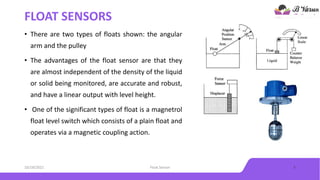
• There are two types of floats shown: the angular
arm and the pulley
• The advantages of the float sensor are that they
are almost independent of the density of the liquid
or solid being monitored, are accurate and robust,
and have a linear output with level height.
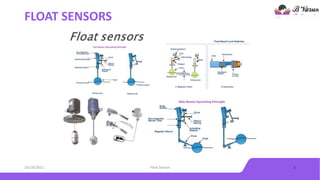
• One of the significant types of float is a magnetrol
float level switch which consists of a plain float and
operates via a magnetic coupling action.
10/18/2021 Float Sensor 5
FLOAT SENSORS
10/18/2021 Float Sensor 6
DISPLACER SWITCHES
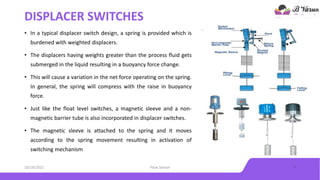
• In a typical displacer switch design, a spring is provided which is
burdened with weighted displacers.
• The displacers having weights greater than the process fluid gets
submerged in the liquid resulting in a buoyancy force change.
• This will cause a variation in the net force operating on the spring.
In general, the spring will compress with the raise in buoyancy
force.
• Just like the float level switches, a magnetic sleeve and a non-
magnetic barrier tube is also incorporated in displacer switches.
• The magnetic sleeve is attached to the spring and it moves
according to the spring movement resulting in activation of
switching mechanism
10/18/2021 Float Sensor 7
CONDUCTIVE PROBES
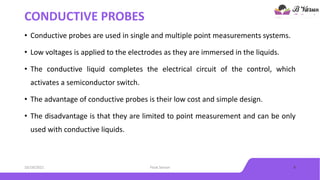
• Conductive probes are used in single and multiple point measurements systems.
• Low voltages is applied to the electrodes as they are immersed in the liquids.
• The conductive liquid completes the electrical circuit of the control, which
activates a semiconductor switch.
• The advantage of conductive probes is their low cost and simple design.
• The disadvantage is that they are limited to point measurement and can be only
used with conductive liquids.
10/18/2021 Float Sensor 8
CAPACITIVE PROBES
• They are used for continues measurements
• The value of the capacitance can be change by varying the dielectric.
• The probe and the metal wall of the tank form the two plates of a
capacitor, and the contents in the tank is the dielectric.
• When the tank is empty the dielectric is the air.
• As the level changes the dielectric constant changes and causes the
capacitance change.
10/18/2021 Float Sensor 9
ULTRASONIC LEVEL SENSORS
• Ultrasonic or sonic devices can be used for single point or continuous level
measurement of a liquid or a solid.
• A pulse of sonic waves (approximately 10 kHz) or ultrasonic waves (more than 20
kHz) from the transmitter is reflected from the surface of the liquid to the
receiver, and the time for the echo to reach the receiver is measured.
• The time delay gives the distance from the transmitter and receiver to the surface
of the liquid, from which the liquid level can be calculated, knowing the velocity
of ultrasonic waves (approximately 340 m/s)
10/18/2021 Float Sensor 10
RADAR MEASUREMENT
• Radar gauges differ from ultrasonic in that they use microwaves
instead of sound waves.
• Like ultrasonic devices they measure from the top of the vessel to
determine the product level.
• Two examples of radar gauges are the 5.8GHz and 24GHz systems.
• The higher transmission frequency can be used to detect dry, non-
conductive materials with very low bulk density.
10/18/2021 Float Sensor 11
10/18/2021 Float Sensor 12
10/18/2021 Float Sensor 13
B.Varun
9787608011
bvarun.me@gmail.com
varun.me@srit.org
varunnelson bvarun.me
varunme bvarunme

Float sensor

  • 1.
  • 2.
    LEVEL SENSOR YOUR SECTIONSUBTITLE 10/18/2021 Float Sensor 2
  • 3.
    LEVEL MEASUREMENT • Levelsensing devices can be divided into four categories • Direct sensing, in which the actual level is monitored • Indirect sensing, in which a property of the liquid, such as pressure, is sensed to determine the liquid level • Single point measurement, in which it is only necessary to detect the presence or absence of a liquid at a specific level 10/18/2021 Float Sensor 3
  • 4.
    SIMPLE SIGHT GLASSES •A visual indication of the level can be obtained when part of the vessel is constructed from transparent material or the liquid in a vessel is bypassed through a transparent tube. • The liquid level then can be observed directly in the sight glass Glass gauges are cheap but easily broken, and should not be used with hazardous liquid. • The advantage of using stop valves with the use of a bypass pipe, is the ease in removal for cleaning. • 10/18/2021 Float Sensor 4
  • 5.
    FLOAT SENSORS • Thereare two types of floats shown: the angular arm and the pulley • The advantages of the float sensor are that they are almost independent of the density of the liquid or solid being monitored, are accurate and robust, and have a linear output with level height. • One of the significant types of float is a magnetrol float level switch which consists of a plain float and operates via a magnetic coupling action. 10/18/2021 Float Sensor 5
  • 6.
  • 7.
    DISPLACER SWITCHES • Ina typical displacer switch design, a spring is provided which is burdened with weighted displacers. • The displacers having weights greater than the process fluid gets submerged in the liquid resulting in a buoyancy force change. • This will cause a variation in the net force operating on the spring. In general, the spring will compress with the raise in buoyancy force. • Just like the float level switches, a magnetic sleeve and a non- magnetic barrier tube is also incorporated in displacer switches. • The magnetic sleeve is attached to the spring and it moves according to the spring movement resulting in activation of switching mechanism 10/18/2021 Float Sensor 7
  • 8.
    CONDUCTIVE PROBES • Conductiveprobes are used in single and multiple point measurements systems. • Low voltages is applied to the electrodes as they are immersed in the liquids. • The conductive liquid completes the electrical circuit of the control, which activates a semiconductor switch. • The advantage of conductive probes is their low cost and simple design. • The disadvantage is that they are limited to point measurement and can be only used with conductive liquids. 10/18/2021 Float Sensor 8
  • 9.
    CAPACITIVE PROBES • Theyare used for continues measurements • The value of the capacitance can be change by varying the dielectric. • The probe and the metal wall of the tank form the two plates of a capacitor, and the contents in the tank is the dielectric. • When the tank is empty the dielectric is the air. • As the level changes the dielectric constant changes and causes the capacitance change. 10/18/2021 Float Sensor 9
  • 10.
    ULTRASONIC LEVEL SENSORS •Ultrasonic or sonic devices can be used for single point or continuous level measurement of a liquid or a solid. • A pulse of sonic waves (approximately 10 kHz) or ultrasonic waves (more than 20 kHz) from the transmitter is reflected from the surface of the liquid to the receiver, and the time for the echo to reach the receiver is measured. • The time delay gives the distance from the transmitter and receiver to the surface of the liquid, from which the liquid level can be calculated, knowing the velocity of ultrasonic waves (approximately 340 m/s) 10/18/2021 Float Sensor 10
  • 11.
    RADAR MEASUREMENT • Radargauges differ from ultrasonic in that they use microwaves instead of sound waves. • Like ultrasonic devices they measure from the top of the vessel to determine the product level. • Two examples of radar gauges are the 5.8GHz and 24GHz systems. • The higher transmission frequency can be used to detect dry, non- conductive materials with very low bulk density. 10/18/2021 Float Sensor 11
  • 12.
  • 13.
  • 14.