BY
PATNAM SHRUTHI
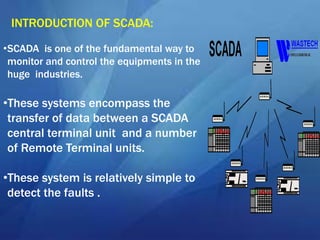
INTRODUCTION OF SCADA:
•SCADA is one of the fundamental way to
monitor and control the equipments in the
huge industries.

•These systems encompass the
transfer of data between a SCADA
central terminal unit and a number
of Remote Terminal units.
•These system is relatively simple to
detect the faults .
OBJECTIVE OF THE PROJECT:
•To find the remote electrical parameters like voltage, current
,active and reactive power, power factor at power stations
during transmission of power.
•To protect the electrical circuitry by operating an
electromagnetic relay whenever the electrical parameters
exceeds the predefined values.
•To send the information of the relay status to the remote
power stations by using wireless Radio frequency Technology.
EXISTING SYSTEM:
1stGeneration SCADA system:

2nd Generation SCADA system:
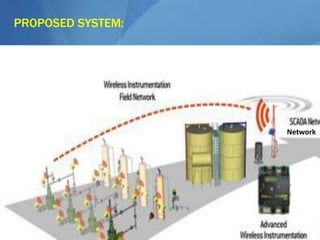
PROPOSED SYSTEM:

Network
BLOCK DIAGRAM:
MAIN COMPONENTS OF PROJECT:
Potential transformers
Atmega16 microcontroller
Regulated power supply
Relays
Isolators

Radio frequency Module
LCD display
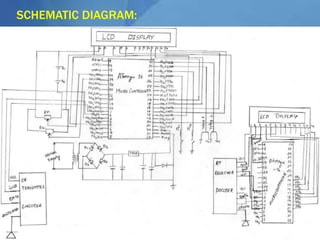
SCHEMATIC DIAGRAM:
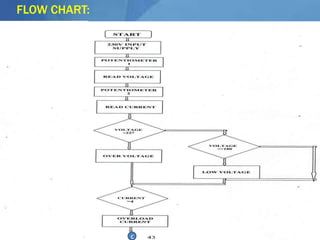
FLOW CHART:

c
c
WORKING:

Wireless RF
Technology

Transmission Lines

Relay &
Isolators

Potential
Transformer

R.P.S

Micro
controller

Parameters
display

RF Antenna

RF
RECEIVER

Micro
Controller

R.P.S

Status
Display
ADVANTAGES:
Increase Efficiency
•Minimize faults
•Isolate and precisely locate faults
Maximize Profitability
•Reduce failures
•Reduce operations overhead
•Reduce man power requirement
DIS-ADVANTAGES:
•Initial cost is more to establish SCADA system in real
time process.
•Maintenance cost is more in real time process.
•Construction of SCADA is Massive in real time process.
•SCADA system can be damaged by environmental
changes
FUTURE SCOPE:
The researches are being done by electrical engineering
scientists in Gujarat and Pune to reduce the cost of SCADA
and to implement them in small scale industries and
medium scale industries in future.
CONCLUSION:
We wanted to conclude that this project addresses how
to measure parameters and control flow of high current
and high voltage in transmission lines by tripping the
relays .These relays get activated whenever electrical
parameter exceed predefined values. By using RF
technology the parameter data status is transmitted to
Remote power stations.
SCADA Implementation Based on wireless RF Technology

SCADA Implementation Based on wireless RF Technology

  • 1.
  • 2.
    INTRODUCTION OF SCADA: •SCADAis one of the fundamental way to monitor and control the equipments in the huge industries. •These systems encompass the transfer of data between a SCADA central terminal unit and a number of Remote Terminal units. •These system is relatively simple to detect the faults .
  • 3.
    OBJECTIVE OF THEPROJECT: •To find the remote electrical parameters like voltage, current ,active and reactive power, power factor at power stations during transmission of power. •To protect the electrical circuitry by operating an electromagnetic relay whenever the electrical parameters exceeds the predefined values. •To send the information of the relay status to the remote power stations by using wireless Radio frequency Technology.
  • 4.
    EXISTING SYSTEM: 1stGeneration SCADAsystem: 2nd Generation SCADA system:
  • 5.
  • 6.
  • 7.
    MAIN COMPONENTS OFPROJECT: Potential transformers Atmega16 microcontroller Regulated power supply Relays Isolators Radio frequency Module LCD display
  • 8.
  • 9.
  • 10.
  • 11.
    WORKING: Wireless RF Technology Transmission Lines Relay& Isolators Potential Transformer R.P.S Micro controller Parameters display RF Antenna RF RECEIVER Micro Controller R.P.S Status Display
  • 12.
    ADVANTAGES: Increase Efficiency •Minimize faults •Isolateand precisely locate faults Maximize Profitability •Reduce failures •Reduce operations overhead •Reduce man power requirement
  • 13.
    DIS-ADVANTAGES: •Initial cost ismore to establish SCADA system in real time process. •Maintenance cost is more in real time process. •Construction of SCADA is Massive in real time process. •SCADA system can be damaged by environmental changes
  • 14.
    FUTURE SCOPE: The researchesare being done by electrical engineering scientists in Gujarat and Pune to reduce the cost of SCADA and to implement them in small scale industries and medium scale industries in future.
  • 15.
    CONCLUSION: We wanted toconclude that this project addresses how to measure parameters and control flow of high current and high voltage in transmission lines by tripping the relays .These relays get activated whenever electrical parameter exceed predefined values. By using RF technology the parameter data status is transmitted to Remote power stations.