https://microsites.bournemouth.ac.uk/cel/
Innovative Pedagogy:
the kick in the discovery
Mar 2017David Biggins
https://microsites.bournemouth.ac.uk/cel/ 2
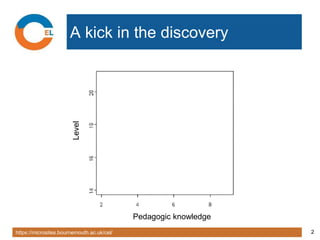
A kick in the discovery
Level
Pedagogic knowledge
https://microsites.bournemouth.ac.uk/cel/ 3
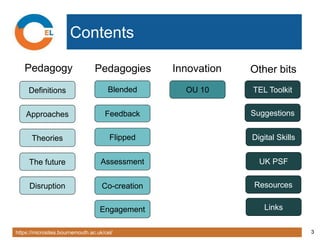
Contents
Blended OU 10 TEL Toolkit
Feedback
Digital Skills
UK PSFAssessment
Flipped
Pedagogies InnovationPedagogy Other bits
Approaches
Theories
Co-creation
Engagement Links
Resources
Suggestions
Definitions
The future
Disruption
https://microsites.bournemouth.ac.uk/cel/ 4
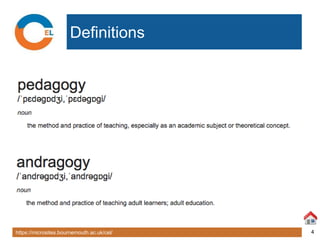
Definitions
https://microsites.bournemouth.ac.uk/cel/ 5
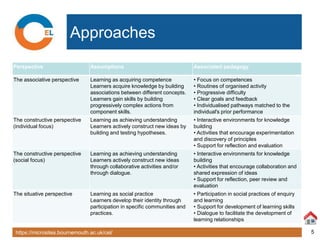
Approaches
Perspective Assumptions Associated pedagogy
The associative perspective Learning as acquiring competence
Learners acquire knowledge by building
associations between different concepts.
Learners gain skills by building
progressively complex actions from
component skills.
• Focus on competences
• Routines of organised activity
• Progressive difficulty
• Clear goals and feedback
• Individualised pathways matched to the
individual's prior performance
The constructive perspective
(individual focus)
Learning as achieving understanding
Learners actively construct new ideas by
building and testing hypotheses.
• Interactive environments for knowledge
building
• Activities that encourage experimentation
and discovery of principles
• Support for reflection and evaluation
The constructive perspective
(social focus)
Learning as achieving understanding
Learners actively construct new ideas
through collaborative activities and/or
through dialogue.
• Interactive environments for knowledge
building
• Activities that encourage collaboration and
shared expression of ideas
• Support for reflection, peer review and
evaluation
The situative perspective Learning as social practice
Learners develop their identity through
participation in specific communities and
practices.
• Participation in social practices of enquiry
and learning
• Support for development of learning skills
• Dialogue to facilitate the development of
learning relationships
https://microsites.bournemouth.ac.uk/cel/ 6
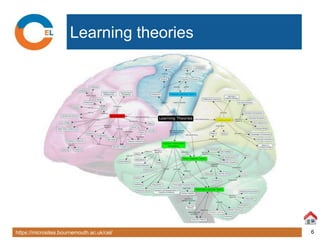
Learning theories
https://microsites.bournemouth.ac.uk/cel/ 7
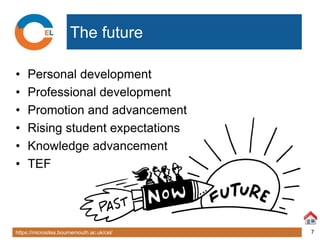
The future
• Personal development
• Professional development
• Promotion and advancement
• Rising student expectations
• Knowledge advancement
• TEF
https://microsites.bournemouth.ac.uk/cel/ 8
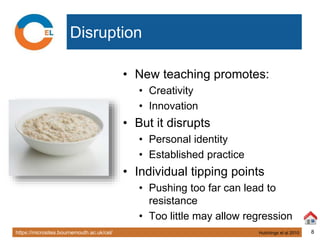
Disruption
• New teaching promotes:
• Creativity
• Innovation
• But it disrupts
• Personal identity
• Established practice
• Individual tipping points
• Pushing too far can lead to
resistance
• Too little may allow regression
Hutchings et al 2010
https://microsites.bournemouth.ac.uk/cel/ 9
TEL Toolkit
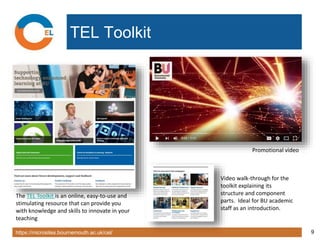
The TEL Toolkit is an online, easy-to-use and
stimulating resource that can provide you
with knowledge and skills to innovate in your
teaching
Promotional video
Video walk-through for the
toolkit explaining its
structure and component
parts. Ideal for BU academic
staff as an introduction.
https://microsites.bournemouth.ac.uk/cel/ 10
TEL Toolkit
• Launched Feb 2016
• Publicly available. Drupal site
• Metrics to mid Feb 17
• 6,527 session
• 24,508 pageviews
• Maintained and developed by the TEL Toolkit
Working group
• Minutes on the CEL I drive
• Eg Epigeum and Collaborate added
https://microsites.bournemouth.ac.uk/cel/ 11
TEL suggestions
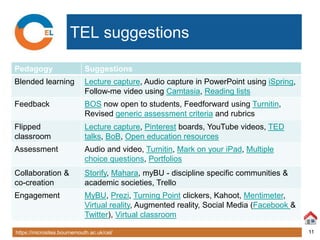
Pedagogy Suggestions
Blended learning Lecture capture, Audio capture in PowerPoint using iSpring,
Follow-me video using Camtasia, Reading lists
Feedback BOS now open to students, Feedforward using Turnitin,
Revised generic assessment criteria and rubrics
Flipped
classroom
Lecture capture, Pinterest boards, YouTube videos, TED
talks, BoB, Open education resources
Assessment Audio and video, Turnitin, Mark on your iPad, Multiple
choice questions, Portfolios
Collaboration &
co-creation
Storify, Mahara, myBU - discipline specific communities &
academic societies, Trello
Engagement MyBU, Prezi, Turning Point clickers, Kahoot, Mentimeter,
Virtual reality, Augmented reality, Social Media (Facebook &
Twitter), Virtual classroom
https://microsites.bournemouth.ac.uk/cel/ 12
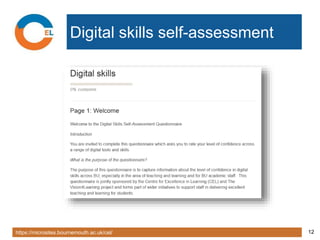
Digital skills self-assessment
https://microsites.bournemouth.ac.uk/cel/ 13
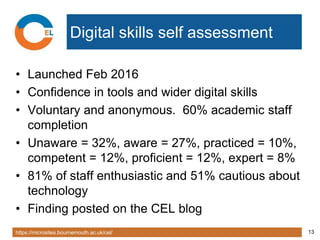
Digital skills self assessment
• Launched Feb 2016
• Confidence in tools and wider digital skills
• Voluntary and anonymous. 60% academic staff
completion
• Unaware = 32%, aware = 27%, practiced = 10%,
competent = 12%, proficient = 12%, expert = 8%
• 81% of staff enthusiastic and 51% cautious about
technology
• Finding posted on the CEL blog
https://microsites.bournemouth.ac.uk/cel/ 14
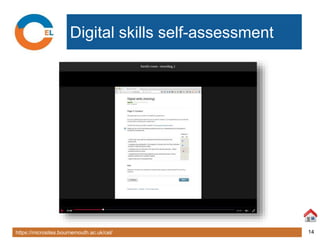
Digital skills self-assessment
https://microsites.bournemouth.ac.uk/cel/ 15
Other resources
• Engage with the ‘Try Something Different’campaign
• Complete the digital skills self assessment
• Refer to the case studies on the CEL site
• Use the CEL staff and theme leaders to generate ideas/ lead
workshops on innovation in curriculum:
• Prof Debbie Holley, David Biggins – TEL
• Carly Lamont – employability
• Anne Quinney – assessment
• Use the CEL blog – search for and add information
• Look out for CEL seminars/CPD units, commenced March
• Service Excellence (20 Apr) and CELebrate conferences (13
Jun)
https://microsites.bournemouth.ac.uk/cel/ 16
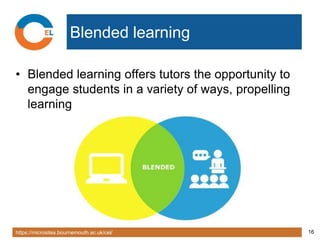
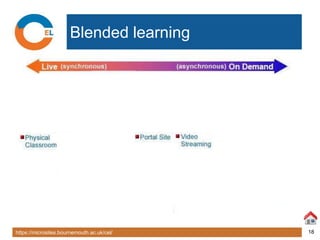
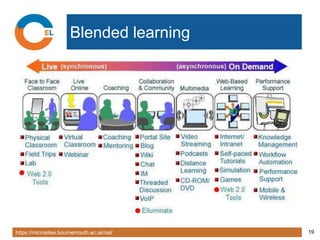
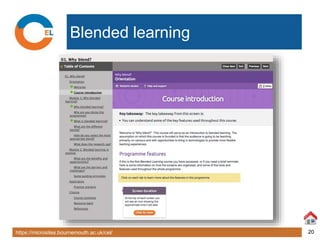
Blended learning
• Blended learning offers tutors the opportunity to
engage students in a variety of ways, propelling
learning
https://microsites.bournemouth.ac.uk/cel/ 17
Blended learning
https://microsites.bournemouth.ac.uk/cel/ 18
Blended learning
https://microsites.bournemouth.ac.uk/cel/ 19
Blended learning
https://microsites.bournemouth.ac.uk/cel/ 20
Blended learning
https://microsites.bournemouth.ac.uk/cel/ 21
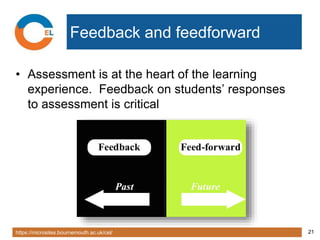
Feedback and feedforward
• Assessment is at the heart of the learning
experience. Feedback on students’ responses
to assessment is critical
https://microsites.bournemouth.ac.uk/cel/ 22
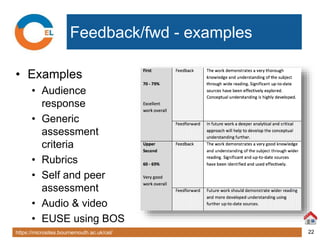
Feedback/fwd - examples
• Examples
• Audience
response
• Generic
assessment
criteria
• Rubrics
• Self and peer
assessment
• Audio & video
• EUSE using BOS
https://microsites.bournemouth.ac.uk/cel/ 23
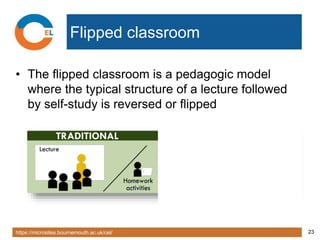
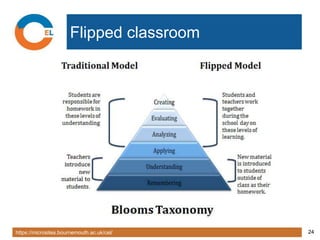
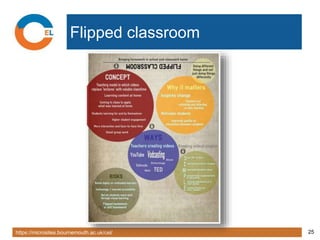
Flipped classroom
• The flipped classroom is a pedagogic model
where the typical structure of a lecture followed
by self-study is reversed or flipped
https://microsites.bournemouth.ac.uk/cel/ 24
Flipped classroom
https://microsites.bournemouth.ac.uk/cel/ 25
Flipped classroom
https://microsites.bournemouth.ac.uk/cel/ 26
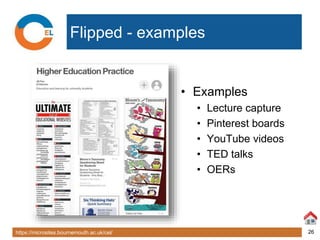
Flipped - examples
• Examples
• Lecture capture
• Pinterest boards
• YouTube videos
• TED talks
• OERs
https://microsites.bournemouth.ac.uk/cel/ 27
Assessment
• In the NSS, Assessment has been the lowest
scoring dimension nationally
• Students are driven by assessment and pay
attention to things they are assessed on
https://microsites.bournemouth.ac.uk/cel/ 28
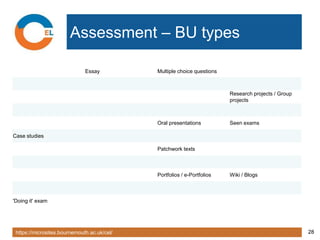
Assessment – BU types
Essay Multiple choice questions
Research projects / Group
projects
Oral presentations Seen exams
Case studies
Patchwork texts
Portfolios / e-Portfolios Wiki / Blogs
'Doing it' exam
https://microsites.bournemouth.ac.uk/cel/ 29
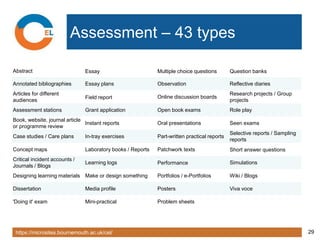
Assessment – 43 types
Abstract Essay Multiple choice questions Question banks
Annotated bibliographies Essay plans Observation Reflective diaries
Articles for different
audiences
Field report Online discussion boards
Research projects / Group
projects
Assessment stations Grant application Open book exams Role play
Book, website, journal article
or programme review
Instant reports Oral presentations Seen exams
Case studies / Care plans In-tray exercises Part-written practical reports
Selective reports / Sampling
reports
Concept maps Laboratory books / Reports Patchwork texts Short answer questions
Critical incident accounts /
Journals / Blogs
Learning logs Performance Simulations
Designing learning materials Make or design something Portfolios / e-Portfolios Wiki / Blogs
Dissertation Media profile Posters Viva voce
'Doing it' exam Mini-practical Problem sheets
https://microsites.bournemouth.ac.uk/cel/ 30
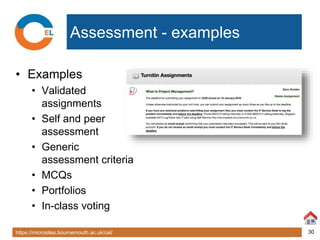
Assessment - examples
• Examples
• Validated
assignments
• Self and peer
assessment
• Generic
assessment criteria
• MCQs
• Portfolios
• In-class voting
https://microsites.bournemouth.ac.uk/cel/ 31
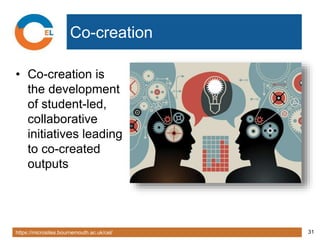
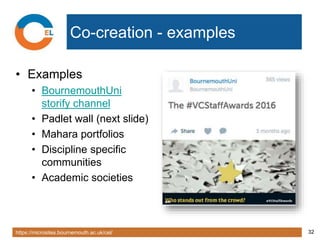
Co-creation
• Co-creation is
the development
of student-led,
collaborative
initiatives leading
to co-created
outputs
https://microsites.bournemouth.ac.uk/cel/ 32
Co-creation - examples
• Examples
• BournemouthUni
storify channel
• Padlet wall (next slide)
• Mahara portfolios
• Discipline specific
communities
• Academic societies
https://microsites.bournemouth.ac.uk/cel/ 33
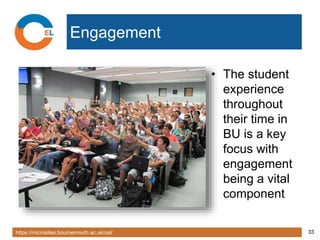
Engagement
• The student
experience
throughout
their time in
BU is a key
focus with
engagement
being a vital
component
https://microsites.bournemouth.ac.uk/cel/ 34
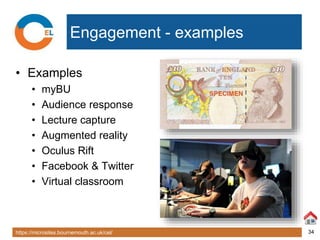
Engagement - examples
• Examples
• myBU
• Audience response
• Lecture capture
• Augmented reality
• Oculus Rift
• Facebook & Twitter
• Virtual classroom
https://microsites.bournemouth.ac.uk/cel/ 35
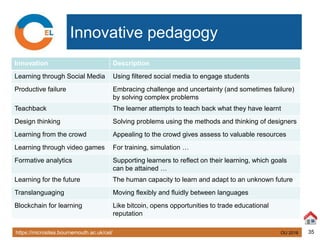
Innovative pedagogy
Innovation Description
Learning through Social Media Using filtered social media to engage students
Productive failure Embracing challenge and uncertainty (and sometimes failure)
by solving complex problems
Teachback The learner attempts to teach back what they have learnt
Design thinking Solving problems using the methods and thinking of designers
Learning from the crowd Appealing to the crowd gives assess to valuable resources
Learning through video games For training, simulation …
Formative analytics Supporting learners to reflect on their learning, which goals
can be attained …
Learning for the future The human capacity to learn and adapt to an unknown future
Translanguaging Moving flexibly and fluidly between languages
Blockchain for learning Like bitcoin, opens opportunities to trade educational
reputation
OU 2016
https://microsites.bournemouth.ac.uk/cel/ 36
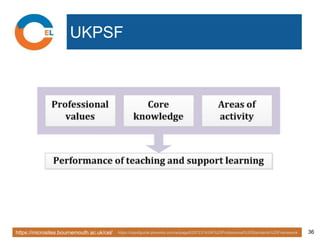
UKPSF
https://ukpsfguide.pbworks.com/w/page/62972374/UK%20Professional%20Standards%20Framework
https://microsites.bournemouth.ac.uk/cel/ 37
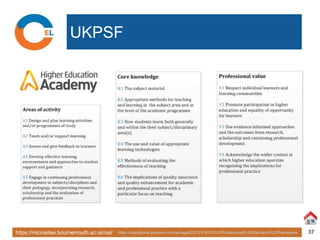
UKPSF
https://ukpsfguide.pbworks.com/w/page/62972374/UK%20Professional%20Standards%20Framework
https://microsites.bournemouth.ac.uk/cel/ 38
Links
• TEL Toolkit
• Using digital media in new learning models by Jisc, 2015
• 7 Things you should know about Flipped Classrooms by Educause,
Feb 2012
• The Inverted Classroom: What it is, Why We Need it and What it
Might Look Like, a keynote Prezi presentation, Teaching
Conference, University of Edinburgh, Jan 2012
• 5 Things I wish I knew When I Flipped My Class
• Let’s Use Video to Reinvent Education, TED talk by Salman Khan
• The 10 Best Web Tools for Flipped Classrooms, by EDUDEMIC,
2013
• http://www.open.ac.uk/blogs/innovating/

Technology Enhanced Learning and Innovative pedagogy