MODULE PLANNING
COURSE DESIGN:
Randi Plake
Instructional Designer
March 19, 2021
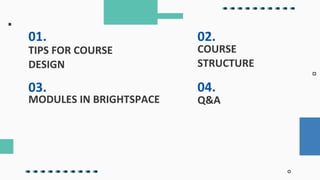
01.
TIPS FOR COURSE
DESIGN
02.
COURSE
STRUCTURE
03.
MODULES IN BRIGHTSPACE
04.
Q&A
01.
Strategies to think about
TIPS FOR
COURSE DESIGN
3 TIPS FOR DESIGNING A
BRIGHTSPACE COURSE
● Be Authentic
● Be In Touch
● Be Organized
3 TIPS FOR DESIGNING A BRIGHTSPACE COURSE
BE AUTHENTIC
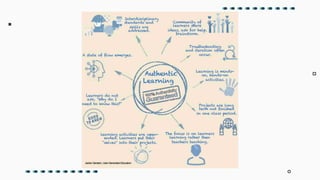
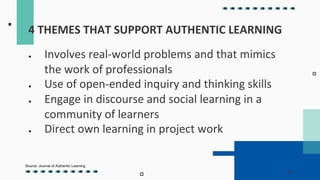
● Involves real-world problems and that mimics
the work of professionals
● Use of open-ended inquiry and thinking skills
● Engage in discourse and social learning in a
community of learners
● Direct own learning in project work
4 THEMES THAT SUPPORT AUTHENTIC LEARNING
Source: Journal of Authentic Learning
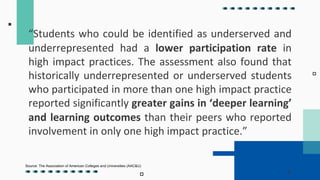
“Students who could be identified as underserved and
underrepresented had a lower participation rate in
high impact practices. The assessment also found that
historically underrepresented or underserved students
who participated in more than one high impact practice
reported significantly greater gains in ‘deeper learning’
and learning outcomes than their peers who reported
involvement in only one high impact practice.”
Source: The Association of American Colleges and Universities (AAC&U)
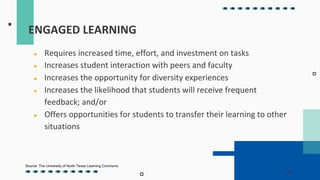
ENGAGED LEARNING
● Requires increased time, effort, and investment on tasks
● Increases student interaction with peers and faculty
● Increases the opportunity for diversity experiences
● Increases the likelihood that students will receive frequent
feedback; and/or
● Offers opportunities for students to transfer their learning to other
situations
Source: The University of North Texas Learning Commons
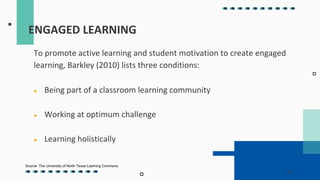
ENGAGED LEARNING
To promote active learning and student motivation to create engaged
learning, Barkley (2010) lists three conditions:
● Being part of a classroom learning community
● Working at optimum challenge
● Learning holistically
Source: The University of North Texas Learning Commons
BE IN TOUCH
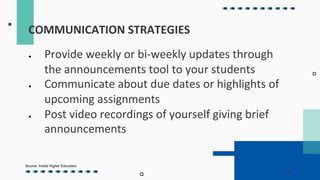
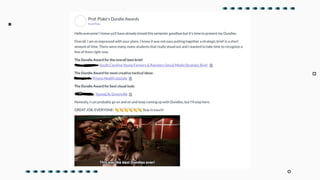
● Provide weekly or bi-weekly updates through
the announcements tool to your students
● Communicate about due dates or highlights of
upcoming assignments
● Post video recordings of yourself giving brief
announcements
COMMUNICATION STRATEGIES
Source: Inside Higher Education
BE ORGANIZED
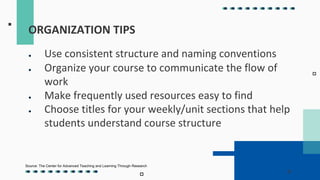
● Use consistent structure and naming conventions
● Organize your course to communicate the flow of
work
● Make frequently used resources easy to find
● Choose titles for your weekly/unit sections that help
students understand course structure
ORGANIZATION TIPS
Source: The Center for Advanced Teaching and Learning Through Research
Any questions?
02.
Develop organized modules
COURSE
STRUCTURE
3 TIPS FOR DEVELOPING
AN ORGANIZED COURSE
● Embrace Consistency
● Organize Your Modules
● Plan Modules Backwards
3 TIPS FOR DEVELOPING AN ORGANIZED COURSE
EMBRACE CONSISTENCY
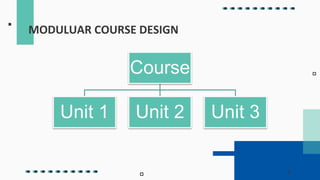
MODULUAR COURSE DESIGN
Course
Unit 1 Unit 2 Unit 3
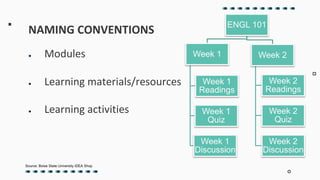
● Modules
● Learning materials/resources
● Learning activities
ENGL 101
Week 1
Week 1
Readings
Week 1
Quiz
Week 1
Discussion
Week 2
Week 2
Readings
Week 2
Quiz
Week 2
Discussion
NAMING CONVENTIONS
Source: Boise State University IDEA Shop
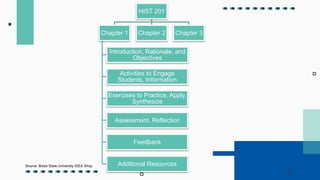
ORGANIZE YOUR MODULES
HIST 201
Chapter 1
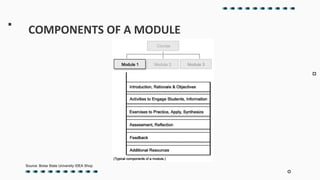
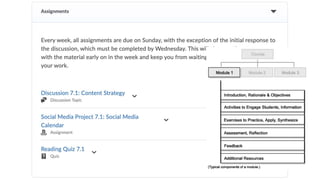
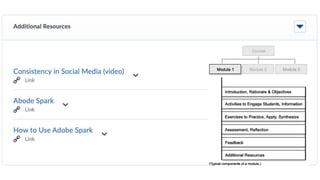
Introduction, Rationale, and
Objectives
Activities to Engage
Students, Information
Exercises to Practice, Apply,
Synthesize
Assessment, Reflection
Feedback
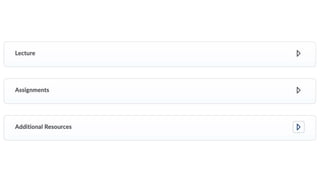
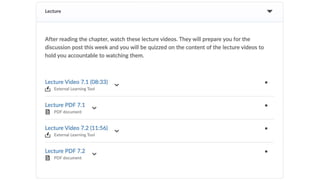
Additional Resources
Chapter 2 Chapter 3
Source: Boise State University IDEA Shop
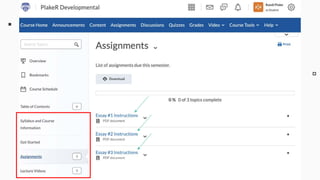
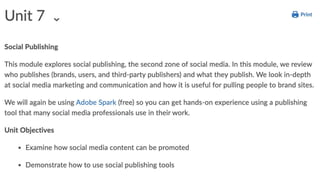
BAD MODULE DESIGN
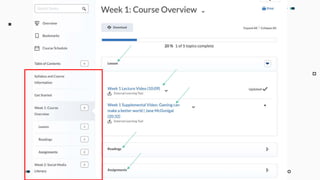
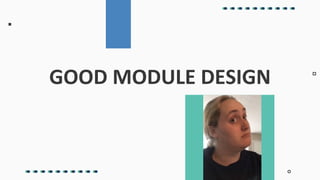
GOOD MODULE DESIGN
COMPONENTS OF A MODULE
Source: Boise State University IDEA Shop
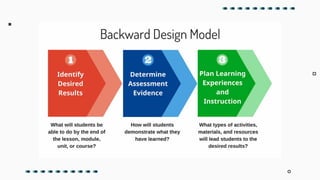
PLAN BACKWARDS
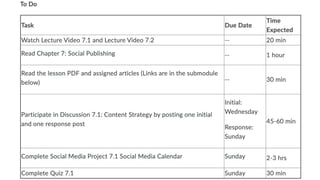
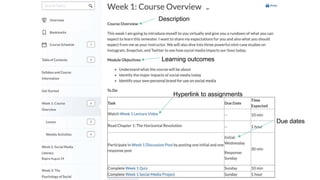
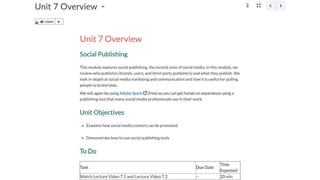
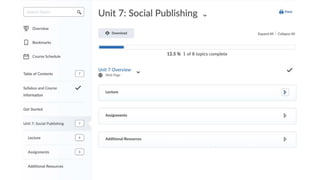
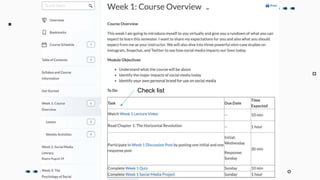
● Begin with a module overview page
● Include precise instructions
MODULE DEVELOPMENT
Source: UC Davis
Description
Learning outcomes
Hyperlink to assignments
Due dates
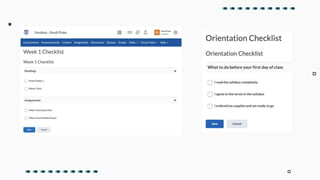
JOB AIDS/CHECK LISTS
Check list
Any questions?
03.
Building modules in the Content area
MODULES IN
BRIGHTSPACE
CONTENT AND MODULES
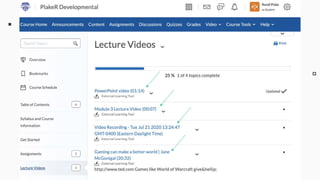
● Content area is the hub of your class
● Use modules to organize your course content
like folders on a computer or chapters within a
book
● Orientation to Content section
● How to create a module
● Introduction to Course Builder tool
An Overview of the Content Area and Modules
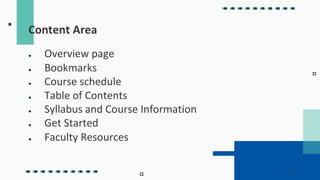
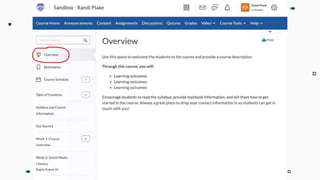
Content Area
● Overview page
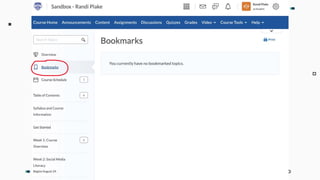
● Bookmarks
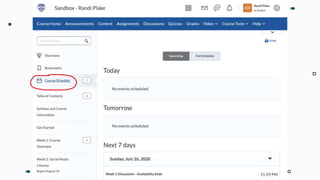
● Course schedule
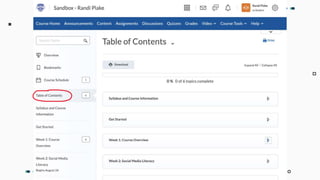
● Table of Contents
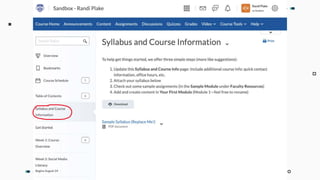
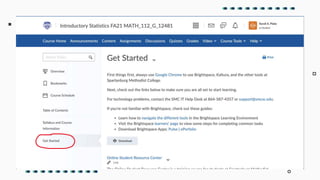
● Syllabus and Course Information
● Get Started
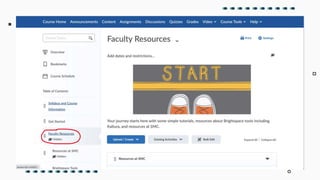
● Faculty Resources
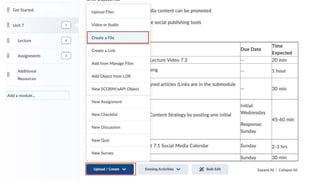
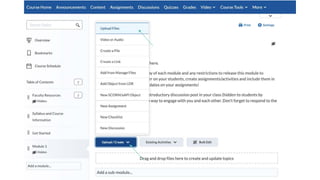
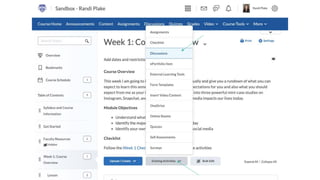
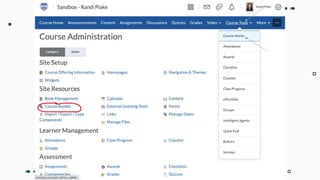
HOW TO CREATE A
MODULE IN BRIGHTSPACE
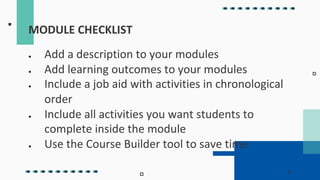
MODULE CHECKLIST
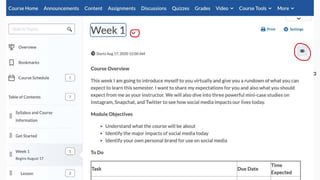
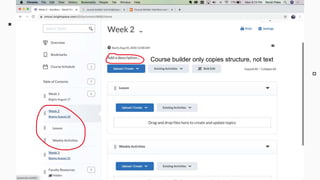
● Add a description to your modules
● Add learning outcomes to your modules
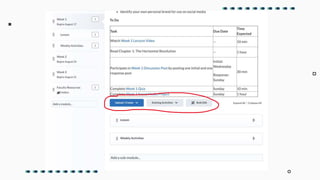
● Include a job aid with activities in chronological
order
● Include all activities you want students to
complete inside the module
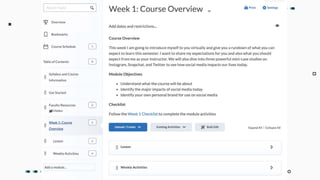
● Use the Course Builder tool to save time
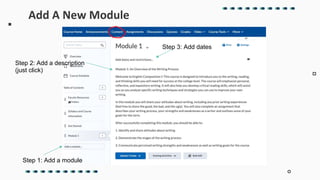
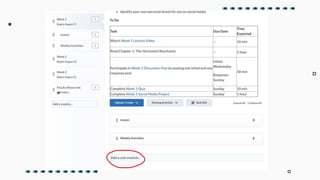
Step 1: Add a module
Step 2: Add a description
(just click)
Step 3: Add dates
Add A New Module
Any questions?
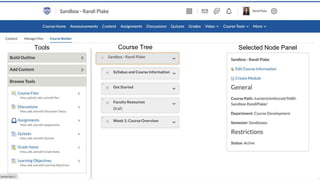
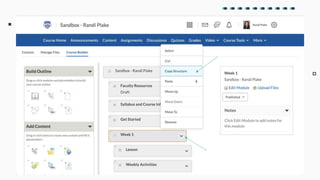
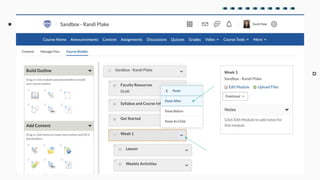
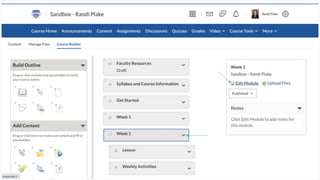
COURSE BUILDER TOOL
Course Tree Selected Node Panel
Tools
Course builder only copies structure, not text
Any questions?
04.
Any questions?
Q&A
Any questions?
WORKS CITED
Barkley, E.F. (2010). Student engagement techniques. San Francisco: John Wiley and Sons.
Finley, Ashley, and Tia McNair. Assessing High-Impact Learning for Underserved Students. Association of American Colleges & Universities, 24
Nov. 2014, www.aacu.org/assessinghips.
Hunt, Andrea N., et al. “High Impact Practices and Historically Underrepresented Minority Students.” Center for Engaged Learning, Elon
University, 26 Jan. 2021, www.centerforengagedlearning.org/resources/high-impact-practices-and-historically-underrepresented-minority-
students/
“Organize Your Online Course for Student Success.” Center for Advancing Teaching and Learning Through Research, Northeastern University, 20
Aug. 2020, learning.northeastern.edu/organize-your-online-course-for-student-success/.
Rule, Audrey C. “Editorial: The Components of Authentic Learning.” Journal of Authentic Learning, vol. 3, no. 1, Aug. 2006, pp. 1–10.
“Structure Your Canvas Course.” Keep Teaching, UC Davis, 6 Dec. 2020, keepteaching.ucdavis.edu/organize-your-course-remote-
instruction/planning-remote-instruction/quick-start-guide.
“Using a Modular Approach to Course Design.” IDEA Shop, Boise State University, 30 Sept. 2015, www.boisestate.edu/ctl-idea/teaching-with-
tech/primer/using-a-modular-approach-to-course-design/.
“Why Engaged Learning?” UNT Teaching Commons, The University of North Texas, 2021, teachingcommons.unt.edu/teaching-
essentials/engaged-learning/why-engaged-learning.
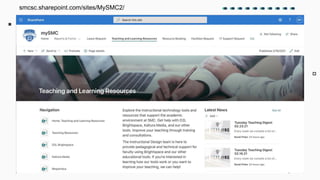
smcsc.sharepoint.com/sites/MySMC2/
UPCOMING WORKSHOPS
First Tuesday Lunch & Learn (Tuesday, April 6, 12-1 p.m.)
Kaltura MediaSpace (with Brendan Plake)
Grab your lunch and join us for an informative session! There will be a short presentation followed by a Q&A.
Bring any questions you have!
Teaching With Multimedia (Friday, April 9, 9-9:45 a.m.)
Learn how to incorporate videos, podcasts, songs, and apps into your online and in-person courses for a
high-impact active learning experience.
Accessibility in D2L Brightspace (Wednesday, April 14, 1-2 p.m.)
Learn about the key accessibility features in Brightspace and how to create accessible course materials such
as text documents, images, and videos with captions. Our special guests from Accessibility Services will give
us an overview of student accommodations and what students are entitled to.

Course Design: Module Planning

  • 1.
    MODULE PLANNING COURSE DESIGN: RandiPlake Instructional Designer March 19, 2021
  • 2.
  • 3.
    01. Strategies to thinkabout TIPS FOR COURSE DESIGN
  • 4.
    3 TIPS FORDESIGNING A BRIGHTSPACE COURSE
  • 5.
    ● Be Authentic ●Be In Touch ● Be Organized 3 TIPS FOR DESIGNING A BRIGHTSPACE COURSE
  • 6.
  • 8.
    ● Involves real-worldproblems and that mimics the work of professionals ● Use of open-ended inquiry and thinking skills ● Engage in discourse and social learning in a community of learners ● Direct own learning in project work 4 THEMES THAT SUPPORT AUTHENTIC LEARNING Source: Journal of Authentic Learning
  • 11.
    “Students who couldbe identified as underserved and underrepresented had a lower participation rate in high impact practices. The assessment also found that historically underrepresented or underserved students who participated in more than one high impact practice reported significantly greater gains in ‘deeper learning’ and learning outcomes than their peers who reported involvement in only one high impact practice.” Source: The Association of American Colleges and Universities (AAC&U)
  • 12.
    ENGAGED LEARNING ● Requiresincreased time, effort, and investment on tasks ● Increases student interaction with peers and faculty ● Increases the opportunity for diversity experiences ● Increases the likelihood that students will receive frequent feedback; and/or ● Offers opportunities for students to transfer their learning to other situations Source: The University of North Texas Learning Commons
  • 14.
    ENGAGED LEARNING To promoteactive learning and student motivation to create engaged learning, Barkley (2010) lists three conditions: ● Being part of a classroom learning community ● Working at optimum challenge ● Learning holistically Source: The University of North Texas Learning Commons
  • 15.
  • 17.
    ● Provide weeklyor bi-weekly updates through the announcements tool to your students ● Communicate about due dates or highlights of upcoming assignments ● Post video recordings of yourself giving brief announcements COMMUNICATION STRATEGIES Source: Inside Higher Education
  • 19.
  • 21.
    ● Use consistentstructure and naming conventions ● Organize your course to communicate the flow of work ● Make frequently used resources easy to find ● Choose titles for your weekly/unit sections that help students understand course structure ORGANIZATION TIPS Source: The Center for Advanced Teaching and Learning Through Research
  • 22.
  • 23.
  • 24.
    3 TIPS FORDEVELOPING AN ORGANIZED COURSE
  • 25.
    ● Embrace Consistency ●Organize Your Modules ● Plan Modules Backwards 3 TIPS FOR DEVELOPING AN ORGANIZED COURSE
  • 26.
  • 28.
  • 29.
    ● Modules ● Learningmaterials/resources ● Learning activities ENGL 101 Week 1 Week 1 Readings Week 1 Quiz Week 1 Discussion Week 2 Week 2 Readings Week 2 Quiz Week 2 Discussion NAMING CONVENTIONS Source: Boise State University IDEA Shop
  • 33.
  • 34.
    HIST 201 Chapter 1 Introduction,Rationale, and Objectives Activities to Engage Students, Information Exercises to Practice, Apply, Synthesize Assessment, Reflection Feedback Additional Resources Chapter 2 Chapter 3 Source: Boise State University IDEA Shop
  • 35.
  • 38.
  • 40.
    COMPONENTS OF AMODULE Source: Boise State University IDEA Shop
  • 47.
  • 49.
    ● Begin witha module overview page ● Include precise instructions MODULE DEVELOPMENT Source: UC Davis
  • 50.
  • 54.
  • 55.
  • 57.
  • 58.
    03. Building modules inthe Content area MODULES IN BRIGHTSPACE
  • 59.
    CONTENT AND MODULES ●Content area is the hub of your class ● Use modules to organize your course content like folders on a computer or chapters within a book
  • 60.
    ● Orientation toContent section ● How to create a module ● Introduction to Course Builder tool An Overview of the Content Area and Modules
  • 61.
    Content Area ● Overviewpage ● Bookmarks ● Course schedule ● Table of Contents ● Syllabus and Course Information ● Get Started ● Faculty Resources
  • 69.
    HOW TO CREATEA MODULE IN BRIGHTSPACE
  • 70.
    MODULE CHECKLIST ● Adda description to your modules ● Add learning outcomes to your modules ● Include a job aid with activities in chronological order ● Include all activities you want students to complete inside the module ● Use the Course Builder tool to save time
  • 71.
    Step 1: Adda module Step 2: Add a description (just click) Step 3: Add dates Add A New Module
  • 78.
  • 79.
  • 81.
    Course Tree SelectedNode Panel Tools
  • 85.
    Course builder onlycopies structure, not text
  • 86.
  • 87.
  • 88.
  • 89.
    WORKS CITED Barkley, E.F.(2010). Student engagement techniques. San Francisco: John Wiley and Sons. Finley, Ashley, and Tia McNair. Assessing High-Impact Learning for Underserved Students. Association of American Colleges & Universities, 24 Nov. 2014, www.aacu.org/assessinghips. Hunt, Andrea N., et al. “High Impact Practices and Historically Underrepresented Minority Students.” Center for Engaged Learning, Elon University, 26 Jan. 2021, www.centerforengagedlearning.org/resources/high-impact-practices-and-historically-underrepresented-minority- students/ “Organize Your Online Course for Student Success.” Center for Advancing Teaching and Learning Through Research, Northeastern University, 20 Aug. 2020, learning.northeastern.edu/organize-your-online-course-for-student-success/. Rule, Audrey C. “Editorial: The Components of Authentic Learning.” Journal of Authentic Learning, vol. 3, no. 1, Aug. 2006, pp. 1–10. “Structure Your Canvas Course.” Keep Teaching, UC Davis, 6 Dec. 2020, keepteaching.ucdavis.edu/organize-your-course-remote- instruction/planning-remote-instruction/quick-start-guide. “Using a Modular Approach to Course Design.” IDEA Shop, Boise State University, 30 Sept. 2015, www.boisestate.edu/ctl-idea/teaching-with- tech/primer/using-a-modular-approach-to-course-design/. “Why Engaged Learning?” UNT Teaching Commons, The University of North Texas, 2021, teachingcommons.unt.edu/teaching- essentials/engaged-learning/why-engaged-learning.
  • 90.
  • 91.
    UPCOMING WORKSHOPS First TuesdayLunch & Learn (Tuesday, April 6, 12-1 p.m.) Kaltura MediaSpace (with Brendan Plake) Grab your lunch and join us for an informative session! There will be a short presentation followed by a Q&A. Bring any questions you have! Teaching With Multimedia (Friday, April 9, 9-9:45 a.m.) Learn how to incorporate videos, podcasts, songs, and apps into your online and in-person courses for a high-impact active learning experience. Accessibility in D2L Brightspace (Wednesday, April 14, 1-2 p.m.) Learn about the key accessibility features in Brightspace and how to create accessible course materials such as text documents, images, and videos with captions. Our special guests from Accessibility Services will give us an overview of student accommodations and what students are entitled to.