Flipping Classrooms
Federica Oradini and Gunter Saunders (in spirit)
A few disclaimers?
• Flipping is easy to talk about
• It can appear harder to get started
• Its harder to do the bigger the class
• It may already be what you do
• Not everything needs to be flipped
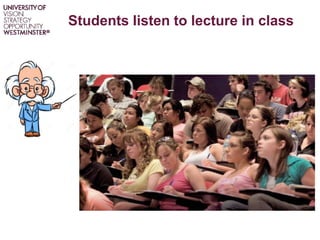
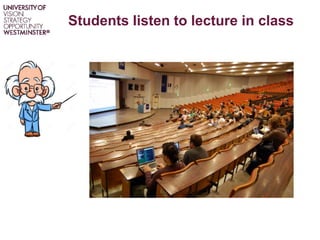
Students listen to lecture in class
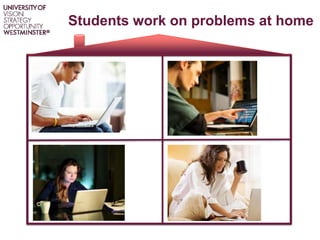
Students work on problems at home
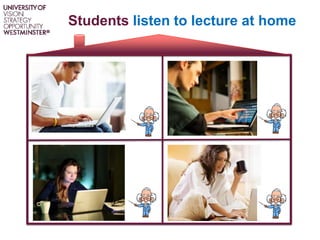
Students listen to lecture at home
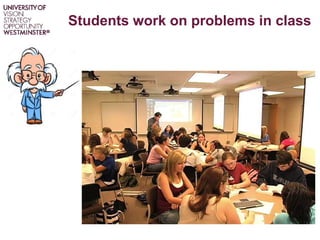
Students work on problems in class
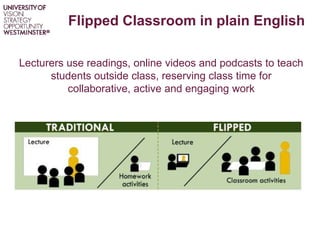
Flipped Classroom in plain English
Lecturers use readings, online videos and podcasts to teach
students outside class, reserving class time for
collaborative, active and engaging work
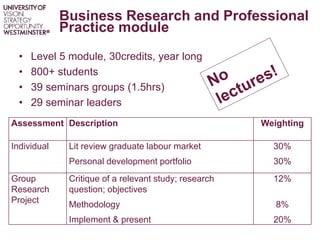
Business Research and Professional
Practice module
• Level 5 module, 30credits, year long
• 800+ students
• 39 seminars groups (1.5hrs)
• 29 seminar leaders
Assessment Description Weighting
Individual Lit review graduate labour market
Personal development portfolio
30%
30%
Group
Research
Project
Critique of a relevant study; research
question; objectives
Methodology
Implement & present
12%
8%
20%
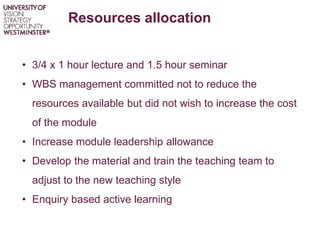
Resources allocation
• 3/4 x 1 hour lecture and 1.5 hour seminar
• WBS management committed not to reduce the
resources available but did not wish to increase the cost
of the module
• Increase module leadership allowance
• Develop the material and train the teaching team to
adjust to the new teaching style
• Enquiry based active learning
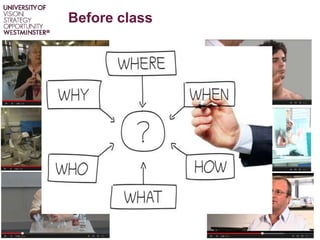
Before class
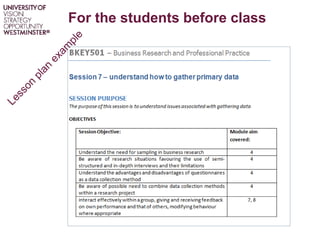
For the students before class
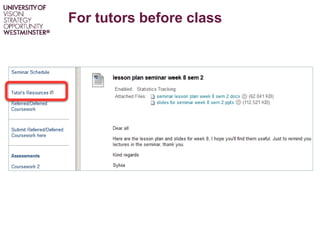
For tutors before class
Repurposing value of class time
The real value added is in repurposing class time into a
workshop where students can inquire about lecture
content, test their skills in applying new knowledge, work
together to solve problems and grapple with material,
interacting with one another in hands-on activities
receiving feedback from teachers and peers.
That’s where the deep learning happened!
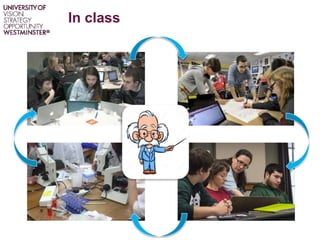
In class
What practitioners say
• The technology needs to fit with and supports the face-
to-face learning strategies
• Structured activities have to integrate with online
resources and in-class activities
• Provide students with a seamless learning experience
between the classroom and the online environment
Simply uploading notes and lectures online is not an
effective method of engaging students.
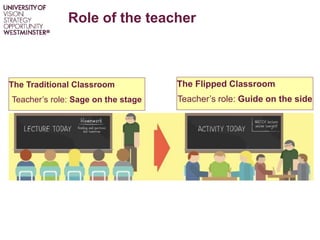
Role of the teacher
The Traditional Classroom
Teacher’s role: Sage on the stage
The Flipped Classroom
Teacher’s role: Guide on the side
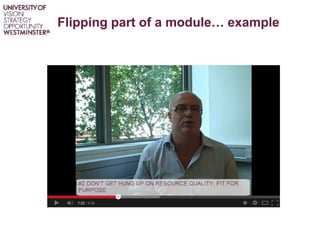
Flipping part of a module… example
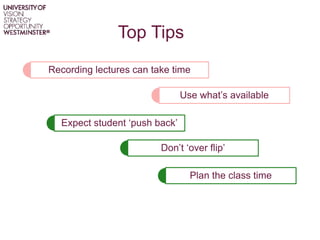
Top Tips
Recording lectures can take time
Use what’s available
Don’t ‘over flip’
Expect student ‘push back’
Plan the class time
References
• Bates, S., & Galloway, R. (2012). The inverted classroom in a large enrolment introductory
physics course: a case study. In Proceedings of the 1st International Conference on the
Aiming for Excellence in STEM Learning and Teaching
http://www.heacademy.ac.uk/assets/documents/stem-
conference/PhysicalSciences/Simon_Bates_Ross_Galloway.pdf
• Bates S.P. and Galloway R.K., (2012) The Inverted Classroom: what it is, why we need it and
what it might look like, Prezi.com http://bit.ly/invertedclassroom
• Dale, Edgar. "Audiovisual methods in teaching." (1969)
• Khan, S. (2011). Let's use video to reinvent education [Video file]. Retrieved
from http://www.ted.com
• Tan, E., & Pearce, N. (2012) Open education videos in the classroom: exploring the
opportunities and barriers to the use of YouTube in teaching introductory sociology, Research
in Learning Technology, 19. Available from: http://journals.co-
action.net/index.php/rlt/article/view/7783
• The Flipped Classroom Infographic http://www.knewton.com/flipped-classroom/
• The Flipping Conference http://flippingproject.wikispaces.com/The+Flipping+Conference
• Using online lectures to support active learning – video case study
http://youtu.be/5NAIBt10Lug
• Zappe, S., Leicht, R., Messner, J., Litzinger, T., & Lee, H. W. (2009) Flipping" the classroom to
explore active learning in a large undergraduate course, In American Society for Engineering
Education, American Society for Engineering Education, Available from: http://goo.gl/etW6Fj

Flipped Classrooms

  • 2.
    Flipping Classrooms Federica Oradiniand Gunter Saunders (in spirit)
  • 3.
    A few disclaimers? •Flipping is easy to talk about • It can appear harder to get started • Its harder to do the bigger the class • It may already be what you do • Not everything needs to be flipped
  • 4.
    Students listen tolecture in class
  • 5.
    Students listen tolecture in class
  • 6.
    Students work onproblems at home
  • 7.
    Students listen tolecture at home
  • 8.
    Students work onproblems in class
  • 9.
    Flipped Classroom inplain English Lecturers use readings, online videos and podcasts to teach students outside class, reserving class time for collaborative, active and engaging work
  • 10.
    Business Research andProfessional Practice module • Level 5 module, 30credits, year long • 800+ students • 39 seminars groups (1.5hrs) • 29 seminar leaders Assessment Description Weighting Individual Lit review graduate labour market Personal development portfolio 30% 30% Group Research Project Critique of a relevant study; research question; objectives Methodology Implement & present 12% 8% 20%
  • 11.
    Resources allocation • 3/4x 1 hour lecture and 1.5 hour seminar • WBS management committed not to reduce the resources available but did not wish to increase the cost of the module • Increase module leadership allowance • Develop the material and train the teaching team to adjust to the new teaching style • Enquiry based active learning
  • 12.
  • 13.
    For the studentsbefore class
  • 14.
  • 15.
    Repurposing value ofclass time The real value added is in repurposing class time into a workshop where students can inquire about lecture content, test their skills in applying new knowledge, work together to solve problems and grapple with material, interacting with one another in hands-on activities receiving feedback from teachers and peers. That’s where the deep learning happened!
  • 16.
  • 17.
    What practitioners say •The technology needs to fit with and supports the face- to-face learning strategies • Structured activities have to integrate with online resources and in-class activities • Provide students with a seamless learning experience between the classroom and the online environment Simply uploading notes and lectures online is not an effective method of engaging students.
  • 18.
    Role of theteacher The Traditional Classroom Teacher’s role: Sage on the stage The Flipped Classroom Teacher’s role: Guide on the side
  • 19.
    Flipping part ofa module… example
  • 20.
    Top Tips Recording lecturescan take time Use what’s available Don’t ‘over flip’ Expect student ‘push back’ Plan the class time
  • 21.
    References • Bates, S.,& Galloway, R. (2012). The inverted classroom in a large enrolment introductory physics course: a case study. In Proceedings of the 1st International Conference on the Aiming for Excellence in STEM Learning and Teaching http://www.heacademy.ac.uk/assets/documents/stem- conference/PhysicalSciences/Simon_Bates_Ross_Galloway.pdf • Bates S.P. and Galloway R.K., (2012) The Inverted Classroom: what it is, why we need it and what it might look like, Prezi.com http://bit.ly/invertedclassroom • Dale, Edgar. "Audiovisual methods in teaching." (1969) • Khan, S. (2011). Let's use video to reinvent education [Video file]. Retrieved from http://www.ted.com • Tan, E., & Pearce, N. (2012) Open education videos in the classroom: exploring the opportunities and barriers to the use of YouTube in teaching introductory sociology, Research in Learning Technology, 19. Available from: http://journals.co- action.net/index.php/rlt/article/view/7783 • The Flipped Classroom Infographic http://www.knewton.com/flipped-classroom/ • The Flipping Conference http://flippingproject.wikispaces.com/The+Flipping+Conference • Using online lectures to support active learning – video case study http://youtu.be/5NAIBt10Lug • Zappe, S., Leicht, R., Messner, J., Litzinger, T., & Lee, H. W. (2009) Flipping" the classroom to explore active learning in a large undergraduate course, In American Society for Engineering Education, American Society for Engineering Education, Available from: http://goo.gl/etW6Fj

Editor's Notes

  • #5 We teach courses where normally we lecture students during class time
  • #7 They work on homework and group assignments in their own time
  • #8 But what if there was a way to do the lectures outside the classtime, where students watch, listen to, interact with the content on their own time
  • #9 So we can use classtime to get students to work on engaging activities together
  • #10 So the idea to make the time that we spend with the student more effective Increase student engagement and improve student learning Although implementing a flipped classroom places different demands on academics and forces students to adjust their expectations, the model has the potential to bring about a distinctive shift in priorities - from merely covering material to working toward mastery of it.
  • #13 The main idea is to capture your presence, thoughts and guidance that would normally takes place in the classroom settings
  • #17 Spend the first 25 minutes discussing the content of the video What if students don’t watch videos: Require students to interact with the information (e.g. takes notes, ask questions) If they havent some teachers walk out, some ask the students to leave and go to a computer lab whilst others carry on Collaborate in groups with each other, peer learning, peer pressure Class is engaging, sociable, collaborative they want to be part of what’s going on They see the value of being part of the classroom Scaffold what you want them to do (if necessary to that in class the first time and highlight what you want them to do, pause/rewind take notes)
  • #18 Agree with the students how they were going to learn during the semester – justin fast feedback