Laurie Curro
General Manager Power System Services
Horizon Power
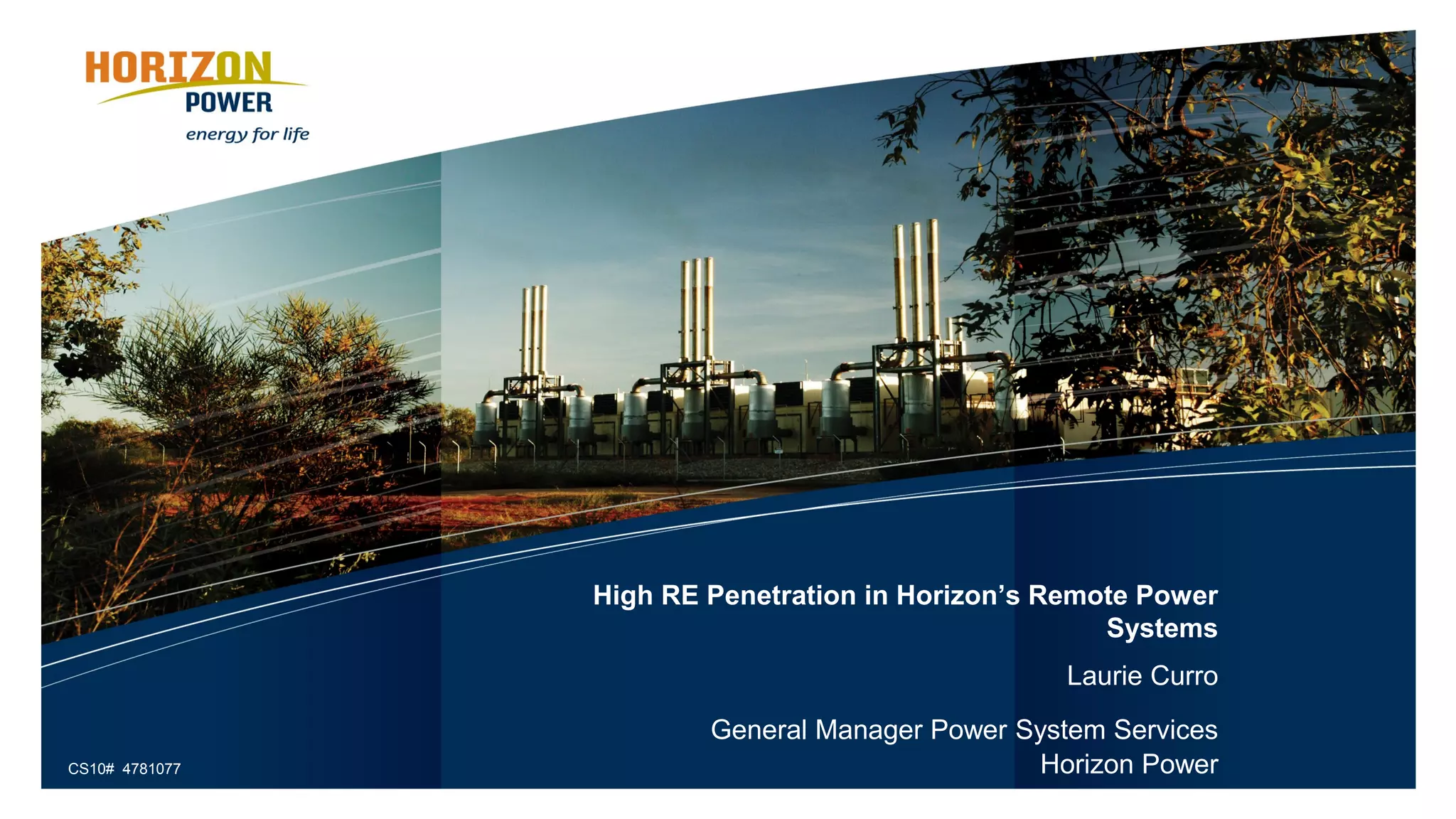
High RE Penetration in Horizon’s Remote Power
Systems
CS10# 4781077
Agenda
• Who is Horizon Power
• History of Renewable Energy
• Insatiable demand for Renewable Energy
• Trends
• Storage – a game changer
• Multi-flow networks
• Control systems
• Trials and projects
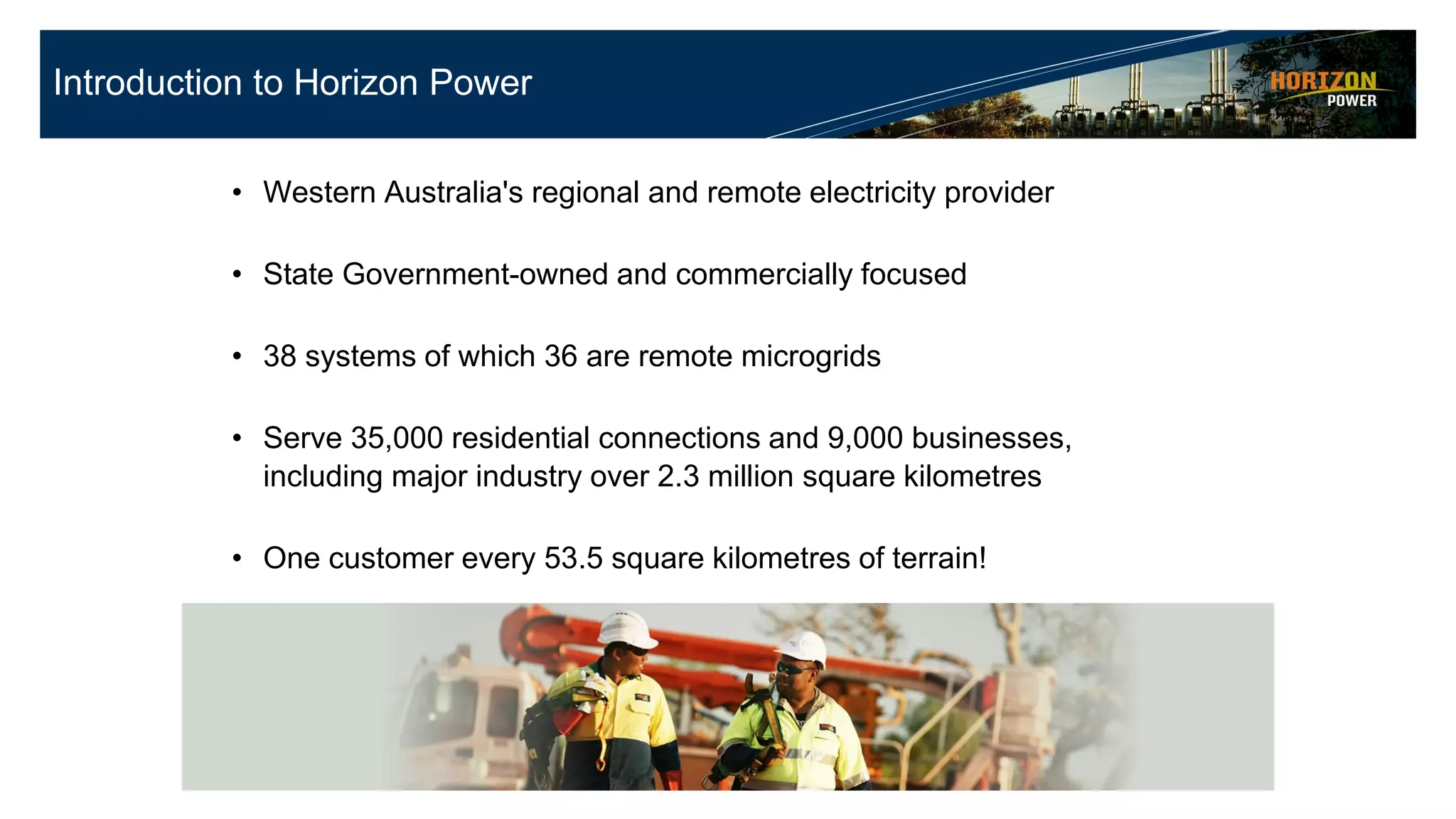
• Western Australia's regional and remote electricity provider
• State Government-owned and commercially focused
• 38 systems of which 36 are remote microgrids
• Serve 35,000 residential connections and 9,000 businesses,
including major industry over 2.3 million square kilometres
• One customer every 53.5 square kilometres of terrain!
• Responsible for the generation, procurement, distribution and
retailing of electricity
Introduction to Horizon Power
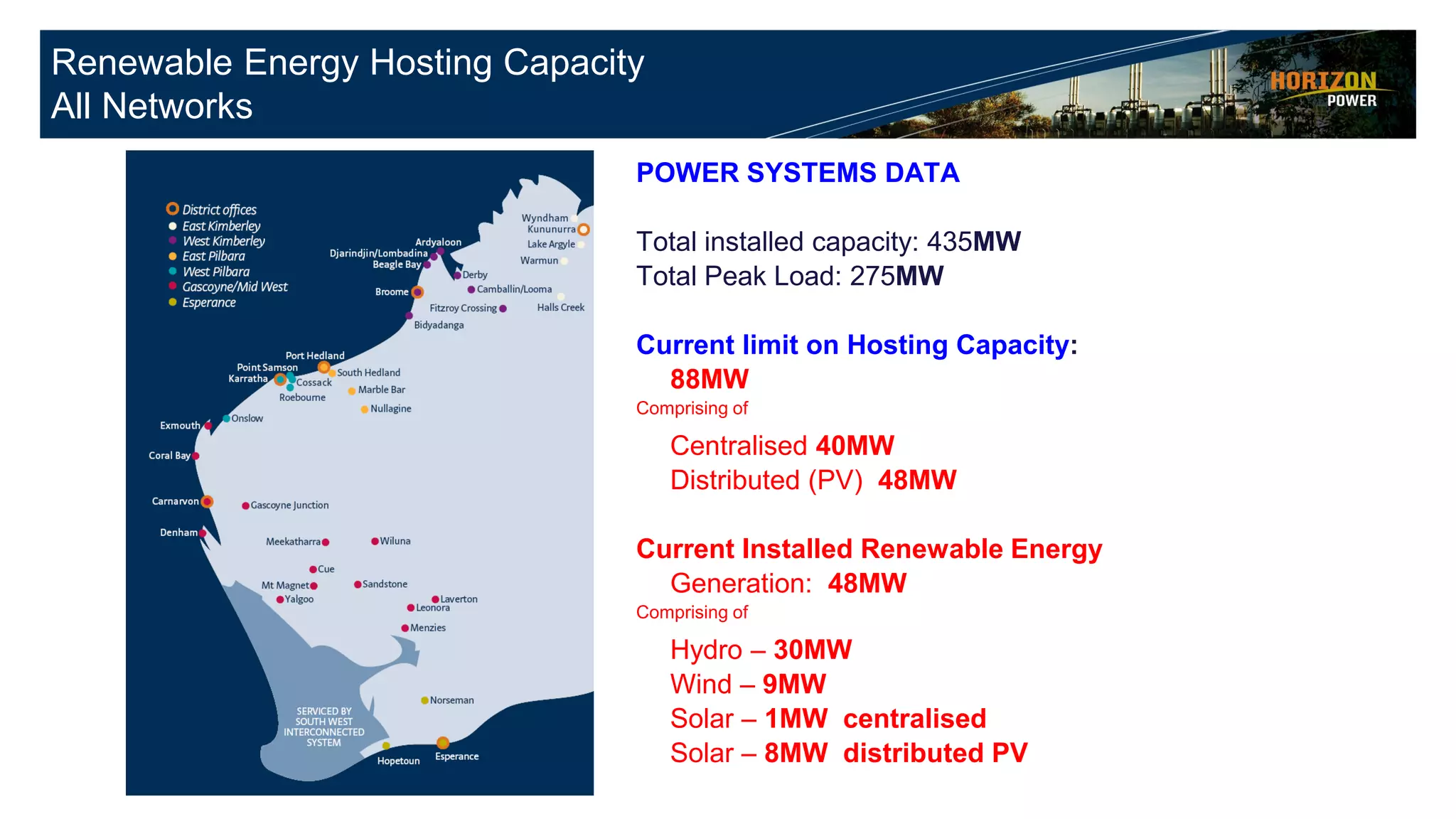
POWER SYSTEMS DATA
Total installed capacity: 435MW
Total Peak Load: 275MW
Current limit on Hosting Capacity:
88MW
Comprising of
Centralised 40MW
Distributed (PV) 48MW
Current Installed Renewable Energy
Generation: 48MW
Comprising of
Hydro – 30MW
Wind – 9MW
Solar – 1MW centralised
Solar – 8MW distributed PV
Renewable Energy Hosting Capacity
All Networks
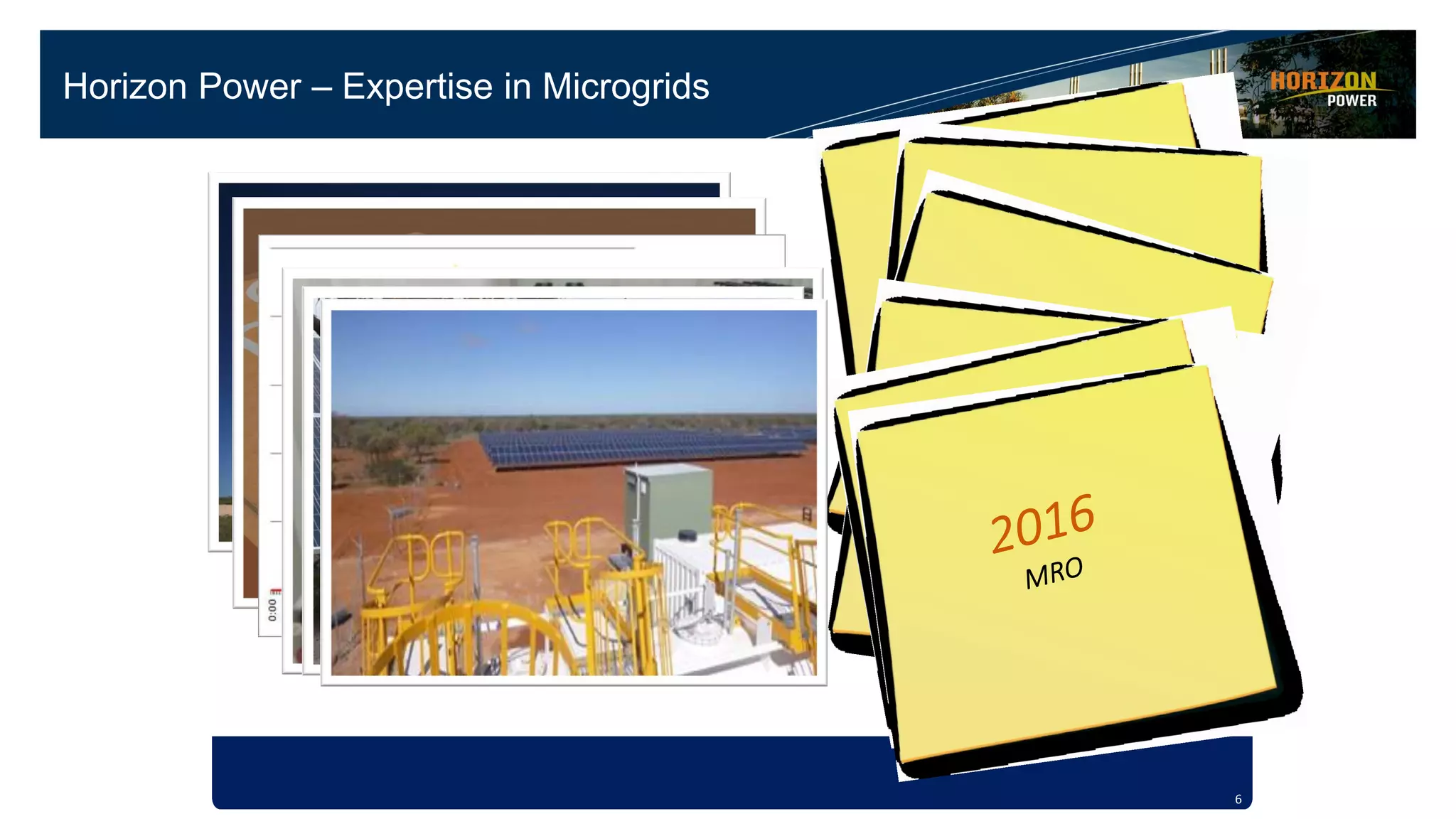
Horizon Power – Expertise in Microgrids
6
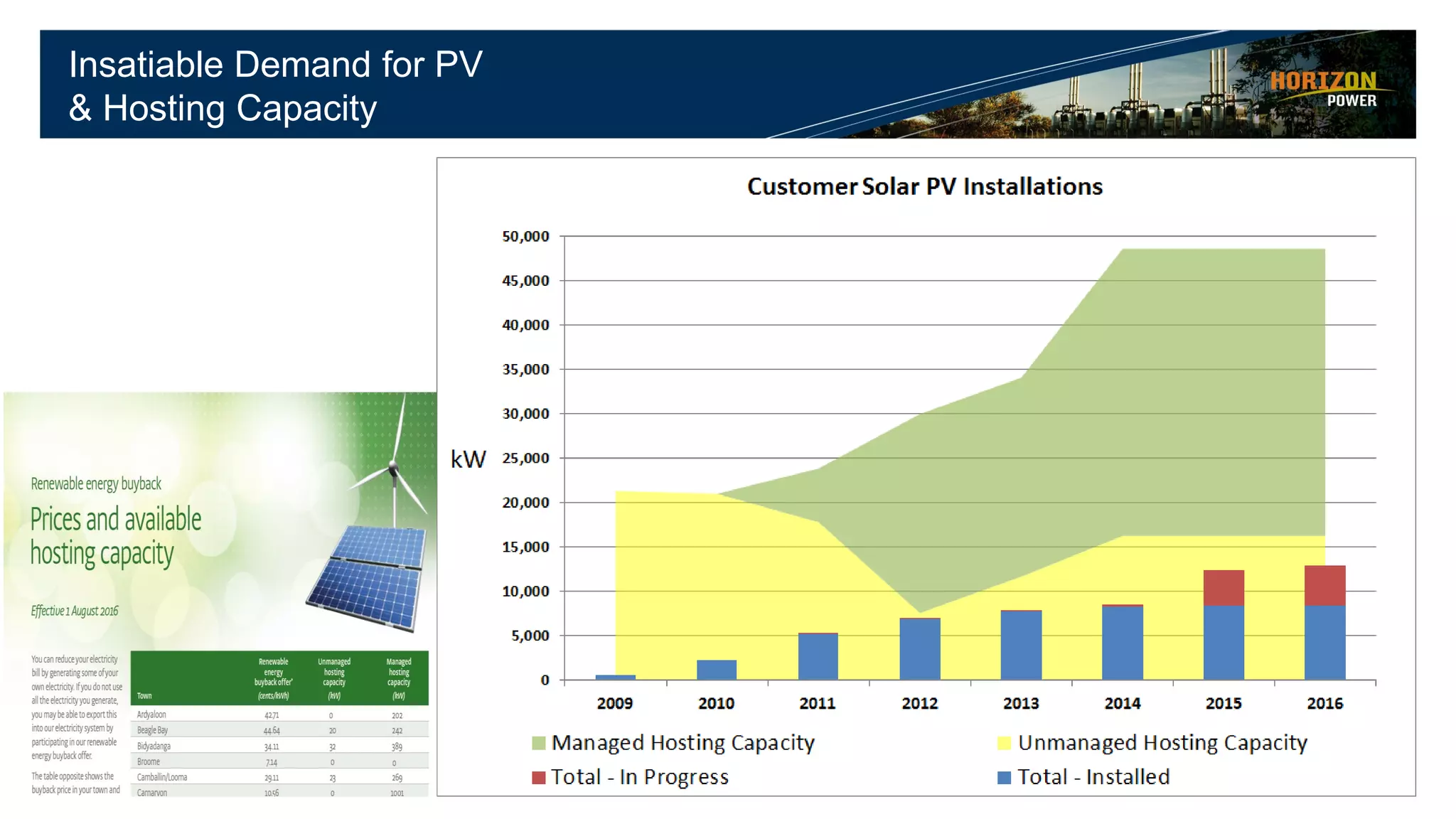
Insatiable Demand for PV
& Hosting Capacity
Increasing
investment
in
renewables
Decreasing
demand for
centralised
generation
Rising
electricity
prices
Falling cost
of new
technology
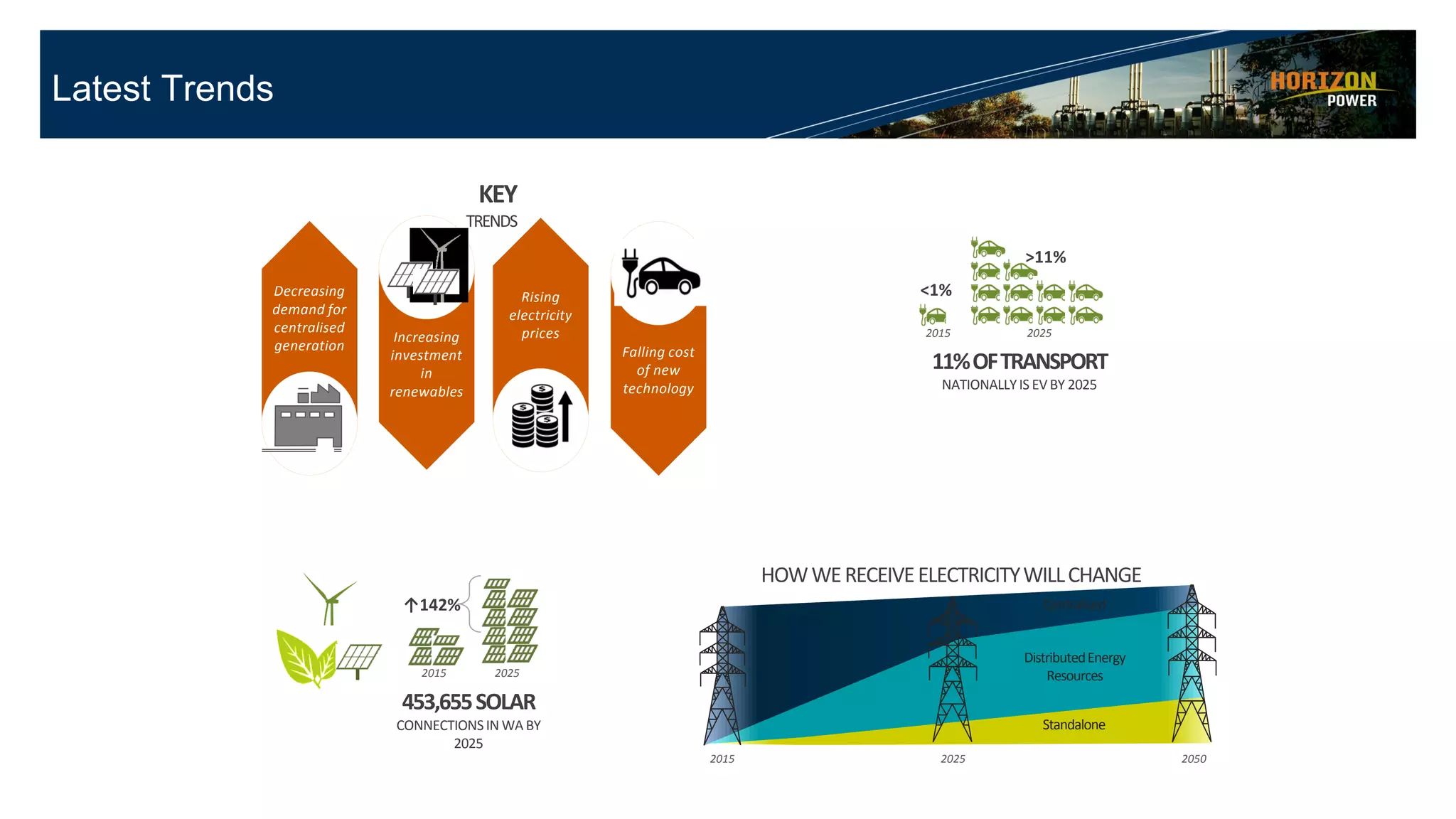
KEY
TRENDS
2015 2025 2050
Standalone
DistributedEnergy
Resources
Centralised
HOWWERECEIVEELECTRICITYWILLCHANGE
2015 2025
453,655SOLAR
CONNECTIONSIN WA BY
2025
↑142%
2015 2025
<1%
>11%
11%OFTRANSPORT
NATIONALLYIS EV BY 2025
Latest Trends
Latest Trends
9
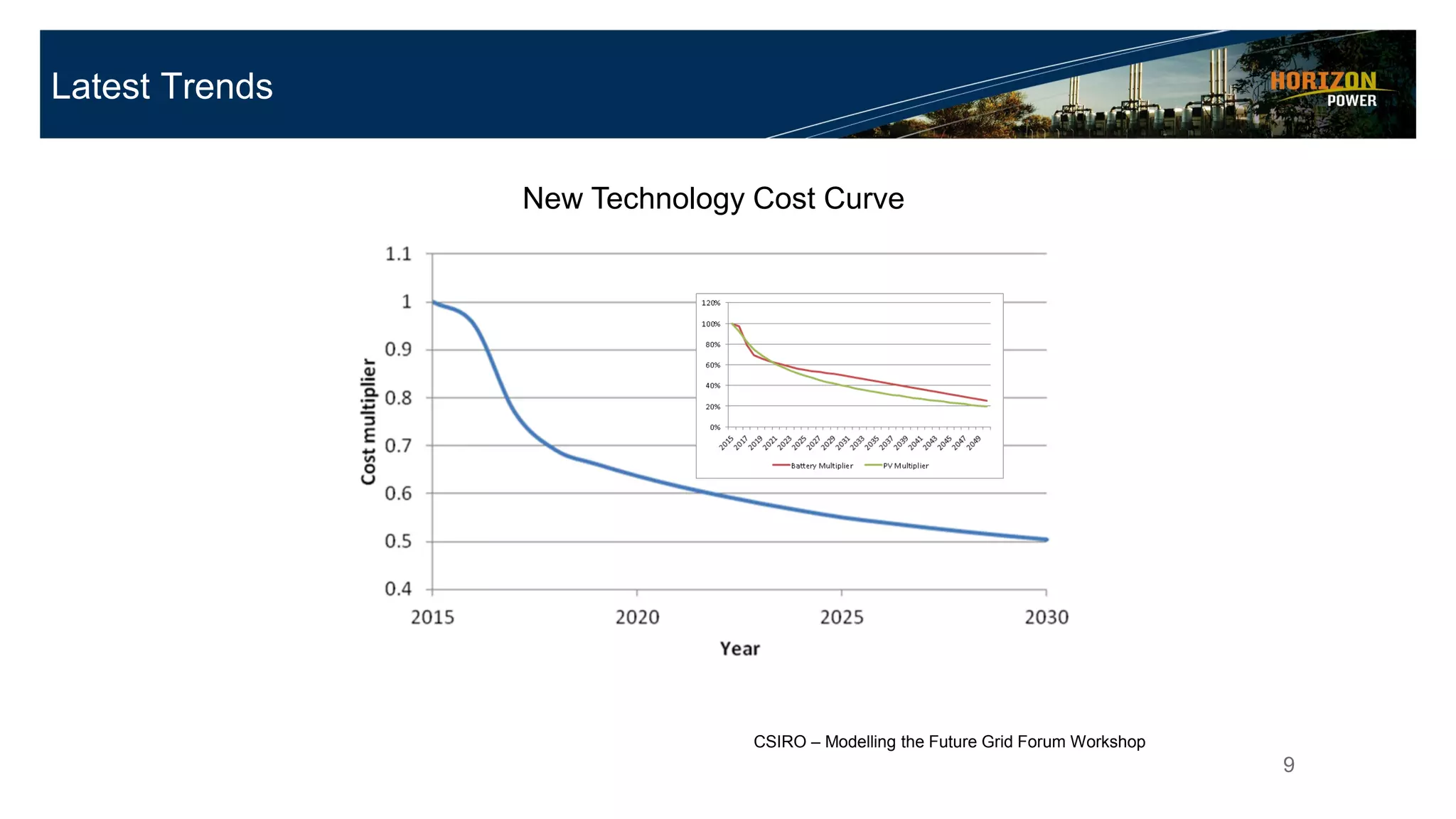
New Technology Cost Curve
CSIRO – Modelling the Future Grid Forum Workshop
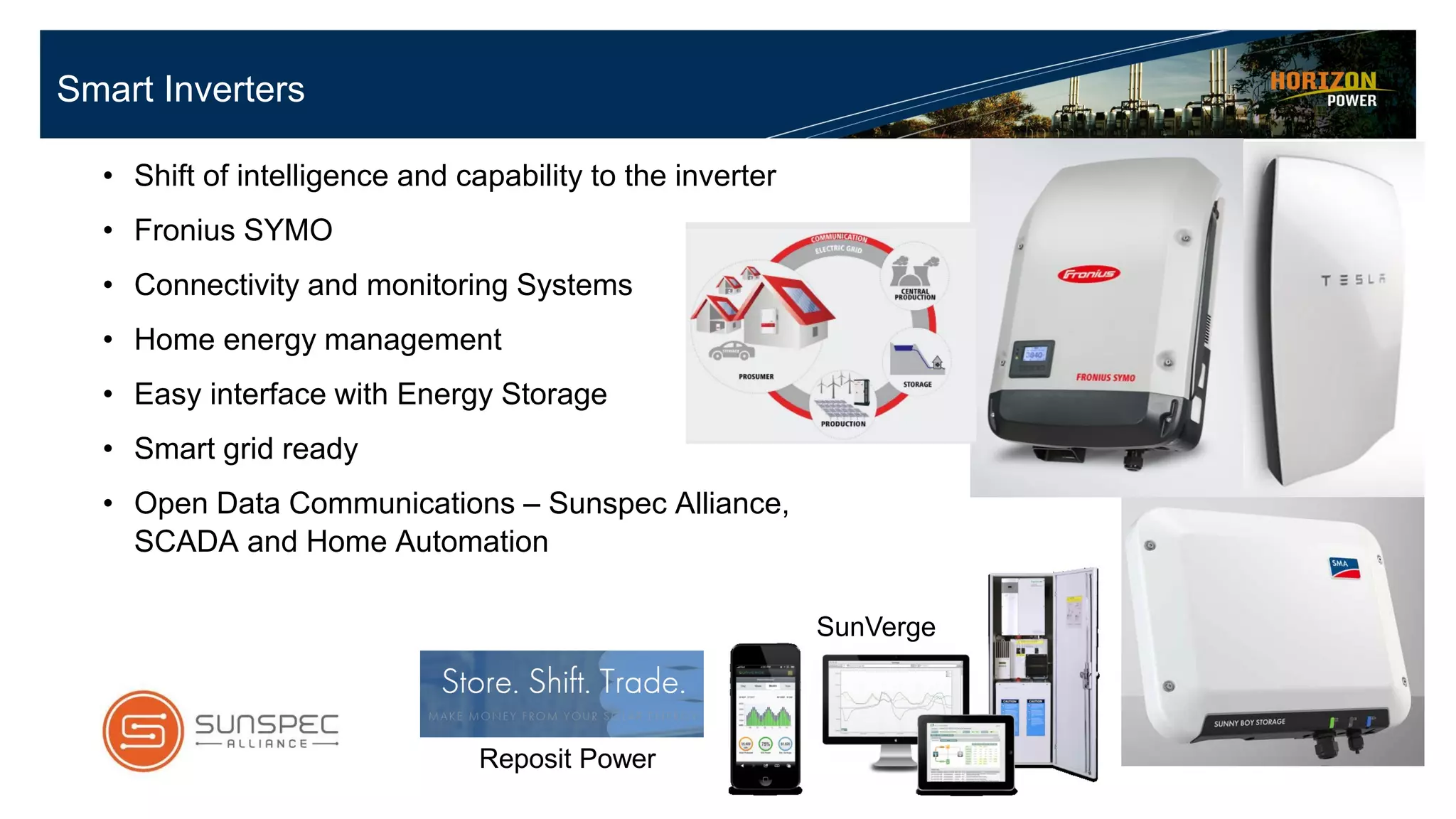
Smart Inverters
• Shift of intelligence and capability to the inverter
• Fronius SYMO
• Connectivity and monitoring Systems
• Home energy management
• Easy interface with Energy Storage
• Smart grid ready
• Open Data Communications – Sunspec Alliance,
SCADA and Home Automation
Reposit Power
SunVerge
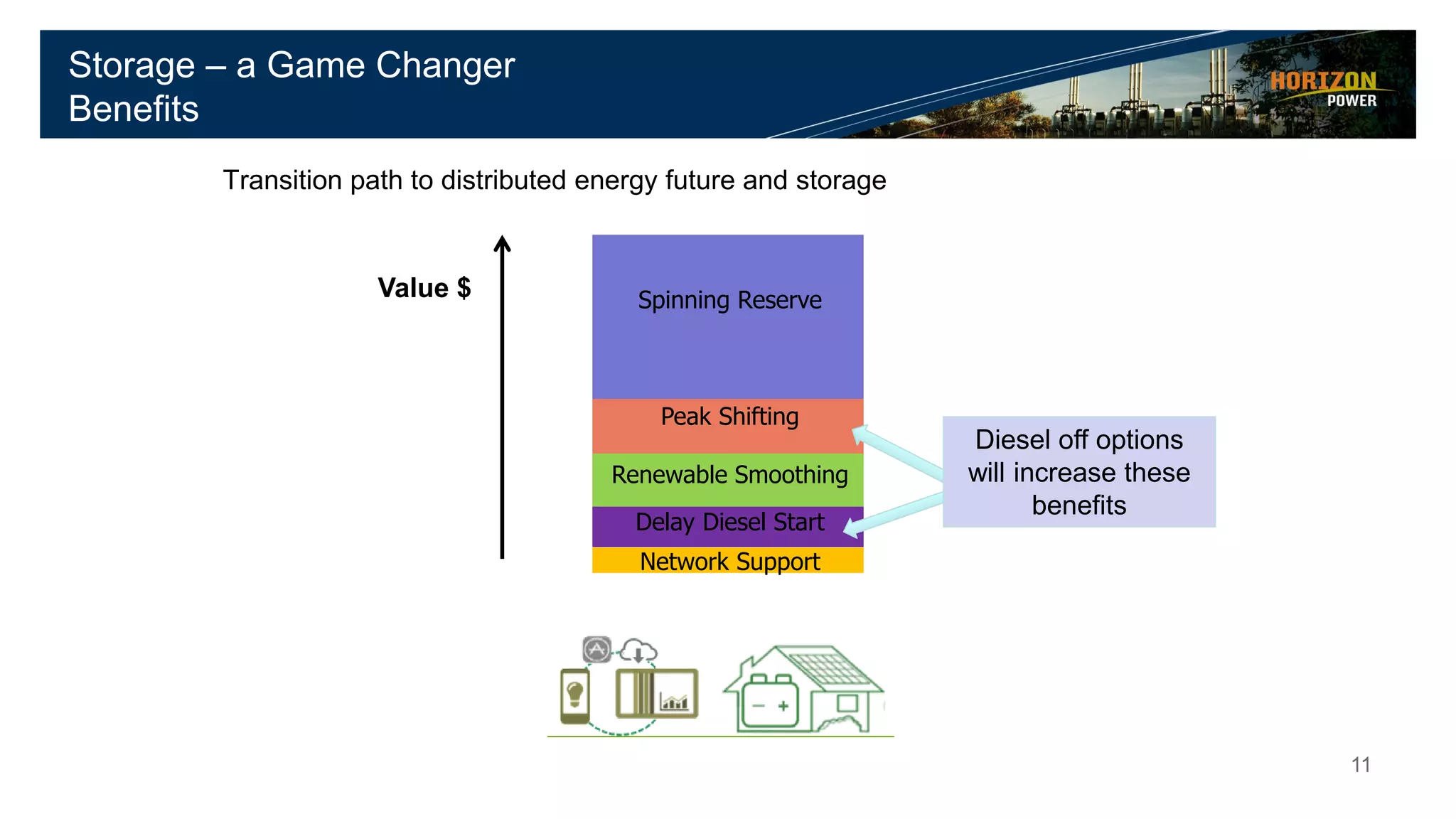
Storage Benefits
Spinning Reserve
Peak Shifting
Renewable Smoothing
Delay Diesel Start
Network Support
Value $
Transition path to distributed energy future and storage
Diesel off options
will increase these
benefits
Storage – a Game Changer
Benefits
11
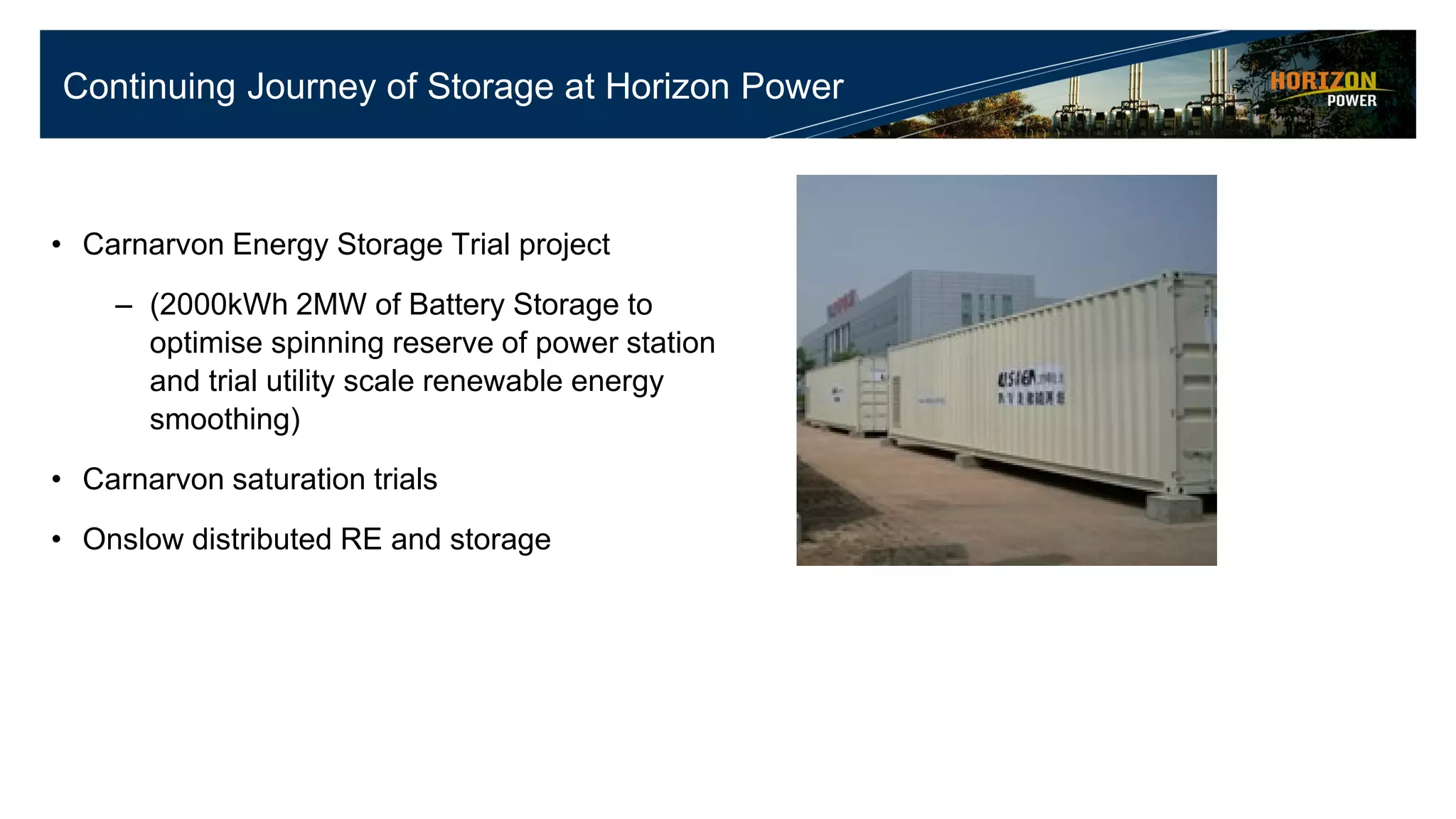
Continuing Journey of Storage at Horizon Power
• Carnarvon Energy Storage Trial project
– (2000kWh 2MW of Battery Storage to
optimise spinning reserve of power station
and trial utility scale renewable energy
smoothing)
• Carnarvon saturation trials
• Onslow distributed RE and storage
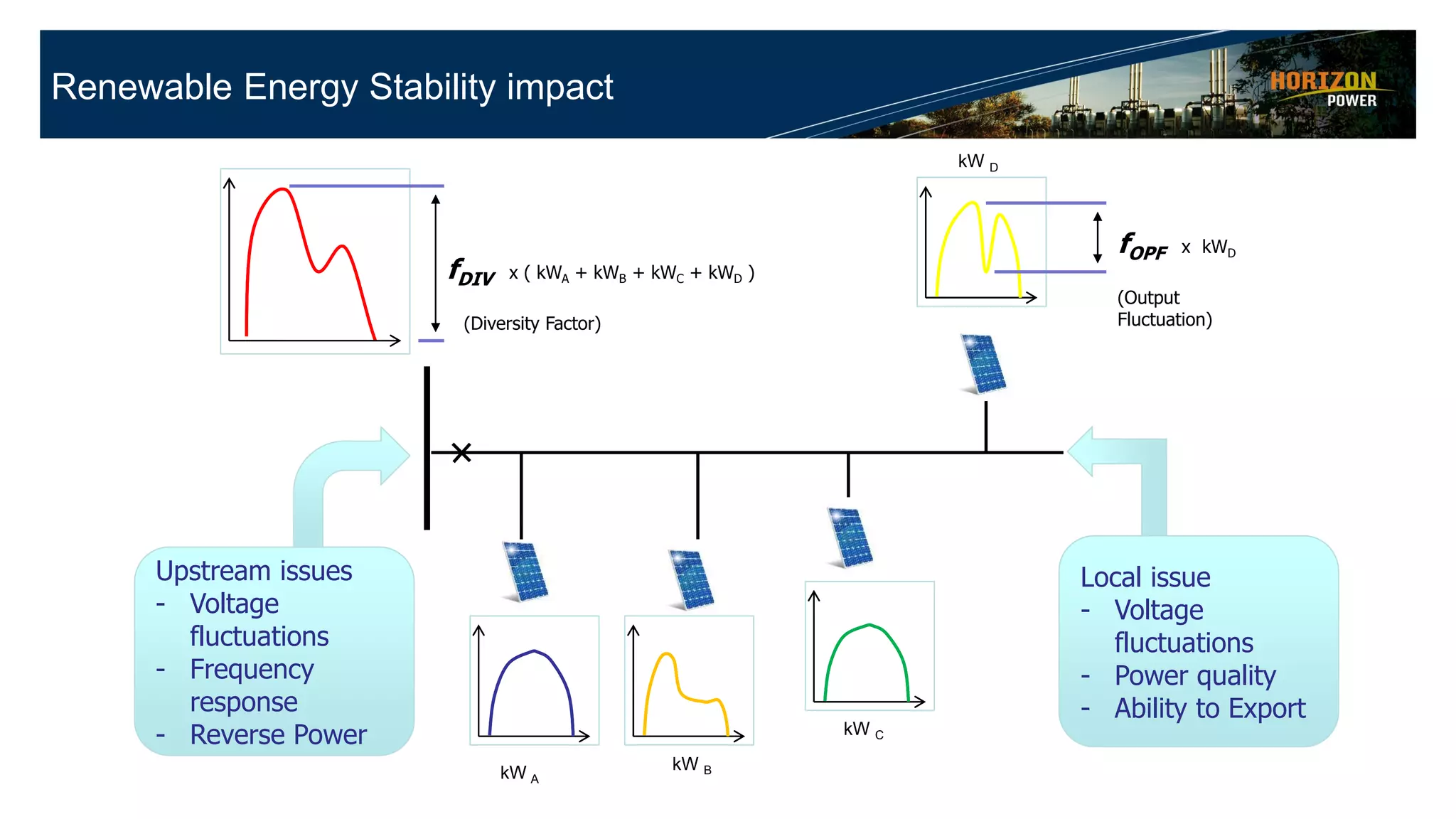
Renewable Energy Stability impact
fOPF x kWD
(Output
Fluctuation)
fDIV x ( kWA + kWB + kWC + kWD )
(Diversity Factor)
kW A
kW B
kW D
kW C
Local issue
- Voltage
fluctuations
- Power quality
- Ability to Export
Local issue
- Voltage
fluctuations
- Power quality
- Ability to Export
Upstream issues
- Voltage
fluctuations
- Frequency
response
- Reverse Power
Upstream issues
- Voltage
fluctuations
- Frequency
response
- Reverse Power
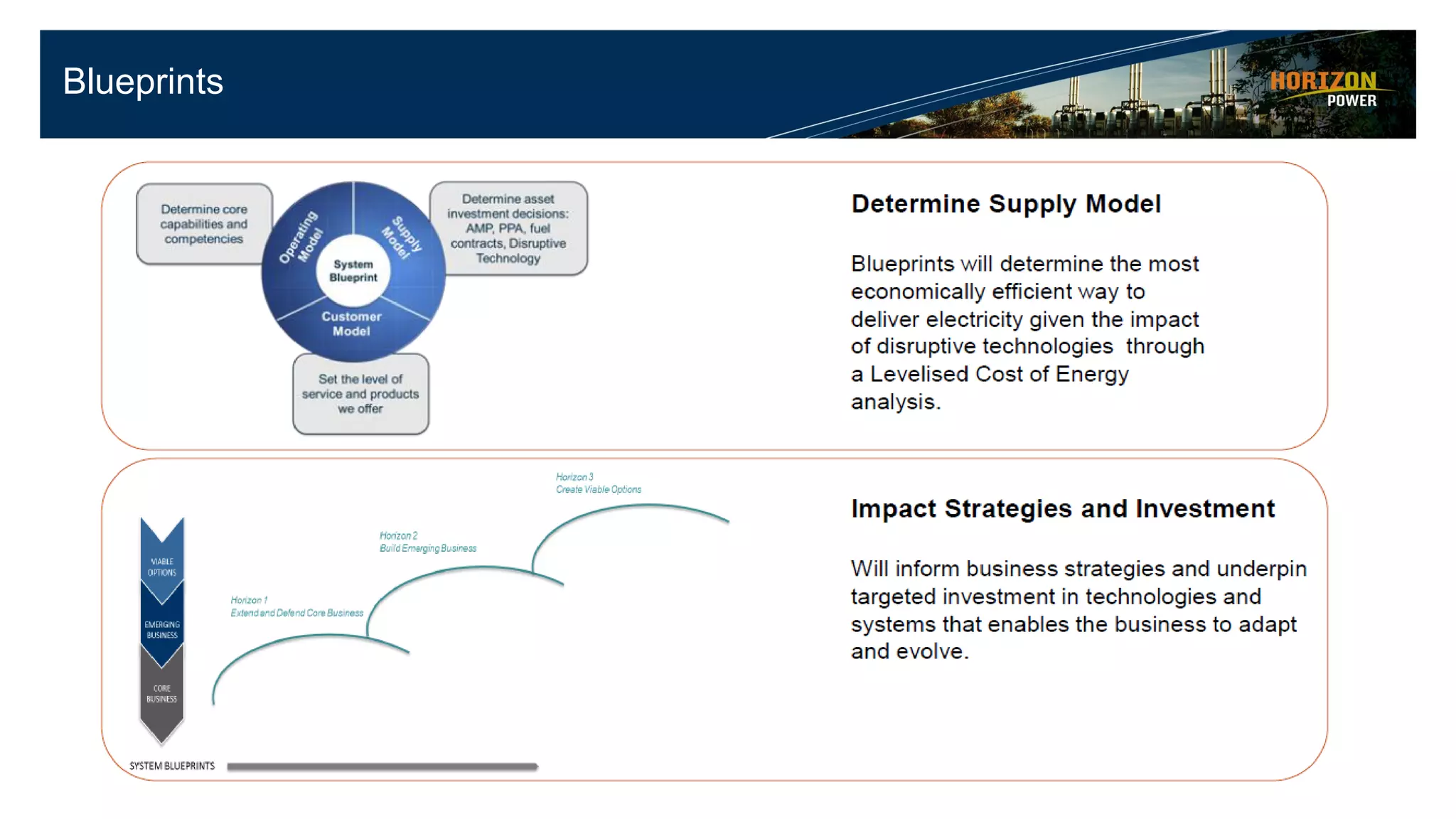
Blueprints
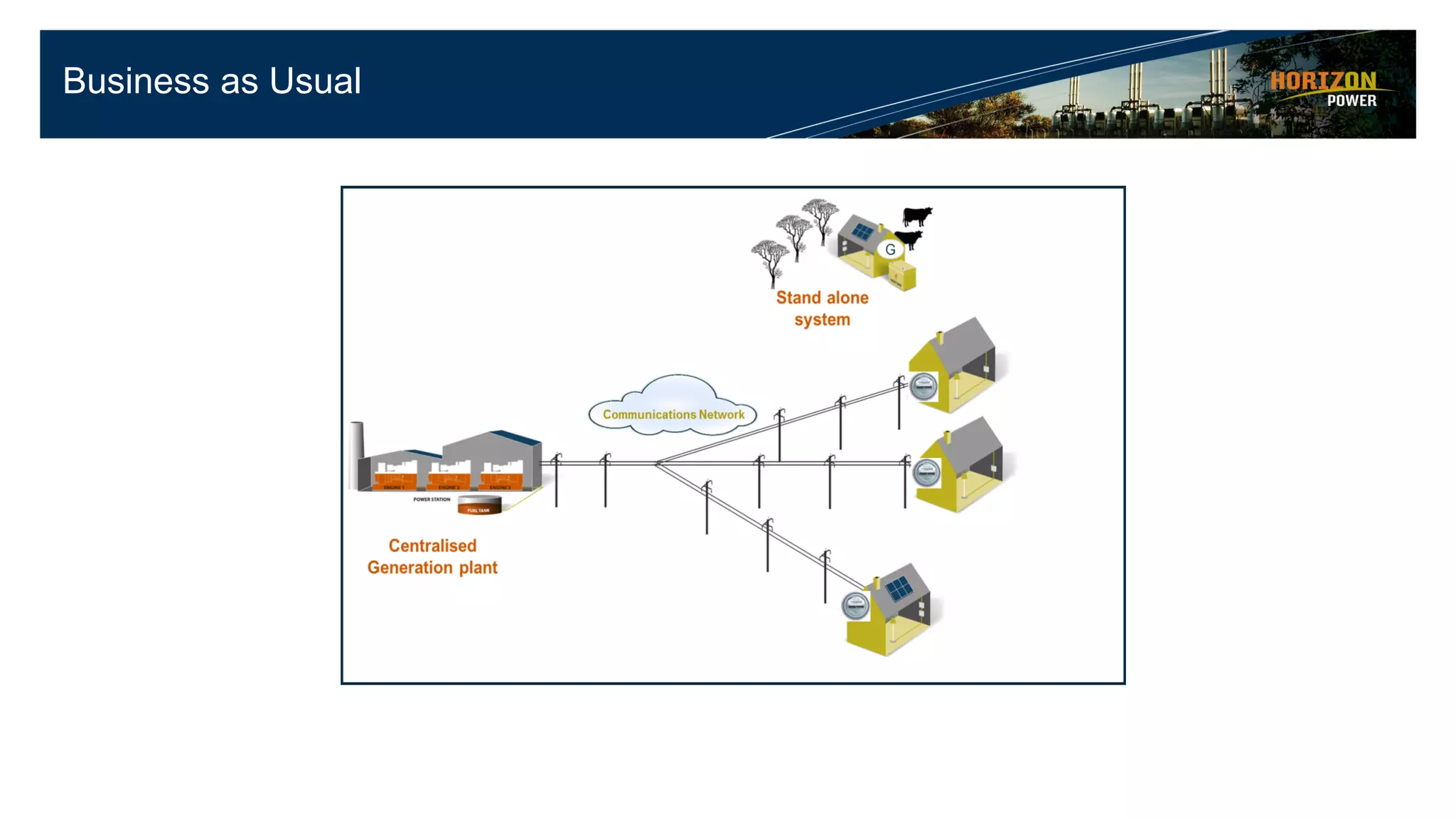
Business as Usual
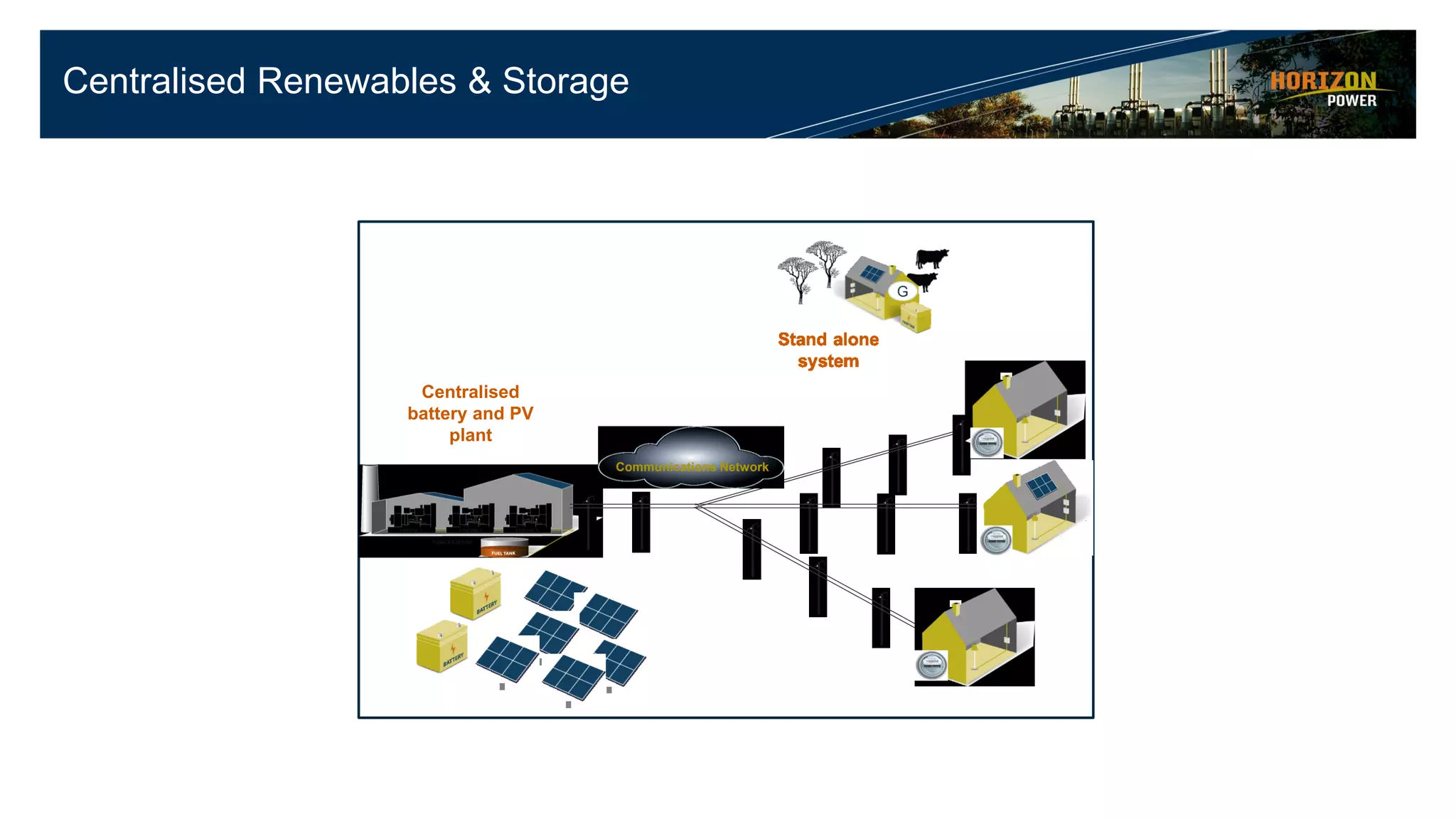
Centralised Renewables & Storage
Centralised
battery and PV
plant
Centralised
battery and PV
plant
Communications Network
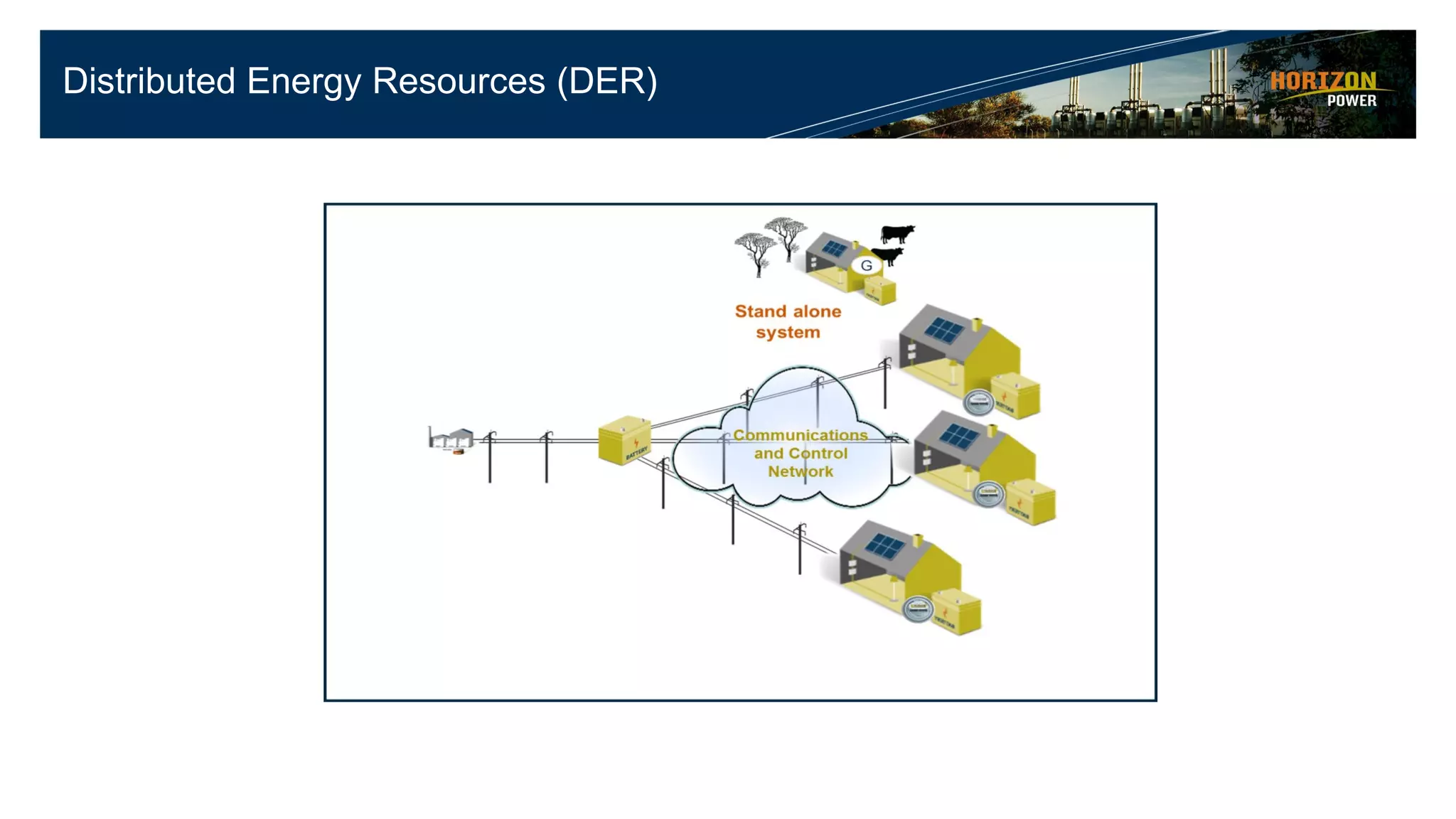
Distributed Energy Resources (DER)
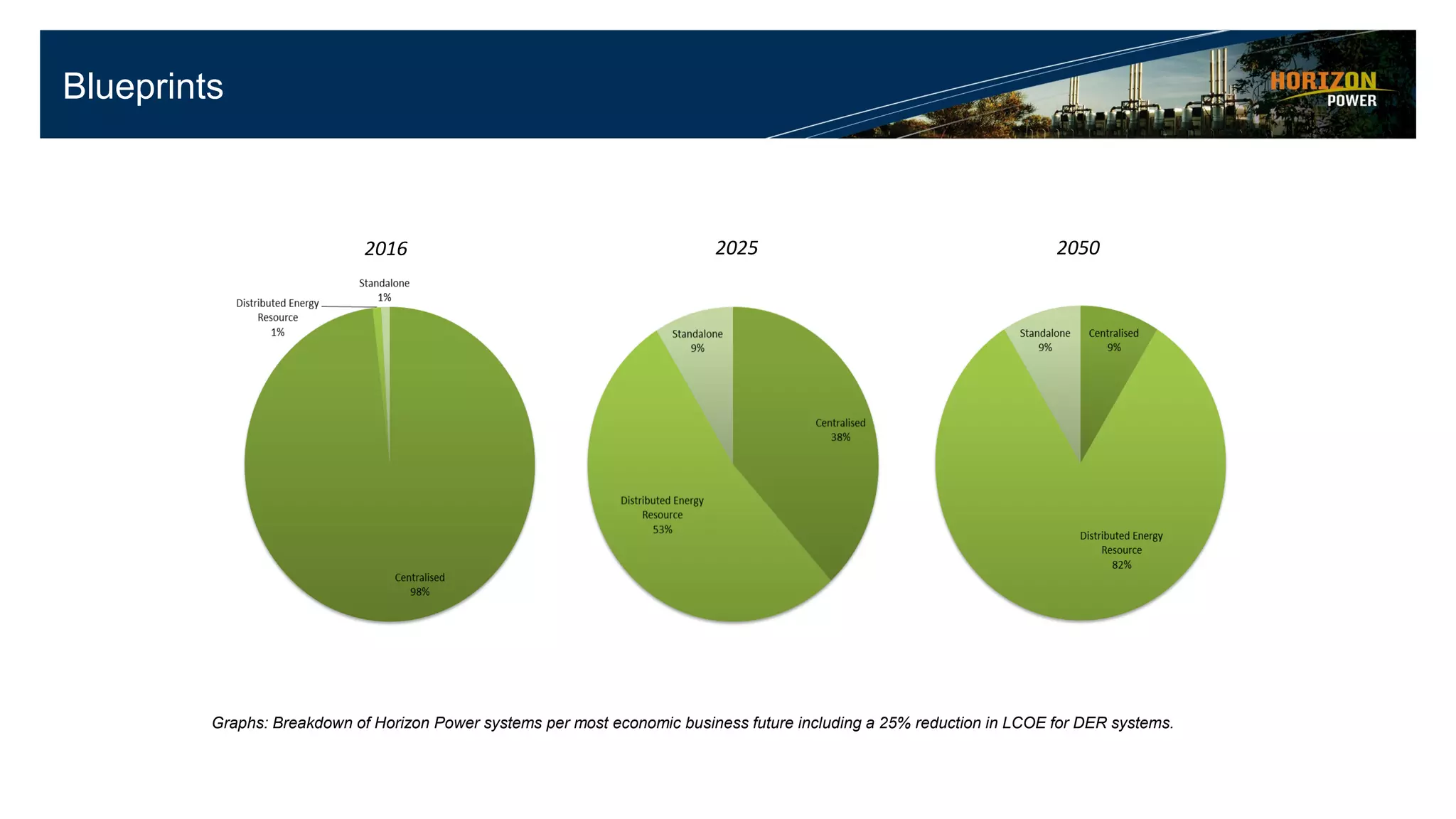
Blueprints
2016 2025 2050
Graphs: Breakdown of Horizon Power systems per most economic business future including a 25% reduction in LCOE for DER systems.
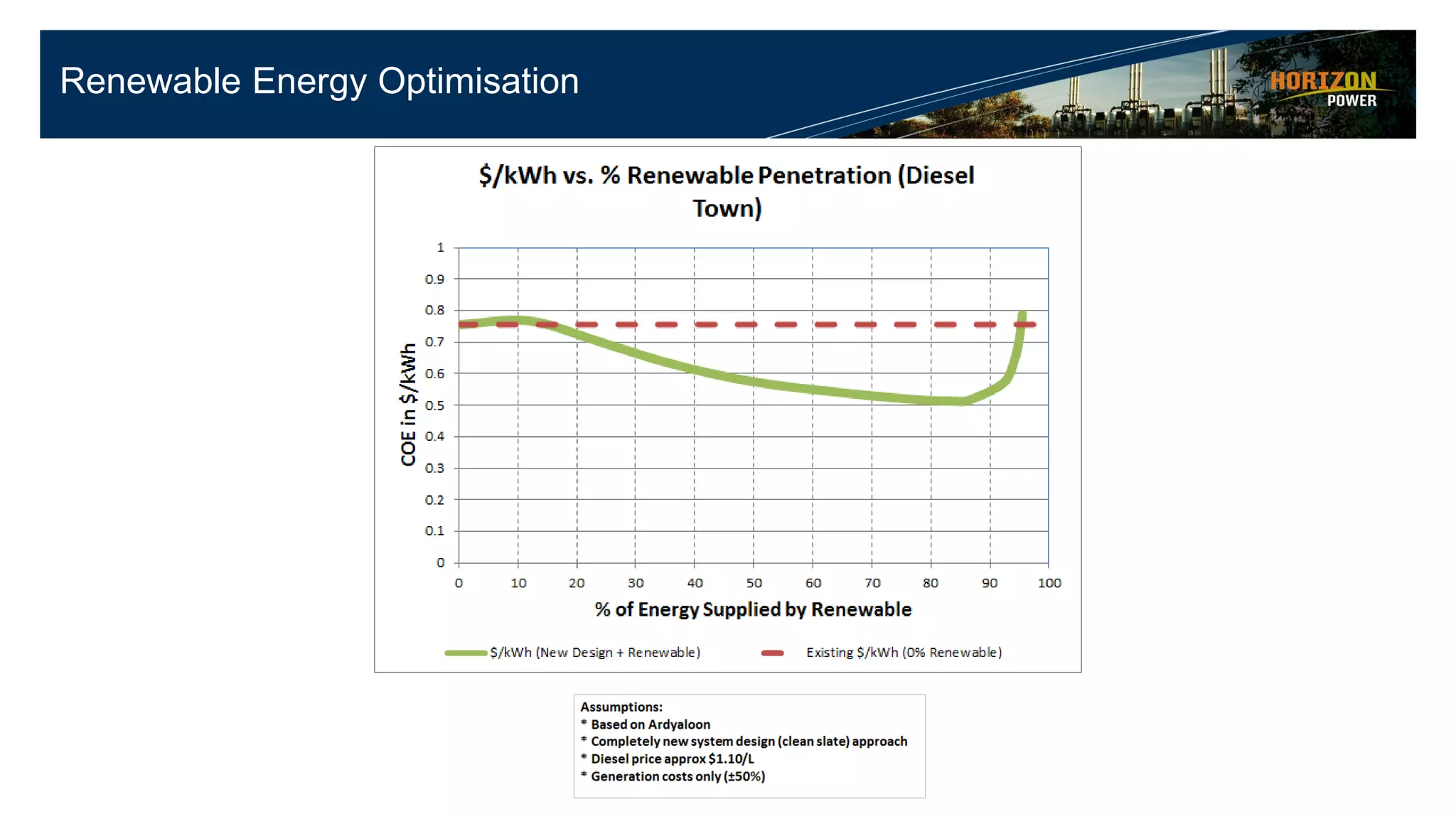
Renewable Energy Optimisation
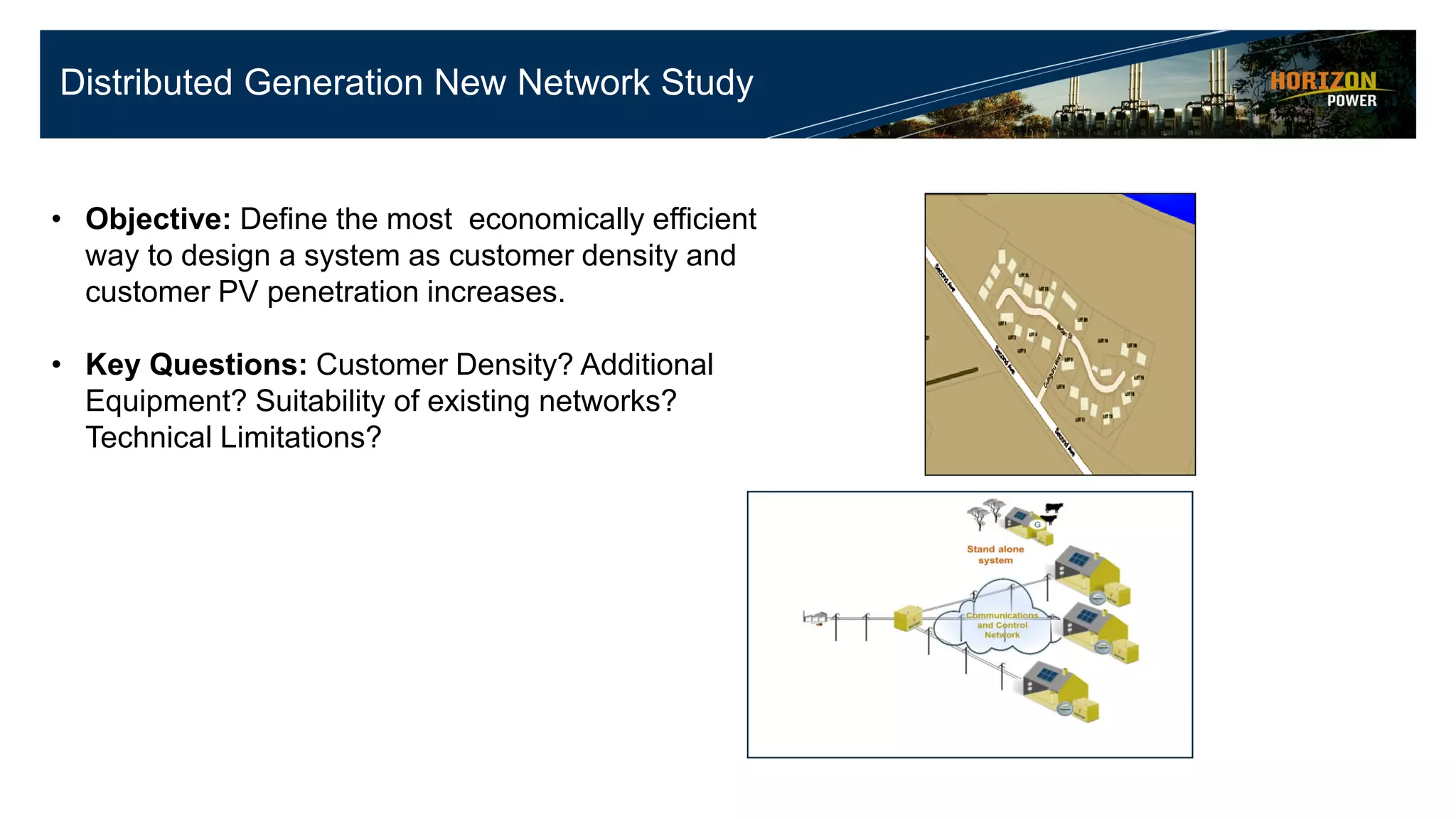
Distributed Generation New Network Study
• Objective: Define the most economically efficient
way to design a system as customer density and
customer PV penetration increases.
• Key Questions: Customer Density? Additional
Equipment? Suitability of existing networks?
Technical Limitations?
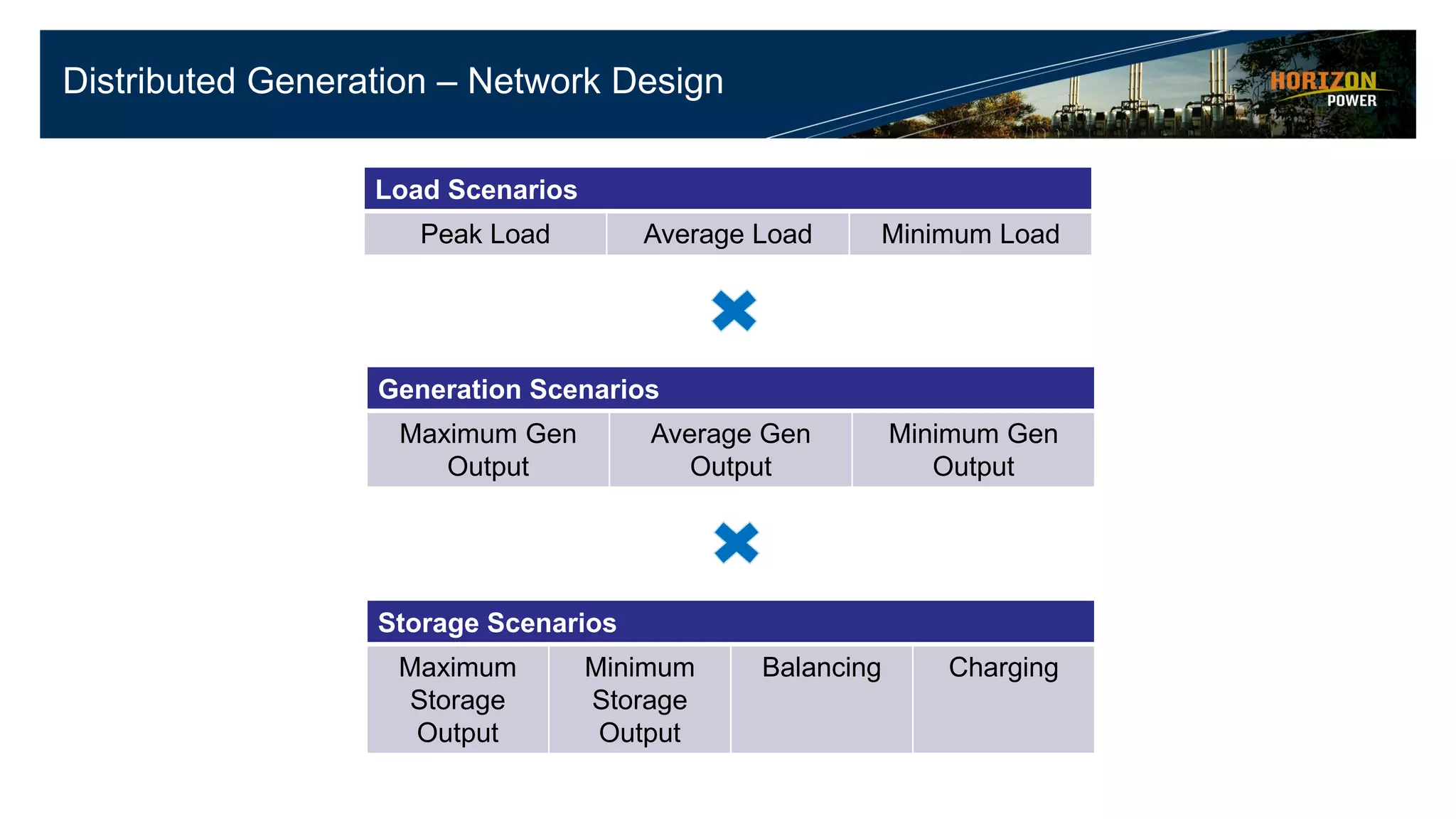
Distributed Generation – Network Design
Load Scenarios
Peak Load Average Load Minimum Load
Generation Scenarios
Maximum Gen
Output
Average Gen
Output
Minimum Gen
Output
Storage Scenarios
Maximum
Storage
Output
Minimum
Storage
Output
Balancing Charging
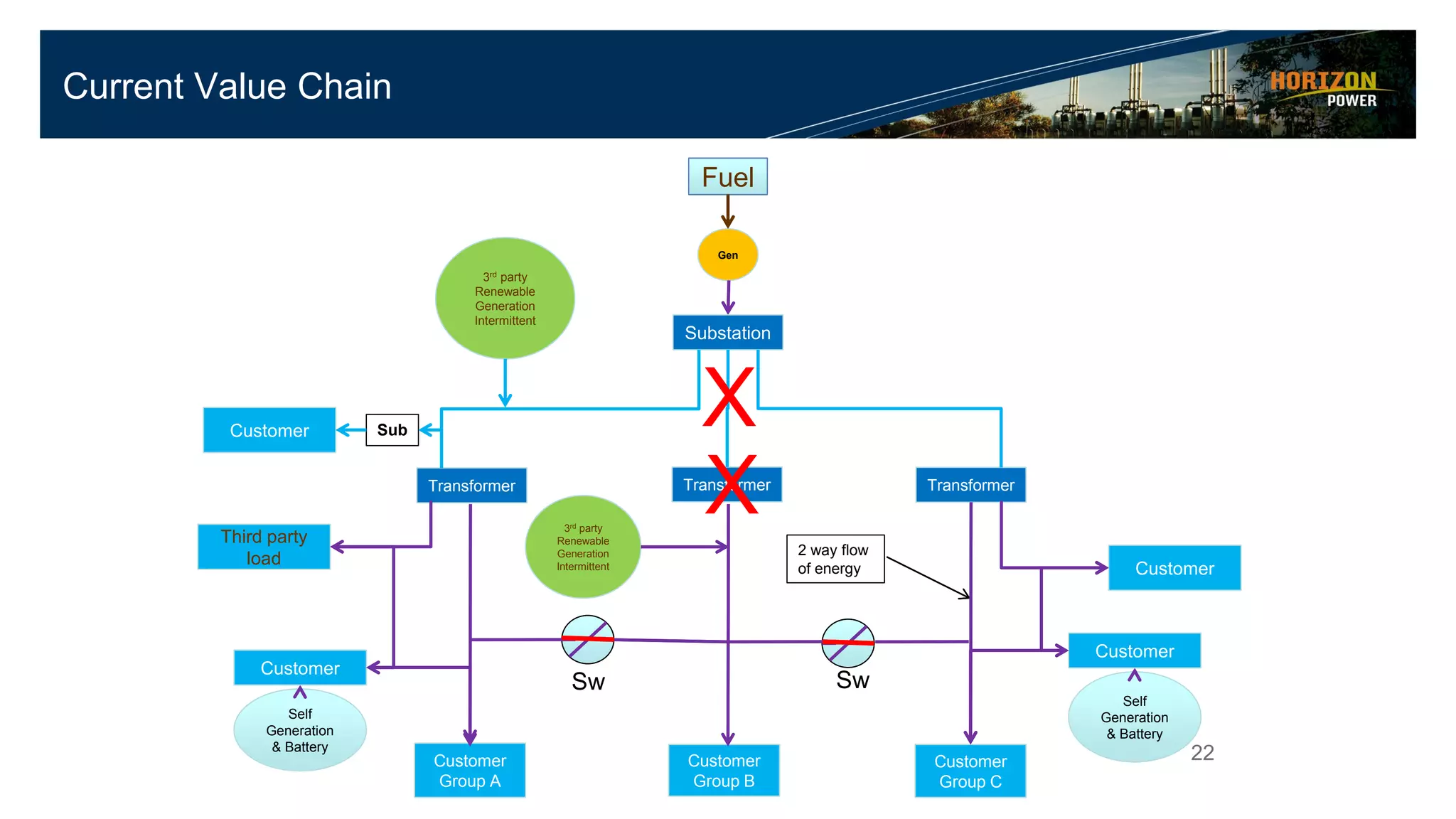
Current Value Chain
FuelFuel
GenGen
Self
Generation
& Battery
Self
Generation
& Battery
CustomerCustomer
Sub
Customer
Group A
Customer
Group A
2 way flow
of energy
Third party
load
Third party
load
22
TransformerTransformer
SubstationSubstation
Customer
Group B
Customer
Group B
Customer
Group C
Customer
Group C
TransformerTransformerTransformerTransformer
CustomerCustomer
CustomerCustomer
Self
Generation
& Battery
Self
Generation
& Battery
CustomerCustomer
3rd party
Renewable
Generation
Intermittent
3rd party
Renewable
Generation
Intermittent
3rd party
Renewable
Generation
Intermittent
3rd party
Renewable
Generation
Intermittent
Sw Sw
X
X
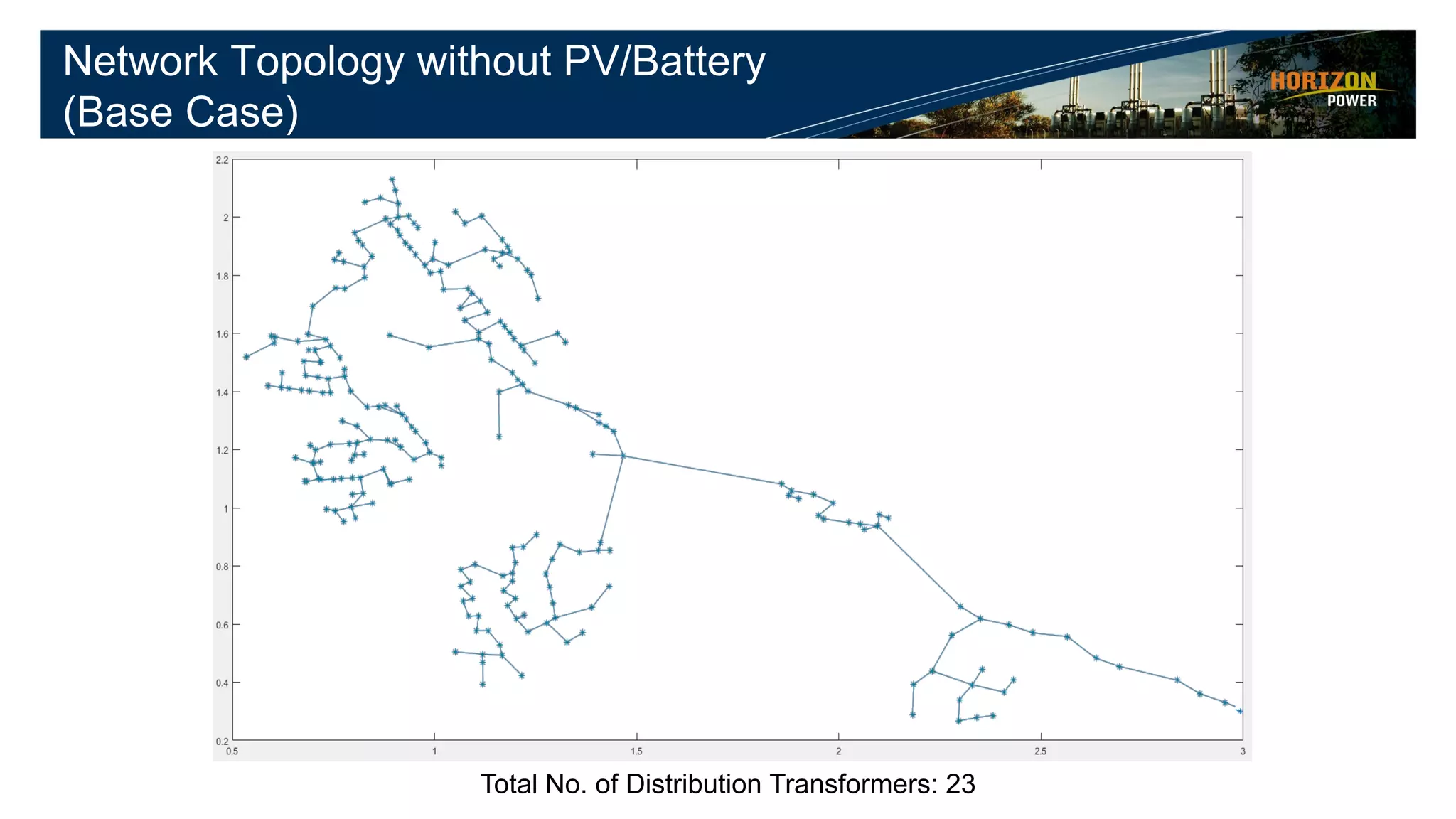
Network Topology without PV/Battery
(Base Case)
Total No. of Distribution Transformers: 23
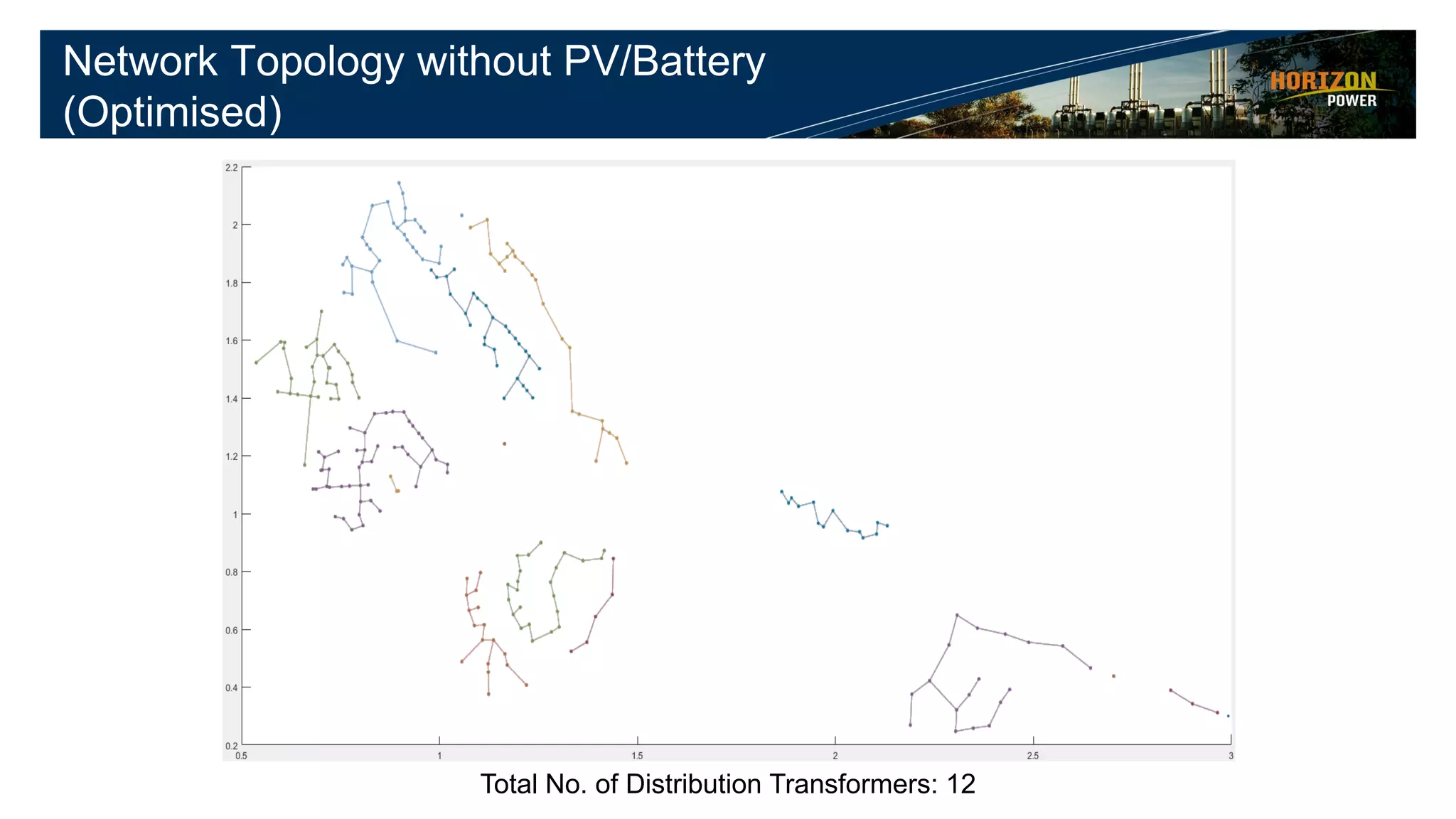
Network Topology without PV/Battery
(Optimised)
Total No. of Distribution Transformers: 12
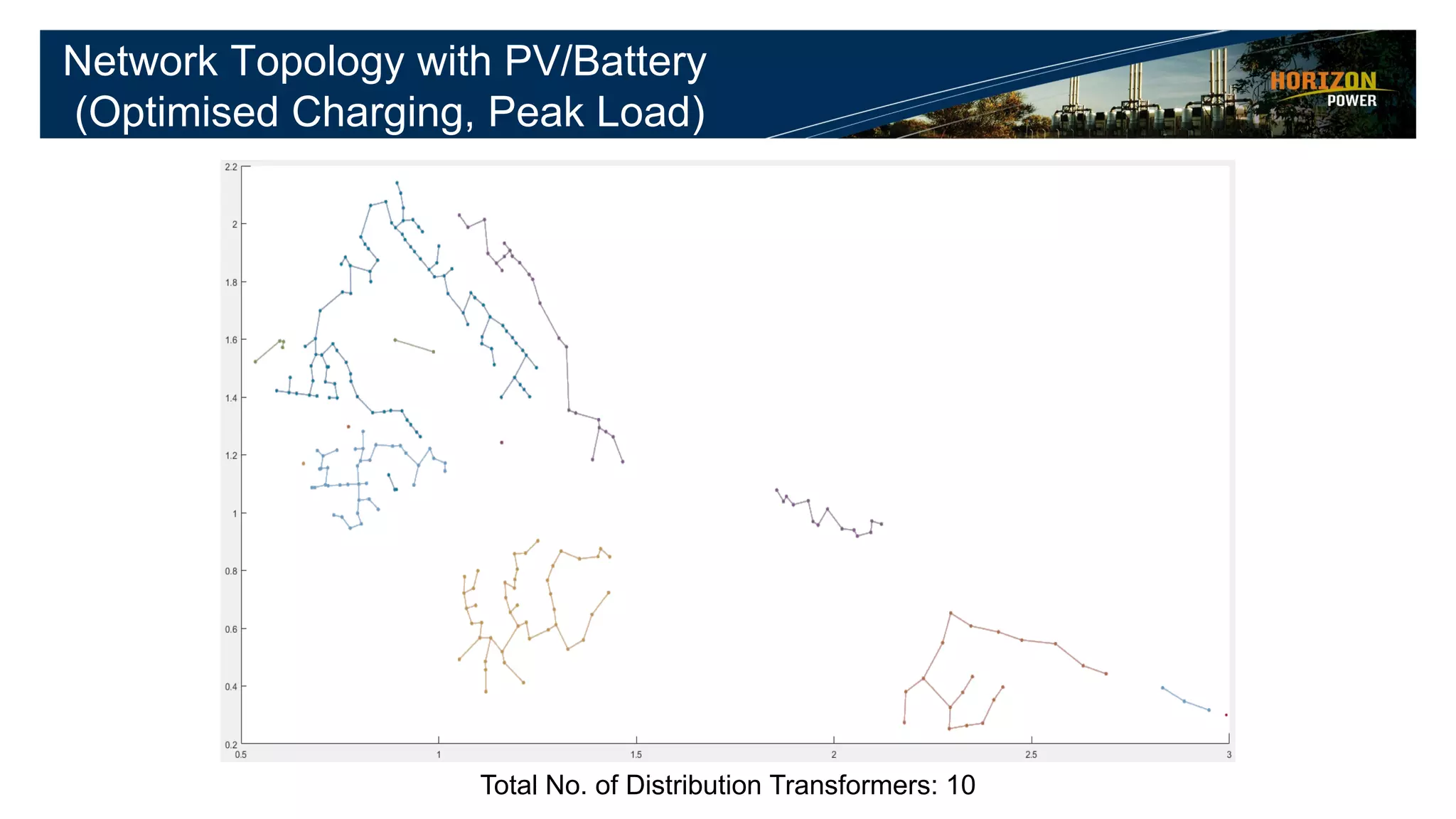
Network Topology with PV/Battery
(Optimised Charging, Peak Load)
Total No. of Distribution Transformers: 10
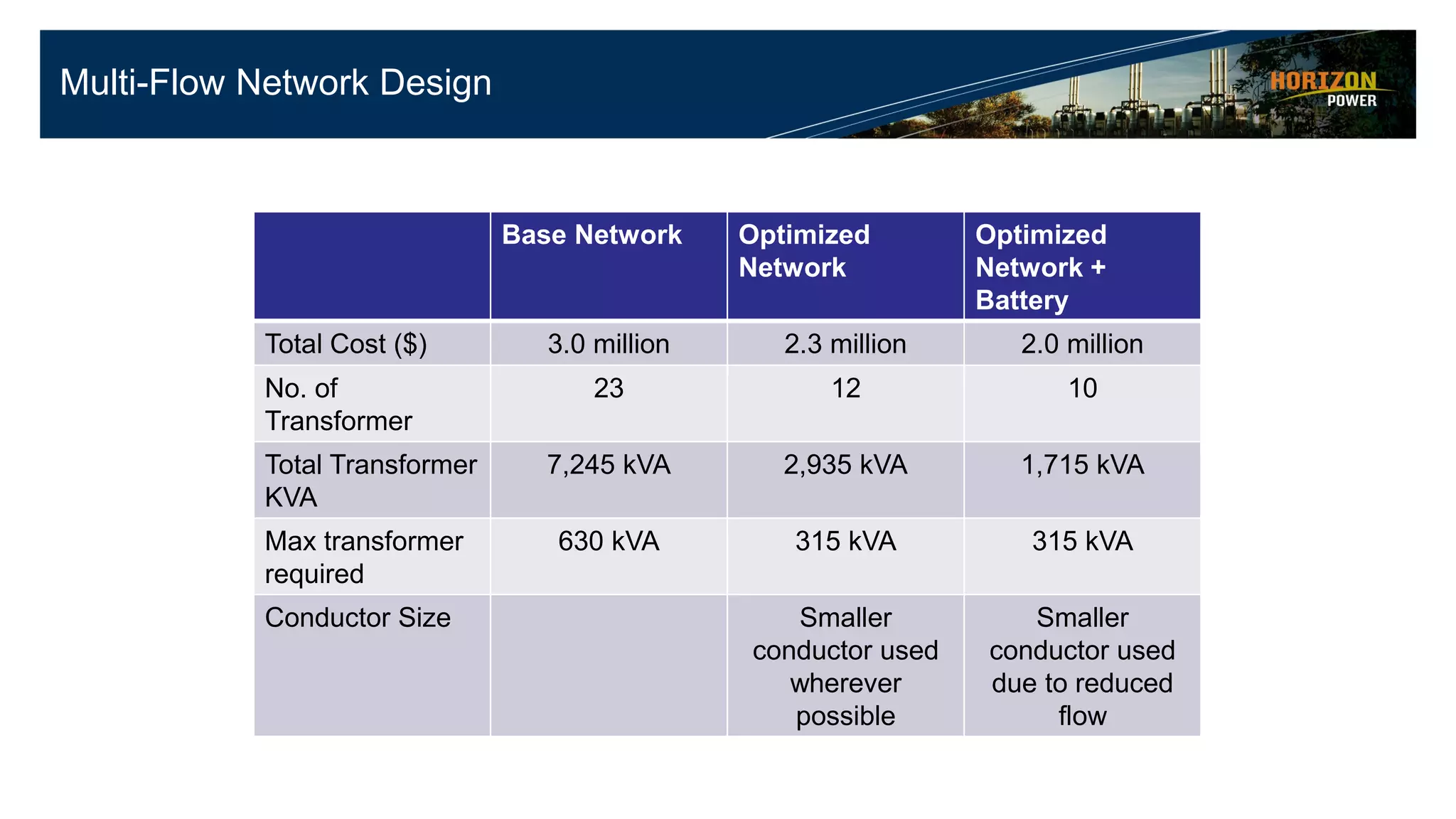
Multi-Flow Network Design
Base Network Optimized
Network
Optimized
Network +
Battery
Total Cost ($) 3.0 million 2.3 million 2.0 million
No. of
Transformer
23 12 10
Total Transformer
KVA
7,245 kVA 2,935 kVA 1,715 kVA
Max transformer
required
630 kVA 315 kVA 315 kVA
Conductor Size Smaller
conductor used
wherever
possible
Smaller
conductor used
due to reduced
flow
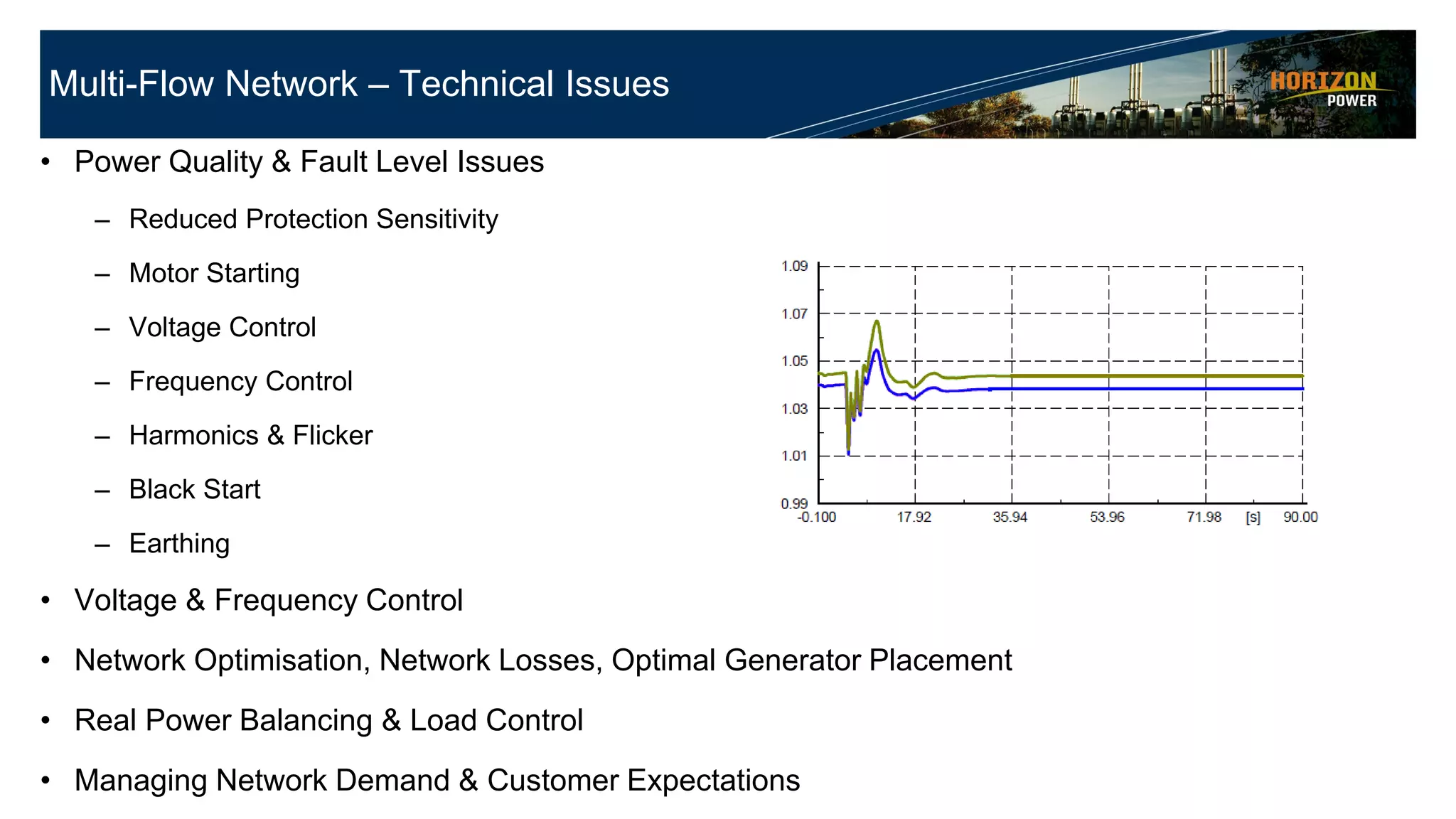
Multi-Flow Network – Technical Issues
• Power Quality & Fault Level Issues
– Reduced Protection Sensitivity
– Motor Starting
– Voltage Control
– Frequency Control
– Harmonics & Flicker
– Black Start
– Earthing
• Voltage & Frequency Control
• Network Optimisation, Network Losses, Optimal Generator Placement
• Real Power Balancing & Load Control
• Managing Network Demand & Customer Expectations
Customer & Stakeholder Expectations
• Customers are looking to take greater control of their
energy to reduce energy costs.
• Consumer demand for renewable energy is growing.
• Customers expect a choice of energy options, including
more renewable energy options.
• Customers want fewer restrictions to taking up solar.
• Customers want to see transparency, and active
communication and education of the community on
renewable and other energy options.
• Energy costs should be as affordable as possible.
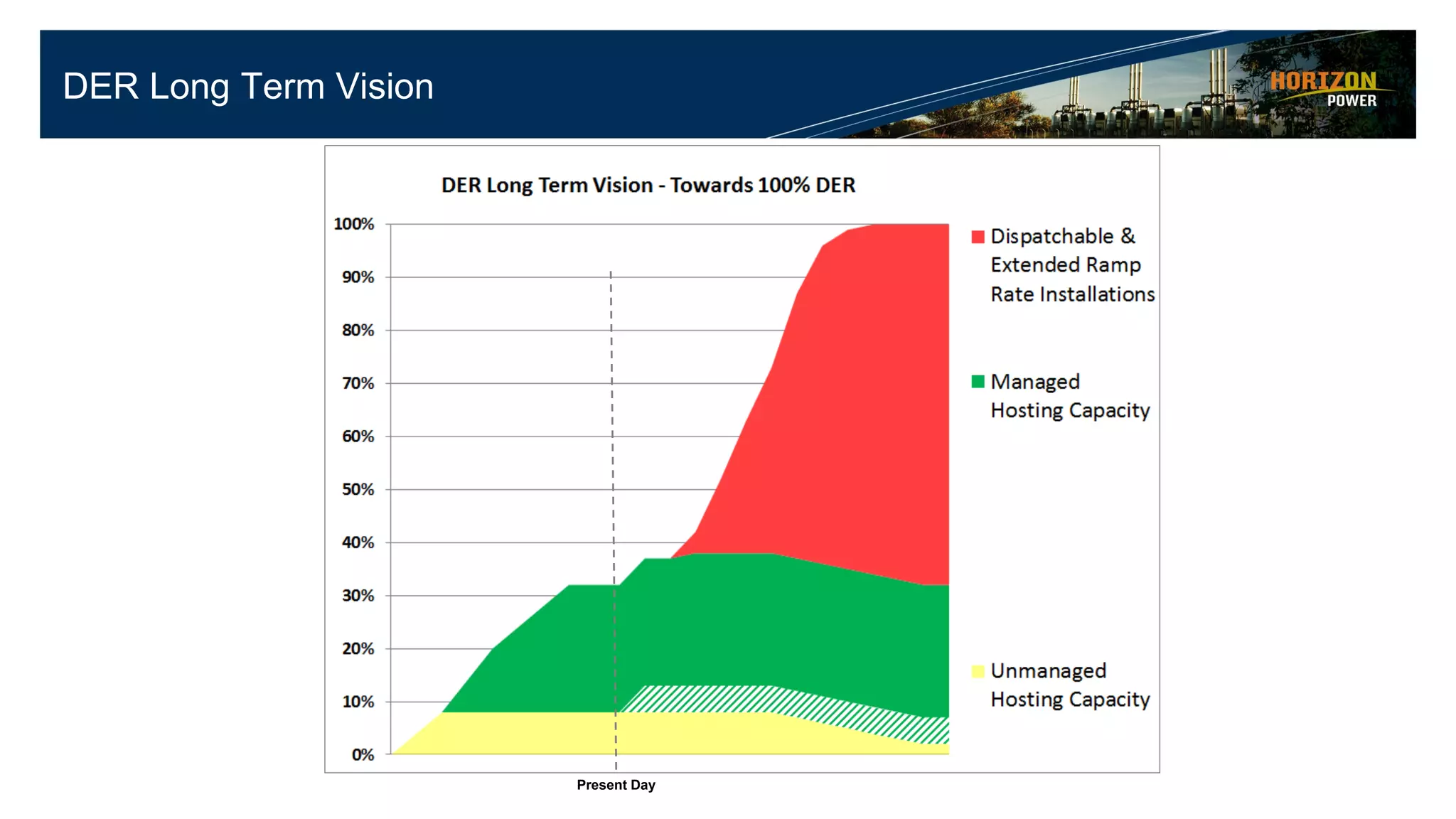
DER Long Term Vision
Present Day
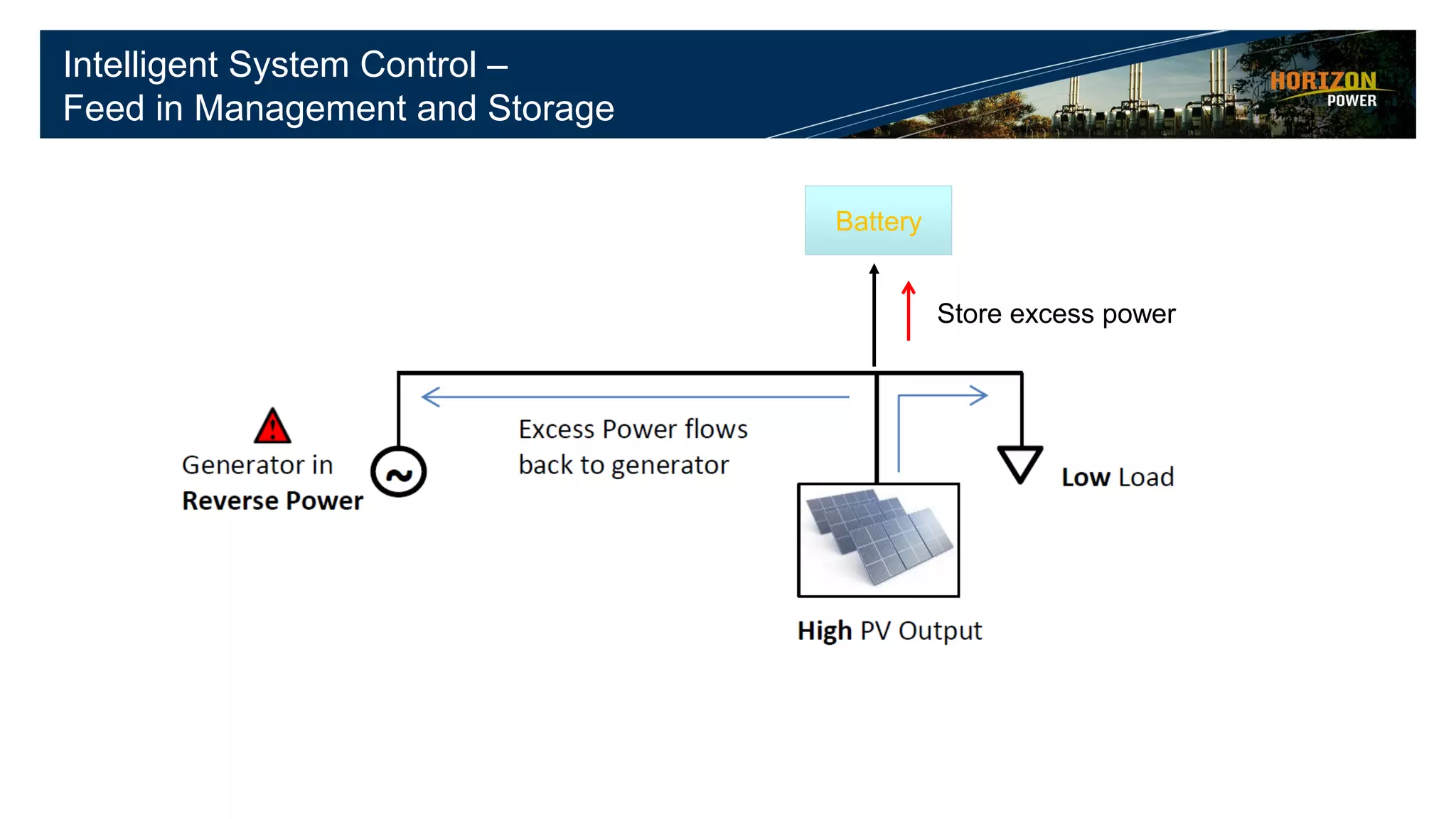
Intelligent System Control –
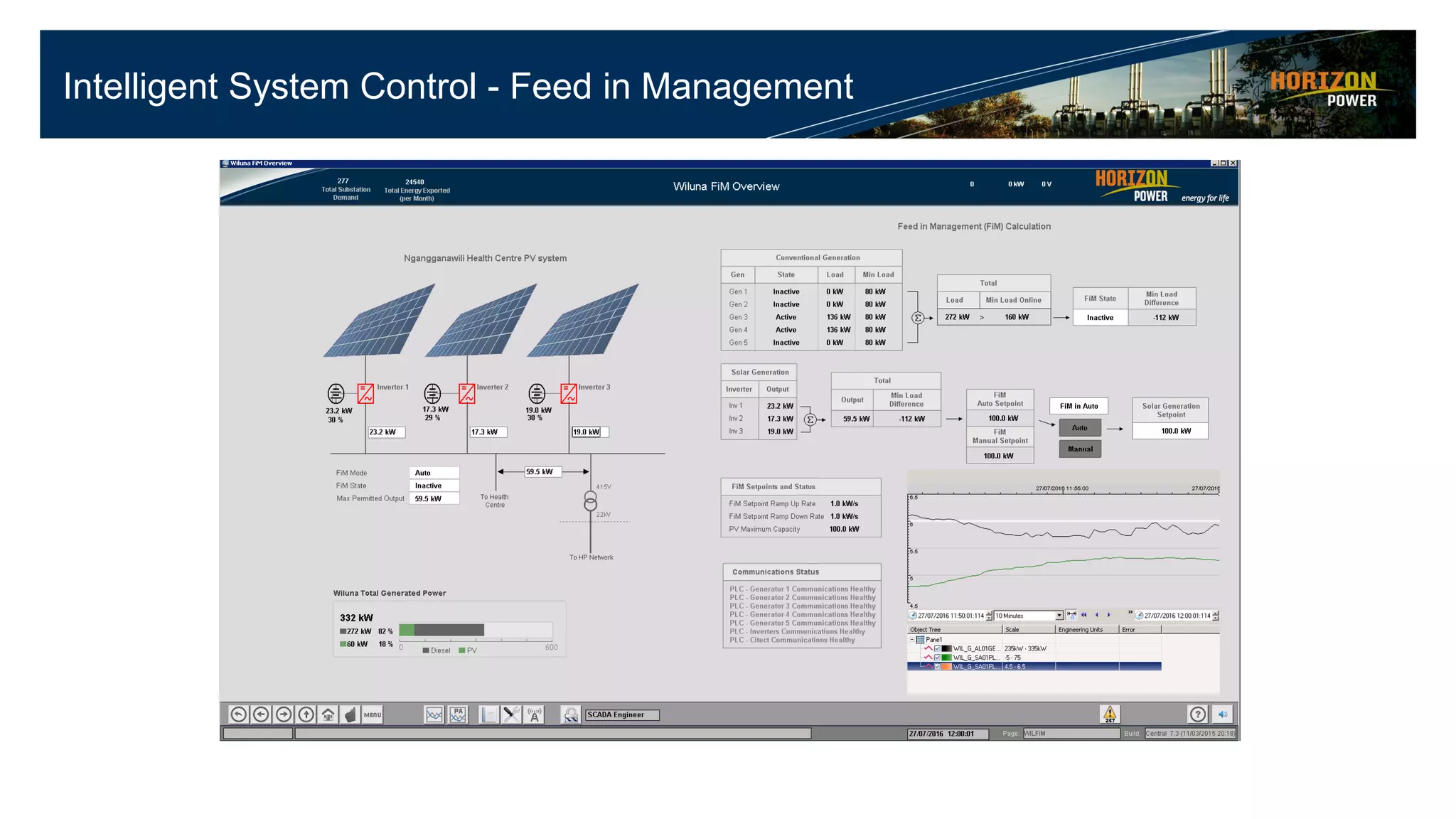
Feed in Management and Storage
BatteryBattery
Store excess power
Intelligent System Control - Feed in Management
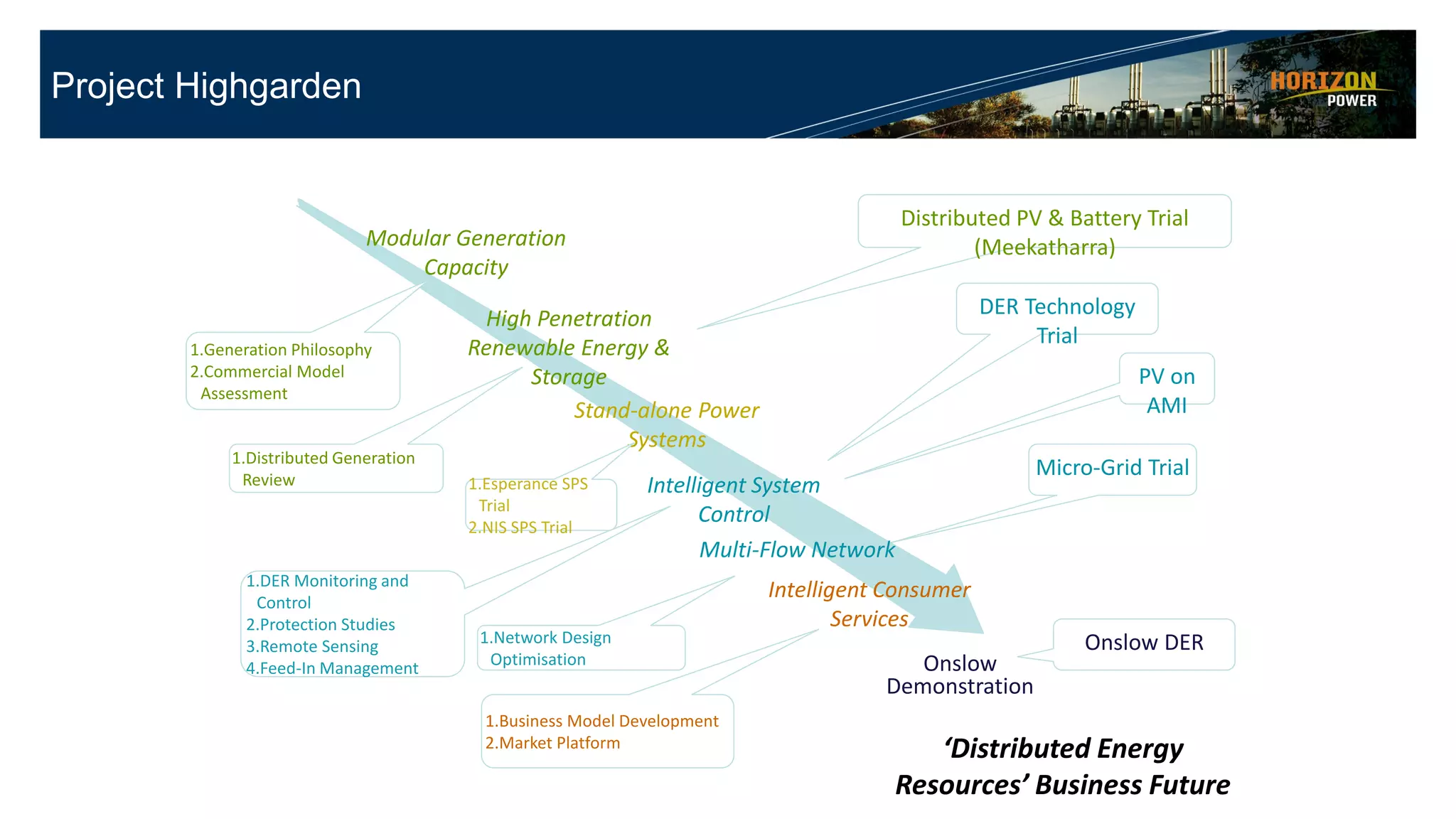
Project Highgarden
PV on
AMI
Distributed PV & Battery Trial
(Meekatharra)
Micro-Grid Trial
Intelligent System
Control
‘Distributed Energy
Resources’ Business Future
Multi-Flow Network
DER Technology
Trial
Stand-alone Power
Systems
Modular Generation
Capacity
High Penetration
Renewable Energy &
Storage
1.Business Model Development
2.Market Platform
Intelligent Consumer
Services
Onslow
Demonstration
1.DER Monitoring and
Control
2.Protection Studies
3.Remote Sensing
4.Feed-In Management
1.Distributed Generation
Review
1.Network Design
Optimisation
1.Generation Philosophy
2.Commercial Model
Assessment
1.Esperance SPS
Trial
2.NIS SPS Trial
Onslow DER
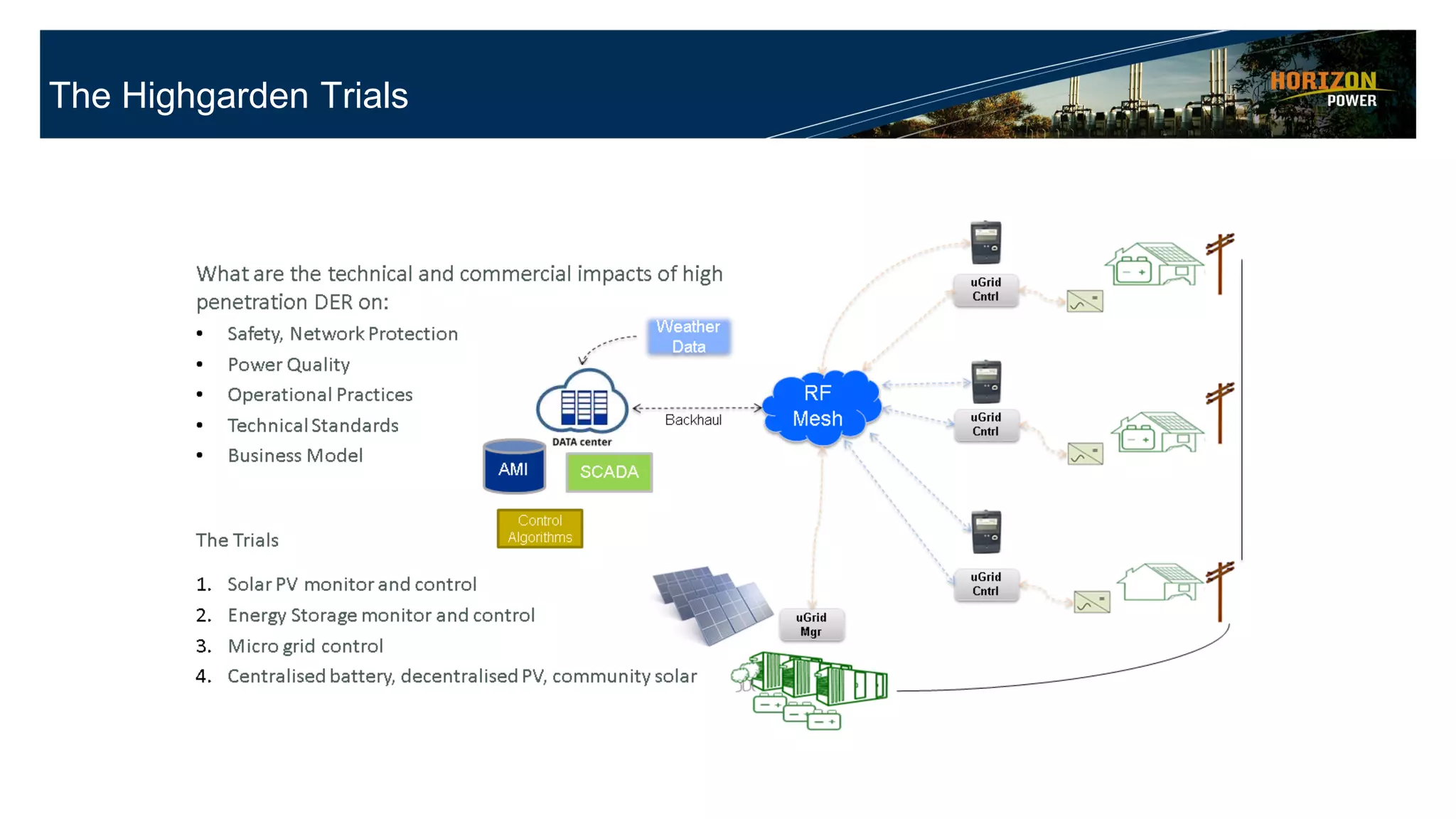
The Highgarden Trials
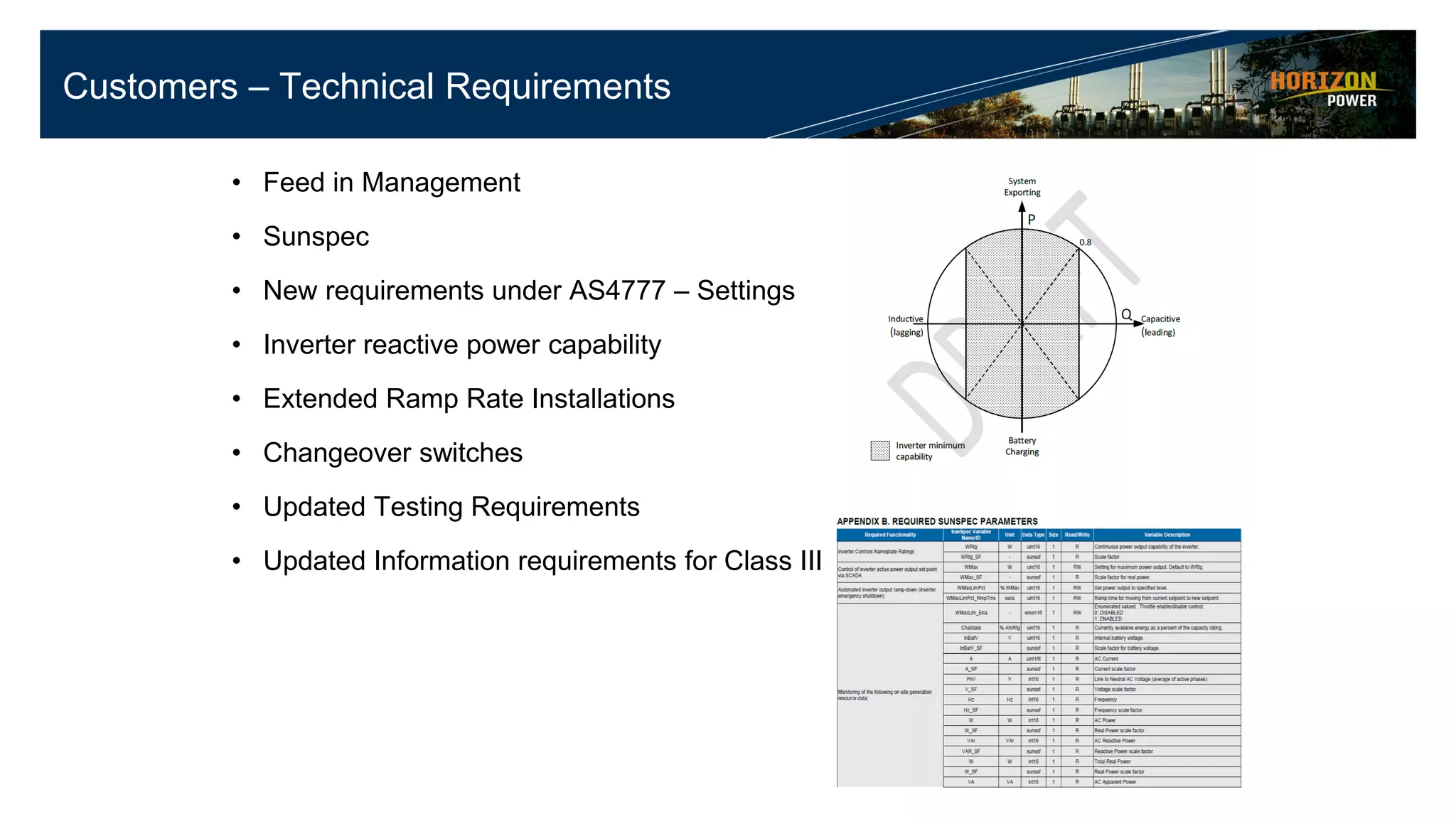
Customers – Technical Requirements
• Feed in Management
• Sunspec
• New requirements under AS4777 – Settings
• Inverter reactive power capability
• Extended Ramp Rate Installations
• Changeover switches
• Updated Testing Requirements
• Updated Information requirements for Class III
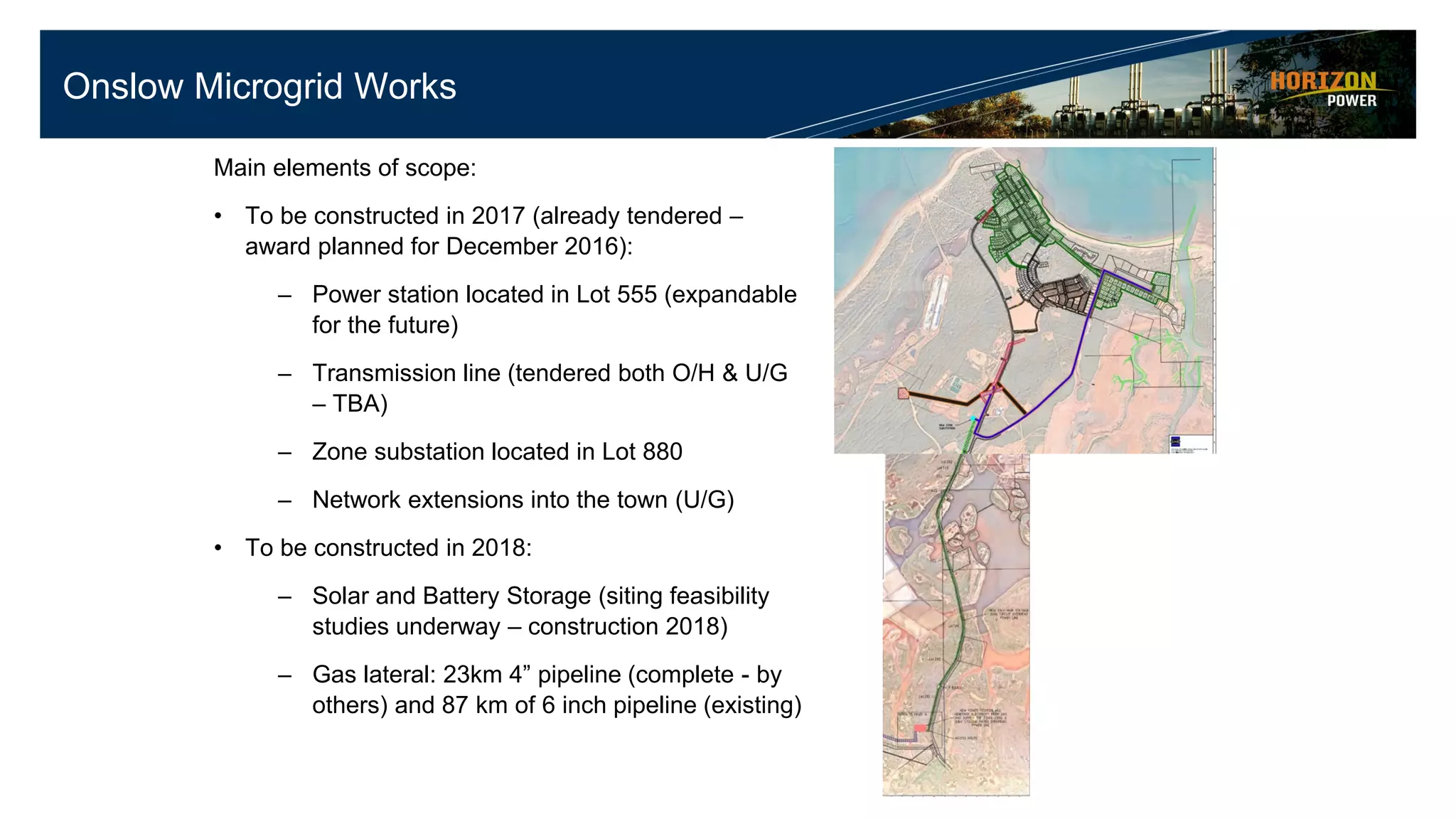
Onslow Microgrid Works
Main elements of scope:
• To be constructed in 2017 (already tendered –
award planned for December 2016):
– Power station located in Lot 555 (expandable
for the future)
– Transmission line (tendered both O/H & U/G
– TBA)
– Zone substation located in Lot 880
– Network extensions into the town (U/G)
• To be constructed in 2018:
– Solar and Battery Storage (siting feasibility
studies underway – construction 2018)
– Gas lateral: 23km 4” pipeline (complete - by
others) and 87 km of 6 inch pipeline (existing)
38
Thank You & Questions
Laurie Curro
General Manager Power System Services
0061 8 6310 1530
laurie.curro@horizonpower.com.au
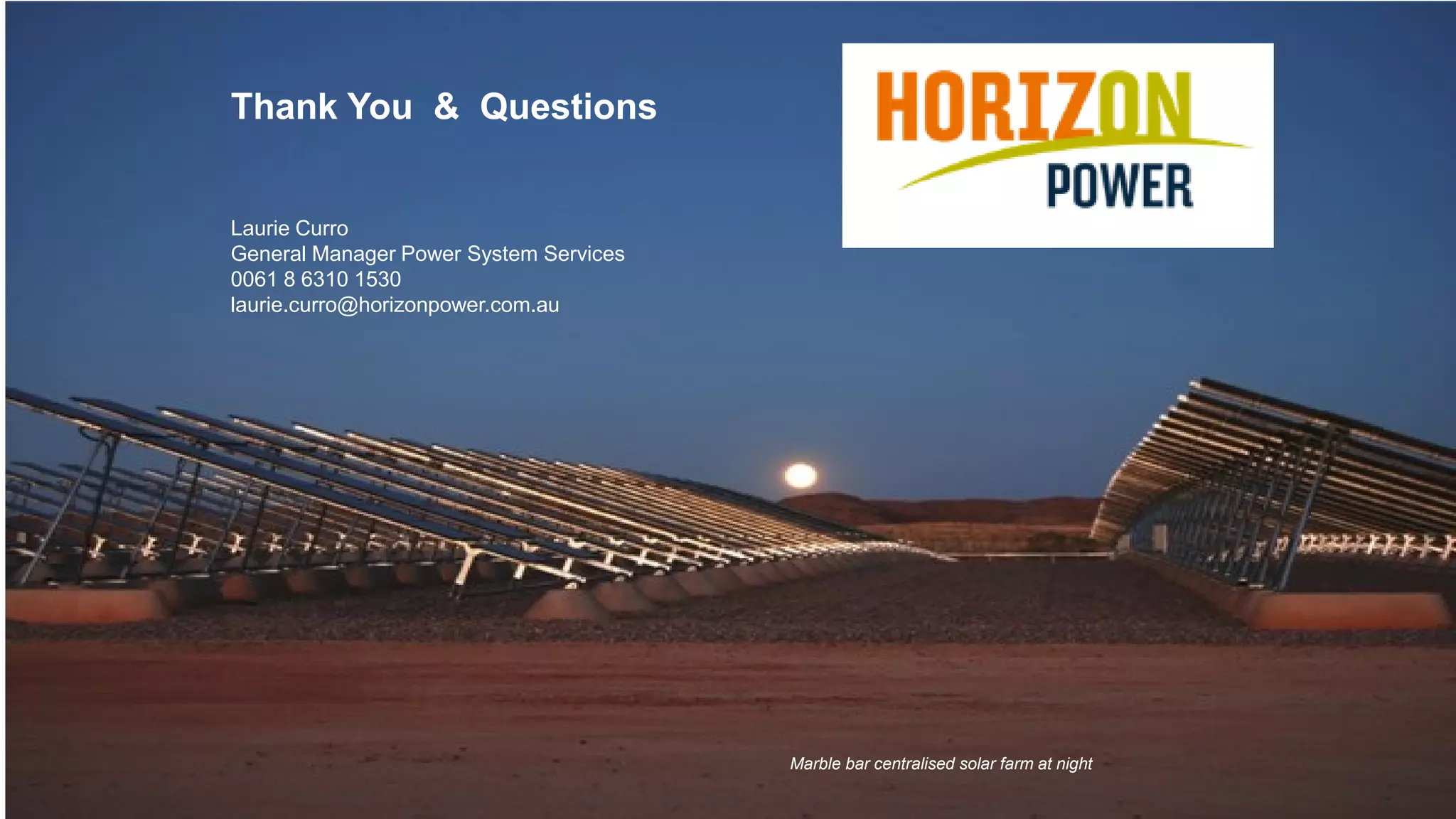
Marble bar centralised solar farm at night

Flinders Island Isolated Power System (IPS) Connect 2016 L CURRO Horizon Power

  • 1.
    Laurie Curro General ManagerPower System Services Horizon Power High RE Penetration in Horizon’s Remote Power Systems CS10# 4781077
  • 2.
    Agenda • Who isHorizon Power • History of Renewable Energy • Insatiable demand for Renewable Energy • Trends • Storage – a game changer • Multi-flow networks • Control systems • Trials and projects
  • 3.
    • Western Australia'sregional and remote electricity provider • State Government-owned and commercially focused • 38 systems of which 36 are remote microgrids • Serve 35,000 residential connections and 9,000 businesses, including major industry over 2.3 million square kilometres • One customer every 53.5 square kilometres of terrain! • Responsible for the generation, procurement, distribution and retailing of electricity Introduction to Horizon Power
  • 4.
    POWER SYSTEMS DATA Totalinstalled capacity: 435MW Total Peak Load: 275MW Current limit on Hosting Capacity: 88MW Comprising of Centralised 40MW Distributed (PV) 48MW Current Installed Renewable Energy Generation: 48MW Comprising of Hydro – 30MW Wind – 9MW Solar – 1MW centralised Solar – 8MW distributed PV Renewable Energy Hosting Capacity All Networks
  • 5.
    Horizon Power –Expertise in Microgrids 6
  • 6.
    Insatiable Demand forPV & Hosting Capacity
  • 7.
    Increasing investment in renewables Decreasing demand for centralised generation Rising electricity prices Falling cost ofnew technology KEY TRENDS 2015 2025 2050 Standalone DistributedEnergy Resources Centralised HOWWERECEIVEELECTRICITYWILLCHANGE 2015 2025 453,655SOLAR CONNECTIONSIN WA BY 2025 ↑142% 2015 2025 <1% >11% 11%OFTRANSPORT NATIONALLYIS EV BY 2025 Latest Trends
  • 8.
    Latest Trends 9 New TechnologyCost Curve CSIRO – Modelling the Future Grid Forum Workshop
  • 9.
    Smart Inverters • Shiftof intelligence and capability to the inverter • Fronius SYMO • Connectivity and monitoring Systems • Home energy management • Easy interface with Energy Storage • Smart grid ready • Open Data Communications – Sunspec Alliance, SCADA and Home Automation Reposit Power SunVerge
  • 10.
    Storage Benefits Spinning Reserve PeakShifting Renewable Smoothing Delay Diesel Start Network Support Value $ Transition path to distributed energy future and storage Diesel off options will increase these benefits Storage – a Game Changer Benefits 11
  • 11.
    Continuing Journey ofStorage at Horizon Power • Carnarvon Energy Storage Trial project – (2000kWh 2MW of Battery Storage to optimise spinning reserve of power station and trial utility scale renewable energy smoothing) • Carnarvon saturation trials • Onslow distributed RE and storage
  • 12.
    Renewable Energy Stabilityimpact fOPF x kWD (Output Fluctuation) fDIV x ( kWA + kWB + kWC + kWD ) (Diversity Factor) kW A kW B kW D kW C Local issue - Voltage fluctuations - Power quality - Ability to Export Local issue - Voltage fluctuations - Power quality - Ability to Export Upstream issues - Voltage fluctuations - Frequency response - Reverse Power Upstream issues - Voltage fluctuations - Frequency response - Reverse Power
  • 13.
  • 14.
  • 15.
    Centralised Renewables &Storage Centralised battery and PV plant Centralised battery and PV plant Communications Network
  • 16.
  • 17.
    Blueprints 2016 2025 2050 Graphs:Breakdown of Horizon Power systems per most economic business future including a 25% reduction in LCOE for DER systems.
  • 18.
  • 19.
    Distributed Generation NewNetwork Study • Objective: Define the most economically efficient way to design a system as customer density and customer PV penetration increases. • Key Questions: Customer Density? Additional Equipment? Suitability of existing networks? Technical Limitations?
  • 20.
    Distributed Generation –Network Design Load Scenarios Peak Load Average Load Minimum Load Generation Scenarios Maximum Gen Output Average Gen Output Minimum Gen Output Storage Scenarios Maximum Storage Output Minimum Storage Output Balancing Charging
  • 21.
    Current Value Chain FuelFuel GenGen Self Generation &Battery Self Generation & Battery CustomerCustomer Sub Customer Group A Customer Group A 2 way flow of energy Third party load Third party load 22 TransformerTransformer SubstationSubstation Customer Group B Customer Group B Customer Group C Customer Group C TransformerTransformerTransformerTransformer CustomerCustomer CustomerCustomer Self Generation & Battery Self Generation & Battery CustomerCustomer 3rd party Renewable Generation Intermittent 3rd party Renewable Generation Intermittent 3rd party Renewable Generation Intermittent 3rd party Renewable Generation Intermittent Sw Sw X X
  • 22.
    Network Topology withoutPV/Battery (Base Case) Total No. of Distribution Transformers: 23
  • 23.
    Network Topology withoutPV/Battery (Optimised) Total No. of Distribution Transformers: 12
  • 24.
    Network Topology withPV/Battery (Optimised Charging, Peak Load) Total No. of Distribution Transformers: 10
  • 25.
    Multi-Flow Network Design BaseNetwork Optimized Network Optimized Network + Battery Total Cost ($) 3.0 million 2.3 million 2.0 million No. of Transformer 23 12 10 Total Transformer KVA 7,245 kVA 2,935 kVA 1,715 kVA Max transformer required 630 kVA 315 kVA 315 kVA Conductor Size Smaller conductor used wherever possible Smaller conductor used due to reduced flow
  • 26.
    Multi-Flow Network –Technical Issues • Power Quality & Fault Level Issues – Reduced Protection Sensitivity – Motor Starting – Voltage Control – Frequency Control – Harmonics & Flicker – Black Start – Earthing • Voltage & Frequency Control • Network Optimisation, Network Losses, Optimal Generator Placement • Real Power Balancing & Load Control • Managing Network Demand & Customer Expectations
  • 27.
    Customer & StakeholderExpectations • Customers are looking to take greater control of their energy to reduce energy costs. • Consumer demand for renewable energy is growing. • Customers expect a choice of energy options, including more renewable energy options. • Customers want fewer restrictions to taking up solar. • Customers want to see transparency, and active communication and education of the community on renewable and other energy options. • Energy costs should be as affordable as possible.
  • 28.
    DER Long TermVision Present Day
  • 29.
    Intelligent System Control– Feed in Management and Storage BatteryBattery Store excess power
  • 30.
    Intelligent System Control- Feed in Management
  • 31.
    Project Highgarden PV on AMI DistributedPV & Battery Trial (Meekatharra) Micro-Grid Trial Intelligent System Control ‘Distributed Energy Resources’ Business Future Multi-Flow Network DER Technology Trial Stand-alone Power Systems Modular Generation Capacity High Penetration Renewable Energy & Storage 1.Business Model Development 2.Market Platform Intelligent Consumer Services Onslow Demonstration 1.DER Monitoring and Control 2.Protection Studies 3.Remote Sensing 4.Feed-In Management 1.Distributed Generation Review 1.Network Design Optimisation 1.Generation Philosophy 2.Commercial Model Assessment 1.Esperance SPS Trial 2.NIS SPS Trial Onslow DER
  • 32.
  • 33.
    Customers – TechnicalRequirements • Feed in Management • Sunspec • New requirements under AS4777 – Settings • Inverter reactive power capability • Extended Ramp Rate Installations • Changeover switches • Updated Testing Requirements • Updated Information requirements for Class III
  • 34.
    Onslow Microgrid Works Mainelements of scope: • To be constructed in 2017 (already tendered – award planned for December 2016): – Power station located in Lot 555 (expandable for the future) – Transmission line (tendered both O/H & U/G – TBA) – Zone substation located in Lot 880 – Network extensions into the town (U/G) • To be constructed in 2018: – Solar and Battery Storage (siting feasibility studies underway – construction 2018) – Gas lateral: 23km 4” pipeline (complete - by others) and 87 km of 6 inch pipeline (existing)
  • 35.
    38 Thank You &Questions Laurie Curro General Manager Power System Services 0061 8 6310 1530 laurie.curro@horizonpower.com.au Marble bar centralised solar farm at night