0
Table of contents
INTRODUCTION………………………………….1
Contents
1. RUNAWAY…………………………………….2
2. RUNAWAY MARKING……………………..3
3. TAXIWAY……………………………….……..4
4. MARKINGS…………………………………….6
5. LIGHTING COLOUR………………………..7
5.1. ALS
5.2. VASI
5.3. PAPI
6. FLIGHT STRIP FULL SCALE……………10
7. PICTURE MODEL………..…………………11
CONCLUSION………………,……………………12
BIBLIOGRAPHY…………………………………13
1
Introduction
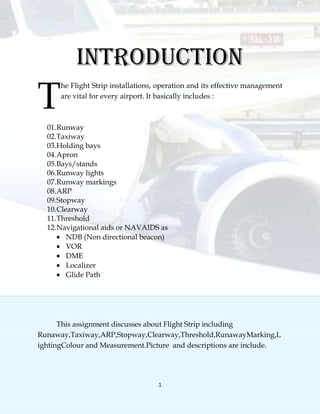
he Flight Strip installations, operation and its effective management
are vital for every airport. It basically includes :
01.Runway
02.Taxiway
03.Holding bays
04.Apron
05.Bays/stands
06.Runway lights
07.Runway markings
08.ARP
09.Stopway
10.Clearway
11.Threshold
12.Navigational aids or NAVAIDS as
NDB (Non directional beacon)
VOR
DME
Localizer
Glide Path
This assignment discusses about Flight Strip including
Runaway,Taxiway,ARP,Stopway,Clearway,Threshold,RunawayMarking,L
ightingColour and Measurement.Picture and descriptions are include.
T
2
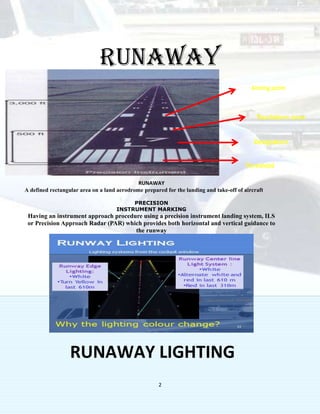
RUNAWAY
Threshold
KK
Touchdown zone
Aiming point
Designators
RUNAWAY
A defined rectangular area on a land aerodrome prepared for the landing and take-off of aircraft
PRECISION
INSTRUMENT MARKING
Having an instrument approach procedure using a precision instrument landing system, ILS
or Precision Approach Radar (PAR) which provides both horizontal and vertical guidance to
the runway
RUNAWAY LIGHTING
3
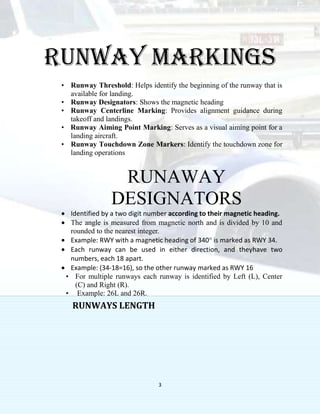
RUNWAY MARKINGS
• Runway Threshold: Helps identify the beginning of the runway that is
available for landing.
• Runway Designators: Shows the magnetic heading
• Runway Centerline Marking: Provides alignment guidance during
takeoff and landings.
• Runway Aiming Point Marking: Serves as a visual aiming point for a
landing aircraft.
• Runway Touchdown Zone Markers: Identify the touchdown zone for
landing operations
RUNAWAY
DESIGNATORS
Identified by a two digit number according to their magnetic heading.
The angle is measured from magnetic north and is divided by 10 and
rounded to the nearest integer.
Example: RWY with a magnetic heading of 340° is marked as RWY 34.
Each runway can be used in either direction, and theyhave two
numbers, each 18 apart.
Example: (34-18=16), so the other runway marked as RWY 16
• For multiple runways each runway is identified by Left (L), Center
(C) and Right (R).
• Example: 26L and 26R.
RUNWAYS LENGTH
4
TAXIWAY
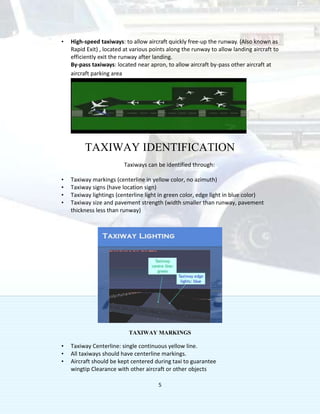
• Generally, width smaller than runway
• Lightings for night flying
• Can be one or multiple in bigger airport.
• Taxiways should be provided to permit the safe surface movement of aircraft.
• Sufficient entrance and exit taxiways for a runway should be provided to make the
movement of airplanes to and from the runway smooth and to provide more rapid
exit taxiways when traffic volumes are high.
There are four types of taxiways:
• Parallel taxiways: aligned parallel next to runway
• Entrance taxiways: perpendicular to the runway & located near the departure end
of runways.
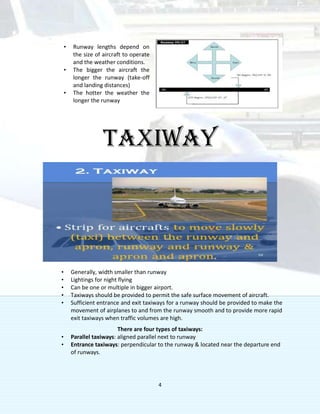
• Runway lengths depend on
the size of aircraft to operate
and the weather conditions.
• The bigger the aircraft the
longer the runway (take-off
and landing distances)
• The hotter the weather the
longer the runway
5
• High-speed taxiways: to allow aircraft quickly free-up the runway. (Also known as
Rapid Exit) , located at various points along the runway to allow landing aircraft to
efficiently exit the runway after landing.
By-pass taxiways: located near apron, to allow aircraft by-pass other aircraft at
aircraft parking area
TAXIWAY IDENTIFICATION
Taxiways can be identified through:
• Taxiway markings (centerline in yellow color, no azimuth)
• Taxiway signs (have location sign)
• Taxiway lightings (centerline light in green color, edge light in blue color)
• Taxiway size and pavement strength (width smaller than runway, pavement
thickness less than runway)
TAXIWAY MARKINGS
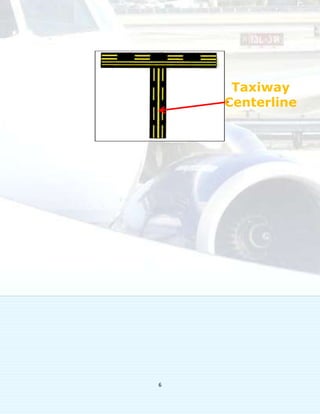
• Taxiway Centerline: single continuous yellow line.
• All taxiways should have centerline markings.
• Aircraft should be kept centered during taxi to guarantee
wingtip Clearance with other aircraft or other objects
6
Taxiway
Centerline
7
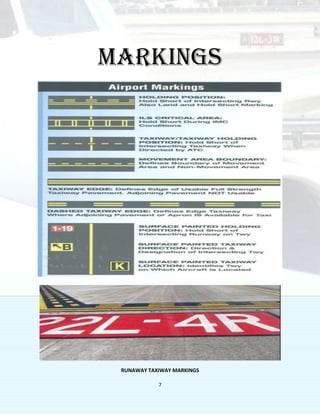
MARKINGS
RUNAWAY TAXIWAY MARKINGS
8
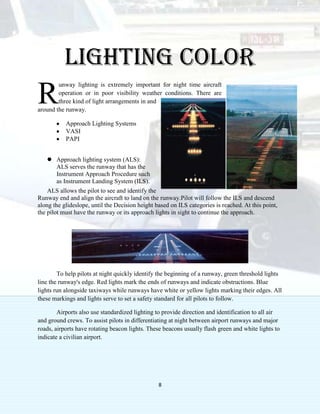
Lighting color
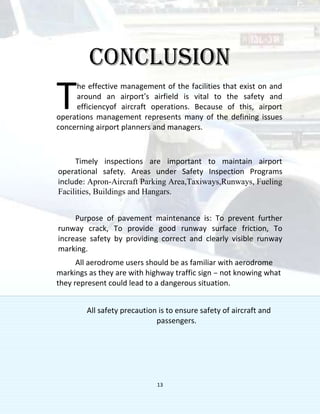
unway lighting is extremely important for night time aircraft
operation or in poor visibility weather conditions. There are
three kind of light arrangements in and
around the runway.
Approach Lighting Systems
VASI
PAPI
 Approach lighting system (ALS):
ALS serves the runway that has the
Instrument Approach Procedure such
as Instrument Landing System (ILS).
ALS allows the pilot to see and identify the
Runway end and align the aircraft to land on the runway.Pilot will follow the ILS and descend
along the glideslope, until the Decision height based on ILS categories is reached. At this point,
the pilot must have the runway or its approach lights in sight to continue the approach.
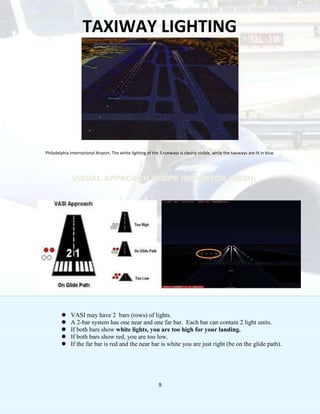
To help pilots at night quickly identify the beginning of a runway, green threshold lights
line the runway's edge. Red lights mark the ends of runways and indicate obstructions. Blue
lights run alongside taxiways while runways have white or yellow lights marking their edges. All
these markings and lights serve to set a safety standard for all pilots to follow.
Airports also use standardized lighting to provide direction and identification to all air
and ground crews. To assist pilots in differentiating at night between airport runways and major
roads, airports have rotating beacon lights. These beacons usually flash green and white lights to
indicate a civilian airport.
R
9
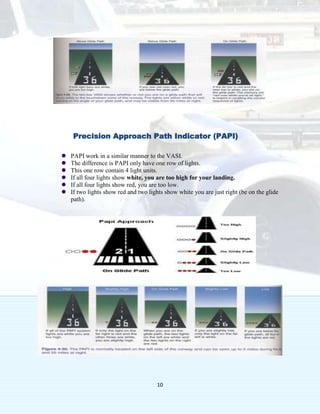
Philadelphia International Airport. The white lighting of the 3 runways is clearly visible, while the taxiways are lit in blue.
 VASI may have 2 bars (rows) of lights.
 A 2-bar system has one near and one far bar. Each bar can contain 2 light units.
 If both bars show white lights, you are too high for your landing.
 If both bars show red, you are too low.
 If the far bar is red and the near bar is white you are just right (be on the glide path).
TAXIWAY LIGHTING
VISUAL APPROACH SLOPE INDICATOR (VASI):
10
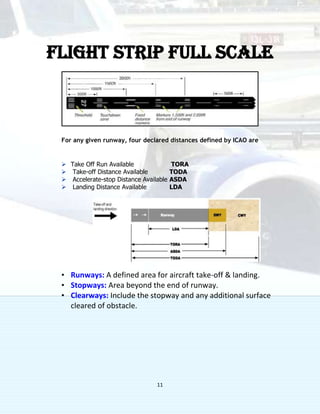
 PAPI work in a similar manner to the VASI.
 The difference is PAPI only have one row of lights.
 This one row contain 4 light units.
 If all four lights show white, you are too high for your landing.
 If all four lights show red, you are too low.
 If two lights show red and two lights show white you are just right (be on the glide
path).
Precision Approach Path Indicator (PAPI)
11
FLIGHT STRIP FULL SCALE
For any given runway, four declared distances defined by ICAO are
 Take Off Run Available TORA
 Take-off Distance Available TODA
 Accelerate-stop Distance Available ASDA
 Landing Distance Available LDA
• Runways: A defined area for aircraft take-off & landing.
• Stopways: Area beyond the end of runway.
• Clearways: Include the stopway and any additional surface
cleared of obstacle.
12
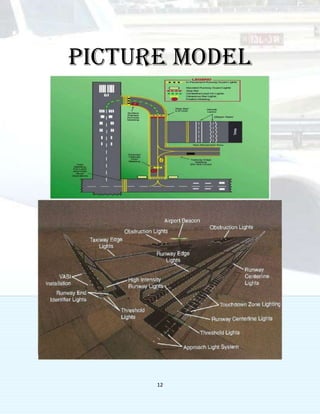
PICTURE MODEL
13
CONCLUSION
he effective management of the facilities that exist on and
around an airport’s airfield is vital to the safety and
efficiencyof aircraft operations. Because of this, airport
operations management represents many of the defining issues
concerning airport planners and managers.
Timely inspections are important to maintain airport
operational safety. Areas under Safety Inspection Programs
include: Apron-Aircraft Parking Area,Taxiways,Runways, Fueling
Facilities, Buildings and Hangars.
Purpose of pavement maintenance is: To prevent further
runway crack, To provide good runway surface friction, To
increase safety by providing correct and clearly visible runway
marking.
All aerodrome users should be as familiar with aerodrome
markings as they are with highway traffic sign – not knowing what
they represent could lead to a dangerous situation.
All safety precaution is to ensure safety of aircraft and
passengers.
T
14
BIBLIOGRAPHY
1. For Books:
Author(s) Year Title City Publisher
AviationManagementCollege 2010 Airport Management KL AMC
2. For Internet Sources (no author)
Article
Title
URL (Internet Site Address)
Pilot
Friends
http://www.pilotfriend.com/training/flight_training/communication/atc_light.htm
3. For Educated Person and Other Periodicals:
Author’s Name Notes Position
Zulianabt Ismail Powerpoint Lecturer
Mejar Maya MarimuthuPowerpoint Lecturer

flight strip/ marking/scale

  • 1.
    0 Table of contents INTRODUCTION………………………………….1 Contents 1.RUNAWAY…………………………………….2 2. RUNAWAY MARKING……………………..3 3. TAXIWAY……………………………….……..4 4. MARKINGS…………………………………….6 5. LIGHTING COLOUR………………………..7 5.1. ALS 5.2. VASI 5.3. PAPI 6. FLIGHT STRIP FULL SCALE……………10 7. PICTURE MODEL………..…………………11 CONCLUSION………………,……………………12 BIBLIOGRAPHY…………………………………13
  • 2.
    1 Introduction he Flight Stripinstallations, operation and its effective management are vital for every airport. It basically includes : 01.Runway 02.Taxiway 03.Holding bays 04.Apron 05.Bays/stands 06.Runway lights 07.Runway markings 08.ARP 09.Stopway 10.Clearway 11.Threshold 12.Navigational aids or NAVAIDS as NDB (Non directional beacon) VOR DME Localizer Glide Path This assignment discusses about Flight Strip including Runaway,Taxiway,ARP,Stopway,Clearway,Threshold,RunawayMarking,L ightingColour and Measurement.Picture and descriptions are include. T
  • 3.
    2 RUNAWAY Threshold KK Touchdown zone Aiming point Designators RUNAWAY Adefined rectangular area on a land aerodrome prepared for the landing and take-off of aircraft PRECISION INSTRUMENT MARKING Having an instrument approach procedure using a precision instrument landing system, ILS or Precision Approach Radar (PAR) which provides both horizontal and vertical guidance to the runway RUNAWAY LIGHTING
  • 4.
    3 RUNWAY MARKINGS • RunwayThreshold: Helps identify the beginning of the runway that is available for landing. • Runway Designators: Shows the magnetic heading • Runway Centerline Marking: Provides alignment guidance during takeoff and landings. • Runway Aiming Point Marking: Serves as a visual aiming point for a landing aircraft. • Runway Touchdown Zone Markers: Identify the touchdown zone for landing operations RUNAWAY DESIGNATORS Identified by a two digit number according to their magnetic heading. The angle is measured from magnetic north and is divided by 10 and rounded to the nearest integer. Example: RWY with a magnetic heading of 340° is marked as RWY 34. Each runway can be used in either direction, and theyhave two numbers, each 18 apart. Example: (34-18=16), so the other runway marked as RWY 16 • For multiple runways each runway is identified by Left (L), Center (C) and Right (R). • Example: 26L and 26R. RUNWAYS LENGTH
  • 5.
    4 TAXIWAY • Generally, widthsmaller than runway • Lightings for night flying • Can be one or multiple in bigger airport. • Taxiways should be provided to permit the safe surface movement of aircraft. • Sufficient entrance and exit taxiways for a runway should be provided to make the movement of airplanes to and from the runway smooth and to provide more rapid exit taxiways when traffic volumes are high. There are four types of taxiways: • Parallel taxiways: aligned parallel next to runway • Entrance taxiways: perpendicular to the runway & located near the departure end of runways. • Runway lengths depend on the size of aircraft to operate and the weather conditions. • The bigger the aircraft the longer the runway (take-off and landing distances) • The hotter the weather the longer the runway
  • 6.
    5 • High-speed taxiways:to allow aircraft quickly free-up the runway. (Also known as Rapid Exit) , located at various points along the runway to allow landing aircraft to efficiently exit the runway after landing. By-pass taxiways: located near apron, to allow aircraft by-pass other aircraft at aircraft parking area TAXIWAY IDENTIFICATION Taxiways can be identified through: • Taxiway markings (centerline in yellow color, no azimuth) • Taxiway signs (have location sign) • Taxiway lightings (centerline light in green color, edge light in blue color) • Taxiway size and pavement strength (width smaller than runway, pavement thickness less than runway) TAXIWAY MARKINGS • Taxiway Centerline: single continuous yellow line. • All taxiways should have centerline markings. • Aircraft should be kept centered during taxi to guarantee wingtip Clearance with other aircraft or other objects
  • 7.
  • 8.
  • 9.
    8 Lighting color unway lightingis extremely important for night time aircraft operation or in poor visibility weather conditions. There are three kind of light arrangements in and around the runway. Approach Lighting Systems VASI PAPI  Approach lighting system (ALS): ALS serves the runway that has the Instrument Approach Procedure such as Instrument Landing System (ILS). ALS allows the pilot to see and identify the Runway end and align the aircraft to land on the runway.Pilot will follow the ILS and descend along the glideslope, until the Decision height based on ILS categories is reached. At this point, the pilot must have the runway or its approach lights in sight to continue the approach. To help pilots at night quickly identify the beginning of a runway, green threshold lights line the runway's edge. Red lights mark the ends of runways and indicate obstructions. Blue lights run alongside taxiways while runways have white or yellow lights marking their edges. All these markings and lights serve to set a safety standard for all pilots to follow. Airports also use standardized lighting to provide direction and identification to all air and ground crews. To assist pilots in differentiating at night between airport runways and major roads, airports have rotating beacon lights. These beacons usually flash green and white lights to indicate a civilian airport. R
  • 10.
    9 Philadelphia International Airport.The white lighting of the 3 runways is clearly visible, while the taxiways are lit in blue.  VASI may have 2 bars (rows) of lights.  A 2-bar system has one near and one far bar. Each bar can contain 2 light units.  If both bars show white lights, you are too high for your landing.  If both bars show red, you are too low.  If the far bar is red and the near bar is white you are just right (be on the glide path). TAXIWAY LIGHTING VISUAL APPROACH SLOPE INDICATOR (VASI):
  • 11.
    10  PAPI workin a similar manner to the VASI.  The difference is PAPI only have one row of lights.  This one row contain 4 light units.  If all four lights show white, you are too high for your landing.  If all four lights show red, you are too low.  If two lights show red and two lights show white you are just right (be on the glide path). Precision Approach Path Indicator (PAPI)
  • 12.
    11 FLIGHT STRIP FULLSCALE For any given runway, four declared distances defined by ICAO are  Take Off Run Available TORA  Take-off Distance Available TODA  Accelerate-stop Distance Available ASDA  Landing Distance Available LDA • Runways: A defined area for aircraft take-off & landing. • Stopways: Area beyond the end of runway. • Clearways: Include the stopway and any additional surface cleared of obstacle.
  • 13.
  • 14.
    13 CONCLUSION he effective managementof the facilities that exist on and around an airport’s airfield is vital to the safety and efficiencyof aircraft operations. Because of this, airport operations management represents many of the defining issues concerning airport planners and managers. Timely inspections are important to maintain airport operational safety. Areas under Safety Inspection Programs include: Apron-Aircraft Parking Area,Taxiways,Runways, Fueling Facilities, Buildings and Hangars. Purpose of pavement maintenance is: To prevent further runway crack, To provide good runway surface friction, To increase safety by providing correct and clearly visible runway marking. All aerodrome users should be as familiar with aerodrome markings as they are with highway traffic sign – not knowing what they represent could lead to a dangerous situation. All safety precaution is to ensure safety of aircraft and passengers. T
  • 15.
    14 BIBLIOGRAPHY 1. For Books: Author(s)Year Title City Publisher AviationManagementCollege 2010 Airport Management KL AMC 2. For Internet Sources (no author) Article Title URL (Internet Site Address) Pilot Friends http://www.pilotfriend.com/training/flight_training/communication/atc_light.htm 3. For Educated Person and Other Periodicals: Author’s Name Notes Position Zulianabt Ismail Powerpoint Lecturer Mejar Maya MarimuthuPowerpoint Lecturer