AIRPORT LIGHTING
Bilal Ahmad (2016-MS-TE-16)
Syed Iqrar Hussain Jaffery (2016-MS-TE-09)
Muhammad Usman Latif (2016-MS-TE-23)
Haris Naveed (2016-MS-TE-17)
• To achieve uniformity and to guide pilots
for unfamiliar airports,
– Colours and general arrangement of airport
lights are standardized.
• Kept clean, well-maintained, checked
regularly
• Provision of emergency power supplies
AIRPORT LIGHTING –
Requirements
1) Airport Beacon
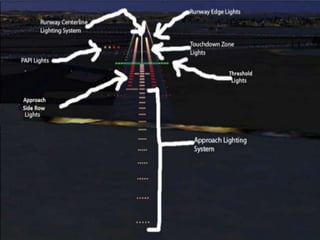
2) Approach Lighting
3) Threshold Lighting
4) Runway Lighting
5) PAPI Lighting
6) Taxiway Lighting
7) Apron and Hangar Lighting
8) Boundary Lighting
9) Lighting of Wind Direction Indicator
ELEMENTS OF AIRPORT
LIGHTING
1) AIRPORT BEACON
• Beacon- strong beam of light- used to indicate
any geographical location- situated slightly above
the horizontal- rotated to produce flashing light to
an observer.
• It gives out white and green flashes in the
horizontal directions 180◦ apart.
• Flashes are visible for the pilot from any direction
of approach and it indicates the approximate
situation of an airport equipped for the night
operations.
• Rotates at six revolutions per minute- mounted at
top of terminal building or hangar.
1) AIRPORT BEACON
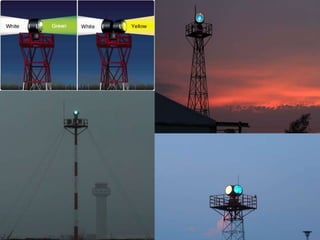
• The combination of light colors from an airport
beacon indicates the type of airport.
– Flashing white and green for civilian land
airports
– Flashing white and yellow for a water airport
– Flashing white, yellow, and green for a heliport
– Two quick white flashes alternating with a green
flash identifying a military airport.
• Provided sufficiently high to clear all
obstructions, on Control Tower or on top of
a 51-feet open steel tower/ pole
• Tower height may vary from 20-feet to 90-
feet
• It consists of two 500 watts bulb
1) AIRPORT BEACON
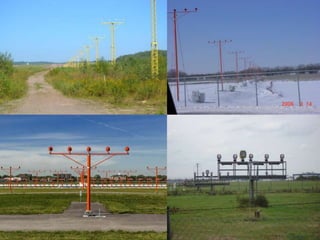
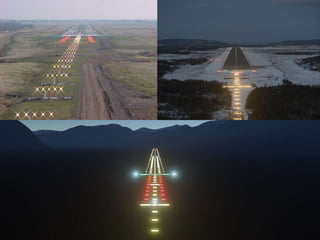
• Before runway begins- sequence of high-intensity
lighting arrangement for a length of 900m/ 3000 ft.
• Helps pilots to check if the aircraft is centered
correctly of not.
• Gives way to touchdown zone lights from threshold
of the runway.
• Normally mounted on pedestals-varying heights-to
accommodate any irregularities in ground- ensuring
the lights themselves are in level.
• Support structures are available in 6 ft to 128 ft heights
to provide a high intensity guidance system in the clear
zone. (FAA-E2702 specs)
2) Approach Lighting
Arrangements adopted for approach
lightings:
I. Calvert system
II. ICAO system
2) Approach Lighting
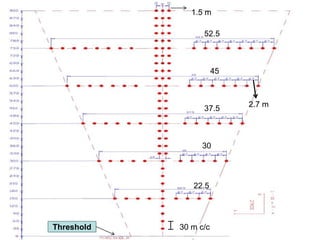
I) Calvert system:
• Widely used in Europe and other parts of
the world. (Commonwealth countries)
• Developed by E.S.Calvert in Great Britain.
• In this, there are six transverse rows of
lights of variable length placed.
• In this, the roll guidance is principally
provided by the transverse rows of lights.
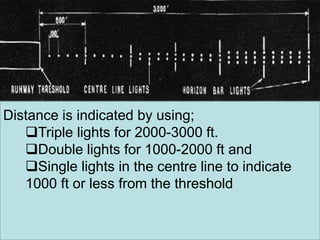
Distance is indicated by using;
Triple lights for 2000-3000 ft.
Double lights for 1000-2000 ft and
Single lights in the centre line to indicate
1000 ft or less from the threshold
Threshold 30 m c/c
2.7 m
1.5 m
52.5
45
37.5
30
22.5
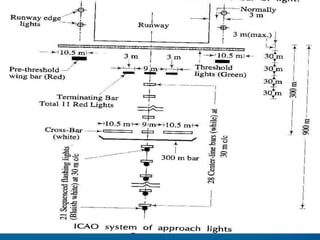
II) ICAO system:
• Known as centre-line configuration.
• In this, there is only one crossbar 300m/ 1000 ft.
from the threshold.
• In this, the roll guidance is provided by bars
4.2m in length, placed at 30m c/c on the
extended centre-line of the runway and a single
crossbar 300m from the threshold.
• The 4.2m long bars consists of 5 closely spaced
lights to give the effect of continuous bar of light.
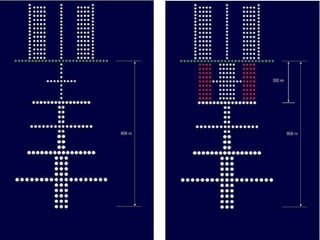
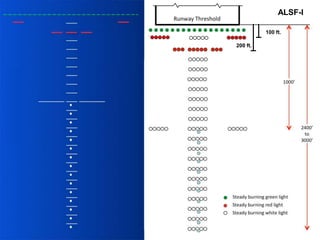
ALSF-I
100 ft.
200 ft.
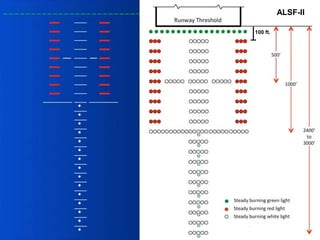
ALSF-II
100 ft.
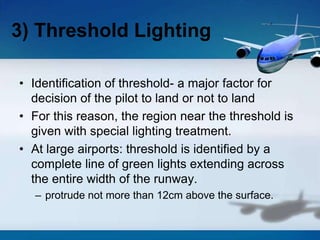
• Identification of threshold- a major factor for
decision of the pilot to land or not to land
• For this reason, the region near the threshold is
given with special lighting treatment.
• At large airports: threshold is identified by a
complete line of green lights extending across
the entire width of the runway.
– protrude not more than 12cm above the surface.
3) Threshold Lighting
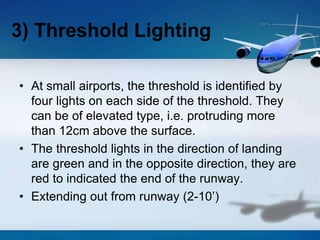
• At small airports, the threshold is identified by
four lights on each side of the threshold. They
can be of elevated type, i.e. protruding more
than 12cm above the surface.
• The threshold lights in the direction of landing
are green and in the opposite direction, they are
red to indicated the end of the runway.
• Extending out from runway (2-10’)
3) Threshold Lighting
• Runway Edge Lights
• Generally elevated units
• Project 30 inches above surface
• White lights along the edge of runway
• Not more than 10 feet from edge of pavement
• Lights in final 2000 feet of runway are yellow to
indicate caution. (In direction of operation)
• Spacing:
• 200-ft max longitudinal spacing
4) Runway Lighting
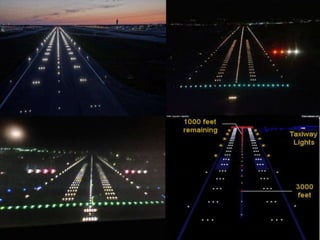
• Runway Centerline and Touchdown Lights
• Installed in Pavement
• Touchdown zone lights are three-bulb white bars.
• Located on each side of runway centerline
• Extend 3000 feet from runway threshold, or one-half the runway
length for runways less than 6000 feet long
• Spaced at 100-ft intervals
• 36 feet from runway centerline on each side
• Centerline lights are also white.
• Spaced at 50-ft intervals
• Offset 2 feet from runway centerline
• Change colors in last 3000 feet of runway in direction of operation
• Last 1000’- Red
• Next 2000’- Alternate between red and white
4) Runway Lighting
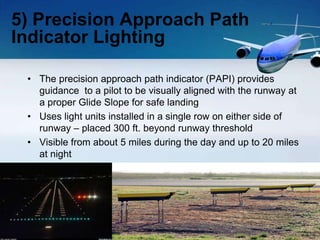
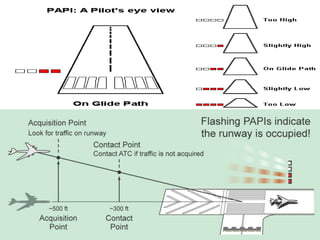
• The precision approach path indicator (PAPI) provides
guidance to a pilot to be visually aligned with the runway at
a proper Glide Slope for safe landing
• Uses light units installed in a single row on either side of
runway – placed 300 ft. beyond runway threshold
• Visible from about 5 miles during the day and up to 20 miles
at night
5) Precision Approach Path
Indicator Lighting
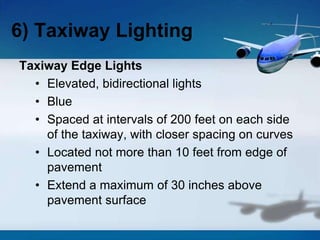
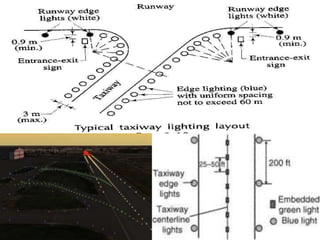
Taxiway Edge Lights
• Elevated, bidirectional lights
• Blue
• Spaced at intervals of 200 feet on each side
of the taxiway, with closer spacing on curves
• Located not more than 10 feet from edge of
pavement
• Extend a maximum of 30 inches above
pavement surface
6) Taxiway Lighting
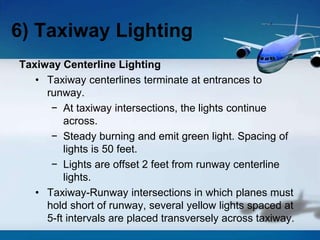
Taxiway Centerline Lighting
• Taxiway centerlines terminate at entrances to
runway.
− At taxiway intersections, the lights continue
across.
− Steady burning and emit green light. Spacing of
lights is 50 feet.
− Lights are offset 2 feet from runway centerline
lights.
• Taxiway-Runway intersections in which planes must
hold short of runway, several yellow lights spaced at
5-ft intervals are placed transversely across taxiway.
6) Taxiway Lighting
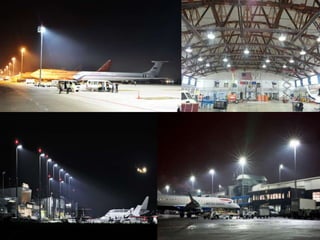
• These areas for are floodlit/ hanger lights for the
convenience in servicing and loading
• Flood-lighting system: constitues a projector
designed to be arranged to illuminate a surface.
• Mounted such a way that they do not cause
glare in the eyes of the pilots, passengers and
service personnel.
• Placed at a height of not less than 12m above
the pavement.
7) Apron and Hanger
Lighting
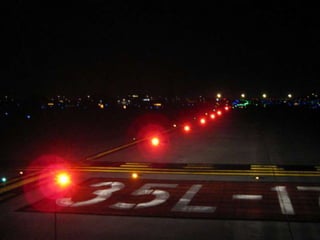
• Entire boundary of the airfield is provided with
lights at a c/c distance of about 90m with height
of about 75cm from the ground.
• For indicating hazardous approach, the
boundary lights are provided with red marker
lights
8) Boundary Lighting
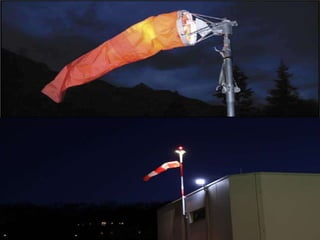
• The wind direction indicator is illuminated by four
200 watts angle reflectors placed 1.8m above
the top of the cone for providing a continuous
lighting at any position of the cone.
• This arrangement grants the use of wind
direction indicator at night and during bad
weathers.
9) Lighting for Wind Direction
Indicator
• Federal Aviation Administration. A Quick Reference: Airfield Standards, 2nd
edition. FAA, October 2011. Web. 14 December 2012.
• Horonjeff, Rob, and Francis X. Mckelvey. Planning and Design of Airports,
4thedition. Boston: McGraw Hill, 1994. Print.
• http://www.bsttsb.gc.ca/eng/
• https://books.google.com.pk/books=rotating+beacon+tower+height&source
• http://code7700.com
• https://www.ivao.aero/training/documentation/books/PP_ADC_Aerodrome_
Lighting_System.pdf
• http://www.flightlight.com/airportlighting/
• http://encyclopedia2.thefreedictionary.com/taxiway+lighting
• http://www.pilotfriend.com
References
Airport lighting

Airport lighting

  • 2.
    AIRPORT LIGHTING Bilal Ahmad(2016-MS-TE-16) Syed Iqrar Hussain Jaffery (2016-MS-TE-09) Muhammad Usman Latif (2016-MS-TE-23) Haris Naveed (2016-MS-TE-17)
  • 3.
    • To achieveuniformity and to guide pilots for unfamiliar airports, – Colours and general arrangement of airport lights are standardized. • Kept clean, well-maintained, checked regularly • Provision of emergency power supplies AIRPORT LIGHTING – Requirements
  • 4.
    1) Airport Beacon 2)Approach Lighting 3) Threshold Lighting 4) Runway Lighting 5) PAPI Lighting 6) Taxiway Lighting 7) Apron and Hangar Lighting 8) Boundary Lighting 9) Lighting of Wind Direction Indicator ELEMENTS OF AIRPORT LIGHTING
  • 6.
    1) AIRPORT BEACON •Beacon- strong beam of light- used to indicate any geographical location- situated slightly above the horizontal- rotated to produce flashing light to an observer. • It gives out white and green flashes in the horizontal directions 180◦ apart. • Flashes are visible for the pilot from any direction of approach and it indicates the approximate situation of an airport equipped for the night operations. • Rotates at six revolutions per minute- mounted at top of terminal building or hangar.
  • 7.
    1) AIRPORT BEACON •The combination of light colors from an airport beacon indicates the type of airport. – Flashing white and green for civilian land airports – Flashing white and yellow for a water airport – Flashing white, yellow, and green for a heliport – Two quick white flashes alternating with a green flash identifying a military airport.
  • 8.
    • Provided sufficientlyhigh to clear all obstructions, on Control Tower or on top of a 51-feet open steel tower/ pole • Tower height may vary from 20-feet to 90- feet • It consists of two 500 watts bulb 1) AIRPORT BEACON
  • 10.
    • Before runwaybegins- sequence of high-intensity lighting arrangement for a length of 900m/ 3000 ft. • Helps pilots to check if the aircraft is centered correctly of not. • Gives way to touchdown zone lights from threshold of the runway. • Normally mounted on pedestals-varying heights-to accommodate any irregularities in ground- ensuring the lights themselves are in level. • Support structures are available in 6 ft to 128 ft heights to provide a high intensity guidance system in the clear zone. (FAA-E2702 specs) 2) Approach Lighting
  • 12.
    Arrangements adopted forapproach lightings: I. Calvert system II. ICAO system 2) Approach Lighting
  • 13.
    I) Calvert system: •Widely used in Europe and other parts of the world. (Commonwealth countries) • Developed by E.S.Calvert in Great Britain. • In this, there are six transverse rows of lights of variable length placed. • In this, the roll guidance is principally provided by the transverse rows of lights.
  • 14.
    Distance is indicatedby using; Triple lights for 2000-3000 ft. Double lights for 1000-2000 ft and Single lights in the centre line to indicate 1000 ft or less from the threshold
  • 15.
    Threshold 30 mc/c 2.7 m 1.5 m 52.5 45 37.5 30 22.5
  • 18.
    II) ICAO system: •Known as centre-line configuration. • In this, there is only one crossbar 300m/ 1000 ft. from the threshold. • In this, the roll guidance is provided by bars 4.2m in length, placed at 30m c/c on the extended centre-line of the runway and a single crossbar 300m from the threshold. • The 4.2m long bars consists of 5 closely spaced lights to give the effect of continuous bar of light.
  • 20.
  • 21.
  • 23.
    • Identification ofthreshold- a major factor for decision of the pilot to land or not to land • For this reason, the region near the threshold is given with special lighting treatment. • At large airports: threshold is identified by a complete line of green lights extending across the entire width of the runway. – protrude not more than 12cm above the surface. 3) Threshold Lighting
  • 24.
    • At smallairports, the threshold is identified by four lights on each side of the threshold. They can be of elevated type, i.e. protruding more than 12cm above the surface. • The threshold lights in the direction of landing are green and in the opposite direction, they are red to indicated the end of the runway. • Extending out from runway (2-10’) 3) Threshold Lighting
  • 25.
    • Runway EdgeLights • Generally elevated units • Project 30 inches above surface • White lights along the edge of runway • Not more than 10 feet from edge of pavement • Lights in final 2000 feet of runway are yellow to indicate caution. (In direction of operation) • Spacing: • 200-ft max longitudinal spacing 4) Runway Lighting
  • 26.
    • Runway Centerlineand Touchdown Lights • Installed in Pavement • Touchdown zone lights are three-bulb white bars. • Located on each side of runway centerline • Extend 3000 feet from runway threshold, or one-half the runway length for runways less than 6000 feet long • Spaced at 100-ft intervals • 36 feet from runway centerline on each side • Centerline lights are also white. • Spaced at 50-ft intervals • Offset 2 feet from runway centerline • Change colors in last 3000 feet of runway in direction of operation • Last 1000’- Red • Next 2000’- Alternate between red and white 4) Runway Lighting
  • 28.
    • The precisionapproach path indicator (PAPI) provides guidance to a pilot to be visually aligned with the runway at a proper Glide Slope for safe landing • Uses light units installed in a single row on either side of runway – placed 300 ft. beyond runway threshold • Visible from about 5 miles during the day and up to 20 miles at night 5) Precision Approach Path Indicator Lighting
  • 30.
    Taxiway Edge Lights •Elevated, bidirectional lights • Blue • Spaced at intervals of 200 feet on each side of the taxiway, with closer spacing on curves • Located not more than 10 feet from edge of pavement • Extend a maximum of 30 inches above pavement surface 6) Taxiway Lighting
  • 31.
    Taxiway Centerline Lighting •Taxiway centerlines terminate at entrances to runway. − At taxiway intersections, the lights continue across. − Steady burning and emit green light. Spacing of lights is 50 feet. − Lights are offset 2 feet from runway centerline lights. • Taxiway-Runway intersections in which planes must hold short of runway, several yellow lights spaced at 5-ft intervals are placed transversely across taxiway. 6) Taxiway Lighting
  • 33.
    • These areasfor are floodlit/ hanger lights for the convenience in servicing and loading • Flood-lighting system: constitues a projector designed to be arranged to illuminate a surface. • Mounted such a way that they do not cause glare in the eyes of the pilots, passengers and service personnel. • Placed at a height of not less than 12m above the pavement. 7) Apron and Hanger Lighting
  • 35.
    • Entire boundaryof the airfield is provided with lights at a c/c distance of about 90m with height of about 75cm from the ground. • For indicating hazardous approach, the boundary lights are provided with red marker lights 8) Boundary Lighting
  • 37.
    • The winddirection indicator is illuminated by four 200 watts angle reflectors placed 1.8m above the top of the cone for providing a continuous lighting at any position of the cone. • This arrangement grants the use of wind direction indicator at night and during bad weathers. 9) Lighting for Wind Direction Indicator
  • 39.
    • Federal AviationAdministration. A Quick Reference: Airfield Standards, 2nd edition. FAA, October 2011. Web. 14 December 2012. • Horonjeff, Rob, and Francis X. Mckelvey. Planning and Design of Airports, 4thedition. Boston: McGraw Hill, 1994. Print. • http://www.bsttsb.gc.ca/eng/ • https://books.google.com.pk/books=rotating+beacon+tower+height&source • http://code7700.com • https://www.ivao.aero/training/documentation/books/PP_ADC_Aerodrome_ Lighting_System.pdf • http://www.flightlight.com/airportlighting/ • http://encyclopedia2.thefreedictionary.com/taxiway+lighting • http://www.pilotfriend.com References

Editor's Notes

  • #4 Major airport contains 30,000 lights
  • #11 The runway thresholds are markings across the runway that denote the beginning and end of the designated space for landing and takeoff under non-emergency conditions.
  • #25 c/c spacing depands upon runway width. They are equally spaced
  • #26 Commercial runway length 6000 ft to 8000 ft
  • #27 Commercial runway length 6000 ft to 8000 ft
  • #29 Visual Glide Slope Indicator or Visual Glideslope Indicator (VGSI) is a ground device that uses lights to assist a pilot in landing an airplane at an airport.