FLEXOR & EXTENSOR MECHANISM
ARJUN B S
3RD
YEAR BPT
CONTENTS:
FLEXOR MECHANISM
ANNULAR PULLEY
CRUCIATE PULLEY
EXTENSOR MECHANISM
EXTENSOR MECHANISM INFLUENCE ON METACARPOPHALANGEAL JOINT FUNCTION
FLEXOR MECHANISM
Optimal function of the FDS and FDP muscles depends not only on stabilization
by the wrist musculature but also on intact flexor gliding mechanisms.
COMPONENTS OF FLEXOR MECHANISM:
Flexor retinaculae
Bursae
Digital tendon sheaths
 The fibrous retinacular structures (proximal flexor retinaculum, TCL, and
extensor retinaculum) tie the long flexor tendons to the hand.
 The bursae and tendon sheaths facilitate friction-free excursion of the tendons on
the fibrous retinaculae.
 The retinaculae prevent bowstringing of the tendons that would result in loss of
excursion and work efficiency in the contracting muscles that pass under them.
 The tendons are anchored without interfering with their excursion and without
creating frictional forces that would cause degeneration of the tendons over time.
 The radial and ulnar bursae contain a synovial-like fluid that minimizes
frictional forces.
 The ulnar bursa is typically not continuous with the digital tendon sheaths for
the index, middle, and ring fingers.
 The radial bursa encases the FPL muscle and is continuous with its digital
tendon sheath.
 The extent and communication of the digital tendon sheaths is functionally
relevant because infection within a sheath will travel its full length,
producing painful tenosynovitis.
 If a sheath is continuous with the ulnar or radial bursa, the infection may
spread from the sheath into the palm (or vice versa).
 The tendon sheaths for each finger end proximal to the insertion of the
FDP muscle, effectively ending at the distal aspect of the middle phalanx
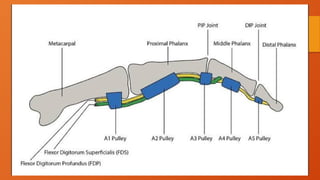
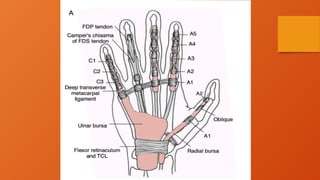
 The FDS and FDP tendons of each finger pass through a fibro-osseous
tunnel that comprises five transversely oriented annular pulleys, as well as
three obliquely oriented cruciate pulleys.
ANNULAR PULLEY CRUCIATE PULLEY
A1 C1
A2 C2
A3 C3
A4
A5
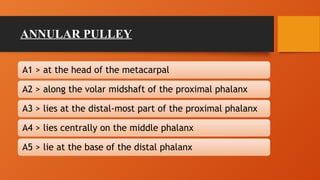
ANNULAR PULLEY
A1 > at the head of the metacarpal
A2 > along the volar midshaft of the proximal phalanx
A3 > lies at the distal-most part of the proximal phalanx
A4 > lies centrally on the middle phalanx
A5 > lie at the base of the distal phalanx
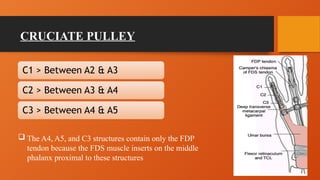
CRUCIATE PULLEY
C1 > Between A2 & A3
C2 > Between A3 & A4
C3 > Between A4 & A5
 The A4, A5, and C3 structures contain only the FDP
tendon because the FDS muscle inserts on the middle
phalanx proximal to these structures
 An additional annular pulley found proximal to the A1 has also been described
and has been named the palmar aponeurosis (PA) pulley.
 The thumb has a distinct pulley system, including two annular and one oblique
pulley.
 Of the potential six annular pulleys (PA, A1 through A5), integrity of pulleys A2
and A4 is credited with being most critical to maintaining FDS/FDP muscle
efficiency.
 Friction of the FDS and FDP tendons on the annular pulleys and cruciate
ligaments is minimized by the digital tendon sheaths that envelop the tendons
from the point at which the tendons pass into the most proximal annular pulley
(PA or A1) to the point at which the tendon of the FDP muscle passes through the
most distal cruciate pulley (C3 or A5).
 The synovial-like fluid contained in each of the digital tendon sheaths permits
gliding of the tendons beneath their ligamentous constraints and between each
other.
 Vascular supply to the gliding mechanism is critical to maintaining synovial fluid
and tendon nutrition. Direct vascularization of each tendon occurs through vessels
that reach the tendon via the vincula tendinum.
 VINCULA TENDINUM : These are folds of the synovial membrane (usually four
in number) that carry blood vessels to the body of the tendon and to the tendinous
insertions of the FDS and FDP muscles of each finger
 The function of the annular pulleys is to keep the flexor tendons close to the
bone, allowing only a minimum amount of bowstringing and migration
volarly from the joint axes.
 This sacrifices the increase in MA that might occur with substantial
bowstringing of the tendons but enhances both tendon excursion efficiency
and work efficiency of the long flexors.
 Any interruption in either the annular pulleys or the digital tendon sheaths can
result in substantial impairment of FDS and FDP muscle functioning or in
structural deformity.
 Trigger finger is one example of the disability that can be created when
repetitive trauma to a flexor tendon results in the formation of nodules on the
tendon and thickening of an annular pulley. Finger flexion may be prevented
completely, or the finger may be unable to reextend.
EXTENSOR MECHANISM
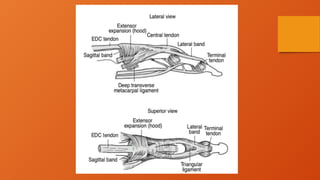
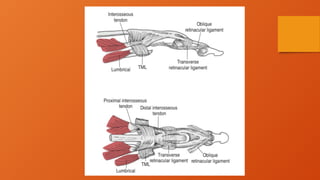
The EDC tendon and all its complicated active and passive interconnections
at and distal to the MCP joint are known together as the extensor mechanism.
COMPONENTS OF THE EXTENSOR MECHANISM:
Tendons of the Extensor digitorum communis muscle
The extensor hood
The central tendon
The lateral bands which merge In to the terminal tendon
 The lateral bands are interconnected dorsally by a triangular band of
superficial fibers known as the triangular, or dorsal retinacular, ligament.
 The triangular ligament helps stabilize the bands on the dorsum of the
finger.
 The sagittal bands connect the volar surface of the hood to the volar plates
and transverse metacarpal ligament.
 The sagittal bands aid in stabilization not only of the volar plates but also
of the hood at the MCP joint.
 The sagittal bands help to prevent bowstringing of the extensor
mechanism during active MCP joint extension, as well as transmitting
force that will extend the proximal phalanx.
 The sagittal bands are also responsible for centralizing the EDC tendon over
the MCP joint, preventing tendon subluxation
 The dorsal interossei (DI), volar interossei (VI), and lumbrical muscles are
the active components of the extensor mechanism
 The interossei muscles may also contribute fibers to the central tendon and
both lateral bands. The lumbrical muscles attach proximally to the FDP
tendons and distally to the lateral band.
 A final passive element that contributes to the extensor mechanism are the
oblique retinacular ligaments (ORLs)
Extensor Mechanism Influence on
Metacarpophalangeal Joint Function
The EDC tendon passes dorsal to the MCP joint axis.
 An active contraction of the muscle creates tension on the sagittal bands of the
extensor mechanism, pulls the bands proximally over the MCP joint, and extends the
proximal phalanx.
In order to simultaneously extend the PIP and DIP joints, the EDC muscle requires
active assistance.
The other active forces that are part of the extensor mechanism are the dorsal
interossei (DI), volar interossei (VI) and lumbrical muscles.
Each of these muscles passes volar to the MCP joint axis and, therefore, creates a
flexor force at the joint.
 However, when the EDC, interossei, and lumbrical muscles all contract
simultaneously, the MP joint will extend (as will the IP joints) because the
torque produced by the EDC muscle at the MCP joint exceeds the MCP joint
flexor torque of the intrinsic muscles.
 An isolated contraction of the EDC muscle will result in MCP joint
hyperextension with IP flexion.
 The flexion is produced by passive tension in the FDS and FDP muscles when
the MCP joint is extended.
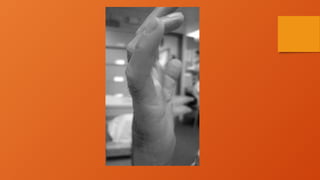
 This position of the fingers (MCP joint hyperextension with passive IP flexion)
is known as clawing.
 The proximal phalanx hyperextends on the metacarpal below while the middle
and distal phalanx flex over it.
 When the intrinsic muscles are weak or paralyzed, the EDC muscle is
unopposed, and the fingers claw not only with active MCP joint extension
but also at rest.
 The clawing at rest demonstrates that the passive tension in the intact EDC
muscle exceeds the passive tension in the remaining MCP joint flexors.
 The clawed position is also known as an intrinsic minus position because it
is attributed to the absence of the finger intrinsic muscles (the interossei
and lumbrical muscles).
REFERENCE:
Joint Structure and Function: A Comprehensive Analysis
Fourth Edition
By : Pamela K. Levangie
Cynthia C. Norkin
THANK YOU

FLEXOR & EXTENSOR MECHANISM BIOMECHANICS

  • 1.
    FLEXOR & EXTENSORMECHANISM ARJUN B S 3RD YEAR BPT
  • 2.
    CONTENTS: FLEXOR MECHANISM ANNULAR PULLEY CRUCIATEPULLEY EXTENSOR MECHANISM EXTENSOR MECHANISM INFLUENCE ON METACARPOPHALANGEAL JOINT FUNCTION
  • 3.
    FLEXOR MECHANISM Optimal functionof the FDS and FDP muscles depends not only on stabilization by the wrist musculature but also on intact flexor gliding mechanisms. COMPONENTS OF FLEXOR MECHANISM: Flexor retinaculae Bursae Digital tendon sheaths
  • 4.
     The fibrousretinacular structures (proximal flexor retinaculum, TCL, and extensor retinaculum) tie the long flexor tendons to the hand.  The bursae and tendon sheaths facilitate friction-free excursion of the tendons on the fibrous retinaculae.  The retinaculae prevent bowstringing of the tendons that would result in loss of excursion and work efficiency in the contracting muscles that pass under them.  The tendons are anchored without interfering with their excursion and without creating frictional forces that would cause degeneration of the tendons over time.
  • 5.
     The radialand ulnar bursae contain a synovial-like fluid that minimizes frictional forces.  The ulnar bursa is typically not continuous with the digital tendon sheaths for the index, middle, and ring fingers.  The radial bursa encases the FPL muscle and is continuous with its digital tendon sheath.  The extent and communication of the digital tendon sheaths is functionally relevant because infection within a sheath will travel its full length, producing painful tenosynovitis.  If a sheath is continuous with the ulnar or radial bursa, the infection may spread from the sheath into the palm (or vice versa).
  • 6.
     The tendonsheaths for each finger end proximal to the insertion of the FDP muscle, effectively ending at the distal aspect of the middle phalanx  The FDS and FDP tendons of each finger pass through a fibro-osseous tunnel that comprises five transversely oriented annular pulleys, as well as three obliquely oriented cruciate pulleys. ANNULAR PULLEY CRUCIATE PULLEY A1 C1 A2 C2 A3 C3 A4 A5
  • 7.
    ANNULAR PULLEY A1 >at the head of the metacarpal A2 > along the volar midshaft of the proximal phalanx A3 > lies at the distal-most part of the proximal phalanx A4 > lies centrally on the middle phalanx A5 > lie at the base of the distal phalanx
  • 9.
    CRUCIATE PULLEY C1 >Between A2 & A3 C2 > Between A3 & A4 C3 > Between A4 & A5  The A4, A5, and C3 structures contain only the FDP tendon because the FDS muscle inserts on the middle phalanx proximal to these structures
  • 10.
     An additionalannular pulley found proximal to the A1 has also been described and has been named the palmar aponeurosis (PA) pulley.  The thumb has a distinct pulley system, including two annular and one oblique pulley.  Of the potential six annular pulleys (PA, A1 through A5), integrity of pulleys A2 and A4 is credited with being most critical to maintaining FDS/FDP muscle efficiency.
  • 12.
     Friction ofthe FDS and FDP tendons on the annular pulleys and cruciate ligaments is minimized by the digital tendon sheaths that envelop the tendons from the point at which the tendons pass into the most proximal annular pulley (PA or A1) to the point at which the tendon of the FDP muscle passes through the most distal cruciate pulley (C3 or A5).  The synovial-like fluid contained in each of the digital tendon sheaths permits gliding of the tendons beneath their ligamentous constraints and between each other.
  • 13.
     Vascular supplyto the gliding mechanism is critical to maintaining synovial fluid and tendon nutrition. Direct vascularization of each tendon occurs through vessels that reach the tendon via the vincula tendinum.  VINCULA TENDINUM : These are folds of the synovial membrane (usually four in number) that carry blood vessels to the body of the tendon and to the tendinous insertions of the FDS and FDP muscles of each finger
  • 14.
     The functionof the annular pulleys is to keep the flexor tendons close to the bone, allowing only a minimum amount of bowstringing and migration volarly from the joint axes.  This sacrifices the increase in MA that might occur with substantial bowstringing of the tendons but enhances both tendon excursion efficiency and work efficiency of the long flexors.  Any interruption in either the annular pulleys or the digital tendon sheaths can result in substantial impairment of FDS and FDP muscle functioning or in structural deformity.  Trigger finger is one example of the disability that can be created when repetitive trauma to a flexor tendon results in the formation of nodules on the tendon and thickening of an annular pulley. Finger flexion may be prevented completely, or the finger may be unable to reextend.
  • 15.
    EXTENSOR MECHANISM The EDCtendon and all its complicated active and passive interconnections at and distal to the MCP joint are known together as the extensor mechanism. COMPONENTS OF THE EXTENSOR MECHANISM: Tendons of the Extensor digitorum communis muscle The extensor hood The central tendon The lateral bands which merge In to the terminal tendon
  • 17.
     The lateralbands are interconnected dorsally by a triangular band of superficial fibers known as the triangular, or dorsal retinacular, ligament.  The triangular ligament helps stabilize the bands on the dorsum of the finger.  The sagittal bands connect the volar surface of the hood to the volar plates and transverse metacarpal ligament.  The sagittal bands aid in stabilization not only of the volar plates but also of the hood at the MCP joint.  The sagittal bands help to prevent bowstringing of the extensor mechanism during active MCP joint extension, as well as transmitting force that will extend the proximal phalanx.
  • 18.
     The sagittalbands are also responsible for centralizing the EDC tendon over the MCP joint, preventing tendon subluxation  The dorsal interossei (DI), volar interossei (VI), and lumbrical muscles are the active components of the extensor mechanism  The interossei muscles may also contribute fibers to the central tendon and both lateral bands. The lumbrical muscles attach proximally to the FDP tendons and distally to the lateral band.  A final passive element that contributes to the extensor mechanism are the oblique retinacular ligaments (ORLs)
  • 20.
    Extensor Mechanism Influenceon Metacarpophalangeal Joint Function The EDC tendon passes dorsal to the MCP joint axis.  An active contraction of the muscle creates tension on the sagittal bands of the extensor mechanism, pulls the bands proximally over the MCP joint, and extends the proximal phalanx. In order to simultaneously extend the PIP and DIP joints, the EDC muscle requires active assistance. The other active forces that are part of the extensor mechanism are the dorsal interossei (DI), volar interossei (VI) and lumbrical muscles. Each of these muscles passes volar to the MCP joint axis and, therefore, creates a flexor force at the joint.
  • 21.
     However, whenthe EDC, interossei, and lumbrical muscles all contract simultaneously, the MP joint will extend (as will the IP joints) because the torque produced by the EDC muscle at the MCP joint exceeds the MCP joint flexor torque of the intrinsic muscles.  An isolated contraction of the EDC muscle will result in MCP joint hyperextension with IP flexion.  The flexion is produced by passive tension in the FDS and FDP muscles when the MCP joint is extended.  This position of the fingers (MCP joint hyperextension with passive IP flexion) is known as clawing.  The proximal phalanx hyperextends on the metacarpal below while the middle and distal phalanx flex over it.
  • 23.
     When theintrinsic muscles are weak or paralyzed, the EDC muscle is unopposed, and the fingers claw not only with active MCP joint extension but also at rest.  The clawing at rest demonstrates that the passive tension in the intact EDC muscle exceeds the passive tension in the remaining MCP joint flexors.  The clawed position is also known as an intrinsic minus position because it is attributed to the absence of the finger intrinsic muscles (the interossei and lumbrical muscles).
  • 24.
    REFERENCE: Joint Structure andFunction: A Comprehensive Analysis Fourth Edition By : Pamela K. Levangie Cynthia C. Norkin
  • 25.