BUSS 5251 INTERNATIONAL BUSINESS
Topic 8
Managing International Business Finance
(from Dr Ian Cook)
Overview of Seminar
• Overview of Finance systems
• Foreign currency systems
• International Monetary Fund
• Implications for Managers
Financial Implications
• Foreign exchange market: a market for converting the
currency of one country into the currency of another.
• Exchange rate: the rate at which one currency is
converted into another
• Foreign exchange risk: the risk that arises from changes
in exchange rates
The Functions of the
Foreign Exchange Market
• The Foreign exchange market serves two main
functions:
– Convert the currency of one country into the
currency of another
– Provide some insurance against foreign exchange
risk…
• Foreign exchange risk: the adverse
consequences of unpredictable changes
in the exchange rates
Currency Conversion
• Consumers can compare the relative prices of
goods and services in different countries using
exchange rates
• International businesses have four main uses for
foreign exchange markets
– To exchange currency received in the
course of doing business abroad back
into the currency of its home country
– To pay a foreign company for its
products or services in its country’s
currency
Insuring against Foreign
Exchange Risk
• Forward exchanges occur when two parties agree to
exchange currency and execute the deal at some specific
date in the future
– Exchange rates governing such future
transactions are referred to as forward
exchange rates
– For most major currencies, forward
exchange rates are quoted for 30 days,
90 days, and 180 days into the future
• When a firm enters into a forward exchange contract, it
Insuring against Foreign
Exchange Risk
• Currency swap: the simultaneous purchase and sale of a
given amount of foreign exchange for two different
value dates
• Swaps are transacted between international businesses
and their banks, between banks, and between
governments when it is desirable to move out of one
currency into another for a limited period without
incurring foreign exchange risk
The Nature of the Foreign
Exchange Market
• The foreign exchange market is a global network of
banks, brokers and foreign exchange dealers connected
by electronic communications systems
• The most important trading centers include: London,
New York, Tokyo, and Singapore
• London’s dominance is explained by:
– History (capital of the first major
industrialized nation)
– Geography (between Tokyo/Singapore
and New York)
• Two major features of the foreign exchange market:
Economic Theories of
Exchange Rate Determination
• Exchange rates are determined by the demand and
supply of one currency relative to the demand and supply
of another
• Price and exchange rates:
– Law of One Price
– Purchasing Power Parity (PPP)
– Money supply and price inflation
• Interest rates and exchange rates
• Investor psychology and “Bandwagon” effects
Law of One Price
• In competitive markets free of transportation costs and
trade barriers, identical products sold in different
countries must sell for the same price when their price is
expressed in terms of the same currency
• Example: US/French exchange rate: $1 = .78Eur
A jacket selling for $50 in New York should retail for
39.24Eur in Paris (50x.78)
Purchasing Power Parity
• By comparing the prices of identical products in
different currencies, it should be possible to determine
the ‘real’ or PPP exchange rate - if markets were
efficient
• In relatively efficient markets (few impediments to trade
and investment) then a ‘basket of goods’ should be
roughly equivalent in each country
Money Supply and Inflation
• PPP theory predicts that changes in relative prices will
result in a change in exchange rates
– A country with high inflation should
expect its currency to depreciate against
the currency of a country with a lower
inflation rate
– Inflation occurs when the money supply
increases faster than output increases
• Purchasing Power Parity puzzle
Exchange Rate Forecasting
• Individuals that believe in the efficient market theory
believe that prices reflect all available public information
– Forward rates should be unbiased
predictors of future spot rates
• Individuals that feel there is an inefficient market believe
that prices do not reflect all available information
– Forward exchange rates will not be the
best possible predictor of future spot
exchange rates
– If this is true, it may be worthwhile for
Approaches to Forecasting
• Fundamental analysis…
– Draws on economic theory to construct
sophisticated econometric models for
predicting exchange rate movements
• Technical analysis…
– Uses price and volume data to determine
trends
Currency Convertibility
• Governments can place restrictions on the convertibility
of currency
– A country’s currency is said to be freely
convertible when the country’s
government allows both residents and
nonresidents to purchase unlimited
amounts of a foreign currency with it
– A currency is said to be externally
convertible when only nonresidents may
convert it into a foreign currency without
any limitations
Currency Convertibility
• Government restrictions can include:
– A restriction on residents’ ability to
convert the domestic currency into a
foreign currency
– Restricting domestic businesses’ ability
to take foreign currency out of the
country
• Governments will limit or restrict convertibility for a
number of reasons that include:
– Preserving foreign exchange reserves
International Monetary System
• The international monetary system refers to the
institutional arrangements that govern exchange
rates.
• Floating exchange rates occur when the foreign
exchange market determines the relative value of a
currency
• The world’s four major currencies – dollar, euro,
yen, and pound – are all free to float against each
other
IMS (Cont’d)
• Pegged exchange rates occur when the value of a
currency is fixed relative to a reference currency
• Dirty float occurs when countries hold the value of
their currency within a range of a reference currency
• Fixed exchange rate occurs when a set of currencies
are fixed against each other at some mutually agreed
upon exchange rate:
– Pegged exchange rates, dirty floats and fixed
exchange rates all require some degree of
government intervention
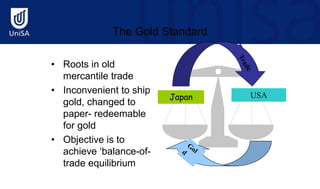
The Gold Standard
• Roots in old
mercantile trade
• Inconvenient to ship
gold, changed to
paper- redeemable
for gold
• Objective is to
achieve ‘balance-of-
trade equilibrium
USA
Japan
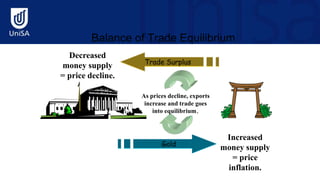
Balance of Trade Equilibrium
Trade Surplus
Gold
Increased
money supply
= price
inflation.
Decreased
money supply
= price decline.
As prices decline, exports
increase and trade goes
into equilibrium.
International Monetary Fund
(IMF)
• The International Monetary Fund (IMF) Articles
of Agreement were heavily influenced by the
worldwide financial collapse, competitive
devaluations, trade wars, high unemployment,
hyperinflation in Germany and elsewhere, and
general economic disintegration that occurred
between the two world wars
• The aim of the IMF was to try to avoid a repetition of
that chaos through a combination of discipline and
flexibility
International Monetary
Fund (Cont’d)
• Discipline…
– Maintaining a fixed exchange rate imposes
monetary discipline, curtails inflation
– Brake on competitive devaluations and stability to
the world trade environment
• Flexibility…
– Lending facility:
• Lend foreign currencies to countries
having balance-of-payments problems
– Adjustable parities:
• Allow countries to devalue currencies
more than 10% if balance of
payments was in “fundamental
Role of the World Bank
• The official name for the world bank is the
International Bank for Reconstruction and
Development
• Purpose: To fund Europe’s reconstruction and
help 3rd world countries.
• Overshadowed by Marshall Plan, so it turns
towards development
– Lending money raised through WB bond sales :
• Agriculture
• Education
• Population control
The Floating Exchange Rate
• The Jamaica agreement revised the IMF’s Articles of
Agreement to reflect the new reality of floating
exchange rates
– Floating rates acceptable
– Gold abandoned as reserve asset
– IMF quotas increased
• IMF continues its role of helping countries cope with
macroeconomic and exchange rate problems
Exchange Rates Since 1973
• Exchange rates have been more volatile for a
number of reasons including:
– Oil crisis -1971
– Loss of confidence in the dollar - 1977-78
– Oil crisis – 1979, OPEC increases price
of oil
– Unexpected rise in the dollar - 1980-85
– Rapid fall of the dollar - 1985-87 and
1993-95
Fixed Versus Floating
Exchange Rates
• Floating:
– Monetary policy
autonomy
• Restores control to
government
– Trade balance
adjustments
• Adjust the currency to
correct trade
imbalances
• Fixed:
– Monetary discipline
– Speculation
– Limits speculators
– Uncertainty
– Predictable rate
movements
– Trade balance
adjustments
– Argue no link between
exchange rates and trade
• Link between savings
and investment
Crisis Management by the IMF
• The IMF’s activities have expanded because periodic
financial crises have continued to hit many
economies
– Currency crisis:
• When a speculative attack on a
currency’s exchange value results in a
sharp depreciation of the currency’s
value or forces authorities to defend
the currency
– Banking crisis:
• Loss of confidence in the banking
Evaluating the IMF
Policy Prescriptions
• Inappropriate policies
– The IMF’s ‘one-size-fits-all’ approach to
macroeconomic policy is inappropriate
for many countries
• Moral hazard
– People behave recklessly when they
know they will be saved if things go
wrong
• Lack of Accountability
– The IMF has become too powerful for an
Implications for Managers
• It is critical that international businesses
understand the influence of exchange rates on
the profitability of trade and investment deals
– Adverse changes in exchange rates can make apparently
profitable deals unprofitable
• The risk introduced into international business
transactions by changes in exchange rates is
referred to as foreign exchange risk
– Foreign exchange risk is usually divided into three main
categories: transaction exposure, translation exposure, and
economic exposure
Implications for Managers
• Transaction exposure: the extent to which the
income from individual transactions is affected by
fluctuations in foreign exchange values
• Translation exposure: the impact of currency
exchange rate changes on the reported financial
statements of a company
• Economic exposure: the extent to which a firm’s
future international earning power is affected by
changes in exchange rates

BUSS5251Topic 8(2).ppt

  • 1.
    BUSS 5251 INTERNATIONALBUSINESS Topic 8 Managing International Business Finance (from Dr Ian Cook)
  • 2.
    Overview of Seminar •Overview of Finance systems • Foreign currency systems • International Monetary Fund • Implications for Managers
  • 3.
    Financial Implications • Foreignexchange market: a market for converting the currency of one country into the currency of another. • Exchange rate: the rate at which one currency is converted into another • Foreign exchange risk: the risk that arises from changes in exchange rates
  • 4.
    The Functions ofthe Foreign Exchange Market • The Foreign exchange market serves two main functions: – Convert the currency of one country into the currency of another – Provide some insurance against foreign exchange risk… • Foreign exchange risk: the adverse consequences of unpredictable changes in the exchange rates
  • 5.
    Currency Conversion • Consumerscan compare the relative prices of goods and services in different countries using exchange rates • International businesses have four main uses for foreign exchange markets – To exchange currency received in the course of doing business abroad back into the currency of its home country – To pay a foreign company for its products or services in its country’s currency
  • 6.
    Insuring against Foreign ExchangeRisk • Forward exchanges occur when two parties agree to exchange currency and execute the deal at some specific date in the future – Exchange rates governing such future transactions are referred to as forward exchange rates – For most major currencies, forward exchange rates are quoted for 30 days, 90 days, and 180 days into the future • When a firm enters into a forward exchange contract, it
  • 7.
    Insuring against Foreign ExchangeRisk • Currency swap: the simultaneous purchase and sale of a given amount of foreign exchange for two different value dates • Swaps are transacted between international businesses and their banks, between banks, and between governments when it is desirable to move out of one currency into another for a limited period without incurring foreign exchange risk
  • 8.
    The Nature ofthe Foreign Exchange Market • The foreign exchange market is a global network of banks, brokers and foreign exchange dealers connected by electronic communications systems • The most important trading centers include: London, New York, Tokyo, and Singapore • London’s dominance is explained by: – History (capital of the first major industrialized nation) – Geography (between Tokyo/Singapore and New York) • Two major features of the foreign exchange market:
  • 9.
    Economic Theories of ExchangeRate Determination • Exchange rates are determined by the demand and supply of one currency relative to the demand and supply of another • Price and exchange rates: – Law of One Price – Purchasing Power Parity (PPP) – Money supply and price inflation • Interest rates and exchange rates • Investor psychology and “Bandwagon” effects
  • 10.
    Law of OnePrice • In competitive markets free of transportation costs and trade barriers, identical products sold in different countries must sell for the same price when their price is expressed in terms of the same currency • Example: US/French exchange rate: $1 = .78Eur A jacket selling for $50 in New York should retail for 39.24Eur in Paris (50x.78)
  • 11.
    Purchasing Power Parity •By comparing the prices of identical products in different currencies, it should be possible to determine the ‘real’ or PPP exchange rate - if markets were efficient • In relatively efficient markets (few impediments to trade and investment) then a ‘basket of goods’ should be roughly equivalent in each country
  • 12.
    Money Supply andInflation • PPP theory predicts that changes in relative prices will result in a change in exchange rates – A country with high inflation should expect its currency to depreciate against the currency of a country with a lower inflation rate – Inflation occurs when the money supply increases faster than output increases • Purchasing Power Parity puzzle
  • 13.
    Exchange Rate Forecasting •Individuals that believe in the efficient market theory believe that prices reflect all available public information – Forward rates should be unbiased predictors of future spot rates • Individuals that feel there is an inefficient market believe that prices do not reflect all available information – Forward exchange rates will not be the best possible predictor of future spot exchange rates – If this is true, it may be worthwhile for
  • 14.
    Approaches to Forecasting •Fundamental analysis… – Draws on economic theory to construct sophisticated econometric models for predicting exchange rate movements • Technical analysis… – Uses price and volume data to determine trends
  • 15.
    Currency Convertibility • Governmentscan place restrictions on the convertibility of currency – A country’s currency is said to be freely convertible when the country’s government allows both residents and nonresidents to purchase unlimited amounts of a foreign currency with it – A currency is said to be externally convertible when only nonresidents may convert it into a foreign currency without any limitations
  • 16.
    Currency Convertibility • Governmentrestrictions can include: – A restriction on residents’ ability to convert the domestic currency into a foreign currency – Restricting domestic businesses’ ability to take foreign currency out of the country • Governments will limit or restrict convertibility for a number of reasons that include: – Preserving foreign exchange reserves
  • 17.
    International Monetary System •The international monetary system refers to the institutional arrangements that govern exchange rates. • Floating exchange rates occur when the foreign exchange market determines the relative value of a currency • The world’s four major currencies – dollar, euro, yen, and pound – are all free to float against each other
  • 18.
    IMS (Cont’d) • Peggedexchange rates occur when the value of a currency is fixed relative to a reference currency • Dirty float occurs when countries hold the value of their currency within a range of a reference currency • Fixed exchange rate occurs when a set of currencies are fixed against each other at some mutually agreed upon exchange rate: – Pegged exchange rates, dirty floats and fixed exchange rates all require some degree of government intervention
  • 19.
    The Gold Standard •Roots in old mercantile trade • Inconvenient to ship gold, changed to paper- redeemable for gold • Objective is to achieve ‘balance-of- trade equilibrium USA Japan
  • 20.
    Balance of TradeEquilibrium Trade Surplus Gold Increased money supply = price inflation. Decreased money supply = price decline. As prices decline, exports increase and trade goes into equilibrium.
  • 21.
    International Monetary Fund (IMF) •The International Monetary Fund (IMF) Articles of Agreement were heavily influenced by the worldwide financial collapse, competitive devaluations, trade wars, high unemployment, hyperinflation in Germany and elsewhere, and general economic disintegration that occurred between the two world wars • The aim of the IMF was to try to avoid a repetition of that chaos through a combination of discipline and flexibility
  • 22.
    International Monetary Fund (Cont’d) •Discipline… – Maintaining a fixed exchange rate imposes monetary discipline, curtails inflation – Brake on competitive devaluations and stability to the world trade environment • Flexibility… – Lending facility: • Lend foreign currencies to countries having balance-of-payments problems – Adjustable parities: • Allow countries to devalue currencies more than 10% if balance of payments was in “fundamental
  • 23.
    Role of theWorld Bank • The official name for the world bank is the International Bank for Reconstruction and Development • Purpose: To fund Europe’s reconstruction and help 3rd world countries. • Overshadowed by Marshall Plan, so it turns towards development – Lending money raised through WB bond sales : • Agriculture • Education • Population control
  • 24.
    The Floating ExchangeRate • The Jamaica agreement revised the IMF’s Articles of Agreement to reflect the new reality of floating exchange rates – Floating rates acceptable – Gold abandoned as reserve asset – IMF quotas increased • IMF continues its role of helping countries cope with macroeconomic and exchange rate problems
  • 25.
    Exchange Rates Since1973 • Exchange rates have been more volatile for a number of reasons including: – Oil crisis -1971 – Loss of confidence in the dollar - 1977-78 – Oil crisis – 1979, OPEC increases price of oil – Unexpected rise in the dollar - 1980-85 – Rapid fall of the dollar - 1985-87 and 1993-95
  • 26.
    Fixed Versus Floating ExchangeRates • Floating: – Monetary policy autonomy • Restores control to government – Trade balance adjustments • Adjust the currency to correct trade imbalances • Fixed: – Monetary discipline – Speculation – Limits speculators – Uncertainty – Predictable rate movements – Trade balance adjustments – Argue no link between exchange rates and trade • Link between savings and investment
  • 27.
    Crisis Management bythe IMF • The IMF’s activities have expanded because periodic financial crises have continued to hit many economies – Currency crisis: • When a speculative attack on a currency’s exchange value results in a sharp depreciation of the currency’s value or forces authorities to defend the currency – Banking crisis: • Loss of confidence in the banking
  • 28.
    Evaluating the IMF PolicyPrescriptions • Inappropriate policies – The IMF’s ‘one-size-fits-all’ approach to macroeconomic policy is inappropriate for many countries • Moral hazard – People behave recklessly when they know they will be saved if things go wrong • Lack of Accountability – The IMF has become too powerful for an
  • 29.
    Implications for Managers •It is critical that international businesses understand the influence of exchange rates on the profitability of trade and investment deals – Adverse changes in exchange rates can make apparently profitable deals unprofitable • The risk introduced into international business transactions by changes in exchange rates is referred to as foreign exchange risk – Foreign exchange risk is usually divided into three main categories: transaction exposure, translation exposure, and economic exposure
  • 30.
    Implications for Managers •Transaction exposure: the extent to which the income from individual transactions is affected by fluctuations in foreign exchange values • Translation exposure: the impact of currency exchange rate changes on the reported financial statements of a company • Economic exposure: the extent to which a firm’s future international earning power is affected by changes in exchange rates