The Birkman Method serves as:An assessment tool that measures motivation and outward behaviorNon-judgmental profile of interests, behaviors, motivational needs, and reactions under stressPredictive summary of how individuals and work-units approach communication, conflict, and decision-makingYour targeted objective is to identify your “effective or productive” behaviors, your needs or motivations, and your unproductive behaviorsLeadership effectiveness is rooted in FLEXIBILITY – your path lies in “RANGE” NOT “CHANGE”.
Architect of the Birkman MethodDeveloped in 1952 by Dr. Roger BirkmanWWII fighter pilot who observed that individuals  experiencing similar situations have different perceptions Continued his research after the War as an Industrial PsychologistPioneered use of computer methods to identify differences within self and between others
BackgroundBirkman taken by over 2 million peopleUsed by more than 75% of Fortune 500Comparative business/industrial database of leaders from various countries around the worldValidated by the US National Science FoundationValid across corporate functions and culturesMeasures self + social perceptions + motivationsCreates common language about leadership and communication styles
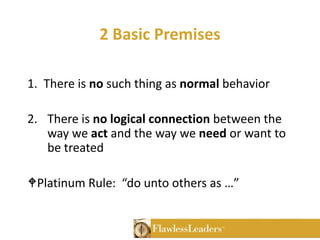
2 Basic Premises1.  There is no such thing as normal behavior2.	There is no logical connection between the way we act and the way we need or want to be treatedPlatinum Rule:  “do unto others as …”
If MetIf NotMetSTRESSHow Birkman uses these premises:Behavioral RelationshipsUSUALObservable
 Learned
Effective and productiveNEEDSUnderlying or hidden  expectations and motivations
 Difficult to change – core strengths
Counter productive,  	frustrated, reactive      behavior
Least effective, least   economic behaviorINTERESTSThe way you like to getwork doneMotivates you to have yourneeds met
Why does it work?The intensity is measured numerically using two 1-99 scales1 for usual behavior1 for needs and stress1406099IntenseIntense1-39   Low40-60 Mid61-99 High
The Birkman dimensions to Performance: ORGANIZATIONAL FOCUS USUAL BEHAVIOR STRESS BEHAVIOR MOTIVATIONAL NEEDS INTERESTS
Organizational Focus(Foundation ColorsSM) A persons …	- natural approach to work 	- natural approach to problem solving	- means of engaging  and influencing others	- dominant perceptual filter or viewpointThe Foundation Colors are designed to be Design/Strategy
  Sales/Marketing
  Operations/Technology
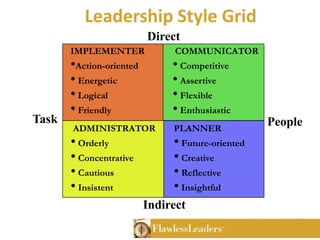
Administration/FiscalLeadership Style GridDirectIMPLEMENTERAction-oriented
 Energetic
 Logical
 Friendly COMMUNICATOR Competitive
 Assertive
 Flexible
 EnthusiasticTaskPeople ADMINISTRATOR Orderly
 Concentrative
 Cautious
 InsistentPLANNER Future-oriented
 Creative
 Reflective
 InsightfulIndirect
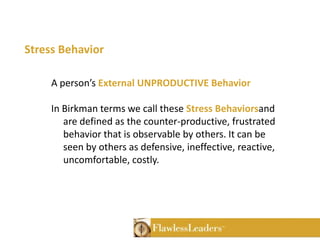
Usual BehaviorA person’s External PRODUCTIVE BehaviorIn Birkman terms we call these Usual Behaviorsand are defined as the productive, socialized behavior that is observable by others. It is seen by others as socially positive, flexible, adaptable, civilized, appropriate, comfortable, natural, and easily modified by experience or training.

Flawless Leaders.Birk

  • 3.
    The Birkman Methodserves as:An assessment tool that measures motivation and outward behaviorNon-judgmental profile of interests, behaviors, motivational needs, and reactions under stressPredictive summary of how individuals and work-units approach communication, conflict, and decision-makingYour targeted objective is to identify your “effective or productive” behaviors, your needs or motivations, and your unproductive behaviorsLeadership effectiveness is rooted in FLEXIBILITY – your path lies in “RANGE” NOT “CHANGE”.
  • 4.
    Architect of theBirkman MethodDeveloped in 1952 by Dr. Roger BirkmanWWII fighter pilot who observed that individuals experiencing similar situations have different perceptions Continued his research after the War as an Industrial PsychologistPioneered use of computer methods to identify differences within self and between others
  • 5.
    BackgroundBirkman taken byover 2 million peopleUsed by more than 75% of Fortune 500Comparative business/industrial database of leaders from various countries around the worldValidated by the US National Science FoundationValid across corporate functions and culturesMeasures self + social perceptions + motivationsCreates common language about leadership and communication styles
  • 6.
    2 Basic Premises1. There is no such thing as normal behavior2. There is no logical connection between the way we act and the way we need or want to be treatedPlatinum Rule: “do unto others as …”
  • 7.
    If MetIf NotMetSTRESSHowBirkman uses these premises:Behavioral RelationshipsUSUALObservable
  • 8.
  • 9.
    Effective and productiveNEEDSUnderlyingor hidden expectations and motivations
  • 10.
    Difficult tochange – core strengths
  • 11.
    Counter productive, frustrated, reactive behavior
  • 12.
    Least effective, least economic behaviorINTERESTSThe way you like to getwork doneMotivates you to have yourneeds met
  • 13.
    Why does itwork?The intensity is measured numerically using two 1-99 scales1 for usual behavior1 for needs and stress1406099IntenseIntense1-39 Low40-60 Mid61-99 High
  • 14.
    The Birkman dimensionsto Performance: ORGANIZATIONAL FOCUS USUAL BEHAVIOR STRESS BEHAVIOR MOTIVATIONAL NEEDS INTERESTS
  • 15.
    Organizational Focus(Foundation ColorsSM)A persons … - natural approach to work - natural approach to problem solving - means of engaging and influencing others - dominant perceptual filter or viewpointThe Foundation Colors are designed to be Design/Strategy
  • 16.
  • 17.
  • 18.
  • 19.
  • 20.
  • 21.
  • 22.
  • 23.
  • 24.
  • 25.
  • 26.
  • 27.
  • 28.
  • 29.
  • 30.
  • 31.
    Usual BehaviorA person’sExternal PRODUCTIVE BehaviorIn Birkman terms we call these Usual Behaviorsand are defined as the productive, socialized behavior that is observable by others. It is seen by others as socially positive, flexible, adaptable, civilized, appropriate, comfortable, natural, and easily modified by experience or training.