Experiments in Erosion and Deposition Flash Floods and  Slippery Slopes!
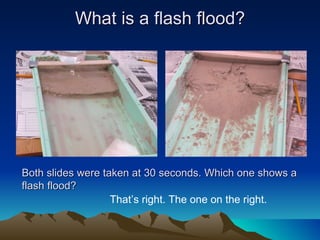
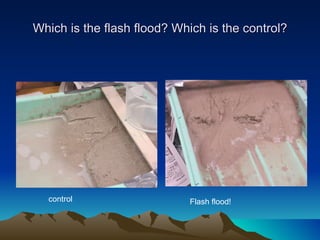
What is a flash flood? Both slides were taken at 30 seconds. Which one shows a flash flood?  That’s right. The one on the right.
A  flash flood  is a very heavy flow of water which is greater than the normal flow and goes over the banks of the stream or river’s normal channel.
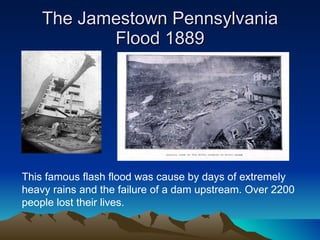
The Jamestown Pennsylvania Flood 1889 This famous flash flood was cause by days of extremely heavy rains and the failure of a dam upstream. Over 2200 people lost their lives.
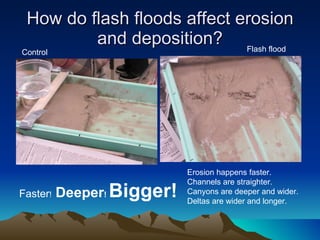
How do flash floods affect erosion and deposition? Faster !   Deeper !  Bigger! Erosion happens faster. Channels are straighter. Canyons are deeper and wider. Deltas are wider and longer. Control  Flash flood
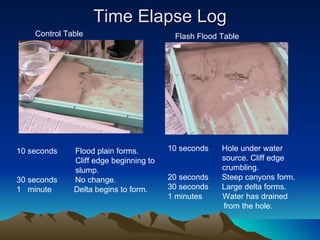
Time Elapse Log 10 seconds  Flood plain forms.    Cliff edge beginning to    slump. 30 seconds  No change. 1  minute  Delta begins to form. 10 seconds  Hole under water    source. Cliff edge      crumbling. 20 seconds  Steep canyons form. 30 seconds  Large delta forms. 1 minutes  Water has drained from the hole. Control Table Flash Flood Table
Which is the flash flood? Which is the control? control Flash flood!
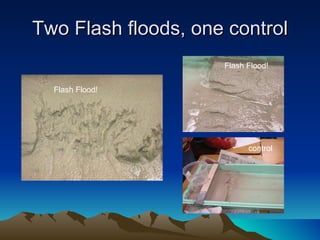
Two Flash floods, one control Flash Flood! Flash Flood! control
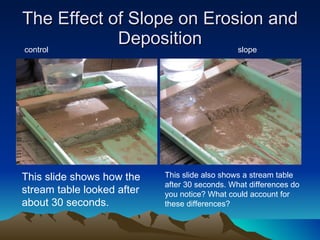
The Effect of Slope on Erosion and Deposition This slide shows how the stream table looked after about 30 seconds. This slide also shows a stream table after 30 seconds. What differences do you notice? What could account for these differences? control slope
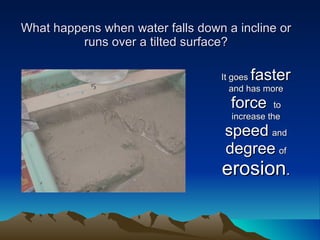
What happens when water falls down a incline or runs over a tilted surface? It goes  faster  and has more  force  to increase the  speed   and   degree   of  erosion .
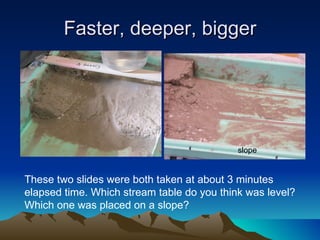
Faster, deeper, bigger These two slides were both taken at about 3 minutes elapsed time. Which stream table do you think was level? Which one was placed on a slope? slope
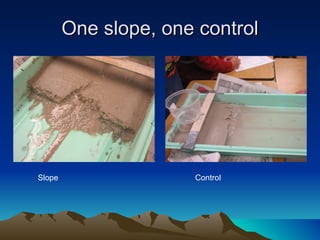
One slope, one control Slope Control
Conducting Experiments What do you think would happen if we increased the slope and had flash flood conditions? What else might you want to learn about erosion and deposition? How can we find out?

Flash flood!

  • 1.
    Experiments in Erosionand Deposition Flash Floods and Slippery Slopes!
  • 2.
    What is aflash flood? Both slides were taken at 30 seconds. Which one shows a flash flood? That’s right. The one on the right.
  • 3.
    A flashflood is a very heavy flow of water which is greater than the normal flow and goes over the banks of the stream or river’s normal channel.
  • 4.
    The Jamestown PennsylvaniaFlood 1889 This famous flash flood was cause by days of extremely heavy rains and the failure of a dam upstream. Over 2200 people lost their lives.
  • 5.
    How do flashfloods affect erosion and deposition? Faster ! Deeper ! Bigger! Erosion happens faster. Channels are straighter. Canyons are deeper and wider. Deltas are wider and longer. Control Flash flood
  • 6.
    Time Elapse Log10 seconds Flood plain forms. Cliff edge beginning to slump. 30 seconds No change. 1 minute Delta begins to form. 10 seconds Hole under water source. Cliff edge crumbling. 20 seconds Steep canyons form. 30 seconds Large delta forms. 1 minutes Water has drained from the hole. Control Table Flash Flood Table
  • 7.
    Which is theflash flood? Which is the control? control Flash flood!
  • 8.
    Two Flash floods,one control Flash Flood! Flash Flood! control
  • 9.
    The Effect ofSlope on Erosion and Deposition This slide shows how the stream table looked after about 30 seconds. This slide also shows a stream table after 30 seconds. What differences do you notice? What could account for these differences? control slope
  • 10.
    What happens whenwater falls down a incline or runs over a tilted surface? It goes faster and has more force to increase the speed and degree of erosion .
  • 11.
    Faster, deeper, biggerThese two slides were both taken at about 3 minutes elapsed time. Which stream table do you think was level? Which one was placed on a slope? slope
  • 12.
    One slope, onecontrol Slope Control
  • 13.
    Conducting Experiments Whatdo you think would happen if we increased the slope and had flash flood conditions? What else might you want to learn about erosion and deposition? How can we find out?