Dust Explosion Hazard Overview
michelman.com
Established in 1949
• Specialty chemicals
• Customer focused
• Family enterprise
Today, Michelman is:
• Global
• Over 400 employees
• Family owned
• Professionally managed
About Us
Michelman Headquarters
Cincinnati, OH
michelman.com
Agenda
• Background
• Dust Hazard Risk factors
• Control Measures
michelman.com
Background
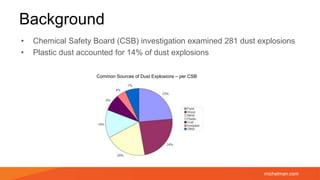
• Chemical Safety Board (CSB) investigation examined 281 dust explosions
• Plastic dust accounted for 14% of dust explosions
Common Sources of Dust Explosions – per CSB
michelman.com
Background – cont.
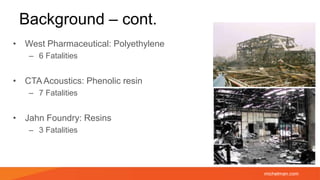
• West Pharmaceutical: Polyethylene
– 6 Fatalities
• CTA Acoustics: Phenolic resin
– 7 Fatalities
• Jahn Foundry: Resins
– 3 Fatalities
michelman.com
michelman.com
Lack of Awareness/Information
• Qualitative statements in SDS are less than adequate
• Quantitative combustible dust fire and explosion properties are
not required by OSHA Hazard/GHS
• 41% of the 140 combustible powder SDSs the CSB surveyed did
not warn users about dust explosion hazards
michelman.com
What’s the Hazard?
• Most solid organic materials will burn or explode if finely divided and
dispersed (<420 microns)
• More than 1/32”of dust over 5% of a room’s surface area is a
significant explosion hazard
• Factors affecting explosivity: particle size, shape, surface
area/volume ratio, humidity, etc.
michelman.com
Dust Risk Factors
• MIT: Minimum Ignition Temperature
• Particle Distribution: Smaller means higher risk
• Kst Value (bar/m.s): Max. rate of pressure rise
• MIE: Minimum Ignition Energy (mJ) : Minimum energy that can ignite
a material in air
michelman.com
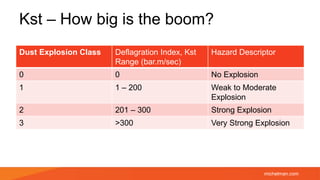
Kst – How big is the boom?
Dust Explosion Class Deflagration Index, Kst
Range (bar.m/sec)
Hazard Descriptor
0 0 No Explosion
1 1 – 200 Weak to Moderate
Explosion
2 201 – 300 Strong Explosion
3 >300 Very Strong Explosion
michelman.com
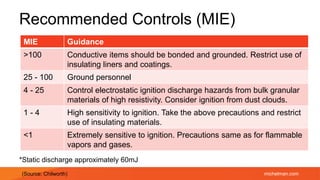
Recommended Controls (MIE)
MIE Guidance
>100 Conductive items should be bonded and grounded. Restrict use of
insulating liners and coatings.
25 - 100 Ground personnel
4 - 25 Control electrostatic ignition discharge hazards from bulk granular
materials of high resistivity. Consider ignition from dust clouds.
1 - 4 High sensitivity to ignition. Take the above precautions and restrict
use of insulating materials.
<1 Extremely sensitive to ignition. Precautions same as for flammable
vapors and gases.
(Source: Chilworth)
*Static discharge approximately 60mJ
michelman.com
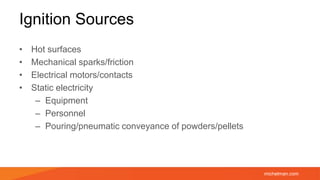
Ignition Sources
• Hot surfaces
• Mechanical sparks/friction
• Electrical motors/contacts
• Static electricity
– Equipment
– Personnel
– Pouring/pneumatic conveyance of powders/pellets
michelman.com
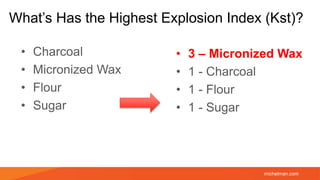
What’s Has the Highest Explosion Index (Kst)?
• Charcoal
• Micronized Wax
• Flour
• Sugar
• 3 – Micronized Wax
• 1 - Charcoal
• 1 - Flour
• 1 - Sugar
michelman.com
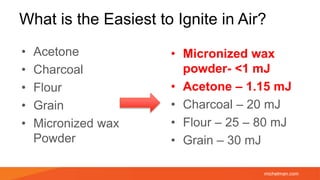
What is the Easiest to Ignite in Air?
• Acetone
• Charcoal
• Flour
• Grain
• Micronized wax
Powder
• Micronized wax
powder- <1 mJ
• Acetone – 1.15 mJ
• Charcoal – 20 mJ
• Flour – 25 – 80 mJ
• Grain – 30 mJ
michelman.com
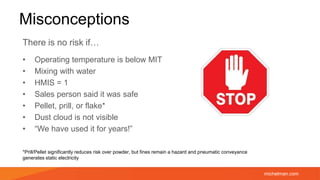
Misconceptions
There is no risk if…
• Operating temperature is below MIT
• Mixing with water
• HMIS = 1
• Sales person said it was safe
• Pellet, prill, or flake*
• Dust cloud is not visible
• “We have used it for years!”
*Prill/Pellet significantly reduces risk over powder, but fines remain a hazard and pneumatic conveyance
generates static electricity
michelman.com
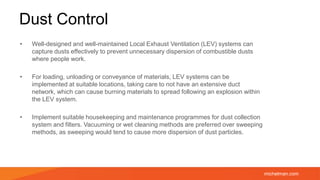
Dust Control
• Well-designed and well-maintained Local Exhaust Ventilation (LEV) systems can
capture dusts effectively to prevent unnecessary dispersion of combustible dusts
where people work.
• For loading, unloading or conveyance of materials, LEV systems can be
implemented at suitable locations, taking care to not have an extensive duct
network, which can cause burning materials to spread following an explosion within
the LEV system.
• Implement suitable housekeeping and maintenance programmes for dust collection
system and filters. Vacuuming or wet cleaning methods are preferred over sweeping
methods, as sweeping would tend to cause more dispersion of dust particles.
michelman.com
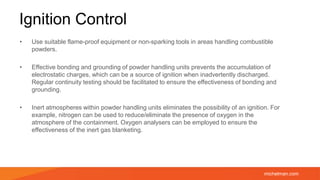
Ignition Control
• Use suitable flame-proof equipment or non-sparking tools in areas handling combustible
powders.
• Effective bonding and grounding of powder handling units prevents the accumulation of
electrostatic charges, which can be a source of ignition when inadvertently discharged.
Regular continuity testing should be facilitated to ensure the effectiveness of bonding and
grounding.
• Inert atmospheres within powder handling units eliminates the possibility of an ignition. For
example, nitrogen can be used to reduce/eliminate the presence of oxygen in the
atmosphere of the containment. Oxygen analysers can be employed to ensure the
effectiveness of the inert gas blanketing.
michelman.com
Explosion Relief and Venting
• Provide explosion relief vents of suitable size at the right locations for powder handling units to
safely vent the energy in the event of a dust explosion. To protect persons at work, explosion relief
vents must be located or positioned away from work areas, walkways, etc.
• Install detectors for sparks or glowing materials within equipment such as grinders, LEV ducting,
etc. Adding an interlock helps to extinguish potential ignition sources or stop further conveyance of
sparks or glowing materials before they reach other parts of the workplace.
• Separate areas handling combustible dusts from other parts of the workplace with distance.
Isolating units with barriers (e.g. chokes, baffles and isolation valves) is also a safety option.
michelman.com
Questions?
bhaveshshukla@Michelman.com

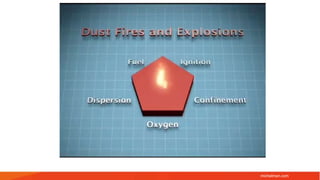
Flammable dust Explosion risk factors

  • 1.
  • 2.
    michelman.com Established in 1949 •Specialty chemicals • Customer focused • Family enterprise Today, Michelman is: • Global • Over 400 employees • Family owned • Professionally managed About Us Michelman Headquarters Cincinnati, OH
  • 3.
    michelman.com Agenda • Background • DustHazard Risk factors • Control Measures
  • 4.
    michelman.com Background • Chemical SafetyBoard (CSB) investigation examined 281 dust explosions • Plastic dust accounted for 14% of dust explosions Common Sources of Dust Explosions – per CSB
  • 5.
    michelman.com Background – cont. •West Pharmaceutical: Polyethylene – 6 Fatalities • CTA Acoustics: Phenolic resin – 7 Fatalities • Jahn Foundry: Resins – 3 Fatalities
  • 6.
  • 7.
    michelman.com Lack of Awareness/Information •Qualitative statements in SDS are less than adequate • Quantitative combustible dust fire and explosion properties are not required by OSHA Hazard/GHS • 41% of the 140 combustible powder SDSs the CSB surveyed did not warn users about dust explosion hazards
  • 8.
    michelman.com What’s the Hazard? •Most solid organic materials will burn or explode if finely divided and dispersed (<420 microns) • More than 1/32”of dust over 5% of a room’s surface area is a significant explosion hazard • Factors affecting explosivity: particle size, shape, surface area/volume ratio, humidity, etc.
  • 9.
    michelman.com Dust Risk Factors •MIT: Minimum Ignition Temperature • Particle Distribution: Smaller means higher risk • Kst Value (bar/m.s): Max. rate of pressure rise • MIE: Minimum Ignition Energy (mJ) : Minimum energy that can ignite a material in air
  • 10.
    michelman.com Kst – Howbig is the boom? Dust Explosion Class Deflagration Index, Kst Range (bar.m/sec) Hazard Descriptor 0 0 No Explosion 1 1 – 200 Weak to Moderate Explosion 2 201 – 300 Strong Explosion 3 >300 Very Strong Explosion
  • 11.
    michelman.com Recommended Controls (MIE) MIEGuidance >100 Conductive items should be bonded and grounded. Restrict use of insulating liners and coatings. 25 - 100 Ground personnel 4 - 25 Control electrostatic ignition discharge hazards from bulk granular materials of high resistivity. Consider ignition from dust clouds. 1 - 4 High sensitivity to ignition. Take the above precautions and restrict use of insulating materials. <1 Extremely sensitive to ignition. Precautions same as for flammable vapors and gases. (Source: Chilworth) *Static discharge approximately 60mJ
  • 12.
    michelman.com Ignition Sources • Hotsurfaces • Mechanical sparks/friction • Electrical motors/contacts • Static electricity – Equipment – Personnel – Pouring/pneumatic conveyance of powders/pellets
  • 13.
    michelman.com What’s Has theHighest Explosion Index (Kst)? • Charcoal • Micronized Wax • Flour • Sugar • 3 – Micronized Wax • 1 - Charcoal • 1 - Flour • 1 - Sugar
  • 14.
    michelman.com What is theEasiest to Ignite in Air? • Acetone • Charcoal • Flour • Grain • Micronized wax Powder • Micronized wax powder- <1 mJ • Acetone – 1.15 mJ • Charcoal – 20 mJ • Flour – 25 – 80 mJ • Grain – 30 mJ
  • 15.
    michelman.com Misconceptions There is norisk if… • Operating temperature is below MIT • Mixing with water • HMIS = 1 • Sales person said it was safe • Pellet, prill, or flake* • Dust cloud is not visible • “We have used it for years!” *Prill/Pellet significantly reduces risk over powder, but fines remain a hazard and pneumatic conveyance generates static electricity
  • 16.
    michelman.com Dust Control • Well-designedand well-maintained Local Exhaust Ventilation (LEV) systems can capture dusts effectively to prevent unnecessary dispersion of combustible dusts where people work. • For loading, unloading or conveyance of materials, LEV systems can be implemented at suitable locations, taking care to not have an extensive duct network, which can cause burning materials to spread following an explosion within the LEV system. • Implement suitable housekeeping and maintenance programmes for dust collection system and filters. Vacuuming or wet cleaning methods are preferred over sweeping methods, as sweeping would tend to cause more dispersion of dust particles.
  • 17.
    michelman.com Ignition Control • Usesuitable flame-proof equipment or non-sparking tools in areas handling combustible powders. • Effective bonding and grounding of powder handling units prevents the accumulation of electrostatic charges, which can be a source of ignition when inadvertently discharged. Regular continuity testing should be facilitated to ensure the effectiveness of bonding and grounding. • Inert atmospheres within powder handling units eliminates the possibility of an ignition. For example, nitrogen can be used to reduce/eliminate the presence of oxygen in the atmosphere of the containment. Oxygen analysers can be employed to ensure the effectiveness of the inert gas blanketing.
  • 18.
    michelman.com Explosion Relief andVenting • Provide explosion relief vents of suitable size at the right locations for powder handling units to safely vent the energy in the event of a dust explosion. To protect persons at work, explosion relief vents must be located or positioned away from work areas, walkways, etc. • Install detectors for sparks or glowing materials within equipment such as grinders, LEV ducting, etc. Adding an interlock helps to extinguish potential ignition sources or stop further conveyance of sparks or glowing materials before they reach other parts of the workplace. • Separate areas handling combustible dusts from other parts of the workplace with distance. Isolating units with barriers (e.g. chokes, baffles and isolation valves) is also a safety option.
  • 19.