MICROTHERM®MicroprousInsulationUse, Fabrication, Installation ,And BenefitsMatthew PassApplication EngineerMicrotherm Incmpass@microtherm.us
AgendaWhat is Microtherm® Microporous Insulation?ASTM C1676 – OverviewBenefits – Why use microporous insulation?Applications – Where & When should it be used?Fabrication – How do I work with it?Installation – How do I install it?Handling and Safety – Is it safe to work with?Question & Answers
What is Microporous Insulation?Composition:Amorphous Silica ParticlesMetal Oxide PowdersNon-RespirableFibersCold pressed to densityDensity effects rigidity & thermal conductivityBlanket – Panel – Board - PipeFaced and fabricated
MICROTHERM® – Key FeaturesMICROTHERM® is a microporous insulation that blocks the transfer of heat even more effectively than still air.Very low thermal conductivity, even at high temperatures.Non-combustible, inorganic material.Fully hydrophobic grade available for outer layers.No respirable fibers. No known health hazards within prescribed operating temperatures.Environmentally friendly. Engineered glass cloth facing minimizes dustNot an Aerogel product.In addition to this, the MICROTHERM Group provides unequalled  world wide sales support, design assistance, and customer service.
ASTM C-1676 – Product Grades & TypesASTM “Grades” define:1) The operating temperature limits2) Water repellency (Hydrophobic) characteristicsNote: Water repellency (Grade 2B) will begin to vanish at temperatures above 250 °C then the product will perform as a non-repellent grade
ASTM C-1676 – Product Grades & TypesASTM “Types” define product formType 1 – Rigid ProductsASTM Terminology = “Board”For Flat or Planar SurfacesMicrotherm ProductsMicrotherm Standard (SG )PanelMicrotherm Hydrophobic PanelMicrotherm Standard (SG) BlockMicrotherm Board Panels are encased in E-Glass fabricBoard and Block are unfaced or shrink-wrapped for handlingThicknesses up to 2” (up to 4” in optional size)
ASTM C-1676 – Product Grades & TypesType II – FlexibleASTM Term = “Quilted”Blanket type productsFlexible in 1 or 2 directionsFor Cylinders or Irregular SurfacesMicrotherm ProductsMicrotherm Standard QuiltMicrotherm Hydrophobic QuiltMicrotherm OverstitchedMicrotherm SlattedThicknessesQuilted and Overstitched – Up to ½”Slatted – Up to 1”
ASTM C-1676 – Product Grades & TypesType III – PipeASTM Term = “Molded Pipe Section”Pre-formed Rigid Pipe SectionsGrooved longitudinal seams minimize heat lossNPS Pipe Sizes from ¾” to 28”Microtherm ProductsMicrotherm MPSThicknessesAlways supplied at 1” (25mm) Thick
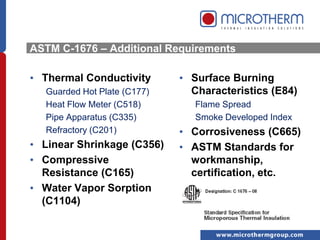
ASTM C-1676 – Additional RequirementsThermal ConductivityGuarded Hot Plate (C177)Heat Flow Meter (C518)Pipe Apparatus (C335)Refractory (C201)Linear Shrinkage (C356)Compressive Resistance (C165)Water Vapor Sorption (C1104)Surface Burning Characteristics (E84)Flame SpreadSmoke Developed IndexCorrosiveness (C665)ASTM Standards for workmanship, certification, etc.
Benefits –Why use Microporous Insulation?Conventional InsulationsMICROTHERM has the lowestThermal Conductivity of anyHigh Temperature InsulationMICROTHERM !
Benefits –Why use Microporous Insulation?Personnel Protection Requirement – Outside Surface < 60°CAmbient25°C56°C6” NPS650°C54°C55% Less Weight  -  28% Less Energy Loss  -  46% Less Volume (OD)
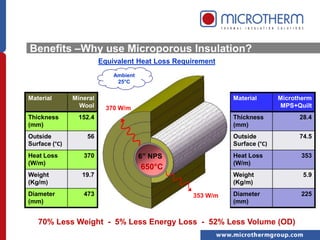
Benefits –Why use Microporous Insulation?Equivalent Heat Loss RequirementAmbient25°C370 W/m6” NPS650°C353 W/m70% Less Weight  -  5% Less Energy Loss  -  52% Less Volume (OD)
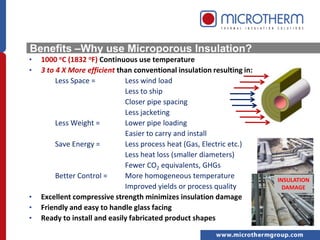
Benefits –Why use Microporous Insulation?1000 oC (1832 oF) Continuous use temperature3 to 4 X More efficient than conventional insulation resulting in:Less Space = 	Less wind load				Less to ship				Closer pipe spacing				Less jacketing	Less Weight =	Lower pipe loading				Easier to carry and install	Save Energy =	Less process heat (Gas, Electric etc.)				Less heat loss (smaller diameters)				Fewer CO2 equivalents, GHGs	Better Control = 	More homogeneous temperature				Improved yields or process qualityExcellent compressive strength minimizes insulation damage Friendly and easy to handle glass facingReady to install and easily fabricated product shapesINSULATIONDAMAGE
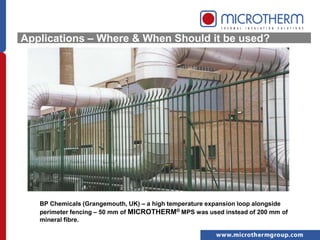
Applications – Where & When Should it be used?BP Chemicals (Grangemouth, UK) – a high temperature expansion loop alongside perimeter fencing – 50 mm of MICROTHERM®MPS was used instead of 200 mm of mineral fibre.
MICROTHERM® Application – Vessel on Load CellsLoad Cell ApplicationConstant Weight Monitoring Required1200 F Process TemperatureYield significantly effected by temperature variationsCompression ResistanceWeight Comparison:Calcium Silicate 11,500 lbsMicrotherm 2,350 lbs~80% Weight ReductionSupportLugLoad Cell
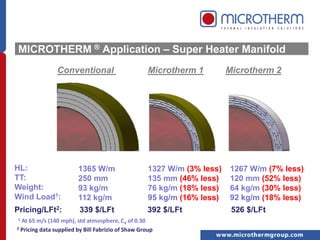
MICROTHERM® Application – Super Heater ManifoldConventional Microtherm 1Microtherm 2HL:TT:Weight:Wind Load1:1365 W/m250 mm93 kg/m112 kg/m1327 W/m (3% less)135 mm (46% less) 76 kg/m (18% less)95 kg/m (16% less)1267 W/m (7% less)120 mm (52% less)64 kg/m (30% less)92 kg/m (18% less)Pricing/LFt2:        339 $/LFt               392 $/LFt                      526 $/LFt 1 At 65 m/s (140 mph), std atmosphere, Cd of 0.302 Pricing data supplied by Bill Fabrizio of Shaw Group
MICROTHERM® ApplicationsMICROTHERM®offers the best thermal insulation protection in the smallest volume.  Wherever SPACE, WEIGHT, or ENERGY are a concern:		Weight Examples - 	Excessive  Pipe/System Loads			Reduction in Pipe Hangers			Installing Insulation on Elevated PlatformsVessels with Load Cells		Space Examples -	High Wind Loads			Congested Piping			More Pipes on a Rack			Maintenance Access			Revamps – Less Energy in Existing Space		Energy Examples-	Kyoto Regulation			Reduced GHGs, NOx, CO2, CE			Reduced Fuel Consumption, Burner UseOther reasons include –MICROTHERM®systems are clean and safe to handle.MICROTHERM®systems are much smaller in volume reducing transport and labor.
Fabrication – How do I work with it? – Tools RequiredYou will need…………………………. A clean flat work surface.
 Marker pen or pencil.
 A tape measure or a template.
 A straight edge for straight cuts.
 A sharp craft knife or similar tool – select the   blade size to suit the thickness for cutting.Also………………………….Microtherm® Quilt, Panel, or Slatted product.
 Sodium Silicate adhesive plus small brush.
 Either – strips of glass cloth.             - pre-cut tape.             - self adhesive glass cloth or   	aluminium foil tape.
Fabrication – How do I work with it? – Straight CutClearly mark the line of the cut on the panel.Use a straight edge.Apply pressure alongside the cut by pressing       down on the straightedge.Cut firmly making sure that the blade penetrates the lower glass cloth covering.Blow off any fine dust.Cut edge is ready for sealing.
Fabrication – How do I work with it? – Curved CutFor best results use a template to mark out the curve before cutting.
 Carefully follow the line of the cut making sure that the knife blade cuts through the lower glass cloth layer.
 Separate the sections and blow off any slight dust residue.
 The cut edge is now ready for sealing.Fabrication – How do I work with it? - Straight SealApply Sodium Silicate adhesive to pre-cut strip of glass cloth.
 Fold it neatly around the cut edge.
 Neatly cut and fold the corners in the sequence shown in the photographs.
For less demanding applications,   self adhesive tapes may be used.
Fabrication – How do I work with it? – Curved Seal50 mm  CUT50 mm  CUTPanel thickness             Glass cloth strip100 mm wide + panel thicknessCut each edge of the glass cloth sealing strip into fringes as shown.
 Apply Sodium Silicate adhesive.

Microtherm For Pipework

  • 1.
    MICROTHERM®MicroprousInsulationUse, Fabrication, Installation,And BenefitsMatthew PassApplication EngineerMicrotherm Incmpass@microtherm.us
  • 2.
    AgendaWhat is Microtherm®Microporous Insulation?ASTM C1676 – OverviewBenefits – Why use microporous insulation?Applications – Where & When should it be used?Fabrication – How do I work with it?Installation – How do I install it?Handling and Safety – Is it safe to work with?Question & Answers
  • 3.
    What is MicroporousInsulation?Composition:Amorphous Silica ParticlesMetal Oxide PowdersNon-RespirableFibersCold pressed to densityDensity effects rigidity & thermal conductivityBlanket – Panel – Board - PipeFaced and fabricated
  • 4.
    MICROTHERM® – KeyFeaturesMICROTHERM® is a microporous insulation that blocks the transfer of heat even more effectively than still air.Very low thermal conductivity, even at high temperatures.Non-combustible, inorganic material.Fully hydrophobic grade available for outer layers.No respirable fibers. No known health hazards within prescribed operating temperatures.Environmentally friendly. Engineered glass cloth facing minimizes dustNot an Aerogel product.In addition to this, the MICROTHERM Group provides unequalled world wide sales support, design assistance, and customer service.
  • 5.
    ASTM C-1676 –Product Grades & TypesASTM “Grades” define:1) The operating temperature limits2) Water repellency (Hydrophobic) characteristicsNote: Water repellency (Grade 2B) will begin to vanish at temperatures above 250 °C then the product will perform as a non-repellent grade
  • 6.
    ASTM C-1676 –Product Grades & TypesASTM “Types” define product formType 1 – Rigid ProductsASTM Terminology = “Board”For Flat or Planar SurfacesMicrotherm ProductsMicrotherm Standard (SG )PanelMicrotherm Hydrophobic PanelMicrotherm Standard (SG) BlockMicrotherm Board Panels are encased in E-Glass fabricBoard and Block are unfaced or shrink-wrapped for handlingThicknesses up to 2” (up to 4” in optional size)
  • 7.
    ASTM C-1676 –Product Grades & TypesType II – FlexibleASTM Term = “Quilted”Blanket type productsFlexible in 1 or 2 directionsFor Cylinders or Irregular SurfacesMicrotherm ProductsMicrotherm Standard QuiltMicrotherm Hydrophobic QuiltMicrotherm OverstitchedMicrotherm SlattedThicknessesQuilted and Overstitched – Up to ½”Slatted – Up to 1”
  • 8.
    ASTM C-1676 –Product Grades & TypesType III – PipeASTM Term = “Molded Pipe Section”Pre-formed Rigid Pipe SectionsGrooved longitudinal seams minimize heat lossNPS Pipe Sizes from ¾” to 28”Microtherm ProductsMicrotherm MPSThicknessesAlways supplied at 1” (25mm) Thick
  • 9.
    ASTM C-1676 –Additional RequirementsThermal ConductivityGuarded Hot Plate (C177)Heat Flow Meter (C518)Pipe Apparatus (C335)Refractory (C201)Linear Shrinkage (C356)Compressive Resistance (C165)Water Vapor Sorption (C1104)Surface Burning Characteristics (E84)Flame SpreadSmoke Developed IndexCorrosiveness (C665)ASTM Standards for workmanship, certification, etc.
  • 10.
    Benefits –Why useMicroporous Insulation?Conventional InsulationsMICROTHERM has the lowestThermal Conductivity of anyHigh Temperature InsulationMICROTHERM !
  • 11.
    Benefits –Why useMicroporous Insulation?Personnel Protection Requirement – Outside Surface < 60°CAmbient25°C56°C6” NPS650°C54°C55% Less Weight - 28% Less Energy Loss - 46% Less Volume (OD)
  • 12.
    Benefits –Why useMicroporous Insulation?Equivalent Heat Loss RequirementAmbient25°C370 W/m6” NPS650°C353 W/m70% Less Weight - 5% Less Energy Loss - 52% Less Volume (OD)
  • 13.
    Benefits –Why useMicroporous Insulation?1000 oC (1832 oF) Continuous use temperature3 to 4 X More efficient than conventional insulation resulting in:Less Space = Less wind load Less to ship Closer pipe spacing Less jacketing Less Weight = Lower pipe loading Easier to carry and install Save Energy = Less process heat (Gas, Electric etc.) Less heat loss (smaller diameters) Fewer CO2 equivalents, GHGs Better Control = More homogeneous temperature Improved yields or process qualityExcellent compressive strength minimizes insulation damage Friendly and easy to handle glass facingReady to install and easily fabricated product shapesINSULATIONDAMAGE
  • 14.
    Applications – Where& When Should it be used?BP Chemicals (Grangemouth, UK) – a high temperature expansion loop alongside perimeter fencing – 50 mm of MICROTHERM®MPS was used instead of 200 mm of mineral fibre.
  • 15.
    MICROTHERM® Application –Vessel on Load CellsLoad Cell ApplicationConstant Weight Monitoring Required1200 F Process TemperatureYield significantly effected by temperature variationsCompression ResistanceWeight Comparison:Calcium Silicate 11,500 lbsMicrotherm 2,350 lbs~80% Weight ReductionSupportLugLoad Cell
  • 16.
    MICROTHERM® Application –Super Heater ManifoldConventional Microtherm 1Microtherm 2HL:TT:Weight:Wind Load1:1365 W/m250 mm93 kg/m112 kg/m1327 W/m (3% less)135 mm (46% less) 76 kg/m (18% less)95 kg/m (16% less)1267 W/m (7% less)120 mm (52% less)64 kg/m (30% less)92 kg/m (18% less)Pricing/LFt2: 339 $/LFt 392 $/LFt 526 $/LFt 1 At 65 m/s (140 mph), std atmosphere, Cd of 0.302 Pricing data supplied by Bill Fabrizio of Shaw Group
  • 17.
    MICROTHERM® ApplicationsMICROTHERM®offers thebest thermal insulation protection in the smallest volume. Wherever SPACE, WEIGHT, or ENERGY are a concern: Weight Examples - Excessive Pipe/System Loads Reduction in Pipe Hangers Installing Insulation on Elevated PlatformsVessels with Load Cells Space Examples - High Wind Loads Congested Piping More Pipes on a Rack Maintenance Access Revamps – Less Energy in Existing Space Energy Examples- Kyoto Regulation Reduced GHGs, NOx, CO2, CE Reduced Fuel Consumption, Burner UseOther reasons include –MICROTHERM®systems are clean and safe to handle.MICROTHERM®systems are much smaller in volume reducing transport and labor.
  • 18.
    Fabrication – Howdo I work with it? – Tools RequiredYou will need…………………………. A clean flat work surface.
  • 19.
    Marker penor pencil.
  • 20.
    A tapemeasure or a template.
  • 21.
    A straightedge for straight cuts.
  • 22.
    A sharpcraft knife or similar tool – select the blade size to suit the thickness for cutting.Also………………………….Microtherm® Quilt, Panel, or Slatted product.
  • 23.
    Sodium Silicateadhesive plus small brush.
  • 24.
    Either –strips of glass cloth. - pre-cut tape. - self adhesive glass cloth or aluminium foil tape.
  • 25.
    Fabrication – Howdo I work with it? – Straight CutClearly mark the line of the cut on the panel.Use a straight edge.Apply pressure alongside the cut by pressing down on the straightedge.Cut firmly making sure that the blade penetrates the lower glass cloth covering.Blow off any fine dust.Cut edge is ready for sealing.
  • 26.
    Fabrication – Howdo I work with it? – Curved CutFor best results use a template to mark out the curve before cutting.
  • 27.
    Carefully followthe line of the cut making sure that the knife blade cuts through the lower glass cloth layer.
  • 28.
    Separate thesections and blow off any slight dust residue.
  • 29.
    The cutedge is now ready for sealing.Fabrication – How do I work with it? - Straight SealApply Sodium Silicate adhesive to pre-cut strip of glass cloth.
  • 30.
    Fold itneatly around the cut edge.
  • 31.
    Neatly cutand fold the corners in the sequence shown in the photographs.
  • 32.
    For less demandingapplications, self adhesive tapes may be used.
  • 33.
    Fabrication – Howdo I work with it? – Curved Seal50 mm CUT50 mm CUTPanel thickness Glass cloth strip100 mm wide + panel thicknessCut each edge of the glass cloth sealing strip into fringes as shown.
  • 34.
    Apply SodiumSilicate adhesive.