Flammability is the ability of a
substance to burn or ignite,
causing fire or combustion. The
degree of difficulty required to
cause the combustion of a
substance is quantified through
fire testing.
Flammability
Flammable
Flame proof
Flame Proof Types
Factors Affecting
Flame resistance
Available Methods
of Test
Standard for the
Flammability
Flammability
Testing
Flame Resistance
Finish
A flammable fabric is one which
propagates flame, i.e. it continues
to burn after the igniting flame has
been removed.
Flame Resistance Rating (M): A
figure derived from the
flammability testing of fabrics and
is of the same order as the time in
seconds necessary for the
propagation of flame 100 inch in a
vertical strip.
Flammability
Flammable
Flame proof
Flame Proof Types
Factors Affecting
Flame resistance
Available Methods
of Test
Standard for the
Flammability
Flammability
Testing
Flame Resistance
Finish
A flame-proof fabric is one which
does not propagate flame, i.e.
any flame goes out quickly when
the igniting flame is withdrawn.
Flame-Resistance: A flame
resistant fabric is one whose
flame resistance rating is high.
Flammability
Flammable
Flame proof
Flame Proof Types
Factors Affecting
Flame resistance
Available Methods
of Test
Standard for the
Flammability
Flammability
Testing
Flame Resistance
Finish
Inherently Flame-proof Material: Material
which, although not submitted to a flame-
proofing process, in flame proof.
Durably Flame-proof Material: A flame-
proof material which, after being
submitted to a washing treatment,
remains flame proof.
Temporarily Flame-proof Material:
Material which complies with the
standard requirement, before, but not
after, the prescribed washing treatment.
Flammability
Flammable
Flame proof
Flame Proof Types
Factors Affecting
Flame resistance
Available Methods
of Test
Standard for the
Flammability
Flammability
Testing
Flame Resistance
Finish
Fibre content
Types of Yarn
Fabric Structure
Fabric weight
Flammability
Flammable
Flame proof
Flame Proof Types
Factors Affecting
Flame resistance
Available Methods
of Test
Standard for the
Flammability
Flammability
Testing
Flame Resistance
Finish
The Visual Timing Test (Here the rate
of flame spread is determined over
fabric suspended vertically)
The 45 Test(The time, t for the
flame to travel 5 inch over fabric
sloping at an angle of 45 degree is
measured in seconds. The flame
resistance rating, M, is then given by
2.5 * t)
The Hoop Test(The rate of flame
spread is determined over the fabric
mounted on a semicircular frame)
Flammability
Flammable
Flame proof
Flame Proof Types
Factors Affecting
Flame resistance
Available Methods
of Test
Standard for the
Flammability
Flammability
Testing
Flame Resistance
Finish
Consumer Product Safety
Commission is amending its
flammability standard for general
wearing apparel, the Standard for
the Flammability of Clothing
Textiles, 16 CFR part 1610. The
Standard, originally issued in 1953,
has become outdated in several
respects. The revisions better
reflect current consumer practices
and technologies and clarify
several aspects of the Standard.
Flammability
Flammable
Flame proof
Flame Proof Types
Factors Affecting
Flame resistance
Available Methods
of Test
Standard for the
Flammability
Flammability
Testing
Flame Resistance
Finish
Exemption of Testing:
Plain Surface
Raised Surface
Note: Acrylic, Modacrylic, Nylon, Olefin,
Polyester, Wool
2.6 oz/sq.yards
Flammability
Flammable
Flame proof
Flame Proof Types
Factors Affecting
Flame resistance
Available Methods
of Test
Standard for the
Flammability
Flammability
Testing
Flame Resistance
Finish
Procedure of Testing:
Refurbishing: 5 Specimen
Original: 5 Specimen
Preliminary Test: Direction finding
Specimen: 6” * 2”
Brushing:
45 degree
Sensor
1sec, 16 mm flame length
Flammability
Flammable
Flame proof
Flame Proof Types
Factors Affecting
Flame resistance
Available Methods
of Test
Standard for the
Flammability
Flammability
Testing
Flame Resistance
Finish
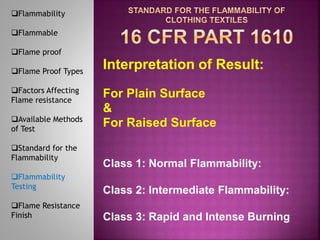
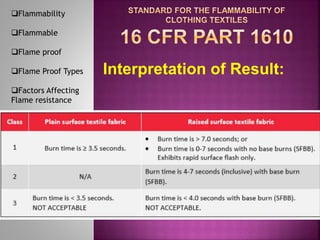
Interpretation of Result:
For Plain Surface
&
For Raised Surface
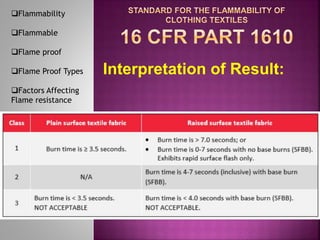
Class 1: Normal Flammability:
Class 2: Intermediate Flammability:
Class 3: Rapid and Intense Burning
Flammability
Flammable
Flame proof
Flame Proof Types
Factors Affecting
Flame resistance
Available Methods
of Test
Standard for the
Flammability
Flammability
Testing
Flame Resistance
Finish
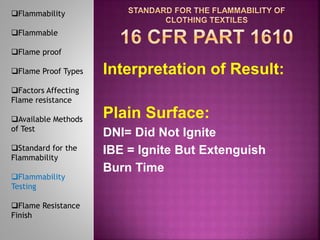
Interpretation of Result:
Plain Surface:
DNI= Did Not Ignite
IBE = Ignite But Extenguish
Burn Time
Flammability
Flammable
Flame proof
Flame Proof Types
Factors Affecting
Flame resistance
Available Methods
of Test
Standard for the
Flammability
Flammability
Testing
Flame Resistance
Finish
Interpretation of Result:
Flammability
Flammable
Flame proof
Flame Proof Types
Factors Affecting
Flame resistance
Available Methods
of Test
Standard for the
Flammability
Flammability
Testing
Flame Resistance
Finish
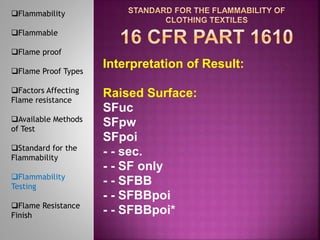
Interpretation of Result:
Raised Surface:
SFuc
SFpw
SFpoi
- - sec.
- - SF only
- - SFBB
- - SFBBpoi
- - SFBBpoi*
Flammability
Flammable
Flame proof
Flame Proof Types
Factors Affecting
Flame resistance
Available Methods
of Test
Standard for the
Flammability
Flammability
Testing
Flame Resistance
Finish
Interpretation of Result:
Flammability
Flammable
Flame proof
Flame Proof Types
Factors Affecting
Flame resistance
Available Methods
of Test
Standard for the
Flammability
Flammability
Testing
Flame Resistance
Finish
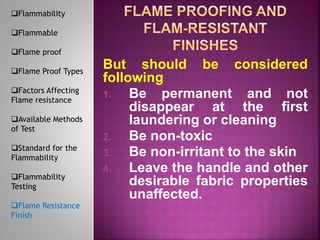
But should be considered
following
1. Be permanent and not
disappear at the first
laundering or cleaning
2. Be non-toxic
3. Be non-irritant to the skin
4. Leave the handle and other
desirable fabric properties
unaffected.
Flammability
Flammable
Flame proof
Flame Proof Types
Factors Affecting
Flame resistance
Available Methods
of Test
Standard for the
Flammability
Flammability
Testing
Flame Resistance
Finish

Flammability testing of clothing

  • 1.
    Flammability is theability of a substance to burn or ignite, causing fire or combustion. The degree of difficulty required to cause the combustion of a substance is quantified through fire testing. Flammability Flammable Flame proof Flame Proof Types Factors Affecting Flame resistance Available Methods of Test Standard for the Flammability Flammability Testing Flame Resistance Finish
  • 2.
    A flammable fabricis one which propagates flame, i.e. it continues to burn after the igniting flame has been removed. Flame Resistance Rating (M): A figure derived from the flammability testing of fabrics and is of the same order as the time in seconds necessary for the propagation of flame 100 inch in a vertical strip. Flammability Flammable Flame proof Flame Proof Types Factors Affecting Flame resistance Available Methods of Test Standard for the Flammability Flammability Testing Flame Resistance Finish
  • 3.
    A flame-proof fabricis one which does not propagate flame, i.e. any flame goes out quickly when the igniting flame is withdrawn. Flame-Resistance: A flame resistant fabric is one whose flame resistance rating is high. Flammability Flammable Flame proof Flame Proof Types Factors Affecting Flame resistance Available Methods of Test Standard for the Flammability Flammability Testing Flame Resistance Finish
  • 4.
    Inherently Flame-proof Material:Material which, although not submitted to a flame- proofing process, in flame proof. Durably Flame-proof Material: A flame- proof material which, after being submitted to a washing treatment, remains flame proof. Temporarily Flame-proof Material: Material which complies with the standard requirement, before, but not after, the prescribed washing treatment. Flammability Flammable Flame proof Flame Proof Types Factors Affecting Flame resistance Available Methods of Test Standard for the Flammability Flammability Testing Flame Resistance Finish
  • 5.
    Fibre content Types ofYarn Fabric Structure Fabric weight Flammability Flammable Flame proof Flame Proof Types Factors Affecting Flame resistance Available Methods of Test Standard for the Flammability Flammability Testing Flame Resistance Finish
  • 6.
    The Visual TimingTest (Here the rate of flame spread is determined over fabric suspended vertically) The 45 Test(The time, t for the flame to travel 5 inch over fabric sloping at an angle of 45 degree is measured in seconds. The flame resistance rating, M, is then given by 2.5 * t) The Hoop Test(The rate of flame spread is determined over the fabric mounted on a semicircular frame) Flammability Flammable Flame proof Flame Proof Types Factors Affecting Flame resistance Available Methods of Test Standard for the Flammability Flammability Testing Flame Resistance Finish
  • 7.
    Consumer Product Safety Commissionis amending its flammability standard for general wearing apparel, the Standard for the Flammability of Clothing Textiles, 16 CFR part 1610. The Standard, originally issued in 1953, has become outdated in several respects. The revisions better reflect current consumer practices and technologies and clarify several aspects of the Standard. Flammability Flammable Flame proof Flame Proof Types Factors Affecting Flame resistance Available Methods of Test Standard for the Flammability Flammability Testing Flame Resistance Finish
  • 8.
    Exemption of Testing: PlainSurface Raised Surface Note: Acrylic, Modacrylic, Nylon, Olefin, Polyester, Wool 2.6 oz/sq.yards Flammability Flammable Flame proof Flame Proof Types Factors Affecting Flame resistance Available Methods of Test Standard for the Flammability Flammability Testing Flame Resistance Finish
  • 9.
    Procedure of Testing: Refurbishing:5 Specimen Original: 5 Specimen Preliminary Test: Direction finding Specimen: 6” * 2” Brushing: 45 degree Sensor 1sec, 16 mm flame length Flammability Flammable Flame proof Flame Proof Types Factors Affecting Flame resistance Available Methods of Test Standard for the Flammability Flammability Testing Flame Resistance Finish
  • 10.
    Interpretation of Result: ForPlain Surface & For Raised Surface Class 1: Normal Flammability: Class 2: Intermediate Flammability: Class 3: Rapid and Intense Burning Flammability Flammable Flame proof Flame Proof Types Factors Affecting Flame resistance Available Methods of Test Standard for the Flammability Flammability Testing Flame Resistance Finish
  • 11.
    Interpretation of Result: PlainSurface: DNI= Did Not Ignite IBE = Ignite But Extenguish Burn Time Flammability Flammable Flame proof Flame Proof Types Factors Affecting Flame resistance Available Methods of Test Standard for the Flammability Flammability Testing Flame Resistance Finish
  • 12.
    Interpretation of Result: Flammability Flammable Flameproof Flame Proof Types Factors Affecting Flame resistance Available Methods of Test Standard for the Flammability Flammability Testing Flame Resistance Finish
  • 13.
    Interpretation of Result: RaisedSurface: SFuc SFpw SFpoi - - sec. - - SF only - - SFBB - - SFBBpoi - - SFBBpoi* Flammability Flammable Flame proof Flame Proof Types Factors Affecting Flame resistance Available Methods of Test Standard for the Flammability Flammability Testing Flame Resistance Finish
  • 14.
    Interpretation of Result: Flammability Flammable Flameproof Flame Proof Types Factors Affecting Flame resistance Available Methods of Test Standard for the Flammability Flammability Testing Flame Resistance Finish
  • 15.
    But should beconsidered following 1. Be permanent and not disappear at the first laundering or cleaning 2. Be non-toxic 3. Be non-irritant to the skin 4. Leave the handle and other desirable fabric properties unaffected. Flammability Flammable Flame proof Flame Proof Types Factors Affecting Flame resistance Available Methods of Test Standard for the Flammability Flammability Testing Flame Resistance Finish