Standardisation in Media Formats


                               FITT
 – Fostering Interregional Exchange in ICT Technology Transfer –


                                      www.FITT-for-Innovation.eu
     Except where otherwise noted, this work is licensed under a Creative Commons Attribution 3.0 License.
Standardisation in Multimedia


  Standardisation is a strategic process in the technological evolution
   and commercialisation of ICT software and hardware. Therefore it is
   important that there is in a very early stage of the technology a close
   collaboration between the research community, the industry and
   policy makers to converge this process within the standardisation
   bodies.
  Nature of reusability: Standardisation in Multimedia is exemplary for
   this process in other domains
  Case is mostly generic
  Quality/Nature of stakeholders: Research institutes, industry, policy,
   Standardisation bodies
  Processes related to case: IP management, standardisation


2 | 03/2011                 Standardisation in Media Formats
Standardisation
Processes in Multimedia
     Peter Schelkens

     Interdisciplinary Institute for Broadband Technology &
     Vrije Universiteit Brussel
     Department of Electronics and Informatics (ETRO)
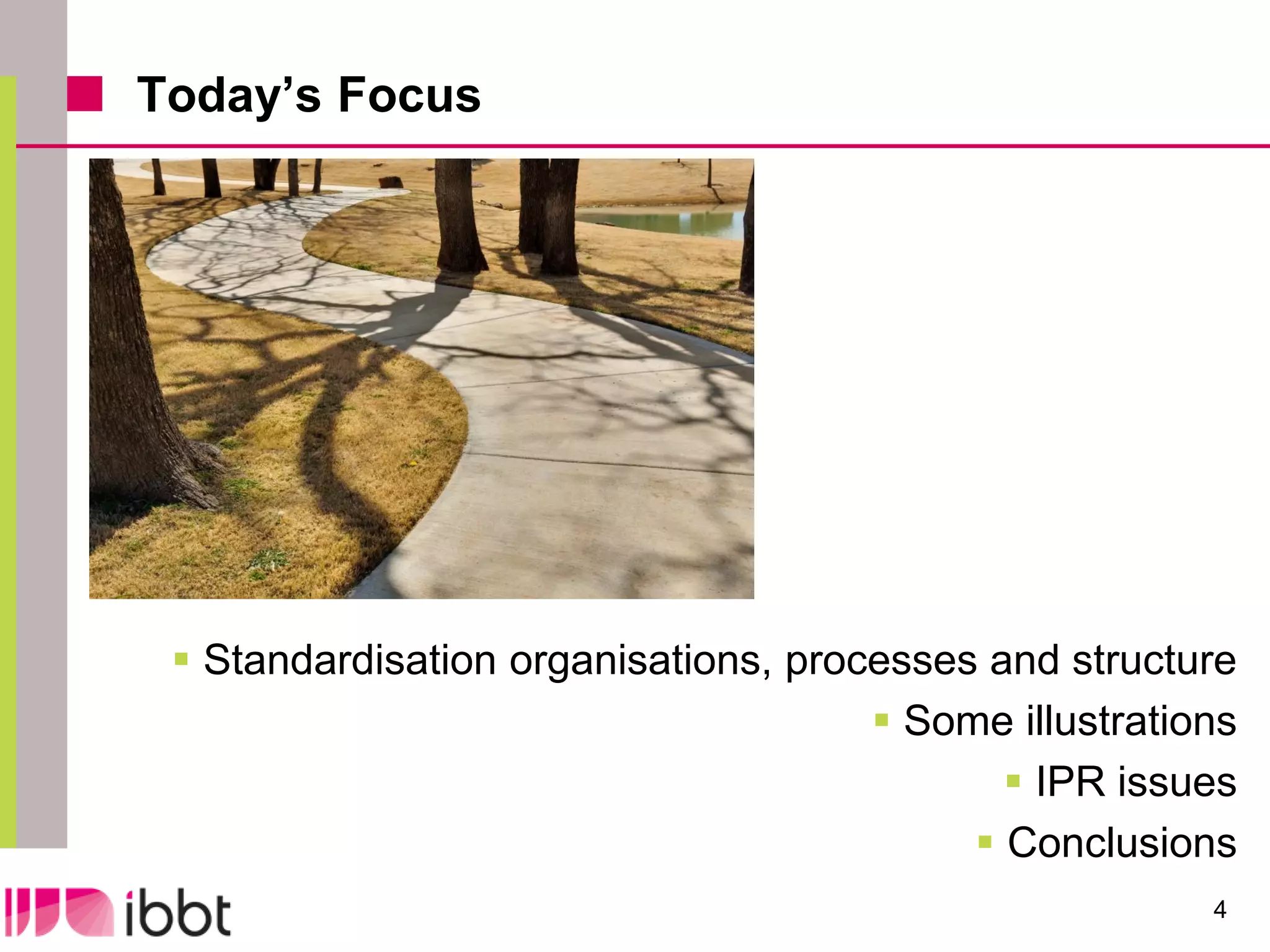
Today’s Focus


  Standardisation organisations, processes and structure
                                       Some illustrations
                                              IPR issues
                                            Conclusions
                                                        4
Today’s Focus


  Standardisation organisations, processes and structure
                                       Some illustrations
                                             IPR Issues
                                            Conclusions
                                                        5
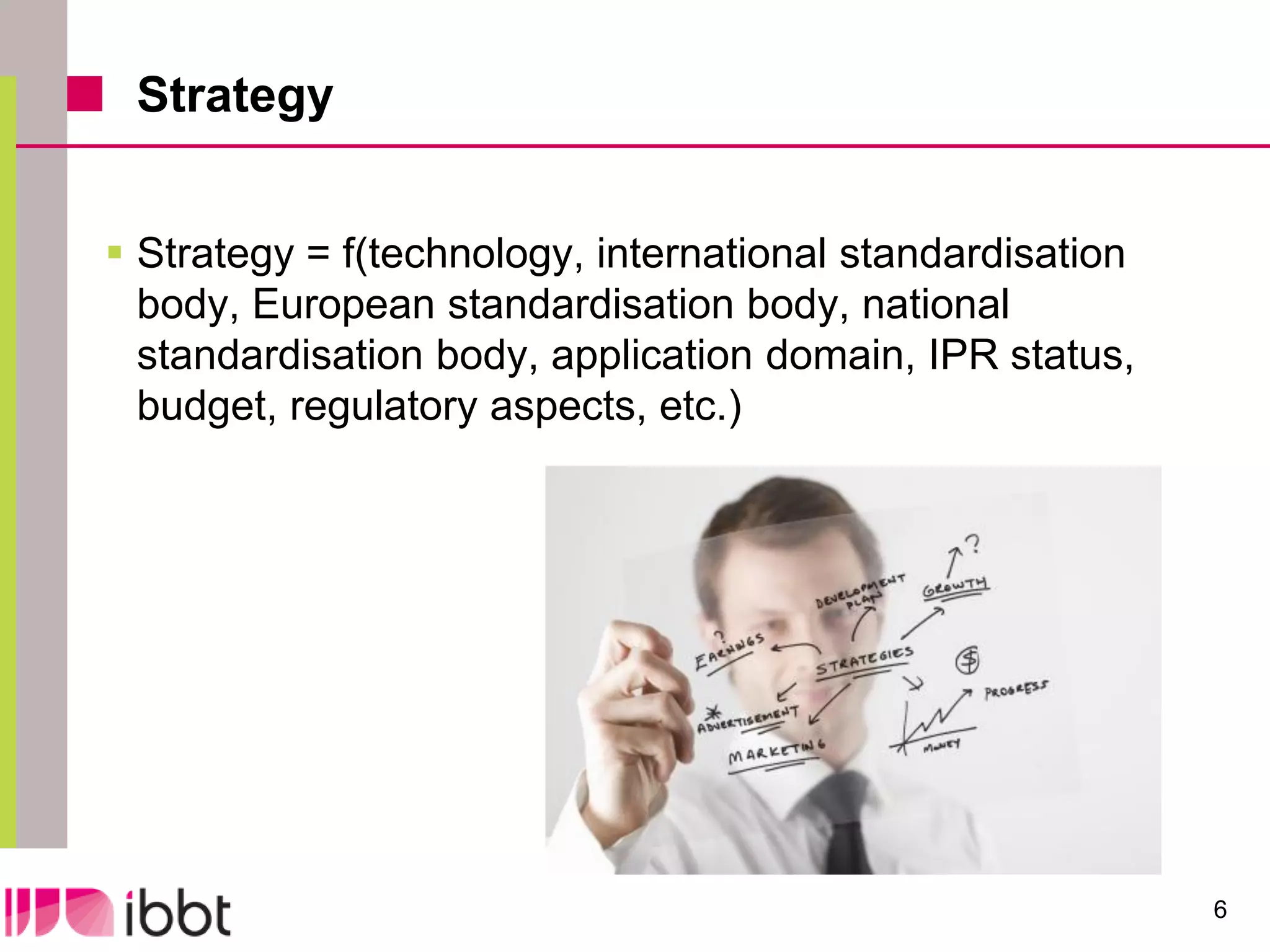
Strategy


 Strategy = f(technology, international standardisation
  body, European standardisation body, national
  standardisation body, application domain, IPR status,
  budget, regulatory aspects, etc.)


                                                           6
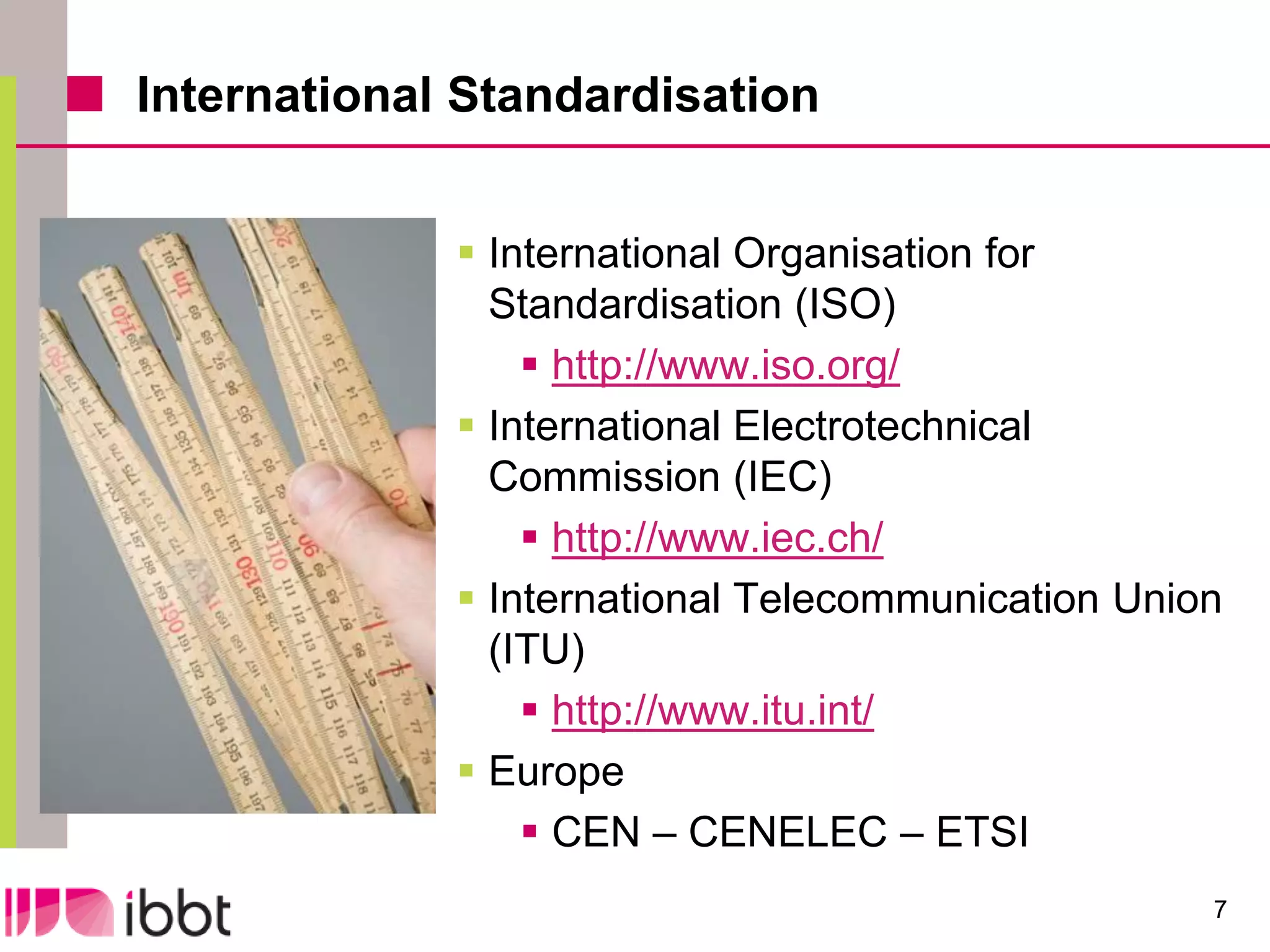
International Standardisation


              International Organisation for
               Standardisation (ISO)
                  http://www.iso.org/
              International Electrotechnical
               Commission (IEC)
                  http://www.iec.ch/
              International Telecommunication Union
               (ITU)
                  http://www.itu.int/
              Europe
                  CEN – CENELEC – ETSI
                                                   7
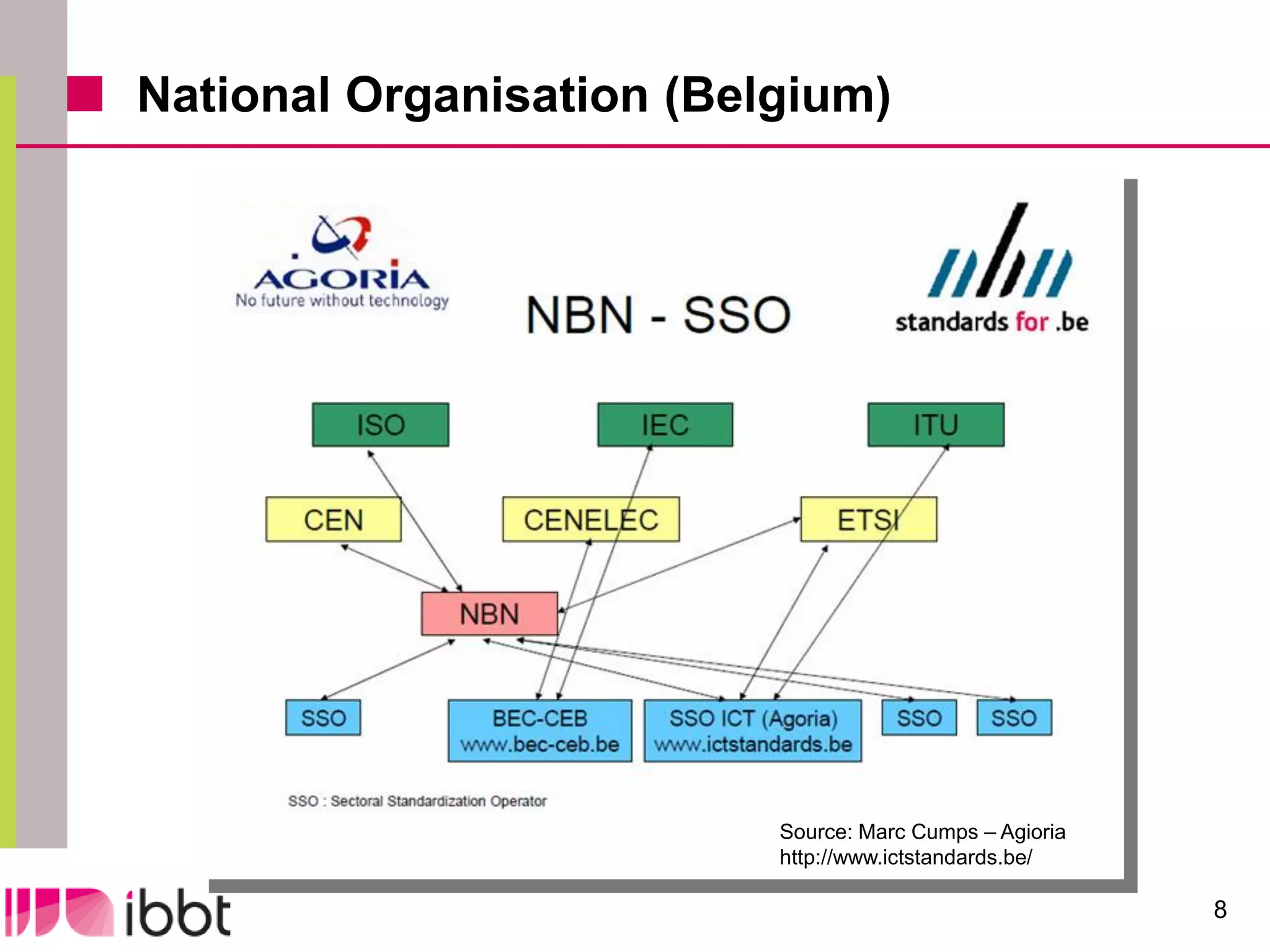
National Organisation (Belgium)


                          Source: Marc Cumps – Agioria
                          http://www.ictstandards.be/

                                                         8
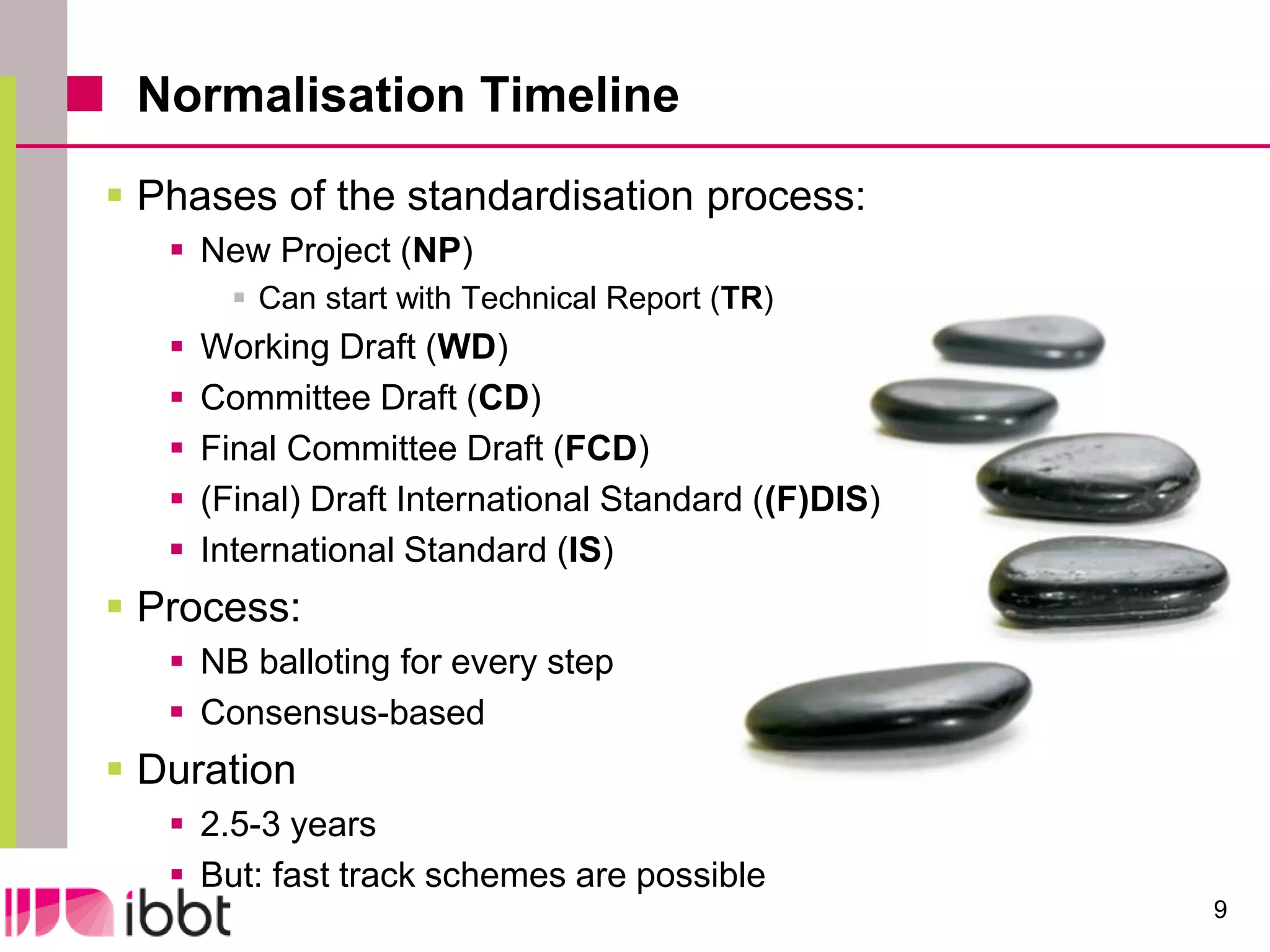
Normalisation Timeline
 Phases of the standardisation process:
    New Project (NP)
          Can start with Technical Report (TR)
      Working Draft (WD)
      Committee Draft (CD)
      Final Committee Draft (FCD)
      (Final) Draft International Standard ((F)DIS)
      International Standard (IS)
 Process:
    NB balloting for every step
    Consensus-based
 Duration
    2.5-3 years
    But: fast track schemes are possible
                                                       9
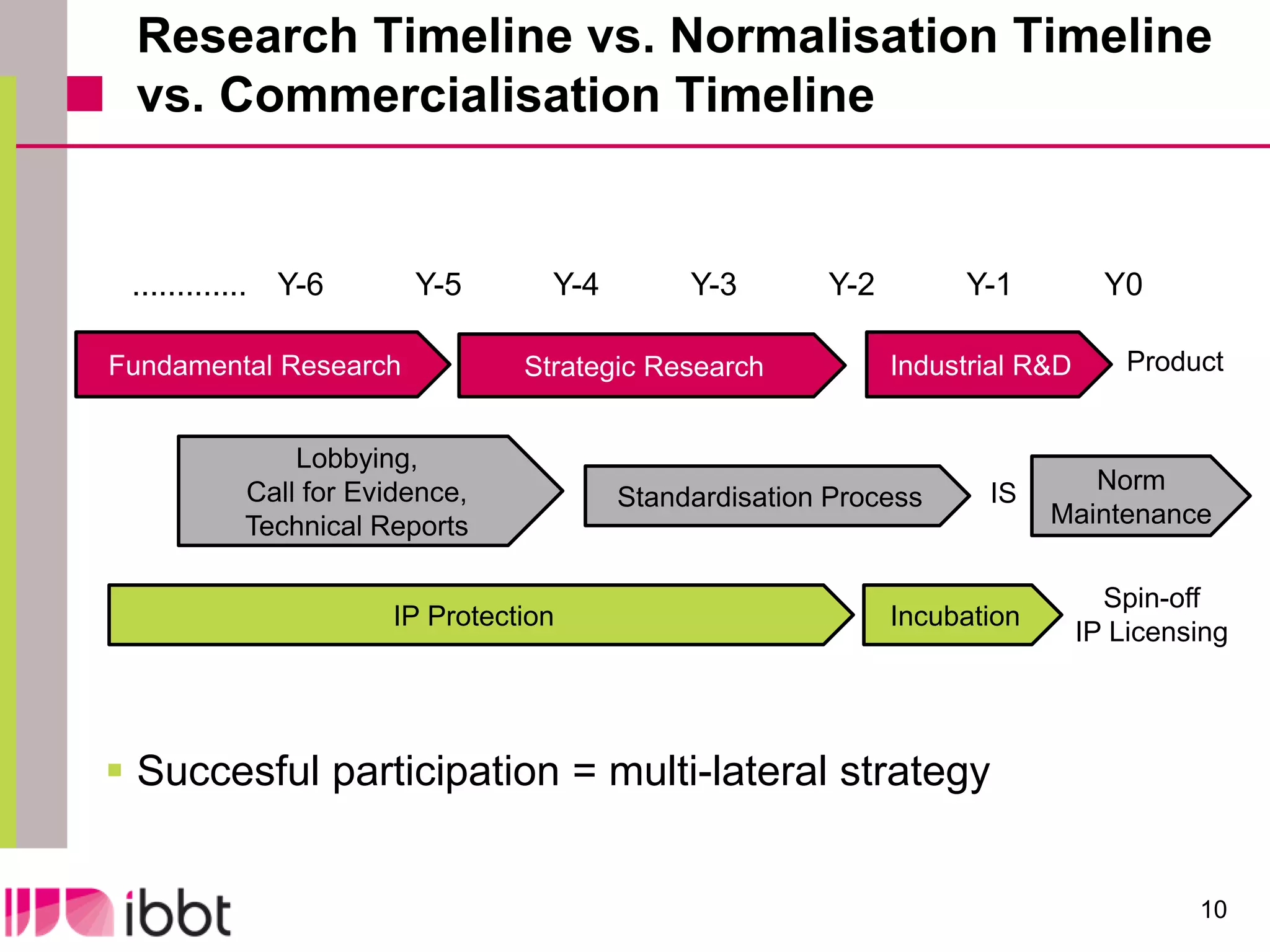
Research Timeline vs. Normalisation Timeline
 vs. Commercialisation Timeline


 ............. Y-6      Y-5       Y-4        Y-3       Y-2        Y-1           Y0

Fundamental Research            Strategic Research           Industrial R&D       Product


               Lobbying,
           Call for Evidence,                                       IS       Norm
                                        Standardisation Process
           Technical Reports                                              Maintenance

                                                                                Spin-off
                      IP Protection                          Incubation
                                                                              IP Licensing


 Succesful participation = multi-lateral strategy


                                                                                       10
Today’s Focus


  Standardisation organisations, processes and structure
                                       Some illustrations
                                             IPR Issues
                                            Conclusions
                                                        11
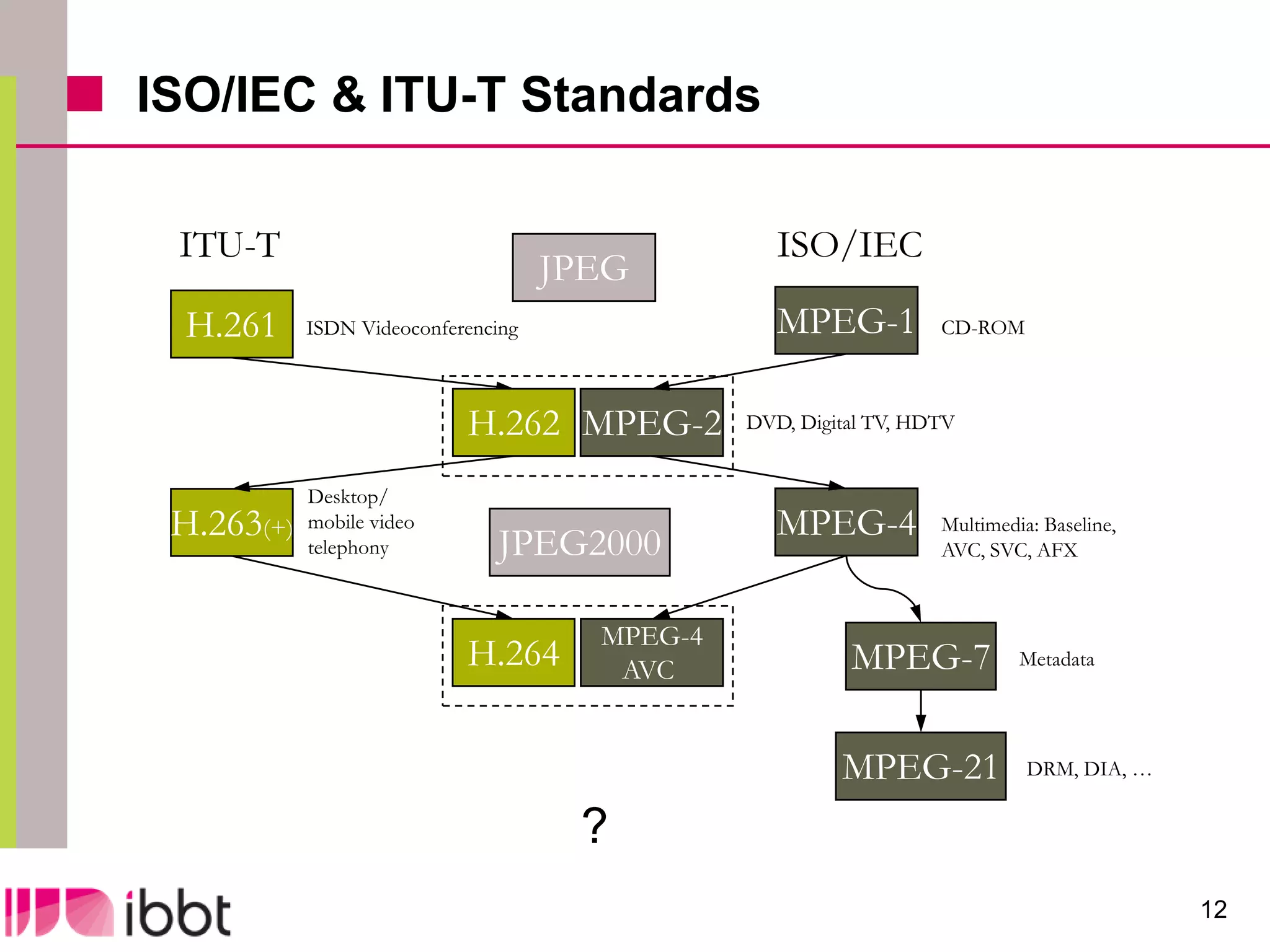
ISO/IEC & ITU-T Standards

 ITU-T                                              ISO/IEC
                                      JPEG
 H.261       ISDN Videoconferencing                 MPEG-1          CD-ROM


                             H.262 MPEG-2        DVD, Digital TV, HDTV


             Desktop/
 H.263   (+) mobile video                           MPEG-4          Multimedia: Baseline,
             telephony          JPEG2000                            AVC, SVC, AFX


                                        MPEG-4
                             H.264       AVC               MPEG-7            Metadata


                                                          MPEG-21             DRM, DIA, …


                                       ?
                                                                                            12
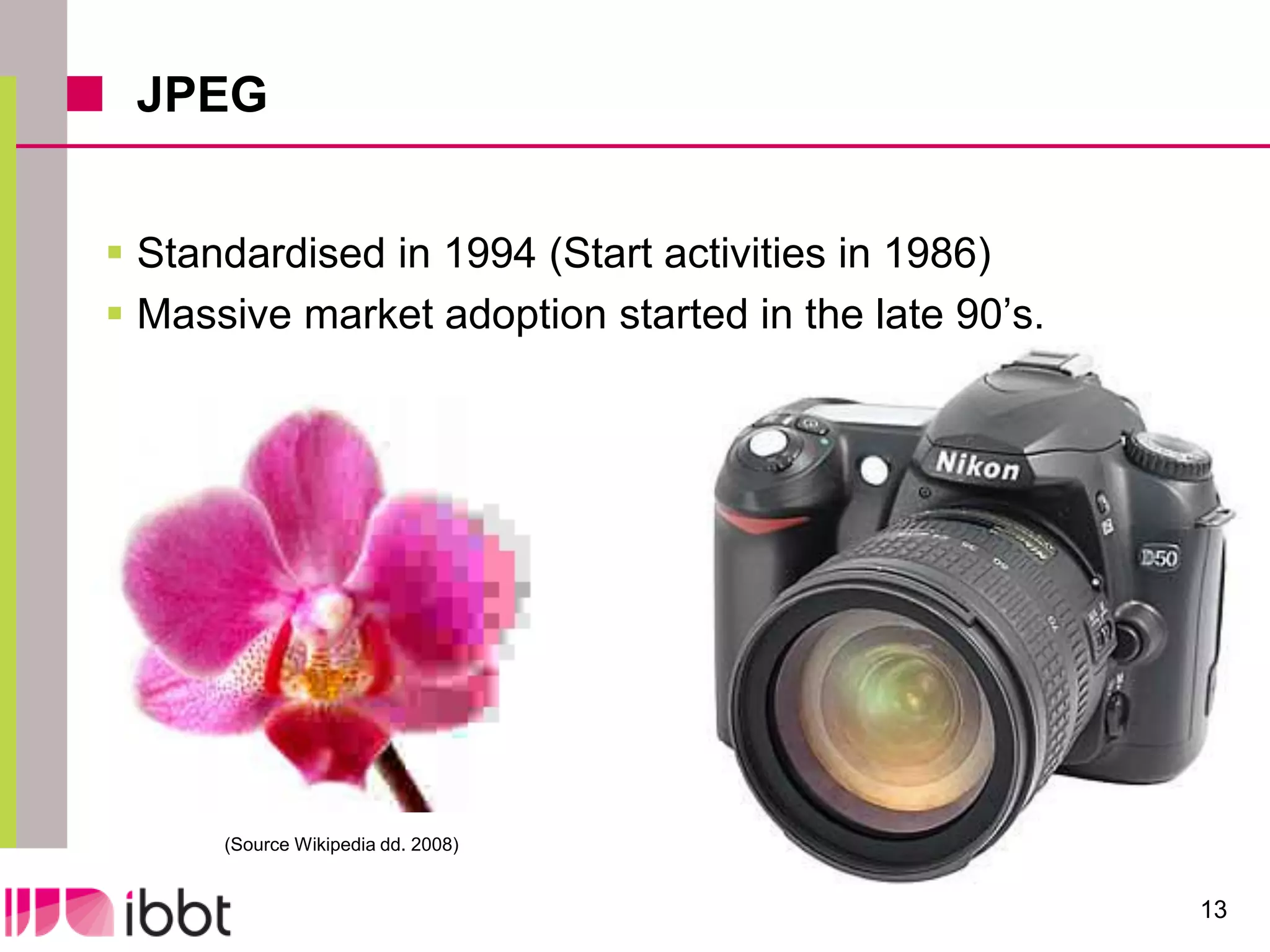
JPEG


 Standardised in 1994 (Start activities in 1986)
 Massive market adoption started in the late 90’s.


      (Source Wikipedia dd. 2008)


                                                      13
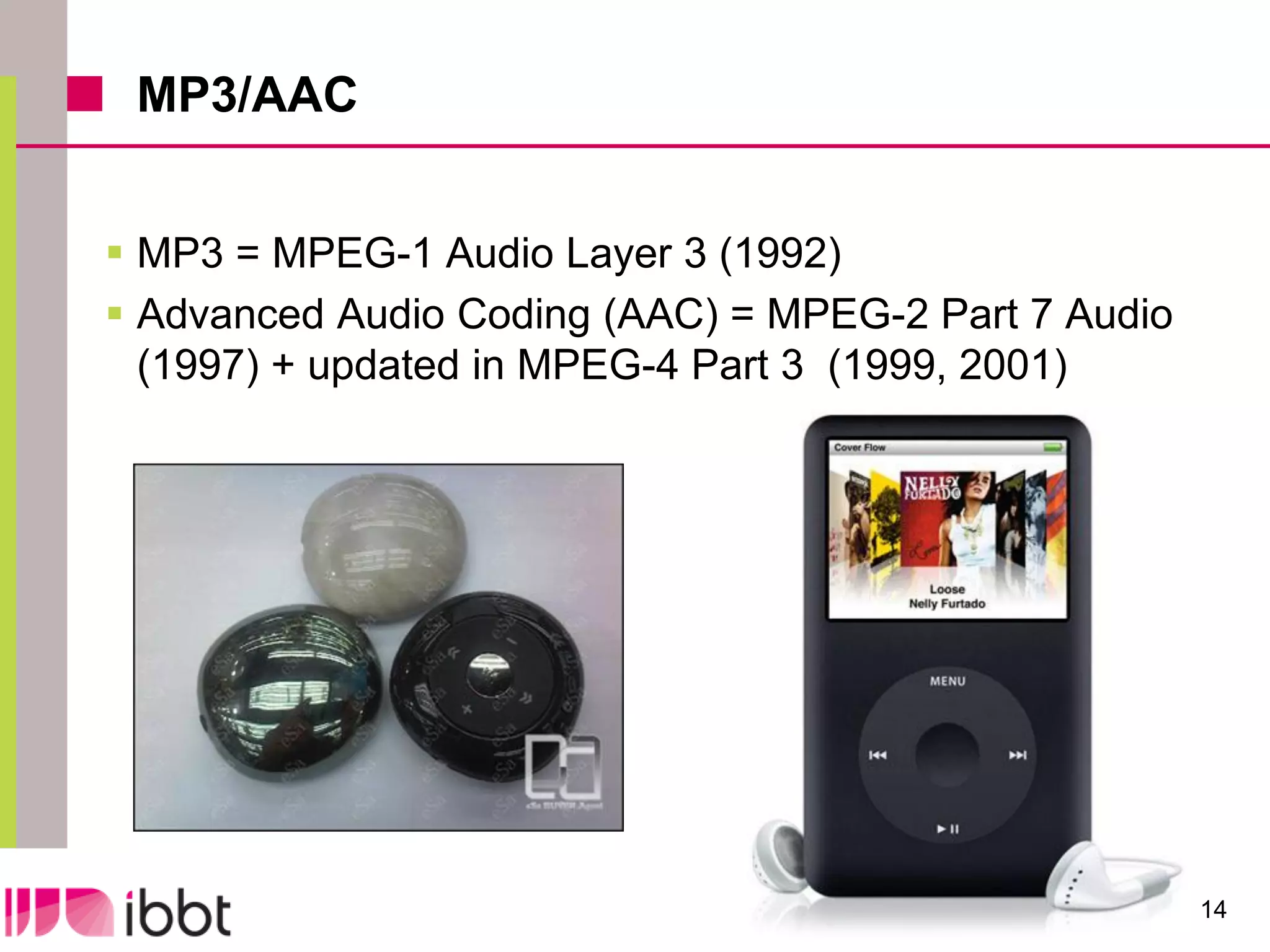
MP3/AAC


 MP3 = MPEG-1 Audio Layer 3 (1992)
 Advanced Audio Coding (AAC) = MPEG-2 Part 7 Audio
  (1997) + updated in MPEG-4 Part 3 (1999, 2001)


                                                      14
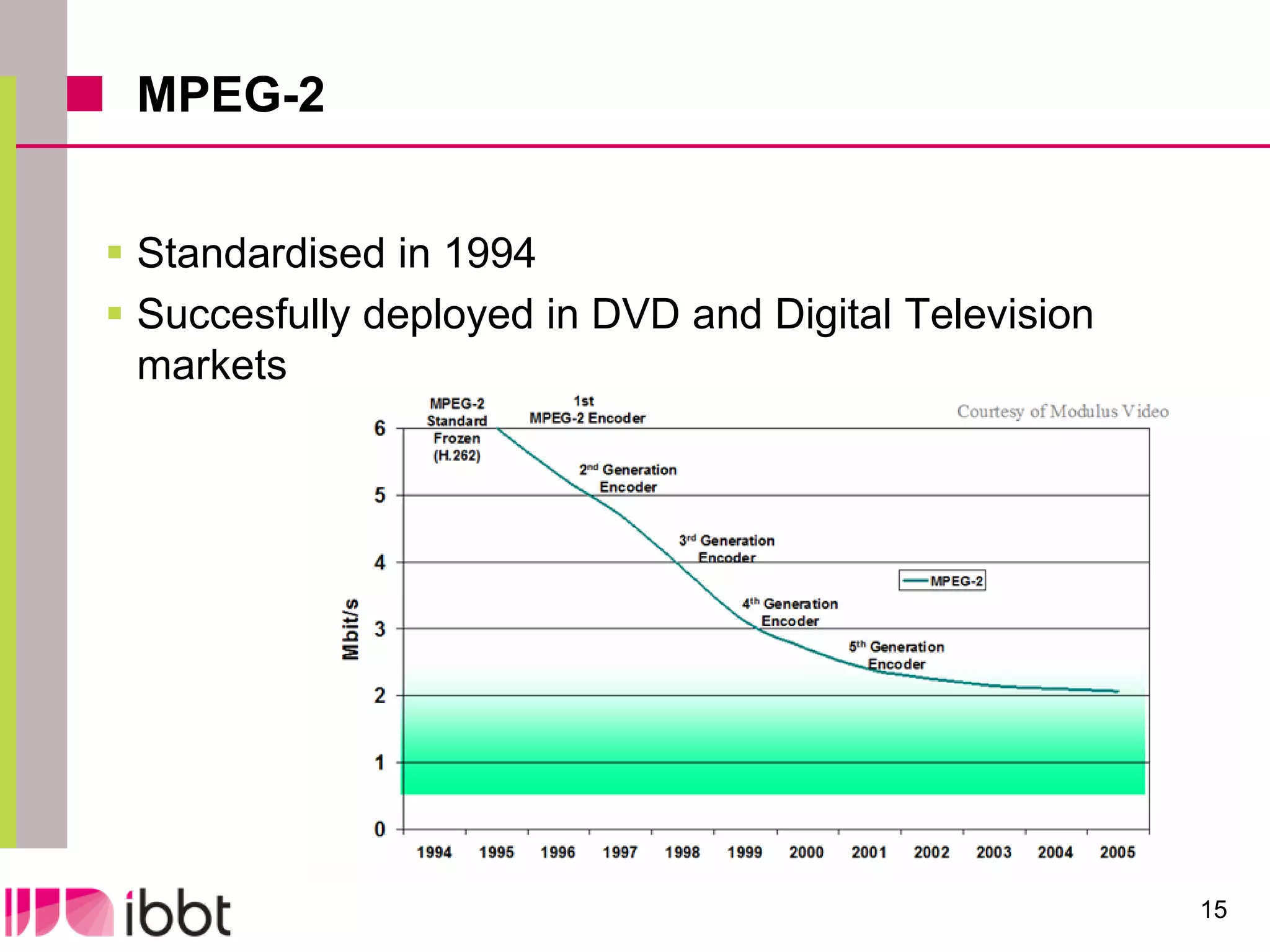
MPEG-2


 Standardised in 1994
 Succesfully deployed in DVD and Digital Television
  markets


                                                       15
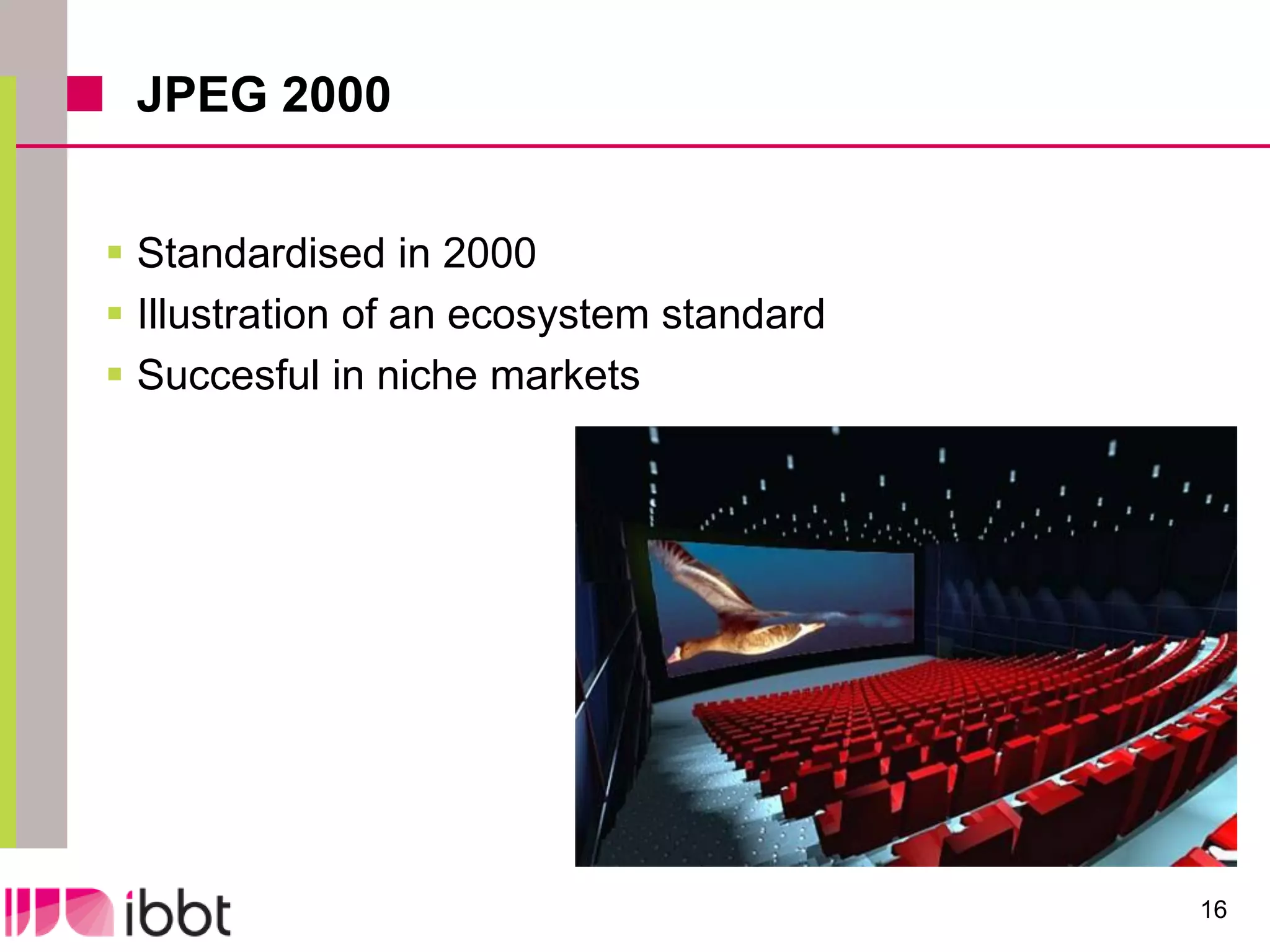
JPEG 2000


 Standardised in 2000
 Illustration of an ecosystem standard
 Succesful in niche markets


                                          16
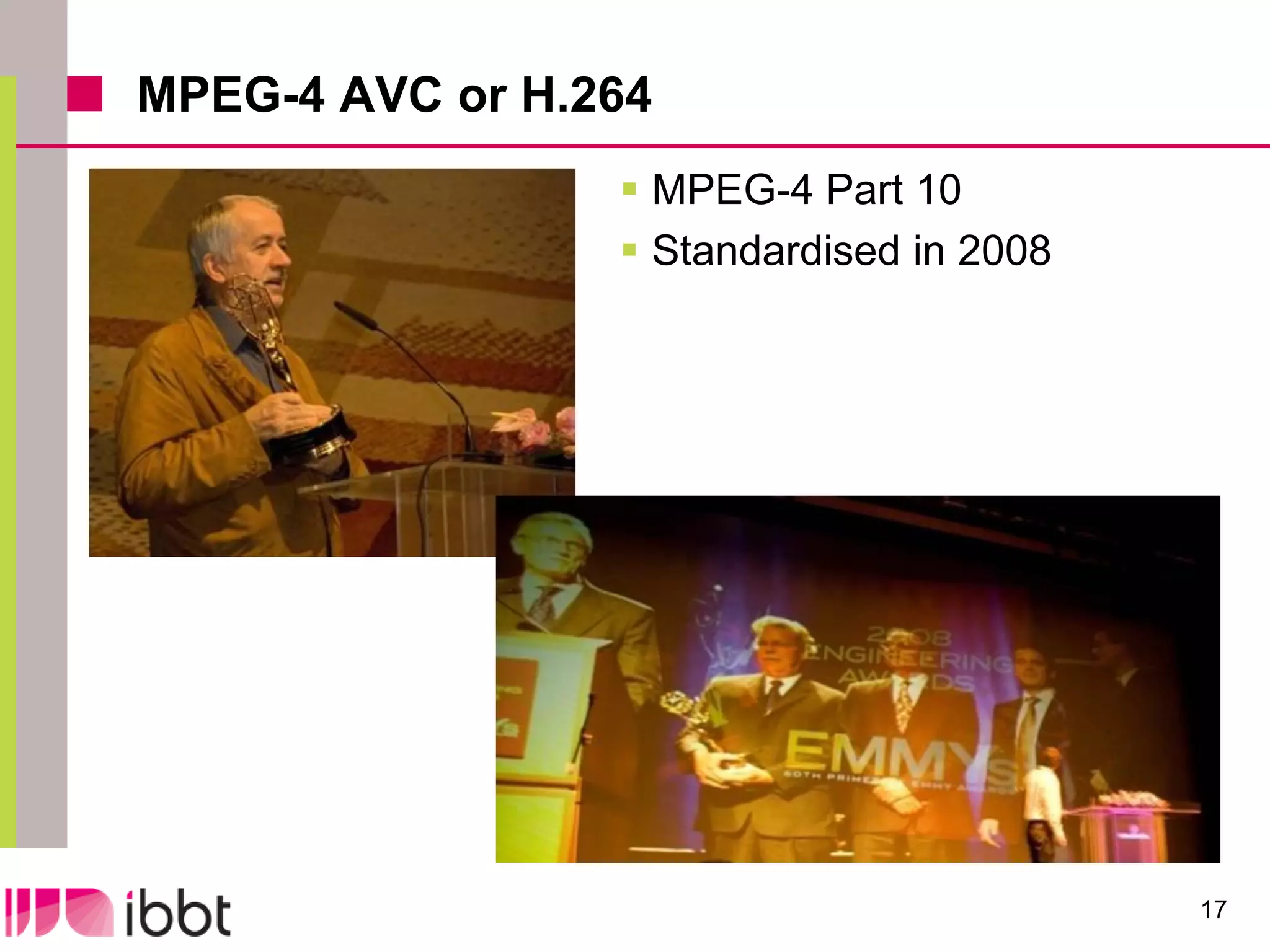
MPEG-4 AVC or H.264
                  MPEG-4 Part 10
                  Standardised in 2008


                                          17
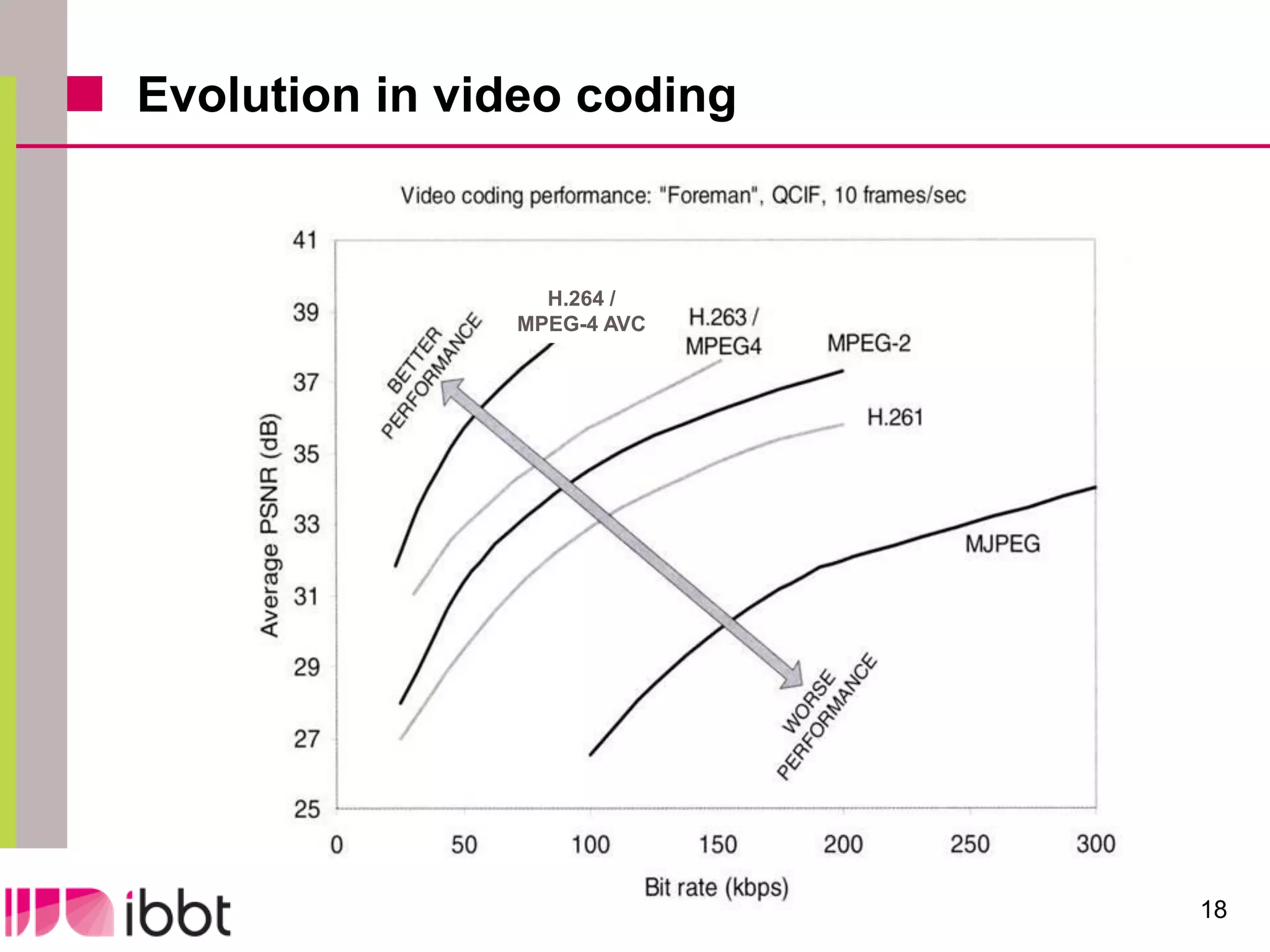
Evolution in video coding


                 H.264 /
               MPEG-4 AVC


                            18
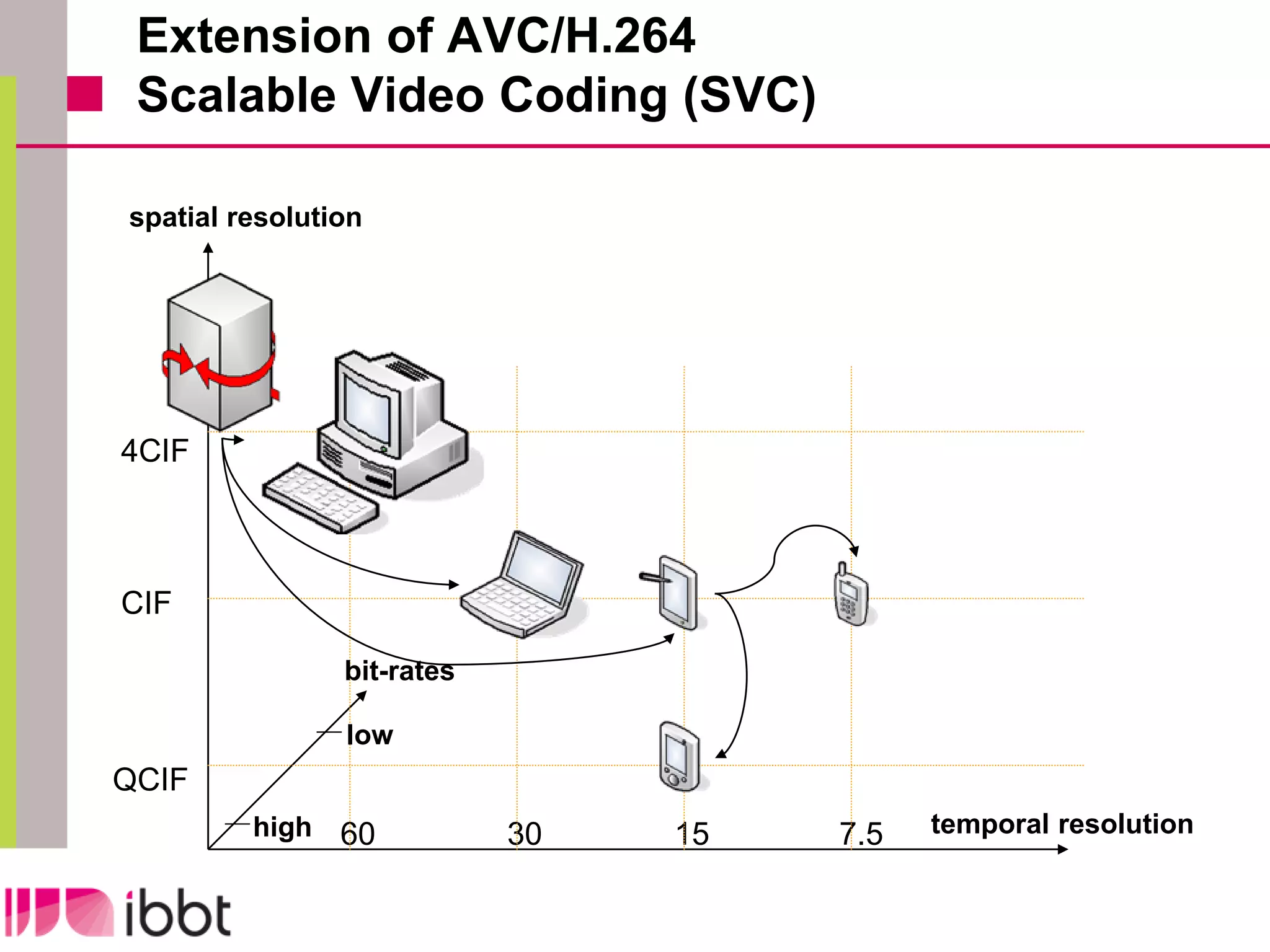
Extension of AVC/H.264
 Scalable Video Coding (SVC)

spatial resolution


4CIF


CIF

                bit-rates

                low
QCIF
         high   60          30   15   7.5   temporal resolution
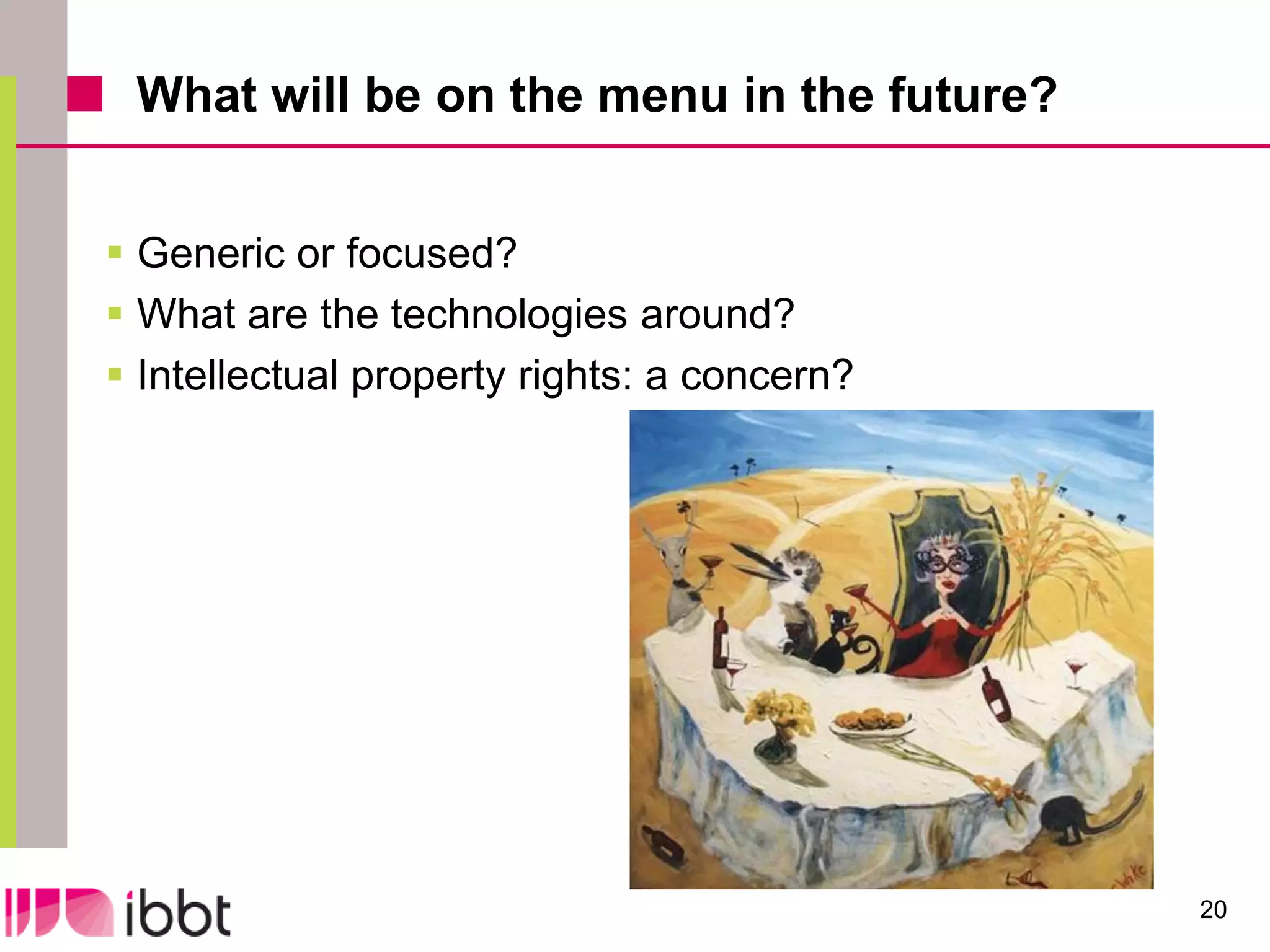
What will be on the menu in the future?


 Generic or focused?
 What are the technologies around?
 Intellectual property rights: a concern?


                                             20
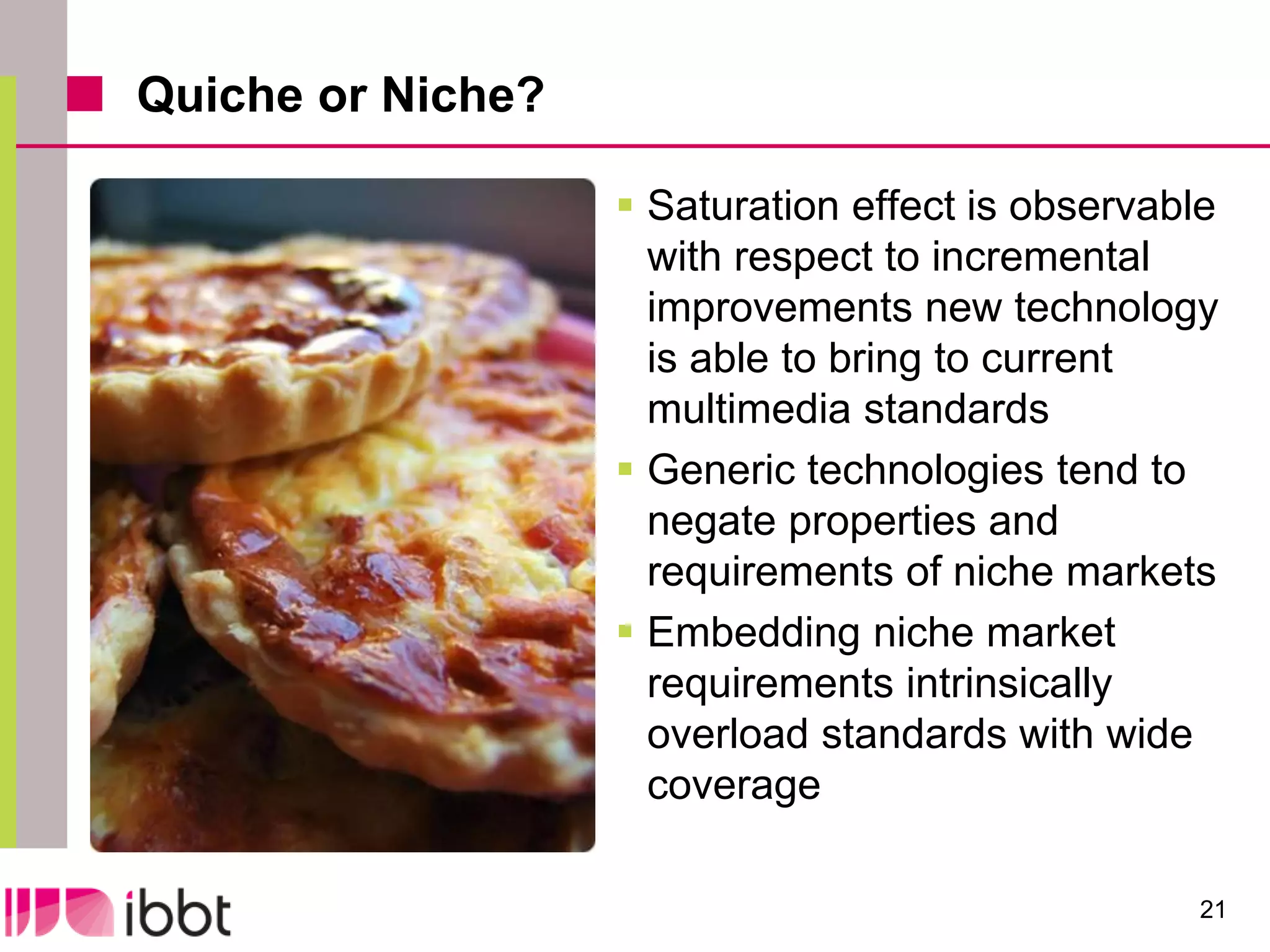
Quiche or Niche?

                    Saturation effect is observable
                     with respect to incremental
                     improvements new technology
                     is able to bring to current
                     multimedia standards
                    Generic technologies tend to
                     negate properties and
                     requirements of niche markets
                    Embedding niche market
                     requirements intrinsically
                     overload standards with wide
                     coverage

                                                  21
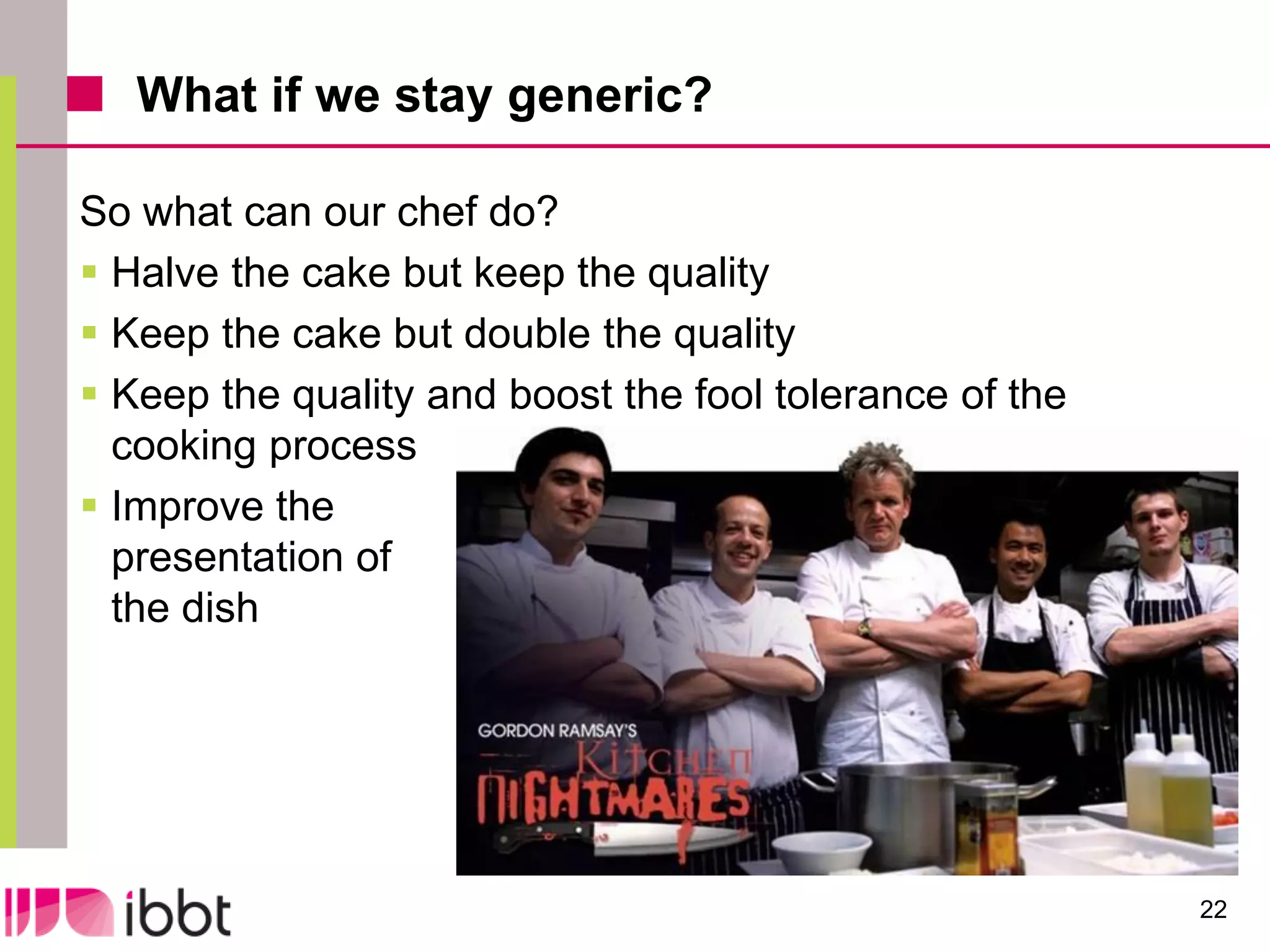
What if we stay generic?

So what can our chef do?
 Halve the cake but keep the quality
 Keep the cake but double the quality
 Keep the quality and boost the fool tolerance of the
  cooking process
 Improve the
  presentation of
  the dish


                                                         22
This is the recepie for ITU-T’s H.265 (1/2)


 Focus on “Less is more”


                                               23
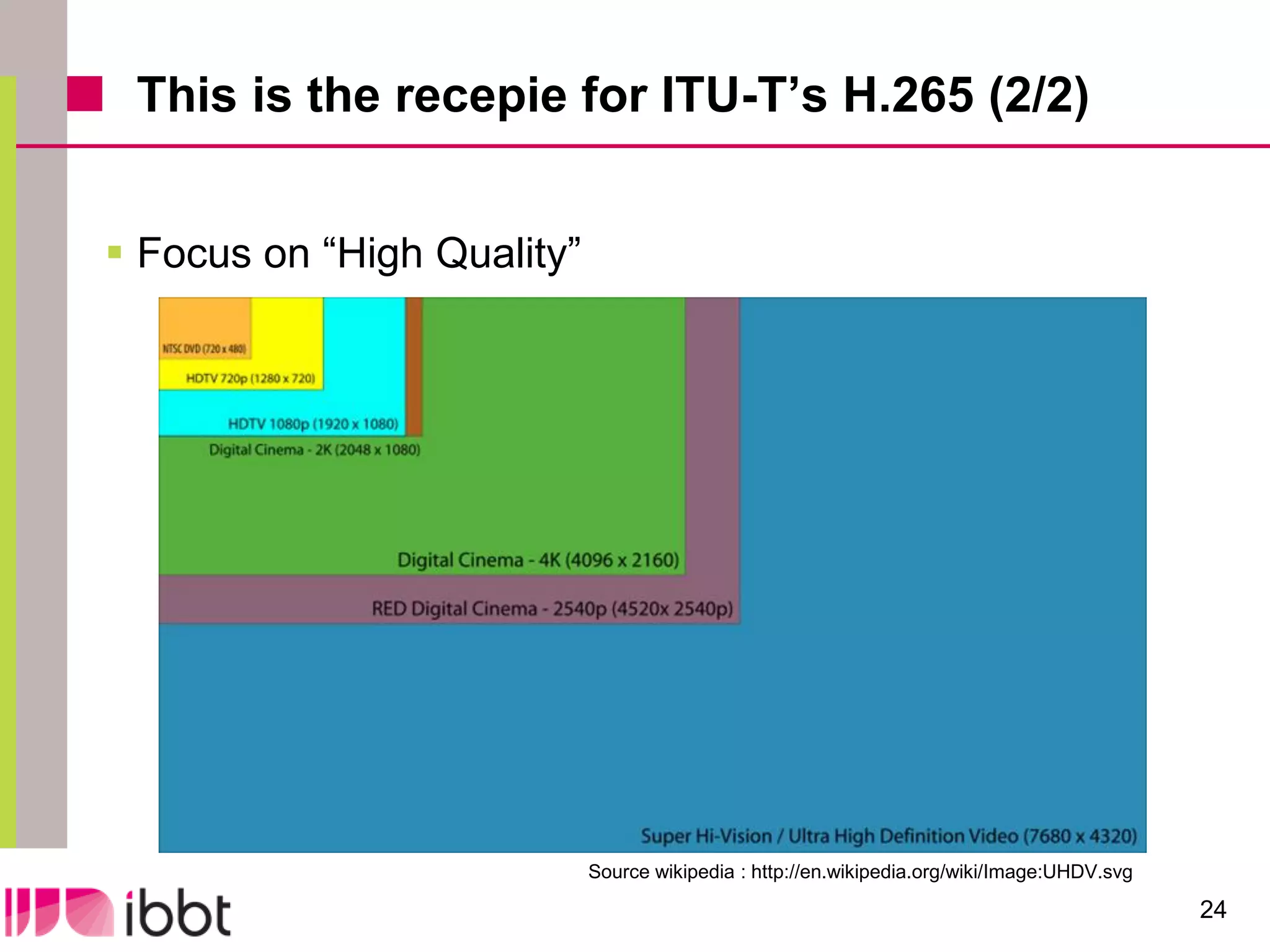
This is the recepie for ITU-T’s H.265 (2/2)


 Focus on “High Quality”


                            Source wikipedia : http://en.wikipedia.org/wiki/Image:UHDV.svg

                                                                                             24
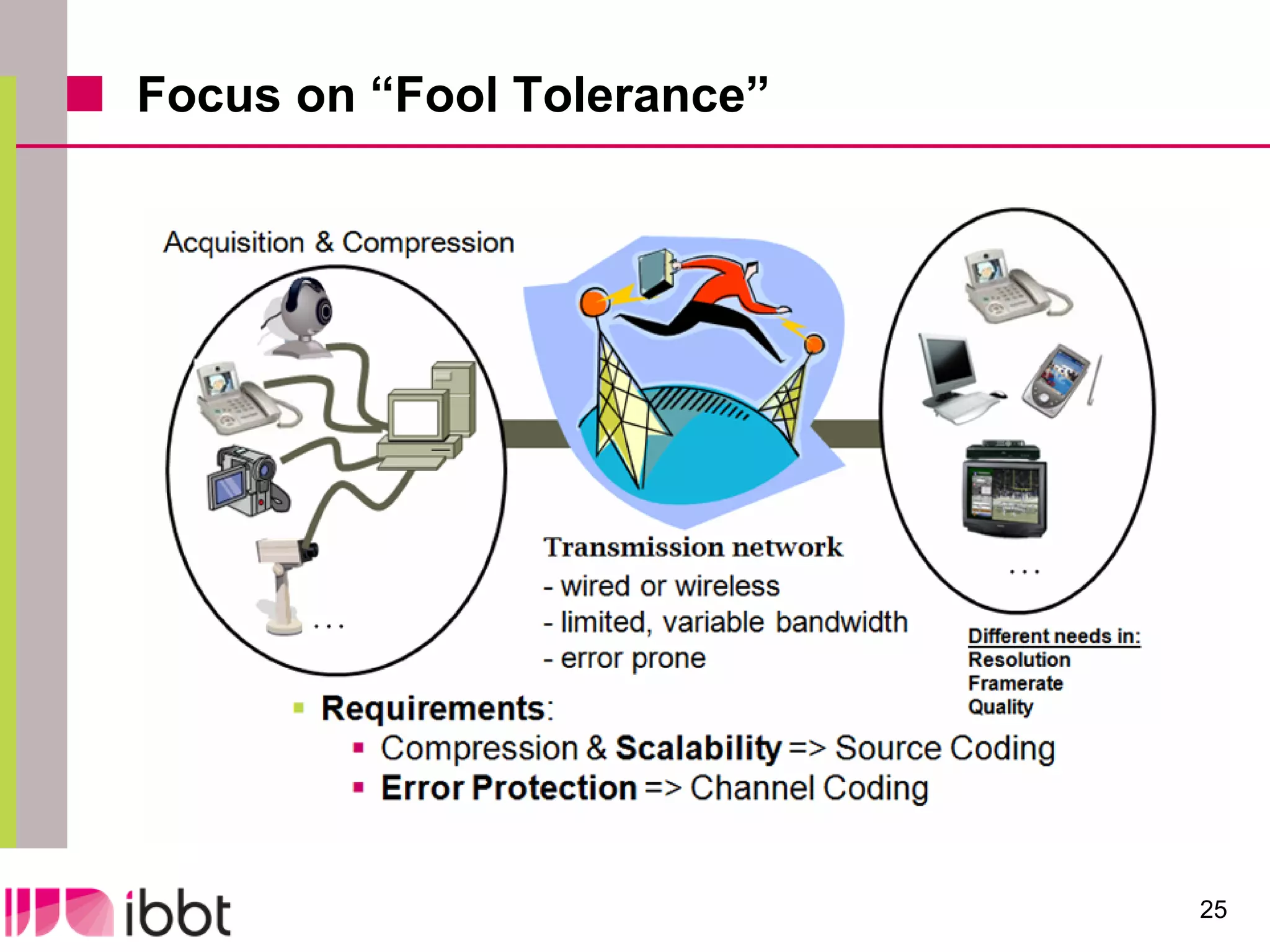
Focus on “Fool Tolerance”


                            25
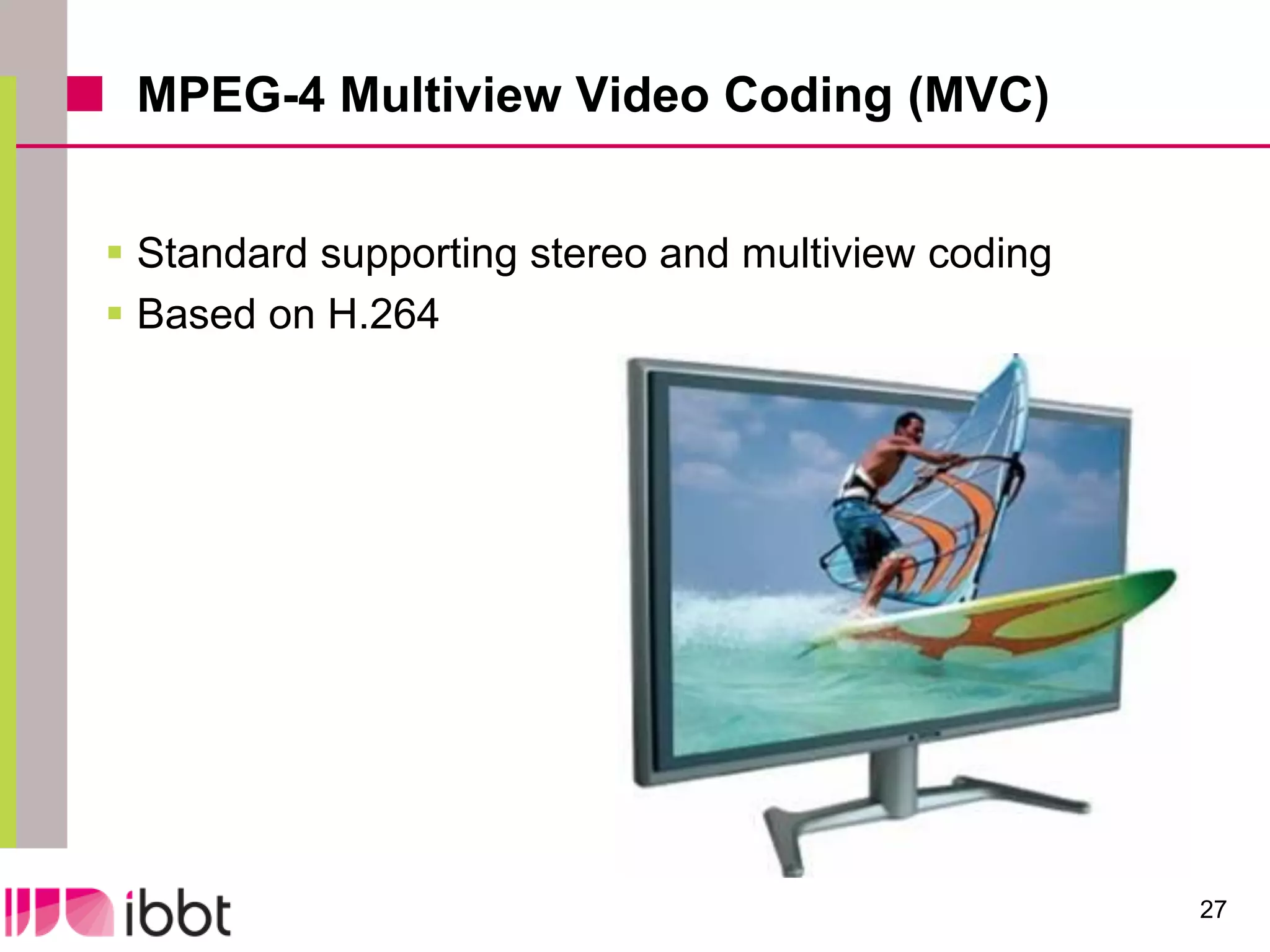
MPEG-4 Multiview Video Coding (MVC)


 Standard supporting stereo and multiview coding
 Based on H.264


                                                    27
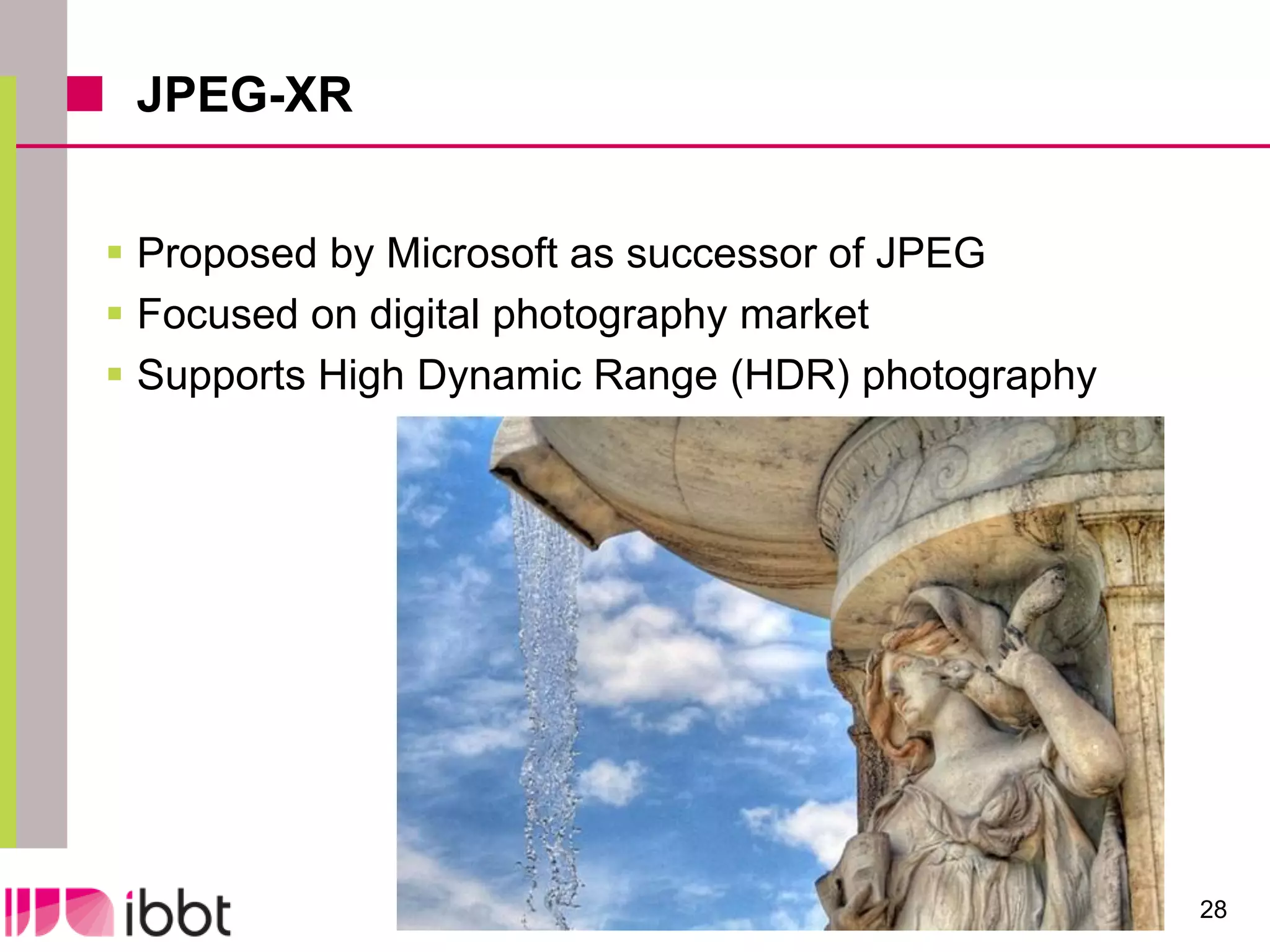
JPEG-XR


 Proposed by Microsoft as successor of JPEG
 Focused on digital photography market
 Supports High Dynamic Range (HDR) photography


                                                  28
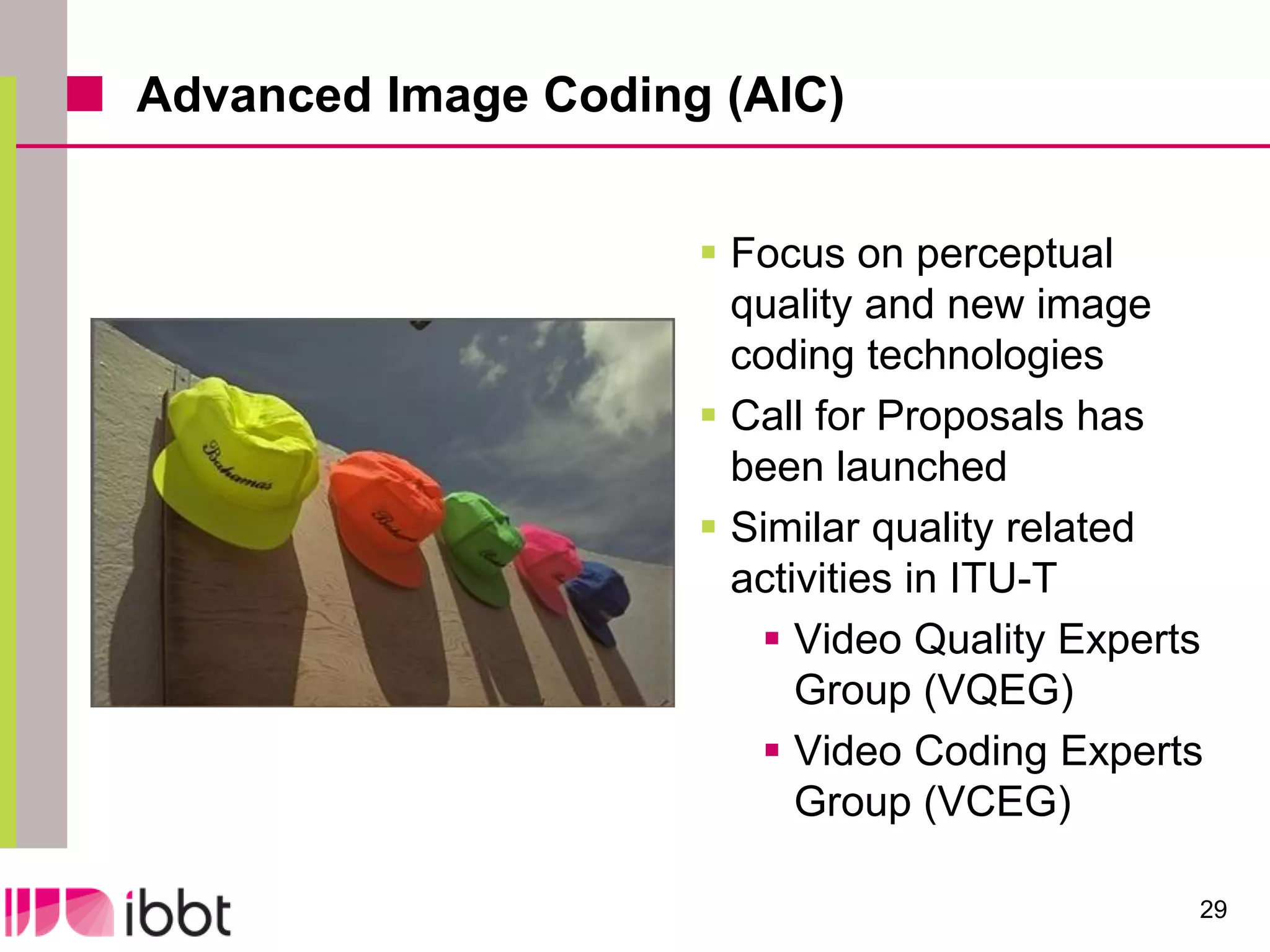
Advanced Image Coding (AIC)


                      Focus on perceptual
                       quality and new image
                       coding technologies
                      Call for Proposals has
                       been launched
                      Similar quality related
                       activities in ITU-T
                         Video Quality Experts
                           Group (VQEG)
                         Video Coding Experts
                           Group (VCEG)

                                              29
Today’s Focus


  Standardisation organisations, processes and structure
                                       Some illustrations
                                             IPR Issues
                                            Conclusions
                                                       30
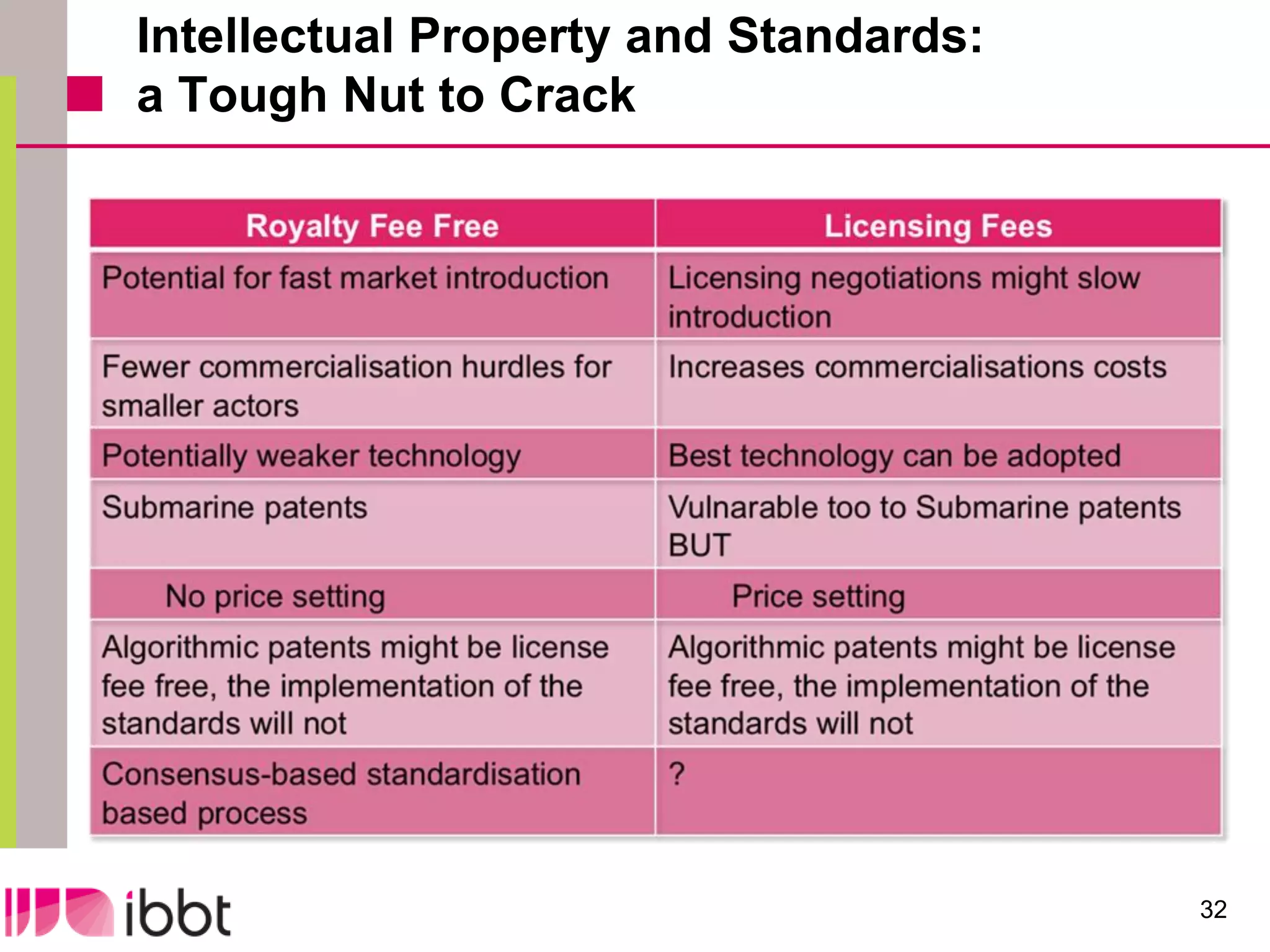
Intellectual Property and Standards:
 a Tough Nut to Crack


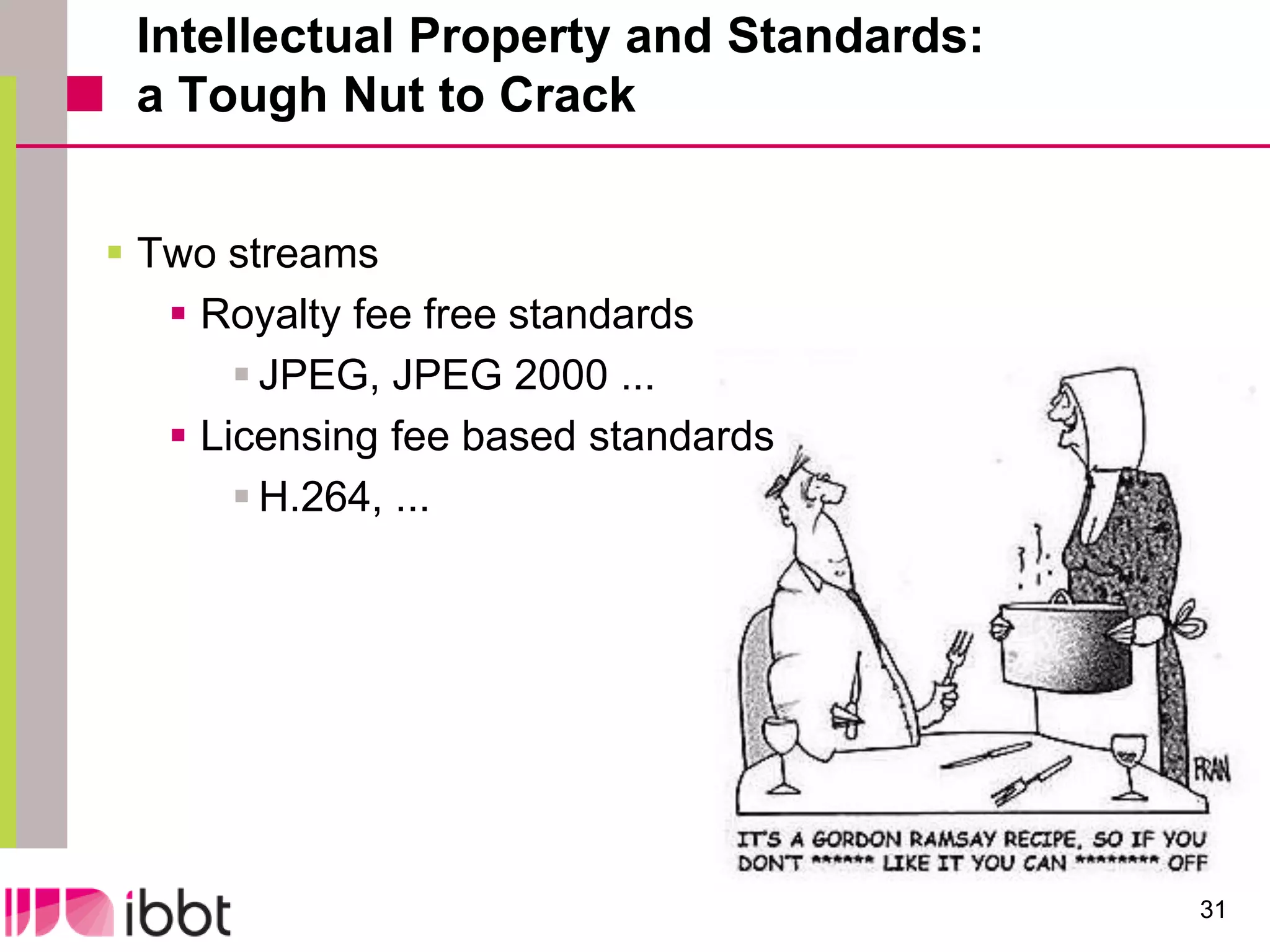
 Two streams
    Royalty fee free standards
        JPEG, JPEG 2000 ...
    Licensing fee based standards
        H.264, ...


                                        31
Intellectual Property and Standards:
a Tough Nut to Crack


                                       32
Today’s Focus


  Standardisation organisations, processes and structure
                                       Some illustrations
                                             IPR Issues
                                            Conclusions
                                                       33
Conclusions


 Strategy = f(technology, international standardisation
  body, European standardisation body, national
  standardisation body, application domain, IPR status,
  budget, regulatory aspects, etc.)
 Be involved!
     You have impact
     Standardisation bodies are an invaluable source of
      information
     But, you have to compose the menu


                                                           34

FITT Toolbox: Standardisation in Media Formats

  • 1.
    Standardisation in MediaFormats FITT – Fostering Interregional Exchange in ICT Technology Transfer – www.FITT-for-Innovation.eu Except where otherwise noted, this work is licensed under a Creative Commons Attribution 3.0 License.
  • 2.
    Standardisation in Multimedia  Standardisation is a strategic process in the technological evolution and commercialisation of ICT software and hardware. Therefore it is important that there is in a very early stage of the technology a close collaboration between the research community, the industry and policy makers to converge this process within the standardisation bodies.  Nature of reusability: Standardisation in Multimedia is exemplary for this process in other domains  Case is mostly generic  Quality/Nature of stakeholders: Research institutes, industry, policy, Standardisation bodies  Processes related to case: IP management, standardisation 2 | 03/2011 Standardisation in Media Formats
  • 3.
    Standardisation Processes in Multimedia Peter Schelkens Interdisciplinary Institute for Broadband Technology & Vrije Universiteit Brussel Department of Electronics and Informatics (ETRO)
  • 4.
    Today’s Focus Standardisation organisations, processes and structure  Some illustrations  IPR issues  Conclusions 4
  • 5.
    Today’s Focus Standardisation organisations, processes and structure  Some illustrations  IPR Issues  Conclusions 5
  • 6.
    Strategy  Strategy =f(technology, international standardisation body, European standardisation body, national standardisation body, application domain, IPR status, budget, regulatory aspects, etc.) 6
  • 7.
    International Standardisation  International Organisation for Standardisation (ISO)  http://www.iso.org/  International Electrotechnical Commission (IEC)  http://www.iec.ch/  International Telecommunication Union (ITU)  http://www.itu.int/  Europe  CEN – CENELEC – ETSI 7
  • 8.
    National Organisation (Belgium) Source: Marc Cumps – Agioria http://www.ictstandards.be/ 8
  • 9.
    Normalisation Timeline  Phasesof the standardisation process:  New Project (NP)  Can start with Technical Report (TR)  Working Draft (WD)  Committee Draft (CD)  Final Committee Draft (FCD)  (Final) Draft International Standard ((F)DIS)  International Standard (IS)  Process:  NB balloting for every step  Consensus-based  Duration  2.5-3 years  But: fast track schemes are possible 9
  • 10.
    Research Timeline vs.Normalisation Timeline vs. Commercialisation Timeline ............. Y-6 Y-5 Y-4 Y-3 Y-2 Y-1 Y0 Fundamental Research Strategic Research Industrial R&D Product Lobbying, Call for Evidence, IS Norm Standardisation Process Technical Reports Maintenance Spin-off IP Protection Incubation IP Licensing  Succesful participation = multi-lateral strategy 10
  • 11.
    Today’s Focus Standardisation organisations, processes and structure  Some illustrations  IPR Issues  Conclusions 11
  • 12.
    ISO/IEC & ITU-TStandards ITU-T ISO/IEC JPEG H.261 ISDN Videoconferencing MPEG-1 CD-ROM H.262 MPEG-2 DVD, Digital TV, HDTV Desktop/ H.263 (+) mobile video MPEG-4 Multimedia: Baseline, telephony JPEG2000 AVC, SVC, AFX MPEG-4 H.264 AVC MPEG-7 Metadata MPEG-21 DRM, DIA, … ? 12
  • 13.
    JPEG  Standardised in1994 (Start activities in 1986)  Massive market adoption started in the late 90’s. (Source Wikipedia dd. 2008) 13
  • 14.
    MP3/AAC  MP3 =MPEG-1 Audio Layer 3 (1992)  Advanced Audio Coding (AAC) = MPEG-2 Part 7 Audio (1997) + updated in MPEG-4 Part 3 (1999, 2001) 14
  • 15.
    MPEG-2  Standardised in1994  Succesfully deployed in DVD and Digital Television markets 15
  • 16.
    JPEG 2000  Standardisedin 2000  Illustration of an ecosystem standard  Succesful in niche markets 16
  • 17.
    MPEG-4 AVC orH.264  MPEG-4 Part 10  Standardised in 2008 17
  • 18.
    Evolution in videocoding H.264 / MPEG-4 AVC 18
  • 19.
    Extension of AVC/H.264 Scalable Video Coding (SVC) spatial resolution 4CIF CIF bit-rates low QCIF high 60 30 15 7.5 temporal resolution
  • 20.
    What will beon the menu in the future?  Generic or focused?  What are the technologies around?  Intellectual property rights: a concern? 20
  • 21.
    Quiche or Niche?  Saturation effect is observable with respect to incremental improvements new technology is able to bring to current multimedia standards  Generic technologies tend to negate properties and requirements of niche markets  Embedding niche market requirements intrinsically overload standards with wide coverage 21
  • 22.
    What if westay generic? So what can our chef do?  Halve the cake but keep the quality  Keep the cake but double the quality  Keep the quality and boost the fool tolerance of the cooking process  Improve the presentation of the dish 22
  • 23.
    This is therecepie for ITU-T’s H.265 (1/2)  Focus on “Less is more” 23
  • 24.
    This is therecepie for ITU-T’s H.265 (2/2)  Focus on “High Quality” Source wikipedia : http://en.wikipedia.org/wiki/Image:UHDV.svg 24
  • 25.
    Focus on “FoolTolerance” 25
  • 26.
    MPEG-4 Multiview VideoCoding (MVC)  Standard supporting stereo and multiview coding  Based on H.264 27
  • 27.
    JPEG-XR  Proposed byMicrosoft as successor of JPEG  Focused on digital photography market  Supports High Dynamic Range (HDR) photography 28
  • 28.
    Advanced Image Coding(AIC)  Focus on perceptual quality and new image coding technologies  Call for Proposals has been launched  Similar quality related activities in ITU-T  Video Quality Experts Group (VQEG)  Video Coding Experts Group (VCEG) 29
  • 29.
    Today’s Focus Standardisation organisations, processes and structure  Some illustrations  IPR Issues  Conclusions 30
  • 30.
    Intellectual Property andStandards: a Tough Nut to Crack  Two streams  Royalty fee free standards  JPEG, JPEG 2000 ...  Licensing fee based standards  H.264, ... 31
  • 31.
    Intellectual Property andStandards: a Tough Nut to Crack 32
  • 32.
    Today’s Focus Standardisation organisations, processes and structure  Some illustrations  IPR Issues  Conclusions 33
  • 33.
    Conclusions  Strategy =f(technology, international standardisation body, European standardisation body, national standardisation body, application domain, IPR status, budget, regulatory aspects, etc.)  Be involved!  You have impact  Standardisation bodies are an invaluable source of information  But, you have to compose the menu 34