Getting Better  Broadcast Picture Quality with  JPEG2000
Alliance Members
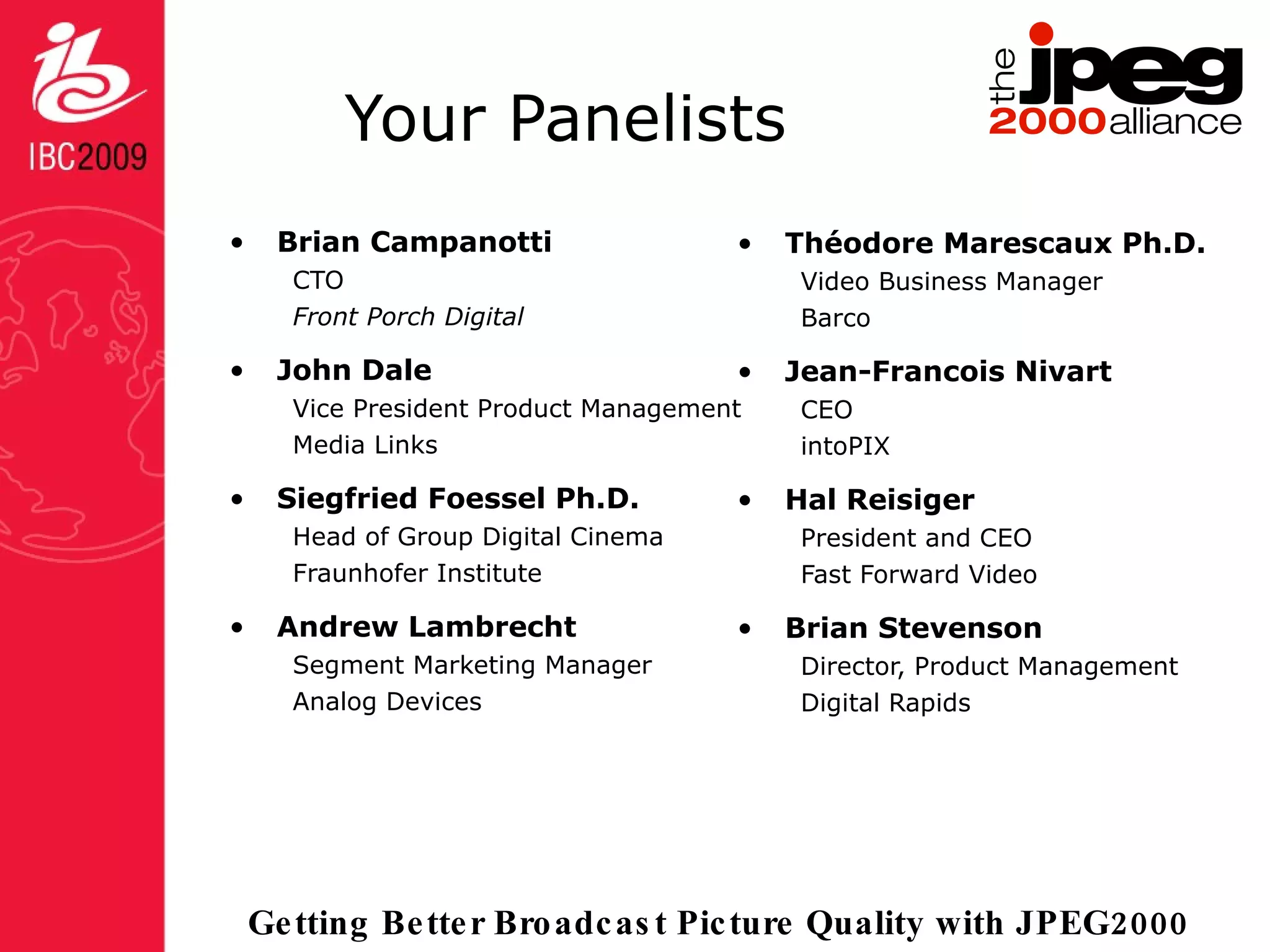
Your Panelists Brian Campanotti CTO Front Porch Digital John Dale Vice President Product Management Media Links Siegfried Foessel Ph.D. Head of Group Digital Cinema Fraunhofer Institute Andrew Lambrecht Segment Marketing Manager Analog Devices Théodore Marescaux Ph.D. Video Business Manager Barco Jean-Francois Nivart CEO intoPIX Hal Reisiger President and CEO Fast Forward Video Brian Stevenson Director, Product Management Digital Rapids
JPEG2000 Alliance Who a consortium of technology leaders Goal JPEG2000 development  into a  leading compression standard JPEG2000 widespread  acceptance  and  deployment How educate and  create awareness  about the benefits of JPEG2000 support of the  compression standard for the benefit of the media and video industries  promote  interoperability between standards and system devices promote the  development of tools   by members and industry peers
About JPEG2000 License free Open standard Lossy and lossless compression Error Resilient Precise and adjustable bit rate control Scalable Low latency Constant quality through multiple generations Supports 4K resolution (and greater) Up to 32-bits per component Symmetric encode and decode
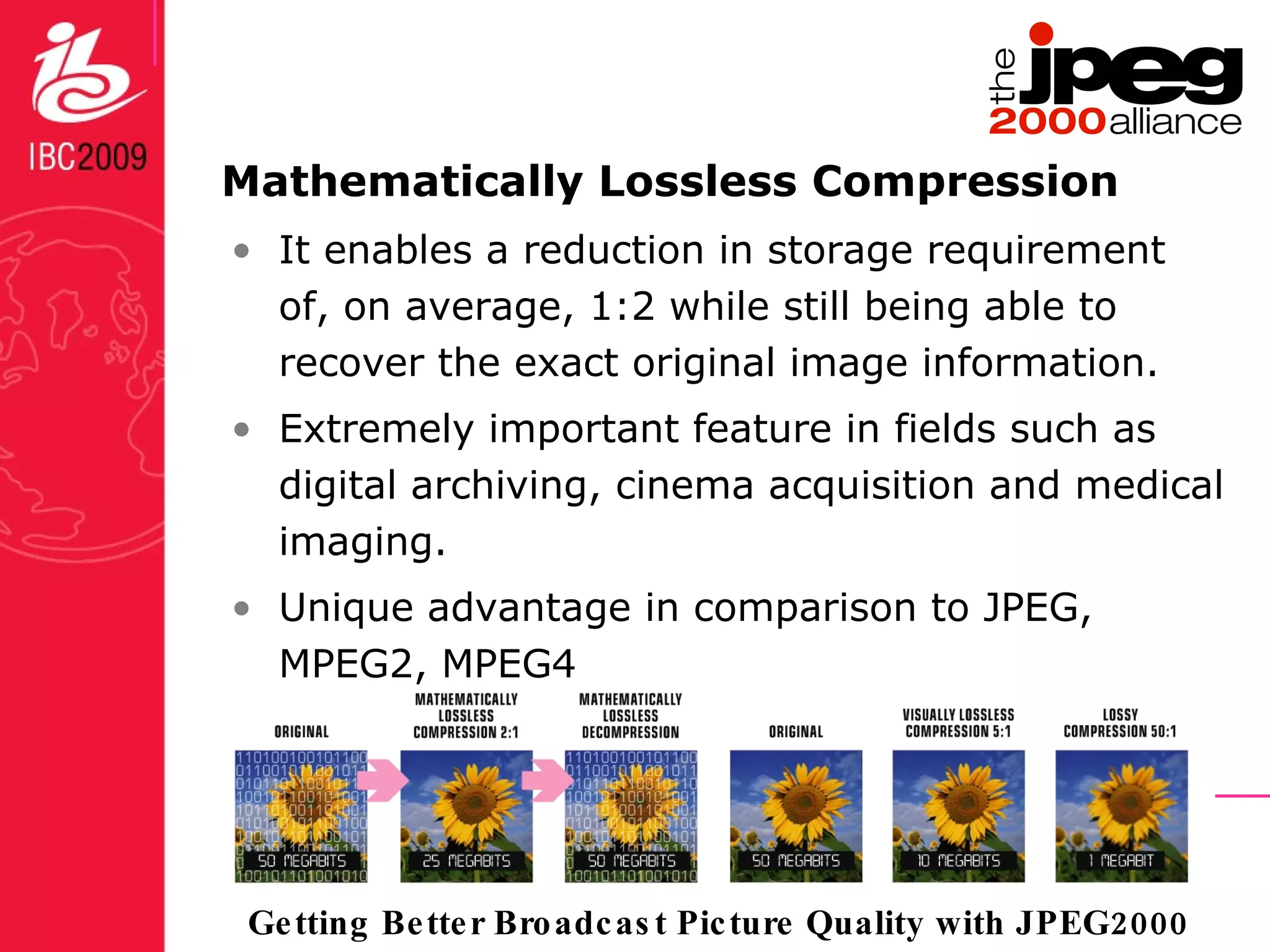
Mathematically Lossless Compression It enables a reduction in storage requirement of, on average, 1:2  while still being able to recover the exact original image information.  Extremely important feature in fields such as digital archiving, cinema acquisition and medical imaging.  Unique advantage in comparison to JPEG, MPEG2, MPEG4
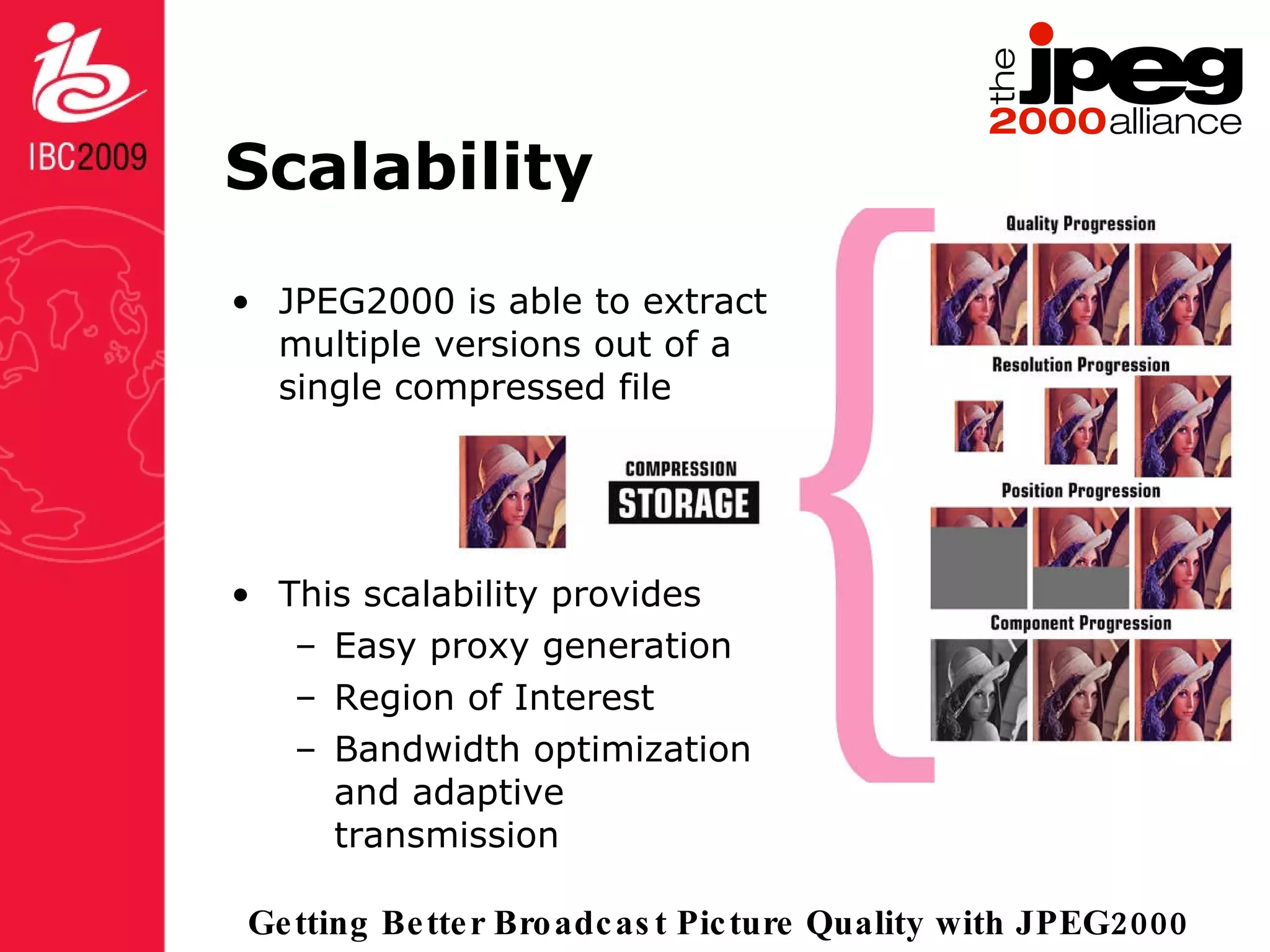
Scalability JPEG2000 is able to extract multiple versions out of a single compressed file This scalability provides Easy proxy generation Region of Interest Bandwidth optimization and adaptive transmission
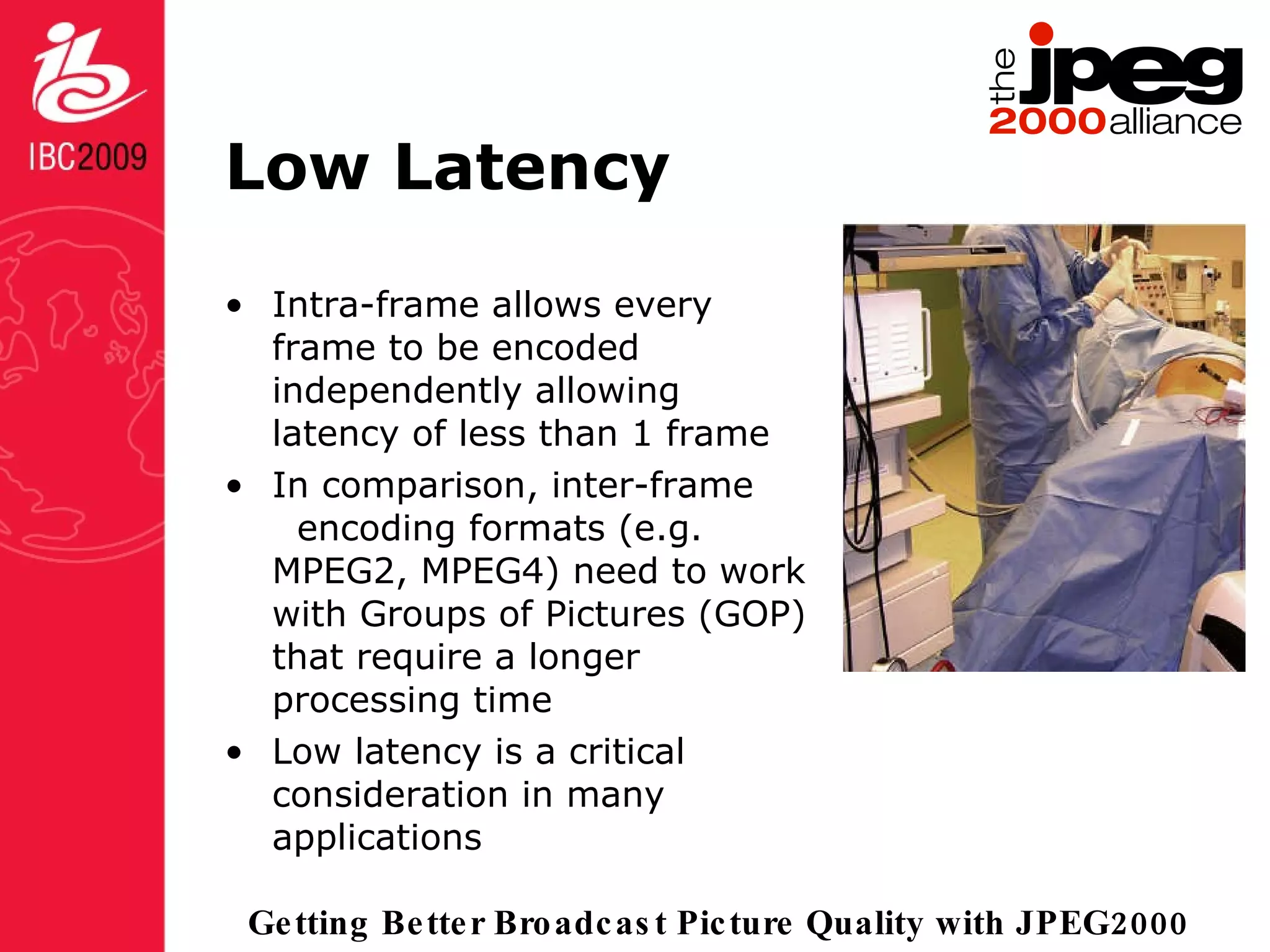
Low Latency Intra-frame allows every frame to be encoded independently allowing latency of less than 1 frame In comparison, inter-frame  encoding formats (e.g. MPEG2, MPEG4) need to work with Groups of Pictures (GOP) that require a longer processing time Low latency is a critical consideration in many applications
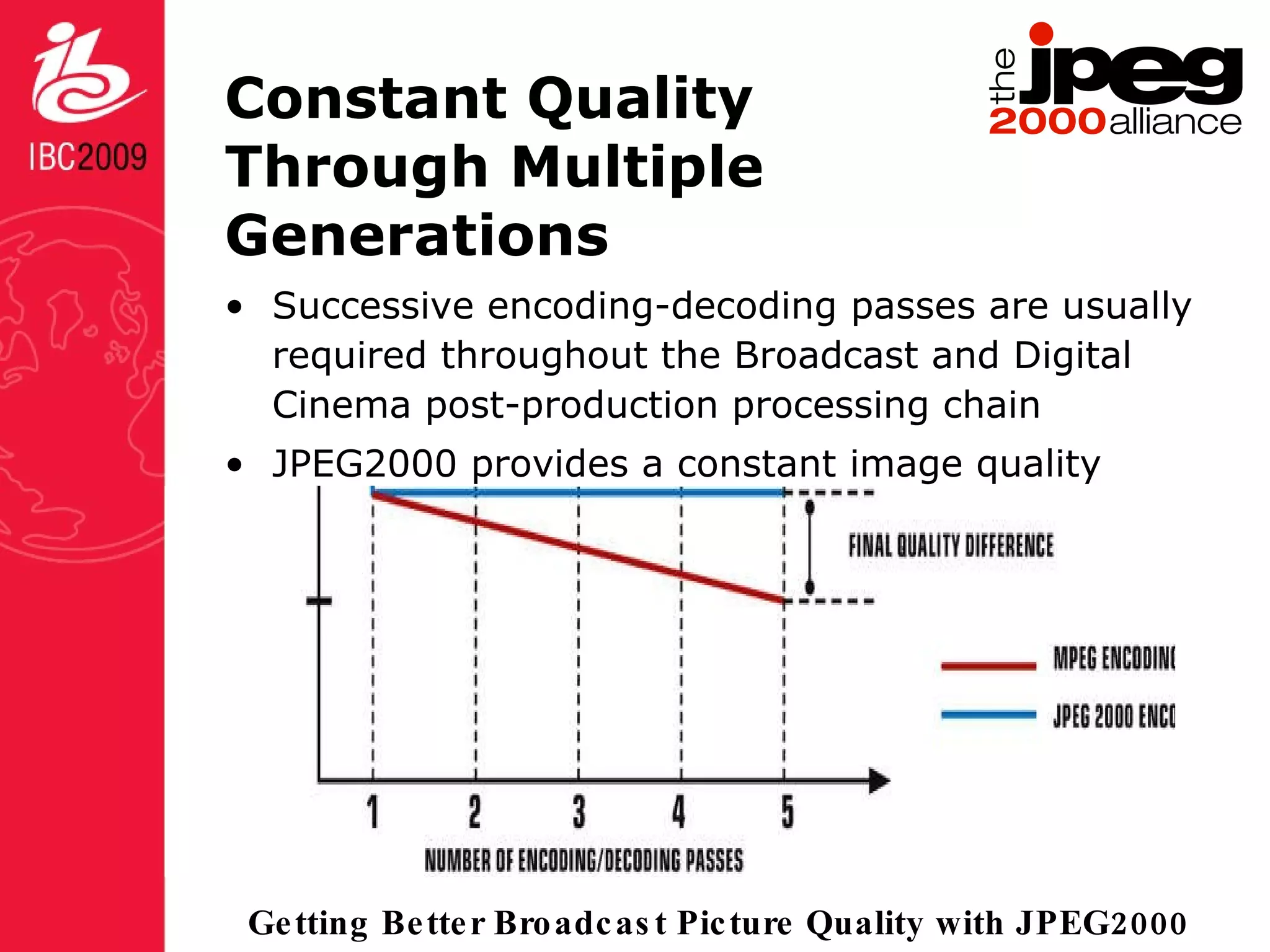
Constant Quality Through Multiple Generations Successive encoding-decoding passes are usually required throughout the Broadcast and Digital Cinema post-production processing chain JPEG2000 provides a constant image quality throughout the production process
Related  Standards Bodies Core Standards JPEG committee,  part of ISO/IEC Theatrical movie  distribution and playback  Digital Cinema Initiatives, LLC (DCI) JPEG ITU SMPTE Broadcast/transport standards  & interoperability VSF SMPTE MPEG EBU
JPEG2000 ISO/IEC Standards ISO/IEC 15444-1: JPEG2000 Part 1,  Core Coding System ISO/IEC 15444-2: JPEG2000 Part 2,  Extensions ISO/IEC 15444-3: JPEG2000 Part 3,  Motion JPEG2000 ISO/IEC 15444-4: JPEG2000 Part 4,  Conformance Testing ISO/IEC 15444-5: JPEG2000 Part 5,  Reference Software ISO/IEC 15444-6: JPEG2000 Part 6,  Compound Image Format ISO/IEC 15444-8: JPEG2000 Part 8,  JPSEC Image Security ISO/IEC 15444-9: JPEG2000 Part 9,  JPIP Interactivity Tools   (APIs and Protocols) ISO/IEC 15444-10: JPEG2000 Part 10,  JP3D 3-Dimensional Data ISO/IEC 15444-11: JPEG2000 Part 11,  JPWL Wireless Applications ISO/IEC 15444-12: JPEG2000 Part 12,  ISO Media Format ISO/IEC 15444-13: JPEG2000 Part 13,  Entry Level Encoder
VSF JPEG2000 Activity Group Mission Create a recommendation for standardization  of real time transport of JPEG2000  for Contribution over IP Networks Real time service encapsulating  JPEG2000 compressed video,  audio, time codes & closed captioning in a program stream Encapsulation into MPEG2TS and the IP/RTP structure  for final transport Utilize a single RTP stream for video/ audio/ancillary  CBR & VBR streams supported Streams up to 1800Mbps supported Two solutions/efforts: MPEG2TS/SMPTE2022  initially thought to be faster to market and with backwards compatibility with legacy MPEG2TS equipment Recommendation development is ongoing, must work with JPEG and MPEG to complete a standard MXF Wrapping over RTP with RTP/Payload Header & FEC VSF work for native uncompressed video should be usable for this effort EBU will pursue this activity
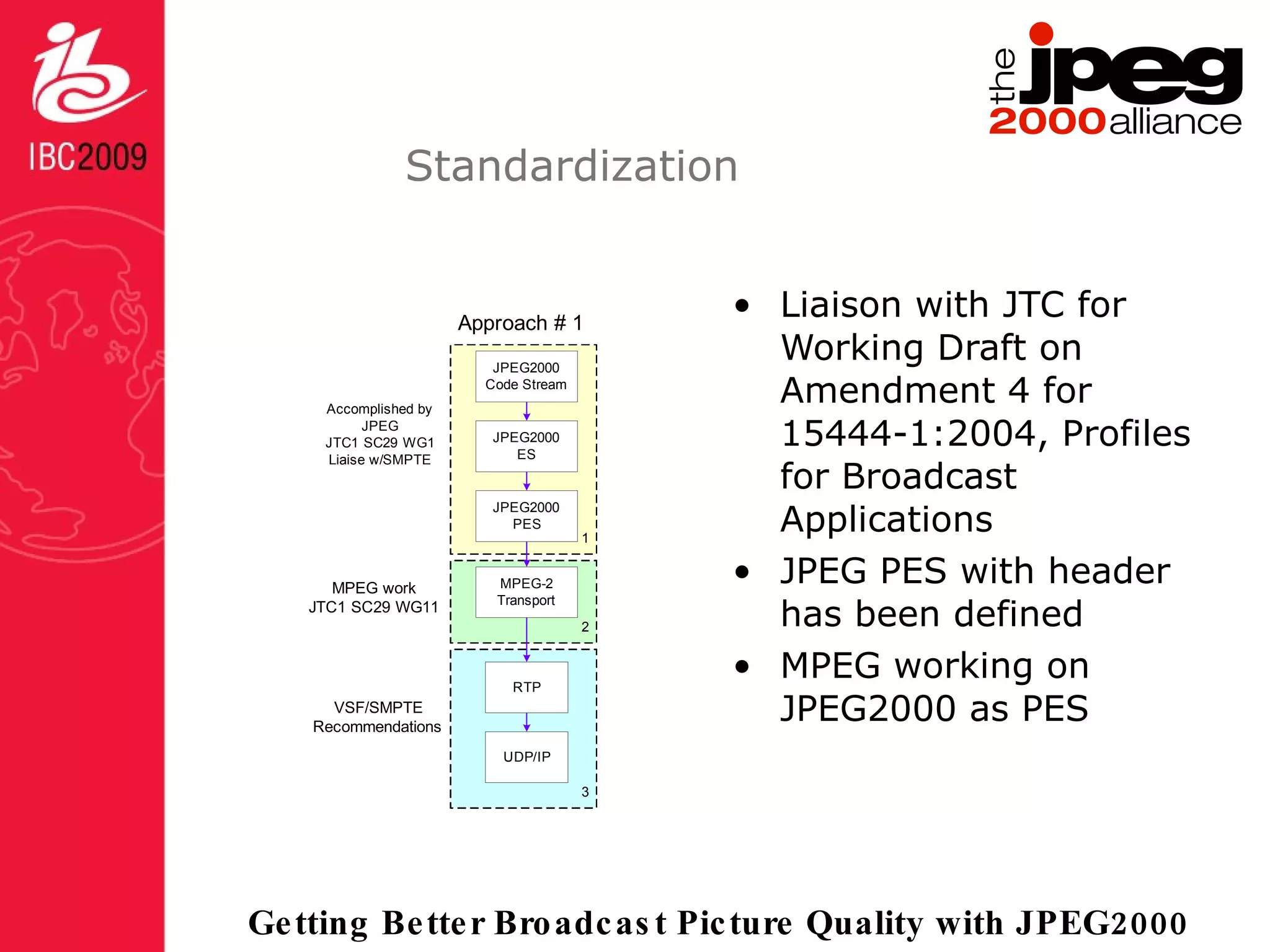
Standardization Liaison with JTC for Working Draft on Amendment 4 for 15444-1:2004,  Profiles for Broadcast Applications JPEG PES with header has been defined MPEG working on JPEG2000 as PES
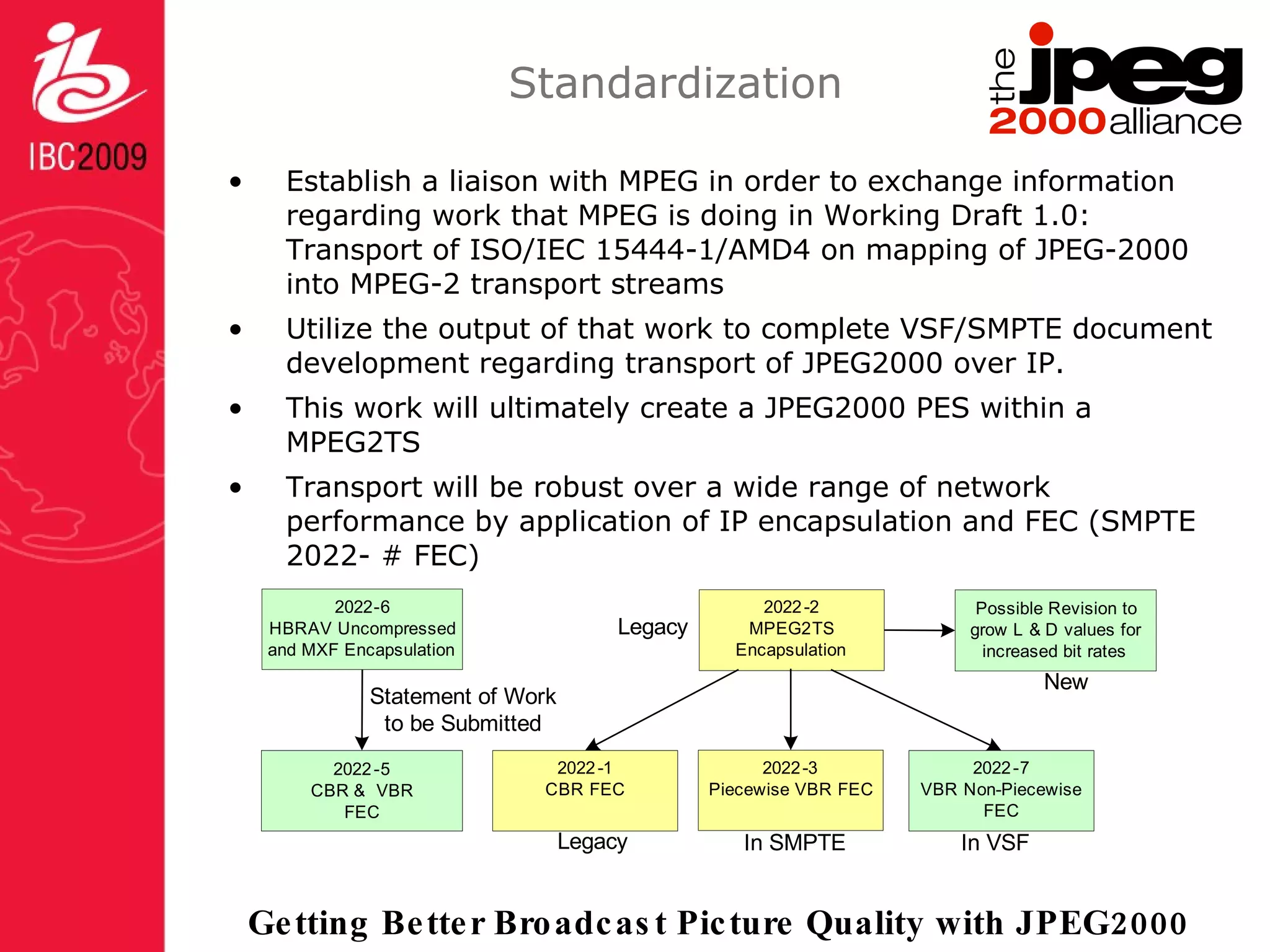
Standardization Establish a liaison with MPEG in order to exchange information regarding work that MPEG is doing in Working Draft 1.0: Transport of ISO/IEC 15444-1/AMD4 on mapping of JPEG-2000 into MPEG-2 transport streams Utilize the output of that work to complete VSF/SMPTE document development regarding transport of JPEG2000 over IP. This work will ultimately create a JPEG2000 PES within a MPEG2TS  Transport will be robust over a wide range of network performance by application of IP encapsulation and FEC (SMPTE 2022- # FEC)
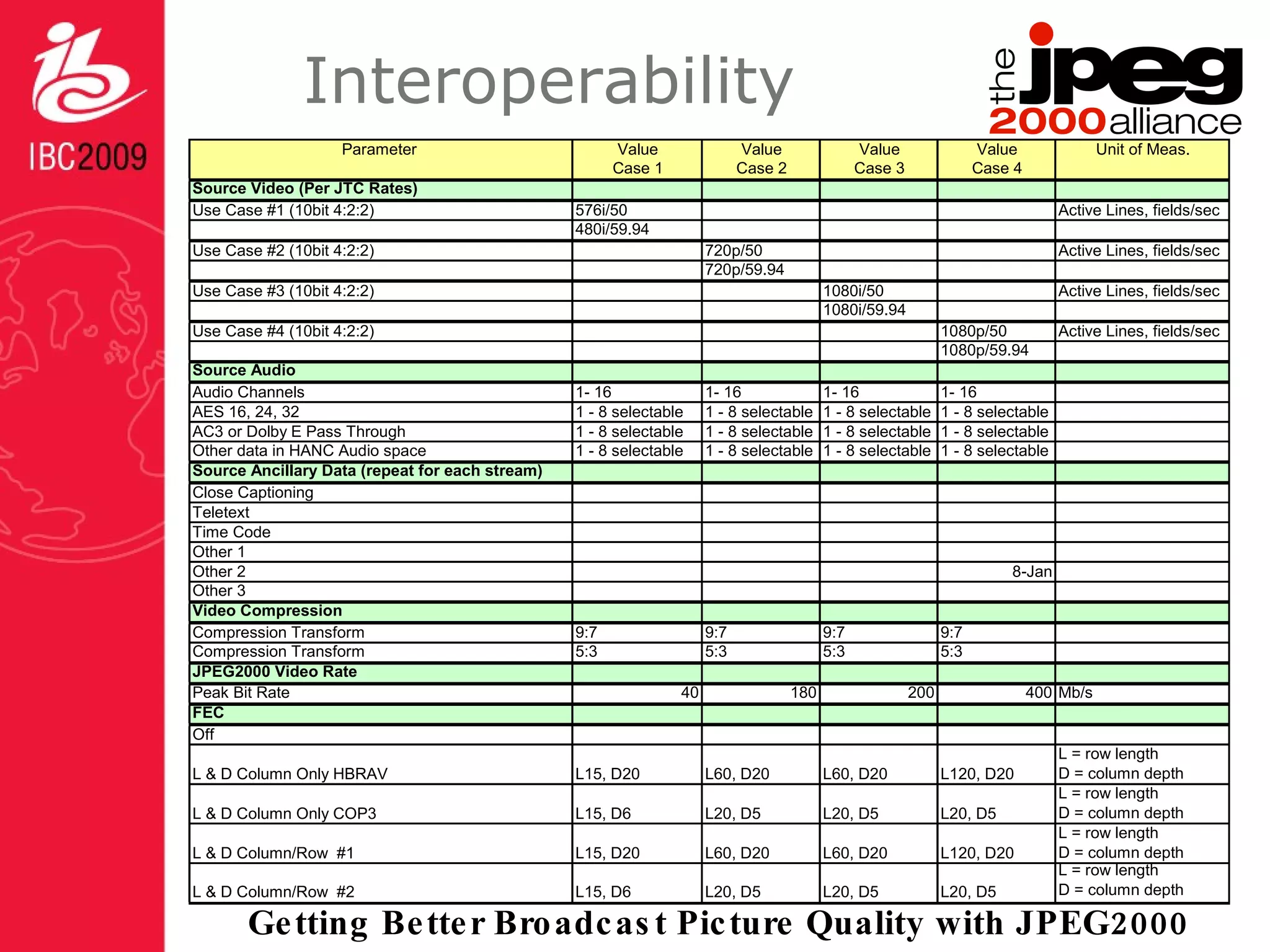
Interoperability
Common JPEG2000 Applications Surveillance cameras and DVRs Digital Cinema Broadcast Post Production Archiving Medical Imaging Military and Aerospace Digital Signage Wireless Video
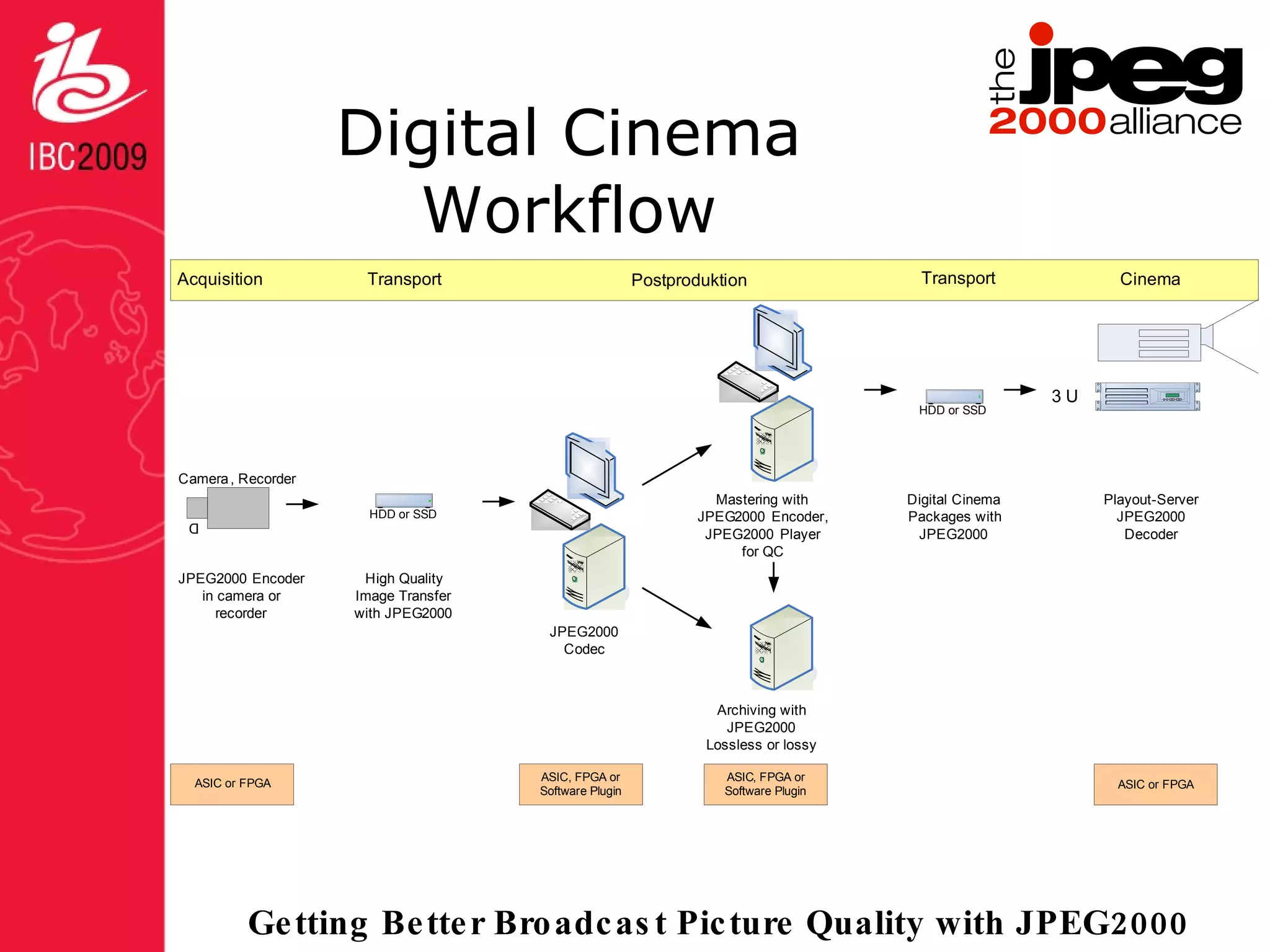
Digital Cinema Workflow
What Can I do  with JPEG2000 in Broadcast? High-quality compression of contribution video feed Studio-to-affiliate video transfer Intra-studio video  High quality storage and playback of multiple feeds Little degradation over many multiple compression cycles
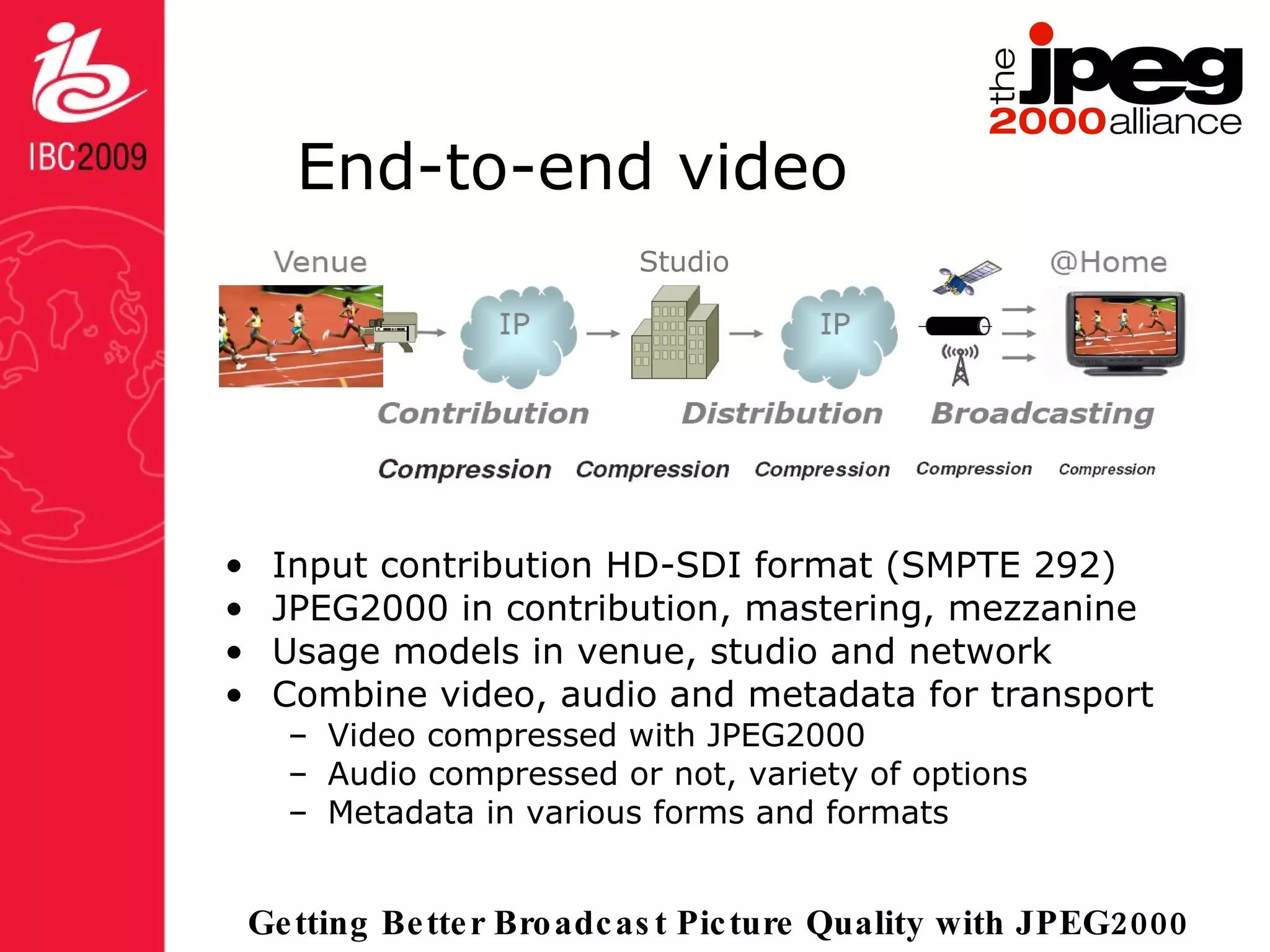
End-to-end video Input contribution HD-SDI format (SMPTE 292) JPEG2000 in contribution, mastering, mezzanine Usage models in venue, studio and network Combine video, audio and metadata for transport Video compressed with JPEG2000  Audio compressed or not, variety of options Metadata in various forms and formats Studio
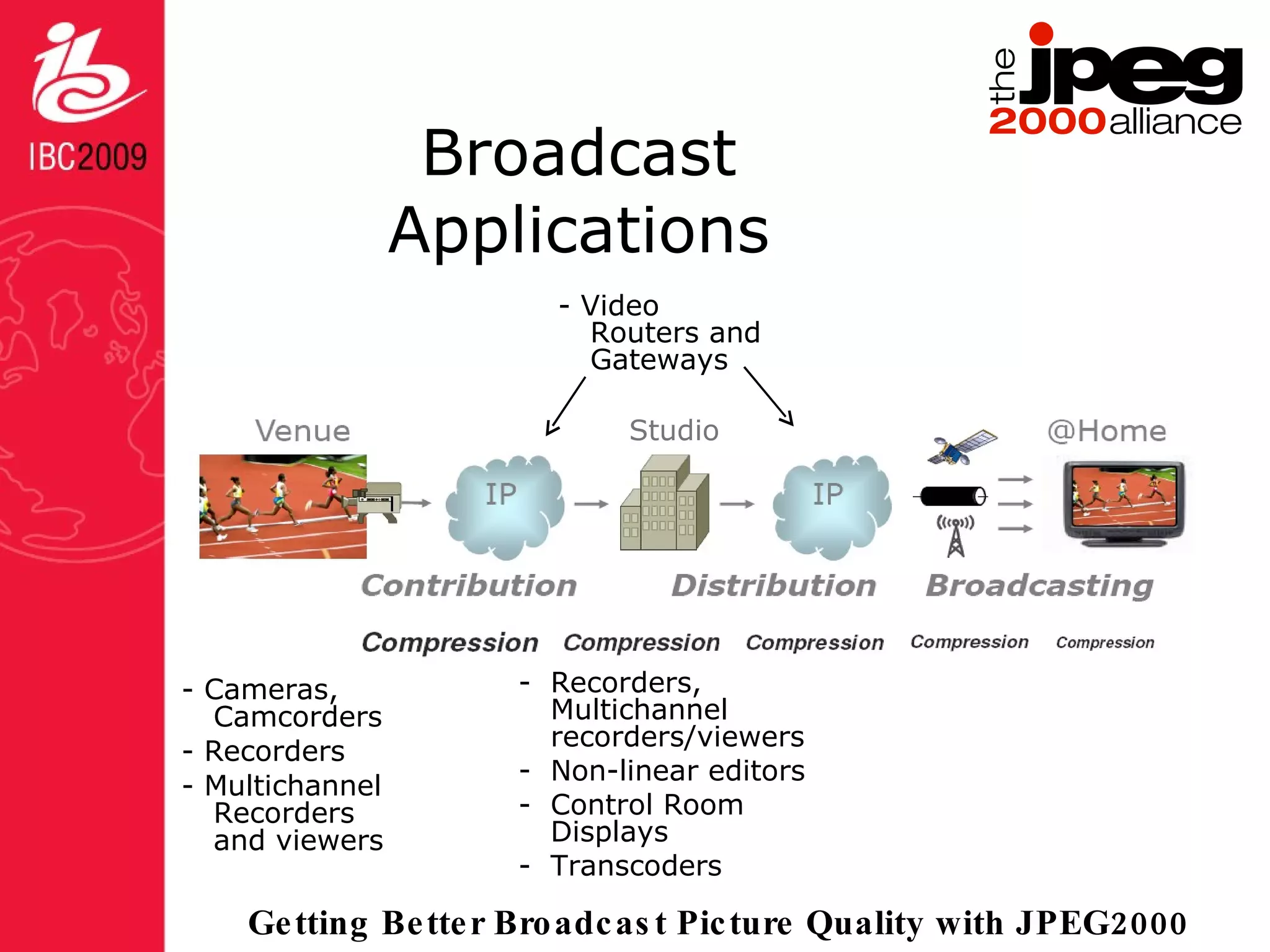
Broadcast Applications - Cameras, Camcorders - Recorders - Multichannel Recorders and viewers - Video Routers and Gateways Recorders, Multichannel recorders/viewers Non-linear editors Control Room Displays Transcoders Studio
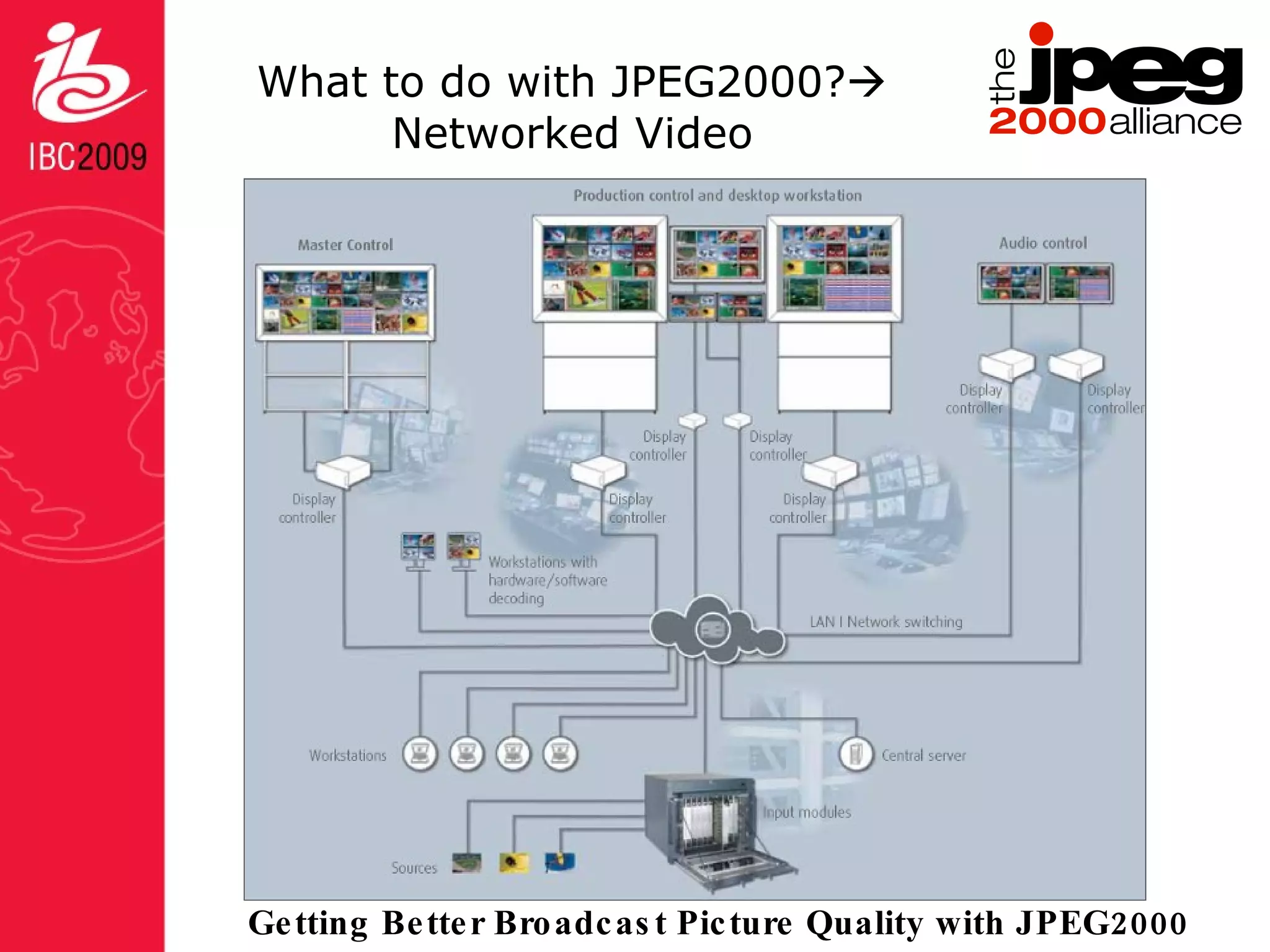
What to do with JPEG2000?   Networked Video
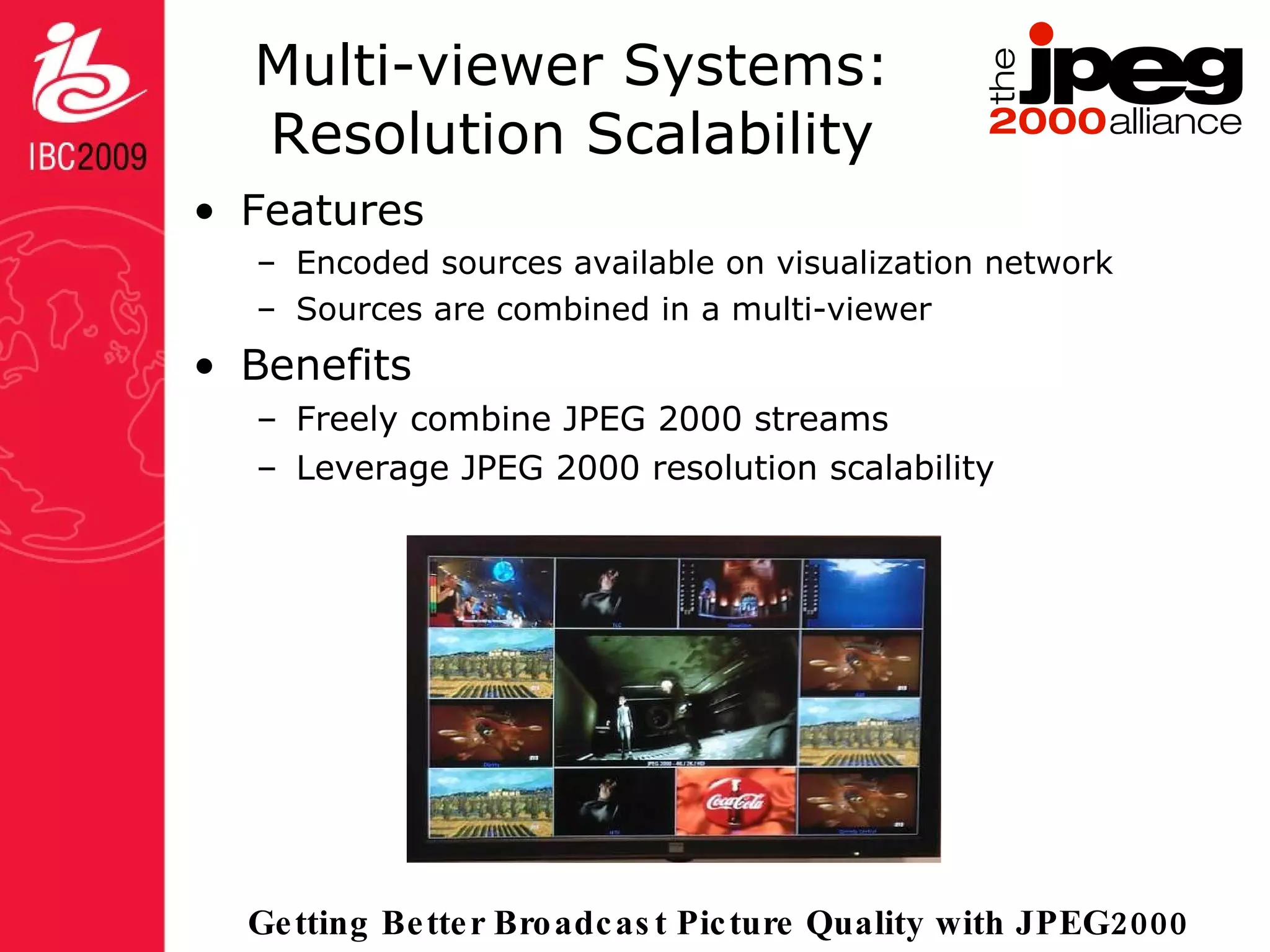
Multi-viewer Systems: Resolution Scalability Features Encoded sources available on visualization network Sources are combined in a multi-viewer Benefits Freely combine JPEG 2000 streams Leverage JPEG 2000 resolution scalability
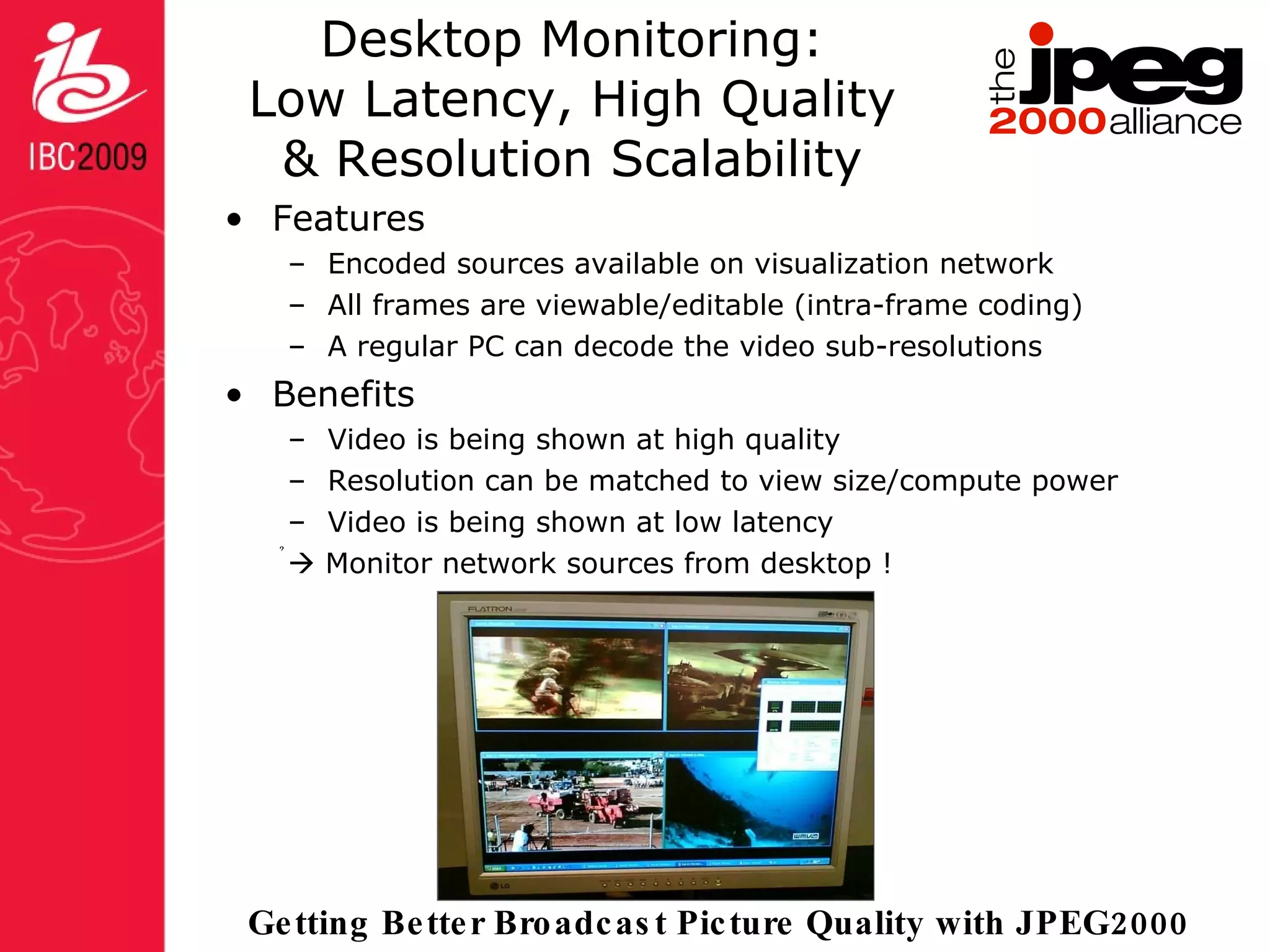
Desktop Monitoring: Low Latency, High Quality & Resolution Scalability Features Encoded sources available on visualization network All frames are viewable/editable (intra-frame coding) A regular PC can decode the video sub-resolutions Benefits Video is being shown at high quality Resolution can be matched to view size/compute power Video is being shown at low latency    Monitor network sources from desktop !
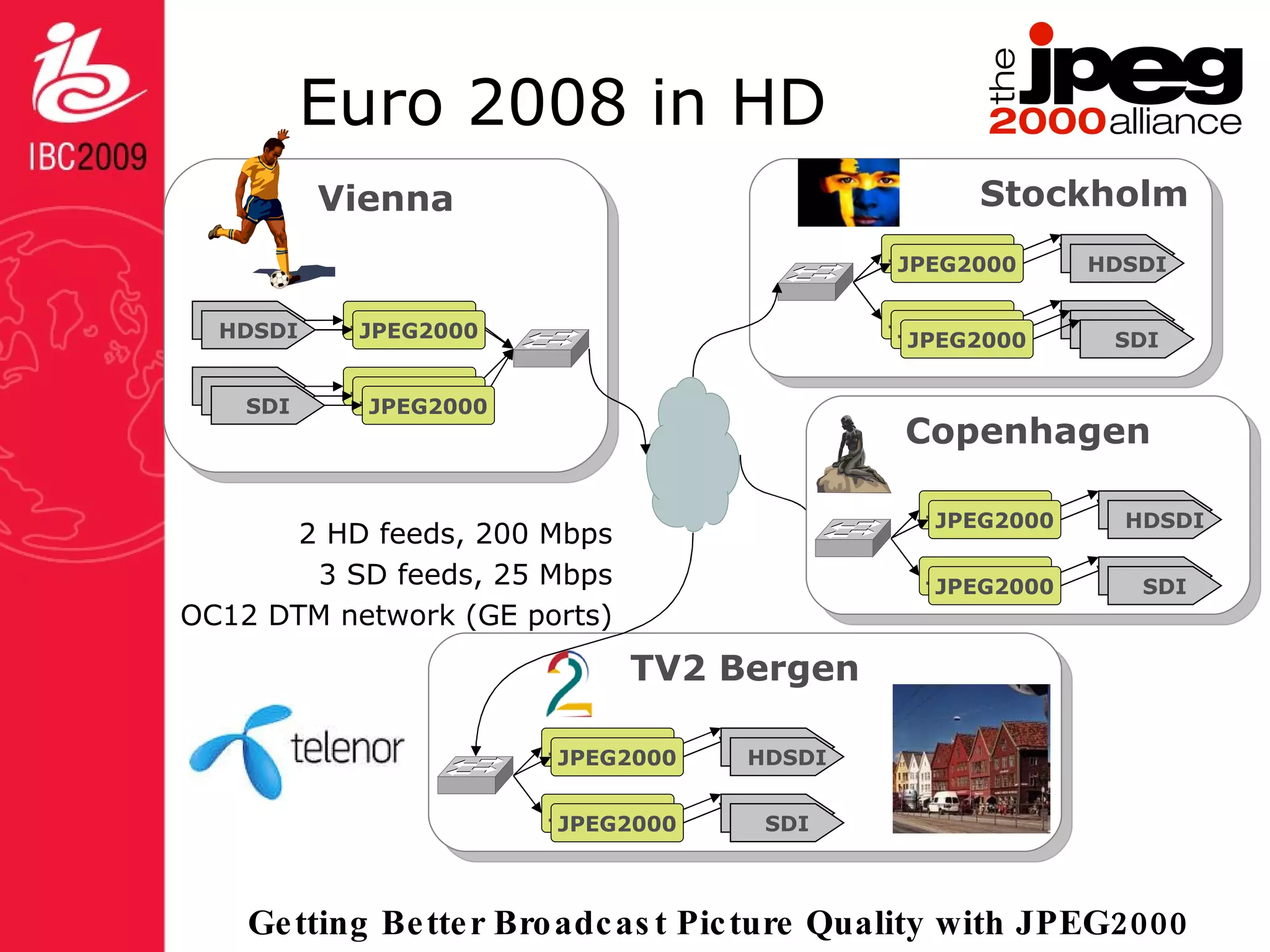
Euro 2008 in HD 2 HD feeds, 200 Mbps 3 SD feeds, 25 Mbps OC12 DTM network (GE ports) Vienna JPEG2000 HDSDI HDSDI JPEG2000 JPEG2000 HDSDI SDI JPEG2000 Stockholm JPEG2000 HDSDI HDSDI JPEG2000 JPEG2000 HDSDI SDI JPEG2000 Copenhagen JPEG2000 HDSDI HDSDI JPEG2000 JPEG2000 HDSDI SDI JPEG2000 TV2 Bergen HDSDI HDSDI JPEG2000 HDSDI SDI JPEG2000 SDI JPEG2000 SDI JPEG2000 JPEG2000 JPEG2000
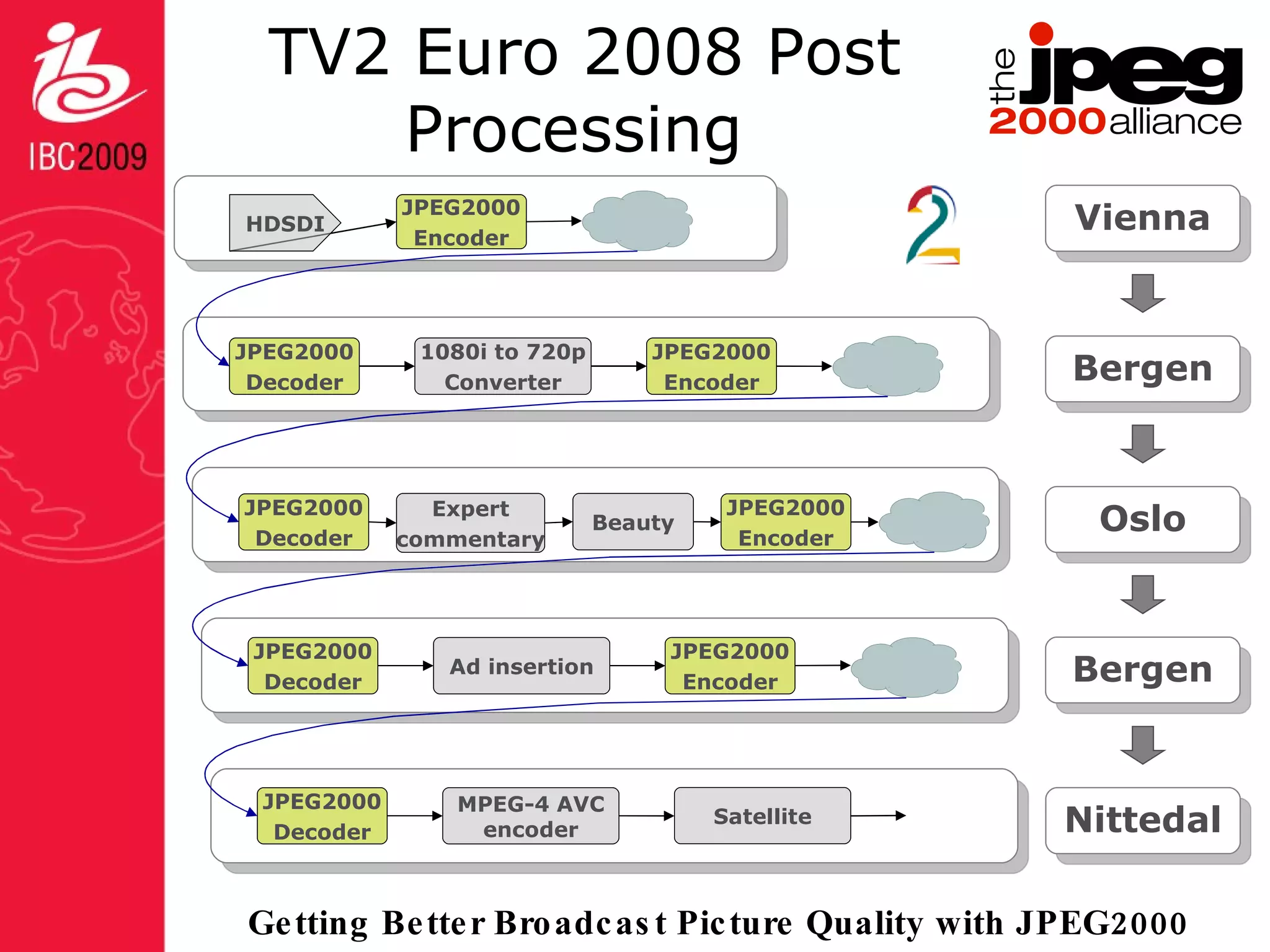
TV2 Euro 2008 Post Processing  JPEG2000 Decoder JPEG2000 Encoder 1080i to 720p Converter JPEG2000 Decoder JPEG2000 Encoder Ad insertion JPEG2000 Decoder MPEG-4 AVC encoder Satellite JPEG2000 Decoder JPEG2000 Encoder Beauty Expert commentary JPEG2000 Encoder HDSDI Vienna Bergen Oslo Bergen Nittedal
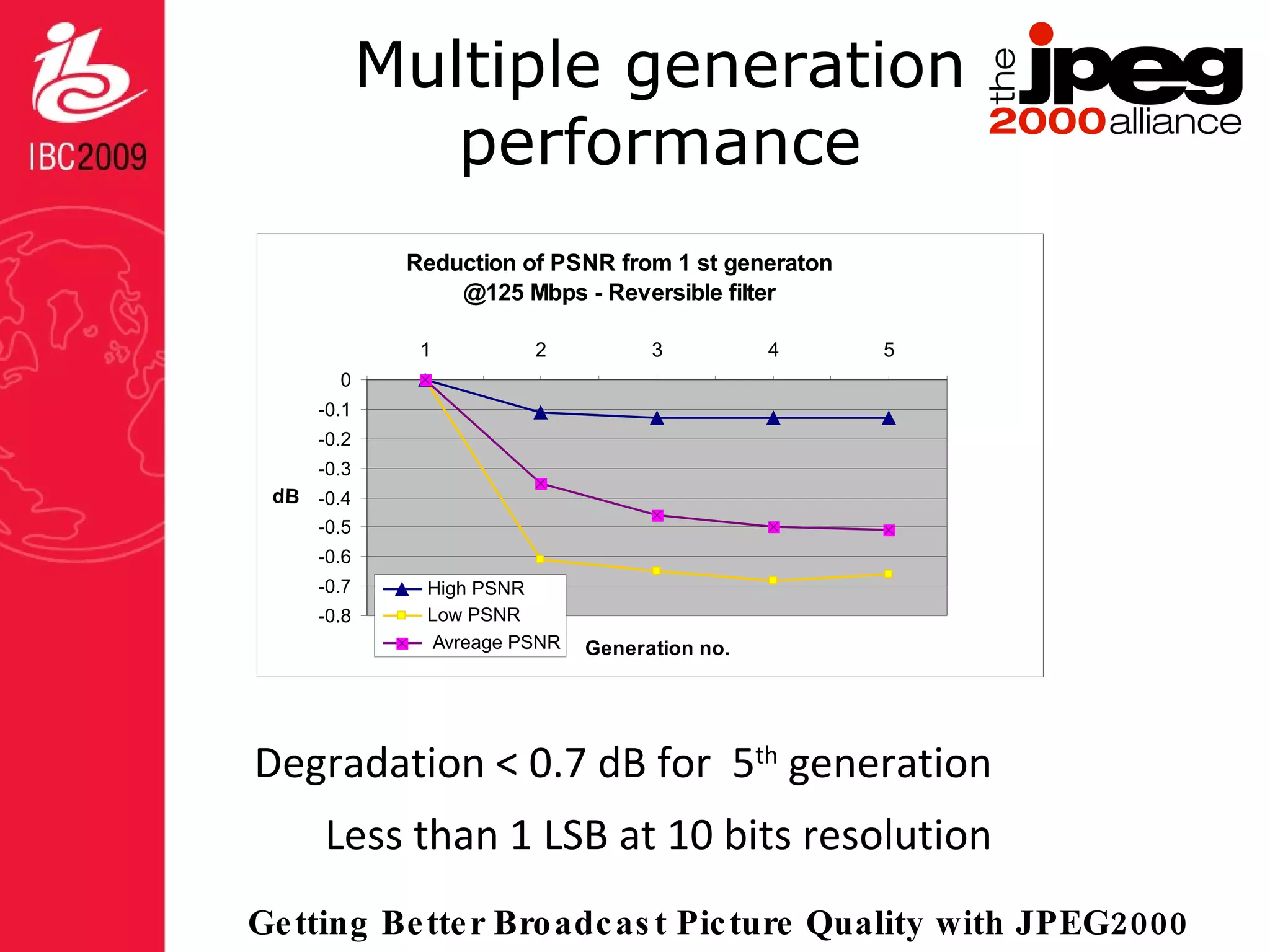
Multiple generation performance Degradation < 0.7 dB for  5 th  generation Less than 1 LSB at 10 bits resolution
JPEG2000 as a Preservation Master JPEG2000 is fast becoming the defacto standard for preservation quality content archiving Media and entertainment companies have been slow to adopt but the opposite is true for archivists Limited “interoperability” between typical broadcast devices and “large file sizes” are considered barriers True  preservation  presents different challenges than traditional file based operations in media organizations
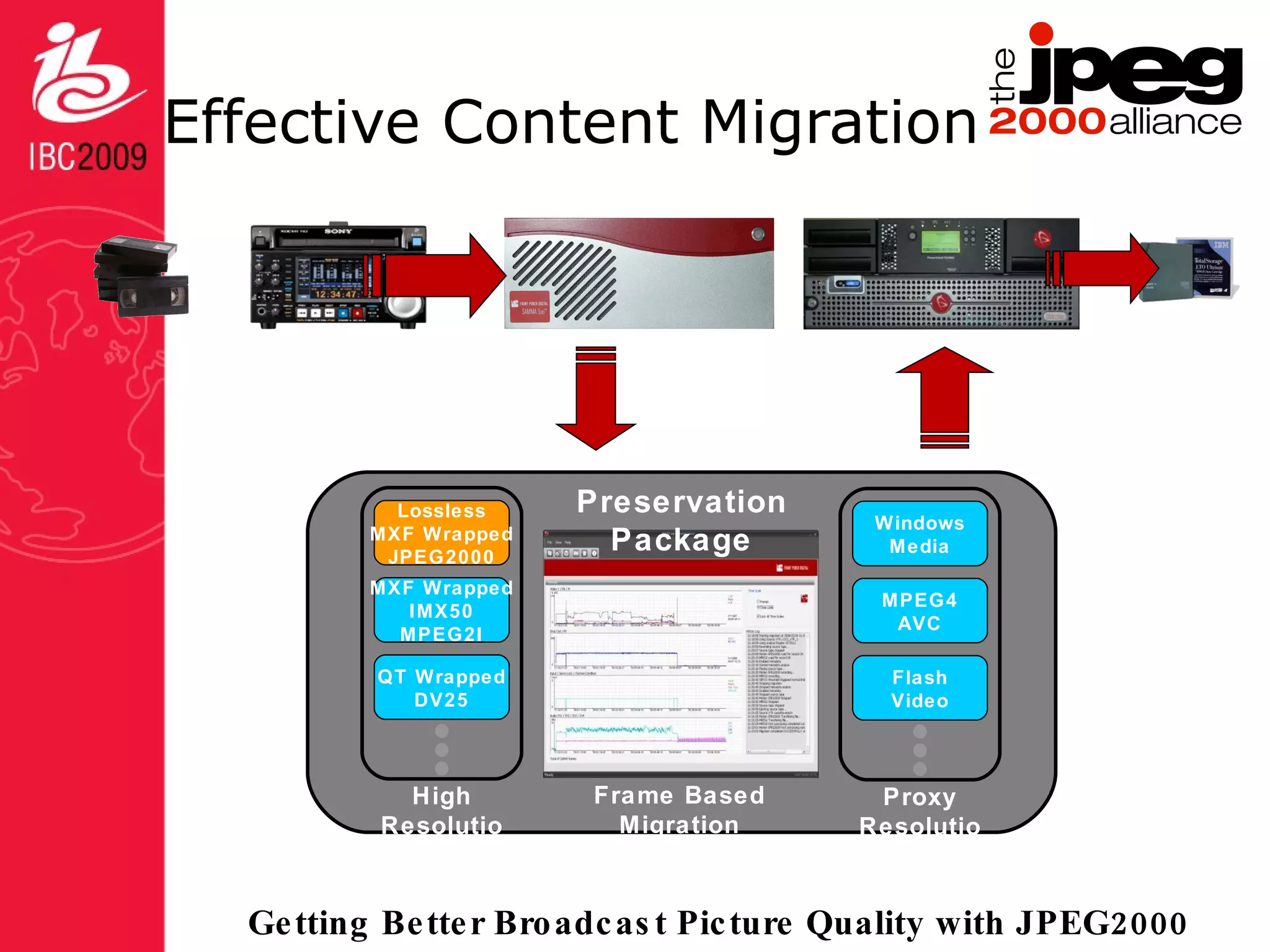
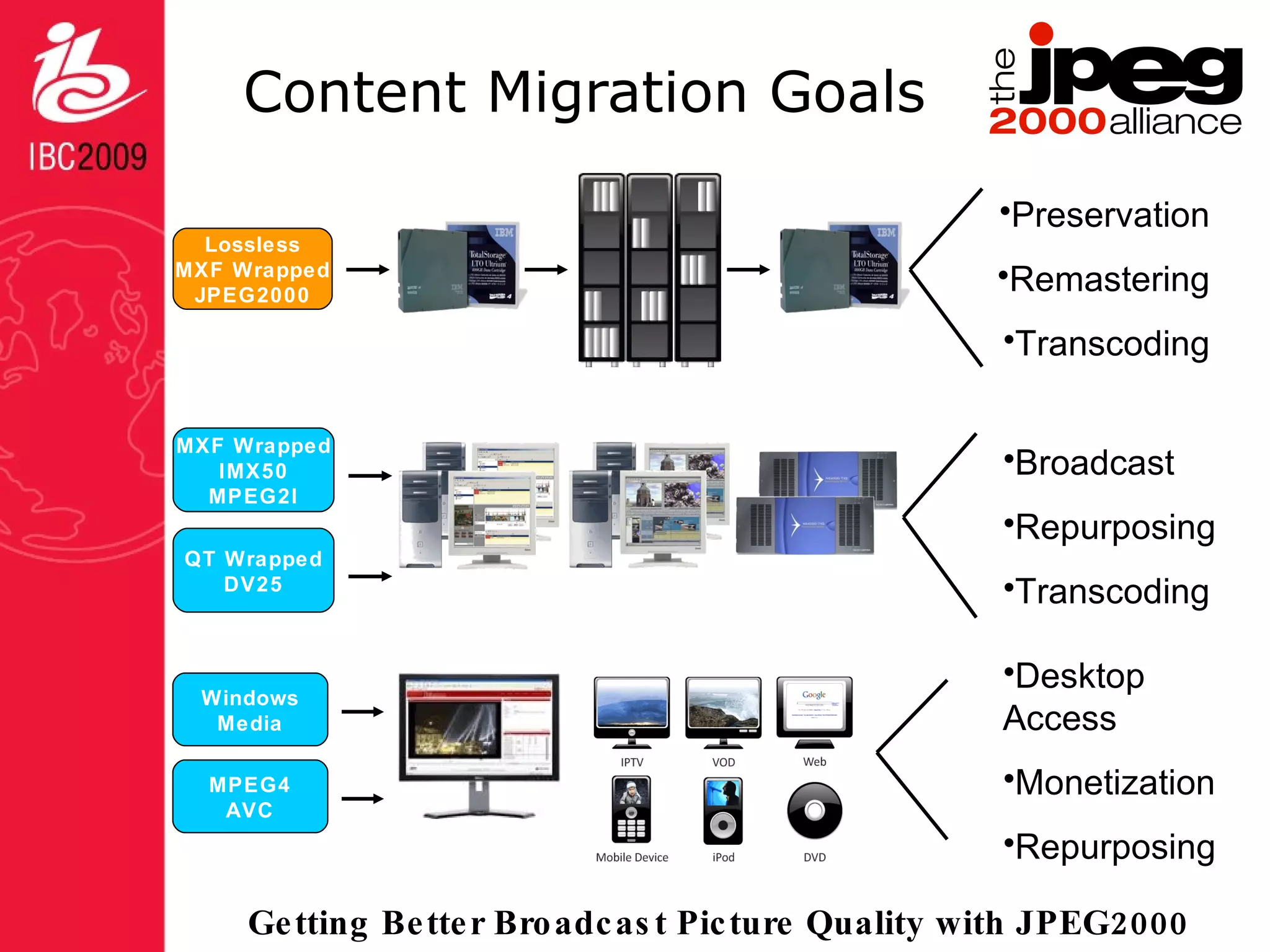
Effective Content Migration Video/Film Masters Solo Migration Engine DIVArchive CSM Data Tape Lossless MXF Wrapped JPEG2000 MXF Wrapped IMX50 MPEG2I QT Wrapped DV25 High Resolution Frame Based Migration Metadata Windows Media MPEG4 AVC Flash Video Proxy Resolution Preservation Package
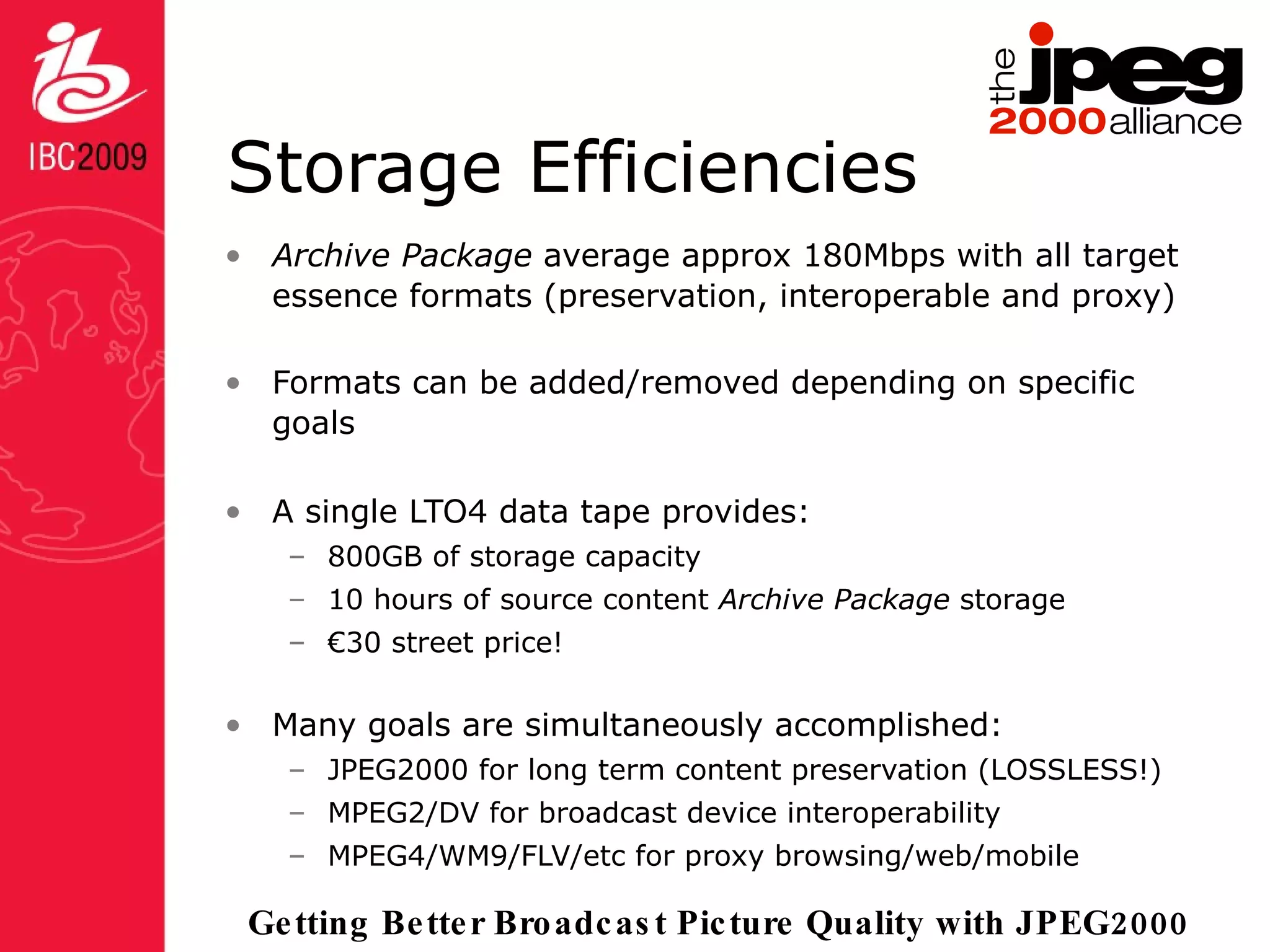
Storage Efficiencies Archive Package  average approx 180Mbps with all target essence formats (preservation, interoperable and proxy) Formats can be added/removed depending on specific goals A single LTO4 data tape provides: 800GB of storage capacity 10 hours of source content  Archive Package  storage € 30 street price! Many goals are simultaneously accomplished: JPEG2000 for long term content preservation (LOSSLESS!) MPEG2/DV for broadcast device interoperability MPEG4/WM9/FLV/etc for proxy browsing/web/mobile
Content Migration Goals Preservation Remastering Transcoding Broadcast Repurposing Transcoding Desktop Access Monetization Repurposing Lossless MXF Wrapped JPEG2000 Data Tape Preservation Storage Data Tape Preserve MXF Wrapped IMX50 MPEG2I QT Wrapped DV25 Video Servers Digital Newsroom Post Production Utilize Windows Media MPEG4 AVC Access Desktop Browsing Desktop Access Monetization Repurposing
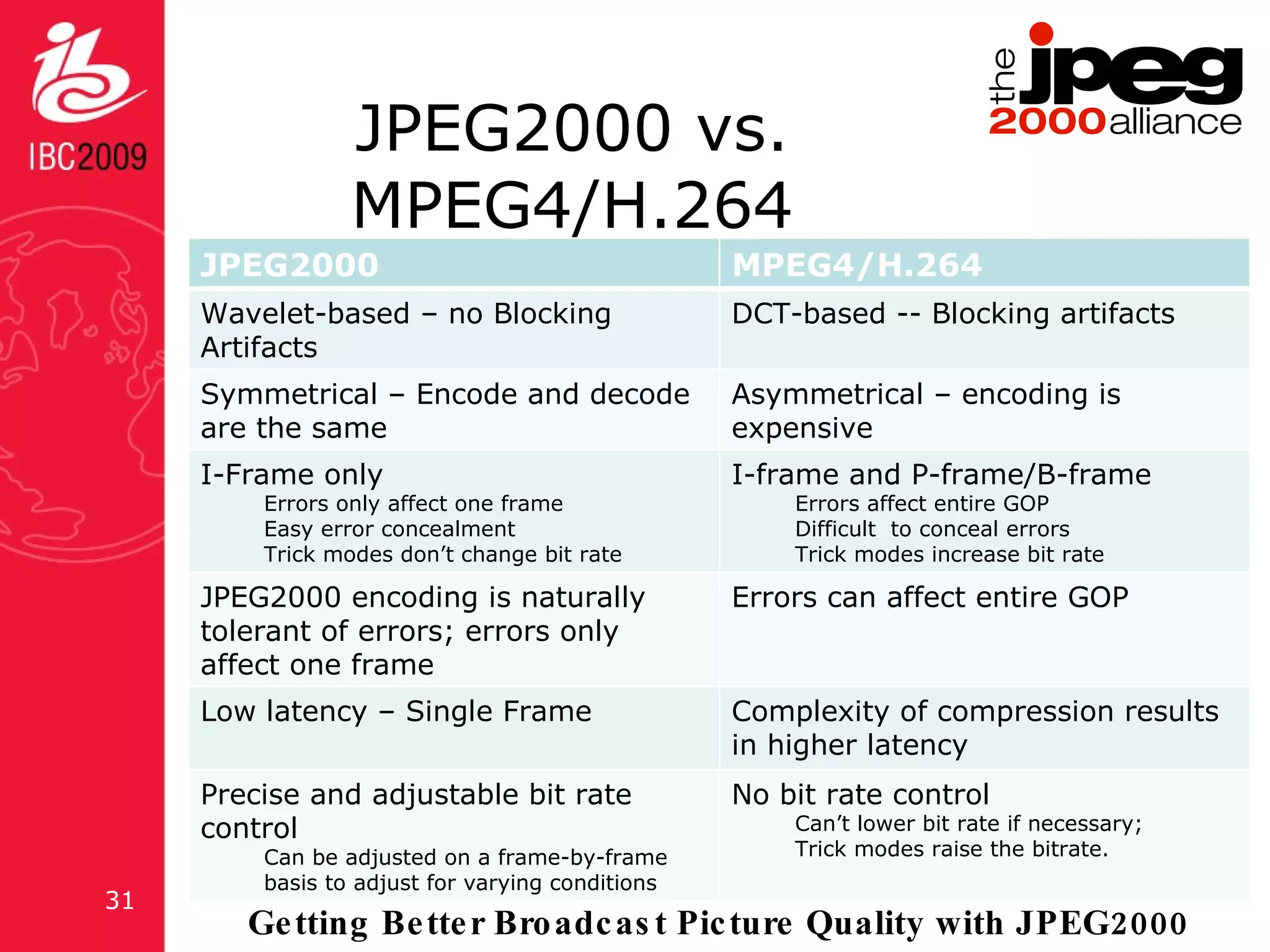
JPEG2000 vs. MPEG4/H.264 JPEG2000  MPEG4/H.264 Wavelet-based – no Blocking Artifacts DCT-based -- Blocking artifacts Symmetrical – Encode and decode are the same Asymmetrical – encoding is expensive I-Frame only Errors only affect one frame Easy error concealment Trick modes don’t change bit rate I-frame and P-frame/B-frame Errors affect entire GOP Difficult  to conceal errors Trick modes increase bit rate JPEG2000 encoding is naturally tolerant of errors; errors only affect one frame Errors can affect entire GOP Low latency – Single Frame Complexity of compression results in higher latency Precise and adjustable bit rate control Can be adjusted on a frame-by-frame basis to adjust for varying conditions No bit rate control Can’t lower bit rate if necessary;  Trick modes raise the bitrate.
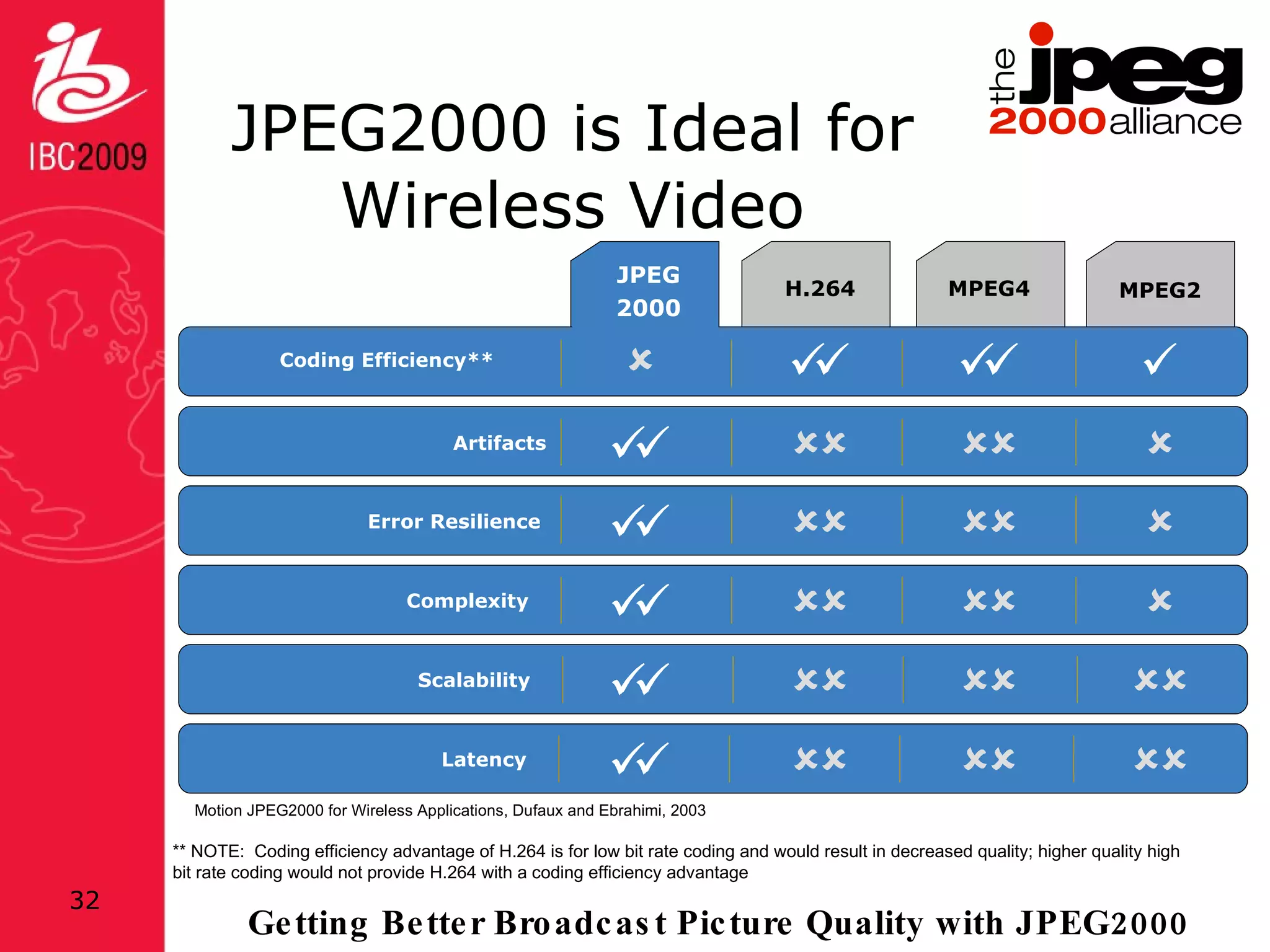
JPEG2000 is Ideal for Wireless Video JPEG 2000 H.264 MPEG2 MPEG4 Motion JPEG2000 for Wireless Applications, Dufaux and Ebrahimi, 2003 ** NOTE:  Coding efficiency advantage of H.264 is for low bit rate coding and would result in decreased quality; higher quality high bit rate coding would not provide H.264 with a coding efficiency advantage Artifacts Error Resilience Complexity Scalability Latency Coding Efficiency**
Highlights JPEG2000 is a mature technology JPEG2000 is accepted as a high quality video encoding technology JPEG2000 is used in a wide variety of broadcast applications Industry activities are ongoing to insure interoperability between different manufacturers’ equipment
Q&A
Thank you for your time,  we hope you found it to be  informative and  productive!

JPEG2000 Alliance IBC 2009

  • 1.
    Getting Better Broadcast Picture Quality with JPEG2000
  • 2.
  • 3.
    Your Panelists BrianCampanotti CTO Front Porch Digital John Dale Vice President Product Management Media Links Siegfried Foessel Ph.D. Head of Group Digital Cinema Fraunhofer Institute Andrew Lambrecht Segment Marketing Manager Analog Devices Théodore Marescaux Ph.D. Video Business Manager Barco Jean-Francois Nivart CEO intoPIX Hal Reisiger President and CEO Fast Forward Video Brian Stevenson Director, Product Management Digital Rapids
  • 4.
    JPEG2000 Alliance Whoa consortium of technology leaders Goal JPEG2000 development into a leading compression standard JPEG2000 widespread acceptance and deployment How educate and create awareness about the benefits of JPEG2000 support of the compression standard for the benefit of the media and video industries promote interoperability between standards and system devices promote the development of tools by members and industry peers
  • 5.
    About JPEG2000 Licensefree Open standard Lossy and lossless compression Error Resilient Precise and adjustable bit rate control Scalable Low latency Constant quality through multiple generations Supports 4K resolution (and greater) Up to 32-bits per component Symmetric encode and decode
  • 6.
    Mathematically Lossless CompressionIt enables a reduction in storage requirement of, on average, 1:2 while still being able to recover the exact original image information. Extremely important feature in fields such as digital archiving, cinema acquisition and medical imaging. Unique advantage in comparison to JPEG, MPEG2, MPEG4
  • 7.
    Scalability JPEG2000 isable to extract multiple versions out of a single compressed file This scalability provides Easy proxy generation Region of Interest Bandwidth optimization and adaptive transmission
  • 8.
    Low Latency Intra-frameallows every frame to be encoded independently allowing latency of less than 1 frame In comparison, inter-frame encoding formats (e.g. MPEG2, MPEG4) need to work with Groups of Pictures (GOP) that require a longer processing time Low latency is a critical consideration in many applications
  • 9.
    Constant Quality ThroughMultiple Generations Successive encoding-decoding passes are usually required throughout the Broadcast and Digital Cinema post-production processing chain JPEG2000 provides a constant image quality throughout the production process
  • 10.
    Related StandardsBodies Core Standards JPEG committee, part of ISO/IEC Theatrical movie distribution and playback Digital Cinema Initiatives, LLC (DCI) JPEG ITU SMPTE Broadcast/transport standards & interoperability VSF SMPTE MPEG EBU
  • 11.
    JPEG2000 ISO/IEC StandardsISO/IEC 15444-1: JPEG2000 Part 1, Core Coding System ISO/IEC 15444-2: JPEG2000 Part 2, Extensions ISO/IEC 15444-3: JPEG2000 Part 3, Motion JPEG2000 ISO/IEC 15444-4: JPEG2000 Part 4, Conformance Testing ISO/IEC 15444-5: JPEG2000 Part 5, Reference Software ISO/IEC 15444-6: JPEG2000 Part 6, Compound Image Format ISO/IEC 15444-8: JPEG2000 Part 8, JPSEC Image Security ISO/IEC 15444-9: JPEG2000 Part 9, JPIP Interactivity Tools (APIs and Protocols) ISO/IEC 15444-10: JPEG2000 Part 10, JP3D 3-Dimensional Data ISO/IEC 15444-11: JPEG2000 Part 11, JPWL Wireless Applications ISO/IEC 15444-12: JPEG2000 Part 12, ISO Media Format ISO/IEC 15444-13: JPEG2000 Part 13, Entry Level Encoder
  • 12.
    VSF JPEG2000 ActivityGroup Mission Create a recommendation for standardization of real time transport of JPEG2000 for Contribution over IP Networks Real time service encapsulating JPEG2000 compressed video, audio, time codes & closed captioning in a program stream Encapsulation into MPEG2TS and the IP/RTP structure for final transport Utilize a single RTP stream for video/ audio/ancillary CBR & VBR streams supported Streams up to 1800Mbps supported Two solutions/efforts: MPEG2TS/SMPTE2022 initially thought to be faster to market and with backwards compatibility with legacy MPEG2TS equipment Recommendation development is ongoing, must work with JPEG and MPEG to complete a standard MXF Wrapping over RTP with RTP/Payload Header & FEC VSF work for native uncompressed video should be usable for this effort EBU will pursue this activity
  • 13.
    Standardization Liaison withJTC for Working Draft on Amendment 4 for 15444-1:2004, Profiles for Broadcast Applications JPEG PES with header has been defined MPEG working on JPEG2000 as PES
  • 14.
    Standardization Establish aliaison with MPEG in order to exchange information regarding work that MPEG is doing in Working Draft 1.0: Transport of ISO/IEC 15444-1/AMD4 on mapping of JPEG-2000 into MPEG-2 transport streams Utilize the output of that work to complete VSF/SMPTE document development regarding transport of JPEG2000 over IP. This work will ultimately create a JPEG2000 PES within a MPEG2TS Transport will be robust over a wide range of network performance by application of IP encapsulation and FEC (SMPTE 2022- # FEC)
  • 15.
  • 16.
    Common JPEG2000 ApplicationsSurveillance cameras and DVRs Digital Cinema Broadcast Post Production Archiving Medical Imaging Military and Aerospace Digital Signage Wireless Video
  • 17.
  • 18.
    What Can Ido with JPEG2000 in Broadcast? High-quality compression of contribution video feed Studio-to-affiliate video transfer Intra-studio video High quality storage and playback of multiple feeds Little degradation over many multiple compression cycles
  • 19.
    End-to-end video Inputcontribution HD-SDI format (SMPTE 292) JPEG2000 in contribution, mastering, mezzanine Usage models in venue, studio and network Combine video, audio and metadata for transport Video compressed with JPEG2000 Audio compressed or not, variety of options Metadata in various forms and formats Studio
  • 20.
    Broadcast Applications -Cameras, Camcorders - Recorders - Multichannel Recorders and viewers - Video Routers and Gateways Recorders, Multichannel recorders/viewers Non-linear editors Control Room Displays Transcoders Studio
  • 21.
    What to dowith JPEG2000?  Networked Video
  • 22.
    Multi-viewer Systems: ResolutionScalability Features Encoded sources available on visualization network Sources are combined in a multi-viewer Benefits Freely combine JPEG 2000 streams Leverage JPEG 2000 resolution scalability
  • 23.
    Desktop Monitoring: LowLatency, High Quality & Resolution Scalability Features Encoded sources available on visualization network All frames are viewable/editable (intra-frame coding) A regular PC can decode the video sub-resolutions Benefits Video is being shown at high quality Resolution can be matched to view size/compute power Video is being shown at low latency  Monitor network sources from desktop !
  • 24.
    Euro 2008 inHD 2 HD feeds, 200 Mbps 3 SD feeds, 25 Mbps OC12 DTM network (GE ports) Vienna JPEG2000 HDSDI HDSDI JPEG2000 JPEG2000 HDSDI SDI JPEG2000 Stockholm JPEG2000 HDSDI HDSDI JPEG2000 JPEG2000 HDSDI SDI JPEG2000 Copenhagen JPEG2000 HDSDI HDSDI JPEG2000 JPEG2000 HDSDI SDI JPEG2000 TV2 Bergen HDSDI HDSDI JPEG2000 HDSDI SDI JPEG2000 SDI JPEG2000 SDI JPEG2000 JPEG2000 JPEG2000
  • 25.
    TV2 Euro 2008Post Processing JPEG2000 Decoder JPEG2000 Encoder 1080i to 720p Converter JPEG2000 Decoder JPEG2000 Encoder Ad insertion JPEG2000 Decoder MPEG-4 AVC encoder Satellite JPEG2000 Decoder JPEG2000 Encoder Beauty Expert commentary JPEG2000 Encoder HDSDI Vienna Bergen Oslo Bergen Nittedal
  • 26.
    Multiple generation performanceDegradation < 0.7 dB for 5 th generation Less than 1 LSB at 10 bits resolution
  • 27.
    JPEG2000 as aPreservation Master JPEG2000 is fast becoming the defacto standard for preservation quality content archiving Media and entertainment companies have been slow to adopt but the opposite is true for archivists Limited “interoperability” between typical broadcast devices and “large file sizes” are considered barriers True preservation presents different challenges than traditional file based operations in media organizations
  • 28.
    Effective Content MigrationVideo/Film Masters Solo Migration Engine DIVArchive CSM Data Tape Lossless MXF Wrapped JPEG2000 MXF Wrapped IMX50 MPEG2I QT Wrapped DV25 High Resolution Frame Based Migration Metadata Windows Media MPEG4 AVC Flash Video Proxy Resolution Preservation Package
  • 29.
    Storage Efficiencies ArchivePackage average approx 180Mbps with all target essence formats (preservation, interoperable and proxy) Formats can be added/removed depending on specific goals A single LTO4 data tape provides: 800GB of storage capacity 10 hours of source content Archive Package storage € 30 street price! Many goals are simultaneously accomplished: JPEG2000 for long term content preservation (LOSSLESS!) MPEG2/DV for broadcast device interoperability MPEG4/WM9/FLV/etc for proxy browsing/web/mobile
  • 30.
    Content Migration GoalsPreservation Remastering Transcoding Broadcast Repurposing Transcoding Desktop Access Monetization Repurposing Lossless MXF Wrapped JPEG2000 Data Tape Preservation Storage Data Tape Preserve MXF Wrapped IMX50 MPEG2I QT Wrapped DV25 Video Servers Digital Newsroom Post Production Utilize Windows Media MPEG4 AVC Access Desktop Browsing Desktop Access Monetization Repurposing
  • 31.
    JPEG2000 vs. MPEG4/H.264JPEG2000 MPEG4/H.264 Wavelet-based – no Blocking Artifacts DCT-based -- Blocking artifacts Symmetrical – Encode and decode are the same Asymmetrical – encoding is expensive I-Frame only Errors only affect one frame Easy error concealment Trick modes don’t change bit rate I-frame and P-frame/B-frame Errors affect entire GOP Difficult to conceal errors Trick modes increase bit rate JPEG2000 encoding is naturally tolerant of errors; errors only affect one frame Errors can affect entire GOP Low latency – Single Frame Complexity of compression results in higher latency Precise and adjustable bit rate control Can be adjusted on a frame-by-frame basis to adjust for varying conditions No bit rate control Can’t lower bit rate if necessary; Trick modes raise the bitrate.
  • 32.
    JPEG2000 is Idealfor Wireless Video JPEG 2000 H.264 MPEG2 MPEG4 Motion JPEG2000 for Wireless Applications, Dufaux and Ebrahimi, 2003 ** NOTE: Coding efficiency advantage of H.264 is for low bit rate coding and would result in decreased quality; higher quality high bit rate coding would not provide H.264 with a coding efficiency advantage Artifacts Error Resilience Complexity Scalability Latency Coding Efficiency**
  • 33.
    Highlights JPEG2000 isa mature technology JPEG2000 is accepted as a high quality video encoding technology JPEG2000 is used in a wide variety of broadcast applications Industry activities are ongoing to insure interoperability between different manufacturers’ equipment
  • 34.
  • 35.
    Thank you foryour time, we hope you found it to be informative and productive!

Editor's Notes

  • #13 Significant progress has been made in the past 60 days. Submission of work statement this week to SMPTE.
  • #15 VSF is pursuing liaison with MPEG to determine time frame for MPEG activity, then a decision can be made on full MPEG or private data fields
  • #22 Connect once, display everywhere Features Video, audio and metadata sources can be connected to NBMS at various physical places Autosensing inputs Encoded sources are sent where monitoring is needed The Display Generator only pick the required sources from the multicast network The desired Layout is composed on the BMS software Benefits Facility wide monitoring Logical connectivity instead physical connectivity Saving cables Adding flexibility Removing complexity Offering scalibility