1-1
Chapter 1:
Catalysts for Change
ISEC 610:
Information Systems Ethics and
Security
1-1
1-2
1-2
Organization of Chapter
• 1-1 Introduction
• 1-2 Milestones in computing
• 1-3 Milestones in networking
• 1-4 Information technology issues
1-3
1-3
1.1 Introduction
Information Age
• Characterized by unprecedented access to
information
• Catalysts
– Low-cost computers
– High-speed communication networks
• Examples of advances in past two decades
– Cell phones
– Email
– World Wide Web
– MP3 players
1-4
1-4
1.1 Introduction (cont.)
Technology and Values
• Dynamic between people, technology
– People adopt technology
– Technology changes society
• Different ways people are affected by technology
– Physical changes (e.g., pains accompany the use of
laptops)
– Psychological changes (e.g., cell phones make you feel
safer)
• Technologies can solve problems, create new problems
– Automobile
– Refrigerator and the Ozone Layer
– Low-cost international communication
– Nuclear weapons and radiation the Ozone Layer
1-5
1-5
Control over New Technologies
• People can control whether to adopt new
technology
– Nuclear power moratorium in United States
– Nuclear power advances in rest of world
• People can influence rate at which technologies
are developed
– Intellectual property laws (make money from creativity)
– Tax structure (accumulate great wealth)
1.1 Introduction (cont.)
1-6
1-6
1.2 Milestones in Computing
• Aids to manual calculating
• Mechanical calculators
• Cash register
• Punched card tabulation
• Precursors of commercial computers
• First commercial computers
• Programming languages and time-sharing
• Transistor and integrated circuit
• IBM System/360
• Microprocessor
• Personal computer
1-7
1-7
Aids to Manual Calculating
• The three important aids to manual calculating are:
– tablet,
– the abacus,
– and mathematical tables
• Tables of logarithms (17th
century)
• Income tax tables (today).
• However, even with them manual calculating is
slow, tedious, and error-prone.
1-8
1-8
Early Mechanical Calculators
• Calculators (from 17th
– 19th
century)
• Social Change  Market for Calculators
– Gilded Age (late 19th
century America)
• Rapid industrialization
• Economic expansion
• Concentration of corporate power
– New, larger corporations
• Multiple layers of management
• Multiple locations
• Needed up-to-date, comprehensive,
reliable, and affordable information
1-9
1-9
Early Mechanical Calculators
• Calculator Adoptions  Social Change
– Fierce competition in calculator market
• Continuous improvements in size, speed, ease of use
• Sales increased rapidly
– “Deskilling” and feminization of bookkeeping
• People of average ability quite productive
• Calculators 6 faster than adding by hand
• Wages dropped
• Women replaced men
1-10
1-10
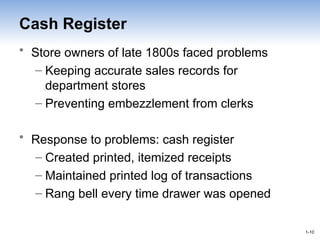
Cash Register
• Store owners of late 1800s faced problems
– Keeping accurate sales records for
department stores
– Preventing embezzlement from clerks
• Response to problems: cash register
– Created printed, itemized receipts
– Maintained printed log of transactions
– Rang bell every time drawer was opened
1-11
1-11
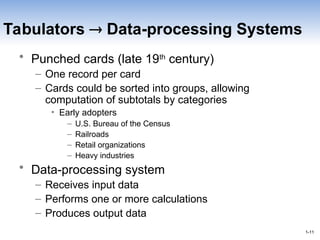
Tabulators  Data-processing Systems
• Punched cards (late 19th
century)
– One record per card
– Cards could be sorted into groups, allowing
computation of subtotals by categories
• Early adopters
– U.S. Bureau of the Census
– Railroads
– Retail organizations
– Heavy industries
• Data-processing system
– Receives input data
– Performs one or more calculations
– Produces output data
1-12
1-12
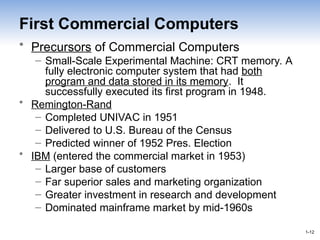
First Commercial Computers
• Precursors of Commercial Computers
– Small-Scale Experimental Machine: CRT memory. A
fully electronic computer system that had both
program and data stored in its memory. It
successfully executed its first program in 1948.
• Remington-Rand
– Completed UNIVAC in 1951
– Delivered to U.S. Bureau of the Census
– Predicted winner of 1952 Pres. Election
• IBM (entered the commercial market in 1953)
– Larger base of customers
– Far superior sales and marketing organization
– Greater investment in research and development
– Dominated mainframe market by mid-1960s
1-13
1-13
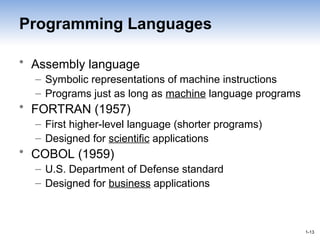
Programming Languages
• Assembly language
– Symbolic representations of machine instructions
– Programs just as long as machine language programs
• FORTRAN (1957)
– First higher-level language (shorter programs)
– Designed for scientific applications
• COBOL (1959)
– U.S. Department of Defense standard
– Designed for business applications
1-14
1-14
Time-Sharing Systems and BASIC
• Time-Sharing Systems (In the early 1960s)
– Divide computer time among multiple users
– Users connect to computer via terminals
– Cost of ownership spread among more people
– Gave many more people access to computers
• BASIC (In the early 1960s)
– Developed at Dartmouth College
– Simple, easy-to-learn programming language
– Popular language for teaching programming
1-15
1-15
Other Advances
• Transistor
– Replacement for vacuum tube
– Invented at Bell Labs (1948)
• Semiconductor
– Faster
– Cheaper
– More reliable
– More energy-efficient
• Integrated Circuit : Semiconductor containing transistors,
capacitors, and resistors
– Advantages over parts they replaced
• Smaller
• Faster
• More reliable
• Less expensive
1-16
1-16
IBM System/360
• Before System/360
– IBM dominated mainframe market in 1960s
– IBM computers were incompatible
– Switch computers  rewrite programs
• System/360 (1964)
– Series of 19 computers with varying levels of
power
– All computers could run same programs -
Compatible
– Upgrade without rewriting programs
1-17
1-17
Microprocessor and Personal Computer
• Microprocessor: Computer inside a single
semiconductor chip
– Invented in 1970 at Intel
– Made personal computers practical
• Example of first PCs
– Altair 8800 (1975)
– Personal computers become popular
• Apple Computer: Apple II
– Developments draw businesses to personal
computers
• IBM launches IBM PC
1-18
1-18
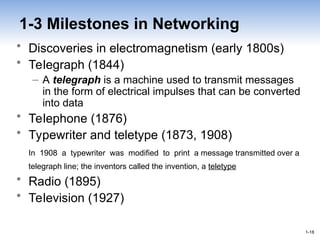
1-3 Milestones in Networking
• Discoveries in electromagnetism (early 1800s)
• Telegraph (1844)
– A telegraph is a machine used to transmit messages
in the form of electrical impulses that can be converted
into data
• Telephone (1876)
• Typewriter and teletype (1873, 1908)
In 1908 a typewriter was modified to print a message transmitted over a
telegraph line; the inventors called the invention, a teletype
• Radio (1895)
• Television (1927)
1-19
1-19
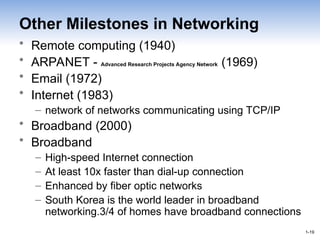
Other Milestones in Networking
• Remote computing (1940)
• ARPANET - Advanced Research Projects Agency Network (1969)
• Email (1972)
• Internet (1983)
– network of networks communicating using TCP/IP
• Broadband (2000)
• Broadband
– High-speed Internet connection
– At least 10x faster than dial-up connection
– Enhanced by fiber optic networks
– South Korea is the world leader in broadband
networking.3/4 of homes have broadband connections
1-20
1-20
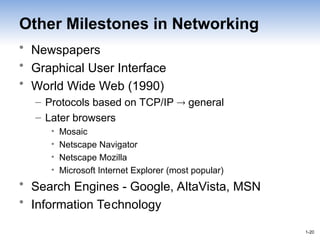
Other Milestones in Networking
• Newspapers
• Graphical User Interface
• World Wide Web (1990)
– Protocols based on TCP/IP  general
– Later browsers
• Mosaic
• Netscape Navigator
• Netscape Mozilla
• Microsoft Internet Explorer (most popular)
• Search Engines - Google, AltaVista, MSN
• Information Technology
1-21
1-21
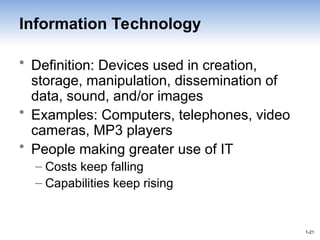
Information Technology
• Definition: Devices used in creation,
storage, manipulation, dissemination of
data, sound, and/or images
• Examples: Computers, telephones, video
cameras, MP3 players
• People making greater use of IT
– Costs keep falling
– Capabilities keep rising
1-22
1-22
1-4 IT Issues
• Email
– Easy way to keep in touch
– Spam has become a real problem
• Web
– Free access to huge amounts of information
– Harmful consequences of some sites
• CDs, MP3s, MP4s
– Free or cheap copies readily available
– May be unfair to musicians
• Credit cards
– Convenience over cash and checks
– Increases possibility of identity theft
– Who owns information about transactions?
1-23
1-23
1-4 IT Issues (cont.)
• Telecommuting
– Saves time, allows more flexible work hours
– Can lead to longer work hours
– May result in fewer chances for promotion
• Improved global communication network
– Allow companies to sell to entire world
– Allow companies to move jobs out of their
home countries.
• World Wide Web
– A conduit for democratic ideas?
– Another tool for totalitarian governments?
1-24
1-24
Conclusions
• Revolutionary discoveries are rare
• Information technology has long history
• Rate of technological change accelerating
• Wrong question: “What will the computer
do to us?”
• Right question: “What will we make of the
computer?”
(quoting Seymour Papert)

Chapter 1 - Catalysts for Change in 610.ppt

  • 1.
    1-1 Chapter 1: Catalysts forChange ISEC 610: Information Systems Ethics and Security 1-1
  • 2.
    1-2 1-2 Organization of Chapter •1-1 Introduction • 1-2 Milestones in computing • 1-3 Milestones in networking • 1-4 Information technology issues
  • 3.
    1-3 1-3 1.1 Introduction Information Age •Characterized by unprecedented access to information • Catalysts – Low-cost computers – High-speed communication networks • Examples of advances in past two decades – Cell phones – Email – World Wide Web – MP3 players
  • 4.
    1-4 1-4 1.1 Introduction (cont.) Technologyand Values • Dynamic between people, technology – People adopt technology – Technology changes society • Different ways people are affected by technology – Physical changes (e.g., pains accompany the use of laptops) – Psychological changes (e.g., cell phones make you feel safer) • Technologies can solve problems, create new problems – Automobile – Refrigerator and the Ozone Layer – Low-cost international communication – Nuclear weapons and radiation the Ozone Layer
  • 5.
    1-5 1-5 Control over NewTechnologies • People can control whether to adopt new technology – Nuclear power moratorium in United States – Nuclear power advances in rest of world • People can influence rate at which technologies are developed – Intellectual property laws (make money from creativity) – Tax structure (accumulate great wealth) 1.1 Introduction (cont.)
  • 6.
    1-6 1-6 1.2 Milestones inComputing • Aids to manual calculating • Mechanical calculators • Cash register • Punched card tabulation • Precursors of commercial computers • First commercial computers • Programming languages and time-sharing • Transistor and integrated circuit • IBM System/360 • Microprocessor • Personal computer
  • 7.
    1-7 1-7 Aids to ManualCalculating • The three important aids to manual calculating are: – tablet, – the abacus, – and mathematical tables • Tables of logarithms (17th century) • Income tax tables (today). • However, even with them manual calculating is slow, tedious, and error-prone.
  • 8.
    1-8 1-8 Early Mechanical Calculators •Calculators (from 17th – 19th century) • Social Change  Market for Calculators – Gilded Age (late 19th century America) • Rapid industrialization • Economic expansion • Concentration of corporate power – New, larger corporations • Multiple layers of management • Multiple locations • Needed up-to-date, comprehensive, reliable, and affordable information
  • 9.
    1-9 1-9 Early Mechanical Calculators •Calculator Adoptions  Social Change – Fierce competition in calculator market • Continuous improvements in size, speed, ease of use • Sales increased rapidly – “Deskilling” and feminization of bookkeeping • People of average ability quite productive • Calculators 6 faster than adding by hand • Wages dropped • Women replaced men
  • 10.
    1-10 1-10 Cash Register • Storeowners of late 1800s faced problems – Keeping accurate sales records for department stores – Preventing embezzlement from clerks • Response to problems: cash register – Created printed, itemized receipts – Maintained printed log of transactions – Rang bell every time drawer was opened
  • 11.
    1-11 1-11 Tabulators  Data-processingSystems • Punched cards (late 19th century) – One record per card – Cards could be sorted into groups, allowing computation of subtotals by categories • Early adopters – U.S. Bureau of the Census – Railroads – Retail organizations – Heavy industries • Data-processing system – Receives input data – Performs one or more calculations – Produces output data
  • 12.
    1-12 1-12 First Commercial Computers •Precursors of Commercial Computers – Small-Scale Experimental Machine: CRT memory. A fully electronic computer system that had both program and data stored in its memory. It successfully executed its first program in 1948. • Remington-Rand – Completed UNIVAC in 1951 – Delivered to U.S. Bureau of the Census – Predicted winner of 1952 Pres. Election • IBM (entered the commercial market in 1953) – Larger base of customers – Far superior sales and marketing organization – Greater investment in research and development – Dominated mainframe market by mid-1960s
  • 13.
    1-13 1-13 Programming Languages • Assemblylanguage – Symbolic representations of machine instructions – Programs just as long as machine language programs • FORTRAN (1957) – First higher-level language (shorter programs) – Designed for scientific applications • COBOL (1959) – U.S. Department of Defense standard – Designed for business applications
  • 14.
    1-14 1-14 Time-Sharing Systems andBASIC • Time-Sharing Systems (In the early 1960s) – Divide computer time among multiple users – Users connect to computer via terminals – Cost of ownership spread among more people – Gave many more people access to computers • BASIC (In the early 1960s) – Developed at Dartmouth College – Simple, easy-to-learn programming language – Popular language for teaching programming
  • 15.
    1-15 1-15 Other Advances • Transistor –Replacement for vacuum tube – Invented at Bell Labs (1948) • Semiconductor – Faster – Cheaper – More reliable – More energy-efficient • Integrated Circuit : Semiconductor containing transistors, capacitors, and resistors – Advantages over parts they replaced • Smaller • Faster • More reliable • Less expensive
  • 16.
    1-16 1-16 IBM System/360 • BeforeSystem/360 – IBM dominated mainframe market in 1960s – IBM computers were incompatible – Switch computers  rewrite programs • System/360 (1964) – Series of 19 computers with varying levels of power – All computers could run same programs - Compatible – Upgrade without rewriting programs
  • 17.
    1-17 1-17 Microprocessor and PersonalComputer • Microprocessor: Computer inside a single semiconductor chip – Invented in 1970 at Intel – Made personal computers practical • Example of first PCs – Altair 8800 (1975) – Personal computers become popular • Apple Computer: Apple II – Developments draw businesses to personal computers • IBM launches IBM PC
  • 18.
    1-18 1-18 1-3 Milestones inNetworking • Discoveries in electromagnetism (early 1800s) • Telegraph (1844) – A telegraph is a machine used to transmit messages in the form of electrical impulses that can be converted into data • Telephone (1876) • Typewriter and teletype (1873, 1908) In 1908 a typewriter was modified to print a message transmitted over a telegraph line; the inventors called the invention, a teletype • Radio (1895) • Television (1927)
  • 19.
    1-19 1-19 Other Milestones inNetworking • Remote computing (1940) • ARPANET - Advanced Research Projects Agency Network (1969) • Email (1972) • Internet (1983) – network of networks communicating using TCP/IP • Broadband (2000) • Broadband – High-speed Internet connection – At least 10x faster than dial-up connection – Enhanced by fiber optic networks – South Korea is the world leader in broadband networking.3/4 of homes have broadband connections
  • 20.
    1-20 1-20 Other Milestones inNetworking • Newspapers • Graphical User Interface • World Wide Web (1990) – Protocols based on TCP/IP  general – Later browsers • Mosaic • Netscape Navigator • Netscape Mozilla • Microsoft Internet Explorer (most popular) • Search Engines - Google, AltaVista, MSN • Information Technology
  • 21.
    1-21 1-21 Information Technology • Definition:Devices used in creation, storage, manipulation, dissemination of data, sound, and/or images • Examples: Computers, telephones, video cameras, MP3 players • People making greater use of IT – Costs keep falling – Capabilities keep rising
  • 22.
    1-22 1-22 1-4 IT Issues •Email – Easy way to keep in touch – Spam has become a real problem • Web – Free access to huge amounts of information – Harmful consequences of some sites • CDs, MP3s, MP4s – Free or cheap copies readily available – May be unfair to musicians • Credit cards – Convenience over cash and checks – Increases possibility of identity theft – Who owns information about transactions?
  • 23.
    1-23 1-23 1-4 IT Issues(cont.) • Telecommuting – Saves time, allows more flexible work hours – Can lead to longer work hours – May result in fewer chances for promotion • Improved global communication network – Allow companies to sell to entire world – Allow companies to move jobs out of their home countries. • World Wide Web – A conduit for democratic ideas? – Another tool for totalitarian governments?
  • 24.
    1-24 1-24 Conclusions • Revolutionary discoveriesare rare • Information technology has long history • Rate of technological change accelerating • Wrong question: “What will the computer do to us?” • Right question: “What will we make of the computer?” (quoting Seymour Papert)