Fundamentals of
Information Technology
(IT-162)
Meer Qaisar Javed
qaisar.javed@uog.edu.pk
Lecture # 07
Department of Information Technology, University of Gujrat
Principles of
Information Systems
(Eighth Edition)
Chapter 1
An Introduction to Information Systems
Principles and Learning
Objectives
 The value of information is directly linked to
how it helps decision makers achieve the
organization’s goals
 Discuss why it is important to study and understand
information systems
 Distinguish data from information and describe the
characteristics used to evaluate the quality of data
Principles of Information Systems, Eighth Edition 3
Principles and Learning
Objectives (continued)
 Computers and information systems are
constantly making it possible for
organizations to improve the way they
conduct business
 Name the components of an information system and
describe several system characteristics
Principles of Information Systems, Eighth Edition 4
Principles and Learning
Objectives (continued)
 Knowing the potential impact of information
systems and having the ability to put this
knowledge to work can result in a successful
personal career, organizations that reach their
goals, and a society with a higher quality of life
◦ List the components of a computer-based information system
◦ Identify the basic types of business information systems and
discuss who uses them, how they are used, and what kinds of
benefits they deliver
Principles of Information Systems, Eighth Edition 5
Principles and Learning
Objectives (continued)
 System users, business managers, and
information systems professionals must work
together to build a successful information
system
 Identify the major steps of the systems development process
and state the goal of each
Principles of Information Systems, Eighth Edition 6
Principles and Learning
Objectives (continued)
 Information systems must be applied
thoughtfully and carefully so that society,
business, and industry can reap their
enormous benefits
 Describe some of the threats to security and privacy that
information systems and the Internet can pose
 Discuss the expanding role and benefits of information
systems in business and industry
Principles of Information Systems, Eighth Edition 7
Why Learn About Information
Systems?
 Information systems used in most professions
 Sales reps
 Managers
 Corporate lawyers
 Indispensable for achieving career goals
Principles of Information Systems, Eighth Edition 8
Introduction
 Information system (IS)
 A set of interrelated components that collect, manipulate, and
disseminate data and information, and provide feedback to
meet an objective
 Examples: ATMs, airline reservation systems, course
reservation systems
Principles of Information Systems, Eighth Edition 9
Information Concepts
 Information is one of an organization’s most
valuable resources
 Information is different from data
Principles of Information Systems, Eighth Edition 10
Data, Information, and
Knowledge
 Data: raw facts
 Information: collection of facts organized in
such a way that they have value beyond the
facts themselves
 Knowledge: awareness and understanding
of a set of information and ways that
information can be made useful to support a
specific task or reach a decision
Principles of Information Systems, Eighth Edition 11
Data, Information, and
Knowledge (continued)
Principles of Information Systems, Eighth Edition 12
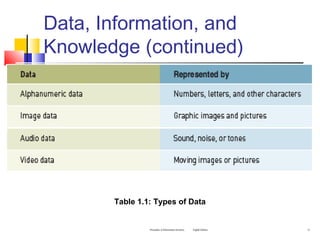
Table 1.1: Types of Data
Principles of Information Systems, Eighth Edition 13
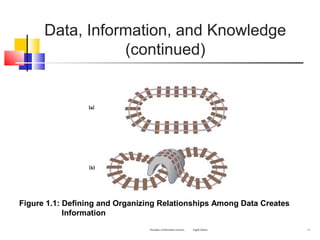
Figure 1.1: Defining and Organizing Relationships Among Data Creates
Information
Data, Information, and Knowledge
(continued)
Principles of Information Systems, Eighth Edition 14
Figure 1.2: The Process of Transforming Data into Information
Data, Information, and Knowledge
(continued)

Fit l07 introduction_is

  • 1.
    Fundamentals of Information Technology (IT-162) MeerQaisar Javed qaisar.javed@uog.edu.pk Lecture # 07 Department of Information Technology, University of Gujrat
  • 2.
    Principles of Information Systems (EighthEdition) Chapter 1 An Introduction to Information Systems
  • 3.
    Principles and Learning Objectives The value of information is directly linked to how it helps decision makers achieve the organization’s goals  Discuss why it is important to study and understand information systems  Distinguish data from information and describe the characteristics used to evaluate the quality of data Principles of Information Systems, Eighth Edition 3
  • 4.
    Principles and Learning Objectives(continued)  Computers and information systems are constantly making it possible for organizations to improve the way they conduct business  Name the components of an information system and describe several system characteristics Principles of Information Systems, Eighth Edition 4
  • 5.
    Principles and Learning Objectives(continued)  Knowing the potential impact of information systems and having the ability to put this knowledge to work can result in a successful personal career, organizations that reach their goals, and a society with a higher quality of life ◦ List the components of a computer-based information system ◦ Identify the basic types of business information systems and discuss who uses them, how they are used, and what kinds of benefits they deliver Principles of Information Systems, Eighth Edition 5
  • 6.
    Principles and Learning Objectives(continued)  System users, business managers, and information systems professionals must work together to build a successful information system  Identify the major steps of the systems development process and state the goal of each Principles of Information Systems, Eighth Edition 6
  • 7.
    Principles and Learning Objectives(continued)  Information systems must be applied thoughtfully and carefully so that society, business, and industry can reap their enormous benefits  Describe some of the threats to security and privacy that information systems and the Internet can pose  Discuss the expanding role and benefits of information systems in business and industry Principles of Information Systems, Eighth Edition 7
  • 8.
    Why Learn AboutInformation Systems?  Information systems used in most professions  Sales reps  Managers  Corporate lawyers  Indispensable for achieving career goals Principles of Information Systems, Eighth Edition 8
  • 9.
    Introduction  Information system(IS)  A set of interrelated components that collect, manipulate, and disseminate data and information, and provide feedback to meet an objective  Examples: ATMs, airline reservation systems, course reservation systems Principles of Information Systems, Eighth Edition 9
  • 10.
    Information Concepts  Informationis one of an organization’s most valuable resources  Information is different from data Principles of Information Systems, Eighth Edition 10
  • 11.
    Data, Information, and Knowledge Data: raw facts  Information: collection of facts organized in such a way that they have value beyond the facts themselves  Knowledge: awareness and understanding of a set of information and ways that information can be made useful to support a specific task or reach a decision Principles of Information Systems, Eighth Edition 11
  • 12.
    Data, Information, and Knowledge(continued) Principles of Information Systems, Eighth Edition 12 Table 1.1: Types of Data
  • 13.
    Principles of InformationSystems, Eighth Edition 13 Figure 1.1: Defining and Organizing Relationships Among Data Creates Information Data, Information, and Knowledge (continued)
  • 14.
    Principles of InformationSystems, Eighth Edition 14 Figure 1.2: The Process of Transforming Data into Information Data, Information, and Knowledge (continued)