Ecofriendly fishing gear
and fishing practices
ASHISH SAHU
Contents
No. Title
1. What is eco friendly gear?
2. If fishing is not eco-friendly!
3. Eofriendly approaches…
4. Innovations in trawl for modification.
5.
6.
Conclusion
Reference
What is an Eco friendly fishing gear?
 Decreases impacts of fishing on habitat.
 Optimise catches of target and minimises unwanted catches.
If fishing is not eco-friendly,
After effects of destructive gears…
Modifications done in the destructive
gears…
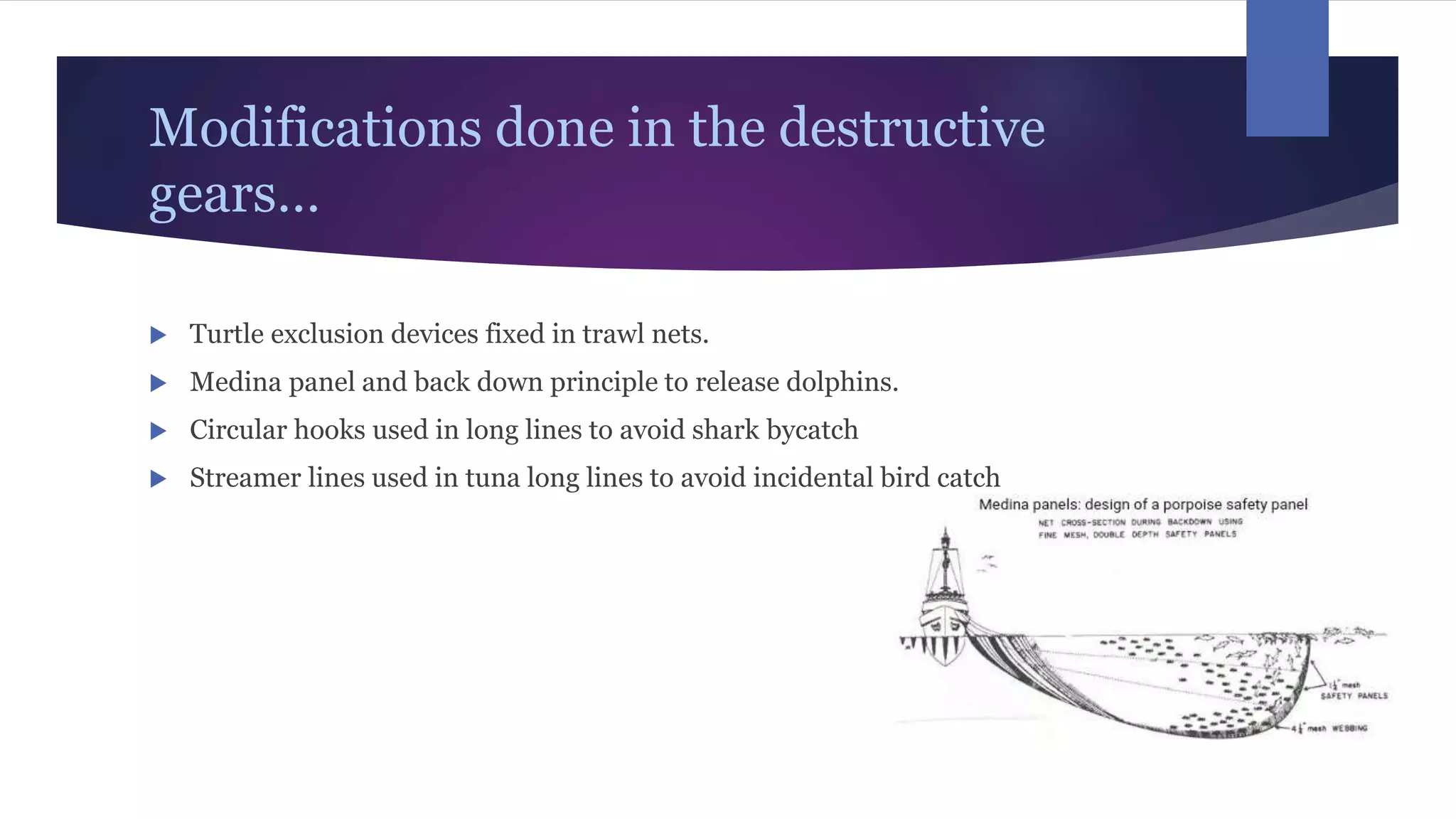
 Turtle exclusion devices fixed in trawl nets.
 Medina panel and back down principle to release dolphins.
 Circular hooks used in long lines to avoid shark bycatch
 Streamer lines used in tuna long lines to avoid incidental bird catch
Eco friendly approaches…
 1. Traps
 Popular trap : Collapsible Kalava trap
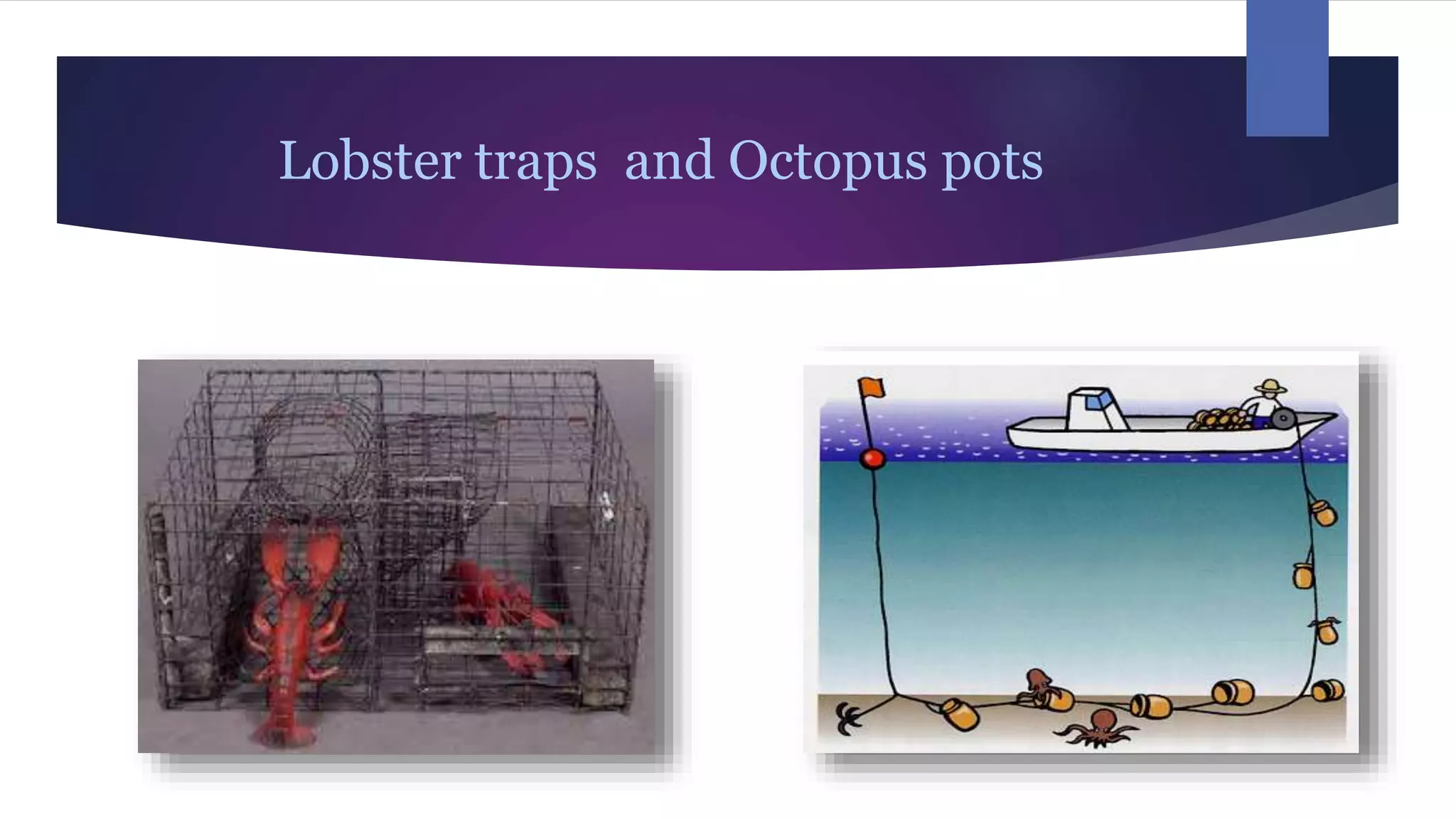
Lobster traps and Octopus pots
Cont’d…
 Modified Salmon traps to avoid seal capture
 Grid in the entrance prevents seals from entering the trap.
 Ecofriendly because the captured salmon is safe from seal attack and
seals are not trapped.
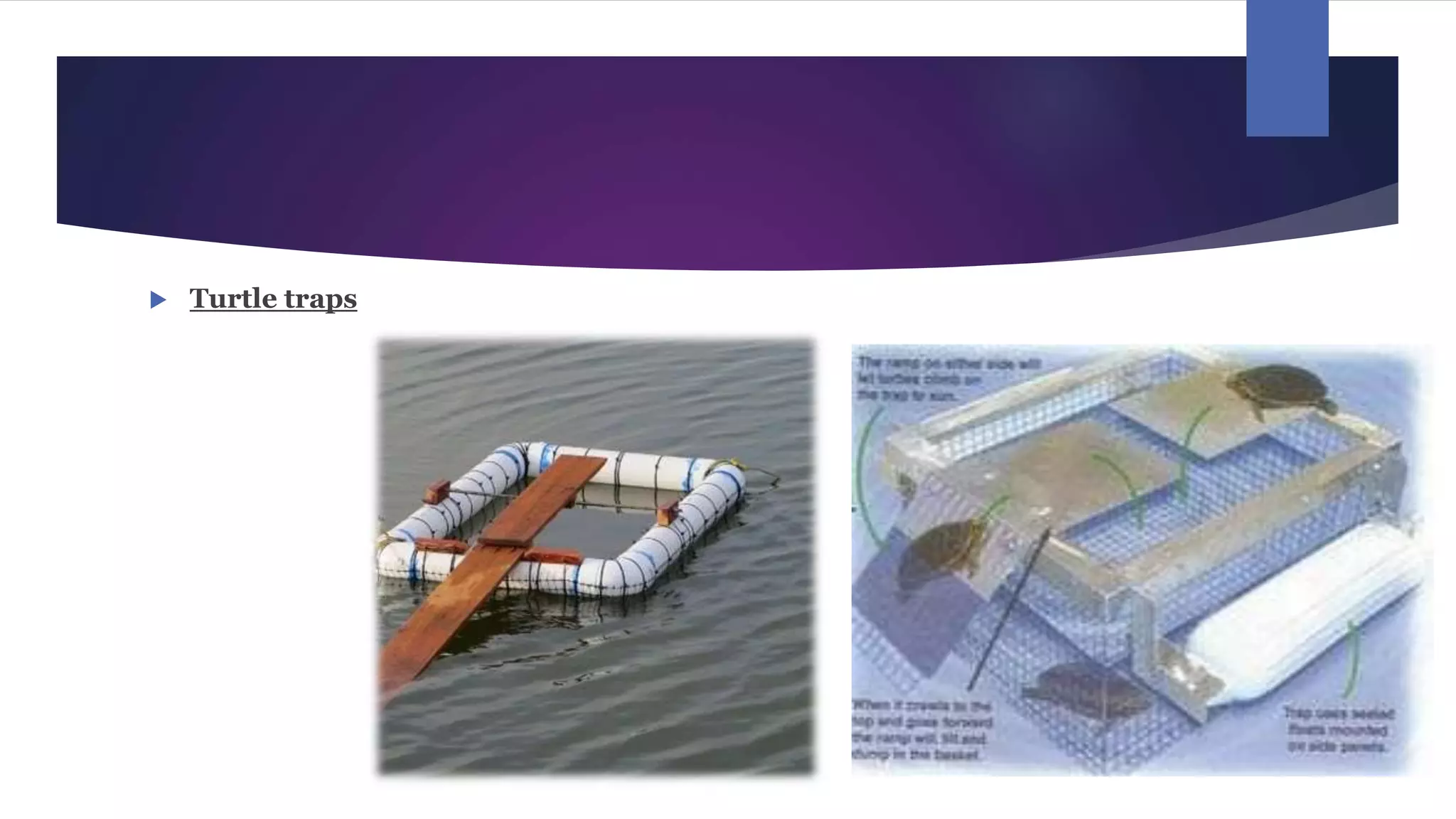
 Turtle traps
cont’d…
 Floating traps and weirs,which guide the fish ever smaller boxes,harm
neither fish nor the environment.
 Reef nets
 Used for salmon in the Northwest, are shallow,near –the –surface
nets that the salmon swim right into,then are tripped into holding
tanks.
 Wire meshed traps that lie on the bottom can damage the ocean floor
if they’re dragged,which led to their being banned in some parts of the
world.Used properly,they’re usually not harmful.
2.Hook and lining(also called pole catching)
 Use of a rod with one line and several hooks.
 Catch is hauled in manually or with a mechanised reel.
 Ecofriendly because,fisherman can quickly release unwanted catch
from their hooks soon after it was caught.
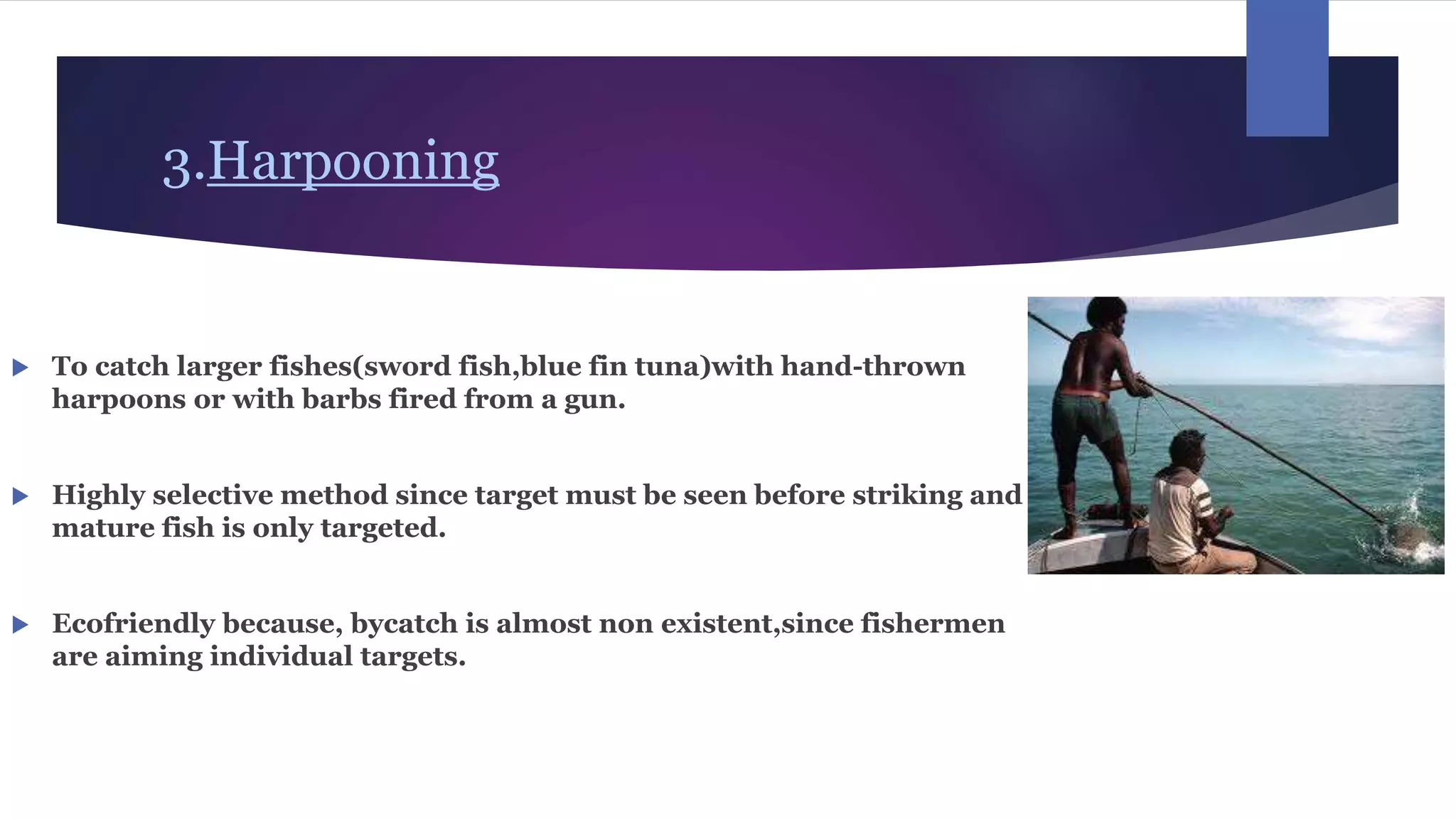
3.Harpooning
 To catch larger fishes(sword fish,blue fin tuna)with hand-thrown
harpoons or with barbs fired from a gun.
 Highly selective method since target must be seen before striking and
mature fish is only targeted.
 Ecofriendly because, bycatch is almost non existent,since fishermen
are aiming individual targets.
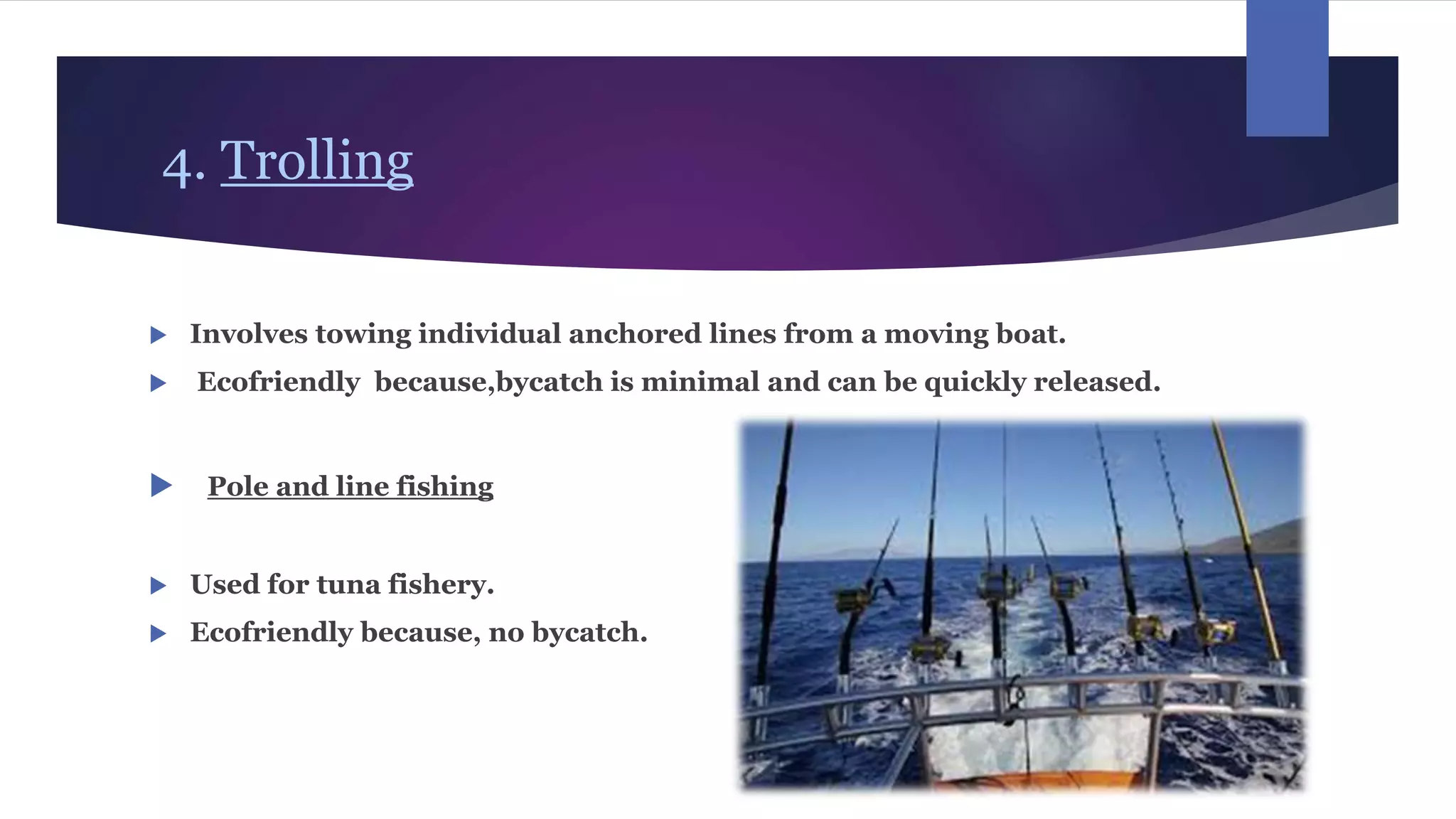
4. Trolling
 Involves towing individual anchored lines from a moving boat.
 Ecofriendly because,bycatch is minimal and can be quickly released.
 Pole and line fishing
 Used for tuna fishery.
 Ecofriendly because, no bycatch.
5.Diving and snorkelling for fish
 Free diving(using mask and snorkel) or scuba diving is a traditional
method for collecting lobster,abalone,seaweed,sponges and reef
dwelling fishes.
 Hand collection by divers is selective and least damaging fishing
method,provided harvesting is carried out responsibly.
Innovations introduced in trawls to make
them eco friendly.
 1.High speed demersal trawl
 Developed by CIFT for operation from FORV Sagar Sampada.
 A false ground line 30cm below the actual ground rope
inorder to keep gear just above sea bed is made.
 Ecofriendly because, this arrangement allows shallow
water mix and other non target finfish to escape.
Cont’d…
 2. Semi pelagic trawls
 Developed by CIFT.
 It has a high lead line, capable of being used offbottom with increased
fishing capacity from the improved mouth-opening.
 Gear moves 2-3 m above bottom,targeting the resource that aggregate
in the water column close to the bottom.Large mesh is used in the fore
part.
 Ecofriendly because, it cause only less damage to bottom fauna and
non target fish.
Conclusion
 Selective and ecofriendly fishing practices should be applied to
conserve biodiversity,population structure and fish quality.
 Selectivity of fishing gear ,gear restrictions and area restrictions
determines the eco friendly nature of a fishing gear.
 Some of the eco-friendly fishing gears include
harpoons,troll,traps,hook and line etc…
 Some of the eco friendly fishing methods include trolling,
pole and line,harpooning,diving and snorkelling for fish etc…
 In general,the mentioned fishing methods do no harm
to the oceans and fishes,but if used improperly,some can.
Reference
 FAO Technical Guidelines for Responsible Fisheries. No. 1, Suppl. 2.Rome,FAO.2009. 49p.
 El Gamal,A.A.,Abdullah,S., and Barrania, A.(editors).2002.Environmentally friendly
Aquaculture and fisheries practices,workshop proceedings,15-17 September
2002.Hurghada,Egypt.173pp
 B.Meenakumari ,Usha Bagirathan,Satyen Kumar Panda.(2014).Impact of bottom trawling on
the epifauna off Veraval Coast,India
 www.fao.org
Ecofriendly fishing practices

Ecofriendly fishing practices

  • 1.
    Ecofriendly fishing gear andfishing practices ASHISH SAHU
  • 2.
    Contents No. Title 1. Whatis eco friendly gear? 2. If fishing is not eco-friendly! 3. Eofriendly approaches… 4. Innovations in trawl for modification. 5. 6. Conclusion Reference
  • 3.
    What is anEco friendly fishing gear?  Decreases impacts of fishing on habitat.  Optimise catches of target and minimises unwanted catches.
  • 4.
    If fishing isnot eco-friendly,
  • 5.
    After effects ofdestructive gears…
  • 6.
    Modifications done inthe destructive gears…  Turtle exclusion devices fixed in trawl nets.  Medina panel and back down principle to release dolphins.  Circular hooks used in long lines to avoid shark bycatch  Streamer lines used in tuna long lines to avoid incidental bird catch
  • 7.
    Eco friendly approaches… 1. Traps  Popular trap : Collapsible Kalava trap
  • 8.
    Lobster traps andOctopus pots
  • 9.
    Cont’d…  Modified Salmontraps to avoid seal capture  Grid in the entrance prevents seals from entering the trap.  Ecofriendly because the captured salmon is safe from seal attack and seals are not trapped.
  • 10.
  • 11.
    cont’d…  Floating trapsand weirs,which guide the fish ever smaller boxes,harm neither fish nor the environment.  Reef nets  Used for salmon in the Northwest, are shallow,near –the –surface nets that the salmon swim right into,then are tripped into holding tanks.  Wire meshed traps that lie on the bottom can damage the ocean floor if they’re dragged,which led to their being banned in some parts of the world.Used properly,they’re usually not harmful.
  • 12.
    2.Hook and lining(alsocalled pole catching)  Use of a rod with one line and several hooks.  Catch is hauled in manually or with a mechanised reel.  Ecofriendly because,fisherman can quickly release unwanted catch from their hooks soon after it was caught.
  • 13.
    3.Harpooning  To catchlarger fishes(sword fish,blue fin tuna)with hand-thrown harpoons or with barbs fired from a gun.  Highly selective method since target must be seen before striking and mature fish is only targeted.  Ecofriendly because, bycatch is almost non existent,since fishermen are aiming individual targets.
  • 14.
    4. Trolling  Involvestowing individual anchored lines from a moving boat.  Ecofriendly because,bycatch is minimal and can be quickly released.  Pole and line fishing  Used for tuna fishery.  Ecofriendly because, no bycatch.
  • 15.
    5.Diving and snorkellingfor fish  Free diving(using mask and snorkel) or scuba diving is a traditional method for collecting lobster,abalone,seaweed,sponges and reef dwelling fishes.  Hand collection by divers is selective and least damaging fishing method,provided harvesting is carried out responsibly.
  • 16.
    Innovations introduced intrawls to make them eco friendly.  1.High speed demersal trawl  Developed by CIFT for operation from FORV Sagar Sampada.  A false ground line 30cm below the actual ground rope inorder to keep gear just above sea bed is made.  Ecofriendly because, this arrangement allows shallow water mix and other non target finfish to escape.
  • 17.
    Cont’d…  2. Semipelagic trawls  Developed by CIFT.  It has a high lead line, capable of being used offbottom with increased fishing capacity from the improved mouth-opening.  Gear moves 2-3 m above bottom,targeting the resource that aggregate in the water column close to the bottom.Large mesh is used in the fore part.  Ecofriendly because, it cause only less damage to bottom fauna and non target fish.
  • 18.
    Conclusion  Selective andecofriendly fishing practices should be applied to conserve biodiversity,population structure and fish quality.  Selectivity of fishing gear ,gear restrictions and area restrictions determines the eco friendly nature of a fishing gear.  Some of the eco-friendly fishing gears include harpoons,troll,traps,hook and line etc…  Some of the eco friendly fishing methods include trolling, pole and line,harpooning,diving and snorkelling for fish etc…  In general,the mentioned fishing methods do no harm to the oceans and fishes,but if used improperly,some can.
  • 19.
    Reference  FAO TechnicalGuidelines for Responsible Fisheries. No. 1, Suppl. 2.Rome,FAO.2009. 49p.  El Gamal,A.A.,Abdullah,S., and Barrania, A.(editors).2002.Environmentally friendly Aquaculture and fisheries practices,workshop proceedings,15-17 September 2002.Hurghada,Egypt.173pp  B.Meenakumari ,Usha Bagirathan,Satyen Kumar Panda.(2014).Impact of bottom trawling on the epifauna off Veraval Coast,India  www.fao.org