Use of otolith microchemistry in fish stock
identification: freshwater, anadromous, and
marine applications
Robin Shin
11/30/16
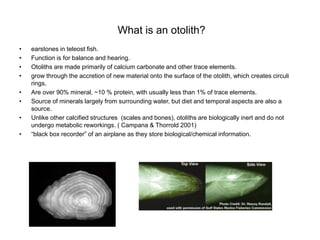
What is an otolith?
• earstones in teleost fish.
• Function is for balance and hearing.
• Otoliths are made primarily of calcium carbonate and other trace elements.
• grow through the accretion of new material onto the surface of the otolith, which creates circuli
rings.
• Are over 90% mineral, ~10 % protein, with usually less than 1% of trace elements.
• Source of minerals largely from surrounding water, but diet and temporal aspects are also a
source.
• Unlike other calcified structures (scales and bones), otoliths are biologically inert and do not
undergo metabolic reworkings. ( Campana & Thorrold 2001)
• “black box recorder” of an airplane as they store biological/chemical information.
Otolith structure
• Otoliths can be found directly behind the brain in bony fish
– Sagitta (largest and most commonly used), asteriscus, and lapillus
• Otolith size and shape differ between species, but generally the form is:
– Sulcus acousticus – two- part tadpole like feature which attaches to auditory nerves. Usually runs parallel
closer to the dorsal edge, curving downward to the ventral edge.
– Cauda- the narrow groove ( tail of the tadpole), points to the posterior of the fish
– Ostium- rounded anterior portion of the sulcus
Red Drum otolith ( FFW)
Chinook salmon cranial
cavity
the history of otolith analysis in fisheries
• Aristotle - possibly first to recognize use of bony structures to age fish.
• Historia Animalium - “the age of a scaly fish may be told by the size and hardness of its scales”
• 1890’s first use of otoliths to age fish using annuli( Reibisch,1899).
• Pannella (1971) discovered that otolith structure can form on a daily basis, led to otolith
microstructure analysis.
• 1980’s- abundance of strontium and barium relative to calcium within otoliths linked to relative
environmental abundance of these elements
Fig. 1. Historical development of otolith-based research in fish
biology and ecology as indicated
Starrs et al. 2006
Otolith: biological & spatial information.
• Biological-majority of otolith papers. (68.4 % of papers between 2005-2012)
– Larval & juvenile age
– Growth & mortality rates
– “microstructure” analysis- using otolith growth rings to obtain information.
• Spatial- 17.6 % of studies between 2005-2012
– Dispersal
– Habitat use
– Migration
– Behavior
– “microchemistry” analysis of minor elements accreted onto otolith overtime.
• Meta-analysis of 476 papers- 62 % marine, 15% freshwater.
Starrs et al. 2006
Otolith microchemistry
• Analyze microchemical signatures due to incremental accretions of elements.
• Up to 31 elements have been detected in otoliths
• Otolith composition dominated by calcium, carbon, oxygen ( CaCo3 backbone)
• Minor elements: Na, Sr, K, S, N, Cl and P occur at >100 ppm
• These elements can be linked to the environment and can provide critical information on:
– habitat use of fish
– local stock populations
– pollution exposure
– natality
Starrs et al. 2006
Anadromous applications
• Help determine anadromous fish stocks- great chemical disparity of the environments
exploited by these fishes (e.g. river vs.estuarine vs. marine environments)
• ratio of Sr:Ca accretion provides information on anadromous movement.
• Degree of accretion depends largely on relative concentrations in the ambient water
such that:
– Sr:Ca ratio is higher in marine environments and lower in freshwater.
– Kalish (1989)- levels of strontium in otolith directly related to levels in the
endolymph
– Estuary brown trout had higher levels of Sr in both otolith & endolymph than non-
anadromous trout.
Campana, 1999
Case study: Life History and Evolution of Migration in Catadromous Eels
(Genus Anguilla) Jun Aoyama*
Ocean Research Institute, The University of Tokyo, 1-15-1, Minamidai, Nakano,
Tokyo 164-8639, Japan
Fig. 12. Strontium maps of the otoliths of three
Japanese eels that show the likely types of habitats
where they lived with a dark blue color for fresh
water, light blue for low salinities, and yellow and
orange for higher salinities in the left panel, and line
transects of Sr:Ca ratios along the length of the
same otoliths show the patterns of change in Sr
levels during the life of each eel (right panel).
• Conclude: facultative
catadromy, “sea eels”
• Latitudinal cline of sea eel
disribution, higher in
northern latitudes.
Case study: Use of otolith microchemistry and stable isotopes to investigate
the ecology and anadromous migrations of Northern Dolly Varden from the Egegik River,
Bristol Bay, Alaska. Envir. Bio Fish Hart et al. 2015
• Dolly varden ( Salvelinus malma) are facultative anadromous salmonids.
– Iteroperous
– Broadly distributed along Pacific rim
– Many questions pertaining to variation in life histories & many ecological questions
unanswered
• 30 sagittal otoliths from fish examined
Case study: Use of otolith microchemistry and stable isotopes to investigate
the ecology and anadromous migrations of Northern Dolly Varden from the Egegik River,
Bristol Bay, Alaska. Envir. Bio Fish Hart et al. 2015
• Results: all fish migrated to sea at age 2-3.
• Migrated annually thereafter and did not overwinter in marine waters.
• 14 fish born from anadromous mothers, 11 non anadromous, 5 uncertain
• Anadromy- sr:ca ratio greater than .5 mmol at the core.
Marine applications
• marine applications generally examine ratios of Sr, Mg, Mn, and Ba within species
and between species.
• Can provide similar but also different information.
– Ex. Atlantic Herring- 3 known nursery areas, found that spawning individuals originate from a
number of different nursing areas based off of differences in Li, Na, Mg, Mn, Sr, and Ba (
Geffen et al. 2010)
– Ex. Ferenbaugh et al. 2009, examined how digestion of otoliths by pinnipeds affected micro
chemical profile when compared to pure otoliths. Up to 65 % discrimination.
– Ex. Multispecies otolith microchemistry.
• Cod (Gadus morhua) and herring (Clupea harengus) differentiate primarily on Mg and
Sr ratios.
• bluemouth (Helicolenus dactylopterus) and sole (Solea solea) differentiate at Mn and
Ba ratios.
Freshwater applications: Unravelling the life history
of Amazonian fishes
through otolith
microchemistry. Herman et al. 2016
• Examined 5 Amazon fish species: 2 sedentary (Arapaima sp. & P. squamosissimus),
1 floodplain (P.nigricans), and 2 migratory catfish (B. rousseauxii and B.
filamentosum)
• Low-resolution laser ablation–ICPMS (LA–ICPMS & scanning X-ray fluorescence
microscopy
Results
• Sedentary: confirm behavior of fish, no long distance migration observed
– Arapaima sp.- Repeated annual bands. Zinc concentrated near sulcus, suggests differential
levels of crystallization between zinc and strontium.
• Conclude: short distance migrations among chemically similar habitats
– P. squamosissimus- alternating bands of Sr:Ca and Mn:Ca suggest occupation of 2 distinct
chemical habitats.
• Conclude: migrations between 2 distinct habitats: upstream blackwater drainages, down
(Mn:Ca ) and down stream nursery habitats (Sr:Ca)
• Mn:Ca associated with low oxygen environments.
• Floodplain: analysis show a rise, plateau, and drop of Mn:Ca in Prochilodus
– Conclude that rise in Mn, associated with migration to upstream blackwater drainages
• Migration: B. rousseauxii Sr:Ca ratios variable and high, decrease in concentration followed by
increase in Ba:Ca ratios.
– Conclude: lives for 1.5 – 2 years in estuary, followed by migration upstream into less saline
environments.
• Migration:Sr :Ca and Ba :Ca for B. filamentosum rose and declined simultaneously
– Conclude: different life histories, some fish use estuary for nursing area, others do not.
Otolith microchemistry methods
• 1. extract and clean otoliths (sagittal most commonly used)
• 2. mount otoliths using adhesive (ex.Thermoplastic cement, resin)
• 3. obtain otolith cross section w/ precision saw.
• 4. sand sulcal groove of otolith down & polish with lapping film.
• 5. remount polished otolith.
• 6. analyze via LA-ICP-MS (Laser Ablation Inductively Coupled
Plasma Mass Spectrometry)
Analysis: LA-ICP-MS
• “ Powerful analytical technology that enables highly sensitive elemental and isotopic
analysis to be performed directly on solid samples.”- Applied Spectra
• 1. laser beam focuses on otolith surface to create aerosols or fine particles (ablation)
• 2. ablated particles are transported to plasma source of the ICP-MS instrument for
ionization of the ablated mass.
– Inductively coupled plasma- plasma created by electric currents which are created by electromagnetic
forces
• 3. ions are introduced to mass spectrometer for elemental analysis
Otolith microchemistry methods
• 1. extract otoliths ( sagittal most commonly used)
• 2. mount otoliths using some type of adhesive ( ex. Thermoplastic
cement)
• 3. sand sulcal groove of otolith down & polish with lapping film.
• 4. remount polished otolith.
• 5. analyze via LA-ICP-MS (Laser Ablation Inductively Coupled
Plasma Mass Spectrometry
• 6. exploratory analysis- establish regional finger print of elements
Conclusion
• Both microstructure and microchemical otolith analyses are a powerful tool
that can provide information on biological and spatial questions pertaining to
fish biology.
• More microchemistry studies should be done on freshwater fish species,
particularly in diverse tropical systems where multiple habitat types are
common within a system.
• Some limitations may include temperature effects on the rate of element
accretion, particularly at low temps.

Otolith2

  • 1.
    Use of otolithmicrochemistry in fish stock identification: freshwater, anadromous, and marine applications Robin Shin 11/30/16
  • 2.
    What is anotolith? • earstones in teleost fish. • Function is for balance and hearing. • Otoliths are made primarily of calcium carbonate and other trace elements. • grow through the accretion of new material onto the surface of the otolith, which creates circuli rings. • Are over 90% mineral, ~10 % protein, with usually less than 1% of trace elements. • Source of minerals largely from surrounding water, but diet and temporal aspects are also a source. • Unlike other calcified structures (scales and bones), otoliths are biologically inert and do not undergo metabolic reworkings. ( Campana & Thorrold 2001) • “black box recorder” of an airplane as they store biological/chemical information.
  • 3.
    Otolith structure • Otolithscan be found directly behind the brain in bony fish – Sagitta (largest and most commonly used), asteriscus, and lapillus • Otolith size and shape differ between species, but generally the form is: – Sulcus acousticus – two- part tadpole like feature which attaches to auditory nerves. Usually runs parallel closer to the dorsal edge, curving downward to the ventral edge. – Cauda- the narrow groove ( tail of the tadpole), points to the posterior of the fish – Ostium- rounded anterior portion of the sulcus Red Drum otolith ( FFW) Chinook salmon cranial cavity
  • 4.
    the history ofotolith analysis in fisheries • Aristotle - possibly first to recognize use of bony structures to age fish. • Historia Animalium - “the age of a scaly fish may be told by the size and hardness of its scales” • 1890’s first use of otoliths to age fish using annuli( Reibisch,1899). • Pannella (1971) discovered that otolith structure can form on a daily basis, led to otolith microstructure analysis. • 1980’s- abundance of strontium and barium relative to calcium within otoliths linked to relative environmental abundance of these elements Fig. 1. Historical development of otolith-based research in fish biology and ecology as indicated Starrs et al. 2006
  • 5.
    Otolith: biological &spatial information. • Biological-majority of otolith papers. (68.4 % of papers between 2005-2012) – Larval & juvenile age – Growth & mortality rates – “microstructure” analysis- using otolith growth rings to obtain information. • Spatial- 17.6 % of studies between 2005-2012 – Dispersal – Habitat use – Migration – Behavior – “microchemistry” analysis of minor elements accreted onto otolith overtime. • Meta-analysis of 476 papers- 62 % marine, 15% freshwater. Starrs et al. 2006
  • 6.
    Otolith microchemistry • Analyzemicrochemical signatures due to incremental accretions of elements. • Up to 31 elements have been detected in otoliths • Otolith composition dominated by calcium, carbon, oxygen ( CaCo3 backbone) • Minor elements: Na, Sr, K, S, N, Cl and P occur at >100 ppm • These elements can be linked to the environment and can provide critical information on: – habitat use of fish – local stock populations – pollution exposure – natality Starrs et al. 2006
  • 7.
    Anadromous applications • Helpdetermine anadromous fish stocks- great chemical disparity of the environments exploited by these fishes (e.g. river vs.estuarine vs. marine environments) • ratio of Sr:Ca accretion provides information on anadromous movement. • Degree of accretion depends largely on relative concentrations in the ambient water such that: – Sr:Ca ratio is higher in marine environments and lower in freshwater. – Kalish (1989)- levels of strontium in otolith directly related to levels in the endolymph – Estuary brown trout had higher levels of Sr in both otolith & endolymph than non- anadromous trout. Campana, 1999
  • 8.
    Case study: LifeHistory and Evolution of Migration in Catadromous Eels (Genus Anguilla) Jun Aoyama* Ocean Research Institute, The University of Tokyo, 1-15-1, Minamidai, Nakano, Tokyo 164-8639, Japan Fig. 12. Strontium maps of the otoliths of three Japanese eels that show the likely types of habitats where they lived with a dark blue color for fresh water, light blue for low salinities, and yellow and orange for higher salinities in the left panel, and line transects of Sr:Ca ratios along the length of the same otoliths show the patterns of change in Sr levels during the life of each eel (right panel). • Conclude: facultative catadromy, “sea eels” • Latitudinal cline of sea eel disribution, higher in northern latitudes.
  • 9.
    Case study: Useof otolith microchemistry and stable isotopes to investigate the ecology and anadromous migrations of Northern Dolly Varden from the Egegik River, Bristol Bay, Alaska. Envir. Bio Fish Hart et al. 2015 • Dolly varden ( Salvelinus malma) are facultative anadromous salmonids. – Iteroperous – Broadly distributed along Pacific rim – Many questions pertaining to variation in life histories & many ecological questions unanswered • 30 sagittal otoliths from fish examined
  • 10.
    Case study: Useof otolith microchemistry and stable isotopes to investigate the ecology and anadromous migrations of Northern Dolly Varden from the Egegik River, Bristol Bay, Alaska. Envir. Bio Fish Hart et al. 2015 • Results: all fish migrated to sea at age 2-3. • Migrated annually thereafter and did not overwinter in marine waters. • 14 fish born from anadromous mothers, 11 non anadromous, 5 uncertain • Anadromy- sr:ca ratio greater than .5 mmol at the core.
  • 11.
    Marine applications • marineapplications generally examine ratios of Sr, Mg, Mn, and Ba within species and between species. • Can provide similar but also different information. – Ex. Atlantic Herring- 3 known nursery areas, found that spawning individuals originate from a number of different nursing areas based off of differences in Li, Na, Mg, Mn, Sr, and Ba ( Geffen et al. 2010) – Ex. Ferenbaugh et al. 2009, examined how digestion of otoliths by pinnipeds affected micro chemical profile when compared to pure otoliths. Up to 65 % discrimination. – Ex. Multispecies otolith microchemistry. • Cod (Gadus morhua) and herring (Clupea harengus) differentiate primarily on Mg and Sr ratios. • bluemouth (Helicolenus dactylopterus) and sole (Solea solea) differentiate at Mn and Ba ratios.
  • 12.
    Freshwater applications: Unravellingthe life history of Amazonian fishes through otolith microchemistry. Herman et al. 2016 • Examined 5 Amazon fish species: 2 sedentary (Arapaima sp. & P. squamosissimus), 1 floodplain (P.nigricans), and 2 migratory catfish (B. rousseauxii and B. filamentosum) • Low-resolution laser ablation–ICPMS (LA–ICPMS & scanning X-ray fluorescence microscopy
  • 14.
    Results • Sedentary: confirmbehavior of fish, no long distance migration observed – Arapaima sp.- Repeated annual bands. Zinc concentrated near sulcus, suggests differential levels of crystallization between zinc and strontium. • Conclude: short distance migrations among chemically similar habitats – P. squamosissimus- alternating bands of Sr:Ca and Mn:Ca suggest occupation of 2 distinct chemical habitats. • Conclude: migrations between 2 distinct habitats: upstream blackwater drainages, down (Mn:Ca ) and down stream nursery habitats (Sr:Ca) • Mn:Ca associated with low oxygen environments. • Floodplain: analysis show a rise, plateau, and drop of Mn:Ca in Prochilodus – Conclude that rise in Mn, associated with migration to upstream blackwater drainages • Migration: B. rousseauxii Sr:Ca ratios variable and high, decrease in concentration followed by increase in Ba:Ca ratios. – Conclude: lives for 1.5 – 2 years in estuary, followed by migration upstream into less saline environments. • Migration:Sr :Ca and Ba :Ca for B. filamentosum rose and declined simultaneously – Conclude: different life histories, some fish use estuary for nursing area, others do not.
  • 15.
    Otolith microchemistry methods •1. extract and clean otoliths (sagittal most commonly used) • 2. mount otoliths using adhesive (ex.Thermoplastic cement, resin) • 3. obtain otolith cross section w/ precision saw. • 4. sand sulcal groove of otolith down & polish with lapping film. • 5. remount polished otolith. • 6. analyze via LA-ICP-MS (Laser Ablation Inductively Coupled Plasma Mass Spectrometry)
  • 16.
    Analysis: LA-ICP-MS • “Powerful analytical technology that enables highly sensitive elemental and isotopic analysis to be performed directly on solid samples.”- Applied Spectra • 1. laser beam focuses on otolith surface to create aerosols or fine particles (ablation) • 2. ablated particles are transported to plasma source of the ICP-MS instrument for ionization of the ablated mass. – Inductively coupled plasma- plasma created by electric currents which are created by electromagnetic forces • 3. ions are introduced to mass spectrometer for elemental analysis
  • 17.
    Otolith microchemistry methods •1. extract otoliths ( sagittal most commonly used) • 2. mount otoliths using some type of adhesive ( ex. Thermoplastic cement) • 3. sand sulcal groove of otolith down & polish with lapping film. • 4. remount polished otolith. • 5. analyze via LA-ICP-MS (Laser Ablation Inductively Coupled Plasma Mass Spectrometry • 6. exploratory analysis- establish regional finger print of elements
  • 18.
    Conclusion • Both microstructureand microchemical otolith analyses are a powerful tool that can provide information on biological and spatial questions pertaining to fish biology. • More microchemistry studies should be done on freshwater fish species, particularly in diverse tropical systems where multiple habitat types are common within a system. • Some limitations may include temperature effects on the rate of element accretion, particularly at low temps.