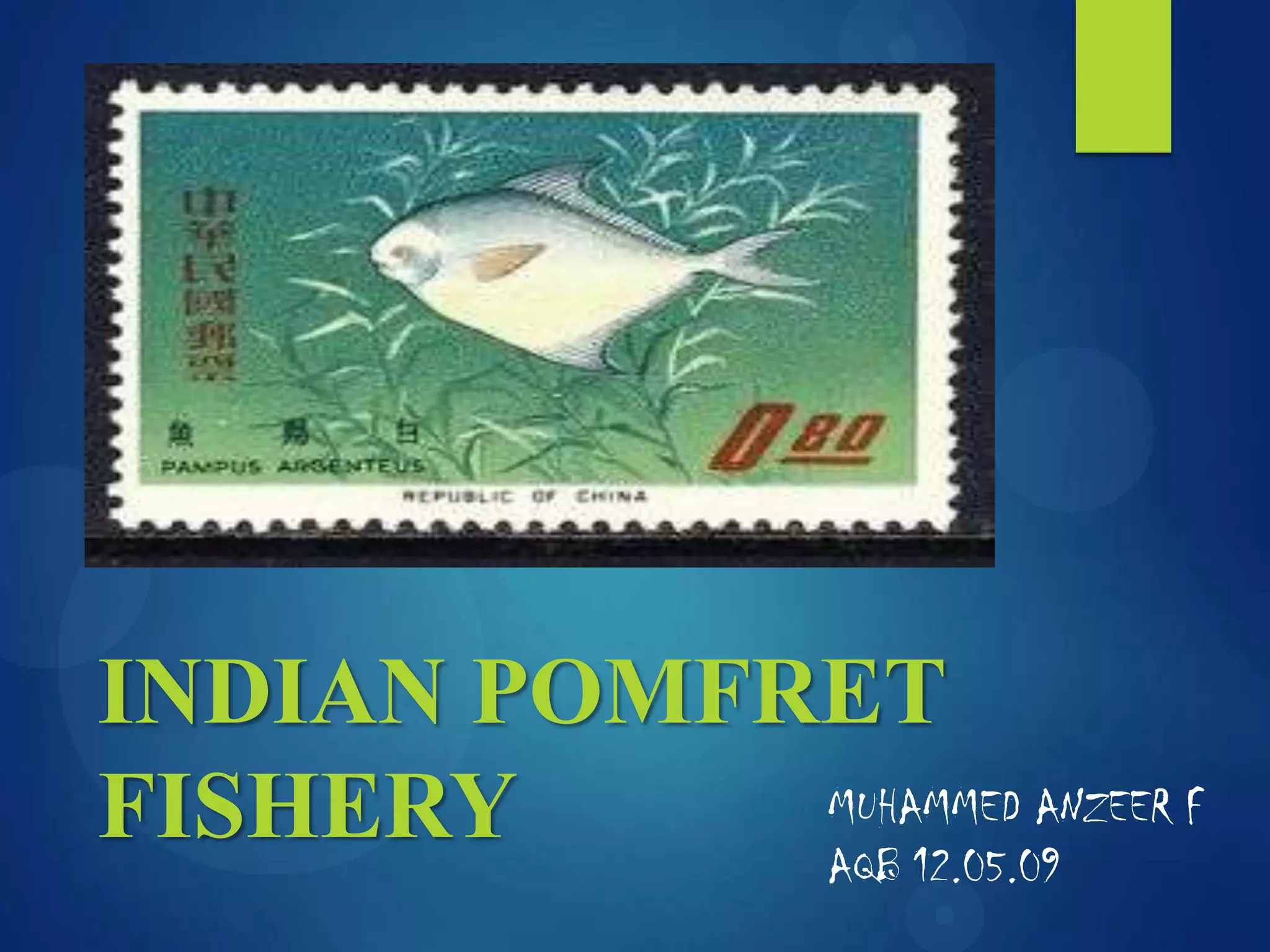
INDIAN POMFRET
MUHAMMED ANZEER F
FISHERY
AQB 12.05.09
INTRODUCTION
The peninsular India extending between latitudes 8º 48' and 37º
06' North and longitudes 68º 07 and 97º 25'East has a coastline
of about 8219km. The Indian Ocean covering the area between
30º and 150º and from the Asian land mass in the North to 50º
south has a total area of 51 million sq km. After the declaration
of Exclusive Economic zone (EEZ) in 1977, the area available
to India is 2.02 million sq km comprising 0.86 million sq km in
the west coast and 0.60 million sq km around the Andaman and
Nicobar Islands. With the absolute right on the EEZ, India has
also acquired the responsibility to conserve, to protect, develop
and optimally exploit the marine resources up to 200 nautical
miles of the coastline.
The Indian fishery in general
 50 ya 6 lakh tonnes ,today 8.67 mt (2nd largest producer in the
world with 5.43% share )

 Different crafts and gears
 Depth range of 0 to 150 m.
 Annual landing in 3.94million metric tonnes (2012)
 North west - 29.2% ,Southwest coast - 35.1% ,south east - 25.5%
, and north east - 10.2%,
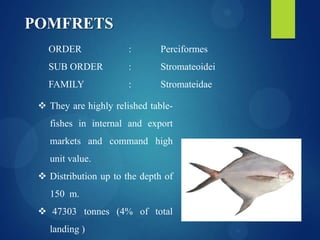
POMFRETS
ORDER

:

Perciformes

SUB ORDER

:

Stromateoidei

FAMILY

:

Stromateidae

 They are highly relished tablefishes in internal and export
markets and command high
unit value.
 Distribution up to the depth of
150 m.
 47303 tonnes (4% of total
landing )
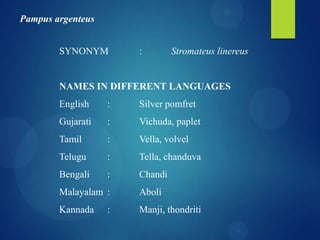
Pampus argenteus
SYNONYM

:

Stromateus linereus

NAMES IN DIFFERENT LANGUAGES
English

:

Silver pomfret

Gujarati

:

Vichuda, paplet

Tamil

:

Vella, volvel

Telugu

:

Tella, chanduva

Bengali

:

Chandi

Malayalam :

Aboli

Kannada

Manji, thondriti

:
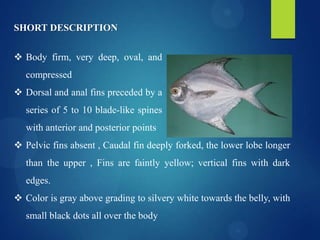
SHORT DESCRIPTION
 Body firm, very deep, oval, and
compressed
 Dorsal and anal fins preceded by a
series of 5 to 10 blade-like spines
with anterior and posterior points

 Pelvic fins absent , Caudal fin deeply forked, the lower lobe longer
than the upper , Fins are faintly yellow; vertical fins with dark
edges.
 Color is gray above grading to silvery white towards the belly, with
small black dots all over the body
Pampus chinensis

NAMES IN DIFFERENT LANGUAGES
English

:

Whitepomfret

Gujarati

:

Paplet, Pthu,Kafri

Marathi

:

Saranga, khalwad, kapri

Tamil

:

Mogang, Vovel

Telugu

:

Chamba

Malayalam :

Vella, Avoli
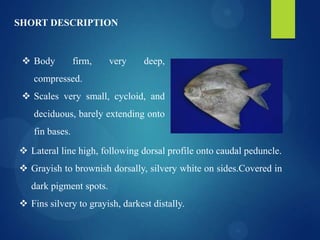
SHORT DESCRIPTION

 Body

firm,

very

deep,

compressed.
 Scales very small, cycloid, and

deciduous, barely extending onto
fin bases.
 Lateral line high, following dorsal profile onto caudal peduncle.
 Grayish to brownish dorsally, silvery white on sides.Covered in
dark pigment spots.
 Fins silvery to grayish, darkest distally.
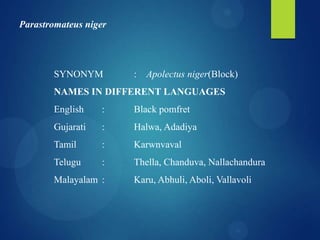
Parastromateus niger

SYNONYM

: Apolectus niger(Block)

NAMES IN DIFFERENT LANGUAGES
English

:

Black pomfret

Gujarati

:

Halwa, Adadiya

Tamil

:

Karwnvaval

Telugu

:

Thella, Chanduva, Nallachandura

Malayalam :

Karu, Abhuli, Aboli, Vallavoli
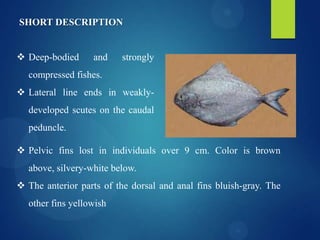
SHORT DESCRIPTION
 Deep-bodied

and

strongly

compressed fishes.
 Lateral line ends in weaklydeveloped scutes on the caudal
peduncle.
 Pelvic fins lost in individuals over 9 cm. Color is brown
above, silvery-white below.
 The anterior parts of the dorsal and anal fins bluish-gray. The
other fins yellowish
GENERAL BIOLOGY
FOOD AND FEEDING
 Copepods and other smaller crustaceans
 Thaliaceans and Hydromedusae (Pampus argenteus)

 Seasonal fluctuations shows some variations in component (based on
availability)
 Feeding intensity was more during mature and maturing stages of the
gonads
 Black pomfret, (Salps - Jasis, Zonaria, Pagea , Salpa, and Thalia
spp.(42.8%)).
 Crustaceans ( Prawns,Acetes, Lucifer, Mysids, Ostacods, Copepods,
Zoea, and Megalopa etc (8.8%)).
MATURITY
Gonads can be distinguished at the time of 15 cm and more
in length.
 Ovary
two small, compact lobes: wine coloured and united at
anterior end
 Testes
as two thin, long strips of tissue, white in colour.
SEX AND FECUNDITY
 Sexes are separate.
 Eventhough can’t be distinguished from external
characters.
 Number of eggs varies with size of ovary.
 Observation for P.argenteus
1)65,702 eggs - 278mm sized ovary.
2)171794 - 320mm sized ovary
 P.niger fecundity - 12558-79200 ova
SEX RATIO

 Equal distribution of sexes.

 In 15-25cm group males and females were more or less
equal. Males were predominant,
 About twice as many as the females in the 25-35cm.while in

size group 45-55cm ,there were no males at all.
 Females predominated during august to October.
 Males were predominated in April-May.
SPAWNING SEASON
 Black pomfret
Spawning starts from July and continued till October (peak in
August-September).
 Silver pomfret
Maharashtra ( October – December), Gujarat (February – august )
and East coast ( January – February).
FISHERIES
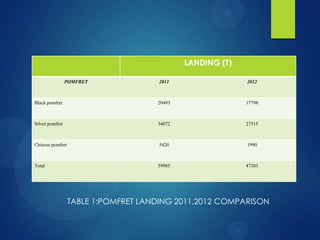
LANDING (T)
POMFRET

2011

2012

Black pomfret

20493

17798

Silver pomfret

34072

27515

Chinese pomfret

5420

1990

Total

59985

47303

TABLE 1:POMFRET LANDING 2011,2012 COMPARISON
STATEWISE LANDINGS
MAHARASHTRA
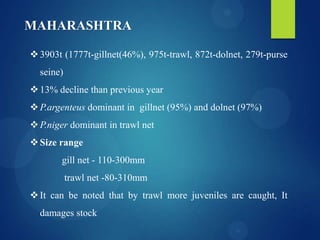
 3903t (1777t-gillnet(46%), 975t-trawl, 872t-dolnet, 279t-purse
seine)

 13% decline than previous year
 P.argenteus dominant in gillnet (95%) and dolnet (97%)
 P.niger dominant in trawl net

 Size range
gill net - 110-300mm
trawl net -80-310mm

 It can be noted that by trawl more juveniles are caught, It
damages stock
GUJARAT
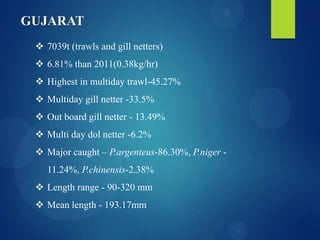
 7039t (trawls and gill netters)
 6.81% than 2011(0.38kg/hr)
 Highest in multiday trawl-45.27%
 Multiday gill netter -33.5%
 Out board gill netter - 13.49%
 Multi day dol netter -6.2%
 Major caught – P.argenteus-86.30%, P.niger 11.24%, P.chinensis-2.38%
 Length range - 90-320 mm
 Mean length - 193.17mm
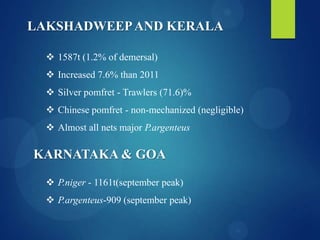
LAKSHADWEEP AND KERALA
 1587t (1.2% of demersal)
 Increased 7.6% than 2011
 Silver pomfret - Trawlers (71.6)%
 Chinese pomfret - non-mechanized (negligible)
 Almost all nets major P.argenteus

KARNATAKA & GOA
 P.niger - 1161t(september peak)
 P.argenteus-909 (september peak)
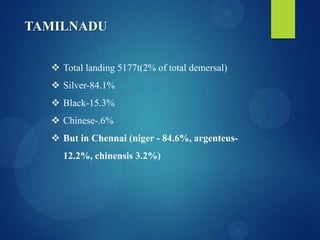
TAMILNADU
 Total landing 5177t(2% of total demersal)

 Silver-84.1%
 Black-15.3%
 Chinese-.6%

 But in Chennai (niger - 84.6%, argenteus12.2%, chinensis 3.2%)
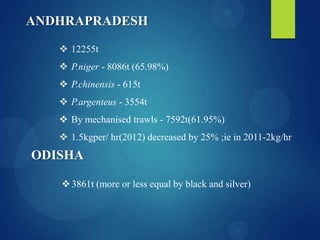
ANDHRAPRADESH
 12255t
 P.niger - 8086t (65.98%)

 P.chinensis - 615t
 P.argenteus - 3554t
 By mechanised trawls - 7592t(61.95%)
 1.5kgper/ hr(2012) decreased by 25% ;ie in 2011-2kg/hr

ODISHA
 3861t (more or less equal by black and silver)
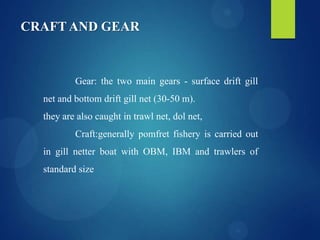
CRAFT AND GEAR

Gear: the two main gears - surface drift gill
net and bottom drift gill net (30-50 m).
they are also caught in trawl net, dol net,
Craft:generally pomfret fishery is carried out
in gill netter boat with OBM, IBM and trawlers of
standard size
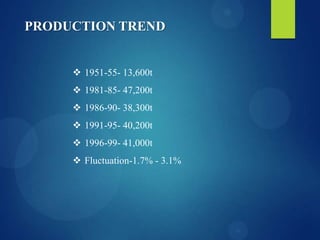
PRODUCTION TREND

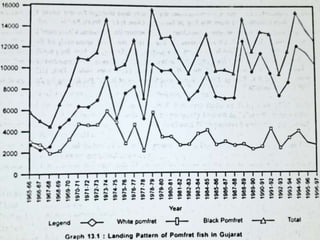
 1951-55- 13,600t
 1981-85- 47,200t
 1986-90- 38,300t
 1991-95- 40,200t
 1996-99- 41,000t
 Fluctuation-1.7% - 3.1%
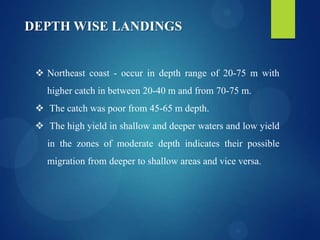
DEPTH WISE LANDINGS

 Northeast coast - occur in depth range of 20-75 m with
higher catch in between 20-40 m and from 70-75 m.
 The catch was poor from 45-65 m depth.
 The high yield in shallow and deeper waters and low yield

in the zones of moderate depth indicates their possible
migration from deeper to shallow areas and vice versa.
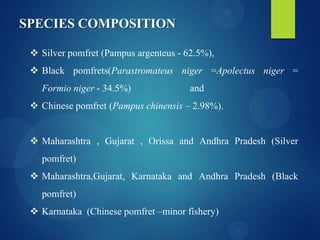
SPECIES COMPOSITION
 Silver pomfret (Pampus argenteus - 62.5%),
 Black pomfrets(Parastromateus niger =Apolectus niger =

Formio niger - 34.5%)

and

 Chinese pomfret (Pampus chinensis – 2.98%).

 Maharashtra , Gujarat , Orissa and Andhra Pradesh (Silver
pomfret)
 Maharashtra,Gujarat, Karnataka and Andhra Pradesh (Black

pomfret)
 Karnataka (Chinese pomfret –minor fishery)
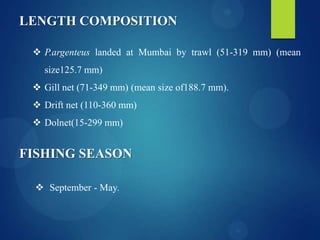
LENGTH COMPOSITION
 P.argenteus landed at Mumbai by trawl (51-319 mm) (mean
size125.7 mm)
 Gill net (71-349 mm) (mean size of188.7 mm).
 Drift net (110-360 mm)
 Dolnet(15-299 mm)

FISHING SEASON
 September - May.
CONSERVATION
 As fishery had collapsed in the north west coast during the
1990’s,

 Restriction of dol net operations to minimize recruitment –
overfishing
 Regulation of gill-nets to minimize the growth - overfishing

 Regulation in mesh size is necessary to preserve stock.
CONCLUSION
 They are highly relished table fishes in internal and export
markets and command high commercial value.
 The annual average capture of 38,000 tonnes forming about
2% of all India marine fisheries.
 Most of their production from Gujarat and Maharashtra in
the North West and Orissa in the northeast coast.
 The principal gear exploiting adult pomfrets are drift gill
nets of 140-155 mm mesh size while dol net exploits
essentially juveniles in the North West coast.
REFERENCES
1.

Dholakia, A.D.2004.Fisheries and aquatic resources of India .
Daya publishing house(Delhi)

2.

Hand book of fisheries and aquaculture.2010.ICAR

3.

Jhingran, V.G. 1974.Fishand fisheries of India.Hindustan
publishing co.(India)

4.

www.fishbase.com [VIEWED ON 12/11/2013]

5.

www.biosearch.com[ VIEWED ON 12/11/2013]

6. http://eprints.cmfri.org.in/9465/1/CMFRI_Annual_Report_201
2-13.pdf[ VIEWED ON 5/2/2014]
INDIAN POMFRET FISHERIES

INDIAN POMFRET FISHERIES

  • 1.
    INDIAN POMFRET MUHAMMED ANZEERF FISHERY AQB 12.05.09
  • 2.
    INTRODUCTION The peninsular Indiaextending between latitudes 8º 48' and 37º 06' North and longitudes 68º 07 and 97º 25'East has a coastline of about 8219km. The Indian Ocean covering the area between 30º and 150º and from the Asian land mass in the North to 50º south has a total area of 51 million sq km. After the declaration of Exclusive Economic zone (EEZ) in 1977, the area available to India is 2.02 million sq km comprising 0.86 million sq km in the west coast and 0.60 million sq km around the Andaman and Nicobar Islands. With the absolute right on the EEZ, India has also acquired the responsibility to conserve, to protect, develop and optimally exploit the marine resources up to 200 nautical miles of the coastline.
  • 3.
    The Indian fisheryin general  50 ya 6 lakh tonnes ,today 8.67 mt (2nd largest producer in the world with 5.43% share )  Different crafts and gears  Depth range of 0 to 150 m.  Annual landing in 3.94million metric tonnes (2012)  North west - 29.2% ,Southwest coast - 35.1% ,south east - 25.5% , and north east - 10.2%,
  • 4.
    POMFRETS ORDER : Perciformes SUB ORDER : Stromateoidei FAMILY : Stromateidae  Theyare highly relished tablefishes in internal and export markets and command high unit value.  Distribution up to the depth of 150 m.  47303 tonnes (4% of total landing )
  • 5.
    Pampus argenteus SYNONYM : Stromateus linereus NAMESIN DIFFERENT LANGUAGES English : Silver pomfret Gujarati : Vichuda, paplet Tamil : Vella, volvel Telugu : Tella, chanduva Bengali : Chandi Malayalam : Aboli Kannada Manji, thondriti :
  • 6.
    SHORT DESCRIPTION  Bodyfirm, very deep, oval, and compressed  Dorsal and anal fins preceded by a series of 5 to 10 blade-like spines with anterior and posterior points  Pelvic fins absent , Caudal fin deeply forked, the lower lobe longer than the upper , Fins are faintly yellow; vertical fins with dark edges.  Color is gray above grading to silvery white towards the belly, with small black dots all over the body
  • 7.
    Pampus chinensis NAMES INDIFFERENT LANGUAGES English : Whitepomfret Gujarati : Paplet, Pthu,Kafri Marathi : Saranga, khalwad, kapri Tamil : Mogang, Vovel Telugu : Chamba Malayalam : Vella, Avoli
  • 8.
    SHORT DESCRIPTION  Body firm, very deep, compressed. Scales very small, cycloid, and deciduous, barely extending onto fin bases.  Lateral line high, following dorsal profile onto caudal peduncle.  Grayish to brownish dorsally, silvery white on sides.Covered in dark pigment spots.  Fins silvery to grayish, darkest distally.
  • 9.
    Parastromateus niger SYNONYM : Apolectusniger(Block) NAMES IN DIFFERENT LANGUAGES English : Black pomfret Gujarati : Halwa, Adadiya Tamil : Karwnvaval Telugu : Thella, Chanduva, Nallachandura Malayalam : Karu, Abhuli, Aboli, Vallavoli
  • 10.
    SHORT DESCRIPTION  Deep-bodied and strongly compressedfishes.  Lateral line ends in weaklydeveloped scutes on the caudal peduncle.  Pelvic fins lost in individuals over 9 cm. Color is brown above, silvery-white below.  The anterior parts of the dorsal and anal fins bluish-gray. The other fins yellowish
  • 11.
  • 12.
    FOOD AND FEEDING Copepods and other smaller crustaceans  Thaliaceans and Hydromedusae (Pampus argenteus)  Seasonal fluctuations shows some variations in component (based on availability)  Feeding intensity was more during mature and maturing stages of the gonads  Black pomfret, (Salps - Jasis, Zonaria, Pagea , Salpa, and Thalia spp.(42.8%)).  Crustaceans ( Prawns,Acetes, Lucifer, Mysids, Ostacods, Copepods, Zoea, and Megalopa etc (8.8%)).
  • 13.
    MATURITY Gonads can bedistinguished at the time of 15 cm and more in length.  Ovary two small, compact lobes: wine coloured and united at anterior end  Testes as two thin, long strips of tissue, white in colour.
  • 14.
    SEX AND FECUNDITY Sexes are separate.  Eventhough can’t be distinguished from external characters.  Number of eggs varies with size of ovary.  Observation for P.argenteus 1)65,702 eggs - 278mm sized ovary. 2)171794 - 320mm sized ovary  P.niger fecundity - 12558-79200 ova
  • 15.
    SEX RATIO  Equaldistribution of sexes.  In 15-25cm group males and females were more or less equal. Males were predominant,  About twice as many as the females in the 25-35cm.while in size group 45-55cm ,there were no males at all.  Females predominated during august to October.  Males were predominated in April-May.
  • 16.
    SPAWNING SEASON  Blackpomfret Spawning starts from July and continued till October (peak in August-September).  Silver pomfret Maharashtra ( October – December), Gujarat (February – august ) and East coast ( January – February).
  • 17.
  • 18.
    LANDING (T) POMFRET 2011 2012 Black pomfret 20493 17798 Silverpomfret 34072 27515 Chinese pomfret 5420 1990 Total 59985 47303 TABLE 1:POMFRET LANDING 2011,2012 COMPARISON
  • 19.
  • 20.
    MAHARASHTRA  3903t (1777t-gillnet(46%),975t-trawl, 872t-dolnet, 279t-purse seine)  13% decline than previous year  P.argenteus dominant in gillnet (95%) and dolnet (97%)  P.niger dominant in trawl net  Size range gill net - 110-300mm trawl net -80-310mm  It can be noted that by trawl more juveniles are caught, It damages stock
  • 21.
    GUJARAT  7039t (trawlsand gill netters)  6.81% than 2011(0.38kg/hr)  Highest in multiday trawl-45.27%  Multiday gill netter -33.5%  Out board gill netter - 13.49%  Multi day dol netter -6.2%  Major caught – P.argenteus-86.30%, P.niger 11.24%, P.chinensis-2.38%  Length range - 90-320 mm  Mean length - 193.17mm
  • 23.
    LAKSHADWEEP AND KERALA 1587t (1.2% of demersal)  Increased 7.6% than 2011  Silver pomfret - Trawlers (71.6)%  Chinese pomfret - non-mechanized (negligible)  Almost all nets major P.argenteus KARNATAKA & GOA  P.niger - 1161t(september peak)  P.argenteus-909 (september peak)
  • 24.
    TAMILNADU  Total landing5177t(2% of total demersal)  Silver-84.1%  Black-15.3%  Chinese-.6%  But in Chennai (niger - 84.6%, argenteus12.2%, chinensis 3.2%)
  • 25.
    ANDHRAPRADESH  12255t  P.niger- 8086t (65.98%)  P.chinensis - 615t  P.argenteus - 3554t  By mechanised trawls - 7592t(61.95%)  1.5kgper/ hr(2012) decreased by 25% ;ie in 2011-2kg/hr ODISHA  3861t (more or less equal by black and silver)
  • 26.
    CRAFT AND GEAR Gear:the two main gears - surface drift gill net and bottom drift gill net (30-50 m). they are also caught in trawl net, dol net, Craft:generally pomfret fishery is carried out in gill netter boat with OBM, IBM and trawlers of standard size
  • 27.
    PRODUCTION TREND  1951-55-13,600t  1981-85- 47,200t  1986-90- 38,300t  1991-95- 40,200t  1996-99- 41,000t  Fluctuation-1.7% - 3.1%
  • 28.
    DEPTH WISE LANDINGS Northeast coast - occur in depth range of 20-75 m with higher catch in between 20-40 m and from 70-75 m.  The catch was poor from 45-65 m depth.  The high yield in shallow and deeper waters and low yield in the zones of moderate depth indicates their possible migration from deeper to shallow areas and vice versa.
  • 29.
    SPECIES COMPOSITION  Silverpomfret (Pampus argenteus - 62.5%),  Black pomfrets(Parastromateus niger =Apolectus niger = Formio niger - 34.5%) and  Chinese pomfret (Pampus chinensis – 2.98%).  Maharashtra , Gujarat , Orissa and Andhra Pradesh (Silver pomfret)  Maharashtra,Gujarat, Karnataka and Andhra Pradesh (Black pomfret)  Karnataka (Chinese pomfret –minor fishery)
  • 30.
    LENGTH COMPOSITION  P.argenteuslanded at Mumbai by trawl (51-319 mm) (mean size125.7 mm)  Gill net (71-349 mm) (mean size of188.7 mm).  Drift net (110-360 mm)  Dolnet(15-299 mm) FISHING SEASON  September - May.
  • 31.
    CONSERVATION  As fisheryhad collapsed in the north west coast during the 1990’s,  Restriction of dol net operations to minimize recruitment – overfishing  Regulation of gill-nets to minimize the growth - overfishing  Regulation in mesh size is necessary to preserve stock.
  • 32.
    CONCLUSION  They arehighly relished table fishes in internal and export markets and command high commercial value.  The annual average capture of 38,000 tonnes forming about 2% of all India marine fisheries.  Most of their production from Gujarat and Maharashtra in the North West and Orissa in the northeast coast.  The principal gear exploiting adult pomfrets are drift gill nets of 140-155 mm mesh size while dol net exploits essentially juveniles in the North West coast.
  • 33.
    REFERENCES 1. Dholakia, A.D.2004.Fisheries andaquatic resources of India . Daya publishing house(Delhi) 2. Hand book of fisheries and aquaculture.2010.ICAR 3. Jhingran, V.G. 1974.Fishand fisheries of India.Hindustan publishing co.(India) 4. www.fishbase.com [VIEWED ON 12/11/2013] 5. www.biosearch.com[ VIEWED ON 12/11/2013] 6. http://eprints.cmfri.org.in/9465/1/CMFRI_Annual_Report_201 2-13.pdf[ VIEWED ON 5/2/2014]