Jagran Lakecity
University
Fiscal policy
TO:- MRS. JASMIN KHARE BY:- AAKASH
TIWARI
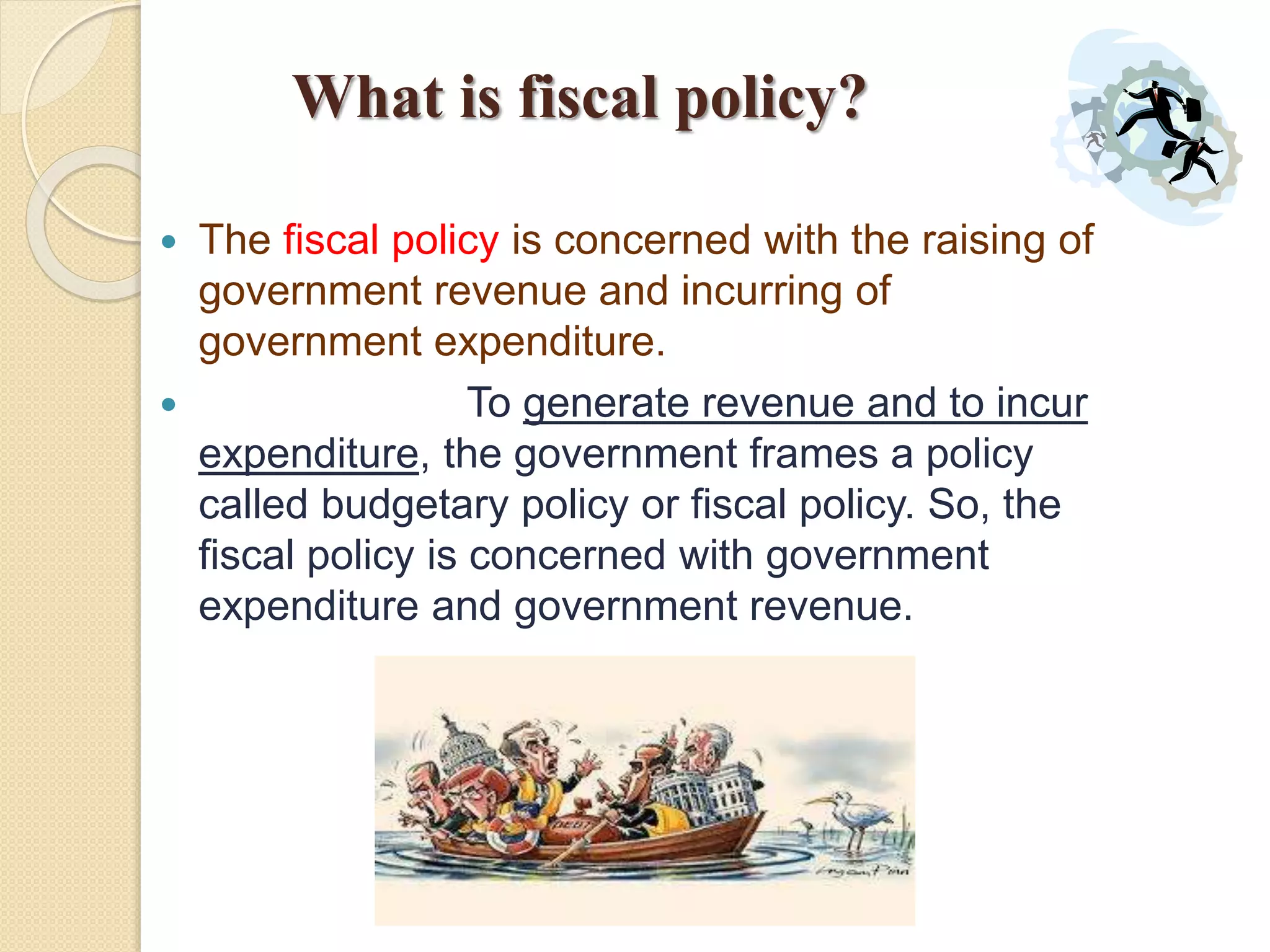
What is fiscal policy?
 The fiscal policy is concerned with the raising of
government revenue and incurring of
government expenditure.
 To generate revenue and to incur
expenditure, the government frames a policy
called budgetary policy or fiscal policy. So, the
fiscal policy is concerned with government
expenditure and government revenue.
 Fiscal policy has to decide on the size and
pattern of flow of expenditure from the
government to the economy and from the
economy back to the government.
in broad term fiscal policy refers to
"that segment of national economic policy which
is primarily concerned with the receipts and
expenditure of central government.
Types of fiscal policy :
 Expansionary Fiscal Policy
 Contractionary Fiscal Policy
Expansionary Fiscal Policy:
 Expansionary fiscal policy uses increased government
spending, reduced taxes or a combination of the two.
The chief objective of a fiscal expansion is to increase
aggregate demand for goods and services across the
economy, as well as to reduce unemployment.
Contractionary Fiscal Policy:
 When government policy-makers cut spending or
increase taxes, they engage in contractionary fiscal
policy. Governments may enact contractionary
measures to slow an economic expansion and prevent
inflation..
 In addition, governments may enact
contractionary policy for ideological reasons. These
include reducing the overall size and scope of government
activity or lowering budget deficits, in which the
government spends more money than it collects.
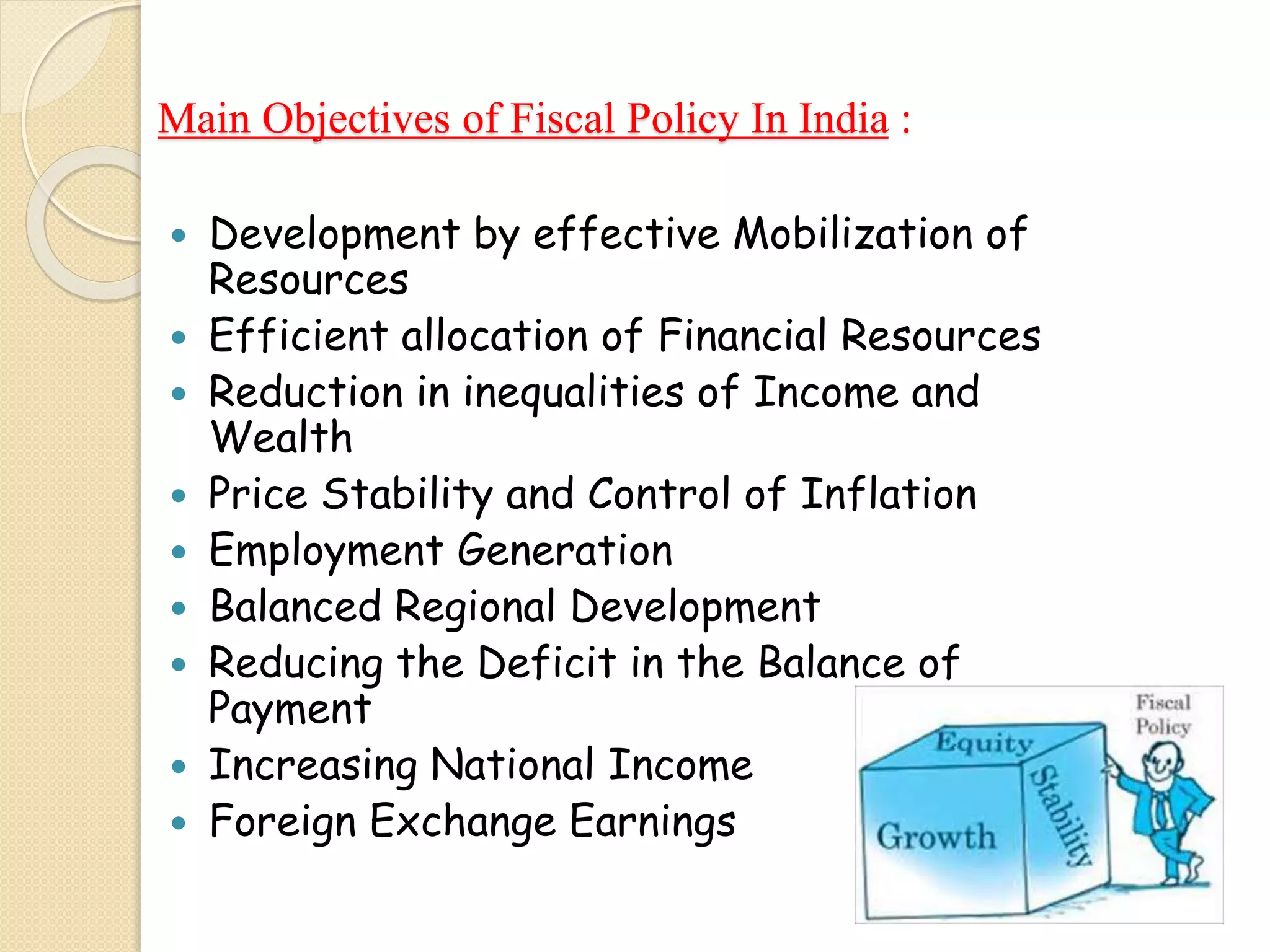
Main Objectives of Fiscal Policy In India :
 Development by effective Mobilization of
Resources
 Efficient allocation of Financial Resources
 Reduction in inequalities of Income and
Wealth
 Price Stability and Control of Inflation
 Employment Generation
 Balanced Regional Development
 Reducing the Deficit in the Balance of
Payment
 Increasing National Income
 Foreign Exchange Earnings
Development by effective Mobilization of
Resources
The principal objective of fiscal policy is to ensure
rapid economic growth and development. This
objective of economic growth and development can be
achieved by Mobilization of Financial Resources
The financial resources can be mobilized by:
 Taxation : Through effective fiscal policies, the
government aims to mobilize resources by way of
direct taxes as well as indirect taxes because most
important source of resource mobilization in India is
taxation.
Public Savings : The resources can be mobilized through
public savings by reducing government expenditure
and increasing surpluses of public sector
enterprises.
Private Savings : Through effective fiscal measures such
as tax benefits, the government can raise resources
from private sector and households.
Efficient allocation of Financial
Resources
 The central and state governments have tried to make
efficient allocation of financial resources. These
resources are allocated for Development Activities
which includes expenditure on railways,
infrastructure, etc
While Non-development Activities
includes expenditure on defense, interest payments,
subsidies, etc.
But generally the fiscal policy should ensure that
the resources are allocated for generation of goods
and services which are socially desirable.
therefore, India's fiscal policy is designed
in such a manner so as to encourage production of
desirable goods and discourage those goods which are
socially undesirable.
Reduction in inequalities of Income and
Wealth
 Fiscal policy aims at achieving equity or social justice
by reducing income inequalities among different
sections of the society. The direct taxes such as
income tax are charged more on the rich people as
compared to lower income groups.
 Indirect taxes are also more in the case of
semi-luxury and luxury items, which are mostly
consumed by the upper middle class and the upper
class.
Price Stability and Control of Inflation
 One of the main objective of fiscal policy is to control
inflation and stabilize price. Therefore, the
government always aims to control the inflation by
Reducing fiscal deficits, introducing tax savings
schemes, Productive use of financial resources, etc.
Increase capital
 The objective of fiscal policy in India is also to
increase the rate of capital formation so as to
accelerate the rate of economic growth.
 In order to increase the rate of
capital formation, the fiscal policy must be efficiently
designed to encourage savings and discourage and
reduce spending.
Increasing National Income
 The fiscal policy aims to increase the national income
of a country. This is because fiscal policy facilitates
the capital formation. This results in economic growth,
which in turn increases the GDP, per capita income and
national income of the country.
Foreign Exchange Earnings
 Fiscal policy attempts to encourage more exports by way of
Fiscal Measures like, exemption of income tax on export
earnings, exemption of sales tax and octroi, etc.
 Foreign exchange provides fiscal benefits to
import substitute industries.
Thank You !!

Fiscal policy by Aakash Tiwari

  • 1.
    Jagran Lakecity University Fiscal policy TO:-MRS. JASMIN KHARE BY:- AAKASH TIWARI
  • 2.
    What is fiscalpolicy?  The fiscal policy is concerned with the raising of government revenue and incurring of government expenditure.  To generate revenue and to incur expenditure, the government frames a policy called budgetary policy or fiscal policy. So, the fiscal policy is concerned with government expenditure and government revenue.
  • 3.
     Fiscal policyhas to decide on the size and pattern of flow of expenditure from the government to the economy and from the economy back to the government. in broad term fiscal policy refers to "that segment of national economic policy which is primarily concerned with the receipts and expenditure of central government.
  • 4.
    Types of fiscalpolicy :  Expansionary Fiscal Policy  Contractionary Fiscal Policy
  • 5.
    Expansionary Fiscal Policy: Expansionary fiscal policy uses increased government spending, reduced taxes or a combination of the two. The chief objective of a fiscal expansion is to increase aggregate demand for goods and services across the economy, as well as to reduce unemployment.
  • 6.
    Contractionary Fiscal Policy: When government policy-makers cut spending or increase taxes, they engage in contractionary fiscal policy. Governments may enact contractionary measures to slow an economic expansion and prevent inflation..  In addition, governments may enact contractionary policy for ideological reasons. These include reducing the overall size and scope of government activity or lowering budget deficits, in which the government spends more money than it collects.
  • 7.
    Main Objectives ofFiscal Policy In India :  Development by effective Mobilization of Resources  Efficient allocation of Financial Resources  Reduction in inequalities of Income and Wealth  Price Stability and Control of Inflation  Employment Generation  Balanced Regional Development  Reducing the Deficit in the Balance of Payment  Increasing National Income  Foreign Exchange Earnings
  • 8.
    Development by effectiveMobilization of Resources The principal objective of fiscal policy is to ensure rapid economic growth and development. This objective of economic growth and development can be achieved by Mobilization of Financial Resources The financial resources can be mobilized by:  Taxation : Through effective fiscal policies, the government aims to mobilize resources by way of direct taxes as well as indirect taxes because most important source of resource mobilization in India is taxation.
  • 9.
    Public Savings :The resources can be mobilized through public savings by reducing government expenditure and increasing surpluses of public sector enterprises. Private Savings : Through effective fiscal measures such as tax benefits, the government can raise resources from private sector and households.
  • 10.
    Efficient allocation ofFinancial Resources  The central and state governments have tried to make efficient allocation of financial resources. These resources are allocated for Development Activities which includes expenditure on railways, infrastructure, etc While Non-development Activities includes expenditure on defense, interest payments, subsidies, etc. But generally the fiscal policy should ensure that the resources are allocated for generation of goods and services which are socially desirable. therefore, India's fiscal policy is designed in such a manner so as to encourage production of desirable goods and discourage those goods which are socially undesirable.
  • 11.
    Reduction in inequalitiesof Income and Wealth  Fiscal policy aims at achieving equity or social justice by reducing income inequalities among different sections of the society. The direct taxes such as income tax are charged more on the rich people as compared to lower income groups.  Indirect taxes are also more in the case of semi-luxury and luxury items, which are mostly consumed by the upper middle class and the upper class.
  • 12.
    Price Stability andControl of Inflation  One of the main objective of fiscal policy is to control inflation and stabilize price. Therefore, the government always aims to control the inflation by Reducing fiscal deficits, introducing tax savings schemes, Productive use of financial resources, etc.
  • 13.
    Increase capital  Theobjective of fiscal policy in India is also to increase the rate of capital formation so as to accelerate the rate of economic growth.  In order to increase the rate of capital formation, the fiscal policy must be efficiently designed to encourage savings and discourage and reduce spending.
  • 14.
    Increasing National Income The fiscal policy aims to increase the national income of a country. This is because fiscal policy facilitates the capital formation. This results in economic growth, which in turn increases the GDP, per capita income and national income of the country.
  • 15.
    Foreign Exchange Earnings Fiscal policy attempts to encourage more exports by way of Fiscal Measures like, exemption of income tax on export earnings, exemption of sales tax and octroi, etc.  Foreign exchange provides fiscal benefits to import substitute industries.
  • 16.