BY- HIMANI GUPTA
• In this hybrid exchange rate system, the exchange rate is
basically determined in the foreign exchange market through
the operation of market forces. So far, the managed floating
exchange rate system is similar to the flexible exchange rate
system.
• But during extreme fluctuations, the central bank under a
managed floating exchange rate system intervenes in the
foreign exchange market. Objective of this intervention is to
minimise the fluctuation in the exchange rate of the
currency.
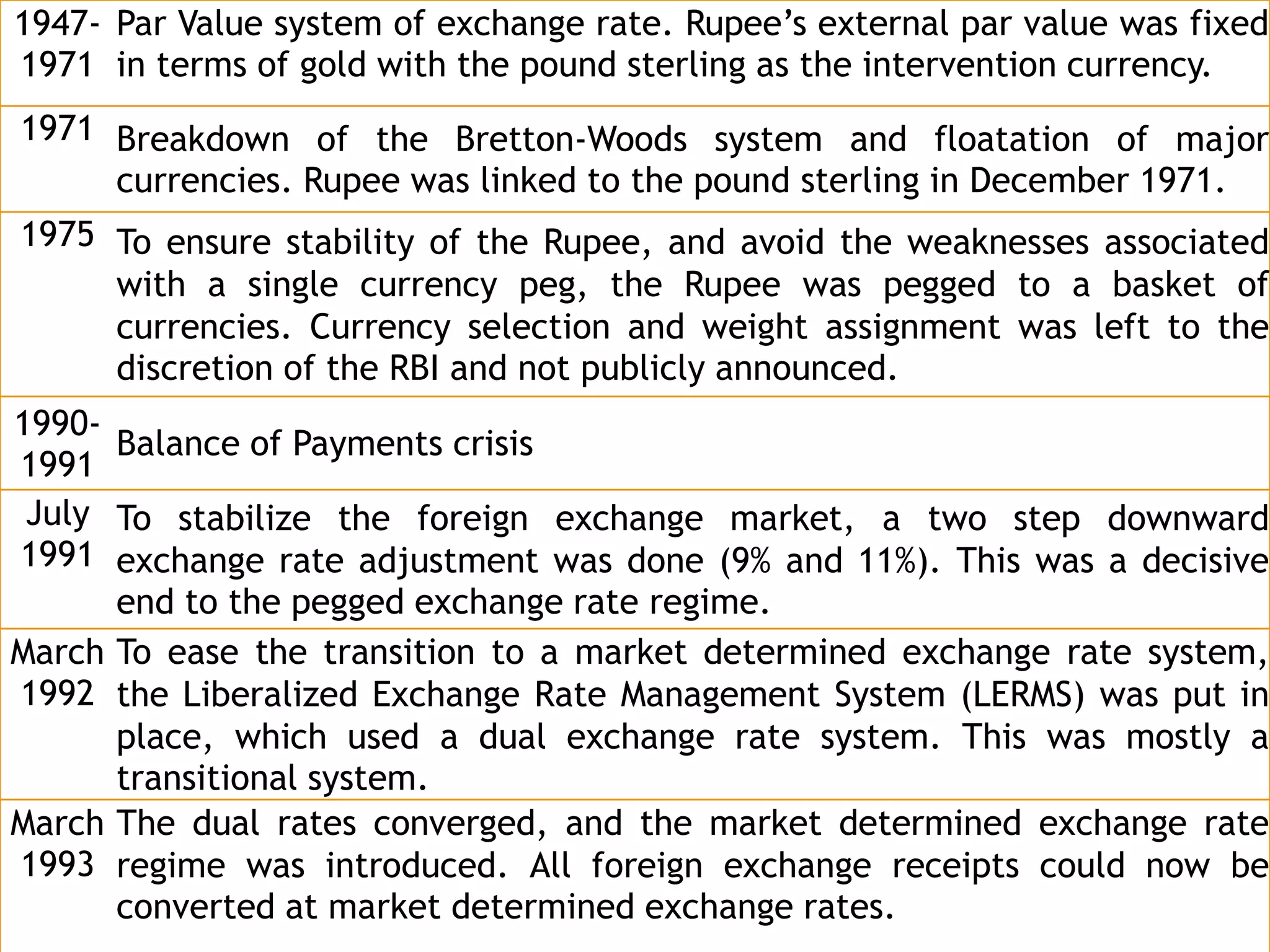
1947-
1971
Par Value system of exchange rate. Rupee’s external par value was fixed
in terms of gold with the pound sterling as the intervention currency.
1971 Breakdown of the Bretton-Woods system and floatation of major
currencies. Rupee was linked to the pound sterling in December 1971.
1975 To ensure stability of the Rupee, and avoid the weaknesses associated
with a single currency peg, the Rupee was pegged to a basket of
currencies. Currency selection and weight assignment was left to the
discretion of the RBI and not publicly announced.
1990-
1991
Balance of Payments crisis
July
1991
To stabilize the foreign exchange market, a two step downward
exchange rate adjustment was done (9% and 11%). This was a decisive
end to the pegged exchange rate regime.
March
1992
To ease the transition to a market determined exchange rate system,
the Liberalized Exchange Rate Management System (LERMS) was put in
place, which used a dual exchange rate system. This was mostly a
transitional system.
March
1993
The dual rates converged, and the market determined exchange rate
regime was introduced. All foreign exchange receipts could now be
converted at market determined exchange rates.
DIRECT INTERVENTION
It refers to purchases and sales
in international currency (i.e.
US dollars and euro) both on
the spot and also in forward
markets.
INDIRECT INTERVENTION
It refers to the use of reserve
requirements and interest rate
flexibility to smoothen temporary
mismatches between demand and
supply of foreign currency.
FY ₹/US $
(Average)
FY ₹/US $
(Average)
FY ₹/US $
(Average)
1993-94 31.37 2000-01 45.68 2007-08 40.24
1994-95 31.4 2001-02 47.69 2008-09 45.99
1995-96 33.45 2002-03 48.4 2009-10 47.42
1996-97 35.5 2003-04 45.95 2010-11 45.52
1997-98 37.17 2004-05 44.93 2011-12 47.92
1998-99 42.07 2005-06 44.26 2012-13 54.41
1999-00 43.33 2006-07 45.25 2013-14 60.50
(₹/US $ Exchange Rate)
As regards the movements in the exchange rate, the annual average value
of rupee vis-a-vis US dollar tended to depreciate all along from 31.37 in FY
1993-94 to 48.40 in FY 2002-03, although then appreciated moving in the
range of 44.26 and 45.95 during FYs 2003-07.
In FY 2007-08, rupee appreciated at a rapid pace making an average of
40.24 a dollar. But again, the rupee depreciated during the following two
financial years, although there was some appreciation, in FY 2010-11.
Again in Sept. 2011, there had been large capital outflows from the Indian
economy resulting in increase in demand for US dollars and therefore
depreciation of Indian rupee. To prevent excessive depreciation of the Indian
rupee, RBI intervened and sold US dollars from its foreign exchange reserves.
Depreciation of a currency is
considered to be desirable as it boosts
exports and reduces imports. But a sharp
depreciation of rupee has a serious
consequence. Not only will it make
imports costlier and fuel another round of
inflation, it will also restrain the RBI from
pushing through the cuts in repo rate and
cash reserve ratio urgently needed for
kick-starting investments and boosting
growth.
Appreciation of rupee makes imports cheaper causing increase
in them. Fall in exports and rise in imports adversely affects balance
of payments on current account. However, more imports brought in
through appreciation of rupee adds to aggregate supply of output and
help in controlling inflation. However,
On the other hand, too much depreciation of rupee is also bad because it
makes imports costlier, especially of fuel oil. Higher value of imports
also adversely affects balance of payments.
Floating exchange rate system in india

Floating exchange rate system in india

  • 1.
  • 2.
    • In thishybrid exchange rate system, the exchange rate is basically determined in the foreign exchange market through the operation of market forces. So far, the managed floating exchange rate system is similar to the flexible exchange rate system. • But during extreme fluctuations, the central bank under a managed floating exchange rate system intervenes in the foreign exchange market. Objective of this intervention is to minimise the fluctuation in the exchange rate of the currency.
  • 4.
    1947- 1971 Par Value systemof exchange rate. Rupee’s external par value was fixed in terms of gold with the pound sterling as the intervention currency. 1971 Breakdown of the Bretton-Woods system and floatation of major currencies. Rupee was linked to the pound sterling in December 1971. 1975 To ensure stability of the Rupee, and avoid the weaknesses associated with a single currency peg, the Rupee was pegged to a basket of currencies. Currency selection and weight assignment was left to the discretion of the RBI and not publicly announced. 1990- 1991 Balance of Payments crisis July 1991 To stabilize the foreign exchange market, a two step downward exchange rate adjustment was done (9% and 11%). This was a decisive end to the pegged exchange rate regime. March 1992 To ease the transition to a market determined exchange rate system, the Liberalized Exchange Rate Management System (LERMS) was put in place, which used a dual exchange rate system. This was mostly a transitional system. March 1993 The dual rates converged, and the market determined exchange rate regime was introduced. All foreign exchange receipts could now be converted at market determined exchange rates.
  • 8.
    DIRECT INTERVENTION It refersto purchases and sales in international currency (i.e. US dollars and euro) both on the spot and also in forward markets. INDIRECT INTERVENTION It refers to the use of reserve requirements and interest rate flexibility to smoothen temporary mismatches between demand and supply of foreign currency.
  • 10.
    FY ₹/US $ (Average) FY₹/US $ (Average) FY ₹/US $ (Average) 1993-94 31.37 2000-01 45.68 2007-08 40.24 1994-95 31.4 2001-02 47.69 2008-09 45.99 1995-96 33.45 2002-03 48.4 2009-10 47.42 1996-97 35.5 2003-04 45.95 2010-11 45.52 1997-98 37.17 2004-05 44.93 2011-12 47.92 1998-99 42.07 2005-06 44.26 2012-13 54.41 1999-00 43.33 2006-07 45.25 2013-14 60.50 (₹/US $ Exchange Rate)
  • 11.
    As regards themovements in the exchange rate, the annual average value of rupee vis-a-vis US dollar tended to depreciate all along from 31.37 in FY 1993-94 to 48.40 in FY 2002-03, although then appreciated moving in the range of 44.26 and 45.95 during FYs 2003-07. In FY 2007-08, rupee appreciated at a rapid pace making an average of 40.24 a dollar. But again, the rupee depreciated during the following two financial years, although there was some appreciation, in FY 2010-11. Again in Sept. 2011, there had been large capital outflows from the Indian economy resulting in increase in demand for US dollars and therefore depreciation of Indian rupee. To prevent excessive depreciation of the Indian rupee, RBI intervened and sold US dollars from its foreign exchange reserves.
  • 13.
    Depreciation of acurrency is considered to be desirable as it boosts exports and reduces imports. But a sharp depreciation of rupee has a serious consequence. Not only will it make imports costlier and fuel another round of inflation, it will also restrain the RBI from pushing through the cuts in repo rate and cash reserve ratio urgently needed for kick-starting investments and boosting growth.
  • 15.
    Appreciation of rupeemakes imports cheaper causing increase in them. Fall in exports and rise in imports adversely affects balance of payments on current account. However, more imports brought in through appreciation of rupee adds to aggregate supply of output and help in controlling inflation. However, On the other hand, too much depreciation of rupee is also bad because it makes imports costlier, especially of fuel oil. Higher value of imports also adversely affects balance of payments.

Editor's Notes

  • #3 Exchange rate system refers to the arrangement for the movement of exchange rate. There are basically three types of exchange rate systems globally: flexible or floating exchange rate system, fixed exchange rate system and managed floating (intermediate exchange rate system). 1st point: Market forces mean the selling and buying activities by various individuals and institutions.
  • #5 The economic crisis was primarily due to the large and growing fiscal imbalances over the 1980s. During the mid-eighties, India started having balance of payments problems. Precipitated by the Gulf War, India’s oil import bill swelled, exports slumped, credit dried up, and investors took their money out. Large fiscal deficits, over time, had a spillover effect on the trade deficit culminating in an external payments crisis. By the end of 1980, India was in serious economic trouble. Since these deficits had to be met by borrowings, the internal debt of the government accumulated rapidly, rising from 35 percent of GDP at the end of 1980-81 to 53 percent of GDP at the end of 1990-91. The foreign exchange reserves had dried up to the point that India could barely finance three weeks worth of imports.
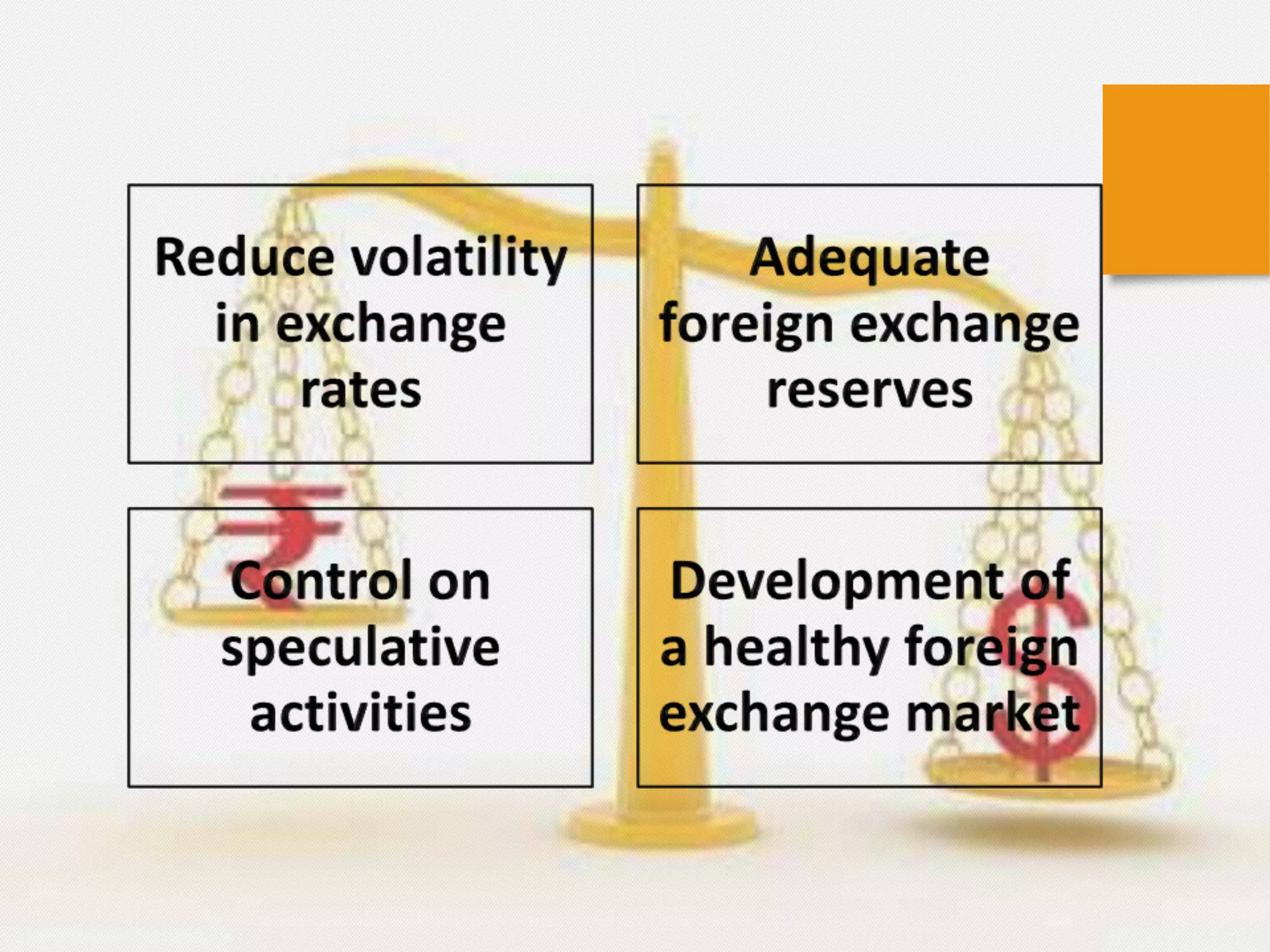
  • #7 The main objectives of India’s exchange rate policy is to ensure that the economic fundamentals are truly reflected in the external value of the rupee. i. Reduce volatility in exchange rates, ensuring that the market correction of exchange rates is effected in an orderly and calibrated manner; ii. Help maintain an adequate level of foreign exchange reserves; iii. Prevent the emergence of destabilisation by speculative activities; and iv. Help eliminate market constraints so as to assist the development of a healthy foreign exchange market.
  • #9 Intervention by the RBI has raised a question as to whether or not there should be an exchange rate band within, which the central bank should allow the currency to fluctuate. The Tarapore Committee in its report on Capital Account Convertibility had, while suggesting transparency in the exchange rate policy of the central bank, recommended a band within which it would allow the currency to move. The RBI has been, in contrast, saying that there cannot be such rigidities in exchange rate policy, and, therefore, the bank should have the right to intervene at its discretion. Such interventions are considered necessary till the rupee is made fully convertible.
  • #12 * FDI. India's stellar economic growth created a large domestic market offering promising opportunities for foreign companies. Moreover, the country's rising competitiveness in many sectors made it an attractive export base. These factors boosted FDI. * External commercial borrowings (ECBs). Indian companies borrowed enormous amounts of money overseas to finance investments and acquisitions at home and abroad. This borrowed money returned to India, boosting capital inflows * Foreign portfolio inflows. India's booming stock market increased the confidence of investors in the country's corporate sector. Foreign portfolio inflows played a key role in fuelling this boom. Another major source of portfolio capital inflows was the overseas equity issues of Indian companies via global depositary receipts (GDRs) and American depositary receipts (ADRs). * Investments and remittances. Indians settled in other countries were a major source of capital inflows, with many non-resident Indians (NRIs) investing large amounts in special bank accounts. While NRIs' emotional connection to their country of origin is part of the explanation for this, the attractive interest rates offered on such deposits provided a powerful incentive. Another large source of foreign-exchange inflows was remittances from the huge number of Indians working overseas temporarily.
  • #14 Breaking out of this policy logjam requires that the government should curtail current account deficit (CAD) by taking steps to boost exports by increasing its competitiveness and undertaking its diversification and also cut imports by imposing high tariffs on luxury imports. Besides, it should make reforms in foreign direct investment policy so that stable capital inflows are attracted to the Indian economy.
  • #15 There is a clash between foreign exchange rate stability and domestic price stability and RBI has been attempting to strike a balance between foreign exchange rate stability and domestic price stability. If in order to ensure foreign exchange rate stability RBI sucks up sufficient dollars, it will result in pumping large sum of Indian rupees into the economy which will lead to the large increase in money supply causing a high rate of inflation. If to check inflation and ensure price stability, it does not mop up dollars from the market and let dollar inflows, this will result in appreciation of rupee. Thus it has to strike a balance in buying dollars from the market so as to check inflation one the hand and to prevent too much appreciation of rupee.