What You Should Know
The New Emergency Codes
What is changing with emergency
codes?
• Emergency codes are being changed to incorporate
use of “plain-language.”
• Plain-language typically uses a phrase to identify
the type of emergency, the code itself, and the
location of the emergency.
Example 1: “Security alert, missing person, 3rd floor
east tower.”
Example 2: “Facility alert, fire alarm, 1st floor
cafeteria.”
2
What are the benefits of using “plain-
language” when calling emergency codes?
• It reduces confusion for health care professionals working
in more than one hospital.
• It allows patients and visitors to better understand what is
happening and to respond in a manner that will help
(rather than hinder) the response of professionals.
• It helps law enforcement officers and emergency rescue
staff better understand what is happening.
• It can improve timeliness of response to an emergency and
can assure that the right people respond to the emergency.
3
What are the goals of changing to
plain-language?
Goals:
• People understand the information received without further
extensive explanation.
• People know what actions are required based on the
information received.
All emergency responders, whether from within or
outside the facility, need to know clearly and quickly
what the emergency is, where the emergency is, and
how they should respond to effectively coordinate
activities.
4
What are the new plain-language
emergency codes?
Codes are organized into four major categories:
Facility alerts
Medical alerts
Weather alerts
Security alerts
Within each category are specific code
descriptors, such as “fire alarm” or “missing
person.”
5
Facility Alert Code Examples
Evacuation
Fire alarm
Hazardous spill
6
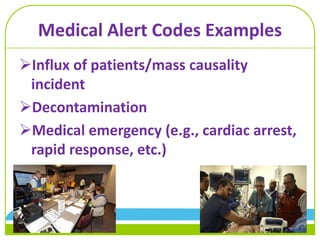
Medical Alert Codes Examples
Influx of patients/mass causality
incident
Decontamination
Medical emergency (e.g., cardiac arrest,
rapid response, etc.)
7
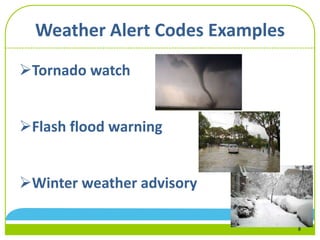
Weather Alert Codes Examples
Tornado watch
Flash flood warning
Winter weather advisory
8
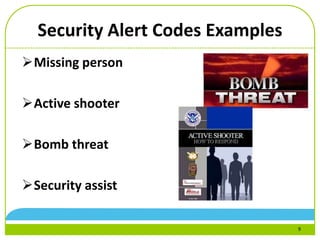
Security Alert Codes Examples
Missing person
Active shooter
Bomb threat
Security assist
9
How is an emergency code called?
• The code should be called in a three-part statement
to include
Alert category
Specific code description
Location of emergency
• Example: “Medical alert, cardiac arrest, Room 231.”
• Additional information or instructions can be
provided if known---for example, the description of a
missing person.
10
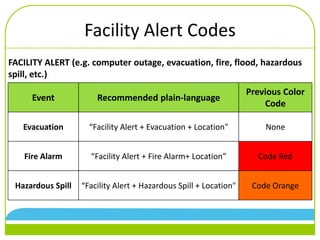
Facility Alert Codes
FACILITY ALERT (e.g. computer outage, evacuation, fire, flood, hazardous
spill, etc.)
Event Recommended plain-language
Previous Color
Code
Evacuation “Facility Alert + Evacuation + Location" None
Fire Alarm “Facility Alert + Fire Alarm+ Location” Code Red
Hazardous Spill “Facility Alert + Hazardous Spill + Location" Code Orange
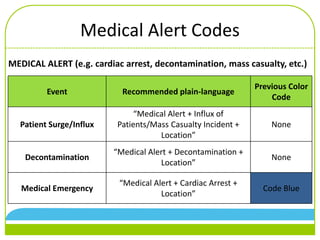
Medical Alert Codes
MEDICAL ALERT (e.g. cardiac arrest, decontamination, mass casualty, etc.)
Event Recommended plain-language
Previous Color
Code
Patient Surge/Influx
“Medical Alert + Influx of
Patients/Mass Casualty Incident +
Location”
None
Decontamination
“Medical Alert + Decontamination +
Location”
None
Medical Emergency
“Medical Alert + Cardiac Arrest +
Location”
Code Blue
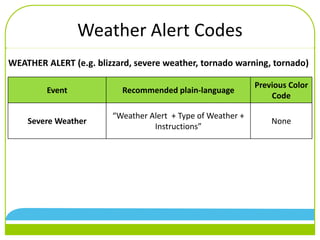
Weather Alert Codes
WEATHER ALERT (e.g. blizzard, severe weather, tornado warning, tornado)
Event Recommended plain-language
Previous Color
Code
Severe Weather
“Weather Alert + Type of Weather +
Instructions”
None
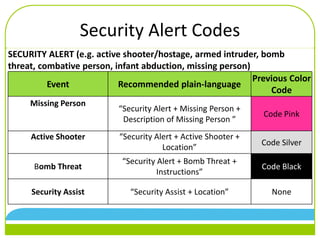
Security Alert Codes
SECURITY ALERT (e.g. active shooter/hostage, armed intruder, bomb
threat, combative person, infant abduction, missing person)
Event Recommended plain-language
Previous Color
Code
Missing Person
“Security Alert + Missing Person +
Description of Missing Person ”
Code Pink
Active Shooter “Security Alert + Active Shooter +
Location”
Code Silver
Bomb Threat
“Security Alert + Bomb Threat +
Instructions”
Code Black
Security Assist “Security Assist + Location” None
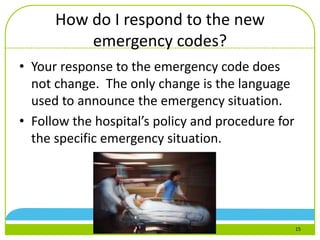
How do I respond to the new
emergency codes?
• Your response to the emergency code does
not change. The only change is the language
used to announce the emergency situation.
• Follow the hospital’s policy and procedure for
the specific emergency situation.
15
When will this go into effect?
• Conversion to plain-language emergency
codes will be effective as of (date) .
16

The new emergency codes what you should know

  • 1.
    What You ShouldKnow The New Emergency Codes
  • 2.
    What is changingwith emergency codes? • Emergency codes are being changed to incorporate use of “plain-language.” • Plain-language typically uses a phrase to identify the type of emergency, the code itself, and the location of the emergency. Example 1: “Security alert, missing person, 3rd floor east tower.” Example 2: “Facility alert, fire alarm, 1st floor cafeteria.” 2
  • 3.
    What are thebenefits of using “plain- language” when calling emergency codes? • It reduces confusion for health care professionals working in more than one hospital. • It allows patients and visitors to better understand what is happening and to respond in a manner that will help (rather than hinder) the response of professionals. • It helps law enforcement officers and emergency rescue staff better understand what is happening. • It can improve timeliness of response to an emergency and can assure that the right people respond to the emergency. 3
  • 4.
    What are thegoals of changing to plain-language? Goals: • People understand the information received without further extensive explanation. • People know what actions are required based on the information received. All emergency responders, whether from within or outside the facility, need to know clearly and quickly what the emergency is, where the emergency is, and how they should respond to effectively coordinate activities. 4
  • 5.
    What are thenew plain-language emergency codes? Codes are organized into four major categories: Facility alerts Medical alerts Weather alerts Security alerts Within each category are specific code descriptors, such as “fire alarm” or “missing person.” 5
  • 6.
    Facility Alert CodeExamples Evacuation Fire alarm Hazardous spill 6
  • 7.
    Medical Alert CodesExamples Influx of patients/mass causality incident Decontamination Medical emergency (e.g., cardiac arrest, rapid response, etc.) 7
  • 8.
    Weather Alert CodesExamples Tornado watch Flash flood warning Winter weather advisory 8
  • 9.
    Security Alert CodesExamples Missing person Active shooter Bomb threat Security assist 9
  • 10.
    How is anemergency code called? • The code should be called in a three-part statement to include Alert category Specific code description Location of emergency • Example: “Medical alert, cardiac arrest, Room 231.” • Additional information or instructions can be provided if known---for example, the description of a missing person. 10
  • 11.
    Facility Alert Codes FACILITYALERT (e.g. computer outage, evacuation, fire, flood, hazardous spill, etc.) Event Recommended plain-language Previous Color Code Evacuation “Facility Alert + Evacuation + Location" None Fire Alarm “Facility Alert + Fire Alarm+ Location” Code Red Hazardous Spill “Facility Alert + Hazardous Spill + Location" Code Orange
  • 12.
    Medical Alert Codes MEDICALALERT (e.g. cardiac arrest, decontamination, mass casualty, etc.) Event Recommended plain-language Previous Color Code Patient Surge/Influx “Medical Alert + Influx of Patients/Mass Casualty Incident + Location” None Decontamination “Medical Alert + Decontamination + Location” None Medical Emergency “Medical Alert + Cardiac Arrest + Location” Code Blue
  • 13.
    Weather Alert Codes WEATHERALERT (e.g. blizzard, severe weather, tornado warning, tornado) Event Recommended plain-language Previous Color Code Severe Weather “Weather Alert + Type of Weather + Instructions” None
  • 14.
    Security Alert Codes SECURITYALERT (e.g. active shooter/hostage, armed intruder, bomb threat, combative person, infant abduction, missing person) Event Recommended plain-language Previous Color Code Missing Person “Security Alert + Missing Person + Description of Missing Person ” Code Pink Active Shooter “Security Alert + Active Shooter + Location” Code Silver Bomb Threat “Security Alert + Bomb Threat + Instructions” Code Black Security Assist “Security Assist + Location” None
  • 15.
    How do Irespond to the new emergency codes? • Your response to the emergency code does not change. The only change is the language used to announce the emergency situation. • Follow the hospital’s policy and procedure for the specific emergency situation. 15
  • 16.
    When will thisgo into effect? • Conversion to plain-language emergency codes will be effective as of (date) . 16