NFPA 20 1-8 (3.2) NFPA Official Definitions
Authority Having Jurisdiction
Authority Having Jurisdiction.*
.* The organization,
office, or individual responsible for approving
equipment, materials, an installation, or a procedure.
A-1-8 (3.2.2) Authority Having Jurisdiction.
The phrase “authority having jurisdiction” is used in NFPA documents in a
broad manner, since jurisdictions and approval agencies vary, as do their
responsibilities. Where public safety is primary, the authority having
jurisdiction may be a federal, state, local, or other regional department or
individual such as a fire chief; fire marshal; chief of a fire prevention bureau,
labor department, or health department; building official; electrical
inspector; or others having statutory authority. For insurance purposes, an
insurance inspection department, rating bureau, or other insurance
company representative may be the authority having jurisdiction. In many
circumstances, the property owner or his or her designated agent assumes
the role of the authority having jurisdiction; at government installations,
the commanding officer or departmental official may be the authority
having jurisdiction.
NFPA 20 (3.2.1)
NFPA 20 (3.2.1)
Approved.*
Approved.* Acceptable to the
Acceptable to the
authority having jurisdiction.
A-1-8 (A.3.2.1) Approved.
The National Fire Protection Association does not approve,
inspect, or certify any installations, procedures, equipment,
or materials; nor does it approve or evaluate testing
laboratories. In determining the acceptability of
installations, procedures, equipment, or materials, the
authority having jurisdiction may base acceptance on
compliance with NFPA or other appropriate standards. In
the absence of such standards, said authority may require
evidence of proper installation, procedure, or use. The
authority having jurisdiction may also refer to the listings
or labeling practices of an organization ( UL or <FM> )
( UL or <FM> )
that is concerned with product evaluations and is thus in a
position to determine compliance with appropriate
standards for the current production of listed items.
WATER SUPPLY
WATER SUPPLY NFPA 20 (5.6)
NFPA 20 (5.6)
The most common sources of fire
protection water are: city water, above
ground tank, below ground tank, well, or
an open body of water ( pond, river,
lake, etc. )
lake, etc. )
NFPA 20 (6.1.2)
NFPA 20 (6.1.2) Centrifugal pumps shall
Centrifugal pumps shall
not be used where a static suction lift is
required.
required.
Find out how many GPM are required and how much PSI
is needed to make the sprinkler and/or stand pipe system
work… Will the “proposed” water supply
water supply and fire
fire
pump
pump meet the system demand ?
Will the water supply be adequate at 150% of the
fire pump rated flow???
fire pump rated flow??? NFPA 20
NFPA 20 (5.6.2)
(5.6.2)
(5.6.5.1)
(5.6.5.1)
NFPA 20 (5.6.2.2)
NFPA 20 (5.6.2.2) Where the water supply
Where the water supply
from a public service main is not adequate in
quality, quantity, or pressure,
quality, quantity, or pressure, an alternative
an alternative
water source “SHALL” be provided.
NFPA 20
NFPA 20 (5.6.5) Head. The head (suction
pressure) available from a water supply shall be
figured on the basis of a flow of 150 percent of
the rated capacity of the fire pump. This head
should be determined by a flow test of the water
supply prior
prior to ordering the pump.
--SAMPLE--
--SAMPLE--
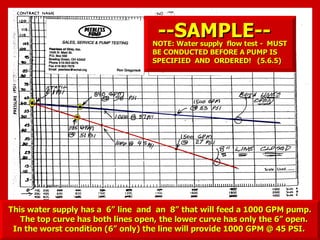
This water supply has a 6” line and an 8” that will feed a 1000 GPM pump.
The top curve has both lines open, the lower curve has only the 6” open.
In the worst condition (6” only) the line will provide 1000 GPM @ 45 PSI.
NOTE: Water supply flow test - MUST
BE CONDUCTED BEFORE A PUMP IS
SPECIFIED AND ORDERED! (5.6.5)
STATE of OHIO FIRE SCHOOL - BGSU 6
Theoretical Conditions
.
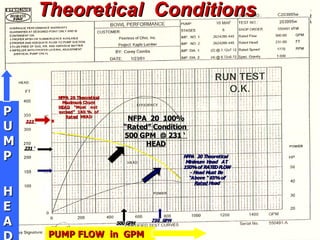
323 ‘
323 ‘
NFPA 20 Theoretical
NFPA 20 Theoretical
Maximum Churn
Maximum Churn
HEAD
HEAD “Must not
“Must not
exceed” 140 % of
exceed” 140 % of
Rated
Rated HEAD
HEAD
231 ‘
231 ‘
NFPA 20 100%
NFPA 20 100%
“Rated” Condition
“Rated” Condition
500 GPM @ 231 ‘
500 GPM @ 231 ‘
HEAD
HEAD
500 GPM
500 GPM
750 GPM
750 GPM
NFPA 20 Theoretical
NFPA 20 Theoretical
Minimum Head AT
Minimum Head AT
150%of RATED FLOW
150%of RATED FLOW
- Head Must Be
- Head Must Be
“Above
“Above “
“ 65%of
65%of
Rated
Rated Head
Head
P
P
U
U
M
M
P
P
H
H
E
E
A
A
PUMP FLOW in GPM
PUMP FLOW in GPM
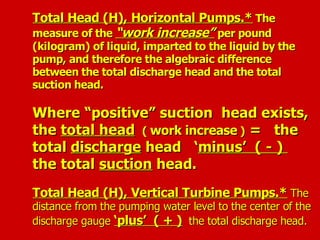
Total Head (H), Horizontal Pumps.*
Total Head (H), Horizontal Pumps.* The
The
measure of the
measure of the “work increase”
“work increase” per pound
per pound
(kilogram) of liquid, imparted to the liquid by the
pump, and therefore the algebraic difference
between the total discharge head and the total
suction head.
suction head.
Where “positive” suction head exists,
the
the total head
total head (
( work increase
work increase )
) = the
= the
total
total discharge
discharge head ‘
head ‘minus’ ( - )
minus’ ( - )
the total
the total suction
suction head.
head.
Total Head (H), Vertical Turbine Pumps.*
Total Head (H), Vertical Turbine Pumps.* The
The
distance from the pumping water level to the center of the
discharge gauge
discharge gauge ‘plus’ ( + )
‘plus’ ( + ) the total discharge head.
the total discharge head.
STATE of OHIO FIRE SCHOOL - BGSU 8
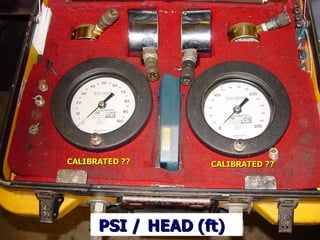
PSI /
PSI / HEAD (ft)
HEAD (ft)
CALIBRATED ??
CALIBRATED ?? CALIBRATED ??
CALIBRATED ??
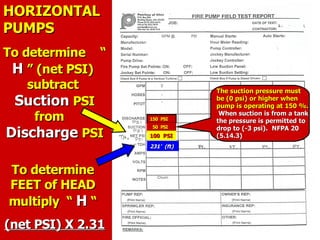
To determine
To determine
FEET of HEAD
FEET of HEAD
multiply “
multiply “ H
H “
“
(net PSI) X 2.31
(net PSI) X 2.31
To determine “
To determine “
H
H ” (net PSI)
” (net PSI)
subtract
subtract
Suction
Suction PSI
PSI
from
from
Discharge
Discharge PSI
PSI
150 PSI
150 PSI
50 PSI
50 PSI
100 PSI
100 PSI
231’ (ft)
231’ (ft)
HORIZONTAL
HORIZONTAL
PUMPS
PUMPS
The suction pressure must
be (0 psi) or higher when
pump is operating at 150 %.
When suction is from a tank
the pressure is permitted to
drop to (-3 psi). NFPA 20
(5.14.3)
(5.14.3)
STATE of OHIO FIRE SCHOOL - BGSU 10
.
.
.
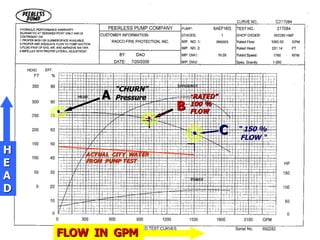
“RATED 100% FLOW “
.
.
A
A
C
C
B
B
.
.
.
.
.
.
“ 150 %
FLOW “
“
“CHURN”
CHURN”
Pressure
Pressure “
“RATED”
RATED”
100 %
100 %
FLOW
FLOW
ACTUAL CITY WATER
ACTUAL CITY WATER
FROM PUMP TEST
FROM PUMP TEST
FLOW IN GPM
FLOW IN GPM
H
H
E
E
A
A
D
D
STATE of OHIO FIRE SCHOOL - BGSU 11
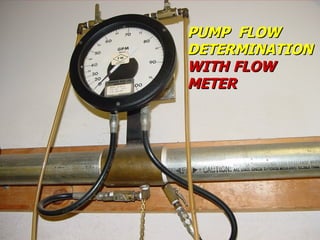
PUMP FLOW
PUMP FLOW
DETERMINATION
DETERMINATION
WITH FLOW
WITH FLOW
METER
METER
STATE of OHIO FIRE SCHOOL - BGSU 12
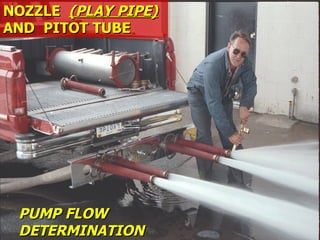
NOZZLE
NOZZLE (PLAY PIPE)
(PLAY PIPE)
AND PITOT TUBE
AND PITOT TUBE
PUMP FLOW
PUMP FLOW
DETERMINATION
DETERMINATION
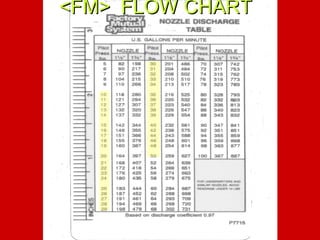
<FM> FLOW CHART
<FM> FLOW CHART
UL / FM
UL / FM
CENTRIFUGAL
CENTRIFUGAL
FIRE PUMPS
FIRE PUMPS
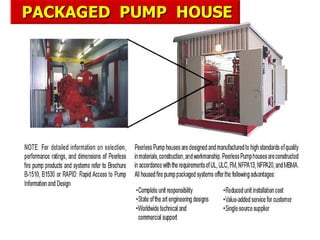
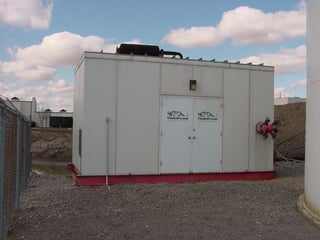
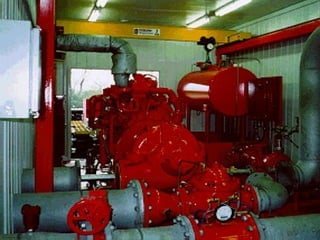
PACKAGED PUMP HOUSE
PACKAGED PUMP HOUSE
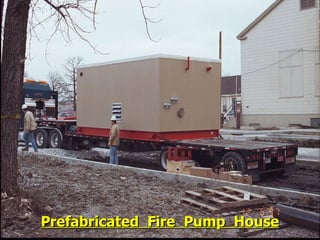
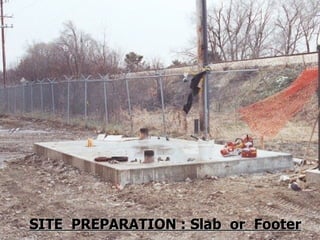
Prefabricated Fire Pump House
SITE PREPARATION : Slab or Footer
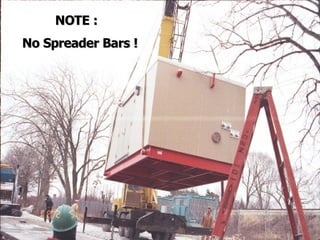
NOTE :
NOTE :
No Spreader Bars !
No Spreader Bars !
STATE of OHIO FIRE SCHOOL - BGSU 19
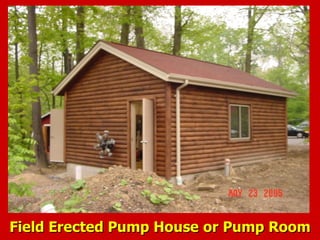
Field Erected Pump House or Pump Room
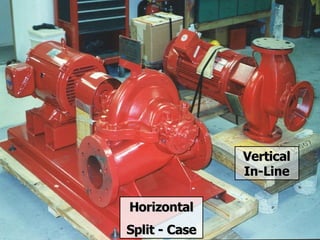
Horizontal
Horizontal
Split - Case
Split - Case
Vertical
Vertical
In-Line
In-Line
STATE of OHIO FIRE SCHOOL - BGSU 24
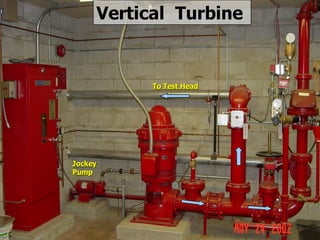
To Test Head
To Test Head
Jockey
Jockey
Pump
Pump
Vertical Turbine
Vertical Turbine
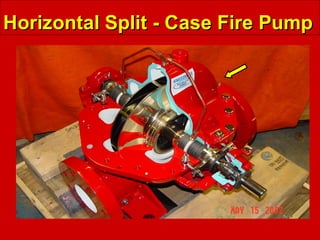
Horizontal Split - Case Fire Pump
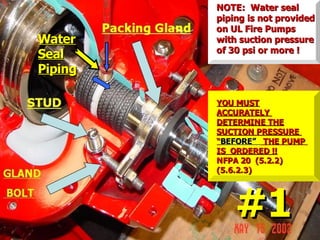
Water
Water
Seal
Seal
Piping
Piping
NOTE: Water seal
NOTE: Water seal
piping is not provided
on UL Fire Pumps
on UL Fire Pumps
with suction pressure
of 30 psi or more !
of 30 psi or more !
#1
#1
YOU MUST
YOU MUST
ACCURATELY
ACCURATELY
DETERMINE THE
DETERMINE THE
SUCTION PRESSURE
SUCTION PRESSURE
“
“BEFORE”
BEFORE” THE PUMP
THE PUMP
IS ORDERED !!
IS ORDERED !!
NFPA 20 (5.2.2)
NFPA 20 (5.2.2)
(5.6.2.3)
(5.6.2.3)
“
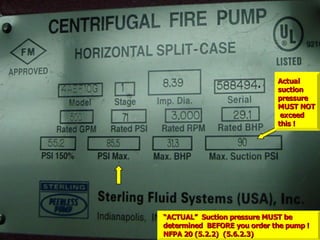
“ACTUAL” Suction pressure MUST be
ACTUAL” Suction pressure MUST be
determined BEFORE you order the pump !
NFPA 20 (5.2.2) (5.6.2.3)
Actual
Actual
suction
suction
pressure
pressure
MUST NOT
MUST NOT
exceed
exceed
this !
this !
STATE of OHIO FIRE SCHOOL - BGSU 28
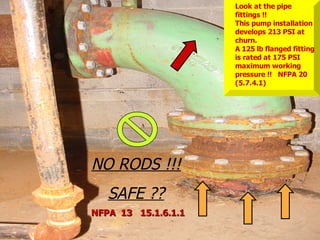
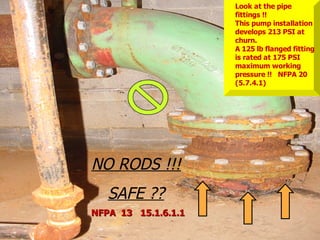
NO RODS !!!
SAFE ??
Look at the pipe
fittings !!
This pump installation
develops 213 PSI at
churn.
A 125 lb flanged fitting
is rated at 175 PSI
maximum working
pressure !! NFPA 20
(5.7.4.1)
NFPA 13 15.1.6.1.1
NFPA 13 15.1.6.1.1
STATE of OHIO FIRE SCHOOL - BGSU 29
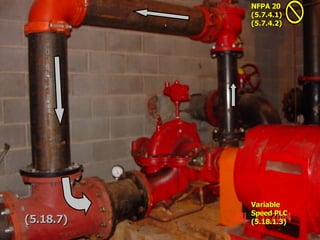
NFPA 20
NFPA 20
(5.7.4.1)
(5.7.4.1)
(5.7.4.2)
(5.7.4.2)
Variable
Variable
Speed PLC
Speed PLC
(5.18.1.3)
(5.18.1.3)
(5.18.7)
(5.18.7)
STATE of OHIO FIRE SCHOOL - BGSU 30
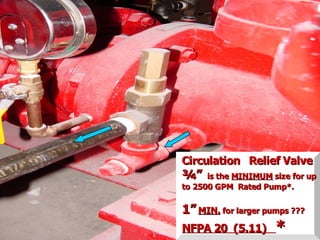
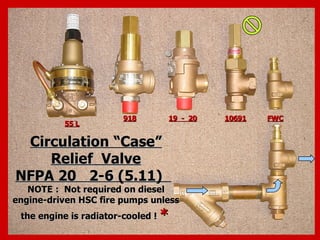
Circulation Relief Valve
¾”
¾” is the
is the MINIMUM
MINIMUM size for up
size for up
to 2500 GPM Rated Pump*.
1”
1” MIN.
MIN. for larger pumps ???
for larger pumps ???
NFPA 20 (5.11)
NFPA 20 (5.11) *
*
Circulation “Case”
Circulation “Case”
Relief Valve
Relief Valve
NFPA 20 2-6 (5.11)
NFPA 20 2-6 (5.11)
NOTE : Not required on diesel
engine-driven HSC fire pumps unless
the engine is radiator-cooled !
the engine is radiator-cooled ! *
*
55 L
55 L
918
918 19 - 20
19 - 20 10691
10691 FWC
FWC
STATE of OHIO FIRE SCHOOL - BGSU 32
NOTE: Above
(optional) Back-
pressure orifice
assembly installed
in ¾” case relief
valve discharge to
create back
pressure and
reduce cavitation.
NOTE: (Optional) Y strainer can
be used when foreign material
(sand or other debris) is present
in the water.
ORIFICE
FLOW
FLOW
Typical CIRCULATION (CASE)
RELIEF VALVE Assembly – The
valve must be installed
(VERTICALLY)
(VERTICALLY) on the pump
on the pump
discharge before the discharge
check valve NFPA 20 (5.11.1.2)
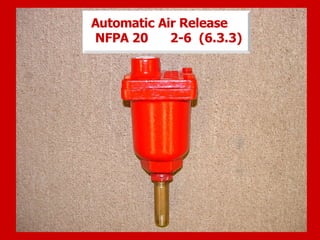
Automatic Air Release
NFPA 20 2-6
Automatic Air Release
NFPA 20 2-6 (6.3.3)
STATE of OHIO FIRE SCHOOL - BGSU 34
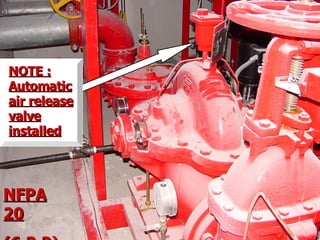
NFPA
NFPA
20
20
NOTE :
NOTE :
Automatic
Automatic
air release
air release
valve
valve
installed
installed
STATE of OHIO FIRE SCHOOL - BGSU 35
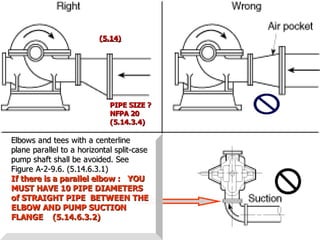
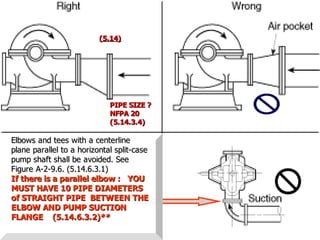
!
!
(5.14)
(5.14)
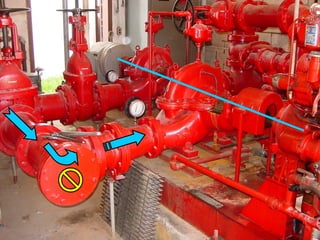
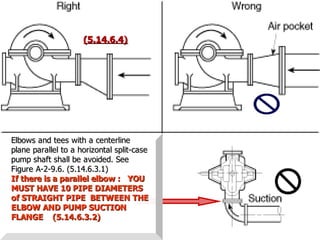
Elbows and tees with a centerline
plane parallel to a horizontal split-case
pump shaft shall be avoided. See
Figure A-2-9.6. (5.14.6.3.1)
If there is a parallel elbow : YOU
MUST HAVE 10 PIPE DIAMETERS
of STRAIGHT PIPE BETWEEN THE
ELBOW AND PUMP SUCTION
FLANGE (5.14.6.3.2)
FLANGE (5.14.6.3.2)
PIPE SIZE ?
PIPE SIZE ?
NFPA 20
NFPA 20
(5.14.3.4)
(5.14.3.4)
STATE of OHIO FIRE SCHOOL - BGSU 36
NFPA 20
NFPA 20
2-9.6.4
2-9.6.4
(5.14.6.4)
(5.14.6.4)
SUCTION
SUCTION
SUCTION
SUCTION
NFPA 20
NFPA 20
2-9.6.4
2-9.6.4
(5.14.6.4)
(5.14.6.4)
STATE of OHIO FIRE SCHOOL - BGSU 38
NFPA 20 2-9.6.3
NFPA 20 2-9.6.3 Elbows and tees
Elbows and tees
with a centerline
with a centerline
plane parallel to
plane parallel to
a horizontal
a horizontal
split-case pump
split-case pump
shaft shall be
shaft shall be
avoided. See
avoided. See
Figure A-2-9.6.
Figure A-2-9.6.
SUCTION
SUCTION
(5.14.6.3.1)
(5.14.6.3.1)
STATE of OHIO FIRE SCHOOL - BGSU 39
CORRECTED !!!
CORRECTED !!!
NOTE: No ELBOWS
NOTE: No ELBOWS
STATE of OHIO FIRE SCHOOL - BGSU 41
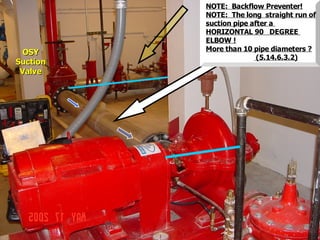
OSY
OSY
Suction
Suction
Valve
Valve
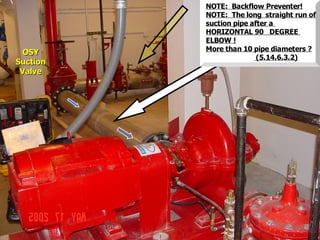
NOTE: Backflow Preventer!
NOTE: The long straight run of
suction pipe after a
HORIZONTAL 90 DEGREE
ELBOW !
More than 10 pipe diameters ?
(5.14.6.3.2)
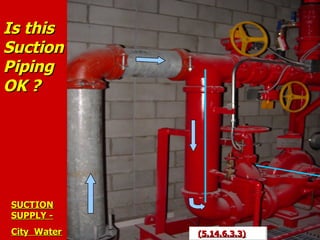
SUCTION
SUCTION
SUPPLY -
SUPPLY -
City Water
City Water
Is this
Is this
Suction
Suction
Piping
Piping
OK ?
OK ?
(5.14.6.3.3)
(5.14.6.3.3)
STATE of OHIO FIRE SCHOOL - BGSU 43
SUCTION
SUCTION
DISCHARGE
DISCHARGE
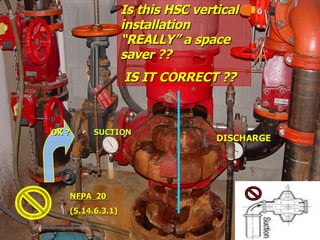
Is this HSC vertical
installation
installation
“REALLY” a space
“REALLY” a space
saver ??
saver ??
IS IT CORRECT ??
IS IT CORRECT ??
OK ?
OK ?
NFPA 20
NFPA 20
(5.14.6.3.1)
(5.14.6.3.1)
STATE of OHIO FIRE SCHOOL - BGSU 44
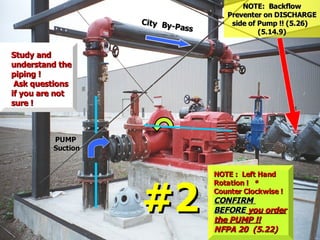
NOTE: Backflow
NOTE: Backflow
Preventer on DISCHARGE
side of Pump !! (5.26)
(5.14.9)
(5.14.9)
PUMP
PUMP
Suction
Suction
City By-Pass
City By-Pass
NOTE : Left Hand
NOTE : Left Hand
Rotation ! *
Rotation ! *
Counter Clockwise !
Counter Clockwise !
CONFIRM
CONFIRM
BEFORE
BEFORE you order
you order
the PUMP !!
the PUMP !!
NFPA 20 (5.22)
NFPA 20 (5.22)
Study and
Study and
understand the
understand the
piping !
piping !
Ask questions
Ask questions
if you are not
if you are not
sure !
sure !
#2
#2
?
?
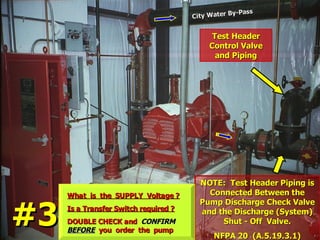
NOTE: Test Header Piping is
Connected Between the
Pump Discharge Check Valve
and the Discharge (System)
Shut - Off Valve.
Shut - Off Valve.
NFPA 20 (A.5.19.3.1)
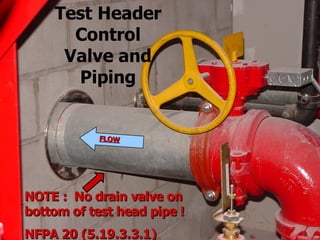
Test Header
Test Header
Control Valve
Control Valve
and Piping
and Piping
City Water By-Pass
City Water By-Pass
What is the SUPPLY Voltage ?
Is a Transfer Switch required ?
DOUBLE CHECK and
DOUBLE CHECK and CONFIRM
CONFIRM
BEFORE
BEFORE you order the pump
you order the pump
#3
#3
Test Header
Control
Valve and
Piping
NOTE : No drain valve on
bottom of test head pipe !
NFPA 20 (5.19.3.3.1)
FLOW
FLOW
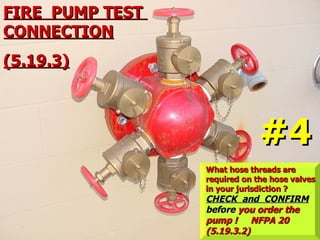
FIRE PUMP TEST
FIRE PUMP TEST
CONNECTION
CONNECTION
(5.19.3)
(5.19.3)
What hose threads are
required on the hose valves
in your jurisdiction ?
CHECK and CONFIRM
CHECK and CONFIRM
before
before you order the
you order the
pump ! NFPA 20
pump ! NFPA 20
(5.19.3.2)
(5.19.3.2)
#4
#4
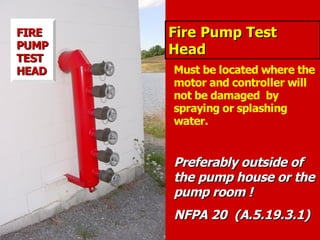
Fire Pump Test
Fire Pump Test
Head
Head
Must be located where the
motor and controller will
not be damaged by
spraying or splashing
water.
Preferably outside of
the pump house or the
pump room !
pump room !
NFPA 20 (A.5.19.3.1)
FIRE
FIRE
PUMP
PUMP
TEST
TEST
HEAD
HEAD
STATE of OHIO FIRE SCHOOL - BGSU 50
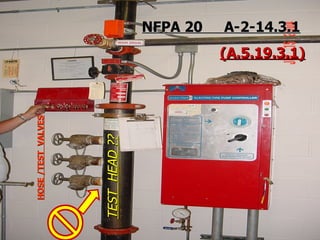
NFPA 20 A-2-14.3.1
NFPA 20 A-2-14.3.1
(A.5.19.3.1)
(A.5.19.3.1)
TEST
HEAD
??
TEST
HEAD
??
HOSE
/TEST
VALVES
HOSE
/TEST
VALVES
STATE of OHIO FIRE SCHOOL - BGSU 51
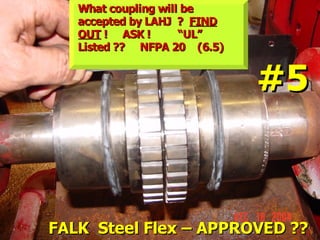
FALK Steel Flex – APPROVED ??
What coupling will be
accepted by LAHJ ?
accepted by LAHJ ? FIND
FIND
OUT
OUT ! ASK ! “UL”
! ASK ! “UL”
Listed ?? NFPA 20 (6.5)
#5
#5
STATE of OHIO FIRE SCHOOL - BGSU 52
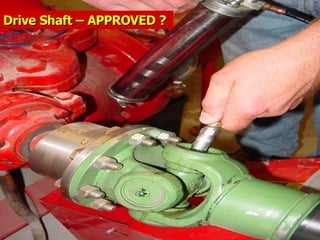
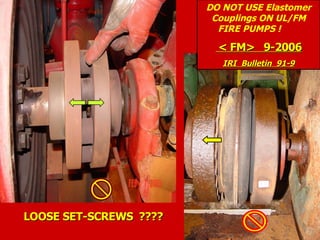
Drive Shaft – APPROVED ?
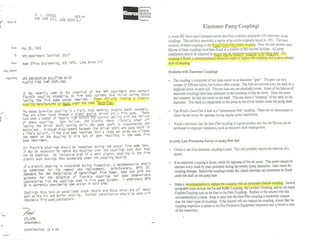
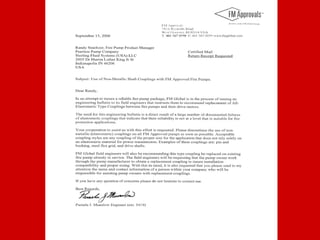
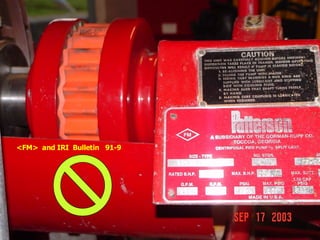
<FM> and IRI Bulletin 91-9
LOOSE SET-SCREWS ????
DO NOT USE Elastomer
Couplings ON UL/FM
FIRE PUMPS !
< FM> 9-2006
< FM> 9-2006
IRI Bulletin 91-9
IRI Bulletin 91-9
STATE of OHIO FIRE SCHOOL - BGSU 57
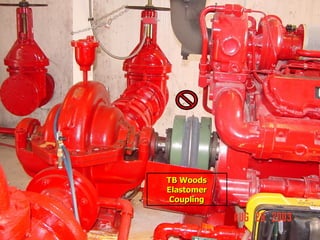
TB Woods
TB Woods
Elastomer
Elastomer
Coupling
Coupling
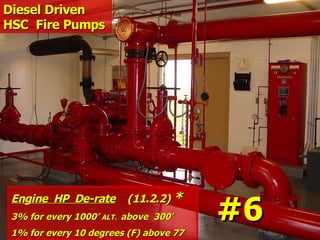
Diesel Driven
Diesel Driven
HSC Fire Pumps
HSC Fire Pumps
Engine HP De-rate
Engine HP De-rate (11.2.2)
(11.2.2) *
*
3% for every 1000’
3% for every 1000’ ALT.
ALT. above 300’
above 300’
1% for every 10 degrees (F) above 77
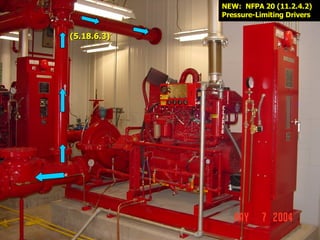
#6
#6
(5.18.6.3)
(5.18.6.3)
NEW: NFPA 20 (11.2.4.2)
Pressure-Limiting Drivers
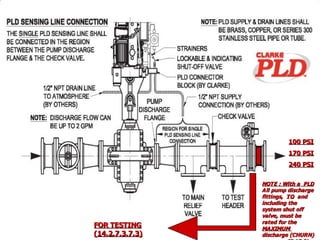
NOTE : With a PLD
NOTE : With a PLD
All pump discharge
All pump discharge
fittings,
fittings, TO
TO and
and
including the
including the
system shut off
system shut off
valve, must be
valve, must be
rated for the
rated for the
MAXIMUM
MAXIMUM
discharge (CHURN)
discharge (CHURN)
100 PSI
100 PSI
170 PSI
170 PSI
240 PSI
240 PSI
FOR TESTING
FOR TESTING
(14.2.7.3.7.3)
(14.2.7.3.7.3)
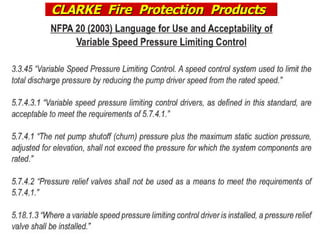
CLARKE Fire Protection Products
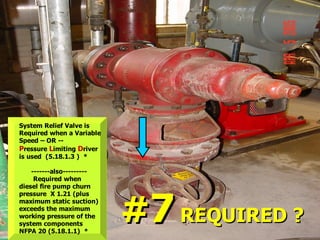
System Relief Valve is
Required when a Variable
Speed – OR --
Pressure Limiting Driver
is used (5.18.1.3 ) *
-------also---------
Required when
diesel fire pump churn
pressure X 1.21 (plus
maximum static suction)
exceeds the maximum
working pressure of the
system components
NFPA 20 (5.18.1.1) *
#
#7
7 REQUIRED ?
REQUIRED ?
STATE of OHIO FIRE SCHOOL - BGSU 63
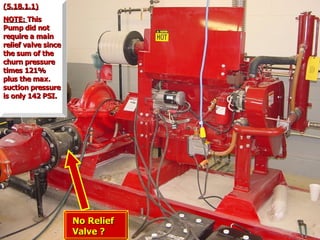
(5.18.1.1)
(5.18.1.1)
NOTE:
NOTE: This
This
Pump did not
Pump did not
require a main
require a main
relief valve since
relief valve since
the sum of the
the sum of the
churn pressure
churn pressure
times 121%
times 121%
plus the max.
plus the max.
suction pressure
suction pressure
is only 142 PSI.
is only 142 PSI.
No Relief
No Relief
Valve ?
Valve ?
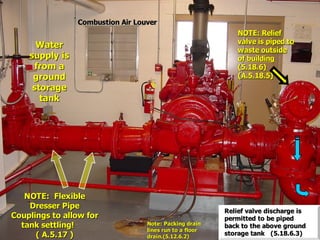
NOTE: Flexible
NOTE: Flexible
Dresser Pipe
Dresser Pipe
Couplings to allow for
tank settling!
tank settling!
( A.5.17 )
( A.5.17 )
Water
Water
supply is
supply is
from a
from a
ground
ground
storage
storage
tank
tank
Combustion Air Louver
NOTE: Relief
NOTE: Relief
valve is piped to
valve is piped to
waste outside
waste outside
of building
of building
(5.18.6)
(5.18.6)
(A.5.18.5)
(A.5.18.5)
Relief valve discharge is
permitted to be piped
back to the above ground
storage tank (5.18.6.3)
Note: Packing drain
Note: Packing drain
lines run to a floor
drain.(5.12.6.2)
drain.(5.12.6.2)
STATE of OHIO FIRE SCHOOL - BGSU 65
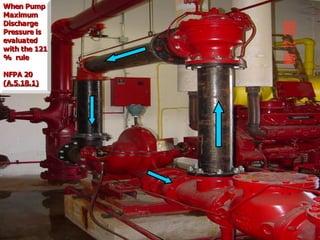
When Pump
When Pump
Maximum
Maximum
Discharge
Discharge
Pressure is
Pressure is
evaluated
evaluated
with the 121
with the 121
% rule
% rule
NFPA 20
NFPA 20
(A.5.18.1)
(A.5.18.1)
STATE of OHIO FIRE SCHOOL - BGSU 66
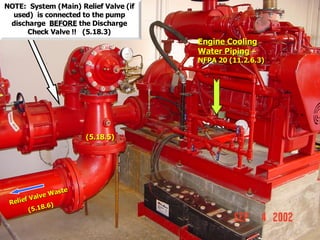
Relief Valve Waste
Relief Valve Waste
(5.18.6)
(5.18.6)
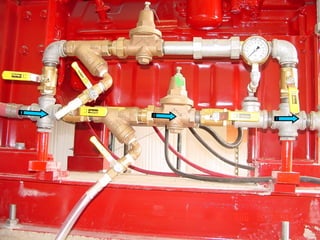
Engine Cooling
Engine Cooling
Water Piping
Water Piping –
–
NFPA 20 (11.2.6.3)
NFPA 20 (11.2.6.3)
NOTE: System (Main) Relief Valve (if
used) is connected to the pump
discharge BEFORE the Discharge
Check Valve !! (5.18.3)
(5.18.5)
(5.18.5)
STATE of OHIO FIRE SCHOOL - BGSU 67
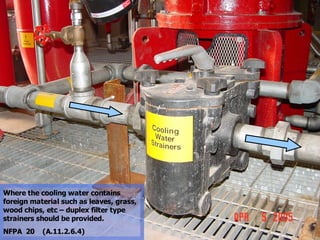
Where the cooling water contains
foreign material such as leaves, grass,
wood chips, etc – duplex filter type
strainers should be provided.
NFPA 20 (A.11.2.6.4)
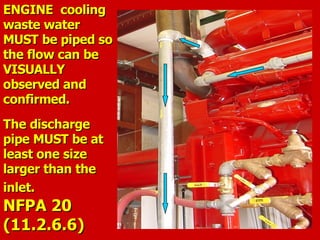
ENGINE cooling
ENGINE cooling
waste water
waste water
MUST be piped so
MUST be piped so
the flow can be
the flow can be
VISUALLY
VISUALLY
observed and
observed and
confirmed.
confirmed.
The discharge
The discharge
pipe MUST be at
pipe MUST be at
least one size
least one size
larger than the
larger than the
inlet.
inlet.
NFPA 20
NFPA 20
(11.2.6.6)
(11.2.6.6)
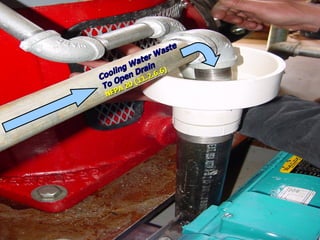
Cooling Water Waste
Cooling Water Waste
To Open Drain
To Open Drain
NFPA 20 (11.2.6.6)
NFPA 20 (11.2.6.6)
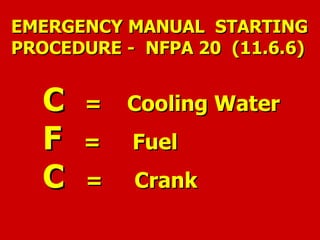
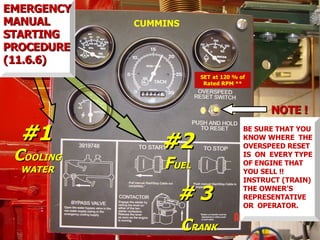
EMERGENCY MANUAL STARTING
PROCEDURE - NFPA 20 (11.6.6)
C
C = Cooling Water
= Cooling Water
F
F = Fuel
= Fuel
C
C = Crank
= Crank
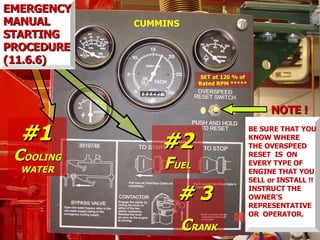
#1
#1
C
COOLING
OOLING
WATER
WATER
#2
#2
F
FUEL
UEL
# 3
# 3
C
CRANK
RANK
NOTE !
NOTE !
SET at 120 % of
Rated RPM *****
EMERGENCY
EMERGENCY
MANUAL
MANUAL
STARTING
STARTING
PROCEDURE
PROCEDURE
(11.6.6)
(11.6.6)
BE SURE THAT YOU
KNOW WHERE
THE OVERSPEED
RESET IS ON
EVERY TYPE OF
ENGINE THAT YOU
SELL or INSTALL !!
INSTRUCT THE
OWNER’S
REPRESENTATIVE
OR OPERATOR.
CUMMINS
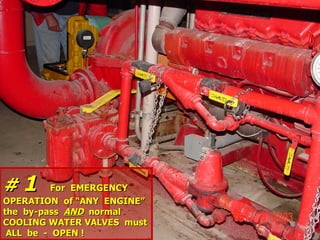
#
# 1
1 For EMERGENCY
For EMERGENCY
OPERATION of “ANY ENGINE”
the by-pass
the by-pass AND
AND normal
normal
COOLING WATER VALVES must
ALL be - OPEN !
ALL be - OPEN !
STATE of OHIO FIRE SCHOOL - BGSU 74
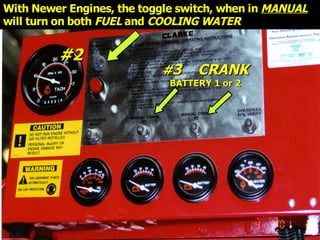
#
#3
3 CRANK
CRANK
BATTERY 1 or 2
BATTERY 1 or 2
#2
#2
With Newer Engines, the toggle switch, when in
With Newer Engines, the toggle switch, when in MANUAL
MANUAL
will turn on both
will turn on both FUEL
FUEL and
and COOLING WATER
COOLING WATER
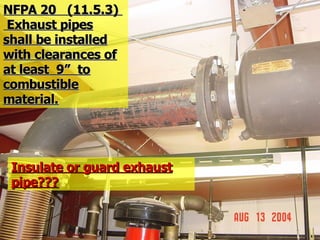
NFPA 20 (11.5.3)
NFPA 20 (11.5.3)
Exhaust pipes
Exhaust pipes
shall be installed
shall be installed
with clearances of
with clearances of
at least 9” to
at least 9” to
combustible
combustible
material.
material.
Insulate or guard exhaust
pipe???
pipe???
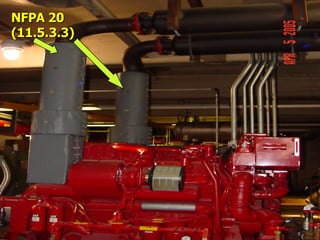
NFPA 20
NFPA 20
(11.5.3.3)
(11.5.3.3)
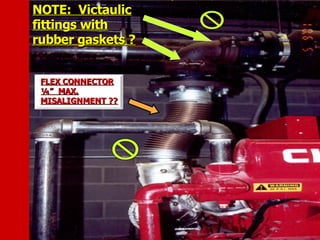
NOTE: Victaulic
NOTE: Victaulic
fittings with
fittings with
rubber gaskets ?
rubber gaskets ?
FLEX CONNECTOR
FLEX CONNECTOR
¼” MAX.
¼” MAX.
MISALIGNMENT ??
MISALIGNMENT ??
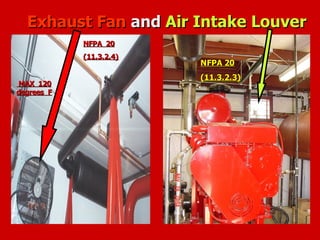
Exhaust Fan
Exhaust Fan and
and Air Intake Louver
Air Intake Louver
NFPA 20
NFPA 20
(11.3.2.4)
(11.3.2.4)
NFPA 20
NFPA 20
(11.3.2.3)
(11.3.2.3)
MAX 120
MAX 120
degrees F
degrees F
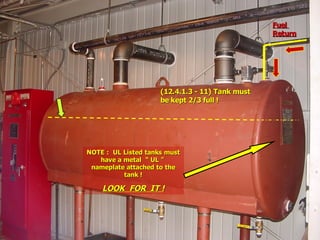
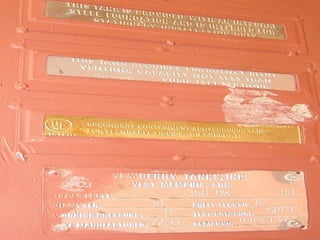
NOTE : UL Listed tanks must
have a metal “ UL ”
have a metal “ UL ”
nameplate attached to the
tank !
tank !
LOOK FOR IT !
LOOK FOR IT !
(12.4.1.3 - 11) Tank must
be kept 2/3 full !
be kept 2/3 full !
Fuel
Fuel
Return
Return
STATE of OHIO FIRE SCHOOL - BGSU 80
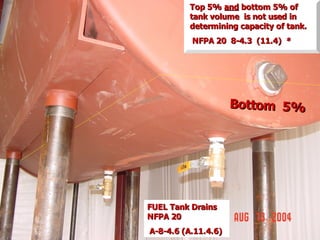
FUEL Tank Drains
FUEL Tank Drains
NFPA 20
NFPA 20
A-8-4.6 (A.11.4.6)
A-8-4.6 (A.11.4.6)
Top 5%
Top 5% and
and bottom 5% of
bottom 5% of
tank volume is not used in
determining capacity of tank.
NFPA 20 8-4.3 (11.4) *
Bottom 5%
Bottom 5%
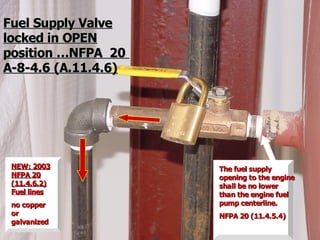
Fuel Supply Valve
Fuel Supply Valve
locked in OPEN
locked in OPEN
position …NFPA 20
position …NFPA 20
A-8-4.6 (A.11.4.6)
A-8-4.6 (A.11.4.6)
NEW: 2003
NEW: 2003
NFPA 20
NFPA 20
(11.4.6.2)
(11.4.6.2)
Fuel lines
Fuel lines
no copper
no copper
or
or
galvanized
galvanized
The fuel supply
The fuel supply
opening to the engine
shall be no lower
shall be no lower
than the engine fuel
pump centerline.
pump centerline.
NFPA 20 (11.4.5.4)
NFPA 20 (11.4.5.4)
STATE of OHIO FIRE SCHOOL - BGSU 83
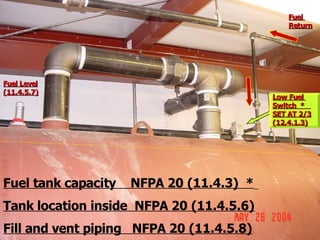
Fuel tank capacity NFPA 20 (11.4.3) *
Tank location inside NFPA 20 (11.4.5.6)
Fill and vent piping NFPA 20 (11.4.5.8)
Fuel Level
Fuel Level
(11.4.5.7)
(11.4.5.7)
Low Fuel
Low Fuel
Switch *
Switch *
SET AT 2/3
SET AT 2/3
(12.4.1.3)
(12.4.1.3)
Fuel
Fuel
Return
Return
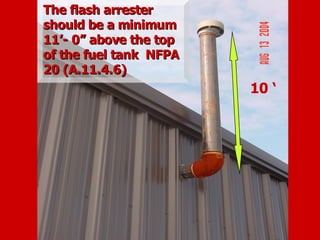
10 ‘
The flash arrester
The flash arrester
should be a minimum
should be a minimum
11’- 0” above the top
of the fuel tank NFPA
20 (A.11.4.6)
20 (A.11.4.6)
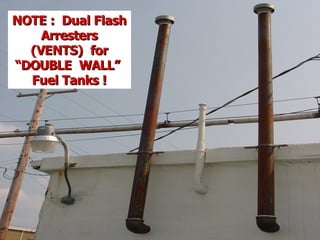
NOTE : Dual Flash
NOTE : Dual Flash
Arresters
Arresters
(VENTS) for
(VENTS) for
“DOUBLE WALL”
“DOUBLE WALL”
Fuel Tanks !
Fuel Tanks !
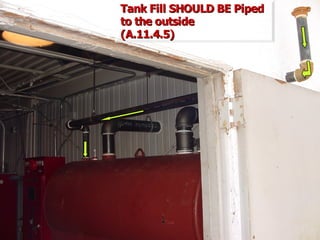
Tank Fill SHOULD BE Piped
to the outside
to the outside
(A.11.4.5)
(A.11.4.5)
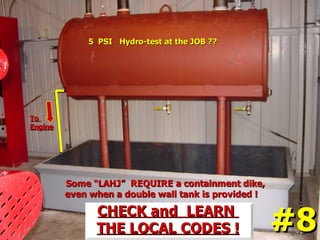
Some “LAHJ” REQUIRE a containment dike,
even when a double wall tank is provided !
CHECK and LEARN
CHECK and LEARN
THE LOCAL CODES !
THE LOCAL CODES !
5 PSI Hydro-test at the JOB ??
To
To
Engine
Engine
#8
#8
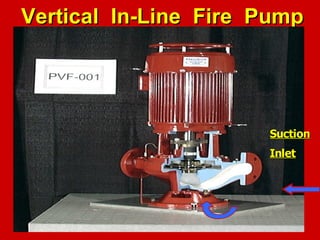
Vertical In-Line Fire Pump
Suction
Suction
Inlet
Inlet
STATE of OHIO FIRE SCHOOL - BGSU 89
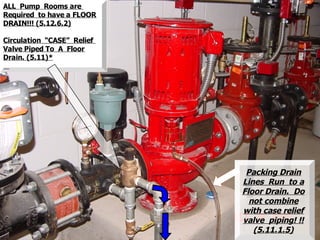
ALL Pump Rooms are
Required to have a FLOOR
DRAIN!!! (5.12.6.2)
Circulation “CASE” Relief
Valve Piped To A Floor
Drain. (5.11)*
Packing Drain
Lines Run to a
Floor Drain. Do
not combine
with case relief
valve piping! !!
(5.11.1.5)
STATE of OHIO FIRE SCHOOL - BGSU 90
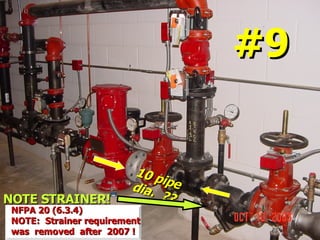
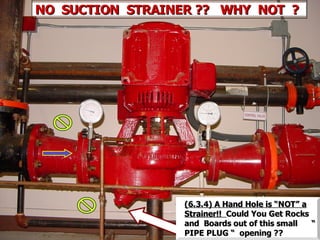
NOTE STRAINER!
NOTE STRAINER!
10 pipe
10 pipe
dia. ??
dia. ??
NFPA 20 (6.3.4)
NFPA 20 (6.3.4)
NOTE: Strainer requirement
was removed after 2007 !
#9
#9
STATE of OHIO FIRE SCHOOL - BGSU 91
(6.3.4) A Hand Hole is “NOT” a
Strainer!!
Strainer!! Could You Get Rocks
Could You Get Rocks
and Boards out of this small “
PIPE PLUG “ opening ??
NO SUCTION STRAINER ?? WHY NOT ?
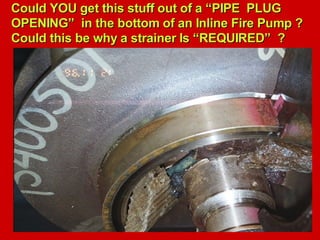
Could YOU get this stuff out of a “PIPE PLUG
OPENING” in the bottom of an Inline Fire Pump ?
Could this be why a strainer Is “REQUIRED” ?
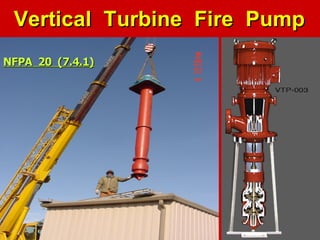
Vertical Turbine Fire Pump
NFPA 20 (7.4.1)
NFPA 20 (7.4.1)
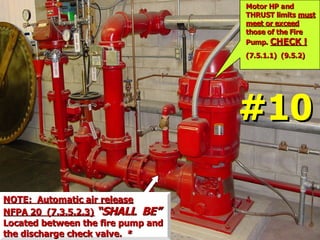
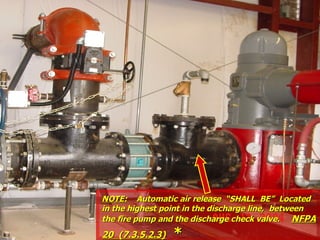
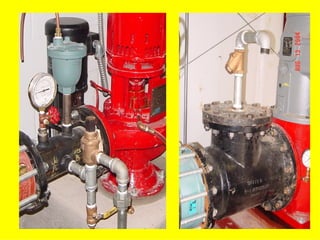
NOTE: Automatic air release
NFPA 20 (7.3.5.2.3)
NFPA 20 (7.3.5.2.3) “SHALL BE”
“SHALL BE”
Located between the fire pump and
the discharge check valve. *
Motor HP and
Motor HP and
THRUST limits
THRUST limits must
must
meet or exceed
meet or exceed
those of the Fire
those of the Fire
Pump.
Pump. CHECK !
CHECK !
(7.5.1.1) (9.5.2)
(7.5.1.1) (9.5.2)
#10
#10
STATE of OHIO FIRE SCHOOL - BGSU 95
NOTE:
NOTE: Automatic air release “SHALL BE” Located
Automatic air release “SHALL BE” Located
in the highest point in the discharge line, between
the fire pump and the discharge check valve.
the fire pump and the discharge check valve. NFPA
NFPA
20 (7.3.5.2.3)
20 (7.3.5.2.3) *
*
STATE of OHIO FIRE SCHOOL - BGSU 96
NFPA 20 (7.6.2.3)
NFPA 20 (7.6.2.3)
ACCESS FOR REMOVAL ?
NFPA 20 ( 7.4.3.7 )
NFPA 20 ( 7.4.3.7 )
I– beams must be parallel
to the driver !
to the driver !
STATE of OHIO FIRE SCHOOL - BGSU 99
One degree of off-set is the preferred
angle, per drive shaft manufacturers!!
NFPA 20 (6.5) (7.5.1.7.2)
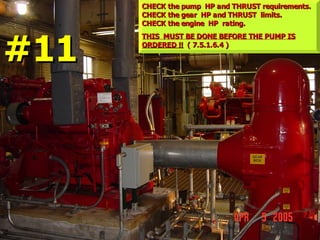
CHECK the pump HP and THRUST requirements.
CHECK the gear HP and THRUST limits.
CHECK the engine HP rating.
THIS MUST BE DONE BEFORE THE PUMP IS
ORDERED !!
ORDERED !! ( 7.5.1.6.4 )
( 7.5.1.6.4 )
#11
#11
STATE of OHIO FIRE SCHOOL - BGSU 101
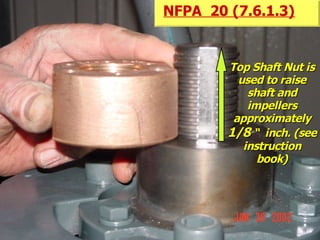
Top Shaft Nut is
Top Shaft Nut is
used to raise
used to raise
shaft and
shaft and
impellers
impellers
approximately
approximately
1/8
1/8 “ inch. (see
“ inch. (see
instruction
instruction
book)
book)
NFPA 20 (7.6.1.3)
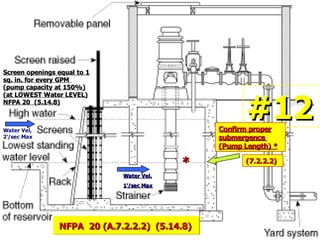
Water Vel,
2’/sec Max
Water Vel.
Water Vel.
1’/sec Max
1’/sec Max
Screen openings equal to 1
sq. in. for every GPM
(pump capacity at 150%)
(at LOWEST Water LEVEL)
NFPA 20 (5.14.8)
NFPA 20 (5.14.8)
Confirm proper
Confirm proper
submergence
submergence
(Pump Length) *
(Pump Length) *
(7.2.2.2)
(7.2.2.2)
NFPA 20 (A.7.2.2.2) (5.14.8)
#12
#12
*
*
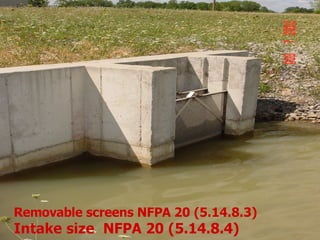
Removable screens NFPA 20 (5.14.8.3)
Intake size NFPA 20 (5.14.8.4)
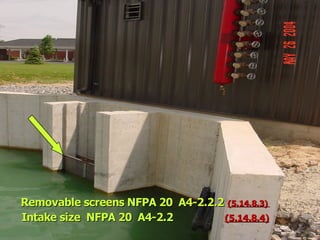
Removable screens NFPA 20 A4-2.2.2
Removable screens NFPA 20 A4-2.2.2 (5.14.8.3)
(5.14.8.3)
Intake size NFPA 20 A4-2.2
Intake size NFPA 20 A4-2.2 (5.14.8.4)
(5.14.8.4)
STATE of OHIO FIRE SCHOOL - BGSU 106
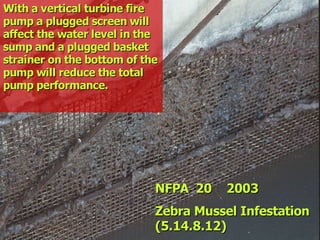
NFPA 20 2003
NFPA 20 2003
Zebra Mussel Infestation
(5.14.8.12)
(5.14.8.12)
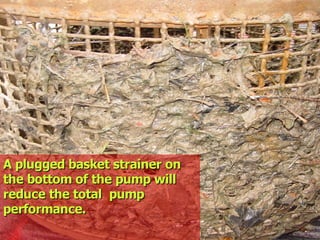
With a vertical turbine fire
pump a plugged screen will
affect the water level in the
sump and a plugged basket
strainer on the bottom of the
pump will reduce the total
pump performance.
pump performance.
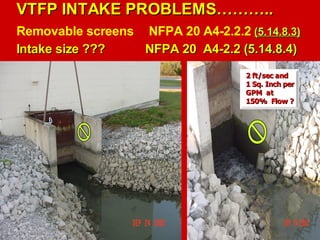
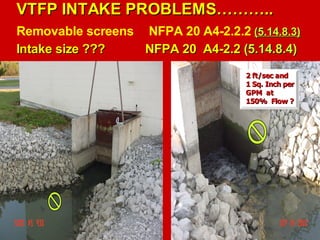
VTFP INTAKE PROBLEMS………..
Removable screens NFPA 20 A4-2.2.2 (5.14.8.3)
(5.14.8.3)
Intake size ???
Intake size ??? NFPA 20 A4-2.2
NFPA 20 A4-2.2 (5.14.8.4)
(5.14.8.4)
2 ft/sec and
2 ft/sec and
1 Sq. Inch per
1 Sq. Inch per
GPM at
GPM at
150% Flow ?
150% Flow ?
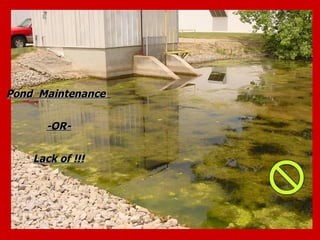
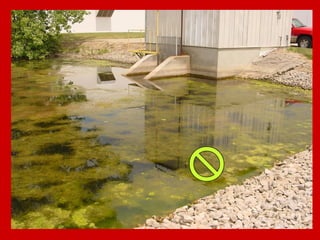
Pond Maintenance
Pond Maintenance
-OR-
-OR-
Lack of !!!
Lack of !!!
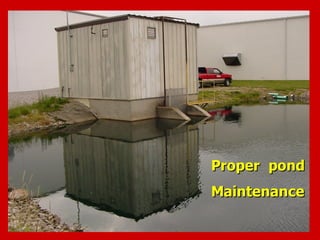
Proper pond
Proper pond
Maintenance
Maintenance
PART 2
PART 2
FIRE PUMP
FIRE PUMP
Acceptance Testing
Acceptance Testing
In The State of
In The State of
OHIO
OHIO
FIRE PUMP
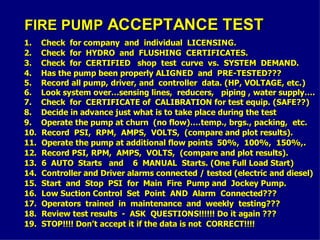
FIRE PUMP ACCEPTANCE TEST
ACCEPTANCE TEST
1. Check for company and individual LICENSING.
2. Check for HYDRO and FLUSHING CERTIFICATES.
3. Check for CERTIFIED shop test curve vs. SYSTEM DEMAND.
4. Has the pump been properly ALIGNED and PRE-TESTED???
5. Record all pump, driver, and controller data. (HP, VOLTAGE, etc.)
6. Look system over…sensing lines, reducers, piping , water supply….
7. Check for CERTIFICATE of CALIBRATION for test equip. (SAFE??)
8. Decide in advance just what is to take place during the test
9. Operate the pump at churn (no flow)….temp., brgs., packing, etc.
10. Record PSI, RPM, AMPS, VOLTS, (compare and plot results).
11. Operate the pump at additional flow points 50%, 100%, 150%,.
12. Record PSI, RPM, AMPS, VOLTS, (compare and plot results).
13. 6 AUTO Starts and 6 MANUAL Starts. (One Full Load Start)
14. Controller and Driver alarms connected / tested (electric and diesel)
15. Start and Stop PSI for Main Fire Pump and Jockey Pump.
16. Low Suction Control Set Point AND Alarm Connected???
17. Operators trained in maintenance and weekly testing???
18. Review test results - ASK QUESTIONS!!!!!! Do it again ???
19. STOP!!!! Don’t accept it if the data is not CORRECT!!!!
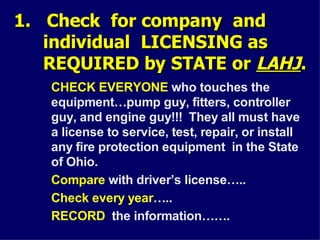
1. Check for company and
individual LICENSING as
REQUIRED by STATE or
REQUIRED by STATE or LAHJ
LAHJ.
.
CHECK EVERYONE who touches the
equipment…pump guy, fitters, controller
guy, and engine guy!!! They all must have
a license to service, test, repair, or install
any fire protection equipment in the State
of Ohio.
Compare with driver’s license…..
Check every year…..
RECORD the information…….
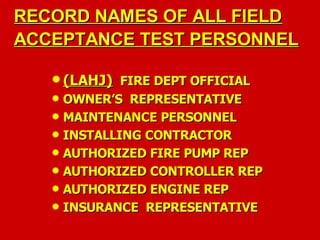
RECORD NAMES OF ALL FIELD
ACCEPTANCE TEST PERSONNEL
 (LAHJ)
(LAHJ) FIRE DEPT OFFICIAL
FIRE DEPT OFFICIAL
 OWNER’S REPRESENTATIVE
OWNER’S REPRESENTATIVE
 MAINTENANCE PERSONNEL
MAINTENANCE PERSONNEL
 INSTALLING CONTRACTOR
INSTALLING CONTRACTOR
 AUTHORIZED FIRE PUMP REP
AUTHORIZED FIRE PUMP REP
 AUTHORIZED CONTROLLER REP
AUTHORIZED CONTROLLER REP
 AUTHORIZED ENGINE REP
AUTHORIZED ENGINE REP
 INSURANCE REPRESENTATIVE
INSURANCE REPRESENTATIVE
STATE of OHIO FIRE SCHOOL - BGSU 114
1.
1. Check for HYDRO and
Check for HYDRO and
FLUSHING CERTIFICATES.
NFPA 20 11-1.1 (14.1)
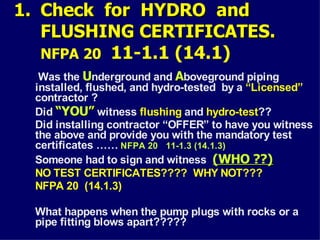
Was the U
Underground and A
Aboveground piping
installed, flushed, and hydro-tested by a “Licensed”
contractor ?
Did “YOU”
“YOU” witness flushing and hydro-test??
Did installing contractor “OFFER” to have you witness
the above and provide you with the mandatory test
certificates …… NFPA 20 11-1.3 (14.1.3)
Someone had to sign and witness (WHO ??)
(WHO ??)
NO TEST CERTIFICATES???? WHY NOT???
NFPA 20 (14.1.3)
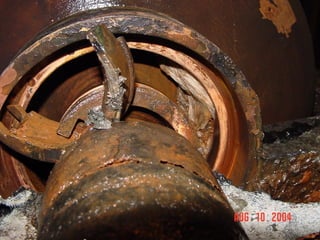
What happens when the pump plugs with rocks or a
pipe fitting blows apart?????
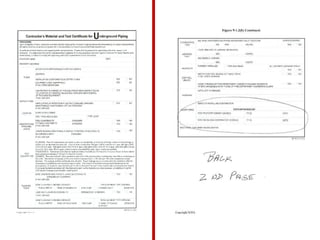
Table (14.1.1.1[a])
Table (14.1.1.1[a]) Minimum Flush Rates
Minimum Flush Rates.
.
Contractor may have a calculated system
demand which, if greater, will require higher
flush rates than those listed below.
Pipe Size
Pipe Size Flow Rate
Flow Rate
in.
in. mm
mm gpm
gpm L/min
L/min
4
4 102
102 590
590 2,233
2,233
6
6 152
152 1,360
1,360 5,148
5,148
8
8 203
203 2,350
2,350 8,895
8,895
10
10 254
254 3,670
3,670 13,891
13,891
12
12 305
305 5,290
5,290 20,023
20,023
NFPA 20 (14.1.1.1) FLUSHING
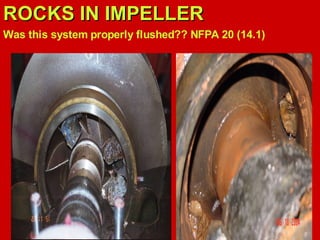
ROCKS IN IMPELLER
ROCKS IN IMPELLER
Was this system properly flushed?? NFPA 20 (14.1)
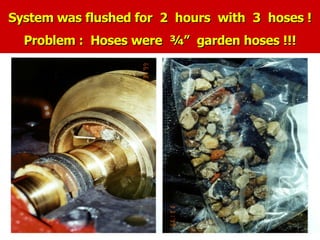
System was flushed for 2 hours with 3 hoses !
Problem : Hoses were ¾” garden hoses !!!
3. Check for PUMP CERTIFIED
SHOP TEST CURVE. Compare
it to the SYSTEM DEMAND.
NFPA 20 2-16
2-16 and 11-2.3 (14.2.4)
Find out how many GPM are required and
how much PSI is needed to make the
sprinkler system work… Will the fire
pump and water supply do it ?
Fire Pumps are selected for “SYSTEM
DESIGNS” which can utilize any pump
flow up to 150% of rated capacity.
NFPA 20 2-3 and A-2-3 (5.8)
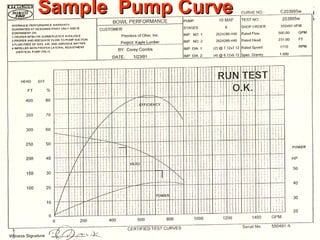
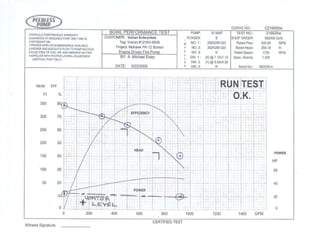
Sample Pump Curve
Sample Pump Curve
4. Has the Pump and Driver
been ALIGNED, LUBRICATED,
and PRE-TESTED???
and PRE-TESTED???
Pump and driver MUST
MUST be field-aligned
NFPA 20 3-5 (6.5.2) and pre-tested PRIOR
PRIOR to
the field acceptance test - includes electrical
includes electrical
NFPA 20 (14.2.3)
NFPA 20 (14.2.3) so that inspector’s time is
not wasted standing around…….. MANY
jurisdictions charge an additional fee if re-
testing is required due to problems with a
system which has not been pre-tested prior
to the acceptance test!!!!
STATE of OHIO FIRE SCHOOL - BGSU 124
STATE of OHIO FIRE SCHOOL - BGSU 125
STATE of OHIO FIRE SCHOOL - BGSU 126
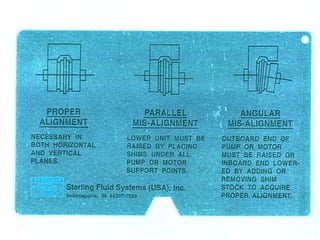
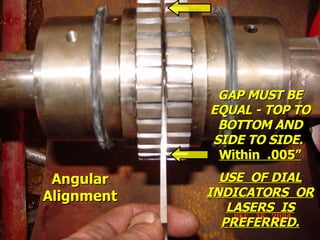
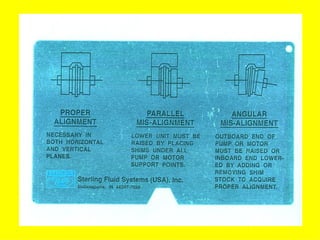
GAP MUST BE
GAP MUST BE
EQUAL - TOP TO
EQUAL - TOP TO
BOTTOM AND
BOTTOM AND
SIDE TO SIDE.
SIDE TO SIDE.
Within .005”
Within .005”
USE OF DIAL
USE OF DIAL
INDICATORS OR
INDICATORS OR
LASERS IS
LASERS IS
PREFERRED.
PREFERRED.
Angular
Angular
Alignment
Alignment
STATE of OHIO FIRE SCHOOL - BGSU 127
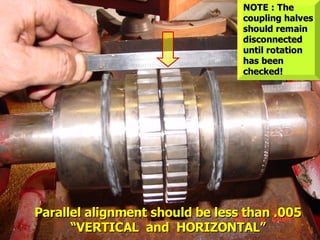
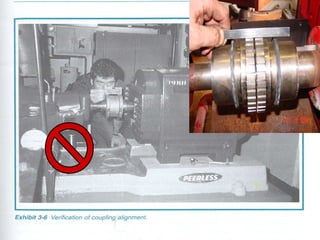
Parallel alignment should be less than .005
“VERTICAL and HORIZONTAL”
NOTE : The
NOTE : The
coupling halves
coupling halves
should remain
should remain
disconnected
disconnected
until rotation
until rotation
has been
has been
checked!
checked!
STATE of OHIO FIRE SCHOOL - BGSU 128
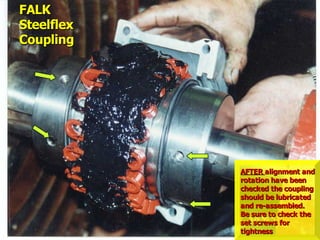
AFTER
AFTER alignment and
alignment and
rotation have been
rotation have been
checked the coupling
should be lubricated
and re-assembled.
and re-assembled.
Be sure to check the
set screws for
set screws for
tightness
tightness
FALK
FALK
Steelflex
Steelflex
Coupling
Coupling
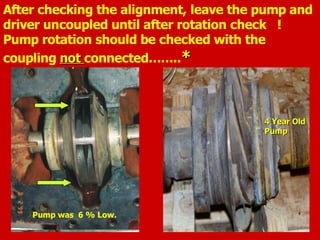
After checking the alignment, leave the pump and
driver uncoupled until after rotation check !
Pump rotation should be checked with the
coupling not
not connected……..*
*
Pump was 6 % Low.
4 Year Old
4 Year Old
Pump
Pump
STATE of OHIO FIRE SCHOOL - BGSU 130
STATE of OHIO FIRE SCHOOL - BGSU 131
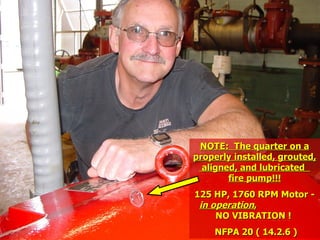
NOTE: The quarter on a
properly installed, grouted,
aligned, and lubricated
fire pump!!!
fire pump!!!
125 HP, 1760 RPM Motor -
in operation
in operation,
,
NO VIBRATION !
NO VIBRATION !
NFPA 20 ( 14.2.6 )
NFPA 20 ( 14.2.6 )
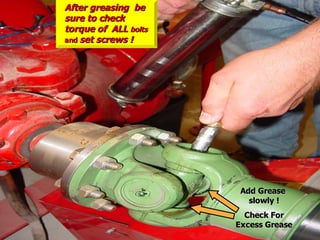
Add Grease
Add Grease
slowly !
slowly !
Check For
Check For
Excess Grease
Excess Grease
After greasing be
After greasing be
sure to check
sure to check
torque of ALL
torque of ALL bolts
bolts
and
and set screws !
set screws !
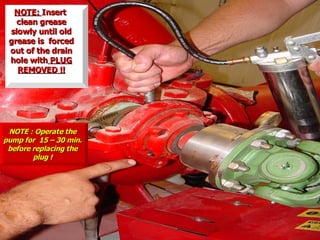
NOTE:
NOTE: Insert
Insert
clean grease
clean grease
slowly until old
slowly until old
grease is forced
grease is forced
out of the drain
out of the drain
hole with
hole with PLUG
PLUG
REMOVED !!
REMOVED !!
NOTE : Operate the
NOTE : Operate the
pump for 15 – 30 min.
before replacing the
plug !
plug !
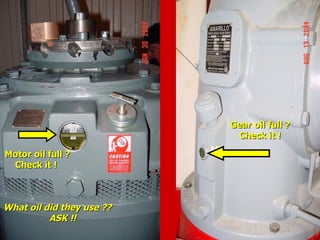
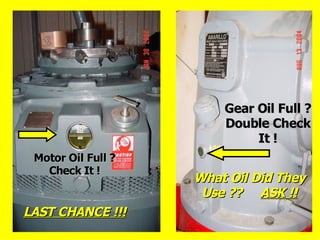
Motor oil full ?
Motor oil full ?
Check it !
Check it !
Gear oil full ?
Gear oil full ?
Check it !
Check it !
What oil did they use ??
ASK !!
ASK !!
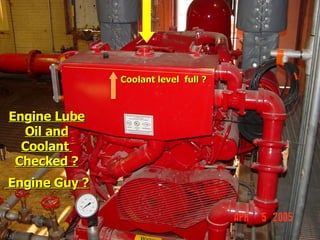
Coolant level full ?
Engine Lube
Engine Lube
Oil and
Oil and
Coolant
Coolant
Checked ?
Checked ?
Engine Guy ?
Engine Guy ?
STATE of OHIO FIRE SCHOOL - BGSU 136
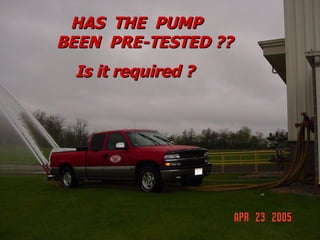
HAS THE PUMP
HAS THE PUMP
BEEN PRE-TESTED ??
BEEN PRE-TESTED ??
Is it required ?
Is it required ?
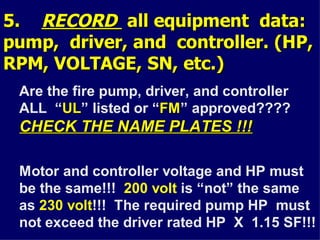
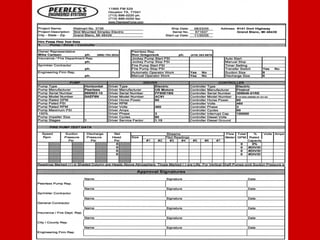
5.
5. RECORD
RECORD all equipment data:
all equipment data:
pump, driver, and controller. (HP,
RPM, VOLTAGE, SN, etc.)
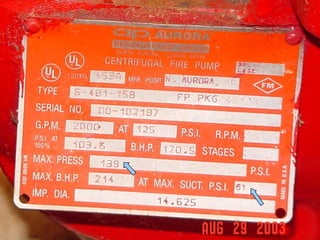
Are the fire pump, driver, and controller
ALL “UL
UL” listed or “FM
FM” approved????
CHECK THE NAME PLATES !!!
Motor and controller voltage and HP must
be the same!!! 200 volt is “not” the same
as 230 volt!!! The required pump HP must
not exceed the driver rated HP X 1.15 SF!!!
STATE of OHIO FIRE SCHOOL - BGSU 139
STATE of OHIO FIRE SCHOOL - BGSU 140
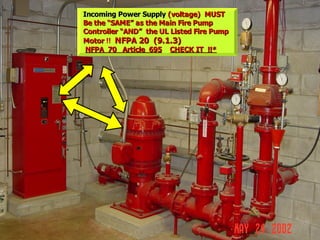
Incoming Power Supply
Incoming Power Supply (voltage) MUST
(voltage) MUST
Be the “SAME” as the Main Fire Pump
Controller “AND” the UL Listed Fire Pump
Motor
Motor !! NFPA 20 (9.1.3)
NFPA 20 (9.1.3)
NFPA 70 Article 695
NFPA 70 Article 695 CHECK IT !!*
CHECK IT !!*
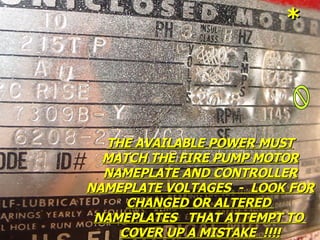
THE AVAILABLE POWER MUST
MATCH THE FIRE PUMP MOTOR
NAMEPLATE AND CONTROLLER
NAMEPLATE VOLTAGES - LOOK FOR
CHANGED OR ALTERED
CHANGED OR ALTERED
NAMEPLATES THAT ATTEMPT TO
COVER UP A MISTAKE !!!!
*
*
*
*
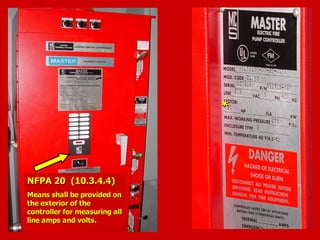
NFPA 20 (10.3.4.4)
NFPA 20 (10.3.4.4)
Means shall be provided on
the exterior of the
the exterior of the
controller for measuring all
line amps and volts.
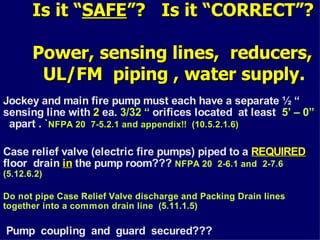
Is it “
Is it “SAFE
SAFE”? Is it “CORRECT”?
”? Is it “CORRECT”?
Power, sensing lines, reducers,
UL/FM piping , water supply
UL/FM piping , water supply.
Jockey and main fire pump must each have a separate ½ “
sensing line with 2 ea. 3/32 “ orifices located at least 5’ – 0”
apart . `NFPA 20 7-5.2.1 and appendix!! (10.5.2.1.6)
NFPA 20 7-5.2.1 and appendix!! (10.5.2.1.6)
Case relief valve (electric fire pumps) piped to a REQUIRED
REQUIRED
floor drain in
in the pump room??? NFPA 20 2-6.1 and 2-7.6
(5.12.6.2)
Do not pipe Case Relief Valve discharge and Packing Drain lines
together into a common drain line (5.11.1.5)
Pump coupling and guard secured???
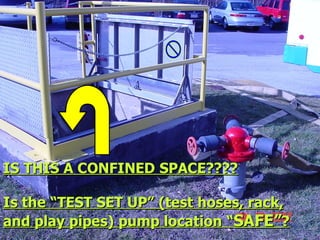
IS THIS A CONFINED SPACE????
Is the “TEST SET UP” (test hoses, rack,
and play pipes) pump location “
and play pipes) pump location “SAFE”
SAFE”?
?
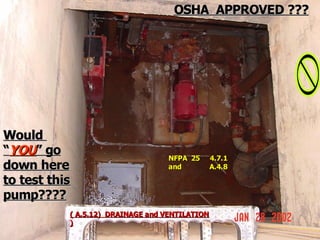
Would
Would
“
“YOU
YOU” go
” go
down here
down here
to test this
to test this
pump????
pump????
OSHA APPROVED ???
OSHA APPROVED ???
NFPA 25 4.7.1
NFPA 25 4.7.1
and A.4.8
and A.4.8
( A.5.12) DRAINAGE and VENTILATION
)
)
STATE of OHIO FIRE SCHOOL - BGSU 146
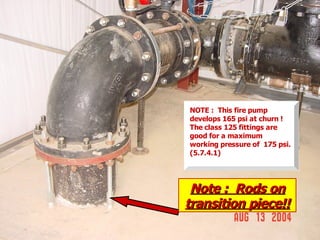
Note : Rods on
Note : Rods on
transition piece!!
transition piece!!
NOTE : This fire pump
develops 165 psi at churn !
The class 125 fittings are
good for a maximum
working pressure of 175 psi.
(5.7.4.1)
STATE of OHIO FIRE SCHOOL - BGSU 147
NO RODS !!!
SAFE ??
Look at the pipe
fittings !!
This pump installation
develops 213 PSI at
churn.
A 125 lb flanged fitting
is rated at 175 PSI
maximum working
pressure !! NFPA 20
(5.7.4.1)
NFPA 13 15.1.6.1.1
NFPA 13 15.1.6.1.1
STATE of OHIO FIRE SCHOOL - BGSU 148
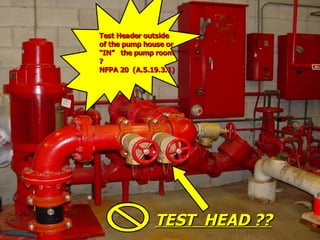
TEST HEAD ??
TEST HEAD ??
Test Header outside
Test Header outside
of the pump house or
“IN” the pump room
“IN” the pump room
?
?
NFPA 20 (A.5.19.3.1)
STATE of OHIO FIRE SCHOOL - BGSU 149
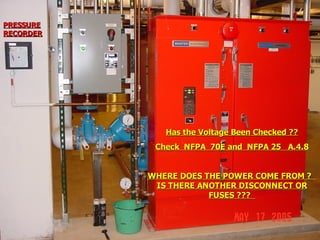
Has the Voltage Been Checked ??
Check NFPA 70E and NFPA 25 A.4.8
WHERE DOES THE POWER COME FROM ?
IS THERE ANOTHER DISCONNECT OR
FUSES ???
FUSES ???
PRESSURE
PRESSURE
RECORDER
RECORDER
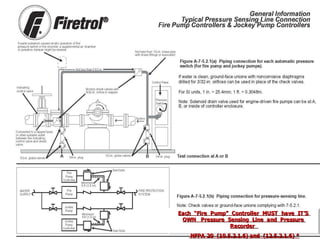
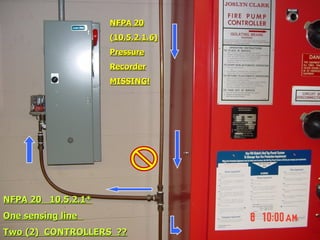
Each “Fire Pump” Controller MUST have IT’S
OWN Pressure Sensing Line and Pressure
Recorder
Recorder
NFPA 20 (10.5.2.1.6) and (12.5.2.1.6) *
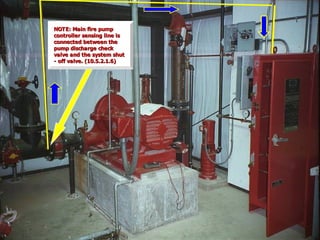
NOTE: Main fire pump
controller sensing line is
connected between the
pump discharge check
valve and the system shut
- off valve. (10.5.2.1.6)
NFPA 20 10.5.2.1*
NFPA 20 10.5.2.1*
One sensing line
One sensing line
Two (2) CONTROLLERS ??
NFPA 20
NFPA 20
(10.5.2.1.6)
(10.5.2.1.6)
Pressure
Pressure
Recorder
Recorder
MISSING!
MISSING!
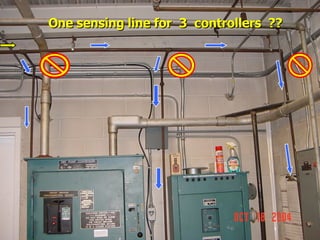
One sensing line for 3 controllers ??
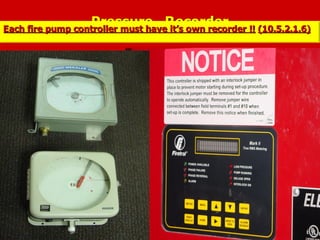
Pressure Recorder
Pressure Recorder
Each fire pump controller must have it’s own recorder !!
Each fire pump controller must have it’s own recorder !! (10.5.2.1.6)
(10.5.2.1.6)
*On the pump suction, a listed OSY valve is
required: no valve, other than a listed OSY valve
is allowed within 50 feet of the pump suction
flange NFPA 20 (5.14.5.2)*
*When located in the suction pipe of a fire pump,
back flow prevention devices, check valves, and
pipeline strainers (for in-line pumps) shall be no
shall be no
closer than 10 pipe diameters from the pump
suction flange
suction flange. NFPA 20 (5.14.6.3.1) (5.26.3)*
STATE of OHIO FIRE SCHOOL - BGSU 156
NOTE ROTATION ?
NOTE ROTATION ?
Counter-Clockwise
Counter-Clockwise
LEFT Hand *
LEFT Hand *
Impeller Turns
Impeller Turns
Toward The Suction !
Have The Wire
Have The Wire
Connections Been
Connections Been
Checked By the
Checked By the
Electrician and/or
Electrician and/or
Controller Guy ?
Controller Guy ?
SUCTION
OSY
OSY
Valve
Valve
STATE of OHIO FIRE SCHOOL - BGSU 157
!
!
(5.14.6.4)
(5.14.6.4)
Elbows and tees with a centerline
plane parallel to a horizontal split-case
pump shaft shall be avoided. See
Figure A-2-9.6. (5.14.6.3.1)
If there is a parallel elbow : YOU
MUST HAVE 10 PIPE DIAMETERS
of STRAIGHT PIPE BETWEEN THE
ELBOW AND PUMP SUCTION
FLANGE (5.14.6.3.2)
FLANGE (5.14.6.3.2)
STATE of OHIO FIRE SCHOOL - BGSU 158
OSY
OSY
Suction
Suction
Valve
Valve
NOTE: Backflow Preventer!
NOTE: The long straight run of
suction pipe after a
HORIZONTAL 90 DEGREE
ELBOW !
More than 10 pipe diameters ?
(5.14.6.3.2)
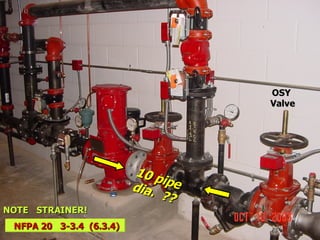
NOTE STRAINER!
NOTE STRAINER!
10 pipe
10 pipe
dia. ??
dia. ??
OSY
OSY
Valve
Valve
NFPA 20 3-3.4 (6.3.4)
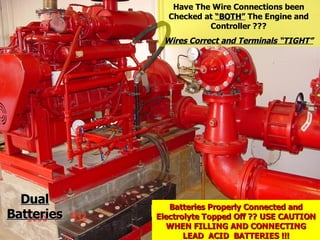
Batteries Properly Connected and
Electrolyte Topped Off ?? USE CAUTION
WHEN FILLING AND CONNECTING
LEAD ACID BATTERIES !!!
Dual
Dual
Batteries
Batteries
Have The Wire Connections been
Checked at “BOTH”
“BOTH” The Engine and
Controller ???
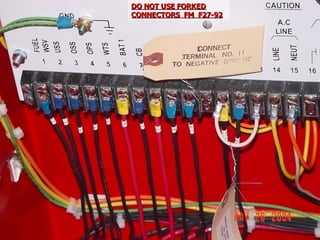
Wires Correct and Terminals “TIGHT”
DO NOT USE FORKED
DO NOT USE FORKED
CONNECTORS FM F27-92
7. Check for CERTIFICATE of
CALIBRATION for test equip.
“
“TEST GAUGES”
TEST GAUGES” and “CLAMP-ON VOLT/AMMETERS” should be re-
calibrated and certified every 12 months (by an approved testing and
calibration facility)….Most never get calibrated and certified ! NFPA 20
NFPA 20
(A.14.2.7.1)
(A.14.2.7.1)
“
“TEST GAUGES”
TEST GAUGES” will have an accuracy of;
will have an accuracy of;
0.25%
0.25% (ASME Grade 3A)
(ASME Grade 3A)
or sometimes-
0.5%
0.5% (ASME Grade 2A) pocket
(ASME Grade 2A) pocket “TEST GAUGES”
“TEST GAUGES” or inspectors
or inspectors
“TEST GAUGES”.
“TEST GAUGES”.
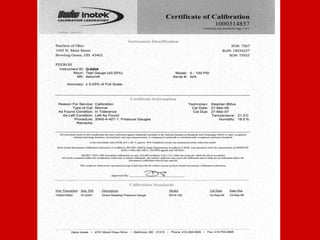
DEMAND a “Certificate of Calibration” from an approved testing and
calibration facility –then- Check and Verify the Serial Numbers! If you
suspect a problem, write down the phone number of the calibration
facility and phone them!!
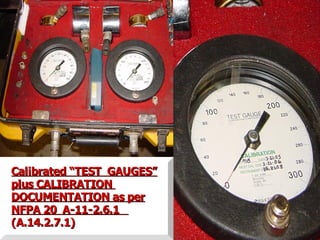
Look for
Look for “TEST GAUGE”
“TEST GAUGE” on the dial.
on the dial.
Calibrated “TEST GAUGES”
plus CALIBRATION
plus CALIBRATION
DOCUMENTATION as per
NFPA 20 A-11-2.6.1
NFPA 20 A-11-2.6.1
(A.14.2.7.1)
(A.14.2.7.1)
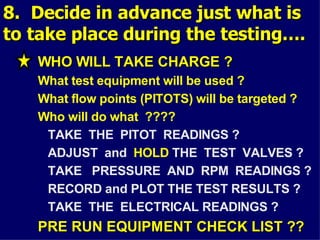
8. Decide in advance just what is
to take place during the testing….
WHO WILL TAKE CHARGE ?
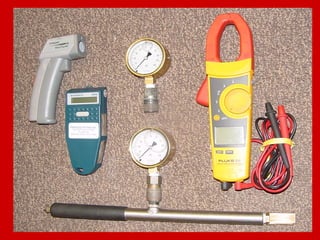
What test equipment will be used ?
What flow points (PITOTS) will be targeted ?
Who will do what ????
TAKE THE PITOT READINGS ?
ADJUST and HOLD THE TEST VALVES ?
TAKE PRESSURE AND RPM READINGS ?
RECORD and PLOT THE TEST RESULTS ?
TAKE THE ELECTRICAL READINGS ?
PRE RUN EQUIPMENT CHECK LIST ??
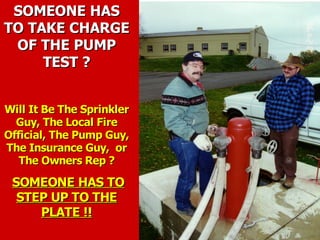
SOMEONE HAS
SOMEONE HAS
TO TAKE CHARGE
TO TAKE CHARGE
OF THE PUMP
OF THE PUMP
TEST ?
TEST ?
Will It Be The Sprinkler
Guy, The Local Fire
Guy, The Local Fire
Official, The Pump Guy,
The Insurance Guy, or
The Owners Rep ?
The Owners Rep ?
SOMEONE HAS TO
SOMEONE HAS TO
STEP UP TO THE
STEP UP TO THE
PLATE !!
PLATE !!
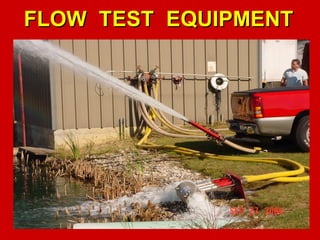
FLOW TEST EQUIPMENT
FLOW TEST EQUIPMENT
STATE of OHIO FIRE SCHOOL - BGSU 170
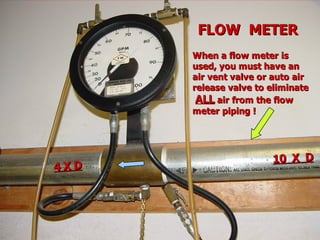
FLOW METER
FLOW METER
When a flow meter is
used, you must have an
air vent valve or auto air
release valve to eliminate
ALL
ALL air from the flow
air from the flow
meter piping !
meter piping !
10 X D
10 X D
4 X D
4 X D
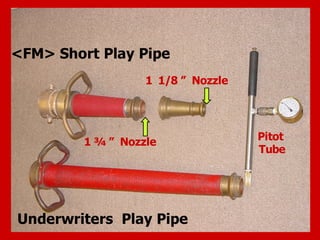
<FM> Short Play Pipe
Underwriters Play Pipe
1 ¾ ” Nozzle
1 1/8 ” Nozzle
Pitot
Tube
STATE of OHIO FIRE SCHOOL - BGSU 172
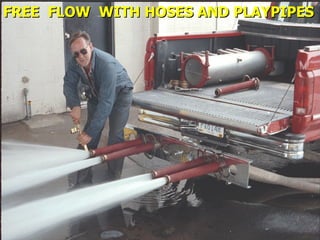
FREE FLOW WITH HOSES AND PLAYPIPES
STATE of OHIO FIRE SCHOOL - BGSU 173
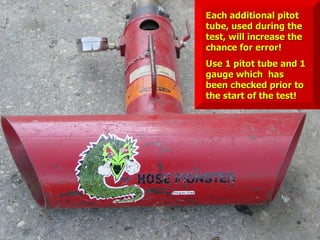
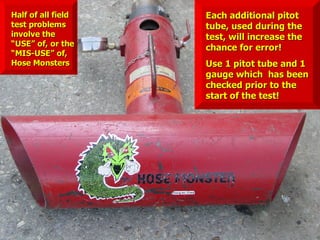
Each additional pitot
tube, used during the
test, will increase the
chance for error!
chance for error!
Use 1 pitot tube and 1
gauge which has
gauge which has
been checked prior to
the start of the test!
STATE of OHIO FIRE SCHOOL - BGSU 174
STATE of OHIO FIRE SCHOOL - BGSU 175
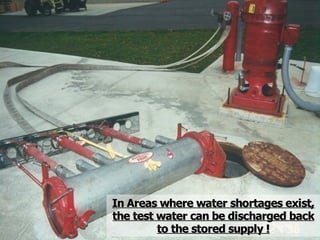
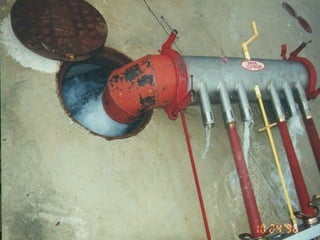
In Areas where water shortages exist,
the test water can be discharged back
to the stored supply !
STATE of OHIO FIRE SCHOOL - BGSU 176
THERBOLIZER 6
THERBOLIZER 6
STATE of OHIO FIRE SCHOOL - BGSU 177
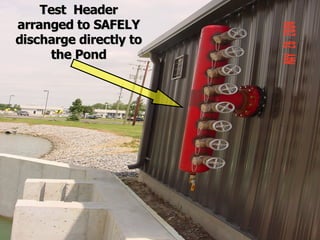
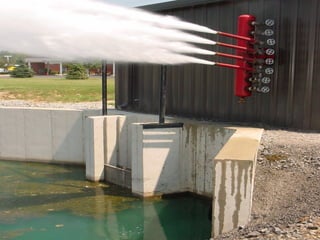
Test Header
Test Header
arranged to SAFELY
arranged to SAFELY
discharge directly to
the Pond
the Pond
STATE of OHIO FIRE SCHOOL - BGSU 178
STATE of OHIO FIRE SCHOOL - BGSU 179
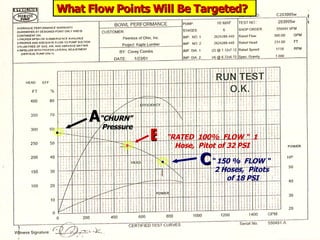
A
A
B
B
C
C
. .
.
“
“CHURN”
CHURN”
Pressure
Pressure
“RATED 100% FLOW “ 1
Hose, Pitot of 32 PSI
“ 150 % FLOW “
2 Hoses, Pitots
of 18 PSI
What Flow Points Will Be Targeted?
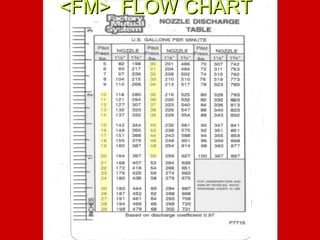
<FM> FLOW CHART
<FM> FLOW CHART
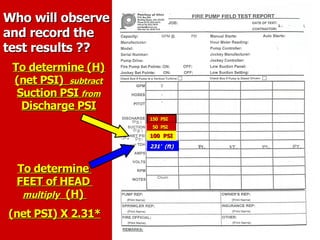
To determine
To determine
FEET of HEAD
FEET of HEAD
multiply
multiply (H)
(H)
(net PSI) X 2.31*
(net PSI) X 2.31*
To determine (H)
To determine (H)
(net PSI)
(net PSI) subtract
subtract
Suction PSI
Suction PSI from
from
Discharge PSI
Discharge PSI
150 PSI
150 PSI
50 PSI
50 PSI
100 PSI
100 PSI
231’ (ft)
231’ (ft)
Who will observe
Who will observe
and record the
and record the
test results ??
test results ??
STATE of OHIO FIRE SCHOOL - BGSU 182
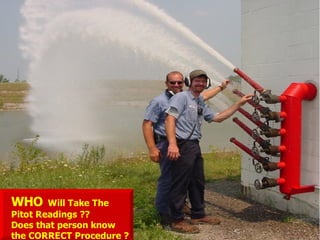
WHO Will Take The
Pitot Readings ??
Does that person know
the CORRECT Procedure ?
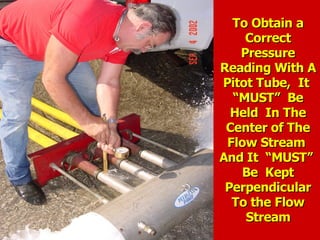
To Obtain a
To Obtain a
Correct
Correct
Pressure
Pressure
Reading With A
Reading With A
Pitot Tube, It
Pitot Tube, It
“MUST” Be
“MUST” Be
Held In The
Held In The
Center of The
Center of The
Flow Stream
Flow Stream
And It “MUST”
And It “MUST”
Be Kept
Be Kept
Perpendicular
Perpendicular
To the Flow
To the Flow
Stream
Stream
STATE of OHIO FIRE SCHOOL - BGSU 184
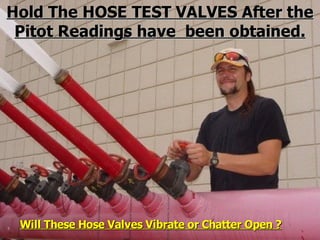
Hold The HOSE TEST VALVES After the
Pitot Readings have been obtained.
Will These Hose Valves Vibrate or Chatter Open ?
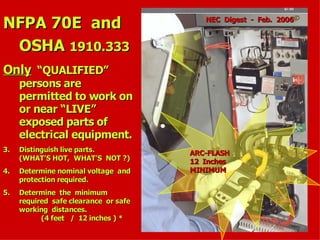
NFPA 70E and
NFPA 70E and
OSHA
OSHA 1910.333
1910.333
Only
Only “QUALIFIED”
“QUALIFIED”
persons are
persons are
permitted to work on
or near “LIVE”
or near “LIVE”
exposed parts of
exposed parts of
electrical equipment.
3.
3. Distinguish live parts.
Distinguish live parts.
(WHAT’S HOT, WHAT’S NOT ?)
4.
4. Determine nominal voltage and
Determine nominal voltage and
protection required.
5.
5. Determine the minimum
Determine the minimum
required safe clearance or safe
working distances.
working distances.
(4 feet / 12 inches ) *
ARC-FLASH
ARC-FLASH
12 Inches
12 Inches
MINIMUM
MINIMUM
NEC Digest - Feb. 2006
OSHA may cite non-compliance with
29CFR 1910.335(a)(1)(i)
29CFR 1910.335(a)(1)(i) which requires
which requires
the use of protective equipment when working
where a potential electrical hazard does
exist.**
exist.**
-OR-
-OR-
29CFR 1910.132(d)(1),
29CFR 1910.132(d)(1), which requires
which requires
employer assessment of workplace hazards
and the use of personal protective equipment.
These regulations are supported by NFPA 70E.
NFPA 70E, is
NFPA 70E, is NOT LAW
NOT LAW, however, it helps
, however, it helps
employers by providing education, guidance,
and
and “how-to”
“how-to” for compliance.
for compliance.
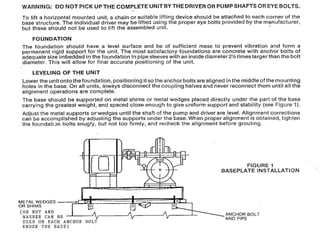
CONFIRM THAT PUMP BASE IS PROPERLY GROUTED
CONFIRM THAT ALL EQUIPMENT IS ALIGNED AND LUBRICATED
CONFIRM THAT COUPLING GUARDS ARE INSTALLED
CONFIRM CASE RELIEF, AIR RELEASE, COOLING WATER ALL CORRECT
CONFIRM THAT POWER IS CORRECT and “ON”
CONFIRM THAT WATER IS AVAILABLE and “ON” (PUMP PRIMED)
CONFIRM THAT PUMP HAS PROPER ROTATION
CONFIRM THAT VALVES ARE IN CORRECT POSITION FOR TESTING
CONFIRM SAFE TEST SET UP (HOSES, PLAYPIPES, WATER DISPOSAL)
CONFIRM THAT SYSTEM PRESSURE IS AT OR ABOVE EXPECTED FIRE
PUMP CHURN PRESSURE (USE THE JOCKEY PUMP) -OR-
IT IS PREFERABLE TO ISOLATE THE SYSTEM
“
“CLOSE THE DISCHARGE
CLOSE THE DISCHARGE
(SYSTEM) VALVE”
(SYSTEM) VALVE”
KEEP IT CLOSED DURING FLOW TESTING
! **
! **
FIRE PUMP “PRE-RUN” CHECK LIST
LAST CHANCE
LAST CHANCE - PRIOR TO TEST
- PRIOR TO TEST
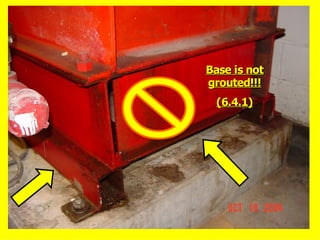
Base is not
Base is not
grouted!!!
grouted!!!
(6.4.1)
(6.4.1)
Motor Oil Full ?
Motor Oil Full ?
Check It !
Check It !
LAST CHANCE !!!
LAST CHANCE !!!
Gear Oil Full ?
Gear Oil Full ?
Double Check
Double Check
It !
It !
What Oil Did They
What Oil Did They
Use ??
Use ?? ASK !!
ASK !!
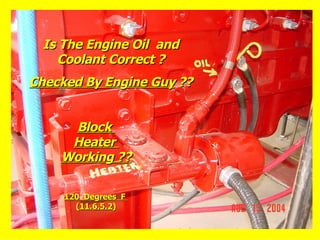
Is The Engine Oil and
Coolant Correct ?
Coolant Correct ?
Checked By Engine Guy
Checked By Engine Guy ??
??
Block
Block
Heater
Heater
Working ??
Working ??
120 Degrees F
120 Degrees F
(11.6.5.2)
(11.6.5.2)
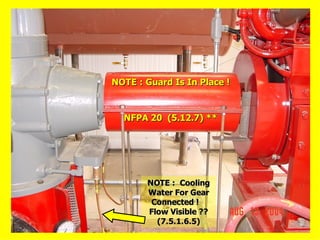
NOTE : Guard Is In Place !
NFPA 20 (5.12.7) **
NFPA 20 (5.12.7) **
NOTE : Cooling
NOTE : Cooling
Water For Gear
Water For Gear
Connected !
Connected !
Flow Visible ??
Flow Visible ??
(7.5.1.6.5)
(7.5.1.6.5)
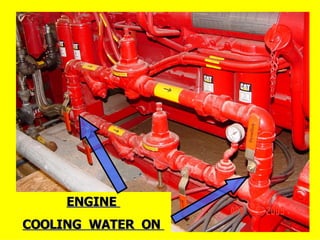
ENGINE
ENGINE
COOLING WATER ON
COOLING WATER ON
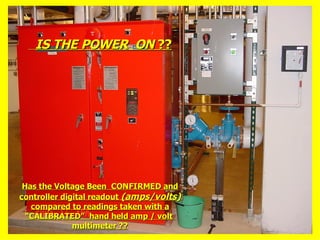
IS THE POWER ON
IS THE POWER ON ??
??
Has the Voltage Been CONFIRMED and
controller digital readout
controller digital readout (amps/volts)
(amps/volts)
compared to readings taken with a
“CALIBRATED” hand held amp / volt
multimeter ??
multimeter ??
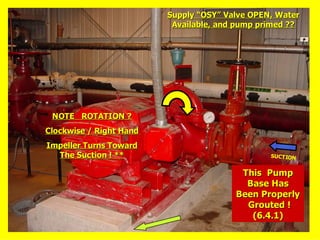
Supply “OSY” Valve OPEN, Water
Available, and pump primed ??
NOTE ROTATION ?
NOTE ROTATION ?
Clockwise / Right Hand
Impeller Turns Toward
The Suction ! **
The Suction ! ** SUCTION
This Pump
This Pump
Base Has
Base Has
Been Properly
Been Properly
Grouted !
Grouted !
(6.4.1)
(6.4.1)
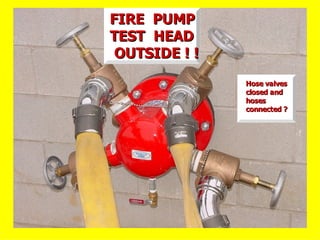
FIRE PUMP
FIRE PUMP
TEST HEAD
TEST HEAD
OUTSIDE ! !
OUTSIDE ! !
Hose valves
Hose valves
closed and
closed and
hoses
hoses
connected ?
connected ?
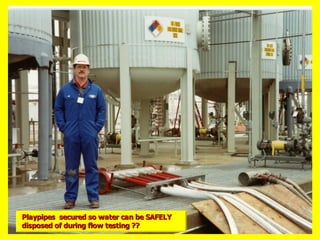
Playpipes secured so water can be SAFELY
disposed of during flow testing ??
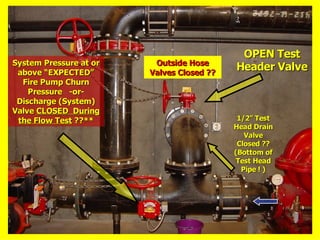
OPEN Test
OPEN Test
Header Valve
Header Valve
System Pressure at or
above “EXPECTED”
above “EXPECTED”
Fire Pump Churn
Fire Pump Churn
Pressure -or-
Pressure -or-
Discharge (System)
Discharge (System)
Valve
Valve CLOSED During
CLOSED During
the Flow Test
the Flow Test ??**
??** 1/2” Test
1/2” Test
Head Drain
Head Drain
Valve
Valve
Closed ??
Closed ??
(Bottom of
(Bottom of
Test Head
Test Head
Pipe ! )
Pipe ! )
Outside Hose
Outside Hose
Valves Closed ??
Valves Closed ??
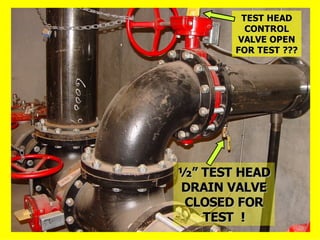
TEST HEAD
TEST HEAD
CONTROL
CONTROL
VALVE OPEN
VALVE OPEN
FOR TEST ???
FOR TEST ???
½” TEST HEAD
½” TEST HEAD
DRAIN VALVE
DRAIN VALVE
CLOSED FOR
CLOSED FOR
TEST !
TEST !
9.
9. Operate the pump at
Operate the pump at CHURN
CHURN PSI
PSI
(POINT A on CURVE)
(POINT A on CURVE)
Momentarily Operate the Pump
Momentarily Operate the Pump - Check for
- Check for
rotation, vibration, pressures, leaks, unusual sounds.
Start The Pump Again:
Check the pump for vibration, temperature,
case relief valve operation (Electric) or cooling water
flow (Diesel), bearing temp, packing leakage, pump
pressures, RPM, Electrical (Controller Guy), etc.
“
“DO NOT”
DO NOT” stand in front of electrical panels or motor
junction boxes and keep the controller doors closed
during the initial starts (THINK SAFETY - 4 Foot Rule).
Note the
Note the test start time
test start time… Pump must be operated for
AT LEAST ONE HOUR
AT LEAST ONE HOUR for “ENTIRE” acceptance test !
NFPA 20 11-2.11 ( 14.2.12 )
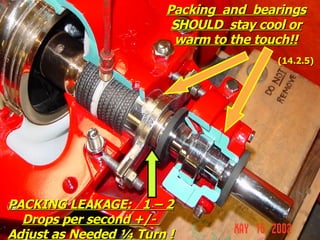
PACKING LEAKAGE: 1 – 2
Drops per second +/-
Adjust as Needed ¼ Turn !
Packing and bearings
SHOULD stay cool or
SHOULD stay cool or
warm to the touch!!
warm to the touch!!
(14.2.5)
(14.2.5)
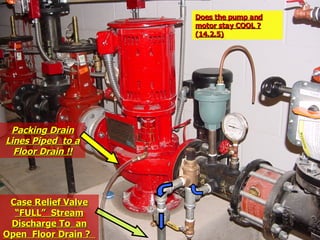
Case Relief Valve
Case Relief Valve
“FULL” Stream
“FULL” Stream
Discharge To an
Discharge To an
Open Floor Drain ?
Open Floor Drain ?
Packing Drain
Packing Drain
Lines Piped to a
Lines Piped to a
Floor Drain !!
Floor Drain !!
Does the pump and
Does the pump and
motor stay COOL ?
motor stay COOL ?
(14.2.5)
(14.2.5)
10. Record
10. Record Churn
Churn PSI Readings,
PSI Readings,
RPM, AMPS, VOLTS,
RPM, AMPS, VOLTS,
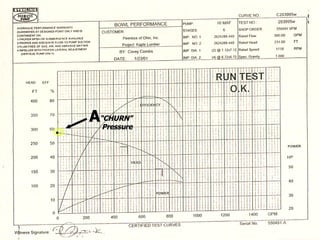
Look at the factory shop test curve and plot the
Churn Pressure in feet of head
feet of head, (no-flow POINT A
A).
How close is it ???? NFPA 20 11-2.3 ( 14.2.4.2 )
NFPA 20 11-2.3 ( 14.2.4.2 )
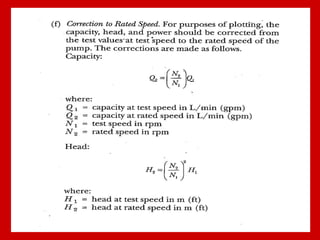
NOTE: Some pumps will require a correction for
(RPM) speed !!! NFPA 20 A-11-2.6.3 ( A.14.2.7.3.f )
NFPA 20 A-11-2.6.3 ( A.14.2.7.3.f )
REMEMBER THIS
REMEMBER THIS - TO GET FEET OF HEAD !!
- TO GET FEET OF HEAD !!
1 PSI = 2.31 FEET OF HEAD -or-
.433 PSI = 1 FOOT OF HEAD
A
A
.
“
“CHURN”
CHURN”
Pressure
Pressure
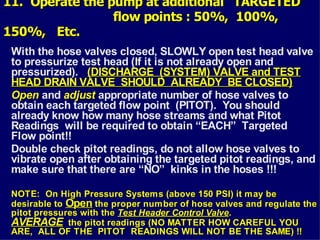
11. Operate the pump at additional “TARGETED”
flow points : 50%, 100%,
150%, Etc.
150%, Etc.
With the hose valves closed, SLOWLY open test head valve
to pressurize test head (If it is not already open and
pressurized). (DISCHARGE (SYSTEM) VALVE and TEST
(DISCHARGE (SYSTEM) VALVE and TEST
HEAD DRAIN VALVE SHOULD ALREADY BE CLOSED)
Open
Open and adjust
adjust appropriate number of hose valves to
obtain each targeted flow point (PITOT). You should
already know how many hose streams and what Pitot
Readings will be required to obtain “EACH” Targeted
Flow point!!
Double check pitot readings, do not allow hose valves to
vibrate open after obtaining the targeted pitot readings, and
make sure that there are “NO” kinks in the hoses !!!
NOTE: On High Pressure Systems (above 150 PSI) it may be
desirable to
desirable to Open
Open the proper number of hose valves and regulate the
the proper number of hose valves and regulate the
pitot pressures with the
pitot pressures with the Test Header Control Valve
Test Header Control Valve.
.
AVERAGE
AVERAGE the pitot readings (NO MATTER HOW CAREFUL YOU
the pitot readings (NO MATTER HOW CAREFUL YOU
ARE, ALL OF THE PITOT READINGS WILL NOT BE THE SAME) !!
12. Record PSI, RPM, AMPS,
VOLTS, (compare and plot
results on the factory curve).
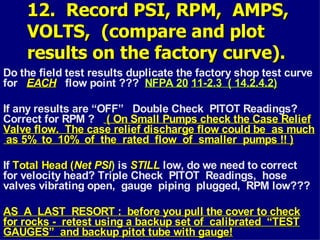
Do the field test results duplicate the factory shop test curve
for EACH
EACH flow point ??? NFPA 20
NFPA 20 11-2.3 ( 14.2.4.2)
11-2.3 ( 14.2.4.2)
If any results are “OFF” Double Check PITOT Readings?
Correct for RPM ? ( On Small Pumps check the Case Relief
( On Small Pumps check the Case Relief
Valve flow. The case relief discharge flow could be as much
as 5% to 10% of the rated flow of smaller pumps !! )
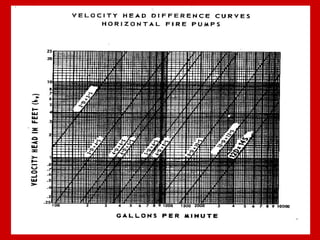
If Total Head (
Total Head (Net PSI
Net PSI) is STILL
STILL low, do we need to correct
for velocity head? Triple Check PITOT Readings, hose
valves vibrating open, gauge piping plugged, RPM low???
AS A LAST RESORT : before you pull the cover to check
for rocks - retest using a backup set of calibrated “TEST
GAUGES” and backup pitot tube with gauge!
STATE of OHIO FIRE SCHOOL - BGSU 208
B
B
C
C
. .
.
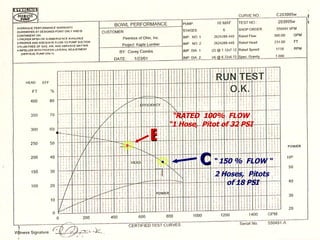
“RATED 100% FLOW
“1 Hose, Pitot of 32 PSI
“ 150 % FLOW “
2 Hoses, Pitots
of 18 PSI
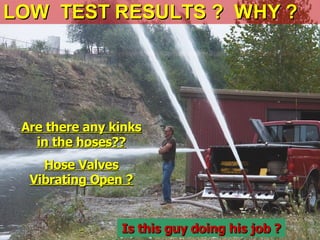
LOW TEST RESULTS ? WHY ?
Are there any kinks
Are there any kinks
in the hoses??
in the hoses??
Hose Valves
Hose Valves
Vibrating Open ?
Vibrating Open ?
Is this guy doing his job ?
STATE of OHIO FIRE SCHOOL - BGSU 210
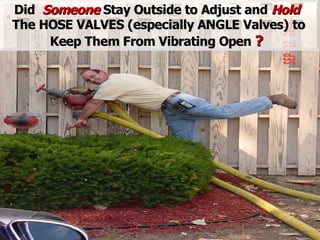
Did
Did Someone
Someone Stay Outside to Adjust and
Stay Outside to Adjust and Hold
Hold
The HOSE VALVES (especially ANGLE Valves) to
Keep Them From Vibrating Open
Keep Them From Vibrating Open ?
?
STATE of OHIO FIRE SCHOOL - BGSU 211
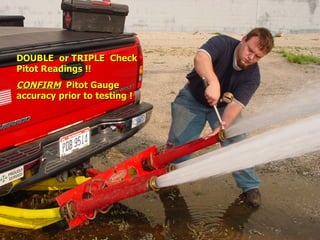
DOUBLE or TRIPLE Check
Pitot Readings !!
Pitot Readings !!
CONFIRM
CONFIRM Pitot Gauge
Pitot Gauge
accuracy prior to testing !
?
?
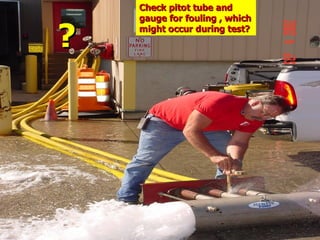
Check pitot tube and
gauge for fouling , which
might occur during test?
Each additional pitot
tube, used during the
test, will increase the
chance for error!
chance for error!
Use 1 pitot tube and 1
gauge which has been
checked prior to the
start of the test!
start of the test!
Half of all field
Half of all field
test problems
test problems
involve the
involve the
“USE” of, or the
“USE” of, or the
“MIS-USE” of,
“MIS-USE” of,
Hose Monsters
Hose Monsters
STATE of OHIO FIRE SCHOOL - BGSU 214
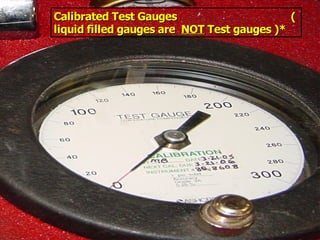
Calibrated Test Gauges (
liquid filled gauges are
liquid filled gauges are NOT
NOT Test gauges )*
Test gauges )*
STATE of OHIO FIRE SCHOOL - BGSU 215
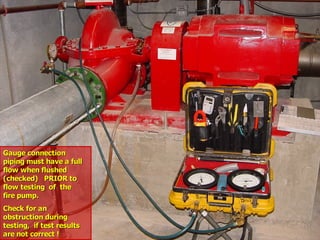
Gauge connection
Gauge connection
piping must have a full
flow when flushed
flow when flushed
(checked) PRIOR to
(checked) PRIOR to
flow testing of the
flow testing of the
fire pump.
fire pump.
Check for an
Check for an
obstruction during
obstruction during
testing, if test results
are not correct !
are not correct !
STATE of OHIO FIRE SCHOOL - BGSU 216
DO NOT
DO NOT
connect test
connect test
gauges to
gauges to
case relief
case relief
valve piping !
valve piping !
STATE of OHIO FIRE SCHOOL - BGSU 217
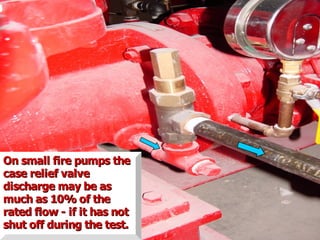
On small fire pumps the
case relief valve
case relief valve
discharge may be as
discharge may be as
much as 10% of the
much as 10% of the
rated flow - if it has not
shut off during the test.
STATE of OHIO FIRE SCHOOL - BGSU 218
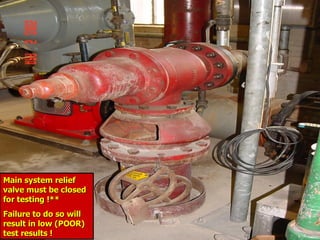
Main system relief
Main system relief
valve must be closed
for testing !**
for testing !**
Failure to do so will
result in low (POOR)
test results !
test results !
STATE of OHIO FIRE SCHOOL - BGSU 219
!
!
(5.14)
(5.14)
Elbows and tees with a centerline
plane parallel to a horizontal split-case
pump shaft shall be avoided. See
Figure A-2-9.6. (5.14.6.3.1)
If there is a parallel elbow : YOU
MUST HAVE 10 PIPE DIAMETERS
of STRAIGHT PIPE BETWEEN THE
ELBOW AND PUMP SUCTION
FLANGE (5.14.6.3.2)**
PIPE SIZE ?
PIPE SIZE ?
NFPA 20
NFPA 20
(5.14.3.4)
(5.14.3.4)
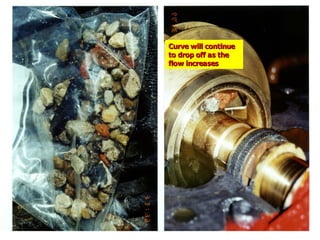
Curve will continue
Curve will continue
to drop off as the
to drop off as the
flow increases
flow increases
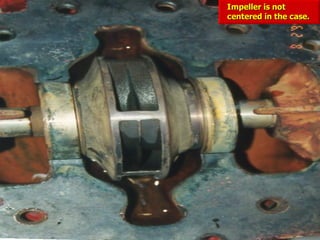
Impeller is not
Impeller is not
centered in the case.
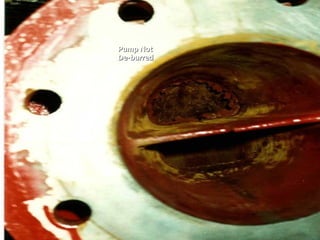
Pump Not
Pump Not
De-burred
De-burred
STATE of OHIO FIRE SCHOOL - BGSU 225
Top Shaft Nut is
Top Shaft Nut is
used to raise shaft
used to raise shaft
and impellers
and impellers
approximately
approximately
1/8
1/8 “ inch. (see
“ inch. (see
instruction book)
instruction book)
VTFP Best Lateral Setting
LOW
LOW
PERFORMANCE
PERFORMANCE
MAY RESULT IF
MAY RESULT IF
LATERAL IS NOT
LATERAL IS NOT
CORRECT !
CORRECT !
STATE of OHIO FIRE SCHOOL - BGSU 226
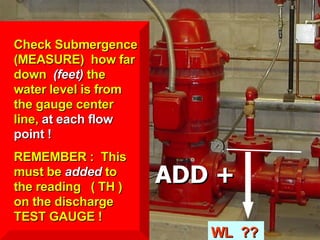
Check Submergence
Check Submergence
(MEASURE) how far
(MEASURE) how far
down
down (feet)
(feet) the
the
water level is from
water level is from
the gauge center
the gauge center
line,
line, at each flow
at each flow
point !
point !
REMEMBER : This
REMEMBER : This
must be
must be added
added to
to
the reading ( TH )
the reading ( TH )
on the discharge
on the discharge
TEST GAUGE !
TEST GAUGE !
WL ??
WL ??
ADD +
ADD +
VTFP INTAKE PROBLEMS………..
Removable screens NFPA 20 A4-2.2.2 (5.14.8.3)
(5.14.8.3)
Intake size ???
Intake size ??? NFPA 20 A4-2.2
NFPA 20 A4-2.2 (5.14.8.4)
(5.14.8.4)
2 ft/sec and
2 ft/sec and
1 Sq. Inch per
1 Sq. Inch per
GPM at
GPM at
150% Flow ?
150% Flow ?
STATE of OHIO FIRE SCHOOL - BGSU 229
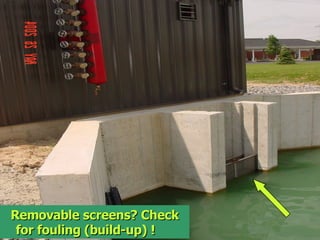
Removable screens? Check
for fouling (build-up) !
STATE of OHIO FIRE SCHOOL - BGSU 230
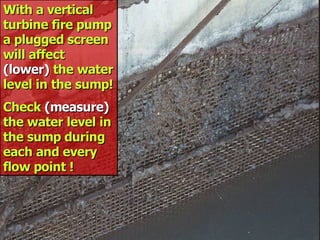
With a vertical
With a vertical
turbine fire pump
turbine fire pump
a plugged screen
a plugged screen
will affect
will affect
(lower)
(lower) the water
the water
level in the sump!
level in the sump!
Check
Check (measure)
(measure)
the water level in
the water level in
the sump during
the sump during
each and every
each and every
flow point !
flow point !
A plugged basket strainer on
the bottom of the pump will
reduce the total pump
performance.
performance.
STATE of OHIO FIRE SCHOOL - BGSU 232
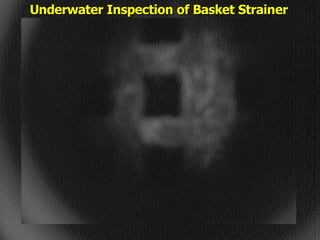
Underwater Inspection of Basket Strainer
13. * “6” AUTO starts
and “6” MANUAL starts *
(one “FULL LOAD” start)
When an electric fire pump is provided with an automatic
transfer switch, at least half of the starts should be performed
while the fire pump is connected to the emergency power
source (with one start under peak load). **
NFPA 20 (14.2.8) (14.2.7.4) **
NOTE: Pumps should be operated for 5 Min. for each
start (This will allow the Motor and Controller time to
Cool Down)
Cool Down)
When a diesel driven fire pump is provided, the starts shall be
divided between both sets of batteries.
NFPA 20 (14.2.8.7)
NFPA 20 (14.2.8.7)
1.
1. Controller and Driver alarms
Controller and Driver alarms
connected, tested, and
demonstrated + low suction…
A. Electric requires Power Available, Phase Reversal, Pump
Running, and Controller Connected to Alt. Source …..…
NFPA 20 (10.4.7.2)
(These are “TROUBLE
TROUBLE” or “SUPERVISORY
SUPERVISORY”
” alarms
alarms)
B. Diesel engine is much more involved…..* Engine Trouble -
High temp, low oil pressure, over crank - fail to start,
charger fail, battery fail, over speed, low fuel, Switch Not
in Auto, and Engine Run…….NFPA 20 (12.6.7.3)
…….NFPA 20 (12.6.7.3)
(These are “TROUBLE
TROUBLE” or “SUPERVISORY
SUPERVISORY”
” alarms
alarms)
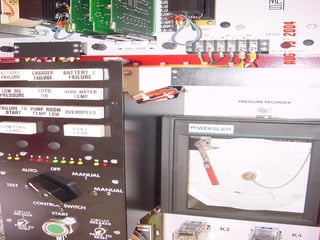
Pressure Recorder Installed / Operational ???
EACH
EACH Fire Pump Controller is required to be furnished
with a pressure recorder. (ELECTRONIC or CHART TYPE)
(ELECTRONIC or CHART TYPE)
NFPA 20
NFPA 20 (10.5.2.1.6 and 12.6.9.1)
(10.5.2.1.6 and 12.6.9.1)
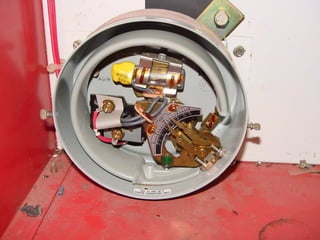
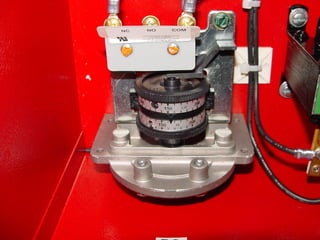
Main Fire Pump and Jockey Pump.
Use a “TEST GAUGE” to
confirm set points.
confirm set points. NFPA
NFPA
20 A-11-2.6 (A.14.2.7)
Jockey “STOP”
Jockey “STOP” = Fire Pump churn pressure plus (+)
lowest static suction pressure !
Jockey “START”
Jockey “START” = Jockey Stop PSI less (-) 10 PSI
Fire Pump “START”
Fire Pump “START” = Jockey Start less (-) 5 –10 PSI
“
“MANUAL” Fire Pump “STOP”
MANUAL” Fire Pump “STOP” = ( Must be used when Fire
Pump is a sole supply pump) !
- or - (if permitted by L.A.H.J.)
“
“AUTOMATIC” Fire Pump “STOP”
AUTOMATIC” Fire Pump “STOP” = (Fire Pump churn +
lowest static suction)
STATE of OHIO FIRE SCHOOL - BGSU 239
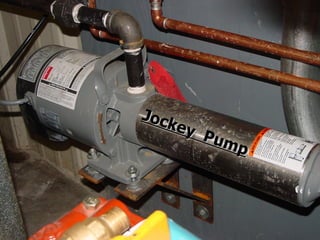
Jockey
Jockey Pump
Pump
STATE of OHIO FIRE SCHOOL - BGSU 240
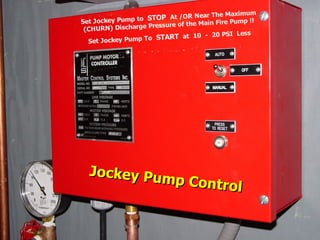
Jockey Pump Control
Jockey Pump Control
Set Jockey Pump to STOP At /OR Near The Maximum
(CHURN) Discharge Pressure of the Main Fire Pump !!
Set Jockey Pump To START at 10 - 20 PSI Less
16. Low Suction Shut Down
Panel/Device Listed, Tested
AND “Alarm” Connected ?
Required by some states to protect the public water supply, when it is
used as the main water source.
Set to lock out the fire pump at 20 PSI,
20 PSI, after a 30 second
30 second delay -
delay - with
with
manual re-set only (OHIO) and ALARM must be monitored (5.23)
manual re-set only (OHIO) and ALARM must be monitored (5.23).
Must be FM or UL listed for Fire Protection Equipment –
not UL Industrial !!
not UL Industrial !! NFPA 13 15.1.8.3
Is the “EQUIPMENT” or “DEVICE” listed in the UL or FM
Directory for Fire Protection Equipment
Directory for Fire Protection Equipment ?
CHECK THE BOOK !
CHECK THE BOOK !
-
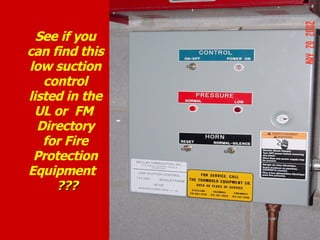
See if you
can find this
low suction
control
listed in the
UL or FM
Directory
for Fire
Protection
Equipment
???
???
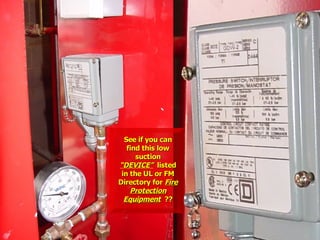
See if you can
See if you can
find this low
find this low
suction
suction
“DEVICE”
“DEVICE” listed
listed
in the UL or FM
in the UL or FM
Directory for
Directory for Fire
Fire
Protection
Protection
Equipment
Equipment ??
??
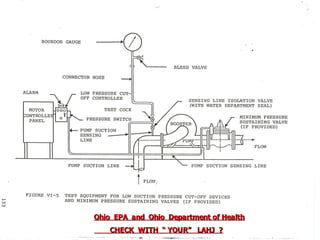
Ohio EPA and Ohio Department of Health
CHECK WITH “ YOUR” LAHJ ?
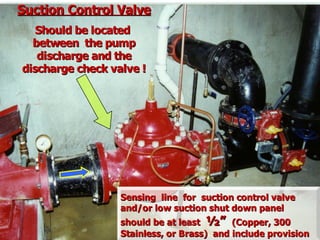
Suction Control Valve
Should be located
Should be located
between the pump
between the pump
discharge and the
discharge and the
discharge check valve !
Sensing line for suction control valve
and/or low suction shut down panel
should be at least
should be at least ½”
½” (Copper, 300
(Copper, 300
Stainless, or Brass) and include provision
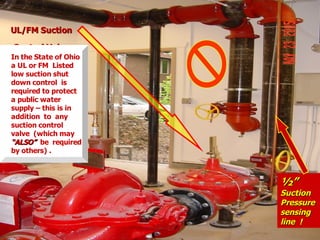
UL/FM Suction
UL/FM Suction
Control Valve
Control Valve
½”
½”
Suction
Suction
Pressure
Pressure
sensing
sensing
line !
line !
In the State of Ohio
a UL or FM Listed
low suction shut
down control is
required to protect
a public water
supply – this is in
addition to any
suction control
valve (which may
“ALSO”
“ALSO” be required
by others) .
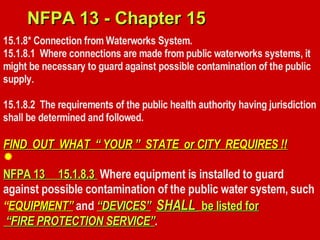
15.1.8* Connection from Waterworks System.
15.1.8.1 Where connections are made from public waterworks systems, it
might be necessary to guard against possible contamination of the public
supply.
15.1.8.2 The requirements of the public health authority having jurisdiction
shall be determined and followed.
FIND OUT WHAT “ YOUR ” STATE or CITY REQUIRES !!
NFPA 13 15.1.8.3
NFPA 13 15.1.8.3 Where equipment is installed to guard
against possible contamination of the public water system, such
“EQUIPMENT”
EQUIPMENT” and “DEVICES”
“DEVICES” SHALL
SHALL be listed for
be listed for
“
“FIRE PROTECTION SERVICE”
FIRE PROTECTION SERVICE”.
NFPA 13 - Chapter 15

17. Operators trained in required
maintenance, weekly operation,
testing, and record keeping ???
Did the pump rep provide a weekly check
list and go over the required weekly
testing, maintenance, and inspections of
the pump, driver, and controller ???
NFPA 20 (14.3 ) NFPA 25 4.1 - 4.3
If not, he is not doing his job!!!
Weekly Check list should include those
items required by NFPA 25 Chapter 8
NFPA 25 Chapter 8.
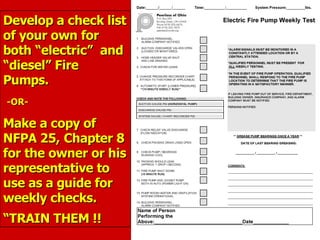
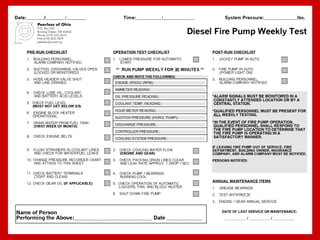
Develop a check list
of your own for
of your own for
both “electric” and
both “electric” and
“diesel” Fire
“diesel” Fire
Pumps.
Pumps.
-OR-
-OR-
Make a copy of
Make a copy of
NFPA 25, Chapter 8
NFPA 25, Chapter 8
for the owner or his
representative to
representative to
use as a guide for
use as a guide for
weekly checks.
weekly checks.
“
“TRAIN THEM !!
TRAIN THEM !!
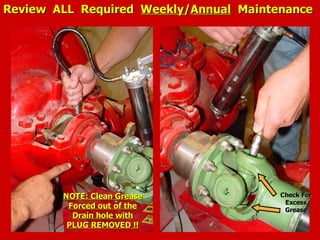
NOTE: Clean Grease
NOTE: Clean Grease
Forced out of the
Forced out of the
Drain hole with
Drain hole with
PLUG REMOVED !!
PLUG REMOVED !!
Check For
Check For
Excess
Excess
Grease
Grease
Review ALL Required
Review ALL Required Weekly
Weekly/
/Annual
Annual Maintenance
Maintenance
STATE of OHIO FIRE SCHOOL - BGSU 254
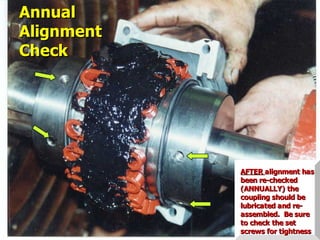
AFTER
AFTER alignment has
alignment has
been re-checked
been re-checked
(ANNUALLY) the
(ANNUALLY) the
coupling should be
coupling should be
lubricated and re-
lubricated and re-
assembled. Be sure
assembled. Be sure
to check the set
to check the set
screws for tightness
Annual
Annual
Alignment
Alignment
Check
Check
HAVE
HAVE
THESE
THESE
FOLKS
FOLKS
BEEN
BEEN
PROPERLY
PROPERLY
TRAINED?
TRAINED?
STATE of OHIO FIRE SCHOOL - BGSU 256
???
???
This is the ONLY “WM” case relief valve –
on record, that had a tight shut off with
“NO” nuisance leakage - until they had to
buy a new pump !!
buy a new pump !!
STATE of OHIO FIRE SCHOOL - BGSU 257
#1
#1
C
COOLING
OOLING
WATER
WATER
#2
#2
F
FUEL
UEL
# 3
# 3
C
CRANK
RANK
NOTE !
NOTE !
SET at 120 % of
Rated RPM **
EMERGENCY
EMERGENCY
MANUAL
MANUAL
STARTING
STARTING
PROCEDURE
PROCEDURE
(11.6.6)
(11.6.6)
BE SURE THAT YOU
KNOW WHERE THE
OVERSPEED RESET
IS ON EVERY TYPE
OF ENGINE THAT
YOU SELL !!
INSTRUCT (TRAIN)
THE OWNER’S
REPRESENTATIVE
OR OPERATOR.
CUMMINS
18. Review test results …
ASK QUESTIONS ! Do it
again if the results do not
look correct ???
look correct ???
Did the pump rep try to rush the testing????
Did the pump rep get nervous or defensive
when you questioned any of the results or test
procedures???
procedures???
Were the PUMP test results at or above the
factory shop test curve and within ½ % (
the minimum accuracy of a CALIBRATED
TEST GAUGE ) ??? NFPA 20 (14.2.4.2)
Did the pump run for
Did the pump run for one hour
one hour (all testing)???
(all testing)???
NFPA 20 (14.2.12)
NFPA 20 (14.2.12)
19.
19. STOP !
STOP ! Don’t accept it if
Don’t accept it if
the pump test results do not
duplicate the shop test curve or
the system is not CORRECT !
L.A.H.J. ( INSPECTOR )
L.A.H.J. ( INSPECTOR ) : YOUR NAME
YOUR NAME and
and
REPUTATION
REPUTATION goes on the bottom line:
Approved and Accepted By:
NAME
NAME : ………………………………………….
………………………………………….
FIRE PUMP “
“Annual”
Annual” FLOW TEST
1.
1. Check
Check for company and individual LICENSING.
for company and individual LICENSING.
2.
2. Check
Check for HYDRO and FLUSH CERTIFICATES (if work has been done).
for HYDRO and FLUSH CERTIFICATES (if work has been done).
3. Look system over…housekeeping, sensing lines, leaks, piping , etc.
4. Record all pump, driver, and controller data. (HP, VOLTAGE, etc.)
5. Has the pump been properly Maintained and ALIGNED ANNUALY???
5. Has the pump been properly Maintained and ALIGNED ANNUALY??? (CHECK)
(CHECK)
6. Review Records of weekly testing and maintenance that was performed.
7.
7. Check
Check for CERTIFICATE of CALIBRATION for
for CERTIFICATE of CALIBRATION for ALL
ALL flow test equip. (SAFE??)
flow test equip. (SAFE??)
8. Decide in advance just what is to take place during the flow test.
9. Operate the pump at Churn (no flow)….temp., brgs., packing, relief, etc.
10. Record Churn Test Results (compare with test results from previous year).
11. Operate the pump at additional flow points 100%, 150%,.
12. Record Test Results , compare with previous year ( within 5 % nameplate?).
13. 1 AUTO Start and 2 MANUAL Starts (One Full Load Start)
14. Controller and Driver alarms
14. Controller and Driver alarms TESTED
TESTED (electric and diesel)
(electric and diesel) (CHECK)
(CHECK)
15.
15. Confirm
Confirm Start and Stop PSI for Main Fire Pump and Jockey Pump.
Start and Stop PSI for Main Fire Pump and Jockey Pump.
16. Low Suction Control Operation, Set Point, Time Delay,
16. Low Suction Control Operation, Set Point, Time Delay, AND
AND Alarm
Alarm TESTED
TESTED ?
?
17. Review
17. Review ALL
ALL results - ASK QUESTIONS!! - ANY CONCERNS?? - Do it again ?
results - ASK QUESTIONS!! - ANY CONCERNS?? - Do it again ?
18. STOP ! INVESTIGATE ! If the PUMP is more than 5 % below nameplate !

Fire Pump Tutorial as per NFPA 20 standard

  • 1.
    NFPA 20 1-8(3.2) NFPA Official Definitions NFPA 20 1-8 (3.2) NFPA Official Definitions Authority Having Jurisdiction Authority Having Jurisdiction.* .* The organization, office, or individual responsible for approving equipment, materials, an installation, or a procedure. A-1-8 (3.2.2) Authority Having Jurisdiction. A-1-8 (3.2.2) Authority Having Jurisdiction. The phrase “authority having jurisdiction” is used in NFPA documents in a broad manner, since jurisdictions and approval agencies vary, as do their responsibilities. Where public safety is primary, the authority having jurisdiction may be a federal, state, local, or other regional department or individual such as a fire chief; fire marshal; chief of a fire prevention bureau, labor department, or health department; building official; electrical inspector; or others having statutory authority. For insurance purposes, an insurance inspection department, rating bureau, or other insurance company representative may be the authority having jurisdiction. In many circumstances, the property owner or his or her designated agent assumes the role of the authority having jurisdiction; at government installations, the commanding officer or departmental official may be the authority having jurisdiction.
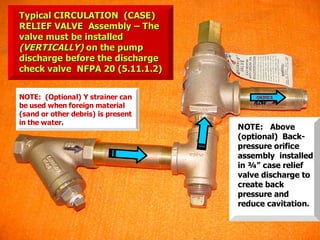
  • 2.
    NFPA 20 (3.2.1) NFPA20 (3.2.1) Approved.* Approved.* Acceptable to the Acceptable to the authority having jurisdiction. authority having jurisdiction. A-1-8 (A.3.2.1) Approved. A-1-8 (A.3.2.1) Approved. The National Fire Protection Association does not approve, inspect, or certify any installations, procedures, equipment, or materials; nor does it approve or evaluate testing laboratories. In determining the acceptability of installations, procedures, equipment, or materials, the authority having jurisdiction may base acceptance on compliance with NFPA or other appropriate standards. In the absence of such standards, said authority may require evidence of proper installation, procedure, or use. The authority having jurisdiction may also refer to the listings or labeling practices of an organization ( UL or <FM> ) ( UL or <FM> ) that is concerned with product evaluations and is thus in a position to determine compliance with appropriate standards for the current production of listed items.
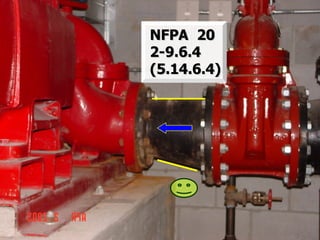
  • 3.
    WATER SUPPLY WATER SUPPLYNFPA 20 (5.6) NFPA 20 (5.6) The most common sources of fire The most common sources of fire protection water are: city water, above protection water are: city water, above ground tank, below ground tank, well, or ground tank, below ground tank, well, or an open body of water ( pond, river, an open body of water ( pond, river, lake, etc. ) lake, etc. ) NFPA 20 (6.1.2) NFPA 20 (6.1.2) Centrifugal pumps shall Centrifugal pumps shall not be used where a static suction lift is not be used where a static suction lift is required. required. Find out how many GPM are required and how much PSI is needed to make the sprinkler and/or stand pipe system work… Will the “proposed” water supply water supply and fire fire pump pump meet the system demand ?
  • 4.
    Will the watersupply be adequate at 150% of the Will the water supply be adequate at 150% of the fire pump rated flow??? fire pump rated flow??? NFPA 20 NFPA 20 (5.6.2) (5.6.2) (5.6.5.1) (5.6.5.1) NFPA 20 (5.6.2.2) NFPA 20 (5.6.2.2) Where the water supply Where the water supply from a public service main is not adequate in from a public service main is not adequate in quality, quantity, or pressure, quality, quantity, or pressure, an alternative an alternative water source “SHALL” be provided. water source “SHALL” be provided. NFPA 20 NFPA 20 (5.6.5) Head. The head (suction pressure) available from a water supply shall be figured on the basis of a flow of 150 percent of the rated capacity of the fire pump. This head should be determined by a flow test of the water supply prior prior to ordering the pump.
  • 5.
    --SAMPLE-- --SAMPLE-- This water supplyhas a 6” line and an 8” that will feed a 1000 GPM pump. This water supply has a 6” line and an 8” that will feed a 1000 GPM pump. The top curve has both lines open, the lower curve has only the 6” open. The top curve has both lines open, the lower curve has only the 6” open. In the worst condition (6” only) the line will provide 1000 GPM @ 45 PSI. In the worst condition (6” only) the line will provide 1000 GPM @ 45 PSI. NOTE: Water supply flow test - MUST NOTE: Water supply flow test - MUST BE CONDUCTED BEFORE A PUMP IS BE CONDUCTED BEFORE A PUMP IS SPECIFIED AND ORDERED! (5.6.5) SPECIFIED AND ORDERED! (5.6.5)
  • 6.
    STATE of OHIOFIRE SCHOOL - BGSU 6 Theoretical Conditions Theoretical Conditions . 323 ‘ 323 ‘ NFPA 20 Theoretical NFPA 20 Theoretical Maximum Churn Maximum Churn HEAD HEAD “Must not “Must not exceed” 140 % of exceed” 140 % of Rated Rated HEAD HEAD 231 ‘ 231 ‘ NFPA 20 100% NFPA 20 100% “Rated” Condition “Rated” Condition 500 GPM @ 231 ‘ 500 GPM @ 231 ‘ HEAD HEAD 500 GPM 500 GPM 750 GPM 750 GPM NFPA 20 Theoretical NFPA 20 Theoretical Minimum Head AT Minimum Head AT 150%of RATED FLOW 150%of RATED FLOW - Head Must Be - Head Must Be “Above “Above “ “ 65%of 65%of Rated Rated Head Head P P U U M M P P H H E E A A PUMP FLOW in GPM PUMP FLOW in GPM
  • 7.
    Total Head (H),Horizontal Pumps.* Total Head (H), Horizontal Pumps.* The The measure of the measure of the “work increase” “work increase” per pound per pound (kilogram) of liquid, imparted to the liquid by the (kilogram) of liquid, imparted to the liquid by the pump, and therefore the algebraic difference pump, and therefore the algebraic difference between the total discharge head and the total between the total discharge head and the total suction head. suction head. Where “positive” suction head exists, Where “positive” suction head exists, the the total head total head ( ( work increase work increase ) ) = the = the total total discharge discharge head ‘ head ‘minus’ ( - ) minus’ ( - ) the total the total suction suction head. head. Total Head (H), Vertical Turbine Pumps.* Total Head (H), Vertical Turbine Pumps.* The The distance from the pumping water level to the center of the distance from the pumping water level to the center of the discharge gauge discharge gauge ‘plus’ ( + ) ‘plus’ ( + ) the total discharge head. the total discharge head.
  • 8.
    STATE of OHIOFIRE SCHOOL - BGSU 8 PSI / PSI / HEAD (ft) HEAD (ft) CALIBRATED ?? CALIBRATED ?? CALIBRATED ?? CALIBRATED ??
  • 9.
    To determine To determine FEETof HEAD FEET of HEAD multiply “ multiply “ H H “ “ (net PSI) X 2.31 (net PSI) X 2.31 To determine “ To determine “ H H ” (net PSI) ” (net PSI) subtract subtract Suction Suction PSI PSI from from Discharge Discharge PSI PSI 150 PSI 150 PSI 50 PSI 50 PSI 100 PSI 100 PSI 231’ (ft) 231’ (ft) HORIZONTAL HORIZONTAL PUMPS PUMPS The suction pressure must The suction pressure must be (0 psi) or higher when be (0 psi) or higher when pump is operating at 150 %. pump is operating at 150 %. When suction is from a tank When suction is from a tank the pressure is permitted to the pressure is permitted to drop to (-3 psi). NFPA 20 drop to (-3 psi). NFPA 20 (5.14.3) (5.14.3)
  • 10.
    STATE of OHIOFIRE SCHOOL - BGSU 10 . . . “RATED 100% FLOW “ . . A A C C B B . . . . . . “ 150 % FLOW “ “ “CHURN” CHURN” Pressure Pressure “ “RATED” RATED” 100 % 100 % FLOW FLOW ACTUAL CITY WATER ACTUAL CITY WATER FROM PUMP TEST FROM PUMP TEST FLOW IN GPM FLOW IN GPM H H E E A A D D
  • 11.
    STATE of OHIOFIRE SCHOOL - BGSU 11 PUMP FLOW PUMP FLOW DETERMINATION DETERMINATION WITH FLOW WITH FLOW METER METER
  • 12.
    STATE of OHIOFIRE SCHOOL - BGSU 12 NOZZLE NOZZLE (PLAY PIPE) (PLAY PIPE) AND PITOT TUBE AND PITOT TUBE PUMP FLOW PUMP FLOW DETERMINATION DETERMINATION
  • 13.
  • 14.
    UL / FM UL/ FM CENTRIFUGAL CENTRIFUGAL FIRE PUMPS FIRE PUMPS
  • 15.
  • 16.
    Prefabricated Fire PumpHouse Prefabricated Fire Pump House
  • 17.
    SITE PREPARATION :Slab or Footer SITE PREPARATION : Slab or Footer
  • 18.
    NOTE : NOTE : NoSpreader Bars ! No Spreader Bars !
  • 19.
    STATE of OHIOFIRE SCHOOL - BGSU 19
  • 21.
    Field Erected PumpHouse or Pump Room Field Erected Pump House or Pump Room
  • 23.
    Horizontal Horizontal Split - Case Split- Case Vertical Vertical In-Line In-Line
  • 24.
    STATE of OHIOFIRE SCHOOL - BGSU 24 To Test Head To Test Head Jockey Jockey Pump Pump Vertical Turbine Vertical Turbine
  • 25.
    Horizontal Split -Case Fire Pump Horizontal Split - Case Fire Pump
  • 26.
    Water Water Seal Seal Piping Piping NOTE: Water seal NOTE:Water seal piping is not provided piping is not provided on UL Fire Pumps on UL Fire Pumps with suction pressure with suction pressure of 30 psi or more ! of 30 psi or more ! #1 #1 YOU MUST YOU MUST ACCURATELY ACCURATELY DETERMINE THE DETERMINE THE SUCTION PRESSURE SUCTION PRESSURE “ “BEFORE” BEFORE” THE PUMP THE PUMP IS ORDERED !! IS ORDERED !! NFPA 20 (5.2.2) NFPA 20 (5.2.2) (5.6.2.3) (5.6.2.3)
  • 27.
    “ “ACTUAL” Suction pressureMUST be ACTUAL” Suction pressure MUST be determined BEFORE you order the pump ! determined BEFORE you order the pump ! NFPA 20 (5.2.2) (5.6.2.3) NFPA 20 (5.2.2) (5.6.2.3) Actual Actual suction suction pressure pressure MUST NOT MUST NOT exceed exceed this ! this !
  • 28.
    STATE of OHIOFIRE SCHOOL - BGSU 28 NO RODS !!! SAFE ?? Look at the pipe fittings !! This pump installation develops 213 PSI at churn. A 125 lb flanged fitting is rated at 175 PSI maximum working pressure !! NFPA 20 (5.7.4.1) NFPA 13 15.1.6.1.1 NFPA 13 15.1.6.1.1
  • 29.
    STATE of OHIOFIRE SCHOOL - BGSU 29 NFPA 20 NFPA 20 (5.7.4.1) (5.7.4.1) (5.7.4.2) (5.7.4.2) Variable Variable Speed PLC Speed PLC (5.18.1.3) (5.18.1.3) (5.18.7) (5.18.7)
  • 30.
    STATE of OHIOFIRE SCHOOL - BGSU 30 Circulation Relief Valve Circulation Relief Valve ¾” ¾” is the is the MINIMUM MINIMUM size for up size for up to 2500 GPM Rated Pump*. to 2500 GPM Rated Pump*. 1” 1” MIN. MIN. for larger pumps ??? for larger pumps ??? NFPA 20 (5.11) NFPA 20 (5.11) * *
  • 31.
    Circulation “Case” Circulation “Case” ReliefValve Relief Valve NFPA 20 2-6 (5.11) NFPA 20 2-6 (5.11) NOTE : Not required on diesel NOTE : Not required on diesel engine-driven HSC fire pumps unless engine-driven HSC fire pumps unless the engine is radiator-cooled ! the engine is radiator-cooled ! * * 55 L 55 L 918 918 19 - 20 19 - 20 10691 10691 FWC FWC
  • 32.
    STATE of OHIOFIRE SCHOOL - BGSU 32 NOTE: Above (optional) Back- pressure orifice assembly installed in ¾” case relief valve discharge to create back pressure and reduce cavitation. NOTE: (Optional) Y strainer can be used when foreign material (sand or other debris) is present in the water. ORIFICE FLOW FLOW Typical CIRCULATION (CASE) Typical CIRCULATION (CASE) RELIEF VALVE Assembly – The RELIEF VALVE Assembly – The valve must be installed valve must be installed (VERTICALLY) (VERTICALLY) on the pump on the pump discharge before the discharge discharge before the discharge check valve NFPA 20 (5.11.1.2) check valve NFPA 20 (5.11.1.2)
  • 33.
    Automatic Air Release NFPA20 2-6 Automatic Air Release NFPA 20 2-6 (6.3.3)
  • 34.
    STATE of OHIOFIRE SCHOOL - BGSU 34 NFPA NFPA 20 20 NOTE : NOTE : Automatic Automatic air release air release valve valve installed installed
  • 35.
    STATE of OHIOFIRE SCHOOL - BGSU 35 ! ! (5.14) (5.14) Elbows and tees with a centerline Elbows and tees with a centerline plane parallel to a horizontal split-case plane parallel to a horizontal split-case pump shaft shall be avoided. See pump shaft shall be avoided. See Figure A-2-9.6. (5.14.6.3.1) Figure A-2-9.6. (5.14.6.3.1) If there is a parallel elbow : YOU If there is a parallel elbow : YOU MUST HAVE 10 PIPE DIAMETERS MUST HAVE 10 PIPE DIAMETERS of STRAIGHT PIPE BETWEEN THE of STRAIGHT PIPE BETWEEN THE ELBOW AND PUMP SUCTION ELBOW AND PUMP SUCTION FLANGE (5.14.6.3.2) FLANGE (5.14.6.3.2) PIPE SIZE ? PIPE SIZE ? NFPA 20 NFPA 20 (5.14.3.4) (5.14.3.4)
  • 36.
    STATE of OHIOFIRE SCHOOL - BGSU 36 NFPA 20 NFPA 20 2-9.6.4 2-9.6.4 (5.14.6.4) (5.14.6.4)
  • 37.
  • 38.
    STATE of OHIOFIRE SCHOOL - BGSU 38 NFPA 20 2-9.6.3 NFPA 20 2-9.6.3 Elbows and tees Elbows and tees with a centerline with a centerline plane parallel to plane parallel to a horizontal a horizontal split-case pump split-case pump shaft shall be shaft shall be avoided. See avoided. See Figure A-2-9.6. Figure A-2-9.6. SUCTION SUCTION (5.14.6.3.1) (5.14.6.3.1)
  • 39.
    STATE of OHIOFIRE SCHOOL - BGSU 39 CORRECTED !!! CORRECTED !!! NOTE: No ELBOWS NOTE: No ELBOWS
  • 41.
    STATE of OHIOFIRE SCHOOL - BGSU 41 OSY OSY Suction Suction Valve Valve NOTE: Backflow Preventer! NOTE: The long straight run of suction pipe after a HORIZONTAL 90 DEGREE ELBOW ! More than 10 pipe diameters ? (5.14.6.3.2)
  • 42.
    SUCTION SUCTION SUPPLY - SUPPLY - CityWater City Water Is this Is this Suction Suction Piping Piping OK ? OK ? (5.14.6.3.3) (5.14.6.3.3)
  • 43.
    STATE of OHIOFIRE SCHOOL - BGSU 43 SUCTION SUCTION DISCHARGE DISCHARGE Is this HSC vertical Is this HSC vertical installation installation “REALLY” a space “REALLY” a space saver ?? saver ?? IS IT CORRECT ?? IS IT CORRECT ?? OK ? OK ? NFPA 20 NFPA 20 (5.14.6.3.1) (5.14.6.3.1)
  • 44.
    STATE of OHIOFIRE SCHOOL - BGSU 44 NOTE: Backflow NOTE: Backflow Preventer on DISCHARGE Preventer on DISCHARGE side of Pump !! (5.26) side of Pump !! (5.26) (5.14.9) (5.14.9) PUMP PUMP Suction Suction City By-Pass City By-Pass NOTE : Left Hand NOTE : Left Hand Rotation ! * Rotation ! * Counter Clockwise ! Counter Clockwise ! CONFIRM CONFIRM BEFORE BEFORE you order you order the PUMP !! the PUMP !! NFPA 20 (5.22) NFPA 20 (5.22) Study and Study and understand the understand the piping ! piping ! Ask questions Ask questions if you are not if you are not sure ! sure ! #2 #2
  • 45.
  • 46.
    NOTE: Test HeaderPiping is NOTE: Test Header Piping is Connected Between the Connected Between the Pump Discharge Check Valve Pump Discharge Check Valve and the Discharge (System) and the Discharge (System) Shut - Off Valve. Shut - Off Valve. NFPA 20 (A.5.19.3.1) NFPA 20 (A.5.19.3.1) Test Header Test Header Control Valve Control Valve and Piping and Piping City Water By-Pass City Water By-Pass What is the SUPPLY Voltage ? What is the SUPPLY Voltage ? Is a Transfer Switch required ? Is a Transfer Switch required ? DOUBLE CHECK and DOUBLE CHECK and CONFIRM CONFIRM BEFORE BEFORE you order the pump you order the pump #3 #3
  • 47.
    Test Header Control Valve and Piping NOTE: No drain valve on NOTE : No drain valve on bottom of test head pipe ! bottom of test head pipe ! NFPA 20 (5.19.3.3.1) NFPA 20 (5.19.3.3.1) FLOW FLOW
  • 48.
    FIRE PUMP TEST FIREPUMP TEST CONNECTION CONNECTION (5.19.3) (5.19.3) What hose threads are What hose threads are required on the hose valves required on the hose valves in your jurisdiction ? in your jurisdiction ? CHECK and CONFIRM CHECK and CONFIRM before before you order the you order the pump ! NFPA 20 pump ! NFPA 20 (5.19.3.2) (5.19.3.2) #4 #4
  • 49.
    Fire Pump Test FirePump Test Head Head Must be located where the motor and controller will not be damaged by spraying or splashing water. Preferably outside of Preferably outside of the pump house or the the pump house or the pump room ! pump room ! NFPA 20 (A.5.19.3.1) NFPA 20 (A.5.19.3.1) FIRE FIRE PUMP PUMP TEST TEST HEAD HEAD
  • 50.
    STATE of OHIOFIRE SCHOOL - BGSU 50 NFPA 20 A-2-14.3.1 NFPA 20 A-2-14.3.1 (A.5.19.3.1) (A.5.19.3.1) TEST HEAD ?? TEST HEAD ?? HOSE /TEST VALVES HOSE /TEST VALVES
  • 51.
    STATE of OHIOFIRE SCHOOL - BGSU 51 FALK Steel Flex – APPROVED ?? FALK Steel Flex – APPROVED ?? What coupling will be What coupling will be accepted by LAHJ ? accepted by LAHJ ? FIND FIND OUT OUT ! ASK ! “UL” ! ASK ! “UL” Listed ?? NFPA 20 (6.5) Listed ?? NFPA 20 (6.5) #5 #5
  • 52.
    STATE of OHIOFIRE SCHOOL - BGSU 52 Drive Shaft – APPROVED ? Drive Shaft – APPROVED ?
  • 55.
    <FM> and IRIBulletin 91-9
  • 56.
    LOOSE SET-SCREWS ???? LOOSESET-SCREWS ???? DO NOT USE Elastomer Couplings ON UL/FM FIRE PUMPS ! < FM> 9-2006 < FM> 9-2006 IRI Bulletin 91-9 IRI Bulletin 91-9
  • 57.
    STATE of OHIOFIRE SCHOOL - BGSU 57 TB Woods TB Woods Elastomer Elastomer Coupling Coupling
  • 58.
    Diesel Driven Diesel Driven HSCFire Pumps HSC Fire Pumps Engine HP De-rate Engine HP De-rate (11.2.2) (11.2.2) * * 3% for every 1000’ 3% for every 1000’ ALT. ALT. above 300’ above 300’ 1% for every 10 degrees (F) above 77 1% for every 10 degrees (F) above 77 #6 #6
  • 59.
    (5.18.6.3) (5.18.6.3) NEW: NFPA 20(11.2.4.2) NEW: NFPA 20 (11.2.4.2) Pressure-Limiting Drivers Pressure-Limiting Drivers
  • 60.
    NOTE : Witha PLD NOTE : With a PLD All pump discharge All pump discharge fittings, fittings, TO TO and and including the including the system shut off system shut off valve, must be valve, must be rated for the rated for the MAXIMUM MAXIMUM discharge (CHURN) discharge (CHURN) 100 PSI 100 PSI 170 PSI 170 PSI 240 PSI 240 PSI FOR TESTING FOR TESTING (14.2.7.3.7.3) (14.2.7.3.7.3)
  • 61.
    CLARKE Fire ProtectionProducts CLARKE Fire Protection Products
  • 62.
    System Relief Valveis Required when a Variable Speed – OR -- Pressure Limiting Driver is used (5.18.1.3 ) * -------also--------- Required when diesel fire pump churn pressure X 1.21 (plus maximum static suction) exceeds the maximum working pressure of the system components NFPA 20 (5.18.1.1) * # #7 7 REQUIRED ? REQUIRED ?
  • 63.
    STATE of OHIOFIRE SCHOOL - BGSU 63 (5.18.1.1) (5.18.1.1) NOTE: NOTE: This This Pump did not Pump did not require a main require a main relief valve since relief valve since the sum of the the sum of the churn pressure churn pressure times 121% times 121% plus the max. plus the max. suction pressure suction pressure is only 142 PSI. is only 142 PSI. No Relief No Relief Valve ? Valve ?
  • 64.
    NOTE: Flexible NOTE: Flexible DresserPipe Dresser Pipe Couplings to allow for Couplings to allow for tank settling! tank settling! ( A.5.17 ) ( A.5.17 ) Water Water supply is supply is from a from a ground ground storage storage tank tank Combustion Air Louver Combustion Air Louver NOTE: Relief NOTE: Relief valve is piped to valve is piped to waste outside waste outside of building of building (5.18.6) (5.18.6) (A.5.18.5) (A.5.18.5) Relief valve discharge is Relief valve discharge is permitted to be piped permitted to be piped back to the above ground back to the above ground storage tank (5.18.6.3) storage tank (5.18.6.3) Note: Packing drain Note: Packing drain lines run to a floor lines run to a floor drain.(5.12.6.2) drain.(5.12.6.2)
  • 65.
    STATE of OHIOFIRE SCHOOL - BGSU 65 When Pump When Pump Maximum Maximum Discharge Discharge Pressure is Pressure is evaluated evaluated with the 121 with the 121 % rule % rule NFPA 20 NFPA 20 (A.5.18.1) (A.5.18.1)
  • 66.
    STATE of OHIOFIRE SCHOOL - BGSU 66 Relief Valve Waste Relief Valve Waste (5.18.6) (5.18.6) Engine Cooling Engine Cooling Water Piping Water Piping – – NFPA 20 (11.2.6.3) NFPA 20 (11.2.6.3) NOTE: System (Main) Relief Valve (if used) is connected to the pump discharge BEFORE the Discharge Check Valve !! (5.18.3) (5.18.5) (5.18.5)
  • 67.
    STATE of OHIOFIRE SCHOOL - BGSU 67 Where the cooling water contains foreign material such as leaves, grass, wood chips, etc – duplex filter type strainers should be provided. NFPA 20 (A.11.2.6.4)
  • 69.
    ENGINE cooling ENGINE cooling wastewater waste water MUST be piped so MUST be piped so the flow can be the flow can be VISUALLY VISUALLY observed and observed and confirmed. confirmed. The discharge The discharge pipe MUST be at pipe MUST be at least one size least one size larger than the larger than the inlet. inlet. NFPA 20 NFPA 20 (11.2.6.6) (11.2.6.6)
  • 70.
    Cooling Water Waste CoolingWater Waste To Open Drain To Open Drain NFPA 20 (11.2.6.6) NFPA 20 (11.2.6.6)
  • 71.
    EMERGENCY MANUAL STARTING EMERGENCYMANUAL STARTING PROCEDURE - NFPA 20 (11.6.6) PROCEDURE - NFPA 20 (11.6.6) C C = Cooling Water = Cooling Water F F = Fuel = Fuel C C = Crank = Crank
  • 72.
    #1 #1 C COOLING OOLING WATER WATER #2 #2 F FUEL UEL # 3 # 3 C CRANK RANK NOTE! NOTE ! SET at 120 % of Rated RPM ***** EMERGENCY EMERGENCY MANUAL MANUAL STARTING STARTING PROCEDURE PROCEDURE (11.6.6) (11.6.6) BE SURE THAT YOU KNOW WHERE THE OVERSPEED RESET IS ON EVERY TYPE OF ENGINE THAT YOU SELL or INSTALL !! INSTRUCT THE OWNER’S REPRESENTATIVE OR OPERATOR. CUMMINS
  • 73.
    # # 1 1 ForEMERGENCY For EMERGENCY OPERATION of “ANY ENGINE” OPERATION of “ANY ENGINE” the by-pass the by-pass AND AND normal normal COOLING WATER VALVES must COOLING WATER VALVES must ALL be - OPEN ! ALL be - OPEN !
  • 74.
    STATE of OHIOFIRE SCHOOL - BGSU 74 # #3 3 CRANK CRANK BATTERY 1 or 2 BATTERY 1 or 2 #2 #2 With Newer Engines, the toggle switch, when in With Newer Engines, the toggle switch, when in MANUAL MANUAL will turn on both will turn on both FUEL FUEL and and COOLING WATER COOLING WATER
  • 75.
    NFPA 20 (11.5.3) NFPA20 (11.5.3) Exhaust pipes Exhaust pipes shall be installed shall be installed with clearances of with clearances of at least 9” to at least 9” to combustible combustible material. material. Insulate or guard exhaust Insulate or guard exhaust pipe??? pipe???
  • 76.
  • 77.
    NOTE: Victaulic NOTE: Victaulic fittingswith fittings with rubber gaskets ? rubber gaskets ? FLEX CONNECTOR FLEX CONNECTOR ¼” MAX. ¼” MAX. MISALIGNMENT ?? MISALIGNMENT ??
  • 78.
    Exhaust Fan Exhaust Fanand and Air Intake Louver Air Intake Louver NFPA 20 NFPA 20 (11.3.2.4) (11.3.2.4) NFPA 20 NFPA 20 (11.3.2.3) (11.3.2.3) MAX 120 MAX 120 degrees F degrees F
  • 79.
    NOTE : ULListed tanks must NOTE : UL Listed tanks must have a metal “ UL ” have a metal “ UL ” nameplate attached to the nameplate attached to the tank ! tank ! LOOK FOR IT ! LOOK FOR IT ! (12.4.1.3 - 11) Tank must (12.4.1.3 - 11) Tank must be kept 2/3 full ! be kept 2/3 full ! Fuel Fuel Return Return
  • 80.
    STATE of OHIOFIRE SCHOOL - BGSU 80
  • 81.
    FUEL Tank Drains FUELTank Drains NFPA 20 NFPA 20 A-8-4.6 (A.11.4.6) A-8-4.6 (A.11.4.6) Top 5% Top 5% and and bottom 5% of bottom 5% of tank volume is not used in tank volume is not used in determining capacity of tank. determining capacity of tank. NFPA 20 8-4.3 (11.4) * NFPA 20 8-4.3 (11.4) * Bottom 5% Bottom 5%
  • 82.
    Fuel Supply Valve FuelSupply Valve locked in OPEN locked in OPEN position …NFPA 20 position …NFPA 20 A-8-4.6 (A.11.4.6) A-8-4.6 (A.11.4.6) NEW: 2003 NEW: 2003 NFPA 20 NFPA 20 (11.4.6.2) (11.4.6.2) Fuel lines Fuel lines no copper no copper or or galvanized galvanized The fuel supply The fuel supply opening to the engine opening to the engine shall be no lower shall be no lower than the engine fuel than the engine fuel pump centerline. pump centerline. NFPA 20 (11.4.5.4) NFPA 20 (11.4.5.4)
  • 83.
    STATE of OHIOFIRE SCHOOL - BGSU 83 Fuel tank capacity NFPA 20 (11.4.3) * Tank location inside NFPA 20 (11.4.5.6) Fill and vent piping NFPA 20 (11.4.5.8) Fuel Level Fuel Level (11.4.5.7) (11.4.5.7) Low Fuel Low Fuel Switch * Switch * SET AT 2/3 SET AT 2/3 (12.4.1.3) (12.4.1.3) Fuel Fuel Return Return
  • 84.
    10 ‘ The flasharrester The flash arrester should be a minimum should be a minimum 11’- 0” above the top 11’- 0” above the top of the fuel tank NFPA of the fuel tank NFPA 20 (A.11.4.6) 20 (A.11.4.6)
  • 85.
    NOTE : DualFlash NOTE : Dual Flash Arresters Arresters (VENTS) for (VENTS) for “DOUBLE WALL” “DOUBLE WALL” Fuel Tanks ! Fuel Tanks !
  • 86.
    Tank Fill SHOULDBE Piped Tank Fill SHOULD BE Piped to the outside to the outside (A.11.4.5) (A.11.4.5)
  • 87.
    Some “LAHJ” REQUIREa containment dike, Some “LAHJ” REQUIRE a containment dike, even when a double wall tank is provided ! even when a double wall tank is provided ! CHECK and LEARN CHECK and LEARN THE LOCAL CODES ! THE LOCAL CODES ! 5 PSI Hydro-test at the JOB ?? 5 PSI Hydro-test at the JOB ?? To To Engine Engine #8 #8
  • 88.
    Vertical In-Line FirePump Vertical In-Line Fire Pump Suction Suction Inlet Inlet
  • 89.
    STATE of OHIOFIRE SCHOOL - BGSU 89 ALL Pump Rooms are Required to have a FLOOR DRAIN!!! (5.12.6.2) Circulation “CASE” Relief Valve Piped To A Floor Drain. (5.11)* Packing Drain Lines Run to a Floor Drain. Do not combine with case relief valve piping! !! (5.11.1.5)
  • 90.
    STATE of OHIOFIRE SCHOOL - BGSU 90 NOTE STRAINER! NOTE STRAINER! 10 pipe 10 pipe dia. ?? dia. ?? NFPA 20 (6.3.4) NFPA 20 (6.3.4) NOTE: Strainer requirement NOTE: Strainer requirement was removed after 2007 ! was removed after 2007 ! #9 #9
  • 91.
    STATE of OHIOFIRE SCHOOL - BGSU 91 (6.3.4) A Hand Hole is “NOT” a (6.3.4) A Hand Hole is “NOT” a Strainer!! Strainer!! Could You Get Rocks Could You Get Rocks and Boards out of this small “ and Boards out of this small “ PIPE PLUG “ opening ?? PIPE PLUG “ opening ?? NO SUCTION STRAINER ?? WHY NOT ? NO SUCTION STRAINER ?? WHY NOT ?
  • 92.
    Could YOU getthis stuff out of a “PIPE PLUG Could YOU get this stuff out of a “PIPE PLUG OPENING” in the bottom of an Inline Fire Pump ? OPENING” in the bottom of an Inline Fire Pump ? Could this be why a strainer Is “REQUIRED” ? Could this be why a strainer Is “REQUIRED” ?
  • 93.
    Vertical Turbine FirePump Vertical Turbine Fire Pump NFPA 20 (7.4.1) NFPA 20 (7.4.1)
  • 94.
    NOTE: Automatic airrelease NOTE: Automatic air release NFPA 20 (7.3.5.2.3) NFPA 20 (7.3.5.2.3) “SHALL BE” “SHALL BE” Located between the fire pump and Located between the fire pump and the discharge check valve. * the discharge check valve. * Motor HP and Motor HP and THRUST limits THRUST limits must must meet or exceed meet or exceed those of the Fire those of the Fire Pump. Pump. CHECK ! CHECK ! (7.5.1.1) (9.5.2) (7.5.1.1) (9.5.2) #10 #10
  • 95.
    STATE of OHIOFIRE SCHOOL - BGSU 95 NOTE: NOTE: Automatic air release “SHALL BE” Located Automatic air release “SHALL BE” Located in the highest point in the discharge line, between in the highest point in the discharge line, between the fire pump and the discharge check valve. the fire pump and the discharge check valve. NFPA NFPA 20 (7.3.5.2.3) 20 (7.3.5.2.3) * *
  • 96.
    STATE of OHIOFIRE SCHOOL - BGSU 96 NFPA 20 (7.6.2.3) NFPA 20 (7.6.2.3) ACCESS FOR REMOVAL ? ACCESS FOR REMOVAL ?
  • 97.
    NFPA 20 (7.4.3.7 ) NFPA 20 ( 7.4.3.7 ) I– beams must be parallel I– beams must be parallel to the driver ! to the driver !
  • 99.
    STATE of OHIOFIRE SCHOOL - BGSU 99 One degree of off-set is the preferred One degree of off-set is the preferred angle, per drive shaft manufacturers!! angle, per drive shaft manufacturers!! NFPA 20 (6.5) (7.5.1.7.2) NFPA 20 (6.5) (7.5.1.7.2)
  • 100.
    CHECK the pumpHP and THRUST requirements. CHECK the pump HP and THRUST requirements. CHECK the gear HP and THRUST limits. CHECK the gear HP and THRUST limits. CHECK the engine HP rating. CHECK the engine HP rating. THIS MUST BE DONE BEFORE THE PUMP IS THIS MUST BE DONE BEFORE THE PUMP IS ORDERED !! ORDERED !! ( 7.5.1.6.4 ) ( 7.5.1.6.4 ) #11 #11
  • 101.
    STATE of OHIOFIRE SCHOOL - BGSU 101 Top Shaft Nut is Top Shaft Nut is used to raise used to raise shaft and shaft and impellers impellers approximately approximately 1/8 1/8 “ inch. (see “ inch. (see instruction instruction book) book) NFPA 20 (7.6.1.3)
  • 102.
    Water Vel, 2’/sec Max WaterVel. Water Vel. 1’/sec Max 1’/sec Max Screen openings equal to 1 Screen openings equal to 1 sq. in. for every GPM sq. in. for every GPM (pump capacity at 150%) (pump capacity at 150%) (at LOWEST Water LEVEL) (at LOWEST Water LEVEL) NFPA 20 (5.14.8) NFPA 20 (5.14.8) Confirm proper Confirm proper submergence submergence (Pump Length) * (Pump Length) * (7.2.2.2) (7.2.2.2) NFPA 20 (A.7.2.2.2) (5.14.8) NFPA 20 (A.7.2.2.2) (5.14.8) #12 #12 * *
  • 104.
    Removable screens NFPA20 (5.14.8.3) Removable screens NFPA 20 (5.14.8.3) Intake size NFPA 20 (5.14.8.4) Intake size NFPA 20 (5.14.8.4)
  • 105.
    Removable screens NFPA20 A4-2.2.2 Removable screens NFPA 20 A4-2.2.2 (5.14.8.3) (5.14.8.3) Intake size NFPA 20 A4-2.2 Intake size NFPA 20 A4-2.2 (5.14.8.4) (5.14.8.4)
  • 106.
    STATE of OHIOFIRE SCHOOL - BGSU 106 NFPA 20 2003 NFPA 20 2003 Zebra Mussel Infestation Zebra Mussel Infestation (5.14.8.12) (5.14.8.12) With a vertical turbine fire With a vertical turbine fire pump a plugged screen will pump a plugged screen will affect the water level in the affect the water level in the sump and a plugged basket sump and a plugged basket strainer on the bottom of the strainer on the bottom of the pump will reduce the total pump will reduce the total pump performance. pump performance.
  • 107.
    VTFP INTAKE PROBLEMS……….. VTFPINTAKE PROBLEMS……….. Removable screens NFPA 20 A4-2.2.2 (5.14.8.3) (5.14.8.3) Intake size ??? Intake size ??? NFPA 20 A4-2.2 NFPA 20 A4-2.2 (5.14.8.4) (5.14.8.4) 2 ft/sec and 2 ft/sec and 1 Sq. Inch per 1 Sq. Inch per GPM at GPM at 150% Flow ? 150% Flow ?
  • 108.
  • 109.
  • 110.
    PART 2 PART 2 FIREPUMP FIRE PUMP Acceptance Testing Acceptance Testing In The State of In The State of OHIO OHIO
  • 111.
    FIRE PUMP FIRE PUMPACCEPTANCE TEST ACCEPTANCE TEST 1. Check for company and individual LICENSING. 1. Check for company and individual LICENSING. 2. Check for HYDRO and FLUSHING CERTIFICATES. 2. Check for HYDRO and FLUSHING CERTIFICATES. 3. Check for CERTIFIED shop test curve vs. SYSTEM DEMAND. 3. Check for CERTIFIED shop test curve vs. SYSTEM DEMAND. 4. Has the pump been properly ALIGNED and PRE-TESTED??? 4. Has the pump been properly ALIGNED and PRE-TESTED??? 5. Record all pump, driver, and controller data. (HP, VOLTAGE, etc.) 5. Record all pump, driver, and controller data. (HP, VOLTAGE, etc.) 6. Look system over…sensing lines, reducers, piping , water supply…. 6. Look system over…sensing lines, reducers, piping , water supply…. 7. Check for CERTIFICATE of CALIBRATION for test equip. (SAFE??) 7. Check for CERTIFICATE of CALIBRATION for test equip. (SAFE??) 8. Decide in advance just what is to take place during the test 8. Decide in advance just what is to take place during the test 9. Operate the pump at churn (no flow)….temp., brgs., packing, etc. 9. Operate the pump at churn (no flow)….temp., brgs., packing, etc. 10. Record PSI, RPM, AMPS, VOLTS, (compare and plot results). 10. Record PSI, RPM, AMPS, VOLTS, (compare and plot results). 11. Operate the pump at additional flow points 50%, 100%, 150%,. 11. Operate the pump at additional flow points 50%, 100%, 150%,. 12. Record PSI, RPM, AMPS, VOLTS, (compare and plot results). 12. Record PSI, RPM, AMPS, VOLTS, (compare and plot results). 13. 6 AUTO Starts and 6 MANUAL Starts. (One Full Load Start) 13. 6 AUTO Starts and 6 MANUAL Starts. (One Full Load Start) 14. Controller and Driver alarms connected / tested (electric and diesel) 14. Controller and Driver alarms connected / tested (electric and diesel) 15. Start and Stop PSI for Main Fire Pump and Jockey Pump. 15. Start and Stop PSI for Main Fire Pump and Jockey Pump. 16. Low Suction Control Set Point AND Alarm Connected??? 16. Low Suction Control Set Point AND Alarm Connected??? 17. Operators trained in maintenance and weekly testing??? 17. Operators trained in maintenance and weekly testing??? 18. Review test results - ASK QUESTIONS!!!!!! Do it again ??? 18. Review test results - ASK QUESTIONS!!!!!! Do it again ??? 19. STOP!!!! Don’t accept it if the data is not CORRECT!!!! 19. STOP!!!! Don’t accept it if the data is not CORRECT!!!!
  • 112.
    1. Check forcompany and 1. Check for company and individual LICENSING as individual LICENSING as REQUIRED by STATE or REQUIRED by STATE or LAHJ LAHJ. . CHECK EVERYONE who touches the equipment…pump guy, fitters, controller guy, and engine guy!!! They all must have a license to service, test, repair, or install any fire protection equipment in the State of Ohio. Compare with driver’s license….. Check every year….. RECORD the information…….
  • 113.
    RECORD NAMES OFALL FIELD RECORD NAMES OF ALL FIELD ACCEPTANCE TEST PERSONNEL ACCEPTANCE TEST PERSONNEL  (LAHJ) (LAHJ) FIRE DEPT OFFICIAL FIRE DEPT OFFICIAL  OWNER’S REPRESENTATIVE OWNER’S REPRESENTATIVE  MAINTENANCE PERSONNEL MAINTENANCE PERSONNEL  INSTALLING CONTRACTOR INSTALLING CONTRACTOR  AUTHORIZED FIRE PUMP REP AUTHORIZED FIRE PUMP REP  AUTHORIZED CONTROLLER REP AUTHORIZED CONTROLLER REP  AUTHORIZED ENGINE REP AUTHORIZED ENGINE REP  INSURANCE REPRESENTATIVE INSURANCE REPRESENTATIVE
  • 114.
    STATE of OHIOFIRE SCHOOL - BGSU 114
  • 115.
    1. 1. Check forHYDRO and Check for HYDRO and FLUSHING CERTIFICATES. FLUSHING CERTIFICATES. NFPA 20 11-1.1 (14.1) Was the U Underground and A Aboveground piping installed, flushed, and hydro-tested by a “Licensed” contractor ? Did “YOU” “YOU” witness flushing and hydro-test?? Did installing contractor “OFFER” to have you witness the above and provide you with the mandatory test certificates …… NFPA 20 11-1.3 (14.1.3) Someone had to sign and witness (WHO ??) (WHO ??) NO TEST CERTIFICATES???? WHY NOT??? NFPA 20 (14.1.3) What happens when the pump plugs with rocks or a pipe fitting blows apart?????
  • 117.
    Table (14.1.1.1[a]) Table (14.1.1.1[a])Minimum Flush Rates Minimum Flush Rates. . Contractor may have a calculated system Contractor may have a calculated system demand which, if greater, will require higher demand which, if greater, will require higher flush rates than those listed below. flush rates than those listed below. Pipe Size Pipe Size Flow Rate Flow Rate in. in. mm mm gpm gpm L/min L/min 4 4 102 102 590 590 2,233 2,233 6 6 152 152 1,360 1,360 5,148 5,148 8 8 203 203 2,350 2,350 8,895 8,895 10 10 254 254 3,670 3,670 13,891 13,891 12 12 305 305 5,290 5,290 20,023 20,023 NFPA 20 (14.1.1.1) FLUSHING NFPA 20 (14.1.1.1) FLUSHING
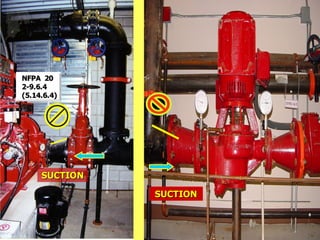
  • 118.
    ROCKS IN IMPELLER ROCKSIN IMPELLER Was this system properly flushed?? NFPA 20 (14.1)
  • 119.
    System was flushedfor 2 hours with 3 hoses ! System was flushed for 2 hours with 3 hoses ! Problem : Hoses were ¾” garden hoses !!! Problem : Hoses were ¾” garden hoses !!!
  • 121.
    3. Check forPUMP CERTIFIED SHOP TEST CURVE. Compare it to the SYSTEM DEMAND. NFPA 20 2-16 2-16 and 11-2.3 (14.2.4) Find out how many GPM are required and how much PSI is needed to make the sprinkler system work… Will the fire pump and water supply do it ? Fire Pumps are selected for “SYSTEM DESIGNS” which can utilize any pump flow up to 150% of rated capacity. NFPA 20 2-3 and A-2-3 (5.8)
  • 122.
  • 123.
    4. Has thePump and Driver 4. Has the Pump and Driver been ALIGNED, LUBRICATED, been ALIGNED, LUBRICATED, and PRE-TESTED??? and PRE-TESTED??? Pump and driver MUST MUST be field-aligned NFPA 20 3-5 (6.5.2) and pre-tested PRIOR PRIOR to the field acceptance test - includes electrical includes electrical NFPA 20 (14.2.3) NFPA 20 (14.2.3) so that inspector’s time is not wasted standing around…….. MANY jurisdictions charge an additional fee if re- testing is required due to problems with a system which has not been pre-tested prior to the acceptance test!!!!
  • 124.
    STATE of OHIOFIRE SCHOOL - BGSU 124
  • 125.
    STATE of OHIOFIRE SCHOOL - BGSU 125
  • 126.
    STATE of OHIOFIRE SCHOOL - BGSU 126 GAP MUST BE GAP MUST BE EQUAL - TOP TO EQUAL - TOP TO BOTTOM AND BOTTOM AND SIDE TO SIDE. SIDE TO SIDE. Within .005” Within .005” USE OF DIAL USE OF DIAL INDICATORS OR INDICATORS OR LASERS IS LASERS IS PREFERRED. PREFERRED. Angular Angular Alignment Alignment
  • 127.
    STATE of OHIOFIRE SCHOOL - BGSU 127 Parallel alignment should be less than .005 Parallel alignment should be less than .005 “VERTICAL and HORIZONTAL” “VERTICAL and HORIZONTAL” NOTE : The NOTE : The coupling halves coupling halves should remain should remain disconnected disconnected until rotation until rotation has been has been checked! checked!
  • 128.
    STATE of OHIOFIRE SCHOOL - BGSU 128 AFTER AFTER alignment and alignment and rotation have been rotation have been checked the coupling checked the coupling should be lubricated should be lubricated and re-assembled. and re-assembled. Be sure to check the Be sure to check the set screws for set screws for tightness tightness FALK FALK Steelflex Steelflex Coupling Coupling
  • 129.
    After checking thealignment, leave the pump and driver uncoupled until after rotation check ! Pump rotation should be checked with the coupling not not connected……..* * Pump was 6 % Low. 4 Year Old 4 Year Old Pump Pump
  • 130.
    STATE of OHIOFIRE SCHOOL - BGSU 130
  • 131.
    STATE of OHIOFIRE SCHOOL - BGSU 131 NOTE: The quarter on a NOTE: The quarter on a properly installed, grouted, properly installed, grouted, aligned, and lubricated aligned, and lubricated fire pump!!! fire pump!!! 125 HP, 1760 RPM Motor - 125 HP, 1760 RPM Motor - in operation in operation, , NO VIBRATION ! NO VIBRATION ! NFPA 20 ( 14.2.6 ) NFPA 20 ( 14.2.6 )
  • 132.
    Add Grease Add Grease slowly! slowly ! Check For Check For Excess Grease Excess Grease After greasing be After greasing be sure to check sure to check torque of ALL torque of ALL bolts bolts and and set screws ! set screws !
  • 133.
    NOTE: NOTE: Insert Insert clean grease cleangrease slowly until old slowly until old grease is forced grease is forced out of the drain out of the drain hole with hole with PLUG PLUG REMOVED !! REMOVED !! NOTE : Operate the NOTE : Operate the pump for 15 – 30 min. pump for 15 – 30 min. before replacing the before replacing the plug ! plug !
  • 134.
    Motor oil full? Motor oil full ? Check it ! Check it ! Gear oil full ? Gear oil full ? Check it ! Check it ! What oil did they use ?? What oil did they use ?? ASK !! ASK !!
  • 135.
    Coolant level full? Coolant level full ? Engine Lube Engine Lube Oil and Oil and Coolant Coolant Checked ? Checked ? Engine Guy ? Engine Guy ?
  • 136.
    STATE of OHIOFIRE SCHOOL - BGSU 136 HAS THE PUMP HAS THE PUMP BEEN PRE-TESTED ?? BEEN PRE-TESTED ?? Is it required ? Is it required ?
  • 137.
    5. 5. RECORD RECORD allequipment data: all equipment data: pump, driver, and controller. (HP, pump, driver, and controller. (HP, RPM, VOLTAGE, SN, etc.) RPM, VOLTAGE, SN, etc.) Are the fire pump, driver, and controller ALL “UL UL” listed or “FM FM” approved???? CHECK THE NAME PLATES !!! CHECK THE NAME PLATES !!! Motor and controller voltage and HP must be the same!!! 200 volt is “not” the same as 230 volt!!! The required pump HP must not exceed the driver rated HP X 1.15 SF!!!
  • 139.
    STATE of OHIOFIRE SCHOOL - BGSU 139
  • 140.
    STATE of OHIOFIRE SCHOOL - BGSU 140 Incoming Power Supply Incoming Power Supply (voltage) MUST (voltage) MUST Be the “SAME” as the Main Fire Pump Be the “SAME” as the Main Fire Pump Controller “AND” the UL Listed Fire Pump Controller “AND” the UL Listed Fire Pump Motor Motor !! NFPA 20 (9.1.3) NFPA 20 (9.1.3) NFPA 70 Article 695 NFPA 70 Article 695 CHECK IT !!* CHECK IT !!*
  • 141.
    THE AVAILABLE POWERMUST THE AVAILABLE POWER MUST MATCH THE FIRE PUMP MOTOR MATCH THE FIRE PUMP MOTOR NAMEPLATE AND CONTROLLER NAMEPLATE AND CONTROLLER NAMEPLATE VOLTAGES - LOOK FOR NAMEPLATE VOLTAGES - LOOK FOR CHANGED OR ALTERED CHANGED OR ALTERED NAMEPLATES THAT ATTEMPT TO NAMEPLATES THAT ATTEMPT TO COVER UP A MISTAKE !!!! COVER UP A MISTAKE !!!! * *
  • 142.
    * * NFPA 20 (10.3.4.4) NFPA20 (10.3.4.4) Means shall be provided on Means shall be provided on the exterior of the the exterior of the controller for measuring all controller for measuring all line amps and volts. line amps and volts.
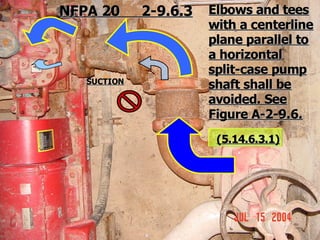
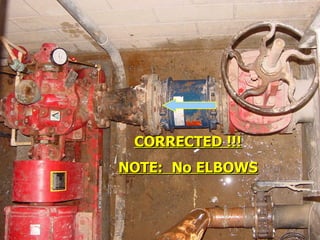
  • 143.
    Is it “ Isit “SAFE SAFE”? Is it “CORRECT”? ”? Is it “CORRECT”? Power, sensing lines, reducers, Power, sensing lines, reducers, UL/FM piping , water supply UL/FM piping , water supply. Jockey and main fire pump must each have a separate ½ “ sensing line with 2 ea. 3/32 “ orifices located at least 5’ – 0” apart . `NFPA 20 7-5.2.1 and appendix!! (10.5.2.1.6) NFPA 20 7-5.2.1 and appendix!! (10.5.2.1.6) Case relief valve (electric fire pumps) piped to a REQUIRED REQUIRED floor drain in in the pump room??? NFPA 20 2-6.1 and 2-7.6 (5.12.6.2) Do not pipe Case Relief Valve discharge and Packing Drain lines together into a common drain line (5.11.1.5) Pump coupling and guard secured???
  • 144.
    IS THIS ACONFINED SPACE???? IS THIS A CONFINED SPACE???? Is the “TEST SET UP” (test hoses, rack, Is the “TEST SET UP” (test hoses, rack, and play pipes) pump location “ and play pipes) pump location “SAFE” SAFE”? ?
  • 145.
    Would Would “ “YOU YOU” go ” go downhere down here to test this to test this pump???? pump???? OSHA APPROVED ??? OSHA APPROVED ??? NFPA 25 4.7.1 NFPA 25 4.7.1 and A.4.8 and A.4.8 ( A.5.12) DRAINAGE and VENTILATION ( A.5.12) DRAINAGE and VENTILATION ) )
  • 146.
    STATE of OHIOFIRE SCHOOL - BGSU 146 Note : Rods on Note : Rods on transition piece!! transition piece!! NOTE : This fire pump develops 165 psi at churn ! The class 125 fittings are good for a maximum working pressure of 175 psi. (5.7.4.1)
  • 147.
    STATE of OHIOFIRE SCHOOL - BGSU 147 NO RODS !!! SAFE ?? Look at the pipe fittings !! This pump installation develops 213 PSI at churn. A 125 lb flanged fitting is rated at 175 PSI maximum working pressure !! NFPA 20 (5.7.4.1) NFPA 13 15.1.6.1.1 NFPA 13 15.1.6.1.1
  • 148.
    STATE of OHIOFIRE SCHOOL - BGSU 148 TEST HEAD ?? TEST HEAD ?? Test Header outside Test Header outside of the pump house or of the pump house or “IN” the pump room “IN” the pump room ? ? NFPA 20 (A.5.19.3.1) NFPA 20 (A.5.19.3.1)
  • 149.
    STATE of OHIOFIRE SCHOOL - BGSU 149 Has the Voltage Been Checked ?? Has the Voltage Been Checked ?? Check NFPA 70E and NFPA 25 A.4.8 Check NFPA 70E and NFPA 25 A.4.8 WHERE DOES THE POWER COME FROM ? WHERE DOES THE POWER COME FROM ? IS THERE ANOTHER DISCONNECT OR IS THERE ANOTHER DISCONNECT OR FUSES ??? FUSES ??? PRESSURE PRESSURE RECORDER RECORDER
  • 150.
    Each “Fire Pump”Controller MUST have IT’S Each “Fire Pump” Controller MUST have IT’S OWN Pressure Sensing Line and Pressure OWN Pressure Sensing Line and Pressure Recorder Recorder NFPA 20 (10.5.2.1.6) and (12.5.2.1.6) * NFPA 20 (10.5.2.1.6) and (12.5.2.1.6) *
  • 151.
    NOTE: Main firepump NOTE: Main fire pump controller sensing line is controller sensing line is connected between the connected between the pump discharge check pump discharge check valve and the system shut valve and the system shut - off valve. (10.5.2.1.6) - off valve. (10.5.2.1.6)
  • 152.
    NFPA 20 10.5.2.1* NFPA20 10.5.2.1* One sensing line One sensing line Two (2) CONTROLLERS ?? Two (2) CONTROLLERS ?? NFPA 20 NFPA 20 (10.5.2.1.6) (10.5.2.1.6) Pressure Pressure Recorder Recorder MISSING! MISSING!
  • 153.
    One sensing linefor 3 controllers ?? One sensing line for 3 controllers ??
  • 154.
    Pressure Recorder Pressure Recorder Eachfire pump controller must have it’s own recorder !! Each fire pump controller must have it’s own recorder !! (10.5.2.1.6) (10.5.2.1.6)
  • 155.
    *On the pumpsuction, a listed OSY valve is required: no valve, other than a listed OSY valve is allowed within 50 feet of the pump suction flange NFPA 20 (5.14.5.2)* *When located in the suction pipe of a fire pump, back flow prevention devices, check valves, and pipeline strainers (for in-line pumps) shall be no shall be no closer than 10 pipe diameters from the pump closer than 10 pipe diameters from the pump suction flange suction flange. NFPA 20 (5.14.6.3.1) (5.26.3)*
  • 156.
    STATE of OHIOFIRE SCHOOL - BGSU 156 NOTE ROTATION ? NOTE ROTATION ? Counter-Clockwise Counter-Clockwise LEFT Hand * LEFT Hand * Impeller Turns Impeller Turns Toward The Suction ! Toward The Suction ! Have The Wire Have The Wire Connections Been Connections Been Checked By the Checked By the Electrician and/or Electrician and/or Controller Guy ? Controller Guy ? SUCTION OSY OSY Valve Valve
  • 157.
    STATE of OHIOFIRE SCHOOL - BGSU 157 ! ! (5.14.6.4) (5.14.6.4) Elbows and tees with a centerline Elbows and tees with a centerline plane parallel to a horizontal split-case plane parallel to a horizontal split-case pump shaft shall be avoided. See pump shaft shall be avoided. See Figure A-2-9.6. (5.14.6.3.1) Figure A-2-9.6. (5.14.6.3.1) If there is a parallel elbow : YOU If there is a parallel elbow : YOU MUST HAVE 10 PIPE DIAMETERS MUST HAVE 10 PIPE DIAMETERS of STRAIGHT PIPE BETWEEN THE of STRAIGHT PIPE BETWEEN THE ELBOW AND PUMP SUCTION ELBOW AND PUMP SUCTION FLANGE (5.14.6.3.2) FLANGE (5.14.6.3.2)
  • 158.
    STATE of OHIOFIRE SCHOOL - BGSU 158 OSY OSY Suction Suction Valve Valve NOTE: Backflow Preventer! NOTE: The long straight run of suction pipe after a HORIZONTAL 90 DEGREE ELBOW ! More than 10 pipe diameters ? (5.14.6.3.2)
  • 159.
    NOTE STRAINER! NOTE STRAINER! 10pipe 10 pipe dia. ?? dia. ?? OSY OSY Valve Valve NFPA 20 3-3.4 (6.3.4) NFPA 20 3-3.4 (6.3.4)
  • 160.
    Batteries Properly Connectedand Batteries Properly Connected and Electrolyte Topped Off ?? USE CAUTION Electrolyte Topped Off ?? USE CAUTION WHEN FILLING AND CONNECTING WHEN FILLING AND CONNECTING LEAD ACID BATTERIES !!! LEAD ACID BATTERIES !!! Dual Dual Batteries Batteries Have The Wire Connections been Checked at “BOTH” “BOTH” The Engine and Controller ??? Wires Correct and Terminals “TIGHT” Wires Correct and Terminals “TIGHT”
  • 161.
    DO NOT USEFORKED DO NOT USE FORKED CONNECTORS FM F27-92 CONNECTORS FM F27-92
  • 162.
    7. Check forCERTIFICATE of 7. Check for CERTIFICATE of CALIBRATION for test equip. CALIBRATION for test equip. “ “TEST GAUGES” TEST GAUGES” and “CLAMP-ON VOLT/AMMETERS” should be re- calibrated and certified every 12 months (by an approved testing and calibration facility)….Most never get calibrated and certified ! NFPA 20 NFPA 20 (A.14.2.7.1) (A.14.2.7.1) “ “TEST GAUGES” TEST GAUGES” will have an accuracy of; will have an accuracy of; 0.25% 0.25% (ASME Grade 3A) (ASME Grade 3A) or sometimes- 0.5% 0.5% (ASME Grade 2A) pocket (ASME Grade 2A) pocket “TEST GAUGES” “TEST GAUGES” or inspectors or inspectors “TEST GAUGES”. “TEST GAUGES”. DEMAND a “Certificate of Calibration” from an approved testing and calibration facility –then- Check and Verify the Serial Numbers! If you suspect a problem, write down the phone number of the calibration facility and phone them!! Look for Look for “TEST GAUGE” “TEST GAUGE” on the dial. on the dial.
  • 164.
    Calibrated “TEST GAUGES” Calibrated“TEST GAUGES” plus CALIBRATION plus CALIBRATION DOCUMENTATION as per DOCUMENTATION as per NFPA 20 A-11-2.6.1 NFPA 20 A-11-2.6.1 (A.14.2.7.1) (A.14.2.7.1)
  • 167.
    8. Decide inadvance just what is 8. Decide in advance just what is to take place during the testing…. to take place during the testing…. WHO WILL TAKE CHARGE ? WHO WILL TAKE CHARGE ? What test equipment will be used ? What flow points (PITOTS) will be targeted ? Who will do what ???? TAKE THE PITOT READINGS ? ADJUST and HOLD THE TEST VALVES ? TAKE PRESSURE AND RPM READINGS ? RECORD and PLOT THE TEST RESULTS ? TAKE THE ELECTRICAL READINGS ? PRE RUN EQUIPMENT CHECK LIST ?? PRE RUN EQUIPMENT CHECK LIST ??
  • 168.
    SOMEONE HAS SOMEONE HAS TOTAKE CHARGE TO TAKE CHARGE OF THE PUMP OF THE PUMP TEST ? TEST ? Will It Be The Sprinkler Will It Be The Sprinkler Guy, The Local Fire Guy, The Local Fire Official, The Pump Guy, Official, The Pump Guy, The Insurance Guy, or The Insurance Guy, or The Owners Rep ? The Owners Rep ? SOMEONE HAS TO SOMEONE HAS TO STEP UP TO THE STEP UP TO THE PLATE !! PLATE !!
  • 169.
  • 170.
    STATE of OHIOFIRE SCHOOL - BGSU 170 FLOW METER FLOW METER When a flow meter is When a flow meter is used, you must have an used, you must have an air vent valve or auto air air vent valve or auto air release valve to eliminate release valve to eliminate ALL ALL air from the flow air from the flow meter piping ! meter piping ! 10 X D 10 X D 4 X D 4 X D
  • 171.
    <FM> Short PlayPipe Underwriters Play Pipe 1 ¾ ” Nozzle 1 1/8 ” Nozzle Pitot Tube
  • 172.
    STATE of OHIOFIRE SCHOOL - BGSU 172 FREE FLOW WITH HOSES AND PLAYPIPES FREE FLOW WITH HOSES AND PLAYPIPES
  • 173.
    STATE of OHIOFIRE SCHOOL - BGSU 173 Each additional pitot Each additional pitot tube, used during the tube, used during the test, will increase the test, will increase the chance for error! chance for error! Use 1 pitot tube and 1 Use 1 pitot tube and 1 gauge which has gauge which has been checked prior to been checked prior to the start of the test! the start of the test!
  • 174.
    STATE of OHIOFIRE SCHOOL - BGSU 174
  • 175.
    STATE of OHIOFIRE SCHOOL - BGSU 175 In Areas where water shortages exist, In Areas where water shortages exist, the test water can be discharged back the test water can be discharged back to the stored supply ! to the stored supply !
  • 176.
    STATE of OHIOFIRE SCHOOL - BGSU 176 THERBOLIZER 6 THERBOLIZER 6
  • 177.
    STATE of OHIOFIRE SCHOOL - BGSU 177 Test Header Test Header arranged to SAFELY arranged to SAFELY discharge directly to discharge directly to the Pond the Pond
  • 178.
    STATE of OHIOFIRE SCHOOL - BGSU 178
  • 179.
    STATE of OHIOFIRE SCHOOL - BGSU 179 A A B B C C . . . “ “CHURN” CHURN” Pressure Pressure “RATED 100% FLOW “ 1 Hose, Pitot of 32 PSI “ 150 % FLOW “ 2 Hoses, Pitots of 18 PSI What Flow Points Will Be Targeted? What Flow Points Will Be Targeted?
  • 180.
  • 181.
    To determine To determine FEETof HEAD FEET of HEAD multiply multiply (H) (H) (net PSI) X 2.31* (net PSI) X 2.31* To determine (H) To determine (H) (net PSI) (net PSI) subtract subtract Suction PSI Suction PSI from from Discharge PSI Discharge PSI 150 PSI 150 PSI 50 PSI 50 PSI 100 PSI 100 PSI 231’ (ft) 231’ (ft) Who will observe Who will observe and record the and record the test results ?? test results ??
  • 182.
    STATE of OHIOFIRE SCHOOL - BGSU 182 WHO Will Take The Pitot Readings ?? Does that person know the CORRECT Procedure ?
  • 183.
    To Obtain a ToObtain a Correct Correct Pressure Pressure Reading With A Reading With A Pitot Tube, It Pitot Tube, It “MUST” Be “MUST” Be Held In The Held In The Center of The Center of The Flow Stream Flow Stream And It “MUST” And It “MUST” Be Kept Be Kept Perpendicular Perpendicular To the Flow To the Flow Stream Stream
  • 184.
    STATE of OHIOFIRE SCHOOL - BGSU 184 Hold The HOSE TEST VALVES After the Hold The HOSE TEST VALVES After the Pitot Readings have been obtained. Pitot Readings have been obtained. Will These Hose Valves Vibrate or Chatter Open ? Will These Hose Valves Vibrate or Chatter Open ?
  • 185.
    NFPA 70E and NFPA70E and OSHA OSHA 1910.333 1910.333 Only Only “QUALIFIED” “QUALIFIED” persons are persons are permitted to work on permitted to work on or near “LIVE” or near “LIVE” exposed parts of exposed parts of electrical equipment. electrical equipment. 3. 3. Distinguish live parts. Distinguish live parts. (WHAT’S HOT, WHAT’S NOT ?) (WHAT’S HOT, WHAT’S NOT ?) 4. 4. Determine nominal voltage and Determine nominal voltage and protection required. protection required. 5. 5. Determine the minimum Determine the minimum required safe clearance or safe required safe clearance or safe working distances. working distances. (4 feet / 12 inches ) * (4 feet / 12 inches ) * ARC-FLASH ARC-FLASH 12 Inches 12 Inches MINIMUM MINIMUM NEC Digest - Feb. 2006 NEC Digest - Feb. 2006
  • 186.
    OSHA may citenon-compliance with OSHA may cite non-compliance with 29CFR 1910.335(a)(1)(i) 29CFR 1910.335(a)(1)(i) which requires which requires the use of protective equipment when working the use of protective equipment when working where a potential electrical hazard does where a potential electrical hazard does exist.** exist.** -OR- -OR- 29CFR 1910.132(d)(1), 29CFR 1910.132(d)(1), which requires which requires employer assessment of workplace hazards employer assessment of workplace hazards and the use of personal protective equipment. and the use of personal protective equipment. These regulations are supported by NFPA 70E. These regulations are supported by NFPA 70E. NFPA 70E, is NFPA 70E, is NOT LAW NOT LAW, however, it helps , however, it helps employers by providing education, guidance, employers by providing education, guidance, and and “how-to” “how-to” for compliance. for compliance.
  • 187.
    CONFIRM THAT PUMPBASE IS PROPERLY GROUTED CONFIRM THAT PUMP BASE IS PROPERLY GROUTED CONFIRM THAT ALL EQUIPMENT IS ALIGNED AND LUBRICATED CONFIRM THAT ALL EQUIPMENT IS ALIGNED AND LUBRICATED CONFIRM THAT COUPLING GUARDS ARE INSTALLED CONFIRM THAT COUPLING GUARDS ARE INSTALLED CONFIRM CASE RELIEF, AIR RELEASE, COOLING WATER ALL CORRECT CONFIRM CASE RELIEF, AIR RELEASE, COOLING WATER ALL CORRECT CONFIRM THAT POWER IS CORRECT and “ON” CONFIRM THAT POWER IS CORRECT and “ON” CONFIRM THAT WATER IS AVAILABLE and “ON” (PUMP PRIMED) CONFIRM THAT WATER IS AVAILABLE and “ON” (PUMP PRIMED) CONFIRM THAT PUMP HAS PROPER ROTATION CONFIRM THAT PUMP HAS PROPER ROTATION CONFIRM THAT VALVES ARE IN CORRECT POSITION FOR TESTING CONFIRM THAT VALVES ARE IN CORRECT POSITION FOR TESTING CONFIRM SAFE TEST SET UP (HOSES, PLAYPIPES, WATER DISPOSAL) CONFIRM SAFE TEST SET UP (HOSES, PLAYPIPES, WATER DISPOSAL) CONFIRM THAT SYSTEM PRESSURE IS AT OR ABOVE EXPECTED FIRE CONFIRM THAT SYSTEM PRESSURE IS AT OR ABOVE EXPECTED FIRE PUMP CHURN PRESSURE (USE THE JOCKEY PUMP) -OR- PUMP CHURN PRESSURE (USE THE JOCKEY PUMP) -OR- IT IS PREFERABLE TO ISOLATE THE SYSTEM IT IS PREFERABLE TO ISOLATE THE SYSTEM “ “CLOSE THE DISCHARGE CLOSE THE DISCHARGE (SYSTEM) VALVE” (SYSTEM) VALVE” KEEP IT CLOSED DURING FLOW TESTING KEEP IT CLOSED DURING FLOW TESTING ! ** ! ** FIRE PUMP “PRE-RUN” CHECK LIST FIRE PUMP “PRE-RUN” CHECK LIST LAST CHANCE LAST CHANCE - PRIOR TO TEST - PRIOR TO TEST
  • 188.
    Base is not Baseis not grouted!!! grouted!!! (6.4.1) (6.4.1)
  • 190.
    Motor Oil Full? Motor Oil Full ? Check It ! Check It ! LAST CHANCE !!! LAST CHANCE !!! Gear Oil Full ? Gear Oil Full ? Double Check Double Check It ! It ! What Oil Did They What Oil Did They Use ?? Use ?? ASK !! ASK !!
  • 191.
    Is The EngineOil and Is The Engine Oil and Coolant Correct ? Coolant Correct ? Checked By Engine Guy Checked By Engine Guy ?? ?? Block Block Heater Heater Working ?? Working ?? 120 Degrees F 120 Degrees F (11.6.5.2) (11.6.5.2)
  • 192.
    NOTE : GuardIs In Place ! NOTE : Guard Is In Place ! NFPA 20 (5.12.7) ** NFPA 20 (5.12.7) ** NOTE : Cooling NOTE : Cooling Water For Gear Water For Gear Connected ! Connected ! Flow Visible ?? Flow Visible ?? (7.5.1.6.5) (7.5.1.6.5)
  • 194.
  • 195.
    IS THE POWERON IS THE POWER ON ?? ?? Has the Voltage Been CONFIRMED and Has the Voltage Been CONFIRMED and controller digital readout controller digital readout (amps/volts) (amps/volts) compared to readings taken with a compared to readings taken with a “CALIBRATED” hand held amp / volt “CALIBRATED” hand held amp / volt multimeter ?? multimeter ??
  • 196.
    Supply “OSY” ValveOPEN, Water Supply “OSY” Valve OPEN, Water Available, and pump primed ?? Available, and pump primed ?? NOTE ROTATION ? NOTE ROTATION ? Clockwise / Right Hand Clockwise / Right Hand Impeller Turns Toward Impeller Turns Toward The Suction ! ** The Suction ! ** SUCTION This Pump This Pump Base Has Base Has Been Properly Been Properly Grouted ! Grouted ! (6.4.1) (6.4.1)
  • 197.
    FIRE PUMP FIRE PUMP TESTHEAD TEST HEAD OUTSIDE ! ! OUTSIDE ! ! Hose valves Hose valves closed and closed and hoses hoses connected ? connected ?
  • 198.
    Playpipes secured sowater can be SAFELY Playpipes secured so water can be SAFELY disposed of during flow testing ?? disposed of during flow testing ??
  • 199.
    OPEN Test OPEN Test HeaderValve Header Valve System Pressure at or System Pressure at or above “EXPECTED” above “EXPECTED” Fire Pump Churn Fire Pump Churn Pressure -or- Pressure -or- Discharge (System) Discharge (System) Valve Valve CLOSED During CLOSED During the Flow Test the Flow Test ??** ??** 1/2” Test 1/2” Test Head Drain Head Drain Valve Valve Closed ?? Closed ?? (Bottom of (Bottom of Test Head Test Head Pipe ! ) Pipe ! ) Outside Hose Outside Hose Valves Closed ?? Valves Closed ??
  • 200.
    TEST HEAD TEST HEAD CONTROL CONTROL VALVEOPEN VALVE OPEN FOR TEST ??? FOR TEST ??? ½” TEST HEAD ½” TEST HEAD DRAIN VALVE DRAIN VALVE CLOSED FOR CLOSED FOR TEST ! TEST !
  • 201.
    9. 9. Operate thepump at Operate the pump at CHURN CHURN PSI PSI (POINT A on CURVE) (POINT A on CURVE) Momentarily Operate the Pump Momentarily Operate the Pump - Check for - Check for rotation, vibration, pressures, leaks, unusual sounds. rotation, vibration, pressures, leaks, unusual sounds. Start The Pump Again: Start The Pump Again: Check the pump for vibration, temperature, Check the pump for vibration, temperature, case relief valve operation (Electric) or cooling water case relief valve operation (Electric) or cooling water flow (Diesel), bearing temp, packing leakage, pump flow (Diesel), bearing temp, packing leakage, pump pressures, RPM, Electrical (Controller Guy), etc. pressures, RPM, Electrical (Controller Guy), etc. “ “DO NOT” DO NOT” stand in front of electrical panels or motor junction boxes and keep the controller doors closed during the initial starts (THINK SAFETY - 4 Foot Rule). Note the Note the test start time test start time… Pump must be operated for AT LEAST ONE HOUR AT LEAST ONE HOUR for “ENTIRE” acceptance test ! NFPA 20 11-2.11 ( 14.2.12 )
  • 202.
    PACKING LEAKAGE: 1– 2 PACKING LEAKAGE: 1 – 2 Drops per second +/- Drops per second +/- Adjust as Needed ¼ Turn ! Adjust as Needed ¼ Turn ! Packing and bearings Packing and bearings SHOULD stay cool or SHOULD stay cool or warm to the touch!! warm to the touch!! (14.2.5) (14.2.5)
  • 203.
    Case Relief Valve CaseRelief Valve “FULL” Stream “FULL” Stream Discharge To an Discharge To an Open Floor Drain ? Open Floor Drain ? Packing Drain Packing Drain Lines Piped to a Lines Piped to a Floor Drain !! Floor Drain !! Does the pump and Does the pump and motor stay COOL ? motor stay COOL ? (14.2.5) (14.2.5)
  • 204.
    10. Record 10. RecordChurn Churn PSI Readings, PSI Readings, RPM, AMPS, VOLTS, RPM, AMPS, VOLTS, Look at the factory shop test curve and plot the Churn Pressure in feet of head feet of head, (no-flow POINT A A). How close is it ???? NFPA 20 11-2.3 ( 14.2.4.2 ) NFPA 20 11-2.3 ( 14.2.4.2 ) NOTE: Some pumps will require a correction for (RPM) speed !!! NFPA 20 A-11-2.6.3 ( A.14.2.7.3.f ) NFPA 20 A-11-2.6.3 ( A.14.2.7.3.f ) REMEMBER THIS REMEMBER THIS - TO GET FEET OF HEAD !! - TO GET FEET OF HEAD !! 1 PSI = 2.31 FEET OF HEAD -or- 1 PSI = 2.31 FEET OF HEAD -or- .433 PSI = 1 FOOT OF HEAD .433 PSI = 1 FOOT OF HEAD
  • 205.
  • 206.
    11. Operate thepump at additional “TARGETED” 11. Operate the pump at additional “TARGETED” flow points : 50%, 100%, flow points : 50%, 100%, 150%, Etc. 150%, Etc. With the hose valves closed, SLOWLY open test head valve to pressurize test head (If it is not already open and pressurized). (DISCHARGE (SYSTEM) VALVE and TEST (DISCHARGE (SYSTEM) VALVE and TEST HEAD DRAIN VALVE SHOULD ALREADY BE CLOSED) HEAD DRAIN VALVE SHOULD ALREADY BE CLOSED) Open Open and adjust adjust appropriate number of hose valves to obtain each targeted flow point (PITOT). You should already know how many hose streams and what Pitot Readings will be required to obtain “EACH” Targeted Flow point!! Double check pitot readings, do not allow hose valves to vibrate open after obtaining the targeted pitot readings, and make sure that there are “NO” kinks in the hoses !!! NOTE: On High Pressure Systems (above 150 PSI) it may be NOTE: On High Pressure Systems (above 150 PSI) it may be desirable to desirable to Open Open the proper number of hose valves and regulate the the proper number of hose valves and regulate the pitot pressures with the pitot pressures with the Test Header Control Valve Test Header Control Valve. . AVERAGE AVERAGE the pitot readings (NO MATTER HOW CAREFUL YOU the pitot readings (NO MATTER HOW CAREFUL YOU ARE, ALL OF THE PITOT READINGS WILL NOT BE THE SAME) !! ARE, ALL OF THE PITOT READINGS WILL NOT BE THE SAME) !!
  • 207.
    12. Record PSI,RPM, AMPS, 12. Record PSI, RPM, AMPS, VOLTS, (compare and plot VOLTS, (compare and plot results on the factory curve). results on the factory curve). Do the field test results duplicate the factory shop test curve for EACH EACH flow point ??? NFPA 20 NFPA 20 11-2.3 ( 14.2.4.2) 11-2.3 ( 14.2.4.2) If any results are “OFF” Double Check PITOT Readings? Correct for RPM ? ( On Small Pumps check the Case Relief ( On Small Pumps check the Case Relief Valve flow. The case relief discharge flow could be as much Valve flow. The case relief discharge flow could be as much as 5% to 10% of the rated flow of smaller pumps !! ) as 5% to 10% of the rated flow of smaller pumps !! ) If Total Head ( Total Head (Net PSI Net PSI) is STILL STILL low, do we need to correct for velocity head? Triple Check PITOT Readings, hose valves vibrating open, gauge piping plugged, RPM low??? AS A LAST RESORT : before you pull the cover to check AS A LAST RESORT : before you pull the cover to check for rocks - retest using a backup set of calibrated “TEST for rocks - retest using a backup set of calibrated “TEST GAUGES” and backup pitot tube with gauge! GAUGES” and backup pitot tube with gauge!
  • 208.
    STATE of OHIOFIRE SCHOOL - BGSU 208 B B C C . . . “RATED 100% FLOW “1 Hose, Pitot of 32 PSI “ 150 % FLOW “ 2 Hoses, Pitots of 18 PSI
  • 209.
    LOW TEST RESULTS? WHY ? LOW TEST RESULTS ? WHY ? Are there any kinks Are there any kinks in the hoses?? in the hoses?? Hose Valves Hose Valves Vibrating Open ? Vibrating Open ? Is this guy doing his job ? Is this guy doing his job ?
  • 210.
    STATE of OHIOFIRE SCHOOL - BGSU 210 Did Did Someone Someone Stay Outside to Adjust and Stay Outside to Adjust and Hold Hold The HOSE VALVES (especially ANGLE Valves) to The HOSE VALVES (especially ANGLE Valves) to Keep Them From Vibrating Open Keep Them From Vibrating Open ? ?
  • 211.
    STATE of OHIOFIRE SCHOOL - BGSU 211 DOUBLE or TRIPLE Check DOUBLE or TRIPLE Check Pitot Readings !! Pitot Readings !! CONFIRM CONFIRM Pitot Gauge Pitot Gauge accuracy prior to testing ! accuracy prior to testing !
  • 212.
    ? ? Check pitot tubeand Check pitot tube and gauge for fouling , which gauge for fouling , which might occur during test? might occur during test?
  • 213.
    Each additional pitot Eachadditional pitot tube, used during the tube, used during the test, will increase the test, will increase the chance for error! chance for error! Use 1 pitot tube and 1 Use 1 pitot tube and 1 gauge which has been gauge which has been checked prior to the checked prior to the start of the test! start of the test! Half of all field Half of all field test problems test problems involve the involve the “USE” of, or the “USE” of, or the “MIS-USE” of, “MIS-USE” of, Hose Monsters Hose Monsters
  • 214.
    STATE of OHIOFIRE SCHOOL - BGSU 214 Calibrated Test Gauges ( Calibrated Test Gauges ( liquid filled gauges are liquid filled gauges are NOT NOT Test gauges )* Test gauges )*
  • 215.
    STATE of OHIOFIRE SCHOOL - BGSU 215 Gauge connection Gauge connection piping must have a full piping must have a full flow when flushed flow when flushed (checked) PRIOR to (checked) PRIOR to flow testing of the flow testing of the fire pump. fire pump. Check for an Check for an obstruction during obstruction during testing, if test results testing, if test results are not correct ! are not correct !
  • 216.
    STATE of OHIOFIRE SCHOOL - BGSU 216 DO NOT DO NOT connect test connect test gauges to gauges to case relief case relief valve piping ! valve piping !
  • 217.
    STATE of OHIOFIRE SCHOOL - BGSU 217 On small fire pumps the On small fire pumps the case relief valve case relief valve discharge may be as discharge may be as much as 10% of the much as 10% of the rated flow - if it has not rated flow - if it has not shut off during the test. shut off during the test.
  • 218.
    STATE of OHIOFIRE SCHOOL - BGSU 218 Main system relief Main system relief valve must be closed valve must be closed for testing !** for testing !** Failure to do so will Failure to do so will result in low (POOR) result in low (POOR) test results ! test results !
  • 219.
    STATE of OHIOFIRE SCHOOL - BGSU 219 ! ! (5.14) (5.14) Elbows and tees with a centerline Elbows and tees with a centerline plane parallel to a horizontal split-case plane parallel to a horizontal split-case pump shaft shall be avoided. See pump shaft shall be avoided. See Figure A-2-9.6. (5.14.6.3.1) Figure A-2-9.6. (5.14.6.3.1) If there is a parallel elbow : YOU If there is a parallel elbow : YOU MUST HAVE 10 PIPE DIAMETERS MUST HAVE 10 PIPE DIAMETERS of STRAIGHT PIPE BETWEEN THE of STRAIGHT PIPE BETWEEN THE ELBOW AND PUMP SUCTION ELBOW AND PUMP SUCTION FLANGE (5.14.6.3.2)** FLANGE (5.14.6.3.2)** PIPE SIZE ? PIPE SIZE ? NFPA 20 NFPA 20 (5.14.3.4) (5.14.3.4)
  • 222.
    Curve will continue Curvewill continue to drop off as the to drop off as the flow increases flow increases
  • 223.
    Impeller is not Impelleris not centered in the case. centered in the case.
  • 224.
  • 225.
    STATE of OHIOFIRE SCHOOL - BGSU 225 Top Shaft Nut is Top Shaft Nut is used to raise shaft used to raise shaft and impellers and impellers approximately approximately 1/8 1/8 “ inch. (see “ inch. (see instruction book) instruction book) VTFP Best Lateral Setting LOW LOW PERFORMANCE PERFORMANCE MAY RESULT IF MAY RESULT IF LATERAL IS NOT LATERAL IS NOT CORRECT ! CORRECT !
  • 226.
    STATE of OHIOFIRE SCHOOL - BGSU 226 Check Submergence Check Submergence (MEASURE) how far (MEASURE) how far down down (feet) (feet) the the water level is from water level is from the gauge center the gauge center line, line, at each flow at each flow point ! point ! REMEMBER : This REMEMBER : This must be must be added added to to the reading ( TH ) the reading ( TH ) on the discharge on the discharge TEST GAUGE ! TEST GAUGE ! WL ?? WL ?? ADD + ADD +
  • 228.
    VTFP INTAKE PROBLEMS……….. VTFPINTAKE PROBLEMS……….. Removable screens NFPA 20 A4-2.2.2 (5.14.8.3) (5.14.8.3) Intake size ??? Intake size ??? NFPA 20 A4-2.2 NFPA 20 A4-2.2 (5.14.8.4) (5.14.8.4) 2 ft/sec and 2 ft/sec and 1 Sq. Inch per 1 Sq. Inch per GPM at GPM at 150% Flow ? 150% Flow ?
  • 229.
    STATE of OHIOFIRE SCHOOL - BGSU 229 Removable screens? Check Removable screens? Check for fouling (build-up) ! for fouling (build-up) !
  • 230.
    STATE of OHIOFIRE SCHOOL - BGSU 230 With a vertical With a vertical turbine fire pump turbine fire pump a plugged screen a plugged screen will affect will affect (lower) (lower) the water the water level in the sump! level in the sump! Check Check (measure) (measure) the water level in the water level in the sump during the sump during each and every each and every flow point ! flow point !
  • 231.
    A plugged basketstrainer on A plugged basket strainer on the bottom of the pump will the bottom of the pump will reduce the total pump reduce the total pump performance. performance.
  • 232.
    STATE of OHIOFIRE SCHOOL - BGSU 232 Underwater Inspection of Basket Strainer Underwater Inspection of Basket Strainer
  • 235.
    13. * “6”AUTO starts and “6” MANUAL starts * (one “FULL LOAD” start) When an electric fire pump is provided with an automatic transfer switch, at least half of the starts should be performed while the fire pump is connected to the emergency power source (with one start under peak load). ** NFPA 20 (14.2.8) (14.2.7.4) ** NFPA 20 (14.2.8) (14.2.7.4) ** NOTE: Pumps should be operated for 5 Min. for each NOTE: Pumps should be operated for 5 Min. for each start (This will allow the Motor and Controller time to start (This will allow the Motor and Controller time to Cool Down) Cool Down) When a diesel driven fire pump is provided, the starts shall be When a diesel driven fire pump is provided, the starts shall be divided between both sets of batteries. divided between both sets of batteries. NFPA 20 (14.2.8.7) NFPA 20 (14.2.8.7)
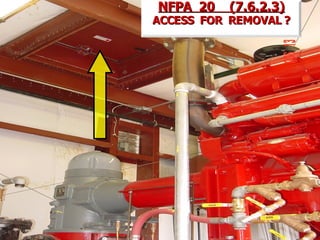
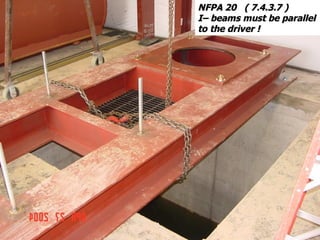
  • 236.
    1. 1. Controller andDriver alarms Controller and Driver alarms connected, tested, and connected, tested, and demonstrated + low suction… demonstrated + low suction… A. Electric requires Power Available, Phase Reversal, Pump Running, and Controller Connected to Alt. Source …..… NFPA 20 (10.4.7.2) (These are “TROUBLE TROUBLE” or “SUPERVISORY SUPERVISORY” ” alarms alarms) B. Diesel engine is much more involved…..* Engine Trouble - High temp, low oil pressure, over crank - fail to start, charger fail, battery fail, over speed, low fuel, Switch Not in Auto, and Engine Run…….NFPA 20 (12.6.7.3) …….NFPA 20 (12.6.7.3) (These are “TROUBLE TROUBLE” or “SUPERVISORY SUPERVISORY” ” alarms alarms) Pressure Recorder Installed / Operational ??? Pressure Recorder Installed / Operational ??? EACH EACH Fire Pump Controller is required to be furnished with a pressure recorder. (ELECTRONIC or CHART TYPE) (ELECTRONIC or CHART TYPE) NFPA 20 NFPA 20 (10.5.2.1.6 and 12.6.9.1) (10.5.2.1.6 and 12.6.9.1)
  • 238.
    Main Fire Pumpand Jockey Pump. Main Fire Pump and Jockey Pump. Use a “TEST GAUGE” to Use a “TEST GAUGE” to confirm set points. confirm set points. NFPA NFPA 20 A-11-2.6 (A.14.2.7) 20 A-11-2.6 (A.14.2.7) Jockey “STOP” Jockey “STOP” = Fire Pump churn pressure plus (+) lowest static suction pressure ! Jockey “START” Jockey “START” = Jockey Stop PSI less (-) 10 PSI Fire Pump “START” Fire Pump “START” = Jockey Start less (-) 5 –10 PSI “ “MANUAL” Fire Pump “STOP” MANUAL” Fire Pump “STOP” = ( Must be used when Fire Pump is a sole supply pump) ! - or - (if permitted by L.A.H.J.) “ “AUTOMATIC” Fire Pump “STOP” AUTOMATIC” Fire Pump “STOP” = (Fire Pump churn + lowest static suction)
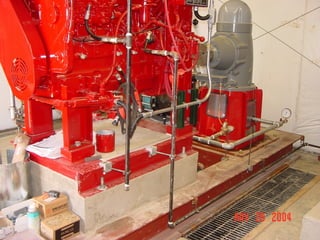
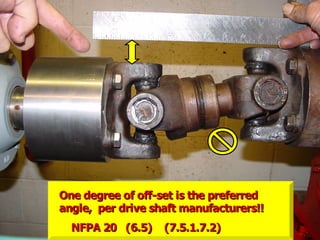
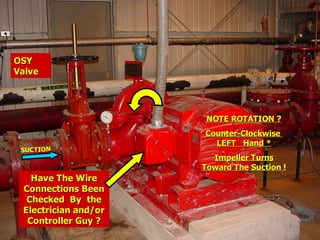
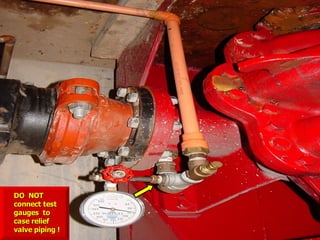
  • 239.
    STATE of OHIOFIRE SCHOOL - BGSU 239 Jockey Jockey Pump Pump
  • 240.
    STATE of OHIOFIRE SCHOOL - BGSU 240 Jockey Pump Control Jockey Pump Control Set Jockey Pump to STOP At /OR Near The Maximum (CHURN) Discharge Pressure of the Main Fire Pump !! Set Jockey Pump To START at 10 - 20 PSI Less
  • 243.
    16. Low SuctionShut Down 16. Low Suction Shut Down Panel/Device Listed, Tested Panel/Device Listed, Tested AND “Alarm” Connected ? AND “Alarm” Connected ? Required by some states to protect the public water supply, when it is used as the main water source. Set to lock out the fire pump at 20 PSI, 20 PSI, after a 30 second 30 second delay - delay - with with manual re-set only (OHIO) and ALARM must be monitored (5.23) manual re-set only (OHIO) and ALARM must be monitored (5.23). Must be FM or UL listed for Fire Protection Equipment – Must be FM or UL listed for Fire Protection Equipment – not UL Industrial !! not UL Industrial !! NFPA 13 15.1.8.3 Is the “EQUIPMENT” or “DEVICE” listed in the UL or FM Is the “EQUIPMENT” or “DEVICE” listed in the UL or FM Directory for Fire Protection Equipment Directory for Fire Protection Equipment ? CHECK THE BOOK ! CHECK THE BOOK !
  • 244.
    - See if you canfind this low suction control listed in the UL or FM Directory for Fire Protection Equipment ??? ???
  • 245.
    See if youcan See if you can find this low find this low suction suction “DEVICE” “DEVICE” listed listed in the UL or FM in the UL or FM Directory for Directory for Fire Fire Protection Protection Equipment Equipment ?? ??
  • 246.
    Ohio EPA andOhio Department of Health Ohio EPA and Ohio Department of Health CHECK WITH “ YOUR” LAHJ ? CHECK WITH “ YOUR” LAHJ ?
  • 247.
    Suction Control Valve SuctionControl Valve Should be located Should be located between the pump between the pump discharge and the discharge and the discharge check valve ! discharge check valve ! Sensing line for suction control valve Sensing line for suction control valve and/or low suction shut down panel and/or low suction shut down panel should be at least should be at least ½” ½” (Copper, 300 (Copper, 300 Stainless, or Brass) and include provision Stainless, or Brass) and include provision
  • 248.
    UL/FM Suction UL/FM Suction ControlValve Control Valve ½” ½” Suction Suction Pressure Pressure sensing sensing line ! line ! In the State of Ohio a UL or FM Listed low suction shut down control is required to protect a public water supply – this is in addition to any suction control valve (which may “ALSO” “ALSO” be required by others) .
  • 249.
    15.1.8* Connection fromWaterworks System. 15.1.8.1 Where connections are made from public waterworks systems, it might be necessary to guard against possible contamination of the public supply. 15.1.8.2 The requirements of the public health authority having jurisdiction shall be determined and followed. FIND OUT WHAT “ YOUR ” STATE or CITY REQUIRES !! FIND OUT WHAT “ YOUR ” STATE or CITY REQUIRES !! NFPA 13 15.1.8.3 NFPA 13 15.1.8.3 Where equipment is installed to guard against possible contamination of the public water system, such “EQUIPMENT” EQUIPMENT” and “DEVICES” “DEVICES” SHALL SHALL be listed for be listed for “ “FIRE PROTECTION SERVICE” FIRE PROTECTION SERVICE”. NFPA 13 - Chapter 15 NFPA 13 - Chapter 15 
  • 250.
    17. Operators trainedin required 17. Operators trained in required maintenance, weekly operation, maintenance, weekly operation, testing, and record keeping ??? testing, and record keeping ??? Did the pump rep provide a weekly check list and go over the required weekly testing, maintenance, and inspections of the pump, driver, and controller ??? NFPA 20 (14.3 ) NFPA 25 4.1 - 4.3 NFPA 20 (14.3 ) NFPA 25 4.1 - 4.3 If not, he is not doing his job!!! Weekly Check list should include those items required by NFPA 25 Chapter 8 NFPA 25 Chapter 8.
  • 251.
    Develop a checklist Develop a check list of your own for of your own for both “electric” and both “electric” and “diesel” Fire “diesel” Fire Pumps. Pumps. -OR- -OR- Make a copy of Make a copy of NFPA 25, Chapter 8 NFPA 25, Chapter 8 for the owner or his for the owner or his representative to representative to use as a guide for use as a guide for weekly checks. weekly checks. “ “TRAIN THEM !! TRAIN THEM !!
  • 253.
    NOTE: Clean Grease NOTE:Clean Grease Forced out of the Forced out of the Drain hole with Drain hole with PLUG REMOVED !! PLUG REMOVED !! Check For Check For Excess Excess Grease Grease Review ALL Required Review ALL Required Weekly Weekly/ /Annual Annual Maintenance Maintenance
  • 254.
    STATE of OHIOFIRE SCHOOL - BGSU 254 AFTER AFTER alignment has alignment has been re-checked been re-checked (ANNUALLY) the (ANNUALLY) the coupling should be coupling should be lubricated and re- lubricated and re- assembled. Be sure assembled. Be sure to check the set to check the set screws for tightness screws for tightness Annual Annual Alignment Alignment Check Check
  • 255.
  • 256.
    STATE of OHIOFIRE SCHOOL - BGSU 256 ??? ??? This is the ONLY “WM” case relief valve – This is the ONLY “WM” case relief valve – on record, that had a tight shut off with on record, that had a tight shut off with “NO” nuisance leakage - until they had to “NO” nuisance leakage - until they had to buy a new pump !! buy a new pump !!
  • 257.
    STATE of OHIOFIRE SCHOOL - BGSU 257 #1 #1 C COOLING OOLING WATER WATER #2 #2 F FUEL UEL # 3 # 3 C CRANK RANK NOTE ! NOTE ! SET at 120 % of Rated RPM ** EMERGENCY EMERGENCY MANUAL MANUAL STARTING STARTING PROCEDURE PROCEDURE (11.6.6) (11.6.6) BE SURE THAT YOU KNOW WHERE THE OVERSPEED RESET IS ON EVERY TYPE OF ENGINE THAT YOU SELL !! INSTRUCT (TRAIN) THE OWNER’S REPRESENTATIVE OR OPERATOR. CUMMINS
  • 258.
    18. Review testresults … 18. Review test results … ASK QUESTIONS ! Do it ASK QUESTIONS ! Do it again if the results do not again if the results do not look correct ??? look correct ??? Did the pump rep try to rush the testing???? Did the pump rep try to rush the testing???? Did the pump rep get nervous or defensive Did the pump rep get nervous or defensive when you questioned any of the results or test when you questioned any of the results or test procedures??? procedures??? Were the PUMP test results at or above the Were the PUMP test results at or above the factory shop test curve and within ½ % ( factory shop test curve and within ½ % ( the minimum accuracy of a CALIBRATED the minimum accuracy of a CALIBRATED TEST GAUGE ) ??? NFPA 20 (14.2.4.2) TEST GAUGE ) ??? NFPA 20 (14.2.4.2) Did the pump run for Did the pump run for one hour one hour (all testing)??? (all testing)??? NFPA 20 (14.2.12) NFPA 20 (14.2.12)
  • 260.
    19. 19. STOP ! STOP! Don’t accept it if Don’t accept it if the pump test results do not the pump test results do not duplicate the shop test curve or duplicate the shop test curve or the system is not CORRECT ! the system is not CORRECT ! L.A.H.J. ( INSPECTOR ) L.A.H.J. ( INSPECTOR ) : YOUR NAME YOUR NAME and and REPUTATION REPUTATION goes on the bottom line: Approved and Accepted By: NAME NAME : …………………………………………. ………………………………………….
  • 261.
    FIRE PUMP “ “Annual” Annual”FLOW TEST 1. 1. Check Check for company and individual LICENSING. for company and individual LICENSING. 2. 2. Check Check for HYDRO and FLUSH CERTIFICATES (if work has been done). for HYDRO and FLUSH CERTIFICATES (if work has been done). 3. Look system over…housekeeping, sensing lines, leaks, piping , etc. 3. Look system over…housekeeping, sensing lines, leaks, piping , etc. 4. Record all pump, driver, and controller data. (HP, VOLTAGE, etc.) 4. Record all pump, driver, and controller data. (HP, VOLTAGE, etc.) 5. Has the pump been properly Maintained and ALIGNED ANNUALY??? 5. Has the pump been properly Maintained and ALIGNED ANNUALY??? (CHECK) (CHECK) 6. Review Records of weekly testing and maintenance that was performed. 6. Review Records of weekly testing and maintenance that was performed. 7. 7. Check Check for CERTIFICATE of CALIBRATION for for CERTIFICATE of CALIBRATION for ALL ALL flow test equip. (SAFE??) flow test equip. (SAFE??) 8. Decide in advance just what is to take place during the flow test. 8. Decide in advance just what is to take place during the flow test. 9. Operate the pump at Churn (no flow)….temp., brgs., packing, relief, etc. 9. Operate the pump at Churn (no flow)….temp., brgs., packing, relief, etc. 10. Record Churn Test Results (compare with test results from previous year). 10. Record Churn Test Results (compare with test results from previous year). 11. Operate the pump at additional flow points 100%, 150%,. 11. Operate the pump at additional flow points 100%, 150%,. 12. Record Test Results , compare with previous year ( within 5 % nameplate?). 12. Record Test Results , compare with previous year ( within 5 % nameplate?). 13. 1 AUTO Start and 2 MANUAL Starts (One Full Load Start) 13. 1 AUTO Start and 2 MANUAL Starts (One Full Load Start) 14. Controller and Driver alarms 14. Controller and Driver alarms TESTED TESTED (electric and diesel) (electric and diesel) (CHECK) (CHECK) 15. 15. Confirm Confirm Start and Stop PSI for Main Fire Pump and Jockey Pump. Start and Stop PSI for Main Fire Pump and Jockey Pump. 16. Low Suction Control Operation, Set Point, Time Delay, 16. Low Suction Control Operation, Set Point, Time Delay, AND AND Alarm Alarm TESTED TESTED ? ? 17. Review 17. Review ALL ALL results - ASK QUESTIONS!! - ANY CONCERNS?? - Do it again ? results - ASK QUESTIONS!! - ANY CONCERNS?? - Do it again ? 18. STOP ! INVESTIGATE ! If the PUMP is more than 5 % below nameplate ! 18. STOP ! INVESTIGATE ! If the PUMP is more than 5 % below nameplate !