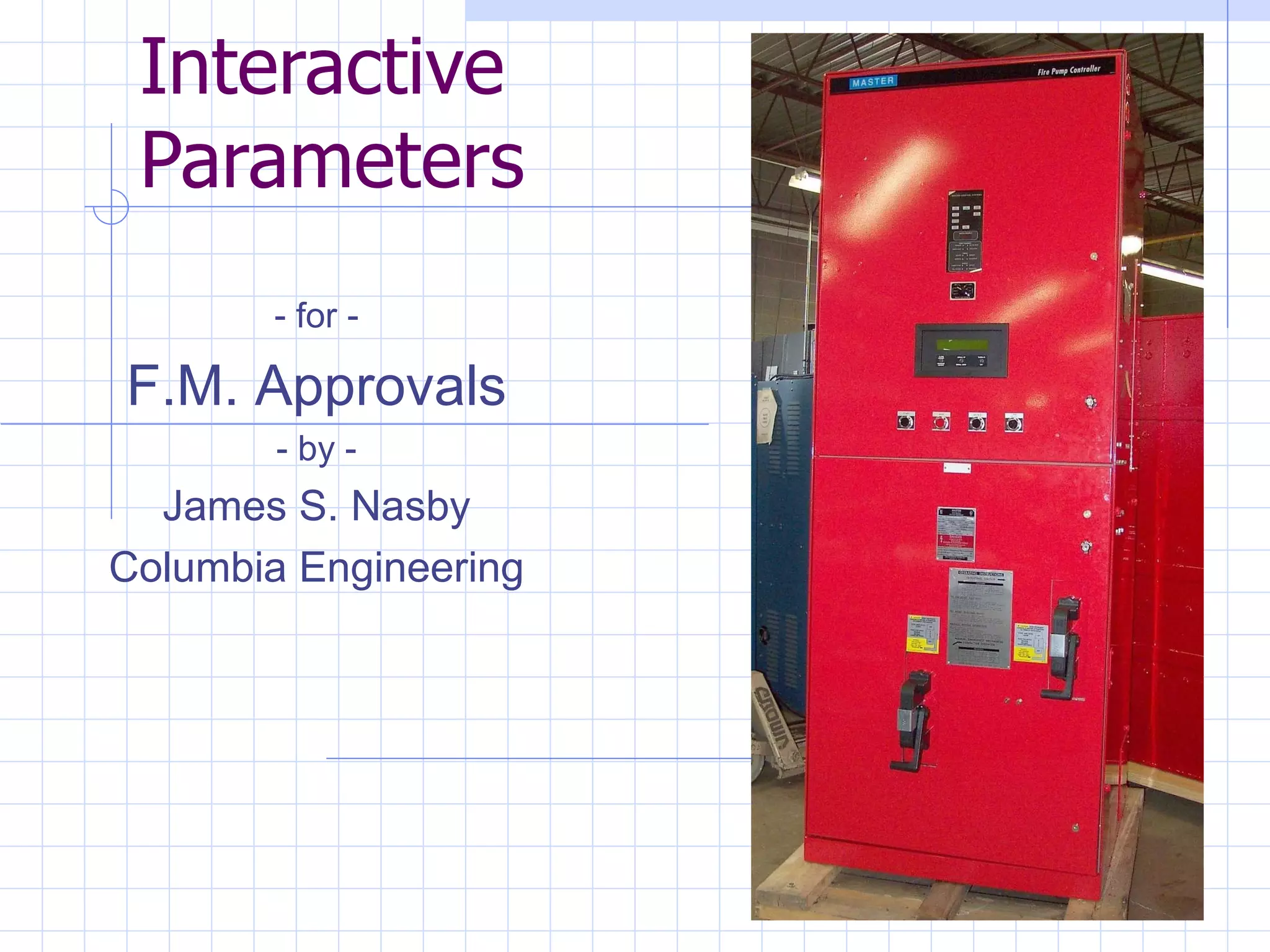
Interactive Parameters - for - F.M. Approvals - by - James S. Nasby Columbia Engineering
Topics to Be Covered E.F.P.C. Interdependencies D.F.P.C. Interdependencies Variable Speed System Parameters
Interactions Controller Dielectric Strength Surge Arrester Transient Energy (Current) Goes Where? U.L. Test = 1.0 Kv + 2xV line  = 2.0 Kv One Second (Factory) Test  (Still Not Required by U.L.??)  = 1.2 (1.0Kv+xV line  = 2.4 Kv) 5.0 Kvac or 6.0 KVdc Keeps Energy out of Controller (Except for Surge Arrester) One -vs- Three CPT's for D.C. Control Power Three Rectifier Circuits - Good (Triple Redundant) Three  Isolated  Rectifier Circuits - Best (Overcomes Rectifier Short Circuits) Semiconductors Almost Always Fail as Short Circuits (Especially due to Over Loads)
Interactions Control Circuitry Always Powered? Hard Wired Circuitry Can Be Isolated (Off-Line) in Standby Mode for Better Transient and Long Term Reliability Microprocessor Designs have Boot-up Time Issues Processor Boot Up Time -vs- Power Irregularities Recording Separate Buffers for Alarm & Data? Rapidly Occurring Alarm Events Overwrite Pressure Records or vice versa. Frequent Pressure Readings or Once Every Ten Minutes? Data Reduction used to Store More Useful Data (Changes)? How many Pressure Readings Stored?
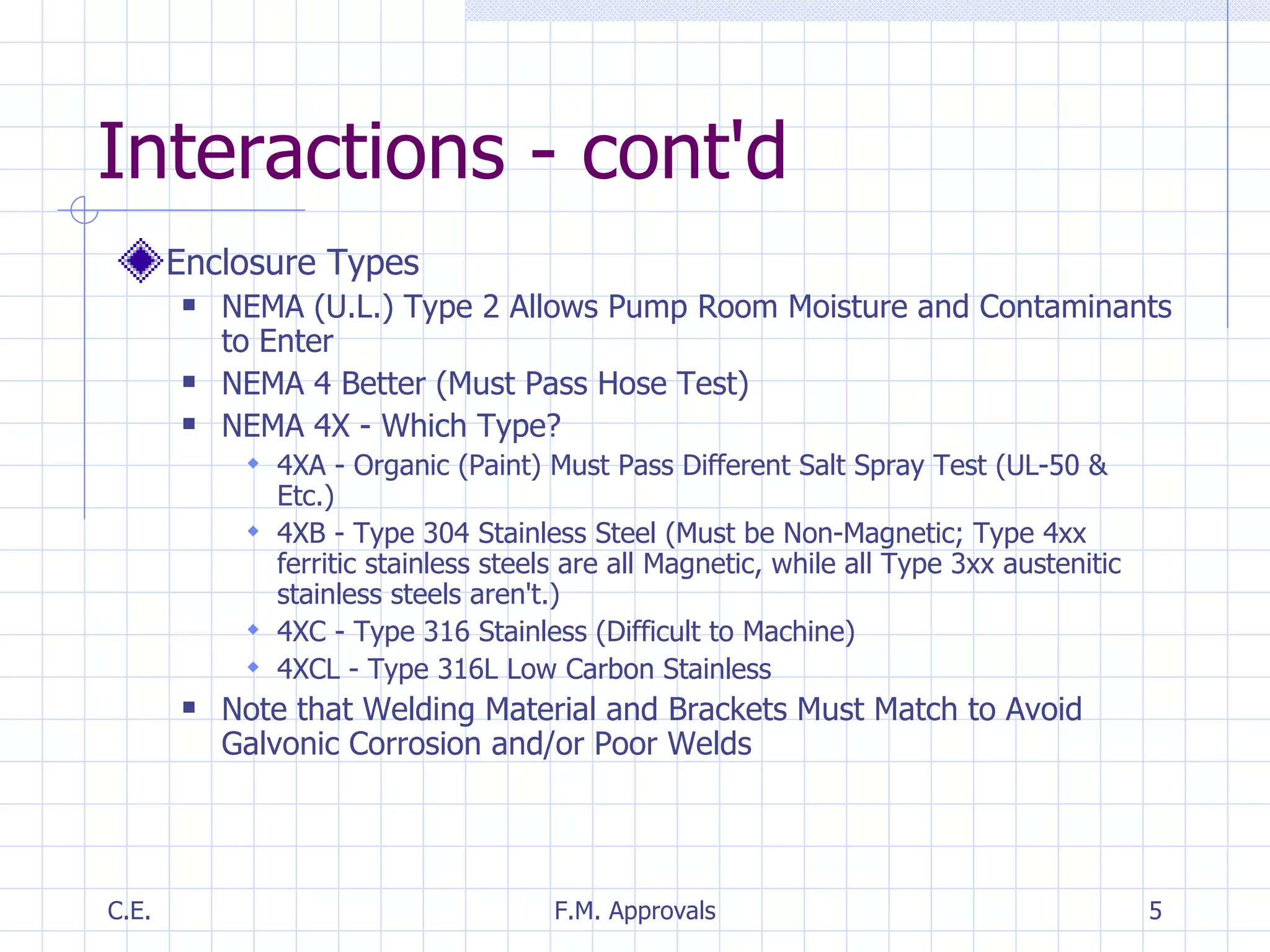
Interactions - cont'd Enclosure Types NEMA (U.L.) Type 2 Allows Pump Room Moisture and Contaminants to Enter NEMA 4 Better (Must Pass Hose Test) NEMA 4X - Which Type? 4XA - Organic (Paint) Must Pass Different Salt Spray Test (UL-50 & Etc.) 4XB - Type 304 Stainless Steel (Must be Non-Magnetic; Type 4xx ferritic stainless steels are all Magnetic, while all Type 3xx austenitic stainless steels aren't.) 4XC - Type 316 Stainless (Difficult to Machine) 4XCL - Type 316L Low Carbon Stainless Note that Welding Material and Brackets Must Match to Avoid Galvonic Corrosion and/or Poor Welds
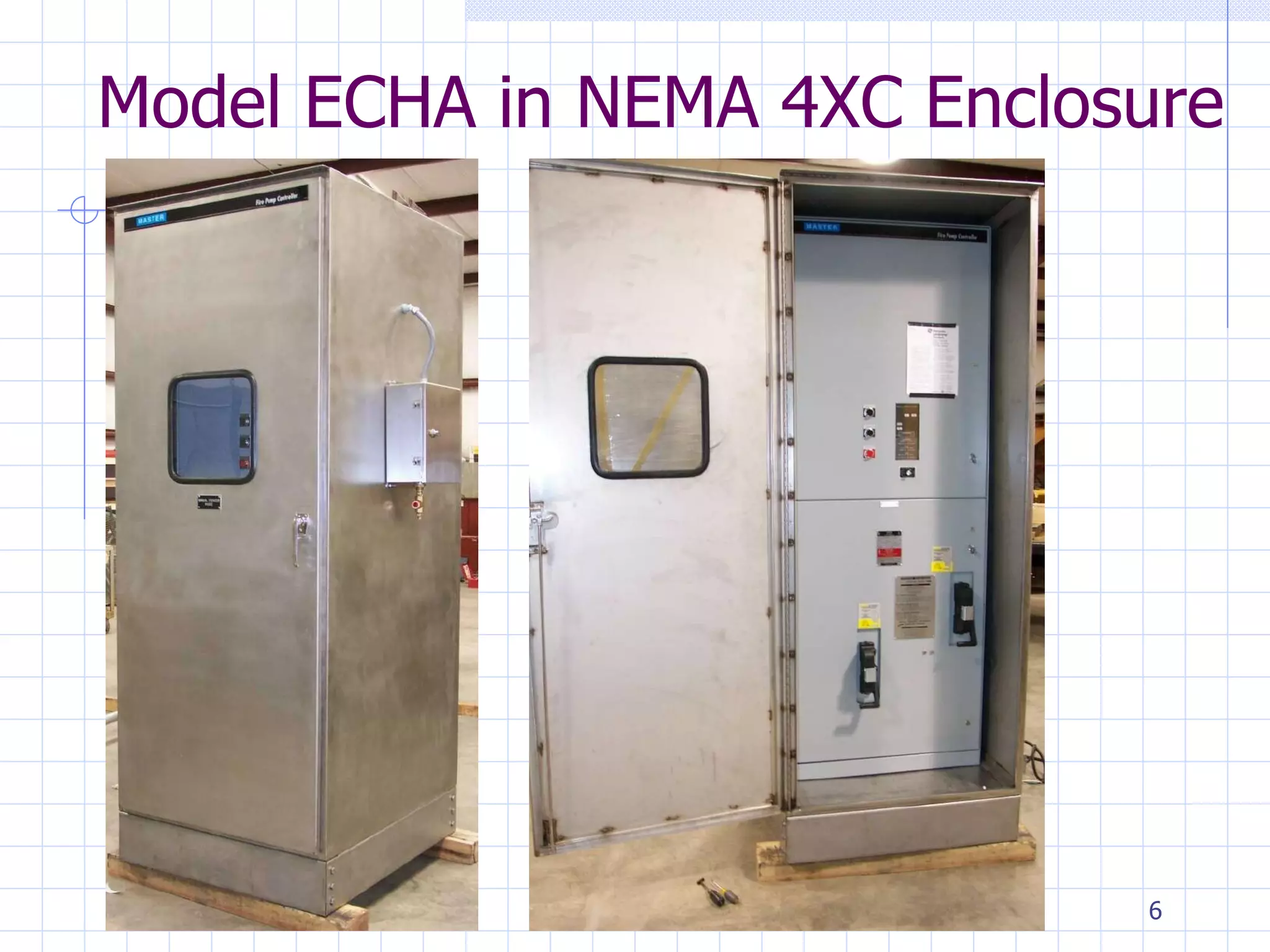
Model ECHA in NEMA 4XC Enclosure
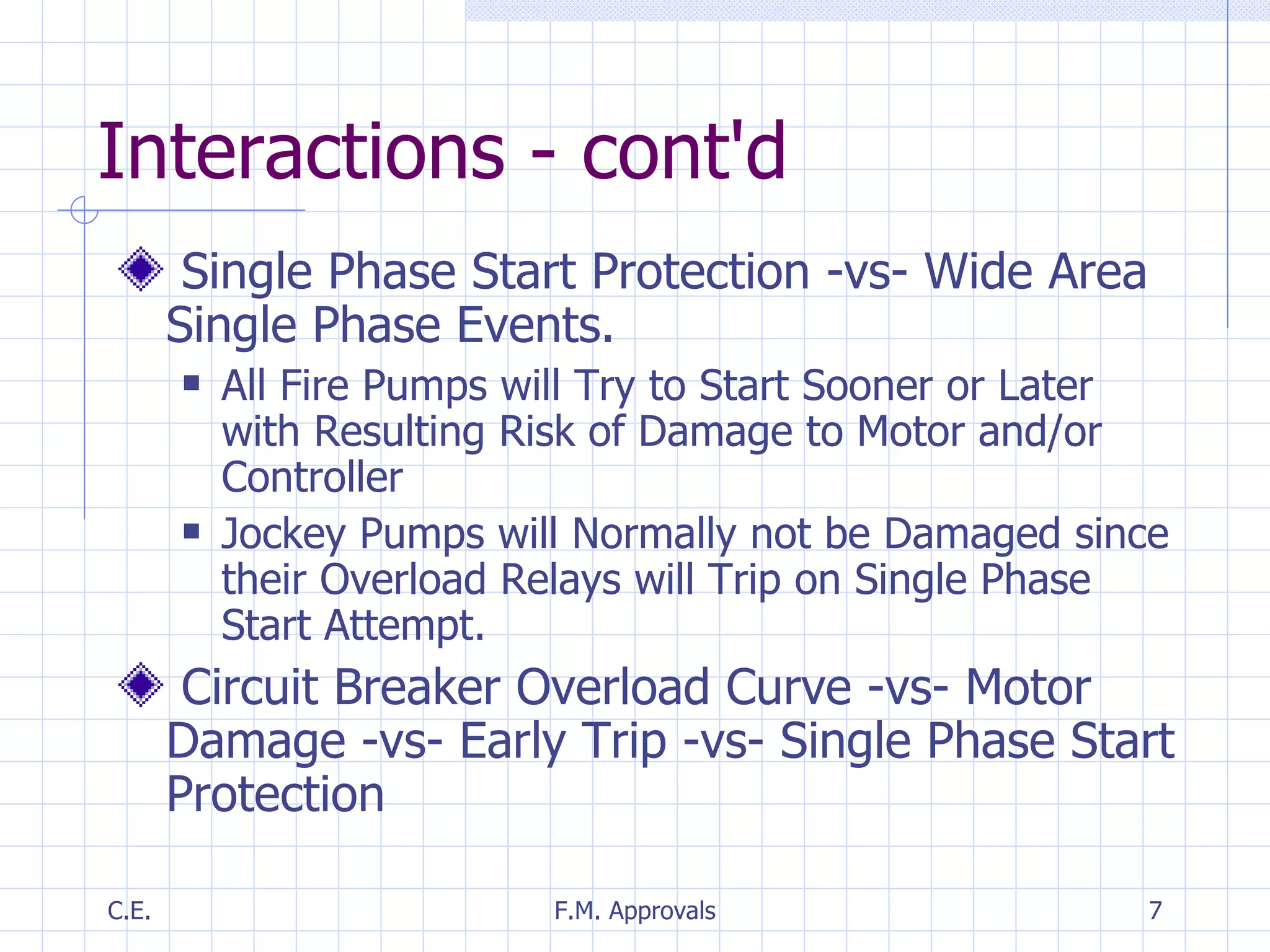
Interactions - cont'd Single Phase Start Protection -vs- Wide Area Single Phase Events. All Fire Pumps will Try to Start Sooner or Later with Resulting Risk of Damage to Motor and/or Controller Jockey Pumps will Normally not be Damaged since their Overload Relays will Trip on Single Phase Start Attempt. Circuit Breaker Overload Curve -vs- Motor Damage -vs- Early Trip -vs- Single Phase Start Protection
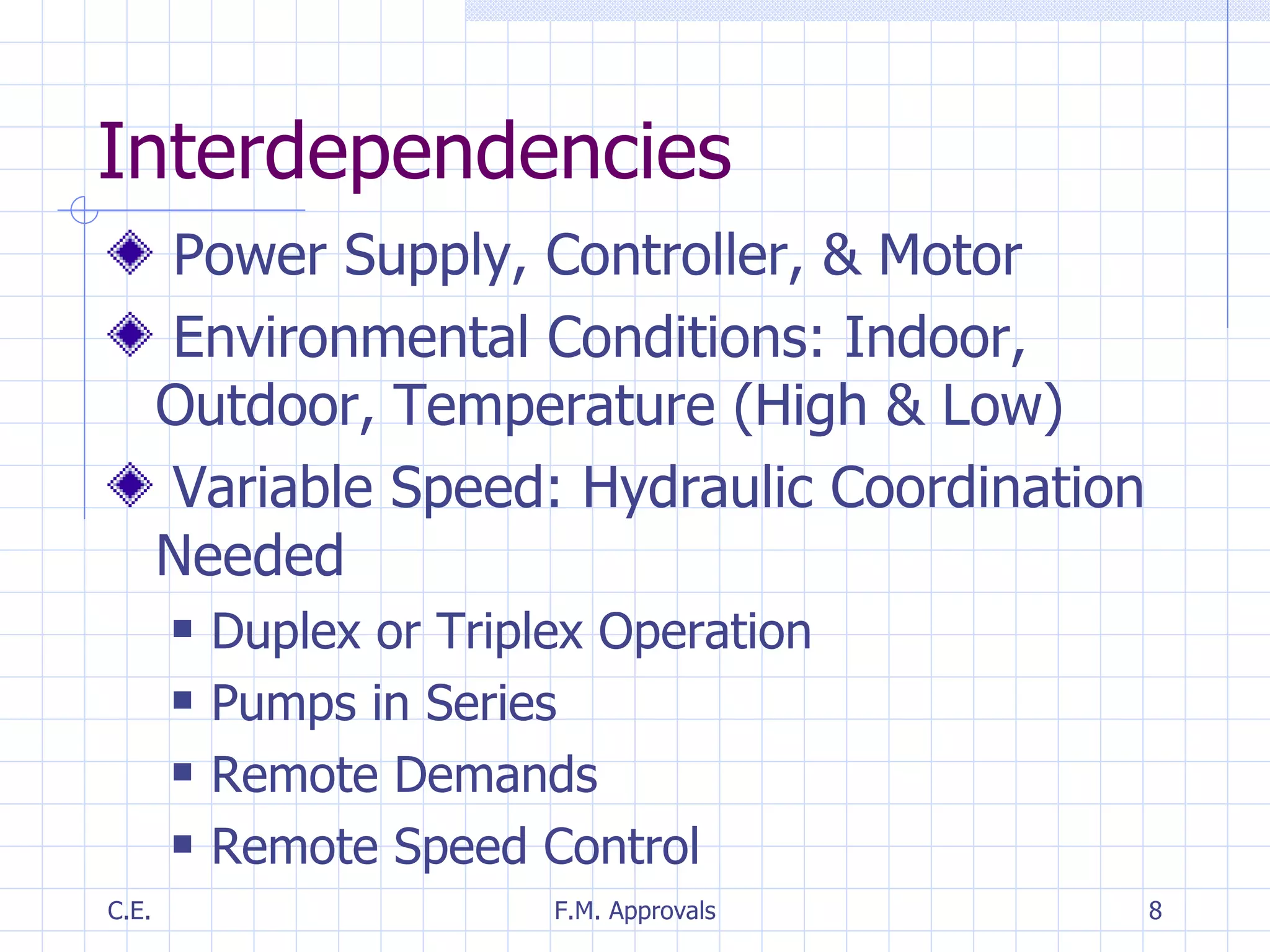
Interdependencies Power Supply, Controller, & Motor Environmental Conditions: Indoor, Outdoor, Temperature (High & Low) Variable Speed: Hydraulic Coordination Needed Duplex or Triplex Operation Pumps in Series Remote Demands Remote Speed Control
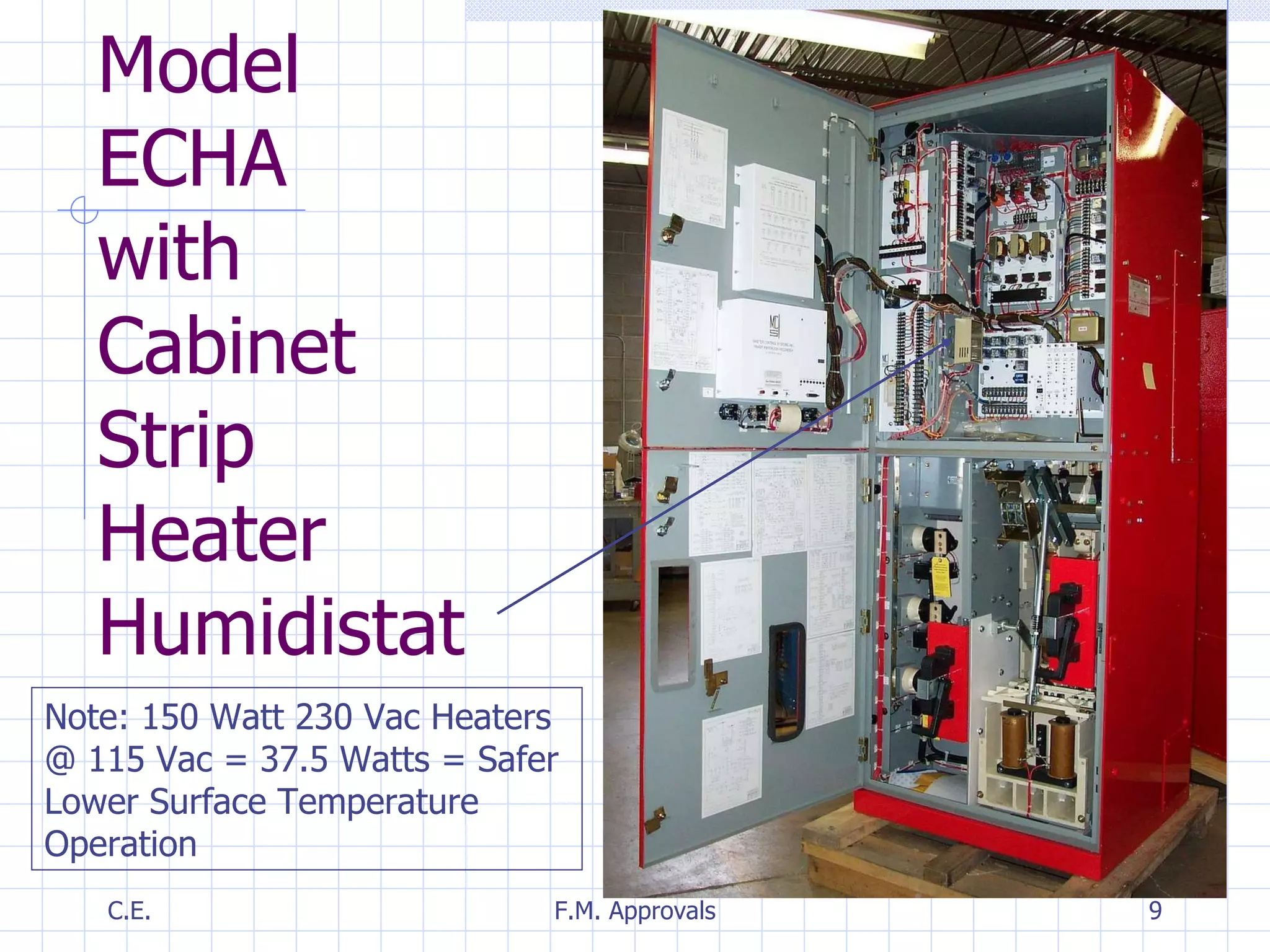
Model ECHA with Cabinet Strip  Heater Humidistat Note: 150 Watt 230 Vac Heaters @ 115 Vac = 37.5 Watts = Safer Lower Surface Temperature Operation
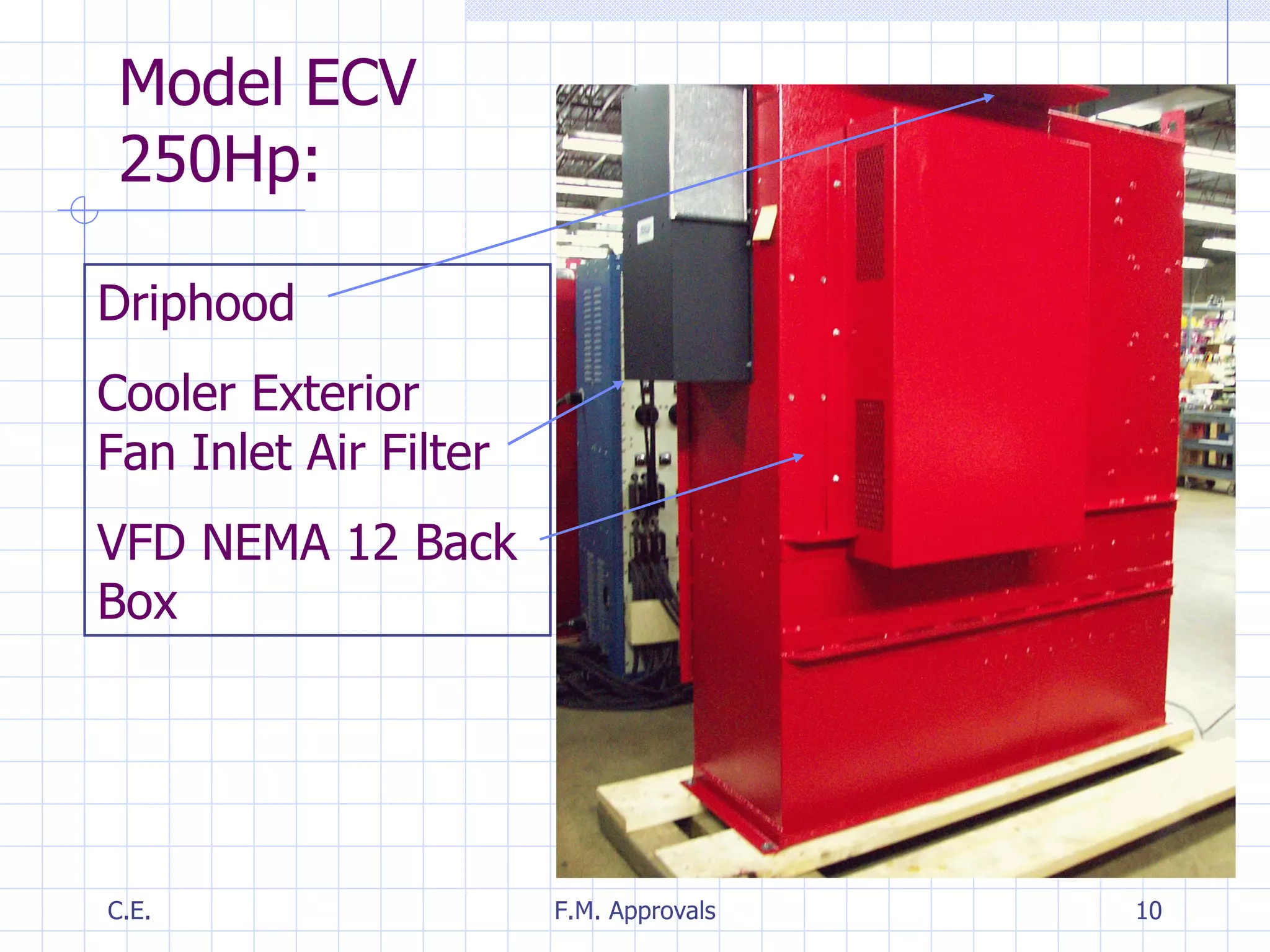
Model ECV 250Hp: Driphood Cooler Exterior  Fan Inlet Air Filter VFD NEMA 12 Back Box
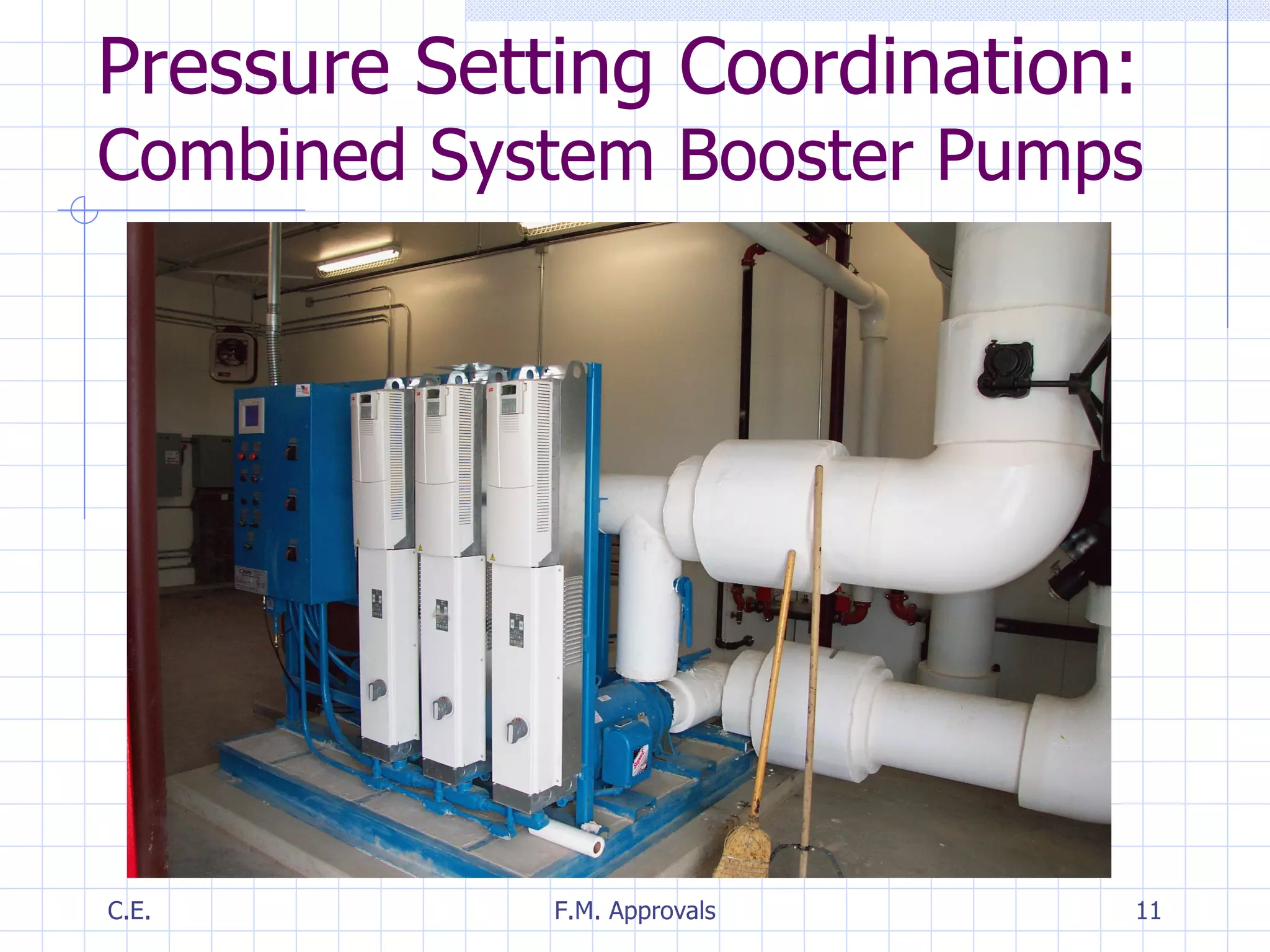
Pressure Setting Coordination: Combined System Booster Pumps
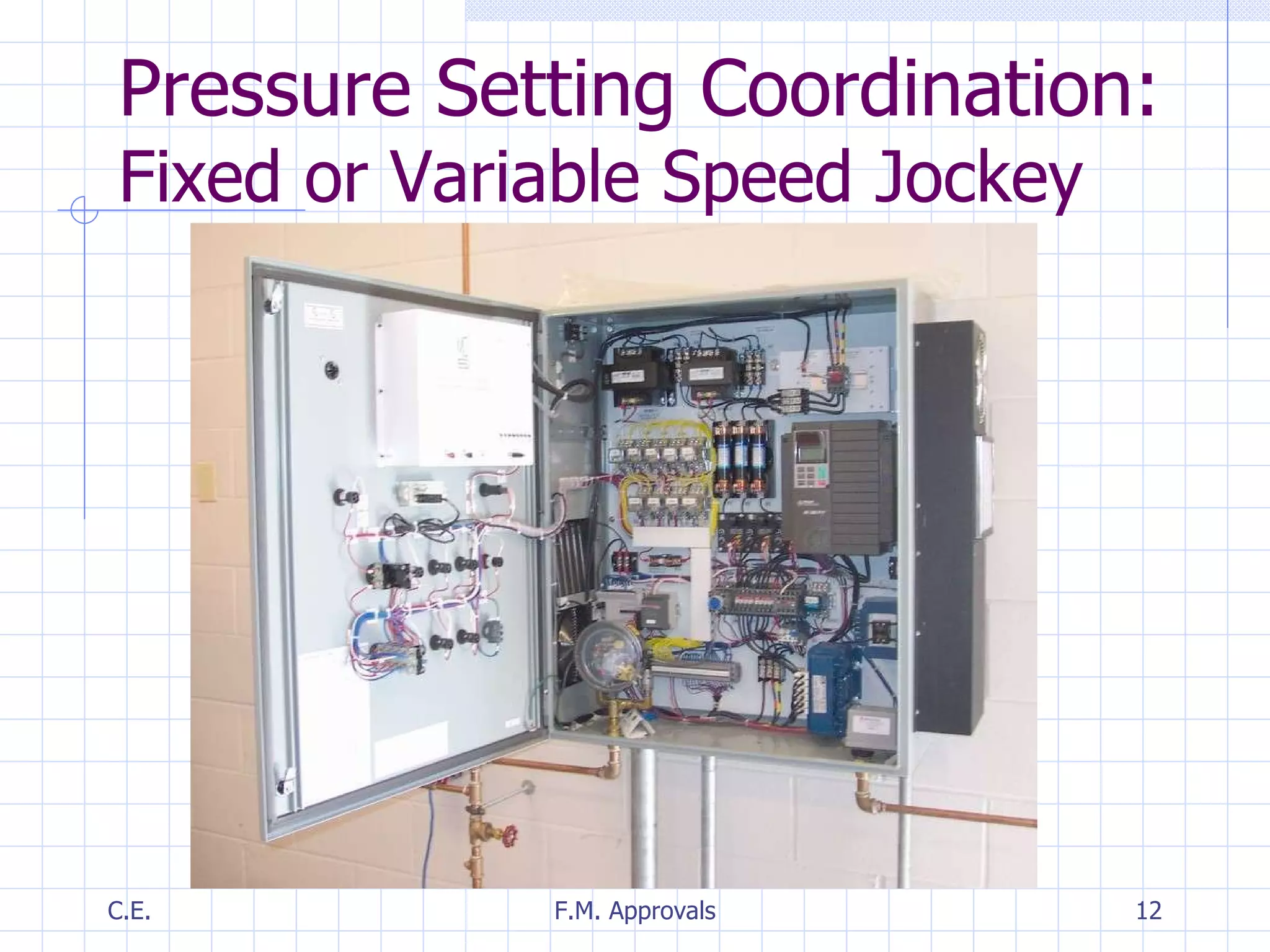
Pressure Setting Coordination: Fixed or Variable Speed Jockey
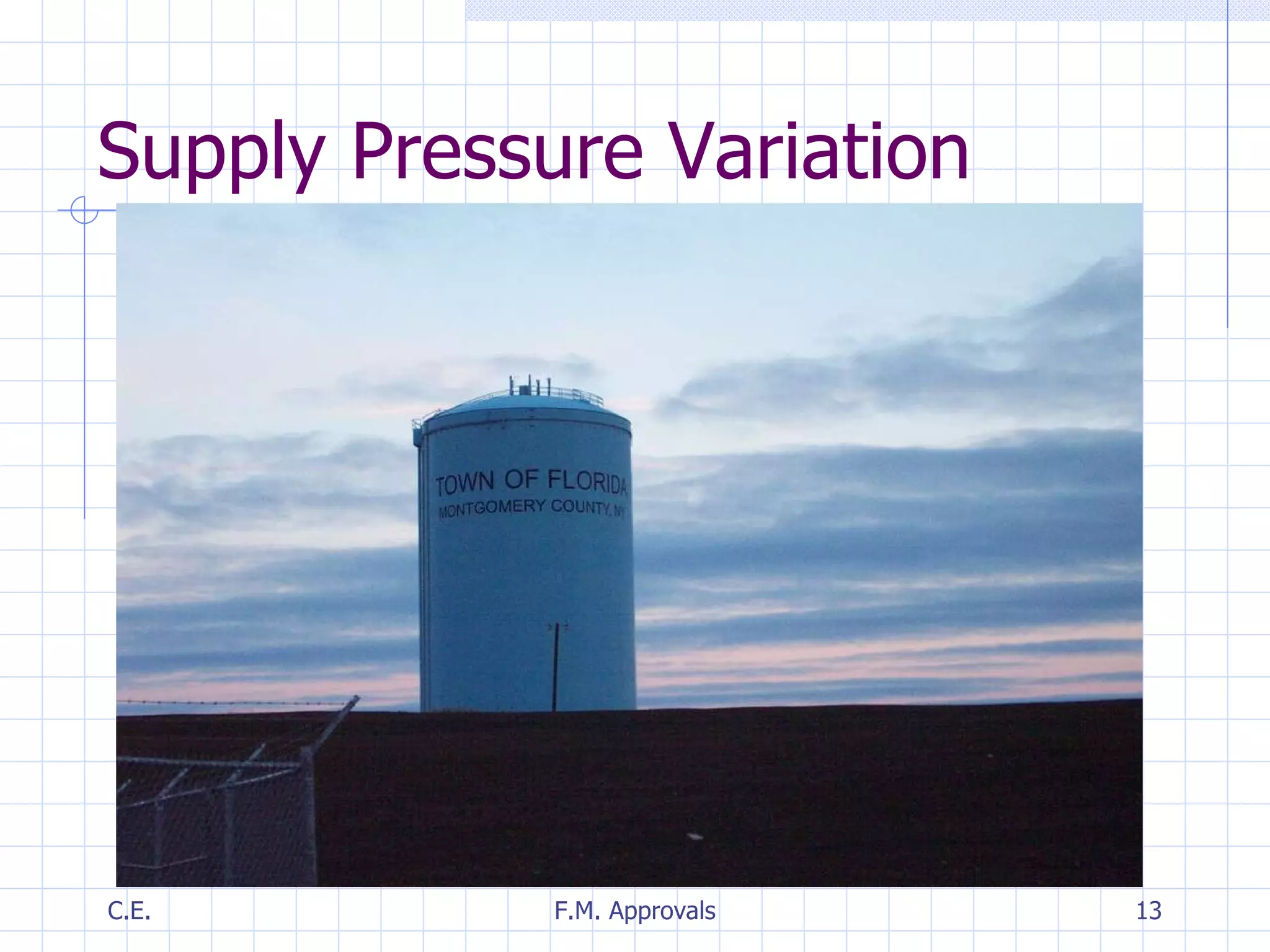
Supply Pressure Variation
DFPC Interdependencies Controller  -vs-  Engine Devices Controller  -vs-  Engine Batteries PLD Overpressure Alarm and Sensing ECM (ECU) Engine Add’l Alarms Controller  -vs-  Speed Switch Controller  -vs-  Other Pump House Loads Voltage Margins of Controller and Engine
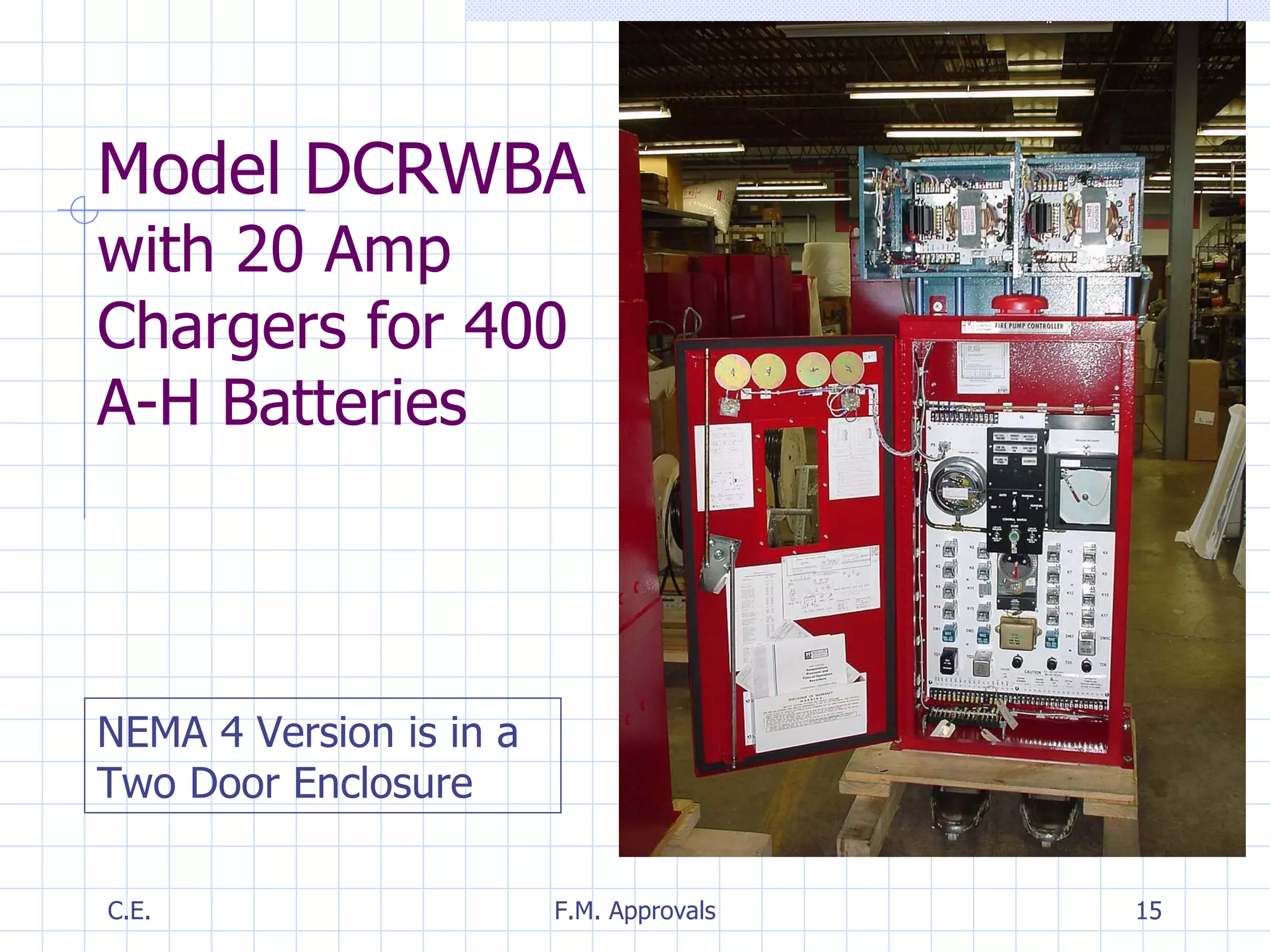
Model DCRWBA  with 20 Amp Chargers for 400 A-H Batteries NEMA 4 Version is in a Two Door Enclosure
Interactions - cont'd Alarms Needed Others Interactions ??
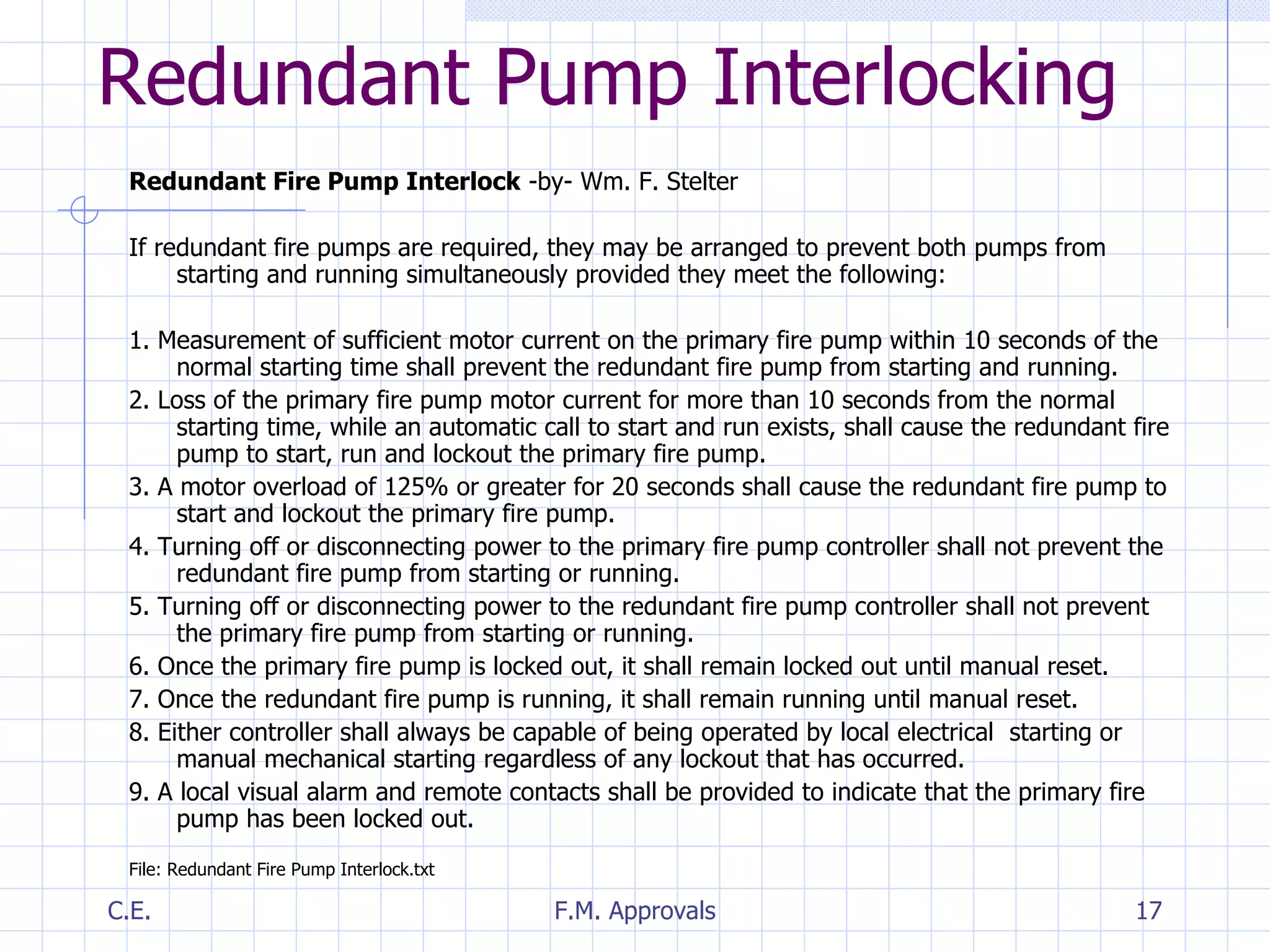
Redundant Pump Interlocking Redundant Fire Pump Interlock  -by- Wm. F. Stelter If redundant fire pumps are required, they may be arranged to prevent both pumps from starting and running simultaneously provided they meet the following: 1. Measurement of sufficient motor current on the primary fire pump within 10 seconds of the normal starting time shall prevent the redundant fire pump from starting and running. 2. Loss of the primary fire pump motor current for more than 10 seconds from the normal starting time, while an automatic call to start and run exists, shall cause the redundant fire pump to start, run and lockout the primary fire pump. 3. A motor overload of 125% or greater for 20 seconds shall cause the redundant fire pump to start and lockout the primary fire pump. 4. Turning off or disconnecting power to the primary fire pump controller shall not prevent the redundant fire pump from starting or running. 5. Turning off or disconnecting power to the redundant fire pump controller shall not prevent the primary fire pump from starting or running. 6. Once the primary fire pump is locked out, it shall remain locked out until manual reset. 7. Once the redundant fire pump is running, it shall remain running until manual reset. 8. Either controller shall always be capable of being operated by local electrical  starting or manual mechanical starting regardless of any lockout that has occurred. 9. A local visual alarm and remote contacts shall be provided to indicate that the primary fire pump has been locked out. File: Redundant Fire Pump Interlock.txt
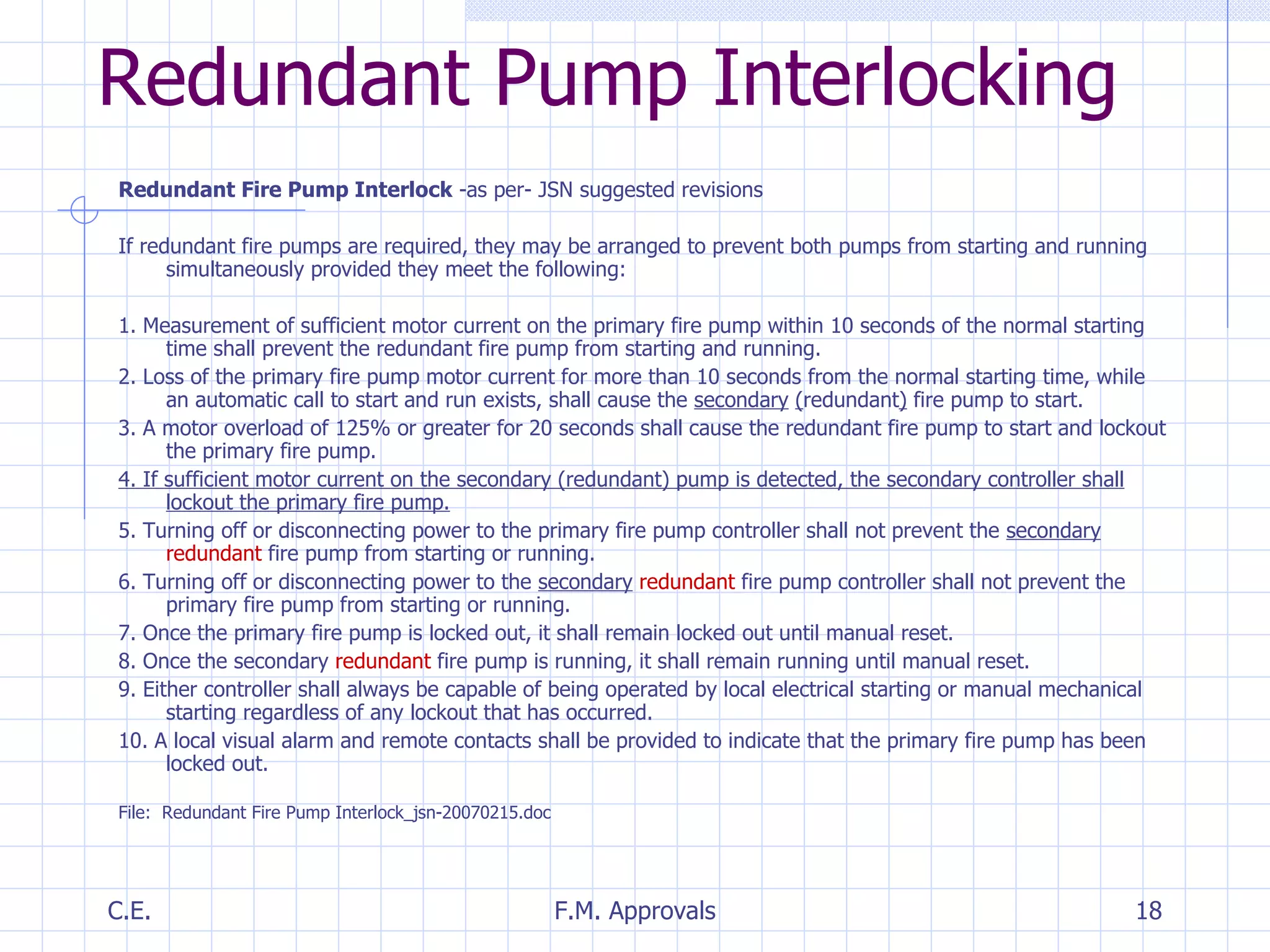
Redundant Fire Pump Interlock  -as per- JSN suggested revisions If redundant fire pumps are required, they may be arranged to prevent both pumps from starting and running simultaneously provided they meet the following: 1. Measurement of sufficient motor current on the primary fire pump within 10 seconds of the normal starting time shall prevent the redundant fire pump from starting and running. 2. Loss of the primary fire pump motor current for more than 10 seconds from the normal starting time, while an automatic call to start and run exists, shall cause the  secondary   ( redundant )  fire pump to start. 3. A motor overload of 125% or greater for 20 seconds shall cause the redundant fire pump to start and lockout the primary fire pump. 4. If sufficient motor current on the secondary (redundant) pump is detected, the secondary controller shall lockout the primary fire pump. 5. Turning off or disconnecting power to the primary fire pump controller shall not prevent the  secondary   redundant  fire pump from starting or running. 6. Turning off or disconnecting power to the  secondary   redundant  fire pump controller shall not prevent the primary fire pump from starting or running. 7. Once the primary fire pump is locked out, it shall remain locked out until manual reset. 8. Once the secondary  redundant  fire pump is running, it shall remain running until manual reset. 9. Either controller shall always be capable of being operated by local electrical starting or manual mechanical starting regardless of any lockout that has occurred. 10. A local visual alarm and remote contacts shall be provided to indicate that the primary fire pump has been locked out. File:  Redundant Fire Pump Interlock_jsn-20070215.doc Redundant Pump Interlocking
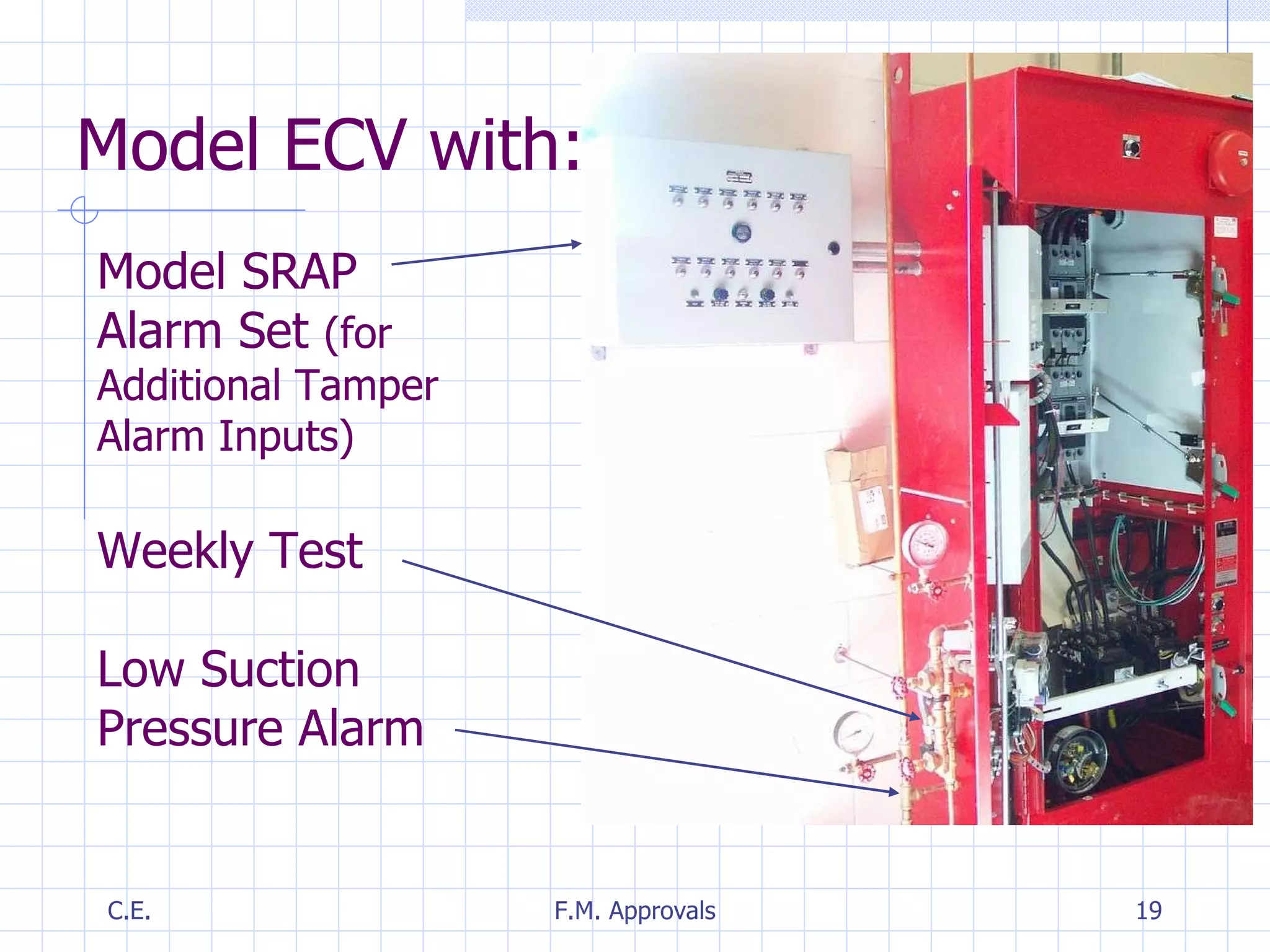
Model ECV with: Model SRAP Alarm Set  (for Additional Tamper Alarm Inputs) Weekly Test Low Suction Pressure Alarm
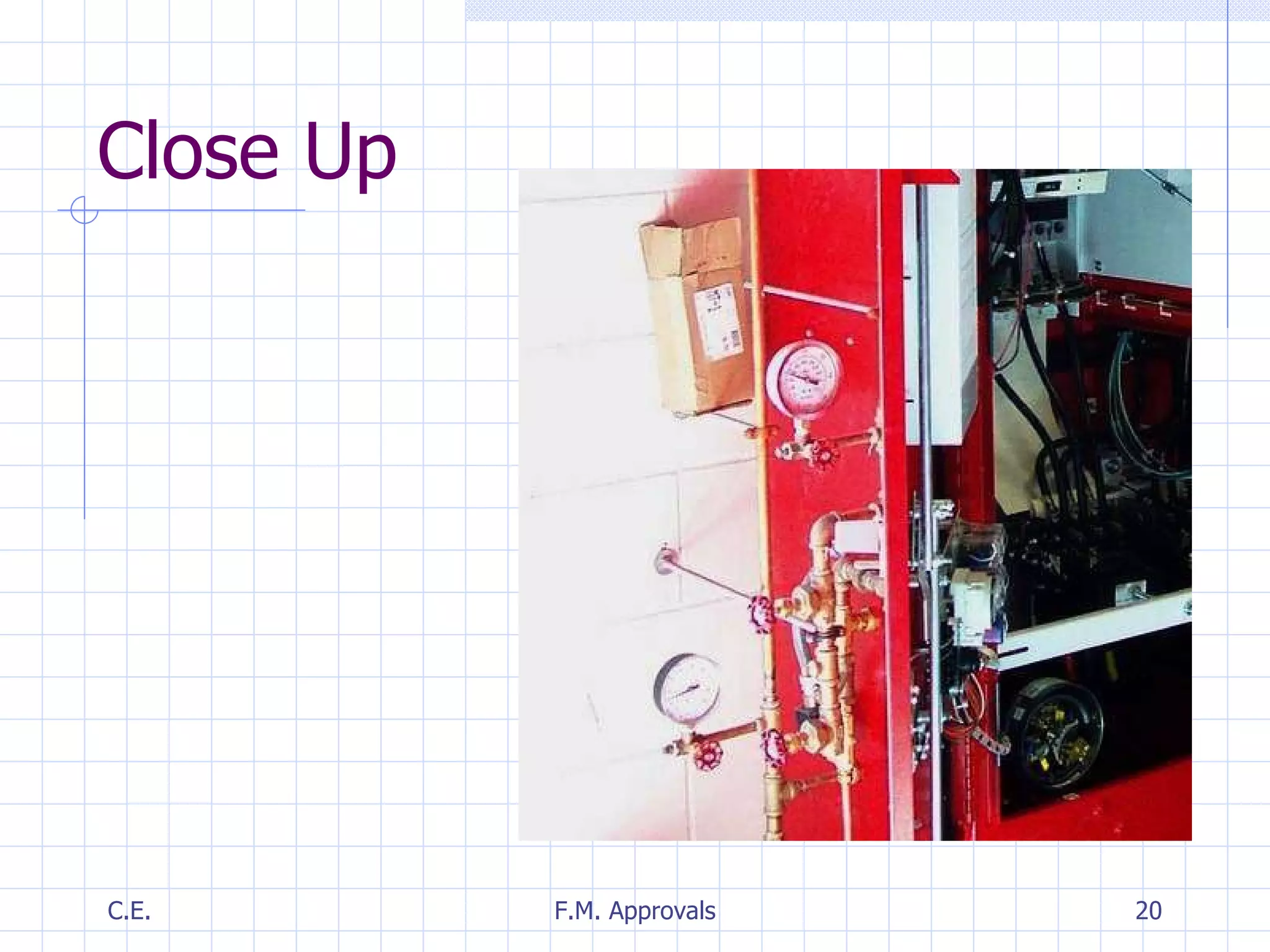
Close Up
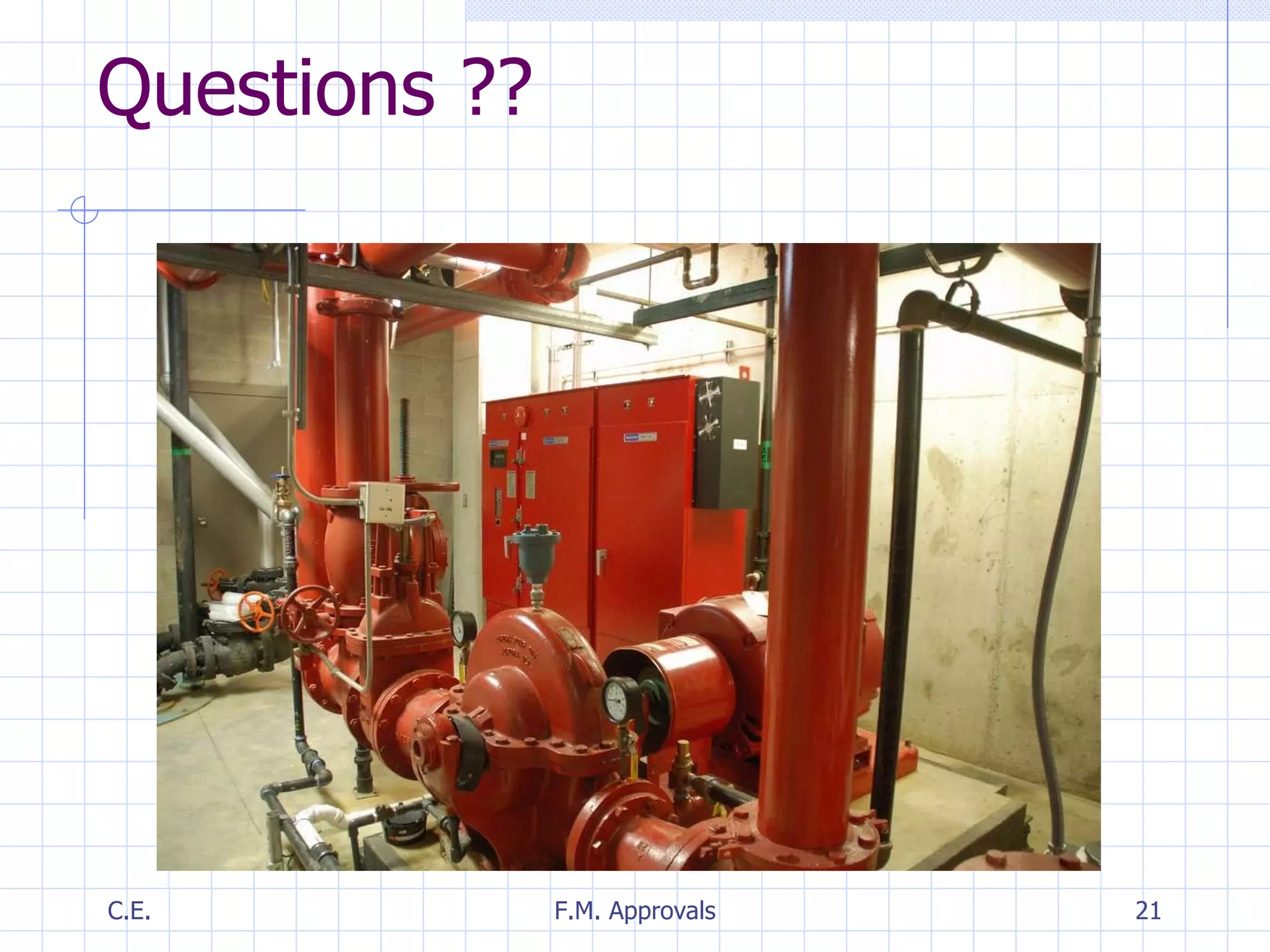
Questions ??

Fire Pump Controller Interactive Parameters

  • 1.
    Interactive Parameters -for - F.M. Approvals - by - James S. Nasby Columbia Engineering
  • 2.
    Topics to BeCovered E.F.P.C. Interdependencies D.F.P.C. Interdependencies Variable Speed System Parameters
  • 3.
    Interactions Controller DielectricStrength Surge Arrester Transient Energy (Current) Goes Where? U.L. Test = 1.0 Kv + 2xV line = 2.0 Kv One Second (Factory) Test (Still Not Required by U.L.??) = 1.2 (1.0Kv+xV line = 2.4 Kv) 5.0 Kvac or 6.0 KVdc Keeps Energy out of Controller (Except for Surge Arrester) One -vs- Three CPT's for D.C. Control Power Three Rectifier Circuits - Good (Triple Redundant) Three Isolated Rectifier Circuits - Best (Overcomes Rectifier Short Circuits) Semiconductors Almost Always Fail as Short Circuits (Especially due to Over Loads)
  • 4.
    Interactions Control CircuitryAlways Powered? Hard Wired Circuitry Can Be Isolated (Off-Line) in Standby Mode for Better Transient and Long Term Reliability Microprocessor Designs have Boot-up Time Issues Processor Boot Up Time -vs- Power Irregularities Recording Separate Buffers for Alarm & Data? Rapidly Occurring Alarm Events Overwrite Pressure Records or vice versa. Frequent Pressure Readings or Once Every Ten Minutes? Data Reduction used to Store More Useful Data (Changes)? How many Pressure Readings Stored?
  • 5.
    Interactions - cont'dEnclosure Types NEMA (U.L.) Type 2 Allows Pump Room Moisture and Contaminants to Enter NEMA 4 Better (Must Pass Hose Test) NEMA 4X - Which Type? 4XA - Organic (Paint) Must Pass Different Salt Spray Test (UL-50 & Etc.) 4XB - Type 304 Stainless Steel (Must be Non-Magnetic; Type 4xx ferritic stainless steels are all Magnetic, while all Type 3xx austenitic stainless steels aren't.) 4XC - Type 316 Stainless (Difficult to Machine) 4XCL - Type 316L Low Carbon Stainless Note that Welding Material and Brackets Must Match to Avoid Galvonic Corrosion and/or Poor Welds
  • 6.
    Model ECHA inNEMA 4XC Enclosure
  • 7.
    Interactions - cont'dSingle Phase Start Protection -vs- Wide Area Single Phase Events. All Fire Pumps will Try to Start Sooner or Later with Resulting Risk of Damage to Motor and/or Controller Jockey Pumps will Normally not be Damaged since their Overload Relays will Trip on Single Phase Start Attempt. Circuit Breaker Overload Curve -vs- Motor Damage -vs- Early Trip -vs- Single Phase Start Protection
  • 8.
    Interdependencies Power Supply,Controller, & Motor Environmental Conditions: Indoor, Outdoor, Temperature (High & Low) Variable Speed: Hydraulic Coordination Needed Duplex or Triplex Operation Pumps in Series Remote Demands Remote Speed Control
  • 9.
    Model ECHA withCabinet Strip Heater Humidistat Note: 150 Watt 230 Vac Heaters @ 115 Vac = 37.5 Watts = Safer Lower Surface Temperature Operation
  • 10.
    Model ECV 250Hp:Driphood Cooler Exterior Fan Inlet Air Filter VFD NEMA 12 Back Box
  • 11.
    Pressure Setting Coordination:Combined System Booster Pumps
  • 12.
    Pressure Setting Coordination:Fixed or Variable Speed Jockey
  • 13.
  • 14.
    DFPC Interdependencies Controller -vs- Engine Devices Controller -vs- Engine Batteries PLD Overpressure Alarm and Sensing ECM (ECU) Engine Add’l Alarms Controller -vs- Speed Switch Controller -vs- Other Pump House Loads Voltage Margins of Controller and Engine
  • 15.
    Model DCRWBA with 20 Amp Chargers for 400 A-H Batteries NEMA 4 Version is in a Two Door Enclosure
  • 16.
    Interactions - cont'dAlarms Needed Others Interactions ??
  • 17.
    Redundant Pump InterlockingRedundant Fire Pump Interlock -by- Wm. F. Stelter If redundant fire pumps are required, they may be arranged to prevent both pumps from starting and running simultaneously provided they meet the following: 1. Measurement of sufficient motor current on the primary fire pump within 10 seconds of the normal starting time shall prevent the redundant fire pump from starting and running. 2. Loss of the primary fire pump motor current for more than 10 seconds from the normal starting time, while an automatic call to start and run exists, shall cause the redundant fire pump to start, run and lockout the primary fire pump. 3. A motor overload of 125% or greater for 20 seconds shall cause the redundant fire pump to start and lockout the primary fire pump. 4. Turning off or disconnecting power to the primary fire pump controller shall not prevent the redundant fire pump from starting or running. 5. Turning off or disconnecting power to the redundant fire pump controller shall not prevent the primary fire pump from starting or running. 6. Once the primary fire pump is locked out, it shall remain locked out until manual reset. 7. Once the redundant fire pump is running, it shall remain running until manual reset. 8. Either controller shall always be capable of being operated by local electrical starting or manual mechanical starting regardless of any lockout that has occurred. 9. A local visual alarm and remote contacts shall be provided to indicate that the primary fire pump has been locked out. File: Redundant Fire Pump Interlock.txt
  • 18.
    Redundant Fire PumpInterlock -as per- JSN suggested revisions If redundant fire pumps are required, they may be arranged to prevent both pumps from starting and running simultaneously provided they meet the following: 1. Measurement of sufficient motor current on the primary fire pump within 10 seconds of the normal starting time shall prevent the redundant fire pump from starting and running. 2. Loss of the primary fire pump motor current for more than 10 seconds from the normal starting time, while an automatic call to start and run exists, shall cause the secondary ( redundant ) fire pump to start. 3. A motor overload of 125% or greater for 20 seconds shall cause the redundant fire pump to start and lockout the primary fire pump. 4. If sufficient motor current on the secondary (redundant) pump is detected, the secondary controller shall lockout the primary fire pump. 5. Turning off or disconnecting power to the primary fire pump controller shall not prevent the secondary redundant fire pump from starting or running. 6. Turning off or disconnecting power to the secondary redundant fire pump controller shall not prevent the primary fire pump from starting or running. 7. Once the primary fire pump is locked out, it shall remain locked out until manual reset. 8. Once the secondary redundant fire pump is running, it shall remain running until manual reset. 9. Either controller shall always be capable of being operated by local electrical starting or manual mechanical starting regardless of any lockout that has occurred. 10. A local visual alarm and remote contacts shall be provided to indicate that the primary fire pump has been locked out. File: Redundant Fire Pump Interlock_jsn-20070215.doc Redundant Pump Interlocking
  • 19.
    Model ECV with:Model SRAP Alarm Set (for Additional Tamper Alarm Inputs) Weekly Test Low Suction Pressure Alarm
  • 20.
  • 21.