Similar to Sources Of Chemical Hazards, Hazard of organic synthesis, Sulfonating hazard, Organic solvent Hazard and Control measure For Chemical Hazard
Sources Of Chemical Hazards, Hazard of organic synthesis, Sulfonating hazard, Organic solvent Hazard and Control measure For Chemical Hazard
1.
SOURCES OF CHEMICALHAZARD, HAZARD OF ORGANIC
SYNTHESIS, SULFONATING HAZARD, ORGANIC SOLVENT
HAZARD, CONTROL MEASURE FOR CHEMICAL HAZARD.
PREPARED BY:
RITESH PHALAK (M.PHARM 2nd
SEM)
SUBJECT: HAZARDS AND SAFETY
MANAGEMENT.
DEPARTMENT OF PHARMACEUTICAL
QUALITY ASSURANCE.
GUIDED BY:
Dr. LIMA PATEL
ASSOCIATE PROFESSOR
PHARMACEUTICAL QUALITY
ASSURANCE DEPARTMENT.
PARUL INSTITUTE OF PHARMACY.
2.
CONTENT
1. INTRODUCTION TOCHEMICAL HAZARD
2. SOURCES OF CHEMICAL HAZARD
3. HAZARDS OF ORGANIC SYNTHESIS
4. SULFONATING HAZARD
5. ORGANIC SOLVENT HAZARD
6. CONTROL MEASURES FOR CHEMICAL HAZARD
7. REFERENCES
3.
INTRUDUCTION TO CHEMICALHAZARD
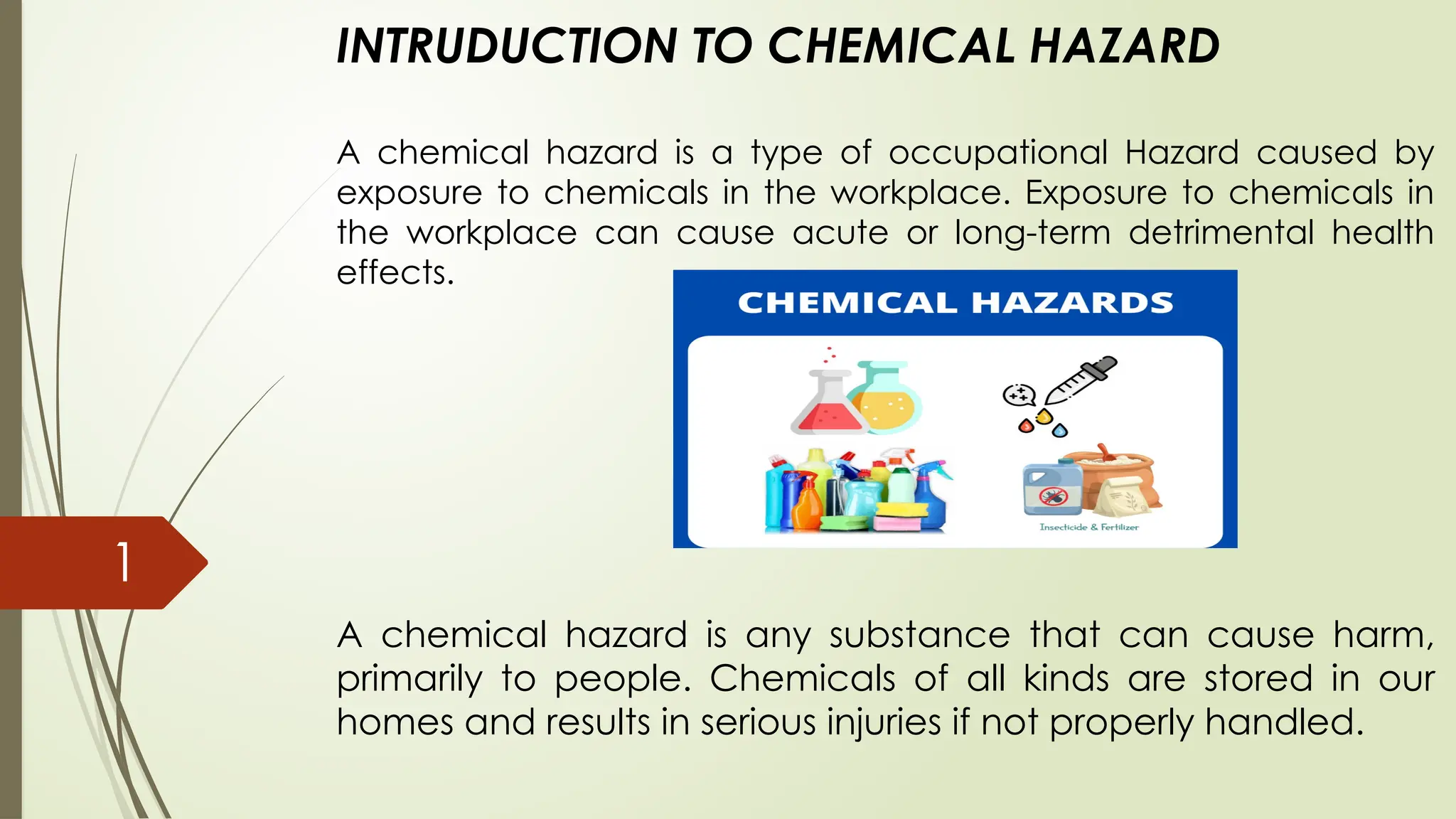
A chemical hazard is a type of occupational Hazard caused by
exposure to chemicals in the workplace. Exposure to chemicals in
the workplace can cause acute or long-term detrimental health
effects.
A chemical hazard is any substance that can cause harm,
primarily to people. Chemicals of all kinds are stored in our
homes and results in serious injuries if not properly handled.
1
4.
SOURCES OF CHEMICALHAZARD IN
PHARMACEUTICALS
2
The production and use of chemicals are fundamental factors in
the economic development of all countries, whether they are
industrialized or developing.
In one way or another, chemicals affect directly or indirectly to all
humans and are essentials to our feeding (fertilizers, pesticides,
food additives, packing), our health care (pharmaceuticals,
cleaning materials), or our well-being (appliances, fuels).
Sources of Hazards in Pharma
• Handling and storage of huge quantity hazardous chemicals.
• Transferring, loading and unloading of solvents and chemicals
to reaction vessels.
• Human errors while handling hazardous chemicals.
5.
CONT….
• Emission ofhazardous air pollutants from reaction vessels due
to overloading or under designed reaction vessels.
• Volatile organic compounds (VOCs) releases from
uncontained (or not connected to scrubbers).
• Reaction vessels and most common VOCs include methanol,
dichloromethane, toluene, ethylene glycol, N,
ndimethylformamide, and acetonitrile.
• Leaks of effluents from wastewater treatment plants or from
effluent collection sumps from process area.
• Coal tar, creosote oil, anthracene oil, paraffin oils, and
chromium, Nickel, cobalt, etc. Hazards may arise when
impure or contaminated chemicals are used.
3
6.
INDICATIONS FOR CHEMICALHAZARDS
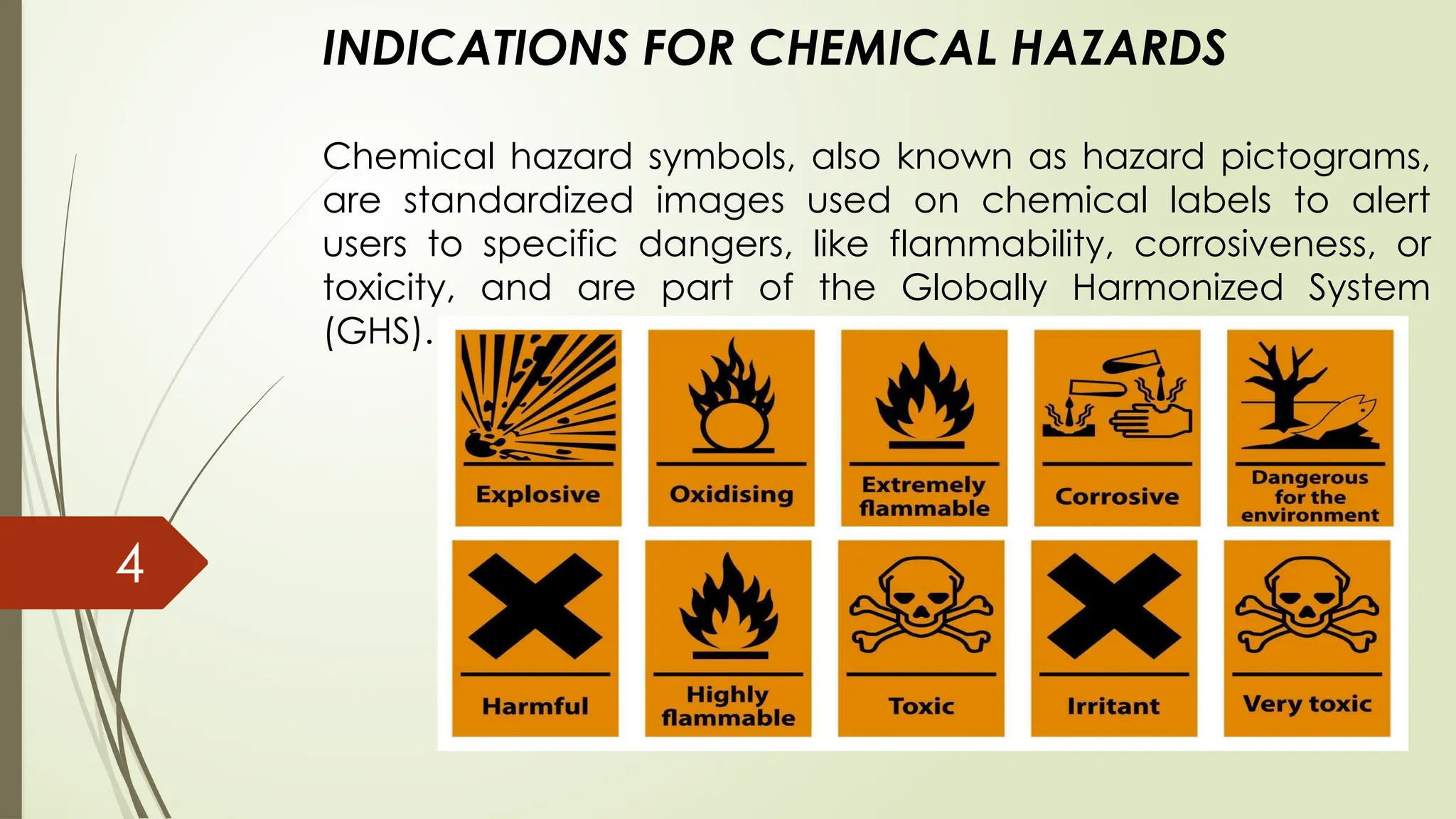
Chemical hazard symbols, also known as hazard pictograms,
are standardized images used on chemical labels to alert
users to specific dangers, like flammability, corrosiveness, or
toxicity, and are part of the Globally Harmonized System
(GHS).
4
7.
HAZARD OF ORGANICSYNTHESIS
Organic synthesis is a special branch of chemical synthesis and is
concerned with the construction of organic compounds via organic
reactions. Organic molecules can often contain a higher level of
complexity compared to purely inorganic compounds have
developed into one of the most important branches of organic
chemistry.
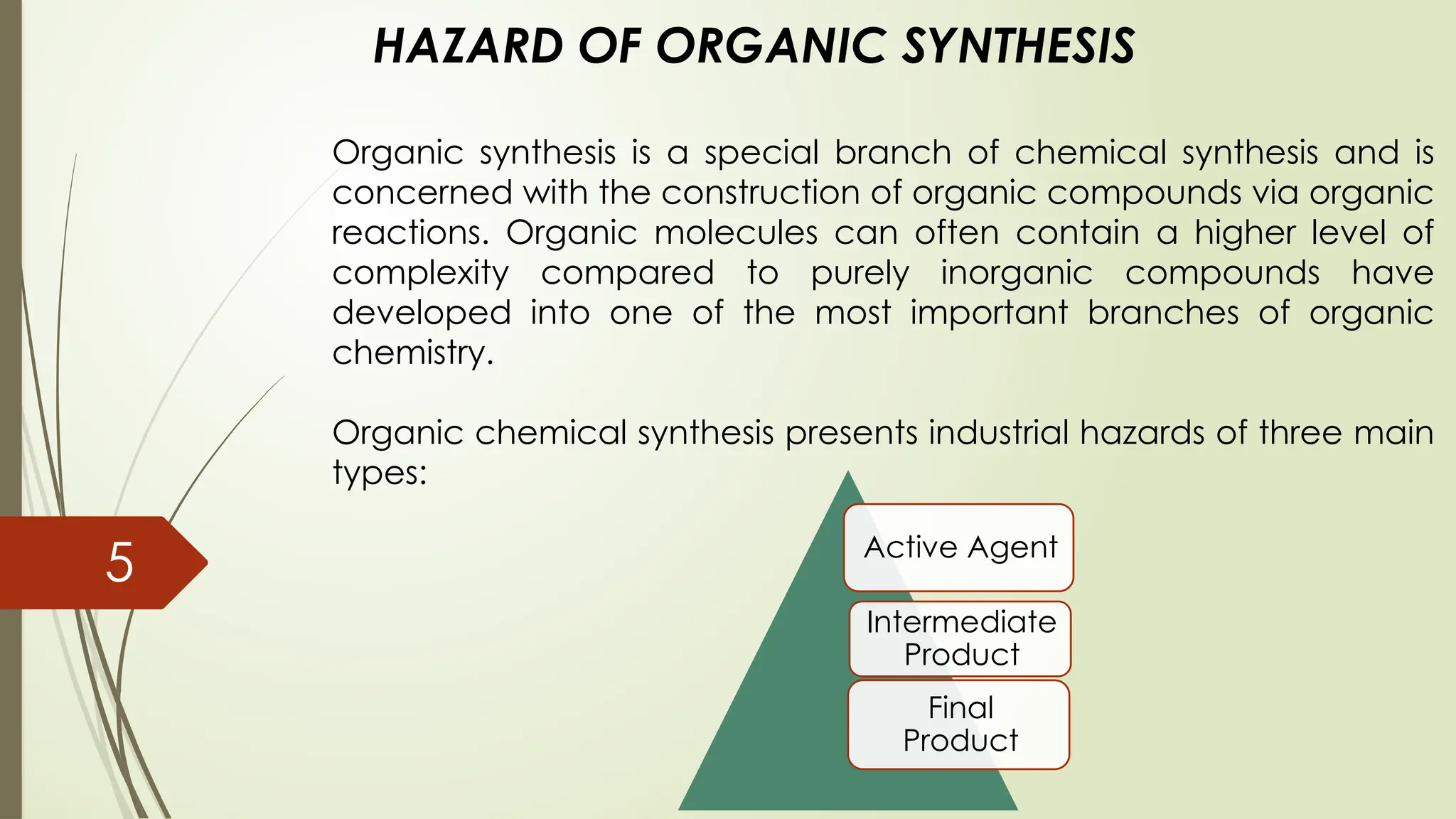
Organic chemical synthesis presents industrial hazards of three main
types:
Active Agent
Intermediate
Product
Final
Product
5
8.
CONT….
1. The Activeagents used to attack and modify the structure
of organic compounds are, by their very nature exceptionally
able to attack and modify the organic compounds of human
body, thus producing highly poisonous effects.
2. The Intermediate Compound in the most organic synthesis is
often characterized by the readiness with which they enter
into the chemical combination with other organic matter:
they are active. This often confers toxic properties of great
variety on them.
6
9.
CONT….
3. The FinalProducts though they are, medicines designed to
be introduced into the human body, may nevertheless
produce severe poisoning under conditions of industrial
exposure.
7
10.
SULFONATING HAZARD
Sulfonation isa chemical process that involves the introduction
of a sulfonic acid group into an organic molecule. This reaction
is widely used in the production of detergents, dyes, and
pharmaceuticals, as well as in various industrial applications.
1) Chlorosulphuric Acid: It is used in manufacture of p-
acetylamino benzene sulfonyl chloride a necessary
intermediate for most sulphonamides. The fumes of the acid
are highly irritating. In many sulphonation reactions, HCl gas &
SO are given off which may lead to bronchitis and
₂
conjunctivitis.
8
11.
CONT….
Prevention: Scrubbing towersof simple and cheap design, or
high stacks, are usually required to eliminate the nuisance.
2) Concentrated Sulphuric acid and fuming sulphuric acid
(Oleum): The heat of reaction of oleum and water is so great
that it requires proper method for washing this acid off the
skin, if spilled.
Prevention: Liberal dousing with anhydrous ethyl alcohol for
first wash, followed immediately by streams of water.
9
12.
ORGANIC SOLVENT HAZARD
Inchemical laboratories, organic solvents are used as
important liquid medium in synthesis, extractions, separations,
purification and drying. Organic solvents also play an
important role in analytical methodologies, spectrometric
measurements and measurements of physicochemical
properties.
1. Acetonitrile toxicity:
Acetonitrile is a harmful substance that has unfriendly
wellbeing impacts and can prompt death. Human
introduction happens by inward breath of acetonitrile vapours
or by the retention of the fluid or vapour through the skin and
eyes.
10
13.
CONT….
2. Toluene toxicity:
TheCNS is the primary target organ for toluene toxicity in both
humans and animals. for acute and chronic exposures. The
individuals exposed to toluene for more duration suffer CNS
disorders and narcosis showing following symptoms:
headache, nausea, drowsiness.
3. Xylene Toxicity:
Xylene vapour is absorbed rapidly through lungs, and xylene
liquid and vapour are absorbed slowly through the skin. 95% of
the absorbed xylene is metabolised in the liver to methyl
hippuric acid (MHA) and 70-80% of metabolites are excreted in
the urine so the levels of excreted metabolites of xylene serves
as indicators of presence of xylene inside the body.
11
14.
CONTROL MEASURES FORCHEMICAL HAZARD
A hazard control measure consists of all steps necessary to
protect workers from exposure to a substance or system, the
training and the procedures required to monitor worker
exposure and their health hazards such as chemicals,
materials or substance, or other types of hazards such as
noise and vibration.
A written workplace hazard control program should outline
which methods are being used to control the exposure and
how these controls will be monitored for effectiveness.
12
15.
CONT….
Priorities For ControlAction
ADMINISTRATIVE
CONTROL
ELIMINATION
SUBSTITUTION
PPE
ISOLATION
ENGINEERING
CONTROLS
13
16.
CONT….
1. Elimination: Themost effective and reliable controls are
those that result in the elimination of the hazardous
chemical.
2. Substitution: Substitution of a hazardous chemical for a
less hazardous one is the next control of choice; however,
care must be taken to ensure that the substituted
chemical does not introduce new hazards. Substitution
also may involve using the chemical in a less hazardous
form or process (e.g., use of the chemical in a pellet form
rather than a dust).
14
17.
CONT….
3. Engineering controls:Engineering controls typically reduce
exposure at the source (e.g., by enclosing the process in vessels
or pipes, or by local exhaust ventilation). Prevention of
uncontrolled releases is important; this may be achieved using
strategies such as quantity reduction and segregation.
4. Administrative controls: In general, administrative controls will
be required to supplement higher-level controls. Administrative
controls may include maintenance of equipment and training
of workers and their managers in the operation of the
equipment. Preventative maintenance is important in
preventing uncontrolled releases. Work procedures may need
to be developed to ensure that engineering controls function
as as designed; this includes any safe handling procedures and
special storage instructions.
15
18.
CONT….
5. Isolation: Isolationof the chemical in time or space from
those potentially exposed can be an effective means of
control (e.g., locating people in a protected control room,
installing a buffer area around a chemical reactor, using the
material when people are not in the vicinity).
6. Personal protective equipment: Any residual risk may require
workers to wear PPE to reduce exposure to chemicals
absorbed through respiration or skin or eye contact. Specialist
knowledge may be required to ensure selection of the correct
type of PPE for a specific chemical. Inappropriate or poorly
maintained PPE itself can act as a source of chemical
exposure (e.g. contaminated gloves can be a source of
ongoing exposure through persistent permeation or occlusion
of the chemical inside the gloves).
16
19.
REFERENCES
1. Review ArticleChemical hazards and safety management in
pharmaceutical industry https://
www.researchgate.net/publication/324504675_Chemical_hazards_an
d_safety_management_in_pharmaceutical_industry
2. Review Article CHEMICAL HAZARDS IN PHARMACEUTICAL
INDUSTRY: AN OVERVIEW https://
www.researchgate.net/publication/322932958_Chemical_
hazards_in_pharmaceutical_industry_An_overview
3. A text book of Hazards and Safety Management by PV
Publications.
4. https://chemistry.iiti.ac.in/lab-safety/hazard-symbols/