Frederick B. Pierson – USDA-ARS, Boise, ID
C. Jason Williams – USDA-ARS, Tucson, AZ
Osama Al-Hamdan – Texas A&M, Kingsville, TX
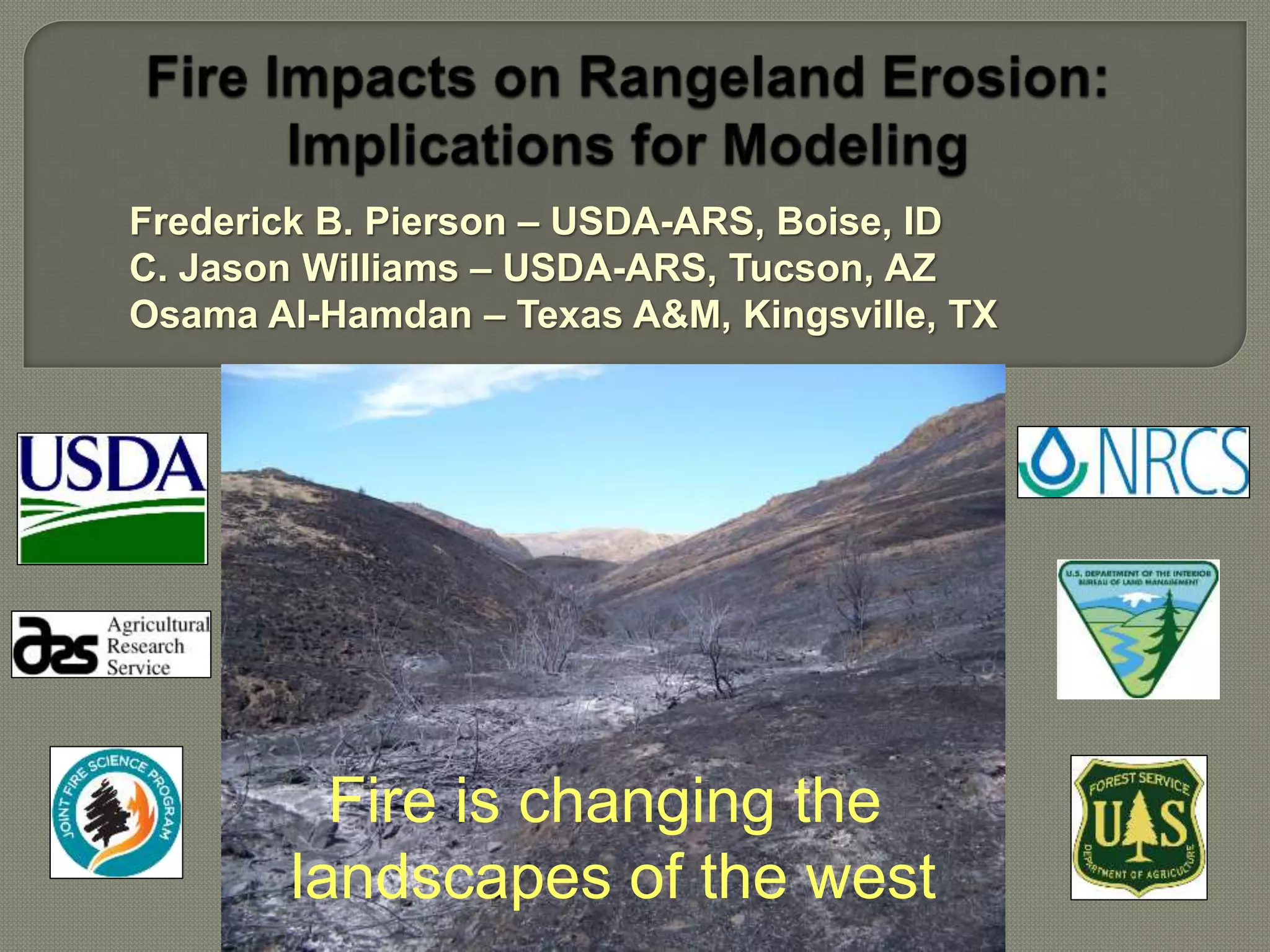
Fire is changing the
landscapes of the west
Overarching Goals:
• Improve understanding of disturbance (fire) impacts on
hydrology and erosion processes
• Develop conceptual and quantitative tools for predicting
effects of disturbance on hydrologic and erosion
processes
• Field guides and syntheses of knowledge
• Physical representation of dominant processes
• Parameterization of models such as RHEM
• Deliver tools to land managers for improved assessment
and management of semi-arid rangelands
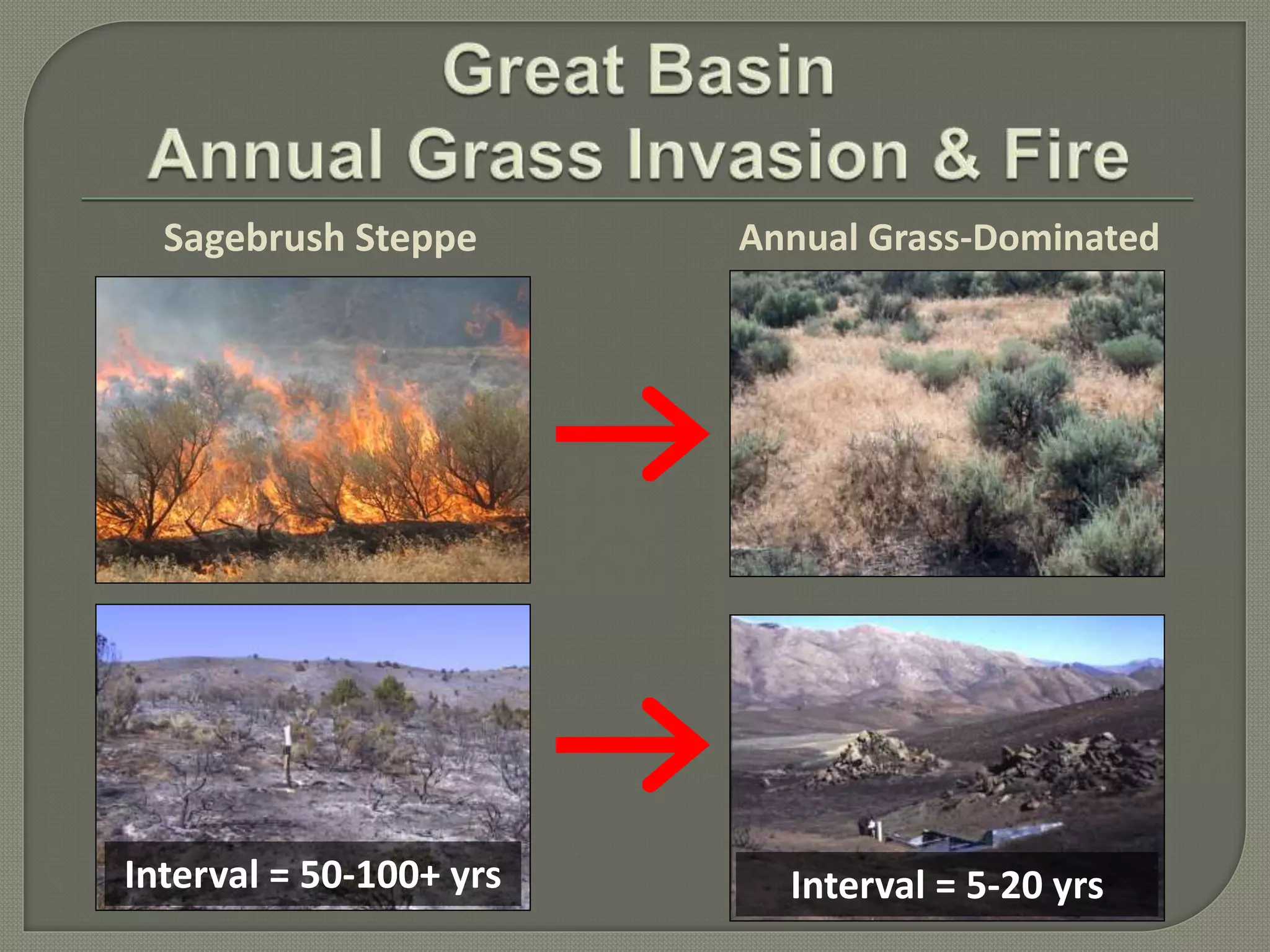
Interval = 50-100+ yrs Interval = 5-20 yrs
Sagebrush Steppe Annual Grass-Dominated
Ladder fuel structure and
dense woody fuel loading
on woodlands promote
high severity burns.
High severity burns on
woodland sites result in
barren landscapes and
present restoration
challenges.
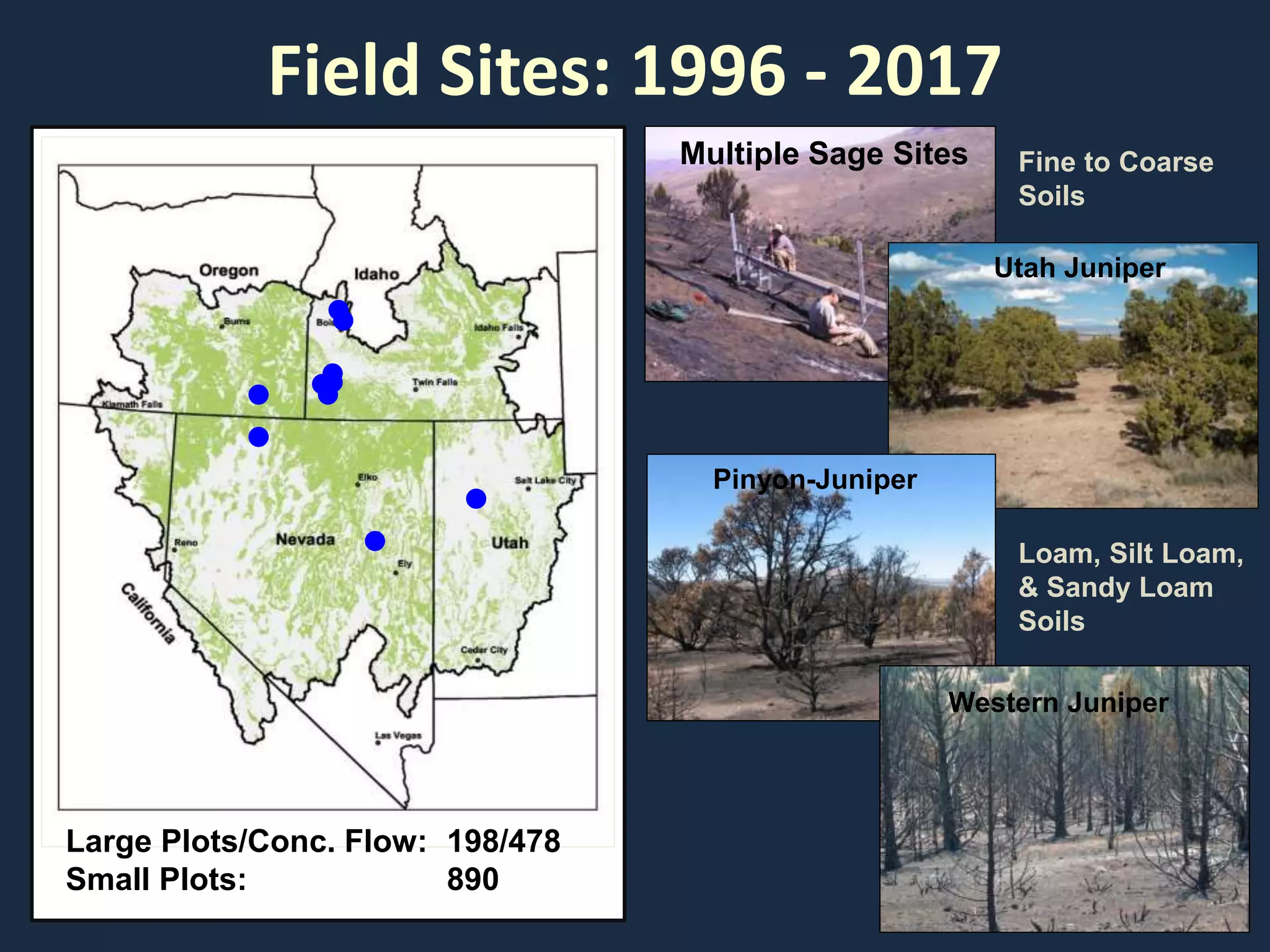
Field Sites: 1996 - 2017
Utah Juniper
*
*
Large Plots/Conc. Flow: 198/478
Small Plots: 890

Fine to Coarse
Soils




Pinyon-Juniper
Western Juniper

Loam, Silt Loam,
& Sandy Loam
Soils
Multiple Sage Sites



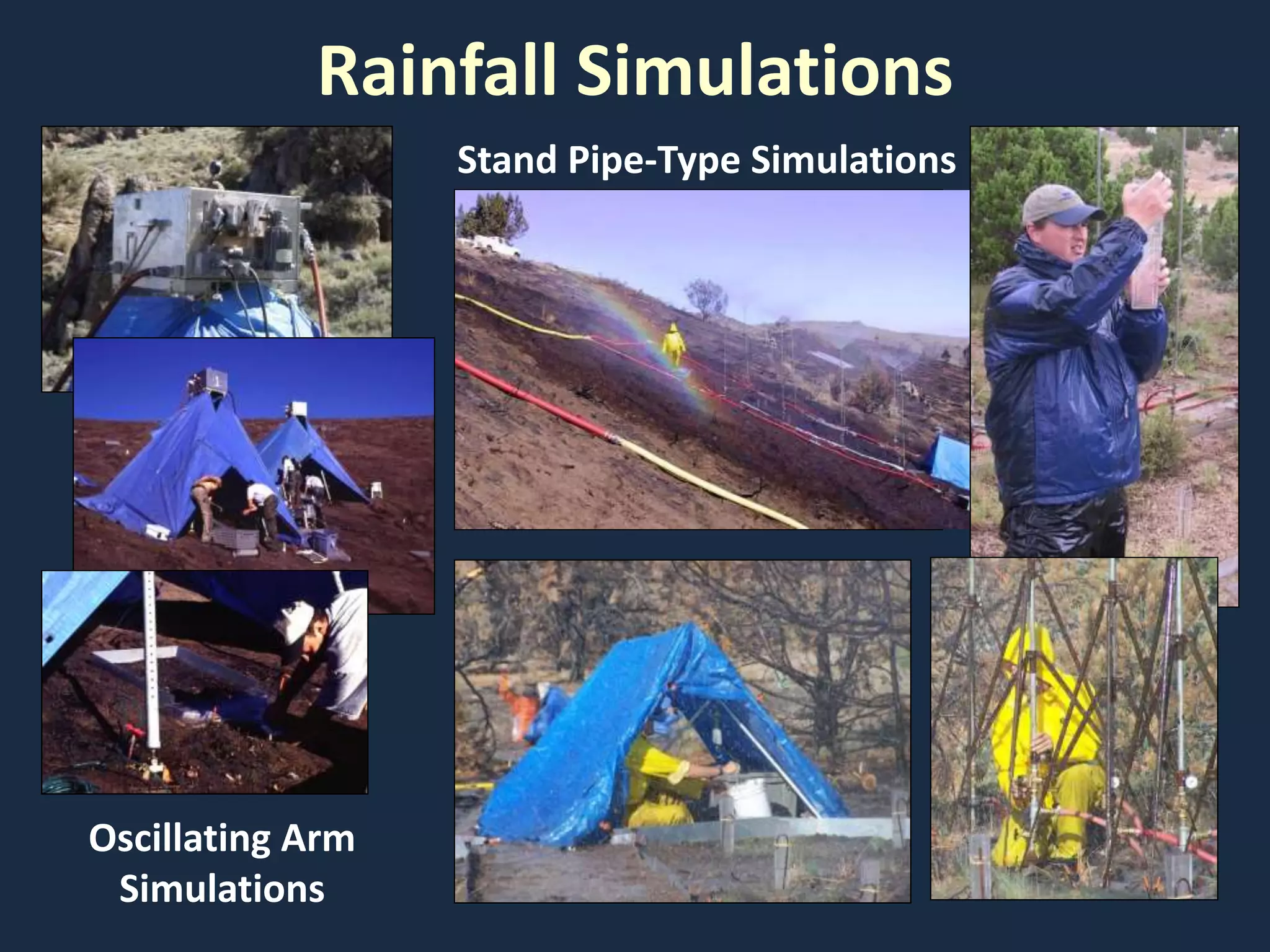
Oscillating Arm
Simulations
Stand Pipe-Type Simulations
Rainfall Simulations
Overland Flow Simulations
Vegetation and Soils
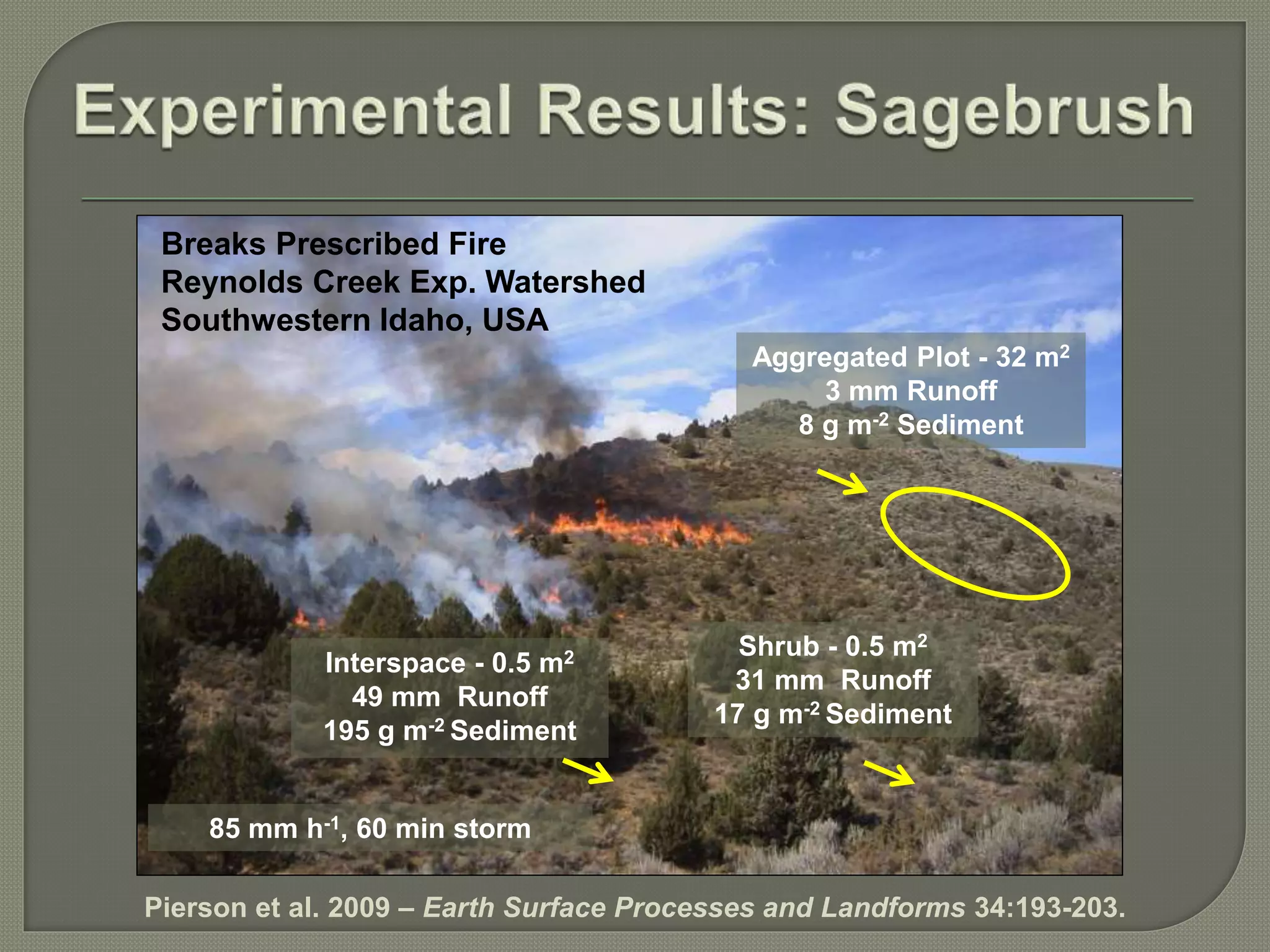
Pierson et al. 2009 – Earth Surface Processes and Landforms 34:193-203.
Interspace - 0.5 m2
49 mm Runoff
195 g m-2 Sediment
Aggregated Plot - 32 m2
3 mm Runoff
8 g m-2 Sediment
Shrub - 0.5 m2
31 mm Runoff
17 g m-2 Sediment
Breaks Prescribed Fire
Reynolds Creek Exp. Watershed
Southwestern Idaho, USA
85 mm h-1, 60 min storm
Pierson et al. 2009 – Earth Surface Processes and Landforms 34:193-203.
Interspace - 0.5 m2
44 mm Runoff
705 g m-2 Sediment
Aggregated Plot - 32 m2
16 mm Runoff
988 g m-2 Sediment
Shrub - 0.5 m2
61 mm Runoff
183 g m-2 Sediment
Breaks Prescribed Fire
Reynolds Creek Exp. Watershed
Southwestern Idaho, USA
Bare Ground as Driver of Connectivity
Pierson et al. 2010 – Rangeland Ecology and Management 63: 614-629.
Williams et al. 2013 – Ecohydrology DOI: 10.1002/eco.1364
13 m2
102 mm h-1
Increased Concentrated Flow
Bare Ground as Driver of Connectivity
• Flow velocity is function of bare
soils, discharge, and slope.
• Probability of overland flow to
concentrate, Al-Hamdan et al.
2013:
Pierson et al. 2009 – Earth Surface Processes and Landforms 34:193-203.
Al-Hamdan et al. 2012 – Earth Surface Processes and Landforms 37: 157-168.
Al-Hamdan et al. 2013 – Transactions of ASABE 56: 539-548.
 
 
exp 6 397 8 335 3 252 3440
1 exp 6 397 8 335 3 252 3440
( 756)
. . S . bare q
. . S .
P
bare q
n
   
    


32.5 m2
85 mm h-1
Fire: Increased Connectivity of Processes
13 m2
102 mm h-1
Increased
Concentrated
Flow
Soil Water Repellency
Soil Water Repellency Effects
Unburned Sagebrush Steppe, Nevada, USA
Time (min)
0 10 20 30 40 50 60
Infiltration(mmh-1)
0
15
30
45
60
75
90
WDPT(s)
0
60
120
180
240
300
Year 1 Year 2 Year 3
Unburned Sagebrush Steppe, Idaho, USA
Time (min)
0 10 20 30 40 50 60
Infiltration(mmh-1)
0
15
30
45
60
75
90
WDPT(s)
0
60
120
180
240
300
Year 1 Year 2
• Repellency can strongly
influence runoff
processes even under
unburned conditions
Pierson et al. 2008 - Catena
70%
75%
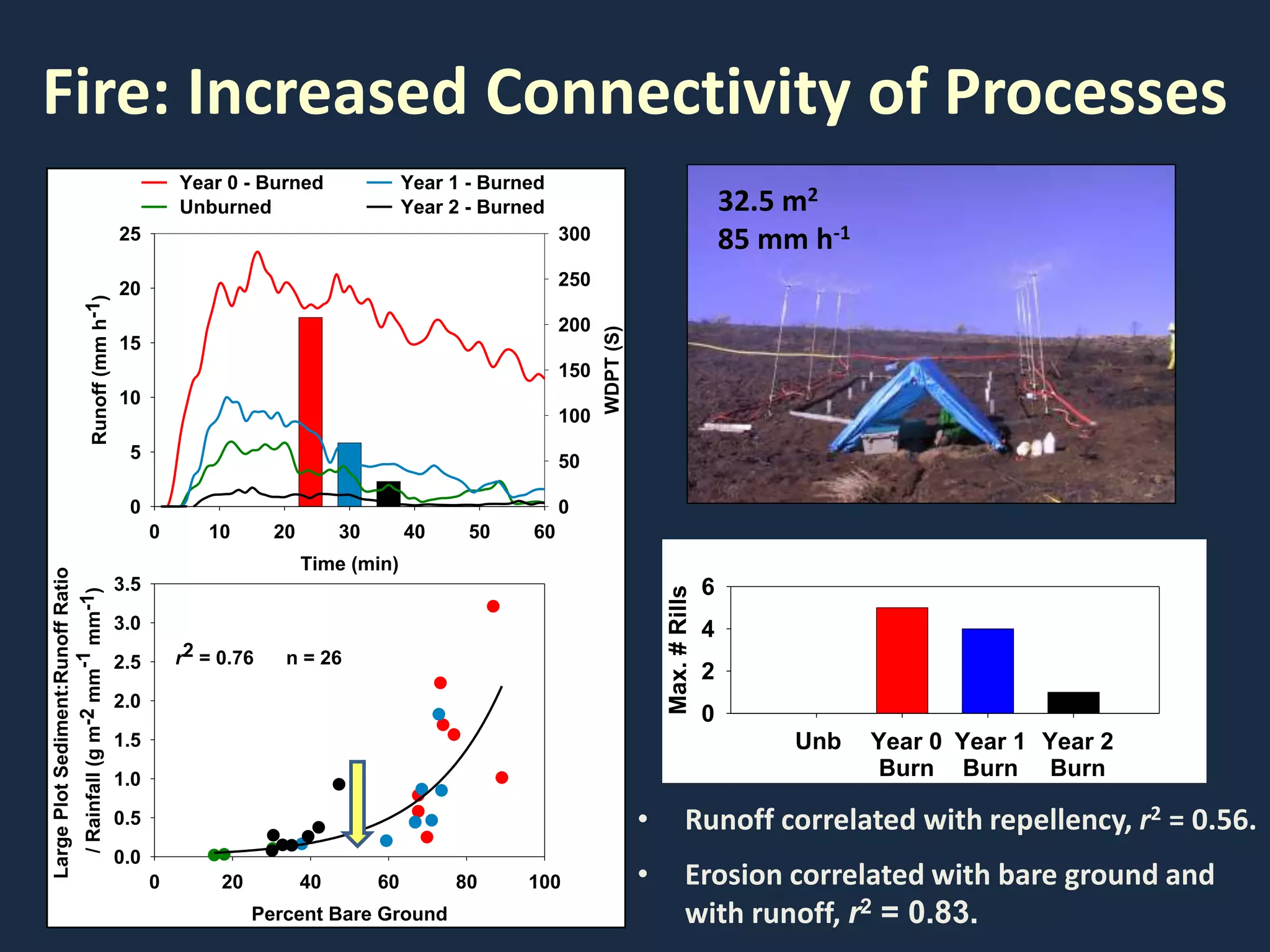
Fire: Increased Connectivity of Processes
WDPT(S)
0
50
100
150
200
250
300
Time (min)
0 10 20 30 40 50 60
Runoff(mmh-1)
0
5
10
15
20
25
Year 0 - Burned
Unburned
Year 1 - Burned
Year 2 - Burned
Percent Bare Ground
0 20 40 60 80 100
LargePlotSediment:RunoffRatio
/Rainfall(gm-2mm-1mm-1)
0.0
0.5
1.0
1.5
2.0
2.5
3.0
3.5
r2 = 0.76 n = 26
32.5 m2
85 mm h-1
Max.#Rills
0
2
4
6
Unb Year 0
Burn
Year 1
Burn
Year 2
Burn
• Runoff correlated with repellency, r2 = 0.56.
• Erosion correlated with bare ground and
with runoff, r2 = 0.83.
 Soil water repellency is common on unburned
and burned conditions for many rangeland
ecosystems.
 Repellency can strongly influence infiltration,
runoff, and vegetation recovery from fire.
 Repellency is highly variable in space and time
and causes of temporal variability remain poorly
understood.
 Variability in repellency and its influence on
hydrology, erosion, and vegetation over varying
spatial scales complicates its inclusion in
hydrologic models.
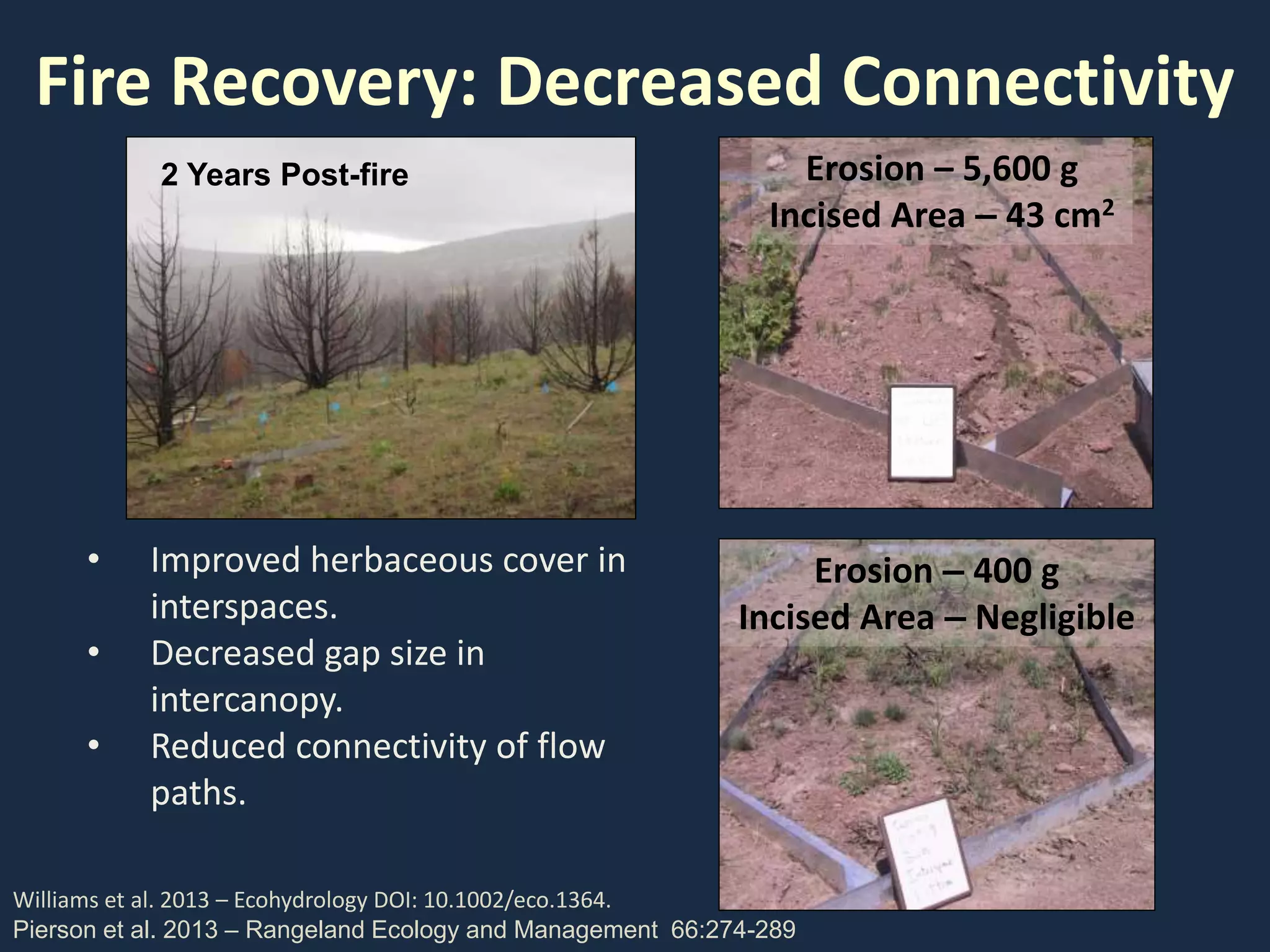
Fire Recovery: Decreased Connectivity
Erosion – 5,600 g
Incised Area – 43 cm2
Erosion – 400 g
Incised Area – Negligible
• Improved herbaceous cover in
interspaces.
• Decreased gap size in
intercanopy.
• Reduced connectivity of flow
paths.
2 Years Post-fire
Williams et al. 2013 – Ecohydrology DOI: 10.1002/eco.1364.
Pierson et al. 2013 – Rangeland Ecology and Management 66:274-289
Fire Recovery: Decreased Connectivity
1 Year Post-burn
2 Years Post-burn
Erosion from large plots:
988 g m-2 Burned Year 0
296 g m-2 Burned Year 1
6 g m-2 Burned Year 2
8 g m-2 Unburned
Two growing seasons
post-fire erosion
returned to pre-fire
levels largely due to
decreased runoff.
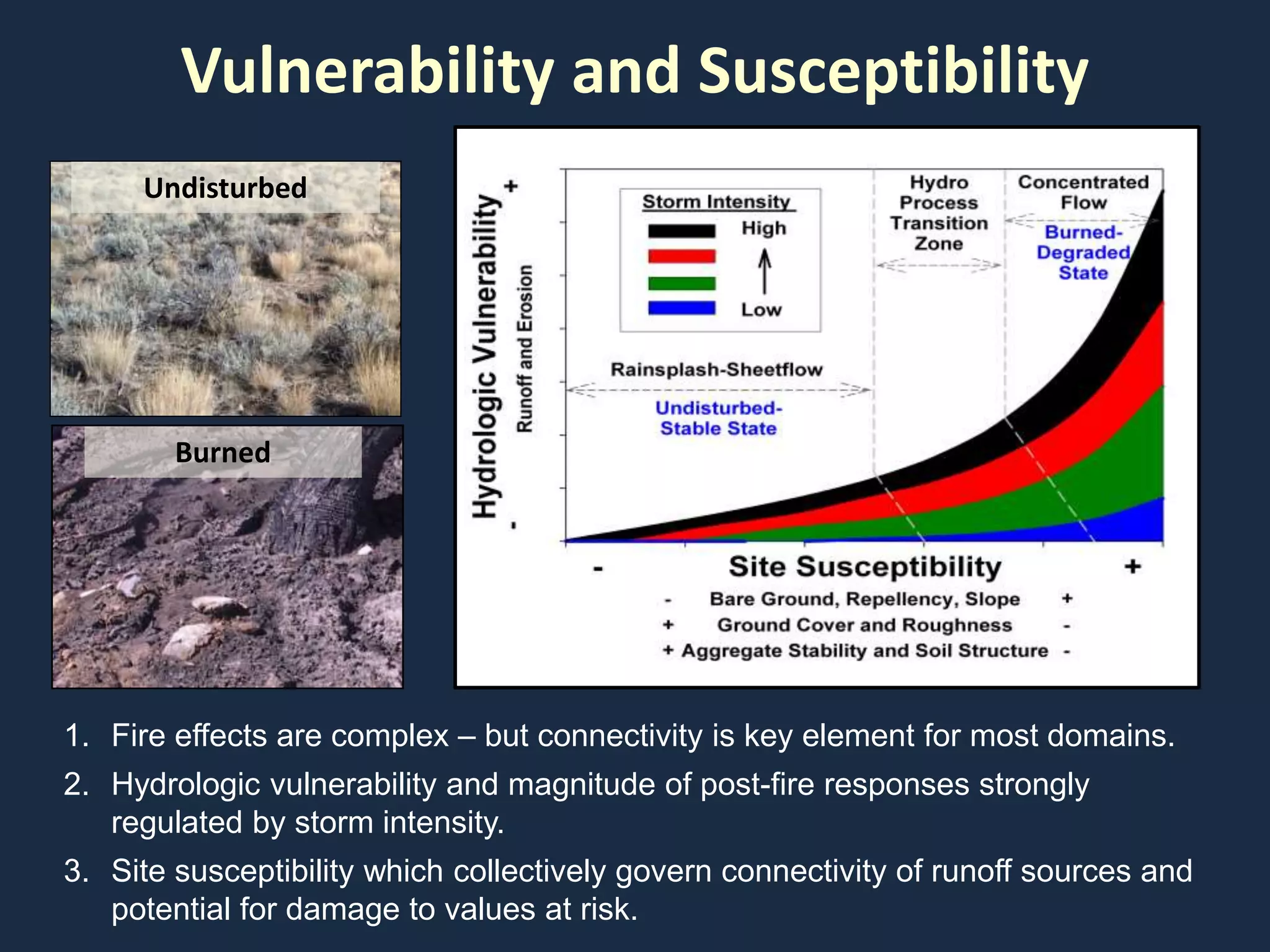
Vulnerability and Susceptibility
Undisturbed
Burned
1. Fire effects are complex – but connectivity is key element for most domains.
2. Hydrologic vulnerability and magnitude of post-fire responses strongly
regulated by storm intensity.
3. Site susceptibility which collectively govern connectivity of runoff sources and
potential for damage to values at risk.
• Fire amplifies cross-scale erosion by increasing
structural (bare ground) and functional connectivity
(processes).
• Amplified cross-scale erosion largely related to a shift in
dominant erosion process (concentrated flow) where
bare ground > 50-60%.
• Post-fire response is regulated by connectivity of
susceptible conditions, processes, sediment availability,
and the magnitude of water input.
• Recovery is strongly related to post-disturbance
vegetation recruitment that reduces structural and
functional connectivity and protects the soil surface.
 Body of work has advanced scientific
understanding of ecohydrologic effects of
fire, woodland encroachment, and land
management practices in Great Basin
sagebrush steppe.
 Contributes substantial data to fill voids in
historical rangeland hydrology databases.
 Combined data is resource for evaluating and
enhancing existing models.
 Knowledge and enhanced technologies
provide tools for assessing rangelands and
guiding management decisions.

Fire impacts on rangeland erosion

  • 1.
    Frederick B. Pierson– USDA-ARS, Boise, ID C. Jason Williams – USDA-ARS, Tucson, AZ Osama Al-Hamdan – Texas A&M, Kingsville, TX Fire is changing the landscapes of the west
  • 2.
    Overarching Goals: • Improveunderstanding of disturbance (fire) impacts on hydrology and erosion processes • Develop conceptual and quantitative tools for predicting effects of disturbance on hydrologic and erosion processes • Field guides and syntheses of knowledge • Physical representation of dominant processes • Parameterization of models such as RHEM • Deliver tools to land managers for improved assessment and management of semi-arid rangelands
  • 3.
    Interval = 50-100+yrs Interval = 5-20 yrs Sagebrush Steppe Annual Grass-Dominated
  • 4.
    Ladder fuel structureand dense woody fuel loading on woodlands promote high severity burns. High severity burns on woodland sites result in barren landscapes and present restoration challenges.
  • 6.
    Field Sites: 1996- 2017 Utah Juniper * * Large Plots/Conc. Flow: 198/478 Small Plots: 890  Fine to Coarse Soils     Pinyon-Juniper Western Juniper  Loam, Silt Loam, & Sandy Loam Soils Multiple Sage Sites   
  • 7.
    Oscillating Arm Simulations Stand Pipe-TypeSimulations Rainfall Simulations
  • 8.
  • 9.
  • 10.
    Pierson et al.2009 – Earth Surface Processes and Landforms 34:193-203. Interspace - 0.5 m2 49 mm Runoff 195 g m-2 Sediment Aggregated Plot - 32 m2 3 mm Runoff 8 g m-2 Sediment Shrub - 0.5 m2 31 mm Runoff 17 g m-2 Sediment Breaks Prescribed Fire Reynolds Creek Exp. Watershed Southwestern Idaho, USA 85 mm h-1, 60 min storm
  • 11.
    Pierson et al.2009 – Earth Surface Processes and Landforms 34:193-203. Interspace - 0.5 m2 44 mm Runoff 705 g m-2 Sediment Aggregated Plot - 32 m2 16 mm Runoff 988 g m-2 Sediment Shrub - 0.5 m2 61 mm Runoff 183 g m-2 Sediment Breaks Prescribed Fire Reynolds Creek Exp. Watershed Southwestern Idaho, USA
  • 12.
    Bare Ground asDriver of Connectivity Pierson et al. 2010 – Rangeland Ecology and Management 63: 614-629. Williams et al. 2013 – Ecohydrology DOI: 10.1002/eco.1364 13 m2 102 mm h-1 Increased Concentrated Flow
  • 13.
    Bare Ground asDriver of Connectivity • Flow velocity is function of bare soils, discharge, and slope. • Probability of overland flow to concentrate, Al-Hamdan et al. 2013: Pierson et al. 2009 – Earth Surface Processes and Landforms 34:193-203. Al-Hamdan et al. 2012 – Earth Surface Processes and Landforms 37: 157-168. Al-Hamdan et al. 2013 – Transactions of ASABE 56: 539-548.     exp 6 397 8 335 3 252 3440 1 exp 6 397 8 335 3 252 3440 ( 756) . . S . bare q . . S . P bare q n            32.5 m2 85 mm h-1
  • 14.
    Fire: Increased Connectivityof Processes 13 m2 102 mm h-1 Increased Concentrated Flow Soil Water Repellency
  • 15.
    Soil Water RepellencyEffects Unburned Sagebrush Steppe, Nevada, USA Time (min) 0 10 20 30 40 50 60 Infiltration(mmh-1) 0 15 30 45 60 75 90 WDPT(s) 0 60 120 180 240 300 Year 1 Year 2 Year 3 Unburned Sagebrush Steppe, Idaho, USA Time (min) 0 10 20 30 40 50 60 Infiltration(mmh-1) 0 15 30 45 60 75 90 WDPT(s) 0 60 120 180 240 300 Year 1 Year 2 • Repellency can strongly influence runoff processes even under unburned conditions Pierson et al. 2008 - Catena 70% 75%
  • 16.
    Fire: Increased Connectivityof Processes WDPT(S) 0 50 100 150 200 250 300 Time (min) 0 10 20 30 40 50 60 Runoff(mmh-1) 0 5 10 15 20 25 Year 0 - Burned Unburned Year 1 - Burned Year 2 - Burned Percent Bare Ground 0 20 40 60 80 100 LargePlotSediment:RunoffRatio /Rainfall(gm-2mm-1mm-1) 0.0 0.5 1.0 1.5 2.0 2.5 3.0 3.5 r2 = 0.76 n = 26 32.5 m2 85 mm h-1 Max.#Rills 0 2 4 6 Unb Year 0 Burn Year 1 Burn Year 2 Burn • Runoff correlated with repellency, r2 = 0.56. • Erosion correlated with bare ground and with runoff, r2 = 0.83.
  • 17.
     Soil waterrepellency is common on unburned and burned conditions for many rangeland ecosystems.  Repellency can strongly influence infiltration, runoff, and vegetation recovery from fire.  Repellency is highly variable in space and time and causes of temporal variability remain poorly understood.  Variability in repellency and its influence on hydrology, erosion, and vegetation over varying spatial scales complicates its inclusion in hydrologic models.
  • 18.
    Fire Recovery: DecreasedConnectivity Erosion – 5,600 g Incised Area – 43 cm2 Erosion – 400 g Incised Area – Negligible • Improved herbaceous cover in interspaces. • Decreased gap size in intercanopy. • Reduced connectivity of flow paths. 2 Years Post-fire Williams et al. 2013 – Ecohydrology DOI: 10.1002/eco.1364. Pierson et al. 2013 – Rangeland Ecology and Management 66:274-289
  • 19.
    Fire Recovery: DecreasedConnectivity 1 Year Post-burn 2 Years Post-burn Erosion from large plots: 988 g m-2 Burned Year 0 296 g m-2 Burned Year 1 6 g m-2 Burned Year 2 8 g m-2 Unburned Two growing seasons post-fire erosion returned to pre-fire levels largely due to decreased runoff.
  • 20.
    Vulnerability and Susceptibility Undisturbed Burned 1.Fire effects are complex – but connectivity is key element for most domains. 2. Hydrologic vulnerability and magnitude of post-fire responses strongly regulated by storm intensity. 3. Site susceptibility which collectively govern connectivity of runoff sources and potential for damage to values at risk.
  • 21.
    • Fire amplifiescross-scale erosion by increasing structural (bare ground) and functional connectivity (processes). • Amplified cross-scale erosion largely related to a shift in dominant erosion process (concentrated flow) where bare ground > 50-60%. • Post-fire response is regulated by connectivity of susceptible conditions, processes, sediment availability, and the magnitude of water input. • Recovery is strongly related to post-disturbance vegetation recruitment that reduces structural and functional connectivity and protects the soil surface.
  • 22.
     Body ofwork has advanced scientific understanding of ecohydrologic effects of fire, woodland encroachment, and land management practices in Great Basin sagebrush steppe.  Contributes substantial data to fill voids in historical rangeland hydrology databases.  Combined data is resource for evaluating and enhancing existing models.  Knowledge and enhanced technologies provide tools for assessing rangelands and guiding management decisions.

Editor's Notes

  • #13 The effects of bare ground are easily visible in these data from rainfall simulations in Great Basin woodlands. Runoff and erosion both increase exponentially where bare soil and rock exceed 50-60%. Above these thresholds, the intercanopy may occupy nearly 90% of a site. This area is the primary source for runoff and its connectivity allows runoff sources to concentrate into rills. This enhances sediment detachment and transport.
  • #14 These data are from a sagebrush site in Idaho and further support the effects of bare ground on runoff and soil loss. Here again, there is quasi-threshold around 60% bare gorund. Above this threshold, the velocity of overland flow and sediment detachment and transport increase exponentially. Data across diverse rangelands in the Great Basin suggest that the probability of flow to concentrate is well predicted by percent bare ground, hillslope angle, and runoff (discharge). The variables capture the connectivity of bare areas, topographic effects on discharge, and the effect of increased runoff.
  • #15 As runoff sources accumulate over larger scales due to connectivity of source areas (exacerbation of repellency effects under trees, high runoff from interspaces), overland flow begins to concentrate. Concentration of flow increases it velocity, transport capacity, and detachment energy. This results in higher sediment delivery per unit of runoff – partially related to the amount of sediment available and partially due to the characteristics of the transport mechanism – rills.
  • #16 The overall response is in part a function of site and soil characteristics: Steep slopes and convergent terrain facilitate runoff generation whereas gentle, divergent terrain creates sinuous flow patterns and slows overland flow Soil texture influences infiltration and erodibility (sandy soils – better infiltration, but erodible; clay soils swell) Low bulk density and good soil structure facilitate infiltration Soil organic matter promotes soil structure and soil fauna that further enhance structure and macropores (better infiltration) Aggregate stability enhances soil structure and infiltration and mitigates erosion Rock lying on the surface promotes infiltration whereas embedded rock facilitates runoff generation and erosion. The degree of saturation affects infiltration (wetness inhibits infiltration and soil stability) Soil water repellency causes rapid runoff generation where bare soils exist, but is mitigated by litter (storage), macropores, and soil moisture
  • #17 Over larger scales, runoff and erosion both increase. Erosion increases exponentially were bare soil exceeds 60%. The number of rills within plots was highest the first year post-fire. Extensive bare ground facilitated concentration of runoff from coppices and interspaces and allowed rills to form --- yielding high soil loss (988 g/m2 post-fire relative to 8 g/m2 prefire).
  • #19 Recovery of vegetation in years post-fire acts to reduce the connectivity of overland flow sources and decrease the flow velocity, detachment energy, and transport capacity. We can see that in these data for the same site 2 years following wildfire. Pre-fire, extensive bare degraded intercanopy areas had significant incision of flow paths. Vegetation recruitement post-fire reduced gap distance between plants, altered flow characteristics, and reduced incision and erosion.
  • #20 Soil loss declined as cover increased and reduced connectivity of runoff sources. Runoff decline with plant recovery reduced transport and detachment – erodibility remained elevated over unburned conditions in Year 3.
  • #21 We can conceptualize hillslope response as representing the vulnerability of the hillslope. Vulnerability is a function of the connectivity of the runoff processes and that connectivity is governed by the susceptibility of the surface and water input or storm intensity – climate over long-term windows. Susceptibility is represented by inherent site characteristics and those imparted by disturbance. So, for burned slopes, this includes burn severity, but also charateristics like slope angle, soil erodiblity, sediment availability, etc. So, knowing something about the overall hydrologic vulnerability (connectivity of processes) informs us of the potential response magnitudes for a range of conditions and storm events and the potential for off site impacts on values at risk. In this talk, I’ll step through these relationships using data for numerous field studies of burned and unburned sites within the Great Basin, but the results are applicable across numerous response domains. ****************************** In this model, vulnerability or the magnitude of response is dictated by the connectivity of processes. Connectivity of processes is a function of the susceptibility of the site and the storm intensity. Susceptibility if function of surface characteristics that are both fire-induced and inherent to the site.