Introduction
Climate warming is believed to shift the climate
envelope of trees upward in elevation, changing
forest dynamics (Benavies et al. 2013). Mountain
pine beetle disturbance may also affect the
number of new saplings.(Overpeck et al. 1990). By
examining changes in trees at an individual scale,
there should be a change in recruitment patterns.
This research will provide information on what
drives change in forest composition so we can
better manage national parks.
Objectives
This study looks at how multiple factors interact
to influence vegetation patterns along transects
(upper and lower range margins of lodgepole
pine). We are looking at how the number of new
lodgepole pine saplings is affected by
1) Pine beetle outbreak, and
2) Climate change
Methods
• Field sampling was conducted in Rocky
Mountain National Park in 1995 and 2012. Each
transect was made up of plots and oriented
along an elevation gradient.
• Plot maps from 1995 and 2012 containing trees
with their species type and diameter at breast
height were used to match trees from each
year to track growth, recruitment of individual
trees on each transect.
• We fit a linear regression with log(sapling
density) as the response variable; pine beetle
severity, elevation, and ecotone type as
predictors, and all possible interactions. We
compared average sapling density at lower vs.
upper range margins using a t-test.
Results
Benavides R, Rabasa SG, Granda E et al. (2013) Direct and
indirect effects of climate on demography and early growth of
Pinus sylvestris at the rear edge: Changing roles of biotic and
abiotic factors (ed Moora M). PLoS ONE, 8, e59824.
Beniston, M., Diaz, H. & Bradley, R. (1997) Climatic change at
high elevation sites: an overview. Climatic Change, 36, 233–251.
Overpeck J, Rind D, Goldberg R (1990) Climate-induced changes
in forest disturbance and vegetation. Nature, 343, 51–53.
Raffa KF, Aukema BH, Bentz BJ, Carroll AL, Hicke JA, Turner
MG, Romme WH (2008) Cross-scale drivers of natural
disturbances prone to anthropogenic amplification: The
dynamics of bark beetle eruptions. BioScience, 58, 501–517
Discussion
• The lack of mountain pine beetle effect on
the number of saplings could be due to the
short time span between outbreaks and
measurements. If we return in the future
we could expect to see more sapling
recruitment to re-establish the forest after
the disturbance.
• The low sapling densities on lower elevation
ecotones is due to climate warming, making
lower elevations less suitable. Trees will
migrate upward towards cooler elevations
that are more climatically suitable.
• As multiple disturbances continue to
interact, sapling recruitment will change.
Climate warming and beetle outbreaks will
shift the envelope upward in elevation and
change the definitions of suitable habitats.
More saplings will continue to grow in
higher elevations after disturbances and
change the forest structure and ecosystem.
References
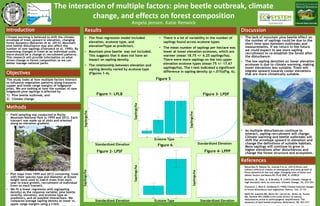
• The final regression model included
elevation, ecotone type, and
elevation*type as predictors.
• Mountain pine beetle was not included.
This suggests that it does not have an
impact on sapling density.
• The relationship between elevation and
sapling density varied by ecotone type
(Figures 1-4).
0
25
50
75
100
-1 0 1
Standardized Elevation
Saplings/ha
• There is a lot of variability in the number of
saplings found across ecotone types.
• The mean number of saplings per hectare was
lower at lower elevation ecotones, which are
warmer (mean 18.75 +/- 6.25 saplings/ha).
There were more saplings on the two upper
elevation ecotone types (mean 75 +/- 17.67
saplings/ha). The t-test indicated a significant
difference in sapling density (p =.015)(Fig. 6).
0
50
100
150
-1 0 1
Standardized Elevation
Saplings/ha
0
25
50
75
100
-1 0 1
Standardized Elevation
Saplings/ha
0
30
60
90
LPPP LPDF LPSF LPLB
Ecotone TypeSaplings/ha
The interaction of multiple factors: pine beetle outbreak, climate
change, and effects on forest composition
Angela Jensen. Katie Renwick
0
25
50
75
100
-1 0 1
Standardized Elevation
Saplings/ha
0
25
50
75
lower upper
Range Margin
Saplings/ha
Saplings/ha
Standardized Elevation
Figure 1- LPLB
Figure 2- LPSF
Standardized Elevation
Saplings/ha
Figure 3- LPDF
Standardized Elevation
Saplings/ha
Figure 4- LPPP
Standardized Elevation
Saplings/ha
Figure 5
Figure 6
Ecotone Type
Saplings/haSaplings/ha
Ecotone Type

poster final

  • 1.
    Introduction Climate warming isbelieved to shift the climate envelope of trees upward in elevation, changing forest dynamics (Benavies et al. 2013). Mountain pine beetle disturbance may also affect the number of new saplings.(Overpeck et al. 1990). By examining changes in trees at an individual scale, there should be a change in recruitment patterns. This research will provide information on what drives change in forest composition so we can better manage national parks. Objectives This study looks at how multiple factors interact to influence vegetation patterns along transects (upper and lower range margins of lodgepole pine). We are looking at how the number of new lodgepole pine saplings is affected by 1) Pine beetle outbreak, and 2) Climate change Methods • Field sampling was conducted in Rocky Mountain National Park in 1995 and 2012. Each transect was made up of plots and oriented along an elevation gradient. • Plot maps from 1995 and 2012 containing trees with their species type and diameter at breast height were used to match trees from each year to track growth, recruitment of individual trees on each transect. • We fit a linear regression with log(sapling density) as the response variable; pine beetle severity, elevation, and ecotone type as predictors, and all possible interactions. We compared average sapling density at lower vs. upper range margins using a t-test. Results Benavides R, Rabasa SG, Granda E et al. (2013) Direct and indirect effects of climate on demography and early growth of Pinus sylvestris at the rear edge: Changing roles of biotic and abiotic factors (ed Moora M). PLoS ONE, 8, e59824. Beniston, M., Diaz, H. & Bradley, R. (1997) Climatic change at high elevation sites: an overview. Climatic Change, 36, 233–251. Overpeck J, Rind D, Goldberg R (1990) Climate-induced changes in forest disturbance and vegetation. Nature, 343, 51–53. Raffa KF, Aukema BH, Bentz BJ, Carroll AL, Hicke JA, Turner MG, Romme WH (2008) Cross-scale drivers of natural disturbances prone to anthropogenic amplification: The dynamics of bark beetle eruptions. BioScience, 58, 501–517 Discussion • The lack of mountain pine beetle effect on the number of saplings could be due to the short time span between outbreaks and measurements. If we return in the future we could expect to see more sapling recruitment to re-establish the forest after the disturbance. • The low sapling densities on lower elevation ecotones is due to climate warming, making lower elevations less suitable. Trees will migrate upward towards cooler elevations that are more climatically suitable. • As multiple disturbances continue to interact, sapling recruitment will change. Climate warming and beetle outbreaks will shift the envelope upward in elevation and change the definitions of suitable habitats. More saplings will continue to grow in higher elevations after disturbances and change the forest structure and ecosystem. References • The final regression model included elevation, ecotone type, and elevation*type as predictors. • Mountain pine beetle was not included. This suggests that it does not have an impact on sapling density. • The relationship between elevation and sapling density varied by ecotone type (Figures 1-4). 0 25 50 75 100 -1 0 1 Standardized Elevation Saplings/ha • There is a lot of variability in the number of saplings found across ecotone types. • The mean number of saplings per hectare was lower at lower elevation ecotones, which are warmer (mean 18.75 +/- 6.25 saplings/ha). There were more saplings on the two upper elevation ecotone types (mean 75 +/- 17.67 saplings/ha). The t-test indicated a significant difference in sapling density (p =.015)(Fig. 6). 0 50 100 150 -1 0 1 Standardized Elevation Saplings/ha 0 25 50 75 100 -1 0 1 Standardized Elevation Saplings/ha 0 30 60 90 LPPP LPDF LPSF LPLB Ecotone TypeSaplings/ha The interaction of multiple factors: pine beetle outbreak, climate change, and effects on forest composition Angela Jensen. Katie Renwick 0 25 50 75 100 -1 0 1 Standardized Elevation Saplings/ha 0 25 50 75 lower upper Range Margin Saplings/ha Saplings/ha Standardized Elevation Figure 1- LPLB Figure 2- LPSF Standardized Elevation Saplings/ha Figure 3- LPDF Standardized Elevation Saplings/ha Figure 4- LPPP Standardized Elevation Saplings/ha Figure 5 Figure 6 Ecotone Type Saplings/haSaplings/ha Ecotone Type