Fire and Forest
Dynamics
in Northern Boreal
Forests
Jill Johnstone
Biology, University of Saskatchewan
Northern
boreal forest
• Conifer
dominated
• Cool soils,
slow growth &
decomposition
• Resistant to
change?
Fire and Global Change

Chapin et al. 2005

Stocks et al. 1998
Can we expect changes in
forest composition?
What are those likely to be?
Resilience and Response Dynamics
dynamic
equilibrium

directional
change
Resilience & Ecosystem Feedbacks
Dominant
species

Disturbance

Functional
traits

Interactions

Competition, herbivory

Recruitment
Alternate successional cycles
A. Black spruce domain

B. Broadleaf forest domain

Broadleaf
dominant

Black spruce
dominant
High moisture
High moss
Cool soils

FIRE

Local seed &
Resprouting

Slow
growth

Poor quality
seedbeds
(organic soil)

Slow nutrient turnover
Low competition

Low moisture
Low moss
Warm soils

Rapid
growth

Rapid nutrient turnover
High competition

Johnstone et al. 2010, Can. J. Forest Research

FIRE

Resprouting &
Seed dispersal
High quality
seedbeds
(mineral soil)
Alternate successional cycles
A. Black spruce domain

B. Broadleaf forest domain

Broadleaf
dominant

Black spruce
dominant
High moisture
High moss
Cool soils

FIRE

Local seed &
Resprouting

Slow
growth

Poor quality
seedbeds
(organic soil)

Slow nutrient turnover
Low competition

Low moisture
Low moss
Warm soils

Rapid
growth

Rapid nutrient turnover
High competition

Johnstone et al. 2010, Can. J. Forest Research

FIRE

Resprouting &
Seed dispersal
High quality
seedbeds
(mineral soil)
How do fire characteristics shape
patterns of forest resilience?
• Why study fire?
– Ubiquitous in western boreal region
– Sensitive to climate
– Post-fire recovery determines future forest
composition
Fire and successional
trajectories in black spruce
forests
Fire severity affects
seedbed quality

Burning of organic soils influences
patterns of post-fire recruitment
Patch effects of fire severity
Low severity (organic)
– Poor seedbeds
– Recruitment requires high
seed inputs
– Favors serotinous conifers

High severity (mineral)
– Higher quality seedbeds
– Creates opportunities for
deciduous establishment
How does this influence forest
dynamics across
heterogeneous landscapes?
Fire severity and post-fire recovery
• Alaska 2004 fires
• 90 black spruce sites
• Initial stand recovery
• Environmental conditions

Field Data

– Potential site moisture
– Elevation
– Potential insolation

• Pre-fire stand structure
– Stem density
– Stem basal area

• Fire severity
– Composite Burn Index (CBI)
– Residual organic layer depth

• Post-fire recruitment
– Tree seedling density
– 4 years post-fire
Spruce seedling density

Boosted regression tree, prediction error=0.54
Johnstone et al. 2010, Global Change Biology
Deciduous seedling density

Boosted regression tree, prediction error=0.44
Johnstone et al. 2010, Global Change Biology
Relative spruce dominance:
Recovery of spruce trajectory

Boosted regression tree, prediction error=0.42
Johnstone et al. 2010, Global Change Biology
Controls on spruce forest resilience
• Severe fires reduce the
competitive advantage of spruce
and favor deciduous species

• Severe fires alter soil microclimate
• Site moisture
– Warm, dry soils favor aspen
– Severe fires are also more likely

• Young stands vulnerable to
change
Studies of fire frequency using
overlapping fires
historic fire

overlap zones:
rapid disturbance return

recent fire

image courtesy of David Milne, Yukon Gov.
Repeat fires alter tree regeneration
40000

stem density (#/ha)

35000

***
Burned at >80 yr.
Burned at <30 yr.

30000
25000
20000

***

15000

***

10000

ns

5000
0
total

Picea

Pinus

Populus

Johnstone & Chapin 2006, Ecosystems
Seed rain

Brown & Johnstone, unpublished
Seedling establishment

Brown & Johnstone, unpublished
How old does a stand need to be
before there is sufficient cone
production to support regeneration?
Cone Production

(log scale)
Cones/tree (Log10 scale)

n=14, p<0.001, r=0.723

Number of Cones Present on Tree

n=170, p<0.001, r=0.360
2.5
2
1.5
1
0.5
0
0

20

40

60

80

Tree Age

Viglas & Johnstone, unpublished
Fire interval effects
• Repeat fires interrupt
conifer regeneration
cycles
– Reduced cone production

• Confers a regeneration
advantage to winddispersed seeds
• Net effect is to shift
trajectories to deciduous
dominance
Shifts in resilience cycles
Black spruce
dominant

Deciduous
dominant

Fire

High moisture
Cool soils
Slow turnover

Low moisture
Warm soils
Rapid turnover

Organic
seedbeds

Slow growth
Low competition

Mineral soil
seedbeds
Resprouting &
seed dispersal
Rapid growth
High competition
Shifts in resilience cycles
Black spruce
dominant
High moisture
Cool soils
Slow turnover

long fire interval
Deciduous
dominant

Fire

severe or
short-interval
fire

Low moisture
Warm soils
Rapid turnover

Organic
seedbeds

Slow growth
Low competition

Mineral soil
seedbeds
Resprouting &
seed dispersal
Rapid growth
High competition
Why is this important?
• Changes in forest cover affect:
– Carbon storage
– Energy and water transfer
– Wildlife and subsistence resources
– Feedbacks to future fire behavior
Fire severity and succession:
Impacts on future fire behavior
• High fire severity transforms black
spruce to deciduous forest
• Deciduous forest has lower flammability
Can fire-initiated changes create a
negative feedback to climate-driven
increases in fire activity?
ALFRESCO simulation experiment
• Spatial simulation model for boreal landscapes
• Succession influenced by fire severity
• 3 Severity Scenarios:
– Low (LSS): All fires burn with low severity (spruce trajectory)
– High (HSS): Maximum extent of high severity (decid. trajectory)
– Mix: Intermediate scenario

• High and moderate scenarios of climate warming
Area = ~ 2500

KEY:
Green & Yellow = Low Sev.
Red = High Sev. in HSS
Black = High Sev. in Mix + HSS

Area = ~1000
Cumulative area burned
High warming

Low warming

Johnstone, Rupp, et al., in review
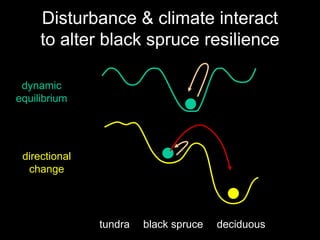
Disturbance & climate interact
to alter black spruce resilience
dynamic
equilibrium

directional
change

tundra

black spruce

deciduous
Future Research
• Mechanistic understanding of plant-soilmicrobial feedbacks
• Quantifying thresholds and tipping
points
• Landscape prediction of vulnerability to
change
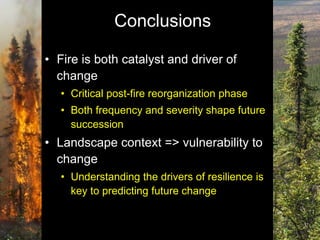
Conclusions
• Fire is both catalyst and driver of
change
• Critical post-fire reorganization phase
• Both frequency and severity shape future
succession

• Landscape context => vulnerability to
change
• Understanding the drivers of resilience is
key to predicting future change
Acknowledgements
Co-authors:
Carissa Brown

Terry Chapin
Teresa Hollingsworth
Michelle Mack

Mark Olsen
Scott Rupp
Ted Schuur
David Verbyla
Jayme Viglas

Fire and Forest Dynamics in Northern Boreal Forests

  • 1.
    Fire and Forest Dynamics inNorthern Boreal Forests Jill Johnstone Biology, University of Saskatchewan
  • 2.
    Northern boreal forest • Conifer dominated •Cool soils, slow growth & decomposition • Resistant to change?
  • 3.
    Fire and GlobalChange Chapin et al. 2005 Stocks et al. 1998
  • 4.
    Can we expectchanges in forest composition? What are those likely to be?
  • 5.
    Resilience and ResponseDynamics dynamic equilibrium directional change
  • 6.
    Resilience & EcosystemFeedbacks Dominant species Disturbance Functional traits Interactions Competition, herbivory Recruitment
  • 7.
    Alternate successional cycles A.Black spruce domain B. Broadleaf forest domain Broadleaf dominant Black spruce dominant High moisture High moss Cool soils FIRE Local seed & Resprouting Slow growth Poor quality seedbeds (organic soil) Slow nutrient turnover Low competition Low moisture Low moss Warm soils Rapid growth Rapid nutrient turnover High competition Johnstone et al. 2010, Can. J. Forest Research FIRE Resprouting & Seed dispersal High quality seedbeds (mineral soil)
  • 8.
    Alternate successional cycles A.Black spruce domain B. Broadleaf forest domain Broadleaf dominant Black spruce dominant High moisture High moss Cool soils FIRE Local seed & Resprouting Slow growth Poor quality seedbeds (organic soil) Slow nutrient turnover Low competition Low moisture Low moss Warm soils Rapid growth Rapid nutrient turnover High competition Johnstone et al. 2010, Can. J. Forest Research FIRE Resprouting & Seed dispersal High quality seedbeds (mineral soil)
  • 9.
    How do firecharacteristics shape patterns of forest resilience? • Why study fire? – Ubiquitous in western boreal region – Sensitive to climate – Post-fire recovery determines future forest composition
  • 10.
    Fire and successional trajectoriesin black spruce forests
  • 11.
    Fire severity affects seedbedquality Burning of organic soils influences patterns of post-fire recruitment
  • 12.
    Patch effects offire severity Low severity (organic) – Poor seedbeds – Recruitment requires high seed inputs – Favors serotinous conifers High severity (mineral) – Higher quality seedbeds – Creates opportunities for deciduous establishment
  • 13.
    How does thisinfluence forest dynamics across heterogeneous landscapes?
  • 14.
    Fire severity andpost-fire recovery • Alaska 2004 fires • 90 black spruce sites • Initial stand recovery
  • 15.
    • Environmental conditions FieldData – Potential site moisture – Elevation – Potential insolation • Pre-fire stand structure – Stem density – Stem basal area • Fire severity – Composite Burn Index (CBI) – Residual organic layer depth • Post-fire recruitment – Tree seedling density – 4 years post-fire
  • 16.
    Spruce seedling density Boostedregression tree, prediction error=0.54 Johnstone et al. 2010, Global Change Biology
  • 17.
    Deciduous seedling density Boostedregression tree, prediction error=0.44 Johnstone et al. 2010, Global Change Biology
  • 18.
    Relative spruce dominance: Recoveryof spruce trajectory Boosted regression tree, prediction error=0.42 Johnstone et al. 2010, Global Change Biology
  • 19.
    Controls on spruceforest resilience • Severe fires reduce the competitive advantage of spruce and favor deciduous species • Severe fires alter soil microclimate • Site moisture – Warm, dry soils favor aspen – Severe fires are also more likely • Young stands vulnerable to change
  • 20.
    Studies of firefrequency using overlapping fires historic fire overlap zones: rapid disturbance return recent fire image courtesy of David Milne, Yukon Gov.
  • 21.
    Repeat fires altertree regeneration 40000 stem density (#/ha) 35000 *** Burned at >80 yr. Burned at <30 yr. 30000 25000 20000 *** 15000 *** 10000 ns 5000 0 total Picea Pinus Populus Johnstone & Chapin 2006, Ecosystems
  • 22.
    Seed rain Brown &Johnstone, unpublished
  • 23.
    Seedling establishment Brown &Johnstone, unpublished
  • 24.
    How old doesa stand need to be before there is sufficient cone production to support regeneration?
  • 25.
    Cone Production (log scale) Cones/tree(Log10 scale) n=14, p<0.001, r=0.723 Number of Cones Present on Tree n=170, p<0.001, r=0.360 2.5 2 1.5 1 0.5 0 0 20 40 60 80 Tree Age Viglas & Johnstone, unpublished
  • 26.
    Fire interval effects •Repeat fires interrupt conifer regeneration cycles – Reduced cone production • Confers a regeneration advantage to winddispersed seeds • Net effect is to shift trajectories to deciduous dominance
  • 27.
    Shifts in resiliencecycles Black spruce dominant Deciduous dominant Fire High moisture Cool soils Slow turnover Low moisture Warm soils Rapid turnover Organic seedbeds Slow growth Low competition Mineral soil seedbeds Resprouting & seed dispersal Rapid growth High competition
  • 28.
    Shifts in resiliencecycles Black spruce dominant High moisture Cool soils Slow turnover long fire interval Deciduous dominant Fire severe or short-interval fire Low moisture Warm soils Rapid turnover Organic seedbeds Slow growth Low competition Mineral soil seedbeds Resprouting & seed dispersal Rapid growth High competition
  • 29.
    Why is thisimportant? • Changes in forest cover affect: – Carbon storage – Energy and water transfer – Wildlife and subsistence resources – Feedbacks to future fire behavior
  • 30.
    Fire severity andsuccession: Impacts on future fire behavior • High fire severity transforms black spruce to deciduous forest • Deciduous forest has lower flammability Can fire-initiated changes create a negative feedback to climate-driven increases in fire activity?
  • 31.
    ALFRESCO simulation experiment •Spatial simulation model for boreal landscapes • Succession influenced by fire severity • 3 Severity Scenarios: – Low (LSS): All fires burn with low severity (spruce trajectory) – High (HSS): Maximum extent of high severity (decid. trajectory) – Mix: Intermediate scenario • High and moderate scenarios of climate warming Area = ~ 2500 KEY: Green & Yellow = Low Sev. Red = High Sev. in HSS Black = High Sev. in Mix + HSS Area = ~1000
  • 32.
    Cumulative area burned Highwarming Low warming Johnstone, Rupp, et al., in review
  • 33.
    Disturbance & climateinteract to alter black spruce resilience dynamic equilibrium directional change tundra black spruce deciduous
  • 34.
    Future Research • Mechanisticunderstanding of plant-soilmicrobial feedbacks • Quantifying thresholds and tipping points • Landscape prediction of vulnerability to change
  • 35.
    Conclusions • Fire isboth catalyst and driver of change • Critical post-fire reorganization phase • Both frequency and severity shape future succession • Landscape context => vulnerability to change • Understanding the drivers of resilience is key to predicting future change
  • 36.
    Acknowledgements Co-authors: Carissa Brown Terry Chapin TeresaHollingsworth Michelle Mack Mark Olsen Scott Rupp Ted Schuur David Verbyla Jayme Viglas