Download to read offline
![IJRET: International Journal of Research in Engineering and Technology eISSN: 2319-1163 | pISSN: 2321-7308
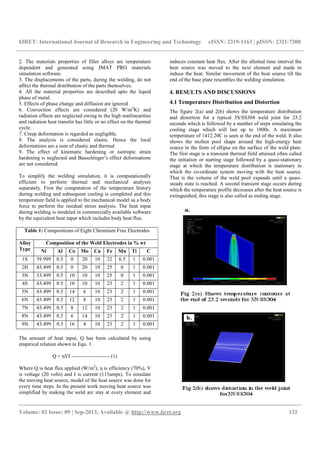
__________________________________________________________________________________________
Volume: 02 Issue: 09 | Sep-2013, Available @ http://www.ijret.org 130
FINITE ELEMENT ANALYSIS OF DISSIMILAR WELDING BETWEEN
NEWLY DEVELOPED CR-FREE NICKEL BASED WELDING
ELECTRODE AND STAINLESS STEEL AISI 304
Nataraj. J.R1
, M.krishna2
, G.R.Rajkumar2
1, 2, 3
Dept. of Mechanical Engg, R.V.College of Engineering, Bangalore-59, India, nataraj_jr@yahoo.com
Abstract
TIG welding is a popular joining method for stainless steel (SS) which contains 16-18% of Cr and is responsible for its corrosion
resistance and good mechanical properties. The SS welding electrode is over alloyed with 18-22% of Cr. During TIG welding, fumes
containing carcinogenic hexavalent Cr+6
are generated which are mainly from the electrode rather than the base metal and this
affects the health of the welder. To mitigate these problem eight versions of nickel based Cr- free electrode materials were developed.
After extensive literature survey and discussions with welding expert’s chemical composition of filler rod (electrode) is decided such
that the weld joint should have good mechanical properties. It is well known fact that structural components in addition to structural
loads also experience welding induced residual stress. Presence of residual stresses may be favorable or harmful for the structural
components depending on their nature and magnitude. Hence the main focus of the study is to perform Finite Element Analysis to
understand the complete nature of residual stresses and distortions in butt welded joints using the eight novel Cr- free electrodes with
base plates AISI SS304 and to determining the best weldment combination. Ansys 13, a finite element (FE) based commercial
software, sequentially coupled transient thermal-mechanical, three dimensional finite element models were developed and the
simulation was done using elemental birth and death technique. After the FE analysis it was seen that though the variation in
distortions were not considerable by virtue of restraints, the stresses in each variety of the weld showed notable variations of about
30MPabetween the best and the least preferred composition.
Keywords: FEA, Residual Stresses, Butt weld, Cr-Free Nickel Electrodes, AISI 304 Stainless Steel.
---------------------------------------------------------------------***----------------------------------------------------------------------
1. INTRODUCTION
AISI 304 stainless steel (SS) has excellent properties like high
strength to weight ratio, high ductility, excellent drawing,
forming and spinning properties, so it is used in applications
like chemical equipment, food industries, coal hopper, power
plant, marine equipments and etc. It is essentially a low carbon
steel which contains 18% chromium (Cr) by weight. It is this
addition of Cr that gives steel its unique corrosion resistance
properties. Due to these excellent mechanical properties and
balanced austenitic structure SS is often used in fabrication
industries. When they are fabricated into structures, SS
components are often joined by welding. Though SS have
excellent corrosion resistance when heated to temperatures
between 450-900°C (typical welding temperature) Cr
depletion occurs and is now vulnerable to corrosion. Hence
most of the conventional SS electrodes are over alloyed with
Cr to make up for this loss. The National Institute of
Occupational Safety and Health (NIOSH) have noticed that,
Cr+6
fumes generating in welding of SS and suspected them as
carcinogens which poses serious risk to the welder’s health
[1]. Conventional SS filler material contributes in a
predominant way in generating Cr+6
fume than the base metal,
although base metal diluted into the weld can also end up in
the fume but not more than that of filler material. Many
proposed solutions like exhaust systems, masks etc. are
expensive and not very practical. Occupational Safety and
Health Administration (OSHA) in United States recommend
Cr Free welding of SS. Therefore Cr-free nickel electrodes
have the potential to offer a permanent solution to the
problem. However during welding a very complex thermal
cycle is applied to the weldment which in turn causes
irreversible elastic- plastic deformation and consequently
gives rise to the residual stresses and distortions in and around
fusion zone and heat affected zone (HAZ). Presence of
residual stresses may be beneficial or harmful for the
structural component depending on the nature and magnitude.
The residual stresses also affect the creep and fatigue life and
may lead to stress corrosion cracking. Further the use of a
dissimilar joint may lead to metallurgical and diffusion effects
complicating the problem. Therefore the analysis of the
weldments for residual stresses and distortions is the required.
Many expensive techniques like measuring residual stresses in
metals including stress relaxation techniques, diffraction
techniques, cracking techniques and techniques by use of
stress sensitive properties are extensively used. However,
these techniques cannot obtain complete stress distribution and
most of them are costly and time consuming and some of the](https://image.slidesharecdn.com/finiteelementanalysisofdissimilarweldingbetween-140805014826-phpapp02/85/Finite-element-analysis-of-dissimilar-welding-between-1-320.jpg)
![IJRET: International Journal of Research in Engineering and Technology eISSN: 2319-1163 | pISSN: 2321-7308
__________________________________________________________________________________________
Volume: 02 Issue: 09 | Sep-2013, Available @ http://www.ijret.org 130
FINITE ELEMENT ANALYSIS OF DISSIMILAR WELDING BETWEEN
NEWLY DEVELOPED CR-FREE NICKEL BASED WELDING
ELECTRODE AND STAINLESS STEEL AISI 304
Nataraj. J.R1
, M.krishna2
, G.R.Rajkumar2
1, 2, 3
Dept. of Mechanical Engg, R.V.College of Engineering, Bangalore-59, India, nataraj_jr@yahoo.com
Abstract
TIG welding is a popular joining method for stainless steel (SS) which contains 16-18% of Cr and is responsible for its corrosion
resistance and good mechanical properties. The SS welding electrode is over alloyed with 18-22% of Cr. During TIG welding, fumes
containing carcinogenic hexavalent Cr+6
are generated which are mainly from the electrode rather than the base metal and this
affects the health of the welder. To mitigate these problem eight versions of nickel based Cr- free electrode materials were developed.
After extensive literature survey and discussions with welding expert’s chemical composition of filler rod (electrode) is decided such
that the weld joint should have good mechanical properties. It is well known fact that structural components in addition to structural
loads also experience welding induced residual stress. Presence of residual stresses may be favorable or harmful for the structural
components depending on their nature and magnitude. Hence the main focus of the study is to perform Finite Element Analysis to
understand the complete nature of residual stresses and distortions in butt welded joints using the eight novel Cr- free electrodes with
base plates AISI SS304 and to determining the best weldment combination. Ansys 13, a finite element (FE) based commercial
software, sequentially coupled transient thermal-mechanical, three dimensional finite element models were developed and the
simulation was done using elemental birth and death technique. After the FE analysis it was seen that though the variation in
distortions were not considerable by virtue of restraints, the stresses in each variety of the weld showed notable variations of about
30MPabetween the best and the least preferred composition.
Keywords: FEA, Residual Stresses, Butt weld, Cr-Free Nickel Electrodes, AISI 304 Stainless Steel.
---------------------------------------------------------------------***----------------------------------------------------------------------
1. INTRODUCTION
AISI 304 stainless steel (SS) has excellent properties like high
strength to weight ratio, high ductility, excellent drawing,
forming and spinning properties, so it is used in applications
like chemical equipment, food industries, coal hopper, power
plant, marine equipments and etc. It is essentially a low carbon
steel which contains 18% chromium (Cr) by weight. It is this
addition of Cr that gives steel its unique corrosion resistance
properties. Due to these excellent mechanical properties and
balanced austenitic structure SS is often used in fabrication
industries. When they are fabricated into structures, SS
components are often joined by welding. Though SS have
excellent corrosion resistance when heated to temperatures
between 450-900°C (typical welding temperature) Cr
depletion occurs and is now vulnerable to corrosion. Hence
most of the conventional SS electrodes are over alloyed with
Cr to make up for this loss. The National Institute of
Occupational Safety and Health (NIOSH) have noticed that,
Cr+6
fumes generating in welding of SS and suspected them as
carcinogens which poses serious risk to the welder’s health
[1]. Conventional SS filler material contributes in a
predominant way in generating Cr+6
fume than the base metal,
although base metal diluted into the weld can also end up in
the fume but not more than that of filler material. Many
proposed solutions like exhaust systems, masks etc. are
expensive and not very practical. Occupational Safety and
Health Administration (OSHA) in United States recommend
Cr Free welding of SS. Therefore Cr-free nickel electrodes
have the potential to offer a permanent solution to the
problem. However during welding a very complex thermal
cycle is applied to the weldment which in turn causes
irreversible elastic- plastic deformation and consequently
gives rise to the residual stresses and distortions in and around
fusion zone and heat affected zone (HAZ). Presence of
residual stresses may be beneficial or harmful for the
structural component depending on the nature and magnitude.
The residual stresses also affect the creep and fatigue life and
may lead to stress corrosion cracking. Further the use of a
dissimilar joint may lead to metallurgical and diffusion effects
complicating the problem. Therefore the analysis of the
weldments for residual stresses and distortions is the required.
Many expensive techniques like measuring residual stresses in
metals including stress relaxation techniques, diffraction
techniques, cracking techniques and techniques by use of
stress sensitive properties are extensively used. However,
these techniques cannot obtain complete stress distribution and
most of them are costly and time consuming and some of the](https://image.slidesharecdn.com/finiteelementanalysisofdissimilarweldingbetween-140805014826-phpapp02/75/Finite-element-analysis-of-dissimilar-welding-between-1-2048.jpg)
![IJRET: International Journal of Research in Engineering and Technology eISSN: 2319-1163 | pISSN: 2321-7308
__________________________________________________________________________________________
Volume: 02 Issue: 09 | Sep-2013, Available @ http://www.ijret.org 131
tests are destructive. However FEM being one of the
conventional methods that can be applied to determine
residual stresses and distortion for the most complex and real
time applications in a cost effective way.
The prediction of weld residual stress has been the subject of
many investigators. Finite element analysis (FEA) has been
used by many researchers to perform welding simulations and
to predict weld residual stresses in different types of joints and
materials. This prediction is very difficult due to the complex
variations of temperature as a consequence of heat input with
respect to time (transient analysis), variation of stresses state
arising which is a function of temperature, thermal contraction
and expansion, and variation of material properties with time
and space. Gurinder Singh Brar [2] performed finite Element
Simulation of Residual Stresses in Butt Welding of Two AISI
304 Stainless Steel Plates. MatoPerić et al [3] made a
Comparison of Residual Stresses in Butt-Welded Plates Using
Software Packages Abaqus and Ansys. M Jeyakumar et al [4]
closely examined the differences between a 2D plane stress
and a 3D analysis. All the models discussed above simple
hypothesis was assumed, however it was stated that 2D
modeling was unable to capture the nuances of 3D modeling,
for instance variation of stress along thickness, electrode
movement etc. In a work by LI YAJIANG et al [5], who
investigated the distribution of the residual stress in the gas
shielded arc weld joint of HQ130 grade high strength steel
using ANSYS software and in the study carried out by
Andrea Capriccioli and Paolo Frosi[6] related to a large
sensitivity analysis the importance of dynamic mesh were
explained. Further in most of the models sequentially coupled
analysis was implemented. Deng et al [7] compared two steels
with 0.15% C and 0.44% C with martensite start and end
temperatures of 476oC and 328oC respectively and found that
there was virtually no difference in the longitudinal residual
stress distribution whether or not phase transformation was
considered in low carbon steel. Also Cheng [8] studied the
butt weld with and without restraint for heat treatable
aluminum alloys. It was shown that the models with restraint
showed a higher value of stress and lesser distortion whereas
models without restraints in which only the rigid body motion
was constrained showed lesser stress and higher distortion. In
all the above mentioned works, the birth and death technique
was extensively used.
2. SIMULATION OF WELDING PROCESS
In the present study, the butt-weld joint of two AISI 304
stainless steel plates with Ni weld bead ( electrode
compositions is shown in table 3) is modeled using a
commercially available finite element software. Joint made by
two plates of 6 mm thick and 120 mm wide (along the welding
direction) was considered. The weld-groove angle is 80°.
Various dimensions of the butt welded joint are shown in Fig.
1(a). Mesh consists of solid hexahedron 8-node element which
is solid 278 for thermal analysis and solid 185 for structural
analysis. The contact elements used was contac173 and target
element used was targe170. Mesh control is applied to the
weldment area. Heat convection was allowed at all the
surfaces. Structural boundary conditions with the meshed
isometric view of the two butt welded plates is shown in figure
1(b).
3.0 ASSUMPTIONS AND BOUNDARY
CONDITIONS IN THE THERMO-MECHANICAL
ANALYSIS
1. Material is isotropic and is at initial room temperature of
300
C.](https://image.slidesharecdn.com/finiteelementanalysisofdissimilarweldingbetween-140805014826-phpapp02/85/Finite-element-analysis-of-dissimilar-welding-between-2-320.jpg)
![IJRET: International Journal of Research in Engineering and Technology eISSN: 2319-1163 | pISSN: 2321-7308
__________________________________________________________________________________________
Volume: 02 Issue: 09 | Sep-2013, Available @ http://www.ijret.org 134
short and narrow plates with a high welding speed, the plate
edges move towards each other during cooling.
Fig 4(a).Transverse Residual Stress Contours for joint
3N/SS304
Fig 4(b) Plot of Transverse Stress for all eight type of Joints
The longitudinal shortening tries to bend plates in the plane.
As a result, the residual stresses illustrated in figure 4 (a) are
formed along the weld centerline. Figure 4 (b) shows the
transverse residual stress distribution along the weld line for
all eight joints welded to SS304. Also, the plot of transverse
stresses doesn’t show a uniform variation with respect to any
filler metal type. That is each alloy may prove to be better at
certain places along the weld joint.
CONCLUSIONS
From the FEA analysis of the eight joints welded with new
chromium free fillers with SS304base plates, the following
conclusions are drawn,
1. In case of temperature distribution the second alloy
recorded the highest possible temperature which was
around 1573.810
C.
2. The value of tensile longitudinal stresses is twice that
of maximum transverse stresses. Hence it could be
concluded that longitudinal stresses play a more
crucial role in the case of failure of the specimen, for
instance by fatigue, stress corrosion cracking etc.
3. In case of transverse stresses alloys 2H, 1S and 4S
stand out to be the three best compositions, each
showing least value of tensile stress at different
regions of the weld.
4. The value of tensile longitudinal residual stress is
least for 2N. It is around 33MPa lower than 5N in
case of SS304, 5N being the alloy having the greatest
tensile longitudinal residual stress.
5. Distortion vector sum in the weld was observed in the
plane of the weld however it was a minute value
around one mm. The least distortion was observed in
case of 2N and highest in case of 8N.
REFERENCES
[1] Criteria for a recommended standard occupational
exposure to hexavalent chromium,Department of
Health and human servicescenters for disease control
and prevention, National Institute for occupational
Safety and Health, Publication No. 2013–128, January
2013
[2] Gurinder Singh Brar, Finite element simulation of
residual stresses in Butt welding of Two AISI 304
stainless steel plates, International Journal on
Theoretical and Applied Research in Mechanical
Engineering (IJTARME), Volume-2, Issue-1, 2013,
2319 – 3182
[3] MatoPerić, DragiStamenković,
ViliMilković,Comparison of Residual Stresses in Butt-
Welded Plates Using Software Packages Abaqus and
Ansys, Scientific Technical Review, Vol.60,No.3-4,
2010, pp.22-26
[4] M. Jeyakumar, T Christopher, R Narayanan and B
NageswaraRao, Residual stress evaluation in butt
welded steel plates, International journal of
engineering and materials sciences, vol.18, December
2011, pp. 425- 434,
[5] Li Yajiang, Wang Juan, Chen Maoaiand ShenXiaoqin,
Finite element analysis of residual stress in the welded
zone of high strength steel, Bull. Mater. Sci., Vol. 27,
No. 2, April 2004, pp. 127–132](https://image.slidesharecdn.com/finiteelementanalysisofdissimilarweldingbetween-140805014826-phpapp02/85/Finite-element-analysis-of-dissimilar-welding-between-5-320.jpg)
![IJRET: International Journal of Research in Engineering and Technology eISSN: 2319-1163 | pISSN: 2321-7308
__________________________________________________________________________________________
Volume: 02 Issue: 09 | Sep-2013, Available @ http://www.ijret.org 135
[6] Andrea Capriccioli, Paolo Frosi,Multipurpose ANSYS
FE procedure for welding processes simulation,Fusion
Engineering and Design 84 , Feb. 2009 ,546–553
[7] Deng et al, FEM prediction of welding residual stress
and distribution in C steel considering phase change
effect,Materials design, volume 30, issue 2, Feb. 2009,
pages 359-366
[8] C.M Cheng,Butt –welding residual stress of heat
treatable aluminum alloys, Journal of Material Science
Technology., Vol. 23, issue 2, 2007 , pp. 217-222
BIOGRAPHIES
J. R. Nataraj has obtained his Bachelors
in Mechanical engineering degree from
Gulbarga University and M.Tech from
University of Applied Sciences Wildau,
Berlin, Germany. He is currently working
as Asst Professor at R.V. Engineering,
Bangalore. He is pursuing PhD under the
guidance of Dr. M. Krishna. He has five international journals
and eight International conference to his credit. His research
interests are New Materials Development and welding.
Dr M Krishna, He has acquired MS from
BITS Pilani, Madhya Pradesh, India and
Ph.D. in Materials Science, Mangalore
University, Mangalore, India. He is
working in the area of Composites,
Alloys, Corrosion & electroplating. He
has published more than 100 research
papers in international refereed journals; He is a recipient of
ARCI Best Paper Award & Best Presentation Award, at
NSSRS-4, 2002, IIT Madras, Chennai. Best Faculty award-
2004 by Dept. of Mech. Engg., R V College of Engineering,
Bangalore. Award of Who’s Who, his name listed in Marquis
Who’s Who in Science and Technology, USA, 2004 and
Living Science Award by International bio-graphical Centre,
Cambridge, United Kingdom, 2004 for his contributions to the
field of Research and Education. Presently he is the Director
of CMRTU (R&D) and Professor of Dept. of Mechanical
Engg, R V College of Engg, Bangalore, India.
Mr. G. R. Rajkumar, has obtained BE
degree from Bangalore university and
M.Tech degree from Kuvempu
university, presently working as Assistant
Professor at R.V.College of Engineering.
Bangalore. He is pursuing Ph.D at
Mangalore University under the guidance
of Dr. M. Krishna. He published papers in three international
conference and two international journals. His area of interest
involves polymer composites, fiber metal laminates and
cryogenic machining.](https://image.slidesharecdn.com/finiteelementanalysisofdissimilarweldingbetween-140805014826-phpapp02/85/Finite-element-analysis-of-dissimilar-welding-between-6-320.jpg)

This study investigates the finite element analysis of dissimilar welding between a new chromium-free nickel-based welding electrode and AISI 304 stainless steel to address health concerns regarding chromium(VI) fumes generated during conventional TIG welding. The analysis focuses on residual stresses and distortions within the welded joints using eight novel electrode compositions, revealing significant variations in stress levels and distortions among the different alloys. Results indicate that alloy 2h exhibits the least distortion and residual stress, highlighting its potential for safer welding applications.


![[IJET V2I5P19] Authors: D. Venkata Krishna, E. Mahesh, G. Kiran, G. Sai Suche...](https://cdn.slidesharecdn.com/ss_thumbnails/ijet-v2i5p19-161107144424-thumbnail.jpg?width=640&height=640&fit=bounds)


