International Journal of Mechanical Engineering and Technology (IJMET), ISSN 0976 –
INTERNATIONAL JOURNAL OF MECHANICAL ENGINEERING
6340(Print), ISSN 0976 – 6359(Online) Volume 4, Issue 6, November - December (2013) © IAEME

AND TECHNOLOGY (IJMET)

ISSN 0976 – 6340 (Print)
ISSN 0976 – 6359 (Online)
Volume 4, Issue 6, November - December (2013), pp. 37-42
© IAEME: www.iaeme.com/ijmet.asp
Journal Impact Factor (2013): 5.7731 (Calculated by GISI)
www.jifactor.com

IJMET
©IAEME

EXPERIMENTAL STUDY OF CO2 ARC WELDING PARAMETERS ON
WELD STRENGTH FOR AISI 1022 STEEL PLATES USING RESPONSE
SURFACE METHODOLOGY
Mr. Shukla B.A.(1),

Prof. Phafat N.G.(2)

(1)

Student, M.E. Manufacturing, Mechanical Engineering Department, J.N.E.C. Aurangabad,
Maharashtra, India
(2)
Associate Professor, Mechanical Engineering Department, J.N.E.C. Aurangabad, Maharashtra,
India

ABSTRACT
This paper focuses on the investigation of CO2 welding parameters to maximize the weld
strength using Response Surface Methodology. Welding current, welding voltage, wire feed rate and
gas pressure was taken as input parameters while the response was only weld strength. Central
Composite Design was chosen for the experimental design. RSM based model has been developed to
determine the weld strength attained by various welding parameters. The quadratic models
developed using RSM shows high accuracy and can be used for prediction within the limits of the
factors investigated.
Keywords: CO2 Welding, AISI 1022, RSM, Weld Strength.
1. INTRODUCTION
CO2 arc welding is one of the major welding process used in industries like automobile,
aircraft industries, railway industries due to its cheaper rates, ease of availability and good deposition
rate.
Weld strength is one of the most important term in welded joints. The life of the welded joint
depends on the weld strength, higher the weld strength higher is the life of the joint. Weld strength
also increases the load bearing capacity of the welded joint, less load bearing capacity is the most
undesirable property in automobile industries. Pinholes, cracks and porosity are the influential
factors for the decrease in weld strength, therefore while welding operation care must be taken to
minimize these defects or eliminate it. Due to all these problems the welding cost increases, there is
waste of time and money, more number of rejected components in the industries. Industries in which
37
International Journal of Mechanical Engineering and Technology (IJMET), ISSN 0976 –
6340(Print), ISSN 0976 – 6359(Online) Volume 4, Issue 6, November - December (2013) © IAEME

welding is a critical enabling technology account for 59% of the total value of production by all
Manufacturing, Construction, and Mining industries.
K. Lalitnarayan, et al [1] studied the effect of CO2 welding parameters using multiple
regression analysis and inverse transformation. M.R. Nakhaei et al [2] conducted an experiment on
laser CO2 welding using Taguchi technique. Ampaiboon A. and Lasunon O. [3] has done the
optimization of joint strength in CO2 welding using Response surface methodology. H.H.Na et al [4]
studied the interaction between process parameters and bead geometry in GMAW using Taguchi
technique. S.W. Campbell et al [5] performed ANN prediction of weld geometry using gas metal arc
welding (GMAW) with alternate shielding gases. S.V. Sapakal and M.T. Telsang [6] has performed
the parametric optimization of MIG welding using Taguchi design method. Vinod Kumar [7] had
performed modeling of weld bead geometry and shape relationships using RSM technique.
As weld strength is very important phenomenon affected by many parameters like type of
material used, welding current, welding voltage etc., Therefore it becomes necessary to develop a
reliable model that predicts the weld strength to reduce the cost of welding, time and money. The
important process parameters are determined based on the literature review carried out on weld
strength. In this investigation an RSM model is developed which predicts the weld strength. RSM is
selected because of its capability to learn and simplify from examples and adjust to changing
conditions. In addition they can be applied in manufacturing area as they are an effective tool to
model non linear systems.
2. RESPONSE SURFACE METHODOLOGY
Response Surface Methodology is one of the optimization techniques in describing the
performance of the welding process and finding the optimum setting of parameters. RSM is a
mathematical-statistical method that used for modeling and predicting the response of interest
affected by some input variables to optimize the response [8].
RSM also specifies the relationships among one or more measured responses and the
essential controllable input factors. When all independent variables are measurable, controllable and
continuous in the process, with negligible error, the response surface model is as follows [8]:
(1)

y= f(x1,x2,…xn)

where “n” is the number of independent variables.
To optimize the response “y”, it is necessary to find an appropriate approximation for the true
functional relationship between the independent variables and the response surface. Usually a
second-order polynomial Equation (2) is used in RSM.
k

k

j =1

j =1

k −1 k

y = β 0 + ∑ β j x j + ∑ β jj x 2 + ∑ ∑ β ij xi x j + ε
j
i

(2)

j

3. EXPERIMENTAL WORK
AISI 1022 steel plates of 100 (length)*90 (width)*6 (thickness) was used as work piece
material for square butt welding in the given study. AISI 1022 has lots of engineering applications
especially in manufacturing sector. AISI 1022 is used by all industry sectors for applications
involving welding plus lightly stressed carburized parts. Typical applications are General
Engineering Parts and Components, Welded Structures etc. Also carburized components like
Camshafts, Light Duty Gears, Gudgeon Pins, Ratchets, Spindles, Worm Gears etc. The chemical
composition of AISI 1022 is shown in Table 1.
38
International Journal of Mechanical Engineering and Technology (IJMET), ISSN 0976 –
6340(Print), ISSN 0976 – 6359(Online) Volume 4, Issue 6, November - December (2013) © IAEME

C
Mn
0.206% 0.70%

Table 1. Chemical composition of AISI 1022 Steel
Cr
Ni
Mo
S
P
Si
0.02% 0.01% 0.01% 0.039% 0.050% 0.19%

Al
0.028%

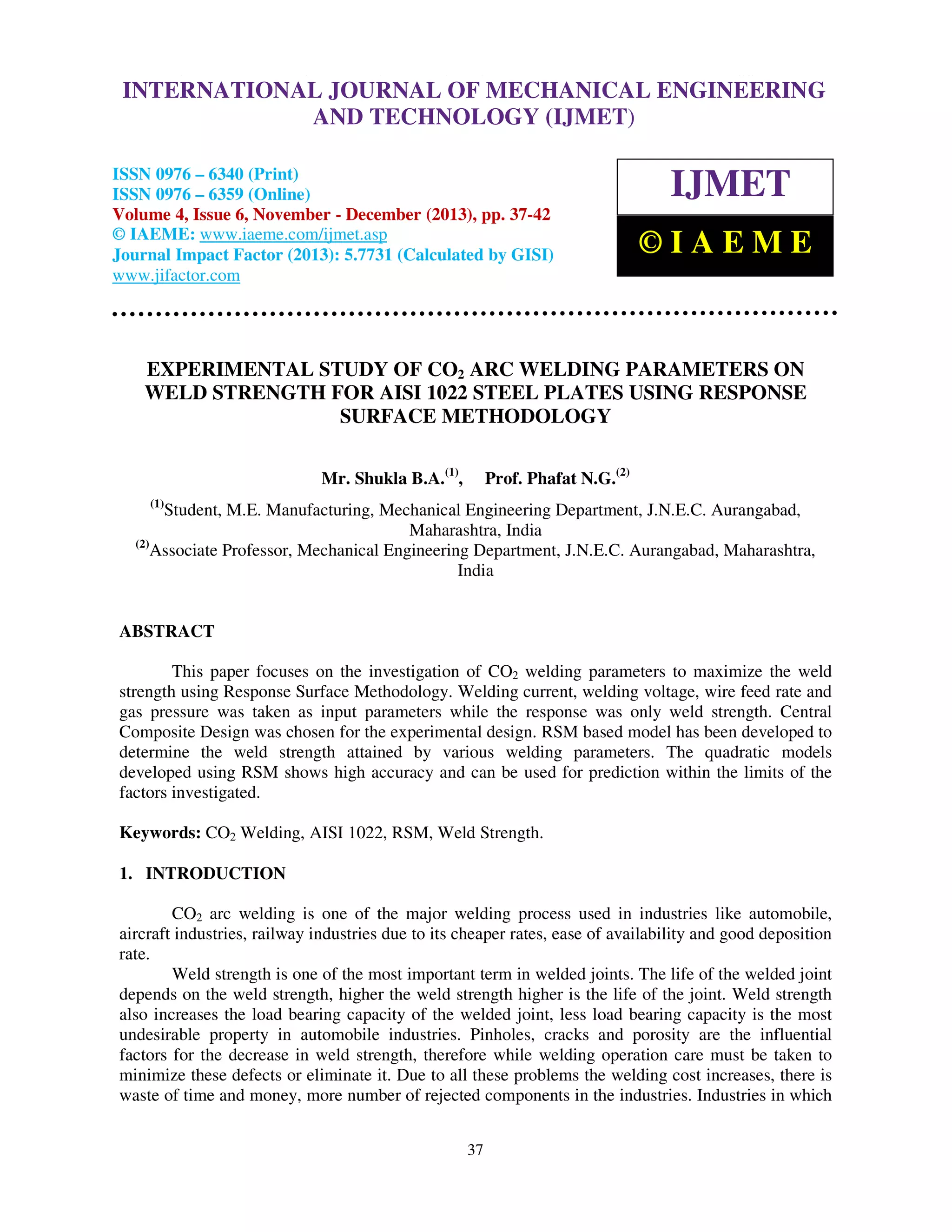
In the present study four parameters namely welding current, welding voltage, wire feed rate
and gas pressure were considered. A five level central composite design (CCD) was used to study
linear, quadratic and two factor interaction effect between the four process variable and one response
(Table 2). The upper limit of a factor was coded as +2 and the lower limit as -2, coded values for
intermediate levels were calculated from the following relationship:

Xi =

2[2 X − ( X max + X min )]
X max − X min

(3)

Where Xi is the required coded values of a variable X, X is any value of the variable from Xmin to
Xmax. Xmin is the lower level of the variable and Xmax is the upper level of the variable.

Sr. no
1.
2.
3.
4.
5.

Levels
-2
-1
0
1
2

Table 2. Factors and their levels
Current (A) Voltage(V) Wire feed rate(cm/min)
90
20
10.16
100
25
12.70
110
30
15.24
120
35
17.78
130
40
20.32

Gas pressure (psi)
20
30
40
50
60

4. RESULTS AND DISCUSSIONS
For the weld strength, the regression table shows the following:
Table 3. Estimated Regression Coefficients for WS
Term
Coef
SE Coef
T
P
Const
3190.69
8.405
379.601
0.000
A
52.12
4.539
11.481
0.000
V
37.05
4.539
8.163
0.000
WF
-82.49
4.539
-18.173
0.000
GP
125.97
4.539
27.751
0.000
A*A
-1.38
4.159
-0.331
0.745
V*V
-2.66
4.159
-0.639
0.532
WF*WF
-2.66
4.159
-0.639
0.532
GP*GP
6.71
4.159
1.613
0.126
A*V
-9.87
5.560
-1.776
0.095
A*WF
-2.97
5.560
-0.534
0.601
A*GP
5.14
5.560
0.924
0.369
V*WF
6.99
5.560
1.258
0.226
V*GP
2.59
5.560
0.466
0.647
WF*GP
-13.25
5.560
-2.383
0.030
R-Sq = 98.80%
R-Sq(adj) = 97.75%
S = 22.2386
39
International Journal of Mechanical Engineering and Technology (IJMET), ISSN 0976 –
6340(Print), ISSN 0976 – 6359(Online) Volume 4, Issue 6, November - December (2013) © IAEME

From the regression table following points were observed
• Linear effects: The p-value of current, voltage, wire feed rate and gas pressure is less than
0.05. Therefore all these parameters has significant effect on weld strength.
• Squared effects: All squared effects are greater than 0.05. Therefore, there is no significant
effects of these squared values on the weld strength.
• Interaction effects: The p-values of WF*GP= 0.03 is less than 0.05. Therefore, their effect on
the model is significant.
We have construct an equation representing the relationship between the response and the factors.
WS = 3191 + 52.1 (A) + 37.1 (V) - 82.5 (WF) + 126 (GP)

(4)

For the weld strength regression equation is
Weld Strength (WS) = 3190.69+52.12(A)+37.05(V)-82.49(WF)+125.97(GP)-1.38(A)22.66(V)2- 2.66(WF)2+6.71(GP)2-9.87(A*V)-2.97(A*WF)+5.14(A*GP)+6.99(V*WF)+
2059(V*GP)-13.25(WF*GP)
(5)
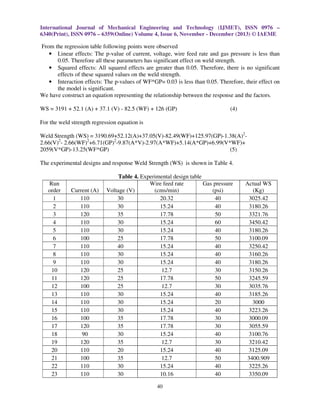
The experimental designs and response Weld Strength (WS) is shown in Table 4.

Run
order
1
2
3
4
5
6
7
8
9
10
11
12
13
14
15
16
17
18
19
20
21
22
23

Current (A)
110
110
120
110
110
100
110
110
110
120
120
100
110
110
110
100
120
90
120
110
100
110
110

Table 4. Experimental design table
Wire feed rate
Gas pressure
Voltage (V)
(cms/min)
(psi)
30
20.32
40
30
15.24
40
35
17.78
50
30
15.24
60
30
15.24
40
25
17.78
50
40
15.24
40
30
15.24
40
30
15.24
40
25
12.7
30
25
17.78
50
25
12.7
30
30
15.24
40
30
15.24
20
30
15.24
40
35
17.78
30
35
17.78
30
30
15.24
40
35
12.7
30
20
15.24
40
35
12.7
50
30
15.24
40
30
10.16
40
40

Actual WS
(Kg)
3025.42
3180.26
3321.76
3450.42
3180.26
3100.09
3250.42
3160.26
3180.26
3150.26
3245.59
3035.76
3185.26
3000
3223.26
3000.09
3055.59
3100.76
3210.42
3125.09
3400.909
3225.26
3350.09
International Journal of Mechanical Engineering and Technology (IJMET), ISSN 0976 –
6340(Print), ISSN 0976 – 6359(Online) Volume 4, Issue 6, November - December (2013) © IAEME

24
25
26
27
28
29
30
31

100
100
120
100
120
130
120
100

35
25
25
35
25
30
35
25

12.7
17.78
17.78
17.78
12.7
15.24
12.7
12.7

30
30
30
50
50
40
50
50

3100
2880.92
3000.57
3225
3451.42
3285
3500.409
3310.925

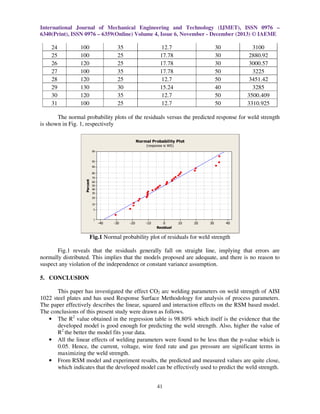
The normal probability plots of the residuals versus the predicted response for weld strength
is shown in Fig. 1, respectively
Normal Probability Plot
(response is WS)
99

95
90

Percent

80
70
60
50
40
30
20
10
5

1

-40

-30

-20

-10

0
Residual

10

20

30

40

Fig.1 Normal probability plot of residuals for weld strength
Fig.1 reveals that the residuals generally fall on straight line, implying that errors are
normally distributed. This implies that the models proposed are adequate, and there is no reason to
suspect any violation of the independence or constant variance assumption.
5. CONCLUSION
This paper has investigated the effect CO2 arc welding parameters on weld strength of AISI
1022 steel plates and has used Response Surface Methodology for analysis of process parameters.
The paper effectively describes the linear, squared and interaction effects on the RSM based model.
The conclusions of this present study were drawn as follows.
• The R2 value obtained in the regression table is 98.80% which itself is the evidence that the
developed model is good enough for predicting the weld strength. Also, higher the value of
R2 the better the model fits your data.
• All the linear effects of welding parameters were found to be less than the p-value which is
0.05. Hence, the current, voltage, wire feed rate and gas pressure are significant terms in
maximizing the weld strength.
• From RSM model and experiment results, the predicted and measured values are quite close,
which indicates that the developed model can be effectively used to predict the weld strength.
41
International Journal of Mechanical Engineering and Technology (IJMET), ISSN 0976 –
6340(Print), ISSN 0976 – 6359(Online) Volume 4, Issue 6, November - December (2013) © IAEME

REFERENCES
[1]

[2]

[3]
[4]

[5]

[6]

[7]

[8]

[9]
[10]

[11]

[12]

[13]

K. Lalitnarayan, M.M.M. Sarcar, K. Mallikarjuna Rao and K. Kameshwaran, “Prediction of
Weld Bead Geometry for CO2 Welding process by Multiple Regression Analysis,”
INTERNATIONAL JOURNAL OF MATHEMATICS AND SCIENTIFIC COMPUTING,
VOL. 1, NO. 1, (2011), 52-57.
M.R. Nakhaei, N. B. Mostafa Arab, Gh. Naderi and M. Hoseinpour Gollo, “Experimental
study on optimization of CO2 laser welding parameters for polypropylene-clay
nanocomposite welds,” Journal of Mechanical Science and Technology 27 (3), (2013), 843848.
Ampaiboon A. and Lasunon O, “Optimization of joint strength in Gas Metal Arc Welding by
Response Surface Methodology,” AIJSTPME, (2010), 3(3), 73-77.
H.H.Na, I.S. Kim, B.Y. Kang, J.Y. Shim, “A experiment study for welding optimization of
fillet welded structure,” Journal of Achievements in Materials and Manufacturing
Engineering, Vol. 45, Issue 2, (2011), 178-187.
S. W. CAMPBELL, A. M. GALLOWAY, and N. A. McPHERSON, “Artificial Neural
Network Prediction of Weld Geometry Performed using GMAW with Alternating Shielding
Gases,” WELDING JOURNAL, VOL. 91, (2012), 174-181.
S. V. Sapakal and M. T. Telsang, “PARAMETRIC OPTIMIZATION OF MIG WELDING
USING TAGUCHI DESIGN METHOD,” International Journal of Advanced Engineering
Research and Studies, Vol. 1, Issue 4, (2012), 28-30.
Vinod Kumar, “Modelling of Weld Bead Geometry and Shape Relationships in Submerged
Arc Welding using Developed Fluxes,” Jordan Journal of Mechanical and Industrial
Engineering, Vol. 5, (2011), 461-470.
Ali Khorram, Majid Ghoreishi, Mohammad Reza Soleymani Yazdi, Mahmood Moradi,
“Optimization of Bead Geometry in CO2 Laser Welding of Ti 6Al 4V Using Response
Surface Methodology,” Scientific Research, 3, (2011), 708-712.
MINITAB 16 (2010) User’s manual, Version 16.
P.B.Wagh, R.R.Deshmukh and S.D.Deshmukh, “Process Parameters Optimization for
Surface Roughness in Edm for AISI D2 Steel by Response Surface Methodology”,
International Journal of Mechanical Engineering & Technology (IJMET), Volume 4, Issue 1,
2013, pp. 203 - 208, ISSN Print: 0976 – 6340, ISSN Online: 0976 – 6359.
Aniruddha Ghosh and Somnath Chattopadhyaya,, “Conical Gaussian Heat Distribution for
Submerged Arc Welding Process”, International Journal of Mechanical Engineering &
Technology (IJMET), Volume 1, Issue 1, 2010, pp. 109 - 123, ISSN Print: 0976 – 6340,
ISSN Online: 0976 – 6359.
Ravi Butola, Shanti Lal Meena and Jitendra Kumar, “Effect of Welding Parameter on Micro
Hardness of Synergic MIG Welding of 304l Austenitic Stainless Steel”, International Journal
of Mechanical Engineering & Technology (IJMET), Volume 4, Issue 3, 2013, pp. 337 - 343,
ISSN Print: 0976 – 6340, ISSN Online: 0976 – 6359.
Aniruddha Ghosh and Somnath Chattopadhyaya,, “Submerged Arc Welding Parameters
Estimation Through Graphical Technique”, International Journal of Mechanical Engineering
& Technology (IJMET), Volume 1, Issue 1, 2010, pp. 95 - 108, ISSN Print: 0976 – 6340,
ISSN Online: 0976 – 6359.

42

30120130406005

  • 1.
    International Journal ofMechanical Engineering and Technology (IJMET), ISSN 0976 – INTERNATIONAL JOURNAL OF MECHANICAL ENGINEERING 6340(Print), ISSN 0976 – 6359(Online) Volume 4, Issue 6, November - December (2013) © IAEME AND TECHNOLOGY (IJMET) ISSN 0976 – 6340 (Print) ISSN 0976 – 6359 (Online) Volume 4, Issue 6, November - December (2013), pp. 37-42 © IAEME: www.iaeme.com/ijmet.asp Journal Impact Factor (2013): 5.7731 (Calculated by GISI) www.jifactor.com IJMET ©IAEME EXPERIMENTAL STUDY OF CO2 ARC WELDING PARAMETERS ON WELD STRENGTH FOR AISI 1022 STEEL PLATES USING RESPONSE SURFACE METHODOLOGY Mr. Shukla B.A.(1), Prof. Phafat N.G.(2) (1) Student, M.E. Manufacturing, Mechanical Engineering Department, J.N.E.C. Aurangabad, Maharashtra, India (2) Associate Professor, Mechanical Engineering Department, J.N.E.C. Aurangabad, Maharashtra, India ABSTRACT This paper focuses on the investigation of CO2 welding parameters to maximize the weld strength using Response Surface Methodology. Welding current, welding voltage, wire feed rate and gas pressure was taken as input parameters while the response was only weld strength. Central Composite Design was chosen for the experimental design. RSM based model has been developed to determine the weld strength attained by various welding parameters. The quadratic models developed using RSM shows high accuracy and can be used for prediction within the limits of the factors investigated. Keywords: CO2 Welding, AISI 1022, RSM, Weld Strength. 1. INTRODUCTION CO2 arc welding is one of the major welding process used in industries like automobile, aircraft industries, railway industries due to its cheaper rates, ease of availability and good deposition rate. Weld strength is one of the most important term in welded joints. The life of the welded joint depends on the weld strength, higher the weld strength higher is the life of the joint. Weld strength also increases the load bearing capacity of the welded joint, less load bearing capacity is the most undesirable property in automobile industries. Pinholes, cracks and porosity are the influential factors for the decrease in weld strength, therefore while welding operation care must be taken to minimize these defects or eliminate it. Due to all these problems the welding cost increases, there is waste of time and money, more number of rejected components in the industries. Industries in which 37
  • 2.
    International Journal ofMechanical Engineering and Technology (IJMET), ISSN 0976 – 6340(Print), ISSN 0976 – 6359(Online) Volume 4, Issue 6, November - December (2013) © IAEME welding is a critical enabling technology account for 59% of the total value of production by all Manufacturing, Construction, and Mining industries. K. Lalitnarayan, et al [1] studied the effect of CO2 welding parameters using multiple regression analysis and inverse transformation. M.R. Nakhaei et al [2] conducted an experiment on laser CO2 welding using Taguchi technique. Ampaiboon A. and Lasunon O. [3] has done the optimization of joint strength in CO2 welding using Response surface methodology. H.H.Na et al [4] studied the interaction between process parameters and bead geometry in GMAW using Taguchi technique. S.W. Campbell et al [5] performed ANN prediction of weld geometry using gas metal arc welding (GMAW) with alternate shielding gases. S.V. Sapakal and M.T. Telsang [6] has performed the parametric optimization of MIG welding using Taguchi design method. Vinod Kumar [7] had performed modeling of weld bead geometry and shape relationships using RSM technique. As weld strength is very important phenomenon affected by many parameters like type of material used, welding current, welding voltage etc., Therefore it becomes necessary to develop a reliable model that predicts the weld strength to reduce the cost of welding, time and money. The important process parameters are determined based on the literature review carried out on weld strength. In this investigation an RSM model is developed which predicts the weld strength. RSM is selected because of its capability to learn and simplify from examples and adjust to changing conditions. In addition they can be applied in manufacturing area as they are an effective tool to model non linear systems. 2. RESPONSE SURFACE METHODOLOGY Response Surface Methodology is one of the optimization techniques in describing the performance of the welding process and finding the optimum setting of parameters. RSM is a mathematical-statistical method that used for modeling and predicting the response of interest affected by some input variables to optimize the response [8]. RSM also specifies the relationships among one or more measured responses and the essential controllable input factors. When all independent variables are measurable, controllable and continuous in the process, with negligible error, the response surface model is as follows [8]: (1) y= f(x1,x2,…xn) where “n” is the number of independent variables. To optimize the response “y”, it is necessary to find an appropriate approximation for the true functional relationship between the independent variables and the response surface. Usually a second-order polynomial Equation (2) is used in RSM. k k j =1 j =1 k −1 k y = β 0 + ∑ β j x j + ∑ β jj x 2 + ∑ ∑ β ij xi x j + ε j i (2) j 3. EXPERIMENTAL WORK AISI 1022 steel plates of 100 (length)*90 (width)*6 (thickness) was used as work piece material for square butt welding in the given study. AISI 1022 has lots of engineering applications especially in manufacturing sector. AISI 1022 is used by all industry sectors for applications involving welding plus lightly stressed carburized parts. Typical applications are General Engineering Parts and Components, Welded Structures etc. Also carburized components like Camshafts, Light Duty Gears, Gudgeon Pins, Ratchets, Spindles, Worm Gears etc. The chemical composition of AISI 1022 is shown in Table 1. 38
  • 3.
    International Journal ofMechanical Engineering and Technology (IJMET), ISSN 0976 – 6340(Print), ISSN 0976 – 6359(Online) Volume 4, Issue 6, November - December (2013) © IAEME C Mn 0.206% 0.70% Table 1. Chemical composition of AISI 1022 Steel Cr Ni Mo S P Si 0.02% 0.01% 0.01% 0.039% 0.050% 0.19% Al 0.028% In the present study four parameters namely welding current, welding voltage, wire feed rate and gas pressure were considered. A five level central composite design (CCD) was used to study linear, quadratic and two factor interaction effect between the four process variable and one response (Table 2). The upper limit of a factor was coded as +2 and the lower limit as -2, coded values for intermediate levels were calculated from the following relationship: Xi = 2[2 X − ( X max + X min )] X max − X min (3) Where Xi is the required coded values of a variable X, X is any value of the variable from Xmin to Xmax. Xmin is the lower level of the variable and Xmax is the upper level of the variable. Sr. no 1. 2. 3. 4. 5. Levels -2 -1 0 1 2 Table 2. Factors and their levels Current (A) Voltage(V) Wire feed rate(cm/min) 90 20 10.16 100 25 12.70 110 30 15.24 120 35 17.78 130 40 20.32 Gas pressure (psi) 20 30 40 50 60 4. RESULTS AND DISCUSSIONS For the weld strength, the regression table shows the following: Table 3. Estimated Regression Coefficients for WS Term Coef SE Coef T P Const 3190.69 8.405 379.601 0.000 A 52.12 4.539 11.481 0.000 V 37.05 4.539 8.163 0.000 WF -82.49 4.539 -18.173 0.000 GP 125.97 4.539 27.751 0.000 A*A -1.38 4.159 -0.331 0.745 V*V -2.66 4.159 -0.639 0.532 WF*WF -2.66 4.159 -0.639 0.532 GP*GP 6.71 4.159 1.613 0.126 A*V -9.87 5.560 -1.776 0.095 A*WF -2.97 5.560 -0.534 0.601 A*GP 5.14 5.560 0.924 0.369 V*WF 6.99 5.560 1.258 0.226 V*GP 2.59 5.560 0.466 0.647 WF*GP -13.25 5.560 -2.383 0.030 R-Sq = 98.80% R-Sq(adj) = 97.75% S = 22.2386 39
  • 4.
    International Journal ofMechanical Engineering and Technology (IJMET), ISSN 0976 – 6340(Print), ISSN 0976 – 6359(Online) Volume 4, Issue 6, November - December (2013) © IAEME From the regression table following points were observed • Linear effects: The p-value of current, voltage, wire feed rate and gas pressure is less than 0.05. Therefore all these parameters has significant effect on weld strength. • Squared effects: All squared effects are greater than 0.05. Therefore, there is no significant effects of these squared values on the weld strength. • Interaction effects: The p-values of WF*GP= 0.03 is less than 0.05. Therefore, their effect on the model is significant. We have construct an equation representing the relationship between the response and the factors. WS = 3191 + 52.1 (A) + 37.1 (V) - 82.5 (WF) + 126 (GP) (4) For the weld strength regression equation is Weld Strength (WS) = 3190.69+52.12(A)+37.05(V)-82.49(WF)+125.97(GP)-1.38(A)22.66(V)2- 2.66(WF)2+6.71(GP)2-9.87(A*V)-2.97(A*WF)+5.14(A*GP)+6.99(V*WF)+ 2059(V*GP)-13.25(WF*GP) (5) The experimental designs and response Weld Strength (WS) is shown in Table 4. Run order 1 2 3 4 5 6 7 8 9 10 11 12 13 14 15 16 17 18 19 20 21 22 23 Current (A) 110 110 120 110 110 100 110 110 110 120 120 100 110 110 110 100 120 90 120 110 100 110 110 Table 4. Experimental design table Wire feed rate Gas pressure Voltage (V) (cms/min) (psi) 30 20.32 40 30 15.24 40 35 17.78 50 30 15.24 60 30 15.24 40 25 17.78 50 40 15.24 40 30 15.24 40 30 15.24 40 25 12.7 30 25 17.78 50 25 12.7 30 30 15.24 40 30 15.24 20 30 15.24 40 35 17.78 30 35 17.78 30 30 15.24 40 35 12.7 30 20 15.24 40 35 12.7 50 30 15.24 40 30 10.16 40 40 Actual WS (Kg) 3025.42 3180.26 3321.76 3450.42 3180.26 3100.09 3250.42 3160.26 3180.26 3150.26 3245.59 3035.76 3185.26 3000 3223.26 3000.09 3055.59 3100.76 3210.42 3125.09 3400.909 3225.26 3350.09
  • 5.
    International Journal ofMechanical Engineering and Technology (IJMET), ISSN 0976 – 6340(Print), ISSN 0976 – 6359(Online) Volume 4, Issue 6, November - December (2013) © IAEME 24 25 26 27 28 29 30 31 100 100 120 100 120 130 120 100 35 25 25 35 25 30 35 25 12.7 17.78 17.78 17.78 12.7 15.24 12.7 12.7 30 30 30 50 50 40 50 50 3100 2880.92 3000.57 3225 3451.42 3285 3500.409 3310.925 The normal probability plots of the residuals versus the predicted response for weld strength is shown in Fig. 1, respectively Normal Probability Plot (response is WS) 99 95 90 Percent 80 70 60 50 40 30 20 10 5 1 -40 -30 -20 -10 0 Residual 10 20 30 40 Fig.1 Normal probability plot of residuals for weld strength Fig.1 reveals that the residuals generally fall on straight line, implying that errors are normally distributed. This implies that the models proposed are adequate, and there is no reason to suspect any violation of the independence or constant variance assumption. 5. CONCLUSION This paper has investigated the effect CO2 arc welding parameters on weld strength of AISI 1022 steel plates and has used Response Surface Methodology for analysis of process parameters. The paper effectively describes the linear, squared and interaction effects on the RSM based model. The conclusions of this present study were drawn as follows. • The R2 value obtained in the regression table is 98.80% which itself is the evidence that the developed model is good enough for predicting the weld strength. Also, higher the value of R2 the better the model fits your data. • All the linear effects of welding parameters were found to be less than the p-value which is 0.05. Hence, the current, voltage, wire feed rate and gas pressure are significant terms in maximizing the weld strength. • From RSM model and experiment results, the predicted and measured values are quite close, which indicates that the developed model can be effectively used to predict the weld strength. 41
  • 6.
    International Journal ofMechanical Engineering and Technology (IJMET), ISSN 0976 – 6340(Print), ISSN 0976 – 6359(Online) Volume 4, Issue 6, November - December (2013) © IAEME REFERENCES [1] [2] [3] [4] [5] [6] [7] [8] [9] [10] [11] [12] [13] K. Lalitnarayan, M.M.M. Sarcar, K. Mallikarjuna Rao and K. Kameshwaran, “Prediction of Weld Bead Geometry for CO2 Welding process by Multiple Regression Analysis,” INTERNATIONAL JOURNAL OF MATHEMATICS AND SCIENTIFIC COMPUTING, VOL. 1, NO. 1, (2011), 52-57. M.R. Nakhaei, N. B. Mostafa Arab, Gh. Naderi and M. Hoseinpour Gollo, “Experimental study on optimization of CO2 laser welding parameters for polypropylene-clay nanocomposite welds,” Journal of Mechanical Science and Technology 27 (3), (2013), 843848. Ampaiboon A. and Lasunon O, “Optimization of joint strength in Gas Metal Arc Welding by Response Surface Methodology,” AIJSTPME, (2010), 3(3), 73-77. H.H.Na, I.S. Kim, B.Y. Kang, J.Y. Shim, “A experiment study for welding optimization of fillet welded structure,” Journal of Achievements in Materials and Manufacturing Engineering, Vol. 45, Issue 2, (2011), 178-187. S. W. CAMPBELL, A. M. GALLOWAY, and N. A. McPHERSON, “Artificial Neural Network Prediction of Weld Geometry Performed using GMAW with Alternating Shielding Gases,” WELDING JOURNAL, VOL. 91, (2012), 174-181. S. V. Sapakal and M. T. Telsang, “PARAMETRIC OPTIMIZATION OF MIG WELDING USING TAGUCHI DESIGN METHOD,” International Journal of Advanced Engineering Research and Studies, Vol. 1, Issue 4, (2012), 28-30. Vinod Kumar, “Modelling of Weld Bead Geometry and Shape Relationships in Submerged Arc Welding using Developed Fluxes,” Jordan Journal of Mechanical and Industrial Engineering, Vol. 5, (2011), 461-470. Ali Khorram, Majid Ghoreishi, Mohammad Reza Soleymani Yazdi, Mahmood Moradi, “Optimization of Bead Geometry in CO2 Laser Welding of Ti 6Al 4V Using Response Surface Methodology,” Scientific Research, 3, (2011), 708-712. MINITAB 16 (2010) User’s manual, Version 16. P.B.Wagh, R.R.Deshmukh and S.D.Deshmukh, “Process Parameters Optimization for Surface Roughness in Edm for AISI D2 Steel by Response Surface Methodology”, International Journal of Mechanical Engineering & Technology (IJMET), Volume 4, Issue 1, 2013, pp. 203 - 208, ISSN Print: 0976 – 6340, ISSN Online: 0976 – 6359. Aniruddha Ghosh and Somnath Chattopadhyaya,, “Conical Gaussian Heat Distribution for Submerged Arc Welding Process”, International Journal of Mechanical Engineering & Technology (IJMET), Volume 1, Issue 1, 2010, pp. 109 - 123, ISSN Print: 0976 – 6340, ISSN Online: 0976 – 6359. Ravi Butola, Shanti Lal Meena and Jitendra Kumar, “Effect of Welding Parameter on Micro Hardness of Synergic MIG Welding of 304l Austenitic Stainless Steel”, International Journal of Mechanical Engineering & Technology (IJMET), Volume 4, Issue 3, 2013, pp. 337 - 343, ISSN Print: 0976 – 6340, ISSN Online: 0976 – 6359. Aniruddha Ghosh and Somnath Chattopadhyaya,, “Submerged Arc Welding Parameters Estimation Through Graphical Technique”, International Journal of Mechanical Engineering & Technology (IJMET), Volume 1, Issue 1, 2010, pp. 95 - 108, ISSN Print: 0976 – 6340, ISSN Online: 0976 – 6359. 42