Finding the right build method
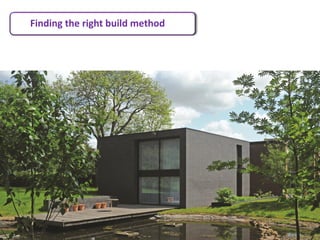
 Finding the right build method
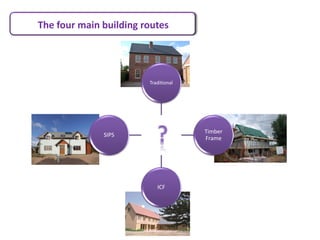
The four main building routes


                        Traditional


                                      Timber
              SIPS
                                      Frame


                           ICF
First priorities


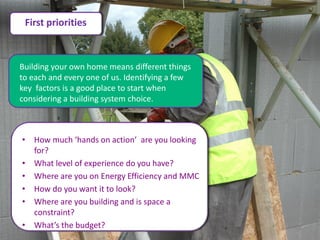
Building your own home means different things
to each and every one of us. Identifying a few
key factors is a good place to start when
considering a building system choice.


• How much ‘hands on action’ are you looking
  for?
• What level of experience do you have?
• Where are you on Energy Efficiency and MMC
• How do you want it to look?
• Where are you building and is space a
  constraint?
• What’s the budget?
Route 1: Traditional


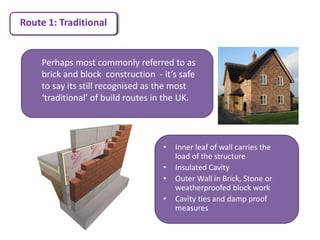
    Perhaps most commonly referred to as
    brick and block construction - it’s safe
    to say its still recognised as the most
    ‘traditional’ of build routes in the UK.


                                   •   Inner leaf of wall carries the
                                       load of the structure
                                   •   Insulated Cavity
                                   •   Outer Wall in Brick, Stone or
                                       weatherproofed block work
                                   •   Cavity ties and damp proof
                                       measures
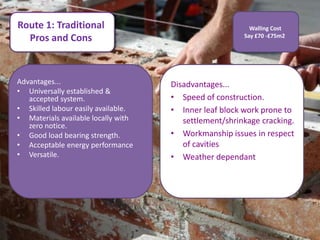
Route 1: Traditional                                      Walling Cost
  Pros and Cons                                         Say £70 -£75m2


Advantages...                        Disadvantages...
• Universally established &
   accepted system.                  • Speed of construction.
• Skilled labour easily available.   • Inner leaf block work prone to
• Materials available locally with      settlement/shrinkage cracking.
   zero notice.
• Good load bearing strength.        • Workmanship issues in respect
• Acceptable energy performance         of cavities
• Versatile.                         • Weather dependant
Route 1: Traditional
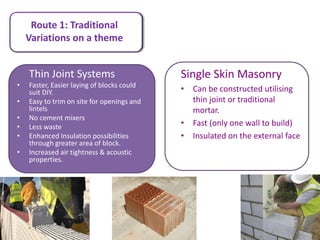
    Variations on a theme


    Thin Joint Systems                      Single Skin Masonry
•   Faster, Easier laying of blocks could
    suit DIY.                               • Can be constructed utilising
•   Easy to trim on site for openings and     thin joint or traditional
    lintels                                   mortar.
•   No cement mixers
•   Less waste                              • Fast (only one wall to build)
•   Enhanced Insulation possibilities       • Insulated on the external face
    through greater area of block.
•   Increased air tightness & acoustic
    properties.
Route 1: Traditional
   Eco & Energy Efficiency


•energy/CO2                           Eco – Credentials:
•water                                (Realistically) Poor
•materials
•surface water runoff (flooding and
flood prevention)                     Energy Efficiency
•waste                                Variable
•pollution
•health and well-being
•management
•ecology
Route 2: Timber Frame


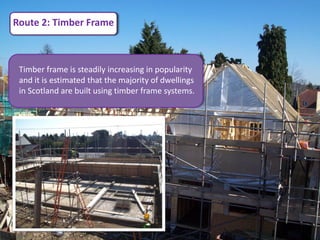
 Timber frame is steadily increasing in popularity
 and it is estimated that the majority of dwellings
 in Scotland are built using timber frame systems.
Route 2: Timber Frame
 Closed Panel System

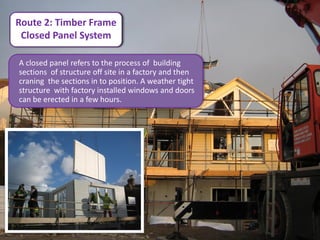
A closed panel refers to the process of building
sections of structure off site in a factory and then
craning the sections in to position. A weather tight
structure with factory installed windows and doors
can be erected in a few hours.
Route 2: Timber Frame
 Open Panel System

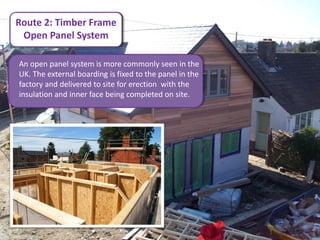
An open panel system is more commonly seen in the
UK. The external boarding is fixed to the panel in the
factory and delivered to site for erection with the
insulation and inner face being completed on site.
Route 2: Timber Frame
     Pros & Cons


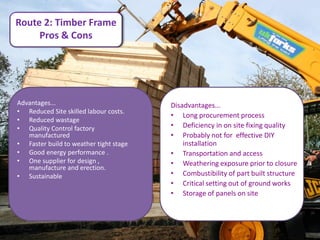
Advantages...                           Disadvantages...
• Reduced Site skilled labour costs.
                                        • Long procurement process
• Reduced wastage
• Quality Control factory               • Deficiency in on site fixing quality
   manufactured                         • Probably not for effective DIY
• Faster build to weather tight stage       installation
• Good energy performance .             • Transportation and access
• One supplier for design ,             • Weathering exposure prior to closure
   manufacture and erection.
• Sustainable                           • Combustibility of part built structure
                                        • Critical setting out of ground works
                                        • Storage of panels on site
Route 2: Timber Frame
Eco-Credentials & Energy Efficiency


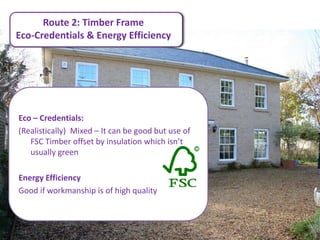
Eco – Credentials:
(Realistically) Mixed – It can be good but use of
   FSC Timber offset by insulation which isn’t
   usually green

Energy Efficiency
Good if workmanship is of high quality.
Route 3: Structurally Insulated Panel (SIPS)


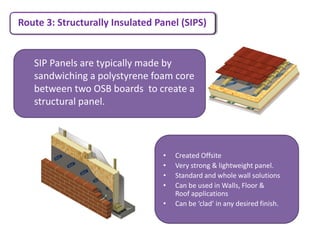
   SIP Panels are typically made by
   sandwiching a polystyrene foam core
   between two OSB boards to create a
   structural panel.


                                 •   Created Offsite
                                 •   Very strong & lightweight panel.
                                 •   Standard and whole wall solutions
                                 •   Can be used in Walls, Floor &
                                     Roof applications
                                 •   Can be ‘clad’ in any desired finish.
Route 3: Structurally Insulated Panel (SIPS)                 Walling Cost
                                                             Say £75 /m2
                                                        Roof Cost say £85 /m2


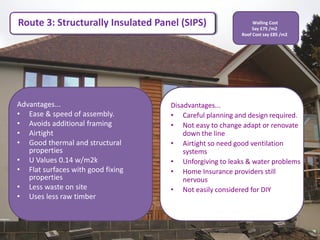
Advantages...                      Disadvantages...
• Ease & speed of assembly.        • Careful planning and design required.
• Avoids additional framing        • Not easy to change adapt or renovate
• Airtight                             down the line
• Good thermal and structural      • Airtight so need good ventilation
   properties                          systems
• U Values 0.14 w/m2k              • Unforgiving to leaks & water problems
• Flat surfaces with good fixing   • Home Insurance providers still
   properties                          nervous
• Less waste on site               • Not easily considered for DIY
• Uses less raw timber
Route 3: SIPS
Eco-Credentials & Energy Efficiency


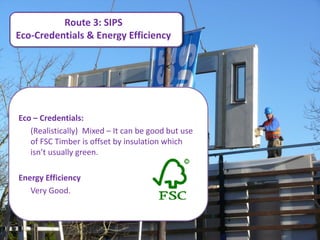
Eco – Credentials:
   (Realistically) Mixed – It can be good but use
   of FSC Timber is offset by insulation which
   isn’t usually green.

Energy Efficiency
   Very Good.
Route 4: Insulated Concrete form work (ICF)


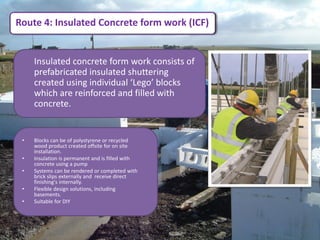
     Insulated concrete form work consists of
     prefabricated insulated shuttering
     created using individual ‘Lego’ blocks
     which are reinforced and filled with
     concrete.


 •   Blocks can be of polystyrene or recycled
     wood product created offsite for on site
     installation.
 •   Insulation is permanent and is filled with
     concrete using a pump
 •   Systems can be rendered or completed with
     brick slips externally and receive direct
     finishing's internally.
 •   Flexible design solutions, including
     basements.
 •   Suitable for DIY
Route 4: Insulated Concrete Formwork(ICF)             DIY Cost
                                                    Say £85 /m2


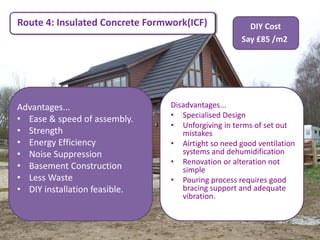
Advantages...                    Disadvantages...
                                 • Specialised Design
• Ease & speed of assembly.
                                 • Unforgiving in terms of set out
• Strength                          mistakes
• Energy Efficiency              • Airtight so need good ventilation
• Noise Suppression                 systems and dehumidification
                                 • Renovation or alteration not
• Basement Construction             simple
• Less Waste                     • Pouring process requires good
• DIY installation feasible.        bracing support and adequate
                                    vibration.
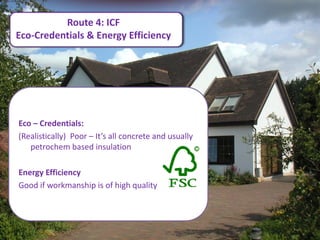
Route 4: ICF
Eco-Credentials & Energy Efficiency


Eco – Credentials:
(Realistically) Poor – It’s all concrete and usually
   petrochem based insulation

Energy Efficiency
Good if workmanship is of high quality.
...and finally

Finding the right build method

  • 1.
    Finding the rightbuild method Finding the right build method
  • 2.
    The four mainbuilding routes Traditional Timber SIPS Frame ICF
  • 3.
    First priorities Building yourown home means different things to each and every one of us. Identifying a few key factors is a good place to start when considering a building system choice. • How much ‘hands on action’ are you looking for? • What level of experience do you have? • Where are you on Energy Efficiency and MMC • How do you want it to look? • Where are you building and is space a constraint? • What’s the budget?
  • 4.
    Route 1: Traditional Perhaps most commonly referred to as brick and block construction - it’s safe to say its still recognised as the most ‘traditional’ of build routes in the UK. • Inner leaf of wall carries the load of the structure • Insulated Cavity • Outer Wall in Brick, Stone or weatherproofed block work • Cavity ties and damp proof measures
  • 5.
    Route 1: Traditional Walling Cost Pros and Cons Say £70 -£75m2 Advantages... Disadvantages... • Universally established & accepted system. • Speed of construction. • Skilled labour easily available. • Inner leaf block work prone to • Materials available locally with settlement/shrinkage cracking. zero notice. • Good load bearing strength. • Workmanship issues in respect • Acceptable energy performance of cavities • Versatile. • Weather dependant
  • 6.
    Route 1: Traditional Variations on a theme Thin Joint Systems Single Skin Masonry • Faster, Easier laying of blocks could suit DIY. • Can be constructed utilising • Easy to trim on site for openings and thin joint or traditional lintels mortar. • No cement mixers • Less waste • Fast (only one wall to build) • Enhanced Insulation possibilities • Insulated on the external face through greater area of block. • Increased air tightness & acoustic properties.
  • 7.
    Route 1: Traditional Eco & Energy Efficiency •energy/CO2 Eco – Credentials: •water (Realistically) Poor •materials •surface water runoff (flooding and flood prevention) Energy Efficiency •waste Variable •pollution •health and well-being •management •ecology
  • 8.
    Route 2: TimberFrame Timber frame is steadily increasing in popularity and it is estimated that the majority of dwellings in Scotland are built using timber frame systems.
  • 9.
    Route 2: TimberFrame Closed Panel System A closed panel refers to the process of building sections of structure off site in a factory and then craning the sections in to position. A weather tight structure with factory installed windows and doors can be erected in a few hours.
  • 10.
    Route 2: TimberFrame Open Panel System An open panel system is more commonly seen in the UK. The external boarding is fixed to the panel in the factory and delivered to site for erection with the insulation and inner face being completed on site.
  • 11.
    Route 2: TimberFrame Pros & Cons Advantages... Disadvantages... • Reduced Site skilled labour costs. • Long procurement process • Reduced wastage • Quality Control factory • Deficiency in on site fixing quality manufactured • Probably not for effective DIY • Faster build to weather tight stage installation • Good energy performance . • Transportation and access • One supplier for design , • Weathering exposure prior to closure manufacture and erection. • Sustainable • Combustibility of part built structure • Critical setting out of ground works • Storage of panels on site
  • 12.
    Route 2: TimberFrame Eco-Credentials & Energy Efficiency Eco – Credentials: (Realistically) Mixed – It can be good but use of FSC Timber offset by insulation which isn’t usually green Energy Efficiency Good if workmanship is of high quality.
  • 13.
    Route 3: StructurallyInsulated Panel (SIPS) SIP Panels are typically made by sandwiching a polystyrene foam core between two OSB boards to create a structural panel. • Created Offsite • Very strong & lightweight panel. • Standard and whole wall solutions • Can be used in Walls, Floor & Roof applications • Can be ‘clad’ in any desired finish.
  • 14.
    Route 3: StructurallyInsulated Panel (SIPS) Walling Cost Say £75 /m2 Roof Cost say £85 /m2 Advantages... Disadvantages... • Ease & speed of assembly. • Careful planning and design required. • Avoids additional framing • Not easy to change adapt or renovate • Airtight down the line • Good thermal and structural • Airtight so need good ventilation properties systems • U Values 0.14 w/m2k • Unforgiving to leaks & water problems • Flat surfaces with good fixing • Home Insurance providers still properties nervous • Less waste on site • Not easily considered for DIY • Uses less raw timber
  • 15.
    Route 3: SIPS Eco-Credentials& Energy Efficiency Eco – Credentials: (Realistically) Mixed – It can be good but use of FSC Timber is offset by insulation which isn’t usually green. Energy Efficiency Very Good.
  • 16.
    Route 4: InsulatedConcrete form work (ICF) Insulated concrete form work consists of prefabricated insulated shuttering created using individual ‘Lego’ blocks which are reinforced and filled with concrete. • Blocks can be of polystyrene or recycled wood product created offsite for on site installation. • Insulation is permanent and is filled with concrete using a pump • Systems can be rendered or completed with brick slips externally and receive direct finishing's internally. • Flexible design solutions, including basements. • Suitable for DIY
  • 17.
    Route 4: InsulatedConcrete Formwork(ICF) DIY Cost Say £85 /m2 Advantages... Disadvantages... • Specialised Design • Ease & speed of assembly. • Unforgiving in terms of set out • Strength mistakes • Energy Efficiency • Airtight so need good ventilation • Noise Suppression systems and dehumidification • Renovation or alteration not • Basement Construction simple • Less Waste • Pouring process requires good • DIY installation feasible. bracing support and adequate vibration.
  • 18.
    Route 4: ICF Eco-Credentials& Energy Efficiency Eco – Credentials: (Realistically) Poor – It’s all concrete and usually petrochem based insulation Energy Efficiency Good if workmanship is of high quality.
  • 19.