Welcome to
Green Framing Options


          Presenter: Wally Geer
          go2wallyworld@hotmail.com
Some Sincere Thanks to:
   The Center for Sustainable Energy
   U.S. Green Building Council, C4 Chapter
   National Association of Home Builder’s Research
    Center
   University College of Dublin
   MosArt Architects, Dublin
   Laura’s Painting, Ojai, CA.
   Greymar Associates, Ventura, CA.
   Sonoma State University
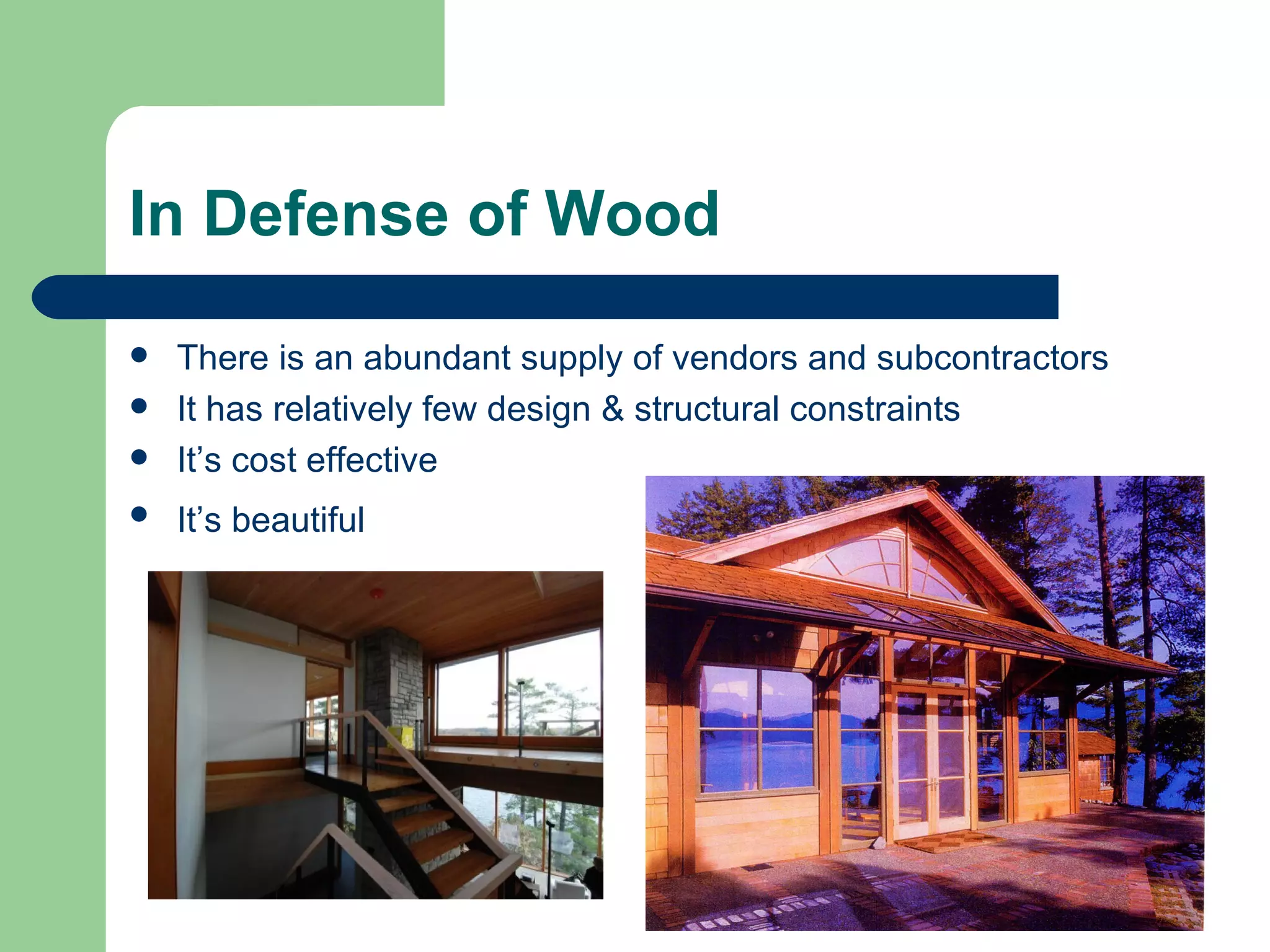
In Defense of Wood

   There is an abundant supply of vendors and subcontractors
   It has relatively few design & structural constraints
   It’s cost effective
   It’s beautiful
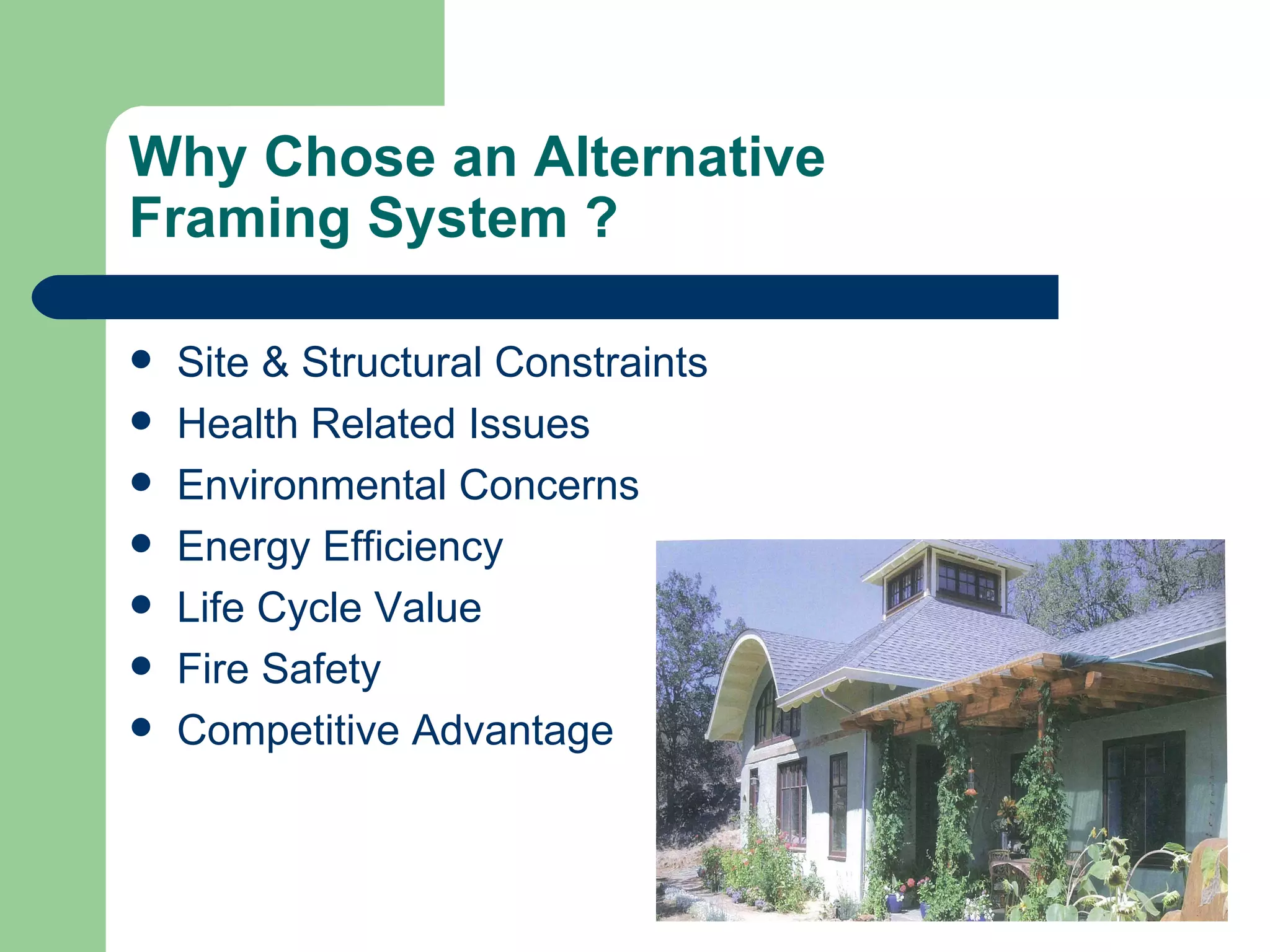
Why Chose an Alternative
Framing System ?

   Site & Structural Constraints
   Health Related Issues
   Environmental Concerns
   Energy Efficiency
   Life Cycle Value
   Fire Safety
   Competitive Advantage
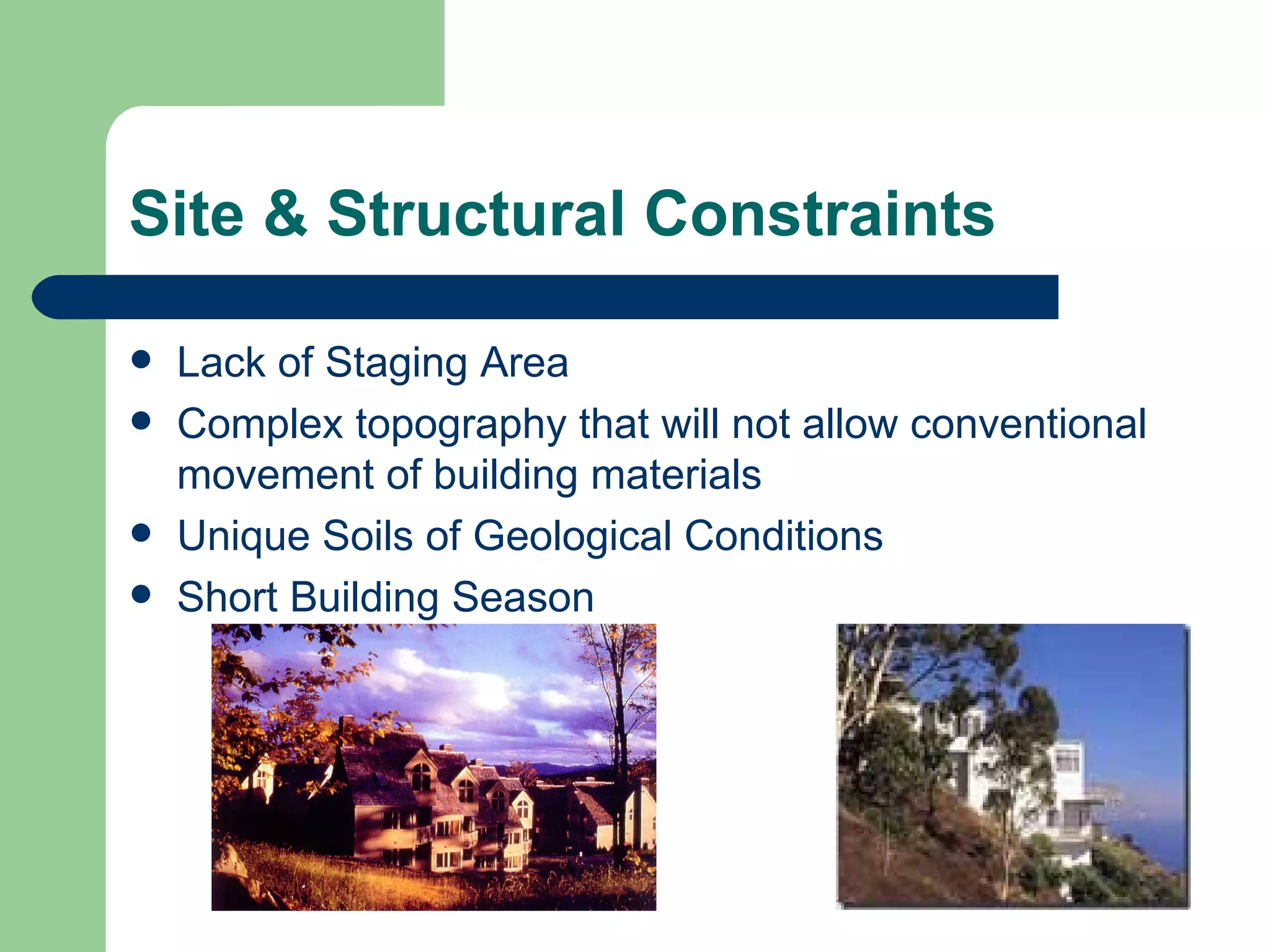
Site & Structural Constraints

   Lack of Staging Area
   Complex topography that will not allow conventional
    movement of building materials
   Unique Soils of Geological Conditions
   Short Building Season
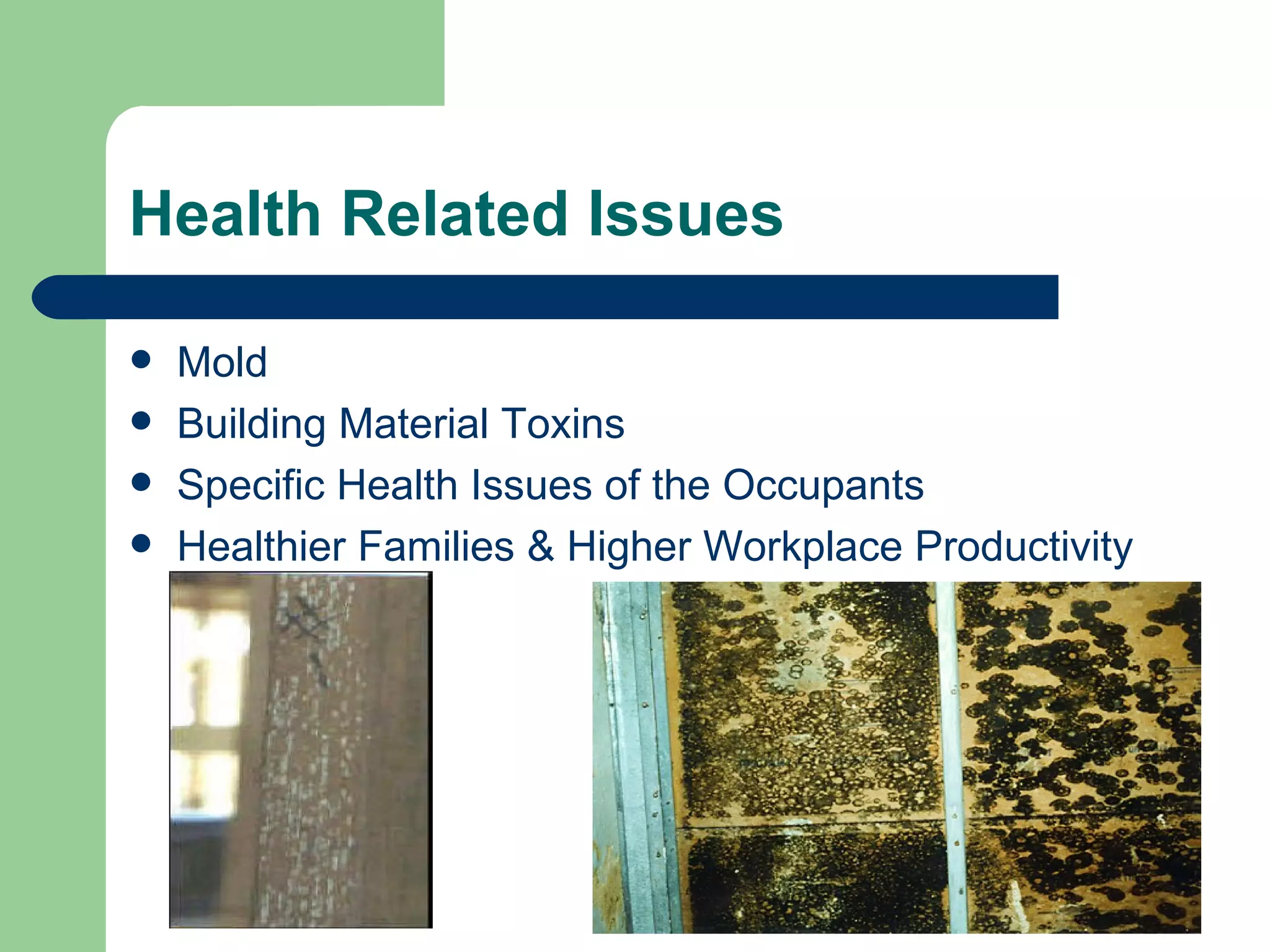
Health Related Issues

   Mold
   Building Material Toxins
   Specific Health Issues of the Occupants
   Healthier Families & Higher Workplace Productivity
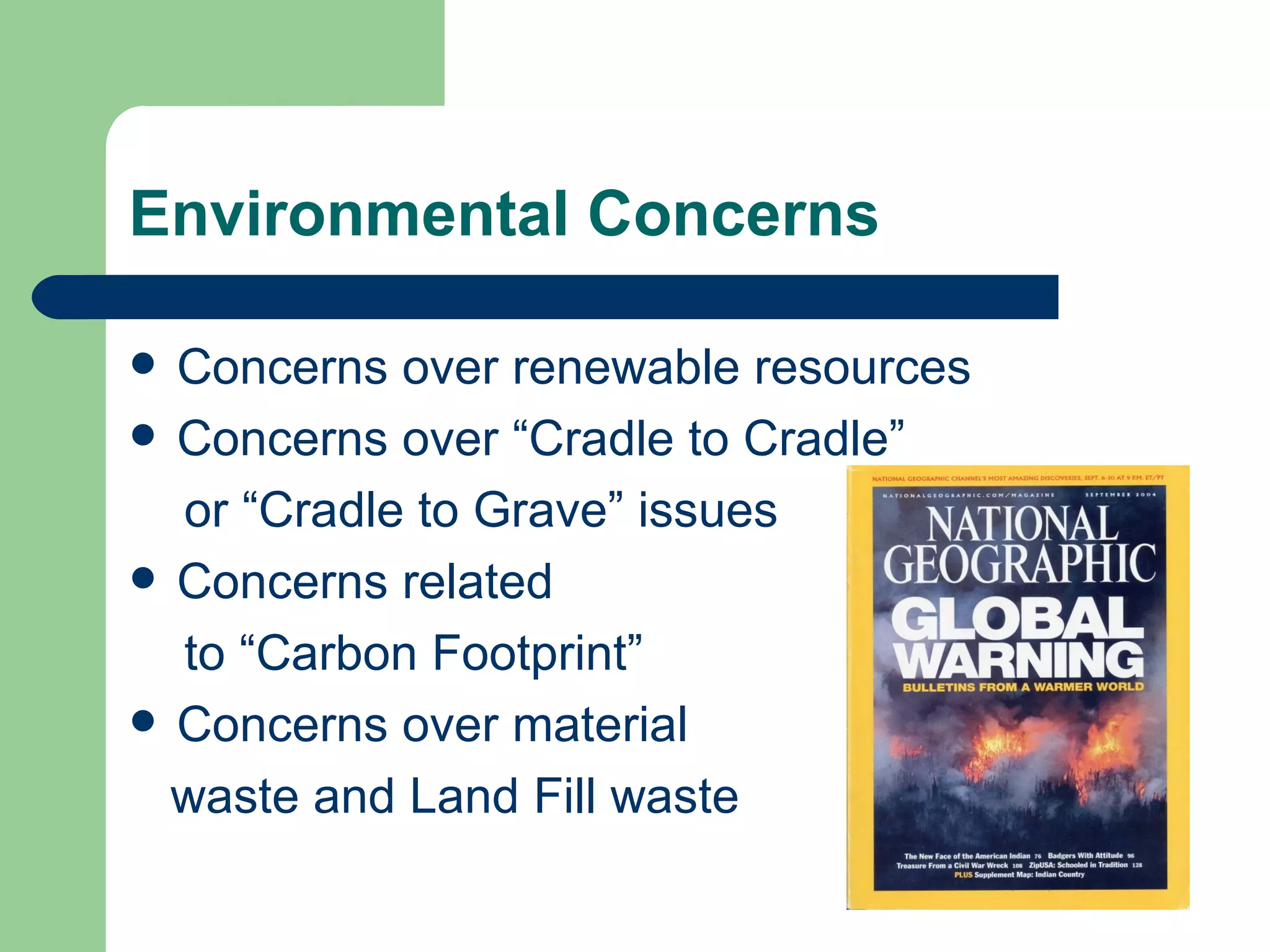
Environmental Concerns

 Concerns over renewable resources
 Concerns over “Cradle to Cradle”

  or “Cradle to Grave” issues
 Concerns related

  to “Carbon Footprint”
 Concerns over material

  waste and Land Fill waste
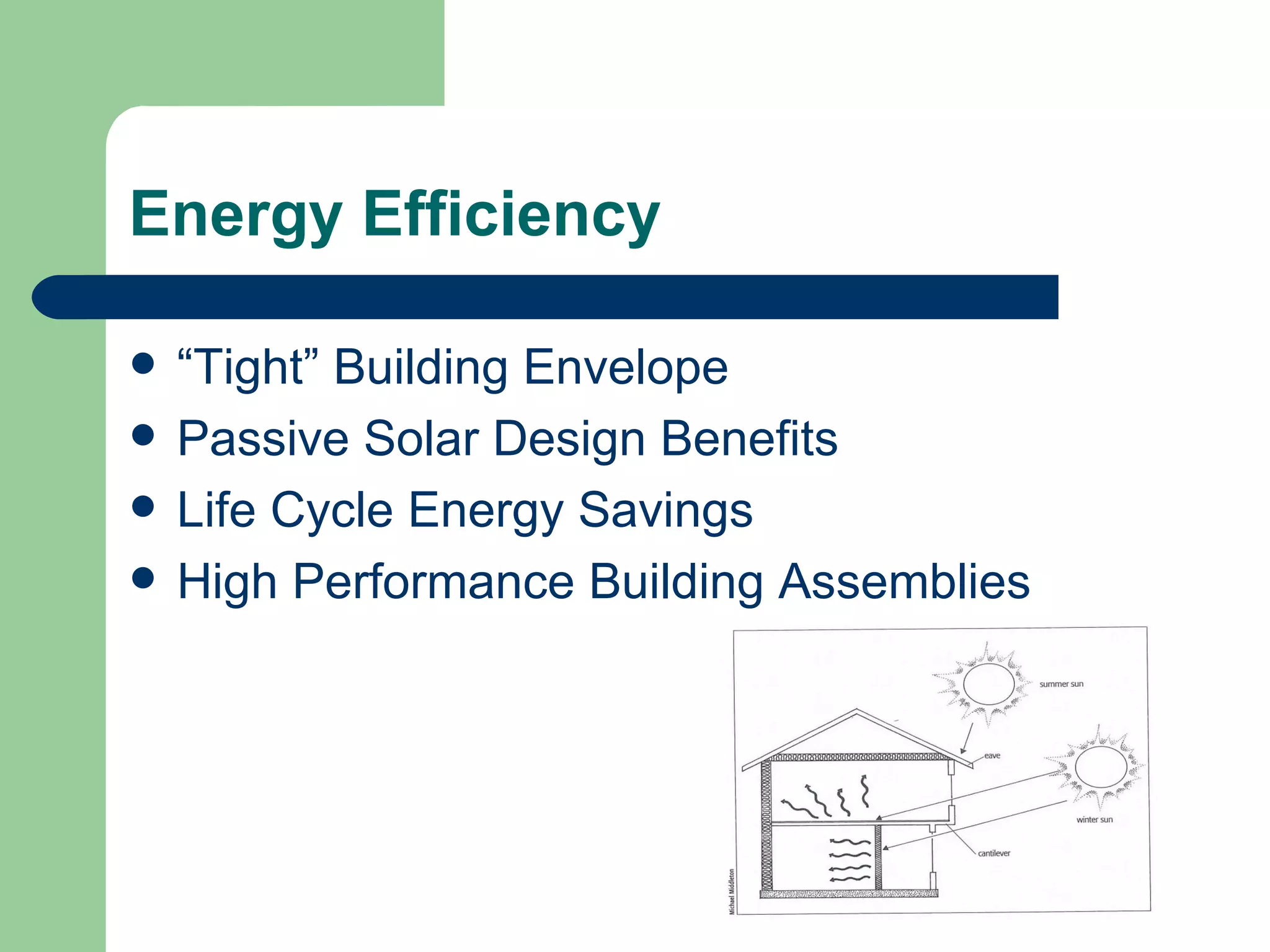
Energy Efficiency

   “Tight” Building Envelope
   Passive Solar Design Benefits
   Life Cycle Energy Savings
   High Performance Building Assemblies
Life Cycle Value

“Life Cycle Value”
is the total Cost of INITIAL CONSTUCTION +
ENERGY CONSUMPTION COSTS over the
functional life of a building
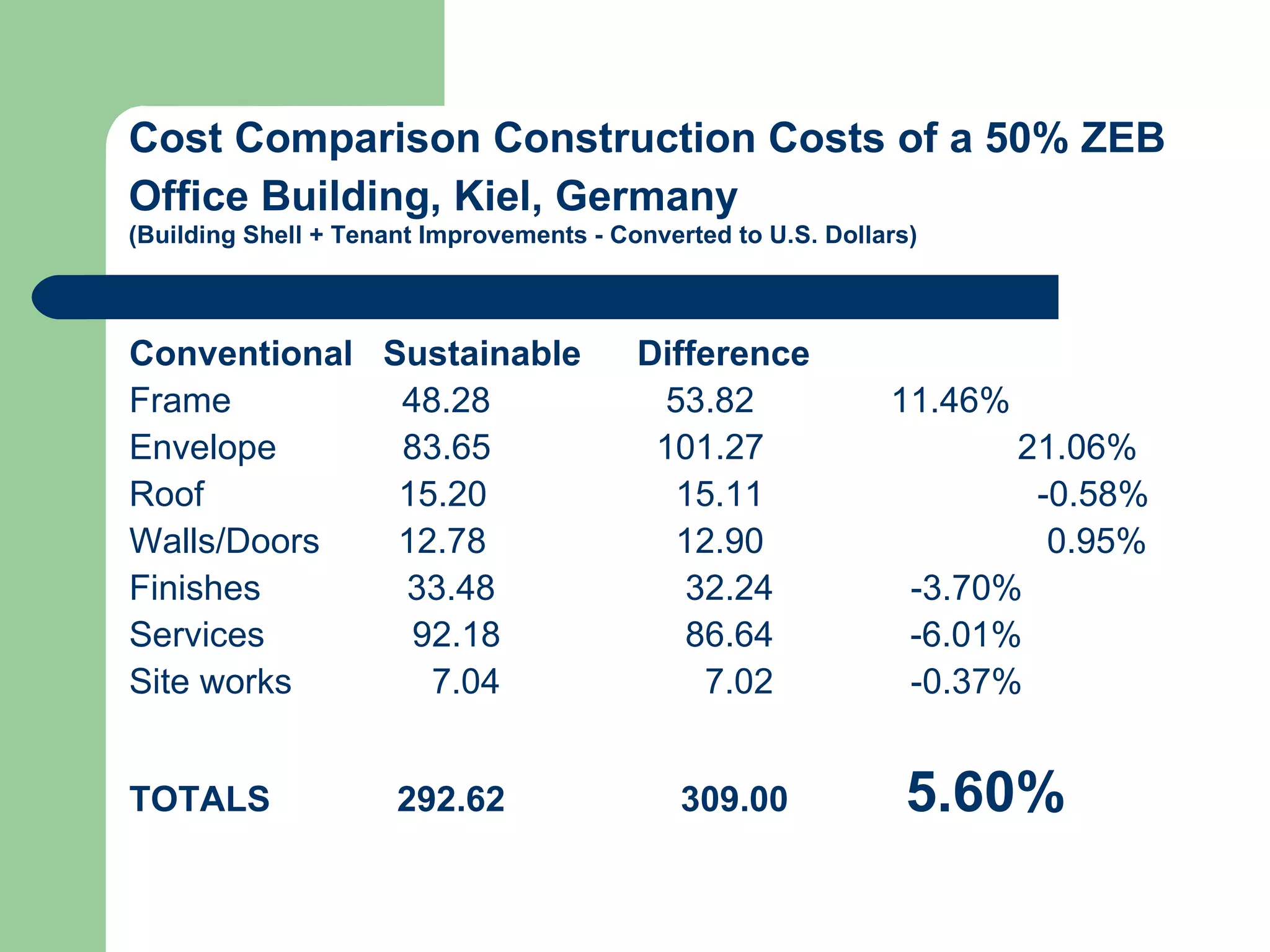
Cost Comparison Construction Costs of a 50% ZEB
Office Building, Kiel, Germany
(Building Shell + Tenant Improvements - Converted to U.S. Dollars)


Conventional Sustainable                  Difference
Frame         48.28                        53.82               11.46%
Envelope      83.65                        101.27                      21.06%
Roof          15.20                         15.11                       -0.58%
Walls/Doors   12.78                         12.90                        0.95%
Finishes      33.48                          32.24               -3.70%
Services       92.18                         86.64               -6.01%
Site works      7.04                          7.02               -0.37%


TOTALS                292.62                  309.00             5.60%
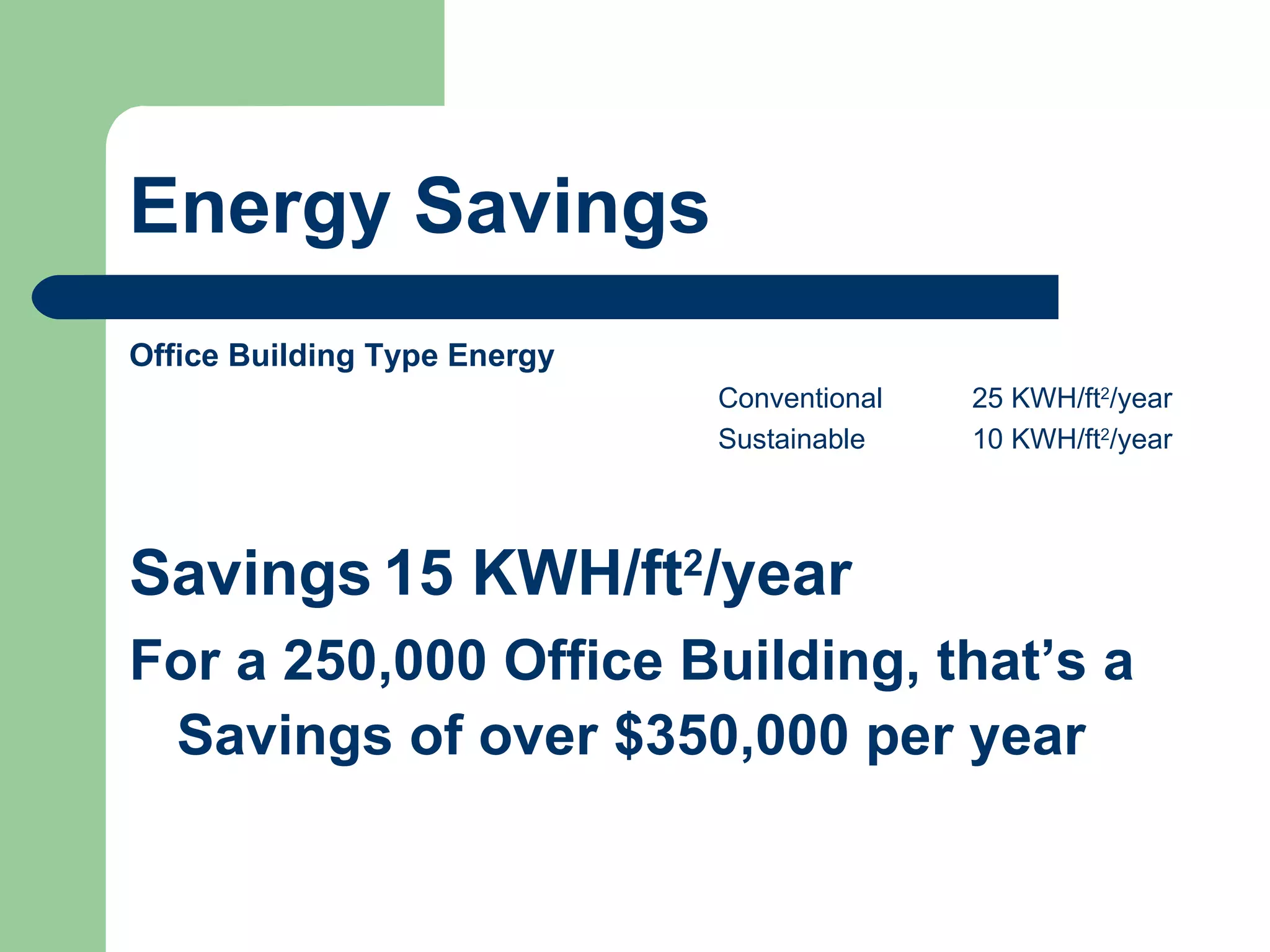
Energy Savings
Office Building Type Energy
                              Conventional   25 KWH/ft2/year
                              Sustainable    10 KWH/ft2/year


Savings 15 KWH/ft2/year
For a 250,000 Office Building, that’s a
 Savings of over $350,000 per year
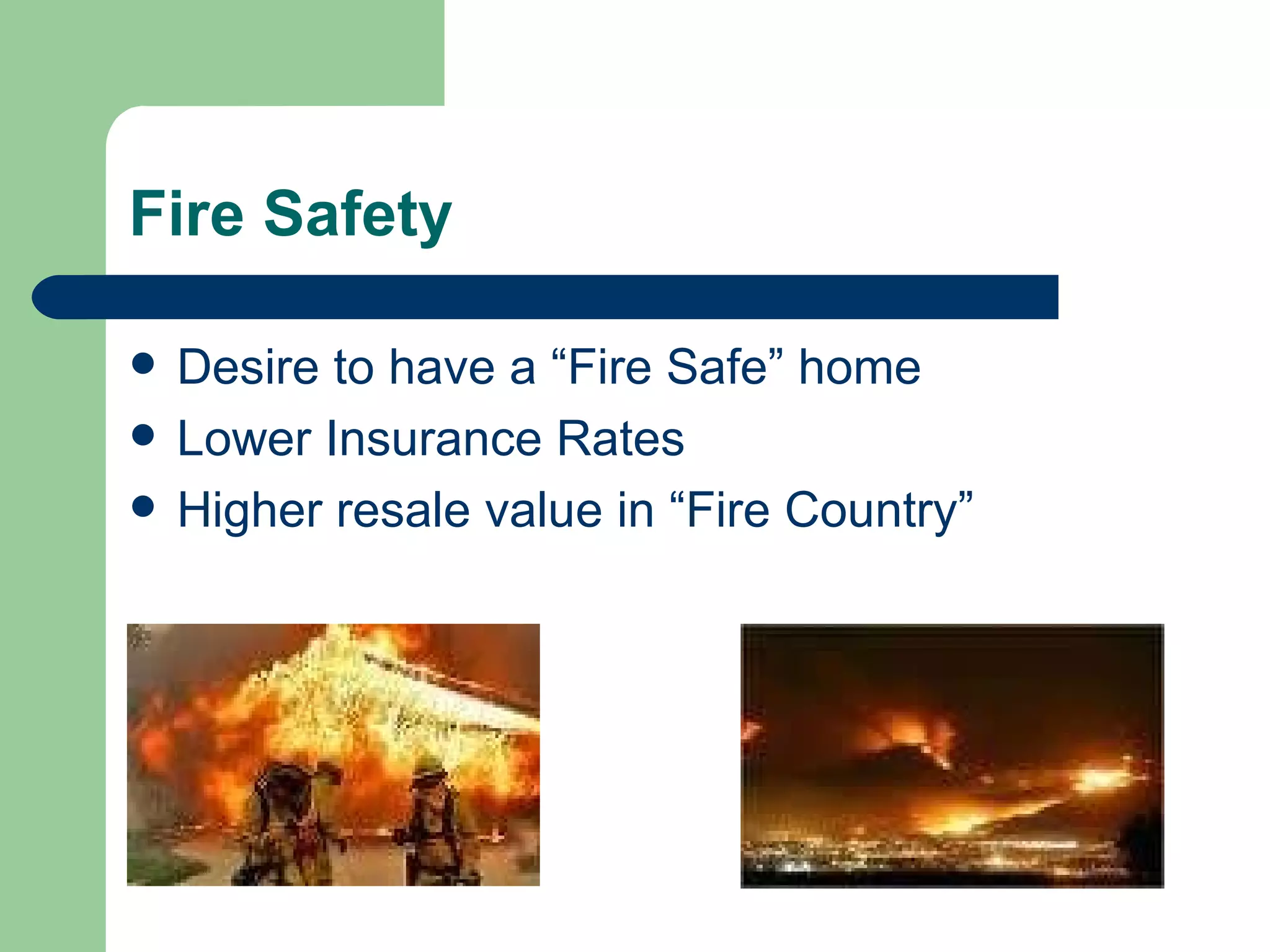
Fire Safety

   Desire to have a “Fire Safe” home
   Lower Insurance Rates
   Higher resale value in “Fire Country”
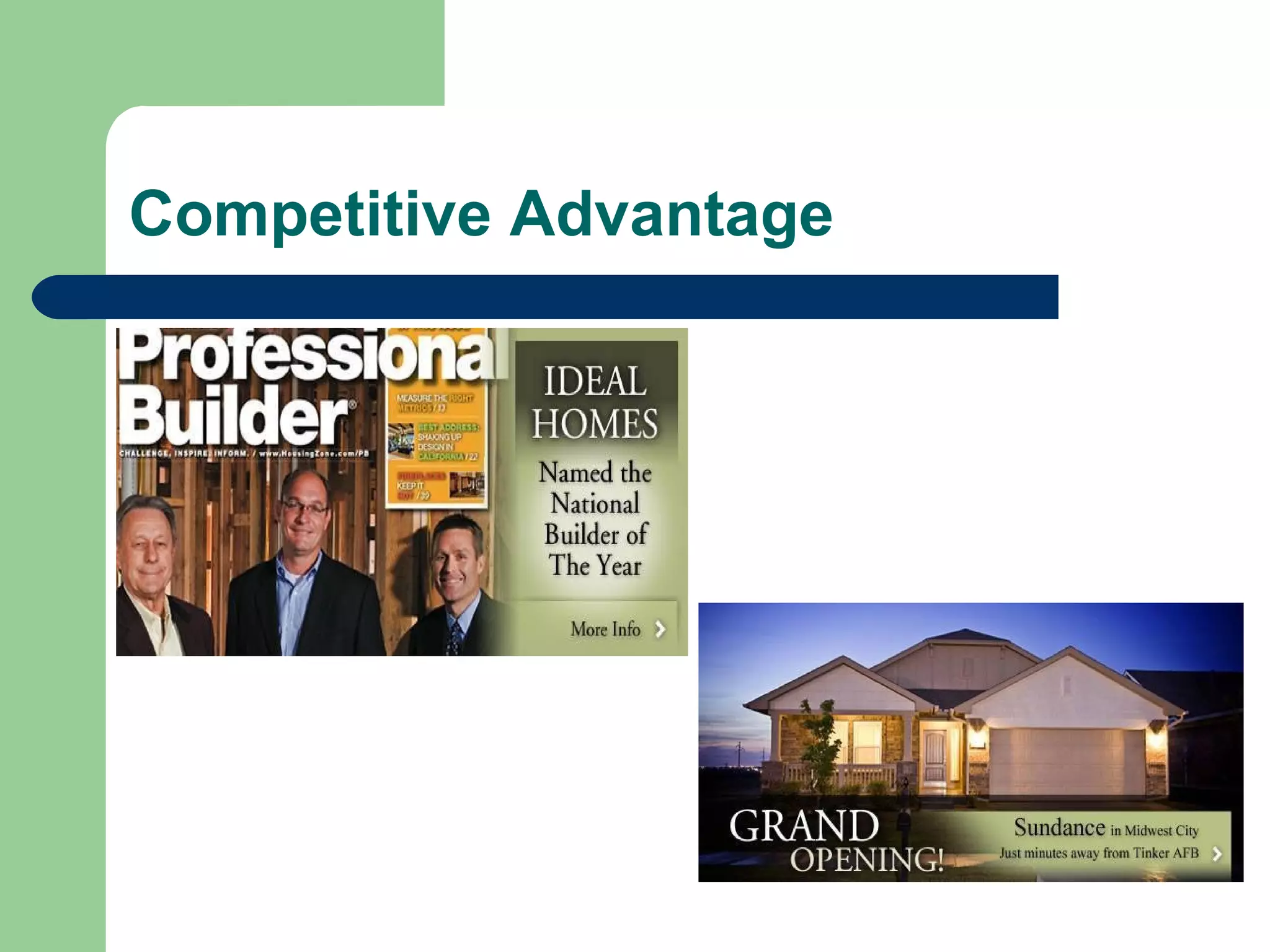
Competitive Advantage
Why NOT to chose an Alternative
Framing System

    Lower Initial Cost of Structural Shell Construction
    Because you can gain “LEED Credits”
    If there are limited options in your market area of
     suppliers or qualified subcontractors
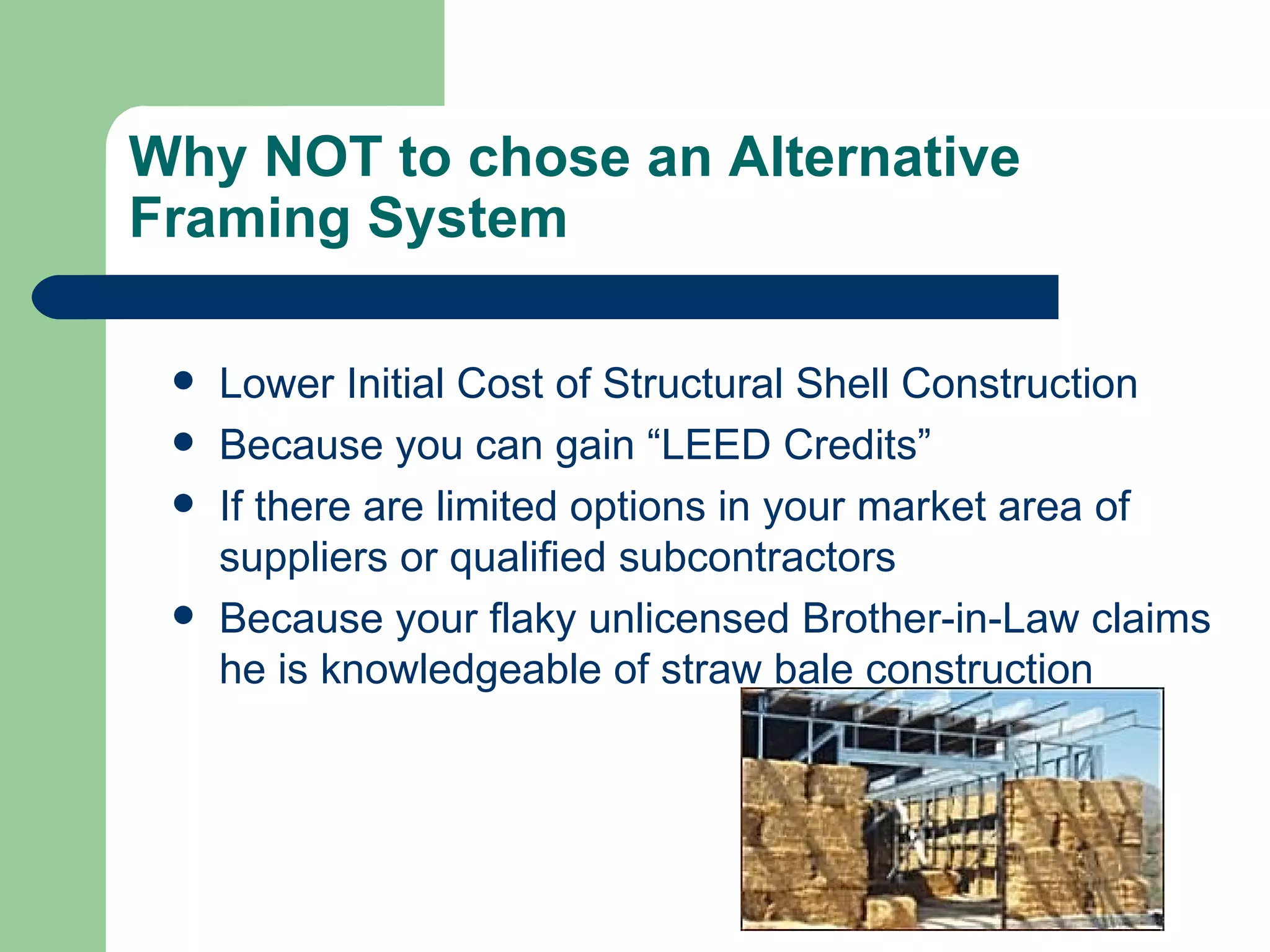
    Because your flaky unlicensed Brother-in-Law claims
     he is knowledgeable of straw bale construction
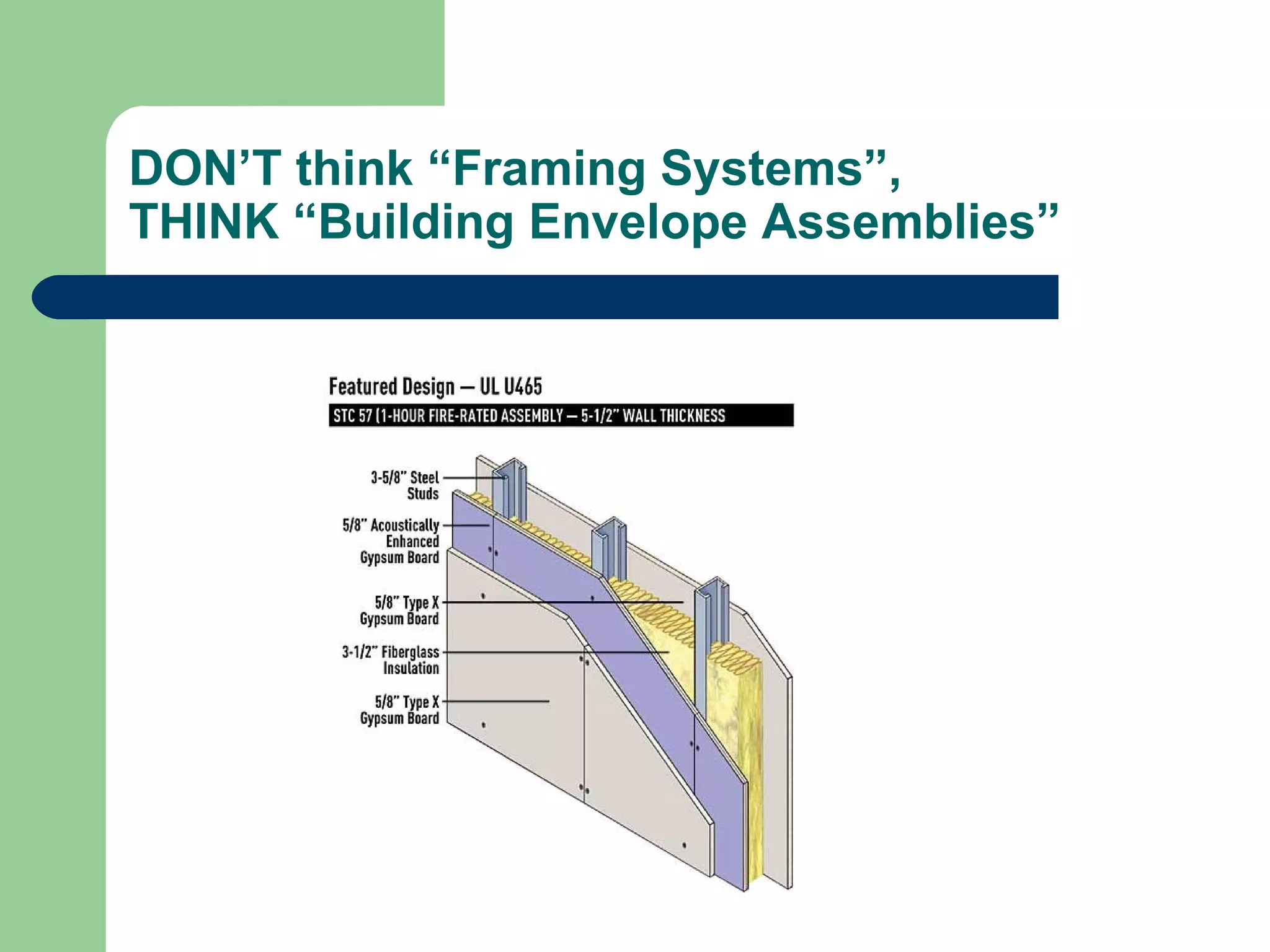
DON’T think “Framing Systems”,
THINK “Building Envelope Assemblies”
When evaluating Building Envelope
Assemblies, consider:

   Structural System
   Adaptability of Floor & Roof Diaphragms
   Exterior Building Skin
   Interior Building Skin
   Insulation
   Adaptability of Plumbing & Electrical within the
    system
   Design & Structural Constraints of the Assembly
When comparing Options,
consider

   Design & Structural Constraints
   Energy Efficiency
   Environmental Attributes
   Initial Construction Cost
   Life Cycle Value
   Fire Safety
   Adaptability of Building Skin Options
   Adaptability of Electrical & Plumbing
   Availability of Raw Materials
   Availability of Qualified Labor & Subcontractors
What are the Options

   Conventional Wood Framing
   FSC Certified Wood Framing
   Light Gauge Steel Framing
   Red Iron Steel Framing
   Structurally Insulated Panels (aka “SIPs”)
   Insulated Concrete Forms (aka “ICFs”)
   Timber Frame Structural Systems
   Straw Bale Construction
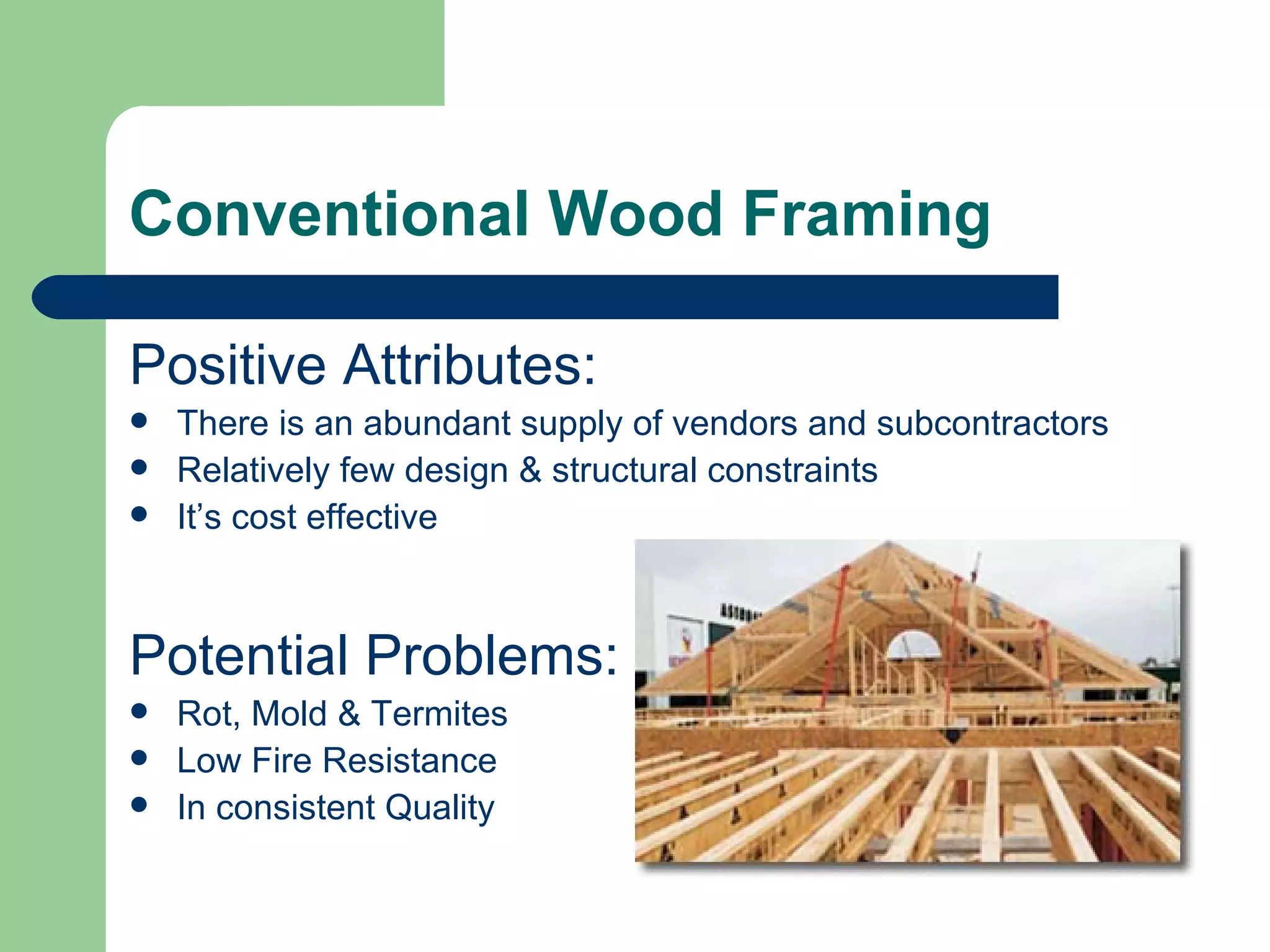
Conventional Wood Framing

Positive Attributes:
   There is an abundant supply of vendors and subcontractors
   Relatively few design & structural constraints
   It’s cost effective


Potential Problems:
   Rot, Mold & Termites
   Low Fire Resistance
   In consistent Quality
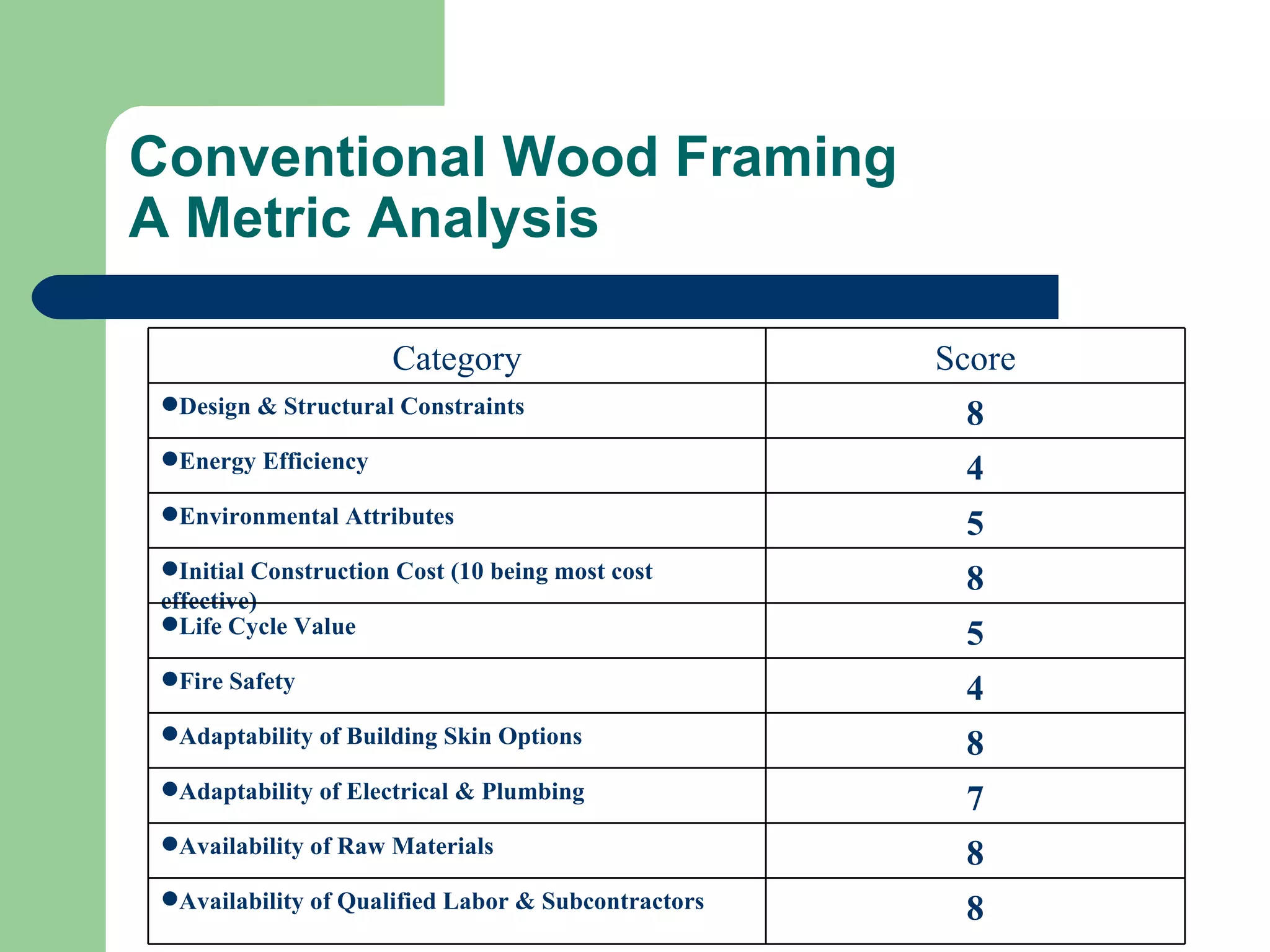
Conventional Wood Framing
A Metric Analysis

                      Category                       Score
 Design & Structural Constraints                     8
 Energy Efficiency                                   4
 Environmental Attributes                            5
 Initial Construction Cost (10 being most cost       8
 effective)
 Life Cycle Value                                    5
 Fire Safety                                         4
 Adaptability of Building Skin Options               8
 Adaptability of Electrical & Plumbing               7
 Availability of Raw Materials                       8
 Availability of Qualified Labor & Subcontractors    8
Forest Stewardship Council (aka “FSC”)
Wood Framing

Positive Attributes:
   Relatively few design & structural constraints
   Highly Environmentally Friendly
   Potential Marketing benefit for builders & developers
Potential Problems:
   Rot, Mold & Termites
   Low Fire Resistance
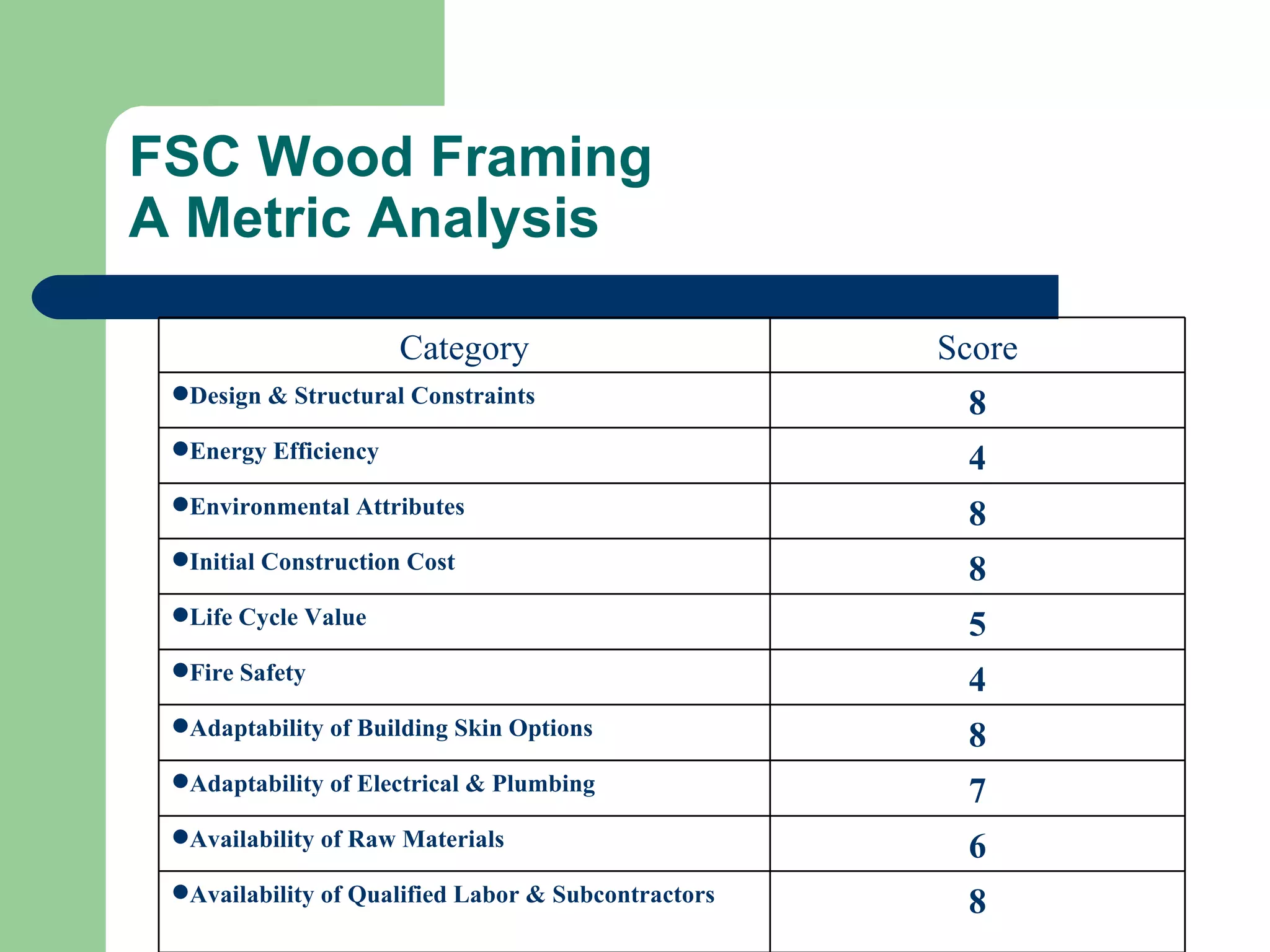
FSC Wood Framing
A Metric Analysis

                      Category                       Score
 Design & Structural Constraints                     8
 Energy Efficiency                                   4
 Environmental Attributes                            8
 Initial Construction Cost                           8
 Life Cycle Value                                    5
 Fire Safety                                         4
 Adaptability of Building Skin Options               8
 Adaptability of Electrical & Plumbing               7
 Availability of Raw Materials                       6
 Availability of Qualified Labor & Subcontractors    8
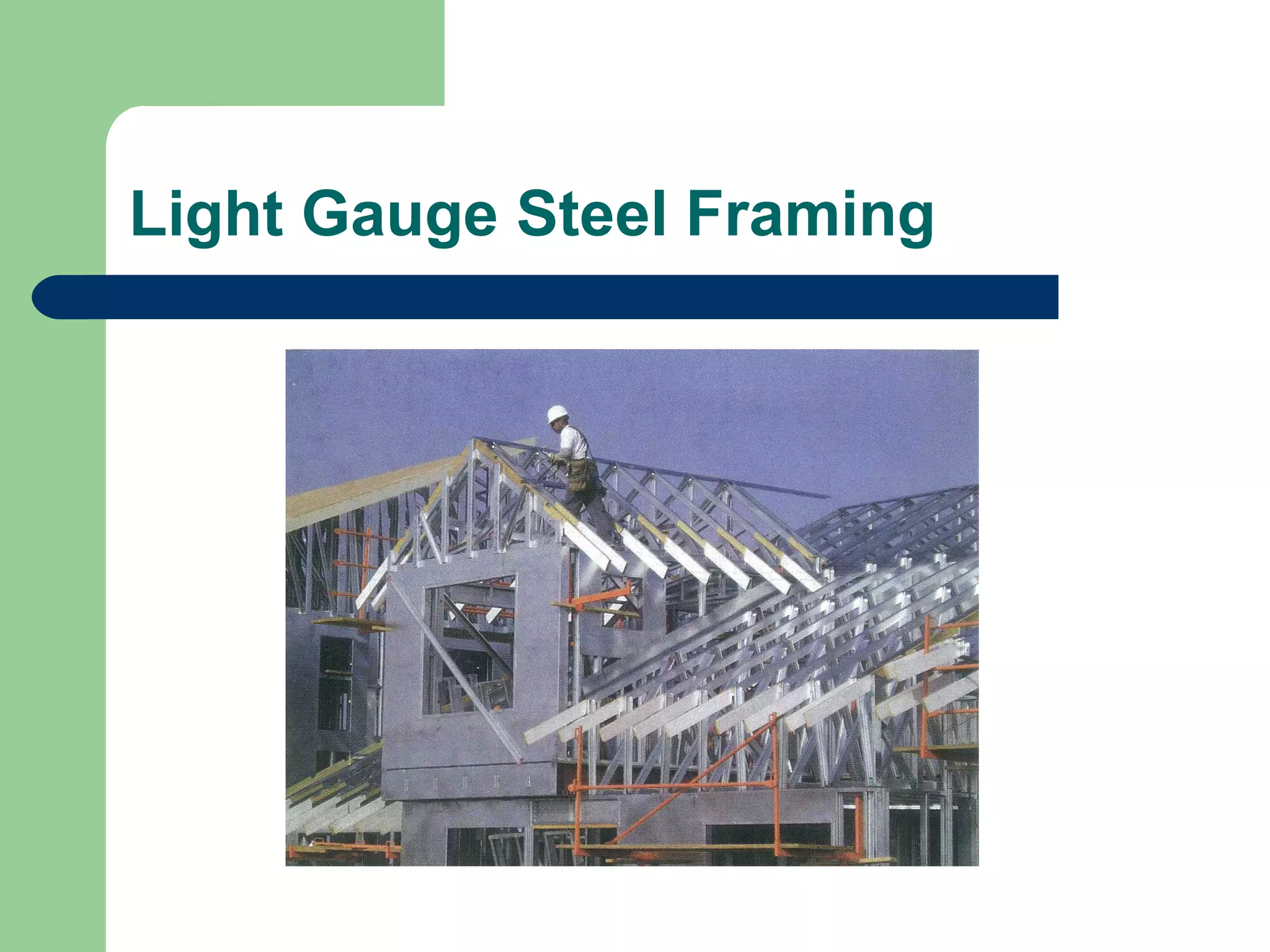
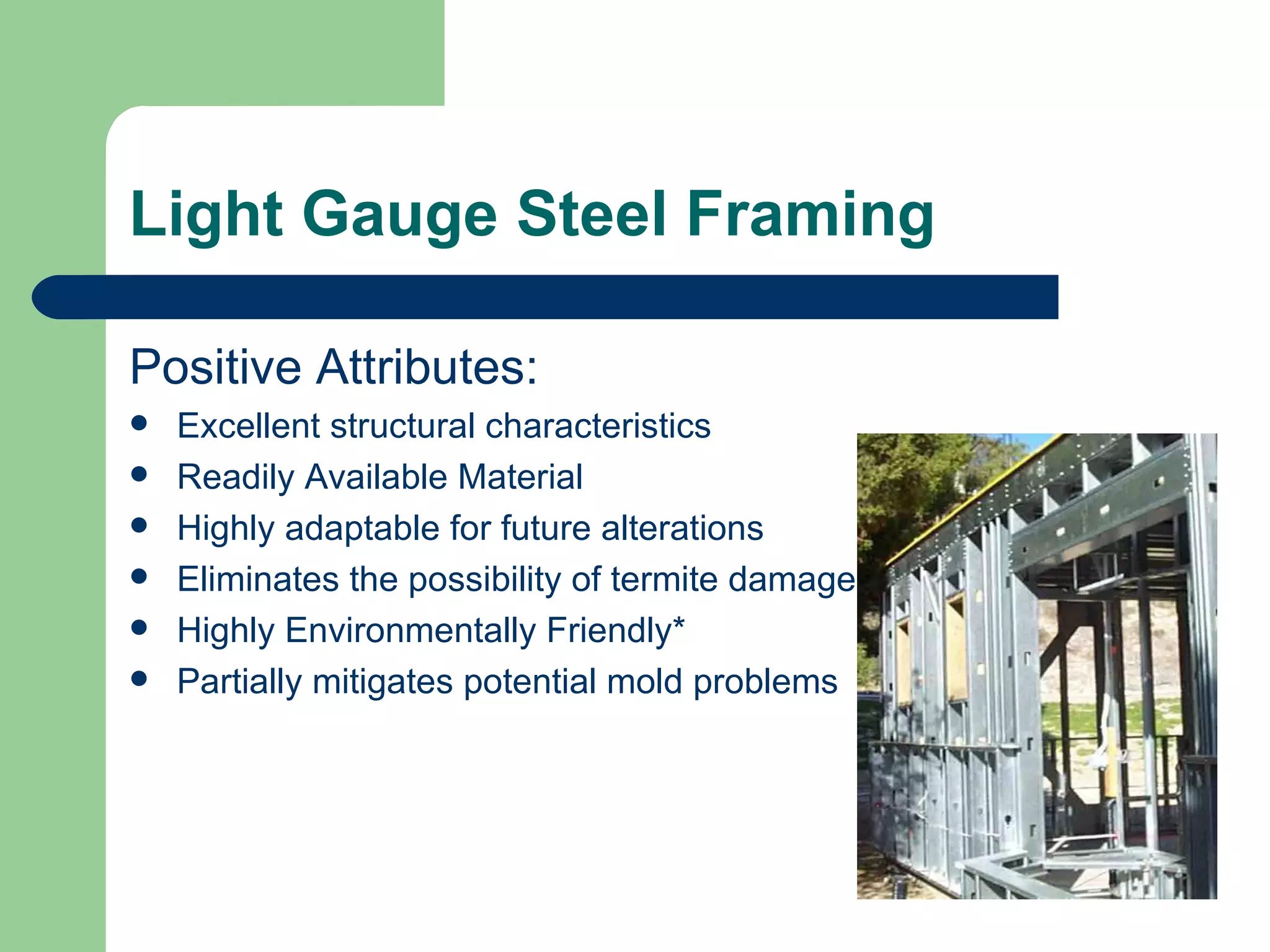
Light Gauge Steel Framing

Positive Attributes:
   Excellent structural characteristics
   Readily Available Material
   Highly adaptable for future alterations
   Eliminates the possibility of termite damage
   Highly Environmentally Friendly*
   Partially mitigates potential mold problems
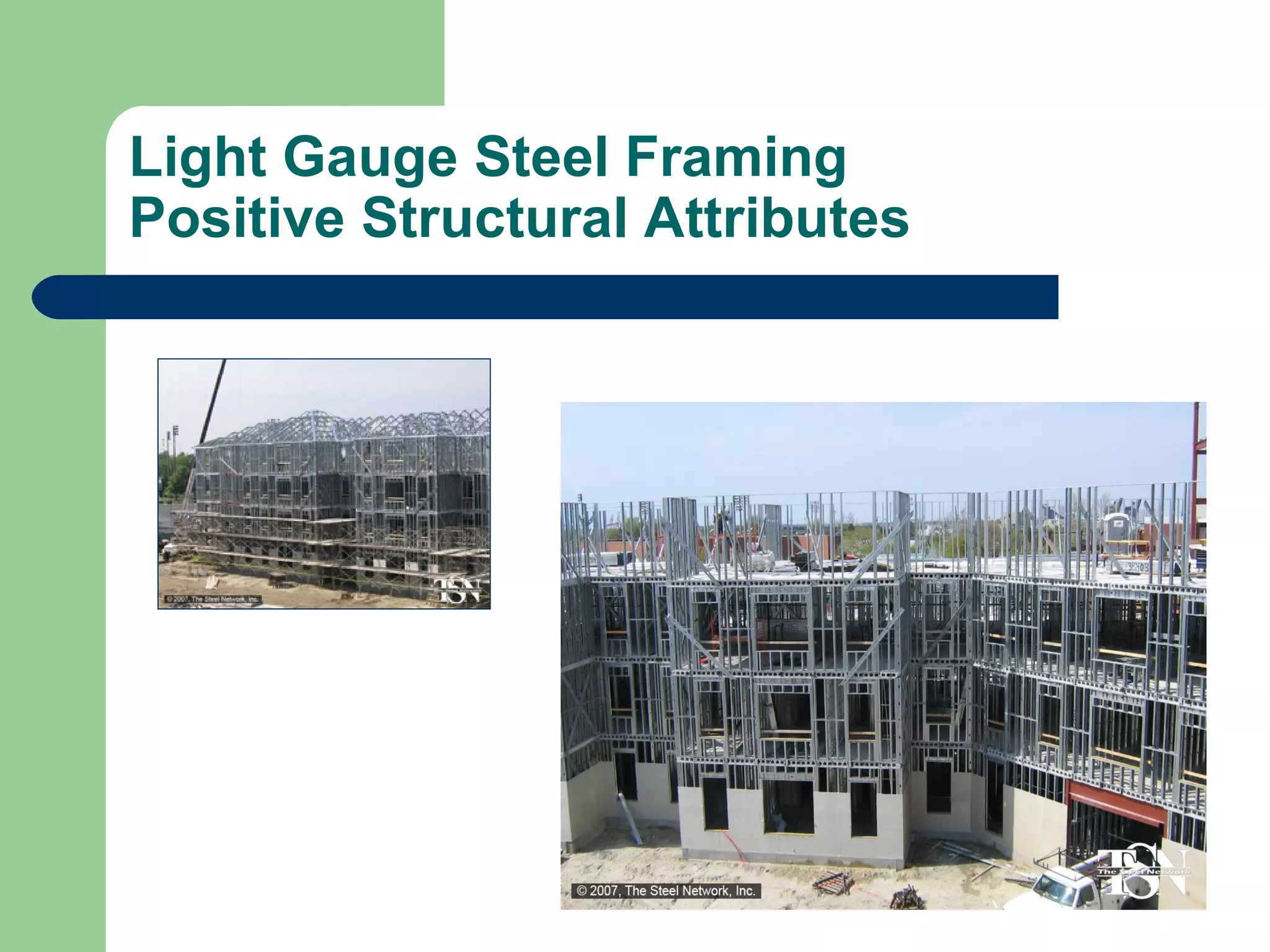
Light Gauge Steel Framing
Positive Structural Attributes
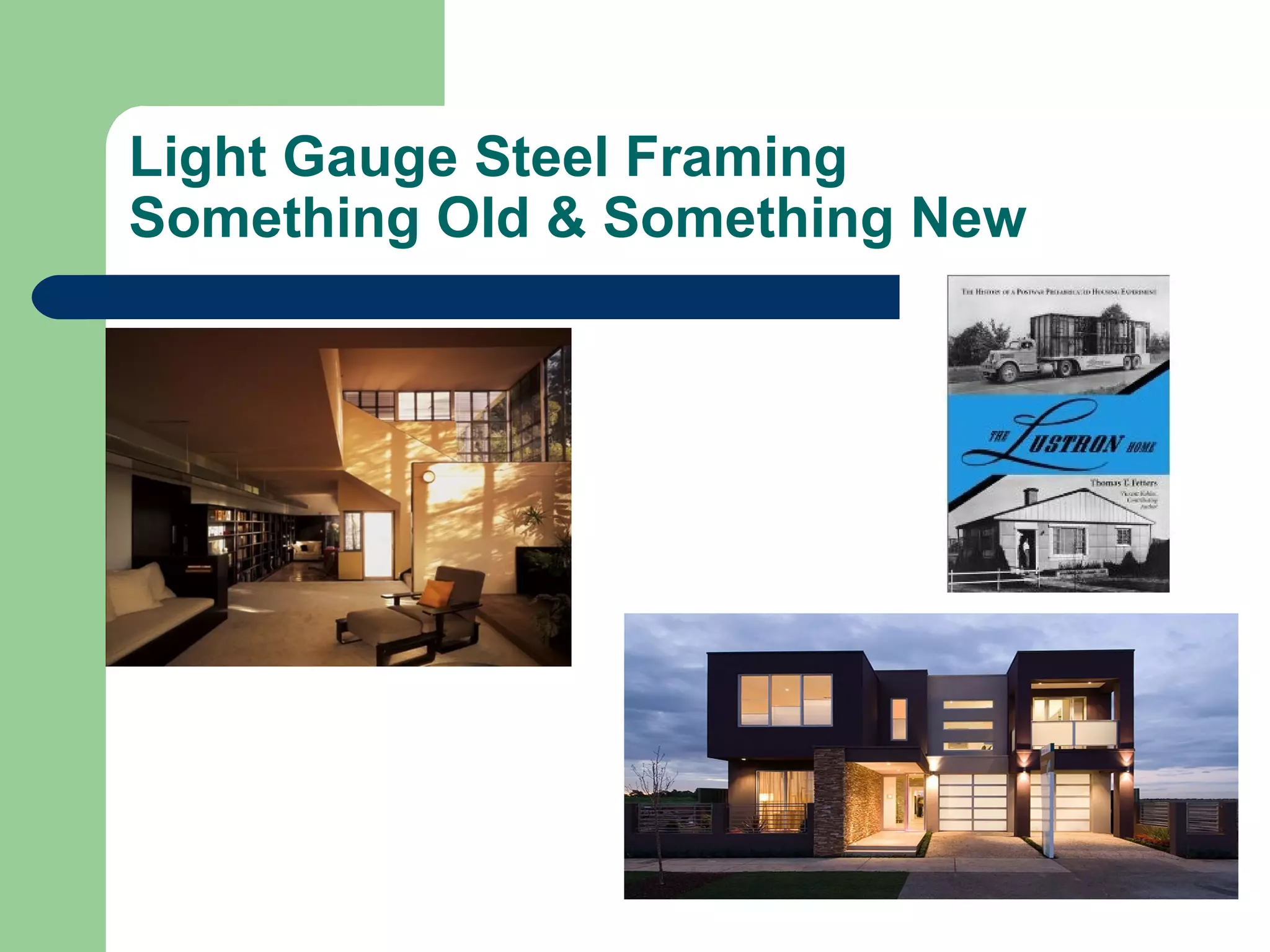
Light Gauge Steel Framing
Something Old & Something New
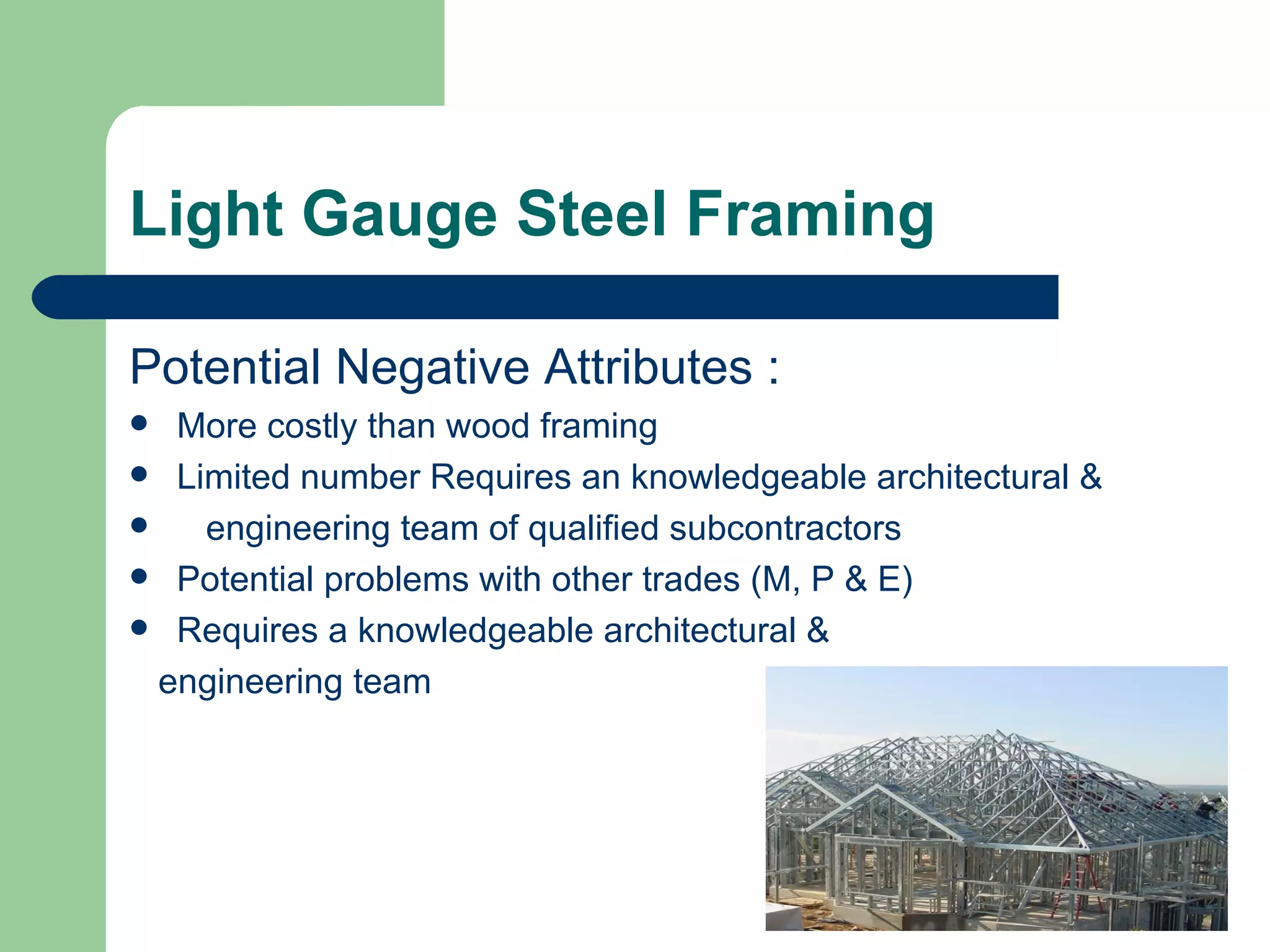
Light Gauge Steel Framing

Potential Negative Attributes :
  More costly than wood framing
 Limited number Requires an knowledgeable architectural &
   engineering team of qualified subcontractors
 Potential problems with other trades (M, P & E)
 Requires a knowledgeable architectural &

  engineering team
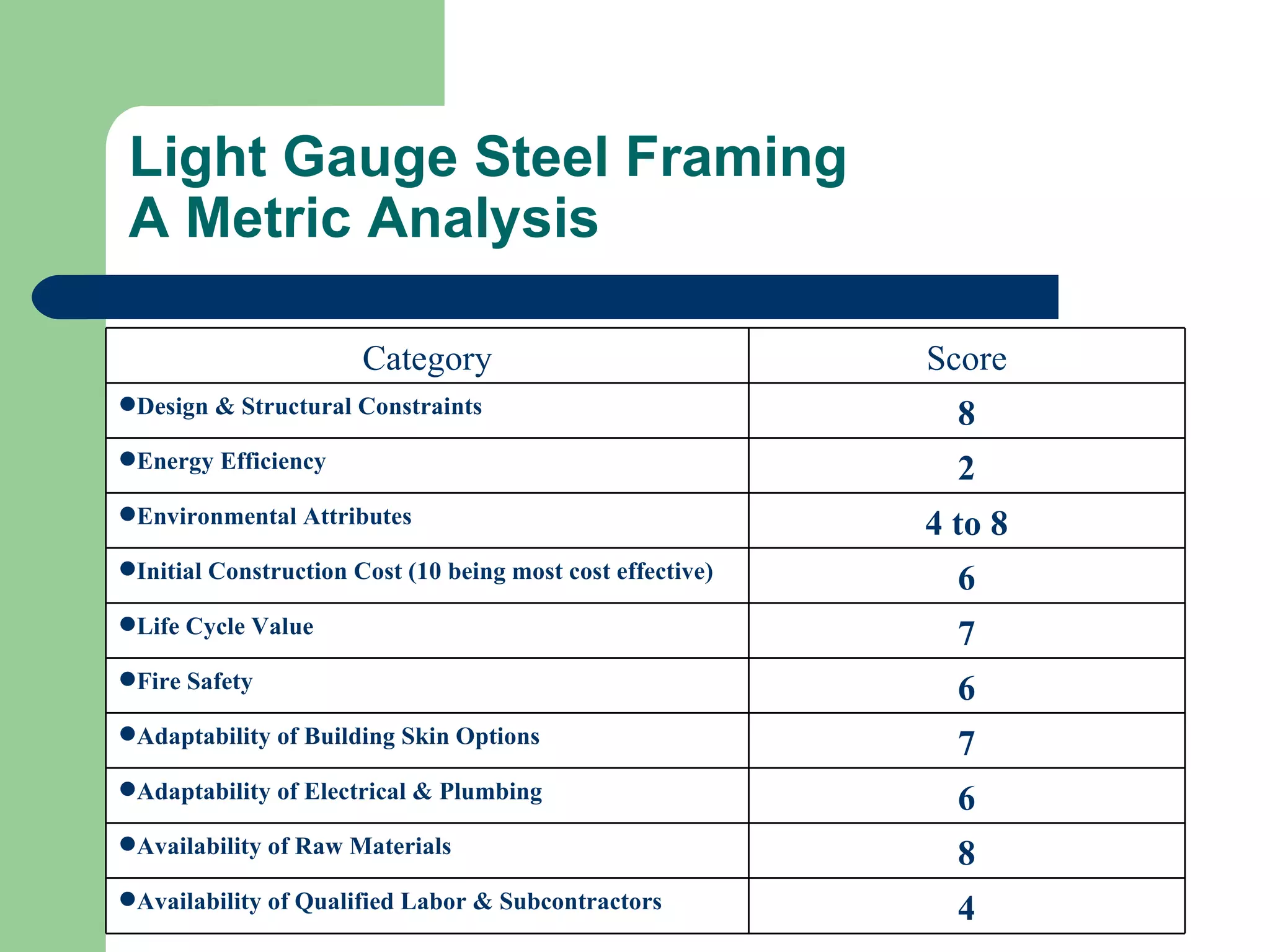
Light Gauge Steel Framing
A Metric Analysis

                       Category                             Score
Design & Structural Constraints                              8
Energy Efficiency                                            2
Environmental Attributes                                   4 to 8
Initial Construction Cost (10 being most cost effective)     6
Life Cycle Value                                             7
Fire Safety                                                  6
Adaptability of Building Skin Options                        7
Adaptability of Electrical & Plumbing                        6
Availability of Raw Materials                                8
Availability of Qualified Labor & Subcontractors             4
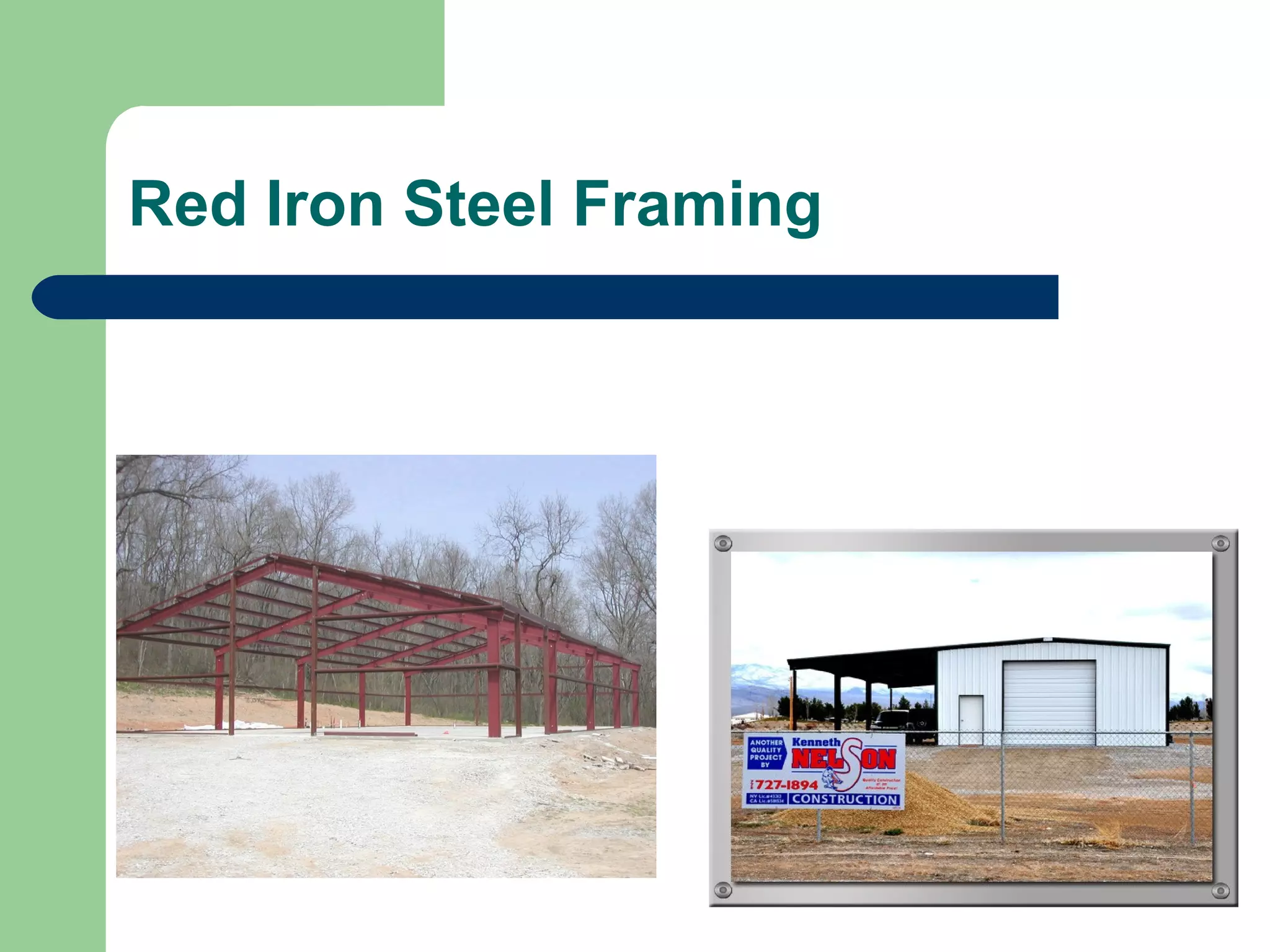
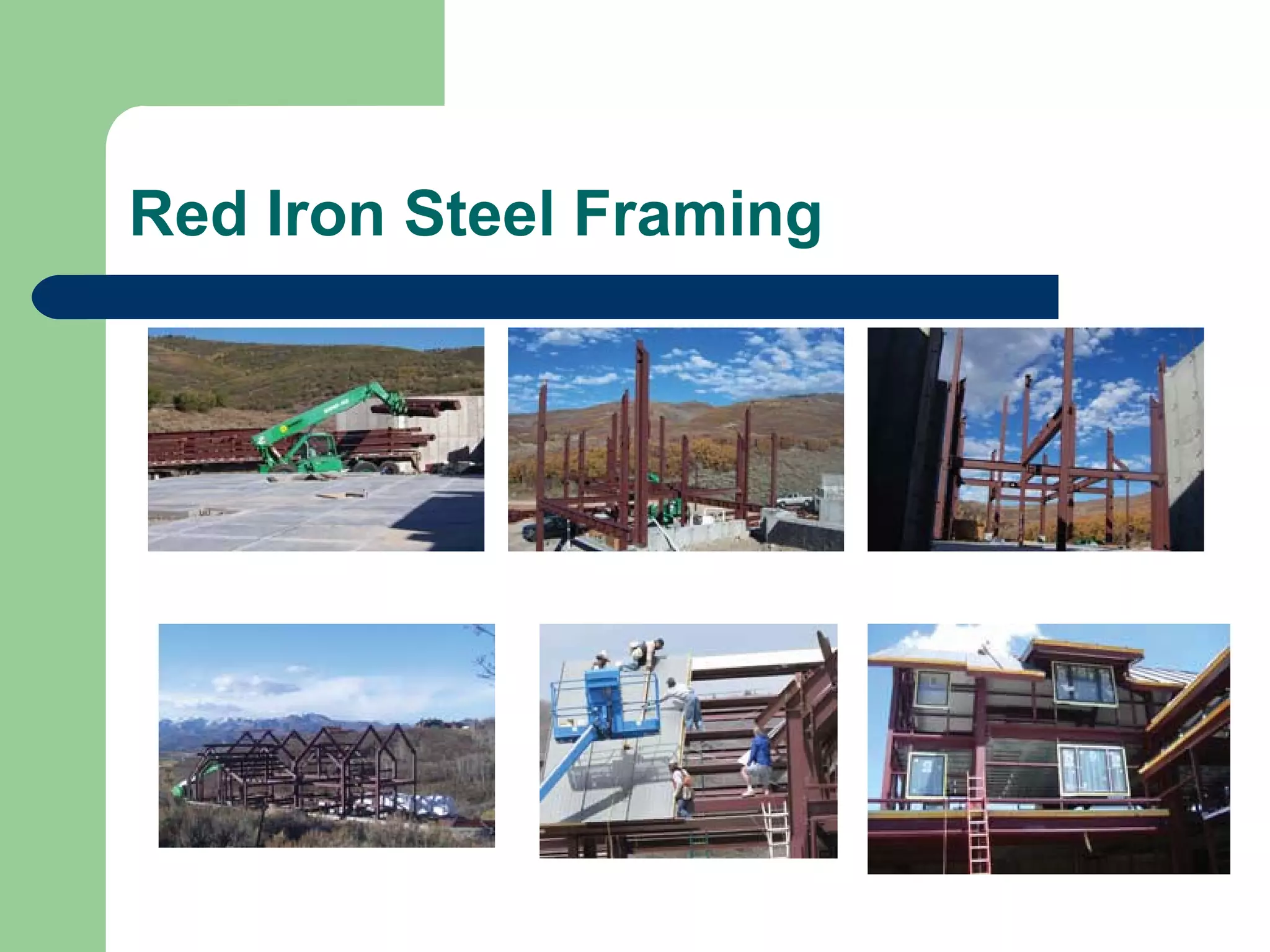
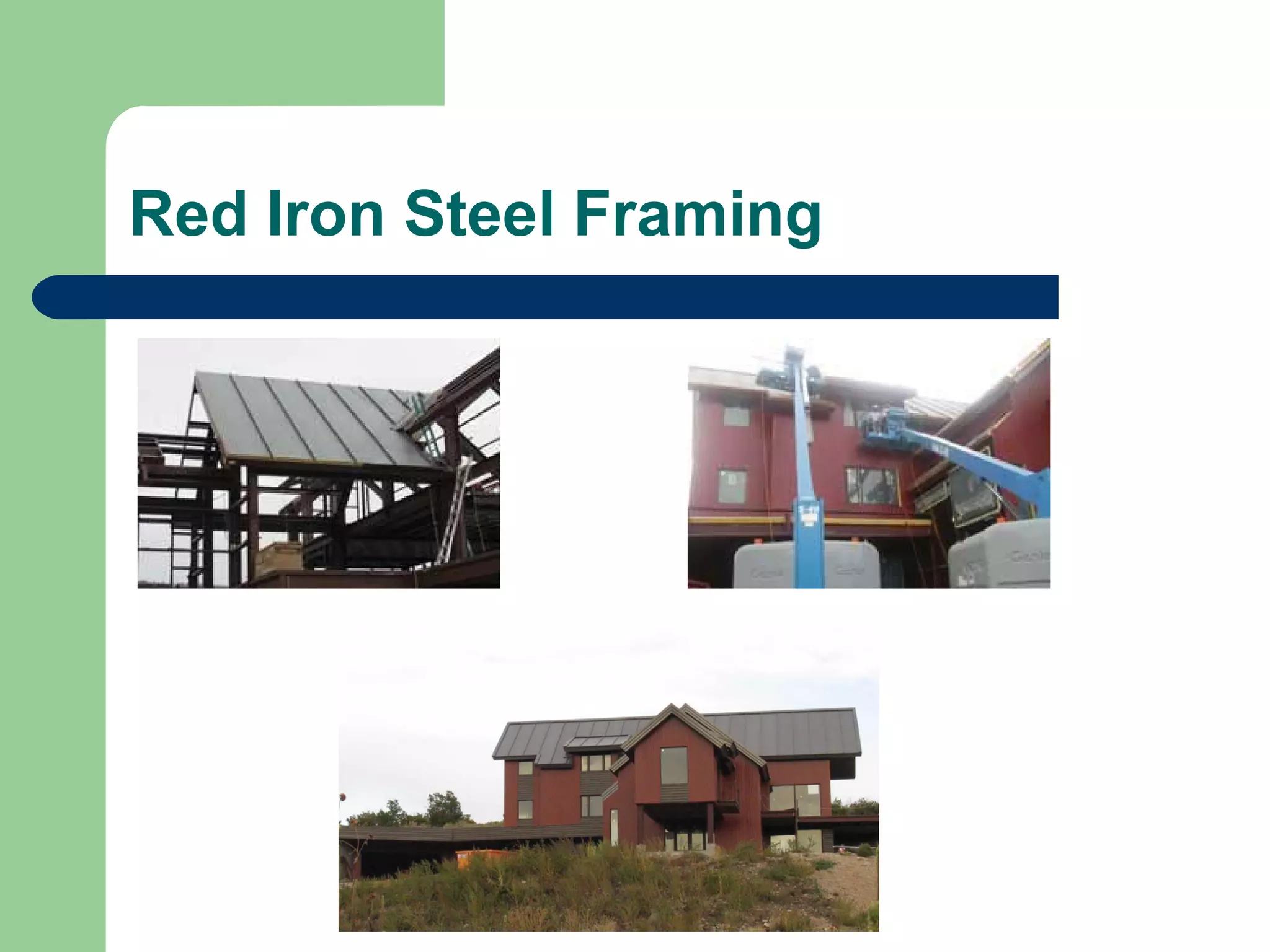
Red Iron Steel Framing

Positive Attributes:
   Excellent structural characteristics
   Readily Available Material
   Eliminates the possibility of termite damage
   Highly Environmentally Friendly*
   Partially mitigates potential mold problems
   Can be potentially very cost effective
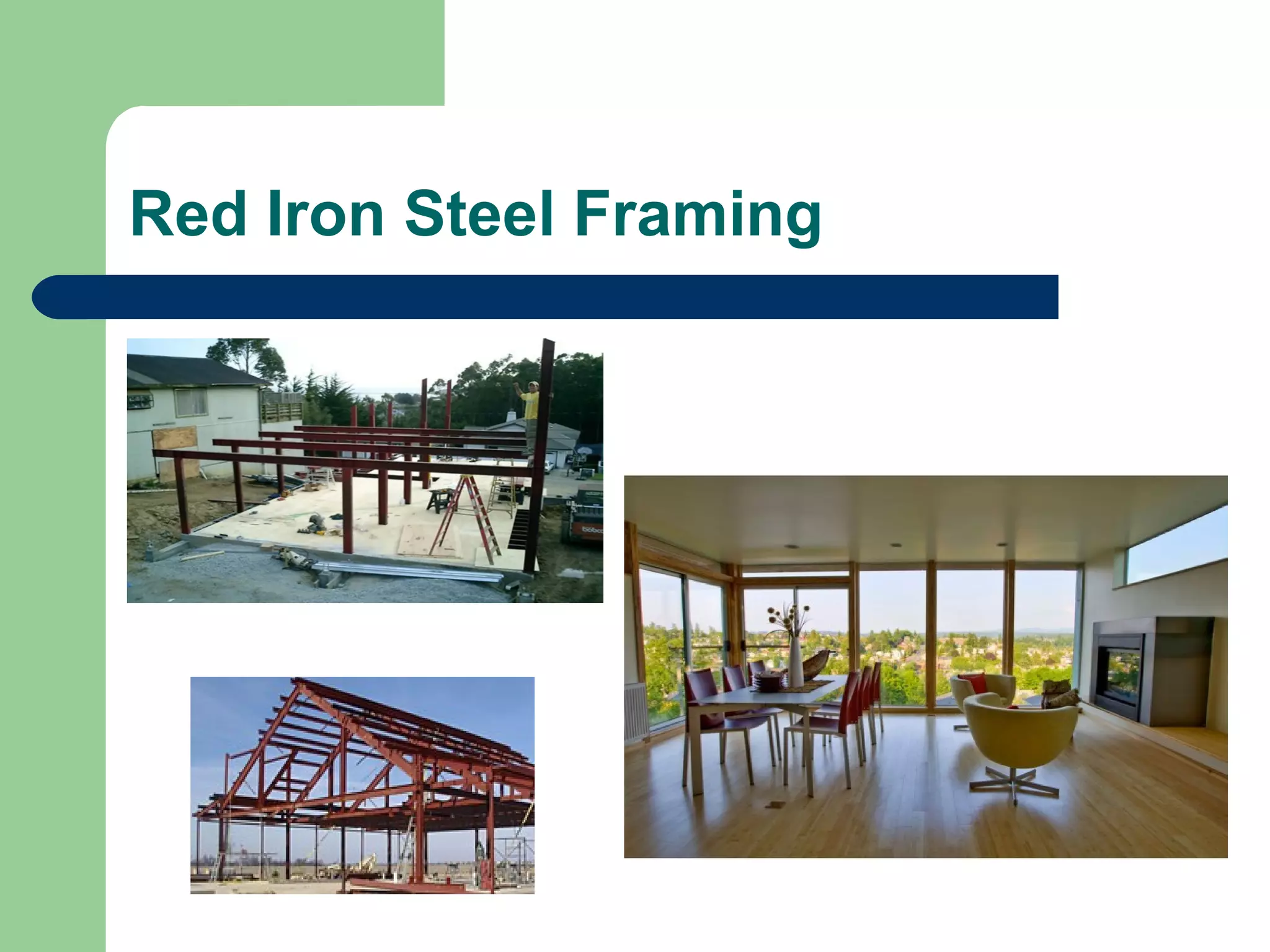
Red Iron Steel Framing

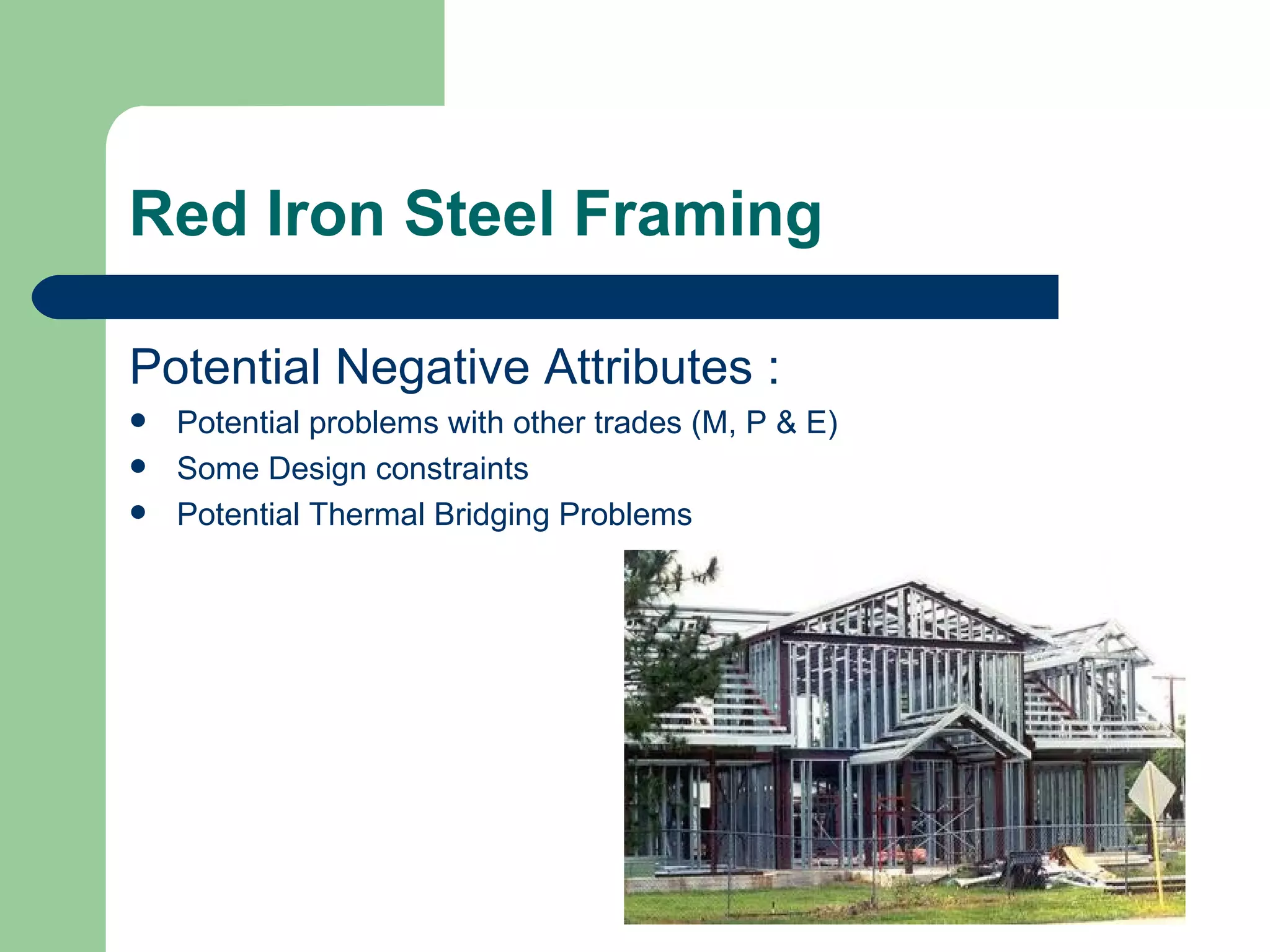
Potential Negative Attributes :
   Potential problems with other trades (M, P & E)
   Some Design constraints
   Potential Thermal Bridging Problems
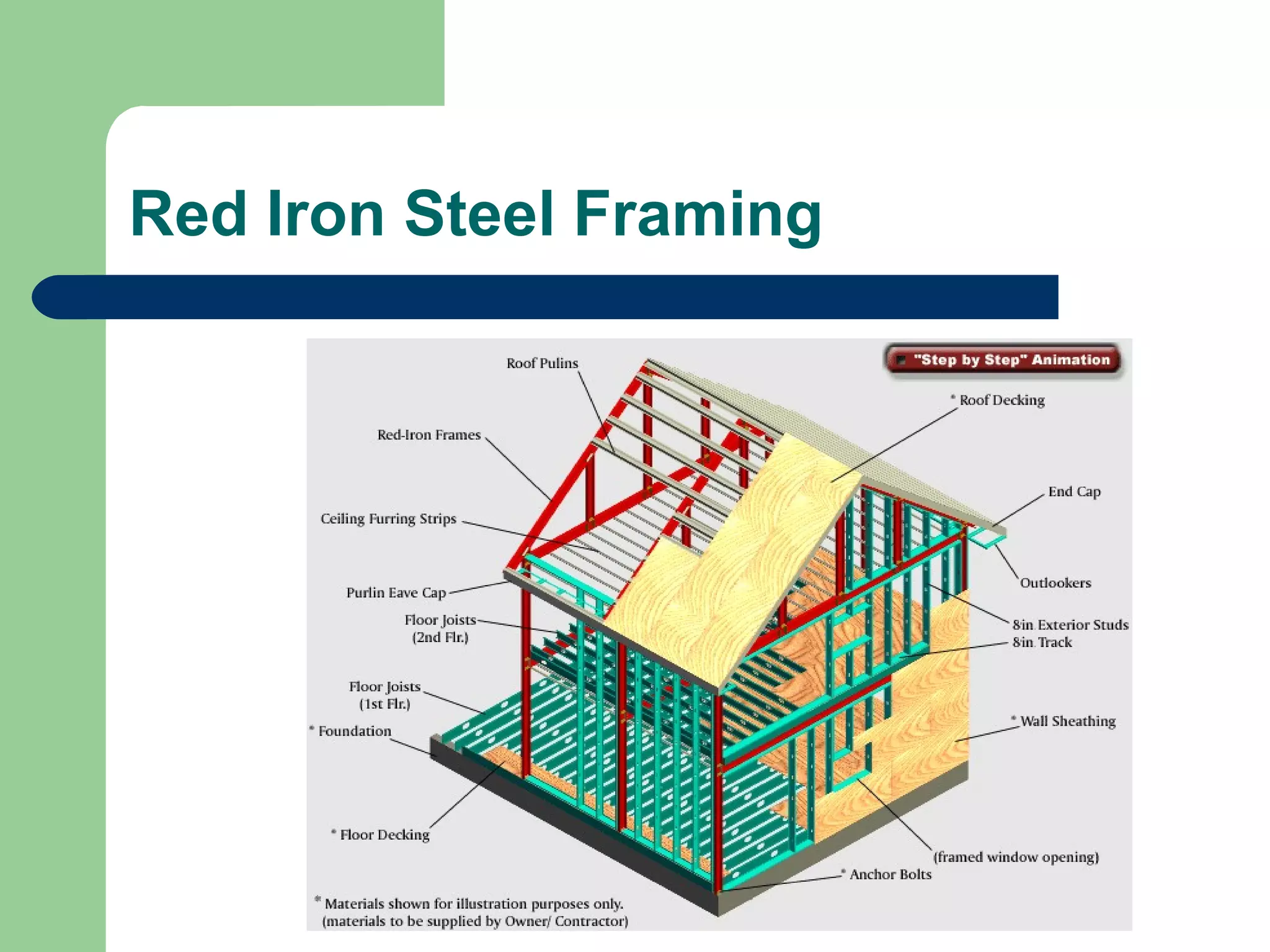
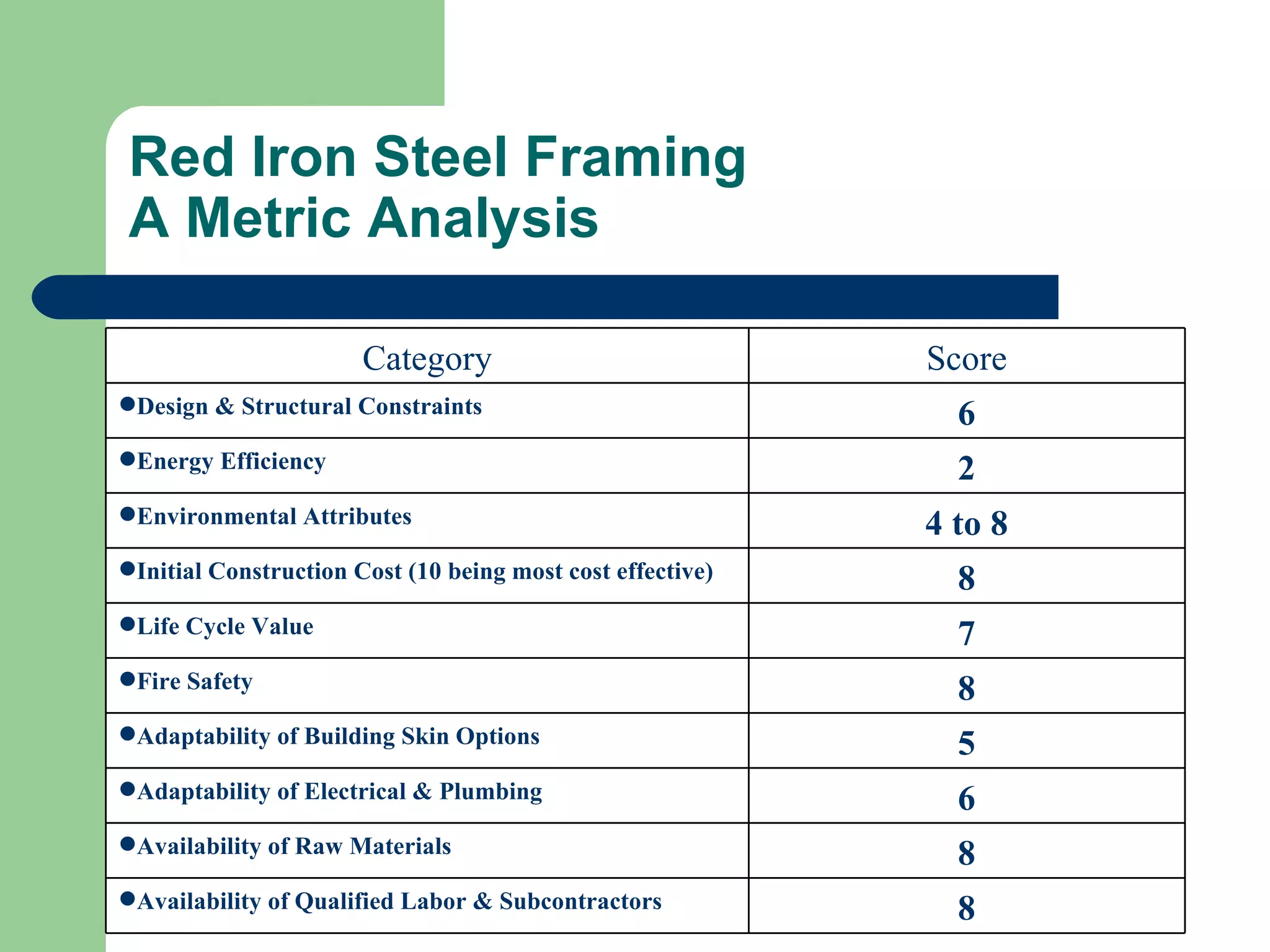
Red Iron Steel Framing
A Metric Analysis

                       Category                             Score
Design & Structural Constraints                              6
Energy Efficiency                                            2
Environmental Attributes                                   4 to 8
Initial Construction Cost (10 being most cost effective)     8
Life Cycle Value                                             7
Fire Safety                                                  8
Adaptability of Building Skin Options                        5
Adaptability of Electrical & Plumbing                        6
Availability of Raw Materials                                8
Availability of Qualified Labor & Subcontractors             8
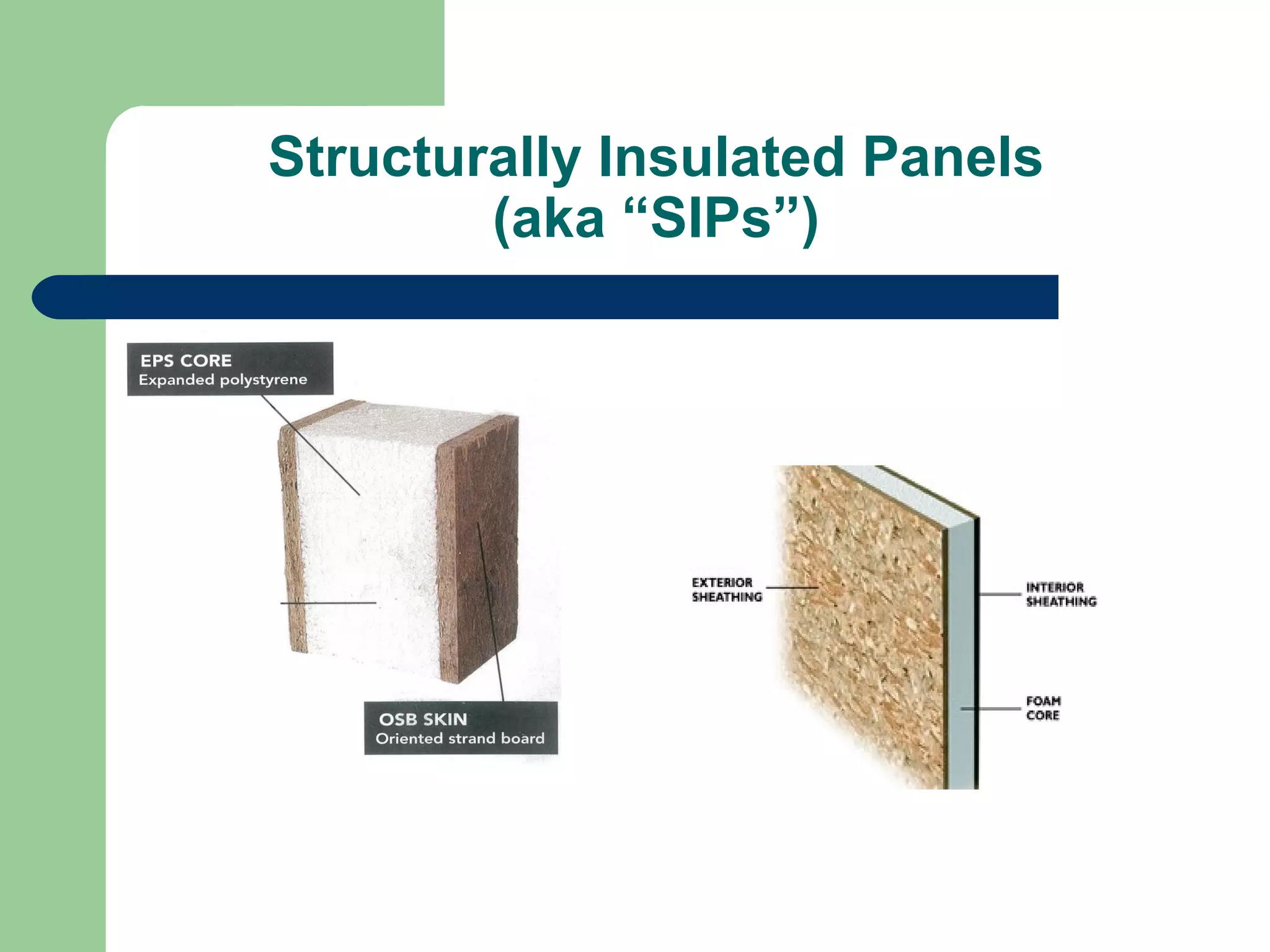
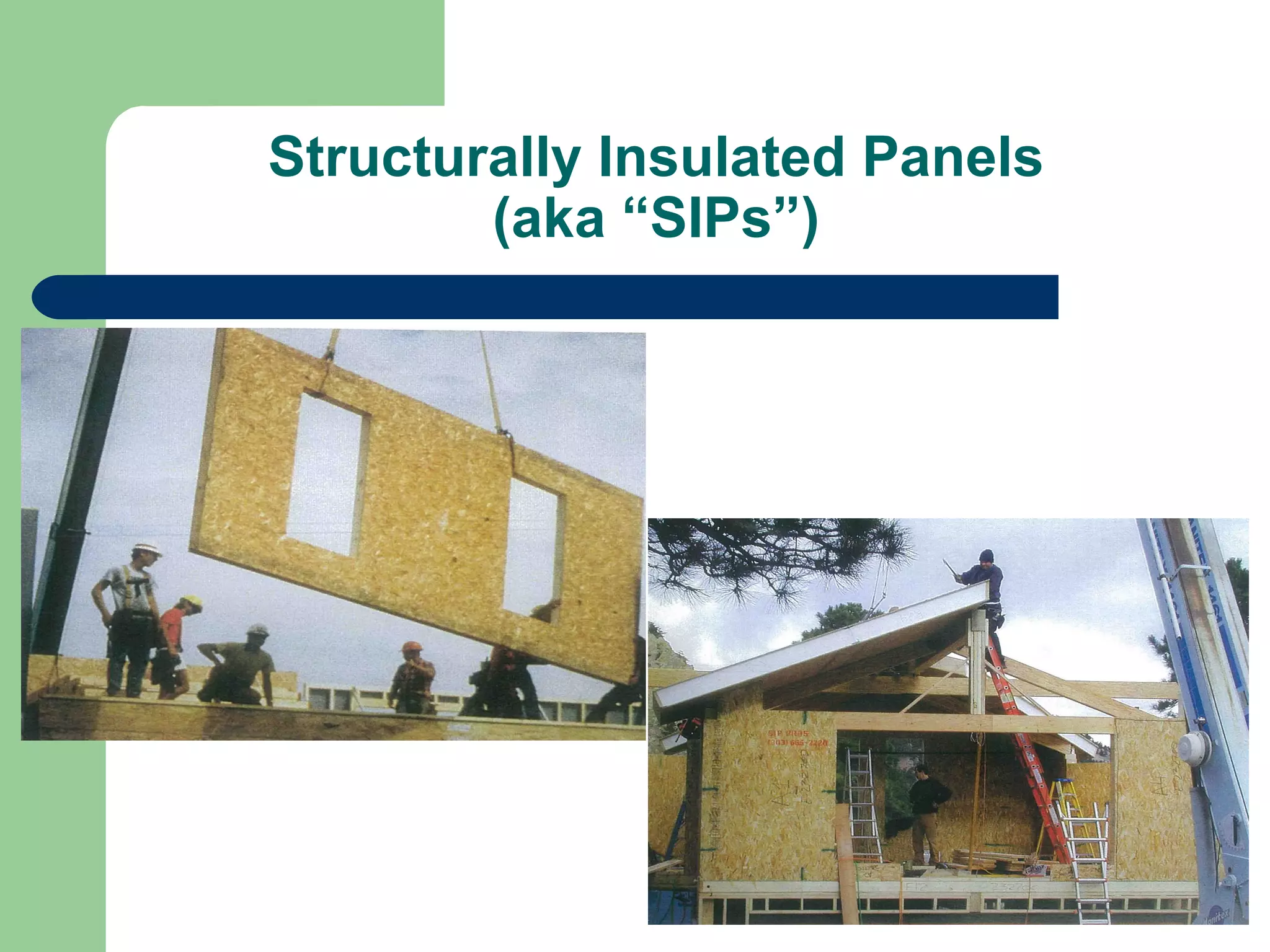
Structurally Insulated Panels
        (aka “SIPs”)
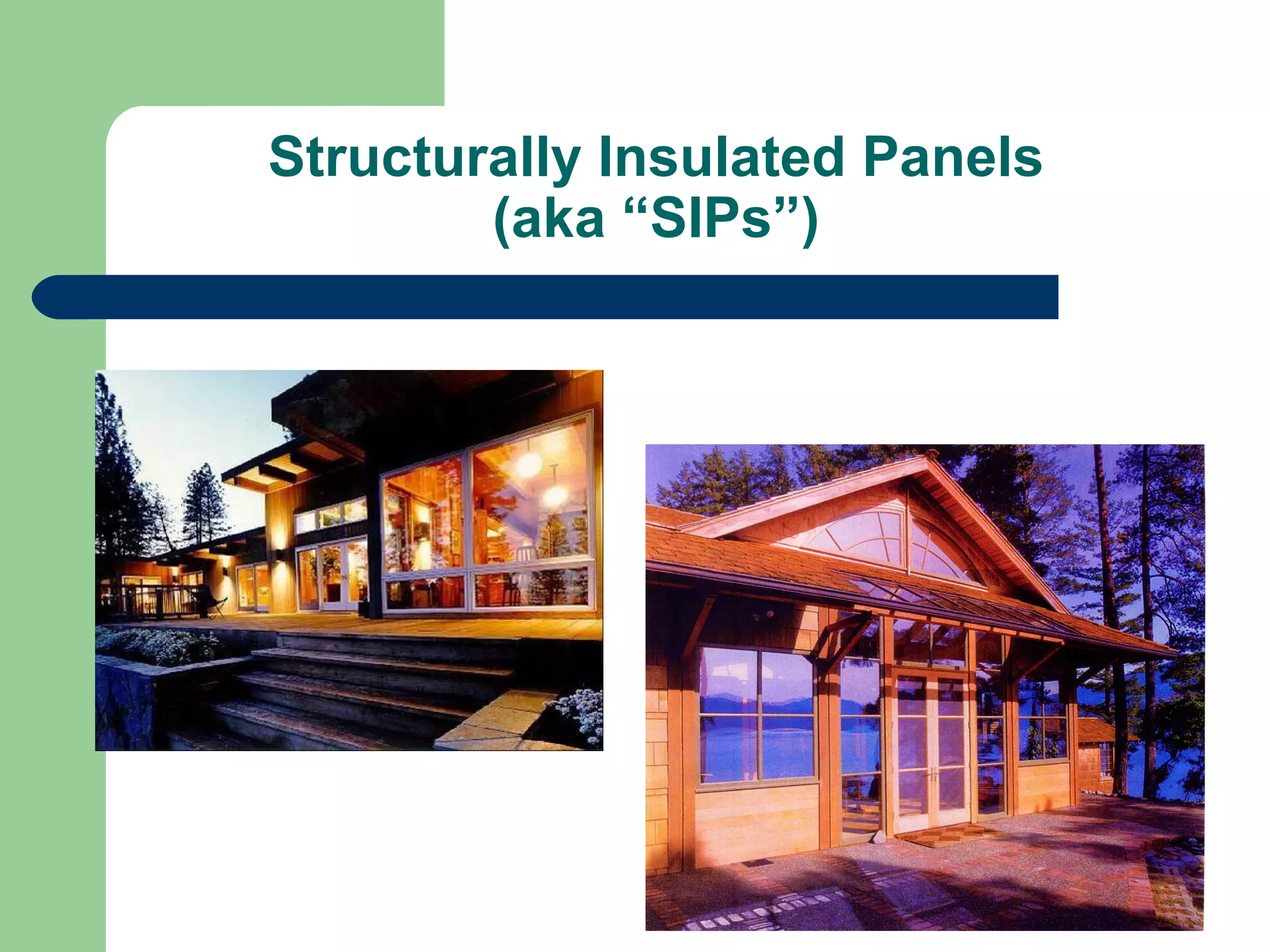
Structurally Insulated Panels
        (aka “SIPs”)
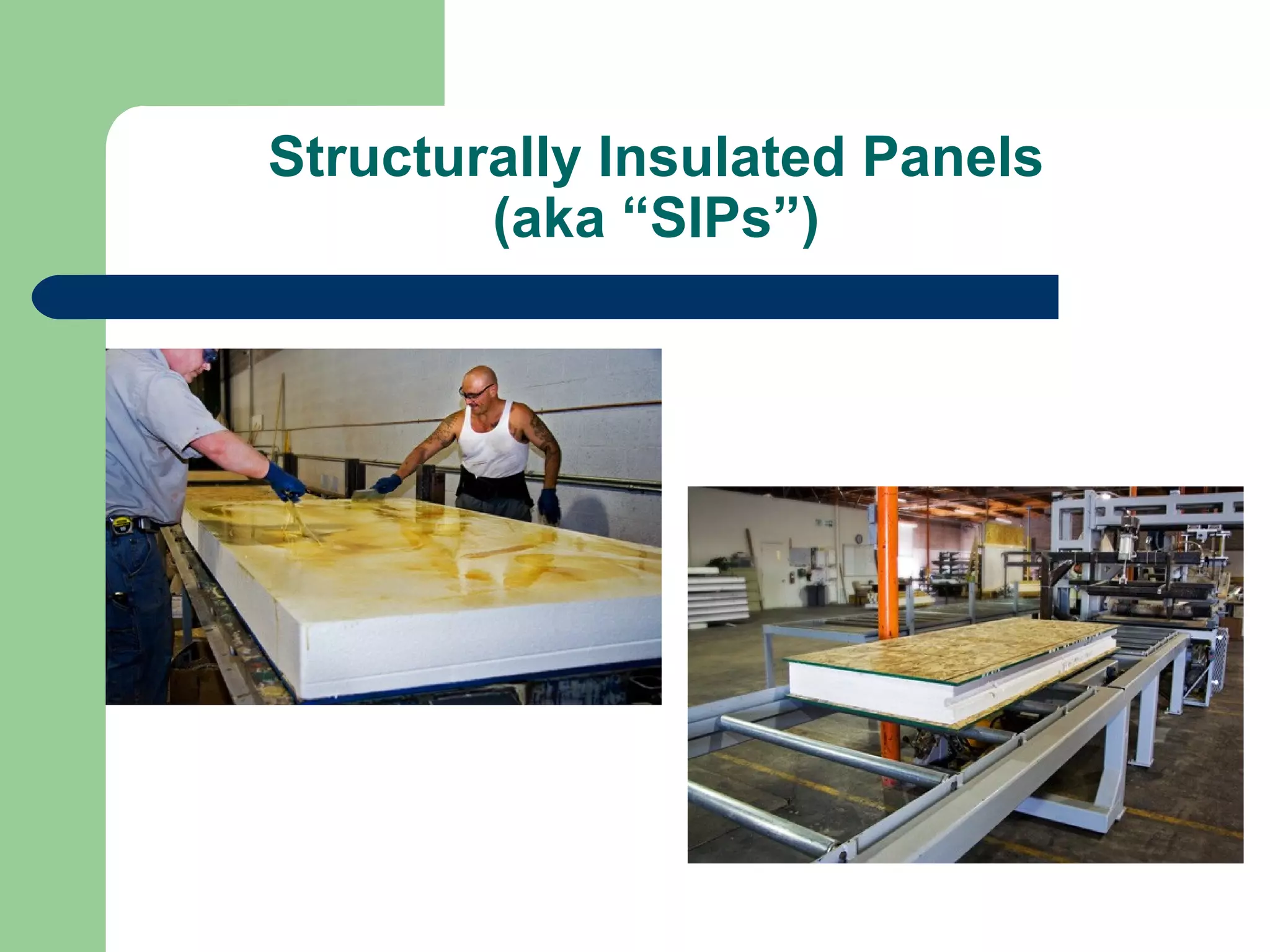
Structurally Insulated Panels
        (aka “SIPs”)
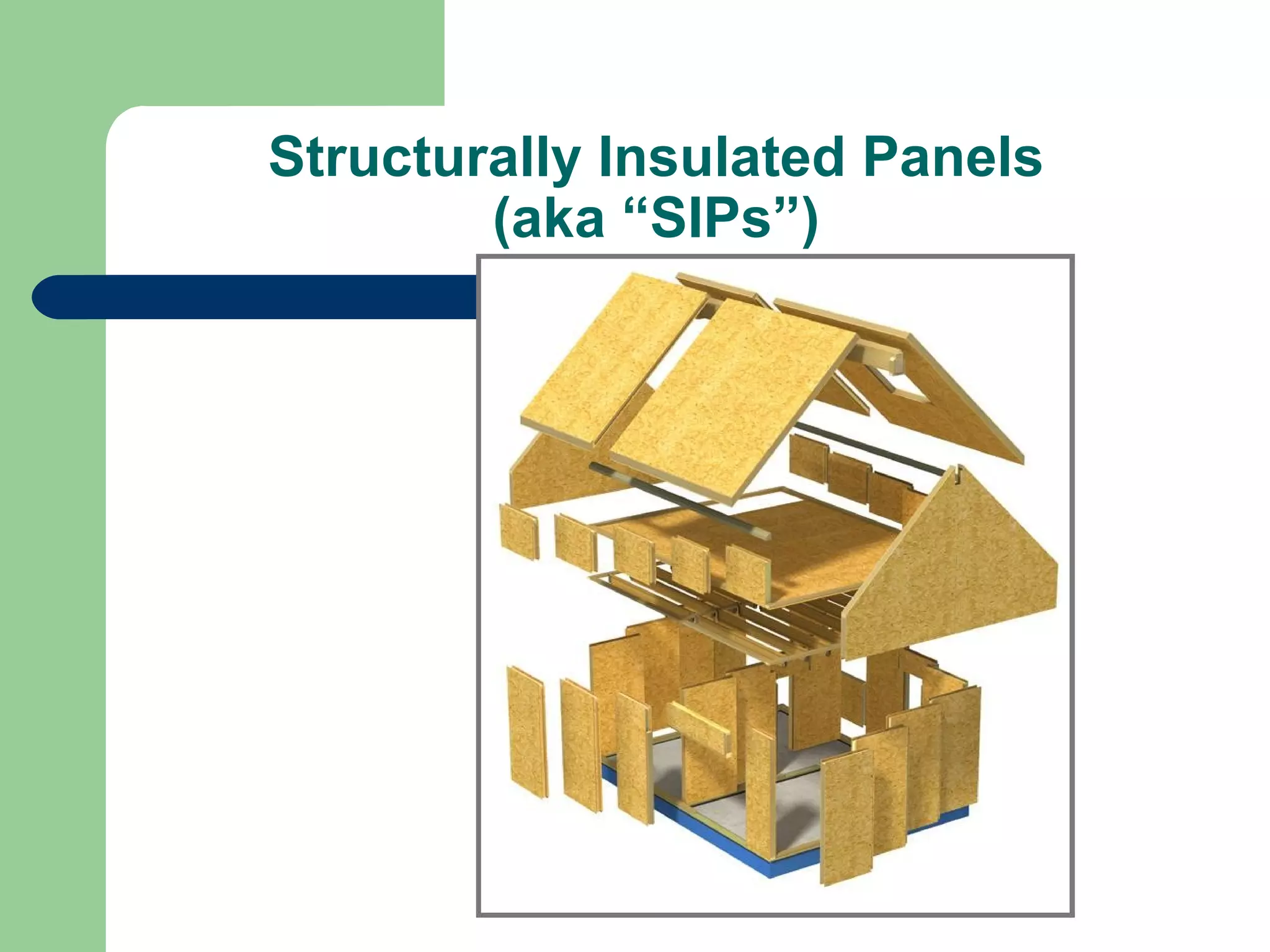
Structurally Insulated Panels
        (aka “SIPs”)
Structurally Insulated Panels
        (aka “SIPs”)
Structurally Insulated Panels
                 (aka “SIPs”)

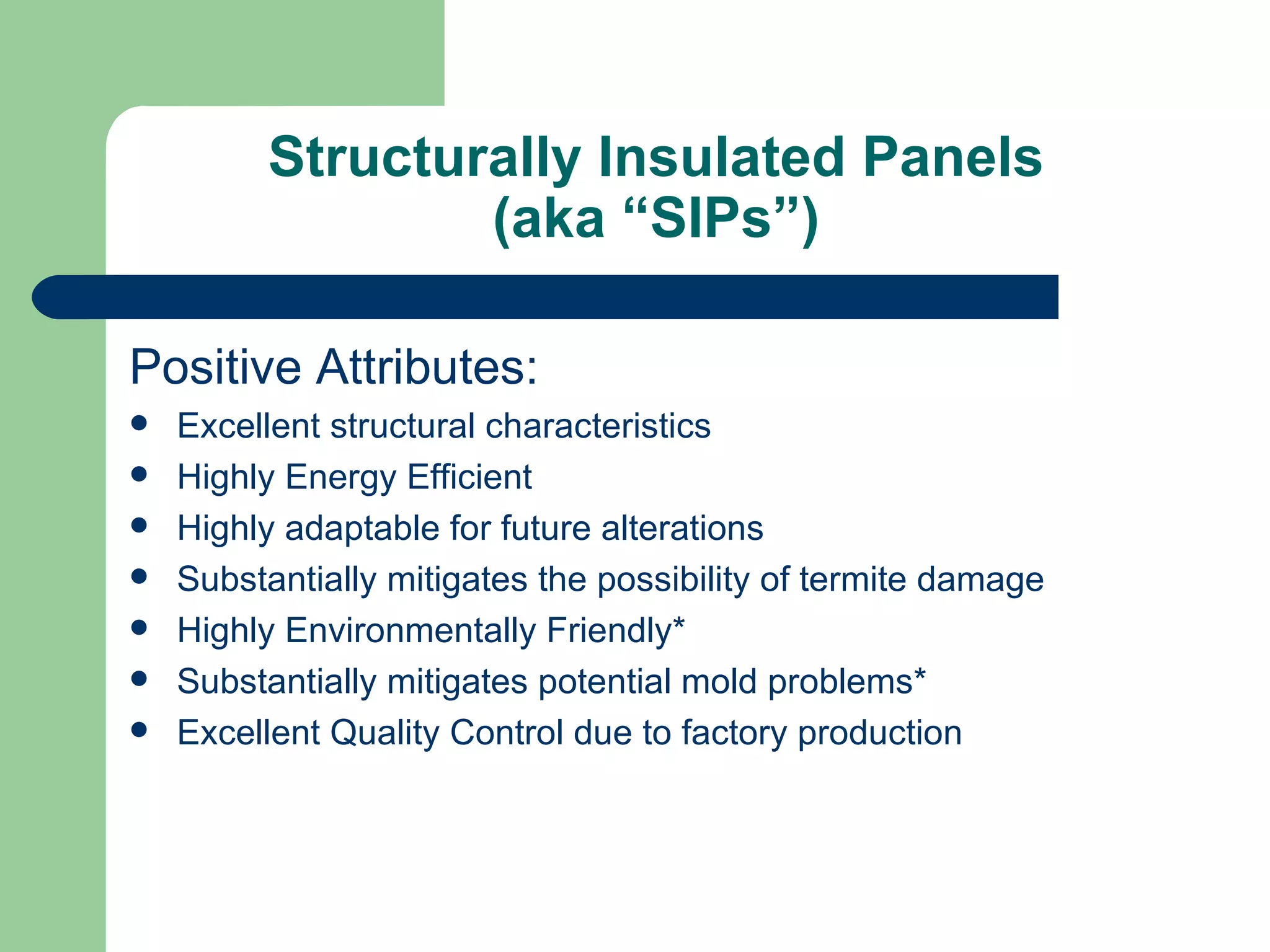
Positive Attributes:
   Excellent structural characteristics
   Highly Energy Efficient
   Highly adaptable for future alterations
   Substantially mitigates the possibility of termite damage
   Highly Environmentally Friendly*
   Substantially mitigates potential mold problems*
   Excellent Quality Control due to factory production
Structurally Insulated Panels
           (aka “SIPs”)


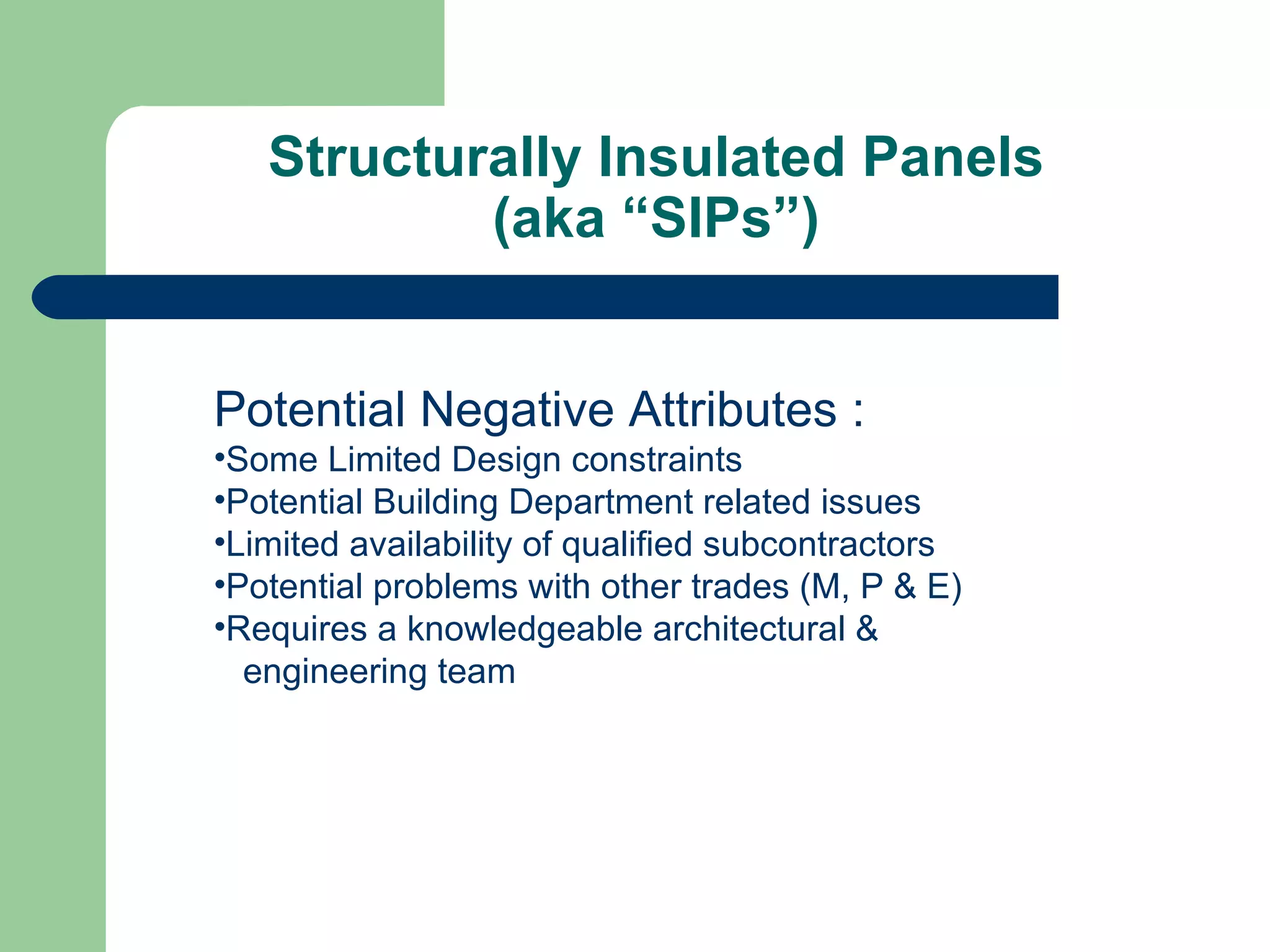
Potential Negative Attributes :
•Some Limited Design constraints
•Potential Building Department related issues
•Limited availability of qualified subcontractors
•Potential problems with other trades (M, P & E)
•Requires a knowledgeable architectural &
  engineering team
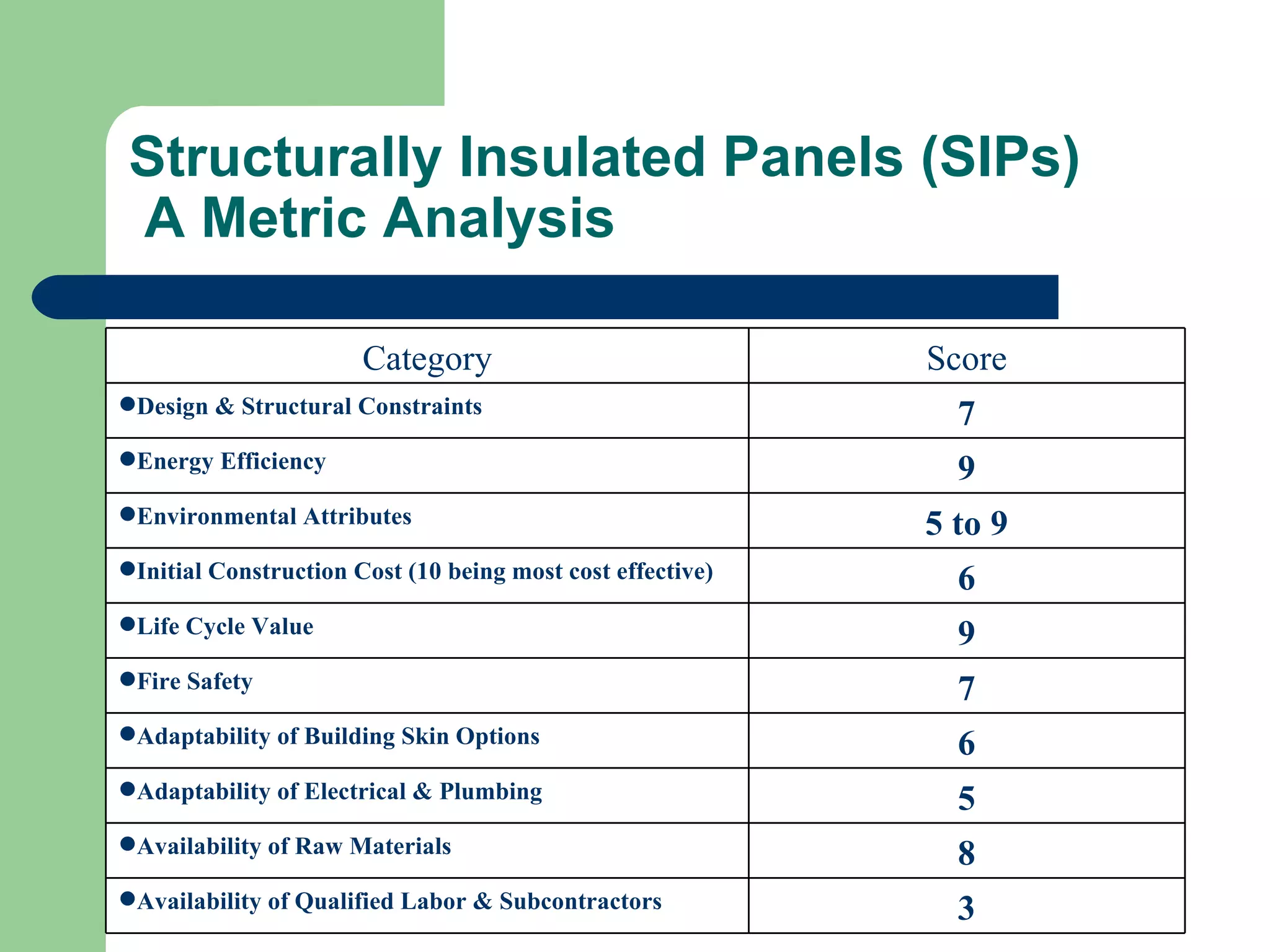
Structurally Insulated Panels (SIPs)
A Metric Analysis

                       Category                             Score
Design & Structural Constraints                              7
Energy Efficiency                                            9
Environmental Attributes                                   5 to 9
Initial Construction Cost (10 being most cost effective)     6
Life Cycle Value                                             9
Fire Safety                                                  7
Adaptability of Building Skin Options                        6
Adaptability of Electrical & Plumbing                        5
Availability of Raw Materials                                8
Availability of Qualified Labor & Subcontractors             3
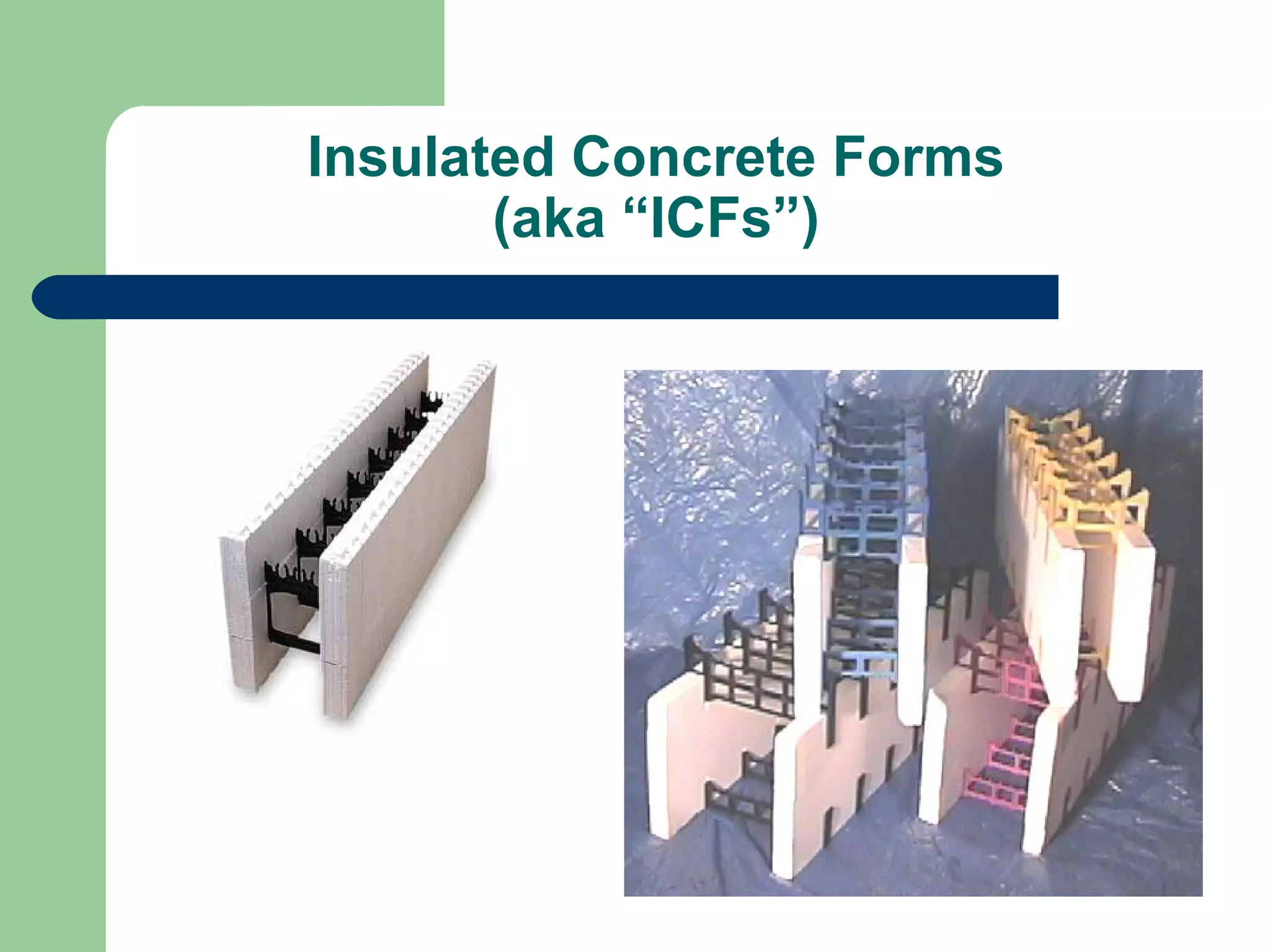
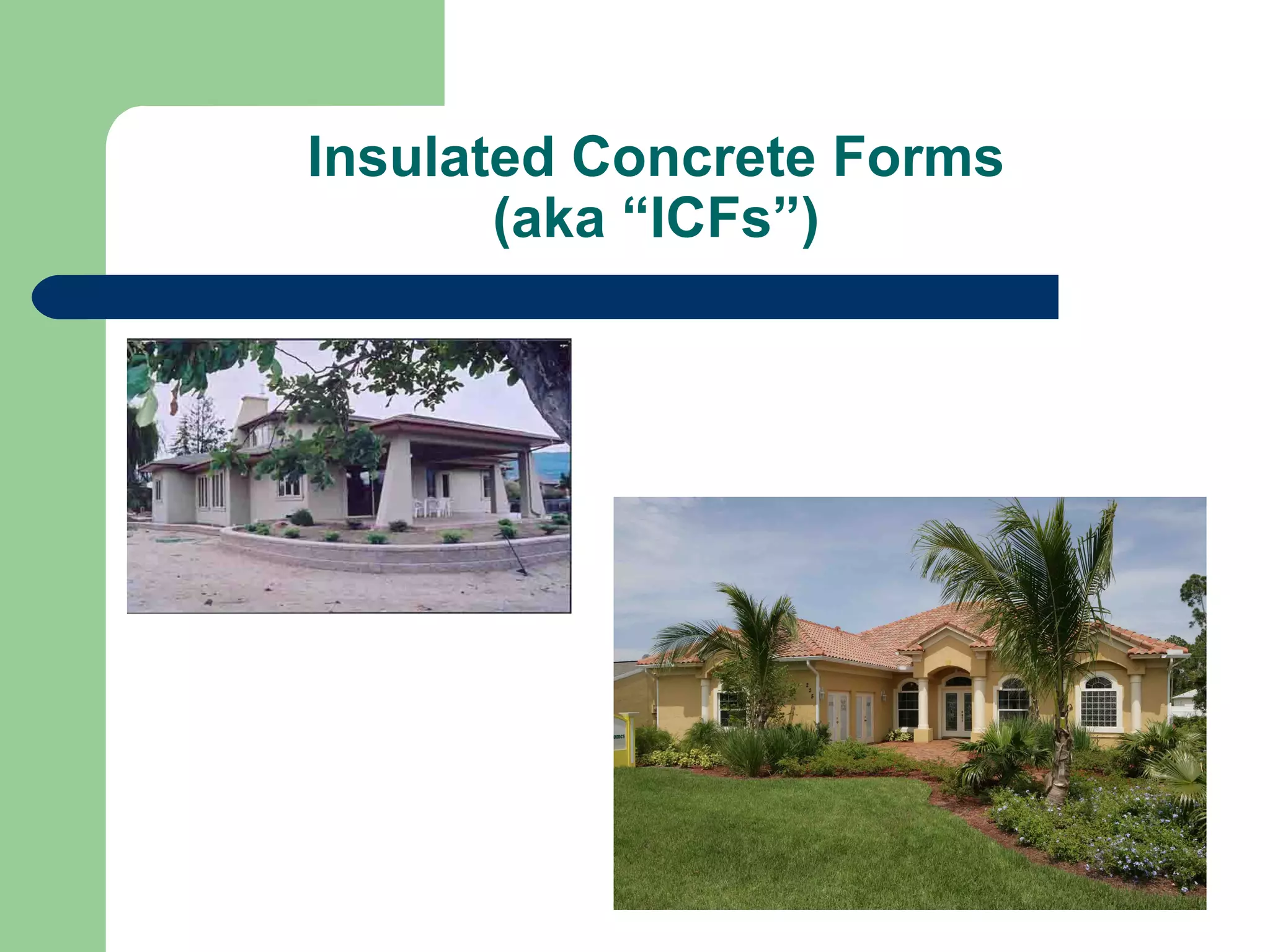
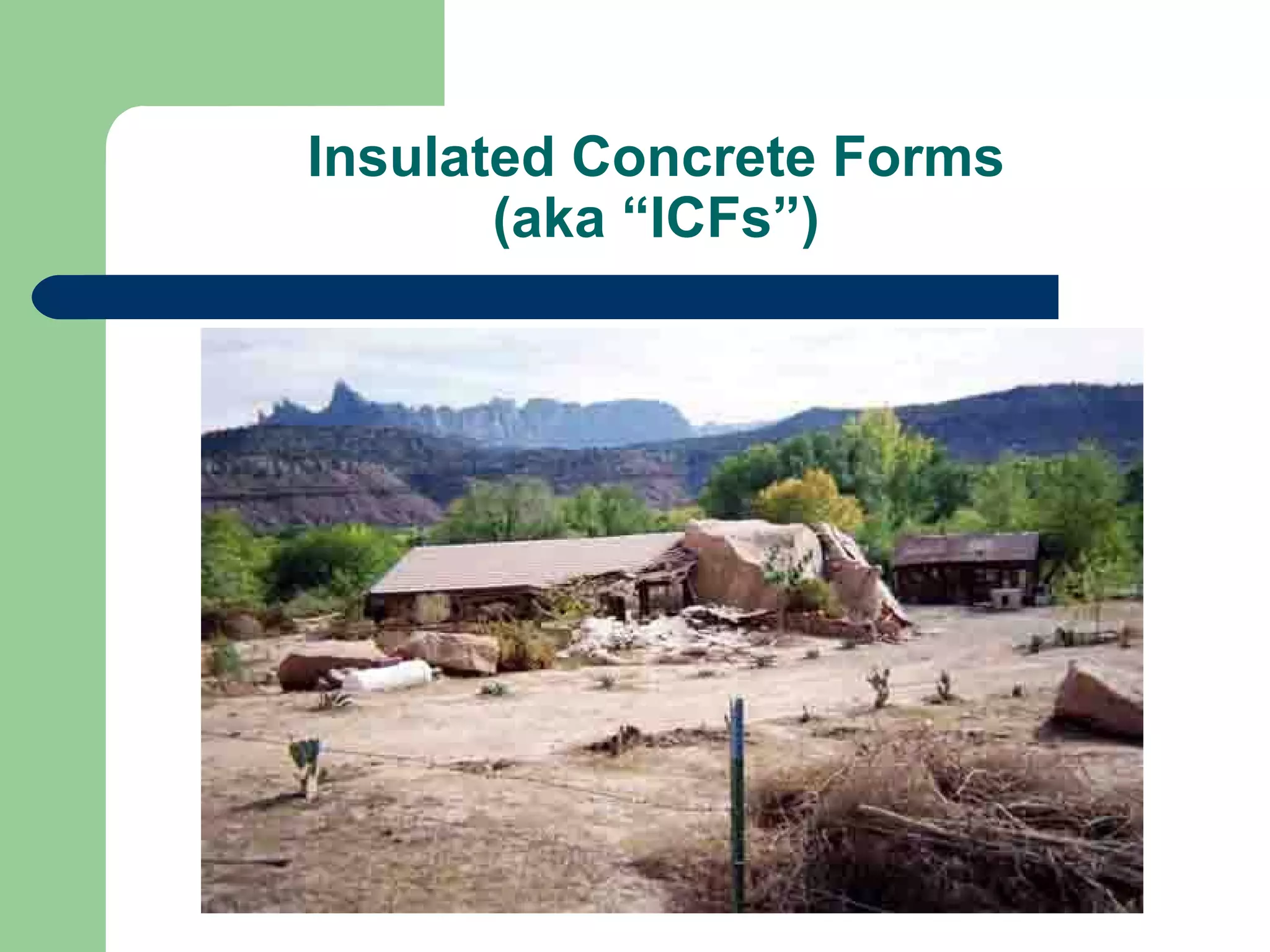
Insulated Concrete Forms
       (aka “ICFs”)
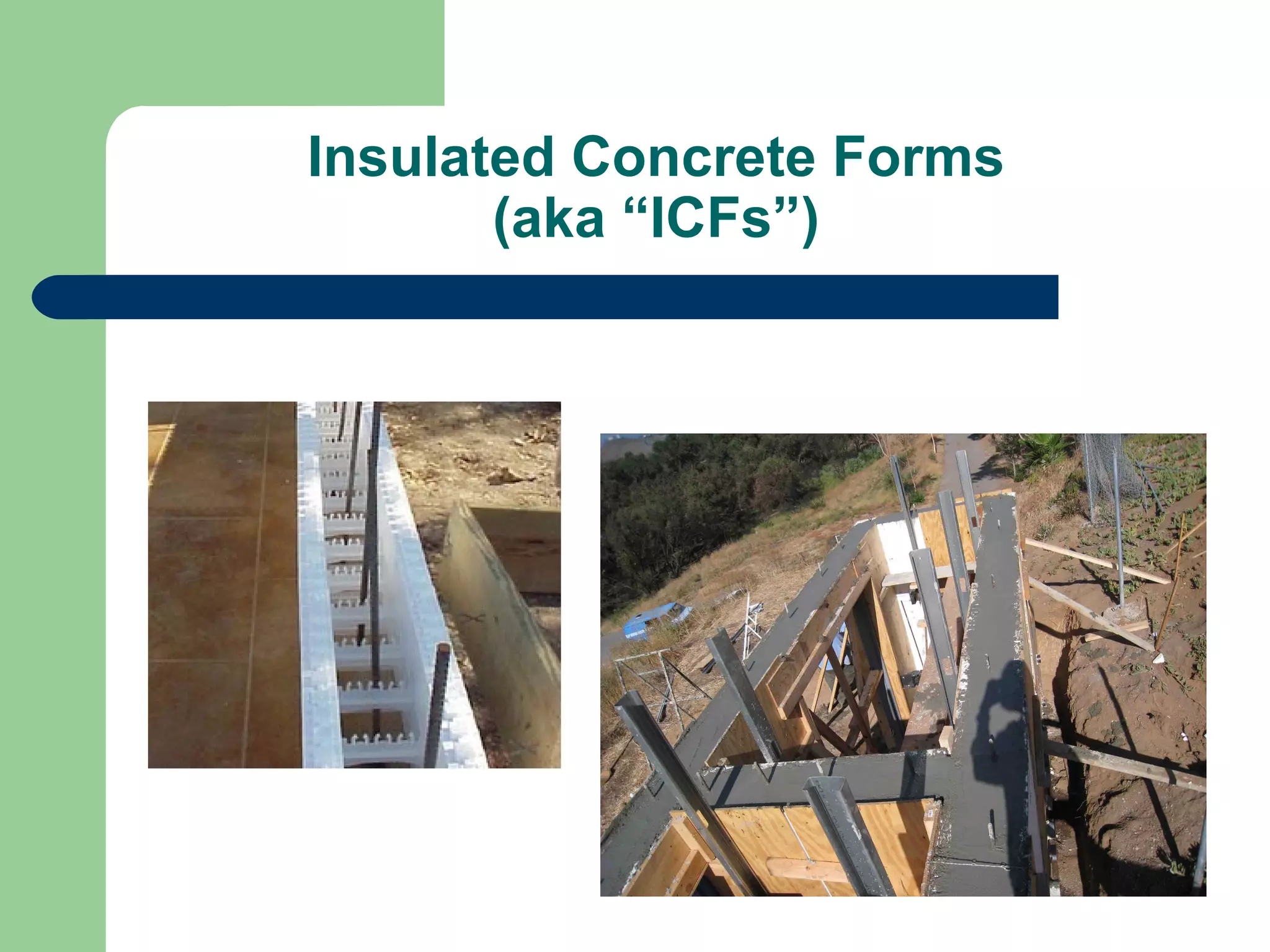
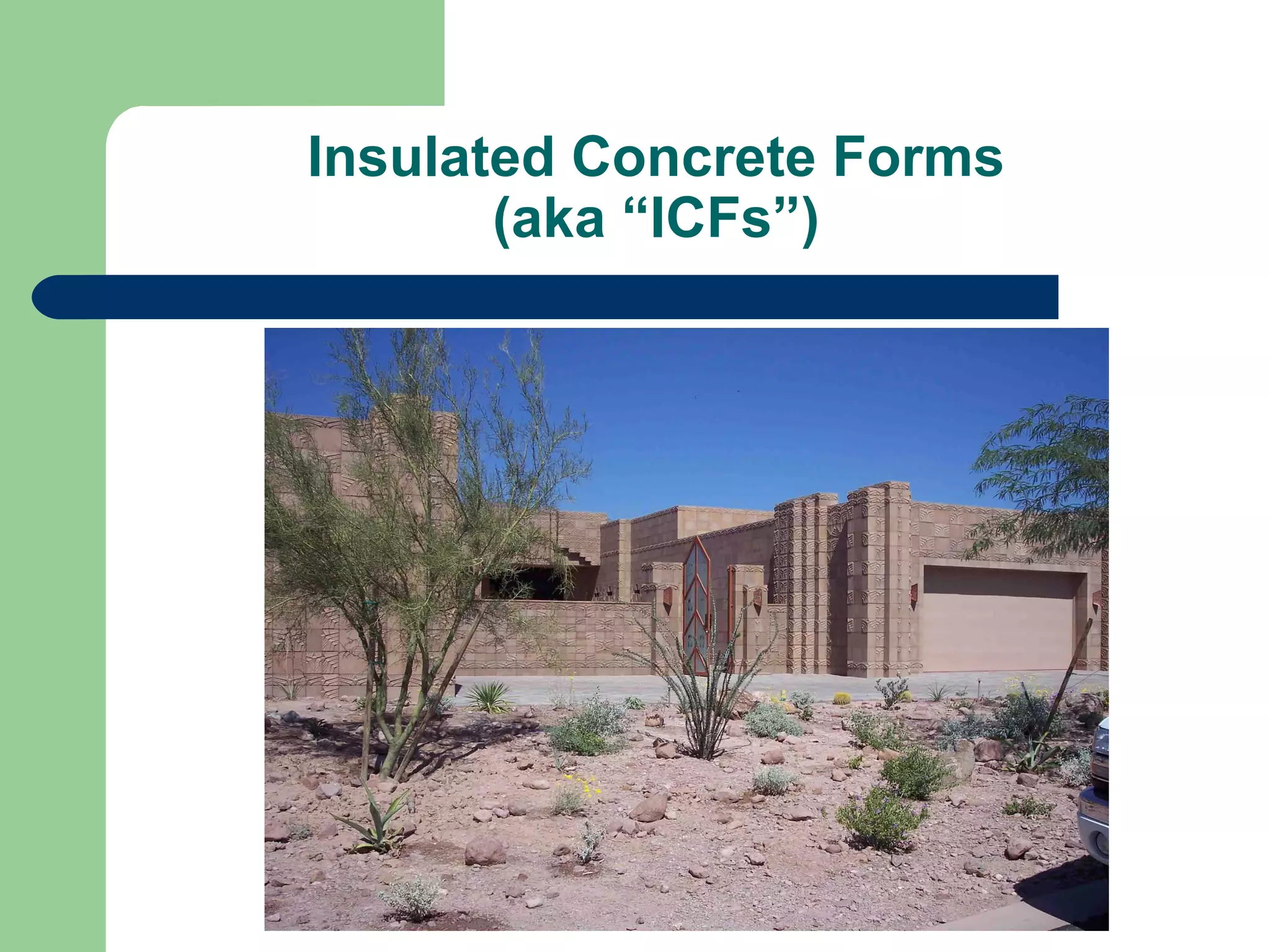
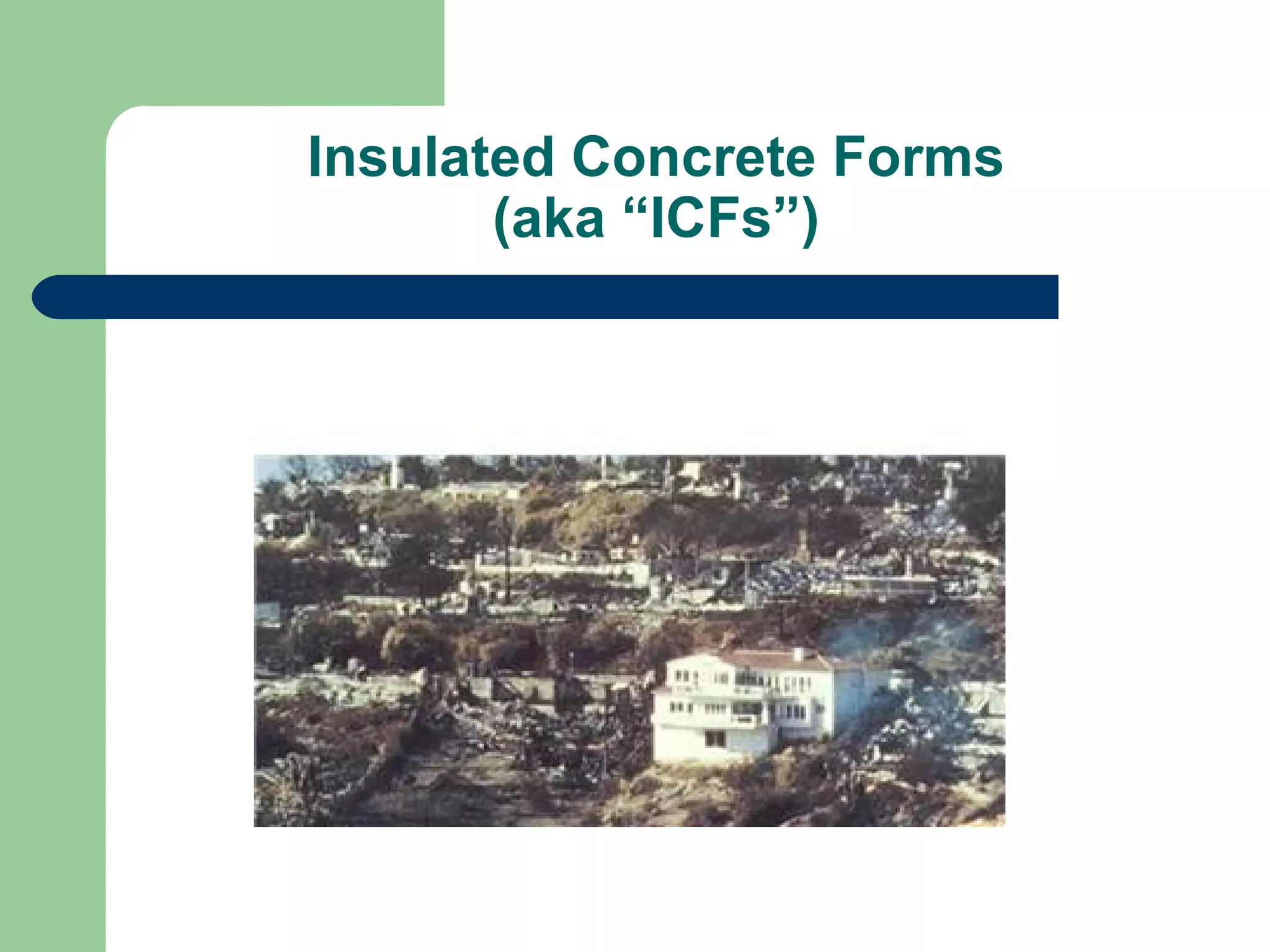
Insulated Concrete Forms
       (aka “ICFs”)
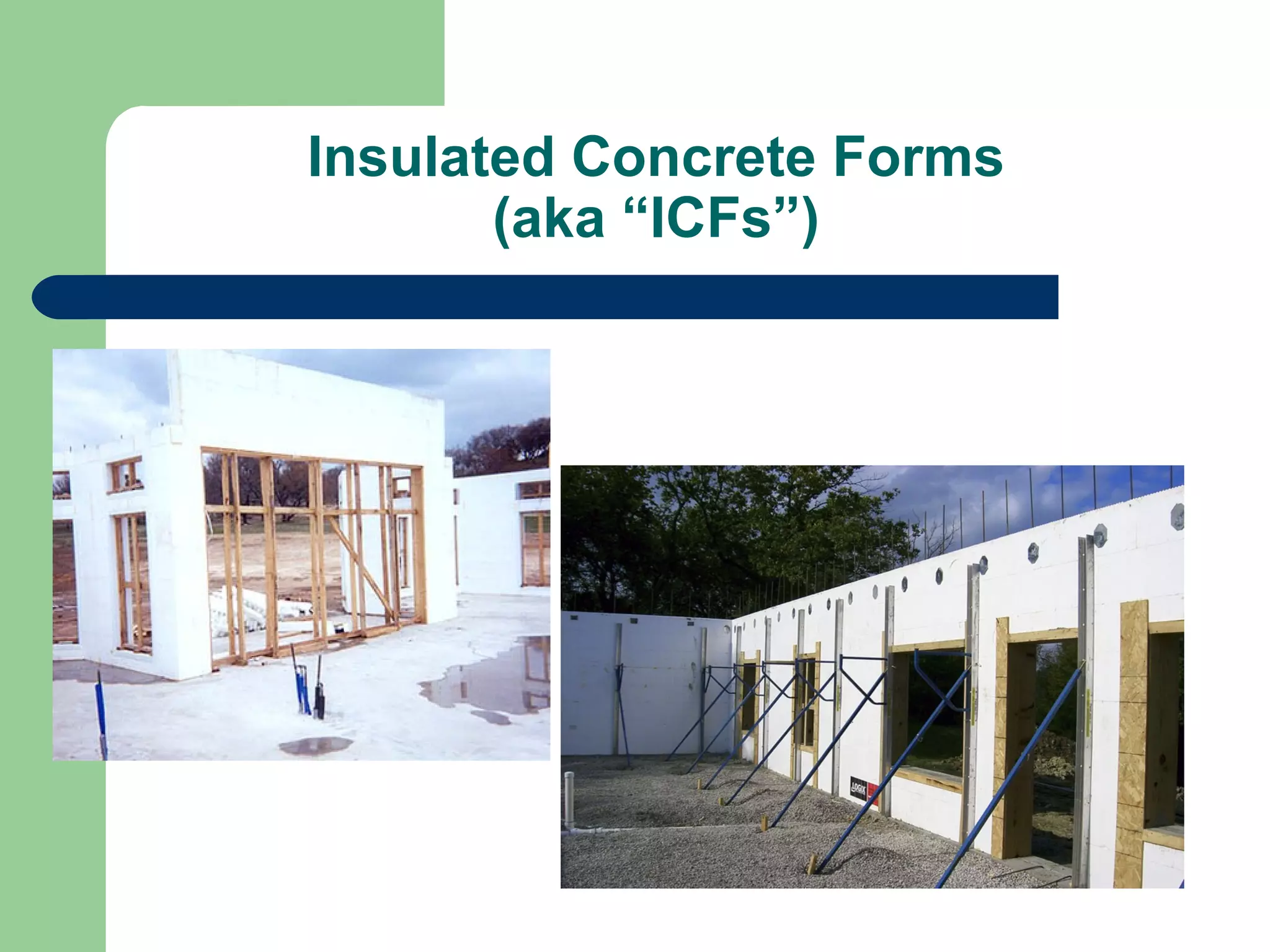
Insulated Concrete Forms
       (aka “ICFs”)
Insulated Concrete Forms
       (aka “ICFs”)
Insulated Concrete Forms
       (aka “ICFs”)
Insulated Concrete Forms
Floor & Roof Options


•Dimensional Lumber
•Light Gauge Steel
•Dietrich “Trade Ready” Joists
•Hambro Bar Joist System
•“Lite Deck”
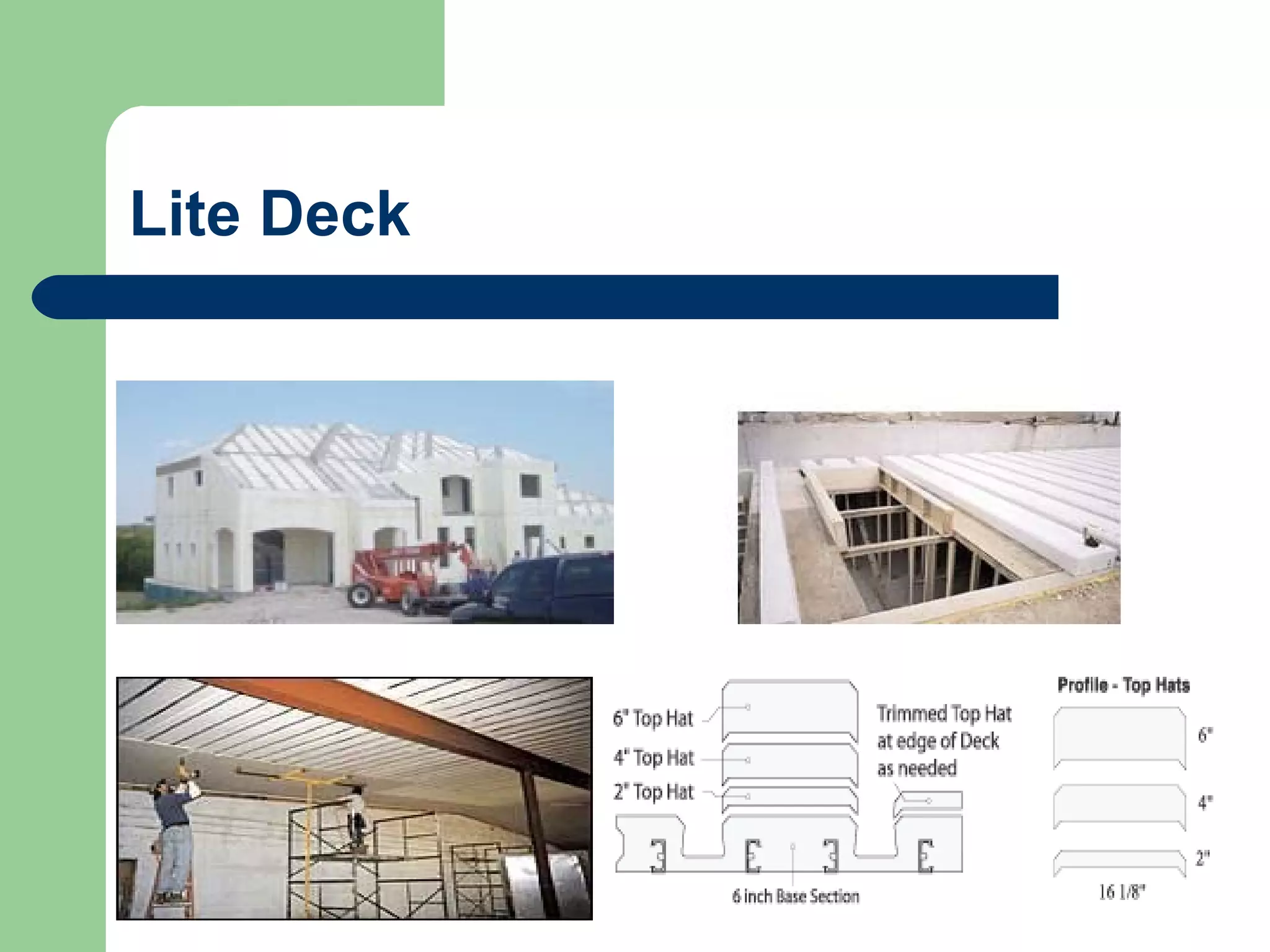
Lite Deck
Insulated Concrete Forms
            (aka “ICFs”)

Positive Attributes:
•Excellent structural characteristics
•Highly Fire Resistant
•Highly Energy Efficient
•Substantially mitigates the possibility of termite damage
•Highly Environmentally Friendly*
•Substantially mitigates potential mold problems*
•Excellent Quality Control due to factory production
•VERY quiet interiors
Insulated Concrete Forms
       (aka “ICFs”)
Insulated Concrete Forms
       (aka “ICFs”)
Insulated Concrete Forms
                 (aka “ICFs”)

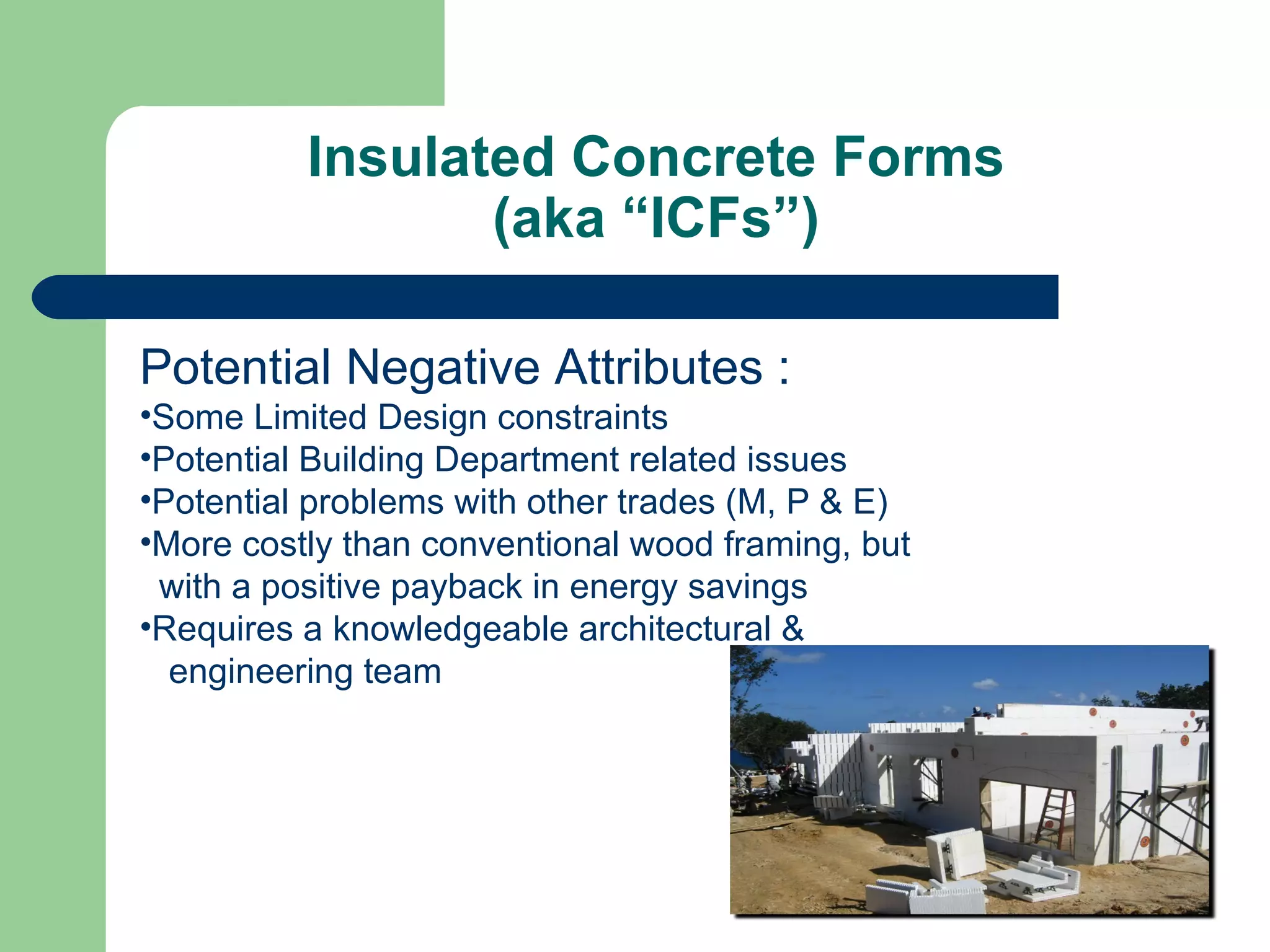
Potential Negative Attributes :
•Some Limited Design constraints
•Potential Building Department related issues
•Potential problems with other trades (M, P & E)
•More costly than conventional wood framing, but
 with a positive payback in energy savings
•Requires a knowledgeable architectural &
  engineering team
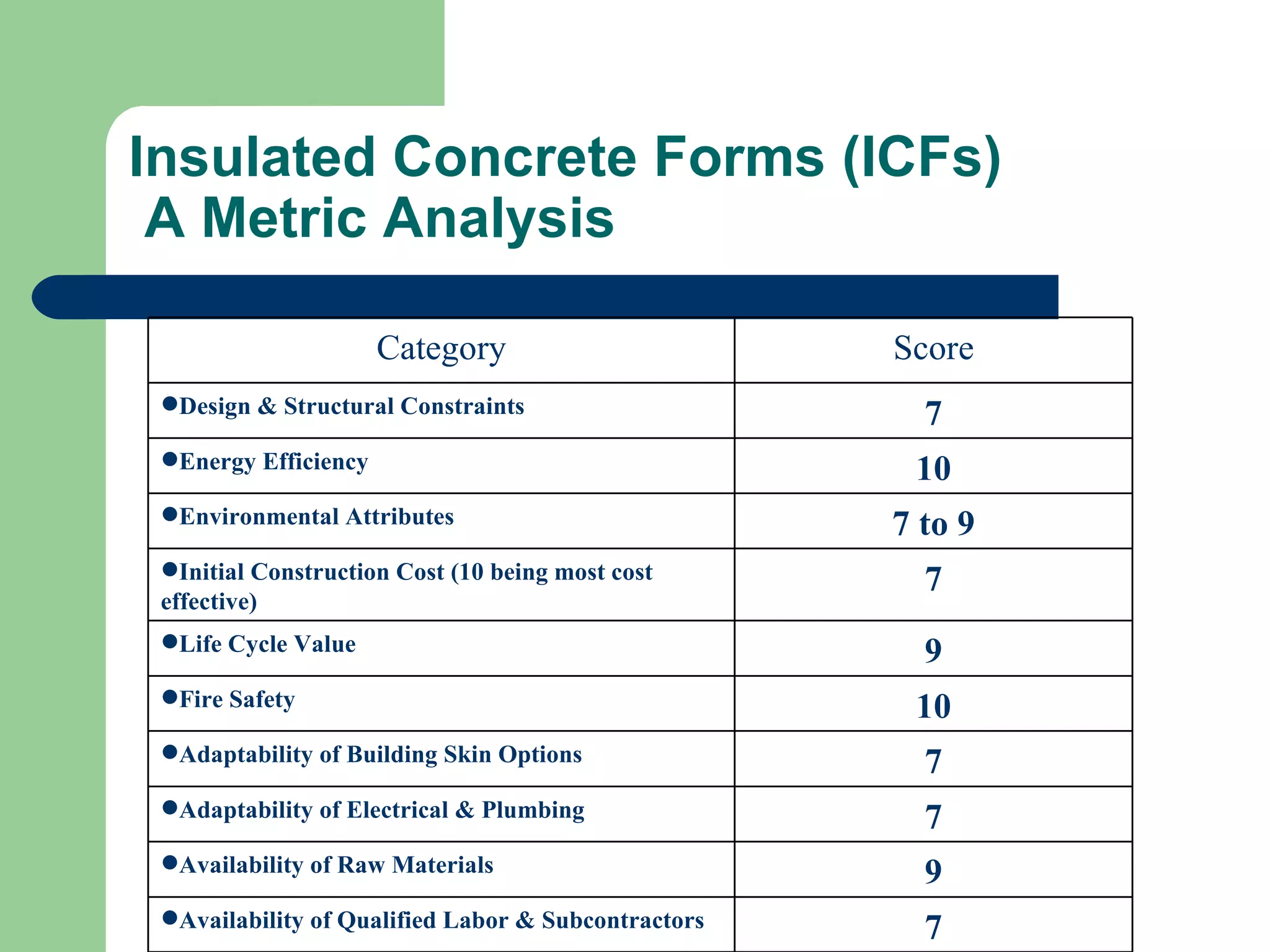
Insulated Concrete Forms (ICFs)
 A Metric Analysis

                      Category                       Score
 Design & Structural Constraints                      7
 Energy Efficiency                                   10
 Environmental Attributes                           7 to 9
 Initial Construction Cost (10 being most cost        7
 effective)
 Life Cycle Value                                     9
 Fire Safety                                         10
 Adaptability of Building Skin Options                7
 Adaptability of Electrical & Plumbing                7
 Availability of Raw Materials                        9
 Availability of Qualified Labor & Subcontractors     7
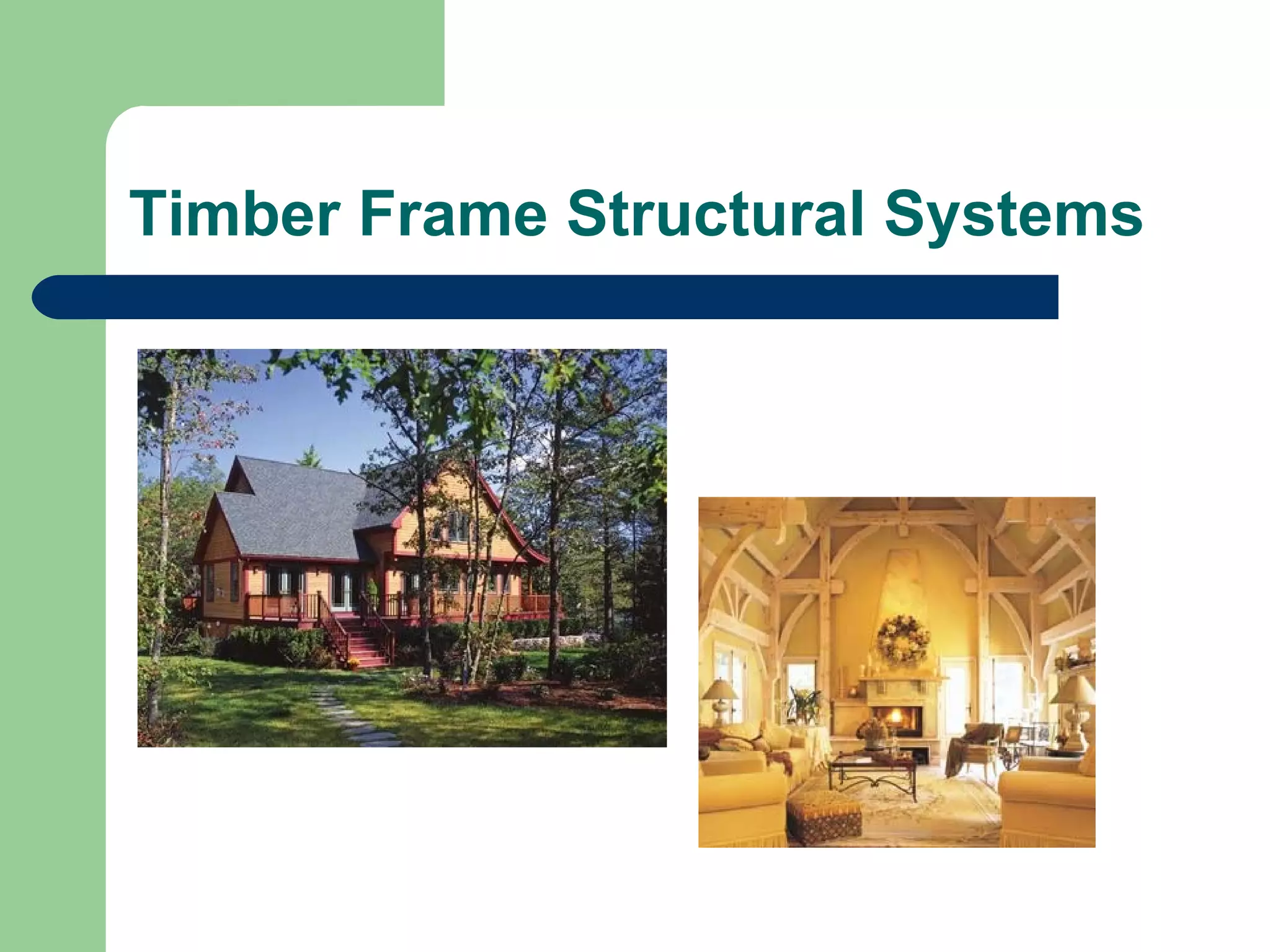
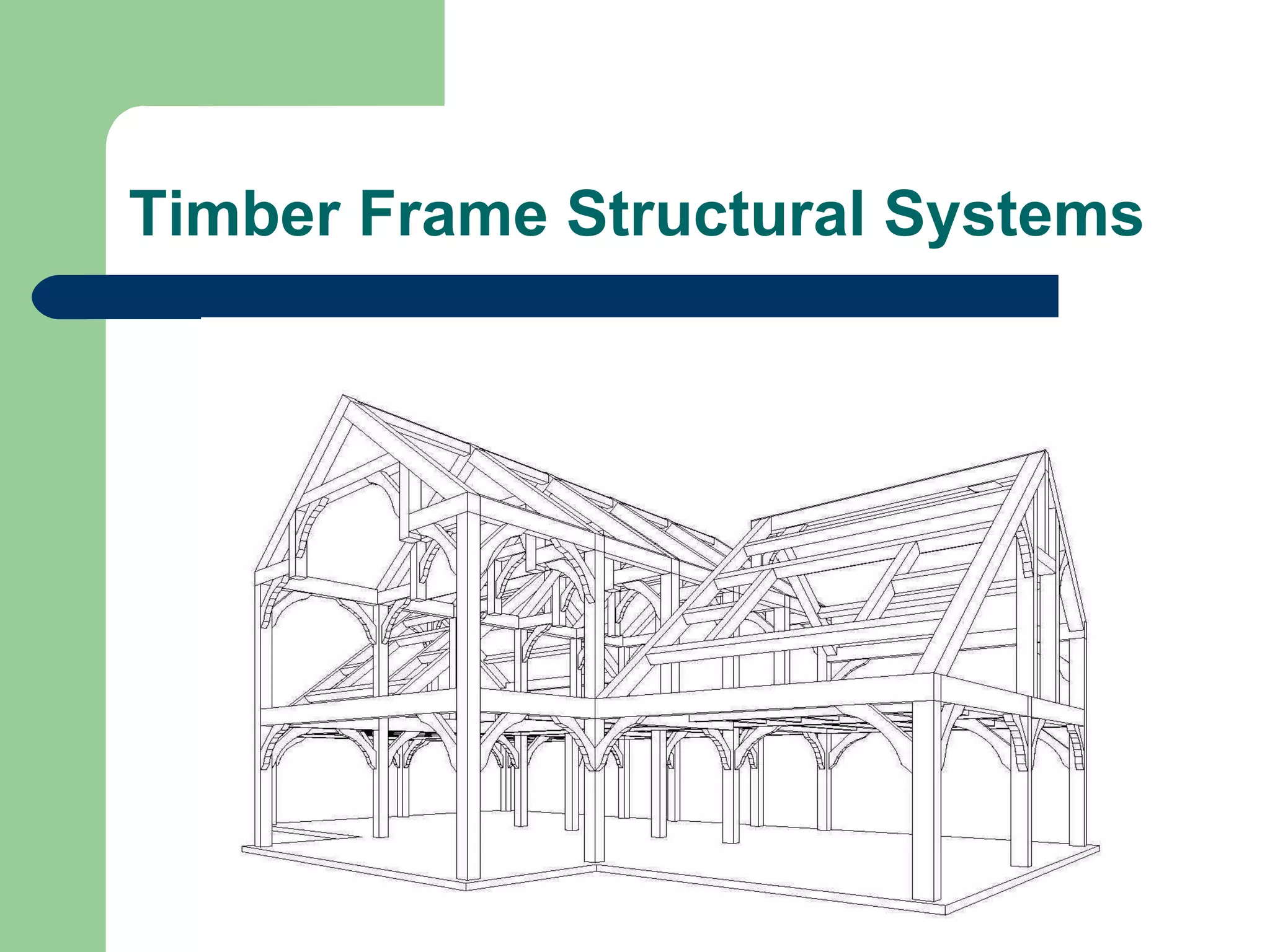
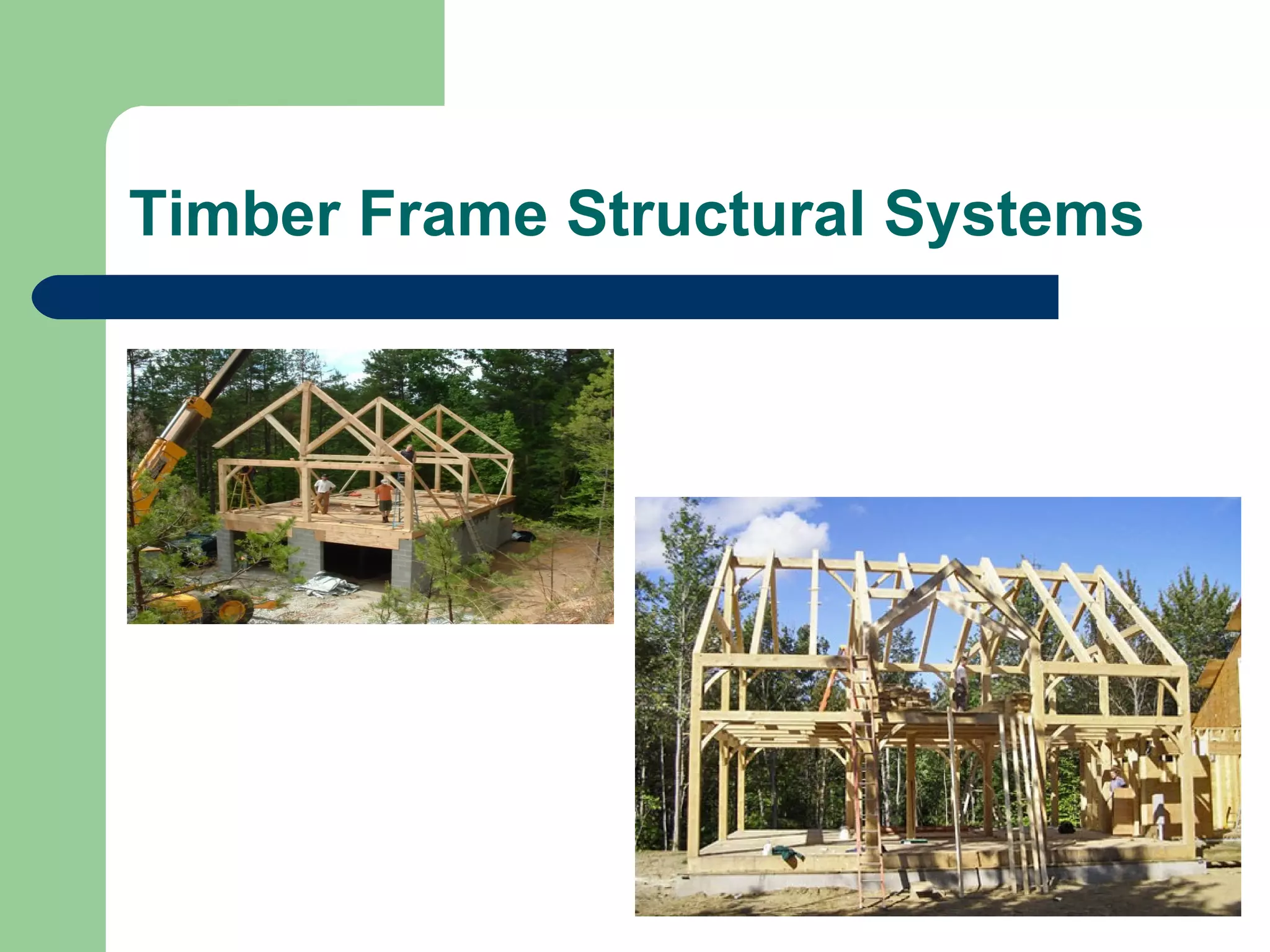
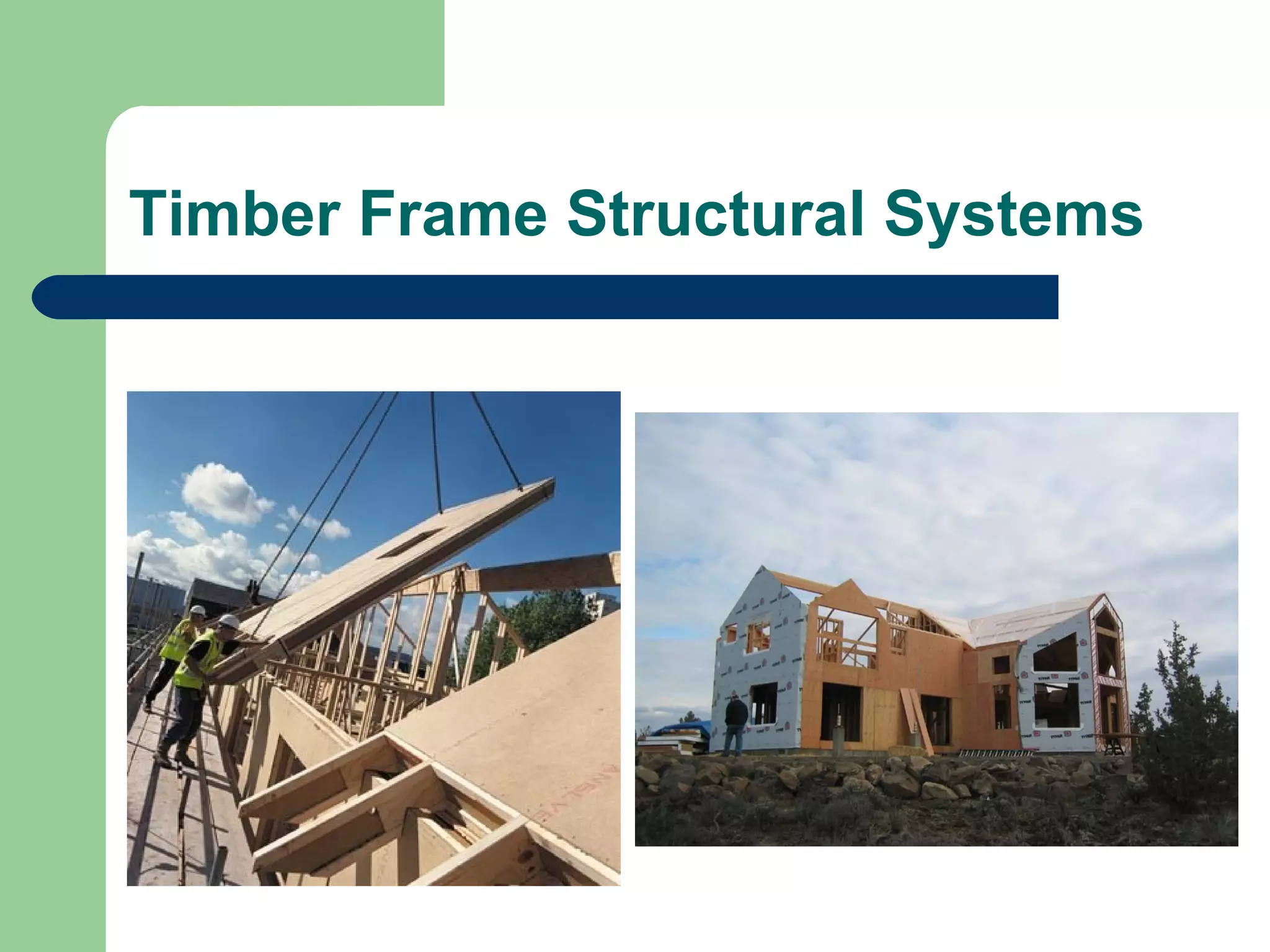
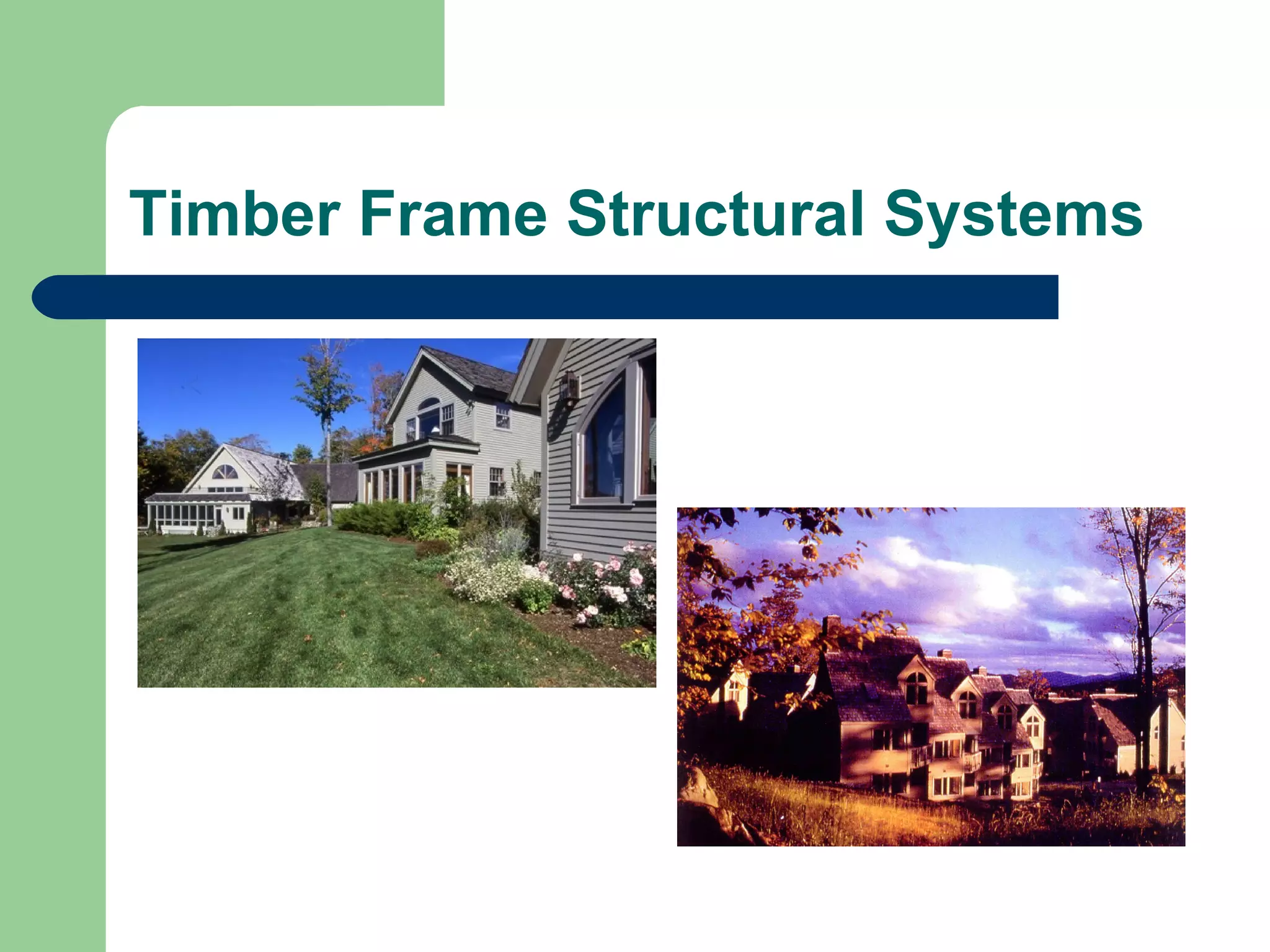
Timber Frame Structural Systems

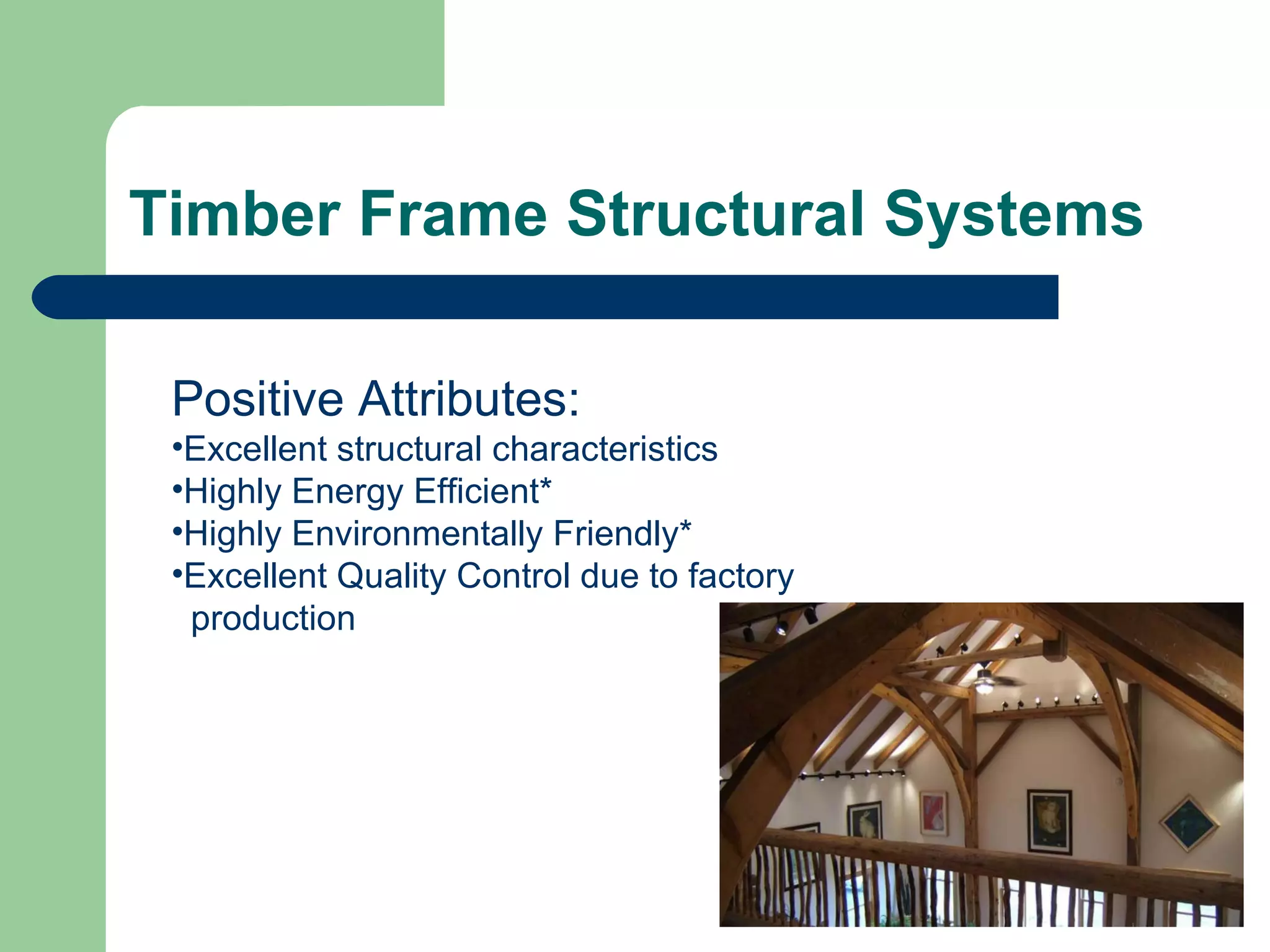
 Positive Attributes:
 •Excellent structural characteristics
 •Highly Energy Efficient*
 •Highly Environmentally Friendly*
 •Excellent Quality Control due to factory
  production
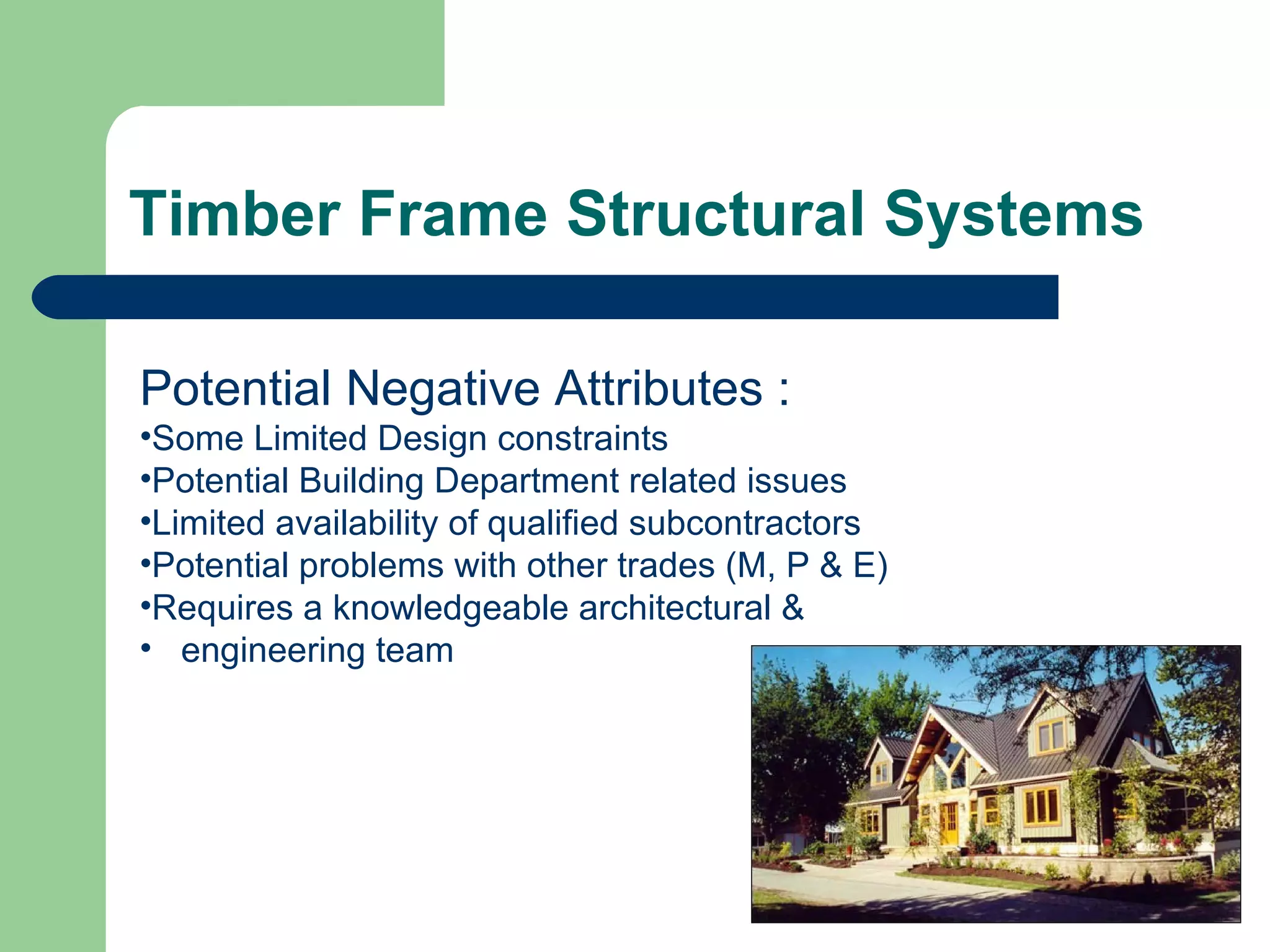
Timber Frame Structural Systems

Potential Negative Attributes :
•Some Limited Design constraints
•Potential Building Department related issues
•Limited availability of qualified subcontractors
•Potential problems with other trades (M, P & E)
•Requires a knowledgeable architectural &
• engineering team
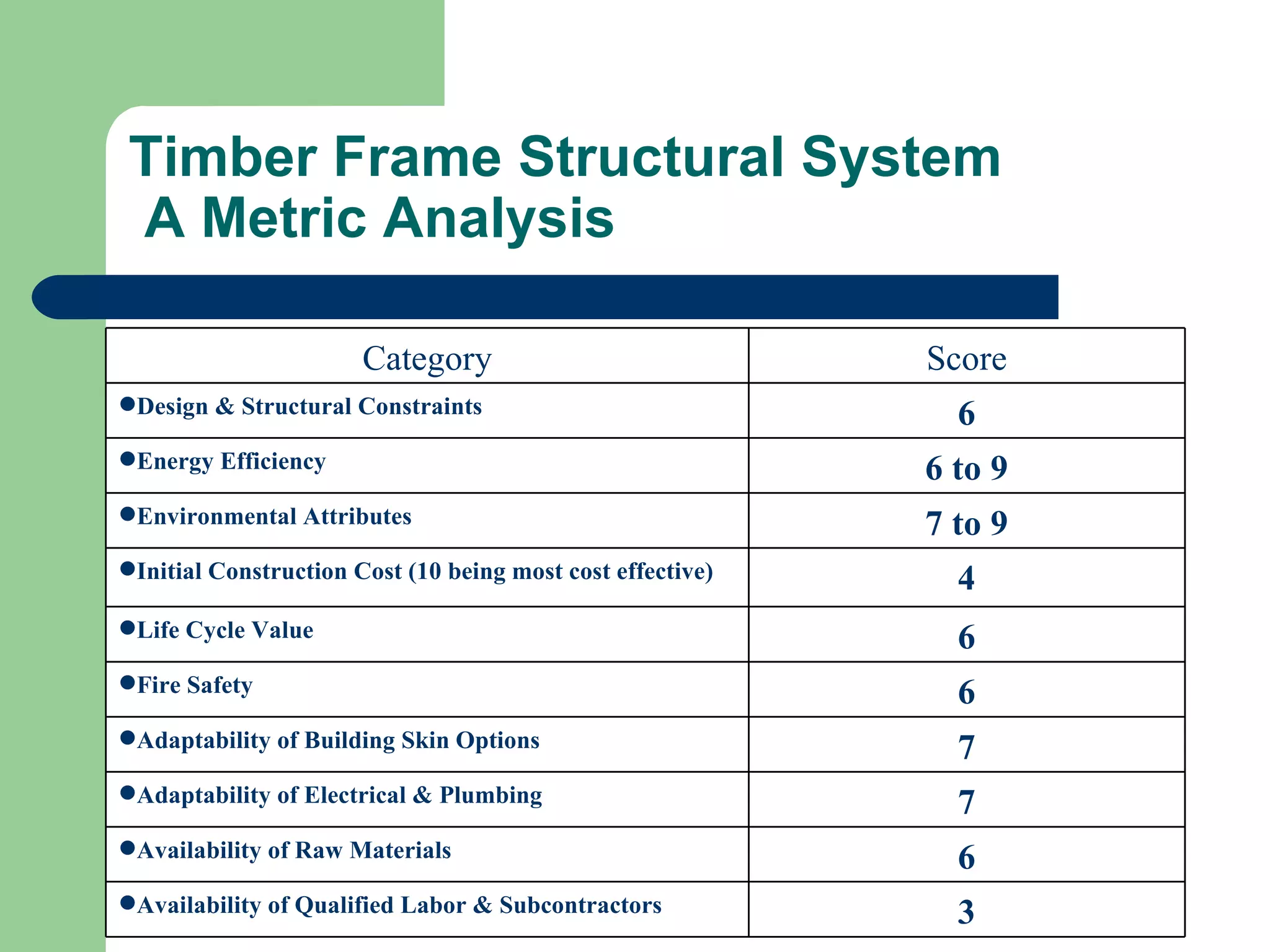
Timber Frame Structural System
A Metric Analysis

                       Category                             Score
Design & Structural Constraints                              6
Energy Efficiency                                          6 to 9
Environmental Attributes                                   7 to 9
Initial Construction Cost (10 being most cost effective)     4
Life Cycle Value                                             6
Fire Safety                                                  6
Adaptability of Building Skin Options                        7
Adaptability of Electrical & Plumbing                        7
Availability of Raw Materials                                6
Availability of Qualified Labor & Subcontractors             3
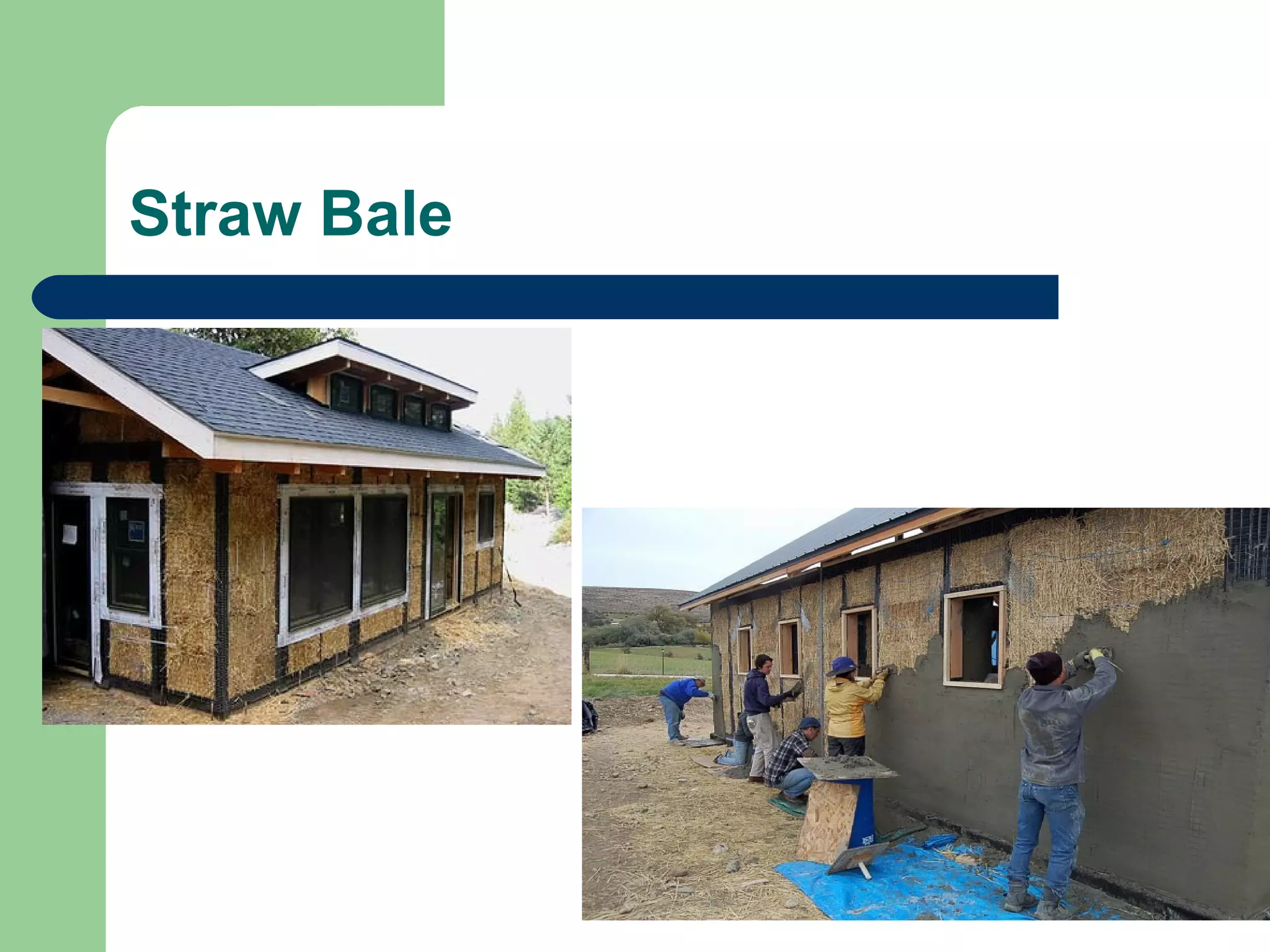
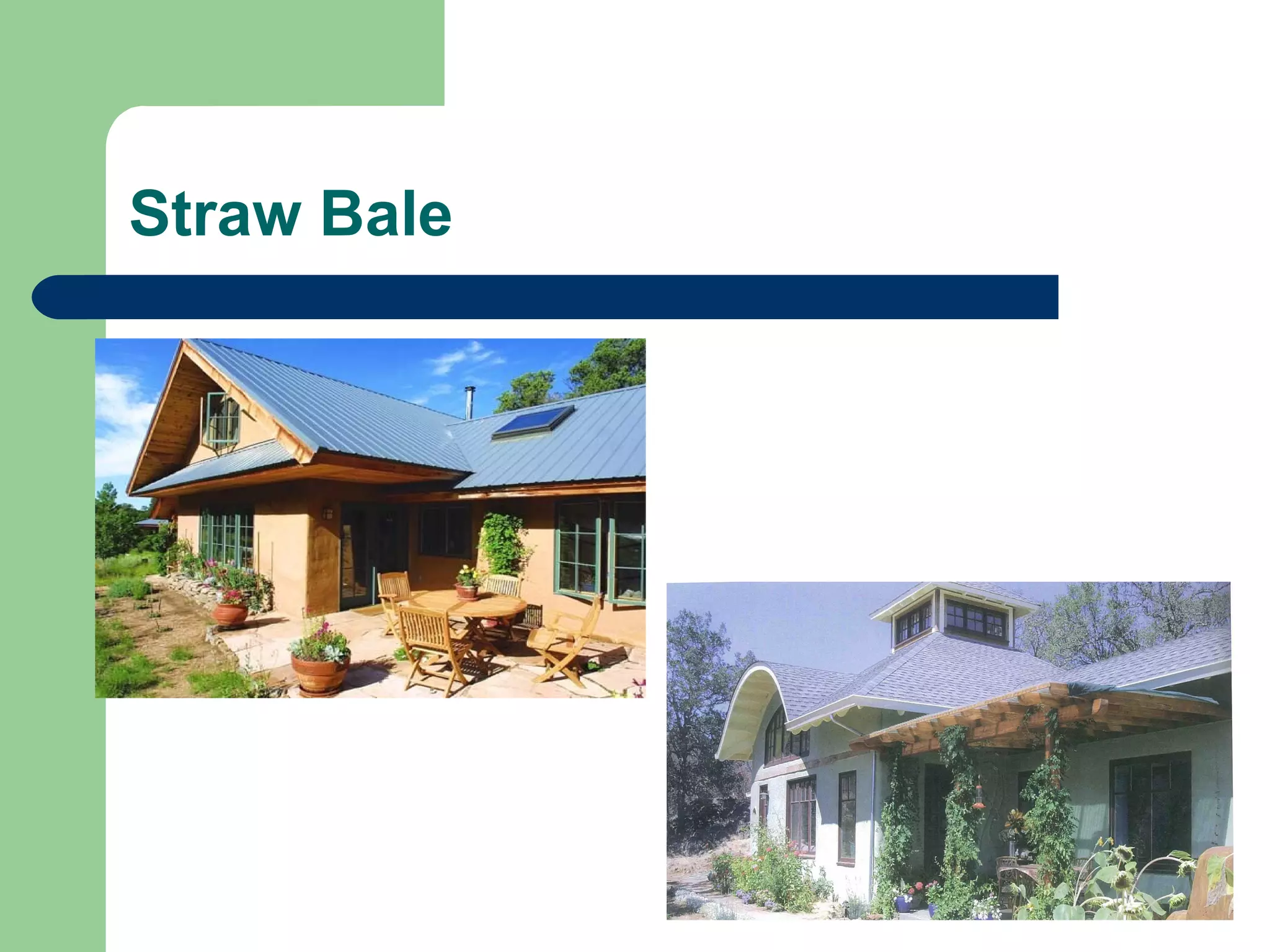
Straw Bale
Straw Bale
Straw Bale
Straw Bale
Straw Bale
Straw Bale

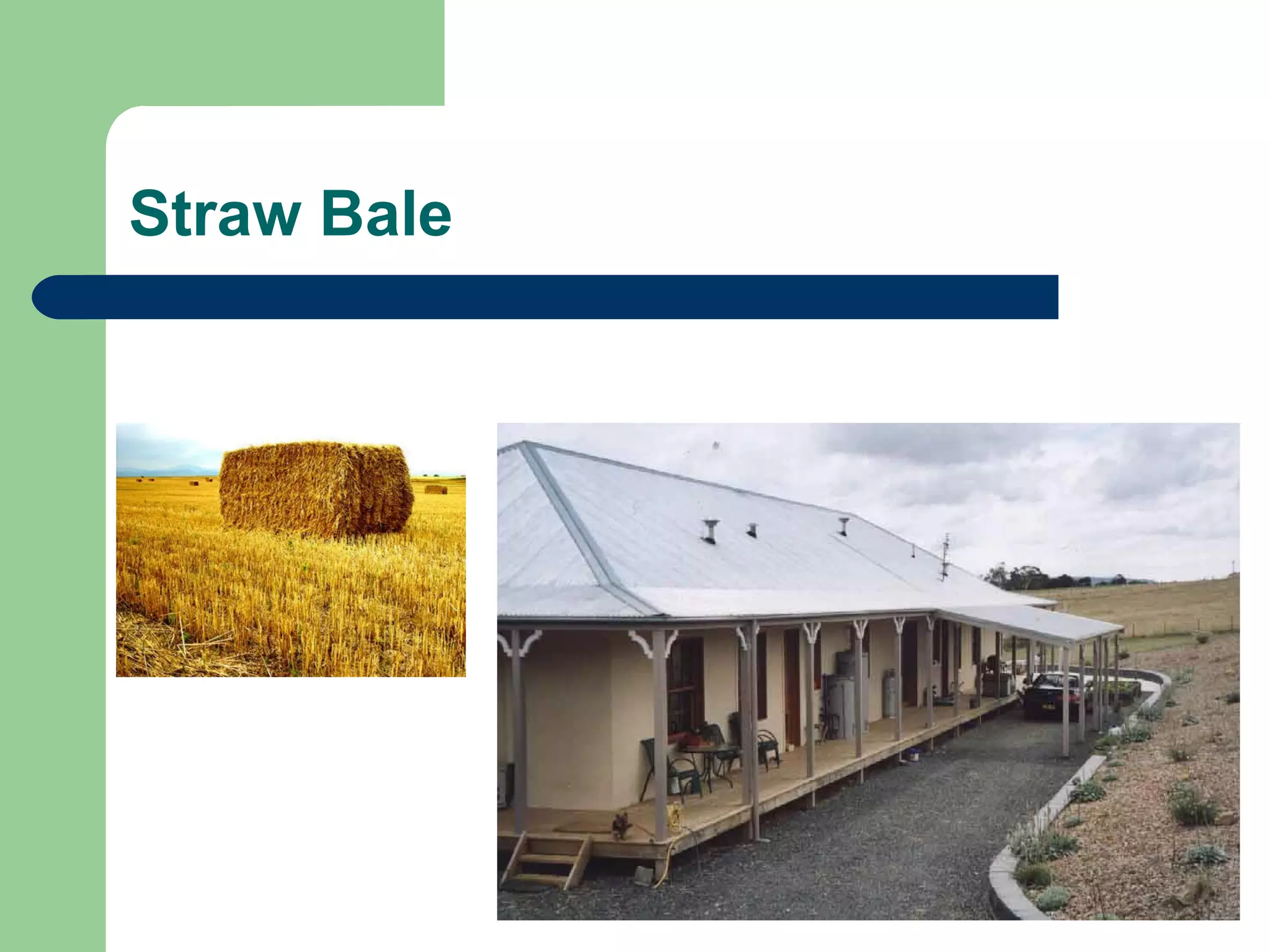
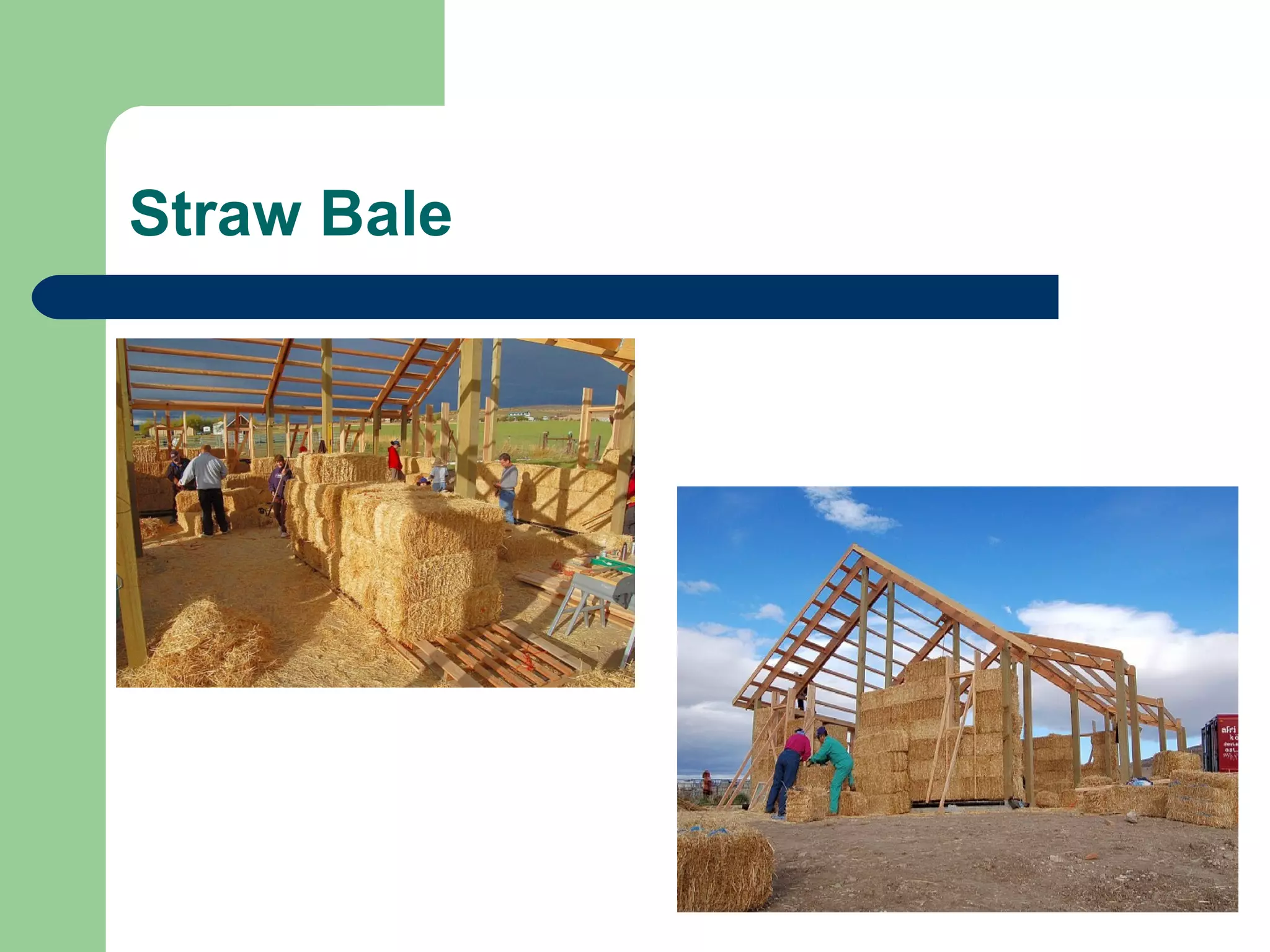
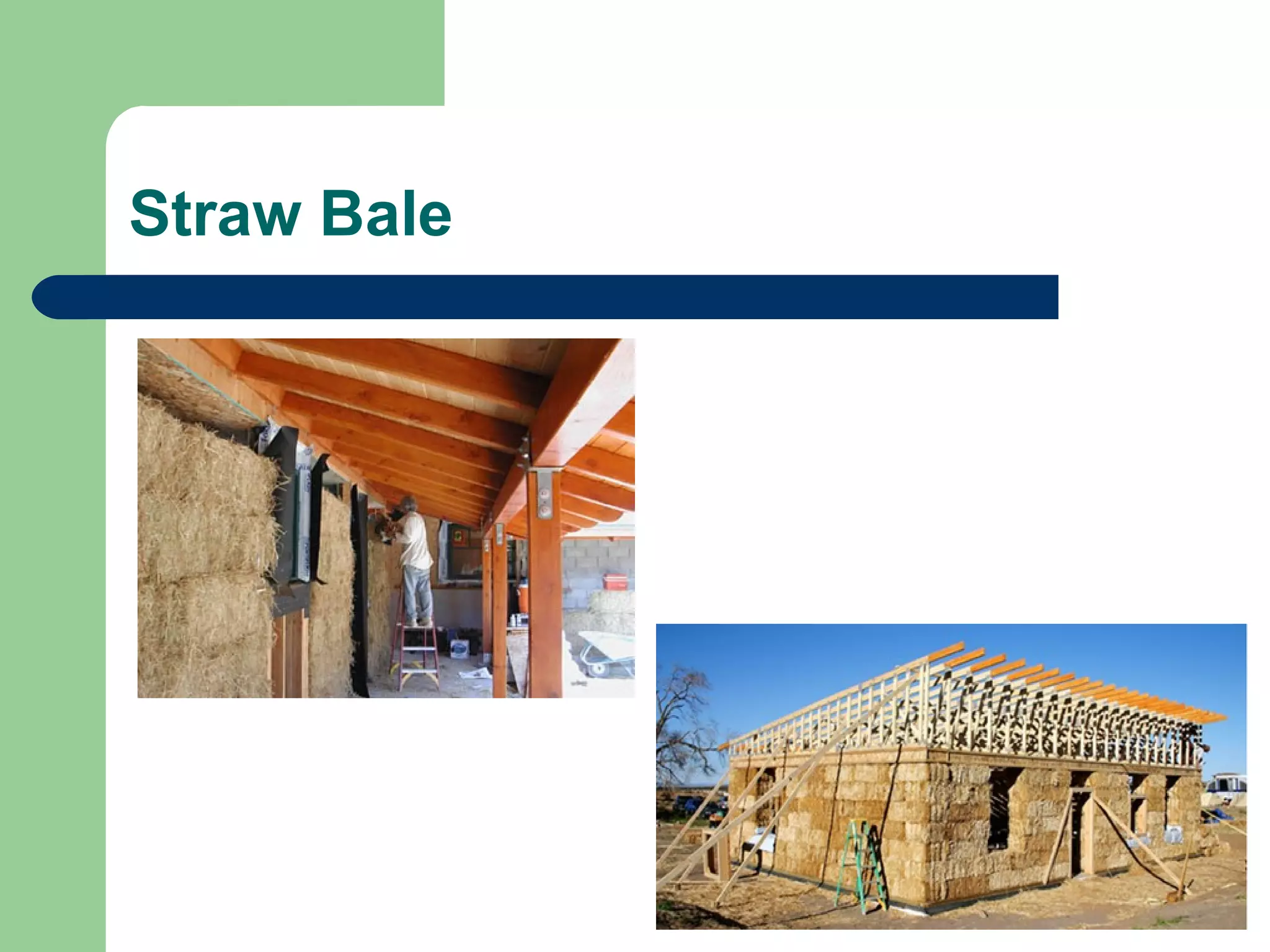
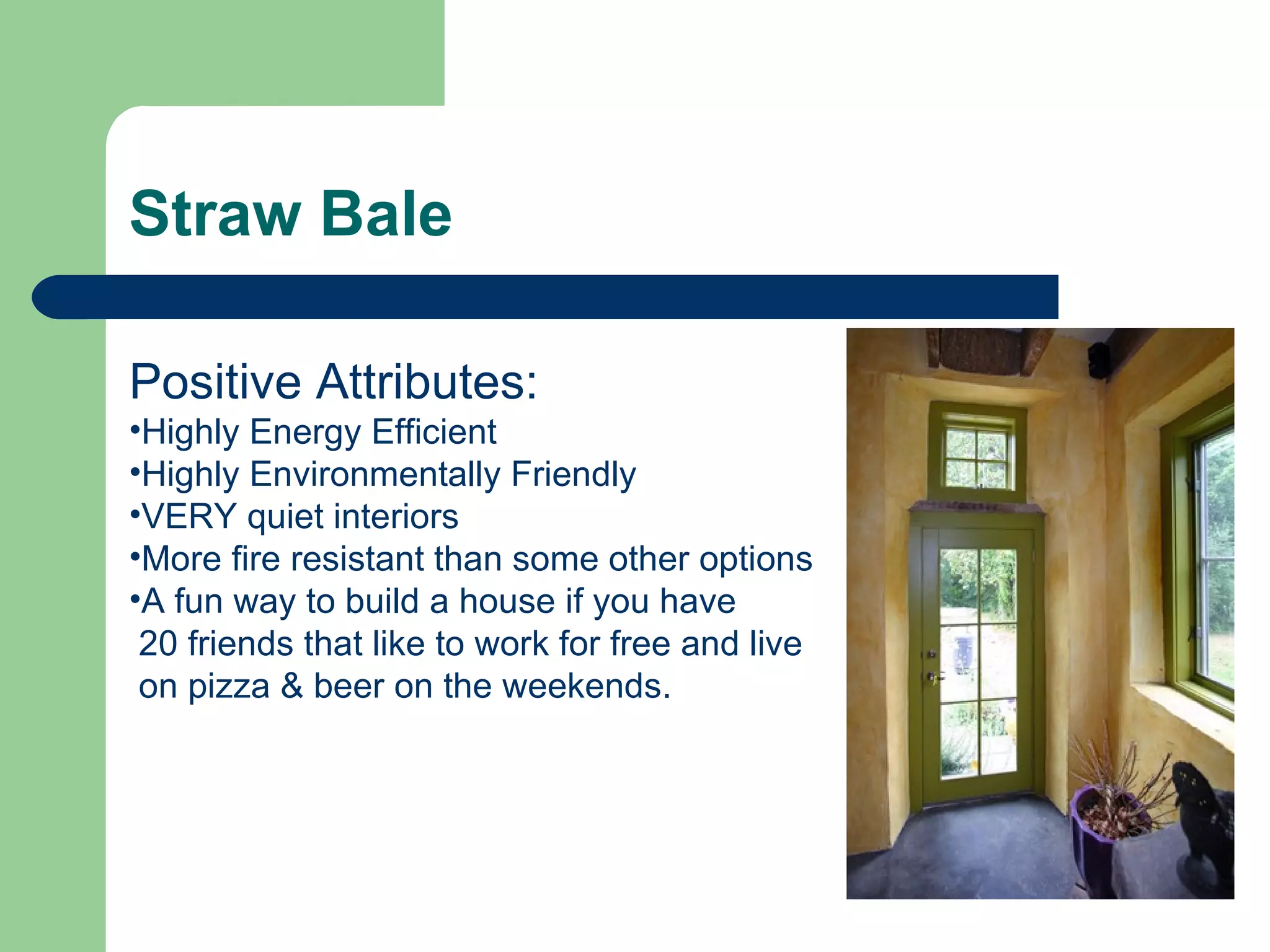
Positive Attributes:
•Highly Energy Efficient
•Highly Environmentally Friendly
•VERY quiet interiors
•More fire resistant than some other options
•A fun way to build a house if you have
 20 friends that like to work for free and live
 on pizza & beer on the weekends.
Straw Bale

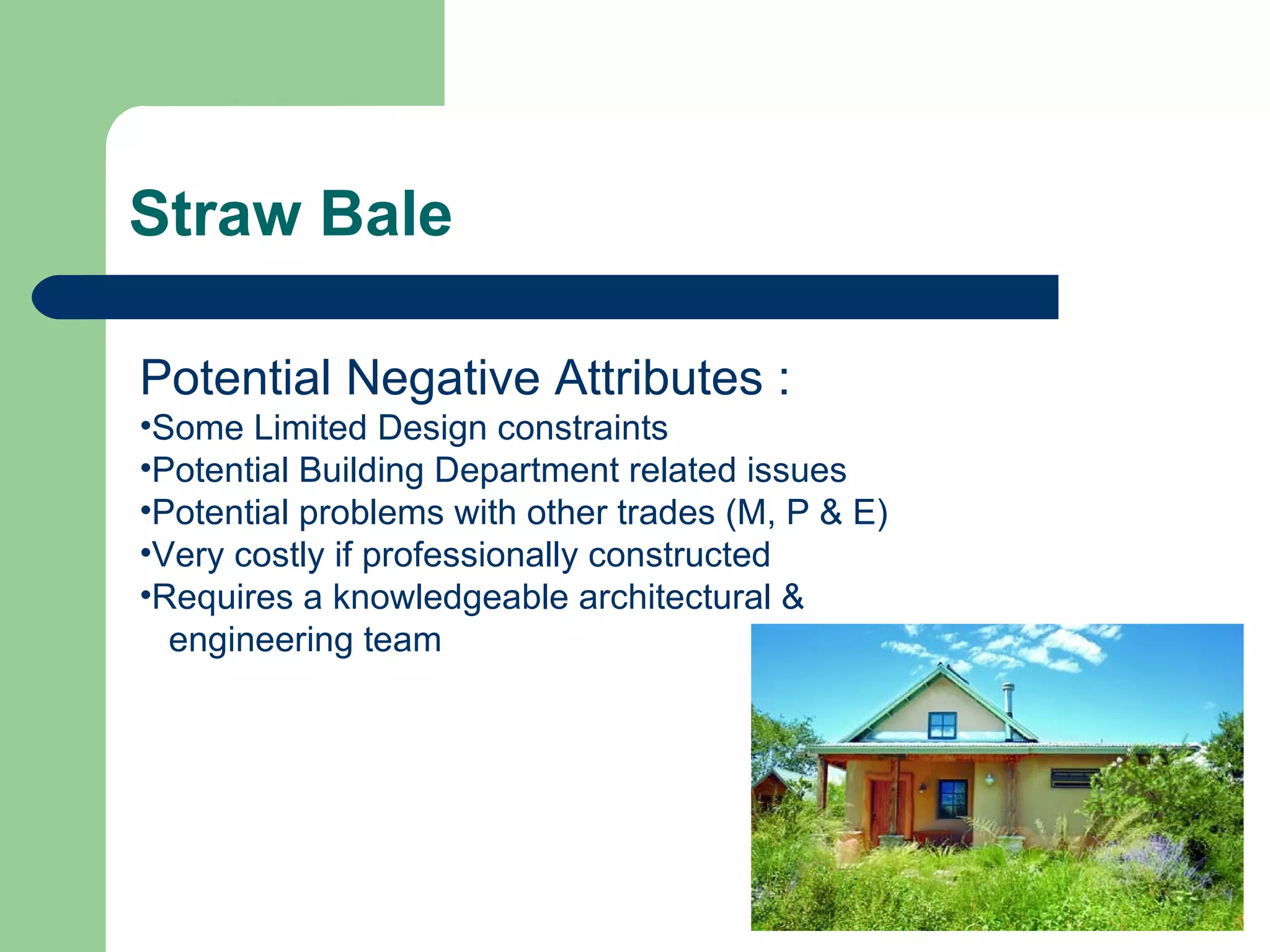
Potential Negative Attributes :
•Some Limited Design constraints
•Potential Building Department related issues
•Potential problems with other trades (M, P & E)
•Very costly if professionally constructed
•Requires a knowledgeable architectural &
  engineering team
Straw Bale
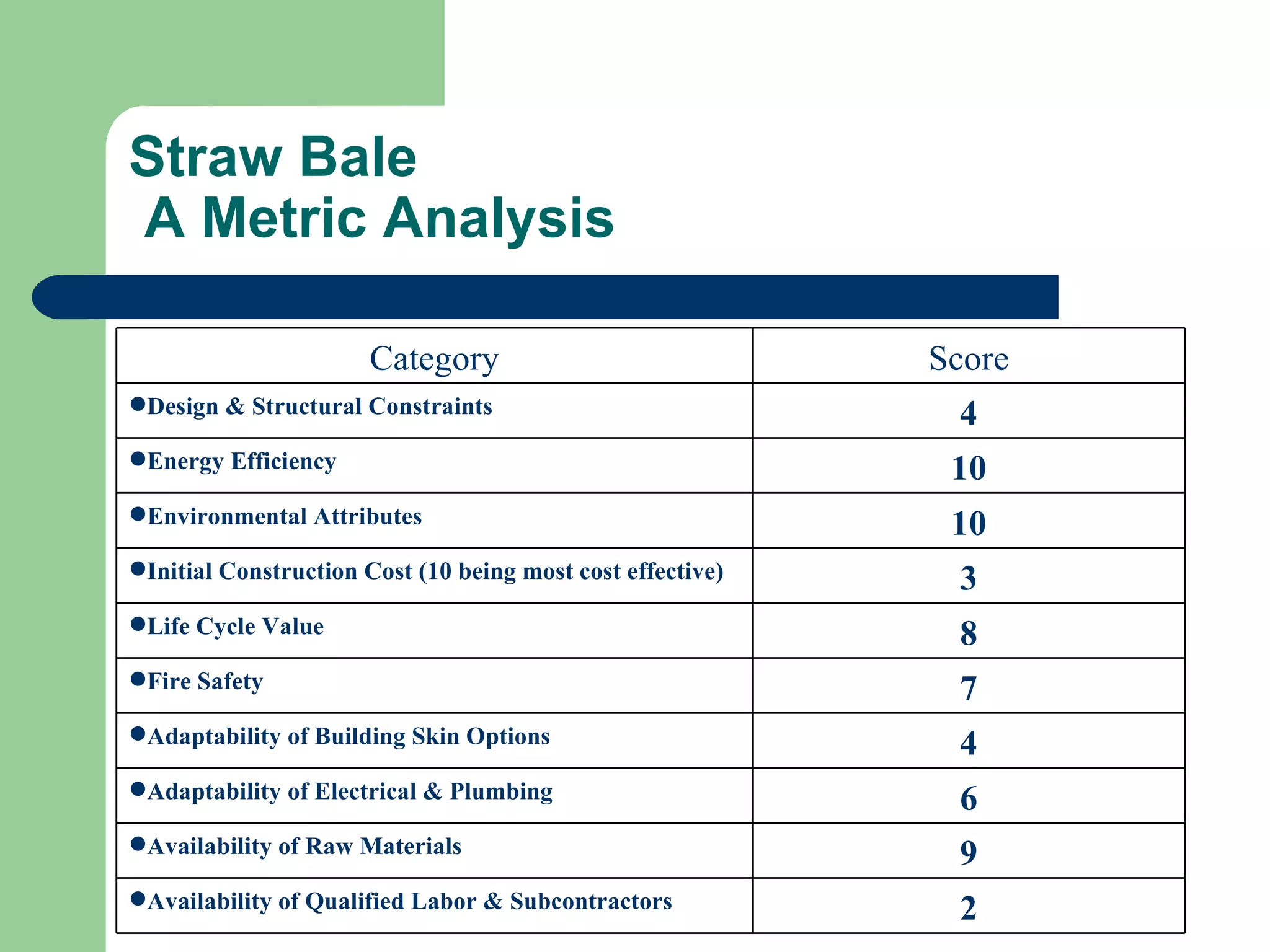
A Metric Analysis

                       Category                             Score
Design & Structural Constraints                             4
Energy Efficiency                                           10
Environmental Attributes                                    10
Initial Construction Cost (10 being most cost effective)    3
Life Cycle Value                                            8
Fire Safety                                                 7
Adaptability of Building Skin Options                       4
Adaptability of Electrical & Plumbing                       6
Availability of Raw Materials                               9
Availability of Qualified Labor & Subcontractors            2
Why Chose an Alternative
Framing System ?

•Site & Structural Constraints
•Health Related Issues
•Environmental Concerns
•Energy Efficiency
•Life Cycle Value
•Fire Safety
•Competitive Advantage
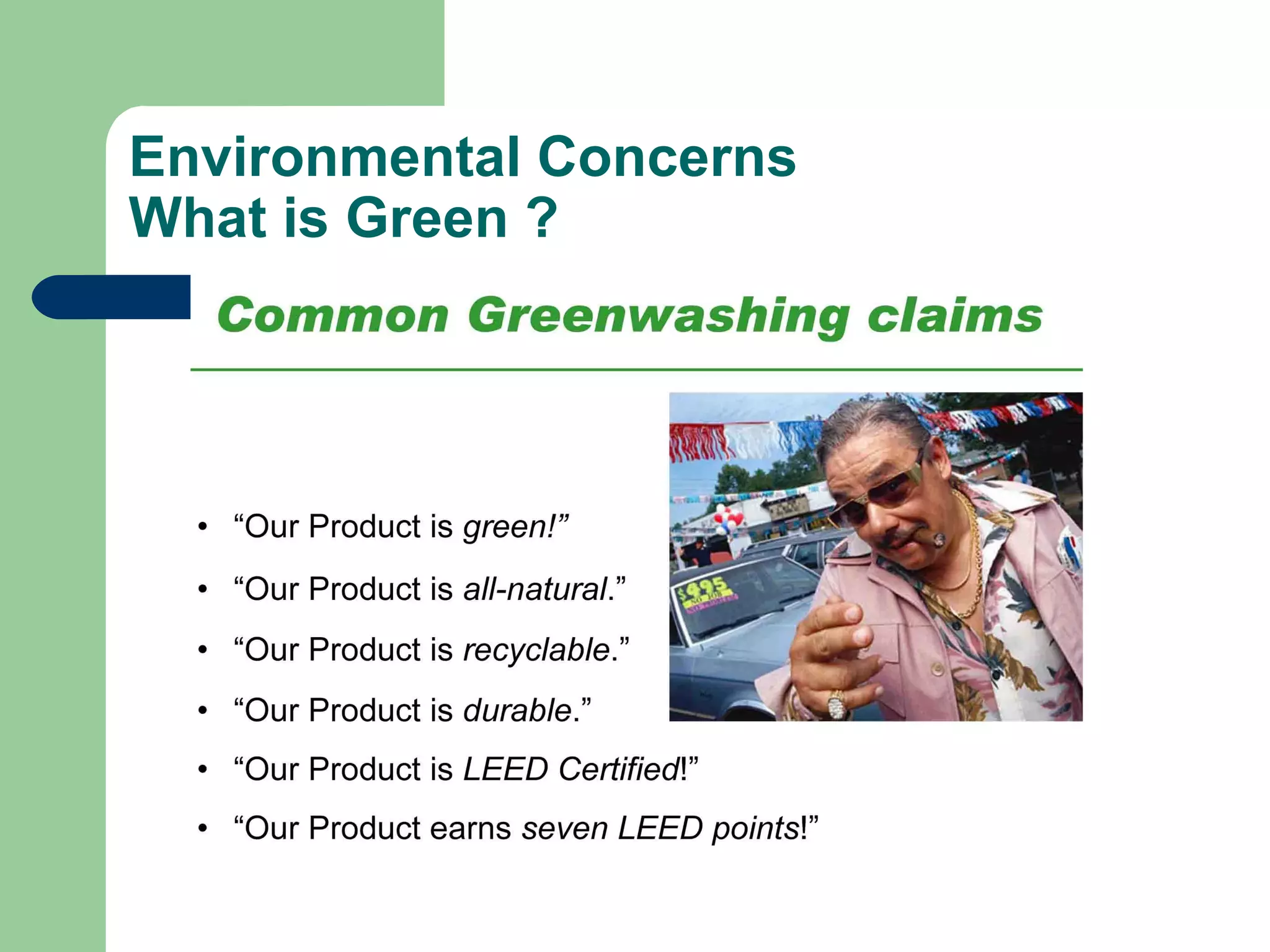
Environmental Concerns
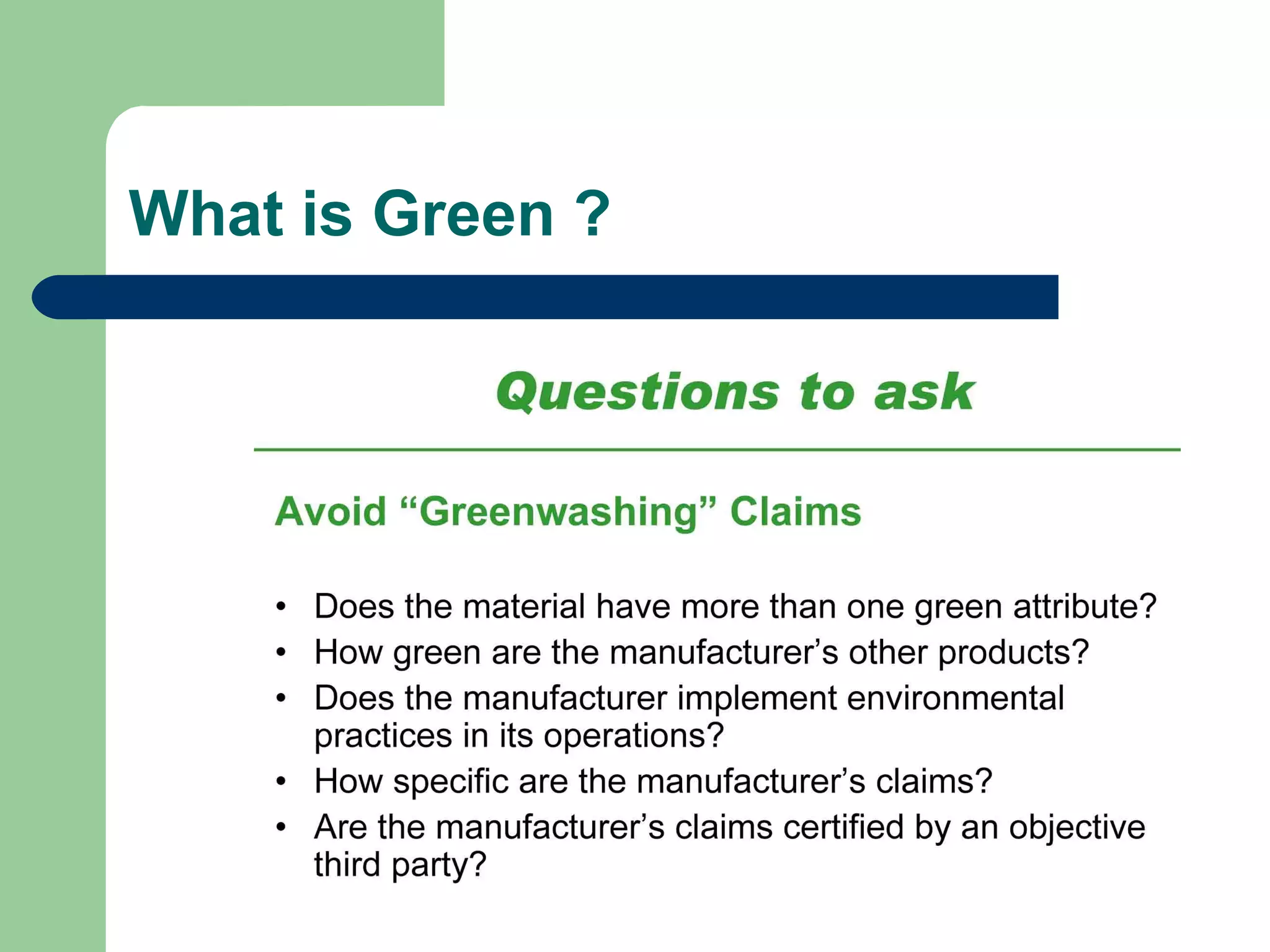
What is Green ?
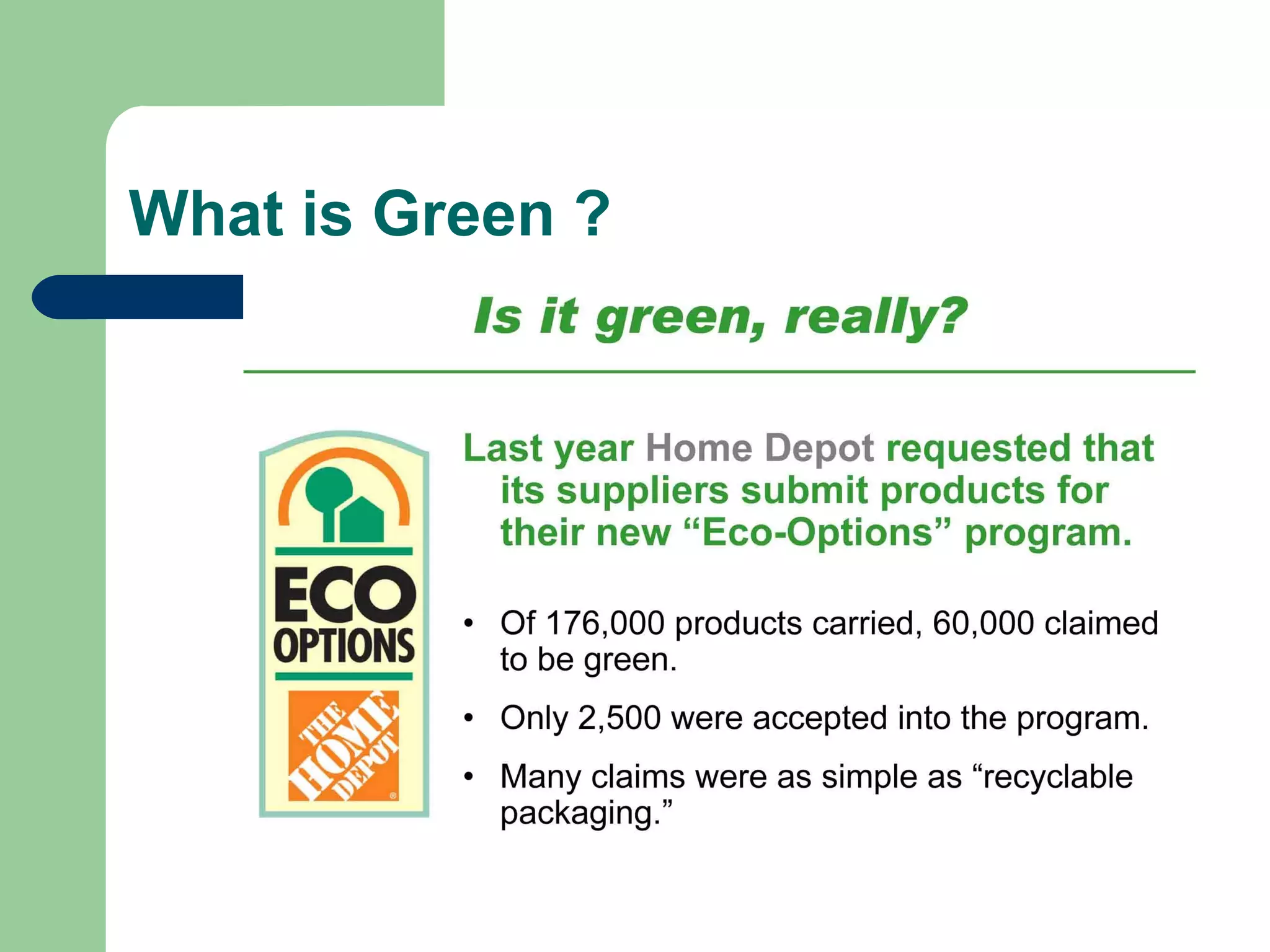
What is Green ?
What is Green ?
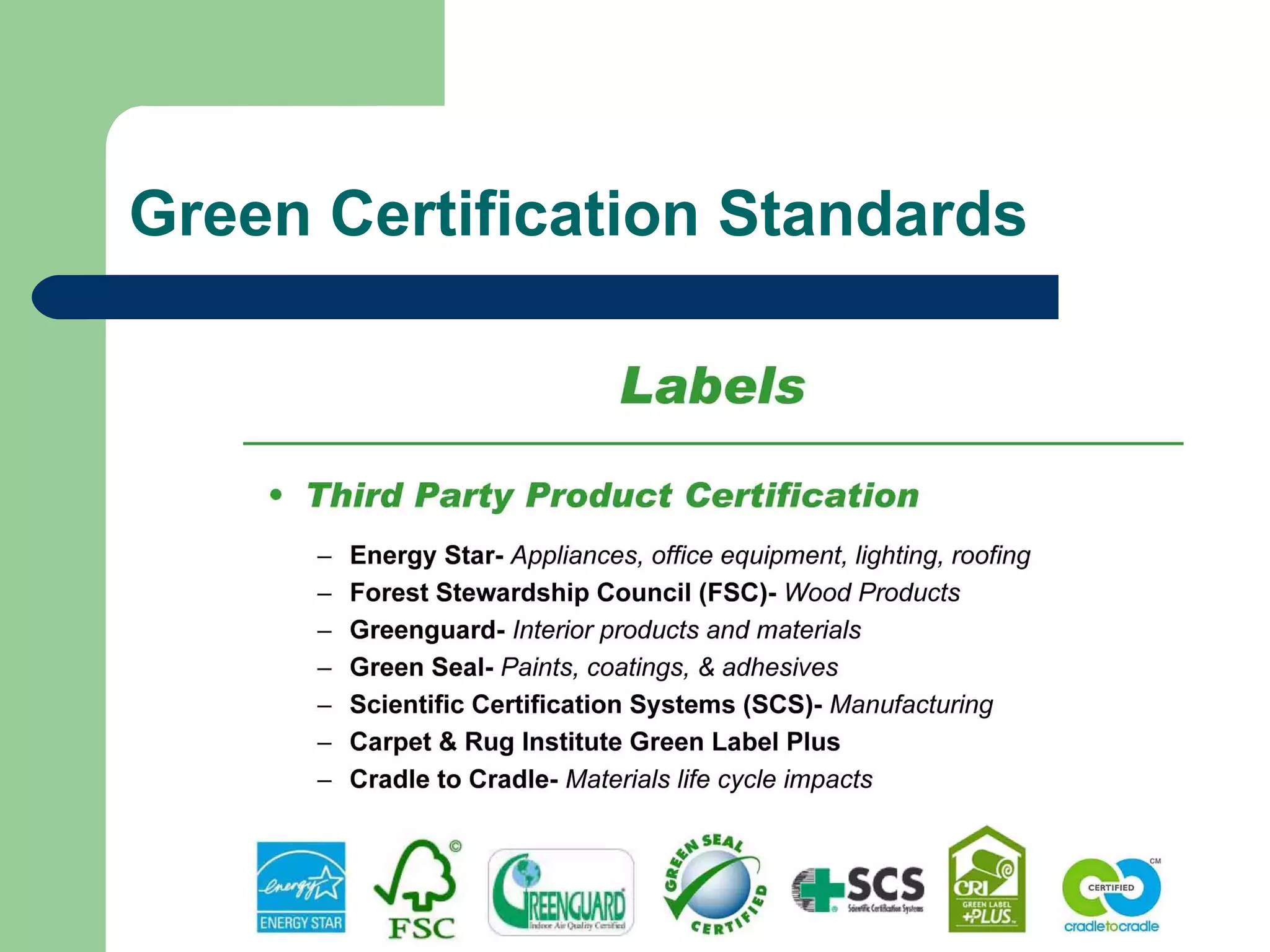
Green Certification Standards
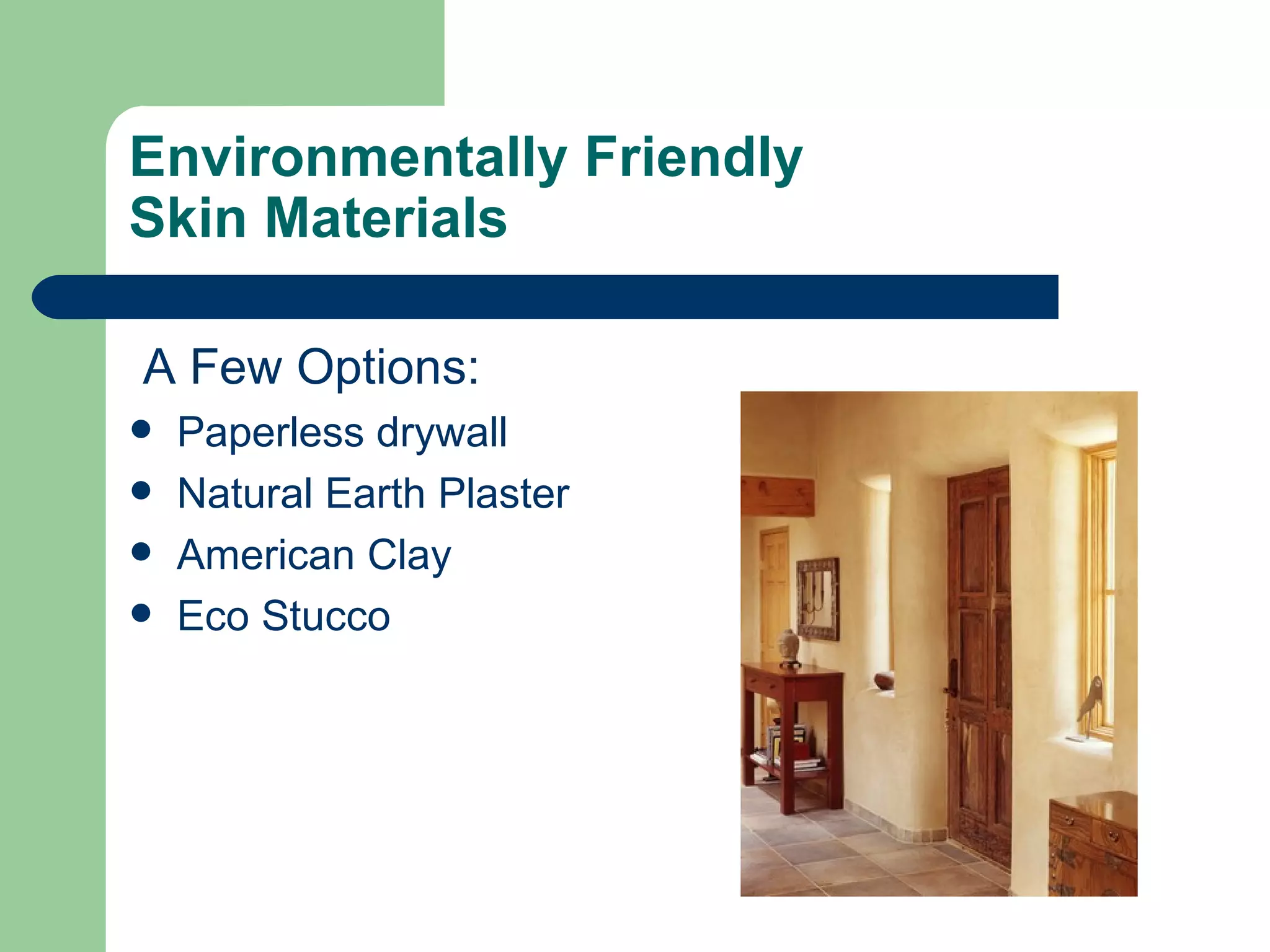
Environmentally Friendly
Skin Materials

A Few Options:
   Paperless drywall
   Natural Earth Plaster
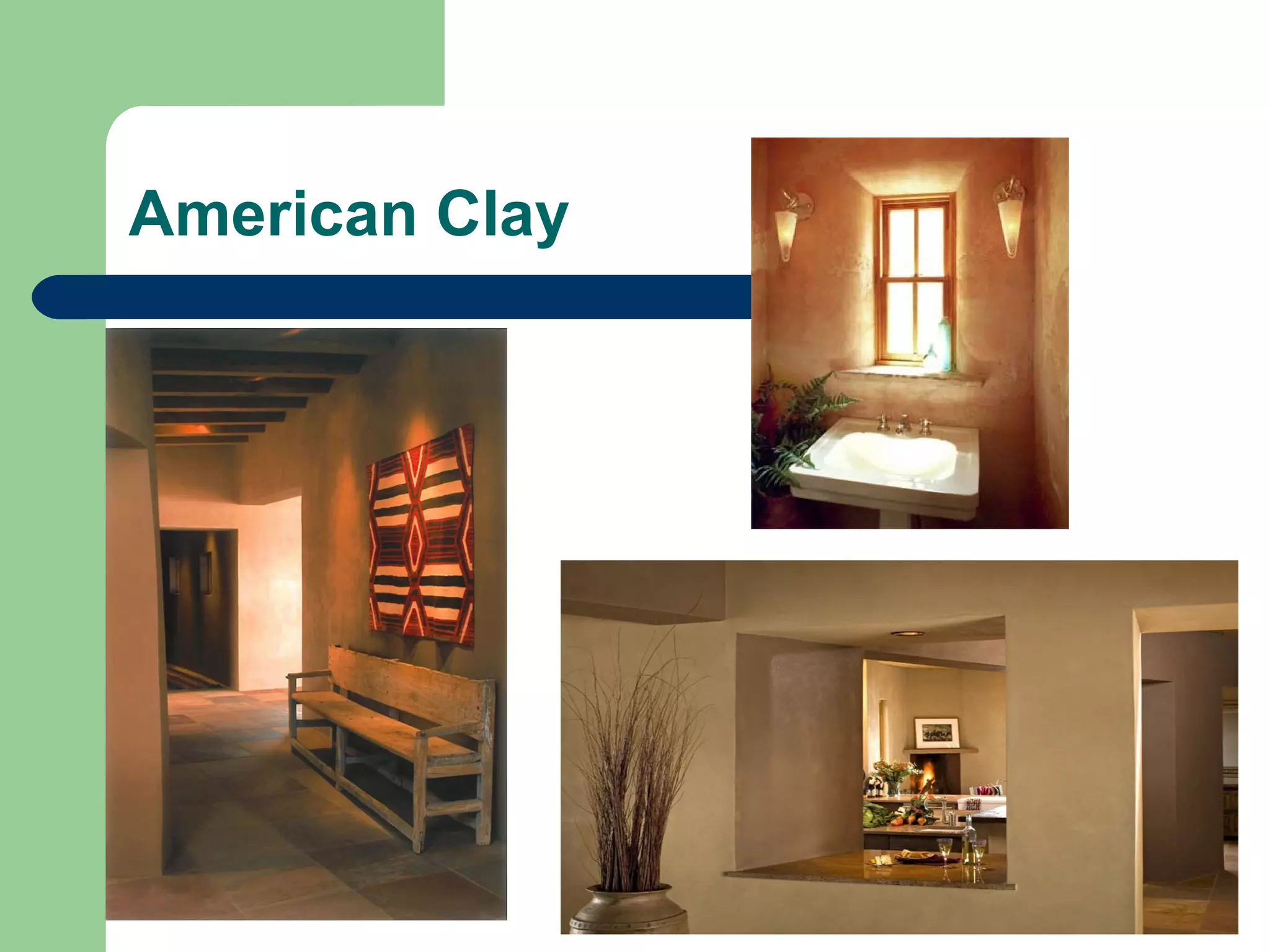
   American Clay
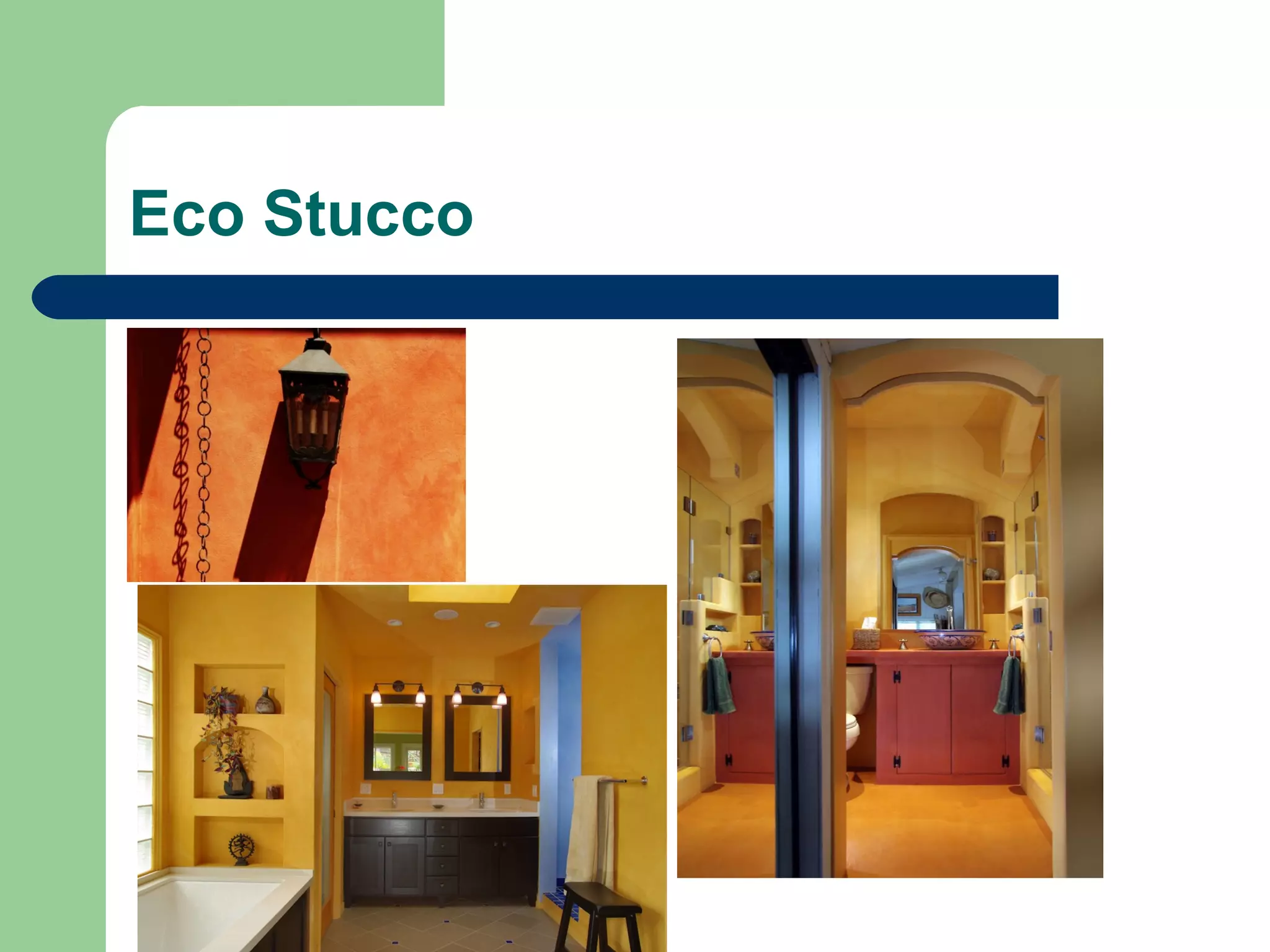
   Eco Stucco
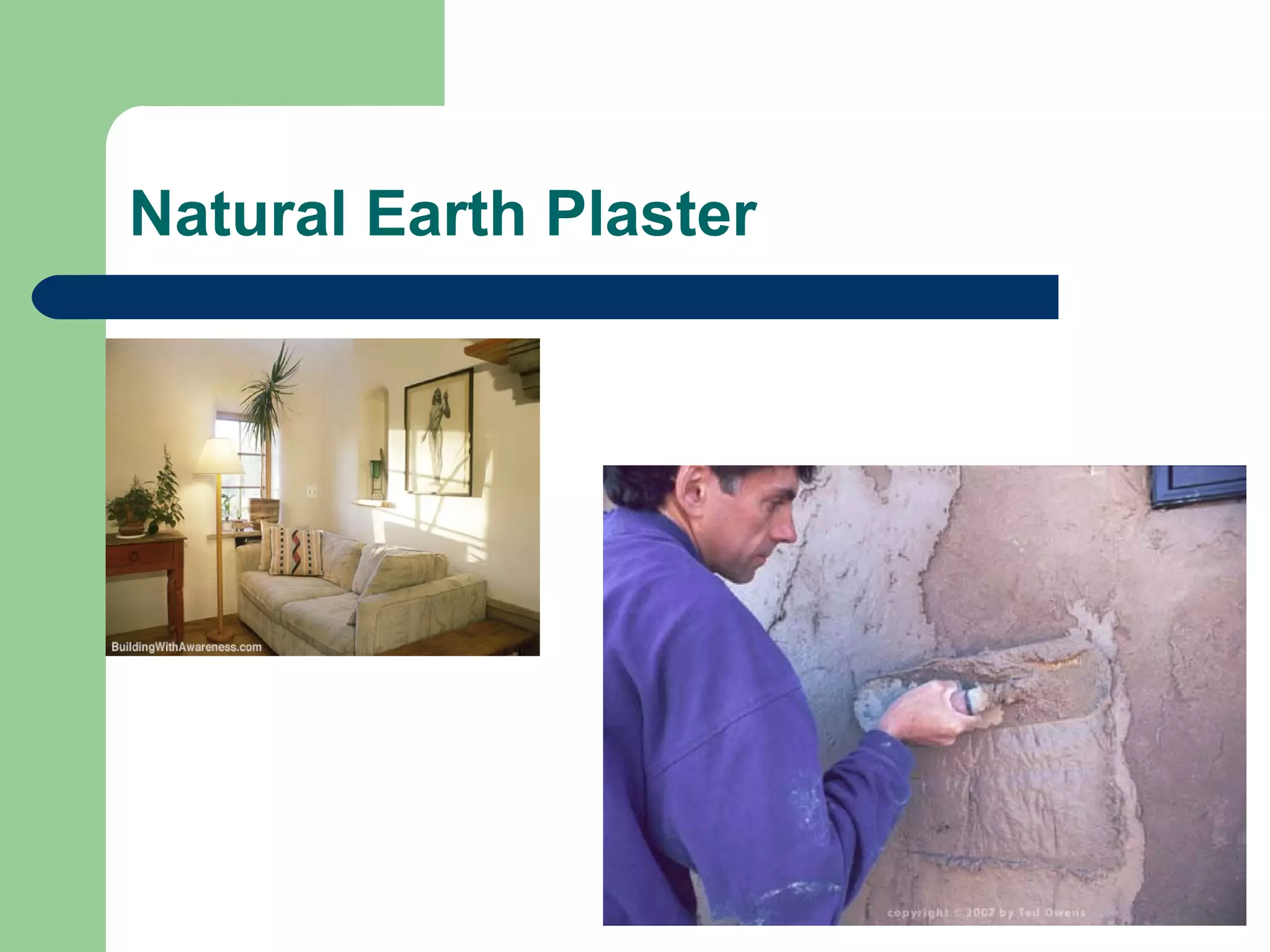
Natural Earth Plaster
American Clay
Eco Stucco
Closing Comments

   There no one magic solution to any building design
   Do your homework, pick wisely
   Respect “single source vendors”, but take them with
    a grain of salt. After all, they have a hammer
   Appreciate that a building’s structural shell is only
    one working component within a synergistic whole
   Have fun & on behalf of the Center for Sustainable
    Energy, THANK YOU FOR BEING HERE TODAY

Green Framing Options

  • 1.
    Welcome to Green FramingOptions Presenter: Wally Geer go2wallyworld@hotmail.com
  • 3.
    Some Sincere Thanksto:  The Center for Sustainable Energy  U.S. Green Building Council, C4 Chapter  National Association of Home Builder’s Research Center  University College of Dublin  MosArt Architects, Dublin  Laura’s Painting, Ojai, CA.  Greymar Associates, Ventura, CA.  Sonoma State University
  • 4.
    In Defense ofWood  There is an abundant supply of vendors and subcontractors  It has relatively few design & structural constraints  It’s cost effective  It’s beautiful
  • 5.
    Why Chose anAlternative Framing System ?  Site & Structural Constraints  Health Related Issues  Environmental Concerns  Energy Efficiency  Life Cycle Value  Fire Safety  Competitive Advantage
  • 6.
    Site & StructuralConstraints  Lack of Staging Area  Complex topography that will not allow conventional movement of building materials  Unique Soils of Geological Conditions  Short Building Season
  • 7.
    Health Related Issues  Mold  Building Material Toxins  Specific Health Issues of the Occupants  Healthier Families & Higher Workplace Productivity
  • 8.
    Environmental Concerns  Concernsover renewable resources  Concerns over “Cradle to Cradle” or “Cradle to Grave” issues  Concerns related to “Carbon Footprint”  Concerns over material waste and Land Fill waste
  • 9.
    Energy Efficiency  “Tight” Building Envelope  Passive Solar Design Benefits  Life Cycle Energy Savings  High Performance Building Assemblies
  • 10.
    Life Cycle Value “LifeCycle Value” is the total Cost of INITIAL CONSTUCTION + ENERGY CONSUMPTION COSTS over the functional life of a building
  • 11.
    Cost Comparison ConstructionCosts of a 50% ZEB Office Building, Kiel, Germany (Building Shell + Tenant Improvements - Converted to U.S. Dollars) Conventional Sustainable Difference Frame 48.28 53.82 11.46% Envelope 83.65 101.27 21.06% Roof 15.20 15.11 -0.58% Walls/Doors 12.78 12.90 0.95% Finishes 33.48 32.24 -3.70% Services 92.18 86.64 -6.01% Site works 7.04 7.02 -0.37% TOTALS 292.62 309.00 5.60%
  • 12.
    Energy Savings Office BuildingType Energy Conventional 25 KWH/ft2/year Sustainable 10 KWH/ft2/year Savings 15 KWH/ft2/year For a 250,000 Office Building, that’s a Savings of over $350,000 per year
  • 13.
    Fire Safety  Desire to have a “Fire Safe” home  Lower Insurance Rates  Higher resale value in “Fire Country”
  • 14.
  • 15.
    Why NOT tochose an Alternative Framing System  Lower Initial Cost of Structural Shell Construction  Because you can gain “LEED Credits”  If there are limited options in your market area of suppliers or qualified subcontractors  Because your flaky unlicensed Brother-in-Law claims he is knowledgeable of straw bale construction
  • 16.
    DON’T think “FramingSystems”, THINK “Building Envelope Assemblies”
  • 17.
    When evaluating BuildingEnvelope Assemblies, consider:  Structural System  Adaptability of Floor & Roof Diaphragms  Exterior Building Skin  Interior Building Skin  Insulation  Adaptability of Plumbing & Electrical within the system  Design & Structural Constraints of the Assembly
  • 18.
    When comparing Options, consider  Design & Structural Constraints  Energy Efficiency  Environmental Attributes  Initial Construction Cost  Life Cycle Value  Fire Safety  Adaptability of Building Skin Options  Adaptability of Electrical & Plumbing  Availability of Raw Materials  Availability of Qualified Labor & Subcontractors
  • 19.
    What are theOptions  Conventional Wood Framing  FSC Certified Wood Framing  Light Gauge Steel Framing  Red Iron Steel Framing  Structurally Insulated Panels (aka “SIPs”)  Insulated Concrete Forms (aka “ICFs”)  Timber Frame Structural Systems  Straw Bale Construction
  • 20.
    Conventional Wood Framing PositiveAttributes:  There is an abundant supply of vendors and subcontractors  Relatively few design & structural constraints  It’s cost effective Potential Problems:  Rot, Mold & Termites  Low Fire Resistance  In consistent Quality
  • 21.
    Conventional Wood Framing AMetric Analysis Category Score Design & Structural Constraints 8 Energy Efficiency 4 Environmental Attributes 5 Initial Construction Cost (10 being most cost 8 effective) Life Cycle Value 5 Fire Safety 4 Adaptability of Building Skin Options 8 Adaptability of Electrical & Plumbing 7 Availability of Raw Materials 8 Availability of Qualified Labor & Subcontractors 8
  • 22.
    Forest Stewardship Council(aka “FSC”) Wood Framing Positive Attributes:  Relatively few design & structural constraints  Highly Environmentally Friendly  Potential Marketing benefit for builders & developers Potential Problems:  Rot, Mold & Termites  Low Fire Resistance
  • 23.
    FSC Wood Framing AMetric Analysis Category Score Design & Structural Constraints 8 Energy Efficiency 4 Environmental Attributes 8 Initial Construction Cost 8 Life Cycle Value 5 Fire Safety 4 Adaptability of Building Skin Options 8 Adaptability of Electrical & Plumbing 7 Availability of Raw Materials 6 Availability of Qualified Labor & Subcontractors 8
  • 24.
  • 25.
    Light Gauge SteelFraming Positive Attributes:  Excellent structural characteristics  Readily Available Material  Highly adaptable for future alterations  Eliminates the possibility of termite damage  Highly Environmentally Friendly*  Partially mitigates potential mold problems
  • 26.
    Light Gauge SteelFraming Positive Structural Attributes
  • 27.
    Light Gauge SteelFraming Something Old & Something New
  • 28.
    Light Gauge SteelFraming Potential Negative Attributes :  More costly than wood framing  Limited number Requires an knowledgeable architectural &  engineering team of qualified subcontractors  Potential problems with other trades (M, P & E)  Requires a knowledgeable architectural & engineering team
  • 29.
    Light Gauge SteelFraming A Metric Analysis Category Score Design & Structural Constraints 8 Energy Efficiency 2 Environmental Attributes 4 to 8 Initial Construction Cost (10 being most cost effective) 6 Life Cycle Value 7 Fire Safety 6 Adaptability of Building Skin Options 7 Adaptability of Electrical & Plumbing 6 Availability of Raw Materials 8 Availability of Qualified Labor & Subcontractors 4
  • 30.
  • 31.
  • 32.
  • 33.
  • 34.
  • 35.
    Red Iron SteelFraming Positive Attributes:  Excellent structural characteristics  Readily Available Material  Eliminates the possibility of termite damage  Highly Environmentally Friendly*  Partially mitigates potential mold problems  Can be potentially very cost effective
  • 36.
    Red Iron SteelFraming Potential Negative Attributes :  Potential problems with other trades (M, P & E)  Some Design constraints  Potential Thermal Bridging Problems
  • 37.
    Red Iron SteelFraming A Metric Analysis Category Score Design & Structural Constraints 6 Energy Efficiency 2 Environmental Attributes 4 to 8 Initial Construction Cost (10 being most cost effective) 8 Life Cycle Value 7 Fire Safety 8 Adaptability of Building Skin Options 5 Adaptability of Electrical & Plumbing 6 Availability of Raw Materials 8 Availability of Qualified Labor & Subcontractors 8
  • 38.
  • 39.
  • 40.
  • 41.
  • 42.
  • 43.
    Structurally Insulated Panels (aka “SIPs”) Positive Attributes:  Excellent structural characteristics  Highly Energy Efficient  Highly adaptable for future alterations  Substantially mitigates the possibility of termite damage  Highly Environmentally Friendly*  Substantially mitigates potential mold problems*  Excellent Quality Control due to factory production
  • 44.
    Structurally Insulated Panels (aka “SIPs”) Potential Negative Attributes : •Some Limited Design constraints •Potential Building Department related issues •Limited availability of qualified subcontractors •Potential problems with other trades (M, P & E) •Requires a knowledgeable architectural & engineering team
  • 45.
    Structurally Insulated Panels(SIPs) A Metric Analysis Category Score Design & Structural Constraints 7 Energy Efficiency 9 Environmental Attributes 5 to 9 Initial Construction Cost (10 being most cost effective) 6 Life Cycle Value 9 Fire Safety 7 Adaptability of Building Skin Options 6 Adaptability of Electrical & Plumbing 5 Availability of Raw Materials 8 Availability of Qualified Labor & Subcontractors 3
  • 46.
    Insulated Concrete Forms (aka “ICFs”)
  • 47.
    Insulated Concrete Forms (aka “ICFs”)
  • 48.
    Insulated Concrete Forms (aka “ICFs”)
  • 49.
    Insulated Concrete Forms (aka “ICFs”)
  • 50.
    Insulated Concrete Forms (aka “ICFs”)
  • 51.
    Insulated Concrete Forms Floor& Roof Options •Dimensional Lumber •Light Gauge Steel •Dietrich “Trade Ready” Joists •Hambro Bar Joist System •“Lite Deck”
  • 52.
  • 53.
    Insulated Concrete Forms (aka “ICFs”) Positive Attributes: •Excellent structural characteristics •Highly Fire Resistant •Highly Energy Efficient •Substantially mitigates the possibility of termite damage •Highly Environmentally Friendly* •Substantially mitigates potential mold problems* •Excellent Quality Control due to factory production •VERY quiet interiors
  • 54.
    Insulated Concrete Forms (aka “ICFs”)
  • 55.
    Insulated Concrete Forms (aka “ICFs”)
  • 56.
    Insulated Concrete Forms (aka “ICFs”) Potential Negative Attributes : •Some Limited Design constraints •Potential Building Department related issues •Potential problems with other trades (M, P & E) •More costly than conventional wood framing, but with a positive payback in energy savings •Requires a knowledgeable architectural & engineering team
  • 57.
    Insulated Concrete Forms(ICFs) A Metric Analysis Category Score Design & Structural Constraints 7 Energy Efficiency 10 Environmental Attributes 7 to 9 Initial Construction Cost (10 being most cost 7 effective) Life Cycle Value 9 Fire Safety 10 Adaptability of Building Skin Options 7 Adaptability of Electrical & Plumbing 7 Availability of Raw Materials 9 Availability of Qualified Labor & Subcontractors 7
  • 58.
  • 59.
  • 60.
  • 61.
  • 62.
  • 63.
    Timber Frame StructuralSystems Positive Attributes: •Excellent structural characteristics •Highly Energy Efficient* •Highly Environmentally Friendly* •Excellent Quality Control due to factory production
  • 64.
    Timber Frame StructuralSystems Potential Negative Attributes : •Some Limited Design constraints •Potential Building Department related issues •Limited availability of qualified subcontractors •Potential problems with other trades (M, P & E) •Requires a knowledgeable architectural & • engineering team
  • 65.
    Timber Frame StructuralSystem A Metric Analysis Category Score Design & Structural Constraints 6 Energy Efficiency 6 to 9 Environmental Attributes 7 to 9 Initial Construction Cost (10 being most cost effective) 4 Life Cycle Value 6 Fire Safety 6 Adaptability of Building Skin Options 7 Adaptability of Electrical & Plumbing 7 Availability of Raw Materials 6 Availability of Qualified Labor & Subcontractors 3
  • 66.
  • 67.
  • 68.
  • 69.
  • 70.
  • 71.
    Straw Bale Positive Attributes: •HighlyEnergy Efficient •Highly Environmentally Friendly •VERY quiet interiors •More fire resistant than some other options •A fun way to build a house if you have 20 friends that like to work for free and live on pizza & beer on the weekends.
  • 72.
    Straw Bale Potential NegativeAttributes : •Some Limited Design constraints •Potential Building Department related issues •Potential problems with other trades (M, P & E) •Very costly if professionally constructed •Requires a knowledgeable architectural & engineering team
  • 73.
    Straw Bale A MetricAnalysis Category Score Design & Structural Constraints 4 Energy Efficiency 10 Environmental Attributes 10 Initial Construction Cost (10 being most cost effective) 3 Life Cycle Value 8 Fire Safety 7 Adaptability of Building Skin Options 4 Adaptability of Electrical & Plumbing 6 Availability of Raw Materials 9 Availability of Qualified Labor & Subcontractors 2
  • 74.
    Why Chose anAlternative Framing System ? •Site & Structural Constraints •Health Related Issues •Environmental Concerns •Energy Efficiency •Life Cycle Value •Fire Safety •Competitive Advantage
  • 75.
  • 76.
  • 77.
  • 78.
  • 79.
    Environmentally Friendly Skin Materials AFew Options:  Paperless drywall  Natural Earth Plaster  American Clay  Eco Stucco
  • 80.
  • 81.
  • 82.
  • 83.
    Closing Comments  There no one magic solution to any building design  Do your homework, pick wisely  Respect “single source vendors”, but take them with a grain of salt. After all, they have a hammer  Appreciate that a building’s structural shell is only one working component within a synergistic whole  Have fun & on behalf of the Center for Sustainable Energy, THANK YOU FOR BEING HERE TODAY