P R E S E N T S
Residential
Construction
Practices
Let’s Build a House Together!
(3) Credit Continuing Education Course
…and a great class!
Continuing Education Providers
are subject to audit by the State of Connecticut
Please:
Mute your cell phone
Use electronic devices judiciously
Remain in attendance until the
end of the class (or we can’t issue
your credits)
Thank you!
Your Credits….
Are submitted electronically to the State of Connecticut
by Tiger Real Estate School
Tiger Real Estate School will email you a
Certificate of Completion within 14 days
Please make sure we don’t land in “spam” and be sure
to save your Certificate where you can find it
There is a $25.00 fee to reissue a Certificate
Startling Statistics!
How many Jobs are created for each single
family home built? (According to NAHB)
Five?
Seven?
One?
Three?
Tax Revenue
How much government tax revenue
is created for each single family
home built?
$ 24,000?
$ 110,000?
$ 74,000?
$ 58,000?
$ 90,000?
Annual Housing Starts
How many national housing starts do
we need to accommodate growing
population and older
housing stock?
950,000?
1.7 million?
3 million?
1.2 million?
2.1 million?
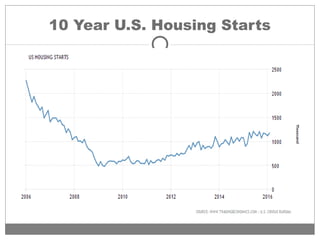
10 Year U.S. Housing Starts
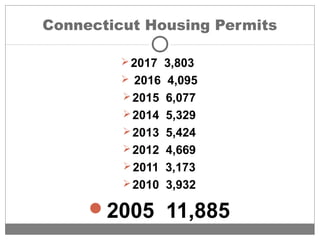
Connecticut Housing Permits
2017 3,803
 2016 4,095
2015 6,077
2014 5,329
2013 5,424
2012 4,669
2011 3,173
2010 3,932
2005 11,885
CONTENTS
Building codes
Foundation systems
Loads on buildings
Floor systems
Wall systems
Roof systems
Roofing
Siding
Decks
Insulation
Finish work
Doors and windows
Special construction
Heating systems
Cooling
Air quality
Water and Waste
Electrical
Building Codes
Regulate:
 design
 construction
 alteration
 repair of buildings
in order to protect the public
safety, health, and welfare
The 2016 CONNECTICUT STATE BUILDING CODE
has been approved and will be effective
for all permit applications on or after OCTOBER 1,
2016.
Major Model Codes
• 2012 International Building Code (IBC)
• 2012 International Existing Building Code (IEBC)
• 2012 International Residential Code (IRC)
There are amendments to each of the codes, full details can be located at the Office of
The State Building Official
Companion Codes
Developed to govern other more
specific aspects of construction
such as plumbing and mechanical work.
May be developed by states or local
municipalities, most are published by the same
groups that publish the model codes.
Companion Codes
Developed to govern other more
specific aspects of construction
such as plumbing and mechanical work.
May be developed by states or local
municipalities, most are published by the same
groups that publish the model codes.
Connecticut Building Codes
•Electrical Code 2014 National Electrical Code (NFPA-70)
•Accessibility Code ICC 2009 Accessible and Usable Buildings and Facilities C
ode
•Plumbing Code 2012 International Plumbing Code
•Mechanical Code 2012 International Mechanical Code
•Energy Code 2012 International Energy Conservation Code
Several other companion codes exist, they are not routinely found in Residential Construction
Practices, but may be applied when referenced in certain circumstances. (IE: Accessibility or
Life Safety) A full list of these companion codes can be located at the Office of the State
Building Official.
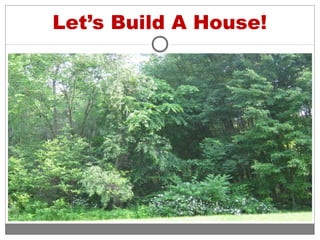
Let’s Build A House!
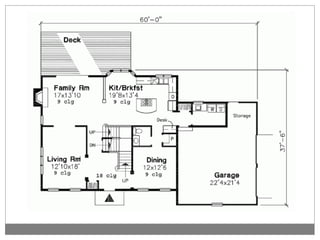
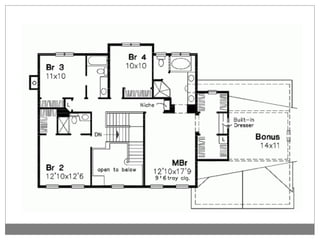
Basic 2400 sq ft colonial
 Not a lot of “bells &
whistles”
 Costs a/o August
2016
 Average
construction quality
 Located in
subdivision – land
price not included
Construction Cost
Estimate based on the
book
National Building
Cost Manual
published by Craftsman
Book Company
Single family residence built under competitive
conditions in or near Fairfield County
 Foundation for normal soil conditions
 Excavation for foundation and piers on a prepared
building pad
 Floor, wall, interior and exterior finishes, roof cover,
interior partitions, doors, windows, trim
 Electric wiring and fixtures
 Rough and finish plumbing, built-in appliances
 Supervision, design fees, permits, utility hook-ups, the
contractor's contingency, overhead and profit.
*Add the cost of the land, government-mandated site development
fees and the cost of bringing utility lines to the site
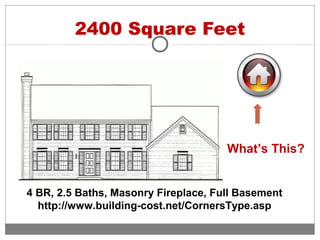
2400 Square Feet
What’s This?
4 BR, 2.5 Baths, Masonry Fireplace, Full Basement
http://www.building-cost.net/CornersType.asp
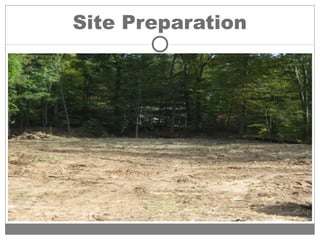
Site Preparation
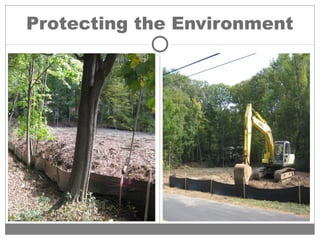
Protecting the Environment
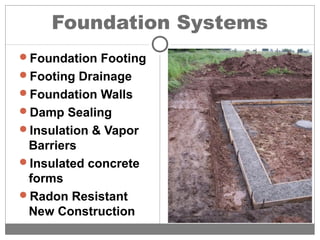
Foundation Systems
Foundation Footing
Footing Drainage
Foundation Walls
Damp Sealing
Insulation & Vapor
Barriers
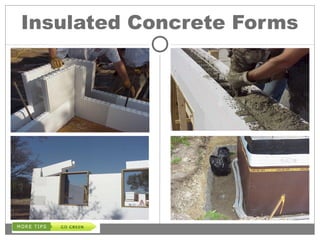
Insulated concrete
forms
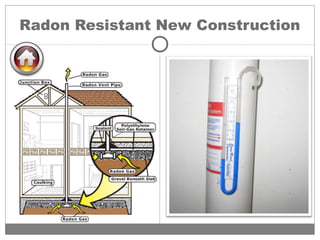
Radon Resistant
New Construction
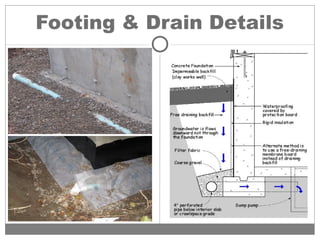
Footing & Drain Details
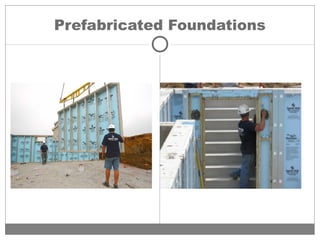
Prefabricated Foundations
Insulated Concrete Forms
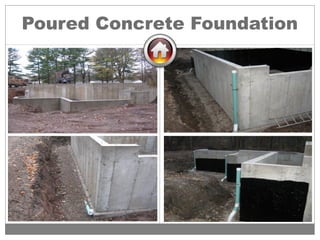
Poured Concrete Foundation
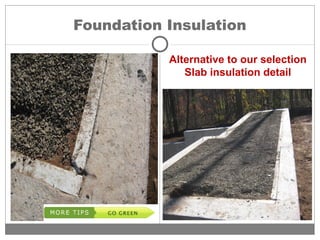
Foundation Insulation
Alternative to our selection
Slab insulation detail
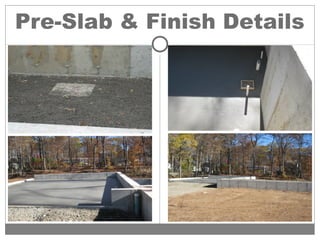
Pre-Slab & Finish Details
Radon Resistant New Construction
Are You Ready….
It’s
time
for…
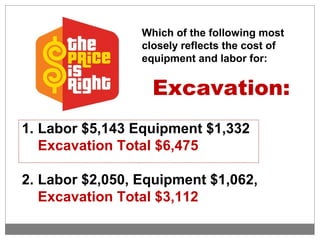
Which of the following most
closely reflects the cost of
equipment and labor for:
Excavation:
1. Labor $5,143 Equipment $1,332
Excavation Total $6,475
2. Labor $2,050, Equipment $1,062,
Excavation Total $3,112
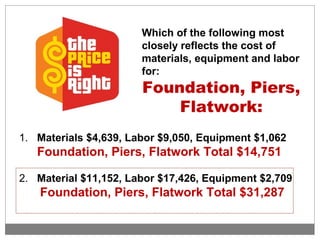
Which of the following most
closely reflects the cost of
materials, equipment and labor
for:
Foundation, Piers,
Flatwork:
1. Materials $4,639, Labor $9,050, Equipment $1,062
Foundation, Piers, Flatwork Total $14,751
2. Material $11,152, Labor $17,426, Equipment $2,709
Foundation, Piers, Flatwork Total $31,287
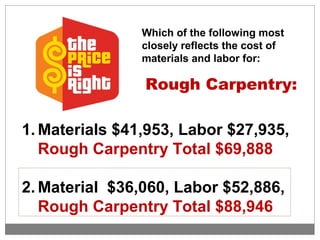
Which of the following most
closely reflects the cost of
materials and labor for:
Rough Carpentry:
1. Materials $41,953, Labor $27,935,
Rough Carpentry Total $69,888
2. Material $36,060, Labor $52,886,
Rough Carpentry Total $88,946
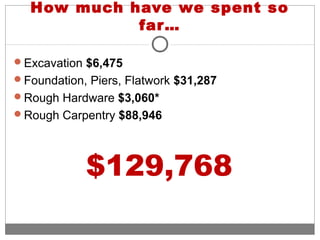
How much have we spent so
far…
Excavation $6,475
Foundation, Piers, Flatwork $31,287
Rough Hardware $3,060*
Rough Carpentry $88,946
$129,768
Structural and Exterior Building Systems
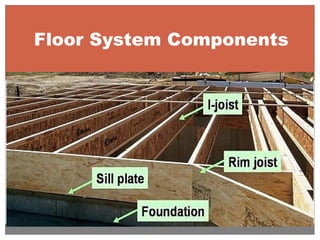
Floor System Components
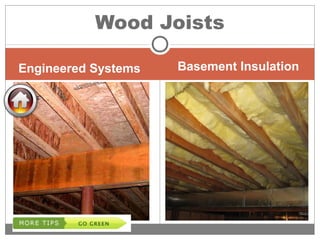
Engineered Systems Basement Insulation
Wood Joists
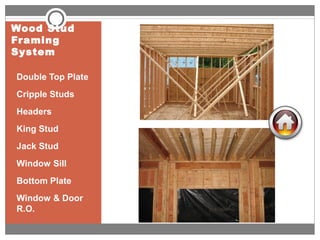
Wood Stud
Framing
System
Double Top Plate
Cripple Studs
Headers
King Stud
Jack Stud
Window Sill
Bottom Plate
Window & Door
R.O.
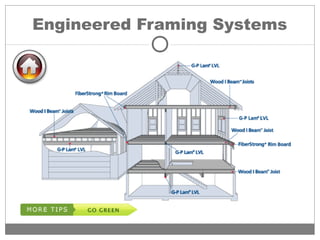
Engineered Framing Systems
The Role of
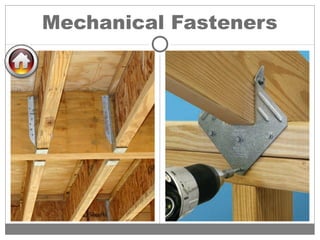
Mechanical Fasteners
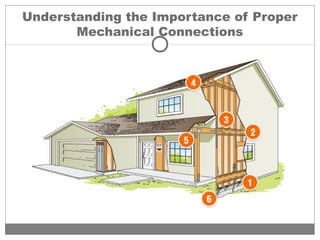
Understanding the Importance of Proper
Mechanical Connections
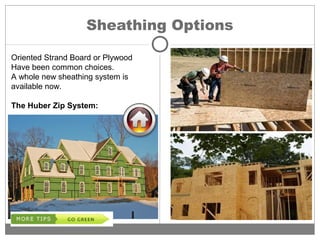
Sheathing Options
Oriented Strand Board or Plywood
Have been common choices.
A whole new sheathing system is
available now.
The Huber Zip System:
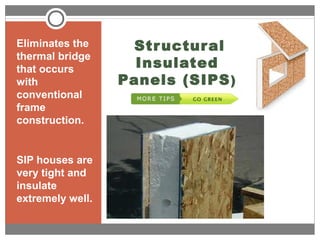
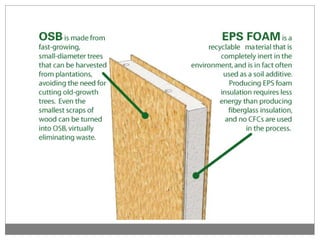
Structural
Insulated
Panels (SIPS)
Eliminates the
thermal bridge
that occurs
with
conventional
frame
construction.
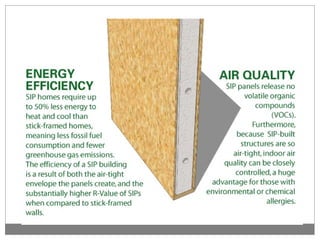
SIP houses are
very tight and
insulate
extremely well.
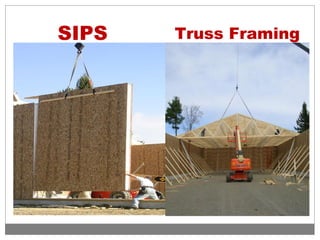
SIPS Truss Framing
SIPS
Roof Systems
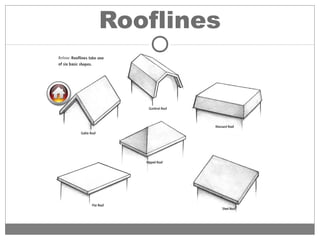
Rooflines
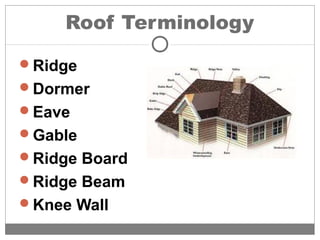
Roof Terminology
Ridge
Dormer
Eave
Gable
Ridge Board
Ridge Beam
Knee Wall
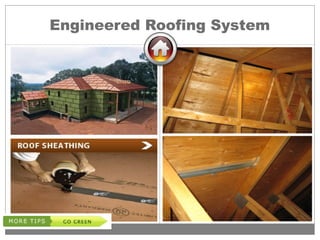
Engineered Roofing System
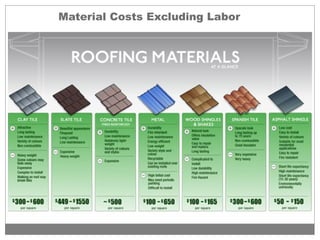
Material Costs Excluding Labor
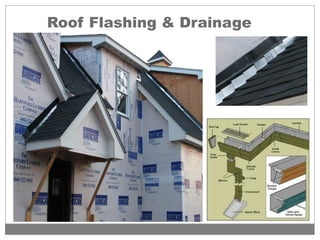
Roof Flashing & Drainage
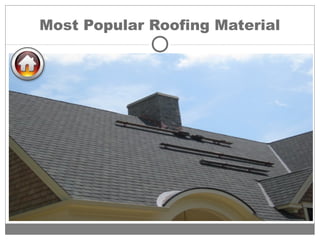
Most Popular Roofing Material
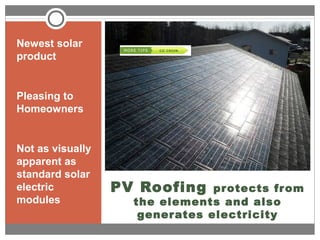
PV Roofing protects from
the elements and also
generates electricity
Newest solar
product
Pleasing to
Homeowners
Not as visually
apparent as
standard solar
electric
modules
Dow Solar Roof
(no longer in production – Tesla has filled the void)
The Savings
Tesla Solar Roof
Elon Musk does it again!
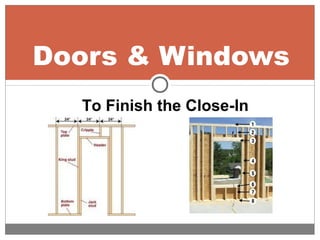
Doors & Windows
To Finish the Close-In
 Masonry Veneer
 Exterior Plywood Finishes
 Wood Shingles/Shakes
 Board Siding
 Stucco Finishes
 Synthetic Products
 Wood or Composite Trim
 Flashing
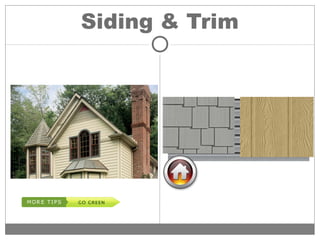
Siding & Trim
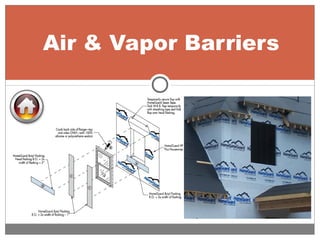
Air & Vapor Barriers
Siding & Trim
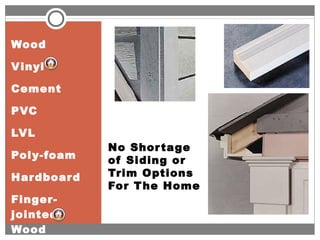
No Shortage
of Siding or
Trim Options
For The Home
Wood
Vinyl
Cement
PVC
LVL
Poly-foam
Hardboard
Finger-
jointed
Wood
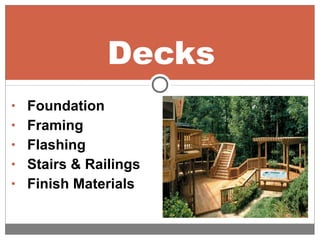
• Foundation
• Framing
• Flashing
• Stairs & Railings
• Finish Materials
Decks
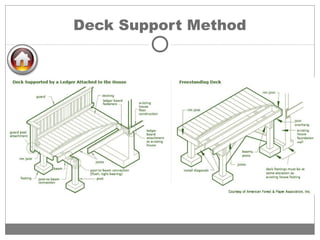
Deck Support Method
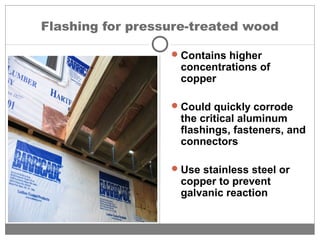
Flashing for pressure-treated wood
Contains higher
concentrations of
copper
Could quickly corrode
the critical aluminum
flashings, fasteners, and
connectors
Use stainless steel or
copper to prevent
galvanic reaction
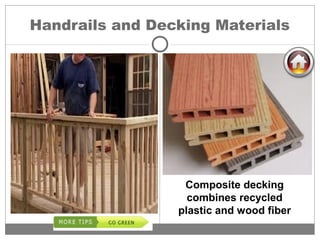
Handrails and Decking Materials
Composite decking
combines recycled
plastic and wood fiber
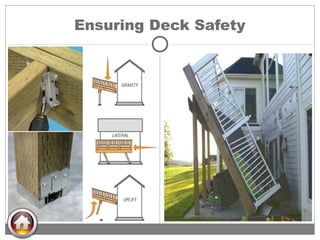
Ensuring Deck Safety
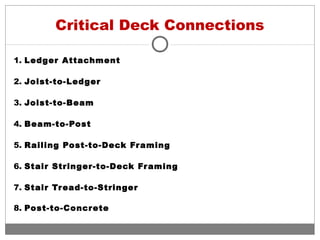
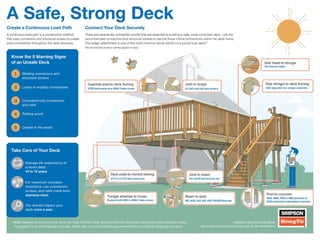
Critical Deck Connections
1. Ledger Attachment
2. Joist-to-Ledger
3. Joist-to-Beam
4. Beam-to-Post
5. Railing Post-to-Deck Framing
6. Stair Stringer-to-Deck Framing
7. Stair Tread-to-Stringer
8. Post-to-Concrete
Let’s Review…
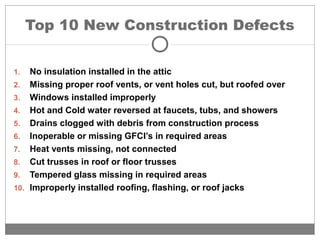
Top 10 New Construction Defects
1. No insulation installed in the attic
2. Missing proper roof vents, or vent holes cut, but roofed over
3. Windows installed improperly
4. Hot and Cold water reversed at faucets, tubs, and showers
5. Drains clogged with debris from construction process
6. Inoperable or missing GFCI’s in required areas
7. Heat vents missing, not connected
8. Cut trusses in roof or floor trusses
9. Tempered glass missing in required areas
10. Improperly installed roofing, flashing, or roof jacks
Are Your Ready?
Let’s Play…….
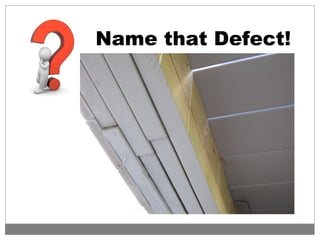
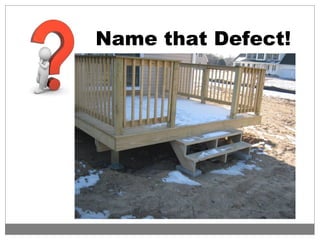
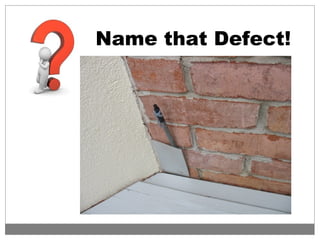
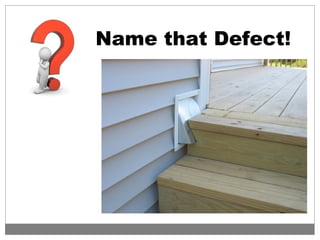
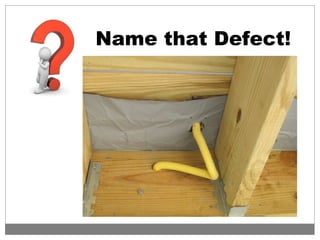
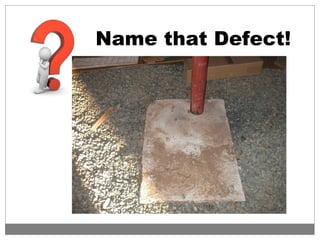
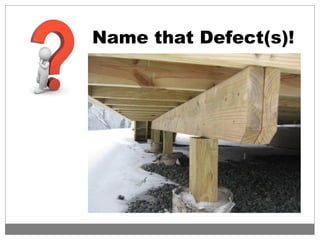
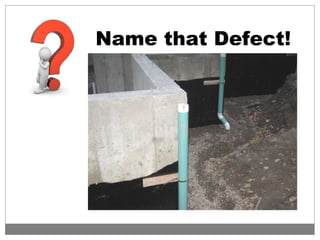
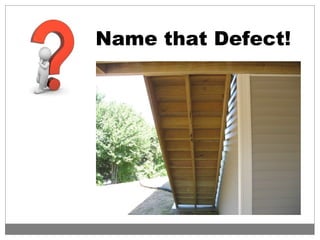
Name That Defect!!
Name that Defect!
Name that Defect!
Name that Defect!
Name that Defect!
Name that Defect!
Name that Defect!
Name that Defect(s)!
Name that Defect!
Name that Defect!
B R E A KB R E A K
15 MINUTE15 MINUTE
2016 – 2018
(3) Credit Continuing Education Courses
 Don’t Let Water Intrusion Sink Your Deal!
 Smart Energy Updates for Existing Homes
 Innovation in Sustainable Housing – Green Building Best Practices
This Old Connecticut House
 Minimize Your Risk, Maximize Your Earnings
 Environmental Issues – Evolution to Resolution
 What to Expect When We’re Inspecting!
 Mold to Sold!
 Residential Building Practices
Your Opinion Matters….
Before the end of
class, please take a
moment to complete
our evaluation form…
Energy Conservation in
New Construction
 Energy Use And Code Considerations
 Doors And Windows
 Insulation And The Building Envelope
 Conservation Systems
 Mechanical Systems
 Indoor Air Quality
 Finishing The Interior
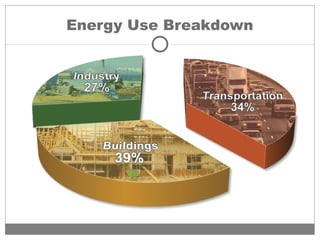
Energy Use Breakdown
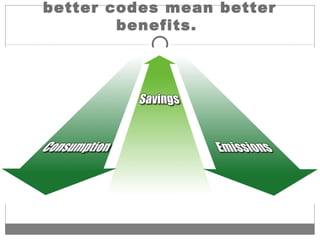
better codes mean better
benefits.
Doors and Windows
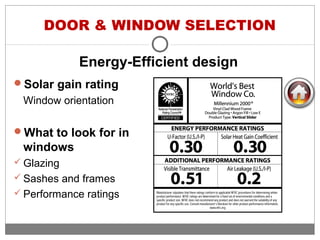
DOOR & WINDOW SELECTION
Solar gain rating
Window orientation
What to look for in
windows
 Glazing
 Sashes and frames
 Performance ratings
Energy-Efficient design
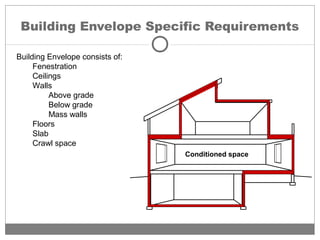
Building Envelope Specific Requirements
Conditioned space
Building Envelope consists of:
Fenestration
Ceilings
Walls
Above grade
Below grade
Mass walls
Floors
Slab
Crawl space
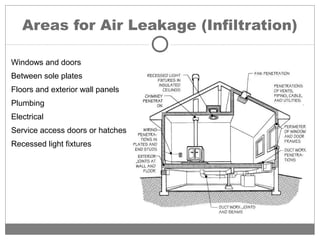
Areas for Air Leakage (Infiltration)
Windows and doors
Between sole plates
Floors and exterior wall panels
Plumbing
Electrical
Service access doors or hatches
Recessed light fixtures
How to Air Seal an Attic
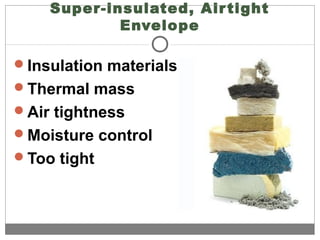
Super-insulated, Airtight
Envelope
Insulation materials
Thermal mass
Air tightness
Moisture control
Too tight
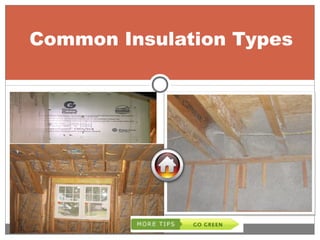
Common Insulation Types
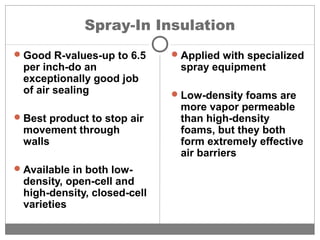
Spray-In Insulation
Good R-values-up to 6.5
per inch-do an
exceptionally good job
of air sealing
Best product to stop air
movement through
walls
Available in both low-
density, open-cell and
high-density, closed-cell
varieties
Applied with specialized
spray equipment
Low-density foams are
more vapor permeable
than high-density
foams, but they both
form extremely effective
air barriers
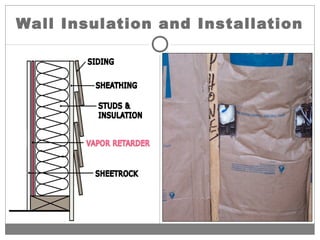
Wall Insulation and Installation
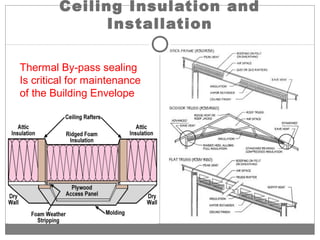
Ceiling Insulation and
Installation
Thermal By-pass sealing
Is critical for maintenance
of the Building Envelope
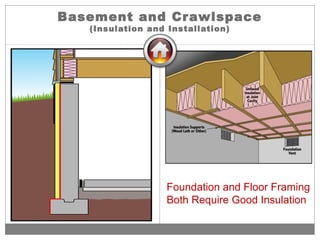
Basement and Crawlspace
(Insulation and Installation)
Foundation and Floor Framing
Both Require Good Insulation
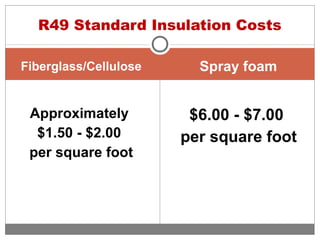
Fiberglass/Cellulose Spray foam
Approximately
$1.50 - $2.00
per square foot
$6.00 - $7.00
per square foot
R49 Standard Insulation Costs
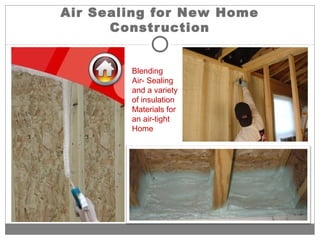
Air Sealing for New Home
Construction
Blending
Air- Sealing
and a variety
of insulation
Materials for
an air-tight
Home
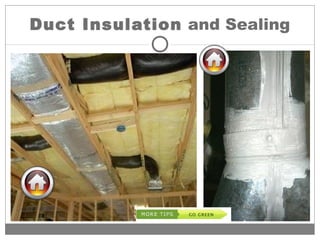
Duct Insulation and Sealing
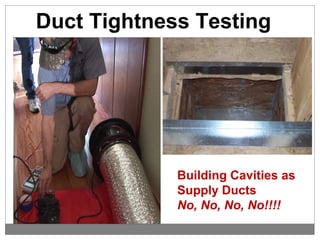
Duct Tightness Testing
Building Cavities as
Supply Ducts
No, No, No, No!!!!
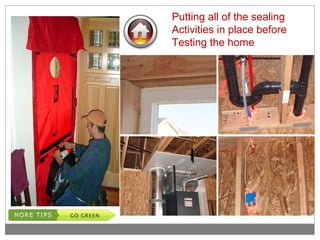
Putting all of the sealing
Activities in place before
Testing the home
Blower Door
Are You Ready….
It’s
time
for…
Which of the following most
closely reflects the cost of
materials and labor for:
Roofing, Flashing,
Fascia:
1. Material $9,967, Labor $11,680
Roofing, Flashing, Fascia Total $21,647
2. Material $15,077, Labor $12,564
Roofing, Flashing, Fascia Total $27,641
Which of the following most
closely reflects the cost of
materials and labor for:
Exterior Trim and
Finish:
1. Material $15,559, Labor $10,434, Equipment $1,343
Exterior Trim and Finish Total $27,336
2. Material $25,648, Labor $15,879, Equipment $1,370
Exterior Trim and Finish Total $42,897
Which of the following most
closely reflects the cost of
materials and labor for:
Insulation:
1. Material $6,231, Labor $2,638,
Insulation Total $8,869
2. Material $6,753, Labor $4,586,
Insulation Total $11,339
Which of the following most
closely reflects the cost of
materials and labor for:
Doors(including garage)
Windows:
1. Materials $5,720, Labor $8,155
Door/Window Total $13,875
2. Materials $10,528 Labor $7,211,
Door/Window Total $17,739
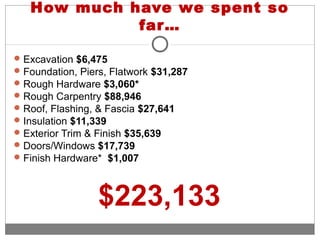
How much have we spent so
far…
Excavation $6,475
Foundation, Piers, Flatwork $31,287
Rough Hardware $3,060*
Rough Carpentry $88,946
Roof, Flashing, & Fascia $27,641
Insulation $11,339
Exterior Trim & Finish $35,639
Doors/Windows $17,739
Finish Hardware* $1,007
$223,133
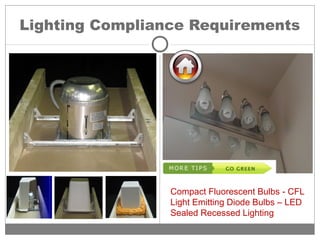
Lighting Compliance Requirements
Compact Fluorescent Bulbs - CFL
Light Emitting Diode Bulbs – LED
Sealed Recessed Lighting
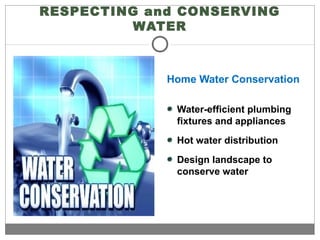
RESPECTING and CONSERVING
WATER
Home Water Conservation
Water-efficient plumbing
fixtures and appliances
Hot water distribution
Design landscape to
conserve water
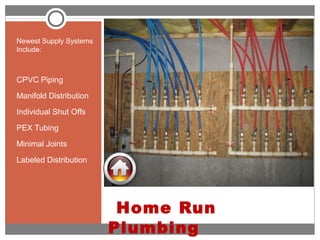
Home Run
Plumbing
Newest Supply Systems
Include:
CPVC Piping
Manifold Distribution
Individual Shut Offs
PEX Tubing
Minimal Joints
Labeled Distribution
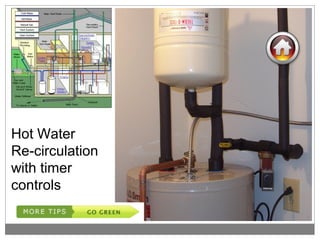
Hot Water
Re-circulation
with timer
controls
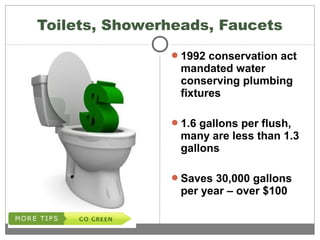
Toilets, Showerheads, Faucets
1992 conservation act
mandated water
conserving plumbing
fixtures
1.6 gallons per flush,
many are less than 1.3
gallons
Saves 30,000 gallons
per year – over $100
Electrical
Conventional Service
Circuits
Wiring
GFCI
AFCI
GFI Tester
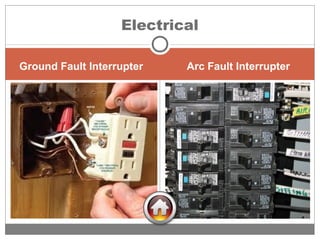
Ground Fault Interrupter Arc Fault Interrupter
Electrical
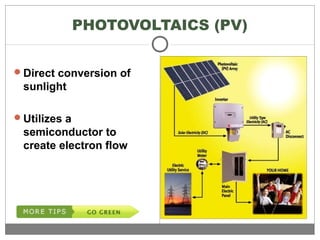
PHOTOVOLTAICS (PV)
Direct conversion of
sunlight
Utilizes a
semiconductor to
create electron flow
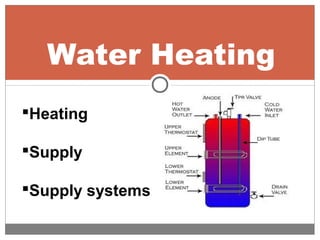
Water Heating
Heating
Supply
Supply systems
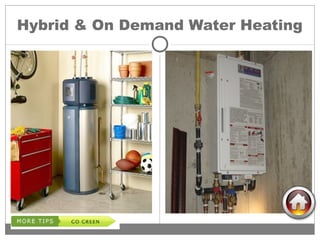
Hybrid & On Demand Water Heating
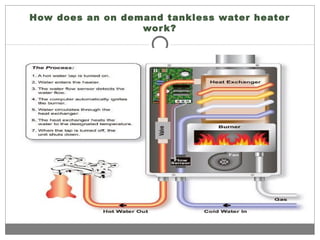
How does an on demand tankless water heater
work?
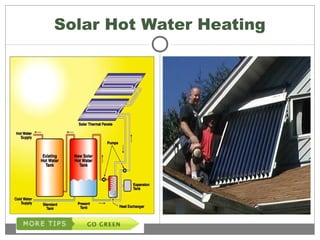
Solar Hot Water Heating
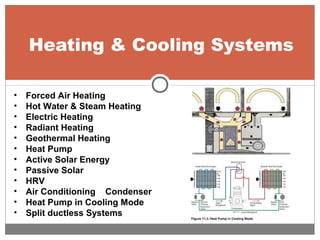
Heating & Cooling Systems
• Forced Air Heating
• Hot Water & Steam Heating
• Electric Heating
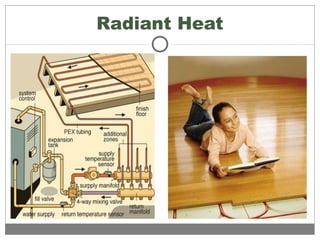
• Radiant Heating
• Geothermal Heating
• Heat Pump
• Active Solar Energy
• Passive Solar
• HRV
• Air Conditioning Condenser
• Heat Pump in Cooling Mode
• Split ductless Systems
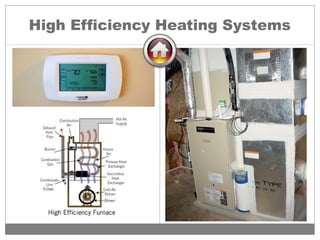
High Efficiency Heating Systems
How boilers work
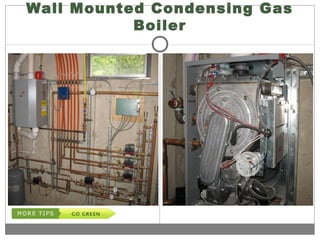
Wall Mounted Condensing Gas
Boiler
Radiant Heat
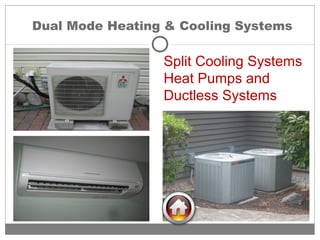
Dual Mode Heating & Cooling Systems
Split Cooling Systems
Heat Pumps and
Ductless Systems
Differentiating High Efficiency HVAC
Systems
A split HVAC system - multiple sections
Indoor coil section in the ductwork
Outdoor coil section (compressor/condenser) installed on the outside of
the home
Inside the home (attic, basement, closet) there may be a combined fan
and air conditioning coil in one box or separate coil and fan sections
which can house a gas or oil heating furnace
 Package system contains all components in one box
(compressor, condenser, fan) typically found installed outside the
home, in some cases on the roof and ducted into the home
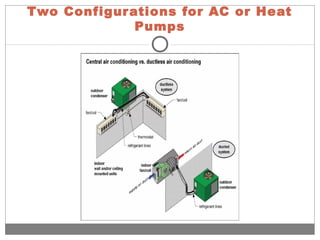
Two Configurations for AC or Heat
Pumps
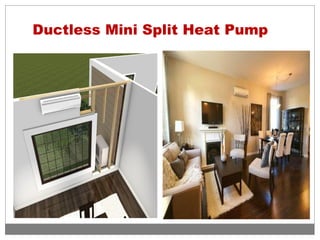
Ductless Mini Split Heat Pump
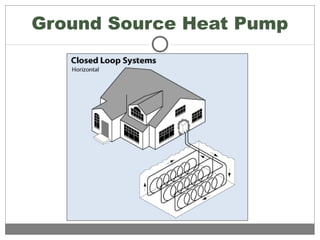
Ground Source Heat Pump
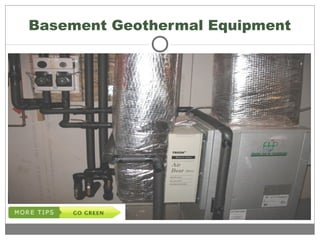
Basement Geothermal Equipment
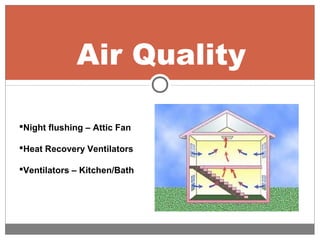
Air Quality
Night flushing – Attic Fan
Heat Recovery Ventilators
Ventilators – Kitchen/Bath
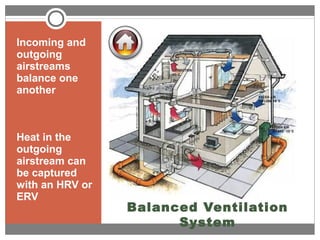
Balanced Ventilation
System
Incoming and
outgoing
airstreams
balance one
another
Heat in the
outgoing
airstream can
be captured
with an HRV or
ERV
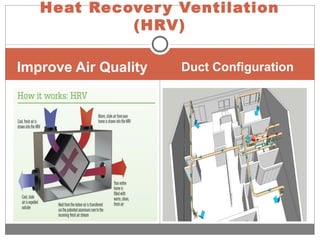
Improve Air Quality Duct Configuration
Heat Recovery Ventilation
(HRV)
Video Heat Recovery Ventilation
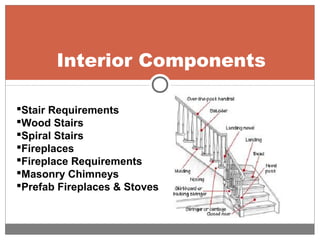
Interior Components
Stair Requirements
Wood Stairs
Spiral Stairs
Fireplaces
Fireplace Requirements
Masonry Chimneys
Prefab Fireplaces & Stoves
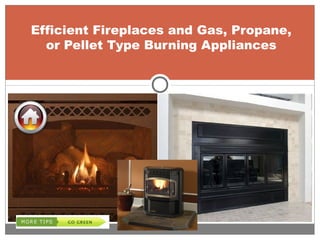
Efficient Fireplaces and Gas, Propane,
or Pellet Type Burning Appliances
One Minute Break –
Your Opinion Matters….
Please take a moment
to complete our
evaluation form…
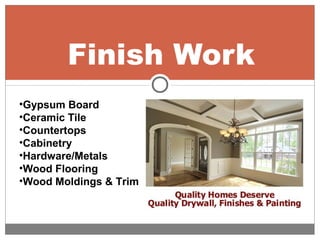
Finish Work
•Gypsum Board
•Ceramic Tile
•Countertops
•Cabinetry
•Hardware/Metals
•Wood Flooring
•Wood Moldings & Trim
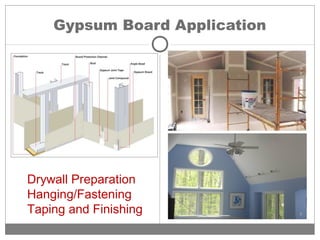
Gypsum Board Application
Drywall Preparation
Hanging/Fastening
Taping and Finishing
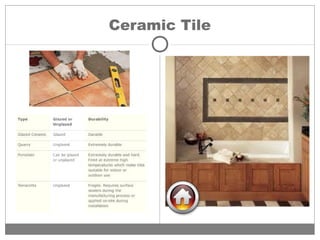
Ceramic Tile
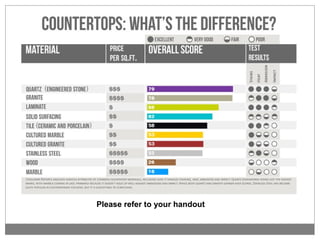
Please refer to your handout
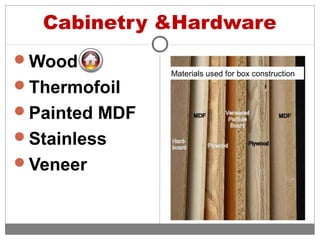
Cabinetry &Hardware
Wood
Thermofoil
Painted MDF
Stainless
Veneer
Materials used for box construction
Wood Moldings and Trim
Cove moldings
Crown moldings
Cornice
 Cornice is a molded
projection that crowns a
wall
 Picture molding is a
horizontal molding
Rails
 Plate rail is a narrow shelf
fixed along a wall and
grooved to hold plates for
ornament or display
Baseboard
 Baseboards conceal and
finish the joints where
sidewalls meet the floors
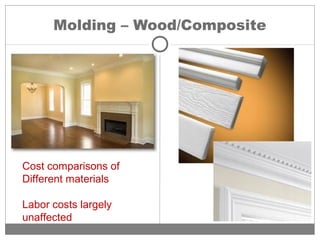
Molding – Wood/Composite
Cost comparisons of
Different materials
Labor costs largely
unaffected
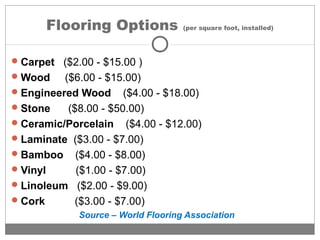
Flooring Options (per square foot, installed)
Carpet ($2.00 - $15.00 )
Wood ($6.00 - $15.00)
Engineered Wood ($4.00 - $18.00)
Stone ($8.00 - $50.00)
Ceramic/Porcelain ($4.00 - $12.00)
Laminate ($3.00 - $7.00)
Bamboo ($4.00 - $8.00)
Vinyl ($1.00 - $7.00)
Linoleum ($2.00 - $9.00)
Cork ($3.00 - $7.00)
Source – World Flooring Association
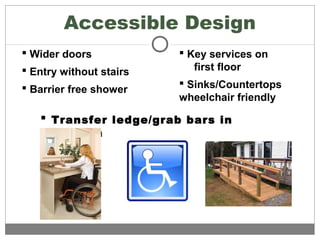
Accessible Design
 Wider doors
 Entry without stairs
 Barrier free shower
 Key services on
first floor
 Sinks/Countertops
wheelchair friendly
 Transfer ledge/grab bars in
bathroom
Are You Ready….
It’s
time
for…
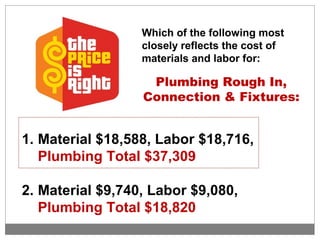
Which of the following most
closely reflects the cost of
materials and labor for:
Plumbing Rough In,
Connection & Fixtures:
1. Material $18,588, Labor $18,716,
Plumbing Total $37,309
2. Material $9,740, Labor $9,080,
Plumbing Total $18,820
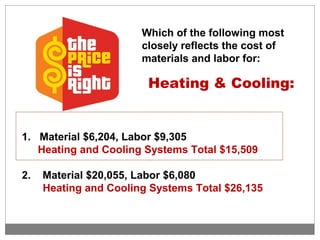
Which of the following most
closely reflects the cost of
materials and labor for:
Heating & Cooling:
1. Material $6,204, Labor $9,305
Heating and Cooling Systems Total $15,509
2. Material $20,055, Labor $6,080
Heating and Cooling Systems Total $26,135
Which of the following most
closely reflects the cost of
materials and labor for:
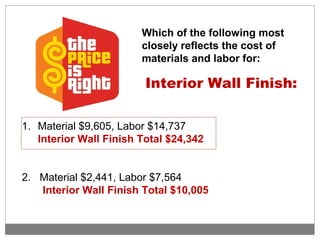
Interior Wall Finish:
1. Material $9,605, Labor $14,737
Interior Wall Finish Total $24,342
2. Material $2,441, Labor $7,564
Interior Wall Finish Total $10,005
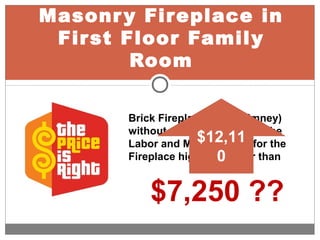
Masonry Fireplace in
First Floor Family
Room
Brick Fireplace (and Chimney)
without a raised hearth. Is the
Labor and Material Cost for the
Fireplace higher or lower than
$7,250 ??
$12,11
0
Which of the following most
closely reflects the cost of
materials and labor for:
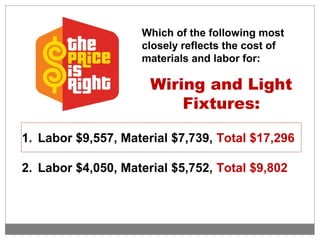
Wiring and Light
Fixtures:
1. Labor $9,557, Material $7,739, Total $17,296
2. Labor $4,050, Material $5,752, Total $9,802
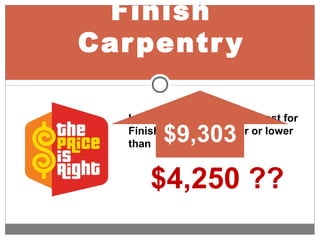
Finish
Carpentry
Is the Labor and Material Cost for
Finish Carpentry higher or lower
than
$4,250 ??
$9,303
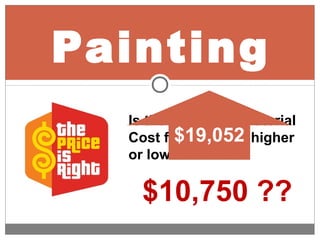
Painting
Is the Labor and Material
Cost for Painting higher
or lower than
$10,750 ??
$19,052
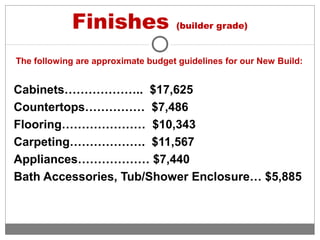
Finishes (builder grade)
The following are approximate budget guidelines for our New Build:
Cabinets……………….. $17,625
Countertops…………… $7,486
Flooring………………… $10,343
Carpeting………………. $11,567
Appliances……………… $7,440
Bath Accessories, Tub/Shower Enclosure… $5,885
Are you ready?
Let’s play…
What’s HOT…….What’s NOT!!!What’s HOT…….What’s NOT!!!
2017 Building Trends
(according to National Association of Home Builders
And National Kitchen & Bath Association)
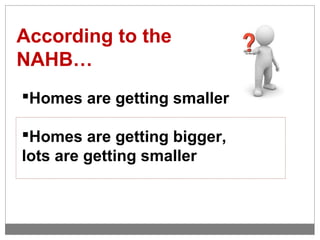
According to the
NAHB…
Homes are getting smaller
Homes are getting bigger,
lots are getting smaller
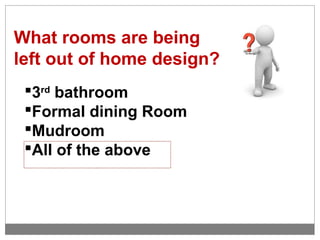
What rooms are being
left out of home design?
3rd
bathroom
Formal dining Room
Mudroom
All of the above
What is the number 1 choice
for kitchen flooring?
Tile
Hardwood
Tile that looks like hardwood
Marble
What countertop material
is most popular?
Marble
Wood
Granite
Quartz/Engineered Stone
Concrete
Stainless Steel
What home features are both
Boomers and Millenials
looking for?
1.Large, spacious interiors
2.High Tech features
3.Open floor plans
4.Outdoor spaces
5.Access to shopping
6.Located near major highways
What home features are least
important to Millenials?
1.Separate Laundry Room
2.Walk in closets
3.Energy efficiency
4.Family Rooms
5.Outdoor kitchens
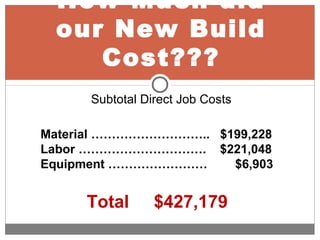
How Much did
our New Build
Cost???
Subtotal Direct Job Costs
Material ……………………….. $199,228
Labor …………………………. $221,048
Equipment …………………… $6,903
Total $427,179
The Cost of
“Doing
Business..”
Indirect Job Costs
Final Cleanup Total ………..$1,760
Insurance Total……………..$12,322
Permits & Utilities Total…… $7,481
Plans & Specs Total……….. $1,760
Total $23,323
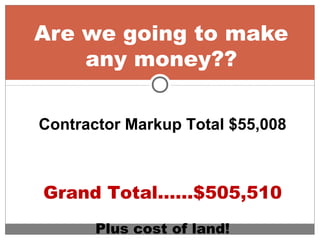
Are we going to make
any money??
Contractor Markup Total $55,008
Grand Total……$505,510
Plus cost of land!
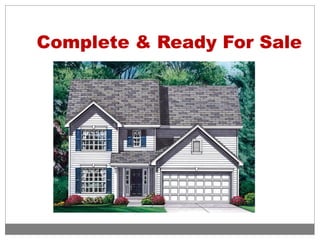
Complete & Ready For Sale
Thank You!!
Questions??
www.tigerinspect.com
Thank you!

2016-18 Fairfield Residential Construction

  • 1.
    P R ES E N T S Residential Construction Practices Let’s Build a House Together! (3) Credit Continuing Education Course
  • 2.
    …and a greatclass! Continuing Education Providers are subject to audit by the State of Connecticut Please: Mute your cell phone Use electronic devices judiciously Remain in attendance until the end of the class (or we can’t issue your credits) Thank you!
  • 3.
    Your Credits…. Are submittedelectronically to the State of Connecticut by Tiger Real Estate School Tiger Real Estate School will email you a Certificate of Completion within 14 days Please make sure we don’t land in “spam” and be sure to save your Certificate where you can find it There is a $25.00 fee to reissue a Certificate
  • 4.
    Startling Statistics! How manyJobs are created for each single family home built? (According to NAHB) Five? Seven? One? Three?
  • 5.
    Tax Revenue How muchgovernment tax revenue is created for each single family home built? $ 24,000? $ 110,000? $ 74,000? $ 58,000? $ 90,000?
  • 6.
    Annual Housing Starts Howmany national housing starts do we need to accommodate growing population and older housing stock? 950,000? 1.7 million? 3 million? 1.2 million? 2.1 million?
  • 7.
    10 Year U.S.Housing Starts
  • 8.
    Connecticut Housing Permits 20173,803  2016 4,095 2015 6,077 2014 5,329 2013 5,424 2012 4,669 2011 3,173 2010 3,932 2005 11,885
  • 9.
    CONTENTS Building codes Foundation systems Loadson buildings Floor systems Wall systems Roof systems Roofing Siding Decks Insulation Finish work Doors and windows Special construction Heating systems Cooling Air quality Water and Waste Electrical
  • 10.
    Building Codes Regulate:  design construction  alteration  repair of buildings in order to protect the public safety, health, and welfare
  • 11.
    The 2016 CONNECTICUTSTATE BUILDING CODE has been approved and will be effective for all permit applications on or after OCTOBER 1, 2016. Major Model Codes • 2012 International Building Code (IBC) • 2012 International Existing Building Code (IEBC) • 2012 International Residential Code (IRC) There are amendments to each of the codes, full details can be located at the Office of The State Building Official
  • 12.
    Companion Codes Developed togovern other more specific aspects of construction such as plumbing and mechanical work. May be developed by states or local municipalities, most are published by the same groups that publish the model codes.
  • 13.
    Companion Codes Developed togovern other more specific aspects of construction such as plumbing and mechanical work. May be developed by states or local municipalities, most are published by the same groups that publish the model codes.
  • 14.
    Connecticut Building Codes •ElectricalCode 2014 National Electrical Code (NFPA-70) •Accessibility Code ICC 2009 Accessible and Usable Buildings and Facilities C ode •Plumbing Code 2012 International Plumbing Code •Mechanical Code 2012 International Mechanical Code •Energy Code 2012 International Energy Conservation Code Several other companion codes exist, they are not routinely found in Residential Construction Practices, but may be applied when referenced in certain circumstances. (IE: Accessibility or Life Safety) A full list of these companion codes can be located at the Office of the State Building Official.
  • 15.
  • 16.
    Basic 2400 sqft colonial  Not a lot of “bells & whistles”  Costs a/o August 2016  Average construction quality  Located in subdivision – land price not included Construction Cost Estimate based on the book National Building Cost Manual published by Craftsman Book Company
  • 17.
    Single family residencebuilt under competitive conditions in or near Fairfield County  Foundation for normal soil conditions  Excavation for foundation and piers on a prepared building pad  Floor, wall, interior and exterior finishes, roof cover, interior partitions, doors, windows, trim  Electric wiring and fixtures  Rough and finish plumbing, built-in appliances  Supervision, design fees, permits, utility hook-ups, the contractor's contingency, overhead and profit. *Add the cost of the land, government-mandated site development fees and the cost of bringing utility lines to the site
  • 18.
    2400 Square Feet What’sThis? 4 BR, 2.5 Baths, Masonry Fireplace, Full Basement http://www.building-cost.net/CornersType.asp
  • 21.
  • 22.
  • 23.
    Foundation Systems Foundation Footing FootingDrainage Foundation Walls Damp Sealing Insulation & Vapor Barriers Insulated concrete forms Radon Resistant New Construction
  • 24.
  • 25.
  • 26.
  • 27.
  • 28.
    Foundation Insulation Alternative toour selection Slab insulation detail
  • 29.
  • 30.
    Radon Resistant NewConstruction
  • 31.
  • 32.
    Which of thefollowing most closely reflects the cost of equipment and labor for: Excavation: 1. Labor $5,143 Equipment $1,332 Excavation Total $6,475 2. Labor $2,050, Equipment $1,062, Excavation Total $3,112
  • 33.
    Which of thefollowing most closely reflects the cost of materials, equipment and labor for: Foundation, Piers, Flatwork: 1. Materials $4,639, Labor $9,050, Equipment $1,062 Foundation, Piers, Flatwork Total $14,751 2. Material $11,152, Labor $17,426, Equipment $2,709 Foundation, Piers, Flatwork Total $31,287
  • 34.
    Which of thefollowing most closely reflects the cost of materials and labor for: Rough Carpentry: 1. Materials $41,953, Labor $27,935, Rough Carpentry Total $69,888 2. Material $36,060, Labor $52,886, Rough Carpentry Total $88,946
  • 35.
    How much havewe spent so far… Excavation $6,475 Foundation, Piers, Flatwork $31,287 Rough Hardware $3,060* Rough Carpentry $88,946 $129,768
  • 36.
    Structural and ExteriorBuilding Systems
  • 37.
  • 38.
    Engineered Systems BasementInsulation Wood Joists
  • 39.
    Wood Stud Framing System Double TopPlate Cripple Studs Headers King Stud Jack Stud Window Sill Bottom Plate Window & Door R.O.
  • 40.
  • 41.
  • 42.
  • 43.
    Understanding the Importanceof Proper Mechanical Connections
  • 44.
    Sheathing Options Oriented StrandBoard or Plywood Have been common choices. A whole new sheathing system is available now. The Huber Zip System:
  • 45.
    Structural Insulated Panels (SIPS) Eliminates the thermalbridge that occurs with conventional frame construction. SIP houses are very tight and insulate extremely well.
  • 48.
  • 49.
  • 50.
  • 51.
  • 52.
  • 53.
  • 54.
  • 55.
  • 56.
  • 57.
    PV Roofing protectsfrom the elements and also generates electricity Newest solar product Pleasing to Homeowners Not as visually apparent as standard solar electric modules
  • 58.
    Dow Solar Roof (nolonger in production – Tesla has filled the void)
  • 59.
  • 60.
    Tesla Solar Roof ElonMusk does it again!
  • 61.
    Doors & Windows ToFinish the Close-In
  • 62.
     Masonry Veneer Exterior Plywood Finishes  Wood Shingles/Shakes  Board Siding  Stucco Finishes  Synthetic Products  Wood or Composite Trim  Flashing Siding & Trim
  • 63.
    Air & VaporBarriers
  • 64.
  • 65.
    No Shortage of Sidingor Trim Options For The Home Wood Vinyl Cement PVC LVL Poly-foam Hardboard Finger- jointed Wood
  • 66.
    • Foundation • Framing •Flashing • Stairs & Railings • Finish Materials Decks
  • 67.
  • 68.
    Flashing for pressure-treatedwood Contains higher concentrations of copper Could quickly corrode the critical aluminum flashings, fasteners, and connectors Use stainless steel or copper to prevent galvanic reaction
  • 69.
    Handrails and DeckingMaterials Composite decking combines recycled plastic and wood fiber
  • 70.
  • 71.
    Critical Deck Connections 1.Ledger Attachment 2. Joist-to-Ledger 3. Joist-to-Beam 4. Beam-to-Post 5. Railing Post-to-Deck Framing 6. Stair Stringer-to-Deck Framing 7. Stair Tread-to-Stringer 8. Post-to-Concrete
  • 73.
  • 74.
    Top 10 NewConstruction Defects 1. No insulation installed in the attic 2. Missing proper roof vents, or vent holes cut, but roofed over 3. Windows installed improperly 4. Hot and Cold water reversed at faucets, tubs, and showers 5. Drains clogged with debris from construction process 6. Inoperable or missing GFCI’s in required areas 7. Heat vents missing, not connected 8. Cut trusses in roof or floor trusses 9. Tempered glass missing in required areas 10. Improperly installed roofing, flashing, or roof jacks
  • 75.
    Are Your Ready? Let’sPlay……. Name That Defect!!
  • 76.
  • 77.
  • 78.
  • 79.
  • 80.
  • 81.
  • 82.
  • 83.
  • 84.
  • 85.
    B R EA KB R E A K 15 MINUTE15 MINUTE
  • 86.
    2016 – 2018 (3)Credit Continuing Education Courses  Don’t Let Water Intrusion Sink Your Deal!  Smart Energy Updates for Existing Homes  Innovation in Sustainable Housing – Green Building Best Practices This Old Connecticut House  Minimize Your Risk, Maximize Your Earnings  Environmental Issues – Evolution to Resolution  What to Expect When We’re Inspecting!  Mold to Sold!  Residential Building Practices
  • 87.
    Your Opinion Matters…. Beforethe end of class, please take a moment to complete our evaluation form…
  • 88.
    Energy Conservation in NewConstruction  Energy Use And Code Considerations  Doors And Windows  Insulation And The Building Envelope  Conservation Systems  Mechanical Systems  Indoor Air Quality  Finishing The Interior
  • 89.
  • 90.
    better codes meanbetter benefits.
  • 91.
  • 92.
    DOOR & WINDOWSELECTION Solar gain rating Window orientation What to look for in windows  Glazing  Sashes and frames  Performance ratings Energy-Efficient design
  • 93.
    Building Envelope SpecificRequirements Conditioned space Building Envelope consists of: Fenestration Ceilings Walls Above grade Below grade Mass walls Floors Slab Crawl space
  • 94.
    Areas for AirLeakage (Infiltration) Windows and doors Between sole plates Floors and exterior wall panels Plumbing Electrical Service access doors or hatches Recessed light fixtures
  • 95.
    How to AirSeal an Attic
  • 96.
    Super-insulated, Airtight Envelope Insulation materials Thermalmass Air tightness Moisture control Too tight
  • 97.
  • 98.
    Spray-In Insulation Good R-values-upto 6.5 per inch-do an exceptionally good job of air sealing Best product to stop air movement through walls Available in both low- density, open-cell and high-density, closed-cell varieties Applied with specialized spray equipment Low-density foams are more vapor permeable than high-density foams, but they both form extremely effective air barriers
  • 99.
    Wall Insulation andInstallation
  • 100.
    Ceiling Insulation and Installation ThermalBy-pass sealing Is critical for maintenance of the Building Envelope
  • 101.
    Basement and Crawlspace (Insulationand Installation) Foundation and Floor Framing Both Require Good Insulation
  • 103.
    Fiberglass/Cellulose Spray foam Approximately $1.50- $2.00 per square foot $6.00 - $7.00 per square foot R49 Standard Insulation Costs
  • 104.
    Air Sealing forNew Home Construction Blending Air- Sealing and a variety of insulation Materials for an air-tight Home
  • 105.
  • 106.
    Duct Tightness Testing BuildingCavities as Supply Ducts No, No, No, No!!!!
  • 107.
    Putting all ofthe sealing Activities in place before Testing the home
  • 108.
  • 109.
  • 110.
    Which of thefollowing most closely reflects the cost of materials and labor for: Roofing, Flashing, Fascia: 1. Material $9,967, Labor $11,680 Roofing, Flashing, Fascia Total $21,647 2. Material $15,077, Labor $12,564 Roofing, Flashing, Fascia Total $27,641
  • 111.
    Which of thefollowing most closely reflects the cost of materials and labor for: Exterior Trim and Finish: 1. Material $15,559, Labor $10,434, Equipment $1,343 Exterior Trim and Finish Total $27,336 2. Material $25,648, Labor $15,879, Equipment $1,370 Exterior Trim and Finish Total $42,897
  • 112.
    Which of thefollowing most closely reflects the cost of materials and labor for: Insulation: 1. Material $6,231, Labor $2,638, Insulation Total $8,869 2. Material $6,753, Labor $4,586, Insulation Total $11,339
  • 113.
    Which of thefollowing most closely reflects the cost of materials and labor for: Doors(including garage) Windows: 1. Materials $5,720, Labor $8,155 Door/Window Total $13,875 2. Materials $10,528 Labor $7,211, Door/Window Total $17,739
  • 114.
    How much havewe spent so far… Excavation $6,475 Foundation, Piers, Flatwork $31,287 Rough Hardware $3,060* Rough Carpentry $88,946 Roof, Flashing, & Fascia $27,641 Insulation $11,339 Exterior Trim & Finish $35,639 Doors/Windows $17,739 Finish Hardware* $1,007 $223,133
  • 115.
    Lighting Compliance Requirements CompactFluorescent Bulbs - CFL Light Emitting Diode Bulbs – LED Sealed Recessed Lighting
  • 116.
    RESPECTING and CONSERVING WATER HomeWater Conservation Water-efficient plumbing fixtures and appliances Hot water distribution Design landscape to conserve water
  • 117.
    Home Run Plumbing Newest SupplySystems Include: CPVC Piping Manifold Distribution Individual Shut Offs PEX Tubing Minimal Joints Labeled Distribution
  • 118.
  • 119.
    Toilets, Showerheads, Faucets 1992conservation act mandated water conserving plumbing fixtures 1.6 gallons per flush, many are less than 1.3 gallons Saves 30,000 gallons per year – over $100
  • 120.
  • 121.
    Ground Fault InterrupterArc Fault Interrupter Electrical
  • 122.
    PHOTOVOLTAICS (PV) Direct conversionof sunlight Utilizes a semiconductor to create electron flow
  • 123.
  • 124.
    Hybrid & OnDemand Water Heating
  • 125.
    How does anon demand tankless water heater work?
  • 126.
  • 127.
    Heating & CoolingSystems • Forced Air Heating • Hot Water & Steam Heating • Electric Heating • Radiant Heating • Geothermal Heating • Heat Pump • Active Solar Energy • Passive Solar • HRV • Air Conditioning Condenser • Heat Pump in Cooling Mode • Split ductless Systems
  • 128.
    High Efficiency HeatingSystems How boilers work
  • 129.
  • 130.
  • 131.
    Dual Mode Heating& Cooling Systems Split Cooling Systems Heat Pumps and Ductless Systems
  • 132.
    Differentiating High EfficiencyHVAC Systems A split HVAC system - multiple sections Indoor coil section in the ductwork Outdoor coil section (compressor/condenser) installed on the outside of the home Inside the home (attic, basement, closet) there may be a combined fan and air conditioning coil in one box or separate coil and fan sections which can house a gas or oil heating furnace  Package system contains all components in one box (compressor, condenser, fan) typically found installed outside the home, in some cases on the roof and ducted into the home
  • 133.
    Two Configurations forAC or Heat Pumps
  • 134.
  • 135.
  • 136.
  • 137.
    Air Quality Night flushing– Attic Fan Heat Recovery Ventilators Ventilators – Kitchen/Bath
  • 138.
    Balanced Ventilation System Incoming and outgoing airstreams balanceone another Heat in the outgoing airstream can be captured with an HRV or ERV
  • 139.
    Improve Air QualityDuct Configuration Heat Recovery Ventilation (HRV)
  • 140.
  • 141.
    Interior Components Stair Requirements WoodStairs Spiral Stairs Fireplaces Fireplace Requirements Masonry Chimneys Prefab Fireplaces & Stoves
  • 142.
    Efficient Fireplaces andGas, Propane, or Pellet Type Burning Appliances
  • 143.
    One Minute Break– Your Opinion Matters…. Please take a moment to complete our evaluation form…
  • 144.
    Finish Work •Gypsum Board •CeramicTile •Countertops •Cabinetry •Hardware/Metals •Wood Flooring •Wood Moldings & Trim
  • 145.
    Gypsum Board Application DrywallPreparation Hanging/Fastening Taping and Finishing
  • 146.
  • 147.
    Please refer toyour handout
  • 148.
  • 149.
    Wood Moldings andTrim Cove moldings Crown moldings Cornice  Cornice is a molded projection that crowns a wall  Picture molding is a horizontal molding Rails  Plate rail is a narrow shelf fixed along a wall and grooved to hold plates for ornament or display Baseboard  Baseboards conceal and finish the joints where sidewalls meet the floors
  • 150.
    Molding – Wood/Composite Costcomparisons of Different materials Labor costs largely unaffected
  • 151.
    Flooring Options (persquare foot, installed) Carpet ($2.00 - $15.00 ) Wood ($6.00 - $15.00) Engineered Wood ($4.00 - $18.00) Stone ($8.00 - $50.00) Ceramic/Porcelain ($4.00 - $12.00) Laminate ($3.00 - $7.00) Bamboo ($4.00 - $8.00) Vinyl ($1.00 - $7.00) Linoleum ($2.00 - $9.00) Cork ($3.00 - $7.00) Source – World Flooring Association
  • 152.
    Accessible Design  Widerdoors  Entry without stairs  Barrier free shower  Key services on first floor  Sinks/Countertops wheelchair friendly  Transfer ledge/grab bars in bathroom
  • 153.
  • 154.
    Which of thefollowing most closely reflects the cost of materials and labor for: Plumbing Rough In, Connection & Fixtures: 1. Material $18,588, Labor $18,716, Plumbing Total $37,309 2. Material $9,740, Labor $9,080, Plumbing Total $18,820
  • 155.
    Which of thefollowing most closely reflects the cost of materials and labor for: Heating & Cooling: 1. Material $6,204, Labor $9,305 Heating and Cooling Systems Total $15,509 2. Material $20,055, Labor $6,080 Heating and Cooling Systems Total $26,135
  • 156.
    Which of thefollowing most closely reflects the cost of materials and labor for: Interior Wall Finish: 1. Material $9,605, Labor $14,737 Interior Wall Finish Total $24,342 2. Material $2,441, Labor $7,564 Interior Wall Finish Total $10,005
  • 157.
    Masonry Fireplace in FirstFloor Family Room Brick Fireplace (and Chimney) without a raised hearth. Is the Labor and Material Cost for the Fireplace higher or lower than $7,250 ?? $12,11 0
  • 158.
    Which of thefollowing most closely reflects the cost of materials and labor for: Wiring and Light Fixtures: 1. Labor $9,557, Material $7,739, Total $17,296 2. Labor $4,050, Material $5,752, Total $9,802
  • 159.
    Finish Carpentry Is the Laborand Material Cost for Finish Carpentry higher or lower than $4,250 ?? $9,303
  • 160.
    Painting Is the Laborand Material Cost for Painting higher or lower than $10,750 ?? $19,052
  • 161.
    Finishes (builder grade) Thefollowing are approximate budget guidelines for our New Build: Cabinets……………….. $17,625 Countertops…………… $7,486 Flooring………………… $10,343 Carpeting………………. $11,567 Appliances……………… $7,440 Bath Accessories, Tub/Shower Enclosure… $5,885
  • 162.
    Are you ready? Let’splay… What’s HOT…….What’s NOT!!!What’s HOT…….What’s NOT!!! 2017 Building Trends (according to National Association of Home Builders And National Kitchen & Bath Association)
  • 163.
    According to the NAHB… Homesare getting smaller Homes are getting bigger, lots are getting smaller
  • 164.
    What rooms arebeing left out of home design? 3rd bathroom Formal dining Room Mudroom All of the above
  • 165.
    What is thenumber 1 choice for kitchen flooring? Tile Hardwood Tile that looks like hardwood Marble
  • 166.
    What countertop material ismost popular? Marble Wood Granite Quartz/Engineered Stone Concrete Stainless Steel
  • 167.
    What home featuresare both Boomers and Millenials looking for? 1.Large, spacious interiors 2.High Tech features 3.Open floor plans 4.Outdoor spaces 5.Access to shopping 6.Located near major highways
  • 168.
    What home featuresare least important to Millenials? 1.Separate Laundry Room 2.Walk in closets 3.Energy efficiency 4.Family Rooms 5.Outdoor kitchens
  • 169.
    How Much did ourNew Build Cost??? Subtotal Direct Job Costs Material ……………………….. $199,228 Labor …………………………. $221,048 Equipment …………………… $6,903 Total $427,179
  • 170.
    The Cost of “Doing Business..” IndirectJob Costs Final Cleanup Total ………..$1,760 Insurance Total……………..$12,322 Permits & Utilities Total…… $7,481 Plans & Specs Total……….. $1,760 Total $23,323
  • 171.
    Are we goingto make any money?? Contractor Markup Total $55,008 Grand Total……$505,510 Plus cost of land!
  • 172.
  • 173.
  • 174.

Editor's Notes

  • #4 Marketing: please be sure to remind Attendees that their local Board will not be aware of these credits. Their local Board only tracks credits for Courses that are taken through them.
  • #5 Today we’re going to make you think. I’m not going to do all the work…so what’s the answer. (Three) What industries benefit most: lumber, concrete, lighting fixtures, heating & cooling, real estate agents, brokers, lawyers. About half of the jobs are created in the construction industry, manufacturing second, then other sectors Residential Construction has a positive, direct impact upon our economy! Housing contributes 15% to GDP!!
  • #6 $90,000 in government revenue, $67,000 in federal, $23,000 in local and state revenue Income is derived from several sources: workers who are subject to federal, state and social security taxes and business owners whose profits are taxed. States impose sales tax on materials and local jurisdictions levy fees for building permits and extending utility services
  • #7 1.7 million. Does any one know how many housing starts we’ve had in the past year? ($500,000) This gap represents more than 3 million untapped jobs
  • #9 GREGORY SEAY Connecticut communities issued more home-building permits in December than a year earlier, yet on an annual basis granted fewer total permits, new data shows. There were 281 permits handed out in December vs.190 issued by 104 communities surveyed by the U.S. Census Bureau, the state Department of Economic and Community Development (DECD) said Tuesday. For 2017, surveyed municipalities issued permits for 3,803 living units vs. 4,095 issued in 2016, DECD said. In 2015, 5,322 permits were granted. Among Greater Hartford communities, Windsor Locks led in 2017, with 181 permits issued -vs. 20 granted in 2016; followed by Vernon, with 112 permits last year vs. 111 the previous year; South Windsor, 102 vs. 117; West Hartford, 72 vs. 51; and Simsbury, 64 vs. 250
  • #10 Throughout the day we will incorporate logical “Green” design considerations, but our focus is on mainstream construction details and terminology. We encourage you to learn more about Green Building and do offer a separate course for your future consideration.
  • #11 Model codes are building codes developed for construction standards by national organizations of building code officials, professional societies, and trade associations for adoption by local communities.
  • #12 Background: State and Local Adoption of Building Energy Codes The development of the International Energy Conservation Code® is based on experiences gained through decades of code developments. The energy shortages of the 1970’s motivated many states and local jurisdictions to add provisions to building codes to make homes more energy-efficient. State and local building energy codes have proven successful in reducing energy consumption and peak electric demand in residential buildings, through the use of energy-efficient windows, added insulation, and reduced air leakage. These codes have become integral parts of almost every state and local jurisdiction’s building code. States and local jurisdictions most often look to national model energy codes as the starting point for their own codes. Simply adopting model energy codes makes it easier for them to keep current with the most recent building practices and technology. In the 1992 Energy Policy Act (“EPAct”) Congress mandated that all states must review and consider adopting the national model energy standard (at that time, the 1992 Model Energy Code). Since then, new model energy codes have been developed and in 1998 the first International Energy Conservation Code® (IECC®) was released. Since 1998 several improved versions have produced even greater energy savings. All of these have been published by the International Code Council®. The latest version of the IECC was released in early 2009. The 2009 IECC builds on the improvements made in the 2000, 2003 and 2006 IECC and each supplement released in 2001, 2004 and 2007. Relationship Between IRC and IECC IECC addresses only energy IRC addresses all codes (structural, plumbing, etc.) Allows builder to carry only one code book Chapter 11 has energy IECC addresses both residential and commercial; IRC only residential, excludes most apartments IRC references IECC Energy requirements in IRC and IECC almost identical Structure of the IECC Chapter 1Administrative Chapter 2Definitions Chapter 3Climate Zones Chapter 4Residential Energy Efficiency Chapter 5Commercial Energy Efficiency Chapter 6 Referenced Standards Overview of Residential Code Requirements Focus is on building envelope Ceilings, walls, windows, floors, foundations Sets insulation levels, window U-factors and solar heat gain coefficients Infiltration control—caulk and seal to prevent air leaks Ducts – seal and insulate Limited space heating, air conditioning, and water heating requirements Federal law sets most equipment efficiency requirements, not the I-codes No lighting or appliance requirements Climate Specific Requirements: Foundations Basements Slabs Crawlspaces Above grade walls Skylights, windows, and doors Roofs Solar Heat Gain Coefficient in warm climates Vapor retarders in cold climates Universal Requirements (apply everywhere): Duct insulation and sealing Infiltration control Including recessed cans   What is the International Energy Conservation Code®? The IECC® is a model energy building code produced by the International Code Council® (ICC®). It is referred to as a “model” code because it was developed through a public hearing process by national experts under the direction of the ICC. The code contains minimum energy efficiency provisions for residential and commercial buildings, offering both prescriptive- and performance-based approaches. The code also contains building envelope requirements for thermal performance and air leakage. The IECC is part of the International “family” of Codes produced by the International Code Council®, which includes other codes such as the International Building Code® (IBC®), International Residential Code® (IRC®), International Mechanical Code® (IMC®), International Plumbing Code® (IPC®), and more. According to the International Code Council, the intent of the IECC is to establish an energy conservation code that: Effectively conserves energy Minimizes increases in construction costs   Allows the use of new materials, products or methods of construction Eliminates preferential treatment for particular industries or types or classes of materials, products or methods of construction Answers to Common Code Questions: • Why Are Building Codes Important?Building codes, of which building energy codes are an essential part, are important primarily because they work to increase the public safety and result in improved building construction. By providing uniformity in construction laws, building codes set minimum standards that will consistently produce safely constructed buildings. Building codes also promote use of new materials and building techniques.• Why Are Building Energy Codes Important?Building energy codes are important because they set meaningful thresholds for all new construction and existing buildings, such as: Windows: maximum U-factors, SHGCs and air leakage for windows, doors and skylights. Insulation: minimum levels of insulation for walls, ceilings, floors, foundations and ducts. Infiltration: require proper sealing. Equipment: require proper HVAC equipment sizing. In addition, these codes ensure a baseline level of comfort and energy performance for all homes.
  • #13 The National Electrical Code safeguarding from hazards arising from the use of electricity for light, heat, and power The Life Safety Code minimum requirements for fire safety The Safety Code for Elevators and Escalators
  • #14 The National Electrical Code safeguarding from hazards arising from the use of electricity for light, heat, and power The Life Safety Code minimum requirements for fire safety The Safety Code for Elevators and Escalators
  • #15 CT Codes are adopted whole or in part (listed as supplements) from newer versions of the national codes After we spend some time on initial construction details, we will review appropriate applications of the 2009 Energy Code, as this will be one of the areas you will focus on when selling new construction.
  • #17 Southington CT – 2400 square feet
  • #18 Costs are for home located in subdivision.
  • #19 Construction Cost Estimate based on the book National Building Cost Manual published by:Craftsman Book CompanyThis is an estimate for a single family residence built under competitive conditions in or near Fairfield County in August 2015. This estimate includes a foundation as required for normal soil conditions, excavation for foundation and piers on a prepared building pad, floor, wall, interior and exterior finishes, roof cover, interior partitions, doors, windows, trim, electric wiring and fixtures, rough and finish plumbing, built-in appliances, supervision, design fees, permits, utility hook-ups, the contractor's contingency, overhead and profit. Highly decorative, starkly original or exceptionally well-appointed residences will cost more. Add the cost of the land, government-mandated site development fees and the cost of bringing utility lines to the site.Total Living Area  2400                                                  
  • #28 Gutter Drains & Damp Proofing
  • #29 Slab Edge Insulation and Installation Determine and record the R-value of slab insulation from the label on the insulation or from manufacturer shipping materials available onsite. Slabs are required to be insulated where the floor surface is less than 12 in. below grade. Slab insulation must be inspected prior to pouring the slab—when the insulation installation is completely visible. Insulation location can be vertical or horizontal inside the foundation wall, however, it must start at the top surface the slab and extend downward to completely cover the slab edge. It can also be located outside the foundation wall. Where insulation is located outside the wall and where it extends horizontally away from the building, it must be protected by pavement or at least 10 in. of soil. If the area has been designated as having heavy termite infestation, then insulation is not required and should be so noted. Verify that insulation is installed according to manufacturer’s instructions.
  • #30 Finishing
  • #33 The answer is #1
  • #34 Answer is #2
  • #35 Answer is #2
  • #36 *rough hardware was not included in “The price is right”
  • #39 Platform Framing: Engineered Framing System: Spans for floor joist: Sub floor layout: Joist Definition Flooring Systems Girders & beams Sub-Flooring
  • #52 Roof Shapes/Styles Different Pitches
  • #53 Rafter Framing
  • #54 Zip Roofing System: Roof Sheathing Underlayment for Shingle Roof: Ice and Water Shield, Self Adhering product I-Joist Rafters, Engineered Ridge Truss Types
  • #56 Flashing Everywhere Roofing Transitions: Roof drainage System:
  • #57 Asphalt vs. all others Underlayment for Shingle Roofing Wood Shingles & Shakes Composition Shingles Slate Shingles Tile Roofing Metal Roofing Flat Roof Assemblies, Single Ply Roofing Systems Roof Drainage Flashing Roof Penetrations Benefits of metal roofing Fire-rated Moss Free Wind Resistant Snow Slides Off Lightweight Resale Value Cooler in Summer, Warmer in Winter Looks Beautiful Long life
  • #58 Shingles can be integrated into roofs with standard asphalt shingle material Simultaneously installed by roofer with conventional shingles – reducing installation costs Addresses consumer’s “cost and acceptance” challenges
  • #59 Dow Solar roof is no longer in production. Tesla has filled the void
  • #62 We will discuss this area after the break as part of an Energy Efficiency Conversation
  • #64 Air Sealing Vapor Barriers
  • #65 Vinyl Siding - all shapes and sizes Masonry Veneer Exterior Plywood Finishes Wood Shingles/Shakes Horizontal Board Siding Vertical Board Siding Stucco Finishes Synthetic Products Flashing
  • #66 Alternatives to Solid Wood Exterior Trim Finger Jointed Wood Laminated Veneer Lumber (LVL) Hardboard Trim Fiber-Cement Cellular PVC Trim
  • #90 Energy use in buildings makes up a very significant piece of the pie. Some sobering statistics help drive home the reality of building energy use: Nearly 5 million commercial buildings and 115 million residential households in the United States consume nearly 40 percent of the nation’s total primary energy (1) Buildings consume 70 percent of electricity in the United States (2) In 2007, carbon dioxide emissions attributable to lighting, heating, cooling, cooking, refrigeration, water heating, and other building services totaled 2517 million metric tons—40 percent of the U.S. total and 8 percent of the global total. (3) Energy Code 2003 International Energy Conservation Code (re-adopted with changes) International Energy Conservation Code Evaluating the Buildings using the newest code models Completing the General Information Section All inputs at the top of the first page of the checklist should be completed. Some of these inputs are repeated on the beginning of each construction stage. Where a single building is being evaluated for each stage of construction, the duplicate inputs can be ignored. Where different buildings are used for completing different stages of construction, the top portion of each checklist stage must be completed for each different building evaluated. Code Official has final authority Software, worksheets Above Code Programs Electronic media can be used Construction work for which a permit is required is subject to inspection Certificate is required Permanently posted on the electrical distribution panel Shall include the following: R-values of insulation installed for the thermal building envelope including ducts outside conditioned spaces U-factors for fenestration SHGC for fenestration HVAC efficiencies SWH equipment
  • #91 Other reasons for Building Codes include: Building energy codes set minimum efficiency boundaries that bring about vital, tangible benefits. ● Reduced energy consumption—by approximately 0.5-quadrillion Btu per year by 2015, and 3.5-quadrillion Btu per year by 2030. This is equivalent to the power generated by 260 medium power plants. (2)   ● Rising cost savings—more than $4 billion per year back in homeowners’ pockets by 2015, a figure that could rise to over $30 billion per year by 2030. Even accounting for increased up-front efficiency investment costs, net benefits are quite significant.   ● Reduced CO2 emissions—by roughly 3 percent in terms of the projected national CO2 emissions in 2030.
  • #92 Energy Performance Testing, Certification and Labeling The National Fenestration Rating Council (NFRC) operates a voluntary program that tests, certifies, and labels windows, doors, and skylights based on their energy performance ratings. The NFRC label provides a reliable way to determine a window's energy properties and to compare products. When properly selected and installed, energy-efficient windows & doors can help minimize your heating, cooling, and lighting costs. Achieving improved window performance in your home involves three steps: Design Consider your home's design and climate in relation to the energy performance of windows. Selection Find windows that meet your energy performance requirements. Installation Ensure proper installation of windows to maximize their energy efficiency.
  • #93 National Fenestration Rating Council Window Ratings Interpretation U-value – measure of heat transmission Lower the U value – the better Air infiltration cfm/ft² Best < 0.30 cfm/ft² Solar Heat Gain – amount of solar heat transmitted Rating 0 to 1 1= 100% solar gain Visual Transmittance (VT) – amount of light transmitted Percentage of light transmitted through window as compared to no window Clear glass – 90% XV.Energy-Efficient Design WINDOW SELECTION Change layout Next most important consideration Solar Gain or Not“Tune” glazing to the window orientation Example: Passive Solar – cool northern climate South wall – high solar gain East and West – summer heat gain more of a problem North side – no direct solar gain What to Look for in Windows Double- or triple-paned glazing Nonconductive sashes and frames Metal cladding on exterior surfaces Low-e glass Argon-filled air spaces Glazing spacers (warm edges) Low air infiltration
  • #94 Mandatory Requirements Building Envelope Air leakage Building envelope Sealed with caulking materials or Closed with gasketing systems Joints and seams sealed or taped or covered with a moisture vapor-permeable wrapping material Recessed lighting Moisture control Maximum fenestration U-factor and SHGC
  • #97 SUPER-INSULATED, AIRTIGHT ENVELOPE Is the number one priority Insulation materials selection/method Insulation is part of a system – insulation + structural support Example: wood frame wall degrades the insulation performance wood insulates to about R- 1 per inch thickness fiberglass insulates to about R- 3.3 per inch thickness whole-wall R value = about 9 instead of R-11 Thermal mass/mass-enhanced R-value Thermal mass – absorbs more heat Mass enhanced R-value – can be 50% more (in certain climates, but no gain in New England) Air tightness – Is the number one priority in designing an energy-efficient house almost as important as insulation methods Moisture control – critical to prevent moisture related damage; including mold Too tight – provide mechanical ventilation
  • #100 Wall Insulation and Installation Determine and record the R-value(s) of insulation applied to wood-framed, steel-framed, and mass walls that are above grade and associated with the building thermal envelope. An above grade wall is one that is less than 50% below grade. Mass walls are those of concrete block, concrete, ICFs, masonry cavity, brick (non-veneer), earth/adobe, and solid timber/logs. If continuous insulation is installed, record the R-value of foam board insulation from the label on the insulation or from manufacturer shipping materials available onsite. This inspection must be done prior to application of interior finish and after service systems are installed within the wall and/or before exterior finish that would hide the insulation from inspection. Determine that wall insulation is installed in accordance with the manufacturer’s installation instructions and all places in the wall that will accommodate insulation are insulated. Verify the instructions are onsite or are readily available to the insulation contractors/installers. If the insulation is integral to a masonry wall (e.g., applied to concrete masonry unit open areas or integral to insulated concrete forms), verify that the insulation is uniformly applied throughout the wall. Insulation Labeling Verify that all insulation installed in the building thermal envelope is labeled as to the tested R-value Verify that the label is visible for inspection If no label, verify that the insulation contractor/installer has provided a certificate verifying the thickness installed and the delivered R-value as installed.
  • #101 Ceiling Insulation and Installation Determine and record the R-value(s) of insulation applied to any framed ceiling. For blown-in attic insulation, verify that the thickness of the insulation is written on markers at a rate of one every 300 ft2 of attic space and compare this with the insulation certificate. This inspection must be done prior to application of interior finish and after service systems installed within the ceiling and/or before exterior finish that would hide the insulation from inspection. If credit is taken for a raised heel, energy or oversized truss rafter system, verify such a system has been installed. Verify that insulation is installed in accordance with the manufacturer’s installation instructions. Attic Access Insulation Determine and record the R-value(s) of insulation applied to any attic access hatches and doors.
  • #102 Basement Insulation and Installation Determine and record the R-value of exterior insulation applied to a wall associated with a conditioned basement or a basement that is unconditioned but does not have the floor above and other components separating the basement from the rest of the building insulated as part of the building envelope. A basement wall is one that is at least 50% below grade. This inspection must be done immediately prior to backfilling when the insulation installation is completely visible. Verify that the insulation is installed according to manufacturer’s instructions. Floor Insulation R-Value and Installation Determine and record the R-value(s) of insulation applied to any wood-framed, steel-framed, or raised (e.g., not slab on grade) concrete floor associated with the building thermal envelope. If continuous insulation is installed, record the R-value of foam board insulation from the label on the insulation or from manufacturer shipping materials available onsite. Verify that floor insulation is installed in accordance with the manufacturer’s installation instructions, that all places in the floor that will accommodate insulation are insulated, and that the insulation is installed in direct contact with the underside of the subfloor decking. Verify the installation instructions are onsite or are readily available to the insulation contractors/installers. This inspection must be done prior to completion of subsequent construction that would make the insulation inaccessible. Vapor Retarders – Code Requirements Requirements Install on “warm-in-winter side” of insulation Use in unvented framed walls, floors, and ceilings Exceptions In construction where moisture or its freezing won’t damage materials If other approved means to avoid condensation are provided Basement Wall Interior Insulation and Installation Determine and record the R-value(s) of insulation applied to the interior of a wall associated with a conditioned basement or a basement that is unconditioned but does not have the floor above and other components separating the basement from the rest of the building insulated as part of the building envelope. A basement wall is one that is at least 50% below grade. Determine that basement wall insulation is installed in accordance with the manufacturer’s installation instructions and all places in the wall that will accommodate insulation are insulated. Verify the instructions are onsite or are readily available to the insulation contractors/installers. This inspection must be done prior to application of interior finish and after service systems are within the wall and/or before exterior finish that would hide the insulation from inspection. If the insulation is integral to a masonry basement wall (e.g., applied to CMU open areas or integral to insulated concrete forms), verify that the insulation is uniformly applied throughout the basement wall. Crawl Space Wall Insulation and Installation Determine and record the R-value of insulation applied to the interior or exterior of walls associated with crawl spaces that are not ventilated to the outside. If the crawl space is ventilated, the floor above the crawl space must be insulated instead of insulating the crawl space walls. Insulation installed on the exterior of the foundation wall must be inspected when the insulation is completely visible, immediately prior to backfilling. Insulation installed on the interior of the foundation wall will typically be inspected during the insulation inspection, in which case this checklist item may be left blank until that inspection stage. Insulation must be installed according to manufacturer’s instructions. Insulation must maintain permanent contact with underside of subfloor When crawlspace walls are insulated, the space should be mechanically vented or conditioned. See Section R408 of the IRC. Vented Crawlspace Requirements: The raised floor over the crawlspace must be insulated. A vapor retarder may be required as part of the floor assembly. Ventilation openings must exist that are equal to at least 1 square foot for each 150 square feet of crawlspace area and be placed to provide cross-flow (IRC 408.1, may be less if ground vapor retarder is installed). Ducts in crawlspace must be sealed and have R-8 insulation. Unvented Crawlspace Requirements: The crawlspace ground surface must be covered with an approved vapor retarder (e.g., plastic sheeting). Crawlspace walls must be insulated to the R-value requirements specific for crawlspace walls (IECC Table 402.1). Crawlspace wall insulation must extend from the top of the wall to the inside finished grade and then 24” vertically or horizontally. Crawlspaces must be mechanically vented (1 cfm exhaust per 50 square feet) or conditioned (heated and cooled as part of the building envelope).
  • #105 Air Sealing for New Home Construction Air sealing is an important factor when constructing an energy-efficient home. These are some air sealing techniques and materials: Air barriers Airtight Drywall, and Simple Caulk and Seal Caulking Weatherstripping. Before developing an air sealing strategy, you should also consider the interaction between any air sealing materials and techniques with other building components, including the following: Insulation Moisture control Ventilation. This is called the whole-house systems approach.
  • #106 Duct Insulation Determine and record the R-value(s) of insulation applied to, or used in, the manufacture of heating and/or cooling ducts that are not completely inside the building thermal envelope (e.g., are located outside the conditioned space). Duct Sealing Verify that all ducts, air handlers, filter boxes, and building cavities used as return air ducts have joints and seams sealed. Verify before application of any duct insulation and before the ducts are made inaccessible for inspection by subsequent construction. Where flexible ducts are installed, containing insulation as an integral component of the duct, conduct the inspection for duct sealing before the connections of the flex duct are taped. Insulation Ducts outside the building envelope shall be insulated to R-8 R-6 allowed for ducts in floor trusses Sealing Joints and seams shall comply with IRC, Section M1601.3.1 Building framing cavities shall not be used as supply ducts
  • #107 Duct Tightness Testing Verify that the ducts and air handler, if not completely located inside the conditioned spaces, were tested for tightness. If tested: Record when the test was conducted (pre-construction or rough in) The leakage rate from the test The specifications under which the test was administered. This information should be available on a test report by the entity conducting the test. Building Cavities as Supply Ducts Verify that no building cavities are used as supply ducts (e.g., function to actually form the duct).
  • #108 Air Sealing Determine compliance with the air sealing requirements via testing or visual inspection of select components of the building. If testing was performed, record when the test was conducted (after rough-in and installation of penetrations), the leakage rate from the test, and the specifications under which the test was administered. This information should be available on a test report by the entity conducting the test. If testing was not performed, conduct a visual inspection of all components listed in the code and determine if they were satisfied. The building is deemed to comply only if all applicable criteria are satisfied. Air Sealing Data Collection Checklist The checklist will assist you in making sure all requirements are inspected. If testing was performed, record when the test was conducted (after rough-in and installation of penetrations), the leakage rate from the test, and the specifications under which the test was administered. This information should be available on a test report by the entity conducting the test. Door U-Factor Determine and record the U-factor(s) for the door assemblies installed in the building envelope. This information should be available from one of the following: A label applied to the assembly Packaging associated with the product By recording the manufacturer make and model number and frame type and looking up the information from the manufacturer’s web site www.nfrc.org. Under the prescriptive approach only, up to 24 ft2 of side-hinged door need not meet the specified U-factor in the code. Indicate in the comments the total area of any non-complying products.
  • #111 Answer is #2
  • #112 Answer #1
  • #113 Answer is #2
  • #114 Answer is #2
  • #115 *finish hardware and rough hardware was not included in “The price is right”
  • #116 Recessed Lighting Fixtures Identify all recessed lighting fixtures installed in the building envelope Verify that they are IC rated and labeled as meeting the code requirements Verify that they have a gasket or caulk applied between the fixture housing and the interior finish of the space where they are located. Type IC rated and labeled in a sealed or gasketed enclosure Type IC rated and labeled as meeting ASTM E 283 with no more than 2.0 cfm of air movement Located inside an airtight box with clearances of at least 0.5 inch from combustible material and 3 inches from insulation Lighting Determine how many permanently installed lamps there are in the dwelling unit Determine how many of those have high efficacy lamps (>=60 lumens per watt when over 40 watts, 50 for over 15 to 40, and 40 for 15 or less) One fixture may have multiple lamps The building must have at least 50% high-efficacy lamps to be deemed compliant.
  • #117 Change layoutRESPECTING AND CONSERVING WATER In-home water conservation Water-efficient plumbing fixtures and appliances Toilets - <1.6 gallons/flush (1994 Fed. Std.) Showerhead Faucet screens Hot water distribution On demand Home-run plumbing 3/8“ tubing
  • #118 Clean up slide on right separate screen
  • #119 Circulating Hot-Water Piping Insulation Determine and record the R-value(s) of insulation applied to circulating service hot water piping, regardless of location. Inspect prior to application of additional pipe coatings or subsequent construction that would make the piping inaccessible for inspection. Identify all pumps associated with the circulating service hot water system. Verify that pumps have an automatic or readily accessible manual control that can turn the unit off when not in use. This inspection should be done by loading (e.g., turning on) each affected system and observing pump operation. Service Water Piping System Controls Verify that circulating service hot water systems have controls to allow manually or automatically turning off the pump(s) when the system is not in use. R-2 required on HVAC systems Exception: Piping that conveys fluids between 55 and 105°F All circulating domestic hot water systems
  • #120 Change layout Treatment series to follow
  • #123 PHOTOVOLTAICS (PV) Direct conversion of sunlight Makes no use of a rotating dynamo – all others do Utilizes a semiconductor to create electron flow
  • #125 Bill sent clearer pictures
  • #126 Tank-less unit cut-away
  • #128 Insert slides series Gas Systems, Oil Systems, Electric Systems
  • #129 Mandatory Requirements Systems - Equipment efficiency set by Federal law, not the I-Codes Controls Heat pump supplementary heat Ducts Sealing Insulation HVAC piping insulation Circulating hot water systems Ventilation Equipment Sizing Heating Equipment Identify each piece of heating, cooling and heating/cooling equipment by manufacturer name and model number. Where multiple components are provided (e.g., split system heat pump or gas furnace/electric air conditioner) the model number of each component should be recorded. This information should be verified against the information identified in Checklist Item PR5. Programmable Thermostat Verify that each dwelling unit has a programmable thermostat for each forced air furnace that can control the heating and cooling system to allow heating temperatures down to 55 °F and cooling temperatures at least 85 °F. Heat Pump Thermostat Verify that heat pumps have a thermostat that will prevent backup heating from operating when the heating load can be satisfied by the heat pump.
  • #134 Add to HVAC Section
  • #135 Add to Ductless Mini Section
  • #136 Ground Source Heat Pump draws heat from the ground during the winters months and transfers the heat to the interior of the home. There is no combustion and very little energy use In the summer, it draws heat from the building and transfers it to the earth, cooling the interior of the home
  • #139 Change color
  • #140 Add to HRV Section before video?
  • #142 Stair Notes: Chimney Notes:
  • #143 Gas vented/vent-less Wood and Pellet stoves Fireplaces, Inserts and stoves Verify that all new wood burning fireplaces have outside combustion air and Gasketed doors.
  • #149 Wood is by far the preferred choice because of variety and cost. Oak, although very hard and durable, has lost it’s appeal. Cherry, birch, maple, hickory, alder and mahogony are most often used. In general, maple is used for painted cabinetry. Current emphasis on mixing finishes and using furniture styles. MDF is material of choice for eco conscious consumers. Stainless is generally as accent cabinetry with an industrial look. Veneer is very expensive, used only in very high end kitchen. (European influence). Shiny brass fallen out of favor Nickel, Stainless, Pewter, Steel Oil rubbed bronze Cleaner sleeker look. Door knobs, hinges, cabinet pulls are in silver or very dark finishes. No more gold. Shower enclosures are frameless. The gold shower enclosure with matching gold faucets are “home suicide/homicide.” The same silver or dark finishes are carried through with light fixtures. No more shiny brass. If brass is used it is very muted. Oil rubbed bronze very popular.
  • #150 Expand upon
  • #155 Answer #1
  • #156 Answer #1
  • #157 Answer #1
  • #158 higher- Fireplace and ChimneyMaterial $4,844Labor $7,266Fireplace and Chimney Total $12,110
  • #159 Answer #1
  • #160 Higher - Finish CarpentryMaterial $1,519Labor $7,784Finish Carpentry Total $9,303
  • #161 Higher - PaintingMaterial $4,356Labor $10,348Painting Total $14,704
  • #162 Finish costs listed are very low – a little bit above builder grade and are generally selected by builder. If Buyer selects finishes, costs may escalate by 20-50%.
  • #164 From Realtor Magazine: "When home prices appreciate at a fast pace, the land value rises even faster, which, in turn, drives the cost of homes higher," according to CoreLogic's Insights blog. "In order to mitigate the high cost of the land value, home builders reduce the size of the lots to bring the cost of the new home down so they can price these homes at a reasonable level."
  • #165 As house sizes decrease it is expected that formal dining rooms, third bathrooms, and mudrooms will begin to be left out of house designs.
  • #166 Hardwood
  • #167 1. quartz, silestone, engineered stone 2. Granite 3. Wood (generally used on island or small sections in perimeter)Black walnut most popular 4. Marble 5. Concrete 6. Stainless Steel Also glass as a countertop material is starting to show up.
  • #168 Boomers & Millenials both want 2, 3, 4 Neither want large spacious interiors, both prefer smaller spaces Neither want access to shopping or highways – they would rather be near walking trails, parks, nature
  • #169 Of the Top 10 features mentioned by home builders, four have to do with energy efficiency: Low-E windows, Energy Star-rated appliances and windows and programmable thermostats. The top features: master bedroom walk-in closets and a separate laundry room