BA High Performance
                      Retrofits

                            Amber Wood
                       Manager, Energy Programs

                          EEBA Conference 2011
                           September 14, 2011


Driving Innovation in Housing Technology
Building America

   Private/public R&D
    partnership sponsored by
    DOE
   Energy-efficient solutions
    for new and existing
    housing
       Technologies/Systems
       Whole-House Test Homes
       Quality Processes
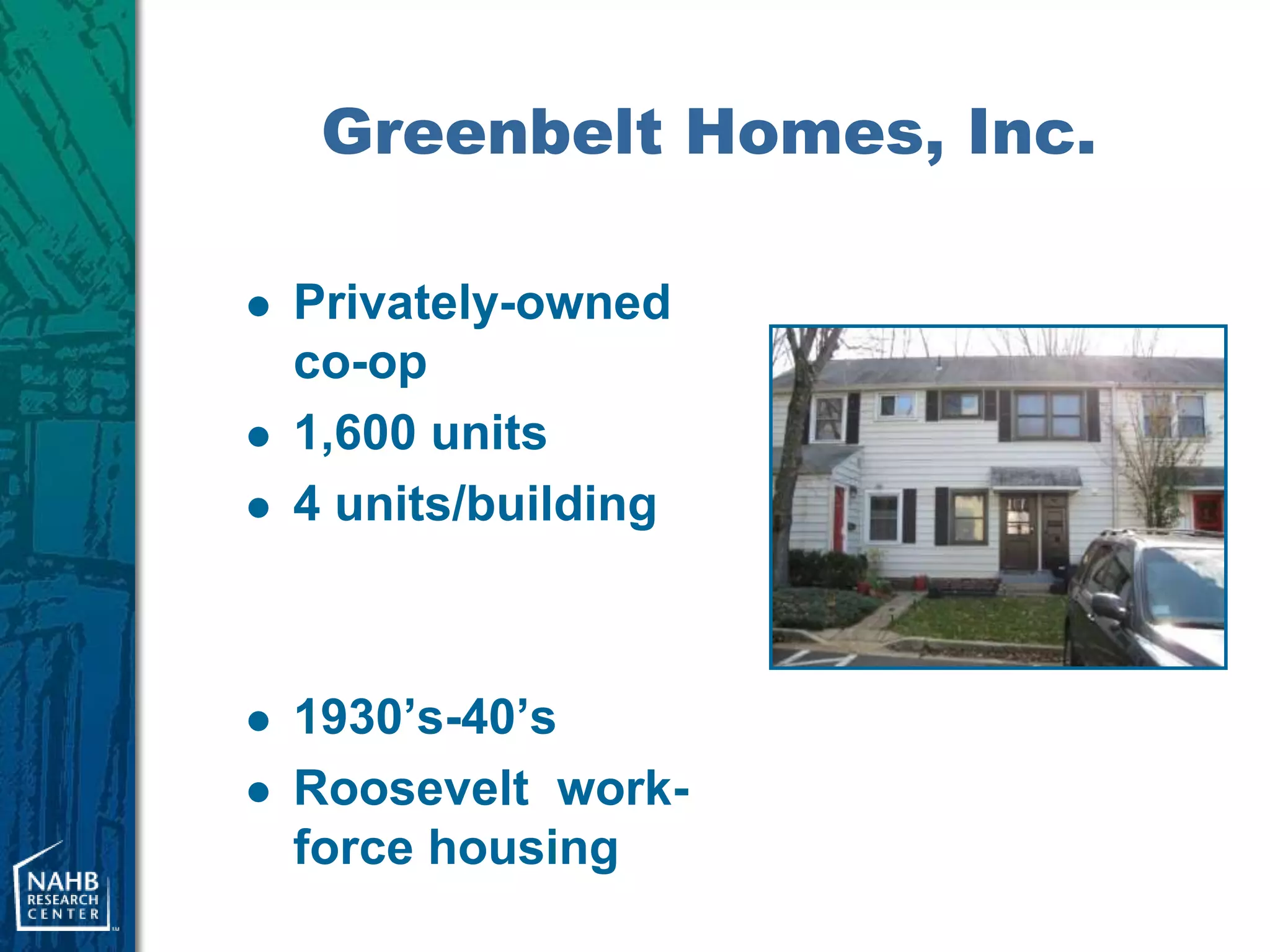
Greenbelt Homes, Inc.

   Privately-owned
    co-op
   1,600 units
   4 units/building


   1930’s-40’s
   Roosevelt work-
    force housing
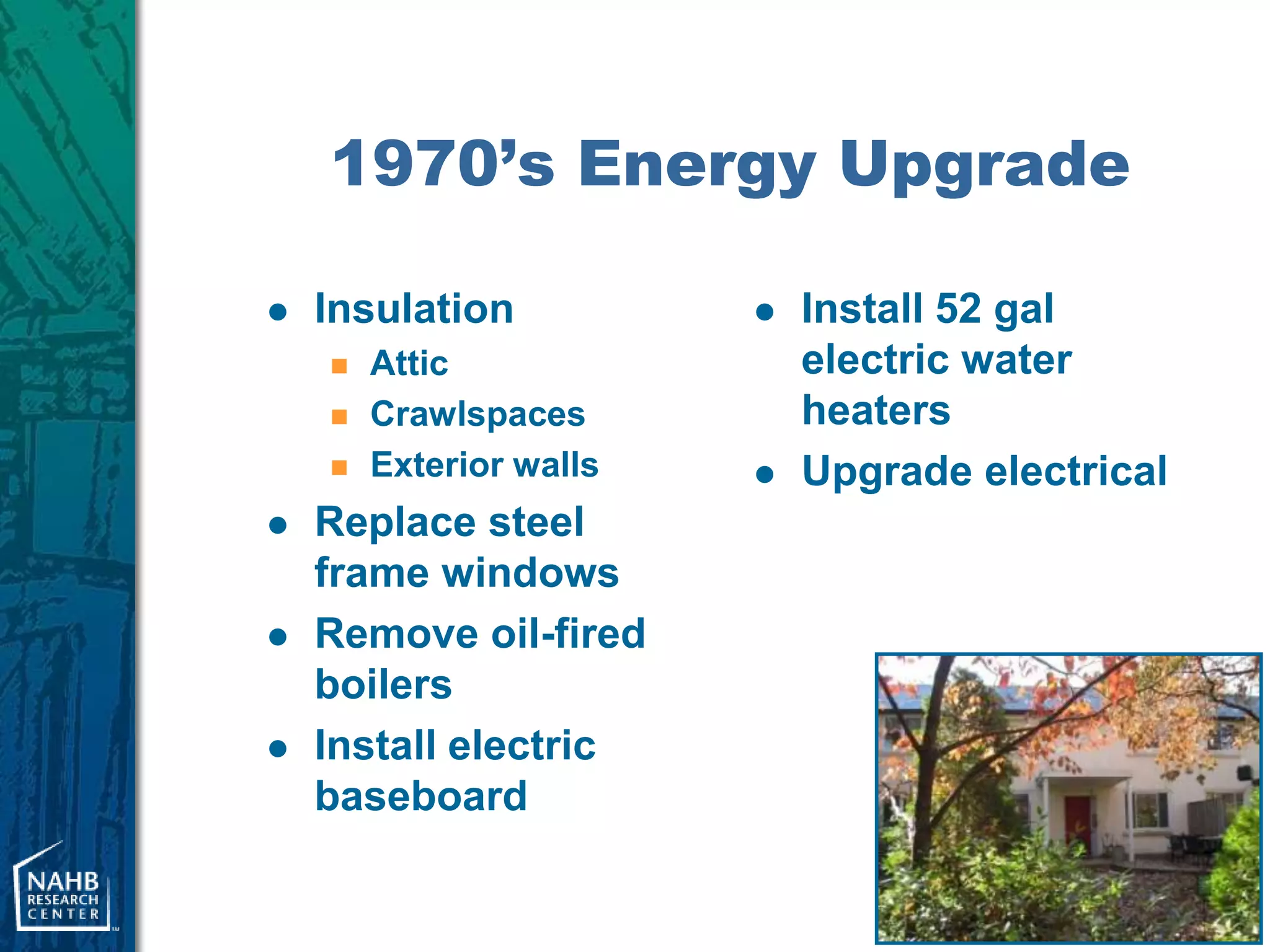
1970’s Energy Upgrade

   Insulation              Install 52 gal
       Attic                electric water
       Crawlspaces          heaters
       Exterior walls      Upgrade electrical
   Replace steel
    frame windows
   Remove oil-fired
    boilers
   Install electric
    baseboard

                                                  4
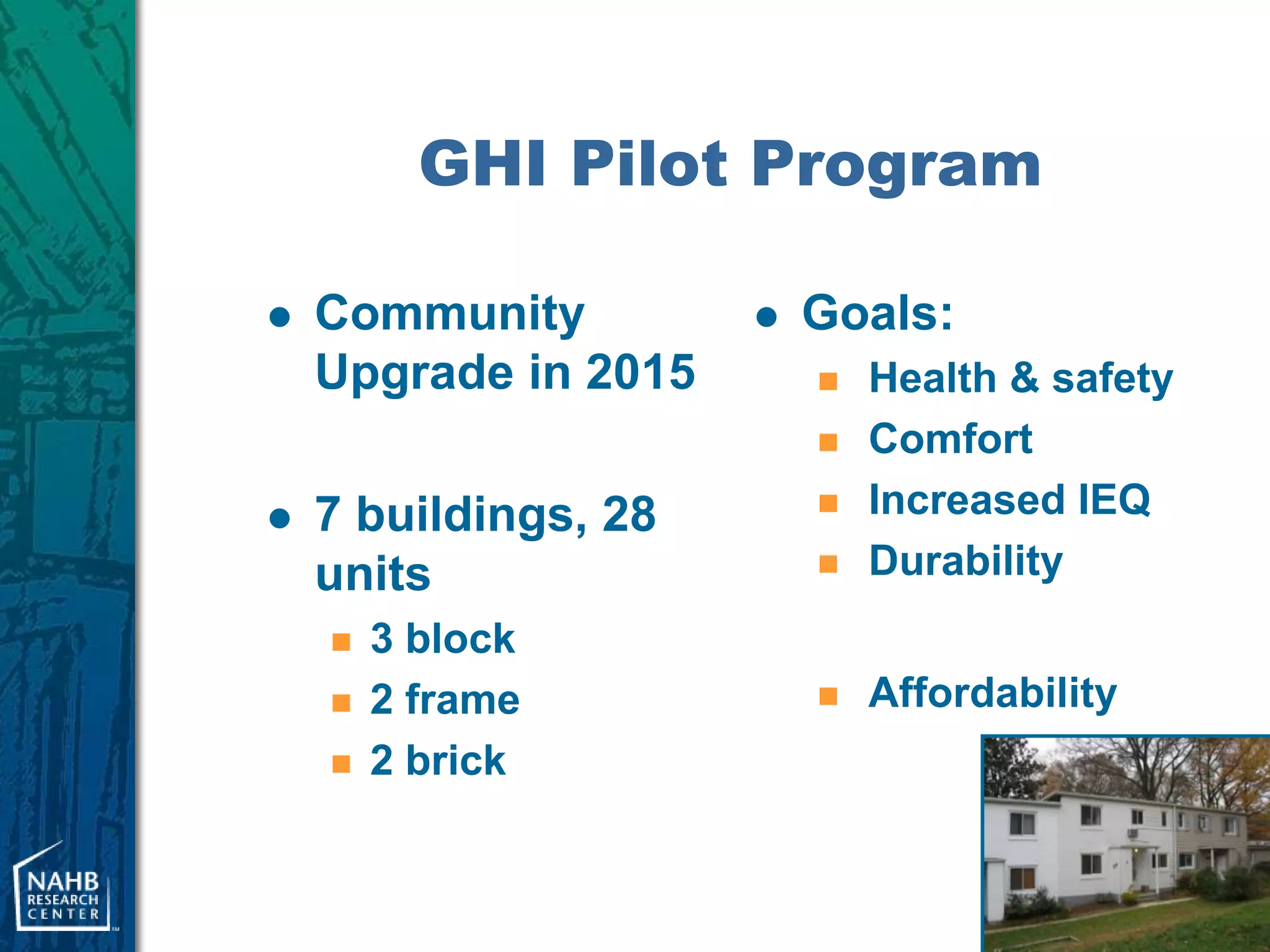
GHI Pilot Program

   Community            Goals:
    Upgrade in 2015          Health & safety
                             Comfort
   7 buildings, 28          Increased IEQ
    units                    Durability
       3 block
       2 frame              Affordability
       2 brick
Why?

Motivations for pilot program:
 Lower utility bills

 Comfort
   Lower life-cycle costs
       Maintenance & replacement


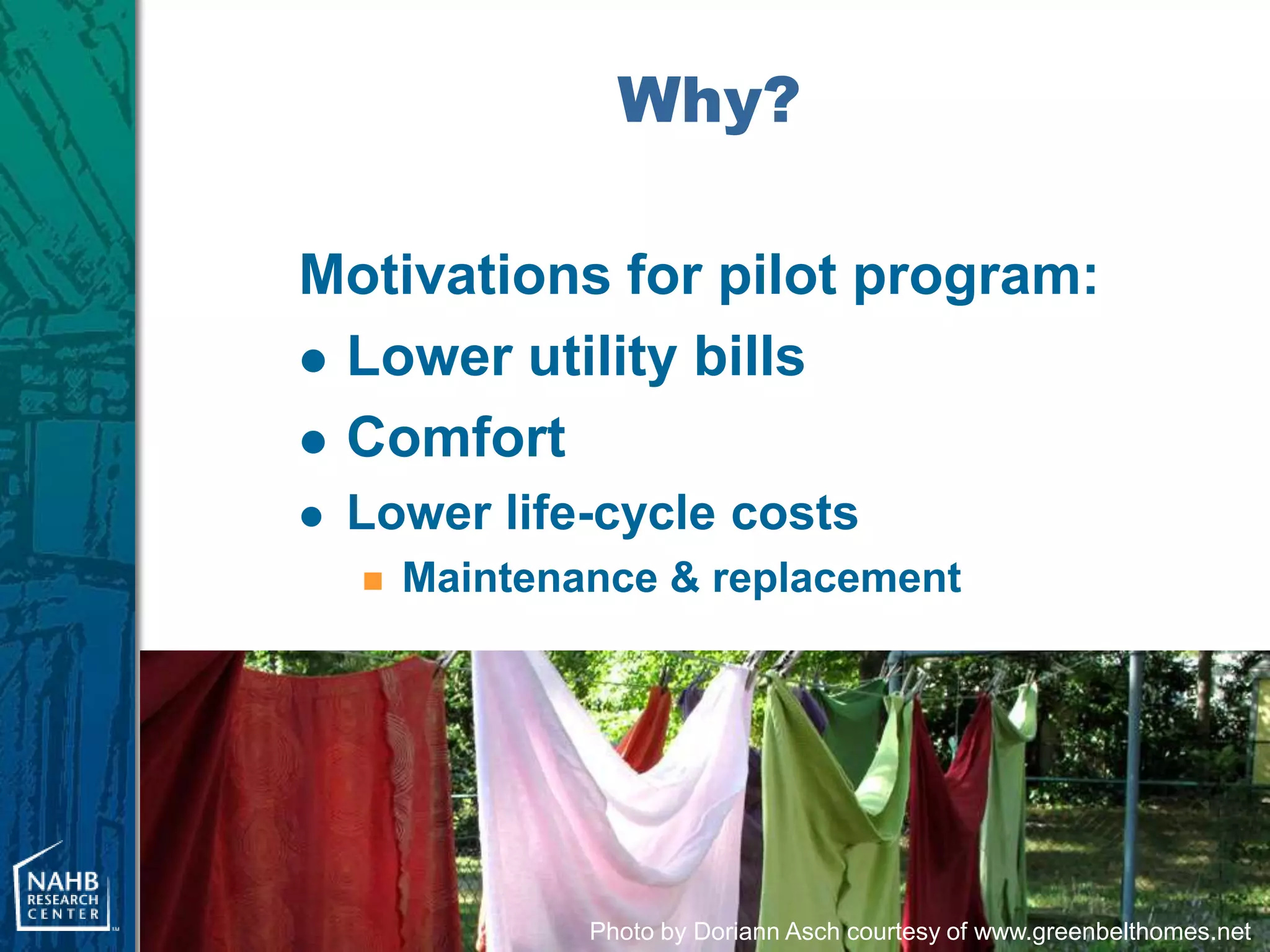
                Photo by Doriann Asch courtesy of www.greenbelthomes.net
Pilot Program

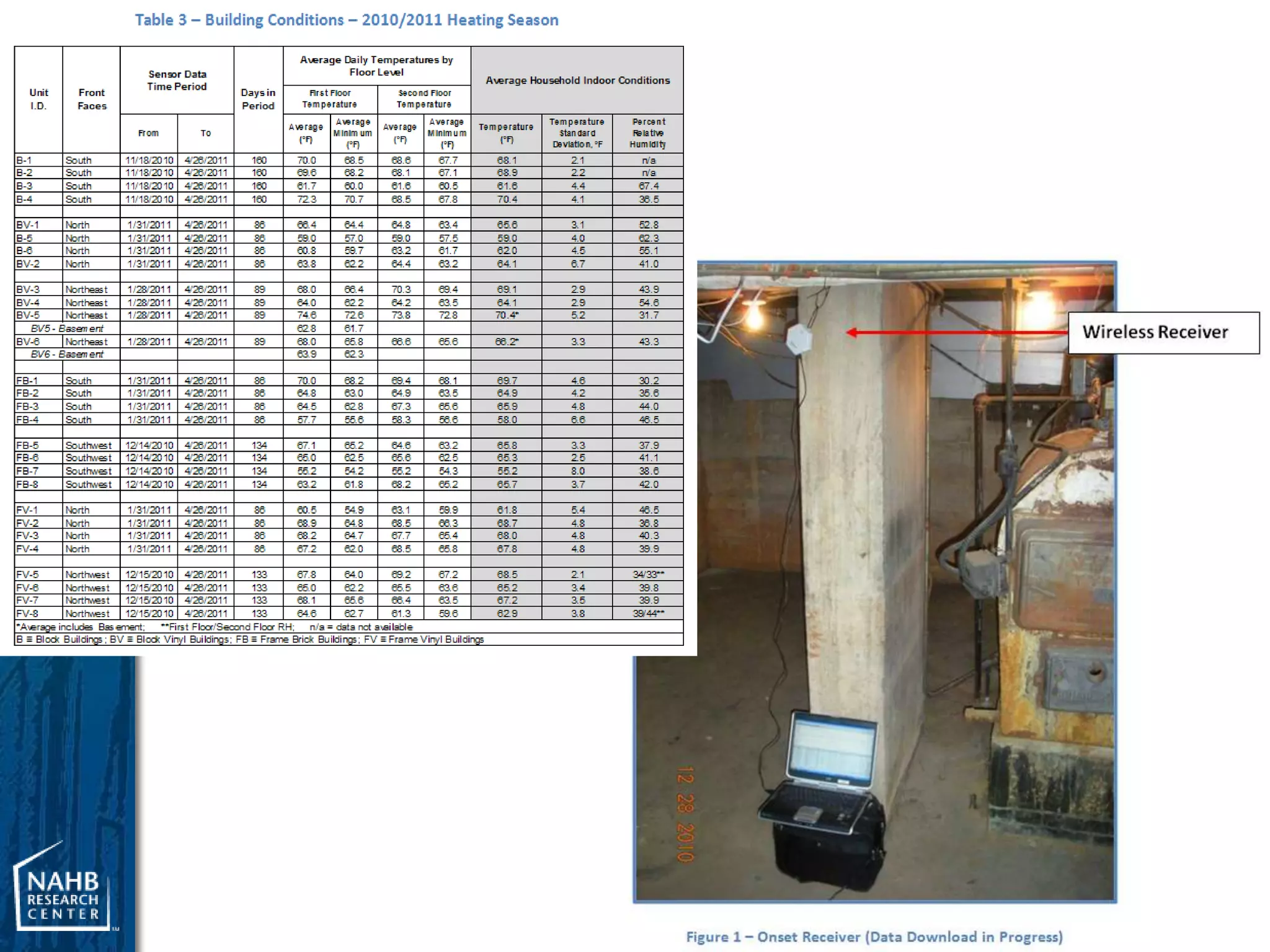
   Baseline Monitoring (2010-2011)
       Pre-Retrofit baseline
       Install Monitoring Equipment
       Air infiltration
       Temperature/Humidity/Energy Use
       Humidity
   Building Envelope Upgrades (2011-2012)
       Retrofit building envelopes
       Monitor envelope upgrade
   HVAC Upgrades (2012-2013)
       Retrofit HVAC
       Monitor upgrade package
Pilot House Assessment

   Walk-Through Evaluation
       Visual Inspection
       Homeowner Operation
       Utility Bills
   Short-term Testing


                                                                          8
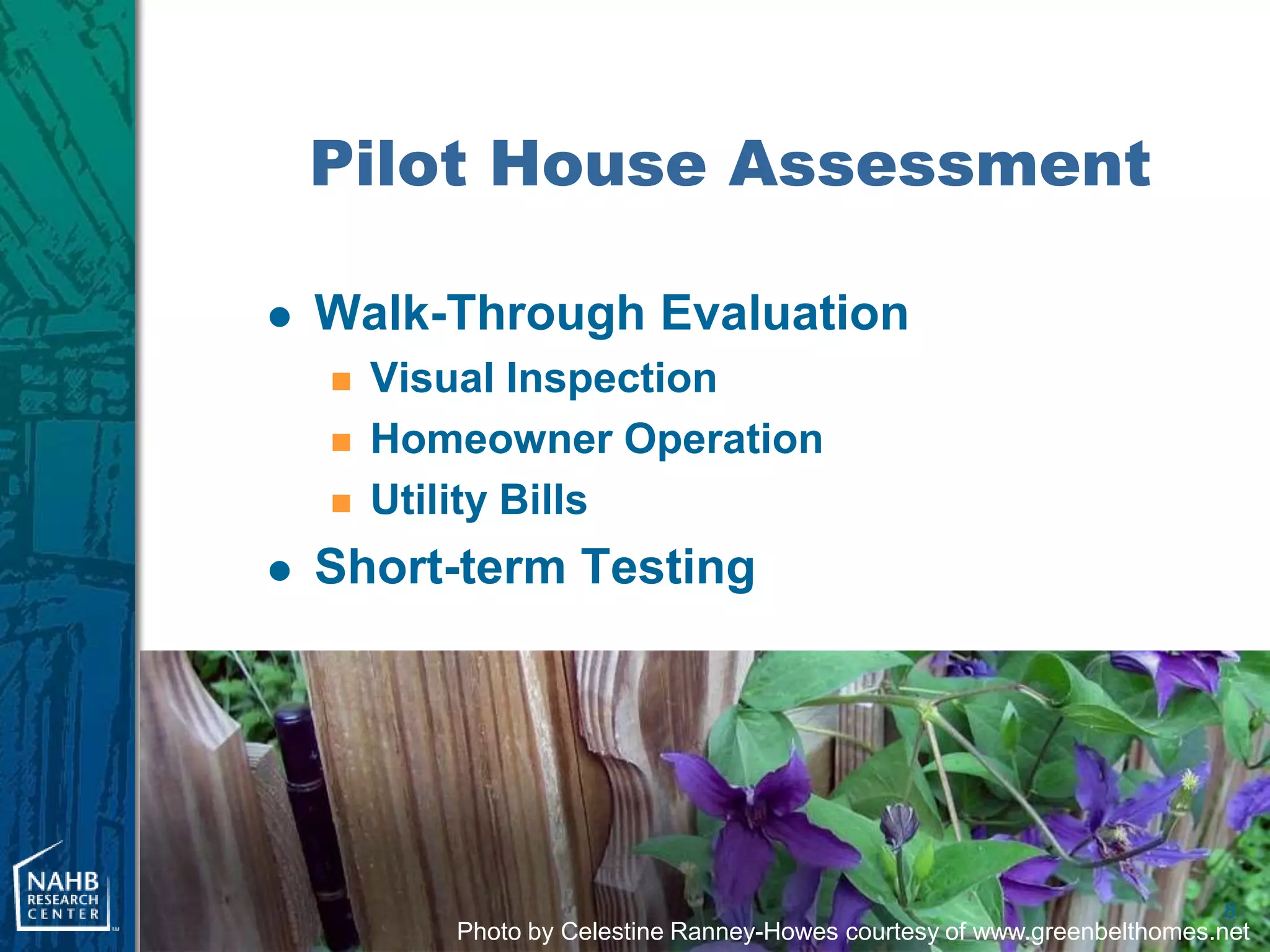
           Photo by Celestine Ranney-Howes courtesy of www.greenbelthomes.net
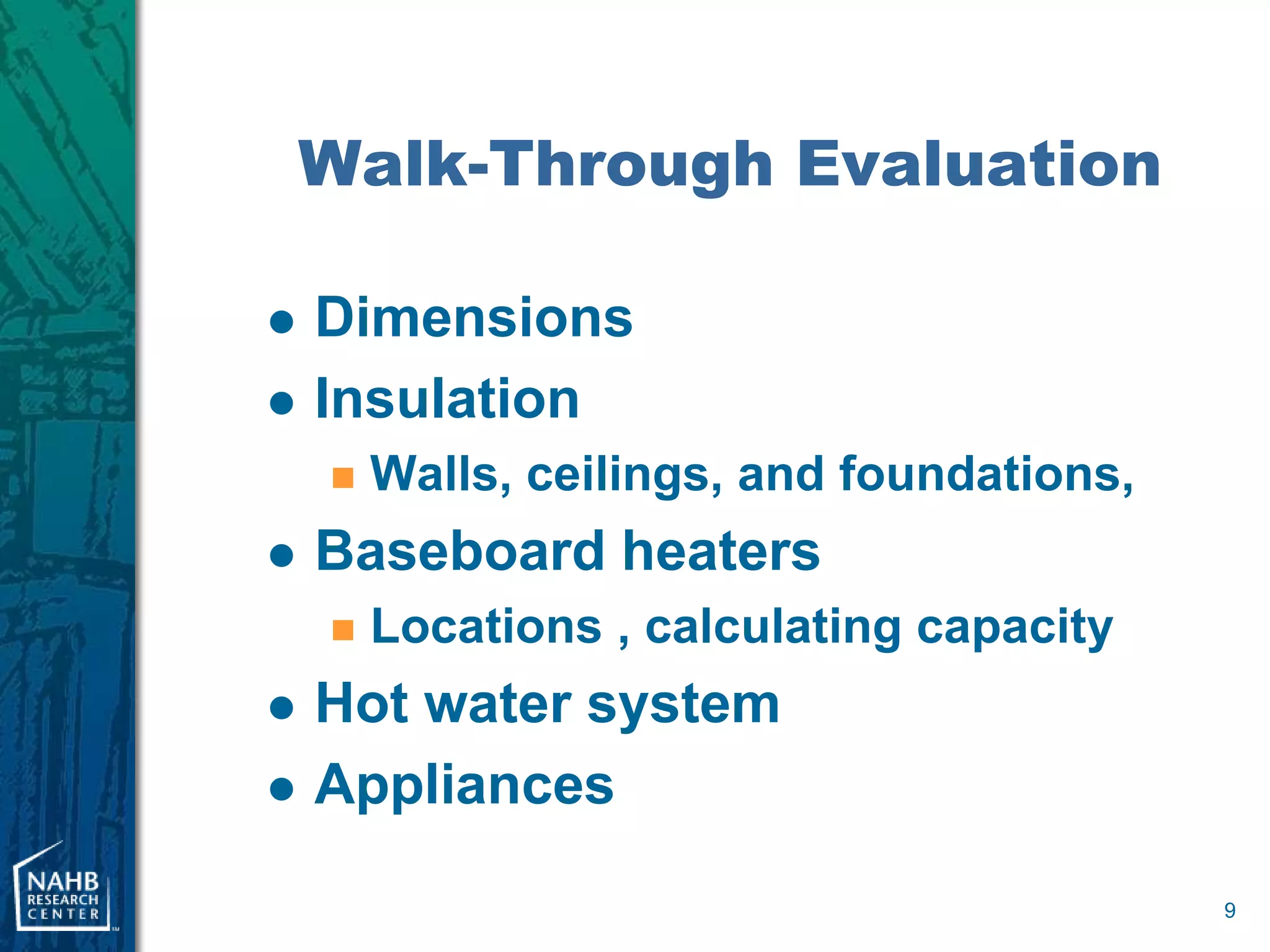
Walk-Through Evaluation

   Dimensions
   Insulation
       Walls, ceilings, and foundations,
   Baseboard heaters
       Locations , calculating capacity
   Hot water system
   Appliances

                                            9
10
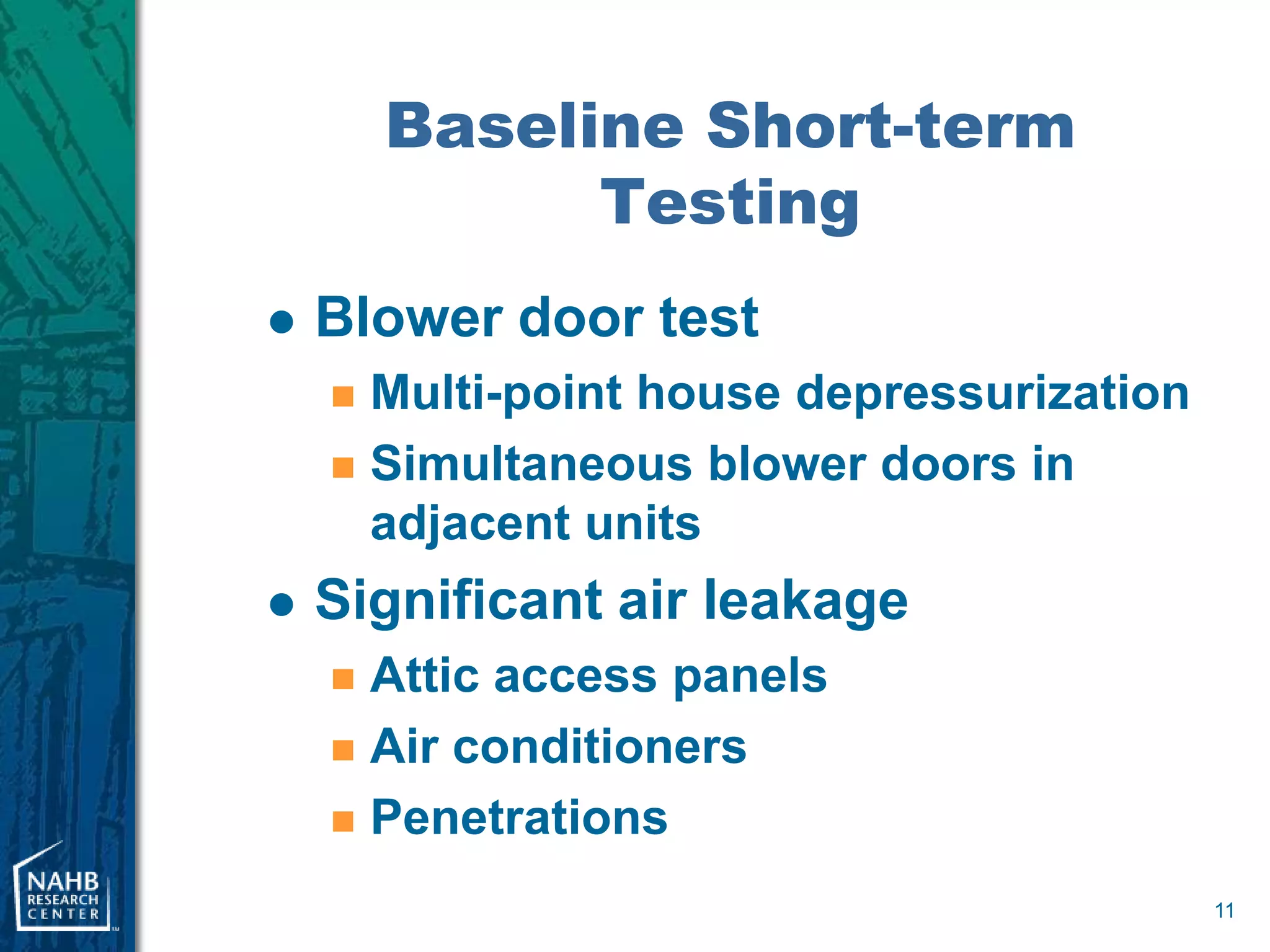
Baseline Short-term
              Testing
   Blower door test
     Multi-point house depressurization
     Simultaneous blower doors in
      adjacent units
   Significant air leakage
     Attic access panels
     Air conditioners

     Penetrations

                                           11
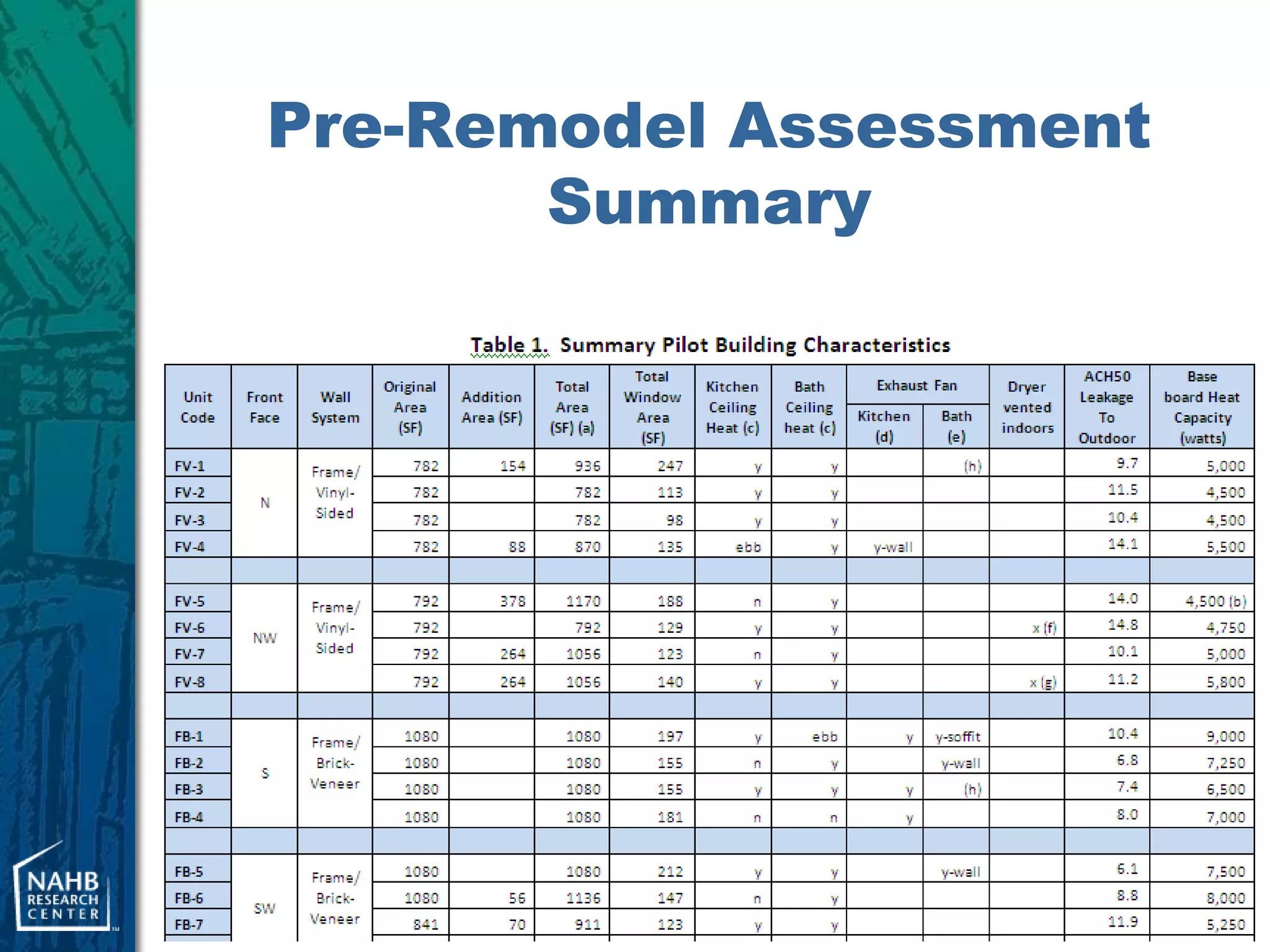
Pre-Remodel Assessment
       Summary
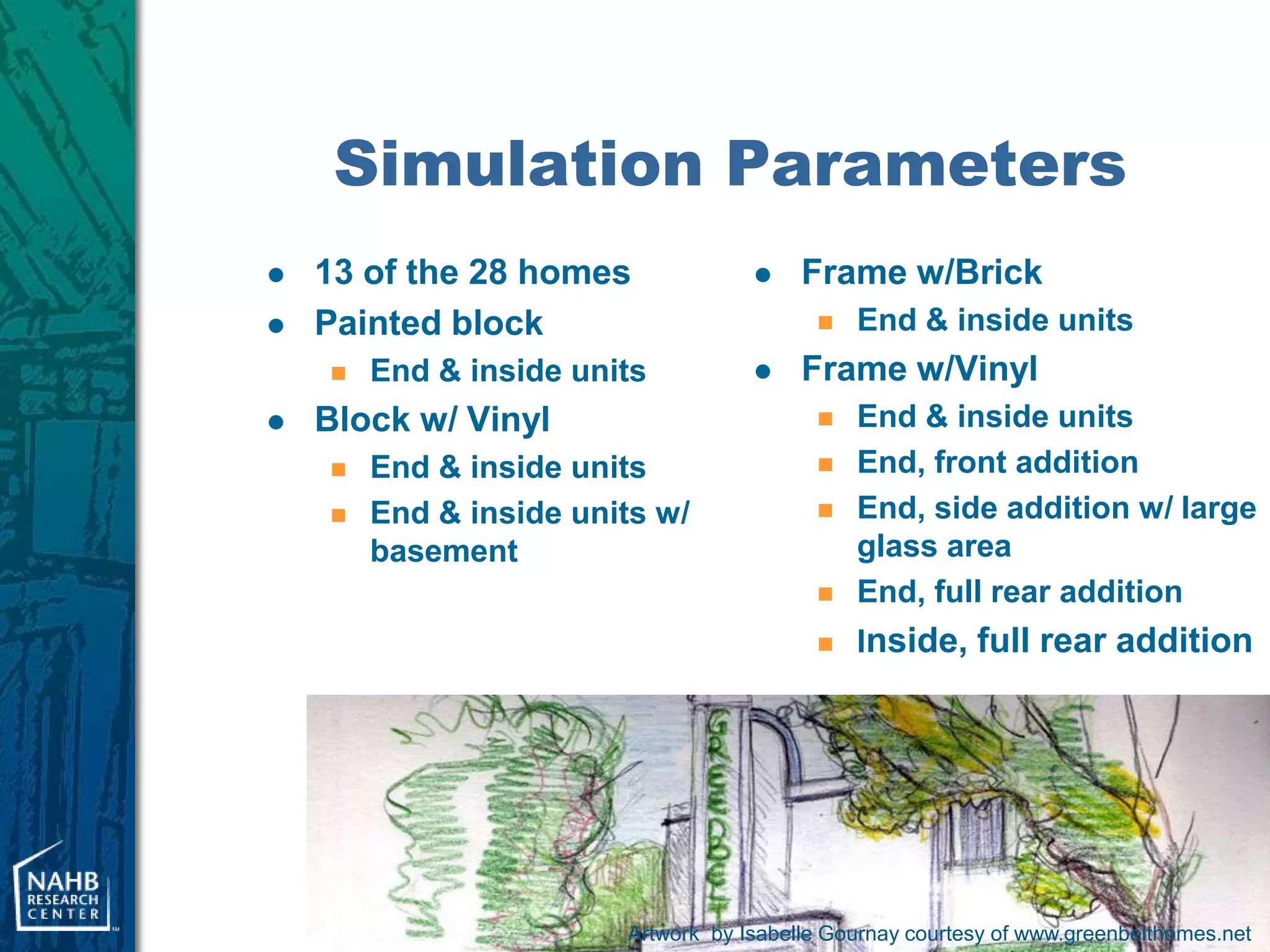
Simulation Parameters
   13 of the 28 homes                  Frame w/Brick
   Painted block                            End & inside units
       End & inside units              Frame w/Vinyl
   Block w/ Vinyl                           End & inside units
       End & inside units                   End, front addition
       End & inside units w/                End, side addition w/ large
        basement                              glass area
                                             End, full rear addition
                                             Inside, full rear addition


                                                                                  13
                        Artwork by Isabelle Gournay courtesy of www.greenbelthomes.net
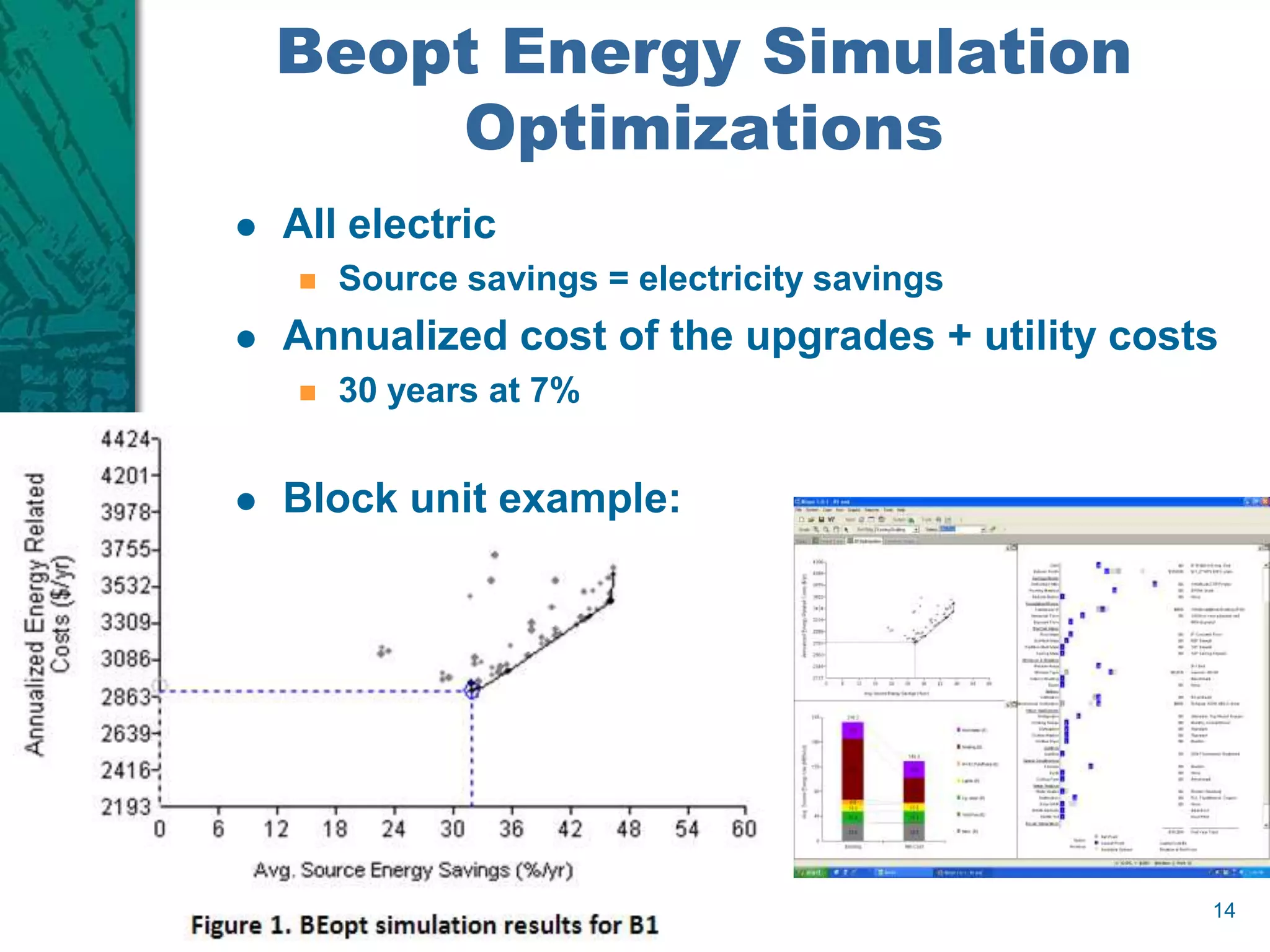
Beopt Energy Simulation
        Optimizations
   All electric
       Source savings = electricity savings
   Annualized cost of the upgrades + utility costs
       30 years at 7%


   Block unit example:


                                                  14
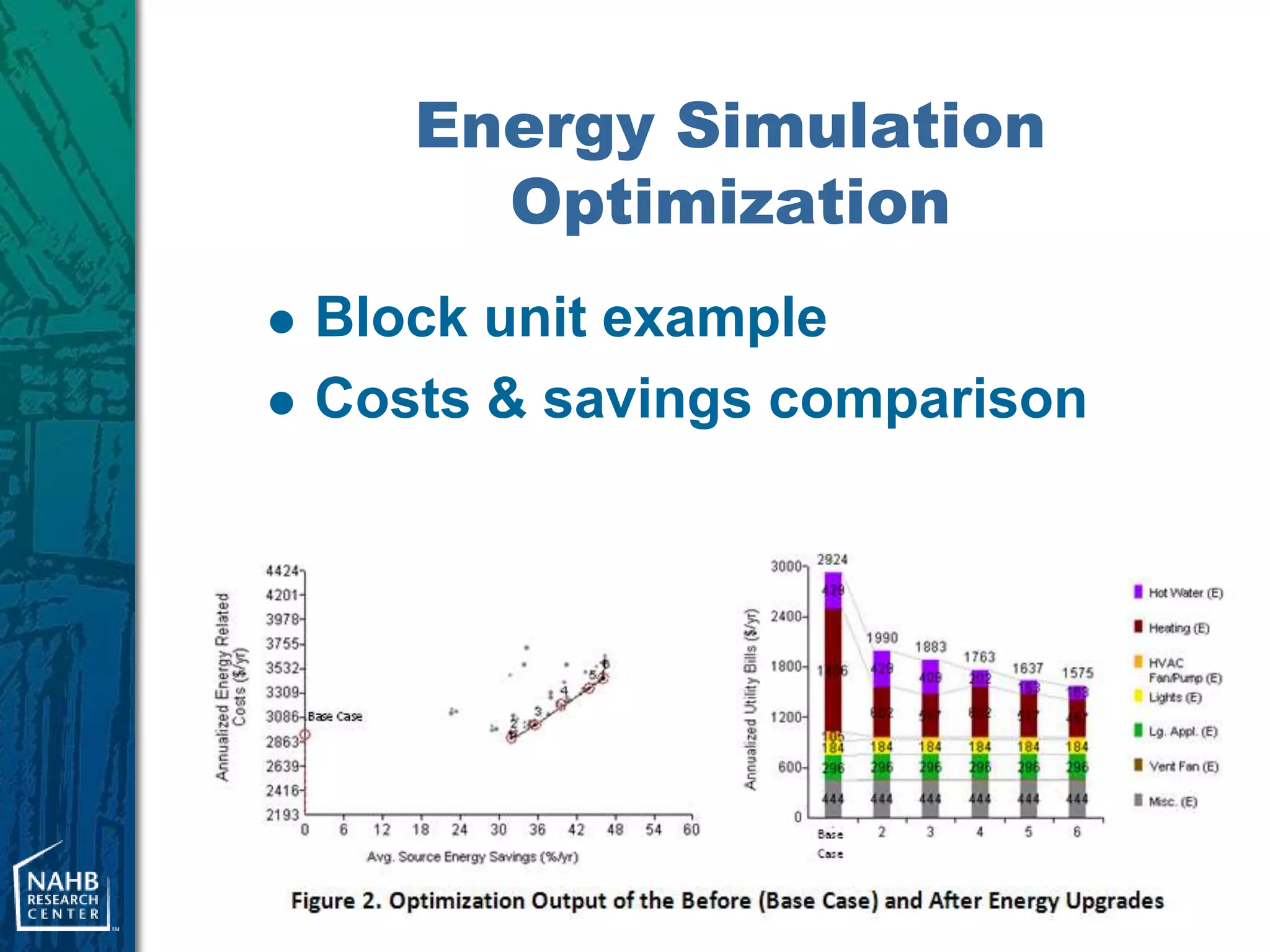
Energy Simulation
         Optimization
   Block unit example
   Costs & savings comparison


                                 15
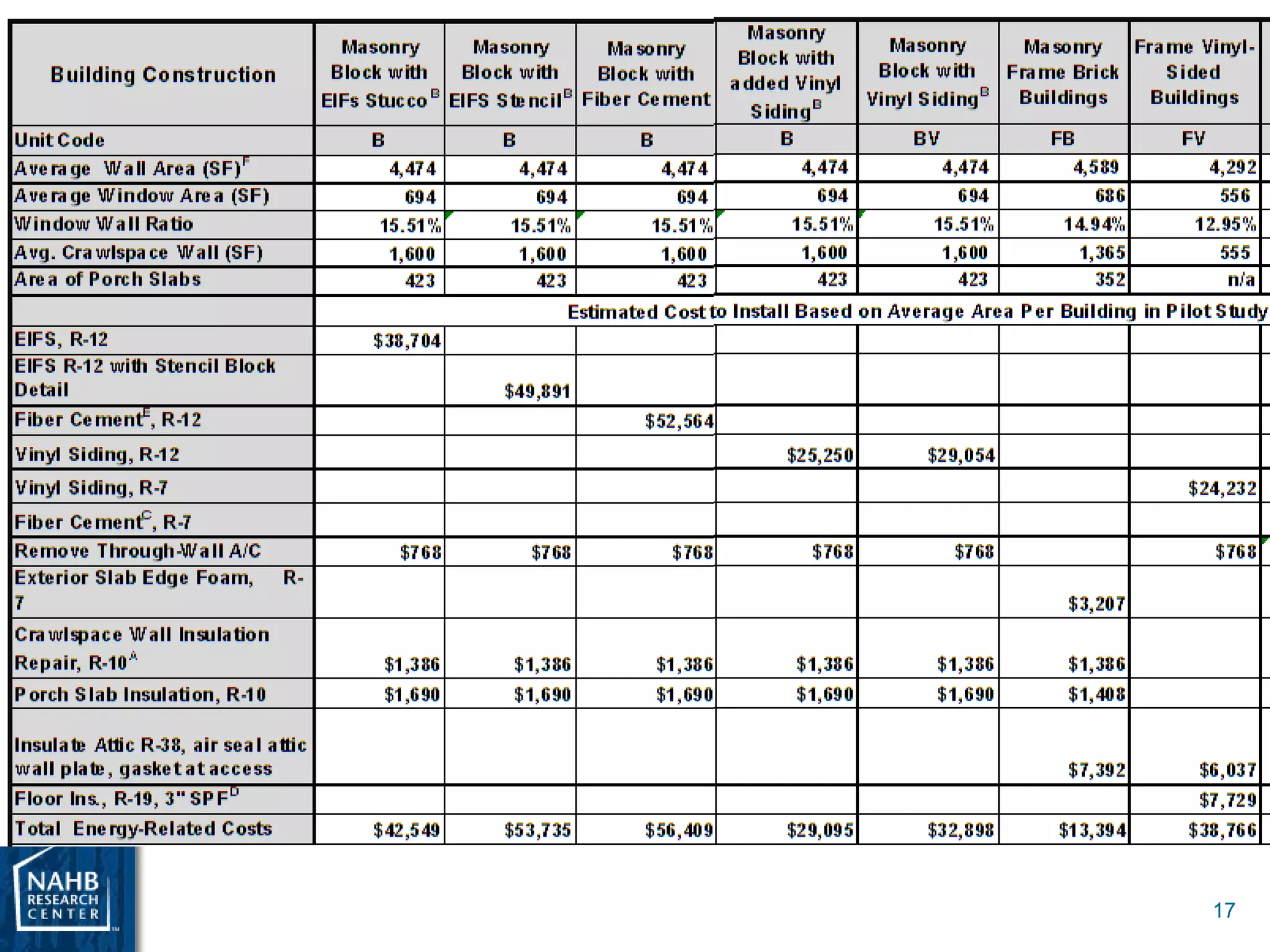
Installation Costs for Building
   Envelope Improvements
     Evaluated on a per-building
      basis
     Do not include remediation
      associated with environmental
      hazards (such as lead paint,
      radon, or asbestos)
     Costs are exclusive of
      management fees
                                      16
17
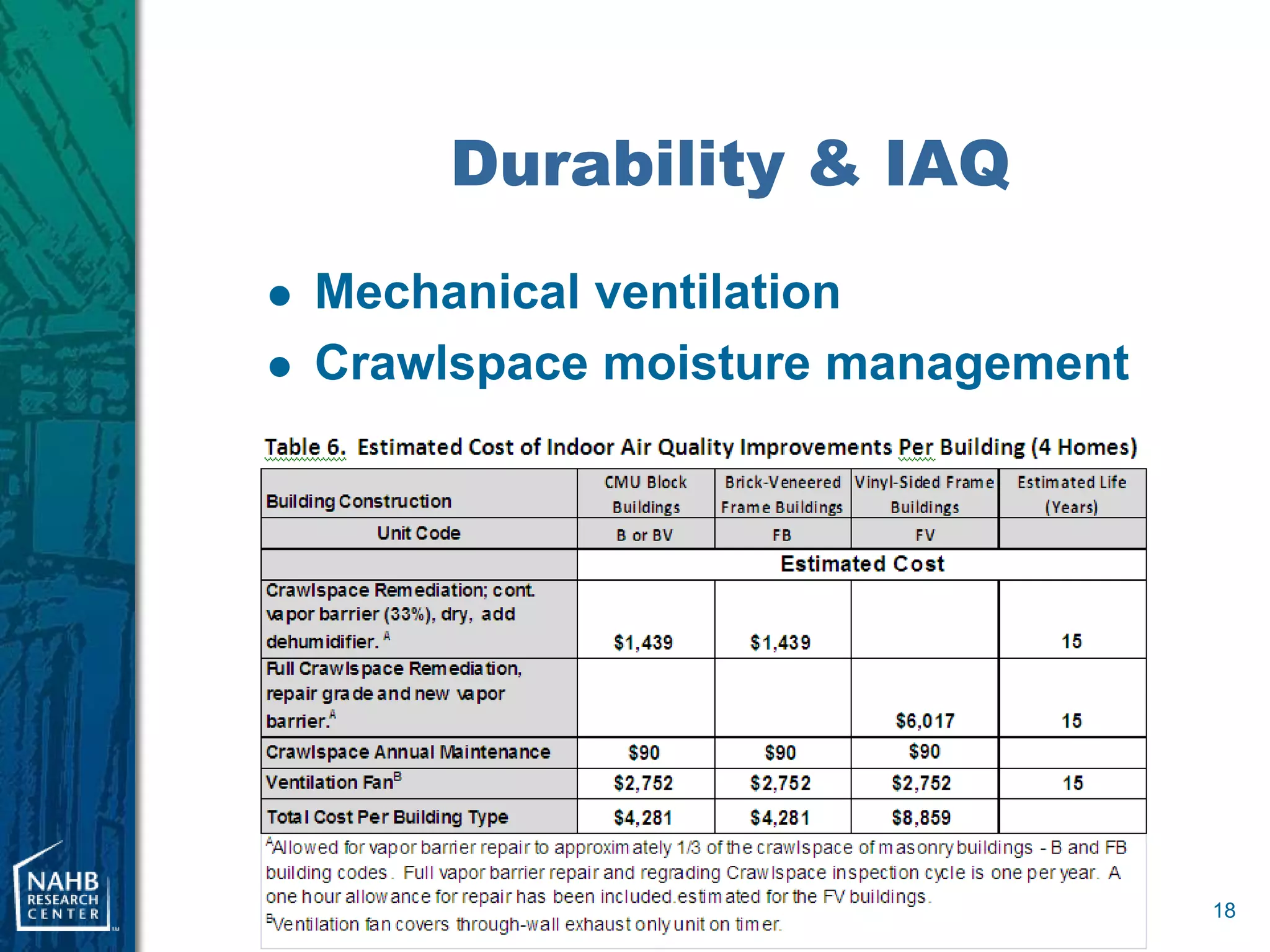
Durability & IAQ
   Mechanical ventilation
   Crawlspace moisture management


                                     18
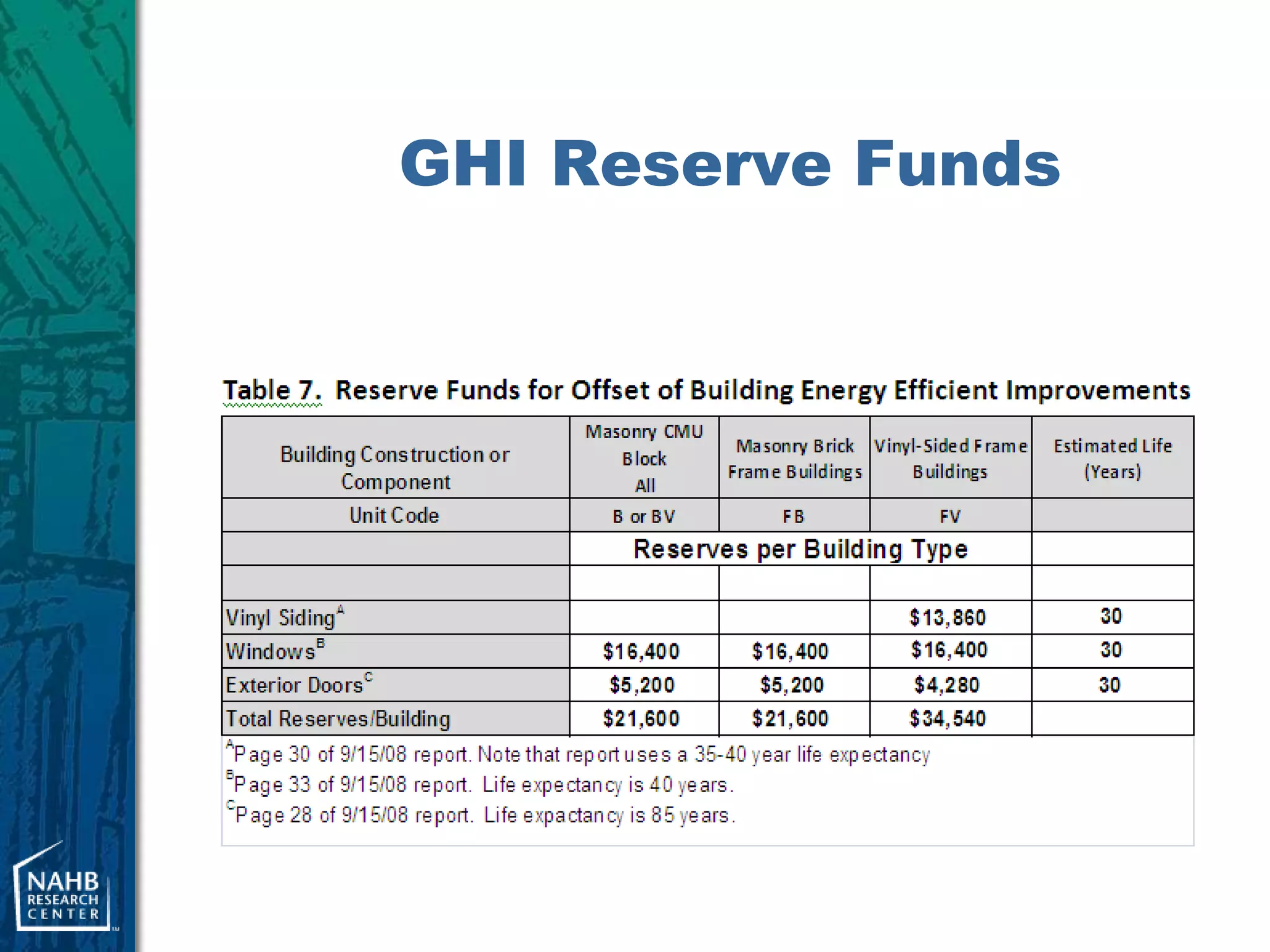
GHI Reserve Funds
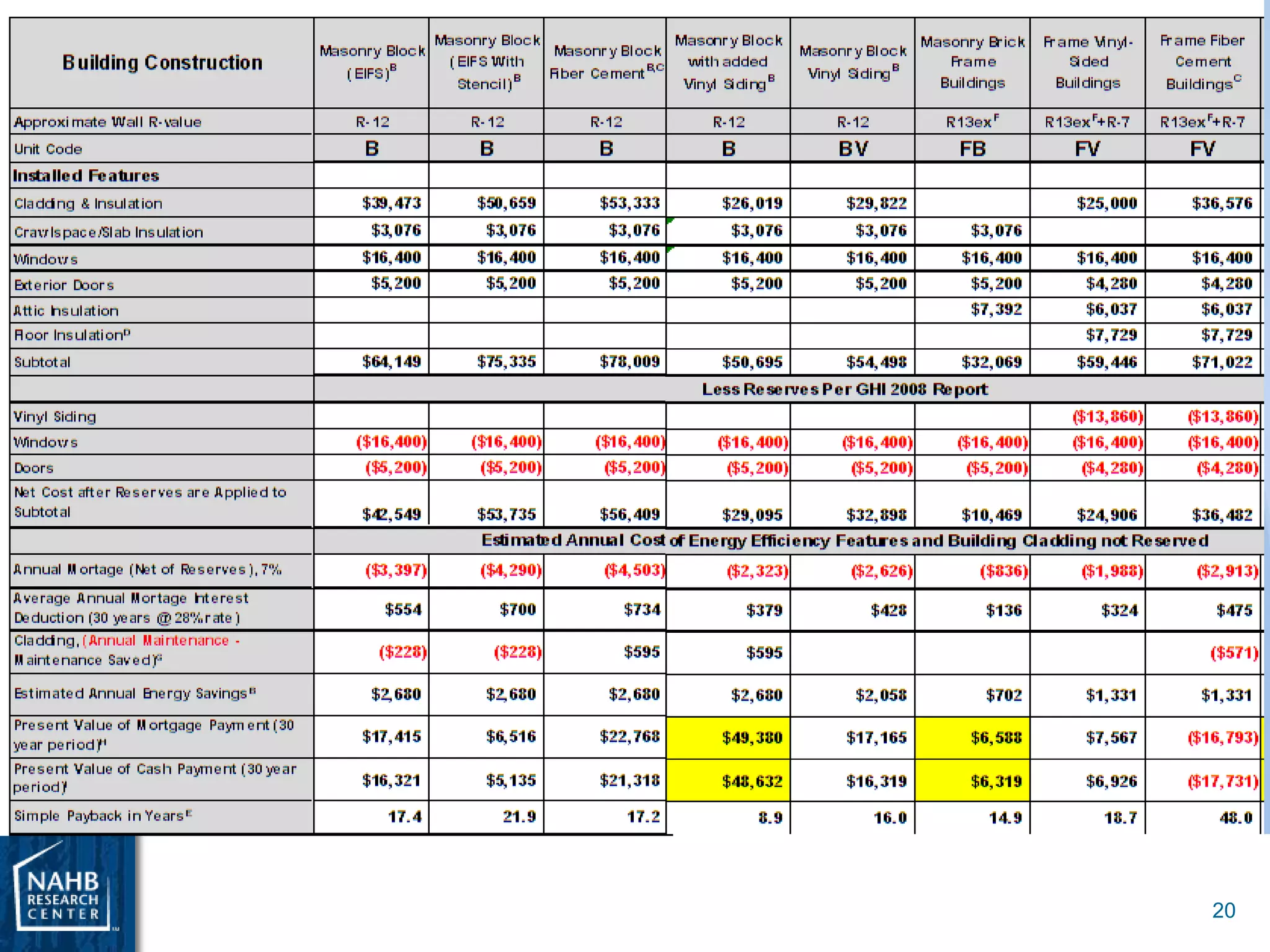
Cost Analysis


                20
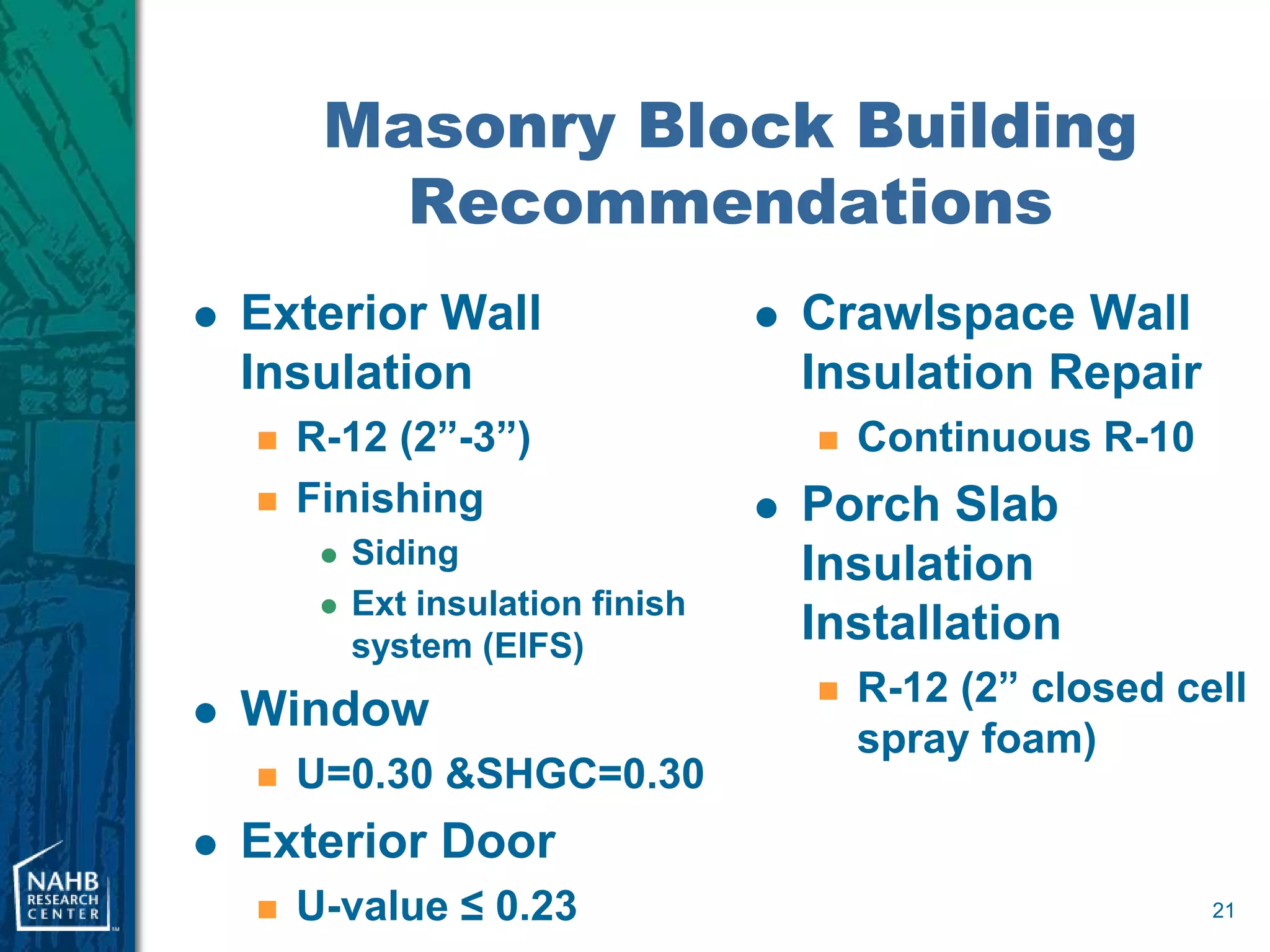
Masonry Block Building
           Recommendations
   Exterior Wall                       Crawlspace Wall
    Insulation                           Insulation Repair
       R-12 (2”-3”)                        Continuous R-10
       Finishing                       Porch Slab
            Siding                      Insulation
            Ext insulation finish
             system (EIFS)
                                         Installation
                                            R-12 (2” closed cell
   Window
                                             spray foam)
       U=0.30 &SHGC=0.30
   Exterior Door
       U-value ≤ 0.23                                         21
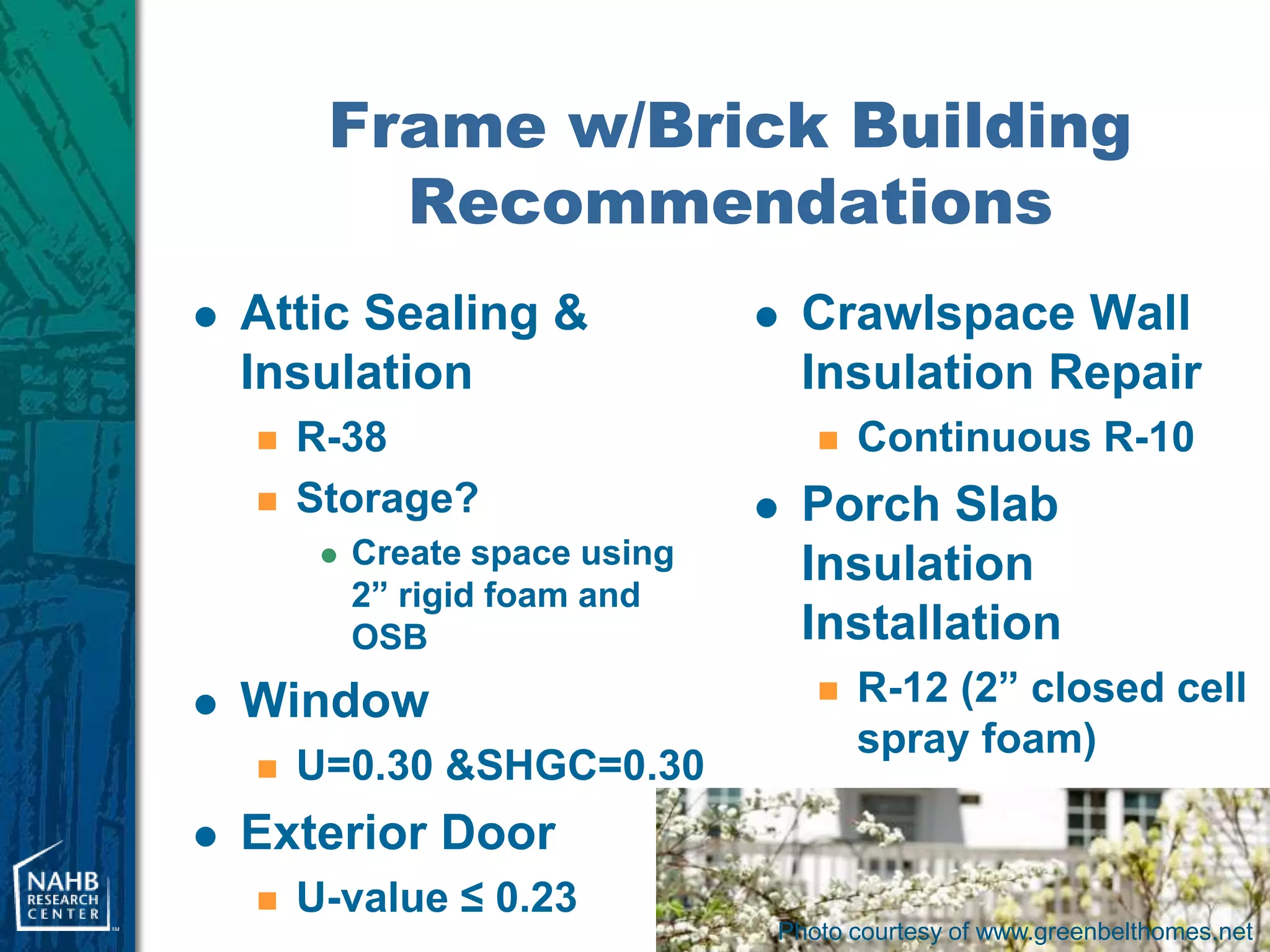
Frame w/Brick Building
           Recommendations
   Attic Sealing &                  Crawlspace Wall
    Insulation                        Insulation Repair
       R-38                             Continuous R-10
       Storage?                     Porch Slab
            Create space using       Insulation
             2” rigid foam and
             OSB                      Installation
   Window                               R-12 (2” closed cell
                                          spray foam)
       U=0.30 &SHGC=0.30
   Exterior Door
       U-value ≤ 0.23                                                22
                                  Photo courtesy of www.greenbelthomes.net
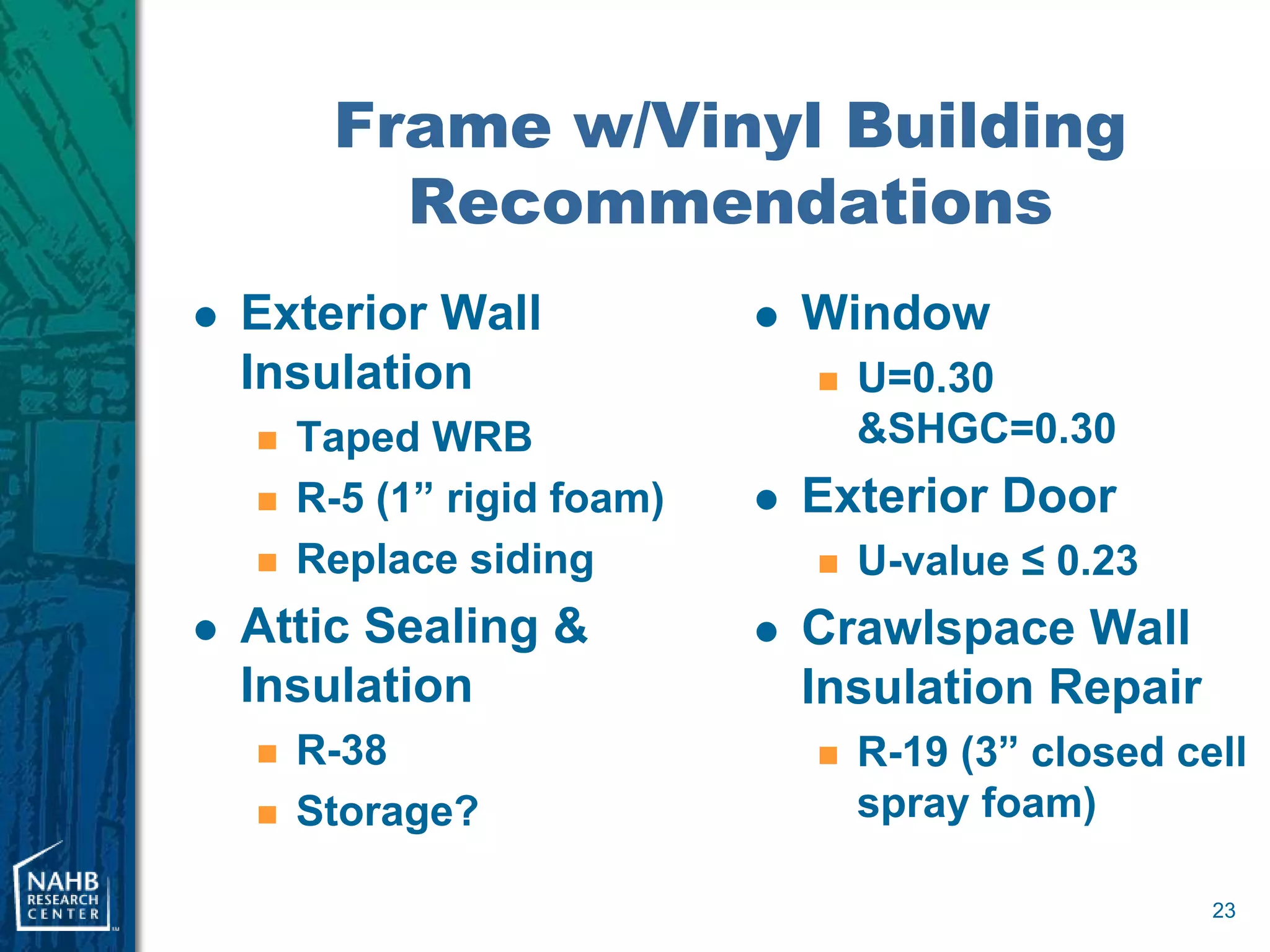
Frame w/Vinyl Building
           Recommendations
   Exterior Wall                Window
    Insulation                       U=0.30
       Taped WRB                     &SHGC=0.30
       R-5 (1” rigid foam)      Exterior Door
       Replace siding               U-value ≤ 0.23
   Attic Sealing &              Crawlspace Wall
    Insulation                    Insulation Repair
       R-38                         R-19 (3” closed cell
       Storage?                      spray foam)

                                                        23
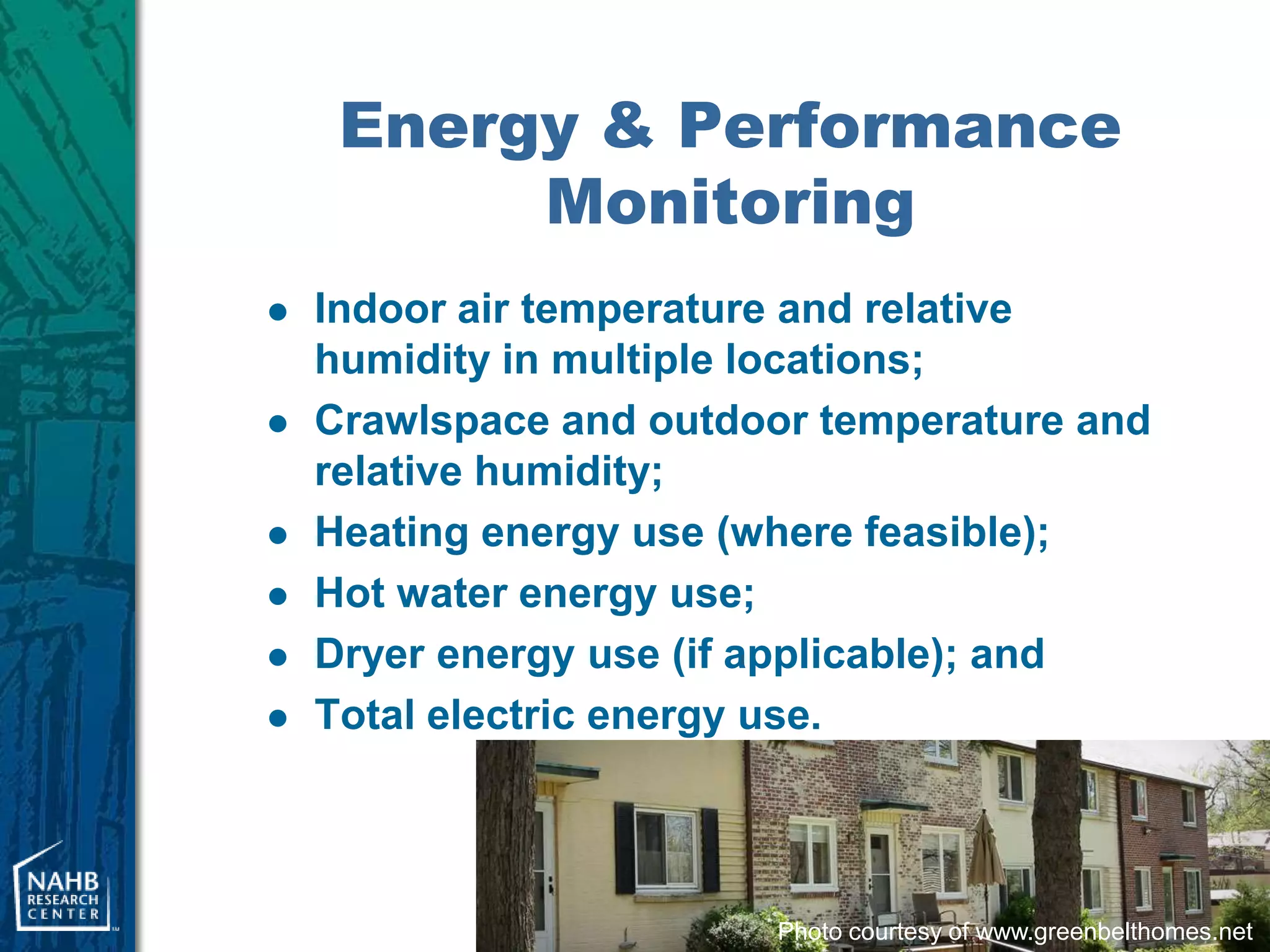
Energy & Performance
          Monitoring
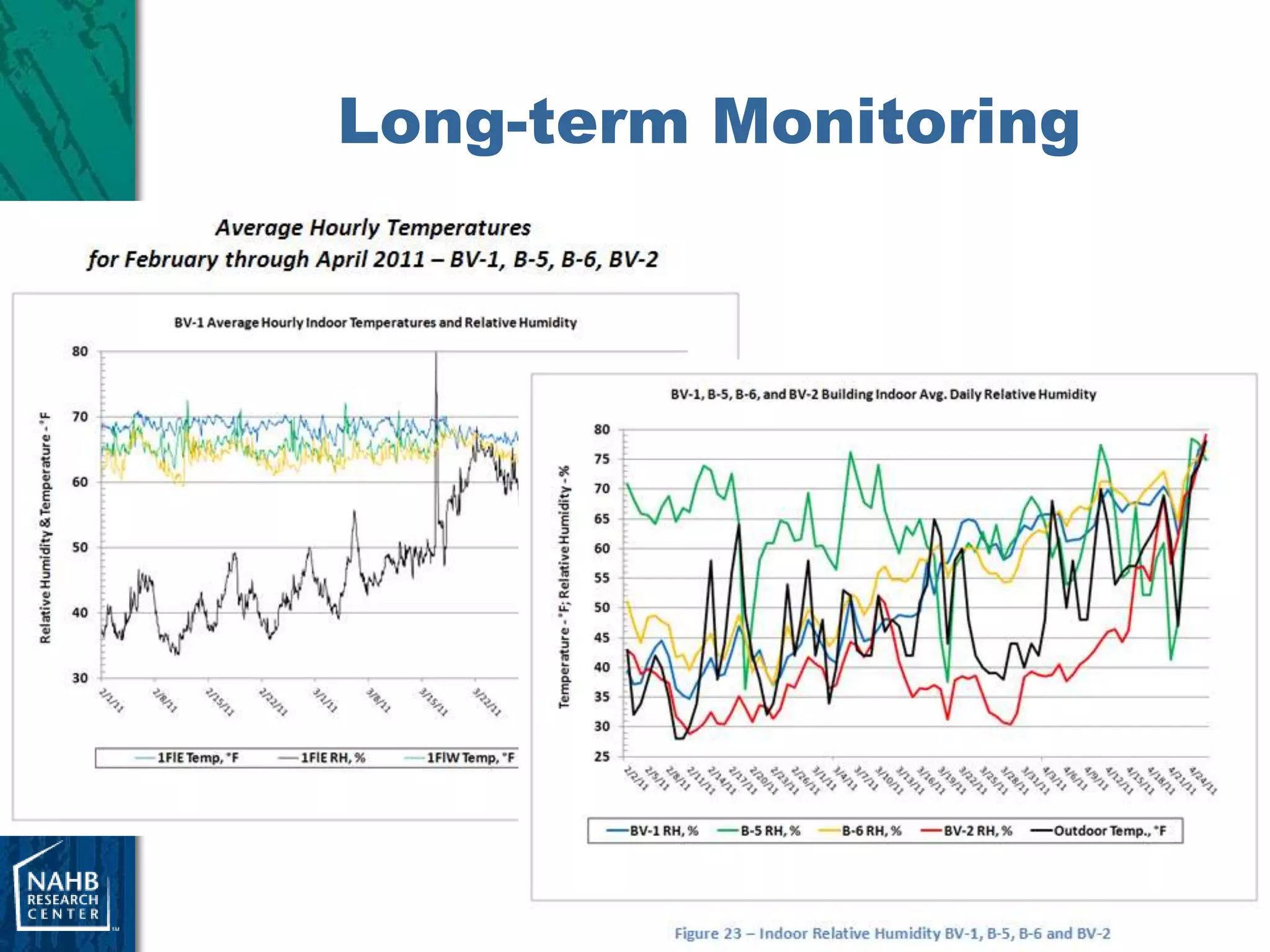
   Indoor air temperature and relative
    humidity in multiple locations;
   Crawlspace and outdoor temperature and
    relative humidity;
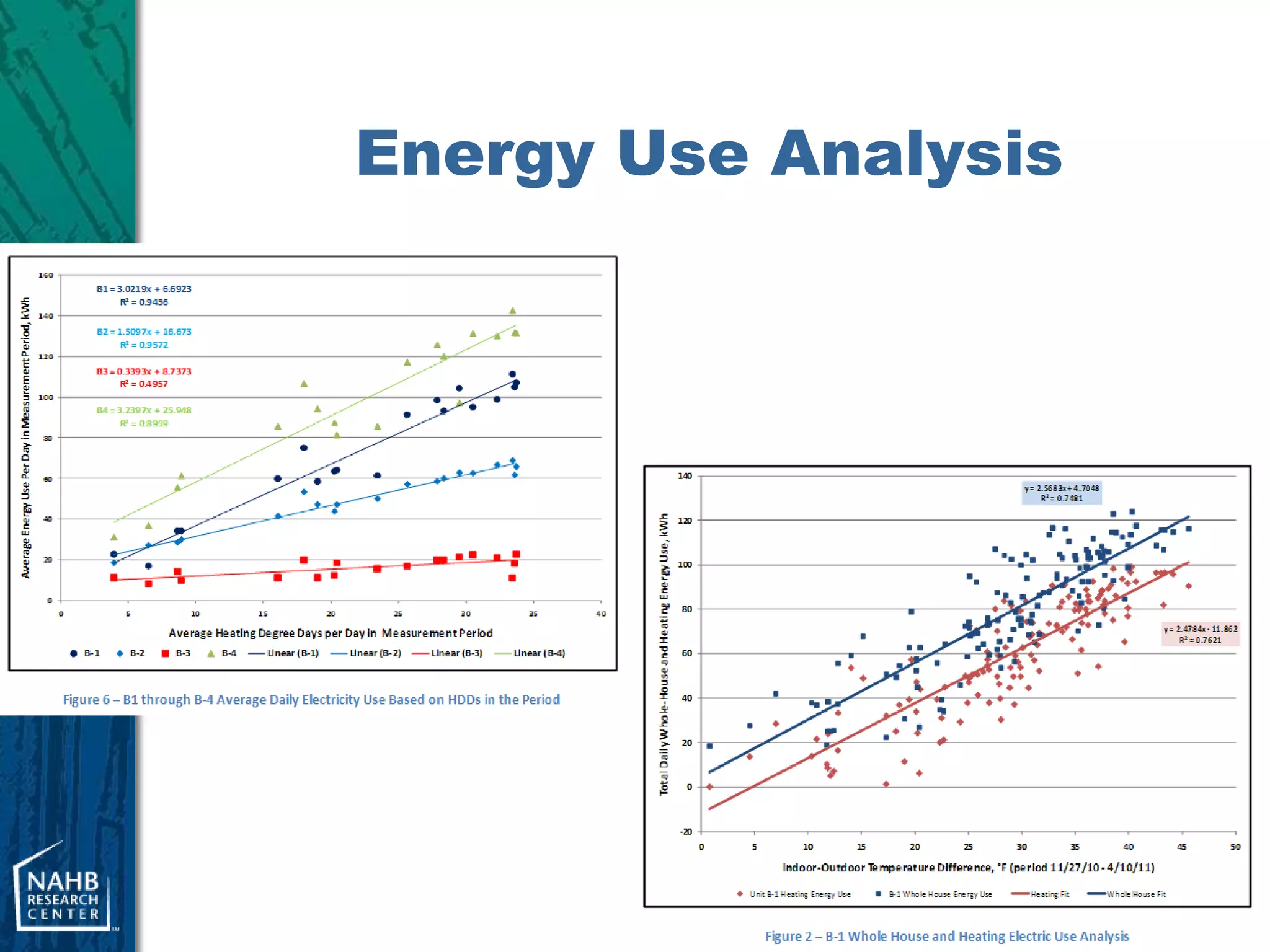
   Heating energy use (where feasible);
   Hot water energy use;
   Dryer energy use (if applicable); and
   Total electric energy use.


                                                             24
                         Photo courtesy of www.greenbelthomes.net
25
Long-term Monitoring


                       26
Energy Use Analysis


                      27
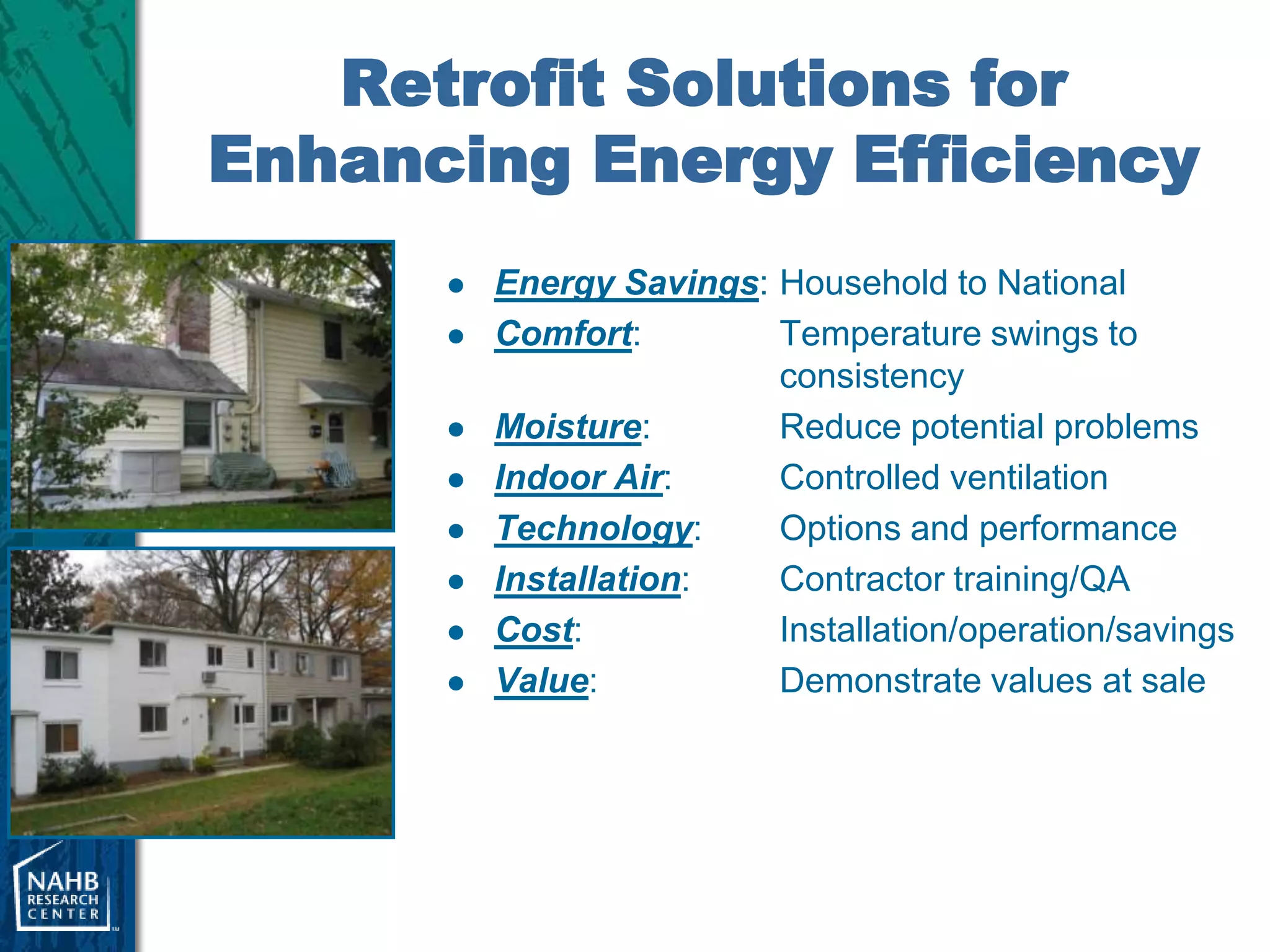
Retrofit Solutions for
Enhancing Energy Efficiency
         Energy Savings: Household to National
         Comfort:        Temperature swings to
                          consistency
         Moisture:       Reduce potential problems
         Indoor Air:     Controlled ventilation
         Technology:     Options and performance
         Installation:   Contractor training/QA
         Cost:           Installation/operation/savings
         Value:          Demonstrate values at sale
Questions?


             29
Thank You!


                            Amber Wood
                        NAHB Research Center
                       Manager, Energy Programs

           400 Prince George’s Blvd  Upper Marlboro, MD 20774
                  (direct) 301.430.6309  (fax) 301.430.6180
                              www.nahbrc.com

Driving Innovation in Housing Technology

2011 09-14 eeba - nahbrc building america high performance retrofits

  • 1.
    BA High Performance Retrofits Amber Wood Manager, Energy Programs EEBA Conference 2011 September 14, 2011 Driving Innovation in Housing Technology
  • 2.
    Building America  Private/public R&D partnership sponsored by DOE  Energy-efficient solutions for new and existing housing  Technologies/Systems  Whole-House Test Homes  Quality Processes
  • 3.
    Greenbelt Homes, Inc.  Privately-owned co-op  1,600 units  4 units/building  1930’s-40’s  Roosevelt work- force housing
  • 4.
    1970’s Energy Upgrade  Insulation  Install 52 gal  Attic electric water  Crawlspaces heaters  Exterior walls  Upgrade electrical  Replace steel frame windows  Remove oil-fired boilers  Install electric baseboard 4
  • 5.
    GHI Pilot Program  Community  Goals: Upgrade in 2015  Health & safety  Comfort  7 buildings, 28  Increased IEQ units  Durability  3 block  2 frame  Affordability  2 brick
  • 6.
    Why? Motivations for pilotprogram:  Lower utility bills  Comfort  Lower life-cycle costs  Maintenance & replacement Photo by Doriann Asch courtesy of www.greenbelthomes.net
  • 7.
    Pilot Program  Baseline Monitoring (2010-2011)  Pre-Retrofit baseline  Install Monitoring Equipment  Air infiltration  Temperature/Humidity/Energy Use  Humidity  Building Envelope Upgrades (2011-2012)  Retrofit building envelopes  Monitor envelope upgrade  HVAC Upgrades (2012-2013)  Retrofit HVAC  Monitor upgrade package
  • 8.
    Pilot House Assessment  Walk-Through Evaluation  Visual Inspection  Homeowner Operation  Utility Bills  Short-term Testing 8 Photo by Celestine Ranney-Howes courtesy of www.greenbelthomes.net
  • 9.
    Walk-Through Evaluation  Dimensions  Insulation  Walls, ceilings, and foundations,  Baseboard heaters  Locations , calculating capacity  Hot water system  Appliances 9
  • 10.
  • 11.
    Baseline Short-term Testing  Blower door test  Multi-point house depressurization  Simultaneous blower doors in adjacent units  Significant air leakage  Attic access panels  Air conditioners  Penetrations 11
  • 12.
  • 13.
    Simulation Parameters  13 of the 28 homes  Frame w/Brick  Painted block  End & inside units  End & inside units  Frame w/Vinyl  Block w/ Vinyl  End & inside units  End & inside units  End, front addition  End & inside units w/  End, side addition w/ large basement glass area  End, full rear addition  Inside, full rear addition 13 Artwork by Isabelle Gournay courtesy of www.greenbelthomes.net
  • 14.
    Beopt Energy Simulation Optimizations  All electric  Source savings = electricity savings  Annualized cost of the upgrades + utility costs  30 years at 7%  Block unit example: 14
  • 15.
    Energy Simulation Optimization  Block unit example  Costs & savings comparison 15
  • 16.
    Installation Costs forBuilding Envelope Improvements  Evaluated on a per-building basis  Do not include remediation associated with environmental hazards (such as lead paint, radon, or asbestos)  Costs are exclusive of management fees 16
  • 17.
  • 18.
    Durability & IAQ  Mechanical ventilation  Crawlspace moisture management 18
  • 19.
  • 20.
  • 21.
    Masonry Block Building Recommendations  Exterior Wall  Crawlspace Wall Insulation Insulation Repair  R-12 (2”-3”)  Continuous R-10  Finishing  Porch Slab  Siding Insulation  Ext insulation finish system (EIFS) Installation  R-12 (2” closed cell  Window spray foam)  U=0.30 &SHGC=0.30  Exterior Door  U-value ≤ 0.23 21
  • 22.
    Frame w/Brick Building Recommendations  Attic Sealing &  Crawlspace Wall Insulation Insulation Repair  R-38  Continuous R-10  Storage?  Porch Slab  Create space using Insulation 2” rigid foam and OSB Installation  Window  R-12 (2” closed cell spray foam)  U=0.30 &SHGC=0.30  Exterior Door  U-value ≤ 0.23 22 Photo courtesy of www.greenbelthomes.net
  • 23.
    Frame w/Vinyl Building Recommendations  Exterior Wall  Window Insulation  U=0.30  Taped WRB &SHGC=0.30  R-5 (1” rigid foam)  Exterior Door  Replace siding  U-value ≤ 0.23  Attic Sealing &  Crawlspace Wall Insulation Insulation Repair  R-38  R-19 (3” closed cell  Storage? spray foam) 23
  • 24.
    Energy & Performance Monitoring  Indoor air temperature and relative humidity in multiple locations;  Crawlspace and outdoor temperature and relative humidity;  Heating energy use (where feasible);  Hot water energy use;  Dryer energy use (if applicable); and  Total electric energy use. 24 Photo courtesy of www.greenbelthomes.net
  • 25.
  • 26.
  • 27.
  • 28.
    Retrofit Solutions for EnhancingEnergy Efficiency  Energy Savings: Household to National  Comfort: Temperature swings to consistency  Moisture: Reduce potential problems  Indoor Air: Controlled ventilation  Technology: Options and performance  Installation: Contractor training/QA  Cost: Installation/operation/savings  Value: Demonstrate values at sale
  • 29.
  • 30.
    Thank You! Amber Wood NAHB Research Center Manager, Energy Programs 400 Prince George’s Blvd  Upper Marlboro, MD 20774 (direct) 301.430.6309  (fax) 301.430.6180 www.nahbrc.com Driving Innovation in Housing Technology

Editor's Notes

  • #5 Oil fired boilers replaced for safety reasons – changed to baseboard heatingIndividually controlled baseboard electric heaters were installed in each room, except in kitchens and bathrooms where ceiling fan-coil heaters with wall-thermostats were installed; Upgraded electrical and installed individual meters for each unitFifty-two (52) gallon electric water heaters were installed for use in every home;Insulation was added in attics, crawl spaces and exterior walls of vinyl-sided frame homes; in attics and crawl spaces of brick homes and in crawl spaces of block homes.Original steel-frame casement windows were replaced with vinyl or aluminum double-glazed window units.
  • #6 BackgroundGoals: Health & safety Comfort Increased IEQ Durability Affordability Lower utility bills Maintenance
  • #8 Collaboration of GHI, NAHBRC, & NREL
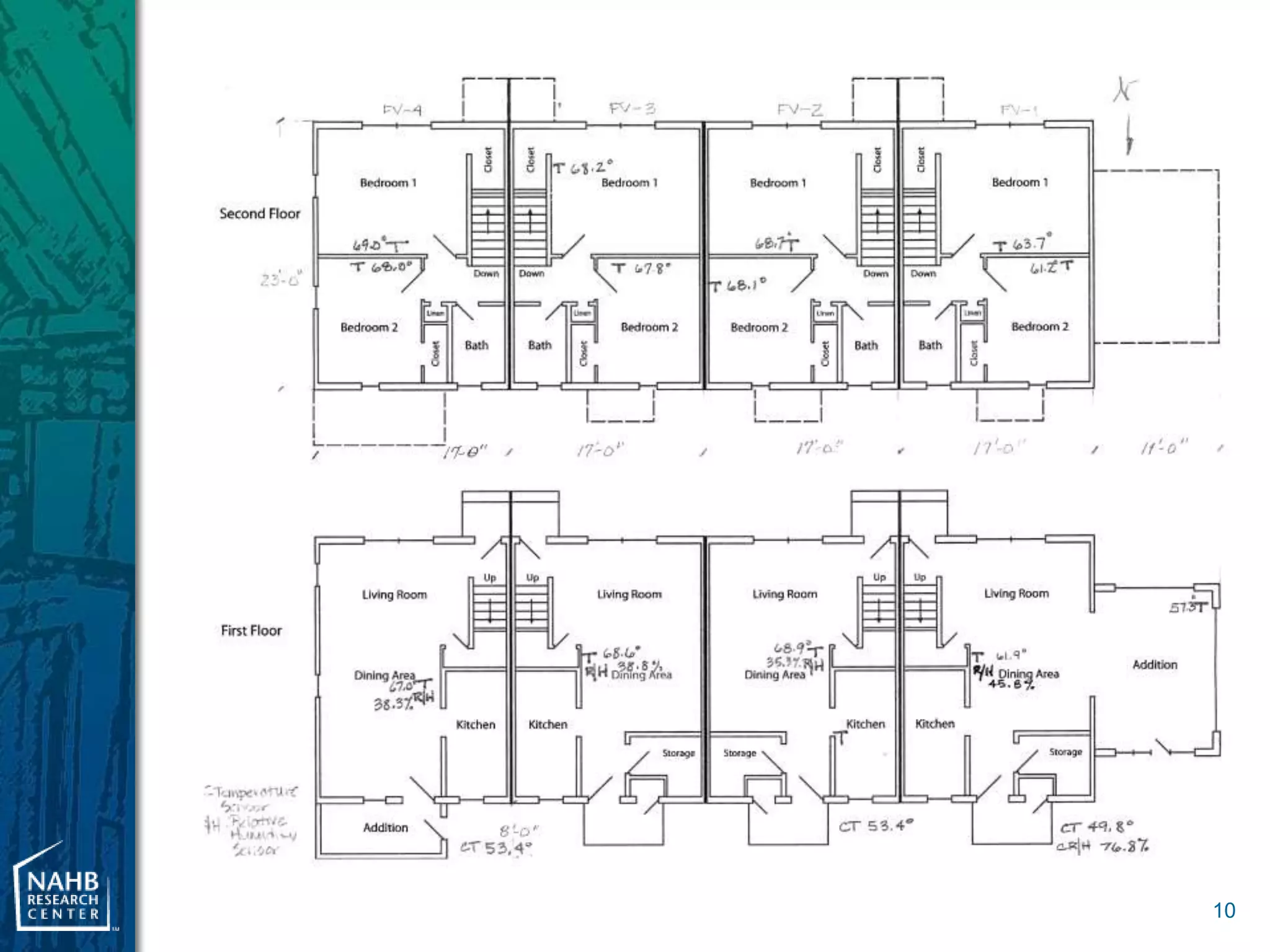
  • #10 Recording house and window dimensions (including additions),Determining insulation levels in the walls, ceilings, and foundations,Documenting equipment and appliance models,Noting locations of baseboard heaters,Calculating capacity of heating and cooling equipmentDetermining the hot water system configuration
  • #12 The Research Center performed short-term testing in conjunction with the walk-through evaluations. This testing included performing a blower door test for each unit (hot water temperatures and fixture flow rates were also measured). Multi-point house depressurization measurements provided total air leakage (which would include leakage to adjacent units) and leakage to the outdoors. Leakage to outdoors was determined by simultaneously running blower doors in adjacent units. Significant air leakage was consistently noticed at the attic access panels, around through-wall and through-window air conditioners, doors, mail slots, and windows, particularly the windows that were unlatched due to malfunction. Frame houses all had significant leakage through the floor at electrical and plumbing penetrations, particularly at the water heater closet. A duct blaster test was performed on the one unit with a ducted system. The air flow of the bath exhaust fans was measured using a flow hood. The actual air leakage measurements were used in simulation models for specific units.
  • #13 Plus visual inspection & utility bills
  • #15 Energy Simulation Optimization
  • #16 Energy Simulation Optimization
  • #19 Features that are not directly responsible for increased energy efficiency were added to the estimated cost analysis to enhance building durability and/or indoor air quality. These are: Mechanical ventilation and controls to provide point source and whole house air exchange; andRemediate crawlspaces to improve insulation performance and indoor air quality through minimizing moisture entrance to the home through the crawlspace
  • #21  While it is admittedly tidy and perhaps overly-simplistic, the majority of the building envelope improvements recommended have been assigned useful life spans of 30 years. The life span coincides with the estimated life of the assumed mortgage (if used to purchase the upgrades). GHI reserve estimates have placed various life spans from 35 to 40 years (vinyl siding on smaller frame homes and windows) to 85 years (exterior doors) on these building elements. Because they are each integral components of the building system, replacement should be planned to occur at the same time to protect the integrity of the buildings. For internal reporting and reserve calculations, the useful lives can be adapted to reflect the experience of GHI and warranty periods offered by the manufacturers whose products are selected for the pilot study.
  • #22 Exterior Wall Insulation2” thickness (extruded polystyrene, XPS, or polyisocyanurate) or 3” expanded polystyrene or polyisocyanurate materialThe masonry block and masonry brick frame crawlspace foundations extend continuously around the buildings encompassing the front and rear porch slabs, as well as the conditioned spaces. Where these do not have an addition (conditioned space) above, two inches of closed cell SPF, R-12, should be applied to the bottom of the slab, accessible from the crawlspace. Unconditioned porch slabs average roughly 400 square feet per building.
  • #23 Attic insulation currently is about R-16
  • #24 For this building type, it is recommended that the existing siding be removed and a weather resistant barrier (WRB) is installed over the wood sheathing and sealed. One inch thickness of rigid foam, R-5 to R-7, installed beneath the horizontal vinyl siding that is scheduled for replacement between 2015 and 2023, is also recommended to compensate for the blown-in cavity insulation which may have settled in the wall. The WRB or the foam should be installed and taped to provide an air barrier over the exterior sheathing which consists of 1”x6”/1”x8” boards.
  • #29 Integrating needs & values