Model Meta-Information

                       Dagmar Waltemath

                          Workshop on
              Ontology in Modeling and Simulation
                      of Neuronal Systems


                   Rostock, 26th of May, 2010

Dagmar Waltemath                          Rostock, 2010
Part 1: Meta-Information and annotations


Dagmar Waltemath                   Rostock, 2010
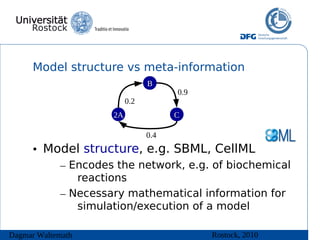
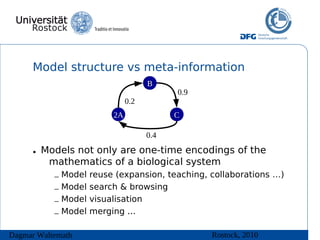
Model structure vs meta-information
                                B
                                      0.9
                          0.2
                     2A               C

                                0.4
      • Model structure, e.g. SBML, CellML
            – Encodes the network, e.g. of biochemical
               reactions
            – Necessary mathematical information for
               simulation/execution of a model

Dagmar Waltemath                            Rostock, 2010
Model structure vs meta-information
                                       B
                                             0.9
                                 0.2
                            2A               C

                                       0.4

      • Models not only are one-time encodings of the
         mathematics of a biological system
           –   Model   reuse (expansion, teaching, collaborations …)
           –   Model   search & browsing
           –   Model   visualisation
           –   Model   merging ...

Dagmar Waltemath                                   Rostock, 2010
Model structure vs meta-information
                                          B
         [SBO]                                  0.9                [Uniprot]
    Protein complex                 0.2                           Tetracycline
                                                      [UniProt]    repressor
                    [GO]       2A               C      Lactose       protein
                 translation                           Operon
                   process                0.4         Repressor

      • Model meta-information helps “understanding” the
         model
            – MIRIAM (Minimum Information Requested in the
               Annotation of Models)
            – Use of controlled annotation, particularly ontologies,
               including Gene Ontology, Systems Biology Ontology,
               UniProt, CheBi ...

Dagmar Waltemath                                         Rostock, 2010
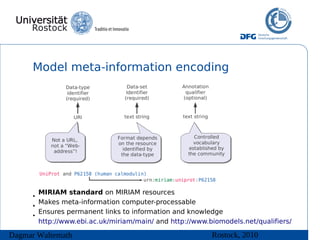
Model meta-information encoding


        MIRIAM standard on MIRIAM resources
      •
        Makes meta-information computer-processable
      •
        Ensures permanent links to information and knowledge
      •
        http://www.ebi.ac.uk/miriam/main/ and http://www.biomodels.net/qualifiers/

Dagmar Waltemath                                          Rostock, 2010
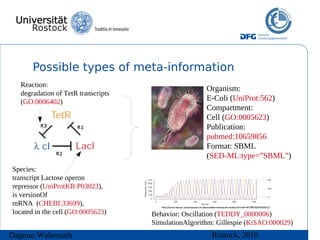
Possible types of meta-information
  Reaction:
                                                     Organism:
  degradation of TetR transcripts
  (GO:0006402)                                       E-Coli (UniProt:562)
                                                     Compartment:
                                                     Cell (GO:0005623)
                                                     Publication:
                                                     pubmed:10659856
                                                     Format: SBML
                                                     (SED-ML:type=”SBML”)
Species:
transcript Lactose operon
repressor (UniProtKB:P03023),
is versionOf
mRNA (CHEBI:33699),
located in the cell (GO:0005623)    Behavior: Oscillation (TEDDY_0000006)
                                    SimulationAlgorithm: Gillespie (KiSAO:000029)
Dagmar Waltemath                                       Rostock, 2010
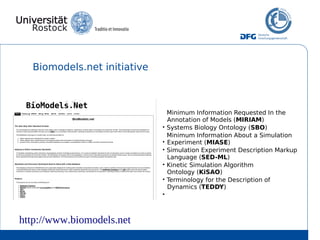
Biomodels.net initiative


                                 Minimum Information Requested In the
                                 Annotation of Models (MIRIAM)
                             •   Systems Biology Ontology (SBO)
                                 Minimum Information About a Simulation
                             •   Experiment (MIASE)
                             •   Simulation Experiment Description Markup
                                 Language (SED-ML)
                             •   Kinetic Simulation Algorithm
                                 Ontology (KiSAO)
                             •   Terminology for the Description of
                                 Dynamics (TEDDY)
                             •


http://www.biomodels.net
Summary

      • Use cases and software for model annotation
          → follow-up presentation Ron Henkel
      • Further information on model meta-information
          – Metadata For Systems Biology, Juty (2009)
             http://videolectures.net/mlsb09_juty_mfsb/

          – Minimum information requested in the annotation of biochemical
             models (MIRIAM), Le Novère, Finney, Hucka et al. , Nature (2006)
             http://www.nature.com/nbt/journal/v23/n12/abs/nbt1156.html


Dagmar Waltemath                                             Rostock, 2010
Part 2: Simulation experiment descriptions


Dagmar Waltemath                    Rostock, 2010
Part 2: Simulation experiment descriptions


        SED-ML: A format proposal for the
            storage and exchange of
             simulation experiments

       (as one particular type of meta-information)

Dagmar Waltemath                     Rostock, 2010
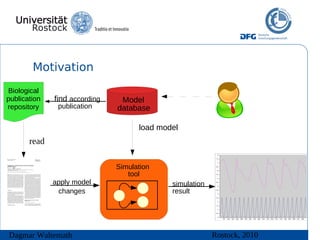
Motivation
Biological
publication   find according    Model
repository     publication     database

                                     load model
       read

                               Simulation
                                  tool
              apply model                    simulation
               changes                       result


Dagmar Waltemath                                          Rostock, 2010
SED-ML

      • Simulation Experiment Description Markup
          Language
            – Community project since 2007
            – XML Format / XML Schema / UML Object model
            – Main parts:
                   •   Pre-processing
                   •   Model references
                   •   Simulation settings
                   •   Post-processing


Dagmar Waltemath                             Rostock, 2010
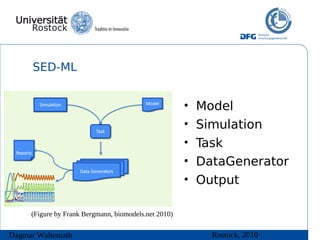
SED-ML


                                                      •   Model
                                                      •   Simulation
                                                      •   Task
                                                      •   DataGenerator
                                                      •   Output

     (Figure by Frank Bergmann, biomodels.net 2010)


Dagmar Waltemath                                            Rostock, 2010
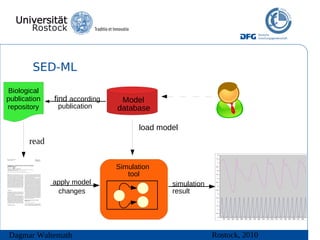
SED-ML
Biological
publication   find according    Model
repository     publication     database

                                     load model
       read

                               Simulation
                                  tool
              apply model                    simulation
               changes                       result


Dagmar Waltemath                                          Rostock, 2010
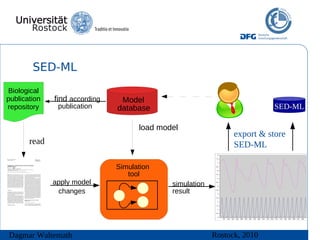
SED-ML
Biological
publication   find according    Model
repository     publication     database                                    SED-ML

                                     load model
                                                                export & store
       read                                                     SED-ML

                               Simulation
                                  tool
              apply model                    simulation
               changes                       result


Dagmar Waltemath                                          Rostock, 2010
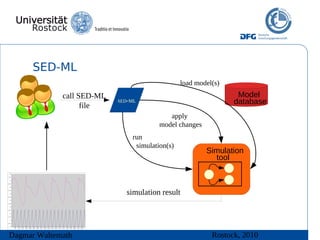
SED-ML
                                                load model(s)
             call SED-ML                                         Model
                   file
                           SED-ML                               database
                                           apply
                                        model changes
                               run
                                simulation(s)
                                                        Simulation
                                                          tool


                             simulation result


Dagmar Waltemath                                          Rostock, 2010
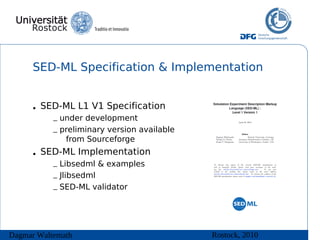
SED-ML Specification & Implementation


      • SED-ML L1 V1 Specification
           – under development
           – preliminary version available
              from Sourceforge
      • SED-ML Implementation
           – Libsedml & examples
           – Jlibsedml
           – SED-ML validator


Dagmar Waltemath                             Rostock, 2010
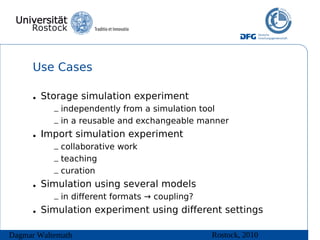
Use Cases

      • Storage simulation experiment
           – independently from a simulation tool
           – in a reusable and exchangeable manner
      • Import simulation experiment
           – collaborative work
           – teaching
           – curation
      • Simulation using several models
           – in different formats → coupling?
      • Simulation experiment using different settings

Dagmar Waltemath                                Rostock, 2010
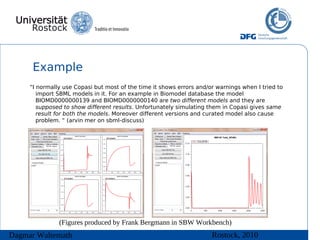
Example
     “I normally use Copasi but most of the time it shows errors and/or warnings when I tried to
        import SBML models in it. For an example in Biomodel database the model
        BIOMD0000000139 and BIOMD0000000140 are two different models and they are
        supposed to show different results. Unfortunately simulating them in Copasi gives same
        result for both the models. Moreover different versions and curated model also cause
        problem. “ (arvin mer on sbml-discuss)


               (Figures produced by Frank Bergmann in SBW Workbench)
Dagmar Waltemath                                                      Rostock, 2010
Summary


      • Community
          –   Nicolas Le Novère (EBI)
          –   Frank Bergmann (SBW Workbench, libsedml)
          –   Richard Adams (SED-ML validator, jlibsedml)
          –   Ion Moraru (Virtual Cell)
          –   …

      • Further Information
          – http://sourceforge.net/projects/sed-ml/
          – http://biomodels.net/sed-ml
      • Getting involved
          – sed-ml-discuss@lists.sourceforge.net


Dagmar Waltemath                                            Rostock, 2010
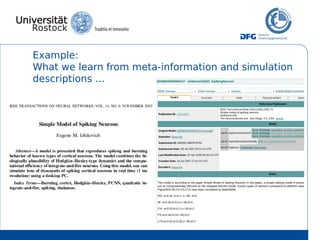
Example:
What we learn from meta-information and simulation
descriptions …
Information in the SBML model

      •   1 compartment
      •   1 standard species
      •   No reactions
      •   8 global quantities (parameters)
      •   2 rate rules
      •   2 events

Dagmar Waltemath                      Rostock, 2010
Information in the model annotation

   Model reference urn:miriam:biomodels.db:BIOMD0000000127
 •
   Publication reference urn:miriam:pubmed:18244602
 •
   Model is on organism mammals urn:miriam:taxonomy:40674
 •
   Compartment is version of a cellular compartment urn:miriam:obo.go:GO
 •
     %3A0005623
   Has a standard species not annotated in the model
 •
   Encodes 2 rate rules: the regulation of membrane potential (variable v)
 •
   urn:miriam:obo.go:GO%3A0042391, the positive regulation of potassium ion
     transport (variable U) urn:miriam:obo.go:GO%3A0043268
   No reactions
 •
   8 global quantities (parameters) not annotated in the SBML model
 •
   Has 2 events: a version of the stabilization of membrane potential (event
 •
     event_0000001) urn:miriam:obo.go:GO%3A0030322, and the detection of
     electrical stimulus (event Stimulus) urn:miriam:obo.go:GO%3A0050981

Dagmar Waltemath                                      Rostock, 2010
Information in the SED-ML file

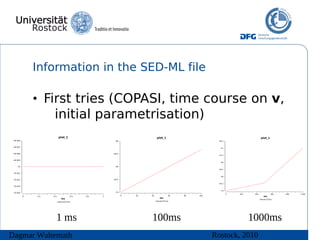
      • First tries (COPASI, time course on v,
          initial parametrisation)


            1 ms          100ms                  1000ms
Dagmar Waltemath                       Rostock, 2010
Information in the SED-ML file

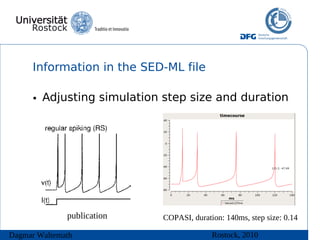
      • Adjusting simulation step size and duration


              publication   COPASI, duration: 140ms, step size: 0.14

Dagmar Waltemath                          Rostock, 2010
Information in the SED-ML file

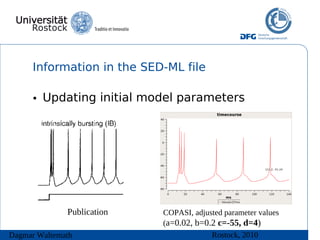
      • Updating initial model parameters


              Publication   COPASI, adjusted parameter values
                            (a=0.02, b=0.2 c=-55, d=4)
Dagmar Waltemath                         Rostock, 2010
Thank you for your attention!


               dagmar.waltemath@uni-rostock.de
              sed-ml-discuss@lists.sourceforge.net

Dagmar Waltemath                        Rostock, 2010

Meta-Information for Bio-Models

  • 1.
    Model Meta-Information Dagmar Waltemath Workshop on Ontology in Modeling and Simulation of Neuronal Systems Rostock, 26th of May, 2010 Dagmar Waltemath Rostock, 2010
  • 2.
    Part 1: Meta-Informationand annotations Dagmar Waltemath Rostock, 2010
  • 3.
    Model structure vsmeta-information B 0.9 0.2 2A C 0.4 • Model structure, e.g. SBML, CellML – Encodes the network, e.g. of biochemical reactions – Necessary mathematical information for simulation/execution of a model Dagmar Waltemath Rostock, 2010
  • 4.
    Model structure vsmeta-information B 0.9 0.2 2A C 0.4 • Models not only are one-time encodings of the mathematics of a biological system – Model reuse (expansion, teaching, collaborations …) – Model search & browsing – Model visualisation – Model merging ... Dagmar Waltemath Rostock, 2010
  • 5.
    Model structure vsmeta-information B [SBO] 0.9 [Uniprot] Protein complex 0.2 Tetracycline [UniProt] repressor [GO] 2A C Lactose protein translation Operon process 0.4 Repressor • Model meta-information helps “understanding” the model – MIRIAM (Minimum Information Requested in the Annotation of Models) – Use of controlled annotation, particularly ontologies, including Gene Ontology, Systems Biology Ontology, UniProt, CheBi ... Dagmar Waltemath Rostock, 2010
  • 6.
    Model meta-information encoding MIRIAM standard on MIRIAM resources • Makes meta-information computer-processable • Ensures permanent links to information and knowledge • http://www.ebi.ac.uk/miriam/main/ and http://www.biomodels.net/qualifiers/ Dagmar Waltemath Rostock, 2010
  • 7.
    Possible types ofmeta-information Reaction: Organism: degradation of TetR transcripts (GO:0006402) E-Coli (UniProt:562) Compartment: Cell (GO:0005623) Publication: pubmed:10659856 Format: SBML (SED-ML:type=”SBML”) Species: transcript Lactose operon repressor (UniProtKB:P03023), is versionOf mRNA (CHEBI:33699), located in the cell (GO:0005623) Behavior: Oscillation (TEDDY_0000006) SimulationAlgorithm: Gillespie (KiSAO:000029) Dagmar Waltemath Rostock, 2010
  • 8.
    Biomodels.net initiative Minimum Information Requested In the Annotation of Models (MIRIAM) • Systems Biology Ontology (SBO) Minimum Information About a Simulation • Experiment (MIASE) • Simulation Experiment Description Markup Language (SED-ML) • Kinetic Simulation Algorithm Ontology (KiSAO) • Terminology for the Description of Dynamics (TEDDY) • http://www.biomodels.net
  • 9.
    Summary • Use cases and software for model annotation → follow-up presentation Ron Henkel • Further information on model meta-information – Metadata For Systems Biology, Juty (2009) http://videolectures.net/mlsb09_juty_mfsb/ – Minimum information requested in the annotation of biochemical models (MIRIAM), Le Novère, Finney, Hucka et al. , Nature (2006) http://www.nature.com/nbt/journal/v23/n12/abs/nbt1156.html Dagmar Waltemath Rostock, 2010
  • 10.
    Part 2: Simulationexperiment descriptions Dagmar Waltemath Rostock, 2010
  • 11.
    Part 2: Simulationexperiment descriptions SED-ML: A format proposal for the storage and exchange of simulation experiments (as one particular type of meta-information) Dagmar Waltemath Rostock, 2010
  • 12.
    Motivation Biological publication find according Model repository publication database load model read Simulation tool apply model simulation changes result Dagmar Waltemath Rostock, 2010
  • 13.
    SED-ML • Simulation Experiment Description Markup Language – Community project since 2007 – XML Format / XML Schema / UML Object model – Main parts: • Pre-processing • Model references • Simulation settings • Post-processing Dagmar Waltemath Rostock, 2010
  • 14.
    SED-ML • Model • Simulation • Task • DataGenerator • Output (Figure by Frank Bergmann, biomodels.net 2010) Dagmar Waltemath Rostock, 2010
  • 15.
    SED-ML Biological publication find according Model repository publication database load model read Simulation tool apply model simulation changes result Dagmar Waltemath Rostock, 2010
  • 16.
    SED-ML Biological publication find according Model repository publication database SED-ML load model export & store read SED-ML Simulation tool apply model simulation changes result Dagmar Waltemath Rostock, 2010
  • 17.
    SED-ML load model(s) call SED-ML Model file SED-ML database apply model changes run simulation(s) Simulation tool simulation result Dagmar Waltemath Rostock, 2010
  • 18.
    SED-ML Specification &Implementation • SED-ML L1 V1 Specification – under development – preliminary version available from Sourceforge • SED-ML Implementation – Libsedml & examples – Jlibsedml – SED-ML validator Dagmar Waltemath Rostock, 2010
  • 19.
    Use Cases • Storage simulation experiment – independently from a simulation tool – in a reusable and exchangeable manner • Import simulation experiment – collaborative work – teaching – curation • Simulation using several models – in different formats → coupling? • Simulation experiment using different settings Dagmar Waltemath Rostock, 2010
  • 20.
    Example “I normally use Copasi but most of the time it shows errors and/or warnings when I tried to import SBML models in it. For an example in Biomodel database the model BIOMD0000000139 and BIOMD0000000140 are two different models and they are supposed to show different results. Unfortunately simulating them in Copasi gives same result for both the models. Moreover different versions and curated model also cause problem. “ (arvin mer on sbml-discuss) (Figures produced by Frank Bergmann in SBW Workbench) Dagmar Waltemath Rostock, 2010
  • 21.
    Summary • Community – Nicolas Le Novère (EBI) – Frank Bergmann (SBW Workbench, libsedml) – Richard Adams (SED-ML validator, jlibsedml) – Ion Moraru (Virtual Cell) – … • Further Information – http://sourceforge.net/projects/sed-ml/ – http://biomodels.net/sed-ml • Getting involved – sed-ml-discuss@lists.sourceforge.net Dagmar Waltemath Rostock, 2010
  • 22.
    Example: What we learnfrom meta-information and simulation descriptions …
  • 23.
    Information in theSBML model • 1 compartment • 1 standard species • No reactions • 8 global quantities (parameters) • 2 rate rules • 2 events Dagmar Waltemath Rostock, 2010
  • 24.
    Information in themodel annotation Model reference urn:miriam:biomodels.db:BIOMD0000000127 • Publication reference urn:miriam:pubmed:18244602 • Model is on organism mammals urn:miriam:taxonomy:40674 • Compartment is version of a cellular compartment urn:miriam:obo.go:GO • %3A0005623 Has a standard species not annotated in the model • Encodes 2 rate rules: the regulation of membrane potential (variable v) • urn:miriam:obo.go:GO%3A0042391, the positive regulation of potassium ion transport (variable U) urn:miriam:obo.go:GO%3A0043268 No reactions • 8 global quantities (parameters) not annotated in the SBML model • Has 2 events: a version of the stabilization of membrane potential (event • event_0000001) urn:miriam:obo.go:GO%3A0030322, and the detection of electrical stimulus (event Stimulus) urn:miriam:obo.go:GO%3A0050981 Dagmar Waltemath Rostock, 2010
  • 25.
    Information in theSED-ML file • First tries (COPASI, time course on v, initial parametrisation) 1 ms 100ms 1000ms Dagmar Waltemath Rostock, 2010
  • 26.
    Information in theSED-ML file • Adjusting simulation step size and duration publication COPASI, duration: 140ms, step size: 0.14 Dagmar Waltemath Rostock, 2010
  • 27.
    Information in theSED-ML file • Updating initial model parameters Publication COPASI, adjusted parameter values (a=0.02, b=0.2 c=-55, d=4) Dagmar Waltemath Rostock, 2010
  • 28.
    Thank you foryour attention! dagmar.waltemath@uni-rostock.de sed-ml-discuss@lists.sourceforge.net Dagmar Waltemath Rostock, 2010