Koronivia Joint Work
on Agriculture
FAO Perspective
Martial Bernoux
Natural Resources Officer
Climate and Environment Division
FAO – CCAFS Global Online Webinar
21 February 2018
FAO Work on Agriculture and Food Security
 Agriculture is particularly vulnerable to the impacts of climate
change and needs to adapt while also representing an important
share of greenhouse gas emissions. Therefore, agriculture and
climate change must be tackled together through a profound
transformation for resilient food and agricultural systems.
 The 2030 Agenda for Sustainable Development and the UN Decade
of Action on Nutrition 2016–2025 call on all countries and
stakeholders to act together to end hunger and prevent all forms
of malnutrition by 2030.
a holistic approach for all agricultural sectors, and their
correlation with food security and other human needs, would
improve the effectiveness of actions undertaken to manage climate
change by addressing intrinsically linked challenges as one
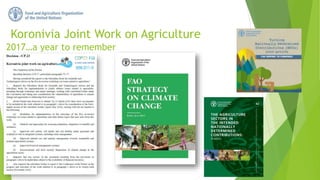
2017…a year to remember
Koronivia Joint Work on Agriculture
a. Implementation of five in-session workshops on
issues related to agriculture
 Importance of knowledge provision and sharing.
 Land-CC Hub – a knowledge platform for climate action
in agricultural sectors.
 Thematic Working Group (TWG) on Agriculture, Food
Security and Land Use, established under the NDC
Partnership.
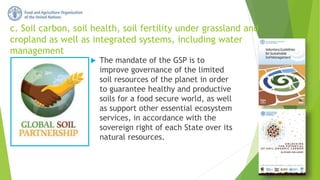
c. Soil carbon, soil health, soil fertility under grassland and
cropland as well as integrated systems, including water
management
 The mandate of the GSP is to
improve governance of the limited
soil resources of the planet in order
to guarantee healthy and productive
soils for a food secure world, as well
as support other essential ecosystem
services, in accordance with the
sovereign right of each State over its
natural resources.
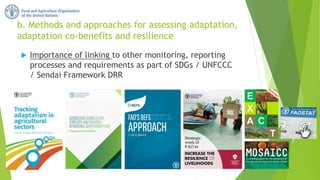
b. Methods and approaches for assessing adaptation,
adaptation co-benefits and resilience
 Importance of linking to other monitoring, reporting
processes and requirements as part of SDGs / UNFCCC
/ Sendai Framework DRR
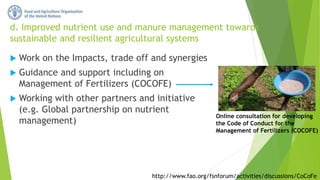
d. Improved nutrient use and manure management towards
sustainable and resilient agricultural systems
 Work on the Impacts, trade off and synergies
 Guidance and support including on
Management of Fertilizers (COCOFE)
 Working with other partners and initiative
(e.g. Global partnership on nutrient
management)
Online consultation for developing
the Code of Conduct for the
Management of Fertilizers (COCOFE)
http://www.fao.org/fsnforum/activities/discussions/CoCoFe
 Importance of link, for example on manure
management / livestock
 Livestock actions and methane (CH4) lifetime
 Productivity improvements that reduce emission
intensities
 Working with other partners and initiative (e.g.
Global partnership on nutrient management)
 Pests and disease
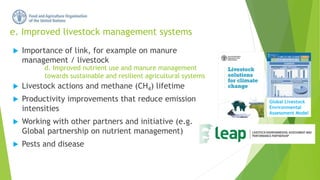
e. Improved livestock management systems
Global Livestock
Environmental
Assessment Model
d. Improved nutrient use and manure management
towards sustainable and resilient agricultural systems
f. Socio-economic and food security dimensions of
climate change in agricultural sector
 Inherent to FAO mandate
 Coordination with other agencies and the CFS
 Need to link Economics & Policy innovations
The way Forward
 FAO will continue to support countries and UNFCCC
processes
 FAO will continue to work with countries to facilitate
access to Climate Finance, including through GEF,
GCF and other funding sources.
Recognition of the specificity of Agriculture
 Agriculture is different than the other
sectors (emissions intensities).
 Landscape approach / holistic dimension
Thank you!
Resources
 FAO Climate Change Portal
 FAO’s work on Climate Change, 2017
 FAO Climate Change Submissions
 FAO and Climate Finance
 Contact: climate-change@fao.org